




Abstract
In computer-mediated communication, users cannot ensure that responsive postings are placed in a directly adjacent position. Yet, paired actions are discernible in which a first pair part (FPP) makes a second pair part (SPP) conditionally relevant. While previous studies of short messaging service (SMS) communication show that users usually send clusters of FPPs and that SPPs are ordered in the same chronology, little is known about sequential practices of dealing with multiple FPPs in text-based WhatsApp communication. This article shows that in German WhatsApp dialogues, users apply a chronological as well as a reversed ordering of SPPs. It is argued that this result can only be partly attributed to the affordances of the mobile messenger. Rather, users arrange SPPs in order to foreground particular topics in extended, chat-like dialogues.
Keywords
Introduction
Smartphones have become an indispensable part of our daily communicative routines (Hepp and Krotz, 2014). We text, we talk, we take pictures and post them in social media platforms. The various mobile apps we use essentially shape the way we communicate: each platform or app provides different functionalities with which communication is enabled, transmitted, structured, displayed and saved. For instance, platforms preconfigure how users can interact with each other (in dyadic or in group chats), which semiotic resources are at their disposal (text, pictures, voice messages) and how their contributions are framed and represented on the mobile device (e.g. with or without time stamps). Their affordances constrain as well as enable modes of communication; however, user communication is far from being determined by a platform’s communicative design (Hutchby, 2001). Within the given interface, users can adapt existing practices to the new technological surroundings, or they can utilize the platform’s semiotic potential to develop innovative practices for their communicative purposes (Herring, 2013). Pointing out differences in the sequential organization of short messaging service (SMS) and WhatsApp messaging, this study argues that their particularities can only be partly attributed to the varying affordances of both communication forms. Rather, users pursue different communicative agendas in SMS and WhatsApp dialogues, which indicate changes in the role mobile messaging plays in the users’ everyday communication.
In a conversation-analytic approach which takes the affordances of mediatized communication into account (in a so-called ‘digital conversation analysis’ Giles et al., 2015) the article compares users’ methods of organizing complex action sequences in SMS and WhatsApp dialogues. Although SMS and WhatsApp text messages can both be conceptualized as mobile messaging or keyboard-to-screen communication (Jucker and Dürscheid, 2012), users have developed varied practices of sequencing their actions. While adjacency pairs (referred to as paired actions in this study; see section ‘From chronology to contiguity’) form one of the most basic sequential formats of both SMS and WhatsApp dialogues (Günthner, 2012; Hutchby and Tanna, 2008; König, 2015a; Laursen, 2005; Spagnolli and Gamberini, 2007), the article argues that different practices of sequentially ordering second pair parts (SPPs) distinguish the one from the other. Based on a collection of German SMS and WhatsApp messages, the analysis focuses on differences in the serialization in ‘packages’ or clusters of first pair parts (FPPs) and SPPs in SMS and WhatsApp text messages (i.e. a series of pair parts (PPs) either posted in one message or in several messages in a row). This comparative approach will trace the development of mobile messaging from a dense and chronological coordination of paired actions in SMS text messages (section ‘Paired actions in SMS dialogues’) to a more chat-like organization in text-based WhatsApp dialogues (section ‘Paired actions in WhatsApp dialogues’).
The ‘Discussion’ section describes factors that can account for the differences in the coordination of paired actions in SMS and WhatsApp text messages. While it is acknowledged that affordances of the communication platform can have a huge impact on message design, the article argues that users have also developed practices which document a change in their conceptualization of what they do with mobile messaging. Such a reflexive approach to the linguistic study of mediatized dialogues, which looks at the interplay of affordances and practices, can help to develop a new understanding of the communicative agenda users pursue in mobile messaging.
Coordinating actions in SMS and WhatsApp messages
Although SMS messaging used to be quite expensive and messages could not be displayed in a continuous thread of postings, SMS have been used for dialogic coordination from early on: users often communicate by formatting their messages in such a way that it makes a response relevant. In conversation analysis (CA), such two-part action sequences connected by conditional relevance are called adjacency pairs, as a first speaker usually stops after the production of the FPP to offer the directly adjacent slot to the second speaker to produce the SPP (Schegloff, 2007; Schegloff and Sacks, 1973). Previous research on SMS shows that texters often send more than one FPP in a single posting (Günthner, 2012; Hutchby and Tanna, 2008; Spagnolli and Gamberini, 2007). Thus, texters are faced with a particular communicative problem when replying to such a ‘sequentially-packed’ posting: ‘[W]hich of these actions should be responded to in a reply, and in what order?’ (Hutchby and Tanna, 2008: 153). Studies for data in British English (Hutchby and Tanna, 2008), Italian (Spagnolli and Gamberini, 2007) and German (Günthner, 2012; König, 2015a) show that in SMS dialogues texters respond to (nearly) all FPPs in the exact same order: Primarily, text messagers show a propensity not just to respond to package-texts with other package-texts, but to reproduce the action structure of the first in the second. This shows a difference with the inverted structure ‘contiguity’ pattern characteristic of conversation [. . .] (Hutchby and Tanna, 2008: 161)
In their analysis, Hutchby and Tanna refer to conversation-analytic studies, which show that in spoken interaction speakers respond to package turns differently: here, the principle of contiguity holds, which treats directly adjacent responses as preferred (Sacks, 1987; Schegloff, 2007). In SMS dialogues, Hutchby and Tanna argue, the reversed or ‘inverted’ ordering of SPPs does not contextualize dispreferred seconds but rather emphasizes the mediatization of dialogues: since the FPPs are represented as asynchronously transmitted texts, they are oriented to as lists which are to be ‘ticked off’ item-by-item (Hutchby and Tanna, 2008: 157).
While there is substantial research on SMS dialogues, little is known about the sequential practices of dealing with multiple FPPs in internet-based mobile messaging. For mobile messengers like WhatsApp the affordances differ substantially: there are no relevant costs or character limits per posting. Moreover, WhatsApp is a multimodal communication platform which offers more communication forms than just dyadic chats (group chats, status information, profile pictures, etc., see Dürscheid and Frick, 2014). It also supplies users with additional semiotic resources ranging from emojis or hyperlinks to voice messages (König and Hector, 2019) and it provides live information about, for example, other users’ online status, their typing activities and the message’s transmission status.
Recent research shows that users adapt their practices to the new communicative framework. On average, WhatsApp text messages are shorter than SMS messages (Dürscheid, 2016). Users prefer to send a series of individual postings – containing one action or action component each 1 – rather than composing extended package-texts (Imo, 2015; König, 2015a; Wyss and Hug, 2016). The following WhatsApp dialogue (Example 1) exemplifies this practice. Sara and Marie try to plan a trip to a music festival.
‘Check Facebook’ (WhatsApp).
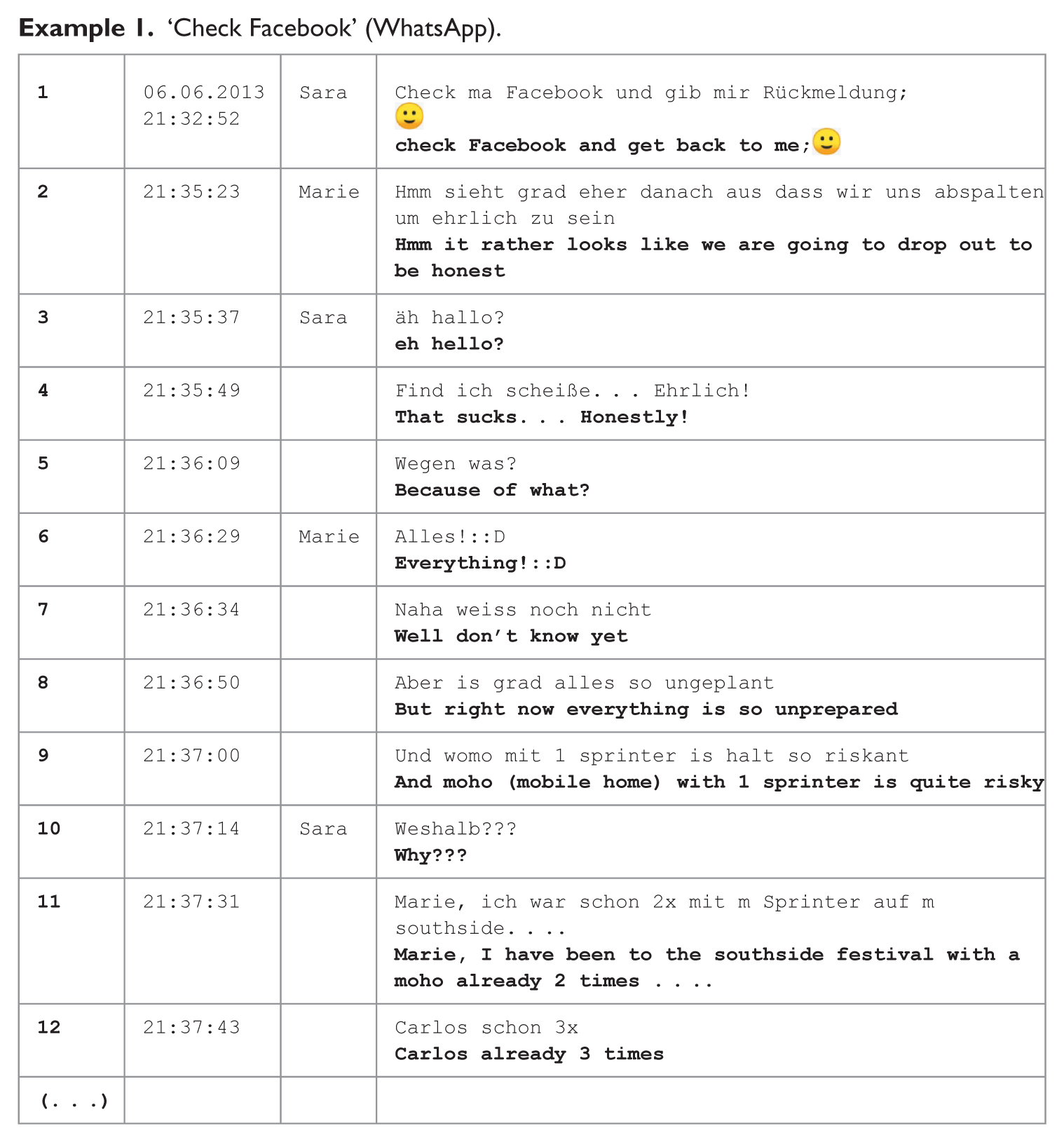
The dialogue begins in a single-posting mode, that is, one posting by Sara is followed by one posting by Marie. Sara then switches to a chunking mode: instead of composing her reply as a single posting – a design characteristic of SMS communication – she sends three individual messages within just a few seconds, expressing her irritation and criticism and asking for reasons for the cancellation. Marie responds with four postings (again within rather short time intervals) to answer Sara’s question and to account for her cancellation. Sara’s response – she asks once again for an explanation and rejects Marie’s doubts as unreasonable – is chunked into several postings again. In a context in which messaging is virtually free of charge, chunking is an effective practice with which WhatsApp users structure longer contributions to the ongoing quasi-synchronous discourse (Imo, 2015; König, 2015a; Wyss and Hug, 2016).
While these studies offer first insights into recent developments in the sequential organization of mobile messaging, the analyses they present are rather decontextualized: little is known about the kinds of actions that are performed in a chunking mode compared with a single-posting mode. A brief survey of WhatsApp dialogues quickly reveals that users do not chunk all their contributions. Moreover, users do not always deal with only one action at a time. They still send multiple FPPs – either as package-texts or chunks in a row – instead of waiting for a response to each PP. Again, users are faced with the communicative problem of having to choose which PP to reply to first. This article investigates how users tackle the communicative problem of dealing with multiple FPPs in SMS and WhatsApp dialogues.
From chronology to contiguity
The study draws on methodological principles of ‘digital conversation analysis’ (Giles et al., 2015). It takes authentic mobile messenger dialogues as its subject matter and investigates the unfolding meaning-making processes between dialogue partners as they are documented in logfile data. Various studies in this field argue that the central conversation-analytic concepts developed for spoken real-time or synchronous interactions can be applied to the analysis of electronically mediated dialogues (Baker Jacobs and Garcia, 2013, for ‘repair’; König, 2015b, for ‘preference’; Simpson, 2013, for ‘floor’). 2 At the same time, they also reflect on the particularities of communication via technical interfaces. While it is generally held in mobile messaging research that postings can be tied by conditional relevance (Günthner, 2011; Hutchby and Tanna, 2008; König, 2015a, 2015b; Laursen, 2005; Spagnolli and Gamberini, 2007), it is also acknowledged that the coordination of PPs works differently. While an FPP can also make an SPP conditionally relevant in SMS or WhatsApp dialogues, the SPP might not be directly adjacent in the sense of temporal immediacy (typing replies might take just a few seconds or several days) or spatial immediacy (the SPP might be the first action in the next posting or other non-related postings might be listed between FPP and SPP, leading to ‘disrupted’ adjacency (Herring, 1999) or ‘virtual’ adjacency (Schönfeldt and Golato, 2003)). 3 Users are usually aware of the fact that their SPPs can be ‘disrupted’ from the FPPs they are responding to and make up for this contingency by making references between postings explicit (e.g. by lexical repetition, Garcia and Baker Jacobs, 1999; Örnberg Berglund, 2009). However, as users cannot ensure that the next posting on the screen protocol will be theirs, the term ‘adjacency’ can be misleading. Thus, in the following the concept of paired action will be used to refer to two-part action sequences by two users which are related by conditional relevance and thus sequentially ordered, that is, a FPP, once it has been posted, makes relevant an SPP within a particular time frame.
This study looks into practices of dealing with multiple FPPs in dyadic SMS and WhatsApp dialogues. It is based on a collection of SMS and WhatsApp messages taken from two different databases. SMS data for the years 2010–2011 were attained from the SMS database (SMS-DB) at the Centrum Sprache und Interaktion. WhatsApp text messages from dyadic chats in 2015–2016 were extracted from the Mobile Communication Database (MoCoDa, for details see http://mocoda.spracheinteraktion.de/). The major part of the data consists of dialogues between North-Rhine Westphalian students in their early and mid-twenties and their friends and family. In general, texters have a flat rate, so there are no relevant costs they have to monitor when sending text messages. From these databases, 100 instances of clusters of at least two FPPs in a row were identified in randomly chosen dialogues (50 for SMS and 50 for WhatsApp dialogues). These instances were then coded for their position within the given dialogue, the relative ordering of the FPPs and SPPs, the kinds of actions that were accomplished, their thematic relation and the mode of contribution (as package-texts or as chunks). Moreover, the number of postings per dialogue and the amount of PPs in each cluster were also identified.
While this collection of SMS and WhatsApp messages cannot be used to determine the overall quantitative distribution of the sequential patterns under study, the qualitative analysis of the conditional relevancies established between FPPs and SPPs and their sequential ordering can point out tendencies in users’ practices. These findings, which take dialogic meaning-making practices as a starting point, can later be used to inform quantitative studies of larger collections or corpora.
Paired actions in SMS dialogues
The analysis of the SMS dialogues in the collection yields a straightforward pattern: all FPP clusters are included in a single sequentially dense posting. This also holds true for the follow-up postings: users do not chunk their responses but rather include all SPPs in one posting as well. While this confirms earlier findings for English (Hutchby and Tanna, 2008), Italian (Spagnolli and Gamberini, 2007) and German text messages (Günthner, 2011), more observations can be made concerning the relative ordering of PPs. Example 2, a dialogue between two 23-year-old students, illustrates this.
‘Despair’ (SMS).
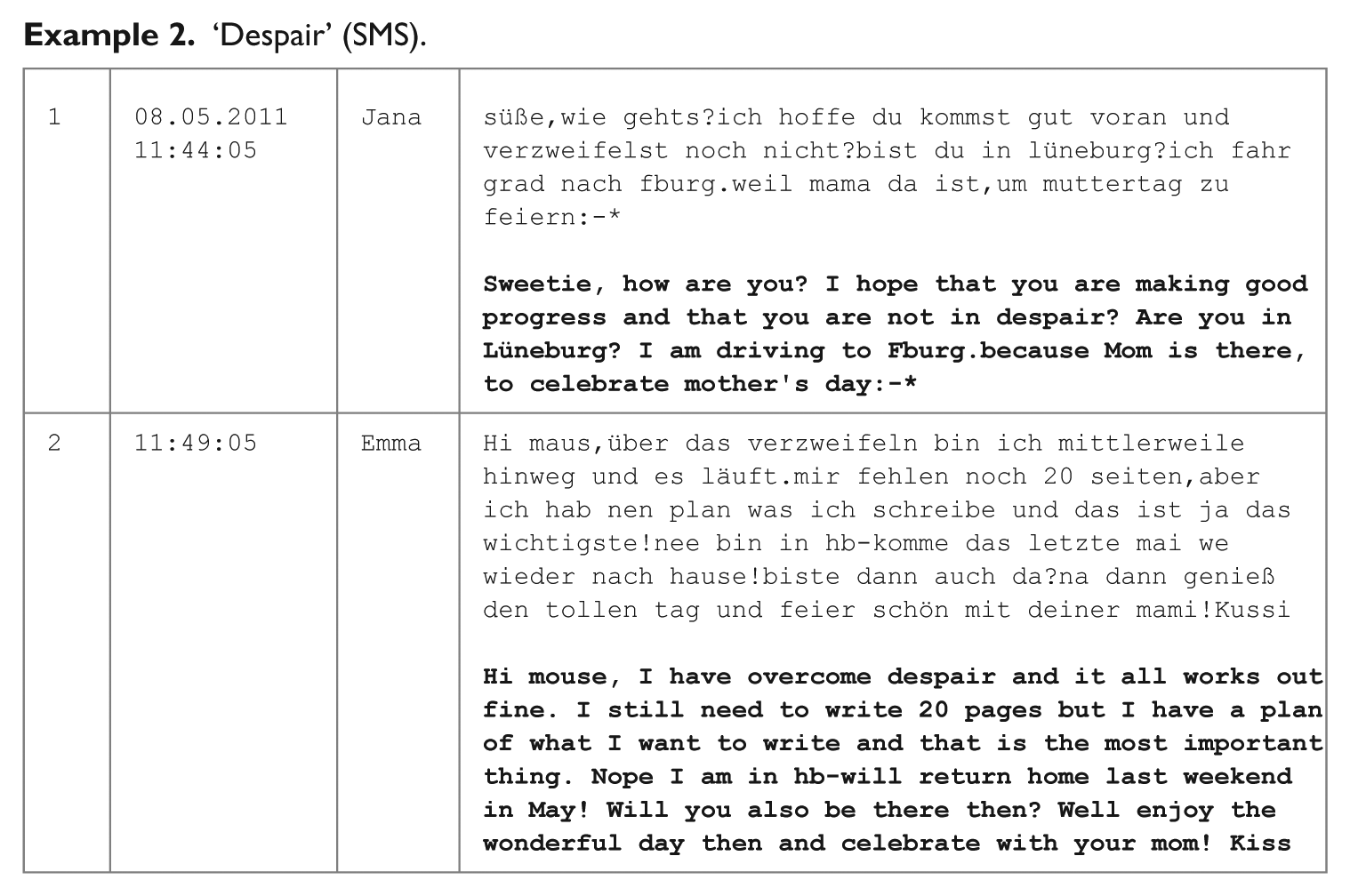
The initial posting contains seven FPPs (including initial and final greetings) which cover quite diverse topics dealing with the current activities both users pursue (status of a paper, whereabouts of both texters). While punctuation is used to mark off sentences and sometimes also clauses, Jana does not apply a particular practice like, for example, a line break to separate the FPPs from one another. In fact, she even links two adjoining sentences by omitting the spacing. So, not only is the first posting sequentially packed, it is also composed as a typographically dense unit.
The same applies for the responsive posting #2. Emma arranges her SPPs in chronological order, that is, she orients to the original order of FPPs in #1. Note, however, that this sequential serialization also extends to new FPPs which relate to one of the foregoing FPPs (in this case: the follow-up question about Jana’s whereabouts in May). The new FPPs are added at the first position after the thematically linked SPP rather than at the end of the posting. This is especially striking, as this technique also pre-empts the dialogue partner from replying in a contiguous slot. So, responsive postings are not only arranged chronologically but also in a thematically coherent order (as thematic blocks).
Also note that Emma does not respond to all the FPPs, a practice which is also observable in Spagnolli and Gamberini’s (2007) data. This is due to the close relationship between the questions about Emma’s well-being and the progression of her paper and Jana’s announcement of and her account for her trip to visit her mom’s. By responding to the latter FPPs, Emma implicitly responds to the former at the same time. This also indicates that users orient to thematic blocks of FPPs rather than to each individual FPP. So, the relative order of SPPs in the responsive posting does contextualize (dis)preference but is rather a way to organize the complex posting into thematically coherent units.
Although message #2 establishes new conditional relevancies, the dialogue as it is represented in the database ends with this text. This reflects the general tendency of SMS dialogues in the collection: they are rather short (see also Spagnolli and Gamberini, 2007). Although text message exchanges can in principle be extended over several postings, SMS dialogues containing clusters of FPPs are usually short. In the given collection, there are 3.3 postings on average per dialogue. This also accounts for the fact that 43 of the 50 clusters of FPPs are posted right at the beginning of a dialogue. As dense packages they contain 4.3 FPPs on average. A chronological ordering of SPPs in thematic blocks (a design which is chosen in 41 of the 50 instances in the collection) enables the dialogue partner to clearly identify the FPP they refer to.
Also, the overall design of these dense messages does not make an extended dialogue expectable: while messages #1 and #2 are clearly linked by conditional relevance, the ‘ritual bracket’ (Goffman, 1974) of an initial greeting/addressing and a final greeting used in both messages formats them as rather separate and closed off contributions (Günthner, 2011: 12). All in all, SMS messages with clusters of FPPs are not designed for ongoing chat-like activities with an incremental or step-by-step development of topics (as illustrated in Example 1).
However, users can turn such an exchange of ‘separate’ package-texts into an extended and more dynamic dialogue. They do this not only by adding more postings but also by adapting the composition of their contributions. Similar to Example 2, Example 3 starts with two messages in the same sequentially dense pattern, but the texters bring about a different ordering of PPs beginning with message #3.
‘The Pictures’ (SMS).
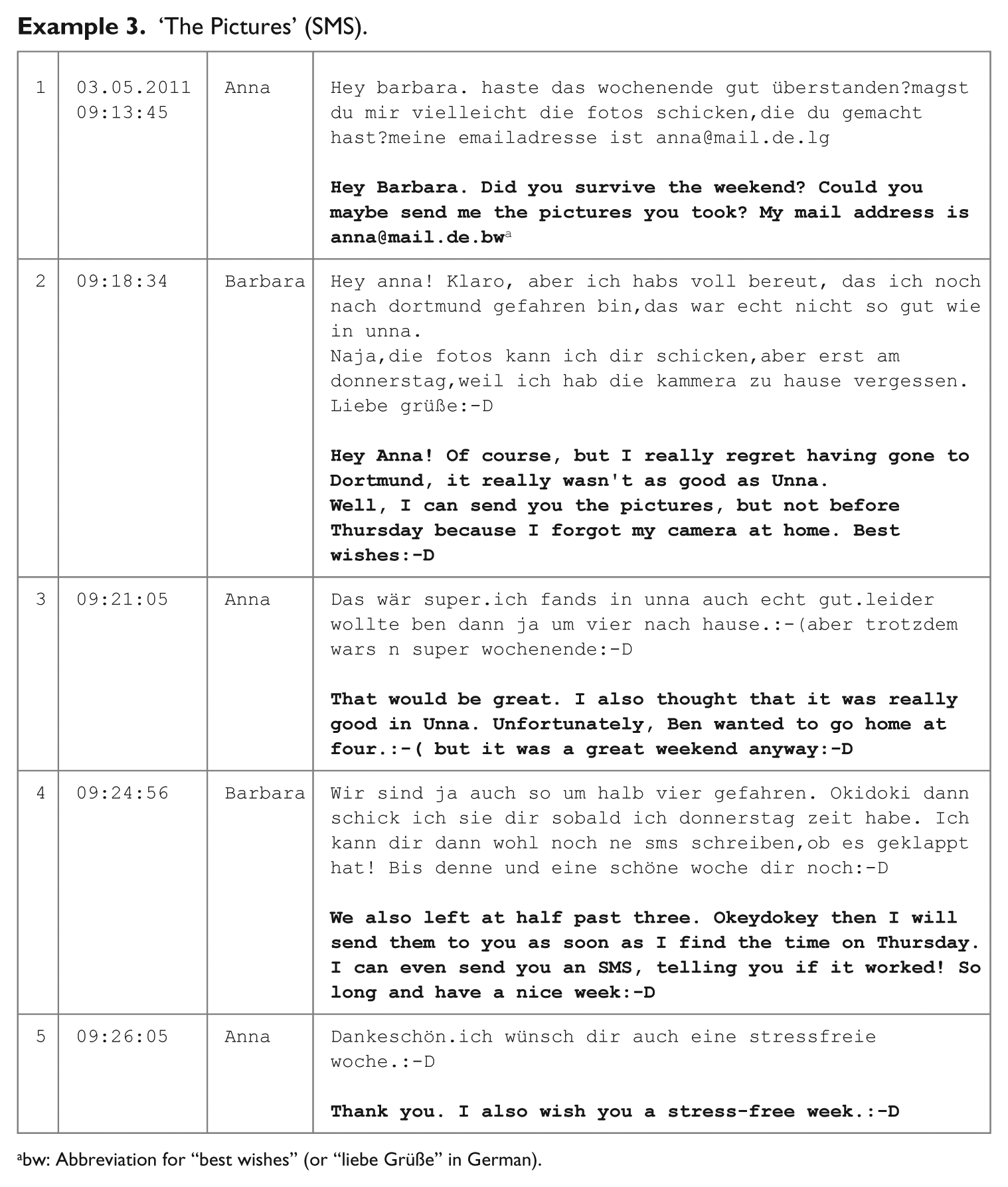
bw: Abbreviation for “best wishes” (or “liebe Grüße” in German).
Message #1 instantiates a sequentially dense package of multiple FPPs in a single posting; the dialogue partner’s SPPs are chronologically ordered in a single posting in message #2 and both text messages are surrounded by a ritual bracket. 4 In her third posting Anna orders her reply differently: she does not start her message with a greeting. Although the final emoticon might function as a closure signal, she no longer separates her posting with a full ritual bracket. This already contextualizes a more ‘dialogical’ or chat-like mode (Günthner, 2011: 12). What is more, both Anna and Barbara change from a chronological to a contiguous ordering of PPs in their replies: in #3 Anna first includes a reaction to Barbara’s compliance with her request (which can be interpreted as a sequence-closing third or as an acceptance of Barbara’s suggestion to send the photos on Thursday), before she then goes back to assessing their meeting in Unna and telling about further weekend activities. In #4 Barbara likewise responds contiguously to the last component in Anna’s message #3 (reacting to Anna’s telling that they had to leave early) before she comes back to the issue of sending her photographs. She also designs her posting without a full ritual bracket, but ends it with final greetings and wishes. So, Anna and Barbara still work through both topics (weekend and photos) in package-texts, but they switch to a contiguous ordering of PPs.
This contiguity pattern is usually found at the third posting position in SMS dialogues, that is, after dialogue partners have already exchanged at least two messages with more than one PP each. With only six instances of this change between a chronological ordering of SPPs and a contiguous ordering in the third or following posting, this practice does not constitute a frequent pattern in the collection; yet, these instances can be seen as precursors of the ways in which WhatsApp users deal with clusters of FPPs, which will be analysed in the following section.
Paired actions in WhatsApp dialogues
In the given collection, WhatsApp dialogues containing clusters of FPPs tend to be longer than SMS exchanges: they have a mean length of 14.2 messages per dialogue. Multiple FPPs can either come in package-texts like in SMS (25/50) or they can be chunked so that each PP is posted in a single message (25/50). Moreover, different practices of responding to these multiple relevancies are discernible. In Example 4, two friends text about their latest achievements in the augmented reality game ‘Pokémon Go’.
‘Pokémon Go’ (WhatsApp).
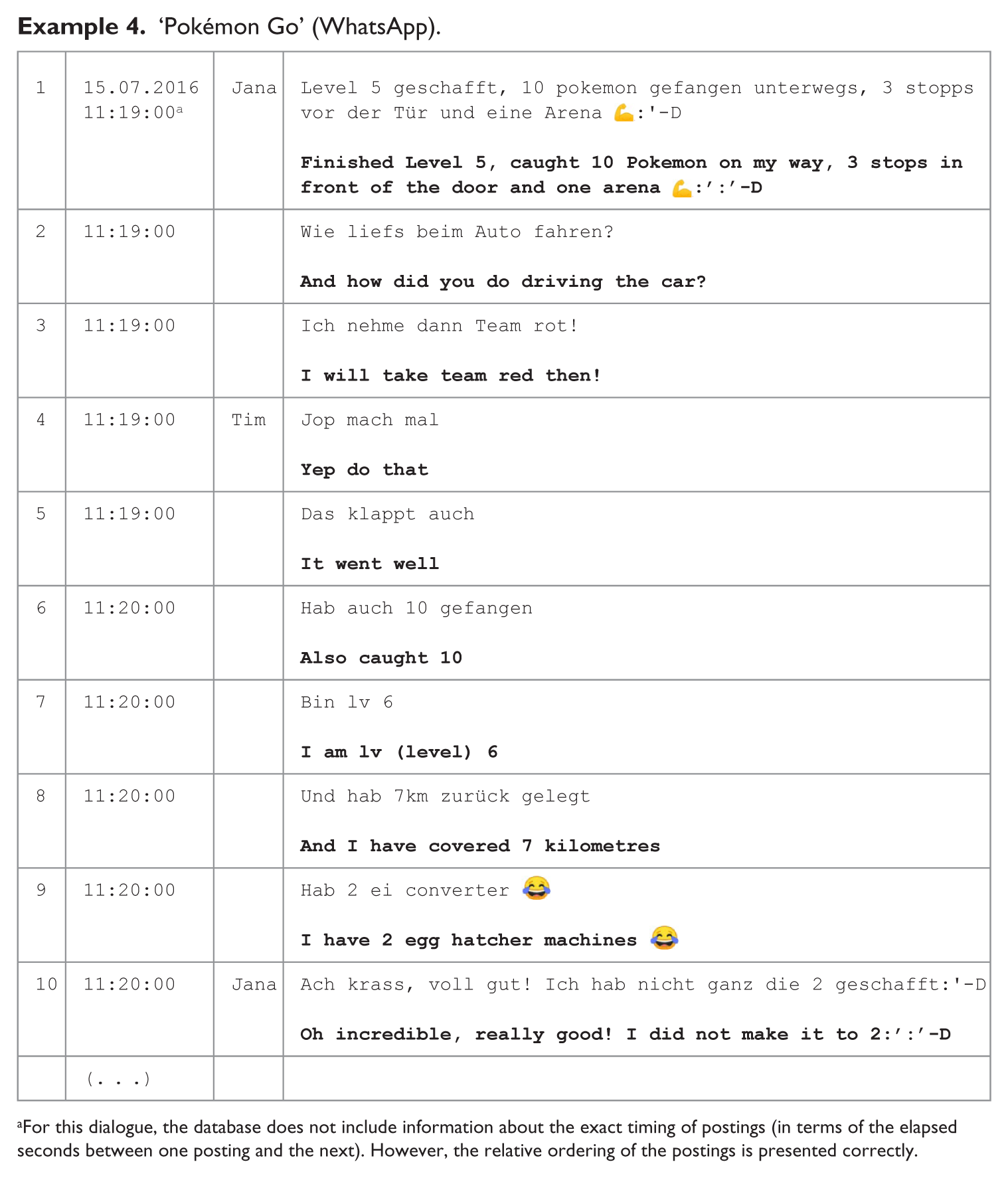
For this dialogue, the database does not include information about the exact timing of postings (in terms of the elapsed seconds between one posting and the next). However, the relative ordering of the postings is presented correctly.
In this dialogue the initial cluster of FPPs as well as the subsequent SPPs are given in a chunking mode. While Jana uses one message for each FPP (summarizing the list of her achievements in one posting), Tim even takes this strategy further in that he first responds in one posting per SPP and then splits the list of his achievements into four separate postings. Responses to clusters of FPPs are chunked in 27 of the 50 instances in the collection, yet there is no one-to-one relation between chunked FPPs and chunked SPPs.
What is striking here is that Tim inverts the order of Jana’s FPPs in his responsive messages: he first responds to her last remark about the team she chose (#4) and then moves on to comment on taking the car (#5) before he finally gives an overview of his achievements (#6–9). Had his responses been ordered chronologically, it could have been plausible that Tim started typing shortly after having read Jana’s first posting – given the rather short time he takes to respond. But in the actual sequential order it is clear that he must have read message #3 before sending off his first response #4. 5 In the given collection, texters use this contiguity pattern of dealing with the last FPPs first in half of the 50 instances studied. This means that WhatsApp texters have not changed their practices entirely, but there is a substantial difference to the rather stable sequential pattern found in SMS dialogues.
This raises the question of why texters now deploy two strategies of dealing with multiple FPPs in WhatsApp dialogues. In the given example, the contiguous ordering of SPPs has the advantage that it assures that at least the first SPP can be easily related to its FPP – preventing a possible disrupted adjacency should Jana continue to contribute more postings. Moreover, Tim can deal with the second and third FPPs rather quickly before he then composes a more detailed and elaborate response to the first FPP, the player’s achievements. This then also sets the topic for the following discourse (#10).
What is also striking in the data is that in WhatsApp dialogues, FPP clusters only contain 2.2 FPPs on average; moreover, they are often positioned in later slots in the dialogue. Only in 21 instances are they positioned in the first posting of the dialogue, like in Example 4. Example 5 illustrates a context in which FPP clusters are introduced in a post-first slot.
‘Alex’ (WhatsApp).
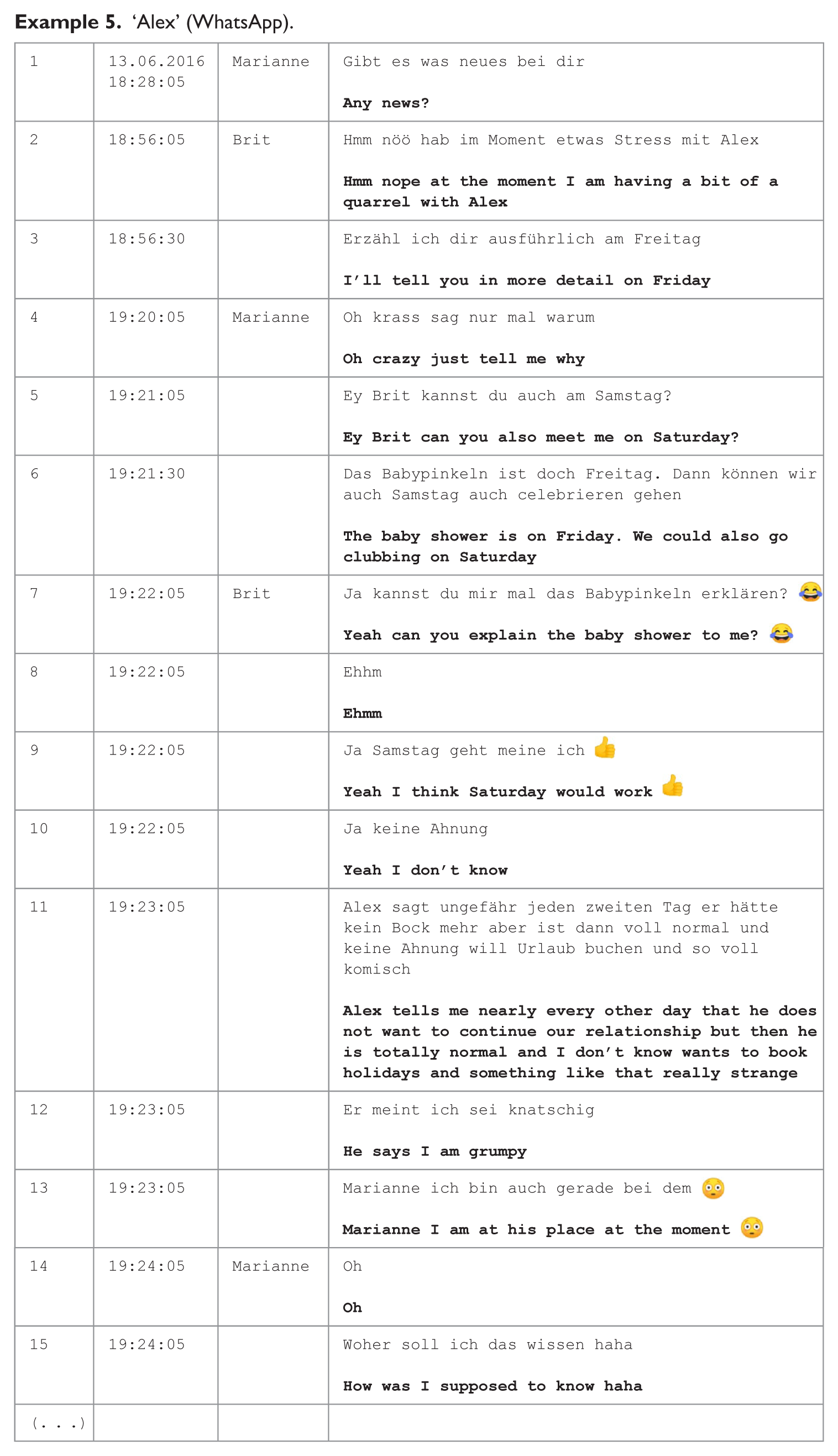
After asking about the reason for Brit’s and Alex’ quarrel (#4), followed by her request to postpone their next meeting, Marianne appends another FPP (#5) which she accounts for in #6. This chunked FPP cluster is produced in a context in which the dialogue as such has already been established. Also note that Marianne’s second FPP is set off by the interjection ‘ey’ and the direct address to Brit as sequentially dislocated.
In her response, Brit first orients to the latter message before she accepts Marianne’s request. She then returns to the initial topic of her quarrel with Alex and projects a next posting dealing with a troublesome subject in #10. Posting #13 not only informs Brit about Marianne’s whereabouts but also contextualizes that she cannot write extensively about her problems. 6 Marianne takes up this thread in her next posting; she does not, however, respond to Brit’s question in #7. This way, both users treat the re-negotiation of the meeting’s date as a side sequence which only shortly diverts them from the main topic of the dialogue. Again, the contiguous mode of dealing with FPP clusters is used to steer the thematic development of the ongoing exchange towards just one topic. It is used as a practice to contextualize the contiguously attended to FPPs as rather unimportant background matters.
So, if the contiguous ordering of SPPs is used for managing the topic development of the dialogue, it still needs to be determined what users do when they deploy the chronological order of SPP. In Example 6 taken from a dialogue between a daughter who studies in London (Ulli) and her mother (Silke), the multiple SPPs follow the original chronology of the FPPs.
‘England’ (WhatsApp).
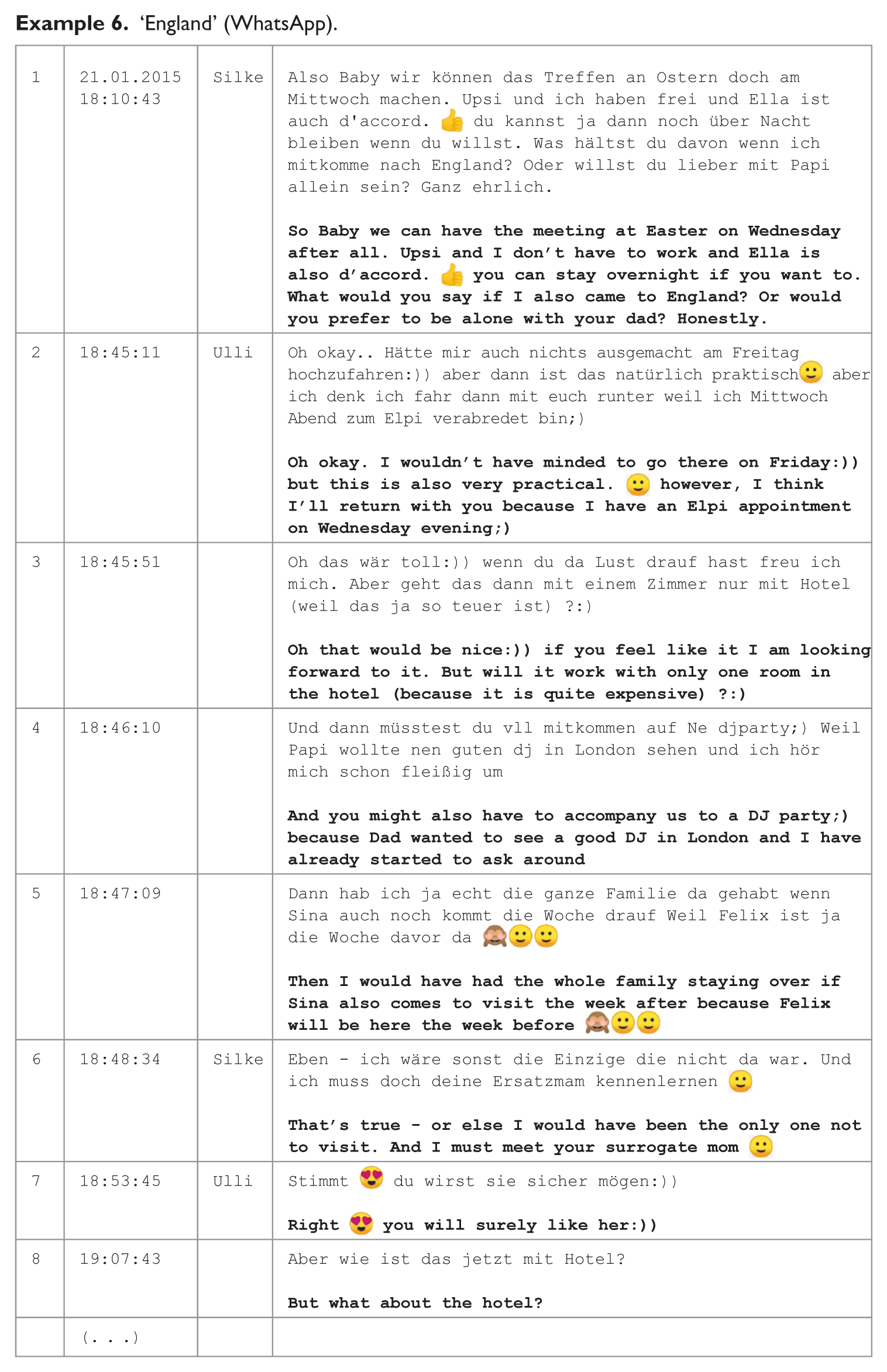
Silke starts two topics (organizing Easter and discussing possible plans to travel to London) with a cluster of multiple FPPs, which Ulli takes up in the same order. In her first responsive posting (#2), she groups the SPPs related to the first topic – acknowledging the change in plans for Easter and outlining her preferences. In a separate posting (#3) she then expresses joy over her mother’s suggestion to come to London (responding to Silke’s first question in #1) before she poses a follow-up question about accommodation options. In #4 she continues to elaborate on the topic of visiting London by telling Silke about the plans she has already made with her father. She thus responds to Silke’s second question concerning her plans to come to London. The next posting #5 gives a rather general comment about all of her family visiting her in London, adding another aspect to the topic at hand. So, postings #3–5 all refer to the same topic and thus foreground it. Indeed, in messages #6–#8 both texters continue their dialogue about Silke’s plans to go to London.
This exemplifies that a chronological ordering of SPPs can also be used to deal with those topics more extensively that come in the last position. So, rather than developing a conversation-like preference for contiguity in WhatsApp dialogues, texters use the sequential ordering of multiple SPPs as a resource for topic management in an ongoing chat-like dialogue. The topics users orient to first in their responsive postings are framed as concerns which can be clarified and settled rather quickly and which do not require additional elaboration. The topics users orient to afterwards are contextualized as subjects which might need a more extensive treatment and which set the agenda for the following chat.
Discussion
This study started from the premise that practices of message design such as chunking should not be analysed in a decontextualized manner. Rather, studies should pursue a digital CA approach and conduct a sequential analysis that takes the conditional relevancies as well as the temporal development of the unfolding dialogues into account in order to determine what users do when they use different sequential designs. The comparative analysis focused on a particular sequential context, namely clusters of FPPs and their subsequent uptake in SMS and in WhatsApp dialogues. The findings not only confirm that WhatsApp users now also chunk multiple FPPs, but also that they often change the order in which they deal with the FPPs. In the 50 instances of FPP clusters, it was just as common to present the SPPs in the chronological order of the FPPs as it was to reverse this order, so that the first SPP was contiguous to the immediately preceding FPP. The following paragraphs will discuss possible factors that might account for this reversal.
While the varying technological affordances might have led to chunking as a strategy for organizing one’s contributions (see section ‘Coordinating actions in SMS and WhatsApp messages’), they alone cannot account for the reversed chronology evident in half of the SPP clusters analysed here. Mobile phones have been able to display texts as dialogic threads in 2011, which rules out the display mode as a relevant explanation. Moreover, nearly all of the SMS texters in the collection had a flat rate option, which rules out the reduction of costs as the main influence for this practice. So, if these factors indeed had an effect, then this phenomenon should have been documented in the SMS collection.
Also, no clear-cut correlation between formatting the FPPs and the SPPs can be made out in the collection. Chunking the FPP does not trigger a contiguous first response, nor does it lead to a chronological resolution of the conditional relevancies. Furthermore, there is no clear pattern for FPP package-texts – which can still be found in WhatsApp despite the general tendency for chunking – to call for a chronology of SPPs. Both chronological and reversed-order SPPs can be found in chunks and in package-texts.
If it is not the formatting of the FPPs or SPPs, then maybe the rapid temporal unfolding of the dialogue influences the choice for the sequential ordering of SPPs. By replying contiguously, users might take the floor in order to project upcoming replies to the other FPPs. Users could, however, also take the floor by working chronologically through the FPPs. In the examples presented here, users responded in rather short time intervals. Some users even seem to have been looking at the screen at the same time – just like in web chats (Beißwenger, 2008). So, users might feel a pressure to react as quickly as possible. Yet, with the reversed order of SPPs they actually do the opposite: instead of sending the SPP to the first FPP in the first possible slot, they rather start with the last SPP. Moreover, there are also contiguous SPPs in contexts with larger time intervals between the individual contributions.
What this shows is that a perspective which only looks at technological affordances or the formats used in the sequential surrounding of the FPP clusters does not offer a straightforward solution to the question of why in WhatsApp dialogues users now also attend to multiple FPPs in a reversed order. Rather, the interpretation of these results calls for a qualitative approach which analyses what it is that users do, which communicative agenda they pursue and which actions they accomplish when they engage in SMS and WhatsApp dialogues. This approach can in turn lead to a refined understanding of how users conceptualize messenger-based communication.
It is apparent that users design WhatsApp dialogues in a more chat-like manner than SMS dialogues. While FPP clusters in WhatsApp dialogues only consist of two FPPs on average, SMS package-texts can include up to seven FPPs in one message alone. Also, WhatsApp users often first establish a general availability of the dialogue partner before they engage in a longer exchange of messages (see König, 2015a). In contrast, SMS dialogues with FPP clusters are rather short and often do not encompass more than three messages. This indicates that SMS texters use FPP clusters in different communicative contexts: SMS texts are designed for short, compacted and rather monologic exchanges which settle many issues in just one go.
In contrast, the sequential design of WhatsApp messages documents the users’ expectation of a more extended and continuous digital encounter. WhatsApp postings are formatted as parts of an ongoing discourse with a rather emergent development of topics. 7 Users work towards settling on a single topic at a time. A contiguous SPP can frame the issue at hand as a rather unimportant background topic which can be dealt with quickly in a side sequence. Users can then elaborate on the topics referred to in the last position and thus foreground them. Chronologically ordered SPPs can be applied to the same end: here it is also the last SPP which sets the topic for the following discourse. So, instead of assuming that WhatsApp users are on the way to developing a general preference for contiguity, the sequential analysis of multiple FPPs and their subsequent uptake indicates that placements of SPPs is a practice for topic management in ongoing dialogues.
Conclusion
The affordances of the mobile phone and the messaging apps clearly predefine the choice of semiotic resources, message production and the temporal and spatial sequencing of postings. While this framework facilitates certain modes of contribution (such as chunking), it cannot fully determine the practices texters use to organize and coordinate their actions in SMS and WhatsApp dialogues. This article has argued that the rise in SPP clusters in reversed chronology cannot straightforwardly be explained as the development of a conversation-like preference for contiguity triggered by the messenger’s affordances. Rather, particularities of the sequential organization of SMS and WhatsApp dialogues can be attributed to differences in the communicative agenda users pursue. Users conceptualize chatting via WhatsApp as a potentially expandable activity. They anticipate that their dialogue partners are willing to engage in a longer and more chat-like exchange of messages and thus apply an emergent, step-by-step approach to topic development.
This anticipation might be a result of the ongoing mediatization of users’ everyday lives: people spend an increasing amount of time with smartphone-based activities in general, which makes it more probable that they will read an incoming message immediately. This heightened engagement with the mobile device is also partly driven by the communication platform: as a default setting, pop-up banners display a WhatsApp message at the top of the screen at the moment of its reception. Users can see the first lines of a text message on the lock screen of their phone, which then invites them to open the app directly and look at the chat protocol. Also, seeing that someone else is online can keep dialogue participants oriented to the app or the smartphone for a longer period of time. Previous chats with various dialogue partners and knowledge about their communicative preferences can also inform this presumed agenda for extended dialogues. All this adds to a general anticipation not only of a rather prompt reply but also of a longer or more frequent engagement with the messenger which – in a second step – can then lead to new practices of sequentially organizing WhatsApp dialogues. So, rather than focusing on a decontextualized analysis of chunking, mean length of postings or frequency of emojis, studies in messenger-based communication should start from a qualitative, practice-based approach which looks at the communicative agendas and activities in which these phenomena are embedded. For instance, instead of just focusing on chunking as a new way of designing contributions to a WhatsApp dialogue, studies should also analyse contexts in which texters do not use chunking in order to determine if it works as a contextualization cue for particular actions or activities.
Moreover, sociolinguistic studies could focus on the practices of action coordination which have been developed in different communities. As the data analysed here represent practices used by university students in their twenties (with their friends and families), they only cover a particular group of users. Also, even though these users have a common sociodemographic background, they engage in different communities of practice which might have developed particular styles and ideologies of contributing to mobile messaging chats. Future studies have to determine how practices of action coordination differ in these communities.
Furthermore, practice-based studies should also take the multimodality of WhatsApp communication into account. This concerns the use of the newly introduced quoting feature and the typographical mark-up of text messages as well as the integration of posting types like pictures, GIFs and voice messages (König and Hector, 2019). In the context of multiple FPPs the multimodal framework expands the communicative task users have to cope with: now they not only need to decide when they want to address which FPP in which form (in a package-text or in several chunks), they also have to choose the posting type in which to deal with the conditional relevancies. Thus, digital CA will have to develop a dialogic approach to the sequential analysis of multimodal resources in mobile messaging.
Footnotes
Acknowledgements
The author thanks Rebecca Walsh for her proofreading.
Declaration of conflicting interests
The author(s) declared no potential conflicts of interest with respect to the research, authorship, and/or publication of this article.
Funding
The author(s) received no financial support for the research, authorship and/or publication of this article.