




Abstract
The 21st century rise of culturally omnivorous tastes and classifications proffers a new dilemma for how markets create attachments and achieve trust for global consumers. Consumer entities must be both globally circulatable and offer a sense of localized authenticity without compromising either. Drawing from research on market trust and attachment, this article introduces the concept of mobile trust regimes to account for how sets of actors and repertoires attempt to address this tension. Through two case studies from gastronomic industries—food halls and natural wine—we investigate the devices of mobility used to facilitate the global circulation of the local. These include standardized aesthetic and affective templates communicated through physical décor, recurrent narratives, and social media curation. We argue that the concept of mobile trust regimes helps clarify two key issues in contemporary consumer culture: tensions between homogenization and heterogenization and how the symbolic value of omnivorous tastes becomes institutionalized and even banal.
Introduction
Markets are contingent on, and animated by, the making of attachments (Cochoy et al., 2017): material and affective bonds between people and things, which are in turn intertwined with issues of trust. Trust is a relational construct, founded on positive expectations of others, anchored by cooperative relationships, and maintained through moral communities (Rousseau et al., 1998; Sztompka, 1999; Veit 2013). Trust is also evaluative: a fulcrum for choosing among alternatives, which becomes all the more crucial as the range of choices expands and individuals’ intimate knowledge of their relative merits and drawbacks declines (Gambetta, 1988). In the context of modern food and drink markets, the making of attachments is fundamentally bound up with problems of trust (Bruegel, 2019). Globalization and technological innovations have lengthened and complicated supply chains, increasing choice for Western consumers while diminishing relational proximity to producers, obscuring points of origin and provenance (Deener, 2020; Howard, 2016). Partially in response, an agri-food and culinary “quality turn” has foregrounded “local,” “organic,” “ethical,” “authentic,” and “sustainable” as bases for belief in the credence of such goods (Brown, 2013; DeSoucey, 2010; Goodman, 2003; Huddart Kennedy et al., 2019; Parga-Dans and Alonso González, 2017). Together, such criteria dovetail with what cultural sociologists call “cultural omnivorousness,” denoting a widened repertoire of “good taste” that prizes the craft and artisanal and eschews the mass and industrial (Johnston and Baumann, 2007; Ocejo, 2017; Smith Maguire, 2018b). For such choices, the formation of trustworthy attachments (material and affective bonds that hinge on positive expectations of satisfying diverse and overlapping (if not also conflicting) ethical, aesthetic, nutritional, culinary, and economic expectations and concerns) is thus far from straightforward.
Existing ideal types of trustworthy attachments have heretofore characterized the food/drink sectors (Sassatelli and Scott, 2001). These comprise trust regimes that are highly local and embedded in specific places, and ones that are highly institutionalized and disembedded from distinctive places but offer consistency and standardized expectations, such as through brands. However, each falls short in explaining market attachments in contemporary omnivorous food and drink markets. Strictly local modes of trust are incompatible with the expansive distribution, and the discursive and aesthetic similarities, of products aimed at omnivores, “hipsters,” and other foodies (e.g., Bookman, 2013; Gerosa, 2021; Johnston and Baumann, 2015; Scott, 2017). And while forms of trust such as governmental, industry, and multi-stakeholder certifications and regulatory frameworks may facilitate consumption, they contravene the evaluative markers of omnivorous “good taste.” Herein lies the puzzle for today’s artisanal food and drink goods, practices, sites, services, and experiences: how do they transcend local origins to achieve consumer trust while retaining their ostensible local embeddedness?
In this article, we offer a novel conceptualization to address this dilemma by proposing “mobile” trust regimes for trustworthy attachments. We characterize such regimes as mobile in two respects. First, they enable the portability of credence qualities of artisanality and authenticity in the circulation of consumable entities at scales that are potentially anathema to such qualities. Mobile trust regimes allow goods to globally circulate in quasi-embedded ways, as both culturally differentiated and bounded by some degree of conformity. Second, they are closely linked with (but not restricted to) the characteristics, platforms, occupations, and tools of digital technology, e-commerce, and social media. They allow embedded modes of trust to become globally replicable, scalable, and legible, even on par with disembedded modes of trust. Mobile trust regimes, then, are a crucial connection between macro-level institutional actors and micro-level consumers in efforts to secure and nurture trust (Fishman and Lizardo, 2013).
The article proceeds by situating our puzzle in the theoretical context of cultural omnivorousness, before considering the challenges omnivorousness poses to the dominant (embedded and disembedded) means by which trustworthy attachments are offered to consumers. In selecting, researching, and comparing food halls and natural wine as two purposive cases from the field of food and drink recently championed by cultural omnivores, we discuss the features of mobile trust regimes, including reliance on particular aesthetic and affective templates. Moreover, we recognize and theorize convergence in these features as they organize the field and work to shape consumption behavior (Arsel and Bean, 2013; Askin and Mauskapf, 2017), such that their modal use in cultural categories has become predictable and even banal. In our discussion, we highlight implications of mobile trust regimes for enhancing understanding of the entangled taste-and-trust relationship in contemporary consumer culture.
Trust and the cultural omnivore’s dilemma
Cultural omnivorousness (Peterson and Kern, 1996; Warde and Gayo-Cal, 2009) has become a dominant paradigm for characterizing high status consumers’ tastes and preferences. For over 25 years, research on developed consumer societies has identified groups, often urban and with higher levels of education and income, more likely to claim diverse cultural tastes and to have preferences that cross or muddy established elite/mass or highbrow/lowbrow culture boundaries within seemingly any consumption genre (Karademir Hazir and Warde, 2016; Lizardo and Skiles, 2012; Warde and Gayo-Cal, 2009). These patterns may appear to confound the homologies of social class and consumption patterns associated with Bourdieu’s (1984) and were initially taken as a challenge to Bourdieu’s account of social reproduction. However, researchers have since developed a more nuanced grasp of Bourdieu’s processual theorization: the relationship between class and status varies over time and space (Peterson 2005), and while practices may change (e.g., highbrow snobbery giving way to highbrow omnivorousness), the underpinning status game remains. Thus, the social reproduction of distinction and stratification via consumption nevertheless persists through cultural omnivorousness (Johnston and Baumann, 2007; Lena, 2019; Oleschuk 2016). This expands repertoires of evaluative criteria through which omnivorous discernment is operationalized and practiced, including a heightened focus on how things are made (including when, where, of what, by whom and guided by what ethos) and their capacity to engender experiences of authenticity, self-hood, or ethical virtue (Smith Maguire, 2013, 2018b; Weinberger et al., 2017).
Although this vein of scholarship often focuses on preferences and participation in cultural domains like music and reading (Bryson, 1996; Childress et al., 2021; Goldberg et al., 2016), food and drink have emerged as fields par excellence in the practice and study of omnivorousness (e.g., Johnston and Baumann, 2007; Pearlman, 2013). In this realm, producer narratives, evaluative conventions, and points of attachment characterize shifting tastes toward a diverse spectrum of edible products (Johnston and Baumann, 2015; Singer, 2018; Ocejo, 2014, 2017; Pozner et al., 2021; Smith Maguire, 2018b, 2019). However, cultural omnivores face a dilemma when it comes to enacting gastronomic discernment. At one level, technological developments in packaging, preservation, logistics, and shipping have seemingly removed traditional constraints on consumer choice and product availability, such as seasonality and locality (Howard, 2016), creating an “omnivore’s dilemma” (Pollan, 2006). This challenge is compounded by growing concerns about the environmental and social implications of corporatized industrial agriculture and the failures of proper oversight (Goodman, 2003; MacKendrick, 2018; Parga-Dans and Alonso González, 2017; Sassatelli and Scott, 2001). These are interlinked challenges of taste and trust for the cultural omnivore, especially given that an increasingly common dimension of their habitus is an orientation that values artisanality, provenance, and genuineness (Carfagna et al., 2014; Currid-Halkett, 2017; Huddart Kennedy et al., 2019). If every food option is available at any time and seemingly no food genre is beyond the pale for discerning consumption, then how are cultural omnivores to know what and whom to trust, ethically and aesthetically?
We approach the cultural omnivore’s dilemma in the field of food and drink as a problem of attachments (Cochoy et al., 2017; see also Callon et al., 2007; McFall, 2009, 2015). Markets are contingent on the accomplishment of material and affective attachments, or bonds, between humans and the things (goods, services, experiences, and ideas) they choose. Considerable effort is directed at rendering these entities “sticky” (McFall et al., 2017: 4) by singularizing particular points of attachment anticipated to mobilize and “hook” certain consumers (Miller and Rose, 1997). How points of attachment are identified, disentangled, and made available entails a range of devices, which may be variably oriented to objectifying product properties (e.g., metrics and rankings) or managing subjective, emotional responses (e.g., feedback, participation, and personalization devices), or some combination thereof. Consumers’ assessments of an entity’s available points of attachment may be rational and deliberate (e.g., careful comparison of different options’ value claims or functional utilities) or intuitive and associative (e.g., gut-feeling of familiarity or conviction). Indeed, the latter is likely more apt for many consumption decisions related to trust, given the spontaneous ease of fuzzy logics of resemblance, pattern recognition, and faith (Bourdieu, 1977; Smith Maguire, 2018a; Stoltz and Lizardo, 2018) and the automatic, unreflective nature of much everyday consumption in practice (Warde, 2014).
In taking this approach, we orient our contribution to expanding understanding of the “creation of norms, standards and institutions” (Warde, 2014: 295) that make cultural omnivorousness possible as a quotidian marketplace reality (cf. Currid-Halkett, 2017). Despite the breadth of research, examinations of how omnivorous tastes impact on market development have been largely “confined to cultural consumption activities, overlooking cultural production activities” (Lee et al., 2015: 121). Consequently, the “reproduction of omnivorous orientations” (Karademir Hazir and Warde, 2016: 86) and “the (macro to micro) linkage between institutional context and individual patterns of cultural choice” (Fishman and Lizardo, 2013: 214) have been less theorized. With few exceptions (e.g., Currid-Halkett, 2017; Johnston and Baumann, 2007; Lizardo and Skiles, 2012), there has been little focus on how omnivorous norms and notions of worth are institutionalized at the aesthetic and discursive level.
This presents a puzzle of how consumer markets have become replete with “omnivore-friendly” options, yet omnivorousness is typically assumed as a fait accompli: extra-ordinary food and drink options simply emerge to give omnivore consumers what they want. In contrast, we focus on the role of objective and subjective devices through which cultural producers and intermediaries produce and reproduce mobile, omnivore-friendly attachments.
Mobile trust regimes
Attachment devices for authentic, artisanal food and drink must engender consumer trust while satisfying the overlapping aesthetic and ethical registers for omnivorous discernment. Trust is, of course, a “critical asset” for any economy, in that it leads toward social cooperation among exchange partners (Granovetter, 2017: 56). Sassatelli and Scott (2001) identified two ideal typical “trust regimes” through which the safety and (predominantly ethical) trustworthiness of food are delivered to consumers. “Embedded” trust regimes are particularistic, personal, local/regional, and characteristic of tight-knit markets in which quality and transparency are still made credible through direct consumer–producer relations. An example might be the relationship with a producer (e.g., a farmer or butcher) who personally vouches for the provenance and cultivation methods of the food from farm to fork. In contrast, “disembedded” trust regimes are universalistic, institutional, and tend to be international/global in scope. They are characteristic of relatively free markets with long and/or distant chains of interdependency, where large-scale agents regulate and enforce compliance with prescribed standards (e.g., “organic” or “fair trade” certifications). Sassatelli and Scott (2001: 238) note that both regimes, while “mixed in different proportions across regions and product categories,” reflect divergent modes of grappling with the problem of trust in the context of markets. What reassures in one context (e.g., personal loyalties) is oft-regarded as “merely eccentric or Luddite” in the other, while what reassures in the other (e.g., third-party certification) is regarded as overly instrumental and must be supplanted or at least complemented by “‘tradition’ as a solution to ‘modern’ problems” (Sassatelli and Scott, 2001: 239).
Both ideal-type attachment regimes fall short, however, in the context of the cultural omnivore’s dilemma. Today’s logics of omnivorousness privilege the authentic, small-scale, and hand-crafted over the standardized, mass-market, and industrial: not simply a preference for embedded modes of trust, but also a stance against disembedded modes. As such, institutionalized reassurances and guarantees (such as official certifications or brands) may be regarded not as a source of confidence but as a cause for confusion or skepticism (Annunziata et al., 2011; Capitello and Sirieix, 2019; DeSoucey and Téchoueyres, 2009). At the same time, while embedded trust regimes seemingly align with particularistic guarantees, they are nonetheless problematic precisely because they are locally circumscribed, relying on material, relational proximity. This cannot account for the empirical realities of the global circulation of artisanal food and drink products, genres, experience-scapes, and collective narratives, which manage to retain an aura of embeddedness and renderings of embedded authenticity within disembedded venues.
Hence, we propose a novel conceptualization of mobile trust regimes as a means through which trustworthy attachments are made available and credible in contemporary markets. We characterize this regime as mobile in two senses. First, attachments are mobile relative to their capacity to make the embeddedness of artisanal goods available for global circulation, such that “the local” can be rendered trustworthy as a disembedded property or value. Second, their mobile nature reflects links with digital technologies that have disrupted assumptions about the need for, or nature of, proximity between consumers and producers. We do not suggest that mobile attachments are necessarily contingent on digital technology (we see historical parallels with traditional media, affinity groups, and even McFall’s (2015) example of door-to-door salesmen). Instead, we argue that they have flourished and even become dominant for certain entities in the digital era because of the affordances of cheap personal technology and new corresponding norms of social media, including capacities for tagging and aggregating data (e.g., through hashtags and algorithms), distributing visual and textual content, and monetizing attention (e.g., through likes and follower counts) (Gerlitz and Helmond, 2013; Morris, 2015). Mobile trust regimes thus contribute to a global institutionalization of new devices and templates that facilitate consumers’ confidence and reassurance, in ways that comply with taste repertoires that prize the “local” while also slipping the geographic and interpersonal bonds of the local per se.
Looking across recent research on consumption practices (e.g., Arsel and Bean, 2013; Choi-Johansson and Cassinger, 2018; Scott 2017), “good taste” and consumer desire often align with the aesthetic regimes of authenticity, craft, and/or modernist design (and its various guises including minimalism and Scandinavian style). Specifically regarding research on food and drink, we note that trust, value, and quality are communicated and legitimated through organizational, spatial, narrative, and performative devices that align points of attachment for the consumption entity with those same aesthetics. For example, Whole Foods Market uses advertisements and brand messaging, in-store displays, décor, and a proprietary scoring system to generate an experience of “ultratransparency” in building consumer trust in the company over and above (and often in the absence of) governmental regulations (MacKendrick, 2018). Producers of celebrated and presumably artisanal goods such as tequila and foie gras strategically decouple outward-facing points of attachment from non-consonant aspects, obscuring modern, industrial production behind an aura of authenticity, historic tradition, and “old-timey” craft (DeSoucey, 2016; Gaytán, 2014). Suitably disentangled points of attachment are made available for consumers through various performative devices, from the skilled showmanship of craft butchers, bartenders, sommeliers, and food truck operators (Ocejo, 2012, 2014; Smith Maguire, 2013; Gerosa, 2021; Thurnell-Read, 2019), to the narrative-dense packaging of gourmet foods (Singer, 2018) and the “About Us” sections of craft producer websites (Koontz and Chapman, 2019).
Case studies: food halls and natural wine
Initial inklings of a “cultural omnivore’s dilemma” emerged for each of the authors in the course of their research on various forms of artisanal food and drink goods, sites, and practices (e.g., DeSoucey, 2016; Ocejo, 2014; Smith Maguire, 2013). In interviews with (for example) foie gras producers, craft butchers, and small-scale wine makers and retailers, we repeatedly came up against a tension between a products’ performed localness and locally embedded authenticity and heritage, and its global circulation as a product per se, far from its origins, and as consumption genres that transcend local instances. Recognizing this conceptual convergence drove our initial formulation of mobile trust regimes, drawing from past research (our own and that of others). We then identified two case studies to serve as illustrations of the generalizability of our novel theoretical construct (Yin, 2003): food halls and natural wine. Both cases involve established global forms that evoke local origins, thus offering relevant examples of how mobile attachments are accomplished in contemporary marketplaces. Our analysis of these cases focuses on how aesthetic and affective templates get communicated and circulated globally while simultaneously producing a sense of the local, thereby aiming to inspire consumer trust and attachment. The examples we use stem predominantly from the United States and Australia; however, we argue that devices of standardized aesthetics and affective templates are not geographically specific but are characteristic of omnivorous markets more broadly. Although such an approach facilitates the development of case-spanning conceptualization, we acknowledge the limitations of case studies and encourage others to refine and expand our account through further empirical analyses.
Food halls
Food halls are free standing, usually enclosed, buildings that comprise multiple food/drink businesses in booths, carts, and stands within the same space. Vendors offer dishes from various cuisines at higher-than-average but still relatively affordable prices. Seating occurs in designated areas, so that groups of patrons can choose from among the options yet eat together. In some respects (multiple vendors and communal eating space, affording retail efficiencies), food halls resemble 20th century shopping mall food courts. However, the cultural form of the food hall hinges on “tapping into consumer demand for authenticity and experience;” in other words: “you cannot merely put lipstick on a food court, call it a ‘Food Hall,’ and expect success” (Cushman & Wakefield, 2019: 8, 22). Today’s food halls feature independent, often start-up, small businesses that emphasize the artisanal, authentic qualities of their fare, defying the standardization and corporatization associated with food courts of yore. Vendors often theme their businesses around a specific dish or category, such as Oaxaca-styled tacos, soup dumplings, or pulled pork sandwiches, with a few additional menu options. The result is an opportunity for omnivorous consumers to dive into a cuisine through specialized products, the qualities of which are typically emphasized through the vendor’s own “authentic” self-presentation (although as Zukin (2010) documents, even ethnic (i.e., “authentic”) vendors prepare dishes specifically for non-ethnic (i.e., white, middle-class) palates).
Food halls have also become anchors of urban redevelopment. The form’s success and expansion over the past decade reflects the harsh margins facing the restaurant and hospitality sectors, as well as post-recession urban revitalization (DeSoucey and Demetry, 2016; Embirico, 2016). Cushman and Wakefield, a global commercial real estate firm, has issued several reports on U.S. food halls since 2016, tracing their growth from 120 in 2016 to 280 in 2018 and a projected 450 in 2020 (Cushman & Wakefield, 2019). Even in the wake of the Coronavirus pandemic, food halls are anticipated to remain a driver of urban recovery and growth due to their retail efficiencies and capacity to accommodate new social distancing restrictions (Cushman & Wakefield, 2020). If first found in major culinary cities such as New York, food halls have diffused throughout the US (Cushman & Wakefield, 2019), and are increasingly popular in Europe (building on a long history of public food markets and bazaars), Asia, and Latin America (Brown, 2018).
The food hall exemplifies several linked aspects of our puzzle of “mobile” trustworthy attachments. It is a cultural and organizational entity for which “the local” remains the sine qua non, while its format achieves extra-local and global circulation. As its concept diffuses, the content remains the same: small businesses selling artisanal, local, and regional food, often in converted warehouses or similar facilities. In fact, décor and atmosphere rest on nearly ubiquitous floating signifiers of minimalist modernism and “chic industrial” design (Arsel and Bean, 2013; Chayka, 2016; Scott, 2017): counter seating with metal stools, reclaimed wood, chalkboard menus, exposed brick and pipes, geometric light fixtures (see Figure 1 and 2 for examples). This agglomeration of now-expected design elements into a circulatable form, recognizable, and repetitive across time and space, is driven by the design sector along with behind-the-scenes investors and public-private partnerships. Leading global (e.g., AvroKO) and national (e.g., Eimer Design) firms oversee multiple food hall projects, legitimating these features in headline “destination” food halls (e.g., AvroKO’s Gotham West Market in New York; Eimer Design’s Junction Food Hall in Colorado), that then trickle down to smaller design firms and lower profile destinations. At the same time, aesthetics are emphasized alongside food by print and online food, travel, and lifestyle media, which help to instantiate a category called “food halls.” For example, articles such as Bon Appétit’s “The 5 Best Food Halls in America” (Duckor, 2013), Eater’s “The 23 Most Anticipated Food Halls in the Country” (Filloon, 2015), or Nuvo’s “The World’s 12 Best Food Halls from Six Continents” (Tchea, 2020) establish legitimate aesthetic benchmarks for the form and circulate expectations for what constitutes a “good” food hall for expectant omnivores, who are drawn to its culinary and social offerings. The Marketplace at the National, Chicago, photo from https://www.eater.com/2015/3/5/8105295/23-most-anticipated-food-halls-eataly-market-hall-ponce-city-market Morgan Street Food Hall, Raleigh, photo courtesy of visitRaleigh.com/Ray Black.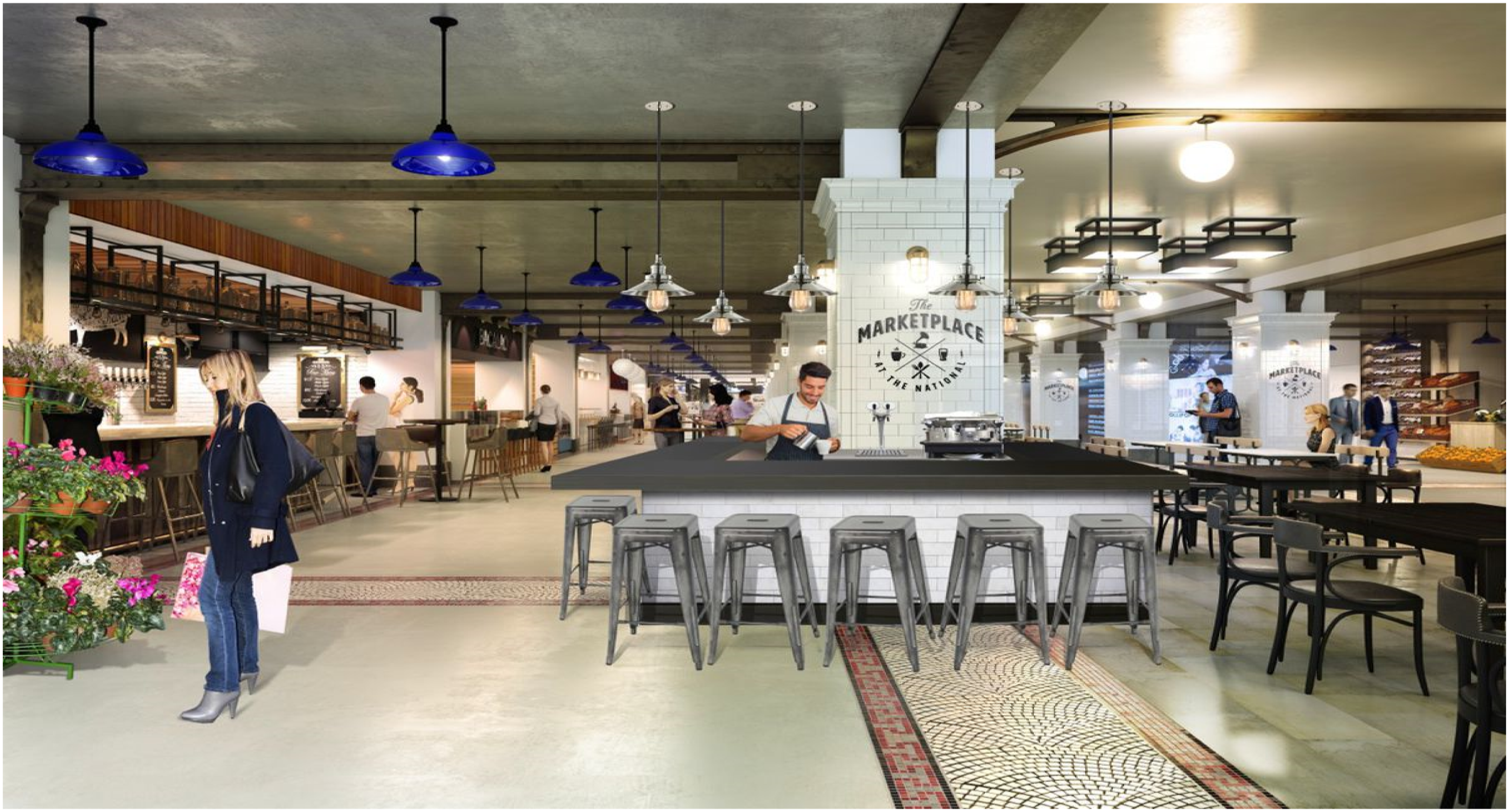
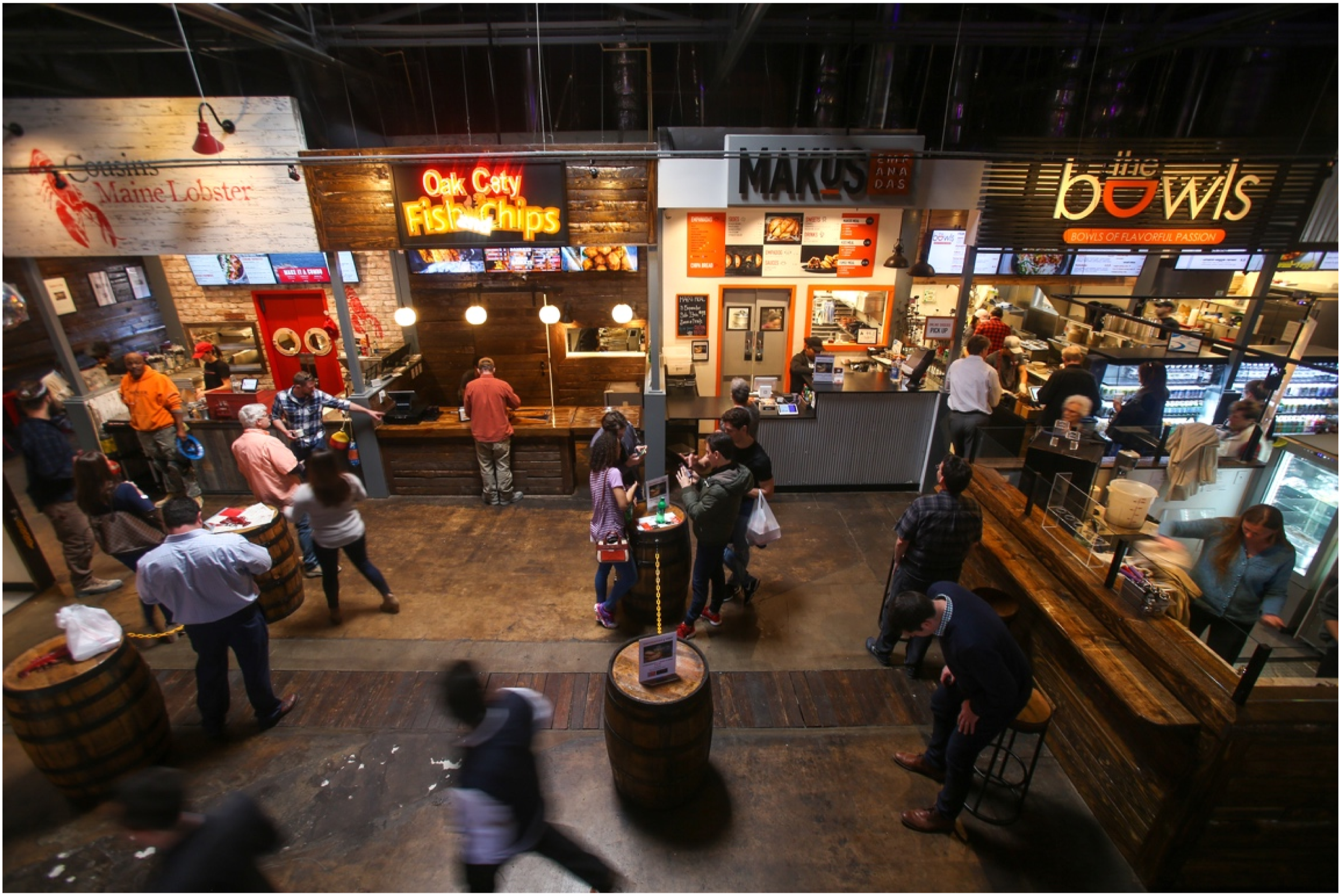
This consolidation of aesthetics and conventionalization that food halls are defined by design as well as food is further deepened through digital and social media (e.g., Pinterest’s “food hall” sub-categories include architecture, interiors, signage, design ideas; 200,000 #foodhall posts on Instagram transform physical spaces and edible objects into circulatable entities for visual consumption). 1 As much as such platforms rely on user-generated content, such that anyone with a smartphone can play a part in the food hall category’s conventionalization, they are also highly instrumental spaces for “influencers” and other professionally-generated content (e.g., Gon, 2021). Thus, alongside “amateur” Instagram posts of visits to a destination #foodhall are countless more posts (advertisements) for specific venues reproducing the #foodhall conventions as content for followers. For example, the culinary offerings and aesthetic design of Raleigh, North Carolina’s Morgan Street Food Hall are reproduced via traditional media (ranked third in USA Today’s “10 Best New Food Halls” list of 2019), by its own social media (31.2 thousand followers of @morganstreetfoodhall on Instagram), through user-generated content (over 5000 #morganstreetfoodhall posts on Instagram), and by micro-influencers, such as the travel blogger who declared: “I’m a tough food critic and fairly judgmental of design. But Raleigh’s Morgan Street Food Hall impressed me in every way.” 2
Thus, a dispersed network of actors—including food vendors and patrons, real estate developers, design firms, travel, food and lifestyle journalists and bloggers—are implicated in the concretization of “food hall” as a cultural, aesthetic, and organizational category. Locally embedded cuisine is a necessary but not sufficient cornerstone for the food hall category, which also rests on the local particularities of dishes being packaged in consistent aesthetics of space and discourses of authenticity. Someone visiting a new food hall in a new city would likely find quite a predictable looking scene, even if the empanada stall has a different proprietor and a different signature spice blend.
Natural wine
The term “natural wine” encompasses a range of viticultural production techniques, including low or no use of chemical fertilizers, herbicides or pesticides, low yields, hand-picking and pruning, reliance on naturally-occurring rather than commercial yeasts, and the reduction (or total avoidance) of sulfur as a stabilizing agent. The resulting wines are explicitly juxtaposed with mainstream winemaking through their alternative approaches to production (e.g., biodynamic, permaculture) that emphasize giving authentic expression to their singular, small-scale terroir and context of production, which cannot be matched by mid- or large-scale producers, and (often) through their peripheral status, in terms of coming from non-traditional regions, producers, and/or varieties of grapes (e.g., red mavrodaphne wine from Kephelonia Greece, or orange sivi pinot wine from Slovenia’s Vipava Valley). Although such attributes may provide points of differentiation and levers for value creation, they also entail particular risks: vintages can be highly variable, the wines themselves can be less stable and can confound established product expectations, and the producer/region/variety may be unknown to even knowledgeable consumers.
Although insistently small-scale and local, natural wine has nevertheless “gone global” in the last two decades, led by numerous independent specialist retailers, restaurants, and wine bars around the world (readily discoverable via review sites such as Yelp and Tripadvisor, and specialist apps such as Vivino or, specifically for natural wine, Raisin), and high-profile exhibitions (such as the Raw Wine Fair, with annual iterations in London, New York, Toronto, Montreal, Los Angeles, and Berlin). This expansion has happened without a formal product category definition: there is no official regulation of the term “natural wine,” although France’s INAO recently introduced a voluntary scheme based on sulfites (Goode, 2020). Although there are certifications available to objectify and guarantee facets of “naturalness” (e.g., Demeter certification of biodynamic viticulture; USDA organic certification), these are not necessarily pursued by producers (Smith Maguire, 2018a). As such, certification may be regarded as too bureaucratic, expensive, constraining, instrumental, or may simply be unavailable (e.g., Protected Designation of Origin schemes do not exist in all producing countries).
In the absence (or refusal) of disembedded trust and quality assurances, the ongoing construction and legitimation of the “natural wine” category must be actively carried out, in part, by the winemaker/winery through such devices as websites and wine labels (which tend to offer information far in excess of mainstream wines, such as the exact geographical location of vineyard sites, and precise dates and conditions of harvest). However, natural wine producers are often very small scale; their efforts at expressing terroir may not extend to label design, and they may not even have a website. Much of the work of category creation and trust-building, therefore, falls to intermediaries: importers, retailers, sommeliers, restaurateurs, wine writers, critics, and bloggers. For example, a Melbourne-based distributor’s website declares:
All of the vignerons that we work with share a genuine love of very small scale farming, working with nature, promoting bio-diversity and bottling nourishing and digestible wines. Every wine that we import and distribute is organically farmed and additive-free. 3
A New York-based importer’s “About Us” page echoes: We present the wines of small vineyards in this competitive worldwide market, in order to defend an endangered species — winemakers who work like artisans, crafting a different wine each year. They do not impose a preconceived taste on their wines, but look to be surprised by what nature gives them … These are handmade wines in the truest sense…
4
In the absence of a formal, centralized product definition, a dominant narrative framing of natural wine nevertheless consolidates, rooted in a consistent (and often florid) repertoire of referents congruous with an omnivorous orientation: small-scale, artisanal, hand-crafted, genuineness, care, and so forth.
Beyond setting expectations and conventions for natural wine, intermediaries are also crucial in guaranteeing quality, with social media providing the means by which personal guarantees and renderings of a wine’s provenance (e.g., anecdotes shared at a restaurant table or wine fair) become globally circulatable. For example, a New York-based importer’s Instagram features a 10-photo post depicting a winemaker and friends, including the importer, carrying out the harvest (see Figure 3). The post communicates the material referents for provenance and authenticity: geographical and biographical specificity (showing the vines, grapes, and hands that harvest), and genuine, intrinsic passion (#ilovemyjob). Similarly, a Melbourne-based importer’s Instagram account offers glimpses of globetrotting, first-hand experiences of wine provenance (see Figure 4). A post featuring three men, toasting with red wine at an informal lunch overlooking fields, is effusively captioned: An ultra, super brilliant afternoon with Beaujolais and Macon superstars… What Pierre has done in 2015 is an utter revelation (I’m freaking out with excitement) and through long elevage, and clearly lots of patience, he’s bottled some outrageously good cuvees. Jerome remains a reference point for trialling (zero ((zero!!!!!)) vineyard treatments for reds in 2017 and ‘18…his wines are startlingly good. Pulpy, pure, round and irresistible.
5
Instagram post, 18 September 2018, from @jennyfrancois https://www.instagram.com/p/Bn38ihqhFLx/ Instagram post, 31 May 2018, from @campbellthomasburton https://www.instagram.com/p/BjbDrufAusz/.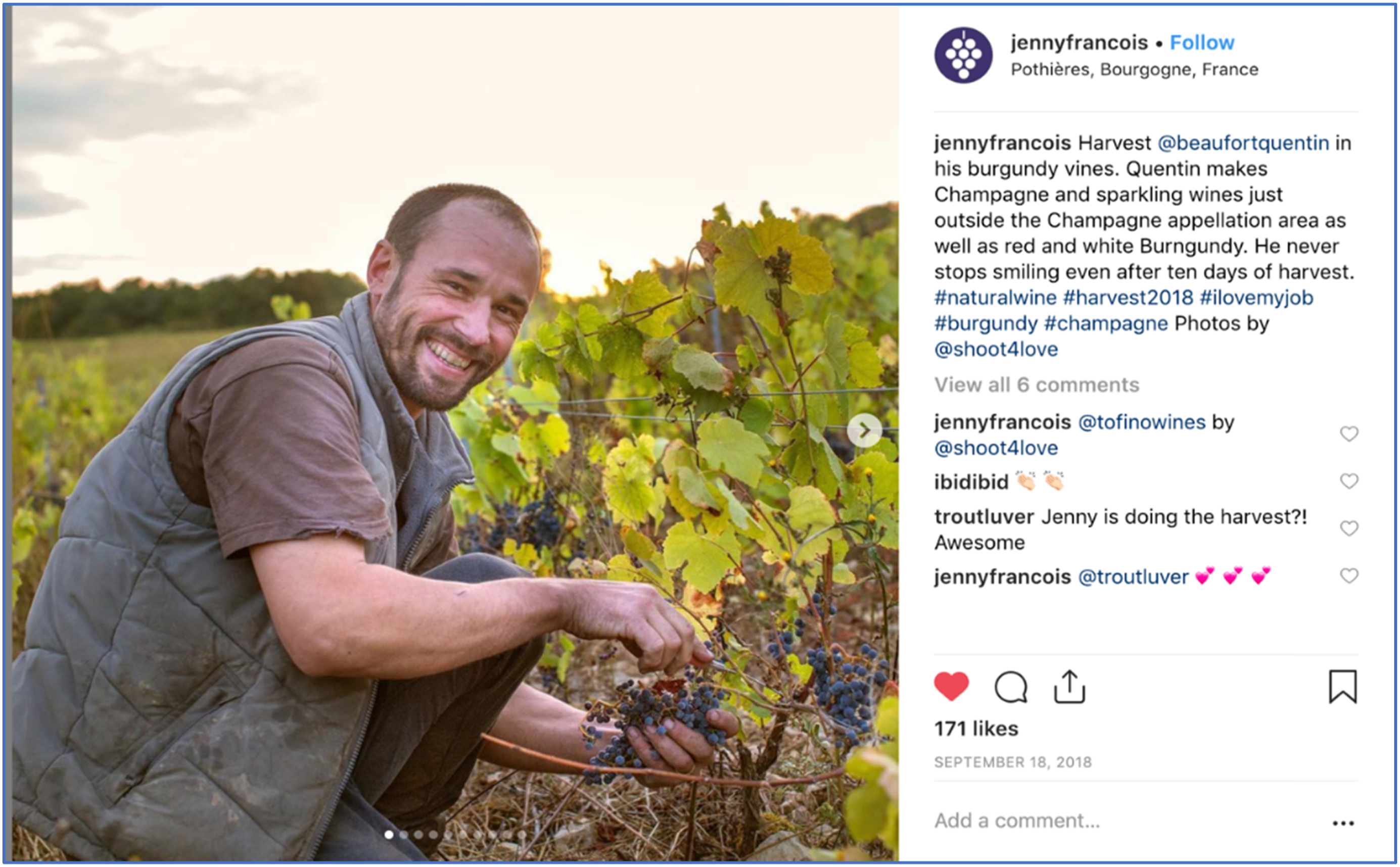
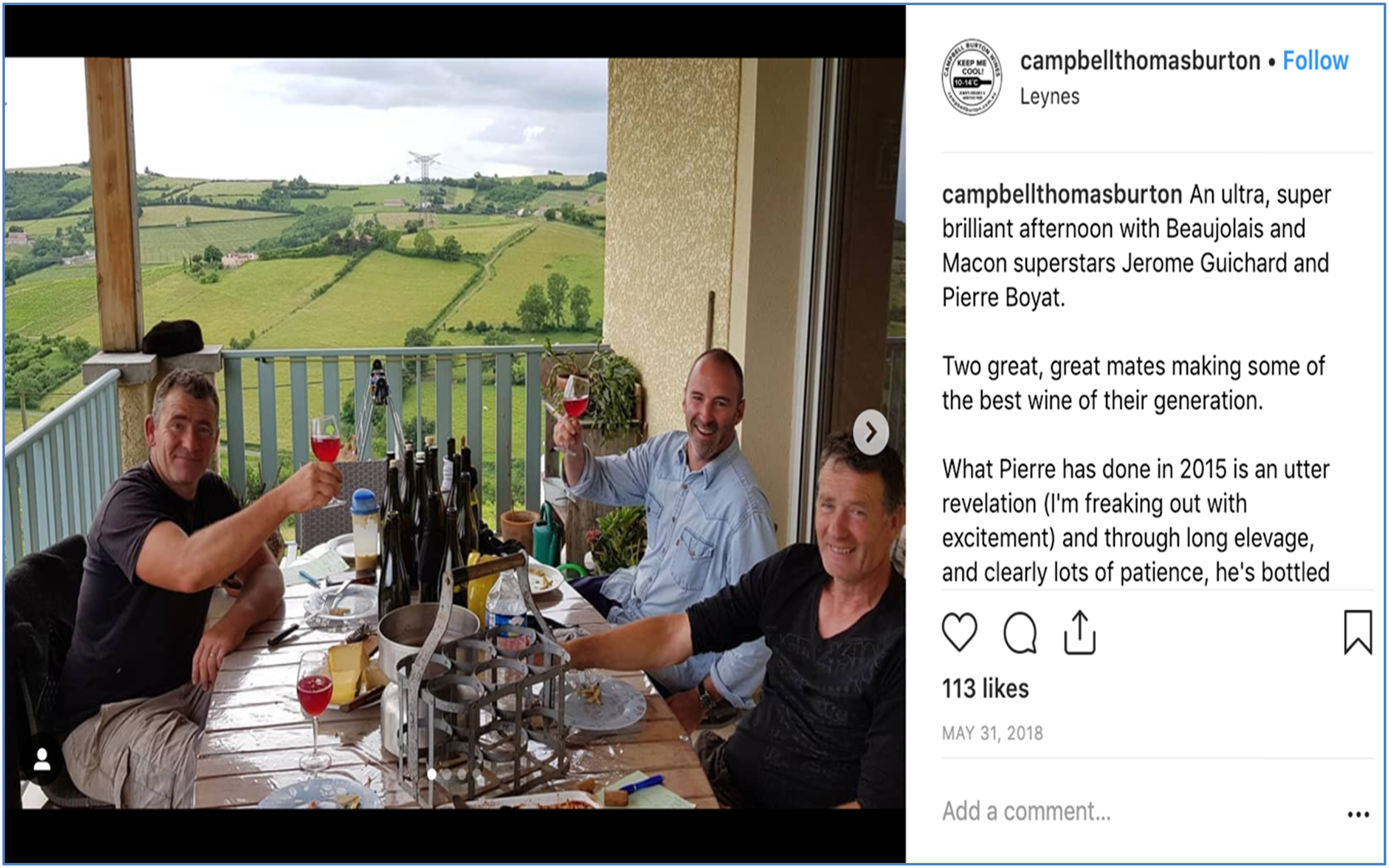
Such posts epitomize the quasi-auto-ethnographic spirit of digital media, with emphases on quick bursts of thick, emic descriptions accompanying snapshots of “real life” supported and amplified by others’ validation of the post via liking, commenting, and sharing. Natural wine intermediaries’ social media renderings of their personal passions and “ultra, super brilliant” experiences offer a sort of gonzo promotional journalism, through which a natural wine’s provenance becomes mobile and affords the consumer-at-distance the impression of “being there,” and is then adopted by others wishing to expound on their own authenticity claims. Objective, disembedded certifications (even if possessed by the winemaker) are eschewed in favor of subjective positioning and affective declarations of the winemaker and intermediary.
The cultural form that natural wine assumes thus exhibits key attributes of our puzzle, vis-à-vis the global circulation of an intensely local product, with its embeddedness seemingly intact. Attributes such as artisanal passion or the minutiae of provenance might be detectable in the glass of natural wine or available via exceptional moments of meeting the winemaker directly; however, for most consumers, these attributes are available only insofar as they are made tangible, legible, and credible through standardized narrative frames, linchpins for which are emotional declarations and the aesthetic tropes of authenticity.
Un/tangling taste and trust today
Utilizing the cases of food halls and natural wine, we have examined some of the material, discursive, and affective devices through which trustworthy points of attachment for food/drink are made available for omnivorous consumers, and how those devices allow food/drink forms to circulate through global channels while retaining auras of embeddedness and local specificity. These devices include templates for the aesthetics of form (e.g., décor, space, symbols, and packaging) that engender familiarity, faith, and emotional resonance as categorical elements of mobile trust regimes. And, by situating individual instances within the imperatives of larger and newly formed cultural categories (food halls; natural wine), these devices fuel the circulation of these categories as “Instagrammable” content. The aesthetics of performance coalesce into readily recognizable, if not generic, templates: the typicity of the dish or glass of wine is guaranteed through the purported authenticity of the producer and intermediary, made legible and credible through embodiment and impassioned storytelling. At the same time, the legitimacy of these cultural categories is co-constructed by a highly distributed array of market actors that extends far beyond the chef or wine maker: writers and bloggers; wine fair and wine app entrepreneurs; real estate developers and design firms; and social media users sharing their experiences, images, and recommendations to demonstrate their omnivorous chops. General and specialist media formats, apps, review sites, and the seeming omniscience of Google’s search engine aggregate globally disparate instances into readily identifiable and searchable categories of consumption entities (e.g., products, sites, and experiences), affirming that market attachments involve both downstream and upstream processes. Indeed, through the trickle down of design, and the participatory generation and circulation of cultural content, such devices enable a co-creation of trustworthy forms and narratives through user-generated content, liking, hash-tagging, and commenting.
We note three implications of our examination of mobile trust regimes for understanding the tangled relationship between taste and trust in contemporary consumer culture. First, a mobile trust regime is oriented to delivering aesthetic, affective attachments, rather than objective guarantees, as the basis for trustworthiness. It endeavors to lessen, even eliminate, the possible frictions for cultural omnivores of consuming something new and different. The credibility and avidity (Cochoy et al., 2017) of a mobile attachment, for example, is tethered not to a specific place, but to the idea of place; not to knowing the actual origin, but to the ideal that origin is knowable; not to the tradition (protected by an official certification), but to a tradition (convincingly communicated). To be mobile—for example, for a tradition to be convincingly communicated as a worthy point of attachment—these cultural forms are enlivened by stories and storytellers. Rather than states, brands, or small-scale producers (as in disembedded or embedded regimes, respectively), a primary cadre of enacting agents for mobile trust regimes are cultural intermediaries (Smith Maguire and Matthews, 2012). Such actors add value through their aesthetic and affective framings, which confer not only legitimacy, but mobility: these are framings that travel and propagate. The local, personal, and idiosyncratic are not scaled up but rather scaled out, by virtue of the technological affordances and narrative conventions of digital and social media that, in turn, make their resultant cultural forms and narratives unexceptional.
Intermediaries and acts of intermediation unquestionably exist in both disembedded and embedded trust regimes. However, the emphasis in mobile trust regimes is on translations of embedded forms of trust (the intermediary’s personal knowledge, experience, and evaluation) into disembedded, circulatable stories that retain an aura of embeddedness. The cultural omnivore can thereby eat tacos at a food hall that, by virtue of its conceptual design, could be in any city or share in the intermediary’s “ultra, super brilliant” afternoon at an obscure Slovenian vineyard. This is not to suggest that consumers are detached from these attachment processes. Increasingly normative expectations of turning one’s everyday experiences into quasi-professional social media products means that consumers participate in co-creating (thereby engendering additional fluency with) the cultural categories they consume (Demetry, 2019; Humphreys and Grayson, 2008; Sheehan, 2022). The problem for mobile attachments is not whether intermediaries or consumers believe in what they are told and tell others, but “that the discourse of the seller achieves the limited and temporary truth not of facts but of emotions and passions” (Callon, 2017: 186).
Second, the global mobility of food halls and natural wines, among other cases, hinges on dynamic tensions between homogenization and heterogenization (cf. DeSoucey et al., 2019; Ram, 2004). Heterogeneous particularization occurs at the level of the plate or glass and is rendered trustworthy through the homogenizing norms of circulating aesthetic and affective templates (Arsel and Bean, 2013). These devices then draw their legitimacy not through compliance with universal standards or accrued interpersonal trust, but through alignment with meta discourses of authenticity, paradigms of modernism and craft, conventions of impassioned storytelling, and fuzzy logics of faith. The provenance, presentation, and gustatory experience of the Oaxaca-styled tacos or Slovenian orange wine are packaged within relatively stable visual and narrative templates, which offer legitimacy for the (potentially strange, unfamiliar, and risky) points of attachment. A mobile attachment is in effect saying: “Never heard of Oaxacan cuisine or orange wine? No problem; the instantly recognizable minimalist décor of the food hall or passionate testimonial of the winemaker will put you at ease. You’re on familiar ground with the safely unfamiliar.” A form of “rationalized authenticity” (DeSoucey et al., 2019) that purports to value cultural diversity, variety, and localness thus greases the wheels of mobile trust regimes, providing a framework for nurturing new attachments. It is little wonder, then, that some cultural commentators even declare authenticity passé (Chayka, 2016; Owens, 2018).
Third, mobile attachments for artisanal food and drink highlight how omnivorous norms and notions of worth are institutionalized within contemporary markets. Familiarity with, and trust in a cultural imaginary of local, authentic, embedded foodstuffs far outstrips the material scope and scale of specific goods, enabling a multitude of local instantiations across geographically disparate moments. At the same time, in addressing the lack of attention to the reproduction of cultural omnivorousness, our conceptualization of mobile trust regimes suggests how it has become commonplace in consumer culture. This is not (simply) about omnivorous tastes trickling down from foodies. Rather, the conventions of omnivorous taste—aligned with authenticity to enact discernment without deference to established boundaries between high/low or legitimate/illegitimate forms—have become the conventional aesthetic framing of many entities. Being a cultural omnivore may be largely the purview of higher-status consumers and professional tastemakers, but the tropes of cultural omnivorousness have become the lingua franca of creative design, digital media, and lifestyle marketing more widely.
Thus, in shifting attention away from spectacular material instances (e.g., artisanal hot dogs and sparkling wine made of Bacchus grapes), and focusing instead on the everyday conventionalization of omnivorousness, we find that we have arrived at a state of banal omnivorousness, the aesthetic handmaiden of ordinary cosmopolitanism (Bookman, 2013; Lamont and Aksartova, 2002). Following Billig’s (1995) observations, we are mindful that the banal should not be mistaken for the benign. Banal omnivorousness is implicated in the reproduction of distinction, as mobile trustworthy attachments continually reference notions of “good taste” even as legitimate taste becomes seemingly more democratic. Moreover, mobile trust regimes are involved in reproducing the very consumer anxieties they ostensibly address. Their norms may help make credible the ethical and aesthetic bona fides of available options, but do so while sowing seeds of doubt that the right choice will remain as such: a perpetual engine for the cultural production of discourse, attachments, stories, sentiments, and reassurances. And finally, the aesthetic, affective elements of mobile trust regimes—however, globally circulated—are nonetheless not equally available to all, if only because of the unequally distributed time and cultural capital required to access, digest, and decode the stories, to master evolving conventions’ new formats and categories, and to run the risk of placing trust in a mobile (that is, transitory, elusive) sense of reassurance.
Footnotes
Acknowledgements
The authors are grateful for constructive feedback received from participants at the 2019 Authenticity Workshop and American Sociological Association and European Group for Organizational Studies conferences, and for the initial impetus supplied by Dr Ocejo's 2017 visiting fellowship at CAMEo, the University of Leicester Research Institute for Cultural and Media Economies.
Declaration of conflicting interests
The author(s) declared no potential conflicts of interest with respect to the research, authorship, and/or publication of this article.
Funding
The author(s) received no financial support for the research, authorship, and/or publication of this article.
