




Abstract
The filigree ground mosaic is placed at the heart of the Grindel neighbourhood in Hamburg, Germany. Tracing the footprint of the former synagogue that once stood there, proudly, it demarcates an absence. It is a reminder of what the Nazis destroyed and sought to extinguish. The fact that the synagogue will finally be rebuilt, in the same place, with the support of the Federal government and the city, is anything but a matter of course. This will be the first reconstruction project of a synagogue of this size in Germany since the Second World War. Yet the project has been controversial in some respects. The two main concerns expressed in the public debate about the form of reconstruction and whether and how to integrate the Synagogue Monument at first sight appeared to be in irreconcilable competition: the importance of maintaining a culture of remembrance, and the legitimate claim of the Jewish Community to recover and rebuild its former place of worship. This would not merely be, as is often said, a sign of Jewish belonging, of identity and representation, in the urban society. Rather, it is about modes of existence that the architecture itself, in the materiality of its form and its presence, embodies and makes possible. To the people, architecture is what makes the difference. It thus shapes the political landscape.
Desire and Existence
For some, it is just an empty square. For others, it is a unique site of German memory culture. The Synagogue Monument, inaugurated on 9 November 1988 50 years after the Night of Broken Glass, designates a void where the Bornplatz Synagogue once proudly stood. Originally erected in 1906 in Romanesque historicist style, with gothic elements and an imposing dome, it was at that time northern Germany’s largest freestanding synagogue. 1 As is often said, at the beginning of the 20th century it represented the self-confidence of Jewish life in Hamburg’s ‘Grindel’ neighbourhood, which was even named Little Jerusalem. Yet, in 1938 the synagogue was desecrated, its interior wrecked, and in the following year it was razed to the ground. The Nazis forced the Jewish community to sell the property and removed the ruins at the community’s expense. Artist Margrit Kahl designed the memorial project by tracing the contours of the synagogue’s complex ceiling in cobblestones on the ground. Due to its frugality, the monument requires some effort of immersion to decipher a message. It lives from being walked on, and thus to realize that the mosaic designates the synagogue’s footprint, to imagine what was once there, and to physically sense an absence (Figure 1).
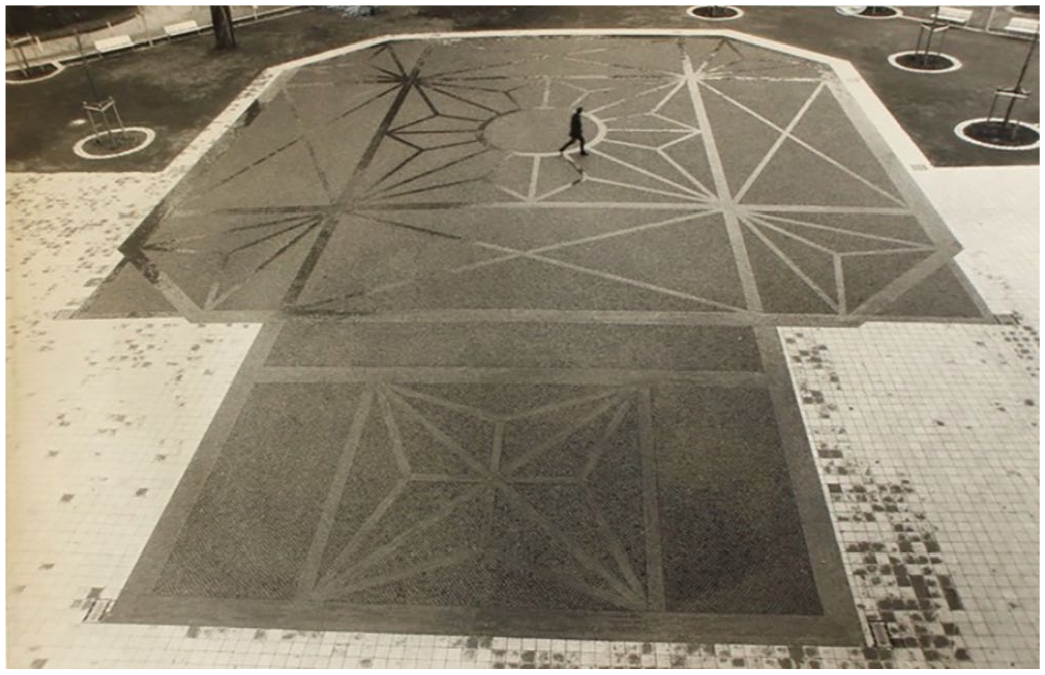
Margrit Kahl: Bornplatz Synagogendenkmal, 1988, Hamburg, Foto: M. Kahl © 2024, Forum für Künstlernachlässe (FKN) Hamburg.
After the Second World War, a new synagogue was erected to accommodate the small Jewish community that had the courage to stay in the city. In 2010, on the 50th anniversary of that rather inconspicuous building, located in a remote area of the city, the desire to rebuild a ‘magnificent’ synagogue exactly on the original site was for the first time prominently formulated by the then chair of the Jewish Community, 2 Ruben Herzberg (cited in Linde-Lembke, 2010): ‘It is our wish to return to our old place, as the empty space is a wound in our life [. . .] A new, large synagogue on the square of the Bornplatz Synagogue must not remain a dream’ 3 (Figure 2). It would take about another 10 years before this dream eventually came close to reality, a fact that spurred a lively and impassioned public debate: about the need to maintain a culture of commemoration as well as the desire to establish a marker of Jewish presence in the city. As will be argued in the following pages, this is not just a matter of identity and belonging, but rather, in a literal sense, a matter of modes of existence: of heterogeneous forms of life that architecture itself, in the materiality of its form and its presence, enables and embodies.
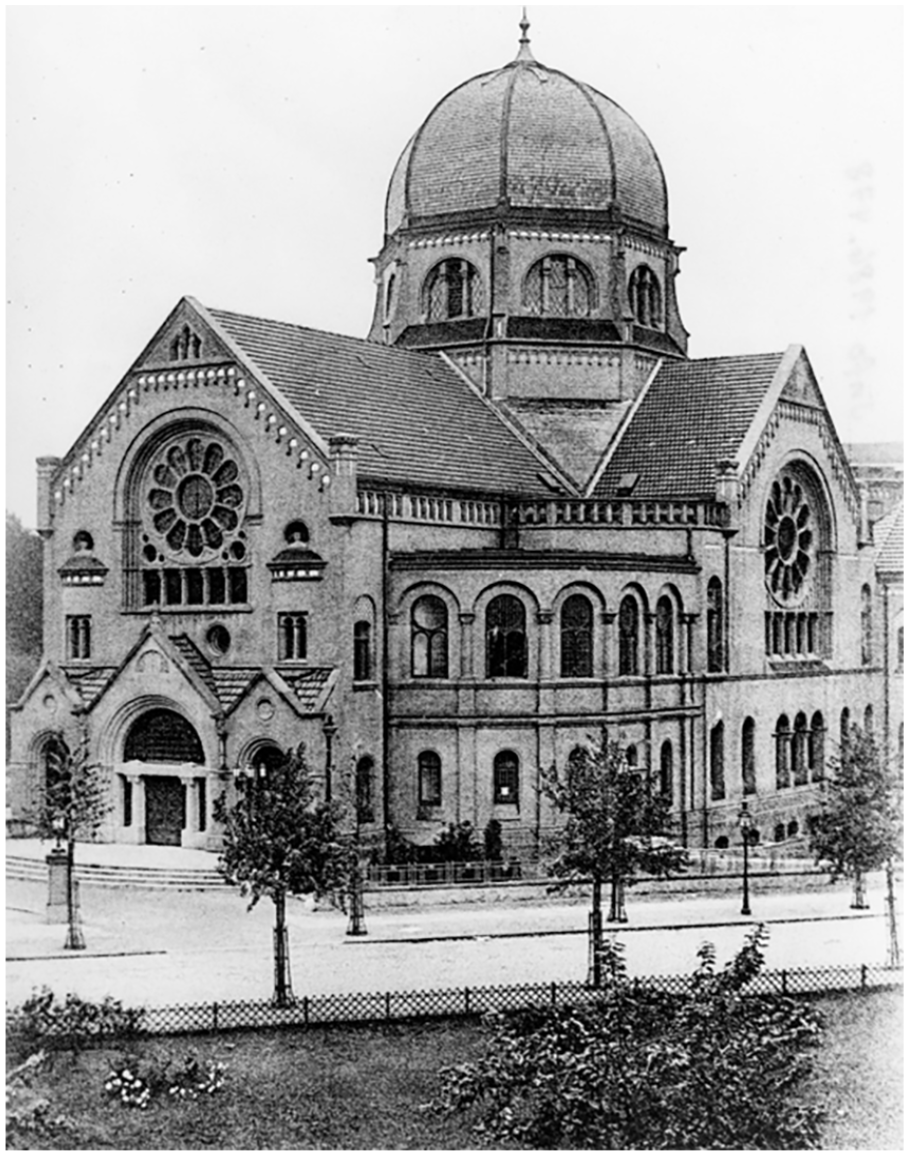
Bornplatz Synagogue (1906).
As a ‘symbolic medium and cultural technique’, architecture can be understood as a ‘mode’ through which collectivities constitute themselves (Delitz, 2018: 38) – which is not the same as saying that architecture represents that collectivity. Unlike a realistic painting or a novel, architecture conveys no meaning, it does not in the first place point to anything other than itself. Rather, the materiality of its form is how it presents itself. Architecture in this sense is self-referential: it speaks about how it is made and it alludes to architectural styles and related buildings. It obtains meaning in the built environment where it comes to be seen and makes a difference. Architecture is intellectually accessible, readable through architectural theory and history; but first and foremost, it is a sensual experience. Its ‘meaning’ remains bound to the materiality of its form (Delitz, 2018; Gleiter, 2014). Rather than conceiving of buildings as ‘material objectivations’ of society and ‘“social facts” in a Durkheimian sense, to the extent that they are visible, touchable, and sensible’ (Steets, 2017: 129), I would therefore insist that architecture shapes societies in the way it presents itself and is there. Architecture, ultimately, eludes ‘symbolic inscription’.
Meaning, to be sure, can be attributed to architecture, and it can also arise from acts of demolition and destruction (Herscher, 2010), where architecture becomes a medium to send a message. Hence, the Night of Broken Glass ‘can be seen as a proto-genocidal episode’ (Bevan, 2006: 8): the attack on synagogues was a direct attack on Jewish life and a harbinger of what was to come. The meaning of architecture changes in history depending on social contexts. This applies in particular to synagogues in Germany. As religious buildings, they may not only ‘draw special attention because their functionality (prayer, worship) is rather unfamiliar to the general public’ today (Becci and Hafner, 2023: 222); rather, a synagogue will perhaps never again be just another house of worship. When rebuilt after its annihilative destruction, it will be a reminder of the Holocaust – and a statement about the societal present. It is also in this sense that synagogues are not just sacral buildings but integral to Jewish life.
In the arduous history of ‘Jewish building’ in Germany after the Second World War, 4 the case of the Bornplatz Synagogue marks a certain turning point, perhaps even a ‘paradigm shift’. 5 While new synagogues that began to be built across the country from the 1950s onwards were often of a rather mundane and unimposing style – like the first one after the war in Hamburg, telling of the cautious return of Jewish life in the city – starting in the 1980s synagogue buildings appeared as indicators of a certain settlement as well as of a new form of cohabitation between Jewish and non-Jewish people, shaped by an emerging spirit of commemoration culture. Together with the case of the Synagogue Fraenkelufer, which at the time of its inauguration in 1916 was among the largest in Berlin, the realization of the desire to rebuild a synagogue on the original site and in accordance with or alluding to its former design, as it was articulated by the respective Jewish communities, was historically new in the late 2010s. 6 The Hamburg case is even more significant, and therefore worth taking a closer look at, as it became the subject of a wider public debate that received media attention on a national and ultimately international level, including voices of Jewish descendants from abroad. 7
The debate around the Bornplatz Synagogue cannot be separated from the specific situation of Jewish life in Germany today and the country’s particular memory culture, which is shaped by the historical ‘burden’ of, and ‘specific responsibility’ for, the Nazi crimes. It finds its expression in recurrent official rituals of commemoration, in a situation where the last remaining survivors of and witnesses to the Shoah are fading away, and in a country that has declared Israel’s security and existence to be its ‘Staatsräson’ (raison d’etat). 8 This general mindset has led to a particular public sensitivity and difficulty in facing challenges of any kind to the ‘singularity of the Holocaust’ (Wildt, 2023). 9 It ‘lends caution to public debate’, but also ‘encourages’ Jewish communities to express their needs (Becci and Hafner, 2023: 222), which also explains why other othered minorities, especially Muslim communities, find themselves in a quite different position in the striving for recognition (Becker, 2021, 2023; Kuppinger, 2014; Özyürek, 2022). Nonetheless, if the ‘rupture of civilization’ that the Holocaust demarcates has bound Jewish and non-Jewish Germans – or German Germans – indissolubly together in a ‘negative symbiosis’ (Diner, 1986), 10 the situation of Jews in Germany today is still one between ‘renewed incorporation’ and ‘continued otherness’ (Becker, 2023: 46; Dekel and Özyürek, 2022).
Approaching architecture through the lens of its materiality involves examining how it takes shape in the landscape of urban society. To delve deeper into the Hamburg debate and study how modes of existence come into play, let us first look at how the synagogue monument and the former place of worship it represents have entered into an ambivalent relationship. After outlining the analytical approach to a debate in which collectives form around matters of reconstruction and restoration, the importance of ‘place’ as a unique site of memorialization and resumption of life is elaborated. As history and the present take place, this also happens through architecture. Instead of irreconcilable positions, a multi-layered and performative dynamic thus comes into view.
The Debate and its Collectivities
After the war, the place of the former synagogue was neglected, and in a way forgotten, for decades by the city, the owner since 1940. Located between the building that was once the Talmud Torah School and a surface air-raid shelter which the Nazis had established for their own protection, it was used until the 1980s as a poorly maintained, wild parking lot. Archaeological excavations at the end of the 1970s, which proved the survival of large parts of the foundation of the old synagogue, brought the existence of the precious Jewish heritage to the awareness of a wider public of the urban society. The square where the Synagogue Monument was laid out, which in 1990 was renamed after the last Rabbi in Hamburg as Joseph Carlebach Square, became a regular location of remembrance on the anniversary of the Pogrom Night as well as an important site for Jewish visitors, including those from abroad (see Rürup, 2021: 13). Today, it lies at the heart of a neighbourhood where Jewish life has gradually begun to flourish again. The Joseph Carlebach Education House, the former Talmud Torah School, reopened in 2007 as a Jewish school, which also teaches non-Jewish children from nursery to high school, and there is a Jewish café and lounge in close proximity. The ‘return’ of the synagogue would make it part of an ensemble together with the Education House – and bring it into direct confrontation with the surface air-raid shelter, which today belongs to the nearby university. Listed as a historic monument, the bunker ‘serves’ everyone who is open to it as a reminder ‘of the devastating bomb attacks as well as, by its location, of the interrelation between this war and the Holocaust’ (Statement, 2020).
It was a sad occasion that caused political support for the rebuilding of the Bornplatz Synagogue to suddenly gain momentum: a terrorist attack on the synagogue in Halle, Saxony-Anhalt, on Yom Kippur in October 2019, which triggered widespread public dismay. As a reaction to that incident, the budget committee of the Bundestag, as part of efforts to fight right-wing extremism and antisemitism in Germany, approved 600,000 euros to fund a feasibility study. In 2020, following a unanimous vote of the democratic parties supporting the ‘reconstruction (Wiedererrichtung) of a representative synagogue on the former site of the Bornplatz Synagogue’, the Hamburg Bürgerschaft (parliamentary assembly) explicitly referred to the Halle attack as well. Although the proposition also insisted on a ‘dignified and appropriate way of dealing with the ground mosaic of Margrit Kahl’, 11 the public conflict was on the table. What seemed to be at stake was a clash between two mutually exclusive projects: rebuilding the Bornplatz Synagogue on its original site, and in its original shape or close to that – the parliamentary decision even spoke of ‘restoration’ (Wiederherstellung) – would also mean erasing the void and with the monument a unique space of commemoration. The alternative would be to confront the Jewish Community literally on a daily basis with the provocation of an ‘empty space’. As the community chair Philipp Stricharz (2021) framed it in a public talk: ‘The Nazis have won, so to speak, until today, they have succeeded in keeping this space empty – even if at least, and this is to be highly acknowledged, the synagogue is remembered. But their bunker still stands – our synagogue does not.’ A group of 45 Israeli intellectuals and citizens, including descendants of former Hamburg inhabitants, couched their concern in an open letter to the Hamburg Senate, the Jewish Community and the German ambassador in Israel in the following terms: ‘Will a monumental replica of the original building fill the void left by destruction, or will it in some sense replace the empty space that evokes memory and thoughtfulness of what was destroyed?’ (Statement, 2021) Both perspectives, notably, claimed a form of physical and mental loss: in the experience of destruction and a painful void or wound that is left.
In view of ‘a project of considerable importance in terms of urban development and remembrance culture’, a group of historians and people from the cultural sector, most of whom had over a long period been committed to the history and presence of Jewish life in Hamburg, ‘strongly’ advocated a broader societal debate, which would include Jewish and non-Jewish voices of the urban society, on ‘how Jewish life in the Grindel quarter could be rethought and shaped in a contemporary, future-oriented way, taking into account the existing conditions’ (Statement, 2020). In particular, the head of the Institute for the History of the German Jews in Hamburg at that time, Miriam Rürup (cited in Diehl, 2019), insisted that the announced feasibility study be ‘opened’: ‘Is it conceivable to build a house for Judaism in which all currents can feel at home?’ As we will see, this aspiration would include the legacy of the Israelite Temple the city of Hamburg can be proud of. It was ‘one of the first Reform synagogues in the world’, and is recognized today as being ‘a nucleus of liberal Judaism worldwide’ (Springer and Aust, 2022: 116). The Temple was not destroyed by the Nazis, but by an air raid in 1944 that left two ruined remnants of the house of worship that the Foundation for Jewish Heritage (n.d.) in London now lists among the 18 ‘unprecedented historic synagogues’ in Europe.
In January 2021, the tender for the feasibility study was eventually published, with the Jewish Community of Hamburg, the orthodox unified congregation, as the principal. The explicit aim was ‘to rebuild the former synagogue at Bornplatz’, and the mandate was to determine ‘how and by what structural concepts’ this would be feasible. As for the ground mosaic, the conditions to be taken into account now appeared somewhat restrained compared to the wording of the parliamentary proposition: they included ‘aspects of monument preservation, also with regard to the existing monument’, as well as the question of how to deal with the adjacent surface air-raid shelter (EU Tenders, 2021).
At first sight, the public debate seemed to be shaped by a fight over symbols between the different stakeholders, with politicians seeing an opportunity to make themselves look good in the fight against antisemitism. 12 Notably, the ambition to rebuild the Bornplatz Synagogue was promoted by a campaign, launched on 9 November 2020 by representatives of the Jewish Community together with local politicians, that said ‘No to Antisemitism – Yes to the Bornplatz Synagogue’ (Stiftung Bornplatzsynagoge, n.d.). It was well covered by the media and eventually obtained more than 100,000 signatures, including many prominent figures of public life; but it was also criticized for its blunt suggestion that not being in favour of rebuilding equalled being antisemitic. 13 Furthermore, in its proposal to rebuild a ‘representative synagogue’ on its original site, the Hamburg Bürgerschaft had taken up the aspiration of the Jewish Community to send a signal and strengthen ‘the visibility of Jewish life’ in the city. 14
What is often overlooked, however, in sociological analyses of disputes over the reconstruction of architectural heritage in cities in general, is the importance of the material presence of architecture and its temporality, that is to say: how it acquires and changes its significance for societies in its material form. It is against this background that we can apprehend the deep concern that drove the objection to restoration, namely that the ‘visible gap left by National Socialism in our city’ would thus be rendered invisible (Rürup, cited in Diehl, 2019), even more so if the synagogue was rebuilt with its original façade (Herzberg, 2021). A restoration, it was argued, would create ‘the illusion that “nothing had ever happened”’ (Statement, 2020) and ‘gloss over the suffering that has occurred’ (Salomon Korn in Springer and Aust, 2022: 22). Taking the former representative synagogue as the model for rebuilding, a further criticism contended, would only reiterate the ambivalence of that time, namely that the architectural style was also an expression of the Jewish community’s striving to be recognized as fully belonging to German society (see Korn in Springer and Aust, 2022: 21). Moreover, today, a building in the 19th century style would appear like an alien element (Rauterberg, 2020); and above all, as only the façade was planned to echo the original synagogue, it would look like ‘creating a kind of stage scenery’ (Korn in Springer and Aust, 2022: 21) of a much smaller synagogue for a much smaller Jewish community today.
Taking the ‘meaning’ of architecture in a very material sense brings a further important moment to the fore: the decisive difference that it makes that a new synagogue indeed stands there. This difference is also key for comprehending that the Synagogue Monument is not just an – immaterial – empty place, signifying a void. In its materiality, it demarcates an absence, one that can be literally sensed. Within such a perspective, the desire to rebuild the Bornplatz Synagogue and to cherish Jewish heritage in the city appears to be not just a matter of identity (Jones, 2011) and symbolic recognition. It is about modes of existence, about the very possibility of Jewish life and of heterogeneous forms of togetherness in the city. The question of how the diverse imaginations find their architectural expression, whether in the shape of a synagogue or a monument, is crucial in this sense. It is a ‘matter of concern’ (Latour, 2005) where the ‘meaning’ of the – anticipated 15 – architecture and its form emerge out of a field of different forces in the dispute, as does the collectivity that constitutes itself around it. Hence, rather than presupposing existent stakeholders and their conflicting aims in that debate, of interest here is how the urban society and different features take shape: 16 how certain motifs develop over time and may overlap, and how they speak about modes of existence in the urban landscape. As we will see, this is also a spatial question of history taking place.
Life Taking Place
‘There’s a memorial or a piece of art hanging on the ceiling’ of the Talmud-Torah School, the chair of the Jewish Community in Hamburg since 2019, Philipp Stricharz, told me in an interview:
[It] was assigned to us through the district assembly. So that’s an installation on the ceiling of the foyer made of broken pieces [. . .] little stars made of broken glass, in memory of the murdered children. So [. . .] if you see it from our perspective: it was intended for us at that time as a gift, and we noticed at that time that it is very important to some people that it goes there, external people, not in the Jewish community [. . .] And what was particularly striking was that no one had thought about what to say to our children, our five- or eight-year-olds, who walk under this thing every single day and then perhaps also ask, ‘Why is that hanging there?’ What should we tell them then? ‘Yes, because the children who were like you a few years ago were murdered here’? That can’t be the point, that our children are reminded every day that children like them were murdered here in the past.
As a present for the re-inauguration of the school, the Jewish Community felt at that time that it could not reject the artwork that it calls a ‘pile of shards’. This is a telling association, in a figurative and literal sense, and Stricharz emphasizes that it was ‘external’, non-Jewish people who wanted to make that gift of commemoration. ‘Pile of shards’ may be understood as what history left to the Jewish people, but also as what really hurts. It can be injurious, as Stricharz indicates when establishing a direct link to the endangerment of the young children who ‘every single day’ pass the installation hanging from the ceiling of the foyer: ‘Has anyone actually checked whether this is structurally safe? Whether the thing might fall down?’ And he goes on to expound:
But this will to commemorate correctly, so to speak, is also stronger than the thought of whether this might not be so great for our children. And our children don’t play any role at all in these considerations. Because it is only about the Shoah and the victims of that time and the people of today who want to commemorate. The fact that Jews exist today and that children exist, in my opinion, plays no role at all in these considerations.
17
In a strikingly clear way, Stricharz draws a contrast between past and present (the victims of the past and the children today), the non-Jewish will to remember and today’s presence of Jewish people, particularly embodied by the children as the future generation. The opposition is also about life and death, which finds its expression in the gift that, albeit unintendedly, seems to endanger the children – and that above all hurts in that the donors are perceived to have been ignorant in what they were doing.
What may seem to be a singular story, a disastrous encounter between the Jewish Community and the, admittedly benevolent, government authority of Hamburg some years ago, is quite illuminating for understanding the specific desire to rebuild the Bornplatz Synagogue. Since the 1990s, when many Jews immigrated from the former Soviet Union, the Jewish communities in Germany have grown considerably – and accordingly become more visible (Klei, 2024). Along with cultural and religious pluralization, the landscape of the memory culture has changed as well, with different historical and territorial references being brought into play, for example, by those who understood themselves as the direct descendants of the victims of the Holocaust or those who fought against the Nazi war of extermination in the Soviet Union (Körber, 2016). Nevertheless, the diverse positions in the debate cannot be said to be clearly divided between generations, as is often suggested, let alone between Jews and non-Jews, as if these were two homogeneous groups. For example, contemporary Jewish witnesses of the Bornplatz Synagogue as well as younger people expressed deep scepticism towards the idea of reconstructing the building in its original form while stressing the importance of the exceptional existing memorial. Aleida Assmann (2021) therefore speaks of ‘two Jewish concerns’ (emphasis added), though she reduces the matter to a conflict between ‘restoring history’ as it was ‘before 1938‘ and ‘the desire of the survivors and their communities to maintain the traces of extermination and the Holocaust in the German memory landscape’. Instead, the fact that the majority of the Jewish Community today, indeed, no longer has any personal or family ties to the former Bornplatz Synagogue (see Deistler, 2023: 45; Korn in Springer and Aust, 2022: 21) may point us to a different motive for the attachment to the proud synagogue.
‘Antisemitism is always treated in a very abstract way’, the chair of the Jewish Community goes on to explain in the interview, but it ‘is nothing abstract at all’. Rather, it ‘is the pressure on Jews to disappear from public life [. . .] Antisemites want there to be nothing Jewish left to see and hear and read and otherwise perceive, either in social discourse or on the street or anywhere else.’
Against this antisemitic determination to negate Jewish existence, Stricharz sets the presence of Jewish life in the city. The ‘noise’ of the kids playing outside on the school grounds is, for him, an indicator of this presence as the rebuilt synagogue would be:
But if you want to express, and we want to, that we Hamburg Jews are not a new phenomenon here, but have roots here and have been here all the time and have been waiting for this reconstruction, and our Jewish community originally built this synagogue and now wants to have it back, and that we are coming back to the centre of the city and not now appearing for the first time [. . .] Only a reconstruction that leans on the past can also remind us of the past. The current situation does not remind us of anything.
Rebuilding the Bornplatz Synagogue is obviously, for the chair of the Jewish Community, a mode of tying in with a past, which is not just to signify but to establish a continuity. It is to set a new beginning that the new generation of children stands for, and to tie in with a different form of remembrance. As architect Thomas Wach (2024: 83) has pointed out: instead of a culture of remembrance, it is the ‘remembrance of a culture’, namely of Jewish self-confidence and self-evident belonging to German society. It is for this reason that an architectural reconstruction must allude to the former synagogue that once proudly embodied that self-confidence.
If this reading of Stricharz’ vision is appropriate, this would mean that the rebuilding is neither intended to cover up the horror of the Shoah – which is part of Jewish ‘family memory’ anyway 18 – nor is it mere nostalgia: the longing for a past ‘that no longer exists or has never existed’ (Boym, 2021: xiii). 19 It is not even negation of the antisemitic negation of Jewish existence, which would imply being directed by the hostility of others, 20 but rather the re-commencement of Jewish life in the city. This is also the view expressed in an interview by literary scholar Rachel Salamander: ‘If you want to tie in with the history, you have to reconstruct the synagogue.’ In Munich, Salamander is committed to the restoration of the former Bauhaus synagogue, which was also destroyed during the November Pogroms. When asked about her assessment of the discussion in Hamburg, she replies: ‘It is about the dignity, the self-confidence that the synagogue embodies in its former form. Reconstruction is important to catch up with ‘how people thought about their future at that time’: ‘what they hoped for’. 21 According to this reading, reconstruction is not mere replication, but rather a form of iteration. It would mean taking up the spirit of that time to envision a new future and let it materialize.
‘All our knowledge of history is attached to places’, historian Karl Schlögel ponders. ‘We cannot do without images of the sites where the events have happened.’ History does not just have its sites and places, it actively ‘takes place’ (Schlögel, 2003: 70; emphasis in the original). And when people associate something with places, something that has taken place there, they actively attend to that place. They attribute meaning to it. Hence, places are physical, and they have a geographical location: they are unique. And when they are invested with meaning: ‘interpreted, narrated, imagined, perceived, felt, understood and imagined’, they may be unique to the people who attribute value to them as well. Places are not just space, and they are not just a ‘backdrop’ or ‘stage’ of interaction (Gieryn, 2000: 465–466). Rather, they constitute a ‘scene’ that makes encounter possible in the first place (see Schwarte, 2009: 181). Places, in this sense, have agency, they yield effects on social life (Gieryn, 2000: 466), but they are also the performative effects of social interaction.
As we have seen, with regard to the shaping of Joseph Carlebach Square in Hamburg, quite different associations and imaginations have been brought into play: some insist that the Synagogue Monument constitutes a ‘landmark’, one that has been pioneering in its being ‘dedicated to the memory of a synagogue’ (Noga-Banai, 2023: 160), and a ‘thought space’ (Mummenhoff, n.d.) that inspires reflection about its history. Demarcating a void and absence, it is a visible sign of an irrecoverable destruction and loss, a ‘wound’ that cannot be healed. Kahl’s ground-level monument therefore in one way or another must be retained. Others see it as a ‘placeholder’ (Stricharz, cited in Althaus, 2022) for the synagogue to be rebuilt. The emptiness must be filled with new life, which is not meant to heal the wound but to make something new possible. Furthermore, the former Bornplatz Synagogue is said to bear the spirit of what at that time was already ‘hidebound architecture’ (Rürup, cited in Dippel, 2021). Its design speaks of the need for adaptation and assimilation (Schillig, 2012), while for others it is an image of the self-confidence and future hope of a prior generation. Although these readings of the monument and its synagogue conflict with each other, none of them is arbitrary or far-fetched. Some of them, especially the metaphor of the void, allude to or iterate, whether intentionally or unintentionally, internationally circulating motifs of architectural Holocaust memorialization. The point here is not whether these motifs are employed strategically or not, but rather how they affect the controversy and, to stay with the concept of history taking place, add layers to history. In this sense, they enact a truth as they pave the way for a common future, however differently imagined. 22
Over time, the diverse positions converged slightly, with the call for an original reconstruction losing its definiteness, and no one disputed the Jewish Community’s right to build their synagogue on a property that had originally been theirs. The reconstruction would certainly not mean cutting off the past, as Daniel Sheffer (cited in Dippel, 2021), founder of the ‘initiative for reconstructing the Bornplatz Synagogue’ and member of the eponymous trust, said while underlining the ambivalence: ‘Jewish life in Germany is just not normal. Reconstruction is also a sign that has an effect in the city of Hamburg, but also beyond Hamburg: Jewish life is there, it wants to take a place in the middle of society.’ Creative ideas articulated to bring the different perspectives together were manifold: from inserting a clear visible sign in the design of the exterior, in principle a faithfully reconstructed façade, ‘in such a way that the memory of the victims of the Holocaust becomes unmistakable’ (Brumlik, 2021), to somehow maintaining the ground mosaic, and at best ‘to find a solution in which Kahl’s work of art stays where it belongs under the open sky’ (Noga-Banai, 2023: 160); and going as far as composing a new arrangement that would consist of various buildings, including a community centre and the synagogue, public space for a café – and the bunker, which would still stand there, though as part of the ensemble at the same time ostensibly impaired (Rürup in Patriotische Gesellschaft, 2021, min. 01:26–01:31). Yet, when the feasibility study of the architectural bureau Wandel Lorch Götze Wach eventually appeared, some precedents turned out to have already been set, 23 while further critical forces made their appearance as well.
The Feasibility Study and the Critical Forces in the Field
The message of the feasibility study was not only that the time for rebuilding the Bornplatz Synagogue ‘has now come’, as the chair of the Jewish Community elatedly put it in a prologue (Wandel et al., 2022: 5). The decision was also that the surface air-raid shelter needed to be torn down – the monument preservation office had already agreed – so as to accommodate the complex future ensemble and, as in the past, to give room for its imposing appearance in the streetscape. Weighed against necessary safety precautions, the architectural ensemble should express openness to the public (see Wandel et al., 2022: 30). The ‘master plan’ provided for two synagogues, for the orthodox and the reform-oriented wing of the Jewish Community, and as the architectural bureau stressed: ‘The realization of a centre of Jewish life will not take place in the shadow of the bunker.’ Despite the promise that the ground mosaic should be integrable, the study concluded that overbuilding the square would be ‘inevitable’. It insisted, however, that in the future architectural realization the mosaic should ‘be appreciated as an important time layer’ (Wandel et al., 2022: 36). The bureau is renowned for its expertise in building synagogues in the German post-war era by explicitly using a new design vocabulary. New synagogues are prominently located rather than rebuilt on their original sites (Wandel et al., 2022: 13). 24 In the outline, the feasibility study prudently put much emphasis on the fact that authentic reconstruction is in any case impossible: ‘We cannot restore the historic Bornplatz Synagogue. The Bornplatz Synagogue was annihilated by the Nazis.’ Hence, the bureau’s ‘fundamental concern’ was to integrate remembrance of the ‘crimes of the Shoah’ and its victims (Wandel et al., 2022: 14), and thus to render ambiguity visible (see Wandel et al., 2022: 12). The ‘return’ of the Jewish Community ‘to this place is not reparation for the loss, it is the beginning of a new chapter of Jewish life in Hamburg’ (Wandel et al., 2022: 30). With its feasibility study presenting the synthesis of five possible variants, each one in its abstract form deviating further from the original, the bureau respected the Jewish Community’s desire that the new synagogue resemble the old one. At the same time, the study provides the reader with an idea of what a new design language could look like – and how ‘a new chapter of Jewish life’ could take shape (Figure 3).
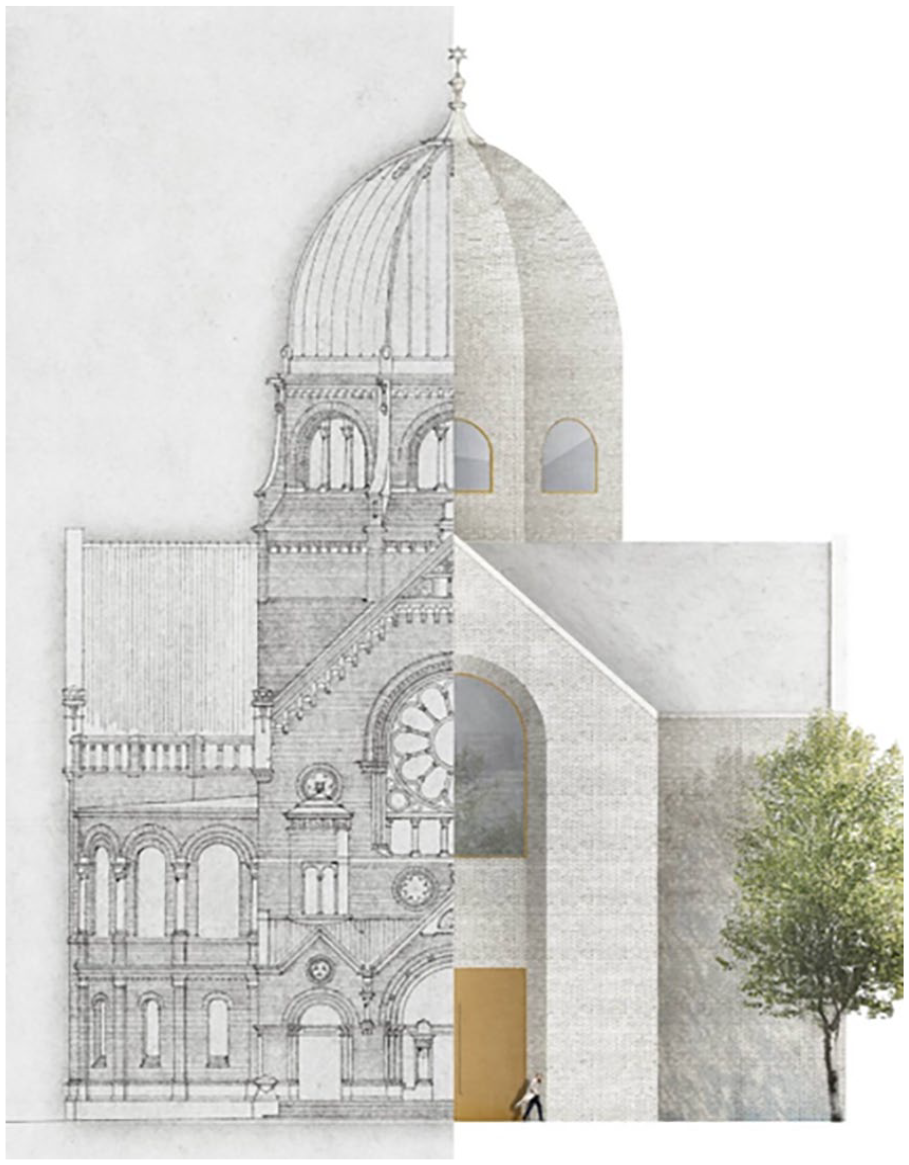
Version 3 of the feasibility study for the Bornplatz Synagogue.
‘If we want to look forward,’ today’s head of the Moses Mendelssohn Centre in Potsdam, Miriam Rürup (Körber-Stiftung, 2021, min. 50:32–39), contended in the debate, ‘we have to take everyone along in this process, and this taking everyone along involves an open and broad discussion’. A debate that wants to be ‘open and broad’ cannot limit itself to just including as many people and parties in the process as possible. Rather it must truly be open, with ultimately everyone exposing themselves to whatever the outcome of that process will be: not knowing who, or what, will eventually manage to get involved and successfully make a claim, and accepting the possibility that the outcome may eventually be other than anyone could have imagined. 25 Just to mention a few matters that turned out to be relevant: the difficult history of the Jewish community in getting back its properties was due to bureaucratic and political ignorance and unwillingness, but also to the policy of the Jewish Trust Corporation (JTC), which after the war was in charge in the British Zone of negotiating and dealing with the poor compensation for expropriated former Jewish property. In view of this body’s priority of supporting the newly founded state of Israel and encouraging migration in the first years after war, only a fractional part of the proceeds from the assets went to the Jewish communities (see Linde-Lembke, 2017; Rürup, 2021: 11–12).
Furthermore, there may be social facts, in a Durkheimian sense, but there are also material facts which need to be made facts and politically recognized in the first place. Among them are architectural artefacts, including monuments, remnants and ruins, that are prepared to give testimony of their history and to lay claim to their social relevance. As a material artefact, the Synagogue Monument may, at first glance, not appear to be a ‘vibrant matter’ (Bennett, 2010) with an appealing effect, compared to a new imposing synagogue standing there. In its material presence, the latter would be nearly impossible to ignore, and definitely guide people’s path. Yet things are not vibrant as such, an encounter between people and things is required for them to affect each other; and whether architecture ‘touches’ us (Ahmed, 2010) depends on several moments: architecture can be catchy because it presents itself in a radically unfamiliar design, while expertise may be required to fully appreciate its unique style. Especially in the case of memorials, knowledge is indispensable to substantially comprehend their historical reference, and their meaning may change over time, depending on public discourses or aesthetic concepts (Young, 1994). Hence, remembrance is never just revived, nor is knowledge just applied. Encounter always involves a singular experience (Golánska, 2020), something that happens – or takes place – in that very moment. It is in this sense that the ground mosaic’s frugality is not its weakness but its strength: to the extent that it demands immersion, demarcating a void, it also eludes musealization; 26 and once approached and acquired, it can forcefully trigger a vibrant experience. As a memorial, it is not a residue of the destroyed synagogue. It is a ‘folding’ of trauma, in Deleuze’s (2006) sense, that ‘transforms its ungraspable and inexpressible’ moments into a form (Lundborg, 2012: 241), into a marked surface, and thus renders it tangible. Delineating the footprint of the synagogue in cobblestones, it asserts itself indeed as a ‘material relict’. 27 It is a manifestation of absence that gives ‘authenticity’ to the place. Rather inconspicuously demarcating a ‘trace of extermination’, it provides a ‘contact’ point with a past that is necessarily ‘invisible’ (Deistler, 2023: 24). This apparently is also its message: that the extermination will always ultimately remain inconceivable.
The former Temple in the Hamburg Poolstrasse, in a neighbourhood where Jewish life in Hamburg once took place, and its recent past are of a similar inconspicuousness. The Temple is a relict and an embodiment of the history and presence of liberal, and notably secular (Rürup in Körber-Stiftung, 2021, min. 40:38), Judaism, not only in Hamburg. Its architecture itself, for example with one and the same entrance for men and women, provided the path for an emancipatory vision of Jewish life. As a ruin, it is today, in Georg Simmel’s (1958) sense, testimony to the evanescence of life. At the same time, it eludes a form of ‘fetishization’ (Pohl, 2022) that would reduce its complex history, for several reasons: ironic twist or not, because it had been abandoned in 1931 for the liberal Jewish community to move into a new Temple in a modern architectural style that was located in a flourishing neighbourhood close to the city’s river Alster, 28 the venerable old Temple did not fall victim to the Nazi destruction in the Pogrom Night – obviously, it was no longer considered relevant Jewish heritage (see Rürup, 2020: 49). 29 In an atmosphere of political denial and ignorance after the war, the Temple, despite its uniqueness, carved out a shadowy existence for a considerable time span. The property had been in private hands and was largely used for commercial purposes, with part of the remains used as residential buildings. Neglected and left to decay, they gradually became uninhabitable. Moreover, located in a backyard, 30 the ruin is far from being visible from the street. To prevent it from falling into oblivion, the Temple needed considerable civic commitment. Eventually in 2003, and long before ‘the dream’ of rebuilding the Bornplatz Synagogue became publicly prominent, the ruin was listed under landmark protection by the City of Hamburg (Denkmalverein Hamburg, n.d.). First indispensable support measures were undertaken to prevent its complete decay. In 2020 the city bought the property back and promised to transfer it to a utilization that would be both respectful of its history and contemporary. Today, the ruin can be appreciated as ‘memory into stone of the emergence of pluralism in Judaism’ (Rürup, 2020: 56). It thus ‘gives an idea of the former splendour and charisma’ (TempelForum, n.d.).
Conclusion
Approaching architecture through the materiality of its form and the meaning of its presence encourages us to understand the dispute over the rebuilding of the Bornplatz Synagogue in Hamburg in its existential dimension. Rebuilding after destruction and the experience of loss appears not only as a question of representation in the urban society, but also as a way of proving one’s presence: the Jewish community is there, as is its house of worship. As a ‘folding’ (Deleuze, 2006) that gives shape to a façade and produces an interior, the synagogue would embody that life. It is a material folding of space – life takes place there – but also of time: the various architectural concepts brought into play in the debate are not just readings but materializations of history, in the way they revive a past and make something happen. In this sense, considering the dynamic and shifting moments of the dispute, rather than assuming conflicting, mutually exclusive and static positions, reveals its multiple layers.
Hence, bringing the Temple’s existence and its legacy back to public awareness does not mean competing with the project of rebuilding the Bornplatz Synagogue but, first and foremost, painting a richer picture of the city’s Jewish heritage. This is a form of reintroducing the Temple into the political landscape of the present and of making it tangible. If history takes place, as Schlögel holds, it is also dispersed: different things, that may be related, happen about the same time in different places. Establishing connections in the debate also means shaping the urban landscape, once again in a very material sense: it means to accommodate quite different views as well as quite different forms of Jewish life in the urban society. What and how that society is, is itself the effect of such political interventions.
In September 2023, the Hamburg parliamentary assembly decided to return the property of the Bornplatz Synagogue to the Jewish Community. 31 Thereupon the Community, in a public act, cut up an enlarged printed copy of the historic Nazi decision of 1939 to pull down the damaged synagogue with scissors (Raawi, 2023). History is written, but it is also made in such symbolic acts where the meaning of the rupture with the rupture of history materializes. Regaining the place and giving it back its prior legal status of ownership to the Jewish Community also means closing the debate to a certain extent, it implies ruling out other possibilities. But this also opens up new possibilities. The preconditions for rebuilding the Bornplatz Synagogue are now established, the tender for the architectural competition was announced for the same year. The reconstruction and preservation of both the synagogue and the precious Temple in the Poolstrasse will, indeed, be visible signs of Jewish life being part of the urban society. But first and foremost, they make certain modes of existence, both in a cultural and an existential sense, possible. And it will depend on the urban society whether and how they will integrate the Synagogue Monument in that life.
Footnotes
Acknowledgements
The author would like to thank Valeria Vegh Weis and Alexandra Klei for helpful comments on a previous version of this article, the anonymous reviewers of this journal, and Miriam Hill for her invaluable research.
Funding
The author disclosed receipt of the following financial support for the research, authorship, and/or publication of this article: This work is part of a larger research project on ‘Caring for the Future: Architectural Heritage, Vulnerability and Collectivities’, funded by the German Research Foundation under Grant number 457229233.
