




Abstract
Due to technological innovations, the music industries have become more accessible for outsiders over the past two decades. Yet, over the same period we have seen an increasing number of popular music programmes at higher music education institutions (HPME programmes). Drawing from interviews with teachers, focus groups with students and a content analysis of policy documents at three Dutch HPME programmes, we investigate whether and in which ways students and teachers perceive such programmes to contribute to the career development of their students. Results indicate that the main benefits that these programmes are perceived to offer concern the development of a set of necessary competences, the establishment of industry relationships and the acquisition of symbolic resources. Second, we consider whether these benefits are understood to contribute to a form of professionalism. In line with the ‘normative value’ perspective on professionalism we find that a norm of expertise is promoted, and in line with the ‘power struggle’ perspective we find that these symbolic resources help to foster a professional identity, both of which are believed to help students to stand out from musicians without forms of formal education entering the market.
Introduction
Over the past two decades, the internet, social media and digital recording technologies have changed the means of production and distribution of music. These technological innovations, since about 2000, have supposedly made it easier for amateurs to enter the music industries, produce and distribute their own music, and operate independently from traditional intermediaries (Young and Collins, 2010). Yet, during the same period, many higher music education institutions embraced – often reluctantly – popular music programmes (Coppes and Berkers, 2022). For example, in the Netherlands, the first higher popular music programme (HPME programmes) started in 1999 (Nuchelmans, 2002). Currently, there are nine HPME programmes at Dutch higher music education institutions which have 3500 to 4000 enrolled students each year, 1 a trend comparable to the UK for example, although in the Netherlands such programmes seem to be more integrated in the career development strategies of musicians and are met with less scepticism than in the UK (see Everts and Haynes, 2021). Overall, this is a notable departure from the ‘informal music learning practices’ that were previously dominant in popular music, whereby young musicians taught themselves and picked up ‘skills and knowledge, usually with the help or encouragement of their family and peers, by watching and imitating musicians around them and by making reference to recordings or performances’ (Green, 2002: 5). In other words, the process of seemingly increased accessibility has been accompanied by a growing number of HPME programmes.
The apparent popularity of formal popular music education might be a response to the oversupply of musicians due to the lowering of barriers (Haynes and Marshall, 2017). This may lead musicians to enrol in HPME programmes in an attempt to gain a competitive advantage (Frith, 2007). For example, students may aim to acquire the skills and knowledge necessary to survive in the music industries, where entrepreneurial business practices for musicians have become markedly more important (Haynes and Marshall, 2017; Hracs and Leslie, 2014). Another possible aim might be to acquire the symbolic resources required to stand out in the crowd (Lizé, 2016), or to establish a network that is necessary to find work and gain access to gatekeepers (Alacovska, 2018). In other words, to understand the popularity of these HPME programmes among students, it is important to investigate the rhetoric regarding the benefits they proffer (Kenning, 2019) above entering these industries without a formal education. Therefore, in this article we explore whether and in what ways students and teachers perceive HPME programmes to contribute to the career development of their students.
Therefore we have performed a multi-method study, for which we interviewed 11 teachers, held 5 small focus groups with students in the last year of their programmes and collected 204 course guides and policy documents at 3 HPME programmes in the Netherlands. As most of these programmes grew out of the conservatories for classical music, the main focus in all of the programmes is mastery of an instrument or one’s voice in addition to song writing and performance. However, in line with broader cultural policy trends in the Netherlands (Essig, 2017), these HPME programmes are increasingly characterized by an emphasis on connecting with the labour market as they contain more courses on how to function in the labour market of the music industries and pay more attention to entrepreneurship in their courses (HBO-raad, [Council for Higher Professional Education] 2011) than used to be the case. This makes these programmes an interesting case to understand the perceived role of such programmes in the career development of their students.
In this article, we divide our research question into two parts, bringing together two lines of research. First, we map the different ways in which students and teachers perceive these programmes as helping students to prepare for a career in music. While alumni may also take on non-musical roles in the music industries, and must therefore acquire a broader range of strategies to prepare for a life of precarious employment (see Everts et al., forthcoming), in this article we focus on how they prepare for the musical part of their career. To do so, we draw from research in higher music education and higher arts education in general, offering an overview of the various advantages such programmes may offer students. Higher arts education gives students time to invest in themselves and opportunities to accrue artistic and entrepreneurial competences (Bennett, 2017; Bridgstock, 2013). They also give students the opportunity to acquire social capital (Bain, 2005; Childress and Gerber, 2015; Fine, 2017) and offer symbolic resources which help students to build a reputation as competent artists (Childress and Gerber, 2015). This article makes an empirical contribution to this literature by showing what students and teachers perceive as the benefits of formal education in the careers of musicians.
Second, we consider whether students and teachers understand such programmes as contributing to the professionalism of students. To see whether this aligns with existing perceptions of professionalism in the literature, we draw from two opposing theoretical perspectives (Evetts, 2003, 2014; Green, 2021; Schinkel and Noordegraaf, 2011; Suddaby and Muzio, 2015). First, researchers understand professionalism as a ‘normative value’ (Evetts, 2014: 35) in which workers are socialized to adhere to a certain professional norm of expertise. Second, professionalism has been framed as a ‘power struggle’ (Schinkel and Noordegraaf, 2011) in which professionals are engaged in internal struggles for dominant positions in their fields where professionalism as such functions as a form of symbolic capital (Bourdieu, 1983). By investigating whether students and teachers consider these HPME programmes help students to obtain these forms of professionalism, this article contributes to this debate (Baldin and Bille, 2021).
Next, we present research on the various ways in which higher arts education such as HPME programmes can benefit students, after which we provide a critical summary of the literature on professionalism in music and the arts.
Literature Review
The Added Value of Higher Arts Education
Research on arts and music education has identified various ways in which HPME programmes can contribute to their students’ career development. 2 To start, music students need to acquire all ‘relevant skills, experience, and knowledge needed for competent performance in one’s work roles’ (Jones, 2002: 214). First, they must improve their artistic performance by learning musical and technical competences such as ‘production, instrumental performance, vocal performance, arrangement, melody, lyric and harmony’ (Bennett, 2015: 14). At the same time, art teachers also believe that artistic skills lie ‘outside the bounds of formal education’ and thus feel they are ‘teaching the unteachable’ (Childress and Gerber, 2015: 8). Yet, while students often enter HPME programmes with a fair degree of skill, as this often is an important requirement at the audition stage for entry, research nevertheless indicates that these programmes give them time to develop their artistic craft (Childress and Gerber, 2015), as suggested by human capital theory (Towse, 2010). As such, they help students to develop their technique from a ‘primary technique, which is relatively unconscious and devoid of conventional influences, to a more fully conscious, conventional technique’ (Green, 2002: 84).
In addition, even though not all programmes do this sufficiently (Hennekam and Bennett, 2016), art programmes may improve students’ entrepreneurial performance by helping them to acquire managerial and business competences pertaining to ‘new venture creation, career self-management, and being enterprising’ (Bridgstock, 2013: 122), by offering knowledge (e.g. mental models), skills (e.g. marketing skills) and attitudes (e.g. self-efficacy) (Toscher, 2019). Such competences help students to find new work opportunities, and to become more flexible and better equipped to identify and create market niches (Bridgstock, 2013). At the same time, this might not increase students’ overall chances of success, as it does not offset the risks involved in the winner-takes-all market they will enter after graduation (Kenning, 2019). In any case, developing these competences is experienced as an important benefit of such programmes, as research shows that students and graduates perceive a strong need for such forms of entrepreneurship education (Hennekam and Bennett, 2016).
The second way in which HPME programmes might help students is by helping them to build relationships in the music industries. Higher arts education teaches them how to talk easily with other industry actors and provides a network of fellow students, teachers and connected industry actors (Fine, 2017). Eager networking can often be perceived as an unattractive trait in art fields, but connections provided through art programmes are a good way to avoid this pitfall as they enable students to build a network without ‘seeming overly careerist’ (Fine, 2017: 1476). These networks provide students with support, a safety net, business opportunities ( Fine, 2017) and resources such as ‘mutual aid, community responsibility and resource redistribution’ (Alacovska, 2018: 1584). Music students are aware of the importance of building a network in music programmes, as they believe that it helps them to find a pathway into the music industries (Comunian et al., 2014). In addition, networks offer knowledge on how to acquire resources by ‘exchanging information on employment, grants, sources of materials, housing and important new work emerging in the field’ (Bain, 2005: 37). Of course, this is not to say that higher arts education is always successful in helping students to build networks: research shows that graduates feel that art programmes ‘ought to spend more time on teaching students how to network’ (Hennekam and Bennett, 2016: 39).
Third, HPME programmes might provide students with institutionalized and embodied cultural capital that can be used as a symbolic resource to gain recognition and acquire dominant position in particular fields (Bourdieu, 1983) and to display their fitness for industry roles (Jones, 2002). First, education programmes can provide institutionalized cultural capital in the form of degrees (Towse, 2010). Such degrees allow cultural intermediaries to identify talented artists, as it signals that students have undergone processes of selection and examination and acquired the necessary competences. Therefore, to strengthen their claim of professionalism, artists often enrol in higher arts education (Childress and Gerber, 2015) because this demonstrates seriousness, a commitment to making a living in the arts and having the right expertise (Bain, 2005; Fine, 2017). Here, the level of recognition of a HPME programme affects the value of its degrees (Comunian et al., 2014).
In addition to the potential value of a diploma, research has shown that higher arts education programmes and occupational communities offer embodied cultural capital that helps artists to interact appropriately with intermediaries (Skaggs, 2019). For example, students learn how to talk about art and how to give and receive criticism (Childress and Gerber, 2015; Fine, 2017). This helps them to ‘cultivate a professional reputation rather than appearing to be a novice’ (Skaggs, 2019: 170) and to be accepted by cultural intermediaries that could help to introduce them to audiences. However, this may be dependent on the specific context: when a band is looking for a new bass player, they may not necessarily choose a popular music graduate (or even avoid them) and select the person whom they see as having the best musical skills.
In short, the literature suggests that higher arts education offers a set of competences, a network and cultural capital that helps to build a reputation and assists students at the start of their career. Yet, the question remains as to whether students and teachers perceive HPME programmes as offering similar benefits and if so, whether it is expected that these benefits will help students to gain a competitive advantage over other musicians entering the music industries.
Professionalism in the Arts
The operationalization of professionalism in the arts and popular music has been described as being notoriously complicated (e.g. Baldin and Bille, 2021; Green, 2021). Because no formal indicators can be defined that distinguish professionals from amateurs (Bain, 2005), and in popular music ‘no single characteristics separates amateur from professional musicians’ (Miller, 2018: 4), it is difficult to determine what being a ‘professional’ artist exactly entails. According to Baldin and Bille (2021), the main reasons for the lack of formal indicators in the arts are that there are no objective quality criteria, artists often engage in multiple job holdings, and formal education is often not a requirement for a career in the arts. Moreover, a sharp binary distinction between professional and amateur musicians does not sufficiently grasp the various ways in which musicians are active in the music industries (see Everts et al., 2022). Consequently, because of the lack of clear parameters, this term risks becoming ‘an empty signifier that does not guarantee quality or excellence nor signify a degree of economic and social status’ (Bain, 2005: 34). Therefore, to investigate whether students and teachers perceive these programmes as contributing to the professionalism of their students, distinguishing them from musicians without a formal degree, we draw on two different theoretical perspectives on professionalism (Evetts, 2003, 2014; Green, 2021; Schinkel and Noordegraaf, 2011; Suddaby and Muzio, 2015), and assess their applicability to popular music: (1) the normative value perspective and (2) the power struggle perspective.
First, in the normative value perspective, professionalism has been analysed from a structural-functionalist perspective, which understands professions as being characterized by specialist skills and knowledge (Schinkel and Noordegraaf, 2011). While this perspective has been heavily criticized, because ‘researchers struggled to identify occupational traits that were actually unique to professions’ (Suddaby and Muzio, 2015: 3), it is currently being reappraised (Evetts, 2014) and ‘quality of service’ and ‘professional performance’ (Evetts, 2003: 405, original emphasis) are being reassessed as important characteristics of professionalism. For example, Green (2021) showed that in hip-hop, professionalism is perceived to be connected to the quality of the produced art. Overall, this line of research indicates that professionalism may consist of a unique form of ‘decentralized occupational control’ (Evetts, 2014: 39). Here, professionalism indicates a set of professional values (Evetts, 2014) as professionals adhere to a professional ethic that shapes their actions (Münte and Scheid, 2017). Next, in order to guarantee a certain level of professional expertise, professions establish a ‘knowledge monopoly’ controlling an ‘area of competence’ (Flisbäck and Lund, 2015: 3). Furthermore, professional fields close the market and create ‘a normative value system in the socialisation of new workers’ (Evetts, 2014: 40) that articulates a norm of professional competence that governs the practices of workers (Fournier, 1999). To acquire professional skills and knowledge, workers need to follow educational programmes that offer advanced education combining theory and occupational training (Sciulli, 2007), which will grant them a special status (Evetts, 2014; Sciulli, 2007). As discussed in the previous section, higher arts education can communicate a set of informal norms with regard to the competences that professional artists should possess, and thus help students to obtain professionalism in this sense (Sciulli, 2007).
Second, from the power struggle perspective, professionalism is perceived as a symbolic resource and the outcome of a struggle about control (Evetts, 2003; Suddaby and Muzio, 2015), both for external closure and internal control and struggle (Schinkel and Noordegraaf, 2011). While according to this perspective, professionalism is not a ‘functional necessity’ (Schinkel and Noordegraaf, 2011: 70), professional groups aim to regulate markets for their own benefit (Abbott, 2014). They do so by establishing jurisdictions (Abbott, 2014) and gaining monopolies over parts of the economy by setting up professional associations, trade unions and educational programmes, thus creating boundaries for outsiders (Flisbäck and Lund, 2015; Suddaby and Muzio, 2015). Moreover, it functions as a symbolic capital in internal struggles for dominant positions in professional fields (Schinkel and Noordegraaf, 2011). According to Suddaby and Muzio (2015), professions should not be understood as ‘static entities’ (2015: 6) but rather as ‘ongoing processes of professionalization’ (2015: 6) where professionals compete with internal competitors. As such, professionalism can be perceived as being used in a struggle for distinction (Flisbäck and Lund, 2015; Schinkel and Noordegraaf, 2011). In other words: ‘what it means to act in a “professional way” is constantly at stake’ (Schinkel and Noordegraaf, 2011: 92). Here, professionalism can be studied ‘in a Bourdieusian fashion [as] processes of professionalization within autonomous professional fields’ (Schinkel and Noordegraaf, 2011: 92), as it functions as a form of cultural capital that is converted into symbolic capital (Bourdieu, 1983) in the art field (Bourdieu, 1993). As such, professionalism increases the perceived competence of artists and creates boundaries for musicians with more or less perceived competence. What makes an artist a professional requires a ‘successful claim and defence of professional status through the construction and maintenance of an artistic identity’ (Bain, 2005: 34). Education can improve students’ professionalism by providing forms of cultural capital that can be used as symbolic resources to construct such a professional identity. While trade unions and professional associations have not been very effective in improving working conditions for artists and musicians (Flisbäck and Lund, 2015), as we have seen in the previous section, research indicates that the cultural capital provided by higher arts education functions as a symbolic resource for increasing a student’s claim to professionalism (Childress and Gerber, 2015) and building a professional identity (Skaggs, 2019).
In sum, based on these two perspectives on professionalism, it is interesting to investigate whether the benefits that HPME programmes are perceived to offer are believed to assist in the acquisition of professionalism, for example by contributing to professional competence and professional status.
Data and Methods
Using a multimethod approach, data were collected at three popular music bachelor programmes at public Dutch higher music education institutions in three major cities in the Netherlands between November 2019 and March 2020. 3 Each four-year-long bachelor programme requires an admission exam and attracts 40 to 150 students per year. Within these programmes, which focus on educating musicians, students follow a main track based on their instrument or voice and song writing and performance. In addition, they can specialize in music teaching, entrepreneurship or recording/producing. A multimethod approach was a suitable method for obtaining a complete overview of the advantages these programmes may offer, as each type of data provides a different perspective which together lead to ‘more complete and corroborated results’ (Cresswell and Clark, 2017: 44).
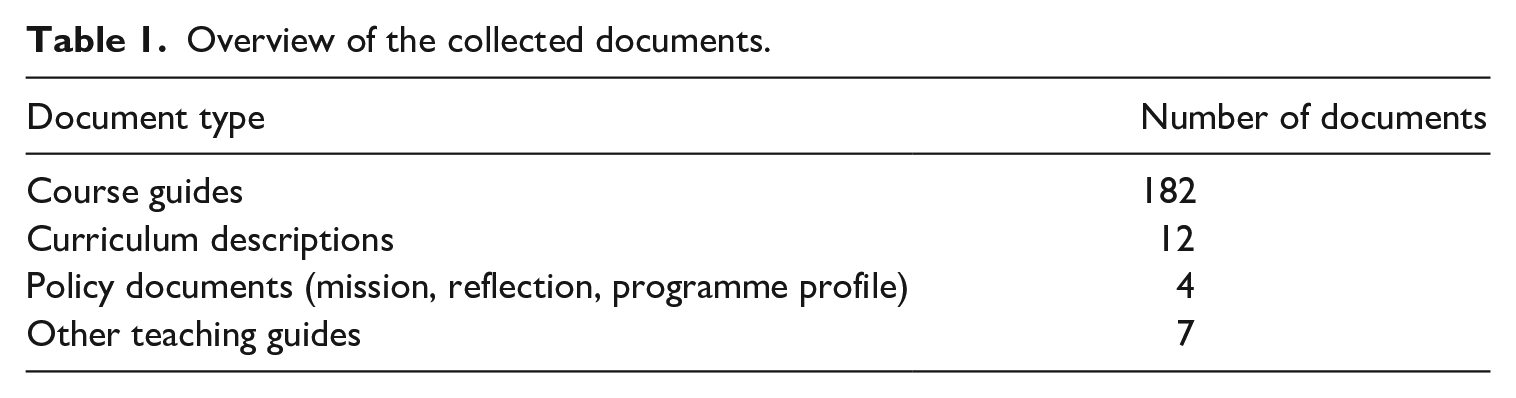
First, all existing course guides, study guides, manuals and policy documents of these programmes were collected, resulting in 204 documents. In Table 1, an overview can be found of the different types of documents that have been collected. By means of a qualitative document analysis, we mapped the existing perspectives on the current music industries, the future roles of students within those industries, and learning goals and taught competences. Second, 11 semi-structured in-depth interviews were conducted with teachers on these programmes. In these interviews, questions were asked about the competences that are taught in these programmes, for example: What is the most important thing you are trying to convey to the students? In addition, questions were asked about the other ways in which these programmes contribute to students’ career building, for example: In what ways does the programme offer opportunities to present music to the public and/or industry? Third, to learn about students’ experiences, five small semi-structured focus groups were organized with students, asking a set of questions similar to the interviews with teachers but focused on the student perspective.
Overview of the collected documents.
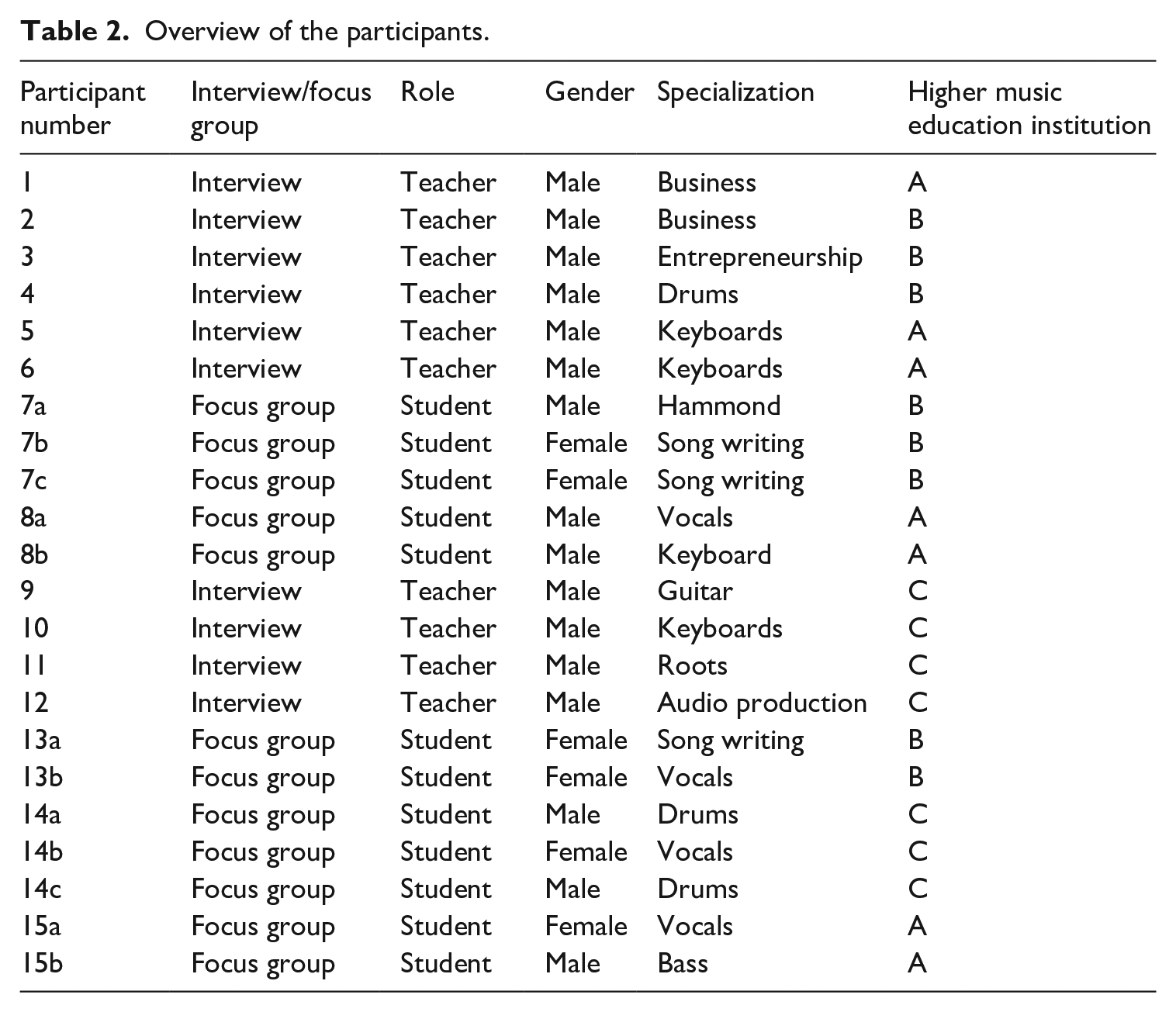
To find students and teachers willing and able to discuss these topics, all participants were approached by means of a purposive sampling approach. We first contacted the directors of education via email, asking for an introductory talk about our study. All three schools responded positively and agreed to participate in this study. All students in the last year of these programmes were invited, as they had experienced the complete programme, by means of an email written by the researchers that was forwarded by the support staff of these schools. To find teachers, the researchers directly approached all teachers who were teaching courses on the music industries and career building or more skill-based courses. For both groups we spoke to everyone who expressed an interest in participating. Table 2 contains an overview of the participants, including their role (student or teacher), gender and topical specialization. While not the main theme of the article, it is worth noting that all teacher interviewees were men and all women interviewees specialized in song writing and vocals – which is in line of a gendered division of labour found in previous studies (Bayton, 1998). All of the teachers were active or had been active in the music industries prior to joining these programmes.
Overview of the participants.
To ensure the anonymity of the institutions, teachers and students, in line with the privacy guidelines of our university, we do not provide biographical information such as participants’ names or where the institution is located. In the analysis, we refer to the interviews and focus groups by an individual case number, after which we specify their role and instrument or specialization, for example ‘3, entrepreneurship teacher’. The documents will be referred to by the letter D, followed by an individual case number.
Most interviews took place at a location that was convenient for the participants and lasted between one and one and a half hours. The focus groups all contained three to four participants per group, and all lasted between one and one and a half hours. However, due to COVID-19, three interviews and one focus group were moved online and took place via Skype. All audio was recorded and transcribed verbatim. Next, the Dutch-language transcripts were analysed together with the collected documents in ATLAS.ti version 9 by means of a thematic analysis (Braun and Clarke, 2006). During the coding process, initial codes were generated first, resulting in 2511 codes, which resulted in four main themes (competences, relationships, symbolic resources and professionalism) and 20 sub-themes that captured all relevant recurring patterns in the data.
Analysis
Based on our analysis, we will first show that a widespread perception exists that popular music programmes assist students’ careers by increasing their competences, helping them to build relationships and offering symbolic resources. We will then review to what extent these benefits are perceived as contributing to students’ professionalism.
Competences
Participants express that HPME programmes help students to acquire various sets of competences to improve their artistic and entrepreneurial performance. Even though technological innovations have made it easy for anyone to make music on their laptop (Young and Collins, 2010), both teachers and students note that one of the main benefits of these HPME programmes is that they improve students’ artistic performance. They believe that artistic skills are still important for finding work in the music industries. The first way in which these programmes improve skills is by teaching a series of creative competences in their courses, such as song writing, composing and performing as well as more elusive competences such as creativity, originality and interpretation. For example, one learning goal of a course was: ‘[a]t the end of the workshop, the student will have more tools to be able to write more creative songs with imaginative content’ (D239). Here, students are encouraged to develop a unique signature that improves each individual’s recognizability as a musician with an attractive identity that stands out in the market. Participants mention that these programmes enable students to develop themselves creatively, for example by teaching about music history, improving improvisation skills and teaching tricks and tools that students can use when writing songs. At the same time, both teachers and students also said that there is room for improvement, especially regarding more in-depth feedback on acts and their repertoires, and more focus on live performance.
Also believed to be important for artistic performance are craft-related competences related to mastering an instrument, such as ‘skills in the use of instruments and playing apparatus, possession of instrumental techniques, satisfactory technical command, level of intonation’ (D47). The shared perception is that students gain more flexibility regarding their skills and learn to think about music and writing more theoretically and technically. This is an important part of the programme, as teachers said that students are not selected on the basis of their craft-related competences, but on their creative competences: ‘we would be very sorry not to admit creative, interesting, captivating artists because they have not yet acquired knowledge in the field of theory. We are very accessible in this regard’ (1, business teacher). In this way, these programmes aim to overcome a selection bias based on socio-economic status, even though access to musical instruments and training means that applicants’ financial position might still influence their chances of being selected. In any case, craft-related competences create new creative possibilities and increase students’ employability, for example because they can perform in different genres, read sheet music and require little preparation. Here, it is interesting to note that popular music is defined very broadly in these programmes, and students learn to play different genres such as pop, rock, hip-hop, metal, funk, singer-songwriter and so on. Furthermore, competences are cultivated which make students reliable performers, as participants argue that these programmes teach the importance of being disciplined, being prepared, turning up on time and sticking to appointments: ‘you know your score, you know how the show is set up, that you are on time, all kinds of standard expectations you have here at school, you are drilled in this’ (8b, keyboards student).
Third, these programmes help students to acquire technical competences needed to turn their artistic performance into tangible products such as recording and producing, for example by teaching ‘theoretical basic knowledge of, and basic skills for, analogue and digital recording equipment, as well as with audio recording and production techniques’ (D276). As a result, at the end of their programme students can ‘record the basic things. We can often mix a bit. We can make demos’ (7b, song-writing student), although both teachers and students express that there is much more to learn here, and programmes could reserve more time for this.
In addition to improving the artistic performance of students, HPME programmes are believed to improve their entrepreneurial performance by offering business competences needed to survive as a self-employed musician. First, students are taught practical knowledge about issues like contracts, royalties, taxes and business models that they need in order to function as self-employed workers, in addition to more general knowledge about how the various music industries (live, publishing, recording, education) operate. Furthermore, both students and teachers regard marketing and networking as vital taught skills. Overall, teachers express the goal that at the end of the programme students should be able to navigate the music industries independently and be aware of the market potential of the music they are producing, or as formulated in a policy document (which was a critical reflection on the role of entrepreneurship in the concerned programme): ‘He [sic] must have an entrepreneurial attitude and must know how to promote and market himself and his music through concept development’ (D110). 4 At the same time, it remains a challenge for these programmes to constantly offer up-to-date knowledge: students feel that the programmes adapt too slowly to market change and both teachers and students complained that some teachers with permanent contracts may have outdated industry knowledge.
In addition, participants said that students acquire a set of managerial competences, which allows them to make informed strategical decisions when building their act. Here, entrepreneurial sensibilities are cultivated by teaching competences such as proactiveness, adaptability, engaging in opportunity creation, and a business attitude when negotiating contracts. Moreover, students also learn how to collaborate with colleagues, manage their team, communicate in a clear manner, cope when others are successful and deal with feedback. With regard to managerial competences, students found that there was room for improvement with regard to offering additional mental health support as they reported experiencing a great deal of stress because of the responsibility they must shoulder for creating their own success (also see Everts et al., forthcoming).
Relationships
A second way in which HPME programmes are understood to contribute to students’ careers is by helping them to build a network. For example, one course guide formulated the overall goal, saying: ‘you have a direct connection to the music industry [. . .] and you are supported by professionals from the industry, and you get the chance to build a network that can greatly benefit you in your musical future’ (D29). HPME programmes are believed to help students to build these relationships in multiple ways. To start, in addition to the fact that HPME programmes teach students how to network, they provide students with a community where they can quickly build a network of peers. This community provides numerous opportunities to find new gigs and new collaborations, both of which are believed to influence the duration of their careers. As one teacher said:
Students build a network with each other and a lot of students think that that is one of the most important things. [This] helps them a lot for the rest of their career. We don’t do anything for that, it comes naturally, that’s what we have the canteen for. (3, entrepreneurship teacher)
Moreover, participants mention that HPME programmes provide a network of teachers. Due to their experience in the music industries, teachers have connections and are often willing to use this network for the students’ benefit. For example, teachers bring students who are looking for industry representation into contact with labels or bookers. In addition, industry actors ask teachers for recommendations for session musicians. Moreover, teachers also pass on gigs to students: ‘I get requests that I can’t do myself because I’m too busy. I sometimes pass them on to students, and that’s actually the start of their careers’ (10, keyboards teacher). However, teachers feel that they cannot use the same contacts repeatedly and risk their reputation if students they have recommended do not perform satisfactorily (Fine, 2017), which means that this usage of their network may have an elite and hierarchical quality to it. Teachers only activate their network for the best students who are fully prepared to take advantage of these opportunities:
I have a large network and I think part of my job is of course connecting [students] to the network. On the other hand, of course, that network should not be burdened with nonsense. So if you send students along, they [. . .] should have done their homework. (1, business teacher)
In addition, participants reported that HPME programmes provide opportunities to meet and work with industry representatives. Teachers encourage students to take advantage of these meetings by exchanging contact details or pitching their demos, which can sometimes lead to students being picked up by these industry actors. For example, this route may lead to work playing in the bands of well-known artists:
It also happens very often that, as a result of concerts with those great artists, students get a permanent place in the band of that artist [. . .] And those guys [sic] then also stop with the programme. Quitting the programme due to success. (10, keyboards teacher)
Overall, participants consider these connections with industry insiders to be vital. At the same time, this does not mean that students believe that these programmes could not do more to help them to build a network as they argue that more efforts should be made to invite industry actors and create more opportunities where students can pitch their music to them. Nevertheless, the general perception in the dataset is that students get picked up quicker by the music industries, which makes it easier for them to find work.
Symbolic Resources
The third contribution that HPME programmes are believed to make is that they offer forms of cultural capital that students can use as symbolic resources to build a favourable reputation in the music industries. Participants mention that graduating from a popular music programme signals to the music industries that one has acquired the necessary level of artistic and entrepreneurial performance and meets the expected quality standard in the music industries. In this way, a degree from a popular music programme functions as ‘a certificate of cultural competence’ (Bourdieu, 1983: 20). Because studying at a popular music programme increases your reputation as a serious artist, students are often offered work without needing to prove their capabilities. As one student said: ‘when they hear that you have completed the [name programme] they think it will be fine’ (15b, bass student). Here, a popular music programme’s reputation shapes the way in which gatekeepers perceive its graduates (e.g. Comunian et al., 2014). For example, according to the participants, studying at a popular music programme known for focusing on session musicianship, increased the expectation that students were skilled in this type of work. According to teachers, however, what is even more symbolically rewarding than graduating and receiving a degree, is leaving these programmes prematurely because your career has already started to take off, so it is rather being selected for such programmes that offers institutionalized cultural capital, rather than graduating. Such a departure signals exceptional talent and ‘precocity’ (Menger, 1999: 551) (described by the teacher quoted earlier as: ‘Quitting the programme due to success’ (10, keyboards teacher)).
Besides its function as a certificate of cultural competence, students and teachers perceive that HPME programmes also help students to build an identity as competent musicians. Most importantly, participants report that students acquire several competences (discussed earlier under craft-related and managerial competences) which function as cultural capital that enables students to show that they are competent musicians who fit within the industry. By showing that they are active and entrepreneurial, students signify that they have the right personality and attitude to do well in the music industries, which they expect will result in more job opportunities. For example, in one programme, song-writing camps were organized in order to foster the entrepreneurial attitude required to fit into the music industries. In addition, students are taught the importance of talking about their music in an appropriate way, are socialized to use the correct jargon, and learn how to approach people. As summarized in a course guide:
As an upcoming music professional, it is important to be able to communicate clearly with all actors (fellow musicians, audience, industry) in the field. It is [. . .] important to know how and in which ways you can do this. (D141)
Overall, these communication skills help students to make a good impression. For a similar reason, the way in which students present themselves to industry actors and audiences is believed to make a difference. In addition, a teacher emphasized that looks matter. For example, he told how providing feedback on students’ clothing style is embedded in his teaching: ‘You often see them change a lot during the programme [. . .] And I’ll make them aware of that, too. That they dress a bit more like their colleagues’ (10, keyboards teacher). Furthermore, students are taught the importance of being good colleagues who are skilled at casual conversation and pleasant company on a tour. Because of this socialization, one student explained that she always aimed to act without any pretentions:
We sometimes think that it is possible to act like an ‘artist’ or have some sort of star attitude. But I always find it very annoying when people act as if they are very important [. . .] When I’m in the rehearsal space, I always think ‘Okay I’m [name] with whom you also just drink coffee or something’. (7c, song-writing student)
In sum, in addition to functioning as institutionalized cultural capital, a widespread belief can be observed in the dataset that a degree programme enables students to acquire embodied cultural capital that can be converted into symbolic capital to signal their industry fit. As a result, it is believed that students are taken more seriously by industry actors, can differentiate themselves from competitors and can fit in with future projects (Jones, 2002).
Creating Professional Musicians
Considering the perceived added value of HPME programmes in the form of competences, relationships and symbolic resources, we will now investigate whether such programmes are understood as contributing to the professionalism of their students.
Professional Musicians as a Normative Value
Throughout the data, we found evidence that these programmes were indeed expected to contribute to the professionalism of their students. In line with the normative value perspective, one recurring interpretation of professionalism in the investigated documents is that professionalism consists of having the right competences to perform industry jobs well, as mentioned here: ‘A sufficient professional level is to be understood as a level qualifying for the label “sufficient” outside the walls of the institution, i.e., on a professional stage, or in a professional situation’ (D47). This framing of teaching competences as a way to increase students’ professionalism, indicates that improving performance is an important perceived purpose of such programmes. Moreover, being a competent musician is promoted as a normative value. Earlier in the analysis we already saw that it is believed that students are socialized to adhere to a norm of expertise in order to create reliable performers, for example by setting a quality standard that they must adhere to and by benchmarking their performance by gaining actual experience in the music industries. Students experience this norm as well:
In the skills lesson you have to play it as it should be played on the radio: mistakes are simply not allowed.[. . .] and I apply that. It’s just in the back of my mind when I write a song: can it be played on the radio or is it not good enough? (8b, keyboards student)
By meeting this norm of competence, students are perceived to increase their reliability as performers, which makes them more attractive for employers as a form of risk mitigation. For example, this is why teachers aim to train session musicians who are:
Taking a song and making it better than it was. And you can learn to do this in a professional manner. In fact, I teach that here weekly to these guys [sic]. This makes them indispensable, so to speak. And that increases the chances for further gigs or connections. (4, drums teacher)
Throughout the data, this norm of expertise was expressed often and framed as a form of professionalism. For example, in several courses it is emphasized that these programmes provide the competences (e.g. music theory or reading) which function as a ‘broad basis for working and thinking in a musically professional manner’ (D86). Students also feel that they are becoming professional musicians because they have become more competent performers: ‘I feel like a professional musician [. . .] You can call me for a job and I can do it’ (13b, vocals student).
One specific aspect of this professional norm of performance is the emphasis that is placed on the importance of the flexibility of students:
A [. . .] graduated musician [. . .] is therefore ready for the current and future professional practice. He [sic] is [. . .] a professional musician, capable of performing very diverse commissions for other artists, sound studios and/or media companies. (D110)
By helping students to act in accordance with a standard of professional performance in different situations, these programmes increase their ‘quality of service’ (Evetts, 2014) and employability for various work roles. This norm of multi-employability is also connected to a sense of professionalism: ‘The professional can perform activities in various roles (mixed professional practice)’ (D24). According to the participants, this flexibility is what gives students the main advantage over musicians without a formal degree in achieving a long-term career in music, characterized by a gig economy where musicians are often self-employed and have to combine multiple jobs (Von der Fuhr, 2015):
The moment you are a guitarist in an act [. . .] and the band breaks up [. . .] Then of course the question is: how employable are you in a different context? If all goes well, our students are really employable. (5, keyboards teacher)
At the same time, participants agreed that these programmes do not teach competences that cannot be acquired otherwise, so in that sense these education programmes are not a necessary condition for finding work in the field. To start, both students and teachers believed that graduates are not guaranteed to be better performers. For example, participants said that musicians without formal education were not necessarily worse musicians and are able to obtain the same level of market success. As one teacher said:
No. Musically speaking not [. . .] Maybe [students] make more conscious choices, but that does not really matter. Someone can do all kinds of things very clumsily and still go far [. . .] We can try to make students more independent and self-reliant and those kinds of things, but that is no guarantee of success. If I look at bands or artists who are big now, it is not because they studied at a popular music academy. Per se. (5, keyboards teacher)
In other words, no knowledge monopoly has been acquired by this occupational group. In addition, as the market for music acts is capricious, it is impossible for HPME programmes to offer competences that guarantee future success. As such, no market closure has been established as the result of this norm of professionalism. Due to this lack of market control, offering competences might not be the sole reason for the popularity of these programmes. Nevertheless, students and teachers perceive that these programmes improve students’ professional performance.
Professional Musicians as a Power Struggle
Second, we have seen that these programmes are believed to help students to distinguish themselves by offering symbolic resources in the form of a degree and other cultural capital necessary to present themselves as competent musicians. In line with the power struggle perspective, in our data these symbolic functions that are used in internal struggles for dominant positions (Schinkel and Noordegraaf, 2011), are to a large extent framed as expressions of professionalism.
First, students experience a degree as an important prerequisite for feeling like a professional musician: ‘Once I have my diploma, I will feel more like a professional musician’ (7b, song writing student). Moreover, it helped to give industry actors the impression that they were professionals: ‘It might be important for people to know you’re professional, that you’ve got your shit together’ (7b, song-writing student). In addition, as discussed, participants believe that a degree makes it easier to find work as a session musician, for example. However, at the same time, participants believe that it is not wise to mention this degree in a résumé of an act, because being seen as a ‘conservatory band’ 5 is bad for your image as it is ‘not very rock and roll’ (13a, song-writing student). Therefore, the value of a diploma differs depending on which role a student pursues within the industry and which audience they wish to reach, while the institutionalized cultural capital that the diploma offers (Bourdieu, 1983) is strategically wagered depending on the context (hidden from broader audiences, but in order to acquire session-musician gigs shown to industry insiders who know its value). Moreover, a degree is required for some jobs, such as a music teacher, work in HPME programmes, or for other occupations that require proof of a higher vocational educational level of thinking. Despite this, many participants said that even though a degree might improve their reputation, it is not a necessity for a career in music: ‘. . . no it has no value. Could you do my job without a degree? Yes, you absolutely could’ (12, audio production teacher). This is also why the threshold is relatively low for students to leave these programmes if they start to obtain industry success (see also Bennett, 2007). In other words, while a degree is believed to increase your professional status, no monopoly has been created by means of educational programmes barring outsiders from the music industries, as musicians without forms of formal education still can enter the market, become successful and obtain professional status. As such, it is not institutionalized cultural capital (Bourdieu, 1983) per se that converts to symbolic capital.
However, the symbolic resources offered to students to present themselves as competent musicians were understood to foster a professional identity that functions as symbolic capital, as students acquire embodied cultural capital that signals a professional level of performance and helps them to display a professional attitude and manner of presentation. For example, in the following statement from a teacher discussing how he teaches students to present themselves during pitches, it becomes clear how this socialization process is perceived as improving professional behaviour:
We invite music publishers to come to listen to your performance [. . .] We prepare them for that. You need to be ready. You should not whine about something for a minute because you are nervous. It needs to be good [. . .] This way you teach them it is a profession. Professional business, and you need to present yourself professionally. (11, roots teacher)
This professional identity is included repeatedly in course guides and policy documents, for example as a learning goal: ‘a professional attitude as a musician in various professional situations’ (D46). As a result, this professional identity is a general expectation throughout the HPME programmes.
Participants believe that this professional identity helps students to act in a professional manner according to the expectations of the music industries and to thrive in this environment: ‘In my experience, the musicians who were enrolled in the programme are by definition more professional. They are more pleasant to work with, because they simply have the right drive’ (12, audio production teacher). For example, giving the impression that they are reliable workers and know how to collaborate and communicate properly, ensures that students are perceived as competent. As such, in opposition to institutionalized cultural capital which cannot always be used to convince audiences, this embodied cultural capital can be converted into symbolic capital as it becomes ‘unrecognized as capital and recognized as legitimate competence’ (Bourdieu, 1983: 18). As a result, this acquired professional identity can be wagered in an internal struggle over dominant positions with internal competitors in the music labour market (Schinkel and Noordegraaf, 2011), increasing one’s chances of being selected for jobs and gigs. For example, one teacher believed that, because of this ‘right’ drive, graduates end up doing more and bigger shows (12, audio production teacher). This belief was widespread, which can be seen in this quotation from another teacher who described his own experience:
I know that I am sometimes asked [for jobs . . .] because I am a pleasant person to work with. And that’s always what I tell [my students]: I always have my shit together, I don’t mind taking it a step further [. . .] I never really complain. Those kinds of things. That’s what I tell them. (10, keyboards teacher)
In sum, while a diploma can have a symbolic value, there is a conviction that the socialization process in HPME programmes teaches students to display correct professional behaviour and to communicate in a professional manner. This embodied cultural capital can be converted into symbolic capital and recognized as professional competence. This can be used by students in a process of distinction in their struggle for dominant positions with internal competitors (Bourdieu, 1993), in which an image of the professional musician is used to gain a competitive advantage and to find work in the music industries.
Conclusion
In this article, we examined whether and in which ways students and teachers perceive that HPME programmes contribute to the career development of their students. Our study suggests that HPME programmes are expected to help students to (1) acquire competences concerning their artistic and entrepreneurial performance, (2) build a network, and (3) acquire symbolic resources in the form of an identity as a competent musician (and to a lesser extent a degree). Even though it is possible to bypass cultural intermediaries and new career paths have emerged in the music industries due to increased accessibility (Haynes and Marshall, 2017; Young and Collins, 2010), HPME programmes seem to be popular with students because they are a relatively efficient way to acquire the resources they need to increase their chances of making a living in music, despite the fact that these resources might not be enough to ensure success. This can be understood as an example of a rhetoric in which the benefits of such programmes are framed as ‘competitive market strategies’ (Kenning, 2019: 119).
Overall, two conclusions can be drawn. First, in line with earlier research (Alacovska, 2018; Lizé, 2016), our findings reveal a perception of the contemporary music labour market in which work is distributed via social ties on the basis of reputation, and consequently, musicians have to invest in making a name for themselves by acquiring symbolic resources and by building relationships. Second, the careers that most students will end up having, combining different industry roles (see also Everts et al., 2022), are perceived to require a varied set of competences. As such, these findings indicate an existing rhetoric that emphasizes the importance of technical skill building for careers in music, in opposition to previous studies on visual arts and creative writing programmes (Childress and Gerber, 2015; Fine, 2017).
Next, we found that students and teachers perceive HPME programmes to contribute to the professionalism of their students. In line with the normative value perspective (Evetts, 2014), we conclude that a norm of expertise is promoted within these programmes, with a special focus on flexibility to ensure quality of service in different industry roles. At the same time, in line with the power struggle perspective (Schinkel and Noordegraaf, 2011), we found that participants believe that symbolic resources are offered to students in the form of a professional identity that helps them in their internal struggle with competitors as it signals their fit with the music industries. Here embodied cultural capital seems to play a more important and unambiguous role than institutionalized cultural capital.
By highlighting these two aspects of professionalism in popular music, our research contributes to the literature that has argued for the synthesis of both understandings of professionalism (Evetts, 2014; Fournier, 1999) as a form of functional performance with a symbolic value. Moreover, our operationalization can be seen as a next step to solve the debate on the conceptualization of professionalism in the arts. It offers major advantages in the form of avoiding a binary understanding of the professional–amateur dichotomy (Miller, 2018). In addition, this operationalization can be used to study similar dynamics in other art fields. Here, the meaning given to the concept of professionalism may reflect the specific make-up of these fields and differ depending on the role of performance in the work of artists, and the level of (internal) competition.
Future research might benefit from addressing some of the questions unanswered in this article. The rhetoric of professionalism is not uncontested, and might also contain a risk of causing self-exploitation, as it promotes self-reliance in a precarious environment (Evetts, 2014; McRobbie, 2016), potentially functions as ‘control at a distance’ (Fournier, 1999: 281), and provides middle-class status to precarious work (McRobbie, 2016). While research indicates that compared to the whole population of artists a smaller percentage of graduates earns a low income, the financial position of most musicians remains precarious (Von der Fuhr, 2015), particularly for women and people from minoritized groups (Berkers et al., 2019). Consequently, it is important to investigate whether these students actually are more successful (financially and artistically) than musicians without formal education, and the way this interacts with gender – especially in the light of the overrepresentation of men in the teaching staff. For example, the emphasis on competence building might falsely present the music industries as a meritocracy within which the ‘best’ succeed. Even though such programmes help with building a reputation and building relationships, it is not clear that these programmes bestow more advantages than, for example, playing gigs and participating in scenes for the same period of time. By doing so we can learn more about whether these perceived benefits actually pay off, or are merely reflecting industry norms, helping to reproduce prevailing inequality and precarity within the music industries and promoting self-exploitation. In other words, in addition to the perceived contributions, it is important that future studies investigate whether these programmes make tangible contributions. Key here is to include the evaluations of industry stakeholders to see whether the perceptions of students and teachers on the roles of these programmes are corroborated by industry insiders.
Lastly, more theorization is needed to understand whether the popularity of HPME programmes among students (Coppes and Berkers, 2022) can only be explained by looking at how they contribute to their students’ careers. For example, the popularity of these programmes may also be an outcome of more egalitarian cultural policies that aim to offer education in ‘popular’ art forms and not just ‘high’ art such as classical music. Nevertheless, this article presents one part of the answer by pointing out the perceptions of the benefits of popular music education.
Footnotes
Funding
The authors disclosed receipt of the following financial support for the research, authorship, and/or publication of this article: The study upon which this work draws was supported as part of the project Staging Popular Music: Researching Sustainable Live Music Ecologies for Artists, Music Venues and Cities (POPLIVE) by the Netherlands Organization for Scientific Research (NWO) and the Taskforce for Applied Research (NRPO-SIA) [grant number 314-99-202, research programme Smart Culture – Arts and Culture]. Partners in this project are Mojo Concerts and The Association of Dutch Pop Music Venues and Festivals (VNPF).
