




Abstract
In academic research on popular music, the framing by musical genres and styles such as ‘Rock’, ‘Jazz’, and ‘Electro’ often seems obvious to social sciences scholars. The history, aesthetic features, and boundaries of musical idioms are major concerns for cultural studies, and the notion that musical styles shape the professional musical landscape is commonly accepted. This article is based on a survey involving 125 respondents in French-speaking Switzerland. It combines network analysis based on musical pairings during the year before the survey, with a typical socio-economic approach to understanding the features and resources of musicians. We demonstrate that the conventional approach of classifying musicians by ‘musical styles’ is not the most effective way to understand the structure of the musical occupational group. Instead, work pairings in music, and more broadly, sub-networks that emerge within our population, effectively group musicians according to their ‘professional style’ rather than their ‘musical style’. The focus is not on playing ‘Rock’, ‘Pop’, or ‘Jazz’, but rather on performing original compositions or covers, and whether one is a unique creative artist playing concerts or a service provider performing for entertainment gigs.
Introduction
In academic research on ‘popular music’, the framing by musical genres and styles (‘Rock’, ‘Jazz’, ‘Electro’, etc.) often imposes itself on sociologists with the force of evidence, particularly when they themselves are music lovers. The history, aesthetic features, and boundaries of musical idioms are major issues for cultural studies, and the idea that musical style shapes socio-professional musical space has been discussed for decades. Our article aims to show that an idiomatic approach tends to veil another distinction essentially structuring musicians’ professional space: a ‘craftsman’ musician playing ‘on demand’ a pre-established repertoire in situations where music production is secondary (wedding, graduation ceremony, mall entertainment, etc.) or an ‘artist’ musician playing in venues where original music and musicians are the primary focus (concert hall, living art stage, festival, etc.).
After briefly presenting the literature on musical styles and network analysis and the Swiss context (Part 2), we will examine the data and the method we used to determine the collaboration network of our respondents (Part 3), present the research questions and hypothesis (Part 4), and show the results from cross-referencing the musicians’ network structure and musical genre mapping (Part 5). Subsequently, we will discuss the weight of different ‘professional styles’ (i.e. the different ways of being a musician beyond musical genres or styles) in shaping the musical network (Part 6) and show the prevalence of that typology.
Literature Overview and Research Context
Idiomatic Approach of Popular Music and its Limits
In the sociology of culture and cultural studies, popular music often prevails in a peculiar style (Bennett, 1980; Cohn, 1970; Frith, 1978; Horsfall et al., 2013; Jeffri, 2003). However, research shows the common-sense typology of musical idioms (‘Rock’, ‘Jazz’, etc.) is ever-evolving (Roy, 2022), such as Richard Peterson (1997) on fabricating Country Music or David Grazian (2003) regarding the social construction of the ‘authentic’ Chicago Blues. Other researchers have questioned the usual classification systems in the arts as they originate directly from an internalist art history approach (Di Maggio, 2011). In a meta-analysis of the idiomatic classification of music, Roy and Dowd (2010) pointed out the strengths and blind spots of such an approach to professional musical activities. Nick Crossley (2015) published critical reflections about an approach from musical ‘styles’, and Jennifer Lena (2012) demonstrated that the most relevant distinction was more between musical ‘genres’ such as avant-garde, industry, local trade, and tradition than idioms such as ‘Rock’, ‘Jazz’ or ‘Electro’. Similarly, we intend to show how musicians work together to form networks by excluding any idiomatic a priori or any preconception of musical styles as the foundations.
Music as Collective Work and Network Analysis
Becker’s (1982) theory of collective action opposes the idea of the romantic representation of the inspired artist creating their work in a studio or office. The ‘work’ is, thus, the product of multiple interactions between competing or cooperating artists, intermediaries, ‘support personnel’, and so on. This observation is valid for most of the artistic disciplines and the instrumentalist musicians who must, in most cases, collaborate with other musicians in orchestras, bands, or ‘one shot’ pairings to get gigs.
To objectify the collective work in the production of cultural and artistic goods and ‘break with the imaginary of the singularity of the creator’ (Sapiro, 2006), network analysis is – since Harrison and Cynthia White’s work on French painters in the 19th century (1965) – a tool of first choice, although little used in the sociology of art. 1 Whether they deal with ‘featurings’ among rappers (Hammou, 2009; Smith, 2006), musical collaborations on jazz recordings (Cohendet et al., 2008; Gleiser and Danon, 2003), dynamics of musicians pairing in TV orchestras (Faulkner, 1983) or music-hall world (Uzzi and Spiro, 2005), interactions within the British punk scene during the 1970s (Crossley, 2015), among contemporary British composers (McAndrew and Everett, 2015) or Britpop’s key players (Millward et al., 2017), and so on, studies on musicians using network analysis allow a better understanding of the collective logics underlying the musical activities.
Heuristically, mobilising the specific tools of network analysis requires preliminary precautions. ‘Network sociology’ covers both the visualisation of relational data with statistical tools and an entire social theory. For Gisèle Sapiro (2006), network sociology was promoted in the USA as a response to the functionalism that prevailed until the 1970s, proposing a ‘relational’ approach. By considering that ‘social structure is shaped by the interactions of individuals’ (Sapiro, 2006: 46–47), the influence of socialisation in family, school, work, and so on, is also considered secondary. This sociological trend also tends to neglect the different forms of capital (economic or cultural) and social dispositions integrated by individuals and shapes their social representation. For instance, network analysis appears to be a valuable means of systematising reflections on the weight of interactions in developing social processes, such as the effects of labelling on deviance, often observed at the micro-sociological level (Crossley, 2010).
If network data are frequently used among supporters of a ‘relational’ and individualistic vision of the social space, they can, nevertheless, be used within the framework of reflections mobilising other social approaches more sensitive to material and symbolic inequalities. This perspective is supported here. However, network analysis among artistic workers is also important because, in focusing on actual interrelations linking people rather than an a priori definition of ‘musician’ (or ‘dancer’, ‘painter’, etc.), designing a professional space with blurred boundaries becomes possible. Thus, with some basic precautions, an approach based on the interrelations between people and/or institutions located in a social space, such as the art world, also allows us to obtain reliable statistical data and results in the production of symbolic goods – a field of activity that is hard to quantify (McPherson, 2001).
Research Context: Relevant Features of the French-Speaking Switzerland
Switzerland is a small country, with one-fourth comprising the French-speaking sector. With less than 10,000 km2 area and approximately 2 million inhabitants, French-speaking Switzerland is interesting for conducting surveys: a limited size and sparsely populated. In addition, it is an appealing place for people from Europe and beyond, and one-third of the population are not Swiss citizens. The median monthly income in Switzerland is over 6,000 CHF (approximately equal Euro and US Dollar values in 2023), far above nearby countries (excluding the even smaller Luxemburg and Liechtenstein). However, the small size of this region is a serious handicap for producing and diffusing ‘symbolic goods’ (Bourdieu, 1971). Most musicians do not earn living wages from domestic gigs, and touring abroad is not as easy as in Italy, France, or Germany, which have many bands and musicians on par with Switzerland and are much cheaper. Thus, musical careers in Switzerland often depend on public (institutional) and private (foundations) support, part-time non-musical employment (‘day jobs’), and music teaching.
Questions and Hypothesis
The main research questions are as follows: Is there a clear socio-professional partition between ‘amateurs’ and ‘professionals’? Is there an ‘aesthetic’ partition of the network, organised around nuclei of ‘jazzmen’, ‘rockers’, and so on? Alternatively, can we point to other principles that are more decisive for pairings and careers, based on the differences between the material, symbolic, and institutional conditions of musical production?
We hypothesised that socio-economic inequalities in the musical milieu draw invisible distinctions between individuals and produce pairings, that is, associations that structure the network and are more important than the musical style being played, the idiom that they may refer to.
Data and Methods
The Musicians LIVES Survey: Studying the Musical Careers in Switzerland
The quantitative data analysed here were collected from the Musicians LIVES project conducted between 2012 and 2016.
Our study aimed to extensively explore the socio-economic forces determining the course of musical careers in French-speaking Switzerland (excluding classical orchestra regular wage-earners). In addition to studying the living conditions of a rather unknown population, we analysed the conditions of producing and diffusing symbolic goods in a small national territory, such as Switzerland, strongly constrained by its economic and cultural context.
National surveys are not useful for rare populations such as ours, particularly in Switzerland, where the central State is traditionally little involved in cultural action (Thévenin and Moeschler, 2018). Using an original data collection device based on the inter-individual networks of our respondents, 2 we gathered first-hand information from 123 musicians who were primarily active in the French-speaking part of Switzerland between 2013 and 2015. With a team of six field investigators including the two of us, we met 123 people with whom we conducted interviews. Following the Respondaent Driven Sampling method (Heckathorn, 1997), each interview ended with the respondent giving us a list of the musicians he or she had played with during the last 12 months.
Data were collected from the respondents regarding collaborative networks, but also training, professional habits, and career development, using life-calendars (Barbeiro and Spini, 2017). We drew the network formed by inter-individual musical collaborations during the 12 months prior to the survey. Our analysis is based on the structure of the ‘so-called’ social space of remunerated musical practices in French-speaking Switzerland (excluding a few established classical orchestras). Subsequently, we compared this network structure with the individual features of musicians and related professional types.
Collaborative Network
Prior to presenting our results, the criteria used to construct a professional musical space network in French-speaking Switzerland are explained. Electing a criterion for bounding artistic occupational groups is often difficult, as the criteria for making a ‘real’ artistic worker ‘professional’ differ according to the observer’s perspective and the national or historical context (Menger, 2010).
Two main dimensions appear to structure the sociological debate on defining the professional groups in art worlds: ‘that of the definition of the criteria of distinction between “amateurs” and “professionals” on the one hand (income, level of engagement in the activity, capital of notoriety, training [. . .])’ and ‘that of the delimitation of the boundaries between the disciplines, the styles and the aesthetic trends on the other hand’ (Coulangeon, 1999). These two dimensions crucially set our criteria for inclusion in reconstituting the musicians’ network in French-speaking Switzerland and the analyses carried out in this article.
Concerning the first point, that is, the boundaries of the professional group, different solutions exist for establishing an effective, but vague, distinction between ‘professional’ (more broadly, artists) and ‘amateur’ musicians. One should focus on those who ‘live off music’, that is, who get all or most of their income from artistic activities. This first strategy, based on an economic criterion, can be easily operationalised and is used in large quantitative surveys on producers of cultural goods. 3 However, this requires systematic data on art workers’ incomes, which are rarely detailed. In many cases, such as in Switzerland, government surveys do not include a specific section on artists or, even less, musicians. 4 Moreover, surveys based on this single economic criterion of inclusion tend to neglect most individuals who take part in art worlds to produce cultural goods but are forced to have a ‘double life’ (Lahire, 2006), a daytime job, as the professional artistic spaces are often poorly remunerative for ordinary artists.
Considering how the logic specific to the artistic field participates in delimitating a perimeter of professionalism, another sampling strategy focuses the analysis on those people who – because, for example, they have been programmed in a gallery or a concert hall (Giuffre, 1999) or they appear in art history works (McAndrew and Everett, 2015) or they have been awarded a prize (Dubois and François, 2013 – have collected marks of consecration from institutions recognised as being the most important ones. This second strategy appears to be more likely to identify artists who are recognised in the professional space and those who stand on higher levels of the pyramid. It allows us to investigate the specific modes of recognition in artistic spaces – often quite explicitly distinguished from ‘economic’ modes of recognition, especially for those whose works are in the ‘sub-field of restricted production’ (Bourdieu, 1992). However, such a sampling method tends to exclude those who gravitate away from the poles of institutional recognition but carry out artistic activities, for example, the ‘dance musicians’ in Chicago in the late 1940s (Becker, 1963).
The two strategies to circumscribe the ‘professionals’ from the ‘amateurs’ that we have just briefly presented lead to two types of reductions. First, an ‘economist’ reduction of the artistic activity, depriving it by the same token of what makes its specificity with regard to most professional activities. Second, a ‘legitimist’ reduction that gives a distorted and one-dimensional image of the artistic work, by presupposing it to be always oriented by the logic structuring the artistic recognition on the highest level. In the case of music, the ethnographic surveys of musicians with little or no recognition (Buscatto, 2007; Grazian, 2004; Perrenoud, 2007) may have pointed out this double limit most acutely, showing that ‘being a musician’ is not only about earning more than 50% of one’s monthly income from musical activities or gaining institutional and critical recognition. It is also about being recognised as a full-fledged ‘musician’ by fellow musicians, potential programmers, bar owners, the audience, and so on. According to the conception of musical activity as a collective action, ‘being a musician’ appears as the sum of interactions, for which the composition of income and the recognition by institutions of consecration constitute convenient but unsatisfactory proxies in a complex and rather unregulated professional framework.
This type of eminent relational definition can be established using network analysis tools. We systematically asked the respondents the names of the musicians with whom they had ‘collaborated’ musically – that is, with whom they had been paid to play on stage or in studio – in the year preceding the survey. Subsequently, we outlined the professional musical space in French-speaking Switzerland, including all the people whom our respondents designated as their peers. We obtained approximately 1300 interconnected individuals in the local network. Without completely exhausting the existing links (as only the people we met through the Respondent Driven Sampling survey were questioned about their collaborations), such an inductive approach allowed us to consider the logic underlying professional musical activities in the entire group.
Despite its relative flexibility, this definition of the population by collaborations is based on a certain idea of what constitutes ‘musical activity’. It considers being paid to play music with others as an indicator of inclusion in the professional group; thus, our approach tends to make collective musical activity in public or studio the ultimate yardstick for assessing professionality. This could exclude, for example, composers or beatmakers and, more broadly, those who produce music alone using digital tools (Conner and Katz, 2020; Jouvenet, 2007) and, thus, are less likely to perform on stage or work with instrumentalists. Moreover, this vision of musical activity is primarily oriented towards musicking as a collective work that our minimal criterion of inclusion carries as the fruit of a specific history. 5 Nevertheless, our ethnographic work carried out in France and Switzerland, as well as our own experiences as musicians, led us to think that playing with others for money remained the primary way to ‘be a musician’. Public performance appears to be the central activity around which the musician’s occupational identity is built in the discourses on professionality in musical schools (Pégourdie, 2016) as well as the view of the musicians themselves (Perrenoud and Bataille, 2019): playing in front of an audience is fundamental to be considered as ‘musician’.
Concerning the question of idiomatic boundaries, the most common strategy is to focus data collection efforts on a subgroup of musicians constituted a priori on a conception of musical ‘style’ (Jazz, Rock, Punk, Rap, Metal, Pop, etc.).
With an approach mobilising the tools of network analysis, sticking to such compartmentalisation appears even more damaging as ‘network analysis makes it possible [. . .] to experience segmentations or solidarities within and beyond the boundaries formalised by the effects of labelling musical “idiom”, “style” or “label”’ (Hammou, 2009). In our survey, we did not set ‘style’ as a selection criterion, being more interested in showing how the question of differences in socio-professional postures could transcend differences in musical ‘styles’. Thus, instead of limiting our sampling process, and outlining the professional space of musicians, the influence of ‘musical style(s)’ on musicians’ careers and professional conventions constitutes the following research question. To what extent do the ‘musical style(s)’ make it possible to account for the attractions – or, in contrast, the repulsions – between subgroups of musicians identified in our established collaborative network?
Regarding the quality and the relevance of our data, a last point could relate to the COVID-19 pandemic. Our data are prior to 2020–2021, raising the question regarding if and how musicians’ collaboration networks were impacted by lockdown measures. However, insight from recent surveys shows that ‘In general, the pandemic solidified the collaborative approach of interview participants’, and music-makers’ collaborative practices are fairly resilient to extrinsic shocks’ (Fram et al., 2021). Therefore, the results presented in the following section are still relevant in a post-lockdown context.
Results and Discussion
Need to Collaborate to ‘Make a Living from Music’: A Network with a Single Component
In its graphic form, a network comprises two elements: points (i.e. nodes or vertices) and the lines that connect them (i.e. links). In our case (Figure 1), the dots symbolise the musicians we met or those mentioned by our respondents as partners in musical collaborations the year prior to our interview. The lines characterise these inter-individual collaborations, mostly within the ephemeral bands. The shape of the dots provides information on the status of the individuals represented, that is, whether they represent one of our ‘seeds’ (black squares), one of our interviewees (black triangles), or whether they were just mentioned in the context of the collaborations (grey squares). Their size is proportional to the number of connections that link them to other points (their ‘degree’). The seeds were carefully selected after several months of exploratory ethnography in the local musical field. We selected profiles as diverse as possible: from a 25-year-old woman playing the trumpet and some analogue synthesisers for several experimental projects in trendy urban clubs to a 55-year-old man singing Elvis and Country repertoires in retirement homes and performing voice recording for radio advertising, from a conservatoire piano teacher who plays a large pipe organ at the church twice a month and the harpsichord with a baroque ensemble hardly 10 times a year to an ‘all-terrain’ electric bass player who performs more than 100 gigs every year in the local milieu, mostly for private parties and animation bands (weddings etc.).
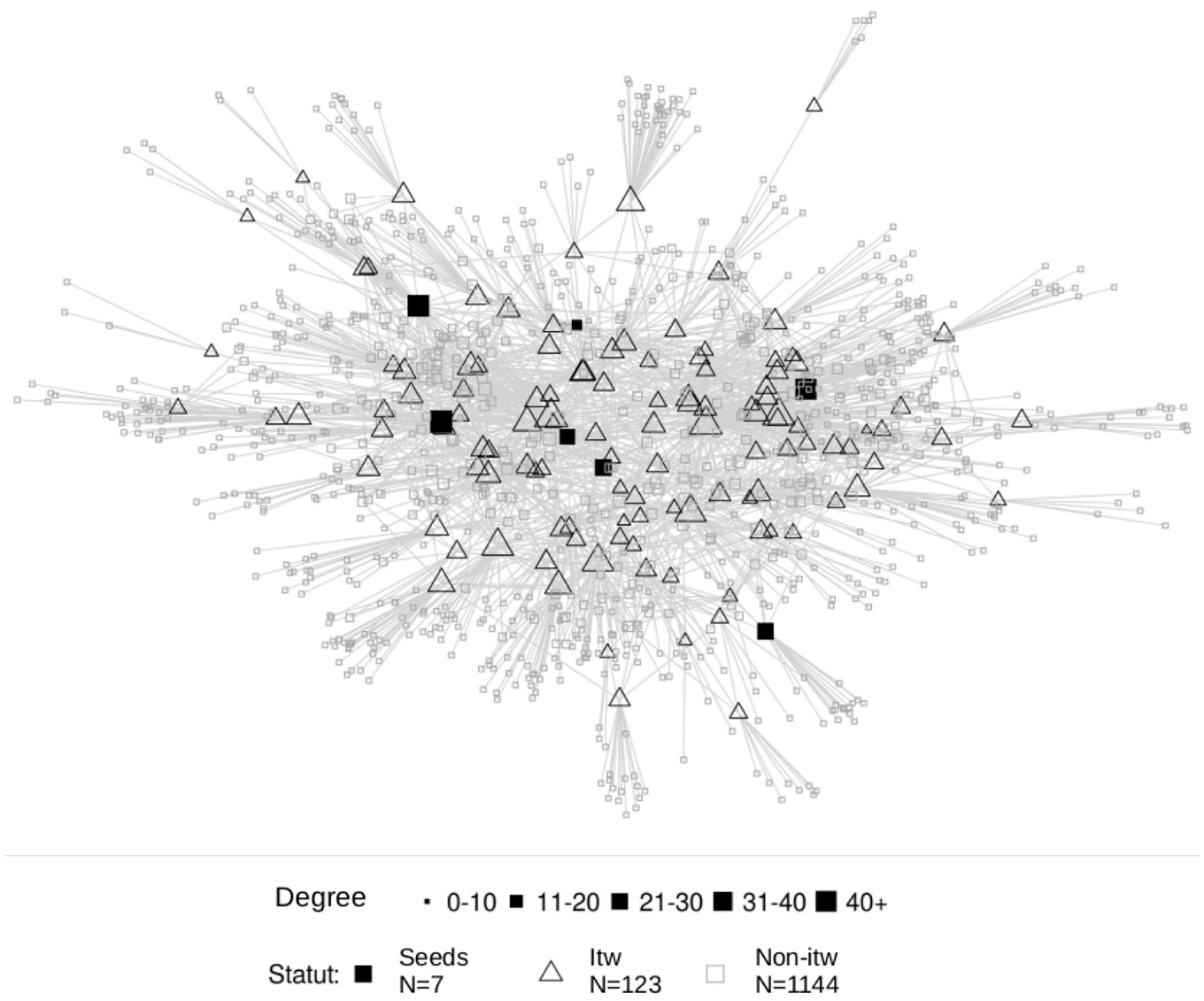
Collaborative network.
A first element is striking: the network developed from the names cited by our respondents is a single component. Thus, there is a path linking all the points represented here despite various styles and professional situations. Whether one enters this mesh of collaborations – as in our case – from a pianist/singer of international renown, a young percussionist fresh out of music school, or a guitarist accustomed to playing wedding banquets, the inter-individual networks appear to intersect rather quickly. This first remark seems to go towards the image of artistic professional spaces as so many ‘small worlds’, where ‘everyone knows each other’, pointed out in certain academic works (Uzzi and Spiro, 2005) and similarly by the individuals evolving in these professional spaces – especially in a small territory such as French-speaking Switzerland. Subsequently, a more detailed analysis of the collaborative network structure will put this first impression into perspective.
More importantly, we do not find distinguishable network components at this first level of analysis, which also indicates that to ‘make a living out of music’ (i.e. not just being an enthusiastic amateur), multiple collaborations across the board are required – relatively independent of the musical ‘styles’ that one enjoys as a listener. This result, congruent with the findings of other qualitative surveys on ‘ordinary’ musicians (MacLeod, 1993; Perrenoud, 2007), is particularly important as it challenges the aesthetic partition often used in the research on popular musicians. This seems to support the hypothesis that, despite individual musical preferences, sustainable inclusion in the musical labour market corresponds to the relative distancing of a stylistic identity and requires standing more as a competent instrumentalist with a relatively broad range of skills for more potential hiring.
If all the musicians mentioned belong to the same component, not everyone will collaborate with everyone. The overwhelming majority of musicians represented here (three-quarters) had only one or two collaborations, and the density of the graph (the number of effective links divided by the total number of potential links between all nodes) was relatively low (0.3%). Moreover, as shown in Figure 1, the professional space is organised in a concentric manner at this first level of analysis: a core group of musicians with a relatively high number of collaborators and a periphery group of more occasional associates. 6
To objectify this structure, we can show, in Figure 2, the different subgroups of individuals according to their minimal number (k) of connections that interlink their members (i.e. k-cores) (Seidman, 1983).
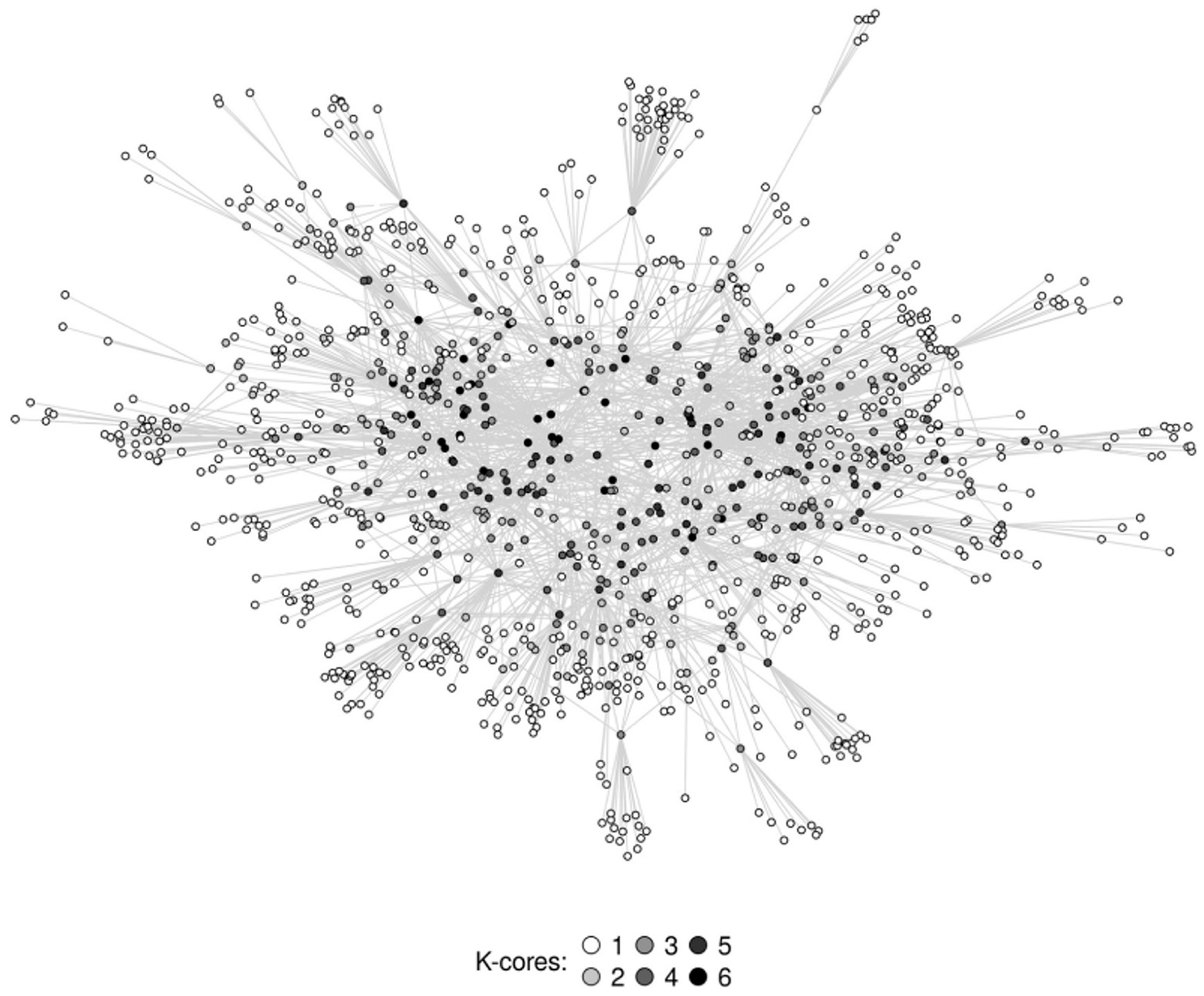
K-cores in the collaborative network (2013).
In our collaborative network, several profiles of individuals can be distinguished according to their types of k-core. Individuals affiliated with a 1-core were the most numerous (779). Fewer individuals were affiliated with the following k-cores: 143, 86, and 71 for the 2-cores, 3-cores, and 4-cores, respectively. The number of individuals enrolled in 5-cores (n=55) and, in particular, 6-cores (n=31) were even fewer. In Figure 2, the more musicians belong to a core gathering of individuals with little interconnection, the more the colour tends towards white. Conversely, those belonging to the most interconnected groups are represented by a dark colour. This gradient demonstrates the concentric structure described earlier. In the case of those we did not interview, the little available information has led us to think that the most ‘peripheral’ individuals, in white, are of two main types as follows: first, Swiss musicians who do not try to make a living from their music and play only occasionally. Second, some are based in other countries or regions (German- or Italian-speaking Switzerland) and have no strong connections with the western Swiss milieu due to geographical and/or cultural distances.
The core group allows us to identify a subgroup of individuals who are very active in French-speaking Switzerland, thus, forming the core of the local professional space.
Two Communities at the Core of the Professional Space
To study more precisely the social logic underlying pairings and links within the network, we have focused on the people most integrated into the professional space because they regularly play for pay with other musicians. This will allow us to investigate the logic leading to the collaborations and to nuance the idea that ‘everyone knows everyone’ by highlighting the important polarities that determine the elective affinities in choosing musical partners.
Moreover, the number of collaborations is not necessarily proportional to recognising one’s professional qualities. Some of the most stable and locally ‘consecrated’ musicians have the privilege to pick the more interesting and rewarding projects and, therefore, have a potentially less dense network than those who are forced to perform in multiple gigs to remain financially and professionally solvent (subbing in a singer backing band, background music for a gala evening, a symposium in a mountain resort, etc.). Some of our respondents professionally occupy a central position because they have met strong critical and public success and/or because they are closely supported by public or private institutions funding artistic creation; however, they are not the most ‘connected’ people in our network. Our reticular approach is insufficient here, as we cannot accurately assess the musicians’ ‘centrality’ in the professional musical space of French-speaking Switzerland: the network mapping tends to favour social capital, connectivity, and performing often with many different people over symbolic capital, centrality, and pairing with prestigious associates. To include musicians occupying important positions from a symbolic/institutional perspective and who can select the most profitable pairings, we opted for a minimal inclusion criterion to draw the outlines of our network’s core: having at least two collaborations in the 12 months preceding our interview.
In Figures 1 and 2, although the network core is more cohesive, it comprises different subgroups with thicker interrelations that often share the same collaborators, as represented on the graphs by zones of high node concentration. Thus, two poles appear, located to the left and right of the core, respectively, and separated by a zone where the links are relatively less thick.
To further explore the logic behind this polarisation, we analysed the characteristics of individuals with respect to their inclusion in one or another of the different communities 7 in the network of musicians, counting at least two links.
Available algorithms can detect communities within complex graphs, such as this one, and are based on different principles. In our case, the objective was to detect two or three main subspaces and not necessarily to produce a complete partition of the network. Therefore, the question is splitting the whole from the top (top-down hierarchy) rather than constituting a network map by the progressive grouping of nodes sharing certain characteristics. Therefore, we opted for a Spinglass algorithm that allows us to set in advance the number of communities we are looking for and create several simulations to make the best possible choice. Compared to other procedures, this algorithm is adapted to networks with relatively few nodes (i.e. <1000). Subsequently, a meta-analysis shows that the Spinglass algorithm is particularly useful for providing a polarised vision of small networks (Yang et al., 2016).
Figure 3 illustrates the two main communities identified within the network of musical collaborations in French-speaking Switzerland. The structure seems less concentric than in the case of the figures representing the complete network of collaborations and is organised around two sets of nodes located on the left and right of the graph, confirming the hypothesis of a bipolarisation intuitively identified as representing the entire collaborative network. Moreover, the two communities were of comparable size: 192 (including 52 interviewees) and 209 (including 76 interviewees) individuals for the communities located to the left (hereafter, left community) and right (hereafter, right community) of the graph, respectively.
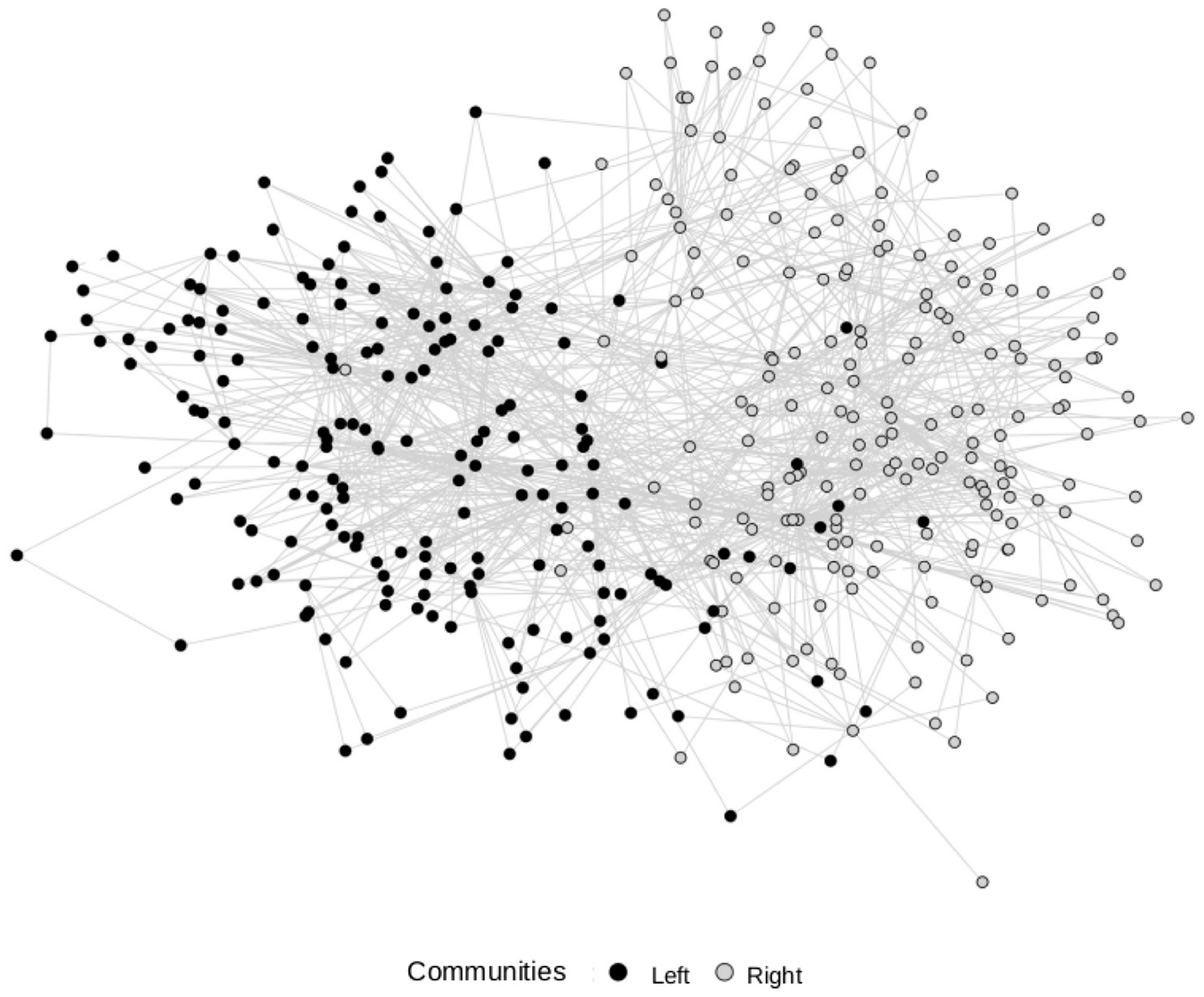
Two communities at the core of the professional space.
Beyond Musical Styles
One of our primary purposes in exploring the collaborative network was to challenge the ‘musical style’ mapping, that is, the essentially aesthetic approach of musical work generally implemented a priori in the studies on ‘non-classical’ musicians. We aimed to empirically test the relevance and limitations of such an approach in relation to problematisation, which is more attentive to working conditions and socio-professional stratification.
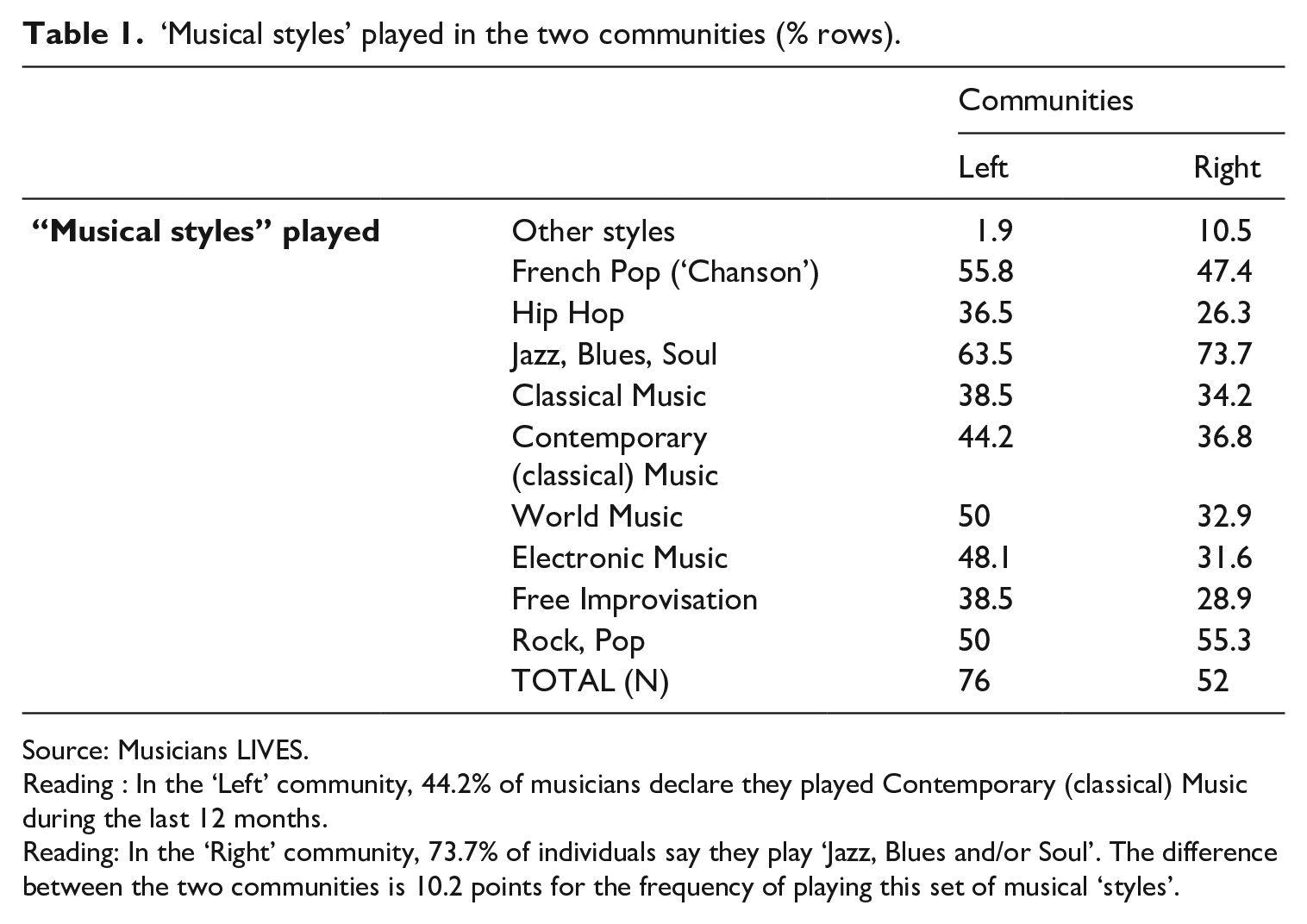
To develop these different analytical perspectives, we can cross-reference membership in either community with different variables, relating to the musical styles practised and employment and working conditions. Table 1 provides an initial overview of how our respondents were distributed in both communities (left and right) according to their musical styles.
‘Musical styles’ played in the two communities (% rows).
Source: Musicians LIVES
Reading : In the ‘Left’ community, 44.2% of musicians declare they played Contemporary (classical) Music during the last 12 months.
Reading: In the ‘Right’ community, 73.7% of individuals say they play ‘Jazz, Blues and/or Soul’. The difference between the two communities is 10.2 points for the frequency of playing this set of musical ‘styles’.
These first cross-tabulations allowed us to identify some elements that differentiate musicians registered in different communities. The most distinctive style categories are ‘World Music’ and ‘Electronic Music’ played in the left community. This is followed by ‘Jazz, Blues, Soul’ in the right community and then, ‘Hip Hop’ and ‘Improvised Music’ (more practised on the left). Musicians located in the left community play the so-called ‘serious’ music (especially ‘Contemporary Music’) somewhat more frequently (Table 1).
If the ‘musical styles’ shape the collaborative network, the aesthetic reading grid is not obvious, and the identified tendencies can appear difficult to understand at first sight. The comparative analysis of the over-/under-representation of ‘Jazz’ and ‘Improvised Music’ in the two communities nevertheless offers an interesting interpretative path. First, in the labelling commonly used to categorise musical productions, this distinction between ‘Jazz’ and ‘Improvised Music’ is not obvious; this is because ‘Jazz and Improvised Music’ is commonly used in the French-speaking world to designate musical developments inspired by the African-American music from the early 20th century. ‘Jazz’ can refer to musical forms that go from the traditional New Orleans ‘old style’ to the most unbridled free Jazz or the most virtuoso and complex contemporary forms.
The 10 categories originally proposed in our questionnaire did not distinguish between ‘Jazz’ and ‘Improvised Music’. Following the observation that many respondents mentioned ‘Improvised Music’ as a possible ‘other’ musical repertoire practised and the consequent recoding of the data collected, we created this category. Moreover, we can hypothesise that many respondents understood ‘Jazz/Blues/Soul’ as a category referring more to aesthetic forms directly influenced by relatively stable and ancient African-American musical currents (Bluegrass, Swing, Be-bop, etc.), whereas ‘Improvised Music’ referred more to the avant-garde forms of music sometimes labelled as ‘Jazz’ (especially radical improvisation, etc.).
In short, between these two categories, the two styles of Jazz are opposed relative to their degree of innovation and proximity to contemporary avant-garde. However, it also creates a contrast between the two diffusion models. For the most traditional forms of Jazz, bars and clubs are still open, but also many ‘anonymous’ gigs that provide easy background music (e.g. for a commercial event or a charity banquet). The more avant-gardist musical forms, based on the values of inspired singular creation, are more likely to be played in public-funded concert halls, in the underground artistic milieu, or possibly contemporary art venues. This also contrasts the two types of occupational identities, one oriented towards reproducing the existing aesthetic forms and repertoire, the other more willingly taking the shape of an original ‘artistic proposal’. This distinction, elaborated during our investigation, was particularly interesting. If we differentiate those types of ‘Jazz’, musicians playing traditional Jazz standards are situated on the right side of our graph (+10.2 points), while those playing more radical Improvised Music are more frequent on the left in similar proportions (+9.6 points). Notably, if they had been assembled under the same label of ‘Jazz and Improvised Music’, the inter-community differences related to both categories would have gone unnoticed.
From these variations, we can hypothesise that the respondents envisioning and practising their musical activity as a ‘creative artist’ is perhaps more frequent in the left community than in the right one. This interpretation is congruent with the slight over-representation of musicians counting ‘Contemporary Music’ in their repertoire – that is, one of the most legitimate musical forms where the musician is considered a creative artist to the point where public verdict does not affect the financing methods, which are mostly publicly funded (Menger, 1983) – in this same left community.
Similarly, to see better which types of ‘Hip Hop’, ‘World Music’, and ‘Electronic Music’ are over/underrepresented in both communities, we can analyse the most common stylistic associations and compensate for the imprecision of such generic categories. A Hip Hop song mixed with electronic music beats – and tending towards ‘abstract Hip Hop’ – does not match the same aesthetic criteria, does not have the same audience, and is not played in venues as more hardcore Hip Hop (Wright et al., 2021 8 ). Thus, analysing the co-occurrences of ‘styles’ in the individual repertoires of our respondents allows us to better grasp the variations presented in Table 1. Figure 4, thus, represents the most frequent co-occurrences of musical ‘styles’ among the musicians in both communities. Here, each ‘style’ is represented by a point. The co-occurrence of ‘styles’ (i.e. the interviewees have declared playing specific ‘styles’ in the context of their musical activities) is symbolised by the lines connecting these different points. The thicker the lines, the more frequent the co-occurrence.
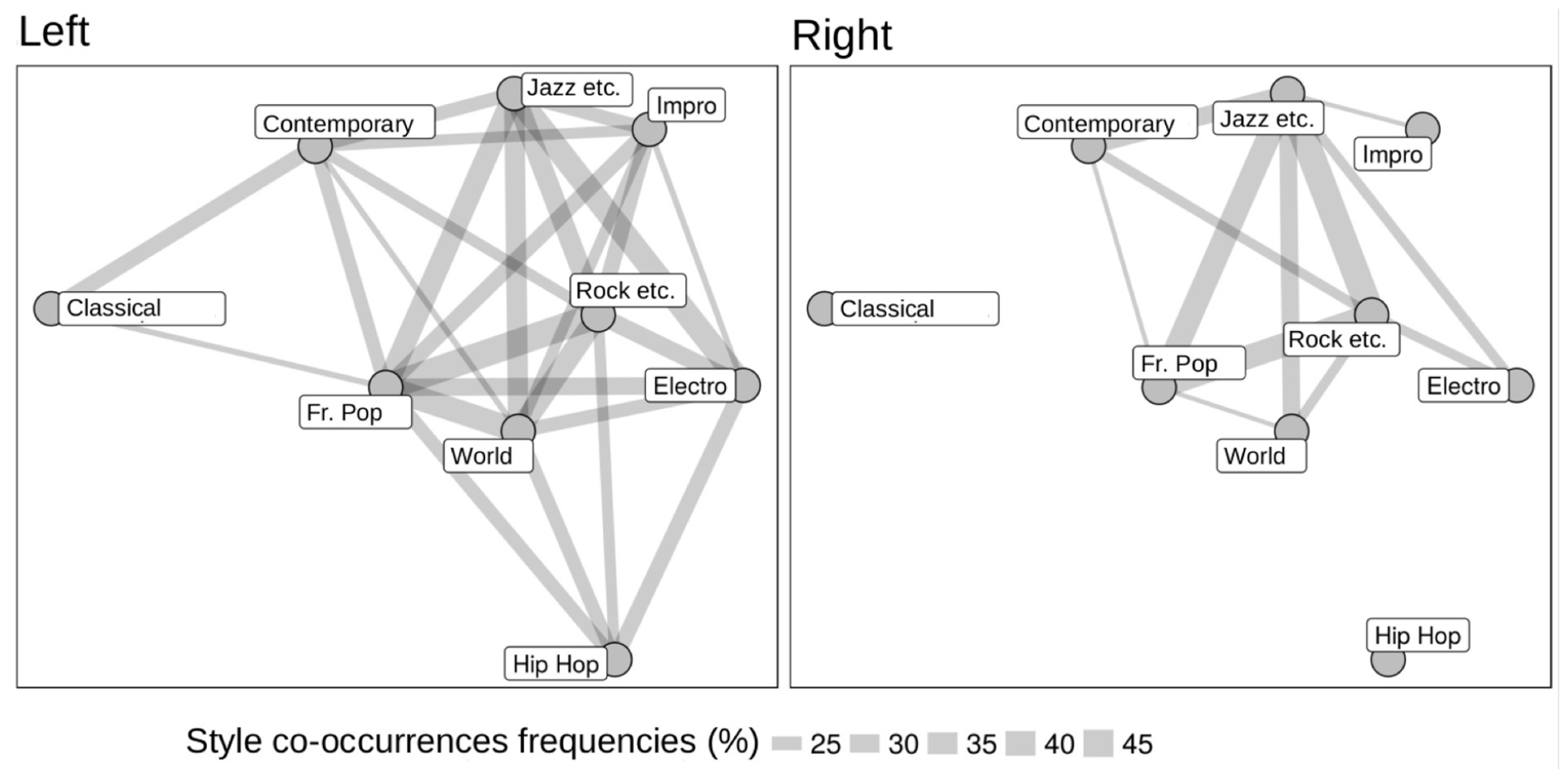
Style co-occurrences frequencies in the two communities.
In the right community, the most common co-occurrences involve ‘Rock’, music identified with the syntagm ‘Jazz/Blues/Soul’, and ‘Songs’ (in French: Chansons). Nearly 40% of the interviewees, who were members of this community, declared that they played a repertoire mixing at least two of these three styles. In contrast, ‘Hip Hop’ and music identified as ‘Classical’ are less systematically associated with other styles in this community. The same is not true in the left community, although the triad ‘Jazz’– ‘Rock’–‘Songs’ is also quite common in this community. Nevertheless, the ‘Jazz’ category was often cited by musicians playing ‘Improvised Music’ and/or ‘Contemporary Music’, that is, categories also cited by our interviewees from the left community. This first remark confirms our hypothesis of greater proximity of the type of ‘Jazz’ played by musicians of the left community to the artistic avant-gardes.
Moreover, musicians in the left community often associate playing ‘Hip Hop’ with playing a repertoire that includes ‘Songs’, ‘World Music’, ‘Electronic Music’, and ‘Rock’. The ‘Hip Hop’ played by those musicians is more often hybridised with the aesthetics from other musical worlds and not the ‘hardcore Hip Hop’ preserved and performed by certain promoters of this style (musicians and intermediaries); it is probably more impacted by the logics of legitimisation carried and implemented by the gatekeepers of the most dominant fractions of the artistic field.
Subsequently, the repertoires of the musicians in the left community more often combine aesthetic influences from different streams but mostly with a highbrow or ‘culturally legitimate’ quality. In most of those cases, playing ‘serious’ music (classical or contemporary) is associated with more popular forms of musical expression, ‘Songs’ and ‘World Music’ in particular, in which profound lyrics and/or the (exotic) authenticity of the music is part of the symbolic value of the socio-aesthetic production. This allows a comparison with certain analyses conducted on musical tastes and consumption, which, are one of the most fundamental expressions of social stratification (Bourdieu, 1979).
In the late 1960s, in France, Bourdieu’s team collected the data that would be used for the demonstration carried out in Distinction; the social gap between members of the upper and popular classes was reflected by musical tastes. In this context, consecrated musical forms (‘Classical’, ‘Baroque’, and ‘Contemporary’) can be contrasted with popular styles (‘Jazz’, ‘Rock’ but even more ‘musette’ 9 or ‘variétés’ 10 ). Contemporary research 11 has shown that since the end of the 20th century, in industrialised countries, this opposition between ‘highbrow’ and ‘lowbrow’ musical genres is no longer the ultimate marker of cultural inequalities. Demonstrating that people from the upper classes have more diverse tastes than those from the working classes, they point out that ‘cultural omnivorousness’ is a new distinction (Bennett et al., 2009; Chan, 2010; Lamont and Fournier, 1992; Nault et al., 2021; Peterson and Kern, 1996). The ‘distinguished’ listener, belonging to a fraction of the social space most endowed with educational and symbolic capital, could like the latest Ed Sheeran single playing in the headphones on their way to attend a performance of the Bach cello suites. An analysis of the musical tastes in Switzerland in the early 2000s demonstrates the same results (Tawfik, 2012): the closer people are to the intellectual professions, the more ‘eclectic’ their musical tastes, and the further the people are from this intellectual upper-middle social class position, the more ‘univorous’ are their musical tastes and the more the titles of their daily playlist are drawn primarily from the exclusive register of ‘popular’ music.
From the interpretative framework developed in these analyses of musical consumption, we can assume that by an effect of ‘structural homology’ (Bourdieu, 1992), the ‘eclectic’ musical range of styles, which is more frequently found among musicians from the left community, reflects musical careers more influenced by cultural legitimacy. That is, this frequent stylistic blending could indicate that the professional practice of musicians from this community is inscribed as ‘artistic’ by legitimising authorities (critics, granting institutions, private foundations, etc.).
A Socio-professional Polarisation
A comparison between the material and symbolic conditions of musical works among the members of both communities supports this interpretation. Table 2 cross-references membership in both communities with several variables providing information on musicians’ work conditions: total revenue, income amount from music, having a ‘daytime job’, and receiving financial support from public or private cultural institutions. Finally, the settings in which the people play (an artist in a concert, a humble service provider in an anonymous background music gig, etc.) and the type of repertoire (mostly original compositions vs mainly covers) also give a more precise idea of their way to ‘be a musician’.
Musical work and employment in the two communities (% in columns).
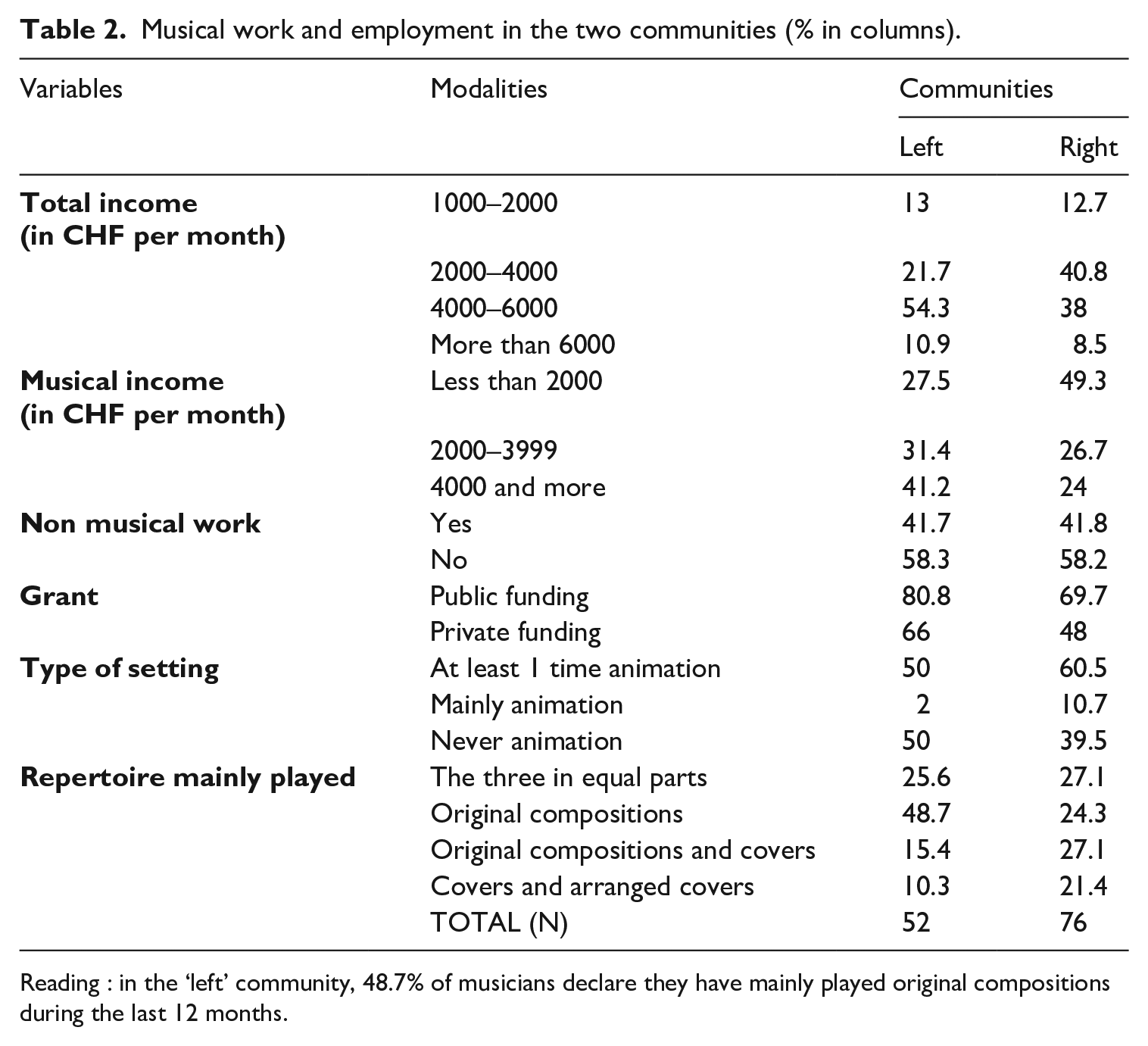
Reading : in the ‘left’ community, 48.7% of musicians declare they have mainly played original compositions during the last 12 months.
The variables related to our interviewees’ employment and work modalities differentiate musicians from the two communities (Table 2). First, with regard to their revenue, musicians from the left community earn more in the upper steps of our scale (CHF 4000 to CHF 6000 by month). 12 That is, 41.2% earn more than CHF 4000/month from their musical activities, whereas almost half of the musicians from the right community earn less than CHF 2000 from musical work. Despite these important differences, having a job outside the music field, a ‘daytime job’, does not differentiate between musicians of both communities. Nevertheless, these disparities in income amount and origin do not necessarily reflect a partition between ‘amateur’ and ‘professional’ musicians but refer more to different ways of making music in an occupational context.
Musicians from the left community receive more subsidies to support their musical activities from public and private institutions, which may also explain their average tendency to earn more from their musical activities than those from the right community. Although the place taken by public administrations supporting culture and the meaning of cultural policies differ greatly from one country to another (Belfiore, 2004; Wiesand, 2002), public power in this field often appears to guarantee the autonomy of the art world in relation to the market in most national spaces (Thévenin and Moeschler, 2018). Public institutions often appear as guarantors of the art world’s autonomy in relation to the market – at least in most of the national spaces of continental Europe. 13 Even if the political consensus around this question is relatively weak in Switzerland, the federal State (for a small part), most of all the local States (‘cantons’), and the cities have increasingly supported arts and culture since the 1980s. Private funding has also risen sharply, chiefly through fiscal tax deductions. 14 These musicians, likely supported by grants in their professional activities, tend to be identified – and, in return, identify themselves more – as ‘creators’ in the vast and heterogeneous field of musical production.
This interpretation was confirmed by analysing the following two cross-tabulations. Among our respondents from the left community, almost no musicians had anonymous background music playing as the main modality of public performance, whereas 10% of the respondents from the right community did have such a background. These musicians from the left community also were less likely to be involved in such ‘degrading’ gigs during the year preceding the survey: 50% in the left community while only 39% in the right. However, the type of music played (not the style) primarily differentiates our respondents regarding their place in the communities; in nearly 50% of the cases, the music played in the left community is exclusively original compositions. Barely 10% of our respondents from this community play only covers or arranged covers. Conversely, 24.3% from the right played their own compositions, instead generally playing a mixed repertoire, mostly composed of covers and arranged covers.
These different analyses all seem to indicate that the bipartition of our survey population around both communities implies a bipolarised professional space between, on the one hand, the musicians whose work is recognised as ‘creative’ and, on the other hand, those who play music as a professional service, aiming to ‘do the job’ rather than express one’s subjectivity and responding to the employer’s expectations. Subsequently, these two types of occupational figures appear to oppose each other. Furthermore, life calendar interviews addressing the careers of our 123 respondents indicates that there are no major changes during the careers. In other words, a musician who plays covers at 20 is very likely to still play covers at 40.
To better understand the relative importance of these different ways of ‘being a musician’ in shaping the musical cooperation network – and point out the limits of an approach based only on musical ‘styles’ – we constructed several logistic regression models. The results are presented in Table 3. Such models generally aim to test the relative influence – that is, the influence ‘all other things being equal’ – of different variables (explanatory) on another (response). We explained to our respondents the fact of being a member of the left community rather than the right. More specifically, we intended to test the impact of the musical ‘styles’ (‘Rock’, ‘Jazz’, ‘Hip Hop’, etc.) played in relation to other variables linked to working and employment conditions. That is, we attempted to study the impact of differences in professional manners (ways of being a musician) on elective affinities for people who play similar ‘musical styles’. In the first stage (Model 1), only the variables related to ‘musical styles’ played were activated to account for the impact of such styles on the constitution of both communities. Similarly, in the second stage (Model 2), only variables related to working and employment conditions were included. Among the different variables presented in Table 2, only income levels (total and musical), allowance of a grant, and type of repertoire played (compositions or covers, regardless of style) were retained 15 . Finally, in the third stage (Model 3), we introduced all variables considered in the two previous models to understand their relative influence on professional pairings.
Relative odds of belonging to the left community compared to the right community (logistic regression), with significance gradient (*, **, or ***).
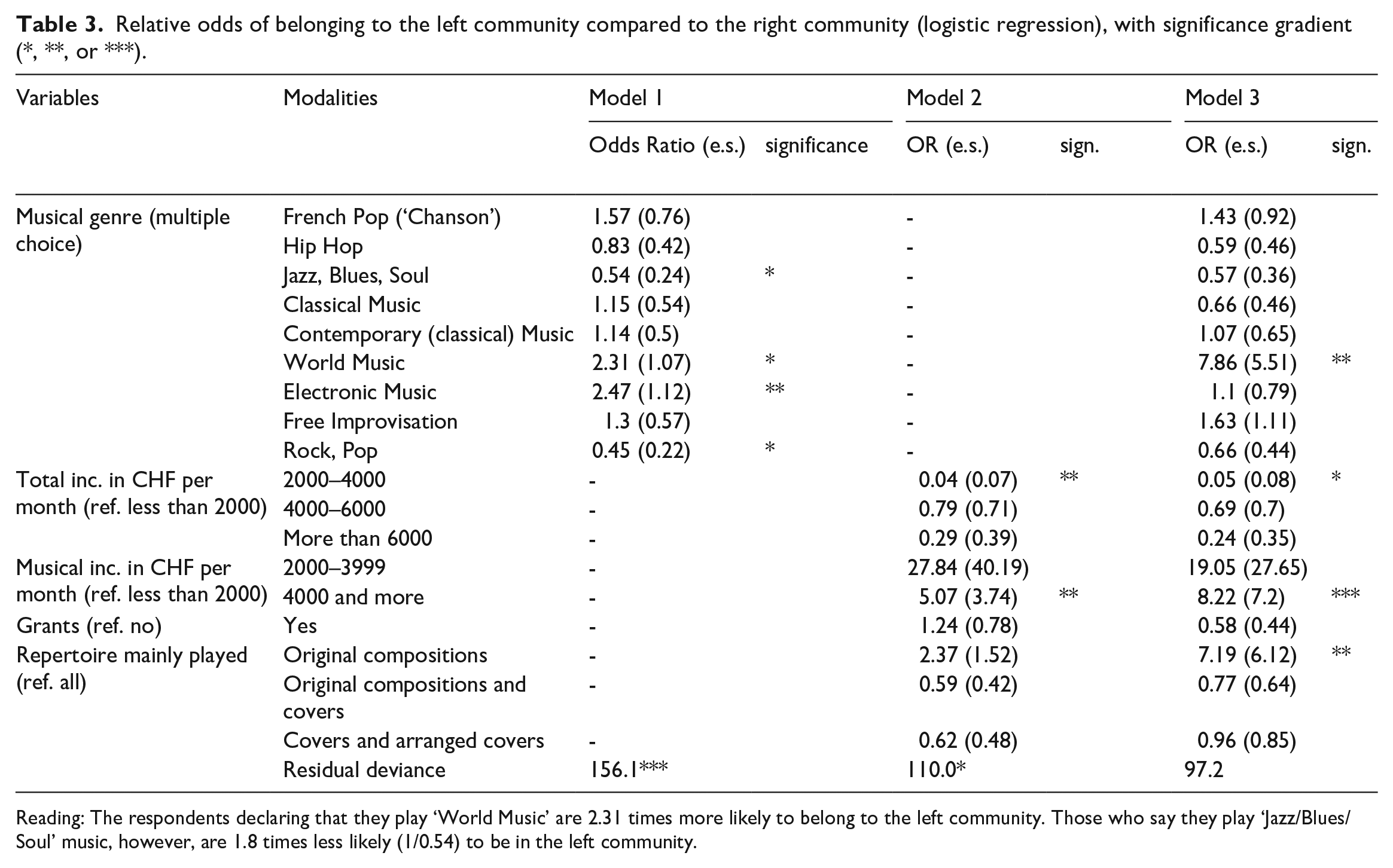
Reading: The respondents declaring that they play ‘World Music’ are 2.31 times more likely to belong to the left community. Those who say they play ‘Jazz/Blues/Soul’ music, however, are 1.8 times less likely (1/0.54) to be in the left community.
We begin with the last two rows of the table, which provide information on the quality of the different models regarding the enrolment of musicians interviewed in both communities. The R2 expresses the percentage of variance explained by the model. The closer it is to 1, the more complete the model is in terms of providing insight into the trends in the population studied. This R2 increased slightly between Models 1 and 2 but not between Models 2 and 3. This initial observation suggests that Model 2 does a better job of ‘explaining’ the variations in membership in both communities than Model 1 and that Model 3’s contribution is relatively weaker in this respect. That is, the work and employment conditions (Model 2) seem better suited for describing the distribution of our respondents between both communities than the musical styles they play.
The residual deviance (residual Df) shows the data not explained by the model. In Model 1, this residual information was too important to rule out the hypothesis that other variables were involved in guiding the trends detected by the analysis. In Models 2 and 3, the significance of the residuals was low and negligible, respectively. This result confirms and completes the previous analysis: Model 3, which includes both the styles played and the variables related to the modalities of musical work (type of venues, level of income, grants, etc.), is most likely to provide a satisfactory overview of the logic underlying the enrolment of our respondents in the left community rather than in the right community.
Subsequently, the results were analysed. The trends are signified by odds ratios, which express the relative chances of belonging to the left community rather than the right community. If the odds are greater than 1, the modality has a positive influence on being a member of the left community (compared with the reference modality chosen). If the odds are between 0 and 1, the opposite is true; the closer the odds are to zero, the more often the modality in question is present in the left community than in the right community.
In Model 1, we see that the most important trends identified through cross-tabulations are confirmed: musicians who declare playing ‘World Music’ or ‘Electronic Music’ are 2.31 and 2.47 times more likely, respectively, to be in the left community than in the right. Those who play music identified with ‘Jazz’ or ‘Rock’, however, are more likely to be in the right of our network of collaborations. In Model 2, the modalities that seemed to have the most weight on membership in the left community were those related to income. The highest incomes – and the highest musical incomes – characterise musicians from the left: they are 5.04 times more likely than their counterparts from the right side to earn, on average, more than 4000 Swiss francs from their musical activities (reference modality here being 2000 Swiss francs). Model 3 reveals several important results. First, once the impact of working and employment conditions is controlled, the effect of the ‘styles’ played on the left/right community almost completely vanishes (merely the fact of playing ‘World Music’ seems to differentiate our respondents from the left). Second, the introduction of the modalities related to the musical styles played brings out the importance of the type of repertoire – and especially, playing more often only original compositions rather than ‘mixed’ repertoires – which distinguishes our respondents of the left from those of the right. This last result is particularly crucial because it indicates that even when they are classified in comparable stylistic categories (Rock, Jazz, Pop, etc.), positioning oneself as a ‘creator’, or not, determines the professional musical collaborations.
Conclusion
Not the musical style (a rather rough categorisation, as demonstrated), but it is more the ‘style’ of appropriation of the musical material (e.g. integrating more, or less, the codes of ‘artistic creation’) and, more precisely, the ‘socio-professional style’ to which it refers that determines the musical partnerships between similar musicians. This professional style refers less to aesthetic conventions framing musical forms than to the ‘lifestyle’ according to Bourdieu (1979), defining the material and symbolic logics shaping music production and a material and symbolic framework in which they deploy their whole life (tastes and cultural practices, outfit and corporal hexis, political opinions, consumption, ways of talking, relation to time and space, etc.). Consequently, the material and symbolic economics of lifestyle inform us about the structure of the occupational space, more than musical styles.
Thus, our analyses indicate that the bipartition of our survey population around both ‘communities’ constitutes a bipolarised professional space between the musicians whose work engages their individual ‘artistic creativity’ and those who play music in a professional framework as a service job, primarily aiming less to express one’s singular creativity than to ‘do the job’ and to fulfil the employer’s requirements. In both communities, the two types of professional positions oppose each other. On the one side, the autonomy and ‘intrinsic utility’ (Becker, 1982) of art for art’s sake, producing composition, artists playing music for its own good; on the other side, reproduced musical covers, heteronomy, and the extrinsic utility of ‘function music’ (Umney, 2016), as any service providing job. If the musical style also seems to orient collaborations, its incidence is subordinated to this material and symbolic dimension of the musical work. One finds there the two great archetypes of the social figure of the musician that appear regularly in the scientific literature since Becker’s founding works until the most recent field investigations.
Footnotes
Acknowledgements

Funding
The author disclosed receipt of the following financial support for the research, authorship, and/or publication of this article: The musicians LIVES project was part of the National Competence Centre in Research LIVES: vulnerability, life course perspective, funded by the Swiss National Scientific Fund.