



Abstract
Artists both desire and dread reviews of their work by media critics. This article draws upon 66 interviews with Swedish novelists in order to examine their experiences of being publicly reviewed. A ‘successful’ reception creates resonant experiences that can be examined on two levels. On the level of interpersonal responsiveness, the authors’ longing to be genuinely understood through the engagement of others with their work is occasionally reciprocated in the reviewer’s reading of their work, resulting in a profound sense of mutual understanding and resonance. In the second dimension, abstracted positioning of the success of the reception is done using indicators of the importance of their book in literary life. The sense of achievement and prestige of having published something important creates resonance and connectedness to the world of literature. The article suggests that artists, through the reception of their works, can be either resonantly or non-resonantly engaged with reviewers’ reading and the indications of their works’ importance.
Introduction
Many newspapers have cultural sections that include reviews of new films, theatre plays, music, video games, art exhibitions and books. Such reviews play a crucial role in shaping the public reception of these works of art, acting as intermediaries between cultural production and consumption. Reviewers engage in position-taking and power struggles, and through their evaluations they attempt to define and claim legitimate art (Bourdieu, 1993). For the artists, being publicly reviewed in newspapers is a test of the worth of their work and their standing in the art world.
This article investigates the experiences of reviewed novelists, who feel they are in an unstable social position due to constantly needing recognition of their artistic self through the evaluation of others. This instability comes from the lack of clear standards for evaluating the quality of works of fiction and the weak professionalisation of being an author (Anheier and Gerhards, 1991; Fürst, 2018; Janssen, 2001; Karpik, 2010; Menger, 2014). Consequently, authors grapple with the perennial problems of aesthetic uncertainty – i.e. the quality of their work – and status indeterminacy – i.e. their standing or reputation in the literary world – (Anheier and Gerhards, 1991). Reviews are crucial to addressing these uncertainties. They are, therefore, both dreaded and desired by authors, as they can influence authors’ understanding of their work, self-image and prospects of future career development.
This article examines authors’ experiences of being reviewed by critics using 66 interviews with Swedish novelists. While authors may use strategies to advance their positions through competition, such as gaming for reviews, this article primarily focuses on the experience of receiving reviews. In this article, the authors’ review experience includes whether or not they have been reviewed in a particular newspaper, where they were reviewed, how many times they were reviewed, who reviewed them, whether it was a positive review and if the reviewer understood the book. By empirically analysing how the authors respond to these aspects of being reviewed, the article develops a framework to understand the authors’ orientations and experiences of being reviewed.
In the framework, two levels are explored that address the unstable social positions of authors. First, the interpersonal level involves a personal and singular form of responsiveness, where the authors long to be understood through the engagement of others with their work. A reading from the reviewer that conforms to the intention of the author creates resonant experiences among the reviewed, validating their position and the value of their work. On the abstract level of positioning, the value of their work and their reputational standing are gauged by, for example, the rankings of the newspapers reviewing their work and the ratings in reviews that show the importance of their book in literary life. For authors, the sense of achievement and prestige of having published something important creates resonance and connectedness to the world of literature. The interpretation and experience of the reception of their books are influenced by their orientations and commitments regarding their style, focus and approach to art, which determine what is achievable within artistic life. This study thereby contributes to scholarly discussions about the quantification of the self (e.g. Mau, 2019) and the engagement between people and things (e.g. Benzecry, 2011; Felski, 2020; Thumala Olave, 2020). By offering a perspective that includes quantification and engagement in the experience of being evaluated, the study offers new knowledge of how artists navigate the consequences of evaluation of their art in the media.
The article will begin with a field description of cultural criticism in newspapers, addressing the shifting media landscape, the crisis discourse of criticism and the work done by reviewers. While recent research does not focus on the artists being reviewed in public, it presents the context in which authors are reviewed. The theory section then conceptualises the abstracted and interpersonal reception levels, drawing on sociological research about resonance, social responsivity, engagement, quantification and valuation. The method section details the two data collection waves, where the second wave further explores the developed conceptualisation. The analysis section presents the authors’ experiences of being reviewed by using examples from the interviews and analyses their meaning to the authors studied. Lastly, the article discusses the implications of the experiences of being reviewed and the usefulness of the developed conceptualisation for understanding the consequences of public cultural evaluation more broadly.
Cultural Journalism and Book Reviewing
The recent research about book reviews focuses on the practices of reviewers and changes in the media landscape that may affect the number of reviews published, classifications in the reviews and how authors may respond to them.
In terms of the media landscape for reviews, fast-paced online media and the decline of printed newspapers have brought about a ‘crisis of criticism’ – at least within public discourse – and are threatening the dominance of traditional reviewing (Chong, 2020; From, 2019; Hanrahan, 2013; Kristensen and From, 2015; Petzold, 2021; Purhonen et al., 2018; Riegert et al., 2022; Sarrimo, 2017). Some earlier research, however, suggests that conventional highbrow cultural critique has not been so badly affected by these changes (Verboord, 2010; Verboord and Janssen, 2015). Nevertheless, the forms of artistic legitimation used in reviews depend on the unique cultural classification systems of each country and may therefore vary (van Venrooij and Schmutz, 2010). However, more recent research across several countries reports contrary tendencies. Studying cultural sections in newspapers from the last five decades in Europe, Purhonen et al. (2018) identify a trend towards legitimating popular culture and popularising traditional legitimate culture (see also Riegert et al., 2022). This cultural shift weakens the traditional distinction between ‘highbrow’ and ‘lowbrow’ culture and may also affect the assigning of status according to the public assessment of culture. Nevertheless, amateur reviews have been associated with resistance to the symbolic violence of the dominant taste and mechanisms that stabilise cultural value in society (Fürst, 2019a; Schwarz, 2016). While the content and role of reviews may have changed, there has been no significant decline in reviews in Swedish newspapers (Riegert et al., 2022).
Kristensen and Riegert (2021) find that cultural journalism, affected by globalisation, digitalisation and conglomeration, has become more streamlined and similar to other news. Elements of cultural journalism have also entered into regular news reporting as a ‘cultural filter’ that includes subjective opinion, interpretation and analysis (Kristensen and Riegert, 2021; Riegert et al., 2022). Cultural journalism’s distinctiveness and authority, therefore, seem to be under threat (Chong, 2020; Kristensen and Riegert, 2021; Purhonen et al., 2018).
The suggested rise of the ‘cultural omnivore’ and cultural eclecticism proposes a blend of amateur and expert evaluation. Amateur evaluations are associated with spontaneous reactions, while expert evaluations gain legitimacy through external criteria, including knowledge of the work’s significance in art history and familiarity with the artist’s previous performances (Hutter, 2013). This distinction between expert and amateur aligns with the ideal type of the expert critic as an appraiser of works, and the layperson as relating to books through closeness and vulnerability (Steiner, 1979; Hanrahan, 2013). While this distinction has always been an ideal type, the new media landscape pushes reviews to include both types of assessment. The blending of these two forms of assessment suggests that authors need to better handle being reviewed through external evaluation criteria and reviewers’ closeness and engagement. Hence, this distinction relates not only to the content of reviews, but also parallels the levels explored and developed in this text.
From the perspective of reviewers, Chong’s (2020) seminal study of book reviewers in the USA shows that they need to handle the initial uncertainty about what a review should look like, what it means to be a reviewer, the quality of a book and how people will be affected by the review. The review creates a book’s public meaning and worth. Critical consensus is reached through ‘a detectable minimal level of agreement about a book’s worth or quality’ (Chong, 2020: 54, italics in original) that affects its status. Reviewers are sometimes also authors, which creates a tension where a ‘good’ or ‘bad’ review may have consequences for the books of a fellow author. A review can also be affected by the status of the author, for example, some reviewers ‘play it nice’ for new authors or because of their experiences of getting bad reviews themselves, while other reviewers do not hold back and give bad reviews as they see it as part of their job. If the book is a ‘big book’, such as those by superstar authors, it is guaranteed to be reviewed, which reproduces the status structures in the literary world.
Introducing new books of an uncertain aesthetic quality is particularly difficult (Karpik, 2010), and one way of handling this is to invent a unique aesthetic label for the book under review (Santana-Acuña, 2021). Similarly, in the visual arts context, the complexity of ‘multivocal’ works may be reduced by using agreed-upon spatial metaphors, thereby reducing the uncertainty of classification and interpretation (Wohl, 2021). Reviewers’ work thus involves determining the quality of work, controlling their own and others’ statuses and handling the complexities of communication. These issues all relate to the reviews published and affect the responses made by the interviewed authors.
This article addresses the experiences of those whose work has been reviewed. The levels presented belong to the function of media literary criticism as a way of informing the public about publications, critically engaging with the content of the work and relating it to existing literature and trends. While the reviews are published in a literary public sphere, they can also be understood as a form of communication, where the reviewer responds to a book in public and the author responds to the review in private. Nevertheless, the state of literary criticism, with the perceived threats to its autonomy, affects how reviews are experienced and the status of being reviewed and assessed in public.
Abstract Positioning and Interpersonal Responsiveness
This article establishes a connection between two levels of responding to being reviewed, as well as between general sociology about contemporary society and research about cultural consumption and production.
The presentation of the conceptualisation will also be discussed in relation to Heinich’s (2020a, 2020b) notion of valuation and will cover measurement (through comparison), attachment and judgment. Authors or other artists thus relate to a public cultural assessment, in the form of a review, by implicitly asking whether their work is of importance to cultural life: if they were reviewed, where and how many times they were reviewed, by whom and with what outcome.
The Abstract Level
Competition is ingrained in many aspects of social life (Boltanski and Chiapello, 2005; Bröckling, 2016; Mau, 2019; Stark, 2020), with both manifest and latent expressions of the outcomes of this competition. Social life becomes a battlefield where people struggle for recognition in a system that benefits dominant groups (Bourdieu, 1984, 1996). In the creative industries, the outcomes of competition between individuals become the hallmarks of careers. Artists may gain an advantage by having a competitive edge (Menger, 2014: 104) and by monitoring other artists in order to position themselves and know their worth (Aspers, 2005). However, it is usually not possible to achieve a resonant experience while competing with other people (Rosa, 2019: 202). In contrast, authors being reviewed are not directly competing with each other. While they are using strategies to elevate their position, they are also responding to a review of their work from the world of literature that informs them about what they have achieved. Authors use such indicators as heuristics to abstractly position their work’s standing and their sense of self-worth. This process is an abstracted interaction between themselves and the response from the literary world, which is gauged through the positioning of their work.
The number of reviews where the book was reviewed and rated as ‘good’, ‘bad’, or ‘neutral’ are examples of such indicators. Authors rely on reviewers as a source of expert opinion (Heinich, 2020a, 2020b) and use it to measure the importance of their work. Usually, the value of cultural goods is measured through indicators codified in stars, awards or numbers, and the value is reduced to the quantified measures available (Heinich, 2020a, 2020b). However, in the absence of any formal rating (e.g. stars) or ranking (e.g. lists) in the review, authors need to interpret reviewers’ assessments by identifying latent indicators of their work’s standing that signal the worth of the artist. This signalling is also used by audiences and peers to understand the reviewer’s assessment of the work and the artist’s standing.
The tension between the orientations of authors and the abstract level of reception may create dissonance and resonance. As the response is based on an interpretation of an abstracted assessment of the reception that positions authors’ work in ratings and rankings, the outcome of this exercise may be satisfying, disappointing, frustrating, or create gratitude that relates to their work having achieved a certain impact and prestige. This achievement thus relates to authors’ standing in an artistic hierarchy and the legitimacy of their work as established by reviewers, rather than explicitly addressing the result as an outcome of an explicit competition.
The Interpersonal Level
While most people gauge the impact of their work through various indicators, how can one identify and understand the more corporeal love for and engagement in cultural goods, performances and projects? The concept of engagement is important in current scholarship about attachments to objects, including research on actor-network theory, such as the attunement to or ‘love’ for books (Felski, 2020; Thumala Olave, 2020) and opera (Benzecry, 2011). Rather than understanding engagement as a form of distinction (Bourdieu, 1984), people’s corporeal experiences from engaging with an object or person are a primordial form of attachment, attraction and connectedness to cultural forms (Benzecry, 2011; Felski, 2020; Heinich, 2020a, 2020b; Hennion, 2001, 2007; Thumala Olave, 2020).
The interpersonal level of reception is about a mediated yet undifferentiated relationship between the artist and the critic. This is a form of interpersonal interaction where the artist is able to take the perspective of the critic and sees that the critic has been able to take the perspective of the artist when reading the work (see Mead, 1934). This form of interaction may result in successful role-taking, which gives the author a sense of a shared understanding of the work, as the author feels that the reviewer ‘understands’ the book. When feeling understood, the author perceives a social bond between the author, book and reviewer.
Comprehending the review experience of authors and artists more generally is not to subsume them into two either/or categories. Instead, the authors deal with a compounded experience of being reviewed, with multiple levels of interpretations that determine whether or not they feel recognised and understood.
Hence, these levels do not only differentiate between formal or quantitative (the number of reviews, the status of the newspaper, ratings, etc.) and substantive or qualitative (the content of reviews and critiques) aspects of being reviewed, but theorise how these aspects are part of the overall review experience and used to, at least temporarily, solve the perennial problem of uncertainty about the worth and quality of artists’ work.
Experiencing the Successful Reception Through Resonance
As mentioned earlier, the publication of a book is a call for a response, and the review is the response to the review on the abstract and interpersonal levels. This interaction on these levels can be understood from an interactionist perspective. Asplund (1987) suggests that social relationships between a person and other persons or things are governed by ‘social responsivity’ and ‘asocial responselessness’. A paper dragon comes alive when it responds to a person’s movements. The world becomes mute when someone is unresponsive, such as when not answering a greeting. People are governed by a demand to respond to stimuli, such as constantly responding to others who greet them. The responsivity of authors may be to get reviewed, be reviewed sufficiently, and in their response, to feel understood by the reviewer and feel the abstracted assessment of the reception that positions their work. A lack of response is similar to the world going mute, which may affect the quality of relationships and authors’ sense of self.
When call and response happen effortlessly with rising engagement, sometimes similar to ‘flow’ (Csikszentmihalyi, 1975), interlocutors enter into a ‘responsorium’ with another person or thing (Asplund, 1987), gain emotional energy (Collins, 2004), or feel resonance (Rosa, 2019). This article will focus on the latter concept.
In recent phenomenological and critical theory work by Rosa (2019), resonance is presented as the existential desire of individuals to relate to each other and be ‘in tune’ with the world. Resonance is a responsive relationship between a subject and the world through self-efficacy and intrinsic interest, where both parties are affected and transformed (Rosa, 2019: 174). The two levels of being reviewed relate to the two axes in the theory of resonance (Rosa, 2019). While the diagonal axis that refers to the world of things is omitted, the horizontal axis relates to interpersonal responsiveness as it includes resonance in social relations. The vertical axis refers to ‘a whole or totality perceived as existing above or beyond the individual’ (Rosa, 2019: 195). In this context, authors relate to such abstract notions as the literary world and assess their achievement in relation to it through indicators.
Interview Sampling, Classifications and Analysis of the Material
The data for this article were collected in two waves (2013–2014, 2020–2021). In the first wave, 34 early-career authors in Sweden were interviewed about their literary careers. The second wave was a follow-up study, asking about any subsequent books they had written. Of the original 34 authors, 21 agreed to be interviewed for a second time. An additional 11 authors were interviewed in the second wave to cover a broader diversity of literary careers, bringing the total number of interviews to 66.
The interviews in 2013 and 2014 were conducted face-to-face at the authors’ homes or in cafés, while the interviews in 2020 and 2021 were conducted online due to the coronavirus pandemic. No significant differences in the length or depth of answers between the two sets of interviews were detected.
Most of the authors interviewed had published novels, but some had also written children’s books, short stories and poetry. The authors’ publishing houses ranged from self-publishing to major publishing houses, and their literary receptions varied from bestsellers receiving literary accolades to only comments from friends. The ambition behind including this variation of literary careers was to uncover patterns in the responses and their possible relation to the author’s career.
The authors have been classified into four types, according to their orientations and commitments (Enzer, 1963: 166; Svensson, 1993: 167). The classifications by Enzer (1963) and Svensson (1993) were made independently, 30 years apart, but are nonetheless similar, which suggests some robustness in this type of classification. Enzer uses expressive-instrumental and intrinsic-extrinsic dimensions to distinguish authors’ commitments, while Svensson uses the dimensions of expression-communication and integrity- adaptation to classify author types. The distinctions are combined here and produce a single model for classifying the authors’ commitments, which is used to analyse the authors’ experiences of being reviewed (see Table 1 here and Table 2 in the Online appendix).
The four forms of commitment and author types.
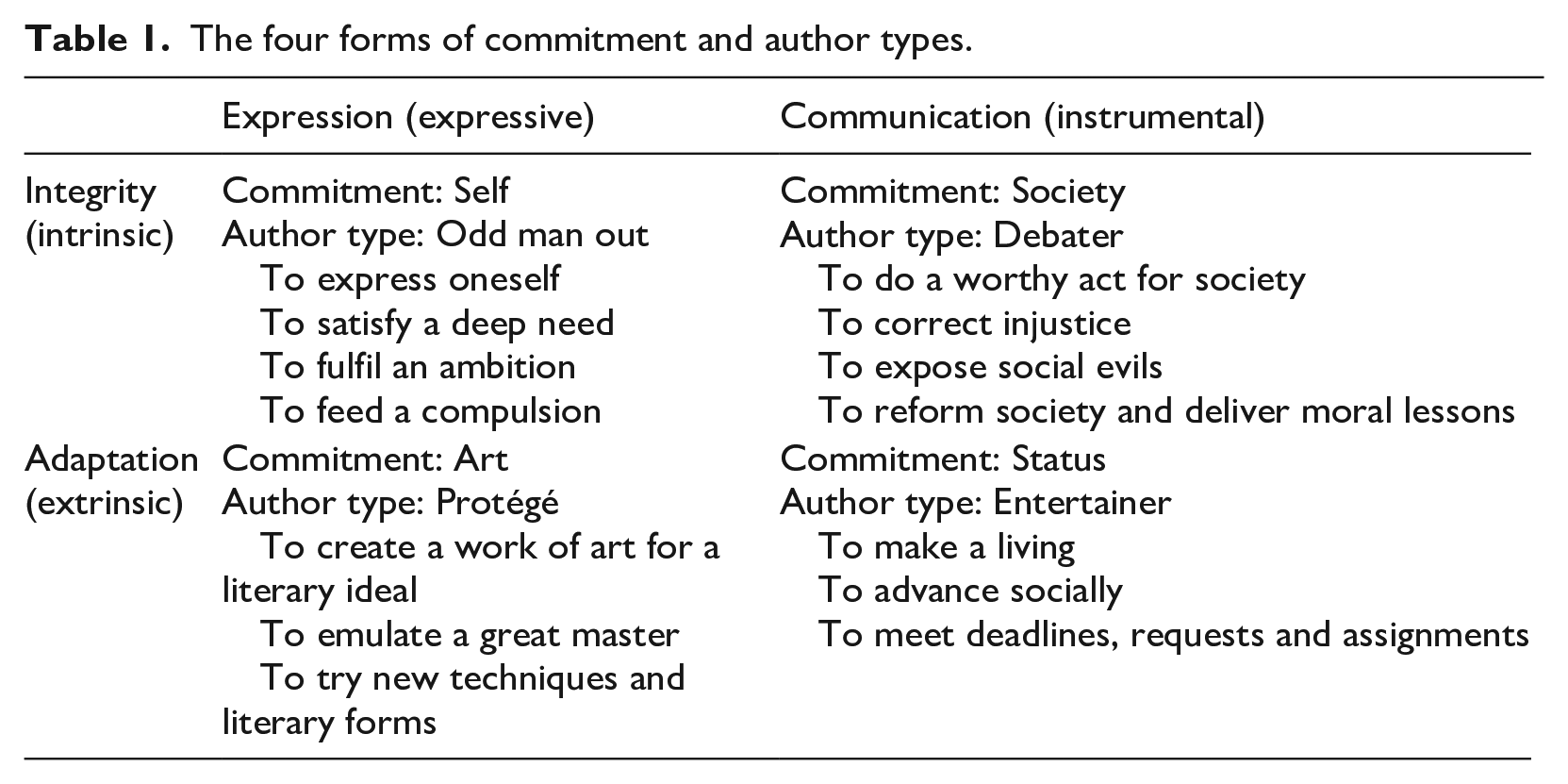
The approach of empirical phenomenology (Aspers, 2009) was used as an inspiration when carrying out the data collection and analysis of the material. The first interviews revealed the relevance of being reviewed. The second set of interviews used the foregoing conceptualisation and aimed to uncover variation in the responses to being reviewed. All material was coded, and the sections relating to being reviewed were analysed in detail. The author classifications and levels relating to responding to being reviewed were used as a conceptual framework in this second step in order to analyse the accounts of responding to being reviewed. The conceptualisation was used to interpret the empirical variation in how the authors thought about where their books were reviewed and by whom. Illustrative examples from the material have been translated and are presented in the analysis section. All author names are pseudonyms (see Table 2 in the Online appendix).
Analysis
At an abstract level, when authors respond to reviews, they aim to engage in commensuration, making various aspects of their public reception comparable by quantifying reviews, evaluating the status of the reviewer or review outlet, and classifying the review as positive, negative or neutral. This level involves the abstracted and general impact of their work and standing. The interpersonal level relates to the personal and singular and is about the experience of being reviewed that corresponds to the feeling of being understood by the reviewer. Hence, at an abstract level, authors focus on quantifiable and generalised aspects of their public reception, while at the interpersonal level, they emphasise the personal and subjective experience of being reviewed and understood by the reviewer.
This analysis section shows that the levels are inherently linked to each other and that authors may experience both levels simultaneously, just one of the levels, or neither.
The analysis now moves from the abstractions of receptions regarding where the book was reviewed, how many times it was reviewed and the rating of the book in reviews, to the interpersonal level of reviewers’ understanding of the book and its consequences for the authors’ writing process.
Where and the Number of Times the Book was Reviewed
When asked about the reception of their novels, the authors often start by listing where they got reviewed and the number of reviews they received. They try to assess the impact of the reception, and, as they cannot readily access the status hierarchies of the literary world and their position within it, they try to find other means of getting a sense of the importance of their work. The number of reviews is used as an indicator of the success of their novels and as a heuristic about whether or not their reception is a relatively prestigious one.
Some time has passed since Mia published her novel, but she still fondly remembers the reception of her book:
Yes, I think it went pretty well. It was reviewed in the major newspapers, which are also online, but it was also reviewed a lot in the local media that praised the book very much at times. (Mia)
The standing of her work is important to Mia as she is pursuing literary ideals and experimenting with literary forms that need public recognition among her peers. The impact matters, and being reviewed by the top reviewers and outlets is important for gauging the importance of her work in the literary world. Mia mentions reviews published in both national and local newspapers, interpreting the assessments in the local newspapers as praise, and she acknowledges the general significance of having been reviewed and the number of reviews in major newspapers.
Mia uses her knowledge about the status of review outlets in the literary world to classify them. The standing of her books in the literary world is indicated by reviews in major newspapers and the number of influential newspapers reviewing the book. Her reception is interpreted by converting it into unified hierarchical metrics, including the classification as positive when assessing the coverage in the local press as praise. The fact that her book was reviewed in prestigious newspapers also matters to her sense of artistic self. In a similar fashion, it is not uncommon for publishing houses to highlight reviews from major newspapers in order to elevate the status of an author, book and their own company.
While a ‘positive review’ may be important to the author, simply being reviewed by high-status reviewers or outlets is important in achieving acclaim and status in public literary life. Tyra discusses having her first book reviewed in ‘practically all newspapers’ that matter:
I have just received the sales figures, and I am disappointed. But the first book’s reception was overwhelming for me. It was reviewed in practically all newspapers; I was totally unprepared. My publisher said, ‘You have to know that there will be no reviews.’ But then I got a lot. (Tyra)
Publishers usually prepare authors for the uncertainty of not knowing whether there will be reviews and what reviewers might think about their books. The tendency is that ‘big books’ and books at major publishing houses have a greater chance of being reviewed (Chong, 2020; Thompson, 2012), and Tyra is published by a small publishing house, which does not generally expect reviews. While she may be exaggerating when she claims she was reviewed in ‘practically all newspapers’, it signals the importance of the number of reviews she received when responding to being reviewed, and it indicates that being reviewed in newspapers confers status. Status also came to Tyra by exceeding the expectations of her publishing house, in other words, she got recognition despite being published by a small publishing house. The large number of reviews also spoke to her as a response in unison from the literary world about the worth of her work. It resonated with her and her ideals of having an impact in the literary world and public debate. Through this reception, she was able to gauge the status of her work, and how she could fulfil her literary commitment.
When Irene is asked about the reception of her books, she focuses instead on the amateur reviewers on the audiobook and e-book streaming platform Storytel: ‘I mean, [this book] has received between 4000 to 5000 comments on Storytel, and let us say 10 of them are negative. It is not even possible to explain the tremendously successful reception of this novel, even though it is a romance novel.’ Unlike the books of the first two authors, genre literature such as romance is less commonly reviewed in major newspapers, which traditionally focus on high-end literature (Bourdieu, 1993). While recent research shows an increasing mix of book review types that include expert and amateur assessments (Chong, 2020; Kristensen and Riegert, 2021; Purhonen et al., 2018), genre literature still largely relies on amateur reviewers commenting online.
Nevertheless, these reviews still create an abstracted notion of the response, which is made into the audience’s collective voice about the novel’s value that creates the book’s ‘critical consensus’ (Chong, 2020: 54). Irene has gauged her status through the quantification of her response, which indicates the book’s importance in the literary world and her identity as an author of some importance. She talks about her constant monitoring of the number of reviews on the platform and the sales list at e-tailers that helps her quantify the response to her novel, classify her work as a bestseller – at least for ‘a moment’ – and see her ranked position in the world of genre literature.
As shown by the stories of Mia, Tyra and Irene, indicators of success are the number of reviews and where the reviews are published. The ranking of review outlets therefore influences the value and impact of the literary reception. The authors express their desire to be reviewed by ‘the most important newspapers’ (Anna), that is, the ones with the biggest circulation (Dagens Nyheter, Svenska Dagbladet, Expressen, Aftonbladet and Göteborgs-Posten), or on popular online forums such as Storytel.
One of the most prestigious aspects of being reviewed is to be featured on the newspaper’s front page. Peter describes this experience: ‘When I woke up that morning, the whole front page of the newspaper was about my book. It was so overwhelming.’ Here, the status of getting the review is amplified by the resonant feeling of being overwhelmed by being on the cover. Tyra was similarly overwhelmed by the response to her book, and both cases show how resonance may arise from being acknowledged and validated in the literary world. At the other end of the spectrum, however, are authors’ disappointments and associated justifications for why their books were not reviewed in major newspapers. The status was not achieved, and the literary world stayed mute in its response.
The Rating of the Book in Reviews
So far, the aspects of where the book was reviewed, the number of reviews and their relative importance for the impression of the response have been analysed. The complexity of the response is simplified through the use of metrics and quantification in the assessment of the book. To authors, reviews are classified and subsumed under the common conceptions of reviews being ‘good’, ‘bad’ and ‘indifferent’.
When classifying reviews, authors may have concerns about what the reviewers decide to focus on and whether there is any bias in the review, which is often due to the belief that reviews for first-time novelists are generally kinder (e.g. Ingrid, Peter, Mia. Moa, Nora). As there is no track record for first-time authors, it is not possible to compare the book to a previous publication (Thompson, 2012), so reviews of debut books are generally bolstered by hopes for the future (Fürst, 2019b, 2022, 2023). However, Irene, who experienced negative reviews online before her book was published, sees reviewing as ‘a rigged system’ of unjust assessments. Anna, for her part, concludes that she got one negative review, which was a blow that she tries to mitigate by comparing it to her readers’ response to the novel:
I got a really nice reception. There were many people that appreciated the theme in the book. There were many book loans in the library. We did not really receive any great reviews. . . ah, Pia Huss wrote about it in Dagens Nyheter. . . she was not that positive, actually. I do not remember what she wrote, but many readers were positive. (Anna)
Anna discusses various techniques for simplifying the assessment of reception through quantified measures, such as the number of library loans and the level of interest in the book’s theme. She also mentions a review in the high-status newspaper Dagens Nyheter. However, she classifies the review as negative and tries to offset this by highlighting her work’s standing among audiences. Hence, the author engages in counting, comparing and justifying her book’s reception to qualify its standing within the literary world. She has recently moved from a preoccupation with elevating literary ideals to trying to make an impact on her young readership through her passion to express herself. Young readers have become more important to her than reviewers. However, her high literary ambition still lingers and accentuates the importance of getting recognition within the literary world.
On the day of Saga’s first interview, she had just received reviews for her latest book:
I have received many reviews today [. . .] It is wonderful. I have received two really positive reviews. I received a really positive review in Svenska Dagbladet. I have received five that are somewhat good and one really negative. (Saga)
Saga has struggled to find her place as an author and has written works that fulfil her need to express herself. Through her personal experience, she wants to change society by emphasising pressing social issues. She counts the number of reviews she gets, which becomes part of the impression of the literary reception of her novels. She then analyses individual reviews, which are classified as ‘positive’, ‘somewhat positive’ and ‘unfavourable’. These assessments become part of her impression of being reviewed and her novels’ reception. Saga’s reviews and positive evaluations bring her an overwhelming experience of resonance and validation of her literary struggles when entering this level of interpretation. This experience results from the achievement of being recognised for her literary commitment.
While the previous authors talk about positive and negative reviews, and while some authors dread negative reviews, others talk about the problems of indifference: ‘No one has published a really bad review. It has been a lukewarm reception like, I mean, people being like “Well, it was okay.” That is the worst’ (Nora). Not reaching an audience or having an impact has frustrated the ambitions in all the roles Nora has taken on. While she did not receive strongly negative reviews, it seems that such reviews might have been preferable to indifferent ones. It may be the case that the reviewers were not properly engaged with the book when giving their lukewarm reception, or that it did not ignite a sufficiently strong response to elicit either a negative or positive review. The abstract level is not fully recognised due to the lack of indicators, but it is rather the muteness of the evaluation of the book that suggests it was not being fully understood by the reviewer.
A Reviewer’s Understanding of a Book
A book’s publication is a call to be understood and recognised, or for someone to respond, and the reading done by a reviewer is a response that reaches both the public and the author. The stakes involved in being understood or not by a reviewer may be high and have consequences for the author’s sense of artistic self. In this context, Robert tells the story of receiving one of his first reviews:
I was travelling in a fellow author’s car, and then I suddenly received a review. It was a review in Aftonbladet that Carl-Michael Edenborg had written. This meant a lot to me. I have a lot of books from the publishing house he ran for many years. There is a lot of literature of the type that has many points of contact with what I have written. It was a very positive review – so positive that, even though I had told myself ‘Yes, yes, reviews are something you have to disregard’, I actually started to cry because I was moved: ‘Wow, someone has understood what I wanted to say, and it is amazing’. (Robert)
While Robert had prepared himself for negative reviews or reviewers not understanding his book, he classified the review as positive and believed the reviewer had understood him and his book. The sudden realisation of having been able to communicate to someone through his book – especially someone held in high regard in the literary world – made him corporeally engaged in the review and he responded by crying. Being understood and creating a genuine connection between the reviewer, review, book and author creates this feeling of resonance. Here, it becomes clear that what was important for Robert was not only getting a positive review or gaining status within the literary world, but also to be understood. Robert’s feeling of resonance was heightened by the status and background of the reviewer and the prestige of the newspaper. Hence, these levels of reception amplify each other in his review experience, and this type of amplification is one of the most gratifying experiences of being reviewed.
Tyra reflects on getting reviewed and reviewers doing their job properly, which entails a deep engagement with the book’s content:
One reviewer did not seem to have read the book that well and did not understand it at all. It was like writing a quote from the cover letter. It was in Aftonbladet. I thought: ‘If this is the only review, then it will be so darn sad’. [laughs] Then I got some great, more thorough reviews, thank heavens, like the reviewer Anna Hallberg who wrote in a way that helped the reader understand the book. (Tyra)
The singular and personal responsive relationship often refers to a specific reviewer (as indicated in both the statements just quoted) having properly understood and read the book. Tyra’s experience relates to a reviewer who had not genuinely engaged with the book but attempted to review it. Instead of relying on the reviewer’s own reading, the reviewer referred only to supplementary material provided by the publishing house. Many of the interviewed authors are concerned that the lack of space in the newspaper to write something substantial is an indication of the shifting media landscape, and that reviewers are not taking sufficient time to understand the books they review.
Another example of a resonant experience from an interpersonal connection can be seen in the interview with Peter. He says that the high-profile reviewer Ingrid Bosseldal, who reviewed his book in Göteborgs-Posten, understood the complexity of his book: ‘the book is not that easy to read and it is hard to understand what it means [. . .] she hit a home run in her reading of my book’. Lovisa, who used to be a reviewer herself, also assesses reviews on this interpersonal level:
I was not so nervous about getting reviewed; I know a lot of book reviewers, and I know that sometimes you get a good reading, and sometimes you get a bad reading. There are very few reviewers that I respect that much. I felt it was not important to be understood in the culture sections of newspapers. But then it’s, of course, fun when people like Aase Berg understand me, and then you will be happy. (Lovisa)
Lovisa talks about having good and bad readings. The act of reading and understanding and the ability to communicate it to an audience is how a review should be done. While Lovisa does not hold many reviewers in high regard, she appreciated the one reviewer who understood her. Here, the levels of response once again coincide. The reviewer, Aase Berg, reviews mostly for prestigious newspapers and is well known, which may be part of what gives status to the publication. Aase Berg’s responsive reading was essential for confirming Lovisa’s artistic abilities. This situation speaks to the relationship between being an acclaimed reviewer and one’s ability to read and understand literature, which assumes a close relationship between acquiring status by being reviewed and getting a responsive reviewing experience. This relationship is important for Lovisa, who, through her writing, tries to make works of art and attempt new techniques.
Several authors use the strategy of being mute in their responses to reviews. For example, Leila told her publishing house that she was not at all interested in the reviews. She explains in her interviews that she did this because of the lack of comprehensive and engaged reading among reviewers.
My publisher updates me on how much the book has sold. She writes to me if anyone has talked to her about the book. I had to tell them that I did not want this regarding reviews: ‘You do not have to say anything. You can take out the goodies from the reviews, and I do not have to read a full review.’
Why don’t you want to read them?
Well, I usually get annoyed at the major newspapers. I have not read many reviews in the smaller newspapers. I would probably get annoyed with them, too. I typically feel that it is not so gratifying for the books reviewed, because the reviews often feel quite haphazard and ill-considered – more of an opinion piece than actually describing how the reviewer has read the book and done an analysis. I probably would not want to read such reviews.
Leila’s idea of proper literary criticism entails a responsive reading communicated through the review. She sees the state of critique in Sweden as flawed, as a form of position-taking by the reviewer rather than engaging with the book and author. Leila is engaged in expressive forms and engagements, wants to promote art and express herself, and she is eager to know about the positive parts of reviews, which might boost her confidence. The blending of the status that comes by being reviewed and that which comes from being understood is again visible. She wants a responsive reading from high-status reviewers, whom she expects to have such abilities. A correspondence between being understood by them and maintaining her literary ambitions would presumably have produced a sense of resonance in her review experience. Nevertheless, she is still reluctant to read reviews and is disappointed and even negatively affected by the form of the review or misunderstandings in reading her book. Hence, there is no interpersonal connection between her and her reviewers. This situation had not changed by the second time she was interviewed.
While authors are discontent about reviews being more like opinion pieces, which may be indicative of a changing media landscape (Chong, 2020; Kristensen and Riegert, 2021; Purhonen et al., 2018), book evaluations may also prioritise assessing a book’s structure and construction over engaging with its narrative or the author’s intention. This focus may hinder a genuine understanding of the book (Johan). A reviewer’s failure to acknowledge a book’s societal relevance and political implications, especially when authors aim to address and correct social injustices, can also lead to a restricted comprehension of the work (Fredrik).
The Influence of Reviewing on the Writing Process
Diana is an author and a critic and talks about how the critique of reviews influences her writing process:
Do your reviews influence your writing? After the first book, when they had objections, was that something you thought about when you continued to write?
Yes, whether I want to or not, I relate to it, even now. The only way not to would be not to read reviews at all. But it is also interesting; you have been working with the text on your own for so long then it is interesting to get a reading, regardless of whether it is positive or negative. I read, and yes, sometimes it is people who do not understand anything, but usually it is good and interesting objections that I can use or relate to. And then there is a lot that you are affected by that you do not want to be affected by, that you get that feeling or even the thought sometimes when you write [. . .] how will this look when it comes out, and it is not so good for one’s process. But quite inevitable, I think.
Diana talks about having different readings of her text, which essentially boils down to whether the reviewer understands and whether she has a resonant experience. Not only does she read the reviews, but she accounts for them when writing. Diana uses the effect of reading, that is, to have someone understand and develop the writing by critique, throughout her writing process.
The interviewees dread certain reviewers because they would have a lasting influence on how their work is perceived. They also feel that these reviewers would have a particular reading and understand their text only from a certain perspective:
When I wrote my book, I always had Dagens Nyheter’s Jonas Thente sitting on my shoulder. I was terrified of him and thought, ‘Damn, I cannot write like this. It’s becoming a cliché. Jonas Thente will totally destroy this. He will make fun of that.’ It was pretty good to have something like a ‘Jonas Thente filter’. Wouldn’t you believe that Jonas Thente reviewed the book and made fun of it? It was really fun [. . .] When you write, you feel observed in some way – in the future. Writing a literary text feels like someone can crack down on your writing, and then it’s fait accompli. (Mikael)
Reviewers’ assessments may thus be a consideration for authors when writing fiction. Jonas Thente is a well-respected reviewer, and Mikael knows that his own standing in the literary world may depend on Thente’s assessment. He knows how Thente reads and assesses books and he uses this to improve the book. Mikael creates a dialogue between the text, reviewer, review and himself even before the text is written, thus creating a tentative understanding of the work from the reviewer’s viewpoint. The author changes the text to improve the chances for resonance to emerge in the future between author, book, reviewer and review. Being reviewed by this reviewer is not only helpful for getting an impression of the importance of the book, but it can also be understood by the reviewer on an interpersonal level.
Discussion
The experience of being reviewed is covered on two levels that both relate to the publication of the book as an implicit request to be acknowledged, recognised and understood. On the abstract level, the quantification of evaluation is used to assess the response, which involves a differentiation of the author and their work, and the response draws on cultural hierarchies of newspapers and reviewers, and ratings of books in reviews. Authors use various indicators to evaluate their reception, creating knowledge about their work’s value. The interpersonal level involves authors’ desire to feel understood through their work by reviewers in an undifferentiated relationship, which is expressed through their reading and mediated through the review. This interpersonal connection is often felt spontaneously and corporally through memorable emotions, which create lasting bonds to the review experience and the connection established with the reviewers’ reading.
These levels can be used separately by authors, but they often join together in the narration of the experience of being reviewed, which amplifies the experience. For example, the abstract level of measuring the impact of the work may be amplified if it is joined by the experience from the interpersonal level, and together they may realise a literary commitment or ambition. Similarly, the interpersonal level may be amplified by also taking into account the importance of the reception through the status of the reviewer, the number of outlets reviewing the book and the classifications of reviews.
Both levels are important when trying to understand the experiences of different types of authors. Authors who express themselves to either satisfy a deep personal need to write, or who are trying to develop literary ideals, are no exception. A review in a high-status outlet or by an acclaimed reviewer can be used by authors to gauge the status of their work and bring about resonant experiences. The levels coincide, for example, through the idea of high-status reviewers or review outlets having a greater ability than others to understand works of fiction. The situation is similar for authors who are committed to society and attempt to engage in public debate, and those who are committed to entertainment and want to make a living by writing. For these authors, having a platform to get their message through is contingent on making an impact on relevant outlets or on relevant people, but for this to happen it is also essential that reviewers can understand the message or ambition they are trying to convey through their writing.
The place of cultural criticism in society depends on how reviewers read and write reviews, and how audiences respond to those reviews. Some books and authors are revered while others are not (Bourdieu, 1993), as the abstract level of experiencing reviews suggests. Reviews also reduce the uncertainty about a book’s quality (Chong, 2020; Santana-Acuña, 2021; Wohl, 2021) and inform consumers about their purchasing decisions, as they are examples of what Karpik (2010) calls a ‘judgment device’. The incommensurable book needs to be made comparable to other books, thus informing potential readers about its value and creating the desire to buy it, or not. A review may also function as an ‘appraisal device’, offering authors insights into the quality of their writing and serving as an indicator of potential future success (Fürst, 2018). The abstract level covers both traditional newspaper reviews and online reviews. The aspect of quantification online may be even more pronounced, as it heavily relies on aggregating scores from the audience who listen to, review and rate the book.
While the abstract level of recognition relies on the externalities of the review, positioning authors, books and reviewers in a broader literary system (cf. Rosengren, 1968), the level of interpersonal connection comes closer to the authors’ corporeality and relationships with real people. In any case, the resonance (Rosa, 2019) of feeling ‘in tune’ arises through the relationships between the author, review and reviewer and through the overwhelming experience of being reviewed and recognised by the important institutions of literary life. This responsive feeling may happen through reviewers’ readings of the book and readers giving their impressions of the book to the author. The author, review and reviewer align to create the author’s experience of ‘being understood’. Authors can feel ‘recognised’ through the reception or by the quantity and content of reviews, which gives a heightened experience of being seen as producing works of value. These feelings also come from their expectations being surpassed and their literary commitments being realised through the reception of their work. The level of interpersonal connectedness refers to the internal or existential matters of offering the book as a medium for communication, which moves the book from the private realm to another person’s private domain, where the assessment and the book’s value are publicly communicated.
Having a book publicly reviewed can be a tense situation, filled with uncertainty about the reviewer’s assessment of its quality (Chong, 2020) and the quality of the review. Instead of the classical modes of reading, where reviewers appraise texts and readers are affected by them (Steiner, 1979), the results here suggest a response by authors through the duality of both appraisals of text and an encounter with a review through vulnerability and closeness.
The work of Bourdieu (1993, 1996) partly explains why certain authors experience resonance while also accounting for authors’ positions, in other words by indicating a manifestation of similar positions of authors and reviewers in a literary field through the mediation of the publication and reception of the book. Nevertheless, the interactional accomplishments of achieving resonance come closer to the actual experiences of authors and go beyond fields and similar positions. The desires achieved through resonance include striving to advance their position in a (battle)field through various strategies and position-taking, which are expressed through their habitus in relation to the field. The authors want to relate and communicate with others and form intimate social bonds and shared understandings. They also want to feel recognised for doing valuable work and taking a position within the literary field. Hence, the artistic fields may be battlefields in competitive struggles for position, but artists also desire social responsivity and resonance on personal and interactional levels, and to be seen as having made something of importance. The two levels are both necessary to imagine and understand the artistic orientations encapsulated within a single individual.
Conclusion
Artists’ orientations and levels of response relating to the experience of being reviewed are relevant for understanding their private responses to public assessments of culture. This includes not just authors, but all artists involved in producing culture with a personal intent that is publicly assessed. The presumed prevalence of these orientations and levels of experience suggests that artists may also relate to other forms of cultural evaluation in similar ways as those identified in this article.
From a pragmatist viewpoint, using the concepts covering the two levels of response is useful. These levels can occur in experiences simultaneously, separately, or not at all. The usefulness of the framework suggests a combination of different scholarships and cultural assessments. The combination includes soft quantifications, as it covers the differentiation of artists, what is produced and its relative value to the public, as well as the interpersonal connection, as it covers engagements and attachments to cultural objects among artists. The experience of being reviewed thus reveals more general ways of relating to the world as an artist that must be studied further in order to better understand artistic production, consumption and circulation of cultural goods.
Supplemental Material
sj-docx-1-cus-10.1177_17499755231211384 – Supplemental material for Resonant Reviews: Experiencing Accurate Readings and Indicators of Literary Accomplishment Among Reviewed Novelists
Supplemental material, sj-docx-1-cus-10.1177_17499755231211384 for Resonant Reviews: Experiencing Accurate Readings and Indicators of Literary Accomplishment Among Reviewed Novelists by Henrik Fürst in Cultural Sociology
Footnotes
Funding
The research reported has been funded by the Swedish Research Council (2018–06708).

Supplemental Material
Supplemental material for this article is available online.
Author Biography
References
Supplementary Material
Please find the following supplemental material available below.
For Open Access articles published under a Creative Commons License, all supplemental material carries the same license as the article it is associated with.
For non-Open Access articles published, all supplemental material carries a non-exclusive license, and permission requests for re-use of supplemental material or any part of supplemental material shall be sent directly to the copyright owner as specified in the copyright notice associated with the article.
