




Abstract
A great amount of effort has gone into studying correspondences between contemporary class structures and the distribution of lifestyles and media practices therein. Structural overlaps between these spaces imply the existence of a symbolic order, where dominant factions of society constitute taste keepers endowed with the power to stigmatize those below them in the social hierarchy. Yet, research has not come to terms with the reach and depth of this symbolic order. This study combines the Bourdieusian approach with recent developments in stigma research and the notion of felt stigma. Using multiple correspondence analysis on a survey with the adult Swedish population (n = 2003) findings align with previous research in that the social space is built around capital volume and capital composition, and that media practices connect to that structure. This symbolic order is not, however, internalized by people at lower social positions. Instead, it is people invested in culture and arts – a cultural middle-class – who are most likely to anticipate that others would look down on their practices and preferences.
Introduction
The social world is ridden with struggle and boundary-drawing. One such struggle concerns legitimate culture and lifestyles (Bourdieu, 1984). Here, those wielding significant volumes of cultural capital – the cultural elites (Jarness, 2017; Krogstad and Stark, 2021), or the taste keepers (Hovden and Knapskog, 2014) – tend to come out on top. By contrast, people lacking the resources to ‘properly’ move about in the cultural realm have been targets of stigmatization by way of constructs like ‘chav’ (Tyler, 2008) or ‘white trash’ (Hartigan, 1997).
In taking our understanding beyond this form of stigmatization ‘from above’, this study asks if social agents impose symbolic violence (Bourdieu, 1991, 2000) upon themselves. By integrating Bourdieu’s conceptual and analytical framework with recent advancements in stigma theory, focus is not only put on the correspondence between the social space and cultural practices in the form of media use, but also on what people across the social space think that others would think about their practices and preferences.
By connecting the notion of symbolic violence to its logical, albeit somewhat shelved, outcome of anticipated stigma the study seeks to expand the empirical scope of Bourdieusian sociology. This endeavour implies taking seriously the sociopsychological effects of symbolic domination, and shedding light on the link between micro-cognitive and macro-level processes related to social and cultural inequality (Lamont et al., 2014).
At present, however, we do not know to what extent the struggles over the legitimate culture and lifestyles translate into internalized stigma, and if such stigma corresponds to certain positions in the social space. In order to shed light on these issues, this study uses multiple correspondence analysis (MCA) on a national survey of the adult Swedish population (n = 2003) to (1) construct a representation of the space of social positions, (2) to study the distribution of media uses therein, and (3) to explore social agents’ felt stigma in the realm of media practices and preferences.
Literature Review
Media scholars and cultural sociologists have done a very good job at understanding and explaining the connection between class and various media and cultural practices and preferences. Class analysis of peoples’ volumes and modes of media and culture consumption stems from a range of sub-fields and disciplines. For instance, half a century ago, Tichenor et al. (1970) identified ‘knowledge gaps’ caused by divergent news consumption patterns between more- and less-resourceful groups in society. Tichenor and colleagues helped to pave the way for new generations of journalism and political communication scholars concerned with inequalities in democratic participation (e.g. Prior, 2007; Strömbäck et al., 2013). In the 1980s, British cultural studies pioneered the study of everyday media use and class (Morley, 1980) which in a similar fashion inspired a generation of scholars to study the class-bound character of media use. In 1984 Pierre Bourdieu’s magnum opus, Distinction, was published in English.
Distinction opened an avenue of research into media use, cultural practices, political opinion and so on in relation to social class with the use of geometric data analysis (Savage and Silva, 2013). Today, this is one of the most established perspectives in the study of culture and social stratification (Flemmen, 2013; Savage and Silva, 2013). This body of research is concerned with the relationship between the distribution of social resources in a given society (the social space) and the universe of available cultural practices and preferences (the symbolic space). In this vein, research has shed light on structural overlaps between the two spaces in terms of, for instance, diets (Atkinson and Deeming, 2015), media practices and news consumption (Hovden and Moe, 2018; Lindell, 2018; Lindell and Hovden, 2018), tastes in music (Savage and Gayo, 2011) and broader lifestyle repertoires (Flemmen et al., 2018; Hjellbrekke et al., 2015; Prieur et al., 2008). Taken together, these studies echo Bourdieu’s original verdict that ‘art and cultural consumption are predisposed, consciously and deliberately or not, to fulfil a social function of legitimating social differences’ (Bourdieu, 1984: 7). Socially dominated groups tend, in other words, to be culturally dominated too.
While efforts have been made to take MCA-oriented cultural sociology (De Keere, 2019; Schmitz et al., 2018) and audience research (Bengtsson, 2007; Cohen et al., 2017) into the moral and emotional realm, research has primarily been concerned with inequalities in ‘how much?’ and ‘what?’ culture/media (Jarness, 2015; Lindell, 2020). One study stands out, in which Bourdieu’s notion of symbolic violence was operationalized and studied in relation to the Swedish space of lifestyles (Atkinson, 2021a). Qualitative scholarship is nonetheless rich on descriptions on for instance working-class culture, morality and identities (Danielsson, 2014; Lamont, 1992; Reay et al., 2009; Skeggs, 2004; Willis, 1977). Beyond studies on specific subjectivities, however, we do not know enough about the extent to which lifestyle discrepancies are felt by agents in the social space. The moral and affective dimensions of class have been downplayed (Reay, 2015; Sayer, 2005). This is particularly the case within the quantitative echelons of Bourdieusian sociology where focus has been put on the distribution of practices and preferences in the social space, or alternatively, how social resources and demographics map onto the space of lifestyles (Rosenlund, 2015).
Bourdieu-inspired analyses also tend to refrain from questions regarding psychology, well-being and ‘negatively connoted meanings and feelings’ (Schmitz et al., 2018: 642; see also Lamont et al., 2014). The task has, after all, primarily been sociological and thus geared towards understanding how social groups manoeuvre amongst various cultural goods. If, however, ‘modern and differentiated societies’ are characterized by structural homologies between the social space and the space of lifestyles (Rosenlund, 2015: 157), this might be internalized and felt by social agents. Lacking the social resources required to ‘properly’ grasp and make sense of ‘legitimate culture’ (Bourdieu, 1984), or being a target of more or less explicit symbolic domination (Tyler, 2008), could leave some socio-cognitive marks, as suggested with the notion of symbolic violence. At present we have not come to terms with the depth and reach of the symbolic order stemming from the systematic overlaps between social positions and lifestyles (Atkinson, 2021a).
Enter Stigma
The concept of stigma – introduced to modern sociology on a broad scale via Goffman’s (1963) ‘attribute that is deeply discrediting’ – can help close in on the moral and mental effects of cultural domination. Of particular importance are the sub-categories self-stigma and felt stigma (Bos et al., 2013; Herek, 2007; Herek et al., 2013). A rich body of media and cultural studies exists on stigma in terms of representation, framing and stereotyping (e.g. Holton et al., 2014; Shildrick, 2018; Slater, 2018; Tyler and Slater, 2018; Wood and Skeggs, 2011). However, the concept of felt stigma can be taken into the realm of cultural practices and tastes, as an operationalization of Bourdieu’s (1989, 1991) notion of symbolic violence. With it, it is possible to capture symbolic domination as anticipated and internalized by agents in the social space.
If it is true that Bourdieusian sociology has refrained from theorizing well-being and stigma in relation to symbolic violence, it is equally true that stigma scholarship has downplayed the role of symbolic domination in promoting stigmatization. While research on stigma is vast and diverse it tends not to focus on culture consumption and ‘stylization of life’ (Bourdieu, 1984: 55). Attention is typically paid to stigma connected to cancer, HIV/AIDS, disability, homosexuality and mental illness (Link and Phelan, 2001). Stigma research has, furthermore, tended to be micro-oriented, and the power structures that maintain stigma have been sidelined (Tyler and Slater, 2018).
In the last two decades, however, leading stigma scholars have proposed ‘a return to stigma from a distinctly sociological perspective’ (Link and Phelan, 2001: 364), and argued for moving beyond the individualistic focus that has hitherto prevailed (Parker and Aggleton, 2003). These insights and critiques have opened up possibilities of cross-fertilization between the sociology of culture, particularly Bourdieu’s (1991, 2000) notion of symbolic violence, and stigma scholarship (Bos et al., 2013; Keen and Padilla, 2014; Link and Phelan, 2014; Parker and Aggleton, 2003).
While the ‘internal’ or individualistic focus is naturally taking centre stage in a study on how stigma is felt by social agents, Bourdieu forces us to consider structural stigma (Bos et al., 2013), and to connect stigma to class struggle (Tyler and Slater, 2018). The import of Bourdieu’s toolkit to stigma theory has nonetheless been limited, and empirically, much is left to be done (Lamont et al., 2014).
It is against this backdrop that this study seeks to contribute to a cross-fertilization between cultural sociology and stigma theory by applying the operational concept of felt stigma for MCA of a contemporary class structure. This allows grasping potential manifestations of the symbolic violence that stems from class-related discrepancies in the realm of media practices and preferences, across the social space. The next section details how this theoretical combination can be deployed in an empirical study.
Symbolic Domination and Felt Stigma
Much like Schmitz et al.’s (2018) integration of fear, and Reay’s (2015) integration of affect into the Bourdieusian conceptual framework, this section follows the work of Lamont and colleagues (2014) and sets out to create a framework able to link micro-cognitive processes in the form of felt stigma to broader cultural processes. Wacquant (2008) has joined these two conceptual worlds together, but not focused at the level where stigma is internalized and felt by social agents. As such, the route taken here allows approaching symbolic violence in an operational way, as it paves the way for an understanding the social-psychological effects of symbolic domination in the social space. It allows us, in other words, to take initial steps towards assessing the reach and depth of the symbolic order (here understood as the systematic correspondences between class positions and lifestyles). I begin, however, by detailing a form of stigmatization that is at the core of Bourdieusian sociology, but usually sidelined by stigma researchers: cultural and symbolic domination.
The social space is Bourdieu’s (1984) metaphor for class relations in modern and differentiated societies (Rosenlund, 2015). Society comprises individuals with different access to various collectively recognized resources – economic, cultural and social capital (Bourdieu, 1986). Individuals’ volumes and types of capital mark their position in the social space. By way of an internalized socio-cognitive structure – the habitus – these positions tend to correspond to dispositions in the form of opinions, tastes, preferences and lifestyles more generally (Bourdieu, 1984, 1990). This makes for the fact that people ‘choose, in the space of available goods and services, goods that occupy a position in this space homologous to the position they themselves occupy in social space’ (Bourdieu, 1989: 19).
We thus end up with the conclusion that it takes resources, particularly cultural capital, in order to move about in the ‘legitimate culture’ in a ‘legitimate manner’ (Bourdieu, 1984: 87). Those endowed with the highest levels of cultural capital have been described as society’s taste keepers (Hovden and Knapskog, 2014) while those deprived of the same resources tend towards ‘refusing what they are refused’ (Bourdieu, 1984: 471). The internalized and class-based notion that this is ‘not for the likes of us’ (1984) is perhaps the example par excellence of misrecognition and symbolic violence. A taste- and lifestyle-oriented stigmatization ensues since ‘the goods of the higher classes are acknowledged and recognized by the agents of other classes’ while at the same time the goods and practices of lower classes ‘are devaluated’ (Schmitz et al., 2018: 628), as manifested through constructs like ‘white trash’ (Hartigan, 1997), ‘chav’ (Tyler, 2008) or ‘disconnected and sedentary working-class’ (Lindell, 2020). Adding to this, the notion of misrecognition helps to explain that:
the contingent nature of the legitimacy of symbolic goods is disguised due to the fact that the agents, taking the social world for granted, fail to recognize the arbitrary nature of the legitimacy’s genesis. In consequence, social inequalities tend to become doxic, being perceived as unalterable social facts. (Schmitz et al., 2018: 628)
While the notion of symbolic violence has clear affinities with the concept of stigma, it has not been explicitly approached as such, and it has not been studied in a systematic fashion, the way that stigma has.
By transposing the Bourdieusian argument into the operational realm of stigma research, it becomes clear that this view presents an implicit hypothesis on structural and public stigma (that is, the misrecognition of ‘legitimate culture’ across the social space) and also on felt stigma which amounts to, in paraphrasing Bos et al. (2013: 3), the anticipation of stigmatization on the part of those not equipped to manoeuvre in the ‘legitimate culture’. The notion of felt stigma is, thus, a productive way to empirically pin down one specific outcome embedded in the broader concepts of misrecognition and symbolic violence.
Felt stigma has been approached empirically by asking people what they think that other, unknown, people would think of themselves (Herek et al., 2013; Link and Phelan, 2014). Translating such operationalization into the realm of media and cultural practices provides an opportunity to operationalize the kind of symbolic violence resulting from the interplay between the macro-sociological order (the correspondence between the ‘legitimate culture’ and the social positions required to master it) and micro-cognitive processes of anticipated stigma.
Leaning on the Bourdieusian model one would expect that relatively well-off segments of a population, especially the culturally rich taste keepers (Hovden and Knapskog, 2014) – who wield stigma power (Link and Phelan, 2014) and reproduce structural and public stigma (Bos et al., 2013) in the realm of culture – are the least likely to anticipate stigma in relation to their cultural preferences and practices. Although this would be the implicit hypothesis in much of Bourdieusian sociology, previous research in Sweden suggests that it is actually the economically rich who are most confident in their lifestyles, possibly due to the increased valorization of materialism (Atkinson, 2021a). One may thus broaden the view and envisage that it is those with high volumes of both economic and cultural capital who are least predisposed to stigmatize themselves in the realm of culture consumption. By contrast, those deprived of the resources required to appreciate the legitimate culture – primarily those lacking cultural capital who are often the target of cultural domination and overt, enacted stigmatization (Tyler, 2008) – should be expected to exert symbolic violence upon themselves. They should, in other words, be expected to anticipate that others would ‘look down on’ their media and cultural preferences since they lack the means to manoeuvre in the legitimate culture in a legitimate manner (Bourdieu, 1984: 87). At the same time those in the upper echelons can use their capital to ‘denigrate others’ (Atkinson, 2021b: 4).
Looking closer at the Bourdieusian approach to symbolic violence and (dis)grace, however, the picture becomes more complex. For instance, Atkinson (2021b) stresses the fact that people play different games in different fields, and that a ‘fall from grace’ might be explained by disengagement in the field in question. We should thus be open to the fact that the ongoing social differentiation and social segmentation of societies might imply that the arbitrary character of the legitimate culture is losing hold in the social space at large. This view is supported by the argument that symbolic struggles in ‘high-choice’ media and cultural environments have generated ‘islandification’ effects rendering social agents increasingly incapable of summoning upon themselves a judging gaze from another province in the social space (Lindell and Hovden, 2018). This kind of symbolic and social unawareness is exacerbated not only by growing differences in material distribution (Therborn, 2020) and geo-social segmentation (Wacquant, 2008), but also by social media logics and algorithmic culture that tailor media diets and decrease chances of incidental exposure to the culture of the other (Couldry and Meijas, 2019; Hallinan and Striphas, 2016; Striphas, 2015).
To complicate the view further, people in lower-class positions might respond to structural stigma by ‘promoting alternative definitions of their social identities and mobilizing a range of repertoires and alternative classification systems’ (Lamont et al., 2014: 589; see also Lamont and Mizrachi, 2012). In a sense, this amounts to ‘bestowing value’ on practices that are objectively devalued (Bourdieu, 1984: 142). Here, Skegg’s (1997) notion of respectability points to the fact that those without ‘access to the dominant symbolic circuits of personhood legitimation’ (Skeggs, 2011: 503) ascribe value to their personhood in the moral (for instance in being a good parent or friend) rather than the cultural realm. This is also emphasized by Lamont (1992, 2000), showing how moral judgement such as work-ethic or family values, rather than cultural practices, form the basis of a person’s value within working-class culture. More concretely this would, contrary to the ‘others-will-look-down-on-me’-hypothesis delineated earlier, imply that the culture of the ‘taste-keepers’ is to a lesser degree present in the life-worlds of those lacking the symbolic mastery required to feel stigmatized by it. Adding to this, Bourdieu’s own descriptions of ‘cultural goodwill’ suggests that middle-classes (particularly the petite-bourgeoisie) have an ‘anxious’ relation to culture – they acknowledge the legitimate culture but they do not know it properly (Bourdieu, 1984: 327). Indeed, recent research suggests that it is first and foremost the upper and middle classes, rather than subordinate groups, who are anxious about their lifestyles (Holmqvist, 2021), particularly the cultural factions who are invested in and have higher stakes in their tastes and lifestyles (Meng, 2020).
It is clear that the question regarding the extent to which social agents – particularly those at lower social positions – internalize the macro-sociological order (the homology between social positions and tastes) and subsequently anticipate their media preferences to be ‘looked down on’ is still very much an open-ended inquiry in need of empirical attention.
Data and Method
In order to study symbolic violence in the shape of anticipated, felt, stigma in the realm of media preferences and practices, a web-based survey was distributed to 10,395 individuals in the adult Swedish population in November of 2020 (from the age of 18 and above). The survey was administered by the research institute Kantar-Sifo and retained an answering rate of 19% (n = 2003). The relatively low answering rate combined with the overrepresentation of older and well-educated individuals implied that data had to be weighted (in terms of age and educational level).
In the endeavour to take the notion of symbolic violence into the operational realm via the concept of felt stigma six individual questions were posed. These were inspired by previous research on felt stigma (Herek et al., 2013; Link and Phelan, 2014) and accordingly the questions asked about what respondents think that other, unknown, people would think about their media practices and preferences. The question was phrased as follows: ‘If other people, whom I don’t know, knew which television shows/movies I watch they would look down on me’. Respondents had the choice of answers between: ‘I don’t agree at all’, ‘I don’t agree’, ‘I somewhat agree’ and ‘I fully agree’. Apart from the item on television and cinematic preferences the other items included the music listened to, the social media profiles followed, uses of the mobile phone, books read, and news media consumed. This design closely follows previous efforts in stigma research (Herek et al., 2013) and recent attempts to measure symbolic violence (Atkinson, 2021a).
In order to contextualize this form of anticipated stigma, and to connect it to the class structure, the social space was constructed using MCA. MCA is the exploratory statistical technique favoured by Bourdieu since it matched the relational and multivariate thinking inherent in the notions of field and social space (Duval, 2018; Hjellbrekke, 2018; Lebaron, 2009). MCA extracts the most prevalent structures from a set of variables and represents them in a two-dimensional space. Supplementary variables, in the first instance media use and in the second instance felt stigma, can then be projected as passive points in the space where ‘Spatial distances on paper are equivalent to social distance’ (Bourdieu et al., 1991: 631).
MCA-oriented Bourdieusian sociology is characterized by two distinct analytical strategies (Rosenlund, 2015). On the one hand there are those following Distinction (Bourdieu, 1984) closely, favouring the construction of a space of lifestyles from a range of cultural preferences and interests (e.g. Glevarec and Cibois, 2021). On the other hand, there are those who instead focus on the ‘mother-category’ (Wacquant and Akçaoğlu, 2017: 62) of Bourdieusian sociology – the social space – and aim to study the distribution of various position-takings as supplementary variables in a space constructed by measurements of respondents’ access to primarily economic and cultural capital (e.g. Flemmen et al., 2018; Prieur et al., 2008). Since we are here not concerned with the structure of the space of lifestyles, but rather the extent to which felt stigma in connection to media use corresponds with social positions, the present study followed the latter strategy.
To construct the social space, previous research designs (Flemmen et al., 2018; Lindell, 2018; Lindell et al., 2021; Rosenlund, 2015; Schmitz et al., 2018) were followed and respondents’ cultural capital was measured with the following items: (1) educational level, (2) parents’ level of education, (3) the ‘cultural character’ of the childhood home (either rich or poor in various cultural expressions) and (4) educational type. Economic capital was measured with: (1) monthly income, (2) assets and savings, (3) the estimated economic worth of car(s) and (4) ownership of a second home in the form of a country house (see Table A1, Appendix).
In order to establish whether or not media use corresponds to various positions in the social space in the first place, four variables where projected as passive points in the social space: commercial TV-use (such as TV3, Kanal5 and TV6), social media use, reading ‘quality press’ (Dagens Nyheter, Svenska Dagbladet), and usage of streaming services (such as Netflix and HBO). While these indicators allowed getting a general sense of the relationship between media preferences and practices and social positions, they are limited not only in their number, but also in their contents. For instance, the inclusion of which shows that are preferred on streaming services, or which genres of music that are preferred, would provide an in-depth view on media preferences and the social space. The manoeuvre of projecting media practices into the social space was, however, primarily contextual and exclusively aimed at establishing whether or not there exists a structural basis for symbolic domination, that is, if there exists a systematic overlap between social positions and media practices that might be anticipated and felt by agents in the social space.
Results and Analysis
Studying the structural traits of felt stigma in relation to media use requires first that the space of social positions is constructed. It furthermore requires establishing the extent to which social positions correspond to media practices and preferences in the first place. That is, if taste and interests are at all connected to various class positions – if there is reason to expect that a ‘symbolic order’ could translate into internalized domination in the form of anticipated stigma. As such, we turn first to the social space and the distribution of various media uses in that space.
The Social Space and Media Use
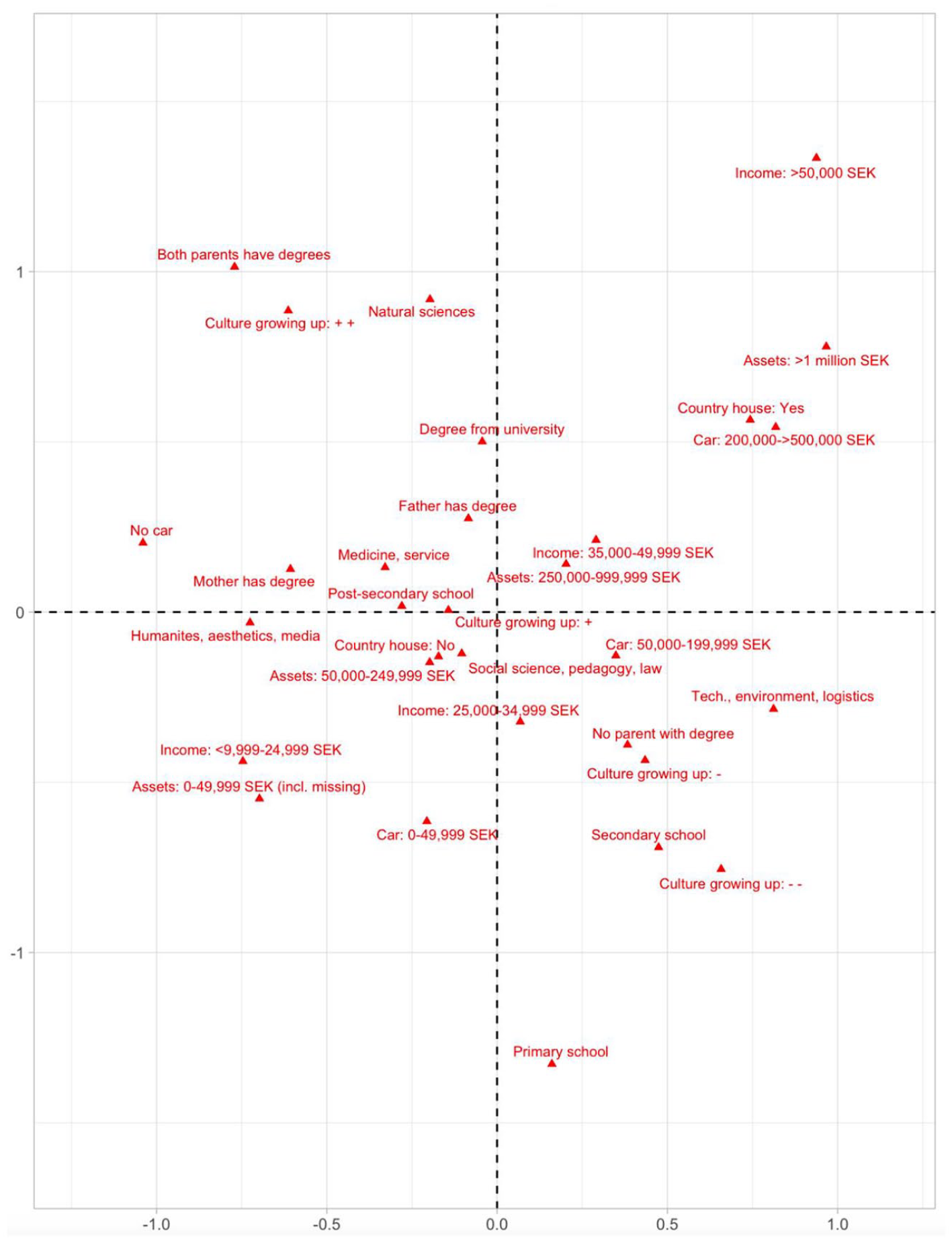
Figure 1 is a statistical representation of the structure of the contemporary Swedish social space. From the eight active variables the MCA retained two main dimensions. Together, these explain 89% of the variance (Table A2, Appendix). As such the subsequent analyses were based on these two dimensions (see Tables A3 and A4 for details on the contribution of active variables to the axes).
The Swedish social space. MCA, axis 1 and 2.
The first, horizontal, dimension accounts for 47% of the variance. At the overarching level this dimension describes differences in agents’ capital composition. To the right in the space, we find agents whose social resources are primarily of economic character (high salaries, significant volumes in assets and savings, possession of valuable cars and country houses). To the left, agents are first and foremost endowed with cultural capital. They have, to a larger degree than others, been raised in culturally rich homes, they have high levels of individual and inherited scholastic capital, and they can be expected to display a certain degree of symbolic mastery via their educational trajectories in the social sciences, humanities and arts.
The second, vertical dimension, accounts for 42% of the variance. This dimension taps into the primary force of social differentiation in Bourdieusian sociology – volume of capital. The highest volumes of overall capital are found at the top of the space, whereas the lowest are located at the bottom. Taken together, the structure of the space resembles not only Bourdieu’s (1984) original conception of the social space, but also previous studies of the contemporary Scandinavian countries (Flemmen et al., 2018; Hjellbrekke et al., 2015; Lindell, 2018; Lindell and Hovden, 2018; Lindell et al., 2021; Prieur et al., 2008; Rosenlund, 2015).
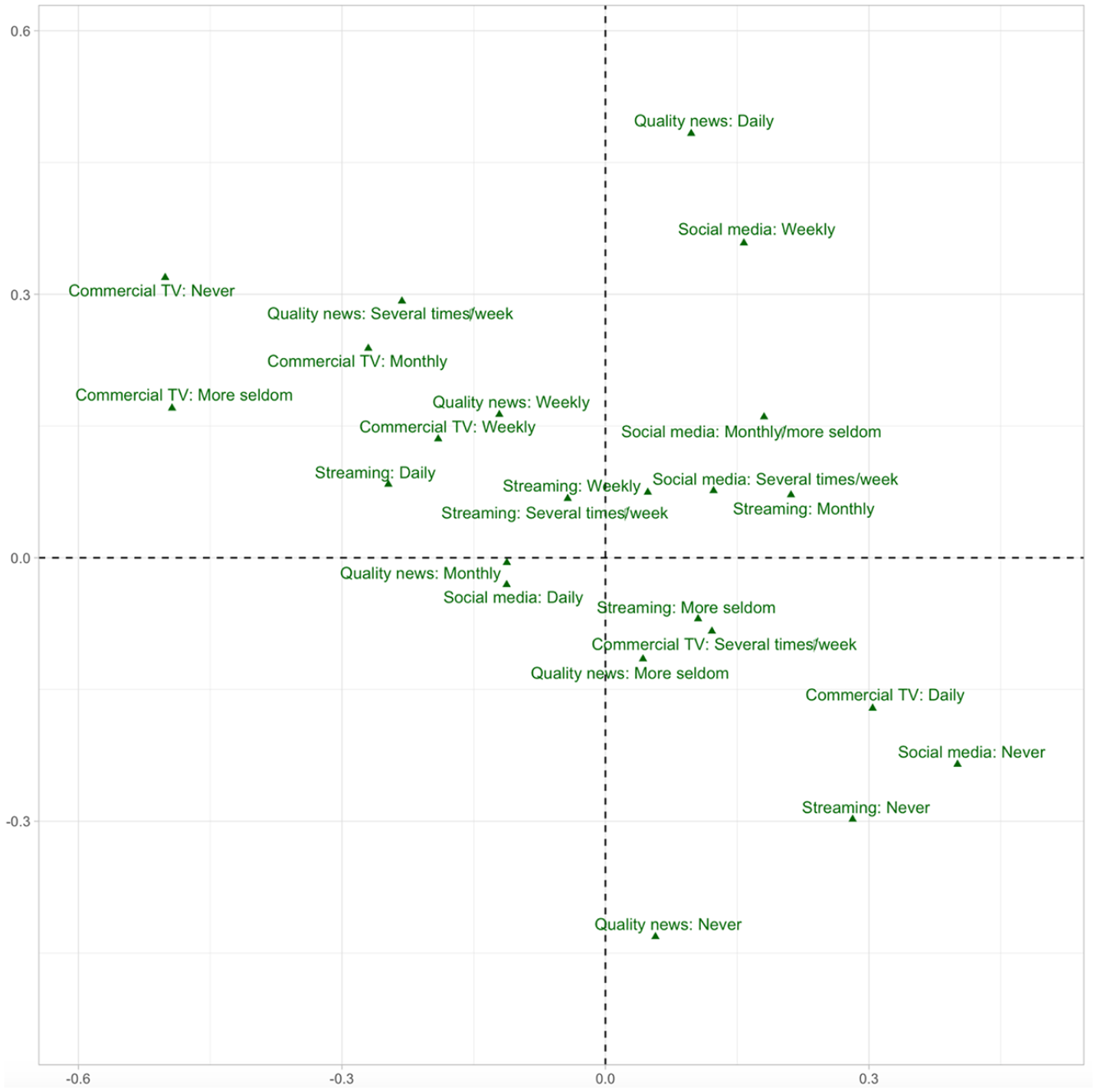
The next step is to analyse the extent to which media use corresponds to various social positions. Figure 2 shows the distribution of the modalities pertaining to the following variables in the social space: commercial TV-use (such as TV3, Kanal5 and TV6), social media use, reading the national ‘quality press’ (Dagens Nyheter, Svenska Dagbladet), and usage of streaming services (such as Netflix and HBO). Here too, findings align with previous studies on the social spaces and the space of lifestyles (Hjellbrekke et al., 2015; Lindell, 2018; Prieur et al., 2008). The culturally rich middle- and upper classes are first and foremost characterized by their rejection of commercial media outlets (see also Lindell, 2018). Consumption of so-called quality news follows the vertical axis on capital volume and becomes more frequent as we move upwards in the social space. The economic middle and upper classes are marked by their frequent use of social media and their consumption of the quality papers. Except for a daily consumption of commercial television, it is non-use that characterizes the dominated factions of society, especially the segments lacking cultural capital (where the non-use of the quality papers stands out most clearly).
Media use in the social space. MCA, axis 1 and 2.
The correspondence between media use and social positions are notable, as many modalities are found at around 0.4 deviations from the centre of the map (Schmitz et al., 2018) at levels of statistical significance (Table A5). In line with previous research (Lindell, 2018; Lindell and Hovden, 2018) on both media practices and preferences and other lifestyle categories this goes to show that social positions connect to culture consumption. Culture consumption is not sociologically neutral, and one of its social functions is that it reinforces the structure of class relations (Bourdieu, 1984). However, the key question remains to be answered: is this symbolic order anticipated and felt by social agents?
Felt Stigma in the Social Space
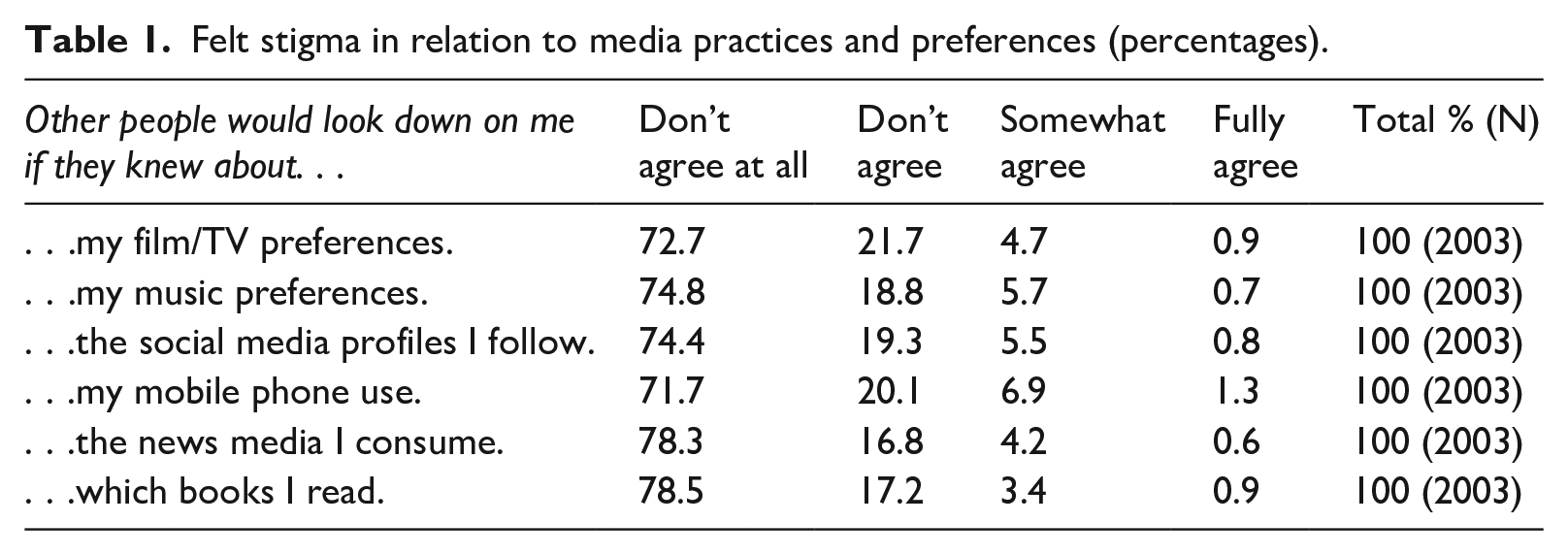
Turning to the distribution within the variables measuring felt stigma in relation to media practices and preferences, we observe that the vast majority of people do not internalize the symbolic order connected to moving about in the ‘legitimate culture’ in a ‘legitimate manner’ (Bourdieu, 1984: 87). Overall, this aligns with Atkinson’s (2021a) findings. As shown in Table 1, more than 70% of respondents do not agree at all that other people would look down on their media practices and preferences. Conversely, only around 1% fully agree to these statements.
Felt stigma in relation to media practices and preferences (percentages).
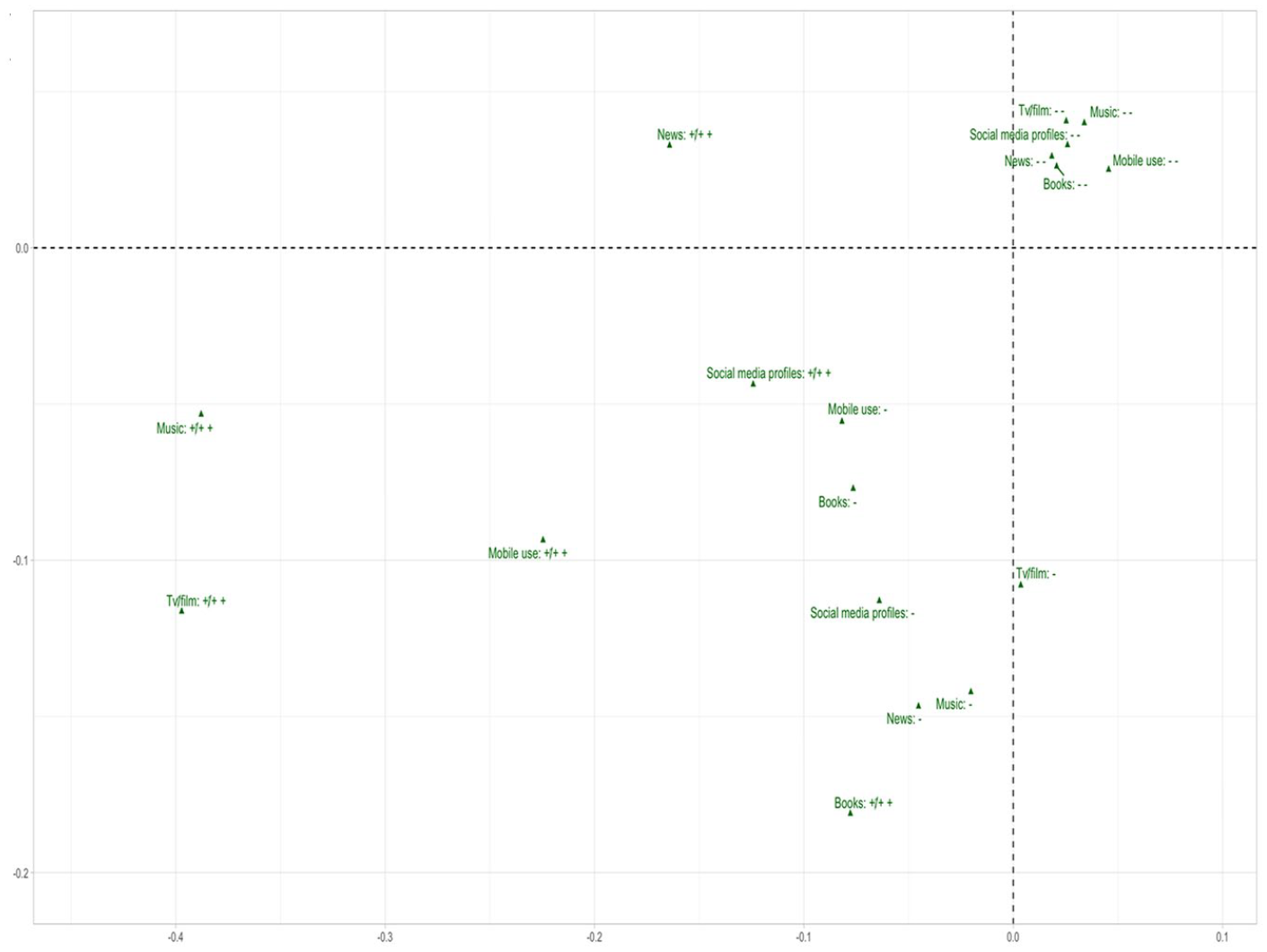
When projecting into the social space the variables measuring felt stigma connected to how others would judge one’s media practices and preferences, we find most modalities very close to the centre of the space, indicating next to no correspondence between social positions and felt stigma (Figure 3). We note, however, in agreement with Atkinson’s (2021a) study, that it is actually social agents whose capital portfolios consist primarily of cultural capital that are prone to experience a felt stigma in relation to their media and cultural practices and preferences (especially cinematic and music preferences) (Atkinson, 2021a). This is a striking finding in relation to a re-occurring contention in Bourdieusian sociology – that ‘the subordinate’ would be the ones more likely to self-impose the mark of disgrace in the cultural realm (Bourdieu, 1984; Waquant and Akçaoğlu, 2017). The alternative view that emerges in the data suggests that the cultural middle class is the segment that anticipates stigma on the basis of their media preferences. This might be explained not so much by a ‘cultural goodwill’ (Bourdieu, 1984) (a concept primarily used to describe to the petite-bourgeoisie’s relation to culture) as by the fact that the cultural middle class is the class invested in and have higher stakes in cultural fields, and they subsequently have more to lose by displaying the ‘wrong’ preferences in the eyes of the other – a point I shall return to.
Felt stigma in the social space. MCA, axis 1 and 2.
Thus, the present results are in some respects in disagreement with the only previous attempt to chart symbolic violence with MCA (Atkinson, 2021a). Atkinson’s study – also set in Sweden – suggests that people at lower social positions are complicit in the symbolic violence exercised on them, and thus more prone to anticipate stigmatization of their tastes. Two differences between the studies are worth highlighting. First, Atkinson is primarily concerned with the space of lifestyles and lifestyle groups (clusters), whereas this study focuses on the social space (which also implies that the present study does not exclude 18–24-year-olds (Atkinson, 2021a: 68)). Atkinson finds that the most ‘capital deprived’ cluster (making up 16% of the sample) is most likely to agree that their tastes would be ‘looked down on’ (2021a: 82) whereas this study finds that only the ‘cultural factions’ of the social space stigmatize themselves on the basis of what imagined others would think of their cinematic and music preferences. Second, in comparison to Atkinsons’s study (which relies on the survey items ‘my preferences and tastes would be looked down upon’ and ‘to enjoy art and classical music a person needs to know more than me’ (2021a: 70)), the present study uses more fine-grained operationalization of symbolic violence/felt stigma in that it distinguishes different media practices and preferences that might be ‘looked down upon’. The focus on the social space as a whole and the detailed mapping of which cultural/media preferences that might be looked down on might explain why the present study fails to find evidence that agents at lower-class positions would impose symbolic violence on themselves.
The present findings do, nonetheless, rhyme well with observations from qualitative research showing that subordinate classes draw on ‘a range of repertoires and alternative classification systems’ (Lamont et al., 2014: 589), and that the working-class valuation of personhood hinges on morality, and not on having the ‘right’ lifestyle and taste (Lamont, 1992, 2000; Skeggs, 1997). At the same time, the positions and status of cultural middle-class agents presupposes a ‘legitimate’ relationship to culture, and their positions are more clearly ‘threatened by their failure to live up to social and aesthetic expectations’ (Holmqvist, 2021: 17).
Conclusions and Discussion
A great amount of effort has gone into studying overlaps between the structure of the social space and the space of lifestyles. These structural homologies have been unearthed in many contexts, including the ‘egalitarian’ Scandinavian countries (Flemmen et al., 2018; Hjellbrekke et al., 2015; Hovden and Moe, 2018; Lindell, 2018; Lindell and Hovden, 2018; Rosenlund, 2015). A synthetizing conclusion is that these countries have moved ‘more and more into conformity with Bourdieu’s model’ (Rosenlund, 2015: 157) in that their social structures are made up of the main dimensions of capital volume and capital composition, and that these forces of differentiation correspond to a range of lifestyles and tastes. This study contributes to this body of Bourdieusian sociology by taking one additional analytical step. Besides (1) constructing the social space and (2) studying the distribution of cultural practices therein, this study (3) set out to understand the extent to which the overlaps between social positions and cultural practices translate into internalized, anticipated, stigma. By constructing the Swedish social space via MCA with a recent national survey, and via the subsequent study of the distribution of media use in that space, this study aligns with the conclusions of previous research. In relation to the first two analytical steps, it is clear that social class remains a factor shaping how we move about in the world of culture and consumption.
However, the key Bourdieusian concept of symbolic violence (Bourdieu, 1991) has received little attention in previous MCA-oriented studies (for an exception, see Atkinson, 2021a). That is to say that the extent to which the symbolic order – the homology between the social space and the space of lifestyles – is internalized and felt by social agents has been neglected. In seeking to remedy this gap, and to take Bourdieusian sociology into the realm of stigma and sociopsychological well-being, this study operationalized the notion that (certain) social agents are complicit in their own degradation – they impose symbolic violence upon themselves because they know ‘their place’ in the existing social order (Bourdieu, 1984). To this end, Bourdieu’s conceptual and analytical approach was combined with recent advancements in stigma research, where the notion of felt stigma (Bos et al., 2013; Herek, 2007; Link and Phelan, 2014) has become a key concept. The study sought to ask respondents about the extent to which they think that others would look down on them, had they known about their media practices and preferences.
Elements in the Bourdieusian narrative suggests that the masters of culture – society’s taste keepers (Hovden and Knapskog, 2014) – should be expected to be less likely to internalize stigma on the basis of their collectively recognized tastes and interests. By contrast, those deprived of the resources required to appreciate ‘the legitimate culture’ in the ‘legitimate manner’ (Bourdieu, 1984: 87) should be expected to summon an imagined other who ‘looks down’ on their choices on what books to read, which movies to watch, which social media profiles to follow, which news coverage to consume, which music to listen to, and the uses of the mobile phone.
While the results of this study align with the Bourdieusian contention that social positions overlap with cultural dispositions, they do not indicate that people at lower social positions internalize this macro-sociological order in cognitive processes of internalized stigma. In line with previous qualitative research (Lamont and Mizrachi, 2012; Lamont et al., 2014; Skeggs, 2011) findings invite us not to take the effects of symbolic violence for granted. This is not to suggest that symbolic boundary drawing between the classes is not at play. The categories of ‘white trash’ (Hartigan, 1997), ‘chav’ (Tyler, 2008), ‘culture elite’ (Jarness, 2017; Krogstad and Stark, 2021), and ‘snobs’ (Lindell, 2020) testify to the existence of both exclusionary and usurpationary boundary drawings across the social space (Jarness and Flemmen, 2019; Lindell, 2020).
However, since anticipated stigma of one’s media preferences does not seem to occur at subordinate positions in the social space, we are inclined to expect that these classes mobilize alternative systems of classification (Lamont et al., 2014; Skeggs, 2011). Instead, those with the highest stakes in the realm of culture consumption and lifestyles are the ones most likely to anticipate stigma in regard to their media preferences. In other words: losing the game requires playing it.
The fact that the form of symbolic violence studied here does not seem to reach subordinate classes connects to the contention that contemporary algorithmically curated media use (Striphas, 2015; Couldry and Meijas, 2019), alongside increasingly pronounced geo-social segmentation (Wacquant, 2008), economic inequality (Therborn, 2020) and polarization (Benkler et al., 2017) of societies have led to the emergence of more or less isolated ‘social islands’ whose populations find it difficult to conjure a judging gaze upon themselves (Lindell and Hovden, 2018). When individuals are probed about the extent to which others would look down on their practices and preferences, it is increasingly difficult to fathom what an alternative cultural repertoire might look like. Algorithmically curated digital media usage breeds individualistic exposure (Hallinan and Striphas, 2016) and the platforms (be it Twitter, Netflix, HBO, Spotify, Instagram, Facebook or a news aggregator) to which much of our media and culture consumption have migrated are explicitly configured to create digital cocoons around individuals and groups (Gaw, 2021). It would follow that the ‘other’, the supposed judge of one’s practices and preferences, is no longer the cultural elite and the taste keepers (Hovden and Knapskog, 2014) but rather the ‘tracked self’ (Bergroth, 2019) or the fellow-inhabitant in one’s own social sub-space – a person sharing one’s own position and disposition (Lindell and Hovden, 2018).
The poor, people referred to as ‘chavs’ or ‘white trash’, and people lacking the keys to cultural mastery, are still being punched down upon. They are not, however, complicit in this symbolic power play – they do not impose this stigma on themselves. One possible explanation to this is found in the previously documented tendency among working-class subjectivities to create allodoxic (Bourdieu, 1984) alternative systems of valuation (Lamont, 2000; Skeggs, 2011). Adding to this, it seems possible that increased algorithmic curation of taste and media use implies that the ‘cultural elites’ are no longer present in the digitalized life-worlds of people at lower social positions. In the platform society (van Dijck et al., 2018) the cultural elites might be losing their power as taste keepers in favour of algorithmic intermediaries (such as the Netflix Recommender System) that prescribe users with the culture corresponding to the taste communities they supposedly belong to (Gaw, 2021). In a time where media users become increasingly encysted in curated and recommended ‘taste communities’ it is the ‘anxious’ (Meng, 2020) cultural middle class, having clear-cut stakes in their media and cultural tastes, that (still) feel that others would look down on their cinematic and music preferences.
Ways Forward
This study challenges a dominant vein in Bourdieusian sociology. The ‘others-will-look-down-on-me’-hypothesis, that is, the expectation that people at subordinate positions would anticipate stigmatization of their culture and media preferences, cannot be confirmed. Results also nuance Bourdieu’s (1984) notion of cultural goodwill of the petite-bourgeoisie. If anything, results suggest that it is an ‘anxious’ cultural middle class that is predisposed, possibly by way of their investments and stakes in their tastes, to expect others to look down on their media preferences and practices.
This raises a number of questions, not only in regard to the present study and its limitations, but also for future research. For one, research should attempt to define the social origins of the ‘other’ casting the stigma. This study asked if respondents anticipated that an unknown other would ‘look down on’ their practices and preferences. It is an open question if results would have been different had respondents been asked if (for example) a university professor, a journalist, an artist, a truck driver, would ‘look down’ on their tastes. Stigma is, furthermore, often dealt with through various coping strategies (e.g. refusal to admit stigma (Corrigan and Watson, 2002)) that are difficult, if not impossible, to handle in a survey design. Additionally, previous research has shown that ethnic minorities and marginalized groups tend to adopt a ‘respectability politics’ in their social media behaviour, in order to ‘pass’ as members of a white middle class (Pitcan et al., 2018; see also Herek, 2007). This type of ‘passing’ is another coping strategy that this quantitative research design is unable to exclude as a potential explanation as to why subordinate classes do not anticipate stigma. This goes to say that future studies should combine qualitative and quantitative approaches in order to account for potential coping strategies that could be dealt with only in in-depth interactions and analyses.
Lastly, this study has suggested that algorithmic curation of individual taste repertoires, which characterizes much of contemporary culture consumption today, is a potential explanation as to why most social agents do not internalize the symbolic order in the form of felt stigma. Future research should further explore the new algorithmic cultural intermediaries and how they impact the role held by traditional cultural intermediaries and taste-keepers. Research should also explore realms of culture consumption that are less mediatized and not as clearly governed by algorithmic culture, to confirm or challenge the notion that it is first and foremost an anxious, cultural, middle class that internalizes stigma in the realm of culture and lifestyles. Lastly, we need to disclose the extent to which distinct sub-spaces, or ‘islands’ (Lindell and Hovden, 2018), in the social space are becoming more insular and ignorant of the dispositions, values and tastes of other sub-spaces and groups in society.
Footnotes
Appendix
V-test for supplementary variables on media use in relation to dimensions 1 and 2.
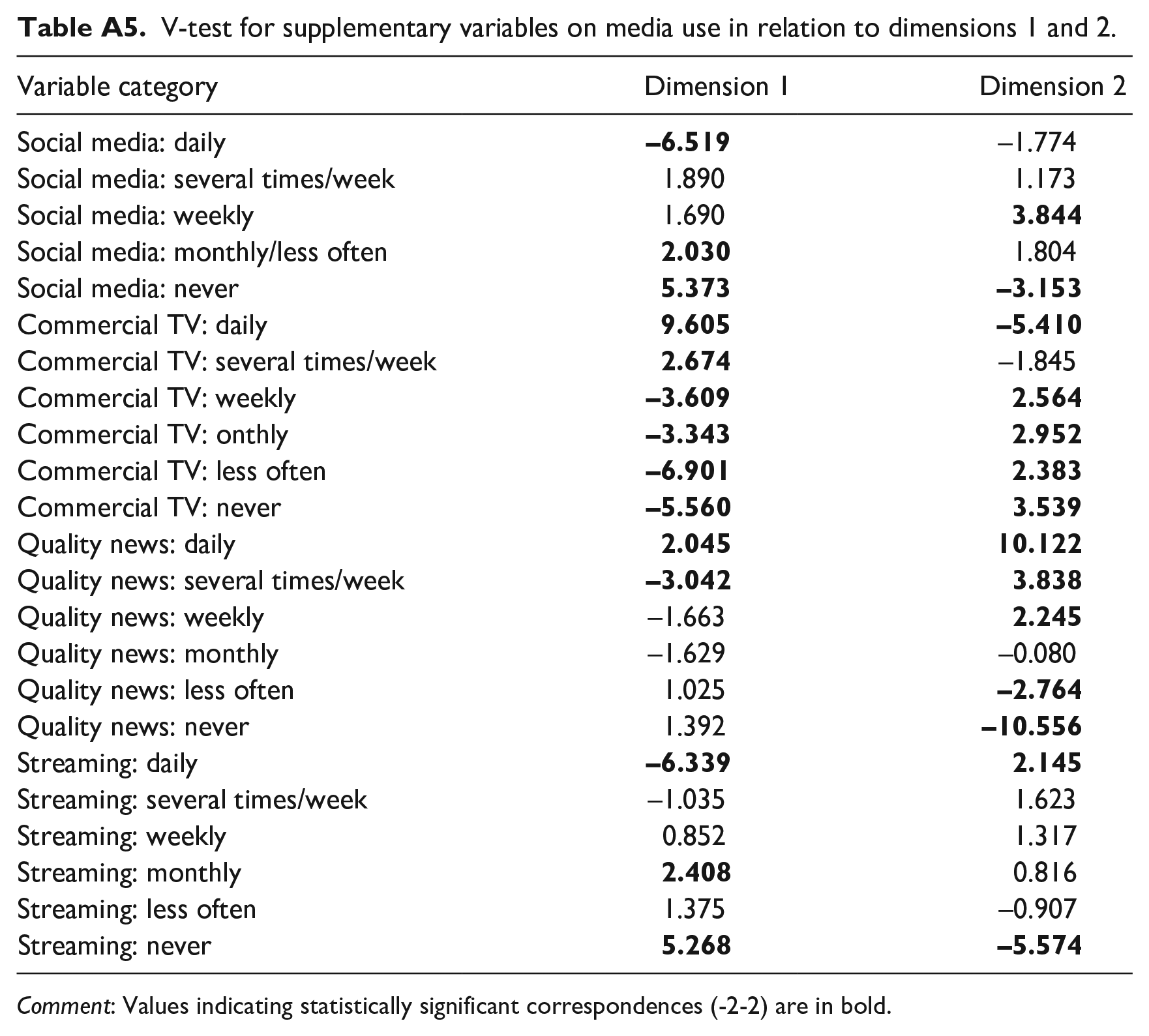
| Variable category | Dimension 1 | Dimension 2 |
|---|---|---|
| Social media: daily |
|
−1.774 |
| Social media: several times/week | 1.890 | 1.173 |
| Social media: weekly | 1.690 |
|
| Social media: monthly/less often |
|
1.804 |
| Social media: never |
|
|
| Commercial TV: daily |
|
|
| Commercial TV: several times/week |
|
−1.845 |
| Commercial TV: weekly |
|
|
| Commercial TV: onthly |
|
|
| Commercial TV: less often |
|
|
| Commercial TV: never |
|
|
| Quality news: daily |
|
|
| Quality news: several times/week |
|
|
| Quality news: weekly | −1.663 |
|
| Quality news: monthly | −1.629 | −0.080 |
| Quality news: less often | 1.025 |
|
| Quality news: never | 1.392 |
|
| Streaming: daily |
|
|
| Streaming: several times/week | −1.035 | 1.623 |
| Streaming: weekly | 0.852 | 1.317 |
| Streaming: monthly |
|
0.816 |
| Streaming: less often | 1.375 | −0.907 |
| Streaming: never |
|
|
Comment: Values indicating statistically significant correspondences (-2-2) are in bold.
Funding
The author disclosed receipt of the following financial support for the research, authorship, and/or publication of this article: This research is funded by the Ander Foundation for Media Research.
