



Abstract
This paper charts the space of lifestyles in Germany in order to assess whether its structure resembles that famously uncovered in France by Bourdieu. Mobilising multiple correspondence analysis and using data from a bespoke national survey of tastes and lifestyles fielded in 2017–18 (n = 2244), it unveils a two-dimensional system defined by tastes for the culturally exclusive and the economically exclusive. These dimensions are strongly associated with indicators of cultural capital and economic capital, and reveal differences by both capital volume and capital composition, but they are also structured by age and ethnic origin. While age is indicative of Bourdieu’s concept of trajectory, the effects of ethnicity underscore the relative autonomy of the space of lifestyles and suggest its determination by more than one structural force.
Introduction
Germany has long been the seedbed of sociological debates over class and consumption. From Max Weber to Ulrich Beck via Norbert Elias and others, the nation at the heart of Europe has informed and elicited numerous and influential theorisations of the nexus between social position and taste for at least a hundred years. A lively and venerable tradition of research in the 20th Century and beyond, furthermore, has centred on the detection and characterisation of contrasting socio-cultural ‘milieus’ across both the Bonn Republic and united Germany, much of which draws at least some inspiration from Pierre Bourdieu’s (1984) pioneering anatomisation of taste in France. Only rarely and latterly, though, has research in Germany embraced the full spatialisation of class and culture inherent in Bourdieu’s thesis and the appropriate statistical tools to document them, and where it does it has been limited by data constraints. There are also regrettable omissions, one of which is examination of the possible effects of ethnicity, as a source of difference and domination analytically separable from class, in differentiating tastes and practice. Recent Bourdieusian scholarship, after all, has stressed the relative autonomy of lifestyles from class and the multidetermination of taste and consumption (Atkinson, 2021a; Bennett et al., 2009; Flemmen et al., 2019), and Germany, with its many waves of post-war immigration, offers an excellent case for exploring these points further.
This paper, then, aims to contribute towards and push forwards the developing Bourdieusian strand of quantitative cultural analysis in two ways. First, it will paint a comprehensive new picture of the space of lifestyles in 21st Century Germany. More specifically, in line with the Bourdieusian framework, it endeavours to construct a multidimensional map of lifestyles using an appropriate tool of geometric data analysis, namely, multiple correspondence analysis. Second, it will then document not only the homologies with social position proxied by capital possession but also the ways in which capital possession is cross-cut or offset by age and ethnicity. To do this, we draw on an original survey fielded in Germany in 2017–18 and including a wide range of items related to consumption – that is, practices and tastes regarding books, television, music, food, art, body modifications and material goods. First, however, it is necessary to provide some context by adumbrating not just the thesis to be examined but the development of and debates over class and culture in Germany.
The spatial model of class and culture and its challengers
Bourdieu’s (1984) thesis was based on several radical conceptual moves. The first is a thorough recasting of class in terms of possession of different forms of capital, especially economic capital (money and wealth) and cultural capital (mastery of legitimated symbolic systems). The second is an insistence on the multidimensionality of class: while upper, lower and intermediate ‘classes’ may be distinguishable on the basis of their overall volume of capital, each is cleft by capital composition, that is, the relative weight of cultural capital against economic capital. Underpinning this is Bourdieu’s specifically relational or spatial vision of the class structure: ‘classes’ are defined by their position relative to one another, but equally there are no hard and fast boundaries between them, only a space of positions defined by polarities, distances and directions. The third move is a break with static conceptions of class by positing time or ‘trajectory’ as the third dimension of the class structure: the meaning of a person’s social position is inextricably defined by how they got there and the probable future (rise, decline or stasis) inscribed into it – something indexed not only by social origin but by age too.
The fourth move is to posit a homology between the space of classes, or ‘social space’, and a space of lifestyles. Cultural activities, interests and goods form their own space defined by a prime opposition of the rare and the common, or the exclusive and the accessible, which also takes the form of a polarity between style and substance or form and function. This is cross-cut by a secondary distinction, this time opposing the hedonistic-luxurious and the intellectual-ascetic, as well as the old and the new. The axes of the lifestyle space, however, could be mapped on to the axes of the social space, with the rare/common polarity corresponding with high/low capital and the intellectual/luxurious or new/old dichotomies corresponding with the division between cultural capital and economic capital, the latter division also dovetailing with age or trajectory insofar as institutionalised cultural capital was more prevalent among youth. This is because opposing tastes – as sets of dispositions and evaluative schemata, or habitus – are the product of adaptation to the possibilities and impossibilities furnished by contrasting positions in the social space.
Bourdieu was certain that similar patterns would be detected beyond France, but subsequent research went in a different direction. In the early 1990s, Peterson (1992) posited a shift away from intellectual or ‘highbrow’ culture as the dominant yardstick of worth towards omnivorousness, that is, the taste for and facility with a wide range of popular and highbrow forms of culture. More recently, though, researchers have become wary of this thesis, largely on methodological grounds (e.g. Atkinson, 2011; Coulangeon and Duval, 2015; Hazir and Warde, 2018; Holt, 1997), and noted its peculiar one-dimensionality: culture is typically treated only as a question of high/low, whatever form that may take, and social position understood purely in hierarchical terms, thus ignoring the role of capital composition in differentiating tastes (Lizardo and Skiles, 2018). Ultimately, most advocates of the omnivore thesis simply do not do what Bourdieu did, that is, map out the space of lifestyles and its homologies (Wuggenig, 2007). To do that one needs to use Bourdieu’s own favoured approach, geometric data analysis, the most commonly used technique of which is multiple correspondence analysis (MCA). MCA is a form of data reduction that operates to transform the variance between variable categories into multiple axes of difference of varying magnitude. The outcome is a space defined by directions and distances between categories – in this case, categories indicating taste or cultural activity.
Use of MCA to test or update Bourdieu’s thesis has proliferated in the last 15 years, with many constructing models of spaces of lifestyles for territories as diverse as Sweden (Börjesson, 2015), Switzerland (Weingartner and Rössel, 2019), Flanders (Roose et al., 2012), Australia (Bennett et al., 2020), Mexico (Bustamante and Garcia, 2015), Poland (Marzec, 2019), the UK (Bennett et al., 2009) and the US (Atkinson, 2022a). Many of these are constrained by the limitations of secondary data, including reliance on unidimensional measures of social position, making a break with the omnivore thesis difficult. Where, however, variables are more varied and differentiated – including indicators of material consumption or sporting preferences alongside participation in highbrow arts, for example – the results are much closer to Bourdieu’s (Flemmen et al., 2019). That is to say, an opposition emerges between the exclusive and the accessible, corresponding with capital volume, which is cross-cut by an axis distinguishing the intellectual (or novel) from the luxurious that corresponds with capital composition.
One point the new wave of MCA research and the omnivore studies have in common, however, is an interest in underlying factors other than class. Capital possession may play a major role, but so too do gender, age and ethnicity/race. Women, for example, are typically more inclined towards highbrow culture than men (Katz-Gerro, 2002), or differentiated from men by their consumption of specific genres of books and film (Bennett et al., 2009), while many studies using MCA emphasise an opposition between ‘youth culture’ and ‘traditional culture’. Some thus argue that generational effects should be taken seriously (Glevarec and Cibois, 2021), though how far this is separable from Bourdieu’s notion of trajectory is debatable. As for race and ethnicity/nationality, Bourdieu (1984) did not ignore it – he emphasised that classes were defined in part by their ethnic composition as much as ethnic groups were defined by their typical class positions. Yet later scholars, working in a context of skyrocketing migration and growing post-colonial sentiment, have suggested that race/ethnicity/nationality, at least in some national contexts, may have an effect on dispositions and taste irreducible to economic and cultural capital, not least insofar as it bears on familiarity with the conspicuously white European canon of the ‘highbrow’ arts (e.g. Bennett et al., 2009; Bryson, 1996; Erikson, 1996; Katz-Gerro, 2002; Meghji, 2019; Trienekens, 2002). It is possible, in fact, to build on marginal remarks by Bourdieu (1991) to posit the existence of a space of ethno-racial/national difference and domination relatively autonomous from the social space yet intersecting with it in complex ways (Atkinson, 2020a; Emirbayer and Desmond, 2015; Hage, 1998; Tabar et al., 2010). This reinforces the point recently pursued by Flemmen et al. (2019) that the space of lifestyles is itself relatively autonomous from the social space rather than directly determined by it. We would argue, however, that this is not because the space of lifestyles is a separate system of stratification, as Flemmen et al. (2019) propose, since it is what Bourdieu would call a space of ‘position-takings’ rather than a space of positions. Rather, the space of lifestyles is co-determined by multiple structural spaces, which is another way of saying that an individual’s practice is adjusted to the necessities or possibilities of more than one system of difference and domination (Atkinson, 2016, 2020a, 2021a).
Class and culture in Germany
The German case offers fertile ground for exploring these themes further. First of all, there is every reason to believe, given the country’s history, that Bourdieu’s general model would hold good. In common with most European social orders, the old German nobility imported a specifically French form of courtly culture centred around appreciation of ‘fine arts’ (classical music, opera, theatre, etc.). This was refracted through the distinct prism of German culture and society to generate not only the peculiar notion of Bildung, or personal and intellectual development through experiential enrichment (including via engagement with the arts), but also, according to Elias (1996, 2000), the opposition between intellectual culture (Kultur), centred on Bildung, and the supposedly superficial and ‘showy’ lifestyle of the aristocracy (Zivilization) – both of which, of course, were defined against ‘vulgar’ popular (Volk) culture. With the decline of the aristocracy in the 20th Century and the entrenchment of consumer capitalism, first in West Germany and then in united Germany, the stage was set for intellectual culture, associated with cultural capital, to face off against the materialistic culture of the economically rich instead.
Although 1980s′ Germany was the wellspring of Beck’s (1992) ‘individualization’ thesis, closer engagements with class and culture in the country were never entirely convinced of a need to move ‘beyond class and status’. Schulze (1992), for example, though influenced by Beck, still identified five distinct ‘milieus’ evincing different styles of life not only defined by their relation to highbrow culture and its opposites (‘triviality’ and ‘excitement’) but also corresponding with contrasting education profiles (and age structures too). Others were even less persuaded. Spellerberg (1996) and Georg (1998), for instance, both used cluster analysis to detect a series of strikingly familiar lifestyle groups. There were working-class clusters centred on either practicality/frugality or entertainment, depending on age, and associated with lower education and incomes, but also a highbrow cluster associated with higher education and a luxury cluster associated with the highest incomes and wealth. Vester et al. (2001), moreover, not only identified a range of ‘milieus’ with divergent lifestyles, values and sociodemographic profiles, based on empirical data, but also went so far as to explicitly position them within Bourdieu’s famous diagram of the homology between the social space and the lifestyles space. This was taken as disproof of the individualization thesis, but the cultural omnivore was nowhere to be found either. In fact, with discerning variables from the start and, therefore, results that did not recommend it, German researchers tended to ignore the omnivore thesis. Gebesmair (1998) was a rare advocate, but what empirical tests there were of the thesis were hardly supportive (Neuhoff, 2001; Rössel, 2006). Most recently, Reckwitz (2020) has suggested that cultural consumption in Germany is characterised by neither individualization nor omnivorousness but a search for the unique and singular.
As suggestive as they are, however, the studies cited did not actually map the space of lifestyles in Germany using MCA. Vester et al.’s (2001) use of Bourdieu’s diagram was an intuitive heuristic device – it was not based on any statistical criteria – while cluster analysis on its own gives little insight into the relational or topological configuration of tastes, that is, the internal dispersion within and external distances between clusters in multiple dimensions. Two clusters may be far apart in one respect, for instance, but close together in another, and this is important because the distances and directions in an MCA space, rigorously constructed, act as approximations of perceived distances and principles of difference and the struggles and evaluations they generate in quotidian practice.
MCA has not, however, been ignored in German research on lifestyles. Far from it: Jörg Blasius has, in several papers, sought to use MCA, applied to a questionnaire modelled on Bourdieu’s own, to construct models of a German space of lifestyles (Blasius and Friedrichs, 2008, 2020; Blasius and Mühlichen, 2010; Blasius and Schmitz, 2013; see also Schmitz, 2016). With variables available for furniture preferences, clothing styles, favourite celebrities and meal predilections, a prime opposition between tastes for form and function was discovered, as was an intersecting secondary axis polarising tastes for the modern and the traditional. Insofar as these were said to correspond, respectively, with differences in economic capital (income) and cultural capital (education level), Bourdieu’s model was apparently confirmed, albeit with a 45° rotation being necessary to bring it fully into line with the volume/composition model. Innovative, technically robust and highly indicative as they may be, however, Blasius’ studies nevertheless bear several methodological constraints that mean the results raise as many questions as they answer and necessitate further research. These constraints include a relatively modest sample size (n = 872) and confinement to respondents from Cologne and Bonn only (and in some papers, from only selected neighbourhoods of those cities), but also use of only a few active variables and limited indicators of social position. The restricted range of lifestyle variables was certainly sufficient for unearthing differences, but it leaves one asking how not only classic components of Kultur and Bildung (classical music, arts, etc.,) but widespread, popular pastimes (television, sports, etc.,) would fit into the space or, indeed, alter its shape – and, with that, how the German case can be compared against international scholarship that focuses directly on these absent elements. The blunt indicators of social position, moreover, and particularly the absence of indicators of wealth and inherited cultural capital or discipline of study, prompt questions regarding the homology with the social space, especially since, in Blasius’ models, age appears (at least prima facie) to be a more pronounced structuring principle in the space than capital composition per se.
There is also nothing on the possible complicating effects of ethnicity. In the German context, this theme evokes above all the long-running ‘guest worker’ (Gastarbeiter) programme. After the Second World War, migrants from nearby countries suffering high unemployment were invited to work and live, with reduced citizenship rights, in West Germany. These countries included Italy, Spain, Greece and Turkey, and despite being seen as a temporary arrangement many guest workers subsequently settled and raised families in Germany. It might be said, therefore, that the guest worker programme operated to differentiate the German ethno-racial/national space (previously structured primarily around the opposition of Western Germans and Eastern Slavs), with consequences for the sense of ‘us’ and ‘them’, ‘our’ culture and ‘their’ culture and the system of symbols indicating social position, particularly in relation to the oppositions of European/Turkish and Christian/Muslim (see Abadan-Unat, 2011).
The link between ethnicity and lifestyles in Germany, however, remains understudied (Otte and Rössel, 2011). The most comprehensive attempt to explore the lifestyles of ethnic minorities in Germany hitherto has been offered by the Sinus Institute (2008). Deploying the familiar concept of ‘milieu’ to produce a typology of minority lifestyles, they concluded that minorities are extremely diverse, being separated into eight milieus largely resembling ones observed in the general population. Yet this approach has been criticised for overstressing internal differentiation at the expense of strong cohesion among many minority ethnic groups (most importantly, Turks) and ignoring crucial differences between them and the ethnic majority, that is, white Germans (Halm and Sauer, 2011). When minorities have been analysed as a part of the general population instead, a different picture emerges. Otte (2004), for example, found Turks to be clustered primarily in ‘traditional worker’ and ‘home centred’ milieus, explicable perhaps by their low economic and cultural capital, while Jacob and Kalter (2011) discovered that the direction of the relationship between parental characteristics and consumption of traditional highbrow culture is reversed in families of Turkish background. How exactly this translates into the cartography of taste and the interplay of structural homologies, however, is unknown.
Data
This paper seeks to plug the gaps in current understanding by constructing a new, comprehensive model of the space of lifestyles in Germany and its homologies. More specifically, its goal is not only to test the applicability of Bourdieu’s original model of cultural differentiation using similar, but updated and adapted, indicators of taste and practice but also to go further than Bourdieu by examining more systematically the interplay of class with other factors. To do this, we draw on a purpose-built survey fielded across Germany in 2017–18. Respondents were recruited through random digit dialling, and the interviews were carried out via telephone.
The response rate for the survey was not retained by the data collection agency for data protection reasons, but we should expect it – in line with market-research industry standards (Kennedy and Hartig, 2019) – to be around six percent. This is low compared to government-sponsored social surveys, raising the possibility of nonresponse bias, and young people and lower-educated people were, indeed, notably underrepresented. For that reason, we commissioned a second phase of fieldwork with screeners for age and education level to bring the final sample in line with distributions derived from the 2011 Census. The final sample (n = 2244) was then weighted by respondent education level, age crossed with father’s education, using data from the European Social Survey as a benchmark, and (to counteract intentional oversampling of Berlin residents for follow-up interviews) region. We then sought external validity for the dataset by comparing responses to selected lifestyle questions against equivalents in the 2014 ALLBUS survey. Relative frequency distributions were satisfactorily similar, and relations with age, gender and education level, measured using Cramer’s V, were extremely close. Results of these checks are reported at https://tinyurl.com/3s9pwd8f.
For all these steps taken to improve and assess data quality, we do not claim the dataset to be without remaining limitations or distortions, not least because there may be other sources of selection bias undetectable with the available variables. The effects would be worse if we were concerned primarily with univariate distributions – nonresponse bias appears less detrimental to multivariate analysis (Amaya and Presser, 2017) – but nonetheless we must be careful not to overdraw conclusions. That is the compromise necessary to have attained bespoke primary data efficiently rather than rely on secondary data.
The survey included a long list of questions on lifestyles. These were in part modelled on previous surveys (including Bourdieu’s), with suitable adaptation to national context, but also purposively constructed, aware of the limitations of earlier surveys, to balance (i) measures of knowledge, taste and practice; (ii) home-based and non-home based activities; and (iii) elements of hypothesized classed cultural styles (cultivation/asceticism, luxury and accessibility). They covered television (hours watched), music (frequency of listening to classical music), food (favourite type of restaurant), books (number owned), sports (favourite to watch and play), art (knowledge of eight named artists), preferred style of clothes, ideal home décor, body modification (tattoos, cosmetic surgery, dental work, hair transplants and sunbeds), possession of cars (number and value) and luxury items (boats, tailored suits, second homes, personalised licence plates and jewellery/watches worth over 500 Euros), frequency of participation in named cultural activities (weekly, monthly, few times per annum, etc.) and favourite cultural activity. The survey also gathered information on social position. Relevant indicators of capital possession – determined on the basis of previous experience of modelling social spaces (Atkinson, 2020b; Atkinson and Rosenlund, 2014) – include household income, savings value, home value, stocks and shares value, education level (crossed with discipline of study at the tertiary level) and parental education and book ownership when the respondent was aged 14. These are complemented by variables relating to gender, age, ethnicity, employment status, occupation, industry of employment and – to capture any legacies of partition – East/West German residence.
Methods
The space of lifestyles is constructed using specific MCA. As already mentioned, MCA is a form of geometric data analysis for categorical variables designed to map the variance between categories spatially. It does this by distinguishing principles or dimensions of variation within the data that account for differing proportions of the total variance, or inertia. Categories are arrayed according to their deviation from one another and are of differing magnitude in contributing to the inertia of the dimension (those with above-average contributions are deemed ‘explicative’). Dimensions, or axes, are reported in order of descending magnitude, and only those axes contributing a substantial proportion of the total inertia are retained for interpretation. There is no set threshold for this, though 70% is a common yardstick. Attention is also paid to sharp drop-offs in explained inertia between axes and to sociological interpretability. As MCA underestimates explained inertia, we use the formula devised by Benzécri (1992) to produce modified inertia rates (to which the 70% yardstick applies). The ‘specific’ variant of MCA allows us to set certain categories, and missing data, as passive, meaning they do not contribute to defining the model’s inertia but are still attributed factor coordinates.
Relative frequencies of active variables.
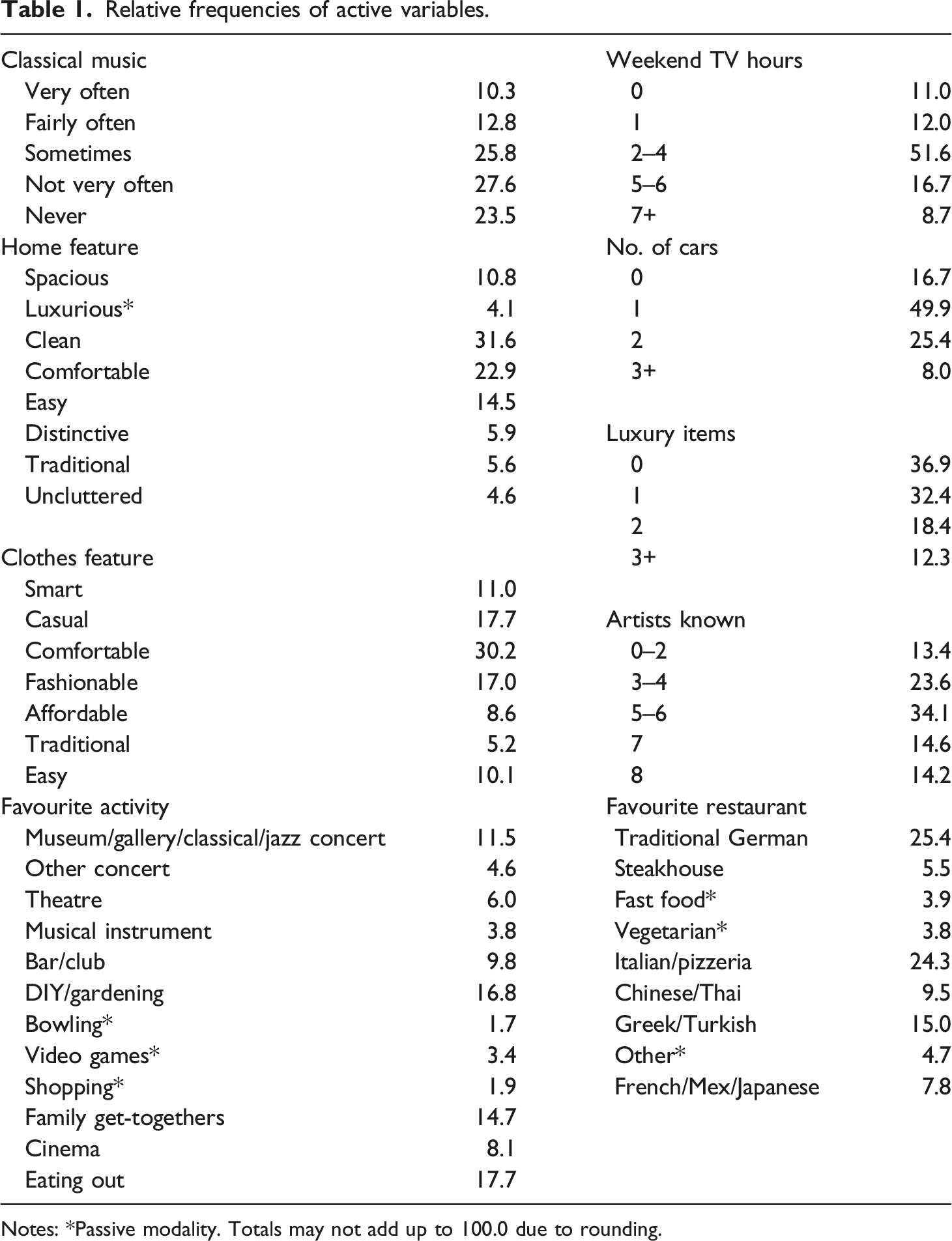
Notes: *Passive modality. Totals may not add up to 100.0 due to rounding.
Relative frequency of age groups and ethno-racial categories by education level.
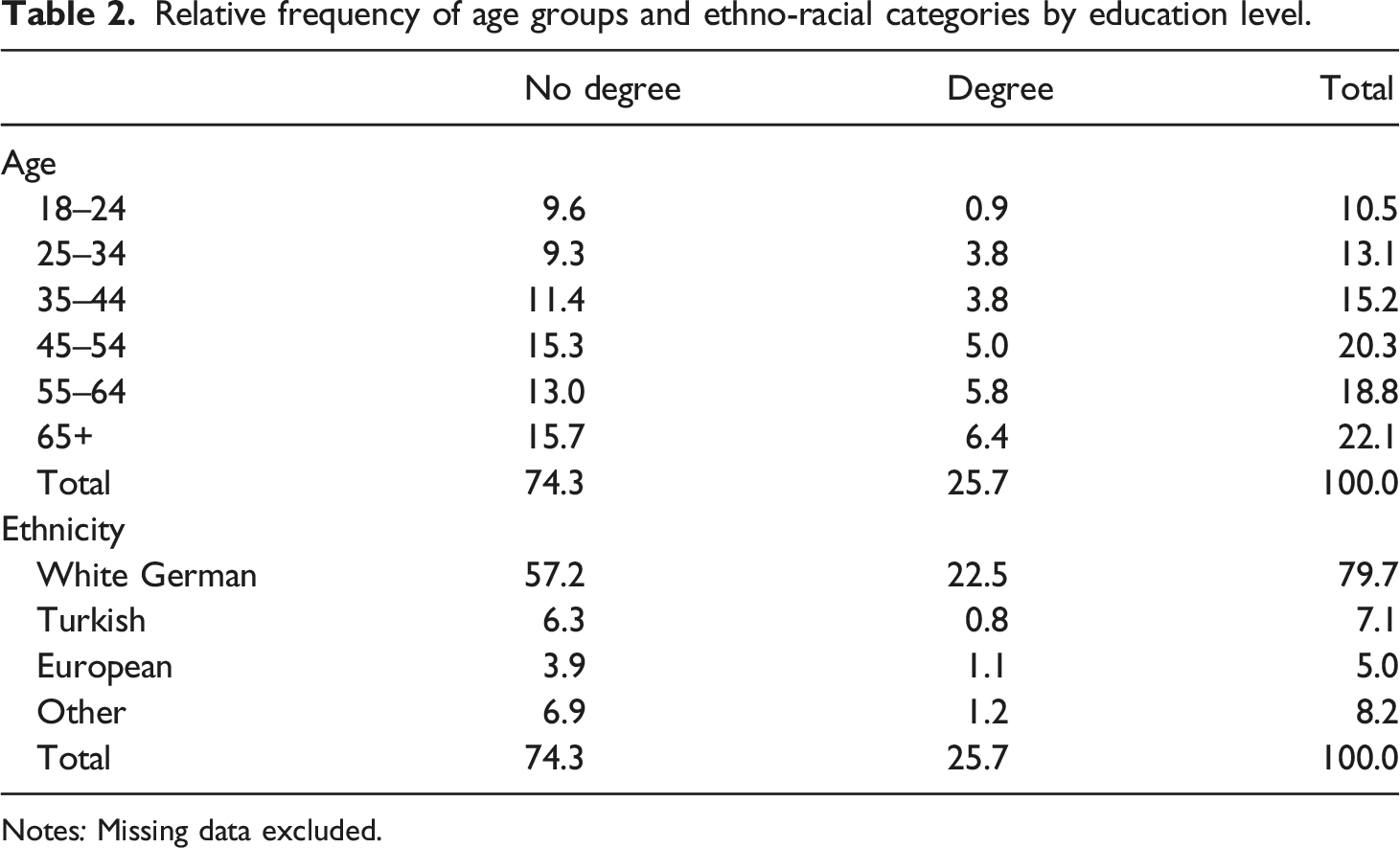
Notes: Missing data excluded.
Kultur and materialism
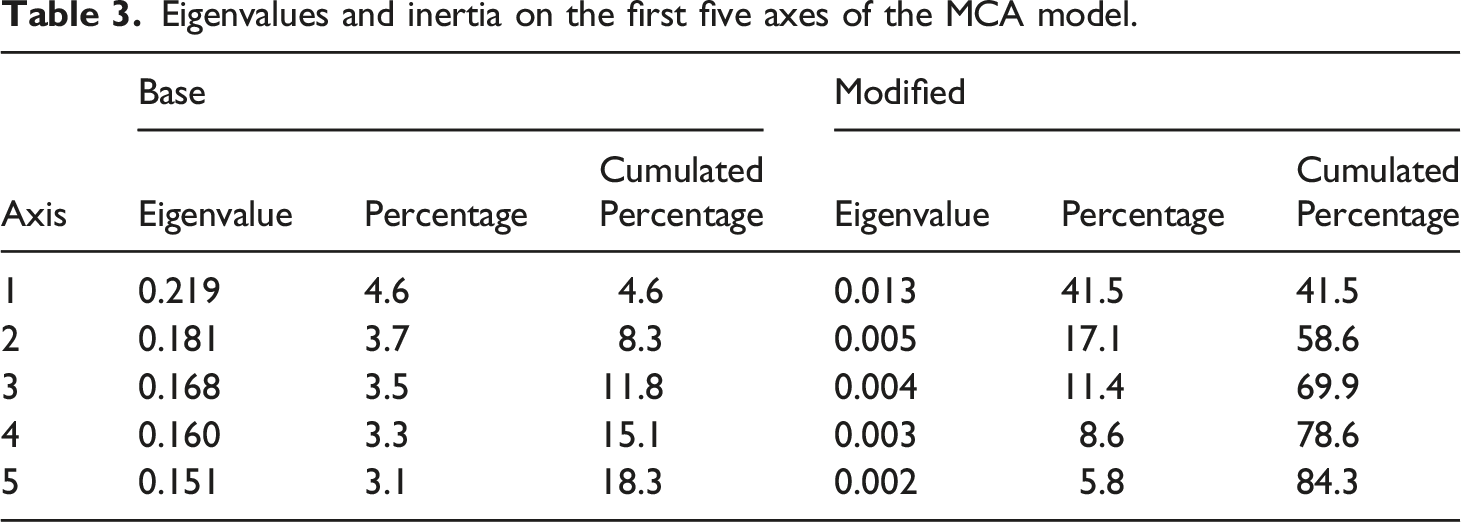
The first dimension of the MCA space bears a modified inertia rate of 42% (Table 3). Modality positions and contributions suggest the prime opposition is between those evincing signs of highbrow culture, or Kultur, and those not doing so (Figure 1, Table 4). Those who listen to classical music are opposed to those who do not; those who know many of the named artists are opposed to those who know few; and those who enjoy museums/galleries/jazz/classical concerts are opposed to those who prefer eating out. Favoured restaurants are also polarised along this axis, with a taste for French/Mexican/Japanese restaurants corresponding with Kultur and Greek/Turkish restaurants (and fast food) forming their gastronomic opposite. Italian restaurants/pizzerias, the most popular types of eatery, are pulled towards the Kultur pole, but to a much lesser extent than French/Mexican/Japanese restaurants. A desire for a clean home and a tendency to watch a lot of weekend television (7 hours or more) also contribute above average to the axis at the anti-Kultur pole. Though they are passive or explained modalities, favouring shopping, bars/clubs and video games (and to a lesser extent fashionable clothes) correspond with this pole too, while a taste for theatre, uncluttered or distinctive homes and playing musical instruments are associated with the Kultur pole. The same is true of preferring affordable or casual clothes and easy homes, but these are situated more in the middling section of the space. MCA space of lifestyle practices, active variables in the plane of axes 1 and 2. Notes: Numbers in parentheses denote explicative status on axes. Modalities in parentheses are passive. weTV = weekend TV. Eigenvalues and inertia on the first five axes of the MCA model. Modality contributions. Notes: contributions over 1.9 are explicative.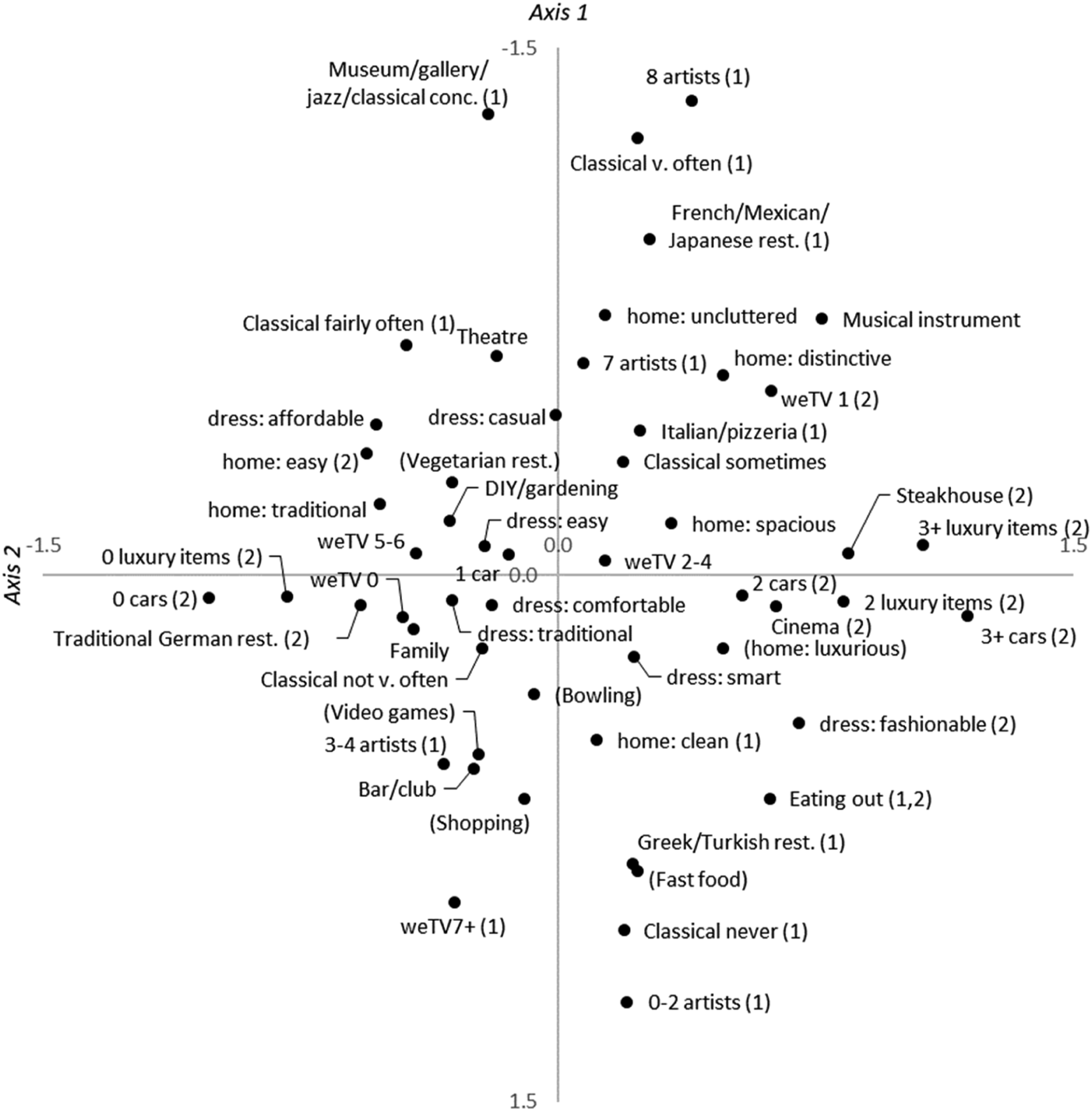
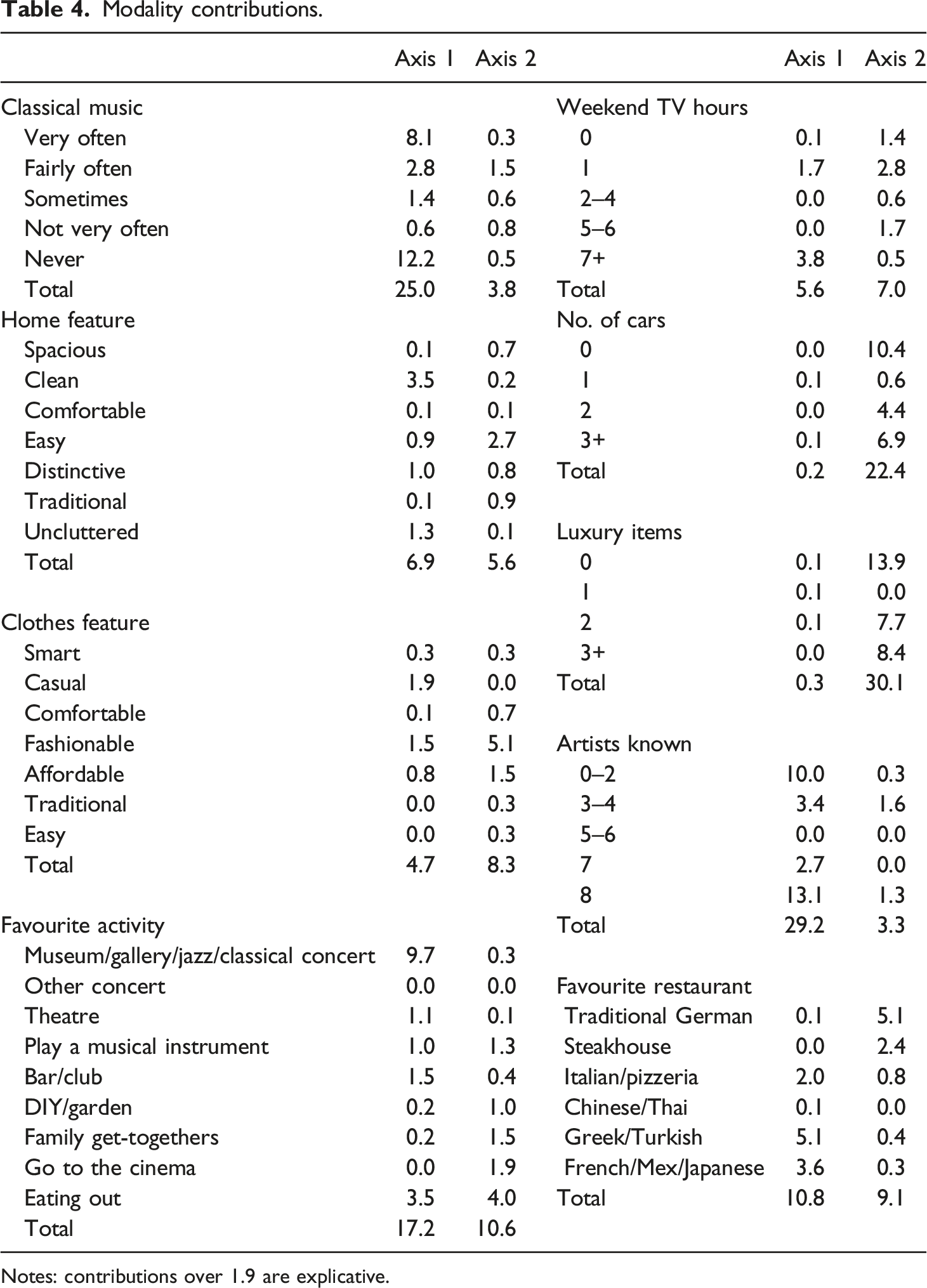
Indicators of material consumption contribute little to the first axis: no modality relating to car ownership or luxury items is explicative. In direct contrast, the second axis, with a modified inertia rate of 17%, is structured principally by indicators of material consumption rather than symbolic mastery. Most conspicuously, those without a car are opposed to those owning multiple cars, and those with no luxury items are opposed to those owning two or more. These two variables alone account for over half of the axis inertia, though the structure of the space is unperturbed by the removal of individual explicative modalities, indicating internal stability (see Hjellbrekke, 2019). This is not all, however. A taste for fashionable clothes, steakhouses, going to the cinema and eating out – all practices suggesting a degree of economic expenditure rather than constraint born of necessity – are explicative at the pole of high material consumption, or luxury, as is watching just a little television at the weekend, while a taste for traditional German restaurants and homes that are easy to look after bear above-average contributions towards the pole of low material consumption. Among the non-explicative modalities bearing atypical coordinates, tastes for distinctive or luxurious homes and playing musical instruments (which can be expensive possessions) are associated with the pole of high material consumption, while preferences for affordable clothes and traditional homes correspond with the non-luxury pole.
The positioning of supplementary lifestyle modalities provides further characterisation of the regions of the principal plane (Figure 2). Book ownership and reading frequency, for example, follow the vertical axis, and the Kultur pole is also associated with playing tennis, yoga/pilates, cycling and watching tennis, gymnastics, skiing or basketball, while watching football (soccer) corresponds with the non-Kultur pole. The individual items of luxury – second homes above all – and expensive vehicles are, unsurprisingly, associated with the luxury pole of the secondary axis, as are several practices of body modification, that is, bodybuilding and, to a lesser degree, using sunbeds, undergoing dental work or having tattoos. Other practices or possessions, however, are more prominently related to both axes. Playing golf, having a hair transplant or cosmetic surgery and, to a lesser extent, boat ownership, for instance, occupy the northeast region defined by Kultur and high material consumption, while refraining from any sport corresponds with the southwest zone. Playing football, keeping fit and an interest in boxing/martial arts, on the other hand, are associated with the southeast – high material consumption/low Kultur – area of the space. Their socio-cultural opposite, it would seem, is walking/hiking, which sits within the northwest – higher Kultur/lower material consumption – region. It would be tempting to say that if the east to southeast area of the space is associated with corporal capacity and appearance, then the practices from the west to northwest could be construed as focussing instead on mental well-being or escape, but the limits of the data mean that must remain conjectural. Supplementary variables in the space. Notes: Only modalities with atypical locations (p < 0.05) on one or both axes are presented. w = watch; p = practice.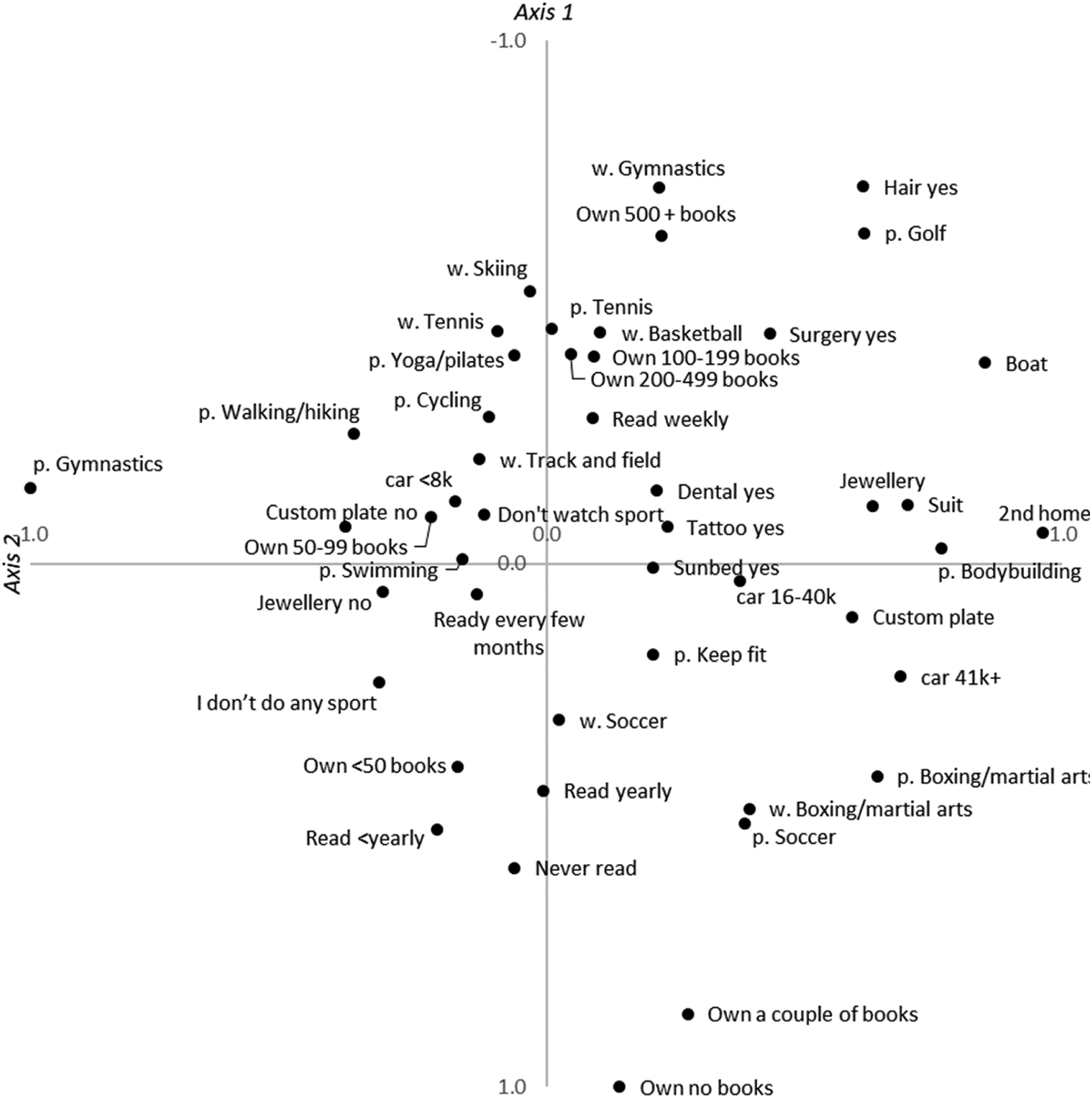
One inference that can be drawn more confidently, however, is that the two axes are not easily equated with a distinction between cultural taste and cultural participation (or behaviour), as per Yaish and Katz-Gerro (2012). Although we do not explore indicators of frequency of engaging in different activities here (though cf. Atkinson, 2022b), both axes are defined by and associated with indicators of taste and practice – and possessions too – and rather approximate underpinning logics of what people like/dislike, do/do not do and have/lack. Those logics, we posit, are polarisations of the exclusive and the accessible, one orienting around symbolic mastery and the other around economic expense, though to confirm that interpretation we must examine correspondences with social positions.
There is, finally, a third axis accounting for 11% of the inertia and bringing the cumulative modified inertia rate to 70%. This takes the form of an opposition between, on the one hand, those displaying high and low symbolic mastery and material consumption (as well as preferring smart clothes) and, on the other hand, those displaying middling-to-high possession (as well as a taste for family get-togethers, casual clothes and theatre). The plane of axes 1 and 3 is thus a parabolic curve essentially serving to distinguish middlebrow culture geometrically. The axis adds little of substance to the findings from the plane of axes 1 and 2 and will not be considered further for reasons of space.
Structuring principles of the space
Projection of indicators of capital possession into the principal plane reveals a strong relationship between the first axis and possession of acquired and inherited cultural capital (Figure 3). Those with degrees – especially arts and social sciences degrees or other degrees, as opposed to natural science/professional or business degrees – are positioned towards the Kultur pole, as are those who had numerous books in the family home when they were teenagers. Surprisingly, having degree-educated parents is only weakly associated with the Kultur pole. Perhaps this suggests that parents with higher education per se – which covers any discipline – are less important to nourishing tastes for highbrow culture than parents who (perhaps being graduates in specific disciplines, like arts and humanities) construct a domestic milieu exhibiting, vaunting and encouraging the acquisition of symbolic mastery. Still, the separation on the axis between parents with degrees and those without qualifications is notable (>0.4 SDs), suggesting parental education as a whole does operate as a structuring principle. Teachers or those otherwise working in the education sector, engineers, social scientists and, above all, cultural producers are the occupational groups most closely associated with the taste for legitimate culture. Their structural opposites, it would seem, are those working in personal services and, especially, those with secondary-level qualifications and/or who had no books in the childhood home and parents with no qualifications. Indicators of social position in the space of lifestyles. Notes: Only modalities with atypical locations (p < 0.05) on one or both are presented. M = mother, F = father, fam = childhood family, k = 000 Euros.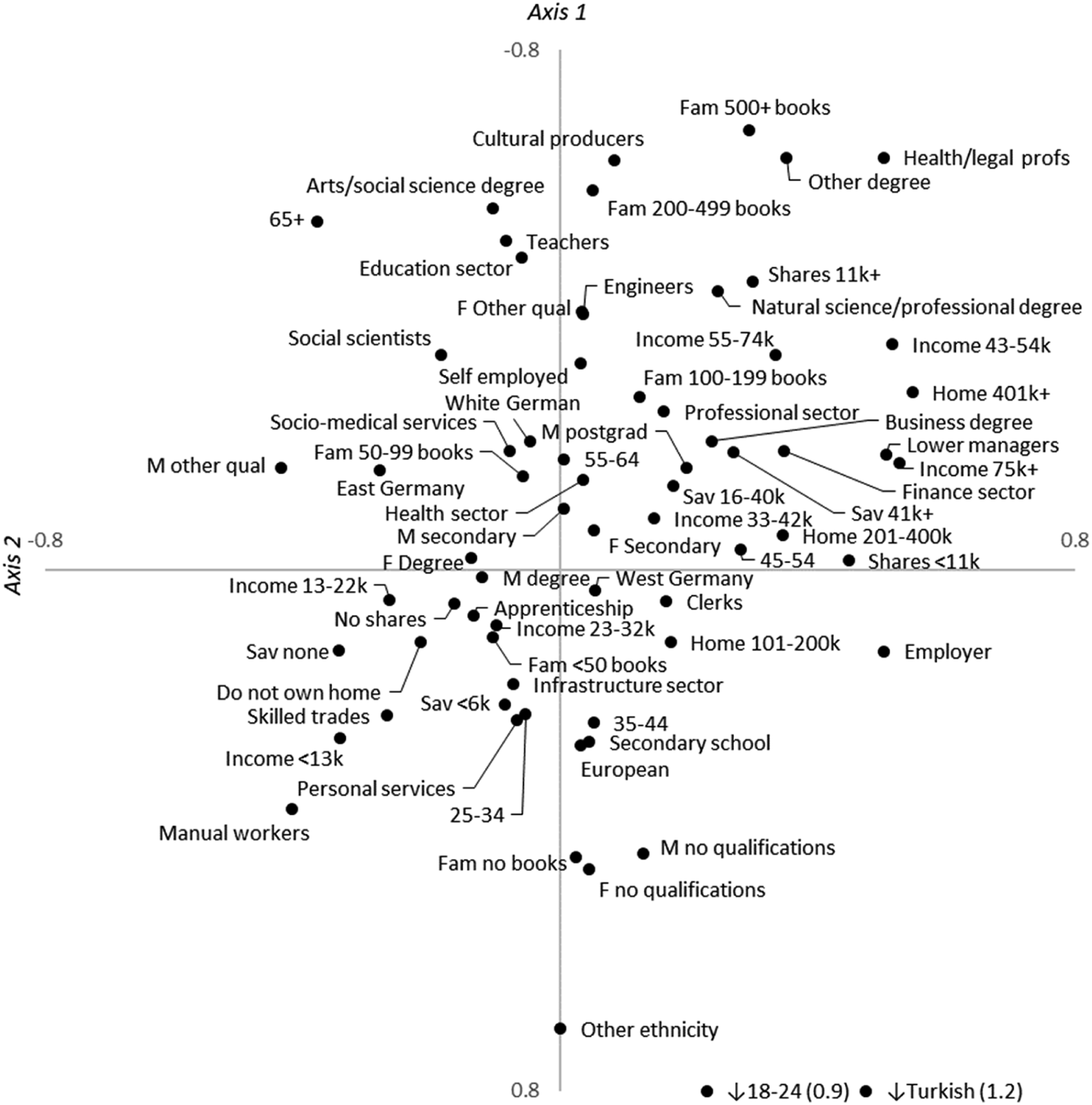
As for the second axis, indicators of higher economic capital – income, home value, savings value, but also being an employer – are associated with the luxury pole, as are working in lower management or the finance sector and having a business degree. The distribution of modalities in the plane, however, betrays the latent structure underpinning them, that is to say, a hypothesised vector for capital volume running between the first and second axes and a perpendicular vector for capital composition – just as in the models of Blasius and his colleagues. All the modalities indicating high capital – economic and cultural – gather in the northeast quadrant of the space, health/legal professionals sitting at the apex, with indicators of cultural capital being further towards the north and indicators of economic capital being further towards the east. Indicators of low capital gather in the southern region of the plane, but with measures of low cultural capital gravitating more towards the south and markers of low economic capital being pulled towards the west of the plane. Skilled and manual workers sit at the nadir of the hypothesied capital volume vector.
The positioning of the indicators of capital, signifying a close homology between the space of lifestyles and the social space, suggests causal links between symbolic mastery and legitimate culture and between distance from necessity and material consumption, which also, at the same time, imply explicative connections between lesser symbolic mastery and physicality and between economic necessity and relatively inexpensive pastimes (walking, family events, bars, video games, etc.). Yet capital possession also meshes with additional factors in the structuring of taste. Gender, admittedly, appears to have little bearing on the lifestyle space (hence its omission from Figure 3), but East Germans, for example, are positioned further towards the non-luxury pole of the second axis, yet slightly higher on the axis of legitimate culture, than West Germans. Perhaps most conspicuous is the effect of age, or trajectory, especially on the first axis. Older age, particularly being aged 65+, is associated with legitimate culture while youth corresponds with an aversion to it and a taste instead for fast food, video games and bars/clubs – precisely the relation that has been found in previous research, including in relation to Germany. Being 65+ is also negatively related to the axis of material consumption, which may explain the positioning of taste for traditional cuisine and dress on that side of the space.
When the relationship between age and acquired cultural capital is modelled by distinguishing those in each category with and without degrees and plotting coordinates separately, the effect is plain to see: age does appear to bear its own force in shaping tastes for legitimate culture – and material consumption too – separable from education level, especially regarding those aged 65+, yet there is a strong distinction between those possessing degrees and those not doing so across the board (Figure 4). Those without a degree in almost all age groups bar the 65+ category are positioned on or below the central point of the dimension, and all those with a degree (excluding the 18–24 category) are positioned above it, though the more so the older one is. Internal separation of age groups on axis 1 is notable in all cases (mean SD = 0.5) except for 18–24 year olds. Given that neither axis is reducible to a simple high/low culture nor high/low material consumption scale but together constitute a relational configuration of a wide range of factors, the overall result is highly dissimilar cultural profiles within age brackets. Those aged 25 to 44 without a degree, for example, may typically enjoy watching football and going to bars, clubs and fast-food outlets while avoiding reading, but those in the same age range with degrees correspond instead with not watching sport, favouring DIY or gardening and maybe even listening to a little classical music. Those aged 65+ with a degree may be most closely associated with classical music and the cathedrals of high culture, furthermore, but those of the same age without degrees correspond more directly with affordable clothes, easy or traditional homes and walking for leisure. There is everything to suggest this represents an interaction of life-course and generational effects with capital possession. Age and ethnicity by acquired cultural capital in the lifestyle space.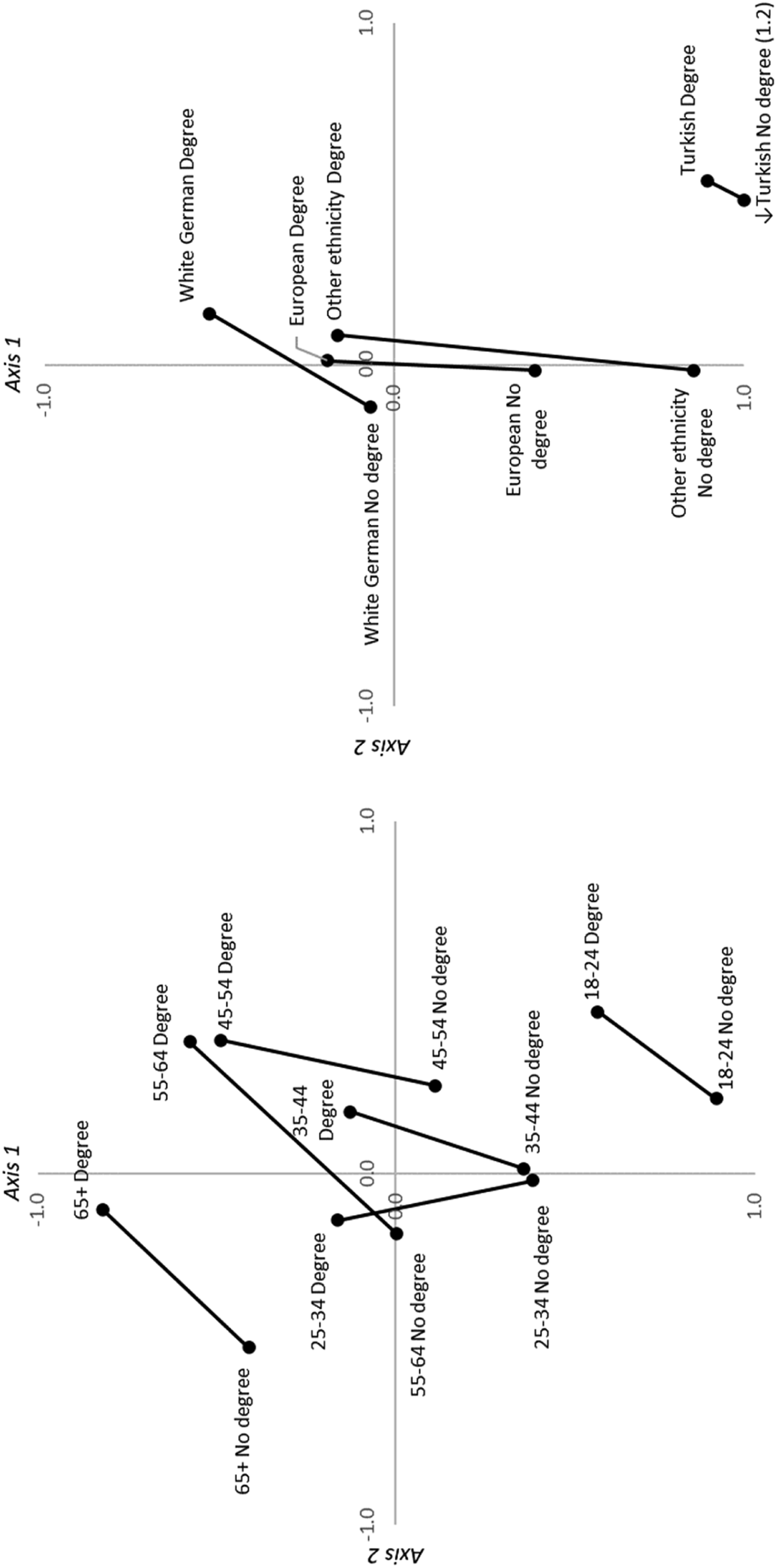
Figure 3 also indicated ethno-national differences play a role in differentiating lifestyles, as those of non-German origin, especially Turks, are situated towards the non-Kultur pole of the primary axis (hence the location of Greek/Turkish restaurants, perhaps). The separation between Turks and white Germans is substantial (1.4 SDs). This implicates differences of cultural capital, for sure. As we know, Turks are much less likely to have degrees than white Germans. Yet even if ethnicity is crossed with the same binary education indicator as for age, differences remain (Figure 4). This is so in two respects. First, while white Germans without a degree (a good proportion of whom have apprenticeships) tend towards the middle of the space, separated from degree-holding white Germans on the premier dimension by a notable distance (0.46 SDs), Europeans and other ethnic minorities without degrees are situated much further down the vertical axis than their degree-holding counterparts, who are nevertheless situated further down the space than degree-holding white Germans. Second, having a degree or not separates all ethnic groups except Turks. They are the only group for which intra-ethnic differences by education level are not notable or large on the vertical axis – even degree-holding Turks are situated far into the lower-right quadrant (if Turks are set as passive in the solution, the overall structure of the axes remains stable, verifying that the axis is not reducible to their specificity). Though low numbers necessitate caution, there are thus grounds to suggest relatively autonomous effects of specifically ethno-national dispositions and orientations, and thus position in the German ethno-racial/national space, on tastes and practices.
Conclusion
Centuries-old distinctions still appear to structure German lifestyles in the early decades of the third millennium. Kultur, as the specifically German rendering of Franco-European intellectual culture originally favoured by the minor nobility and cultural producers of the past against the superficial tastes of the haute aristocracy, seemingly remains opposed to popular or accessible forms of culture. Yet the second ‘other’ to Kultur today, competing to co-define cultural worth against the common and accessible in consumer capitalism, is no longer the Zivilisation of the moribund aristocracy but a materialistic lifestyle centred on luxury and expense as well as, to some extent, the bodily over the mental. If Kultur corresponds with the possession of cultural capital, then materialistic consumption corresponds with the possession of economic capital.
In suggesting this fundamental arrangement of lifestyles, our analysis has corroborated yet deepened extant research on the German case. Insofar as the pastimes and possessions studied resemble items surveyed in research on culture beyond the German case, moreover, they may even suggest cross-national regularities. The similarity with 1970s’ France is evident, for example, but so too are the parallels with lifestyle spaces mapped in similar fashion elsewhere (esp. by Atkinson, 2017, 2021b, 2022a; Flemmen et al., 2019). The internal polarisation of dominant culture and the fact that educational discipline rather than level, as well as refined measures of occupation and inherited cultural capital, were necessary to map correspondences with capital holdings signal the danger of drawing erroneous conclusions – for example ‘the dominant class are omnivorous’ – if social class is reduced to one dimension.
The data were collected before the COVID-19 pandemic and associated lockdowns. The lifestyle space may have manifested differently during the pandemic and will look slightly different today. However, we posit that the structure mapped by our model not only acted as both the conditions of possibility for any changes that occurred during the pandemic and the status quo ante towards which fields of cultural production have since endeavoured to return but also – given its resemblance to structures of difference defining past states of the German case and more recent cases across Europe – approximates a relatively stable relational system of taste underpinning varied expressions across time and place.
We have also endeavoured to map the relationship between capital possession, age and ethnicity in structuring the space of lifestyles. Capital and age were shown to intersect in such a way as to differentiate taste and practice within educational groups but also, at the same time, within age groups, indicating a refraction of life course or generational effects by capital possession and vice versa. As for ethnicity, it transpired that white Germans with and without degrees were separated from other groups on the Kultur axis, especially Turks. The latter are, it would seem, and in line with previous research, less familiar and engaged with highbrow culture in the German/European mould and more closely associated with eating out – especially in restaurants serving familiar cuisine – whether or not they hold degrees. Conceptually speaking, the force of ethnicity in shaping position in the lifestyle space underlines the argument that the latter has relative autonomy from the social space sensu stricto. Lifestyles are shaped by a multitude of factors, in combination with class, even if class is still a prime generative force. In the case of ethnicity, this is even conceivable as a distinct space of difference and domination working alongside yet analytically separable from the social space, though outcomes only ever manifest empirically in the concrete intersection of pressures and desires in individual lifeworlds. Its force is likely to have grown since the 1970s, when Bourdieu set out his thesis, because of increased migration – this being conditioned most profoundly, in the German case, by the post-war guest worker programme. Yet the outcome is not individualization or the absolute decline of class, as Beck had it, but a multiplication of generative forces and a refraction of class by evolving systems of domination.
Footnotes
Declaration of conflicting interests
The author(s) declared no potential conflicts of interest with respect to the research, authorship and/or publication of this article.
Funding
The author(s) disclosed receipt of the following financial support for the research, authorship and/or publication of this article: This work was supported by the European Research Council under the Horizon 2020 Programme, research ID 677055.
