



Abstract
This study investigates how employee gatekeepers decode cultural signals applicants send out during job selection procedures. By focusing on declarative and non-declarative cultural signals such as leisure activities and presentation style, this article examines how recruiters and hiring managers do their gatekeeping recognition work. This is done by in-depth interviewing of 40 HR managers and recruiters, from the cultural and corporate sector in the Netherlands, using a video-elicitation method. The interviews revealed (1) the importance of a fun-factor, (2) that leisure activities not only serve as status markers or indicators for competence but enter as important interactional tools, (3) that gatekeepers look for authentic self-presentation but that this varies between fields and the perceived gender of the candidate. In addition, the comparative design uncovered significant sector variations. Corporate gatekeepers are characterized by the way they decoded sport activities as a signal for a work mentality, valued self-presentation in terms of representativeness and repeatedly relied on competence as an evaluative principle. Cultural gatekeepers, on the other hand, used leisure activities more often as way of cultural matching and were more drawn to a fun-factor while displaying a clear disdain for formal presentation styles.
Introduction
Getting hired is one of the most defining moments in our economic lives. Yet, owing to many quantitative studies, we know that labour market chances are unevenly distributed and that certain groups are systematically disadvantaged during these moments of selection (e.g. women, elderly, immigrants) (Andriessen et al., 2012). That social allocation has a strong cultural component and that people include and exclude on the basis of symbolic self-presentation, signalling status and group membership, is so well established within cultural sociology that it almost serves as self-evident knowledge (Bourdieu, 1984; Lamont et al., 2014; Lareau, 2011). Yet, as Alexander and Smith (2001) argued, often we limit ourselves to circumstantial evidence, such as resource concentration and recurring patterns of disadvantage, to prove the existence of a reproduction of inequality, but if we want to fully unbox the cultural dynamics that drive this, we need to know more about the ‘thinking of gatekeepers’ (2001: 141). This study aims at doing exactly this by examining how employee gatekeepers recognize and decode cultural signals sent out by job candidates.
Fortunately, we do not have to start from scratch but can build on a body of existing studies that have already mapped out how gatekeepers, in situations of uncertainty, arrive at decisions and shape opportunity structures. When confronted with the difficult task of categorizing people, gatekeepers rely on different strategies such as evaluative storytelling (Stevens, 2009), comparison (Hamann and Beljean, 2019) or typecasting (Zuckerman et al., 2003). Moreover, these and other studies showed that the legitimacy of these gatekeeping strategies vary depending on structural field conditions. A recurring conclusion, in this respect, is that when a sector is characterized by absence of clear criteria and by ambiguity on procedures, decisions happen more individual, habitus based and ad hoc (see for example Darr and Mears, 2017; Greenfeld, 1988; Hamann and Beljean, 2019).
Yet, even when standards and protocols are more clearly established, uncertainty remains and questions of legitimacy and personal discretion always prevail because any act of gatekeeping, as Darr and Mears (2017) point out, involves – besides the relational work of determining social ties, transactions, value and media of exchange – recognition work. This is the semiotic practice of recognizing and estimating the (potential) value of the look, skill, talent or personality of a candidate. This study wants to expand our understanding of how recognition work plays out during employee gatekeeping situations. This will be done through redirecting our focus in two ways: case selection and method.
The majority of cultural sociological studies on gatekeeping were primarily concerned with access to the fields of cultural production such as fashion (Darr and Mears, 2017), entertainment (Hamann and Beljean, 2019; Zuckerman et al., 2009) or academic field (Hamann and Beljean, 2019; Stevens, 2009). Yet, we should be careful to presuppose that the same strategies and dynamics will emerge in all types of gatekeeping. There are two important features that are specific to fields of cultural production: (1) winner-takes-it-all mechanism and (2) interpreting cultural signals is deemed a legitimate part of the evaluation. In many other gatekeeping instances, the allocation of resources, possibilities and positions can be more equally distributed while the evaluation of cultural signals are often much more problematic and thus hidden. This study therefore concentrates on employee gatekeeping for non-cultural production job functions because much less is known about how in other and more common areas of the labour market cultural signalling is playing a role.
Employee selection procedures usually involve different types of screening, such as scanning of CVs, comparing personality tests, checking skill credentials or assessing years of experience. But there is also an interactional aspect to it that mainly occurs during the job interview and in which cultural signals get free rein. In this moment, the legitimacy, value and impact of cultural signalling is hardly agreed upon, making recognition work much more tacit. Labour market selections are (often even juridical) expected to be transparent and are supposed to adhere to an ideology of merit, contrasting heavily with an evaluation based on habitus induced ‘taste’ for cultural signs. Especially because creating equal labour opportunities has increasingly become central to our societal understanding of inclusion and discrimination (Dobbin, 2009).
It is clear from previous studies that jobseekers cannot solely rely on skills, credentials or experience to obtain employment, but that cultural signalling in the form of impression management, presentation styles and lifestyle play an important role (Brown and Hesketh, 2004; Hora, 2020; Rivera, 2016). Although we can expect quite some variation in the importance of self-presentation (ranging from technical backstage jobs to frontstage aesthetic labour), due to the role of interviewing in the evaluation process, hiring often revolves as much around performing than informing (Scheuer, 2001).
Nevertheless, although we have indications about which cultural signals are valued by employers (Brown and Hesketh, 2004; Hora, 2020; Koppman, 2016; Nuijten, et al., 2017; Rivera, 2016), we have relatively little knowledge about how employee gatekeepers themselves do their recognition work. This is especially critical, seeing that in the case of non-cultural production function explicit standards on the value of cultural signals are often absent. This study therefore aims to unpack how both declarative and non-declarative types of self-presentation are decoded and integrated into employee gatekeepers’ evaluative logics. In other words, we pay attention to the role of both verbal (such as talking about self and lifestyle) as well as non-verbal (such as demeanour and presentation style) signals during the decision process.
Investigating this, however, poses two difficult questions: How do we elicit what usually remains tacit? And, how to isolate self-presentation from other criteria of evaluation? In order to cater to these questions, and in so doing cover new ground on gatekeeping research, this study introduces a new interview technique, namely, video elicitation questioning combined with a ranking exercise. In total, 40 in-depth interviews with recruiters, HR and hiring managers were conducted, whereby the respondents were presented with eight short video CVs and were asked to evaluate and rank (top-3) their favourite applicants. By omitting (or controlling) for other criteria of evaluation (experience, credentials, education), we can, at least to some extent, isolate the role of cultural signalling through self-presentation. Moreover, because employee gatekeepers are always organizationally embedded, their decisions are contingent on organizational and sector conditions (Bills et al., 2017), this sample includes respondents from both the corporate and cultural employment fields.
The article starts out with a review and discussion of the existing sociological knowledge on cultural dynamics within hiring, with a focus on lifestyle signals and self-presentation styles. It then continues with arguing for an alternative and comparative research design. Finally, based on the findings, which are presented in the fourth section, the article ends with claiming: (1) that lifestyle signals enter the evaluation logic in three different ways, namely, similarity markers, competence signals and interactional tools; (2) that cultural gatekeepers from this sample are more sensitive to a cultural matching logic than their corporate counterparts; and (3) a gatekeeping situation which lacks standards while putting a strong emphasis on informality and authenticity is extra sensitive to an exclusion based on a lack of entitlement.
Recognizing Cultural Signals
Although it is clear that hard skills, such as technical knowledge, years of experience and credentials, remain crucial criteria of employability, they do not constitute the sole avenue leading to professional success. A consistent flow of studies confirms that evaluating ‘personality currencies’, such as lifestyle, demeanour, taste preferences or character traits, are also important assets within the labour market (Brown and Hesketh, 2004; Hora, 2020; Koppman, 2016; Nuijten, et al., 2017; Rivera, 2016; Sharone, 2013). With the risk of oversimplifying, there are largely two ways of reading employee gatekeepers’ interest in self-presentation that are not necessarily mutually exclusive but do highlight different rationales behind hiring evaluations.
A first approach is the human capital view (Becker, 1964) which sees the assessment of self-presentation as necessary because it can be a way to signal competence, motivation and organizational fit. This perspective was embraced by the field of management, human research studies and economics and claims a rather productivity-oriented view on self-presentation: just as skills or credentials, personality can objectively be evaluated as an organizational asset and mined as a resource. As studies seem to indicate, a better fit between personality traits and job characteristics or organizational culture (person–organization fit) positively influence work motivation outcomes and productivity (e.g. Barrick et al., 2013; Kristof, 1996).
This perspective has been criticized directly by Bowles and Gintis (1975) and indirectly by followers of the cultural capital approach of Bourdieu (1984). They advance the argument that personality currencies serve as symbolic markers, allowing groups to close off their resources, such as job positions, for those coming from social backgrounds with lower status. Hence, gatekeepers will (although not necessarily consciously) look for cultural similarity and are thus drawn to recognizable dispositions. That cultural matching – a mechanism of social selection, whereby privileges are reserved for one’s own social group based on shared cultural markers – also plays out during selection procedures has been extensively demonstrated in the case of both education (e.g. Stevens, 2009) and work (e.g. Friedman and Laurison, 2019; Rivera, 2016).
However, regardless of whether one is looking for competence or is (unconsciously) searching for a cultural match, in both cases recognition work needs to be done. This requires the right cultural knowledge on the side of both the candidate (to send out signals) as well as the gatekeeper (to read those signals). As Lizardo (2017) pointed out, this personal cultural knowledge can manifest itself on two levels: declarative and non-declarative. The former refers to the conscious and discursive level of language, ideas and values, that is, knowing what to say, while non-declarative knowledge pertains to dispositional, interactional and embodied knowledge, in other words, knowing what to do.
Knowing What to Say
This study pays special attention to two types of declarative signals: narratives on the self and leisure time activities. In terms of the latter, it has already been extensively argued how leisure activities are not socially innocent, but carry, as status markers, much symbolic weight (Bourdieu, 1984; Lamont et al., 2014; Lareau, 2011). It is therefore not surprising that other studies have also demonstrated the importance of signalling leisure time activities during hiring moments. Lauren Rivera’s (2016) benchmark ethnographic study of hiring managers in top-tier firms revealed that in several stages of the screening process, managers pay close attention to leisure activities that candidates share in both written and spoken form (see also Rivera and Tilcsik, 2016). Other studies revealed that even in comparison to academic qualification, for example, recruiters deem extracurricular activities as important as high grades or prestigious schooling (or sometimes even more important) (Nuijten et al., 2017; Pinto and Ramalheira, 2017).
What needs to be further investigated, is not which leisure time activities are recognized by gatekeepers, but how they evaluate those. Many variations are possible. The study of Rivera, for example, indicated that in some cases it is as straightforward as looking for similarity and recognizability. Candidates who engaged in the same highbrow activities as the hiring managers, such as playing exclusive sports, were seen as a better fit, both on an interpersonal as well as on an organizational level (Rivera, 2016). Yet, we need to be careful to not oversimplify this matching dynamic. Koppman (2016) showed that within the advertisement industry cultural matching was not geared towards a simple peg-in-hole exercise of testing corresponding taste preferences. Her work showed that the manner of cultural consumption was more determining, which explains why cultural omnivores, those who combined several different taste preferences, appeared most successful.
However, some scholars depart altogether from looking for a cultural matching dynamic and interpret managers’ interest in leisure activities as fitting a human capital logic. There is, for instance, compelling evidence that hiring managers justify their interest in these activities by interpreting them as proxy signals for motivation, fit and competence (Brown and Hesketh, 2004; Nuijten et al., 2017). Especially activities entailing organizational and coordination tasks, such as volunteering or managing a sports team, boost the perceived organizational suitability and increases the chance of being invited for an interview (Nemanick and Clark, 2002). In addition, Bonnie Erickson’s (1996) cultural analysis of employee management of a security firm revealed that, in such a corporate context, leisure time activities are mainly used as means of bonding and coordination between different employees (i.e. managers discussing football with shop-level workers) and not as status markers.
Next to leisure time activities, candidates can also deploy different narratives of the self as a form of self-presentation. Based on a country comparison study of US and Israeli job-seeking experience, Ofer Sharone (2013) pointed out that two different narratives of employability circulate. One revolves around suppressing one’s individuality while instead marketing skills, competence and perseverance. A narrative of formality that is most common in Israel. An alternative and popular narrative in the USA centres instead on self-subjectification, whereby an emphasis is placed on expression of passion, desire and authentic personality.
Moreover, content analyses of management literature and career advice books demonstrate that, at least from the demand side, references to authenticity and personal drives are increasingly valued in the labour market (Boltanski and Chiapello, 2005; De Keere, 2014). Especially in the case of white-collar jobs that are characterized by instability and uncertainty, candidates should not only show a professional capability and willingness to work but also need to offer proof of passion (see Rao and Neely, 2019).
Similar to leisure time activities, narratives of the self are associated with specific social positions and can therefore function as cultural markers. While the new cultural middle class is characterized by an enthusiastic endorsement for values such as self-expression and authenticity, the older middle and lower classes seem more drawn towards entrepreneurial idioms such as hard work, ambition and discipline (e.g. Bourdieu, 1984; De Keere, 2020). Hence, the type of narrative that candidates write down in their motivation letters or verbalize during interviews serve as powerful cultural signals, recognized by gatekeepers.
Knowing What to Do
That a part of employee gatekeeping decisions are grounded in non-declarative or intuitive knowledge is confirmed by a stream of recent studies demonstrating how candidate evaluations often involve a chemistry game whereby gut feelings and emotional flows are crucial elements within the decision processes (Brown and Hesketh, 2004; Koppman, 2016; Rivera, 2016; Sharone, 2013). Consequently, presentation confidence, humour and an ease to manipulate interactions are important assets during employee gatekeeping encounters.
As studies of real-life job interviews revealed, the successfulness of a candidate is partly determined by their capacity to topple power balances and arrive at a situation of co-membership (Roberts and Campbell, 2005; Scheuer, 2001). The latter is mainly achieved by informality and loosening of the official role (role distancing). The analysis of videotaped interviews by Scheuer (2001) and Roberts and Campbell (2005) demonstrated that, when interviewers stick to their professional roles (role embracing) and become animators of institutional rules, the chances of candidates being evaluated positively are reduced. On the other hand, candidates who answer formally to institutional demands while informally dealing with the interaction dynamic are better at achieving co-membership. Yet, candidates need self-confidence and ease to make interviews more personal by relying on humour, small talk or innuendo (Roberts and Campbell, 2005; Scheuer, 2001).
However, displaying the right demeanour and presentation style is a rather intricate task. What is deemed appropriate behaviour in one sector, might be frowned upon in another. The ethnographic observations of Rivera (2016) demonstrated that in the case of top-tier US corporate organizations, recruiters expect a certain level of polish from their prospective employees. This is the capacity to convincingly express ambition, drive and confidence, without appearing arrogant or overexcited. The comparative study of Friedman and Laurison (2019), partly relying on interviews with employees from a large accounting firm, confirmed this corporate demand for polish. Yet, when talking to managers working for a television company, they noticed that the creative sector preferred another type of personality expression, which they coined studied informality (2019: 137). This has many facets but boils down to the ability to demonstrate ownership of the informal behavioural codes of the industry such as hugging, humour and casual attire.
The stage is now set to empirically explore how gatekeepers themselves interpret these declarative and non-declarative signals. We know that all these signals play a role, but we know very little about how gatekeepers integrate them in their evaluative logic. Answering this question asks for a specific methodological approach, which will be described in the following sections.
Research Design
The Dutch Case
What makes the Dutch context fascinating in regard to studying the role of cultural signalling is that it is historically characterized by a disapproval of overt status display and a discursive support for egalitarianism (Kuipers, 2013). Consequently, explicit judgement of status positions and snobbism are strongly frowned upon, and class vocabulary is largely absent from public debates (van Eijck, 2013). However, this democratization of taste does not imply that cultural signalling is not a part of symbolic boundary drawing in the Netherlands. Instead, as several researches showed, it makes cultural distinction practices more subtle and tacit, concealing latent class identities (Kuipers, 2013; van Eijck, 2013).
Second, although the Netherlands is relatively egalitarian and has high levels of social mobility (Bukodi et al., 2020), there is compelling evidence that social fluidity clearly varies between occupational groups. The study of Güveli, Luijkx and Ganzeboom (2012) shows that in the Netherlands it is more likely for people with a lower-class background to acquire a job in private technical-corporate sectors than to find employment within the public sociocultural fields. Overall, their results indicate that, as an employment category, sociocultural specialists in the Netherlands are characterized by social closure: not only is it harder to become a part of this occupational group, their members also seem better equipped to protect their offspring from downwards social mobility. So, together with a disapproval of overt status display these variations in mobility patterns turn The Netherlands into an optimal research site to investigate the cultural foundations of social selection.
Comparative Sample
In total, 40 gatekeepers were interviewed from two occupational fields in the Netherlands (see Table 1 for overview). One is the field of corporate organizations (n = 23), focusing on banks, insurance and multinational companies (labelled corporate sector), and the other is the field of large cultural institutions (n = 17), such as museums, concert venues and theatres (labelled cultural sector). All interviewees were recruited via company websites or LinkedIn based on their job descriptions: recruiters, talent acquisition, or human resource managers. To be included in the sample, respondents had to be involved in at least five job-selection procedures a year.
Overview of respondents.
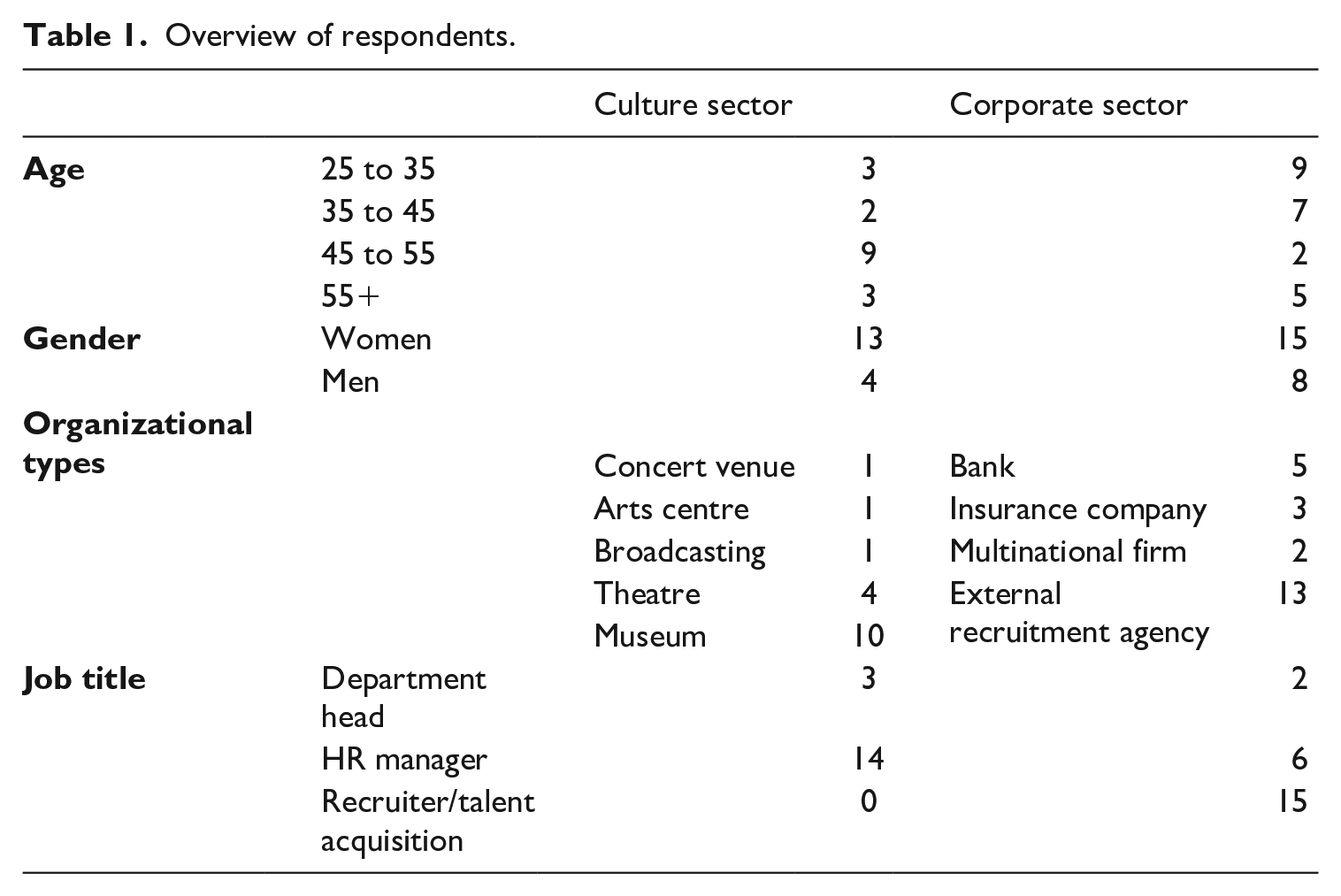
The two employment fields these respondents are gatekeeping, are marked by both similarities and differences. Most importantly, although the productive output of the two fields differ drastically, these organizations partly rely on similar types of workforce such as project managers, accountants, PR coordinators or sales representatives. Hence, when interviewing hiring managers and recruiters, we zoomed in on professional functions that demand at least a college degree and belong to lower management or the upper ranks of the technical workforce. So, although about half of the sample was working for cultural institutions, they did not hire for cultural production functions. The two occupational fields are also comparable in the way the roles of the gatekeepers are defined. Both in large corporate companies as well as in cultural organizations, the hiring managers do not actually hold the resources of the institutions they recruit for (in contrast to, for example, small business owners).
Despite these similarities, the corporate and cultural field are also good comparative cases because of the differences that characterize them. As pointed out earlier, social closure seems more prevalent in the public cultural sector than in the private corporate sector. There are three organizational and field conditions that can foster this situation. First, following a Bourdieusian depiction, the social space (Bourdieu, 1984), we can expect the relative value of cultural capital to diverge. Signalling high levels of cultural capital might be a more successful strategy to gain access in the cultural than in the corporate sector, which in turn allows for more informal social closure. Second, the two fields are infused by very different economic dynamics. While the corporate field is mainly determined by a profit logic, cultural organizations are heavily subsidized by the government, (partly) shielding them from the pressures of the market. Yet, this dependency on public money, also leads to a scarcity in resources and thus a stronger tendency to shield those resources from newcomers. Third, all corporate organizations from our sample had specific personnel and highly professionalized departments that actively attract new employees. This, however, remains so challenging that they often rely on external recruitment agencies to fulfil the demand. For this reason, the corporate sample was split up into internal (n = 10) and external (n = 13) recruiters. Cultural occupational gatekeepers are, on the other hand, usually part of a general HR department, combining hiring with other responsibilities such as wage and personnel administration. Although, the gatekeepers from both sectors in this sample rarely hire their own direct colleagues, one can easily imagine how organizational structure and size can influence tendencies towards social closure.
Video Elicitation and Selection Exercise
To have the gatekeeper do recognition work in terms of both saying and doing, in-depth interviewing was combined with a selection exercise based on video elicitation. Therefore, eight actors presented themselves as candidates in the form of three-minute video résumés. After discussing more general issues like selection protocols and hiring experiences, the respondents were asked (1) to comment on all the videos separately and (2) select a top-3 of candidates most likely to be invited for an interview at their organization (see Appendix for a full structure of the interview). Although the scripts were played out by actors and have artificial elements in them, watching moving images of people and having to react to them does give a sense of reciprocity and imitates aspects of evaluation. These videos thus serve as an evocative tool towards decision-making, allowing respondents to activate different types of cultural knowledge.
The audio-recorded interviews were conducted by me and a research assistant and lasted on average 45 minutes. They were transcribed for a thematic content analysis that was organized in two rounds. Adductive principles of analysis (Tavory and Timmermans, 2014) informed the coding of the data. The first round combined a grounded reading of the transcripts, based on relevant theories (see earlier), with open and in-vivo coding. This allowed us to break down the recognition work of the respondents in a theme-centred manner, which yielded an inventory of important evaluative criteria, recurring issues and self-reported dilemmas. Seeing that an abductive analysis implies a double-checking of our inferences we used this inventory as a coding schema for a second round. In this round, it was deductively coded how prevalent these criteria, issues and dilemmas were for the assessments of the hypothetical candidates and the top-3 rankings. This entire coding process was done with the data analysis software Atlas.ti.
Video Resumes
The actors were provided with written scripts and acting instructions. We had as many male as female actors. All actors were within the same age range (between 23 and 26), wore the same clothes and all were white. The choice of only including white actors was made consciously, and not because we deem race irrelevant in job recruitment evaluations. On the contrary, race and ethnicity still strongly structure labour market discrimination in most societies, including the Netherlands (Andriessen et al., 2012). Yet, a selection exercise based on videotaped actors would fall short in really capturing covert race discrimination in a predominantly white country such as the Netherlands. When it comes to discrimination based on race, extensive media attention that has been given to this issue over the last years in the Netherlands, could make our respondents prone to overcompensation and social desirability. Hence, instead of also including variations in terms of race and ethnicity, it was decided to limit the study to how gatekeepers evaluate white candidates, which comes with clear limitations.
To get a sense of how narratives of the self enter the evaluation process, half of the actors received a more informal script that included making little jokes, talking about their personal lives (e.g. family and friends) and alluding to the importance of being yourself. The other half relied on a formal narrative by sharing certain general competences (e.g. being analytical) or emphasizing the significance of a professional career and productivity. Second, the scripts also contrasted types of leisure activities. For this reason, four scripts included sports activities (i.e. hockey, marathon running, kite surfing and gymnastics), while the other four involved cultural hobbies (i.e. drawing, playing piano, writing and doing theatre). Of course, actors also bring their own bodily idiosyncrasies to their performance, which serve as ‘natural’ non-declarative signals. All actors were asked to smile to the camera and to answer their phone and work on a laptop, in order to display variations in bodily posture. To capture the effect of gender, we had both male and female actors playing out these roles. Finally, it is important to emphasize that none of the fictive candidates shared any explicit information on work experience, credentials or specific skills, nor were they distinguishable in terms of education level (all had a master’s degree in general social science). In the Appendix, the reader will find more detailed information on the interview protocols, videos and selections.
Although there are some general tendencies (see Figures 1, 2 and 3 in Appendix), the data does not allow for a full-fledged quantitative analysis nor is it the intention of the video-elicitation interviews to determine absolute preferences. The goal is not to demonstrate once again that cultural reproduction exists by pointing out which cultural signals are valued the most, but to flesh out how (already well-studied) cultural signals are recognized and inform gatekeepers’ evaluation logics.
Findings
The findings consist of two parts. In the first section, some important commonalities are listed that most employee gatekeepers of this sample shared, regardless of their occupational sector. In this part, the importance of a fun factor and leisure activities, as a triple signal (matching, competence and interaction), is discussed as well as the role of ‘being yourself’ and gendered authenticity. The second part concentrates on the way corporate and cultural respondents deal differently with these leisure activities and formal or informal presentation styles.
Gatekeeping Commonalities
Looking for Fun
In line with the existing literature, the answers of the respondents, regardless of the occupational sector they belong to, largely reconfirmed the depiction of the job interview as partly an emotional game. Many explained, while selecting their fictive candidates, that gut feeling and intuition partly steers their decision: ‘For 85% of the match is based on my gut feeling and for 10% what is on paper’ (Thijs, junior external recruiter). The gatekeepers would immediately add how this intuitive choice is hard to verbalize: ‘Yeah, I have, I think, a click with her, I just have a click, I can’t really explain it’ (Willem, concert house HR manager). In an attempt to justify these non-declarative decisions, they would often employ concepts like ‘charm’, ‘chemistry’ or ‘click’.
Consequently, the vast majority of gatekeepers emphasized the importance of energy levels. Yet, when comparing the amount of energy the different fictive candidates supposedly radiate, it became clear that the gatekeepers are searching for a subtle balance. Candidates they deemed too nervous were not necessarily categorized as bad but could hamper the ‘energy flow’ of the interview. Therefore, effort would have to be invested in calming them down and bringing the interaction to the right energy level. On the other hand, candidates who were understood as either too relaxed or too serious were described as ‘energy leaks’ (Manuel, senior external recruiter). But candidates should also offer the gatekeeper energy. When asking Cecilia, an internal recruiter for a large financial firm, what is a good interview for her, she responded by saying: ‘When it gives me energy. I just came out of an interview and I feel exhausted. So that is also possible. But you can also get a lot of energy from a candidate. That it really makes you happy and you think: yeah this is going to work!’
Respondents also repeatedly mentioned that smiling, laughing and having ‘sparkling eyes’ made candidates appear more open and relatable. Almost all recruiters pointed out that they paid careful attention to the scripted scenes in which the candidates smiled. As Walter, senior talent acquisition manager of a large insurance firm, confessed: ‘I was a bit out of balance at the end, because then she started smiling. Just a little smile, maybe three seconds. And then I thought: she is the one.’ Gatekeepers seemed to use smiling as a part of their post hoc justification for why they are intuitively drawn towards specific candidates.
Closely connected to this, it was often pointed out that having a sense of humour made the candidates more noticeable, confirming the findings of prior research that humour is a powerful signal for socio-cultural division (Friedman and Kuipers, 2013). As James, an HR manager of a large museum, explained: ‘Sometimes, by the way somebody talks. There doesn’t have to be a pun or a joke in the video, but still you can see if somebody has humour. Maybe it’s just purely based on feeling whether somebody has your sense of humour.’
Lifestyle Activities as a Triple Signal
When arriving at the role of leisure activities as a means of self-presentation, gatekeepers from both employment sectors were initially somewhat ambiguous on how to evaluate these declarative signals. Most of them felt it necessary to point out that the hobbies the actors mentioned should not be too decisive. However, in the process of figuring who would fit their top-3, they did increasingly acknowledge that hobbies serve as key signals, also in real-life settings. When asking Anna, a corporate recruiter for a large bank, whether she likes it when candidates mention their hobbies, she answered with confidence: ‘No, liking is really an understatement. I think it is actually important, I think it is characteristic of [Bank] that we also want to know who you are as a person.’
Through a comparison and categorization of activities, respondents tried to determine whether the personality of the candidate would match the culture of the organization or field. Gatekeepers would especially use activities to drop a candidate out of the selection by stating that they were not ‘the type for it’ – a phrase used over a hundred times. Essentially, the analysis showed that there are three distinct yet related ways in which leisure activities inform gatekeepers’ decision-making process: as means of (1) cultural matching, (2) competence disclosure and (3) interactional tools.
In several instances, the mechanism of cultural matching was apparent in the way respondents evaluated hobbies. Certain activities ignited a sense of familiarity amongst some respondents although they formulated this very carefully. As Thijs mentioned: ‘And she played hockey and I played hockey. So, that is a personal click. Of course, there is a presumption in this. Still, the types [that play hockey] are known and I played it myself for a long time, so I can judge on the basis of that.’ So, hobbies are put to work to evaluate if a personal connection or liking is even possible.
Seeing that cultural matching drives informal social closure, it is not only a mechanism for inclusion but also exclusion. In other words, gatekeepers try to figure out how compatible candidates are by judging the activities they do. ‘With a hobby such as drawing’ Simone, an internal recruiter for a large bank explains, ‘I always think, that is a bit artsy. A bit different from me. Nothing wrong with that, but I don’t know if I would say, let’s go for a glass of wine together’.
However, and this is equally important, overall the matching itself was not done through a simple peg-in-hole exercise. Cultural recruiters, for example, were definitely not univocally positive about cultural activities. As Albert, a hiring manager for a highbrow music venue, explained: ‘candidates always try to make the connection with music and then we say, yeah that is fun, but not important to us. You don’t really do anything here with music.’
A second way leisure activities served as signals relates to how occupational gatekeepers try to deduce skills, traits and competences from them. This productive oriented reading of activities concurs with a human capital perspective on the purpose of self-presentation during job interviews. As Eva, a senior recruiter for a large bank, explained: Most of the time I just ask it [about hobbies] during the conversation. I don’t allow my choice to be determined by it, unless when it is for example a leadership position and somebody doesn’t have leadership experience but writes that he is a part of a hockey team or that he plays hockey on a high level and was the captain.
Especially in the corporate sphere, sports activities were often described as ‘useful’ because it ‘mostly means for us that somebody has discipline, is focused on results and is social’ (Marina, junior external recruiter). This instrumental approach to activities did not exclusively hold for sports: the more creative activities were occasionally reframed in this manner. Some respondents really put in an effort to construct a coherent narrative (i.e. evaluative storytelling) about the candidates by reconciling their extracurricular activities with field specific demands. Take for example Marc, a senior external recruiter, who fully engages in evaluative storytelling when assessing the creative Nick (Scenario 8, see Table 2 in the Appendix) to the corporate field: He is a composer who makes his own music. So, he is an explorer but also indicates that he can arrive at the core of things. It has to have a purpose. He is not just creative to be creative, but uses his strong points to get to a result.
Finally, besides cultural matching and competence signalling, hobbies have a third important role during recognition work, as they help to smooth and coordinate the interview process. In order to manipulate the role-distancing/embracing dynamic, gatekeepers bring personal elements into the conversation. Hobbies serve as conversational lubricants, fostering bonding and co-membership.
I always really like it when people mention their hobbies and if you have some link with it, so you can put them at ease. When I feel that somebody comes in very intense, then I say, ‘Oh I see you are a cyclist’, and then you start chatting and you have a more authentic conversation, instead of just immediately asking hard-core questions. (Albert, concert venue hiring manager)
It is not only the candidates who are encouraged to reveal their lifestyle preferences; in both sectors, gatekeepers themselves indicated they have a tendency to talk about their own private selves. Take Camilla, a junior recruiter working for an external employment agency; she explained that establishing a more personal bond with the candidate is essential to any successful job interview: I explain where I come from in terms of work and background. And also depending on what I read on the CV, sometimes they write something about playing the saxophone and sometimes somebody mentions selling ponies or something. Then I make some connection with that. Horses aren’t my thing but I love cats. So, I try to make a connection. I have the idea, although not proven, that people are sometimes a bit rigid, and this makes them loosen up.
Hence, the importance of cultural signals is thus grounded in the interactional reality of job interviews. Whether this interaction is successful, however, depends on the perceived ease of the candidate, which brings us to the next section.
Be Yourself
Initially, many respondents appeared to be somewhat critical about the narratives that focused on authenticity and personal life. Some gatekeepers would point out that, instead of talking about private life, it is better to focus on information about professional competences and motivations, which the formal candidates mentioned. Nevertheless, when it came down to actually selecting candidates for a top-3, informal narrative did have a clear influence on their decision-logic as it seemed to signal some kind of realness and authenticity which, as they mentioned themselves, is what they are eventually looking for: It comes from their gut, at least this how it appears: open, from their gut, from their inner self. He just explained how he wanted to be himself. That is what he [Steven, Scenario 5, see Table 2 in Appendix] said. I think that being yourself is important. And that they want to develop themselves. That is also very important. That you don’t think ‘I come here and I’m going to play out a role for 30 years’. That is not what we want. (Anna, junior in-house recruiter)
There seems to be a consensus amongst all the respondents that the prime task of evaluating is to uncover the ‘real person’. Therefore, gatekeepers need to create a relaxed atmosphere in which candidates feel safe to express themselves. Again, as in the case of leisure activities, we see informality is valued also as an interactional element that aids in achieving role distancing: Some are very technical. They focus on the content. They really tell many job-related things . . . Then I ask: who are you, what do you do in your private life? So, outside your work? Are you married or where do you live? . . . Yeah, when we get stuck on the content, you know, I also really like to know who you are. (Eva, junior HR manager with a large museum)
Most gatekeepers explained that they usually devote the introduction phase of the interview to creating a more personal bond with the candidate, which is also the reason why the vast majority of respondents preferred unstructured interviews. They instigate this role-distancing by telling something about themselves and their own private lives: Then I tell them how long I have been working here and where I live. Yes, something personal. I just became a mother. That is always nice to tell. Usually that ignites something . . . Well, yeah, to get some kind of connection, create a bond or something. I always find that, when you sit down with somebody to just discuss the job function, yeah that doesn’t really fit with me. (Ivana, junior external recruiter)
Gendered Authenticity
Although many gatekeepers forcefully repeated the mantra of ‘just being yourself’, what was deemed an appropriate self, did vary depending on the perceived gender of the candidates. Sex-categorizing based on gendered stereotypes appeared part of the evaluative work, confirming many previous studies on work and gender (e.g. Ridgeway, 2011). This was especially noticeable in how popular female candidates were evaluated more often as friendly or were even referred to as a ‘darling’ (for example by Ingrid, HR manager from a museum). Moreover, female actors that played out formal roles received labels such as ‘too serious’. Similar to Hochschild’s (1983) classical study on emotional labour, we here see how also women’s gatekeeping experiences are marked by a heightened demand for emotional expression and friendliness. Male actors, on the other hand, were more often evaluated as independent, stubborn and technical (although none of them mentioned any technical skills).
Not fitting these sex-categories was eventually penalized with being perceived as less authentic. This can be best exemplified by looking at how the least often selected male and female candidates, namely Irene and Lewis (regardless of which actor played out the script), were evaluated. Irene (Scenario 2, see Table 2 in the Appendix) used a formal type of self-presentation and played hockey on a competitive level. In the end, Irene was only once selected as a top candidate, by an external recruiter. All the others justified dropping Irene from their selection by explaining that she seemed too serious, boring or impersonal. By being competitive and formal, she went against the female stereotype of being friendly and expressive, making her unauthentic. We see a similar pattern with Lewis (Scenario 8), who used a gentler and sensitive presentation style by calling himself expressive, open and creative while his hobby is playing in musicals. Several respondents called him, regardless of which actor played out the role, too shy, unconvincing or simply ‘hard to place’ (Caroline, hiring manager for a large museum).
Gatekeeping Differences
Culture or Sports?
According to Erickson (1996), leisure activities will be recognized differently depending on employment sector. In the private sector, she argues, the constant pressure of the market pushes managers to focus on productivity and less on displays of cultural status. In accordance with this, we discern some general tendencies in how gatekeepers from the two sectors dealt with the two types of activities, culture versus sports, depending on the sector they belong to.
In general, there was a stronger tendency among corporate recruiters towards preferring sports activities. Especially the internal corporate recruiters preferred sports activities. As an indication, we see that all internal recruiters, except one, selected a candidate with sport as hobby as their favourite (see Figure 2 in the Appendix).
More important than the popularity of sports, is how they interpret these activities. Corporate gatekeepers were rather specific in the way they recognized sports activities as signalling a certain ‘winners’ mentality’ (Marina, external junior recruiter), which they defined as a disposition towards discipline and competitiveness. Take for example Martin’s (a junior external recruiter) evaluation of Irene who plays hockey on a competitive level: ‘I like that, because I also did competitive sports. What this tells me is that she knows the ropes. Like, she can deal with some criticism from her coach or team manager’. Cultural gatekeepers in this sample, did not seem to share this preference for sports nor this type of interpretation.
Looking more closely at the cultural respondents, one can notice that they were overall more inclined to reject candidates based on their leisure time activities. As was yet pointed out, cultural managers did certainly not respond automatically positive to cultural hobbies. Rosa, an HR manager for a prestigious museum, for example, recognized the cultural hobbies of Layla (drawing) in the following way: Well, I thought she was a little bit too elitist and we don’t want to be an elitist museum anymore . . . So, I would ask her about that. Because you see this happening, when somebody did a lot of arts or they had a very cultural upbringing. Then I would like to know if she has the right motivation to work here . . . She might get disappointed, it is not that serious and artsy here.
Hence, in line with Bourdieu’s theory of cultural distinction, correctly displaying one’s preference is a balancing act between signalling the right preference while simultaneously hiding possible opportunistic motives for doing so (Bourdieu, 1984).
Formal or informal?
While personal connection appeared to be important for most gatekeepers, looking closely at what type of self-presentation is valued, field differences did emerge. Corporate gatekeepers repeatedly mentioned the importance of representativeness. When they, for example, talked about clothing, it was emphasized that one has to look decent and you need to take into account the preferences of clients. Because in the end, you are the ‘business card of the firm’ (Ivana). Hence, there is something like a ‘corporate style’ which they defined as decent and groomed. In this context, the Dutch word ‘netjes’ (neat/clean/sober), which resembles polished, is used by almost half of the corporate gatekeepers to explain how one should present oneself. It is important to point out here that all actors wore the same sort of black shirt, so this reference to a polished corporate style came from the participants themselves. Yet, there were also clear dissident voices. Some corporate gatekeepers found it necessary to remark that they are trying to slowly get rid of an organizational culture that makes everybody ‘walk around in a grey suit’ (Walter).
Cultural gatekeepers, on the other hand, had a tendency to reject candidates exactly because they appeared too polished. They were, for instance, more often explicitly negative about Thomas – a popular candidate among the corporate recruiters – who used strong agentic language (‘I’m a go-getter’) (see Scenario 6, Table 2 in Appendix). Sarah, a seasoned HR manager for a museum, evaluated Thomas in the following way: Yeah, he would attract us less. But as a type, a corpsbal [business student] is a big word but that is the feeling I had. He used the term go-getter, well, we wouldn’t use that term at all . . . Then I think, wouldn’t you rather work somewhere on the Zuid-as [financial district]. Do you really want to get into the cultural sector?
Hence, formal candidates were seen as ‘no type’ for the cultural sector, which they described, similar to the study of Friedman and Laurison (2019), as more loose and informal. As Sarah explains when evaluating the video presentation of Steven (see Scenario 5, Table 2 in Appendix): This is what we are often looking for, somebody who does not play a role. For example, when [a candidate] is too formal. He [Steven] appears very informal, and that is fine here. We are not looking for people who are too neat [netjes]. We don’t even have a dress code. Most people just wear jeans. So somebody with this kind of wild hair, that is fun and feels authentic and relaxed. Yes, he would be invited.
Overall, cultural gatekeepers stood out through their disdain for boredom and desire for humour and fun. As Edith, also an HR manager of a large museum, explained about rejecting Irene: ‘Yeah, with her, we are not going to be able to have fun.’ A common way cultural gatekeepers rejected candidates they deemed as too low on energy or not interesting was by claiming that they were simply too boring: ‘I thought this was so boring. I thought, okay, she has to do it, she sells herself, but I don’t feel it’ (Vera, HR manager for a theatre).
This sort of dismissive categorization and intuitive rejection was largely absent among corporate gatekeepers. The latter would often arrive at evaluative storytelling, attempting to connect the cultural signals of the candidate to the sector (see earlier). Moreover, they also appeared more loyal to their professional roles, which is especially true for external recruiters. This not only manifests itself in a preference for formality, but also in their use of ‘competence’ as an important evaluative category. The word ‘competence’, for instance, was spontaneously and extensively employed by 14 out of 23 corporate recruiters, while only 3 out of 17 cultural gatekeepers relied on this principle of evaluation.
Discussion
By asking employee gatekeepers to evaluate and select fictive candidates, we were able to delve into how self-presentation is decoded. A common aspect of employee gatekeeping recognition work is that cultural signals are used to ‘uncover the real person’ behind the formal candidate. So, while a job selection interview hardly qualifies as a relaxing occasion, presenting oneself as energetic, fun and, above all, authentic, seems to be highly valued by most employee gatekeepers.
This also explains why leisure time activities enter the evaluation process in a multifaceted way. It is not merely about matching taste with taste, nor is it only instrumentally used to assess competence, but leisure activities also enter the evaluation process as crucial interactional tools. Hence, it is usually less about the type of activity, although it helps to establish co-membership, but more about how it is presented. They serve as conversational tools, easing the path towards role-distancing. So, the importance of ‘concerted cultivation’ (Lareau, 2011) for future labour market success, lies not only in instilling children with the right cultural signals but in fostering a sense of entitlement to use those signals during moments of evaluation. Signalling and interpreting these signals is not a passive process, it demands engagement from both sides. As Erickson (1996) argued, cultural signals need to be put to work to gain value.
Moreover, the effect of gatekeepers’ preference for informality and interactional ease on interview success can be expected to be more prevalent in the case of unstructured interviews as they allow more leeway for interpersonal dynamics and status display. Although all hiring managers from this sample preferred unstructured interviews, studies actually show that formalizing the recruitment procedures increases the chances of socially disadvantaged groups to enter the labour market (de Larquier and Marchal, 2016). Employee gatekeepers’ desire to come to ‘authentic’ disclosure might stem from a sincere interest in the candidate and his or her employability, yet it creates a selection practice which is highly sensitive to tacit discrimination and exclusion. It is rarely defined what counts as authentic or which authenticity is valuable.
Conclusion
This study contributes to the existing literature on gatekeeping and hiring on three counts. First, by extending the concept of ‘recognition work’ – which was, up until now, solely reserved for fields of cultural production – to other moments of gatekeeping, it was possible to map out how cultural signalling emerges during more common instances of labour market selections. Not only did this reveal how leisure activities serve a triple purpose, but also how signalling informality is embedded in the interactional reality of job interviewing. This also shows that it is not an either/or choice between a cultural matching and human capital logic (Becker, 1964; Bourdieu, 1984; Bowles and Gintis, 1975), but that gatekeepers find themselves in situations in which the value of signals can be recognized in a multitude of ways.
Second, by using video elicitation for the first time to study employee gatekeeping, this study was able to focus on the role of self-presentation by (at least partly) blocking out the influence of other aspects of candidate evaluation (e.g. skills, credentials, degrees). This is of course not a way to argue that the latter does not count, but it gives us a deeper insight into how gut feeling (Brown and Hesketh, 2004, Koppman, 2016; Rivera, 2016; Sharone, 2013) and informality (Roberts and Campbell, 2005; Scheuer, 2001) play a crucial role. Although there is a general tendency to strongly appreciate authenticity, what this actually entails seems to be interpreted differently depending on the perceived gender of the candidate or the sector they are applying for.
Third, the comparative approach of this study, brought to light for the first time significant variations in recognition work with respect to employment sectors. Overall, corporate gatekeepers relied more on a human capital logic when evaluating candidates. This manifested itself in (1) the way they decoded sport activities as a signal for a corporate work mentality, (2) their tendency to value self-presentation in terms of representativeness and (3) the recurrent use of competence as an evaluative principle. The cultural gatekeepers of this sample, on the other hand, seem to draw more on a habitus induced type of recognition work that leads more easily to cultural matching. This is noticeable in how they rarely used leisure activities to arrive at an evaluative story of why somebody might fit the job, but instead relied more on taste-based assessments that led towards rejecting the candidate (i.e. not the type for us).
The differences found amongst the gatekeepers from these two sectors help us to peer into the black box of variations in mobility trajectories in the Netherlands. We know that the occupational class of technocrats and specialists, mainly employed in the corporate sector, is more open to people with a lower-class background than the cultural-professional class (Güveli et al., 2012). Hence, a part of the variations in social closure could be explained by different decision logics of the gatekeepers within the respective occupational sectors. The stronger tendency of cultural gatekeepers towards cultural matching fosters exclusion, while a focus on competence might be beneficial for a fairer selection procedure.
It falls outside the scope of this study to explain why exactly these differences exist, but it can be hypothesized that (1) the field position of sociocultural employees, (2) their sector resources and (3) organizational possibilities combined, foster a situation wherein explicit standards of evaluation are more likely to be absent and habitus-based evaluation becomes dominant. First, although cultural gatekeepers of this sample were not selecting for cultural production functions, their adjacency to this field can make them more sensitive to recognition work that heavily draws on cultural capital. As Bourdieu (1984) repeatedly explained, a return on cultural capital places demands on the cultural fractions of society to keep a close watch on who gets access to legitimized culture. Second, because of their reliance on governmental subsidies, the sociocultural sector might be partly shielded from market demands, but it does make them more dependent on limited resources, pushing for (albeit unconsciously) a more protective attitude towards available employment positions. Third, compared to corporate organizations, the level of professionalization of hiring (e.g. no separate departments or specialized recruiters) is much lower in the cultural sector, which can translate to less formalized recruitment procedures and transparency about protocols and criteria. These factors together can encourage opportunity hoarding and social closure more easily.
These hypotheses on the relationship between gatekeeping, lack of standards and organizational conditions beg for more research and a further combination of methods. The elicitation method did reveal how gatekeepers make sense of their own choices, but it leaves partly unanswered the question: Who would eventually be selected? Hence, there is still much to gain from systematically investigating the role of cultural signals in real-life settings. Moreover, although the study was sensitive to class and gender, the method also came with clear drawbacks in terms of intersectionality. It did not allow us to delve into other important issues of exclusion such ageism, ableism and racism, which should remain high on the research agenda on hiring.
Footnotes
Appendix
Acknowledgements
I would like to thank Naomi Loos for her excellent research assistance during the interviewing. Furthermore, I am grateful for the opportunities I got from the Culture Club of the University of Amsterdam and the Harvard Cultural and Social Analysis Workshop to present my work and receive great feedback. Special thanks goes to Olav Velthuis, Stefan Beljean and Kate Williams for their amazing feedback on multiple drafts of this article.
Funding
The author disclosed receipt of the following financial support for the research of this article: This research was supported by the Dutch Research Council (Veni-grant)