




Abstract
In this essay we reflect on the relationship between aesthetic practices and racialised conceptions of belonging. In particular, we explore attributions of beauty and ugliness, order and disorder, as these are made in relation to local space, and we consider how these attributions can be linked to proprietorial claims about who is welcome in those spaces. Our focus is thus on the everyday aesthetics of location: the ways in which aesthetic judgements are tied to the inhabitation of space and, in this case, the exclusionary potential of ‘ways of looking’ at such spaces and at the social relations which exist within them. Drawing on data from qualitative research in two adjoining neighbourhoods in Glasgow’s Southside, we make three analytical contributions. First, we consider the racialising potential of everyday aesthetic responses to local space. Second, we explore the ways in which local social relations themselves can be aesthetically interpreted. Third, we reflect on forms of everyday aesthetic resistance.
Introduction
In this essay we reflect on the relationship between aesthetics and racialised conceptions of belonging. In particular, we explore attributions of beauty and ugliness, order and disorder, as these are made in relation to local space, and we consider how these attributions can be linked to proprietorial claims about who is welcome in those spaces. Our interest is with better understanding what we might call, paraphrasing Floya Anthias (2005: 41–45), the everyday aesthetics of location: the ways in which aesthetic judgements are tied to the inhabitation of space and, in this case, the racialising potential of ways of looking at such spaces and at the social relations which exist within them.
We begin by reviewing recent discussions of everyday aesthetics in both sociology and philosophy and we bring these into critical conversation with accounts that draw attention to the role of aesthetic practices in sustaining racism. Subsequently we describe the research from which our qualitative data arise and provide contextual information regarding the fieldwork site. Our findings are discussed in three parts. The first considers the racialising quality of everyday aesthetic responses to local space. The second describes the ways in which local social relations themselves can be aesthetically interpreted. The third reflects on forms of everyday aesthetic resistance.
Everyday aesthetic judgement
Recent years have seen a growing sociological interest in the significance of ‘social aesthetics’. Olcese and Savage are amongst those who have called for sociologists to more fully engage with ‘an everyday aesthetic rooted not in distance from the world but immersed in the routine and mundane’ (Olcese and Savage, 2015: 721). Paying attention to such questions matters because of what Georgina Born, in an article in this journal, has called ‘the productivity of the aesthetic’ (Born, 2010: 176): that is, the way in which aesthetic judgements and practices may play a constitutive role with regard to social reality, shaping our sense of self as well as the formation and interpretation of social relations and arrangements (see also Wohl, 2015). As Olcese and Savage’s (2015) comment suggests, asking these questions requires us to break from a still influential modernist tradition which has treated aesthetics as properly applicable only to the sphere of art (e.g. Hegel, 1993 [1886]).
The most fulsome recent proposal for a ‘social aesthetics’ is given in John Levi Martin’s witty and scholarly The Explanation of Social Action (Martin, 2011). Martin argues for a model of human activity which takes seriously our capacity to intuit and respond appropriately to the inhering qualities of the social world. That world, he argues, does not simply furnish us with a stream of meaningless data, which we then process according to ‘grids’ provided by language or culture. Rather social objects have phenomenological qualities which we apprehend and act upon. A social aesthetics is conceivable because of our shared capacity for feeling and responding to this qualitatively textured social environment. Moreover, Martin argues, the ‘what’ and the ‘why’ of social objects are rarely distinguishable. Such objects have an ‘oughtness’ about them: our knowledge of them is implicitly a knowledge of what they call on us to do. Martin, it is worth noting, thus draws a distinction between aesthetic ‘perception’ – understood as this capacity to perceive and respond to the impulsion we sense in social objects and situations – and the ways in which people might subsequently go about explaining, rationalising or justifying their actions.
Martin does not mean that the qualities that we perceive in social objects are fixed or univocal or that our apprehension of them is whimsically individual. Rather he follows Bourdieu in arguing that our response to such phenomena is, to a large extent, born of the social relationships which they instantiate for us. We can understand ourselves as existing within fields that are constituted by ‘subjectively understood patterns of alignment’ (Martin, 2011: 305). What we have a feel for, in relation to any social object, is thus a contextual judgement about the affordances of that object in whatever position we hold relative to it and relative also to others who share some orientation towards it. Accordingly, there will never be universal agreement as to these judgements, but there is potential for shared responses amongst groups of individuals. It is in these senses that what he proposes is a social aesthetics.
These recent discussions in our discipline share some ground with – but have not generally intersected with – a similar conversation within philosophy. Here too there has been an emergent concern with ‘everyday aesthetics’. Those writing in this field, such as Yuriko Saito, Tom Leddy and Arnold Berleant, have likewise insisted on recognising and exploring the aesthetic dimensions of our engagement with, and responses to, ordinary objects and situations. Ossi Naukkarinen is typical in proposing, at the start of his study of human practices of clothing and adornment, that ‘Aesthetics should . . . reach beyond the art world’ (Naukkarinen, 1999: 8). In part this claim rests on a phenomenological turn, which understands aesthetic judgements as describing the ‘properties of experienced things, not of physical objects abstracted from our experienced world’ (Leddy, 2005: 7). Leddy notes that once we acknowledge this we can acknowledge also that everyday aesthetic judgements may have their own particular character or criteria.
Importantly, these writers have also argued against the assumption that aesthetic experience presupposes a non-utilitarian relationship to whatever object is in question. As Saito puts it: ‘although it is true that various practical and instrumental purposes are intimately bound up with our everyday experience, such integration does not necessarily detract from aesthetic value’ (Saito, 2001: 92). Aesthetic claims, in short, are not disinterested. If this is so we are able to ask more explicitly how they are entangled with other kinds of judgements such as those concerning, for example, identity or belonging or, as Saito herself provocatively points out, moral virtue (Saito, 2001: 93). In one sense, such a claim is hardly news to sociologists, still surfing the long wake of Bourdieu’s (1984) critique of Kantian aesthetics, but nonetheless the philosophy of everyday aesthetics is helpful – and aligns with models such as that offered by Martin (2011) – to the extent that it takes seriously the significance of aesthetic judgement as a mundane feature of the way in which we go about navigating and making sense of the world.
Aesthetics and racialisation
Yet this philosophical discussion of everyday aesthetics has also exhibited an extraordinary blindness to processes of racialisation. Indeed, the assumption of many of the writers referred to here has tended to be that aesthetic sensibility is necessarily aligned with social justice. Arnold Berleant’s claim is typical: ‘The social equivalent of the willing acceptance of the object in an aesthetic situation lies in recognising the intrinsic value of every person’ (Berleant, 2005: 35). Aesthetics thus names, for Berleant, an orientation to the world in which the uniqueness of others becomes newly vivid but in which we also experience afresh the mutually constitutive nature of our relationship with them. In this regard, he suggests, the experience of beauty, like that of love, entails a ‘relational idea’ (Berleant, 2005: 32). It leads us towards an awareness in which ‘divisions and separations disappear and are replaced by a feeling of empathy’ (Berleant, 2005: 34). Similar claims are to be found in On Beauty and Being Just, in which Elaine Scarry argues that our encounter with the symmetry and balance of that which is beautiful makes us long to defend those qualities where they do not yet exist, including in political arrangements. For this reason beauty acts, at least potentially, as a lever towards social justice: ‘beautiful things’, she writes, ‘hold steadily visible the manifest good of equality and balance’ (Scarry, 1999: 97) and encourage us to extend our care laterally from the object in question to other objects of the same type. Aesthetic awareness thus opens a path, she claims, from ‘the particular to the distributional’ (Scarry, 1999: 82) and teaches us to take pleasure in the experience of being ‘decentred’.
These propositions, attractive as they are, reintroduce the assumption of aesthetic disinterestedness through the back door. They do so by virtue of the fact that they treat aesthetic experience as simply given, detaching it from any account of the way in which social and political structures might shape the ascription of ‘beauty’ or ‘ugliness’ and, conversely, the role played by such ascriptions in the reproduction of those structures. One recalls W.E.B. Du Bois’ angry rebuttal, at the end of Darkwater (1920) to those who made equivalent claims in his time: ‘So strong is the spell of beauty that there are those who, contradicting their own knowledge and experience, try to say that all is beauty. They are called optimists. And they lie’ (Du Bois, 1920: 247). Du Bois’ anger was directed towards the naïve idea that the consequence of aesthetic experience was a kind of transcendence, a raising above the ‘world’s battle and hurt’ (Du Bois, 1920: 223). His chapter ‘Of Beauty and Death’ contrasts such claims with a detailed itinerary of his own experience of travelling in the context of pervasive racism. In this respect what he emphasises is the extent to which a mundane aesthetics – a constant reading of bodies as beautiful or ugly, and a tacitly aesthetic reading of their positioning in social space – is fundamental to the reproduction of racialised identities. If everyday aesthetics practices are indeed ‘productive’ then part of what they produce is the lived reality of race.
John Levi Martin’s (2011) account, by contrast, insists on precisely the socially situated character of aesthetic judgements and on the fact that such judgements help to establish social relations. Yet he is also concerned to defend the acuity of those judgements, our capacity to discern what social objects ‘call out for us to do’ (Martin, 2011: 186). The tension between these two positions becomes most explicit in those passages where Martin specifically addresses the question of racism. Consider, for example, the situation famously analysed by George Yancy in which, in the confines of an elevator, a white passenger responds to Yancy’s presence with evident fearfulness and apprehension: ‘What was previously a familiar space’, Yancy explains, ‘which I inhabited as an uncomplicated modality of my meaningful bodily comportment, has all of a sudden become “a something” that is threatening; my everyday mode of “being-in” has become a mode of being-trapped-in’ (Yancy, 2008: 857–858). Yancy’s point is thus to make us ‘see’ the consequences of a white ‘seeing’ of the world. The white gaze entails not just a reading of a social object but also a rendering of that object; its authority is enacted precisely in the moment of perception, as the racialised body is made vulnerable to (its) scrutiny. As Yancy puts it, elsewhere, reflecting on a similar encounter with a white teacher when he was younger: ‘his invisibility to his own normative here [was] a function of my hypervisibility’ (Yancy, 2005: 219; c.f. Rollock, 2012).
Martin (2011) does discuss encounters of this kind, but when he does so the accent falls strongly on a defence of the ‘veridicality’ of social perception: ‘The white person who perceives hostility and treachery in “blacks” is confronting a social object – a set of relations. These relations are of antagonism, of suppression, and of repression’ (Martin, 2011: 230). In this respect, he suggests, they have ‘correctly perceived the qualities of the intrinsically distorted social object, a set of relations including [their] own. The problem is not in the perception, but in the world, and it makes little sense to put people in a distorted world and ask them to see straight’ (Martin, 2011: 230). The point is reiterated towards the end of the study: ‘it is implausible’, he says, ‘that there is correct knowledge to be had in situations of oppression’. If Goethe, for example, perceived whiteness of skin as evidence of inner superiority, his perception has to be understood as being, at least in one sense, truthful: he ‘saw inequality, and inequality there was’. A ‘decent social aesthetics’, Martin concludes, can only hope to ‘document and situate the antagonisms, not see around them’ (Martin, 2011: 347).
Martin underlines the fact that his reference is to perception, as opposed to whatever propositions or statements of belief individuals may advance on the basis of their perceptions. Nonetheless, and despite his recognition elsewhere of the socially constitutive role of aesthetic responses, his account here treats such perception as if it arrived always after the crime, as if it had no part to play in the formation of those relations. The one-sidedness of this position leaves us with a social aesthetics with little hope of critical purchase on the power of the white gaze, a power which rests, after all, precisely on its claim to normative authority; on the assumption, as Fanon had it, that white eyes are the ‘only real eyes’ (Fanon, 1986: 116). What lies unattended is the very thing which writers in the black radical and postcolonial traditions (e.g. Baldwin, 1988: 1117–1129; Bonilla-Silva, 2012; Puwar, 2004) have been at pains to bring to attention: the extent to which that gaze is generative of, not merely reflective of, racialised social relations. The fact that we don’t have to settle for such an account is largely thanks to the epistemological labour by which those who are subject to these processes have made sense of their own experiences (Yancy, 2008: 249; c.f. Essed, 1991; Rollock et al., 2011). It is that labour which unsettles the authority of the white gaze just as black popular culture, at the level of aesthetic practice, has challenged that authority by reclaiming and reasserting the visibility of the racialised body (Hall, 1996a; Mercer, 1990). Even if we cannot ‘see around’ oppression, it is the hard won ‘second sight’ of those who are racialised which allows us to see the role of seeing in the making of that oppression. Indeed, were it not for such labour, we might wonder how it would racialised be possible for Martin himself to describe racialised social relations as ‘intrinsically distorted’. As Safi Shams points out (Shams, 2015), such a judgement is difficult to square with his more general position that social objects are ‘real as perceived’.
In summary then: the emerging concern with everyday aesthetics promises to bring the category of the aesthetic down to earth, recognising aesthetic judgements and responses as a significant but ordinary part of how people go about making sense of their world. Yet the discussion in philosophy and the model proposed by Martin both, in different ways, end up with a qualified exoneration of aesthetic perception. In the former case this is expressed in a tendency to assume the beneficent consequences of aesthetic experience; in the latter, in the treatment of aesthetic perception as a response to social objects which are treated as given. Neither approach thus pays sufficient attention to the point made by numerous writers in the black radical and postcolonial traditions, which is the extent to which aesthetic perception is itself implicated, in a direct and on-going way, in the making of racialised social relations. Oppression is not just ‘seen’; it is seen into being. In what follows, then, our concern is to explore in empirical detail some of the ways in which this is so. We consider in particular how attributions of beauty and ugliness, order and disorder, as these are made in relation to local and familiar spaces, are implicated in the construction of (but also contestation of) exclusionary accounts of those spaces. At a straightforward level our concern is to insist on the centrality of the question of racism to any exploration of everyday aesthetics. At the same time, taking race seriously in this context may also help us derive some broader conceptual conclusions with regard to the idea of a social aesthetics as such.
The specific context that is our point of focus – the ‘social object’ which is in question, to use Martin’s (2011) term – is the politics of space and, particularly, the constitution of neighbourhood identities. Critical geographers and sociologists have repeatedly insisted on the need to explore what George Lipsitz calls ‘the occluded and disavowed historical geographies and ideologies of racialized space’ (Lipsitz, 2007: 12). At the material level these historical geographies encompass a wide range of formal and informal mechanisms of exclusion including processes, which, ostensibly, are left to the ‘neutral’ hand of the market. As Lipsitz has shown in the context of the USA (Lipsitz, 2006), such economic processes are, in fact, routinely shaped by forms of institutional intervention which have long worked to defend the interests of (mostly white) homeowners, whilst excluding (mostly non-white, often immigrant) others from particular areas. Thus, as Ruth Wilson Gilmore puts it, the ‘territoriality of power is key to understanding racism’ (Gilmore, 2002: 22; see also Gilmore, 1993). Gilmore is one of a number of critics (e.g. Sibley, 1987) who have drawn attention to the historical continuities which exist between the racialised segregation of space in the neoliberal city and the management of urban space under colonialism, as well as the historical confinement of Jewish communities in Europe (Sennett, 2011).
As Lipsitz’s (2002) comment suggests, however, space is racialised in ways that are material and ideological at one and the same time. On the one hand, race becomes ‘real’, it is epistemologically established, as it is read from exclusionary geographies (see e.g. Fields and Fields, 2012; Garland and Chakraborti, 2006). On the other, the character of what David Theo Goldberg calls ‘periphractic’ space (Goldberg, 1993: Chapter 8) – space which is constituted as peripheral or marginal – rests not only on its physical location but also on the way in which that space is interpreted in terms of ‘signs’ or ideas which are taken to indicate racial difference. Thus, Goldberg argues, the material consequences of poverty are subject to a form of ‘double’ reading, which is classed and racialised at once. The ‘signs’ of crime, disorder and squalor are symbolically commuted into evidence of essentialised difference and are, in turn, mobilised as ‘criteria and rationalizations for differential inclusion in the body politic’ (Goldberg, 1993: 202).
It is the role of mundane aesthetic judgement and ascription in this process that we are interested in exploring. The geographer David Delaney has argued that ‘Taking place seriously alerts us to the contextualities and contingencies of power, identity and community. It allows us to ask questions about the role of race in the practices of place-making and the phenomenology of belonging’ (Delaney, 2002: 10). The ‘productivity of the aesthetic’ is heavily at work in such practices, informing and facilitating place-making and inflecting claims of belonging in ways that are both mundane and frequently racialised, but which are also the site of symbolic struggle.
Methodology
The data that we consider here emerge from a series of semi-structured qualitative interviews with representatives from community and campaigning organisations, from educational, health and housing service providers, and with local policy makers in Govanhill. Govanhill is the most ethnically diverse local area in Scotland, a fact which reflects its history as an entry point for migrants coming to Glasgow over a long period, most notably Jewish, Italian, Irish and Highland communities in the 19th century, Pakistani and other Asian communities in the middle part of the 20th century (see Thomas, 1999), and East European migrants after 2004. In recent years the presence of a Roma community, largely from Romania and Slovakia, has been the subject of frequently stigmatising representation in the media and elsewhere (Clark, 2014; Grill, 2012; Poole and Adamson, 2008). We also interviewed representatives from a number of organisations working in the neighbouring area of Pollokshields, in part because some service provision straddles the two communities. Pollokshields is also ethnically diverse, but includes a wide range of housing stock, some of it amongst the most expensive in the city. It thus has a reputation as a middle-class area, although this image conceals considerable levels of economic inequality.
A total of 27 interviews were conducted, involving 31 participants. The interviews formed part of the fieldwork undertaken by the Centre on the Dynamics of Ethnicity, at the University of Manchester, UK. The overarching concern of our work was, through the use of a range of qualitative and participatory approaches, to develop a detailed account of the lived experience of race and of the politics of racism and anti-racism in their situated reality. This tranche of interviews was undertaken to help us better understand the areas in which we were working, their historical development, the key factors which shaped local service provision, and how the politics of racism and anti-racism were locally articulated. Thus recruitment was purposive, aimed at building a detailed and multifaceted picture of the places in question. Following an initial period of ethnographic and historical research we identified a range of locally active third sector, public sector and community organisations. We sought to speak to representatives from organisations which were operating at different scales and with different models of funding and practice. Interviews were audio-recorded, transcribed verbatim and anonymised. Transcripts were independently coded by members of the research team who met subsequently to compare coding and to identify key themes, which then guided a period of focused secondary analysis.
We did not set out to ask specifically about the aesthetic reputation of the area(s) in question. Rather, we asked respondents to: describe the local area(s) to us; to talk about the historical and contemporary development of those area(s); to reflect on how they tended to be charcaterised by both residents and others. It quickly became clear that claims about the neatness, dirtiness or orderliness of local space were a central, and heavily politicised, aspect of debates about local area identity and belonging. Our focus on the aesthetic politics of racialised space was in this sense an inductive outcome in that it was not explicitly prefigured in our research objectives. Nonetheless, the finding was not entirely a surprise. Govanhill has been the subject of a long-standing public discourse which has a strongly aesthetic character, foregrounding as it does problems with rubbish and dirtiness and accompanied, frequently, by images of poorly maintained backcourts and littered streets. At the time of writing, images of this kind continue to typify coverage of the area in the Glasgow press and on Scottish television (Figure 1).
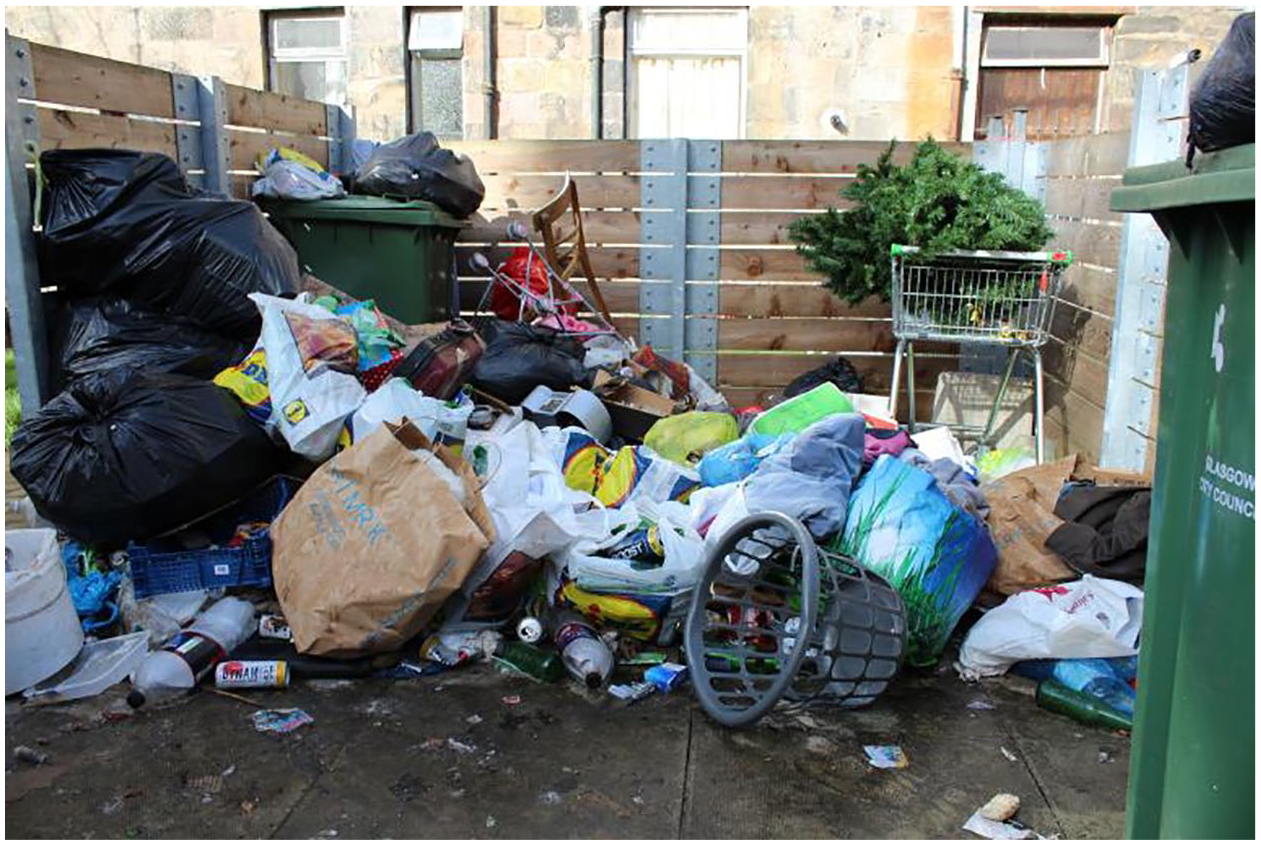
Image from STV report on Govanhill (© STV – used with permission).
A concern with the aesthetic reputation of the area – with how it was ‘seen’ – was thus something that many respondents expressed, and many of those we spoke to were actively involved in contesting the ways in which Govanhill tended to be represented. As one local third-sector worker explained: it’s not always been seen as a poor area. People from the sixties, if you were in the Gorbals [a formerly working class district south of the city centre], you’d consider Govanhill to be quite a step up. There were nicer streets, more avenues, more greenery, things like that, so it was considered a leafy suburb of the working class, you’re moving towards the suburbs. [Now, however, the area is] portrayed as Govan Hell . . . Allison Street in Govanhill is in the Evening Times as Ground Zero, Glasgow’s worst street, things like that. (Worker with local community organisation, Govanhill).
As may be evident from this example and from others that follow, some of those with whom we met both worked and lived in Govanhill. Such respondents, as might be expected, spoke in an organisational and personal capacity at once and they often emphasised their ‘emic’ perspective in making claims or offering explanations. In consequence much of the data considered in this article has, also, a somewhat ‘messy’ quality. Messy, that is, in the sense that ‘third-person’ reflections (concerning the way the area is seen and the consequences of that seeing) were interwoven with more subjective, ‘first-person’ accounts (concerning what ‘I’ have seen). In the analysis that follows, we give some consideration to what the interviews conducted in Pollokshields might suggest about how Govanhill is seen and represented by external actors, but we do not aim to draw analytical conclusions on the basis of a comparison between residents and non-residents specifically. Indeed, this ‘messiness’ in the data was characteristic of the interviews more generally, even those undertaken with representatives from national or city-wide organisations. Such respondents were, for the most part, not locally resident, but insofar as their accounts involved aesthetic description they also tended to resort to first- or second-hand accounts of lived experience in the area. All of this, we suggest, draws attention to an important feature of everyday aesthetic claims. This is that such claims have both an immediate, affective quality – they are expressed as embodied responses to real places – but they are also understood to be socially consequential and are thus the subject of social debate and contestation. As will be elaborated later, the assertion of the seemingly imperative quality of aesthetic claims can be exactly what serves to conceal the politically generative work which those claims entail, something that Stuart Hall pointed out some years ago (Hall, 1996b). Conversely, those who were concerned to contest the racialising politics of such claims often did so not only in analytical fashion, but also through the articulation of their own counter-aesthetic reading of local space.
In view of the contentious nature of politics within the area we felt that, in publishing findings, it was ethically incumbent on us to take particular care in order to protect the anonymity of speakers. For this reason, in what follows, we have limited contextualising information to a non-specific description of the speaker’s institutional affiliation and the location of the interview. Where the question of positionality is relevant to the analytical claims that we are making, racialisation therefore, we have sought to approach this through the description of general patterns that were evident in the data.
Findings
1. The bordering politics of beauty
In this first part of our findings discussion we explore in greater detail the relationship between everyday aesthetic responses to local space and processes of racialisation. We begin with three extracts in which respondents are describing Govanhill: aspects of environmental health that are problematic – particularly around Govanhill – are things like fly-tipping, you know, not necessarily dumping their stuff out the back, but just randomly leaving it on the street at night and then dogs, cats, children even, ripping it open to see if there’s anything in it or whatever, and it’s exposed then and again it brings its own problems and concerns. Other things then – probably going down a particular road there with that – but because of the level of multiculturalism and culture diversity within Govanhill, like, that has a tendency – that would I think anywhere – it has a tendency to create its own tensions, do you know what I mean[?] (Worker for local third-sector organisation, Govanhill)
Here again: you’ve gone from having people who had a stake here, who wanted to live here and who wanted to kind of be here at least for a while and then move on, to people – there’s been an element of white flight as well. There has. I don’t like that expression, but you know what I mean. So there’s been an element of people who have just decided to get out of Govanhill because they can’t stand it anymore I think. You know, there are justifiable sorts of actions there. For many it’s noisy, it’s messy, they don’t like the racial tensions and things like that. (Worker with local community organisation, Govanhill)
Or, here again: in this case the speaker is reporting to us the way in which a local Govanhill resident, with whom she works, describes the area: so she was sort of saying that all these issues that’s she’s got with the area changing, and the poor housing and overcrowding, etc., as well. I mean, she spoke about the overcrowding, particularly for the new groups of people that are coming in. With the overcrowding, she was sort of saying that well, you know, that’s why they’re hanging around on street corners. There’s no work for them, etc. Making a mess on the streets as well, with food being thrown down. So if they’ve eaten, it’s just kind of thrown. etc. And that’s bringing the area down in terms of its kind of image. (Community worker with local third-sector organisation, Pollokshields)
At a straightforward level what is evident here is just the extent to which, when people are asked to describe particular places, the accounts they provide are woven through with aesthetic judgements. These are not, of course, ‘grand’ acts of aesthetic interpretation. They are, rather, mundane claims about, or gestures towards, how a place ‘looks’ or is ‘seen’. They corroborate, moreover, what Tom Leddy (1995) suggests, which is the tendency for everyday aesthetics to have a specific character, often involving an opposition between ‘neatness’ and ‘messiness’, the ‘dirty’ and the ‘clean’. At the same time, what is also evident here is that such judgements are potentially the site of an epistemological slippage by which the effects of poverty become the effects of race, or by which messiness becomes the consequence of diversity. Such claims are not necessarily elaborated in any detailed or even intentional way, but their persistent, prospective presence is made evident in these repeated juxtapositions: ‘Fly tipping . . . cultural diversity’; ‘mess . . . racial tension’; ‘new groups of people . . . bringing down the image of the area’. In this sense, everyday aesthetics can be pivotal to the moment of ‘double’ reading that we have seen Goldberg (1993) describe: the ‘signs’ by which spaces may come to be racialised are often mundanely aesthetic ones.
If everyday aesthetic judgements are thus significant to the racialised reading of space, they are also potentially implicated in the racialisation of social relations within that space. To understand this we need to recognise that such judgements frequently take an accusatory form. As we have seen, discussions in philosophy have tended to emphasise the democratising qualities of aesthetic experience. Elaine Scarry’s (1999) celebration of the way in which the encounter with beauty takes us out of ourselves and teaches us to take pleasure in this experience of ‘unselfing’ (Scarry, 1999: 113) is typical. Yet aesthetic judgements are necessarily double-edged. Being able to attribute beauty in one context implies the possible attribution of ugliness in another and, regardless of what philosophers might say, judgements of this sort rarely seem to be understood as belonging to the realm of abstract experience. Precisely because such responses are provoked by social phenomena – because they are understood to be responses to social objects – they bring with them the tacit question of causality. Thus aesthetic experience is always potentially referred back to those things and people that are taken to be its cause: Govanhill is just – a lot of people describe it as dirty, just a dirty area. I think the way the Roma live, they must adapt into their way of life that they had back home. But there’s always police about as well, so they’ll just do whatever they want on the streets – they’ll do it openly. There’s always old furniture in the street, they’re going through the bins, stealing scrap metal, copper – that’s the reputation they’ve built since they got here. Whereas Pollokshields people treat this as a village as they say . . . What else can I say? They just – I think when it comes to hygiene they just don’t know how to dispose of rubbish properly. There’s dirt everywhere and they just don’t care. (Worker with local third-sector organisation, Pollokshields)
It is in this way that everyday aesthetic claims may play a role in what we can call – contra Scarry (1999) – the process of ‘selfing’, the seeing into existence of a racially defined ‘they’ as something other than the ‘I’ which passes aesthetic judgement upon them. As Stephanie Lawler (2005) puts it: appearances can be ‘made to mean . . . An assumed ignorance and immorality is read off from an aesthetic which is constituted as faulty’ (Lawler, 2005: 437).
Martin is thus surely right to suggest that ‘Every aesthetic encounter determines a “we”‘ (Martin, 2011: 202–203). Indeed, it seems to us that it is just this issue which is most pressing for any project of social aesthetics. But understanding how this process of selfing actually emerges out of such encounters requires us to make messy the neat line that Martin (2011) draws between aesthetic perceptions and whatever propositions are made on the basis of those perceptions. Even if such a distinction holds in the abstract, it seems to make little sense of how aesthetic judgements occur in real life. Until such time as we invent a methodological tool that allows us unmediated access to raw experience, the best we have are aesthetic statements of the sort reported here: ‘Govanhill is just . . . a dirty area’. And the point repeatedly made by black radical writers holds in this regard: perception does not stumble across a social object ready-made, rather the perception is part of the making of the object (including, potentially, its racialisation). Thus the statement ‘this place is dirty’ bears within itself, like a Russian doll, the implicit question ‘whose dirt?’ and inside that, in turn, the question ‘who’s dirty?’ In such moments the aesthetic judgement is already, potentially, a way of seeing and saying race.
Aesthetic perception, in short, initiates relationality, and a relationality which can take various forms. At the time of our research, for example, a number of online campaigns existed which had the purported intention of ‘restoring’ Govanhill. Such campaigns frequently used claims about the aesthetic deterioration of local space as a way of reinscribing the (allegedly) normative quality of whiteness within that space. On the other hand aesthetic claims also sometimes sustained a distinction between Govanhill and adjoining areas, most frequently – as in the preceding examples – Pollokshields. As is discussed in more detail later in this article, that distinction was itself one which often overlapped with a comparison between ‘established’ or ‘integrated’ migrant communities, on the one hand, and ‘newer’ or ‘transient’ migrants, on the other.
Many of our respondents, of course, were themselves critically and reflexively attentive to the fact that aesthetic claims about local space were implicated in the racialisation of social relations. Many, indeed, were involved in an ongoing struggle in this regard, contesting the way in which the accusatory quality of such judgements could be used to underwrite assumptions about the ‘otherness’ of migrant communities: instead of seeing it as a function of poverty, it becomes something that’s wrong with the community, you know. And, of course, accusations about the actual area and the tidiness and cleanliness of the area and everything like that that we’ve gone through because we know that even, you know, thirty years ago, fifty years ago, seventy years ago, the same accusations of any new migrant population in Govanhill were being made . . . it’s a perception thing . . . there is a perception there that, you know, this place is dirty . . . we’re not really looking into the reasons as to why that happens. It’s not about ‘them’ being Roma, but it’s about poverty. (Local worker with national third-sector organisation, Govanhill).
As this respondent, and a number of others made clear, the everyday aesthetic politics of Govanhill, the construction of a ‘perception’ of place which focused on issues of dirtiness had a potentially double political effect. Not only did it sustain an attribution of otherness in the ways that are described in the extract (‘it becomes something that’s wrong with the community’) but it thereby misdirected attention away from the underlying question of economic inequality. As another respondent – a worker in a locally based community project – noted, concerns about the messiness of local space were a familiar motif in discussions of the area and served to justify a range of institutionally sponsored interventions: ‘I think they’re all a bit obsessive about rubbish and having a nice, clean environment to live in . . . everywhere I go it seems to be the focus’. Such interventions, however, took place in a situation where – as he put it elsewhere in the interview – exploitation in the private rented housing sector had gone largely unchallenged: ‘You can’t touch business, you can’t touch the market, it can do what it wants’. Aesthetic judgements are sociologically significant, thus, not just because of what is ‘seen’ but because of what is thereby rendered un-seen or, at least, harder to see. To reiterate: aesthetic judgements are not responses to social objects which are already ‘given’ to our perception. Rather the ‘seeing’ itself constitutes the social object in important ways, including in this negative sense. As the previous respondent puts it, ‘perception’ in one direction sustains ‘not really looking’ in another. Insofar as the dirtiness of local space is seen as an issue of cultural or racial difference, it becomes un-seeable as an issue of poverty or exploitation.
2. Rage for order
Aesthetics are relevant not just to the ways in which people go about navigating the social phenomena which they routinely encounter, but also to the ways in which they envisage the shape of social relations as such (c.f. Simmel, 1968 [1896]). As we show in this second part of our findings discussion, because such claims and expectations generally take place one step back from the immediacy of lived experience, they have a potentially normative character, often being used to sustain claims about what a proper or pleasing form of such relations might be.
Examples of just how routinely our conception of social relations draws on an aesthetic register were widespread in our data. Thus, for example, we interviewed together a manager and key worker in a local community centre. Both strongly defended a model of service provision which refused to prioritise support for particular groups (‘Shall we have a haggis group for white women?’), and were critical of a version of ‘top-down’ multiculturalism which – as they saw it – involved ‘public money [being] used to keep groups separate’. By contrast, they claimed: ‘All our groups are open to everybody’. In articulating this perspective, the interviewees talked more than once about a textile group which met in the centre and which was premised on bringing people of different communities together around projects of artistic production: it’s fourteen years now. This year actually the group has done a new twelve week course and there’s a woman from Angola, a woman from Nigeria, three ladies from – no, two ladies from Pakistan. Two ladies from Brazil. A lady from Singapore. Not, they’re doing a twelve-week course . . . I’m a philistine with art, but they’ll be using it to get to know each other’s culture and move on and grow together. (Manager and worker in local community centre, Pollokshields)
The production of tapestries and other textiles thus served as a form of practice aimed at establishing new social relations but it also provided a means of conceiving of those social relations. Thus one of the respondents, later in the interview, described the work of the centre as involving the inter-weaving of ‘all of these disparate threads’ and pictured the local area as ‘dying to be melded into a sort of really unique community’. In short, it was evident here, as in other cases, that aesthetic practices and models frequently furnish us with ways of envisioning the social world and the situated relations of people within that world.
Yet this envisioning of the social world does not take place on a conceptual blank page. Instead it has to reckon with the force of existing aesthetic understandings and their implications. In this respect, we would point particularly to the enduring potency of an aesthetic tradition which implies that beauty is essentially a matter of things being in their proper place. Notwithstanding the shift in academic discussion towards a phenomenology of aesthetic experience, we need to come to terms with the stubborn authority of this formalist tradition and how it may be politically mobilised. What we might call an ‘aesthetics of order’ was thus an important component of the racialised politics of local space in Govanhill and was often central to the way in which particular conceptions of belonging were articulated. Next, we draw out three interlinked ways in which this was the case.
First, such an aesthetics was evident in the extent to which Govanhill itself was described (especially by interviewees who worked outside the area) as a site of disorder. The area was thus variously talked about as a place of ‘churn’ or ‘fluidity’, sometimes by respondents who made such a claim on their own behalf, but also by others who recognised the force of – and were concerned to contest the implications of – this representation. Such accounts involve an aesthetic component insofar as they rely on the idea that disarrangement is inherently problematic or unattractive. And the racialising potential of that idea emerges, in turn, in the extent to which such disarrangement was associated specifically with the transitory presence of migrants: Govanhill has never been the be all and end all for a lot of people. It’s always the post stop, like moving on. And I think a lot of the – with that migration, it’s kind of been – that’s the way Govanhill is looked at now . . . It’s like that kind of stopover. And then once you’ve like – once you do well for yourself and you’ve got some money, then you get out – you get out of that area as quick as you can and get yourself another house because unfortunately, the area is – you know, it needs a lot of work done to it, in terms of the social threat – social issues that are going on there . . . You know, they’ve got issues about – we still hear about rats and you know, all sorts – and hygienic issues and other things going on there as well. Because people don’t treat it as a home to be honest. (Worker with local third-sector organisation, Pollokshields)
Second, and relatedly, versions of the same conception were evident in the idea of social problems escaping, as it were, the frame of the area. Indicatively, then, a worker with a housing organisation based in Pollokshields talked about his job involving the struggle to make sure ‘that we don’t allow any of the manifestations of the social problems at Govanhill to creep into Pollokshields’. Or, similarly, a worker for a city-wide anti-poverty organisation: we have actually reverted back into a much more violent form of tribalism in areas. And not so much in areas where that would have happened before. So Govanhill, for example, is a very dangerous area – parts of it are very dangerous for the wrong people to be in. And that’s because of ethnic makeup . . . we’ve now got quite a large Roma community, so that’s had a lot of lawlessness connected with it and that has spilled over into neighbouring areas.
In these ways, the imagining of social relationships can appeal to an aesthetic formalism which priseds, above all, the promise of things remaining in their place. Hence the repeated use, in these and other interviews, of mundane aesthetic metaphors to describe social relations within Govanhill and which are suggestive of a dangerous descent into formlessness: ‘spillover’, ‘spillage’, ‘creep’, ‘seeping’. This aesthetic envisioning can become racialising not just because, as in the foregoing extract, a particular community may be presented as a source of the problems which are reportedly ‘spilling’ out of the area, but insofar as diversity itself is thereby construed as disorderly.
Third and finally, this formalist perception was a part of the tacit justification for a range of local initiatives of aesthetic reform that respondents described to us. The political application of formalist aesthetics has a long history, of course. Russ Castronovo (Castronovo, 2007) has shown, for example, the extent to which late 19th and early 20th-century movements of urban reform in the USA frequently assumed that training in an aesthetic appreciation was the most efficient means of integrating migrant communities into their newly acquired American citisednship. These movements find their contemporary equivalents in Govanhill where a number of interventions – such as the training of backcourt wardens (Evening Times, 2015) – have been premised on the need to instil a more attentive aesthetic sensibility amongst new residents. (Witness also, here, the call of the UK Government’s then ‘integration tsar’, Louise Casey, for ‘migrants’ to be told when and how to properly put out their rubbish (Rashid, 2017)). The idea that ‘aesthetic experience . . . [is] . . . a coherent arena for creating a citisednry ruled by its own internal adherence to form’ (Castronovo, 2007: 12), remains forceful.
Here, for example, one respondent describes, critically, their involvement with a programme, sponsored by the City Council, to refurbish the backcourt areas behind local tenement housing stock: We went to our first meeting, we sat round . . . and basically the plans were laid out in front of us already. So the architect had already been appointed and plans drawn up and, you know, we sat there and we kind of realised from day one that this – the remit that were kind of given in engaging the Roma community in ownership and planning of this . . . was out the window. And we realised that the choice was, you know, you could have a round corner to your grass or a square corner, or do you want this kind of lid on your bin or that lid. (Local worker with national third-sector organisation, Govanhill)
Such interventions were clearly not aimed at creating the conditions for any kind of meaningful aesthetic agency on the part of local communities. But what they do demonstrate is the profoundly performative character of this ‘aesthetics of order’. That is to say, they show how a particular mode of aesthetic imagination can sustain practices that are themselves an enactment of ‘ordering’, generating a set of racialised relations in which particular communities are required to submit themselves to the social arrangements envisioned and planned by others. In processes of this sort it is often the state, or its representative institutions, which take on, as it were, the eye of the artist, claiming a perspectival authority which expresses itself in the right to surveil social space and to intervene in the name of order. During our fieldwork, this ‘aesthetic authority’ was in the course of being objectified in the most direct way possible, through the erection of imposing CCTV cameras and the patrolling of camera vans on local streets (Figure 2).
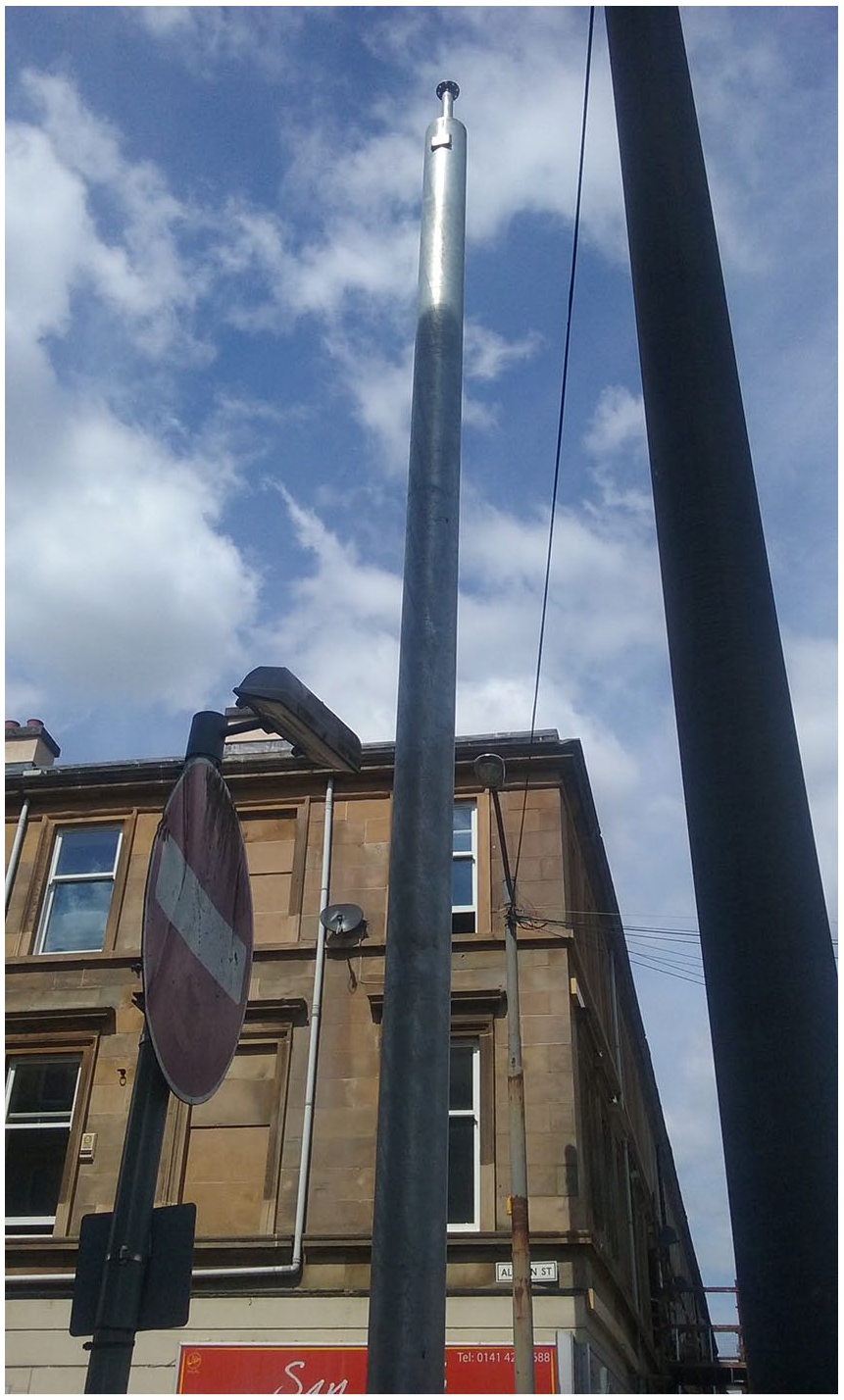
Fieldwork image of CCTV camera stanchion (camera not yet fitted).
In this section, then, we have considered some of the ways in which aesthetic claims are used, routinely, in the process of envisaging and describing situated social relations. A social aesthetics, we suggest, should be concerned not only with the question of how we respond to social relations as these are crystaliased in the ‘social objects’ that we encounter, but also with the role of mundane aesthetic models in how we conceive of and project the shape of those social relations themselves. Part of that role is, as we have seen, the use of such models to support claims about what are taken to be the correct form of those relations. In the examples we have considered here we can see how a long-standing aesthetic tradition which associates beauty with formal order – and which, we might note, was entangled with the ascription of racialised difference from the start (Malik, 1996: Chapter 3) – reverberates in various claims about the ordering of local space and about who properly ‘fits’ into that space. These propositions involve acts of conceptualisation. They are not responses to the inherent ‘oughtness’ of social objects, in Martin’s (2011) terms, but rather involve contestation over the terms of that ‘oughtness’. Nonetheless they are sociologically consequential. This is so, not only because they provide the aesthetic warrant to forms of intervention aimed at establishing more orderly or ‘better integrated’ communities, but also because they undergird the everyday responses to local space which we considered in the first section. The perceived disorder or messiness of local space can thus come to be taken, as we have seen, as aesthetic evidence of the (racialised) disorder attributed to local social relations.
3. Feral beauty
As will be clear from a number of the examples we have already given, many of our respondents were deeply aware of the divisive potential of aesthetic judgements in relation to local space in Govanhill. Interviewees repeatedly emphasised the question of ‘perception’, of how ‘pictures are built up’ about the area. They called critical attention to the processes by which such pictures were implicated in the racialising of local social relations: Go on any search engine and put in Govanhill and it’ll be mostly bad press that you’ll get, you know, like about the perceived difficulties or perceived problems that are caused by the cultural diversity of the area of the transient nature of the demographics of the area or whatever [. . .] the media portray the cultural diversity of the areas as a negative in itself, and focus on things like overcrowding, poor housing, environmental concerns, all of those negatives as well, so they’ll be highlighted a lot in the media but tied to like cultural diversity and not seen as a thing in itself. (Worker with local third-sector organisation, Govanhill)
Many groups and individuals were thus involved in an ongoing struggle about and against the dominant ‘ways of seeing’ the area. In this final section we briefly describe some of the ways in which this struggle was expressed.
As we have already noted, Govanhill has seen a significant number of (often) externally led interventions aimed at aesthetic regeneration in the area, and many of those we spoke to were sceptical about both the substantive and political implications of such interventions. In the example previously cited, the involvement of local people in the arrangement of local space was described as being reduced to a choice of ‘bin lids’ or lawn edgings. Other respondents spoke with comparable frustration about plans to renovate local shop-fronts, or proposals for a new frontage for a local community centre. Common to these responses was a sense that such initiatives made aesthetic choices which were not in any sense tethered to, or grounded in, the lived experience of local people.
By contrast, respondents described to us a range of locally grounded initiatives, many of them developed and led by migrant communities, which served to create what might be called communities of aesthetic practice and which were aimed at challenging exclusionary understandings of the area. These included, for example: walking tours aimed at recognising the inscription of histories of migration in the built environment; community gardening projects; litter pick-ups; various cleaning and recycling initiatives. Whilst we might read such projects as responses to the demand that new migrant communities demonstrate themselves to be good citisedns, and whilst some respondents were themselves unconvinced about the long-term significance of some of these actions, what such initiatives had in common was that they sought to reclaim aesthetics as a mode of practice: not just a matter of looking but of doing. They thereby reclaimed also the aesthetic agency of local communities in shaping local space. As bell hooks explains, for racialised communities in the USA an ability to contest the normative authority of the white gaze, to unsettle its given-ness, depended absolutely on the reclamation of aesthetic practice. Her cautionary reminder is relevant in this context as well: ‘Aesthetics is more than a philosophy or theory of art and beauty; it is a way of inhabiting space, a particular location, a way of looking and becoming’ (hooks, 1995: 65).
Alongside and as part of these aesthetic practices there were deliberate attempts to articulate a kind of ‘counter-aesthetic’ reading of local space and of localised social relations. That is to say: attempts to express a view of the area which rejected the framing provided by the ‘aesthetics of order’ described earlier and which celebrated instead what Paul Gilroy has called the ‘feral beauty of postcolonial society’ (Gilroy, 2004: 157). Thus, for example, the respondent in the following extract counterposed the bustle and diversity of everyday life on Allison Street – Govanhill’s main thoroughfare – to what he called Scotland’s predominant ‘monochrome’: What I’d like to see in Govanhill is more Eastern European identity splashed all over the place, I’d like to walk past pubs and cafes hear Gypsy music come from it and not just Irish music. So if integrating is getting them to do everything we do I don’t know if it’s such a great idea, to be honest. (Worker at local community and social centre, Govanhill)
Read in isolation this might perhaps sound like a prospectus for a kind of hipster cosmopolitanism. In the wider context of this interview, however, it was clear that this counter-aesthetic was closely bound to, and was expressive of, the interviewee’s well-established opposition to a ‘top-down’ politics of integration which they saw as diverting attention from the ‘real problem’ of structural racism: ‘I don’t like the word ‘integration’, to be honest, and I don’t know if it does a whole lot of good . . . using the word integration is not addressing the problems of racism’.
In the same way, another respondent, an outreach worker with the Roma community, pointed out how differently the aesthetics of the local area might appear in the eyes of the people that she worked with precisely because, as she put it, the area is ‘not black and white’: I think they feel better, maybe than in Slovakia and Czech Republic because we are not multicultural nations. And the Roma is the minority there, and the rest of Slovakians are different – different colour of skin, you know. So it’s very obvious that this is the rest of Slovakians and these people from Roma community. And I think they really feel this difference and sort of racism. Not open racism, but you know it’s different here because there are so – especially Govanhill. Govanhill’s amazing because there are like, I don’t know, seventy languages I think in such a small place. So I think for them it’s quite nice to see that the world is more colourful, you know. And in this way, they feel better.
These counter-aesthetics were articulated in the context of on-going public campaigns, mentioned earlier, premised on the idea of returning Govanhill to a nostalgically construed condition of lost beauty and good order, a beauty and order implicitly (and sometimes explicitly) coded as white. It is in that context that this last respondent talked of needing ‘a new way how to see the world’. By shifting the aesthetic point of view she proposed an alternative response to local space which acknowledged the symbolic violence that sustains whiteness as an aesthetic norm and which also celebrated the colourfulness of everyday multiculture.
Conclusion
Recent years have seen a growing interest in the role played by everyday aesthetic perceptions, judgements and practices in the making of, and making sense of, social life. Any project of everyday social aesthetics must pay systematic attention to the ways in which these things are implicated in the reproduction of racialised inequality within that life. Our concern in this essay, drawing on an analysis of qualitative data, has been to tease out some of the ways in which everyday aesthetic responses to local space may be implicated in the articulation of – and contestation of – racialised understandings of such space, and of the social relations which exist there. Here we reiterate some brief analytical conclusions which may be significant for emerging discussions in the sociology of culture.
First, we follow writers in the black radical tradition in insisting that it is necessary to recognise that aesthetic perception plays a constitutive role in these processes. We cannot take the kinds of aesthetic judgement that were reported to us as commonplace features of accounts of Govanhill (‘it’s dirty’, ‘it’s filthy’) as responses to a ‘ready-made’ social object: rather local space is socially constituted as dirty or as filthy in the moment that it is so judged. Moreover, the tacitly accusatory quality of such judgements means that in their situated expression they are always, potentially, part of the way in which racialised social relations are brought into being. As more than one respondent pointed out to us, mundane aesthetic statements of the kind (‘How can you live on Westmoreland Street? It’s disgusting’) were frequently used as an invitation to acquiesce with a racialised view of local relations, inviting responses such that the interlocutors were positioned on one side of a tacit division between an ‘us’ and a ‘them’: ‘It’s disgusting all the rubbish that they leave’. In this respect, we question a model of social aesthetics that accepts the claim that such judgements are straightforwardly ‘called forth’ by a given social object. We suggest instead the necessity of exploring how such judgements are themselves implicated in the ‘calling forth’ of that object including, as in this instance, its calling forth as something which is racialised. Indeed, the seemingly imperative quality of everyday aesthetic claims may be what most effectively disguises the socially constitutive work they perform. All the more reason, then, for a social aesthetics not to take such claims at face value but, rather, to give due attention to what they bring into being.
Second, we suggest that a social aesthetics would need to consider how social relations themselves may be read in ways that are aesthetically inclined, or which rely on the expression of aesthetic metaphors. In this case what we have pointed towards is the persistent authority of a formalist aesthetics of order and the way in which this can be ideologically mobilised so as to construe postcolonial diversity as a form of ugliness. The evidence of that same aesthetics can be traced in interventions and initiatives where it is put to a performative purpose, establishing unequal and racialised social relations which confer aesthetic authority on some whilst denying aesthetic agency to others. Given all of this we recall again Du Bois’ (1920) sceptical response to naïve celebrations of aesthetic experience: the liberating potential of such experience, we argue, is not something we can appeal to until we have come to a proper reckoning with the racialised and racialising potential of everyday aesthetic practices and judgements.
Finally, everyday aesthetics are also a site of struggle. Our interviews provided ample evidence of ongoing efforts to contest stigmatising representations of Govanhill. They provided ample evidence also of a concerted attempt to call attention to, and disrupt, the ways in which claims about the messiness of local space were used to sustain essentialised ideas of difference. Moreover, they provided evidence of what we might well call ‘everyday aesthetic resistance’. Such resistance entailed the formation of local communities of aesthetic practice as well as the articulation of aesthetic counter-readings of diversity. In these ways, many of those living and working in the area challenged a ‘monochromatic’ definition of local space, articulating instead the ‘feral beauty’ of the postcolonial everyday, and celebrating – with James Baldwin – the fact that ‘this world is white no longer, and it will never be white again’ (Baldwin, 1998: 29).
Footnotes
Acknowledgements
We would like to thank the editors of Cultural Sociology and four anonymous reviewers for detailed comments that helped us clarify and better organise the argument of the essay.
Funding
The authors disclosed receipt of the following financial support for the research, authorship, and/or publication of this article: This research was undertaken as part of the work of the ESRC funded research Centre on the Dynamics of Ethnicity (grant number: ES/K002198/1).
