




Abstract
This article examines British screen content consumption among young audiences aged 16–34 in four European countries: Denmark, Germany, the Netherlands and Italy. It suggests a reconsideration of content flow theories that maintain ‘home advantage’ for domestic content, followed by shows from culturally or linguistically proximate countries. The research reveals a shift among younger viewers towards a re-asserted Anglo-American hegemony, driven by the accessibility of English-language content, declining interest in domestic content and growing English-language proficiency. This favours global streamers with English-language productions, primarily from the United States, even in Italy and Germany where dubbed shows have been the dominant viewing option.
Keywords
Introduction
The meteoric rise of global US-owned subscription-funded video-on-demand services (SVoDs) like Netflix, Prime Video and Disney + have multiplied choice across Europe (Grece, 2021), transforming viewing behaviour, especially among younger audiences at the expense of linear broadcast TV viewing (Channel 4, 2025; EBU, 2022; Esser et al., 2025; Sehl, 2020). Yet while young people’s social media use has garnered much academic attention, little is known about their continued engagement with traditional ‘longform’ screen content on VoD or broadcast platforms, here defined as material lasting 20 minutes or longer, and what these shifts mean for our understanding of programme flows across borders.
Drawing on surveys, digital diaries and interviews with young people aged 16–34 in Denmark, Germany, the Netherlands and Italy between October 2022 and April 2024, this article explores shifts in the consumption of longform content, illuminating a move away from ‘home-grown’ content, legacy broadcasters and domestic VoD platforms towards English-language content with potential implications for both domestic production industries and societal cohesion (Biltereyst, 2004: 343). Original data derives from the Screen Encounters with Britain (SEwB) project (2022–2025) combining quantitative and qualitative audience research (Bengesser et al., 2022). Through a research project that tracks young audiences’ engagement with British films and TV, the research considers why English language content, mostly from the US, predominates. Second, it examines the extent to which increased viewing in English is consolidating the position of English-language content in Europe and whether this prompts a reassessment of previous theorisations about home advantage and cultural/linguistic proximity.
The article progresses as follows. First, we map out the context for a theoretical re-examination of content flows, before outlining our approach. Second, we discuss survey findings that illustrate the dominance of viewing of English-language content among younger audiences by focussing on platform, genre and country-of-origin preferences. Third we use interviews with young audiences, supported by digital viewing diaries and additional insights by cultural intermediaries to investigate more closely why US, followed by UK content, is favoured above domestic content and domestic VoD platforms. Building on these findings, we concentrate on the role of English as the ‘language of advantage’ (Collins, 1989) among young people. Based on these empirical insights, the penultimate section revisits previous theories about international TV flows. It suggests a reconceptualisation of theories centred on ‘home advantage’ (Hoskins and Mirus, 1988; Straubhaar, 1991), ‘cultural proximity’ (Straubhaar 1991, 2007), ‘cultural discount’ (Hoskins and Mirus, 1988) and ‘geolinguistic regions’ (Sinclair et al., 1996: 12–13; Straubhaar 2007) towards a re-asserted Anglo-American hegemony, fortified by ‘English as the language of advantage’ (Collins, 1989). Applied to a ‘new media generation’ in Europe – defined by Vilde Schanke Sundet and Marika Luders (2023) as younger generations who have grown up with the global platforms and on-demand services of US transnational corporations – we introduce a revised model that considers (1) the impact of global infrastructure on young people’s media consumption and how it reinforces English-language dominance; and (2) findings that indicate English-language media consumption becoming second nature for those with high English-language proficiency, and those who want to improve their English and/or watch ‘the real thing’.
Theorising content flows and the role of language
VoD services, particularly US-owned transnational SVoDs, have transformed television since the 2010s offering alternative distribution (on-demand) and business models (primarily subscription) on a ‘near-global scale’ (Lotz et al., 2022: 511; Jenner, 2018; Lobato, 2019; Lotz et al., 2021; Podara et al., 2021). The disruption has been such that Sundet and Luders refer to industry perceptions of a ‘new “media generation”’ who regard global streaming services/platforms ‘as an integral part of everyday life’ (2023: 224–6), compared with previous generations who grew up with homogenous, national media. Global players like Netflix, YouTube and social media have drawn young people away from national legacy media, and this trend is expected to persist, based on ‘the twin advantage of scale and capital’ of global players who can navigate the high entry barriers and investment requirements of transnational content aggregation (Chalaby, 2023: 190).
The rise of global platforms and new media generations suggests changes in how and to what extent national and international content is consumed, prompting a re-examination of how we look at programme flows and US content hegemony. Academic scholarship until the late 2010s when choice was largely limited to mass audiences (Lotz et al., 2022: 511) was characterised by agreement that domestic content had a ‘home advantage’ (Hoskins and Mirus, 1988; Straubhaar, 1991). Similar content from other countries was thought less appealing because its foreignness translated into ‘cultural discount’ and fewer purchases by programme buyers (Hoskins and Mirus, 1988: 500). Yet as many countries could not produce and fund all their own programmes – especially fiction – cheaper imports filled the gaps (Steemers, 2004). Broadcasters either imported from the US or from countries that were considered culturally and/or linguistically proximate (Straubhaar, 1991: 39).
Lacking production capacity for fiction, Europe, comprising many smaller territories with linguistic and cultural diversity, came to rely on US films/TV series as channels multiplied in the 1980s (Biltereyst, 1992; De Bens and De Smaele, 2001). US culture became almost a ‘second culture’ (Gitlin, 1998). However, studies in Latin America and Asia found that programme flows were also delineated by ‘geolinguistic regions’ (Sinclair et al., 1996: 12–13; Straubhaar, 2007) and ‘cultural proximity’. According to Joseph D. Straubhaar (2007: 195–206), cultural proximity encompasses a common language, shared historical experiences, values, themes and genres, which benefited genres like telenovelas which proved popular across and beyond Latin America.
However, Straubhaar and colleagues’ (2023: 374) more recent research in Latin America reveals shifts in consumption and class-based variations. Using survey data to analyse respondents’ self-reported interest in TV programmes and films between 2004 and 2014, there was ‘a consistent preference for national programs’, closely followed by US programmes. Preferences for ‘Other Latin’ programmes ranked much lower. In other words, linguistic and cultural proximity appeared to matter less than Straubhaar’s earlier work (1991, 2007) had suggested. Findings also revealed that class might be significant because the ‘richest 10%’ who were most likely to subscribe to US streamers ‘significantly preferred U.S. programs’, and US preferences among the richest 60% grew also between 2004 and 2014 (Straubhaar et al., 2023: 376–377).
Renewed theoretical interest in programme flows came in the late 2010s with SVoDs’ growing investment in non-English language content to attract ‘local audiences’ with local content (Iordache et al., 2021; Jenner, 2018; Mikos, 2022). Given the unexpected transnational popularity of some non-English shows, such as Money Heist (2017-21, Spain) and Squid Game (2021-25, South Korea), there have been further studies of ‘contra-flows’, from South Korea (Ju, 2020; Kaptan and Tutucu, 2021) and Turkey (Khan and Rohn, 2020), that include some audience research. However, in the absence of detailed viewing data from SVoDs, more insights from independent audience research are needed in today’s demand-driven mediascape. Recent studies from Denmark (Jensen and Mitric, 2023) and Australia (Potter et al., 2024) on children and teenagers’ engagement with fiction in an on-demand environment point the way on levels of interest (low) in domestic content, which our research complements with findings on older 16–34-year-olds, that allow further theorisation of audience behaviour.
One avenue for further audience exploration is language (Bengesser et al., 2023). Although language is key for understanding both audience choices and programme flows, research on this has been limited (Biltereyst, 1992; Ksiazek and Webster, 2008). Straubhaar (1991), a key theorist of cultural proximity, agreed that language is important for understanding viewer choices, but evidence was lacking. Reflecting on pan-European TV in the 1980s, Richard Collins (1989: 354–355) proposed a two-tier linguistic proximity model for Europe, where programmes transmitted in the native language appeal most, followed by English-language programmes, but with no audience research to support this claim. Nevertheless, Collins convincingly argued that English is ‘the language of advantage’ because it represents the richest and (almost) largest language community in the world, with additional benefits from its status as the ‘world’s most important second language’ (1989: 354).
English as ‘the language of advantage’ has attracted concern in the Netherlands, a country characterised by limited fiction production and high English language proficiency (see Table 1). Drawing on critical sociolinguists, who argue that language is never neutral, Jelle Mast and colleagues (2017) critique previous flow theories for failing to consider how the cultural connotations of language affect viewing behaviour. They warn that the positive connotations associated with English can lead to a self-perpetuating cycle of English-language dominance, whatever the merits of non-English language and home-grown content: As long as English dominates broadcasting schedules, it will be perceived as a proximate language, which will contribute to its dominance. As long as English is equated with high-quality programming, it will generate the necessary capital on the global market to maintain its high production value, which will contribute to the idea that English equals high quality. As long as broadcasters first and foremost buy the English-language products they feel the audience prefers, those will be the programs the audience will be watching, which will reinforce the perception that those are the programs they prefer (Mast et al., 2017: 2579). Market overview. Sources (L = Line): L1 – Eurostat (2024); L6 – Statistics Denmark (2024); Film Fonds (2023); Kantar (2023); Auditel (2023); L7–10 – Grece and Tran (2023: 100-106); L12 – EF EPI (2024).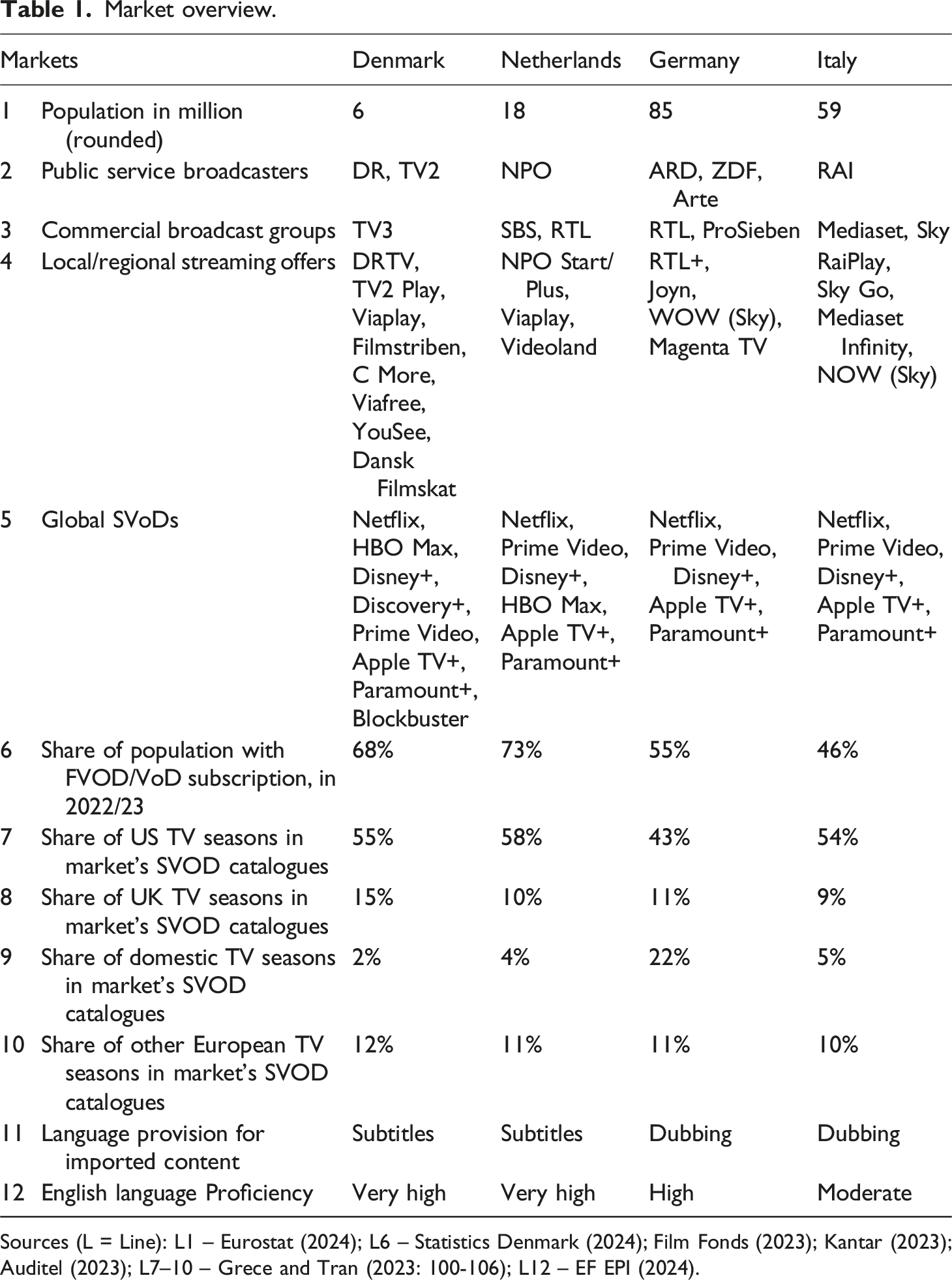
In today’s mediascape of global infrastructures, new media generations and growing English-language proficiency, we argue for the importance of paying more attention to language preferences to further understand audience choices. Streaming platforms have increased opportunities to watch programmes in original languages. However, only by looking at the consumption preferences and practices of young viewers, including language shifts, can we learn more about their motivations and how this impacts ideas about home advantage, geo-linguistic programme flows and the hegemony of US content.
Research approach and market contexts
Findings are based on four online surveys (weighted by age and gender), carried out in local languages in Denmark in 2022 (n = 423), Germany (n = 426) and the Netherlands in 2023 (n = 409) and Italy in 2024 (n = 555), promoted and designed to attract all types of viewers aged 16–34 rather than just UK fans, and to establish general viewing habits and preferences in context rather than just the consumption and reception of UK content. Self-administered surveys, distributed through schools, universities, clubs, young ambassadors and snowball sampling between 2022 and 2024, were followed by digital diaries/tasks over 5 days with 102 participants (20–28 per market, aged 16–34, including a weekend), selected through a screener survey and balanced for varied interest in both UK content and the UK (low to high), age, gender, education and occupation. Diaries were used to document respondents’ daily viewing, with whom they viewed, how they knew about titles, platform/channel selections and language choices, as well as a daily task related to particular genres (posters and videos) or where UK titles appeared on their favourite platform’s landing page. 12 diarists per market (total 48) were then selected for interview, also balanced for interest in the UK/UK content (low to high), age, gender, education and occupation. Structured online interviews lasting an hour, and drawing on digital diaries to explore viewing preferences, practices and motivations, took place in local languages or English, depending on interviewee preference. These were supplemented by three to four 60–90-minute-long online focus groups per country for 16–19s (38 respondents), because an earlier Danish pilot project had shown that this age group is harder to recruit (see Bengesser et al., 2022: 17).
Each round of audience research was preceded by (a) the collection of market data to establish key players, VOD penetration and levels of non-domestic content in SVoD catalogues (see Table 1); (b) catalogue research to identify UK VoD content; and (c) landing page and social media research to identify UK content on selected VoD services available during the surveys and digital diaries. To provide additional national context into young people’s viewing choices, 14 one-hour-long online anonymised semi-structured interviews with English-language teachers from a range of schools (three to five per market) provided insights into how English is taught in schools. 15 one-hour-long online anonymised semi-structured interviews with programme buyers from key VoD and broadcasting platforms in each country (three to five per market) afforded insights into how young people’s viewing practices and preferences are perceived by industry representatives (see Bengesser et al., 2022 for methodological detail). Transcribed interviews were coded in NVivo 14 according to themes and concepts linked to research questions about what is watched and how, how it is found and accessed, viewing motivations and values and experiences attributed to different genres and countries-of-origin.
Case studies were chosen to represent two contrasting market contexts (see Table 1): Denmark and the Netherlands as smaller markets (L1) with higher SVoD penetration rates than Germany or Italy (L6). Germany and Italy by contrast are larger markets with a dubbing tradition (L11), and lower English language proficiency (L12). The Netherlands (1st) and Denmark (7th) ranked above Germany (10th) in 2024 with ‘very high [English language] proficiency’, and substantially higher than Italy (46th) with ‘moderate proficiency’ (2024). By 2023, the share of US TV fiction in SVoD catalogues ranged from 43% in Germany to 58% in the Netherlands (L7), compared to low shares for domestic TV seasons in Denmark (2%), the Netherlands (4%) and Italy (5%), rising to 22% in Germany (Grece and Tran, 2023). The benefits of this comprehensive comparative approach across four countries facilitates greater empirical insights into audience preferences that provide a basis for re-thinking previous theorisations around programme flows and language. In spite of some limitations relating to respondent recall, it does provide a base for pinning down commonalities and distinctions that arise from different market contexts.
Platform, genre and country-of-origin preferences
If players like Netflix invest in more non-English language content does this increase geographically ‘omnivorous’ (Straubhaar et al., 2023: 366) viewing preferences and practices? Or does a global, US-owned SVOD infrastructure combined with rising levels of English-language proficiency further reinforce English as the ‘language of advantage’? And does this advantage result in more entrenched expectations around programme quality among younger viewers, that perpetuates the supremacy of US or Anglo-American programmes? The surveys provided empirical evidence about preferences by establishing (1) the lead of US-owned global platforms among 16–34 s for watching ‘longform’ content (>20 min); (2) preferences for genres in which the US excels; (3) backed up by clear evidence of the US-lead in country-of-origin preferences.
Platform preferences in % in Denmark, Germany, the Netherlands and Italy, by age (16–34).
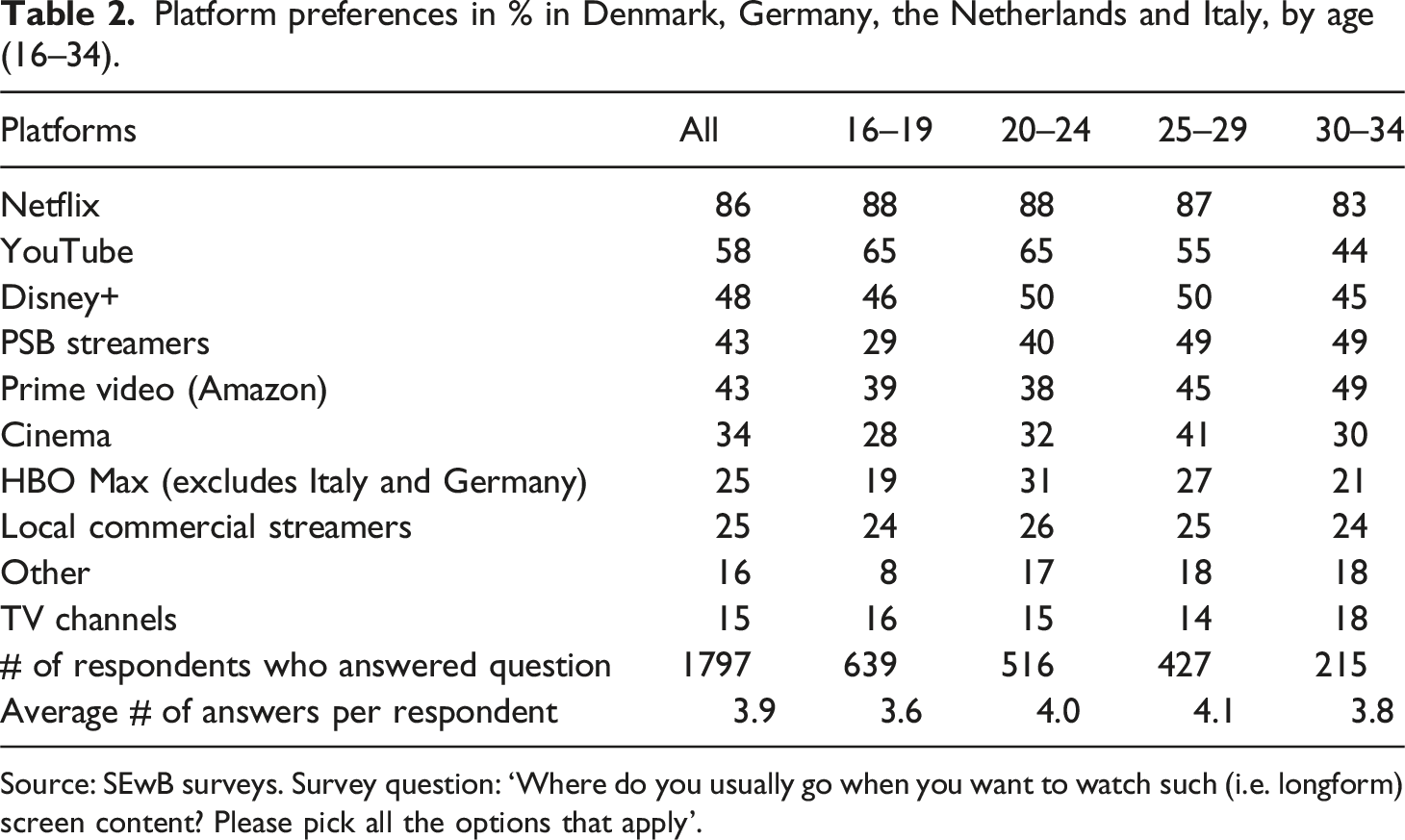
Source: SEwB surveys. Survey question: ‘Where do you usually go when you want to watch such (i.e. longform) screen content? Please pick all the options that apply’.
Genre preferences in % in Denmark, Germany, the Netherlands and Italy, by age (16–34).
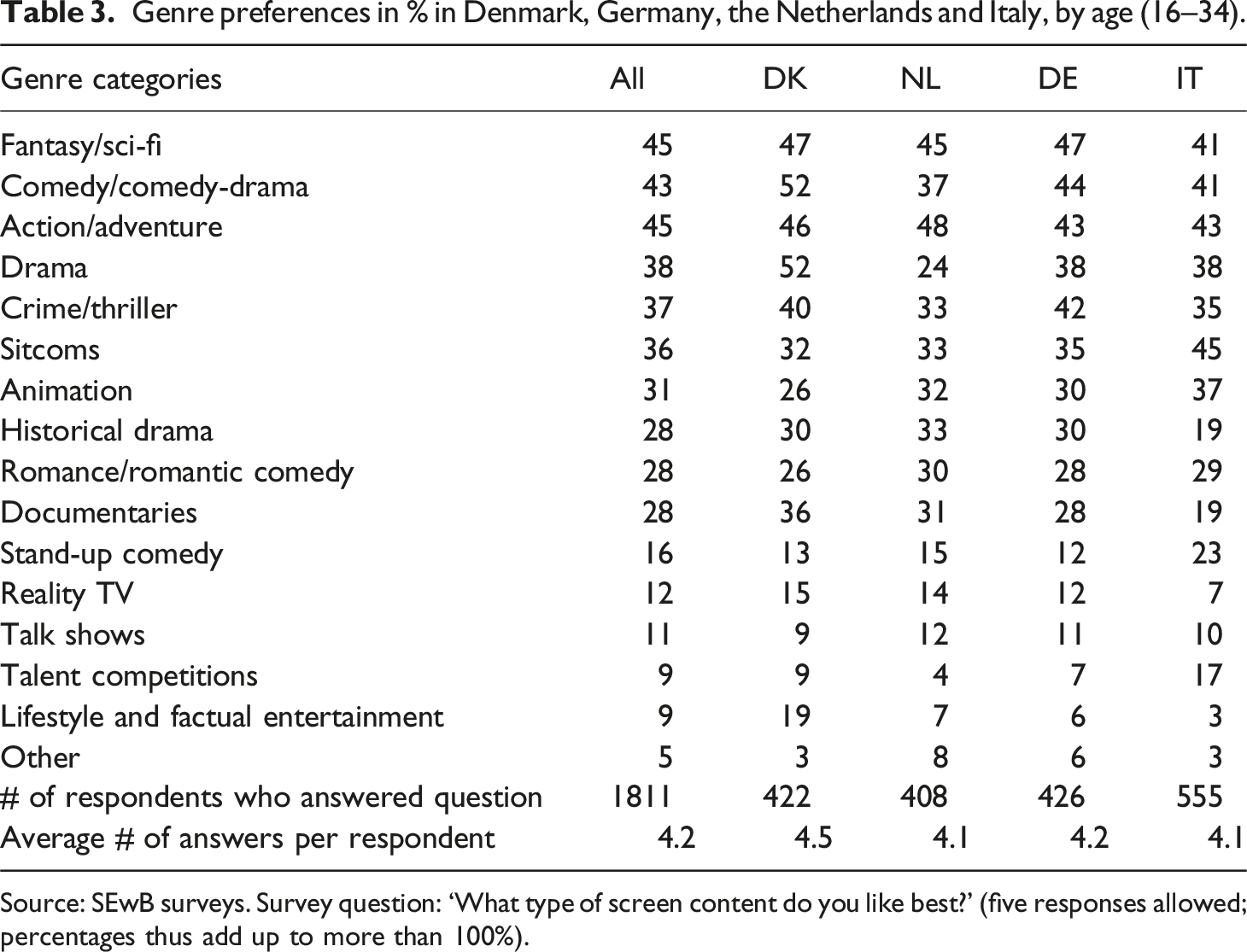
Source: SEwB surveys. Survey question: ‘What type of screen content do you like best?’ (five responses allowed; percentages thus add up to more than 100%).
Country of origin preferences (%) in Denmark, Germany, the Netherlands and Italy for respondents aged 16–34.
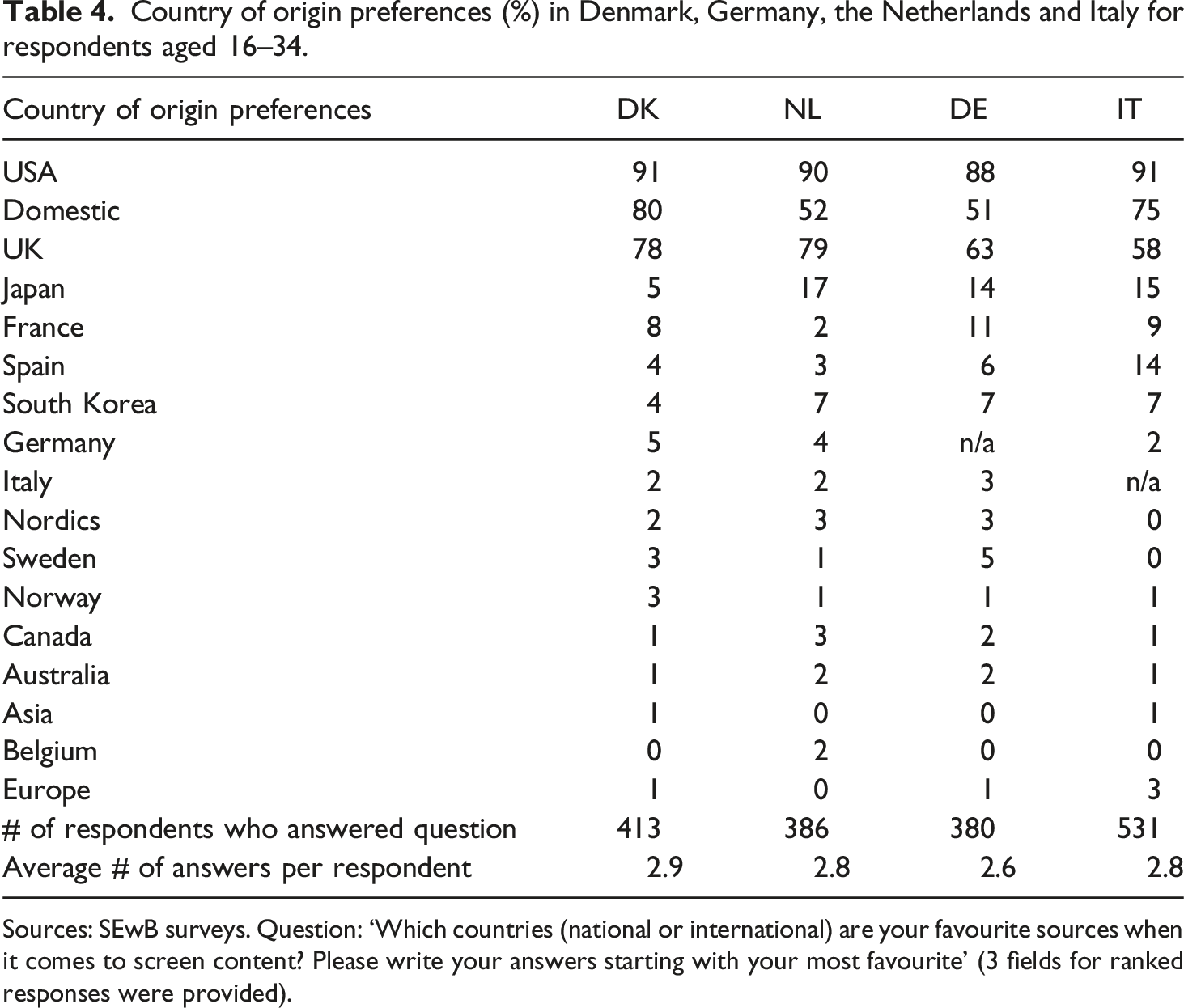
Sources: SEwB surveys. Question: ‘Which countries (national or international) are your favourite sources when it comes to screen content? Please write your answers starting with your most favourite’ (3 fields for ranked responses were provided).
The unrivalled status of US productions becomes even starker if we only consider respondents’ number one choice. Significantly more than half (ranging from 52% in the Netherlands to 61% in Italy) placed the US in first place. Domestic content was strongest in Denmark (24%, second place) and Italy (20%), but weakest in the Netherlands (13%) and Germany (8%) where it came third after the UK (24% in the Netherlands and 20% in Germany). If shares for the UK as first choice are added to US programming, the dominance of English-language content rises further ranging from 70% in Italy to 77% in Germany.
English-language programming – entrenching the ‘language of advantage’
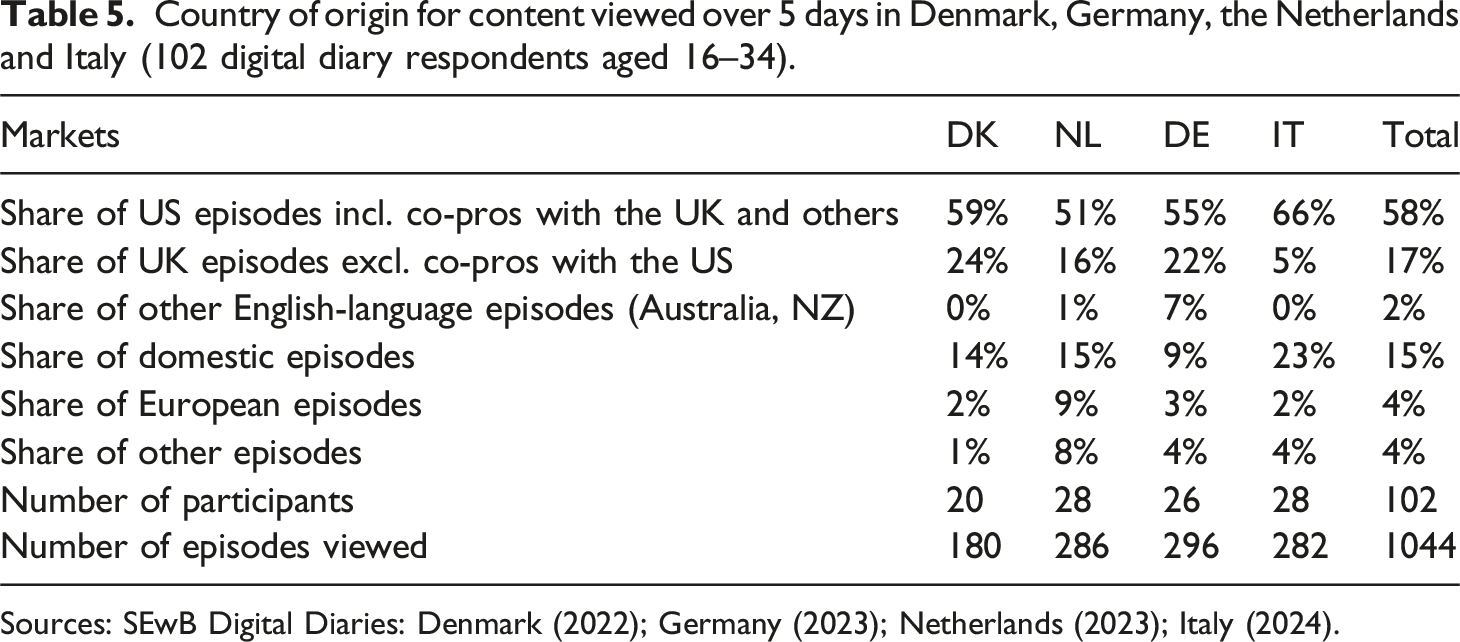
Country of origin for content viewed over 5 days in Denmark, Germany, the Netherlands and Italy (102 digital diary respondents aged 16–34).
Sources: SEwB Digital Diaries: Denmark (2022); Germany (2023); Netherlands (2023); Italy (2024).
Of 1044 episodes viewed by 102 participants during the diaries, 77% were English-language titles, dominated by the US (58%) followed by the UK (17%), with Italy exhibiting the highest share of US viewing (66%). Overall, in terms of home advantage the share of domestic productions accounted for 15% of viewing, with Italy viewing the most (23%) and Germany viewing the least (9%). In terms of cultural and linguistic proximity, productions from other European countries accounted for only 4% of viewed episodes. Echoing the survey, the diaries suggest that English-language productions predominate, that the ‘home advantage’ of domestic programming is low among the young, and that cultural and linguistic proximity with other European countries hardly features at all among young people’s actual viewing choices.
Audience interviews (16–34) and focus groups (16–19) confirmed preferences for English-language content, dominated by US productions. Markus (M26) in Germany watched little in German, because ‘technically they are not that good’ and he focused ‘on the English-speaking world as far as fictional content is concerned’. Similarly, Karl (M18) in the Netherlands mostly watched ‘English-based stuff (…) because I’m not that big a fan of Dutch movies and books and everything’. Jasper (M17) in Denmark also ‘watched mainly British and American – and not a lot of Danish, because I don’t really enjoy Danish television’. Even in Italy, where interest in domestic fiction is stronger, the high US ranking established in the survey was confirmed by Barbara (W31) who preferred ‘American content in terms of films and TV series, definitely’.
First, interviews demonstrated that one key reason for preferring US productions was assumptions about ‘quality’, linked to higher budgets, superior acting, entertainment value and affect, qualities that were all seen as lacking in domestic productions. For Margherita (W27) in Italy ‘American productions’ signified ‘a good chance’ of ‘high quality’ that will get you hooked, basically, that is engaging. For Jamal (M22) in Germany, US shows were ‘superior’ to ‘German shows’ that gave ‘an artistic perspective’ but were ‘quite boring for me. I want to be entertained’. Lene (W17) in Denmark was looking for emotional engagement but felt that Danish series did not ‘really trigger your emotions’ compared to English-language content.
Second, quantity was also a factor, with US providers being able to offer many more titles in those genres (sci-fi, comedy-drama and action) that appeal most to young people, perpetuating the cycle of US/English-language dominance. This was evident in comments made by Mark (M24) in the Netherlands, who confirmed that the Netherlands simply did not produce his favourite fantasy and sci-fi content.
Finally, interviewee explanations about how they discover English-language content and decide what to watch revealed that recommender algorithms used by global platforms and social media play a pivotal role in pushing US and other English-language content to the top of recommendations, further strengthening the ‘self-reinforcing cycle of English language dominance’ (Mast et al., 2017: 2574).
The survey, digital diaries and interviews confirm that young viewers in these countries prefer English-language productions, mostly from the US. This raises the question of the role of the under-researched factor of the English language in motivations to view English-language content.
Reasons for watching British content and for watching the English-language original
To understand better why young viewers engage with British screen productions, nine explicit ‘motivations’ were tested in the survey and then explored in more depth in interviews. Two of these motivations related directly to the English-language: language accessibility and learning English. Two further language-related reasons, ‘authenticity’ and the ‘coolness’ factor, emerged during interviews. Interviews also revealed that another top motivation, the appeal of ‘British humour’, connects with language in that it drives viewing in English.
In survey responses, ‘accessibility of the English language’ proved to be the most important motivation for selecting British programming in Germany (78%), the second most important motivation in Denmark (63%) and the Netherlands (66%) after humour, and the third in Italy (57%). Interviews confirmed the appeal of English-language accessibility for both British and US content, which made shows (with or without subtitles) easier to understand and follow. Lars (M24) in Denmark preferred ‘to watch English spoken language, because also I might have to read subtitles more with the Norwegian or Swedish’. Benedetta (W24) in Italy, a dubbing country, also explained that it was common for her and her friends to watch English-language content in ‘the original language’, but not other languages.
Buyers reinforced the perception of the greater accessibility of English in their estimations of what worked for younger audiences, with alternatives rarely considered (see also Mast et al., 2017: 2579). For one Danish buyer (DKB1), French and German dramas did not work for ‘this target audience’, who did not watch linguistically proximate ‘Swedish or Norwegian even’ meaning that ‘the English language is certainly the number one priority for us’. Similarly, a UK-based buyer for a pan-European SVoD argued that Italian or Spanish content did not ‘cut through as well because even though you’ve got the subtitles the language barrier is sort of there’ (DEB2).
Secondly, while learning English ranked as the lowest (9th) motivation in Denmark (26%) and the Netherlands (34%), it came top in Italy (65%) and joint fourth in Germany (53%) where English language proficiency is lower and dubbing more prevalent. Age is also important. For the youngest aged 16–19, across all four countries ‘learning English’ (59%) is the second ranked reason for watching British content (DE – 68%; DK – 47%; IT – 72%; NL – 55%). The importance of learning English was repeatedly highlighted by teachers. For example, a teacher in an Italian vocational school for hospitality students described students keen to watch Drink Masters (2022 reality TV series about mixologists, US) on Netflix in English to improve their language skills and career opportunities (ITT3).
Thirdly, viewing British content in English appeals because watching with the original soundtrack, even in Italy and Germany as dubbing nations, appears to enhance the viewing experience, making it feel more ‘natural’ and ‘authentic’ (see also Gao and Kuipers, 2023: 70). One German buyer (DEB4) speculating about teenagers thought watching in English was ‘about authenticity’. For the same reasons, a buyer in Italy (ITB2) noted the growing acceptance of subtitles for productions from ‘exotic’ non-English-language locations including Korea, suggesting a change in attitudes towards subtitling in a country more used to dubbed shows.
The link between language and authenticity was confirmed in interviews with young people who often perceive their own language in domestic fictional productions as ‘unnatural’ and ‘cringe’. For Emilia (W24) in Germany, the authenticity of original English-language shows stood in contrast to ‘a lot of German shows [that] are so staged (…) they’re not believable. (…) the voices - how they speak - are so weird that I always think no one in real life would ever talk like that’. Mette (W19) in Denmark claimed not to watch Danish TV at all, because ‘I actually don’t like Danish movies and actors where they speak Danish’. For Lene (W17) also in Denmark, English language content was preferred over Danish ‘because it is cringe and it’s our own language and (…) the English one is just better’. For Kenny (M18) in the Netherlands, ‘I only watch English now’ having grown out of watching ‘a lot of Dutch Youtubers’ when he was younger. Among 16–19s in Denmark and the Netherlands watching in English was deemed preferable to watching in their own language, reinforcing perceptions about English-language programming as ‘cool’, natural and implicitly of higher quality (Jensen and Mitric, 2023; Mast et al., 2017).
The preference for watching in English is also strongly connected to humour, the other top-ranking motivation for watching British screen content. Humour was the top reason in the survey for choosing British content in the Netherlands (70%) and Denmark (68%), and the second reason (63%) in Germany. Audience interviews revealed the pleasures of watching the ‘real thing’ and ‘getting the joke’ by listening to the original soundtrack. As dubbing is less effective for communicating humour (Carra, 2009), Lina (W18) in Germany confirmed that most people she knew watched in English ‘because the jokes are not the same in German’. Even in Italy where humour came seventh in reasons for watching UK content, interviewees mentioned British humour as a key draw and watching in English, at least sometimes, to ‘get the joke’. Humour delivered in English is also decisive for social media promotion where buzz is created through memes and user-generated recommendations that often create a ‘must-see’ sensation amongst those participating in global (English-language) communities on social media (Esser et al., 2023a, 2023b, 2024a, 2024b, 2025).
Young people prefer to watch in English
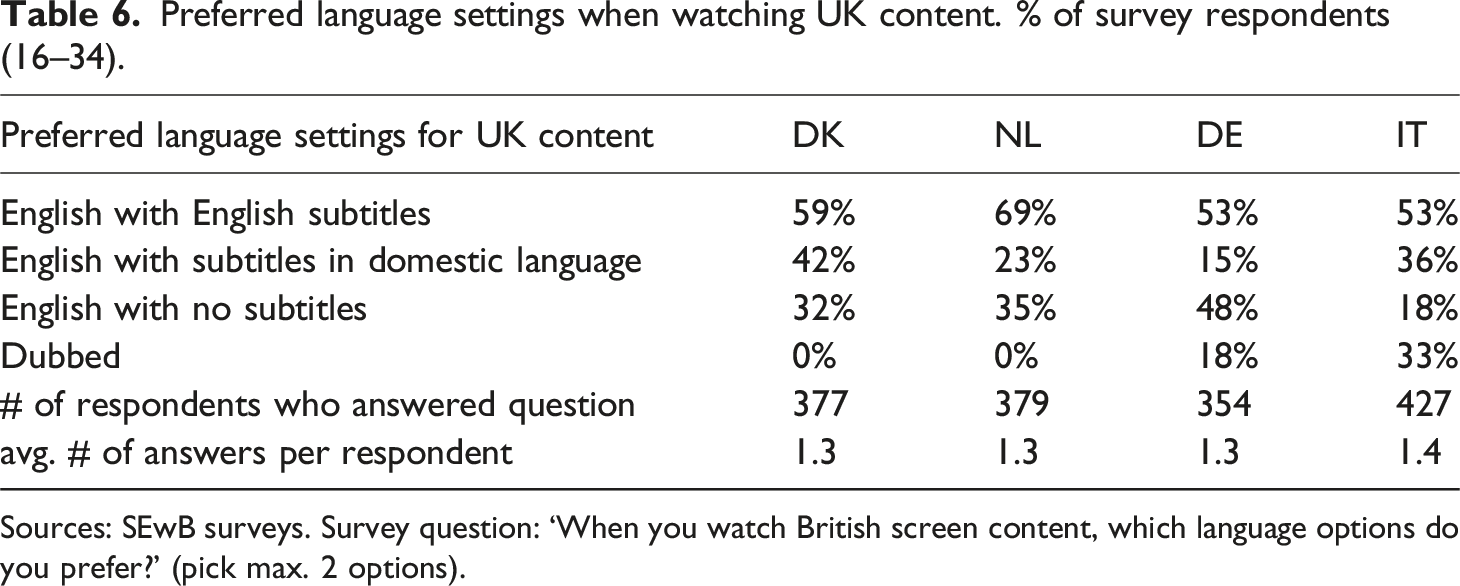
Preferred language settings when watching UK content. % of survey respondents (16–34).
Sources: SEwB surveys. Survey question: ‘When you watch British screen content, which language options do you prefer?’ (pick max. 2 options).
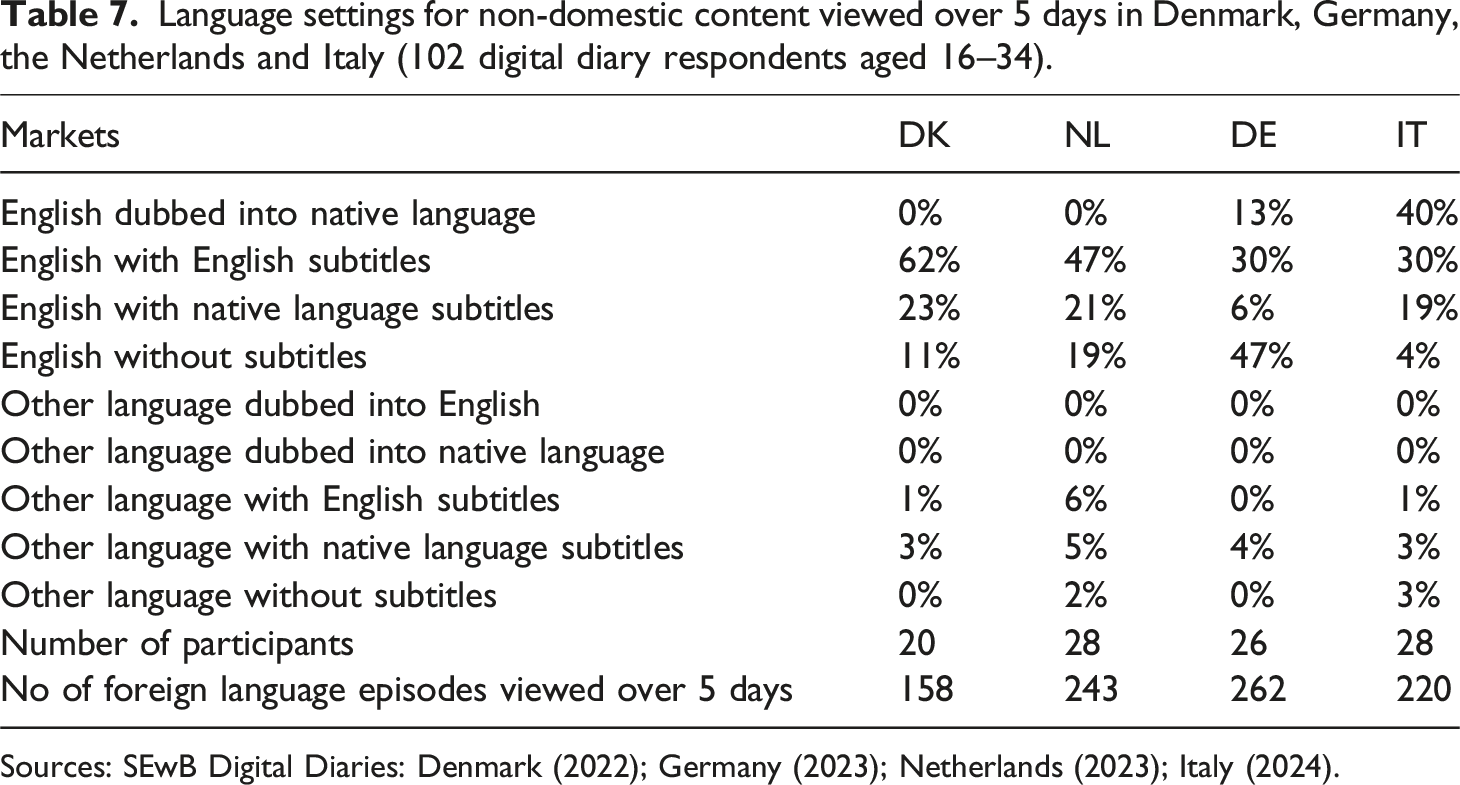
Language settings for non-domestic content viewed over 5 days in Denmark, Germany, the Netherlands and Italy (102 digital diary respondents aged 16–34).
Sources: SEwB Digital Diaries: Denmark (2022); Germany (2023); Netherlands (2023); Italy (2024).
Buyers in dubbing territories, Italy and Germany, warned about people overstating their willingness to watch in English but acknowledged changing viewing practices and language abilities among younger viewers (see also Ghia and Pavesi, 2021). Moreover, the results for dubbing and subtitling preferences (Table 6) and practices (Table 7) for each country make sense when considering the mix of English language proficiency, dubbing offers and acceptance of subtitles in each market, gained through habituation: in Denmark and the Netherlands adult screen content is never dubbed, and young people are habituated early to English in school and to watching with subtitles in English or Dutch. In Germany, more young people prefer watching without subtitles, even with lower English proficiency than in Denmark and the Netherlands, because they are less used to subtitles than their Danish and Dutch counterparts. In Italy, English language proficiency is ‘moderate’ and more viewers hence feel that they need subtitles when watching in English. Despite this complexity, what is clear is that English increasingly dominates young people’s longform viewing.
A new flow paradigm and perspectives on future viewing preferences and behaviours
Although our findings only cover four European countries, they are indicative of wider viewing trends for longform screen content, particularly fiction, among young people in Europe. Younger audiences have grown up with global platforms and access to more English-language content than ever before at the expense of public service and domestic commercial on-demand platforms (Channel 4, 2025; EBU, 2022). They watch in English in subtitling countries like Denmark and the Netherlands, and increasingly in English in dubbing countries like Germany and Italy. Our findings confirm that they prefer US-owned global platforms, and that their favourite fictional shows are not domestic shows followed by culturally and linguistically close productions, as theorised earlier by Straubhaar (1991, 2007) and John Sinclair and colleagues (1996), or shows in the native language followed by English-language productions, as theorised by Collins (1989). Rather English-language productions, mostly from the US, but complemented by UK productions, dominate (Table 4), with national productions trailing significantly, and regional or linguistically proximate non-English language content hardly featuring at all. Image 1 advocates a revised 3-tier language model for young audiences in these countries, positioning English-language film and TV fiction above domestic content. Languages that are linguistically close, like Danish, Norwegian, German or Spanish which cultural proximity proponents would have expected to rank below native languages, but above English, are classified as ‘all other’, reflecting stronger preferences for English language originals among young people. 3-tier language model for film and TV fiction viewing.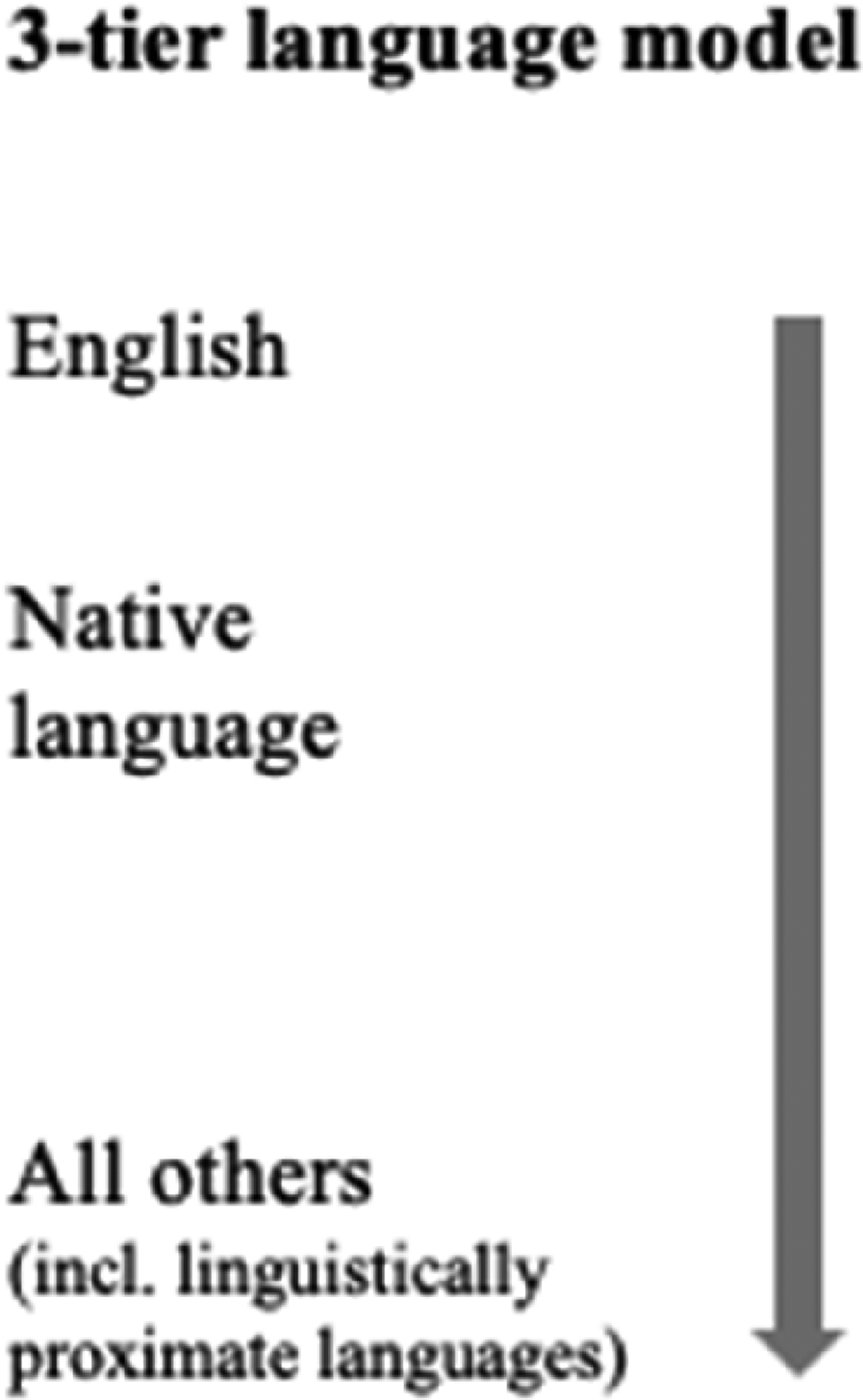
This is not to say that ‘home advantage’, ‘cultural proximity’ and ‘cultural discount’ no longer have any explanatory value. Yet they may be less valid for those contemporary younger audiences, who perceive English-language fiction productions to be qualitatively superior, as the above analysis shows, and who bemoan the comparative lack of favourite genres, quality acting, authenticity, entertainment value, affect and humour in domestic productions (see Esser et al., 2023a, b, 2024a, b, 2025). The appeal of US-owned streaming services, Anglophone social media like TikTok and Instagram, and increasing English language proficiency reveal that home advantage has weakened among younger audiences in these countries. Questioned about whether domestic (longform screen) content ‘feels more relevant than British content’, only 7% of survey respondents in Germany, 15% in the Netherlands, 20% in Denmark and 31% in Italy felt that it did; findings that are corroborated by Pia Majbritt Jensen and Petar Mitric’s (2023) and Anna Potter and colleagues (2024) studies with children and teenagers in Denmark and Australia, respectively (see also Straubhaar et al., 2023, for adults in Latin America).
As Mast et al. (2017) assert, theorisations of programme flows should always consider language in more detail to understand better the consumption and appeal of screen content in a wider context. Increases in English language media consumption, and the wide use of English in European schools and universities, mean that English has become more deeply entrenched within Europe. For most young people interviewed in the Netherlands and Denmark, English has become ‘second nature’. Some like Kris (NB26) in the Netherlands ‘enjoy speaking English more than I do speaking Dutch’. However, in the Netherlands concerns about the future of the Dutch language have become a focus of public debate, with growing numbers of migrants and overseas students reportedly not learning Dutch because English is widely understood (Delputte, 2023; Fresco, 2024).
A further linguistic consequence of high and/or growing English-language proficiency concerns shifting perceptions of proximity where the ubiquity of English on global platforms has made it a much more ‘proximate’ language for young people in the Netherlands than German (Mast et al., 2017: 2574) or Swedish and Norwegian in Denmark. According to one teacher in Denmark (DKT3), if ‘students are asked to read in Swedish or Norwegian it is like they’re being condemned to death every single time. It’s like, “Uh, it’s impossible to read”’. This trend is corroborated by the Nordic Council of Ministers (Nordic Council of Ministers, 2021: 19) who revealed that 95% of Nordic respondents agreed that English is easier to understand than other Scandinavian languages.
Finally, from a media perspective and looking forward, the naturalisation of English as a ‘proximate language’ across social media and global streaming platforms and the equation of English with ‘high-quality programming’ reinforce perceptions that English-language content is the number one preference, surpassing even domestic content (Mast et al., 2017). For example, Mads (M27) in Denmark claimed to watch fewer Danish shows ‘because in general I like the Internet to be in English. Just because that’s what I grew up with’. Over time, those who become used to English on social media and streaming platforms, including viewers in dubbing countries, consume less domestic content. Lotte’s (W19) experience in Germany of switching to English from German and not switching back was typical and indicative: […] when I was younger, I wanted to better my English skills, so I started watching some English Youtubers. And just watching that kind of made me interested in watching more and more and more, and so it got to the point where I just started only consuming English content and basically kind of abandoning the German content.
This behavioural pattern also reinforces the rejection of linear television and/or domestic streaming services, that may not offer English audio tracks; often they lack the rights. As Emilia (W24) in Germany noted, since she started to watch only in English, commercial channel ProSieben, which shows some US sitcoms, has ‘kind of gotten into the background, because they obviously show the shows in German’.
Of course, in Germany and Italy, this shift to English does not yet apply to all young people. In both, there is still a strong relationship between English-language proficiency and choosing to watch in English rather than dubbed versions. In Italy, education is also important: the higher the educational attainment, the greater the likelihood of watching in English. In Denmark and the Netherlands, there are no differences, because dubbing is not an option. With increases in English language-proficiency variations will diminish further.
Among young people across the four countries English-language programming, increasingly viewed in English, is becoming more entrenched as higher status and more popular than domestic content as Collins (1989: 354) anticipated: It is the advantages enjoyed by Anglophone producers within the richest and (of market economies) largest of world language communities that has made their productions the basis of a slowly developing global ‘culture'.
Given advances in English-language proficiency, finite attention, the financial and marketing strengths of Anglo-American producers and global SVoDs, plus recommender algorithms pushing English-language content to the top of SVoD interfaces and social media (Chalaby, 2023), a reversal in consumption from English-language towards national or actual linguistically proximate screen content seems unlikely in future.
Conclusion
By demonstrating young audience preferences for global streamers, US fiction and growing trends towards watching in English, this article argues for a reconsideration of flow theories based around ‘home advantage’, ‘cultural proximity’ and ‘geo-linguistic regions’ towards a greater emphasis on how Anglo-American hegemony is being reasserted in a ‘self-reinforcing cycle of English-language dominance’ (Mast et al., 2017: 2579) at the expense of domestic productions and those from geographically or linguistically proximate non-English-speaking countries.
First preferences for US, complemented by British content, among younger people were documented through surveys, which showed (a) dominance of US-owned global SVoDs for long-form content, (b) overwhelming preferences for fiction that align with US back-catalogues and (c) country-of-origin preferences that placed English-language content, mostly from the US, firmly above native-language and linguistically proximate content. Digital diaries and audience interviews confirmed the leading position of US content, followed by the UK in three countries, except Italy, ahead of domestic and other European content by a large margin. Surveys, interviews and digital diaries also demonstrated that young people in Germany and Italy, two dubbing countries, are increasingly viewing in English like their Danish and Dutch counterparts because English is thought to be accessible, natural and proximate, diminishing the home advantage of domestic producers and linguistically and culturally proximate countries. The increasing attraction of watching in English was also demonstrated as a means for young people to learn English and enjoy the original humour.
A critical argument pertains to the extent to which English will continue to influence and dominate global programme consumption. As this analysis in Europe shows, linguistic preferences are not straightforward. They depend on national contexts and individual viewing preferences. However, even in dubbing countries like Germany and Italy, the position of ‘English as the language of advantage’ (Collins, 1989) is becoming more entrenched, and this dominance is self-reinforcing through media use on streaming platforms and social media, both of which are dominated by English-language content. The more proficient people become in English, the more they perceive English as their second language, the ‘proximate’ language, and this in turn manifests the dominance of the English language. Ultimately, the habit of watching English-language content in English, the status associated with the English language and the associated entrenched belief in the superiority of Anglo-American screen content further cement viewers’ preferences for screen productions in English.
In short, English language hegemony creates and maintains geo-political imbalances between non-Anglophone countries and the Anglo-American sphere returning us to earlier theorisations of Anglo-American dominance (Tunstall, 1977; Tunstall and Machin, 1999) where English-language media exports benefit Anglo-American drama production, reinforced by the wider role of English in education, business and culture. Erstwhile programme flows determined by geo-linguistic and geo-cultural regions are weakened by renewed Anglo-American strength, as are domestic streaming and broadcasting. The ‘implications of that imbalance on culture’ (Lotz et al., 2022: 513) are still unclear but suggest that more audience research is needed to unravel and make sense of what is emerging in different national contexts.
Footnotes
Acknowledgements
We acknowledge the contribution of the following research assistants to data collection for each country: Lina Link, Aarhus University Denmark; Nathalie Klein, Film University Babelsberg, Germany; Rosa Kremer, Groningen University, the Netherlands; Dr Matteo Marinello, University of Bologna, Italy. We acknowledge the contribution of Dr Matthew Hilborn, postdoctoral researcher, for data collection and assistance with interview and industry analysis over the course of the project; Dr Alessandro D’Arma in facilitating the Italian field research with data collection, interview and industry analysis; and data research assistant Marypaz Ventura-Arrieta, King’s College London, for assisting with survey management, implementation and analysis.
Declaration of conflicting interests
The authors declared no potential conflicts of interest with respect to the research, authorship, and/or publication of this article.
Funding
The authors disclosed receipt of the following financial support for the research, authorship, and/or publication of this article: The research from Screen Encounters with Britain (SEwB) was supported by the Arts and Humanities Research Council (grant number AH/W000113/1), part of UK Research and Innovation (UKRI).

Data Availability Statement
The data from Screen Encounters with Britain supporting this article has been deposited in the King’s Open Research Data Repository at 10.18742/22153928 with an access embargo until 30 September 2025. Earlier sharing will be considered on request.