



Abstract
This article examines (im)material digital labor essential to the production of closet decluttering videos on YouTube by analyzing two case studies: Leighannsays and Bestdressed. I highlight three interconnected forms of tidying labor, that is, home, data, and waste management, mobilized for influencer work and cultural platform economy. Wardrobe clean-out videos capitalize on both corporeal and affective aspects of housework and content production in the construction and maintenance of the digital self. They also assemble management labor to organize material articles in domestic space, produce/manage multimedia, and construct/amplify digital existence. The essay also discusses the (im)material labor required by the personal and outsourced handling of the disposed’s hereafters as goods and trash outside of the home. Unpacking how closet decluttering video production nests together (im)material tidying labor associated with disparate sectors from home-based platform cultural production to public management of household waste shed lights on imbricated operations of the influencer ecosystem.
Keywords
In 2018, Leighannsays, a Texas-based white macro lifestyle influencer, 1 was tackling a huge round of closet clear-out. She loved shopping but was not a fan of cleaning. Leighannsays took her followers on this journey of closet decluttering, semi-following the popular KonMari method. The process was exhausting and Leighannsays ditched the KonMari method early on, but she was proud of her results with stacks upon stacks of clothes cleared out. She shared her imperfect side to viewers, reacquainted herself with neglected items, and bonded with long-time followers in the comments section. Huge bags of clothes were dropped off at a local Goodwill store.
In 2019, Bestdressed, a (then) California-based Asian American mega fashion influencer, 2 was filming an “extreme closet cleanout.” After the long decluttering process, she sifted through more than five hours of footage to create an eighteen-minute video. Per user comments requesting more footage of her decision process, Bestdressed put together a bonus video with edited talking clips for her second channel Bestmess. Bestdressed also sorted through pieces and prepared them for online resale. She modeled, took pictures, catalogued, priced, and wrote a description for each item. She made shipping labels, wrote thank you notes, packed all orders, and dropped them off at a parcel delivery service.
Japanese tidying expert Marie Kondo has become a household name, with her terms “tidying up,” “declutter,” and “spark joy” entering our colloquial vocabulary. The KonMari method, a two-part classification system of discarding and organizing, travels outside of official Kondo content—books and TV shows—and is frequently translated into the digital vernacular. This recent decluttering wave is a part of the thriving multimedia lifestyle industry that has been mitigating people’s long-standing anxieties with self-making, homemaking, and the estheticization of everyday life (Featherstone 1991). It partakes in the long tradition of gendered communication designed to reach middle-class housewives with lifestyle-centered programming (Ouellette 2016). Wardrobe clear-out YouTube videos extend lifestyle programming’s self-regulating function, framing “work” not as a site of value production and labor struggles but as an investment in bettering oneself in the quest of the good life. These videos offer insights into how popular housework self-helps are consumed, reinterpreted, practiced, and recirculated. They also illuminate how domestic labor is folded into digital creations for authenticity and, in turn, stronger brand image and community interaction, in hope of potential indirect or alternative monetary rewards. In this article, I argue that the cultural production of closet decluttering videos mobilizes highly gendered (im)material tidying labor in maintaining a creator’s digital authentic self and community, interdependent with tidying labor performed for the management of closet/home, content, and waste online and off, in and beyond domestic spaces.
For most fashion lifestyle influencers, decluttering videos are not their core content but periodic productions. If the KonMari method glamorizes housework and reframes home maintenance as pleasurable and rewarding, vernacular decluttering videos capture challenges that yield discussions of the (im)material tidying and maintenance labor performed by a creator in the management of closet/self, content/community, and home/waste. As housework, closet declutter expresses one’s aspirations toward their ideal home/self, performing repair to an unsatisfactory life. As influencer work, closet declutter gathers storage inventory check, cleanup, and disposal for improved efficiency and esthetics. Turning one’s closet declutter into an online video analogously contributes to an influencer’s brand and community. While the public revealing of one’s clutter may seem to compromise an influencer’s otherwise perfectly constructed imagery, such an act strengthens a creator’s aura of authenticity and facilitates a sense of intimacy/connection with viewers.
Domestic work and influencer labor are both taste work. On screen and off, influencers perform unpaid domestic labor to keep their home/clothes/self-image tasteful. Taste work is not only creative, affective, and inspirational but also material, physical, and instrumental (Pham 2015, 7). Closet decluttering videos is a site to elucidate the “nested precarity” (Duffy et al. 2021) of gendered digital and domestic labor in social media production. The domestic sphere is often separated from the production site, with the latter deemed productive and monetized but the former deemed unproductive and demonetized, exemplifying capitalism’s extraction of dark value. Not recognized as work, housework has been naturalized as a gendered attribute that is “a labor of love” that does not require a wage (Federici [1975] 2012). Ouellette (2019) builds on discussions on home-based women’s labor, proposing that Kondo’s promise of greater well-being through cleaning and curated consumption is dependent on women’s work. The production of closet decluttering videos, I posit, mobilizes gendered notion of work concerning housework and digital labor. Domestic labor shares many (im)material qualities with feminized free digital labor performed by influencers. Wardrobe clean-out video is a productive site to continue the discussions of the feminization of digital work in relation to a long history of feminized, affective housework (Jarrett 2014).
This essay brings together theorizations of housework and other forms of cleaning work, materiality of labor, and layered cultural platform work through the analysis of two decluttering videos by Leighannsays and Bestdressed. Tidying labor performed by fashion lifestyle influencers is interdependent with other infrastructural work under-discussed in the influencer economy. The article demonstrates the (im)material nature of work required by what I call the influencer ecosystem, an ecosystem that crosses private-versus-public and virtual-versus-physical boundaries. The influencer ecosystem includes the production, circulation, consumption, maintenance, and waste of the influencer culture/economy that embeds labor as infrastructure in the everyday operation of digital platforms and commodity networks. This framework speaks to platform studies’ growing interests in the convergence of platform, infrastructure, and labor.
Attending to the influencer ecosystem is thus also attending to the critical concept of “nesting,” which captures the complexity of layered digital (im)material labor necessitated by closet decluttering videos as social media content in the convergence of lifestyle media, self-help industry, throwaway culture, and influencer economy. Re-conceptualizing influencer work as nesting unsettles oppositional understanding of (in)visibility, (im)materiality, and interior/exterior. Nesting gestures toward the constant building of home, social media, and self by gathering, arranging, and ridding. Nesting of closet decluttering video is grounded in the home but also indicates the material relationships among the domestic, the societal, and the planetary (Ukeles 1969). Nesting reveals the contradictory mechanism of “invisibility within and around visibility” by attending to the layered fluid dynamics of corporeal and affective, creative and menial labor required by closet decluttering videos (Poster et al. 2016, 11). Unpacking how the production of closet decluttering videos nests together different tidying labor associated with disparate sectors from home-based platform cultural production to public management of household waste give us insights into the engulfing influencer ecosystem.
This article engages with discussions of im/material labor. Drawing from Maurizio Lazzarato (1996)’s conception of the post-Fordist labor that produces the informational/cultural product, Michael Hardt and Antonio Negri (2004, 108) define immaterial labor as “labor that creates immaterial products.” Such labor combines intellectual with creative labor and is frequently differentiated from manual labor and affective labor, the latter involving human interaction and the production of affects (96). The slippage of the term “immaterial labor”—from labor that creates immaterial products to labor that is itself immaterial—is worth a pause. Hardt and Negri (2004, 109) clarify that even though immaterial labor produces an immaterial product, the labor involved is material, even if the term is often used in a disembodied way. Theorizations of digital immaterial labor frequently dematerialize the labor involved in producing immaterial products, like closet decluttering videos and other cultural platform content productions. Fuchs (2008, 186) states that “the difference [of the labor that characterizes Web 2.0 systems] to manual labor is that it does not primarily change the physical condition of things, but the emotional and communicative aspects of human relations.” Yet digital labor does have major material impacts on individuals, communities, platforms, industries, and the environment. Physical labor enables the production of affect, intimacy, creativity, and knowledge. Despite the tendency to consider creative and affective labor as immaterial and manual labor as physical, all three labor categories involve/integrate physical, intellectual, and communicative aspects. As such, I use the term “(im)material labor” in this essay, using “(im)” to underscore the nested immaterial and material dimensions of digital cultural production and operation.
Both digital and domestic labor today are underpaid and/or unwaged occupations that face precarity and exploitation extended from traditional economies (Scholz 2013). Feminist discussions of work are foundational to theorization of digital (im)material labor, as many non-feminist labor debates ignore the fundamental (im)material aspects of the domestic sphere (Fortunati 2007). Domestic work mobilizes intertwined physical chores and immaterial expressions performed by a gendered laboring body essential to the maintenance and production of capital (Jarrett 2014). In producing closet decluttering social media content, digital prosumer laborer partakes in and mobilizes free and underpaid (im)material home-based work online and off (Terranova 2000). This essay contributes to feminist media scholarship—how gender and class figure into digital work—as I disentangle the relations among fashion/declutter creators as digital consumers, home managers, and producers of cultural texts and household trash.
Premised upon the physical process and result of tidying up, closet decluttering videos provide a venue to interrogate the nested exploitation of platform-driven (im)material labor. My aim to draw out (im)material labor across spatial boundaries speaks to the concept of “boundary resources” concerning how a platform instance expands its boundaries inwards and outwards (Nieborg and Helmond 2019, 209). Rather than focusing on YouTube as a platform, this article uses decluttering videos to examine the materiality of immaterial labor and how online cultural/platform workers depend on other infrastructural workers. My discussion speaks to Duffy et al. (2021, 2)’s framework on how the “nested precarities of visibility” impact social media workers. I extend the discourse beyond the platform ecology to consider how the influencer ecosystem relies on a vast range of everyday operational work. The essay analyzes the two primary videos by Leighannsays and Bestdressed, especially attending to the rhetorical, corporeal, and affective performances by creators and viewers in these videos and their comment sections. I further contextualize them by bringing in paratexts like Bestdressed’s other videos, Marie Kondo’s books, and YouTube videos created by thrift store workers. I find that closet decluttering videos mobilize three interconnected (im)material labors: the often feminized and/or racialized work of tidying and managing one’s home, content, and waste. Returning to the slippage around immaterial labor and asserting the embodied aspects of these nested tidying labors, this article re-materializes the discussion of platform economy and internet culture through a contextualized understanding of digital labor in a range of (im)materiality.
Performing Housework, Self, and Intimacy
Female-identifying creators predominate as authors of YouTube decluttering videos, a genre conforming to the historical tendency for women to perform home production. Leighannsays (Scenario 1) repeatedly states that she is neither good at nor enjoys doing tasks like organizing and cleaning. The video appears to challenge the compulsion to be a good housewife and the sense that women perform housework because, per the normative sexual division of labor, they are naturally good at it. As Leighannsays (2018) states, “[tidying up] does not come naturally to me on any level” (00:37). Nonetheless, the gendered association of housework persists here and beyond as professional and vernacular lifestyle media tend to gender domestic work, promising to help women manage their home with greater efficiency and style (Ouellette 2016, 103) and discover the joy of domestic work despite it being a second shift of labor. For (aspiring) full-time influencers, the production of a closet decluttering video allows for some overlaps between their first and second shifts of labor.
Connecting with audiences is another expected yet unpaid component of influencers’ work that is often considered an investment in audience growth. Baym (2015) refers to it as relational labor: the free labor influencers undertake to communicate with their audiences and to form and maintain relationships that could lead to some form of compensation. Creating connection through the imperfect and vulnerable requires affective as opposed to expert labor. A closet decluttering video confesses “the real,” containing humiliating/shameful revelations that are highly gendered—addictive consumption and messy housekeeping. It functions as a space of commiseration, nostalgia, connection, and aspiration, often involving publicly sharing one’s flaws alongside the excitement/pride of completed decluttering, to convey different affects like shame, surprise, distress, and joy. Rather than demonstrating how to declutter, Leighannsays establishes an emotional connection with her viewers around struggles with home management. The online-mediated audiovisual documentation of closet declutter transforms a time-consuming mundane physical housekeeping work into an affective performance featuring “live” housekeeping struggles that adds to a creator’s layers of performed authenticity (Abidin 2018).
Race plays a discursive role here concerning simultaneous Orientalism and techno-Orientalism, as Leighannsays started off her declutter with the KonMari method but was quick to dismiss it, in turn establishing her realness against Kondo’s perfection. Orientalism is a strategy that visually and materially contains Asia and Asian bodies to traditional imageries and decorative objects. Rather than decorating their homes with pre-modern Asian ornaments, the new Orientalist home centers the ideal of practicing the KonMari method of home management symbolized by a display of Marie Kondo’s books. Techno-Orientalism concerns with the West’s simultaneous fascination with and fear toward Asia’s technological innovation and manufacturing capability. The techno-Orientalist gaze futurizes Asia into a high-tech dystopian zone, rendering Asian bodies as factory machines without personhood and humanity (Roh et al. 2015). There is a clear techno-Orientalist binary presented here: Kondo—the Japanese tidying expert—is set up as unreal and too perfect like a housekeeping machine, in addition to her media content acting as Oriental household ornaments desired by middle-class American women; whereas Leighannsays—the white American influencer—is seen as an authentic human who struggles, makes mistakes, but ultimately overcomes. The racial dynamic will be further discussed later considering the American domestic labor history.
The video’s comment section confirms that Leighannsays builds relationships with followers through sharing and engagement. Figure 1 shows how she has been co-creating “communicative intimacies” that are personal, commercial, and material with followers (Abidin 2015). Closet decluttering videos foreground personal and material intimacies while minimizing commercial intimacies. For example, Leighannsays infuses material fashion objects with her memories of herself and/or others. Comments by Sarah Southcott and Jess Rose establish a personal intimacy with Leighannsays through their shared recognitions and memories tied together by certain articles of clothing (“that shirt! that dress!!”). Tessa S. further notes a “vicarious closet nostalgia” and hence, shared personal intimacy with Leighannsays, established through the material intimacy of owning the same piece of clothing and a commercial intimacy—a consumerist sense bonding (Banet-Weiser 2007)—that implies Tessa S. purchased this item due to Leighannsays’ influencer marketing. Figure 1 also suggests that closets’ intimate storage space hosts both physical clothing items and nostalgic/aspirational experiences. The double intimacies—enabled by both the physical clothing articles and the de-materialized social media platforms saturated with digital videos and photographs—speak to the importance of the management of closet/content/interaction in the production of affect and capital.
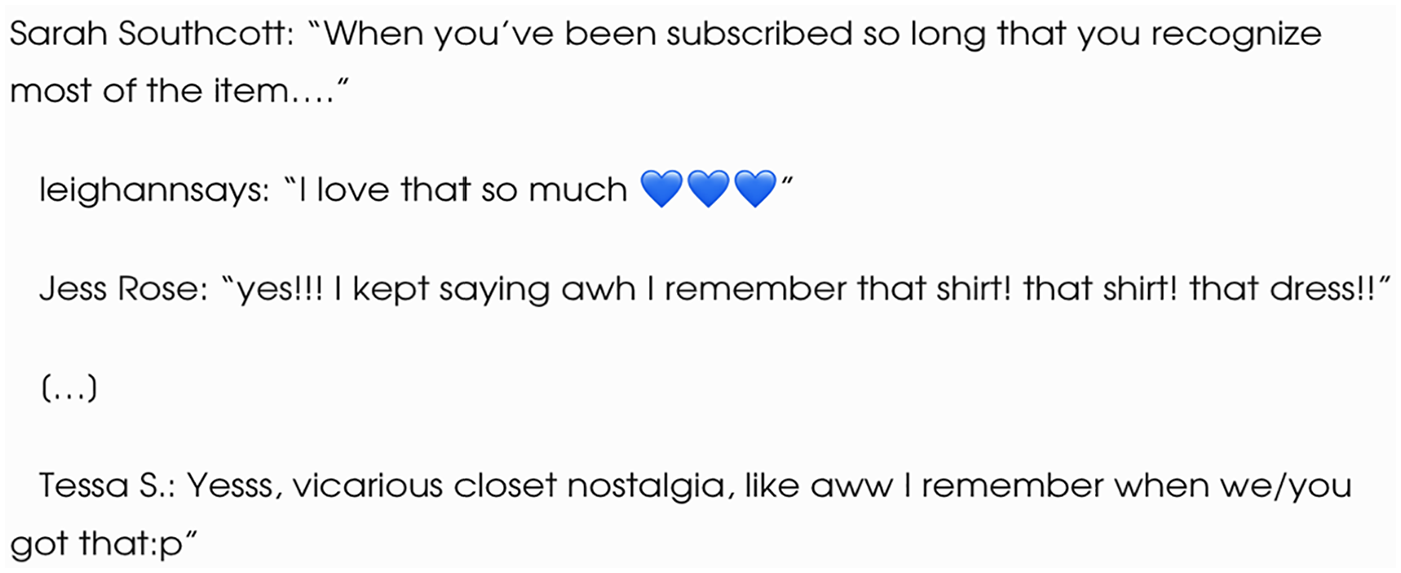
Sample comments under Leighannsays’ video
In a sense, material objects in the closet and the typically domestic work of tidying them up perform and elicit relational labor from both creators and followers. Discarding unwanted pieces and reorganizing kept pieces on video visually solidify a material and affective transformation that is fundamentally enabled by the mundane yet challenging physical and emotional labor of housework. While aspects of housework are captured and made visible, the sheer presence/visibility of domestic labor does not necessarily reveal the labor condition. I contend that the disembodied and hyper-performative interactions on social media platforms, the truncated audiovisual rendering of closet decluttering process, and the self-help emphasis on lifestyle aspirations all dematerialize the time-consuming, labor-intensive, and highly affective (im)material work of housekeeping.
While the appeal of Leighannsays’ video lies in its affective dimension, the affect operates and unfolds through the corporeal process of tidying up. The relational work of building communal connections via this video is grounded in the materiality of overflowing closets and the time-consuming physical/emotional work of managing material objects, home/closet space, self-imagery, and digital community. No closet decluttering video exists without the physical process of clearing out and reorganizing one’s wardrobe, but this dimension is often obfuscated by the videos’ tendency to center and estheticize affective operation. Although the materiality of decluttering is on the screen, affective rhetorical and corporeal performances guide attention away from the mundane physical work toward the more entertaining expressions of emotion.
The self-help discourse—home maintenance as pleasurable/rewarding if one’s inner and physical spaces are connected (Kondo 2014)—dematerializes and depoliticizes housework, deflecting from its identity as outrageously unwaged women’s work (Federici [1975] 2012). The neoliberal economy attracts people to do-it-all, including the doubly unwaged work of tidying up and producing decluttering videos. Further, this housework-as-self-help discourse builds on but is not self-aware of the racialized, classed histories of domestic work. In the American racial capitalism, legacies of slavery and immigration have fundamentally shaped understandings of women vis-à-vis workers. Black women and women of color have always worked more outside their homes as domestic workers. As Davis (1981) notes in Women, Race and Class, “housework is a fluid product of human history,” with its definition, values, function, and range being era/geography/status specific. While housework most commonly refers to the daily work routine of the middle-class/upper-middle-class housewife, most Black women post-emancipation worked as waged domestic labor for a white woman’s home and perform unwaged housework for their own household. The same goes with working-class and poor immigrant women of color who must work outside of their home as waged labor in domestic and other industries.
In the decluttering wave, the KonMari method has been popularized in place of outsourcing housework to waged domestic workers of color. Cleaning and organizing aspects of housework are undertaken by the unwaged housewife under the free guidance and/or paid consultation of celebrity tidying experts widely circulated in lifestyle media. The manual work of cleaning is framed as serving the personal pursuit of happiness. One needs to repeatedly exercise the process of physically holding a piece of clothing in one’s hands to gauge whether any bodily and/or emotional expressions of joy are elicited. Joy is also the ultimate post-declutter state of mind. The KonMari method and closet decluttering videos on YouTube magically make a new ideal self through the physical process of reassessing and reorganizing clothing items.
This disposal-centered process, however, also heavily relies on the outward transferal of housework, leaving a large proportion of the cleaning and sorting work to nontraditional domestic workers in public spheres. The rest of this essay illustrates the nesting of un/paid home-based work that includes housekeeping, content creation, and independent secondhand retail along with waged labor performed by sanitation workers and thrift store workers. Closet decluttering videos offer a way into conversations of social reproduction theory, a Marxist feminist methodology that integratively theorizes labor in both public and private spheres to “interrogate the complex network of social processes and human relations that produces the condition of existence” (Bhattacharya 2017, 2). The next two sections show how vernacular media objects can illuminate layered operations of the influencer ecosystem drawing from labor and resources across sectorial and spatial boundaries.
Managing Closet, Content, and Self
For fashion influencers, wardrobe equals work storage. However, an overstuffed closet, like any overloaded system, yields prolonged retrieval times and missing data. A closet decluttering enables a reassessment and reorganization of their material knowledge and storage. The process of home management, of “assessing” and “putting your house in order” (Kondo 2014, 64), resembles languages of information management. Influencers can discard the unwanted and recast what remains for optimal productivity. This section extends discussions of tidying labor beyond housework, as wardrobes straddle home/office spaces for fashion influencers while closet decluttering videos integrate management of closet/content/self. Production of wardrobe clear-out content mobilizes the (im)material process of sorting, cleaning, and filing clothing items in one’s home, plus the (im)material work related to content production through steps of pre-production planning, content filming, video editing, social media posting and engagement.
Fashion/lifestyle influencers regard their closet as an active home- and work-space for the presentation and transformation of self. Closet declutter physically transforms this space with index, knowledge, and memory of the past and an aspirational logic of the future (Makovicky 2007; Mattern 2017). Physical wardrobes and digital platforms function as archives of memory and aspiration, this compound temporality extending through creators’ expressions of taste/self through the management of closets/social media. A closet archives and expresses personal tastes as shaped by one’s social class and aspirations (Bourdieu [1979] 1984). Content creation (including self-fashioning, making videos, editing photos, writing captions, and blog pieces) enhances personal taste to maximize cultural status and monetary value (Pham 2015, 5). Closet decluttering videos mobilize various modes of taste work like the vocalization of aspirational lifestyle, disposal of unfitted and unwanted items, and visualization of one’s transformation. They document and catalyze the continuous process of regulating and expressing selves via the planned management of one’s possessions and spaces.
Trained as a film student at UCLA, Bestdressed (Scenario 2) adopts an auteur-like approach toward her social media content creation. Currently boasting the most viewed closet decluttering videos on YouTube, Bestdressed’s video has unusually high production values for this usually imperfect, less-polished genre. The video presents a one-woman show that weaves together a single-cam TV comedy with self-help lifestyle talk show and outfit try-on demonstration. Bestdressed treats this closet decluttering video like any other content, consistent with her overall artistic vision in filmic esthetics and self-deprecating humor. She does not shy away from stylized edits that could be considered inauthentic. Rather, her stylistic devices enhance her self-expression. If the camera documents her corporeal and vocal self-performance, she uses mise-en-scene and editing techniques to highlight/enhance certain qualities of herself.
Bestdressed’s video speaks to a kind of work-life integration/regulation that mobilizes the layered home-based managing labor. After a brief title sequence, Bestdressed (2019a, 00:07) addresses her audience, standing right in front of her closet: “So I have this running joke when people come to my apartment that I literally live in a gigantic pile of clothes.” A quick montage follows her posing with a wardrobe full of clothes, a section of floor covered in shoes, a portable clothing rack of jackets, under-bed storage with overflowing sweaters, a bedside cabinet of intimate wear, and an office desk filled with clothes. She justifies this massive cleanout in a series of point-of-view shots that each intentionally center different clutters of clothes. The fast-paced montage cuts across visuals of mess and clutter, as the narration reiterates what we are seeing: “clothes on the floor, clothes that I need to fold, clothes that I need to wash, clothes that I need to put back in their space in the closet, clothes that I need to hang up” (01:07). The shots induce physical and mental overwhelm in the visualization of work to be done. This cinematic call-to-action reflects Kondo’s argument for inner-outer connection, and how bettering one’s surroundings betters oneself. Bestdressed clears out more living space, reorganizes her closets with only useful and joyful items, and feels a corresponding change of mindset. She also generates hours of audiovisual footage for content (this section) and piles of clothes for her independent secondhand retail business (next section).
Management/maintenance work form a large part of content creation, which involves moving back-and-forth across planning and development, staging, filming, editing, and audience interaction. Bestdressed takes on multiple production roles, including performance, producing, script development, directing, cinematography, and editing. She also performs many feminized and racialized forms of production, clerical, and service work—set and prop, makeup and hair, costume, publicity, development, scheduling, and cleaning. Any creator must take on a wide range of physically and mentally demanding roles, whether they are considered creative or rote, central or peripheral. Through a massive amount of embodied work, Bestdressed continues constructing and regulating her style/image/brand/self via the production of audiovisual and written content. She carefully crafts the video’s style and relatability through the camera work, mise-en-scene, editing, sound, narratives, and word choices. This section thus centers backstage work and tactic labor (Abidin 2016; Goffman 1956), under-visibilized work that appears as effortless in digital content production. Borrowing from Taylor (2018)’s map of layered livestream productions and Johnson’s (2021) typology of “off-camera labor,” I assert that closet decluttering video productions involve layered off-camera work performed by fashion lifestyle influencers concerning esthetic construction (personal styles, wardrobe esthetics, and photo/video visuals), relationship building and maintenance (with followers, collaborators, brands, and sponsors), and mundane managerial tasks (self, closet, content, home, and waste).
Engaging her viewers in the comment section, Bestdressed discloses that she sorted through five hours of messy footage to produce this tightly edited, eighteen-minute decluttering video. That “messy footage” represents five or more hours of (im)material performance, whether she is talking through, trying on, or posing for pieces. This labor does not include the countless hours in pre- and post-production, taking Instagram photos (Bestdressed 2018a), editing photos and planning for her Instagram feed (Bestdressed 2019b), and editing YouTube videos (Bestdressed 2018b). The steps in content creation are highly time- and resource-intensive, and thus, workflow efficiency is extremely important. Filming a closet decluttering video requires coordinating the process of filming with that of decluttering. There is the taxing process of planning an extensive wardrobe cleanout: what the criteria are, what the goals are, where to start, how to proceed, what to do with the decluttered. An efficient filming process demands planning: crafting a script, identifying main shooting locations, creating a storyboard with key stylistic elements, setting a filming schedule, making a shot list, and scheduling voice-over recording, etc. Creating a short closet decluttering video mobilizes complex planned organization of both physical and virtual data starting in the stage of pre-production.
If the filming process documents Bestdressed’s embodied performance of closet decluttering, the postproduction editing process materially realizes her creative visions through manipulating recorded footage. Bestdressed’s how-to video on editing (Bestdressed 2018b) describes a pared-down version of her steps, which include examining all the footage and compiling a rough cut (which, in her words, “takes fucking forever”), listening to possible music on SoundCloud for audio background, making a backup file with all these pre-selected data saved (so that she would not need go back to the unsorted pile of raw files as she continues editing), syncing imageries with music and voice-over, adding visual effects to “spice up the video,” color correcting, and cutting the introduction/title sequence. She discloses that the making of the title sequence—putting together an overview clip with a few highlights from the already edited body of the video and adding a designed title to it—took around an hour. One can only guess that the previous steps of organizing and perfecting the content would each take longer than that, yielding at least ten hours spent on editing, and at least fifteen hours on filming and editing this eighteen-minute-long closet declutter video.
After which, she must take care of the management and publicity of her content/self: uploading the video, crafting a video description and publicity materials, and engaging with viewers on YouTube and other platforms. This work relates to the (im)material labor previously discussed concerning the building of connections and intimacies. In this case, the often-considered immaterial relational labor concretely involves additional (im)material work. To fulfill the request from viewers wishing for more footage of her decisions regarding each piece of clothing item (Figure 2), Bestdressed reworks a new version of the video on her second channel Bestmess. The comment posted by Sophia M focuses on an emerging sad affect as she views the time-lapse footage, elicited by an absence of the more intimate interaction afforded by extended talking clips. Yet such sentiment of sadness significantly dissipates in the thread, with followers translating their affects and desires into demands for a “director’s cut” with “no time lapse” that is an “unedited [. . .] long ass video” for the Bestmess channel. The seventeen-minute-long bonus video (Bestmess 2019) consists of more footage that was fast-forwarded in the original video; it is also a compromise, significantly shorter than what the enthusiastic followers were requesting. How Bestdressed manages closet/content/self demonstrates she routinely constructs the (in)visibility within labor as an A-list influencer via her decisions on what is and is not seen by the public (Poster et al. 2016). Such rendering is the under-discussed (im)material work of data management, content production, and the digital self/brand. This section addresses how closet decluttering content creation relies on home-based data hygiene work, necessitating the management of private material and cultural data (physical wardrobe items and digital content materials) and shaping them into public content and digital selves. The subsequent section further extends outside of the home, considering how the domestic genre of closet decluttering mobilizes nested labor in sectors under-discussed vis-à-vis influencer media and platform work.
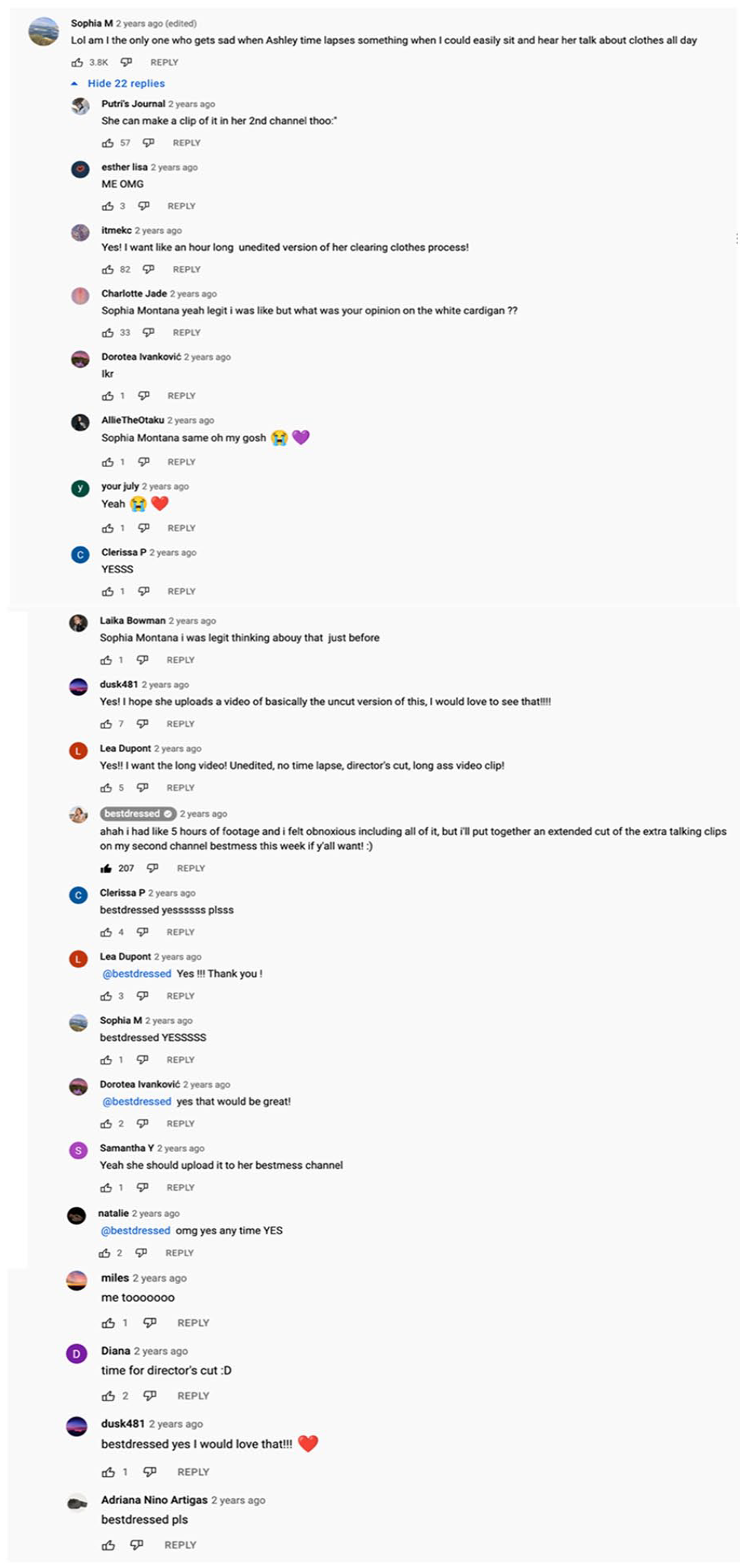
Requests in the comment section of Bestdressed’s video.
Managing Waste In and Outside of the Home
Wardrobe declutter, as an act of sorting, actively creates trash. As Strasser (2000) states, “sorting and classification have a spatial dimension: this goes here, that goes there. Nontrash belongs in the house; trash goes outside.” Insofar as “home” maintenance, online or off, requires an output of garbage, the waste is transferred to service workers to be recycled as goods and/or processed for disposal. Leighannsays’ video starts with footage of herself talking, focused against a blurred background, wherein we see piles and piles of clothes. It cuts to handheld phone footage that reveals purged items in “the donate piles.” Such piles, understood as the victory of the closet declutter process, will be offloaded to a local Goodwill. Kondo brands her onetime big declutter as repair work that will fix one’s problems by alleviating the social issues and familial tensions clutter represents. The self-help industry mobilizes domestic labor as a necessary component of living clutter-free and, hence, problem-free. It advocates discarding and disposing as essential to the repair and maintenance of one’s life. Leighannsays’ emphasis on the quantity of the donate piles resonates with how closet decluttering content often features a quantity of trash bags. Popular images of excess visualize the power of socioeconomic class differences; whether something counts as garbage depends on who’s counting. It is common to see trash bags full of perfectly good items that may be out-of-style or with which the owner is bored.
Waste management demands creativity and labor. It results from capitalism’s planned obsolescence that generates endless profits by mobilizing fast-paced disposals of owned goods and purchases of replacements (Strasser 2000). Kondo (2014) defends against throwaway by emphasizing the “need to [. . .] not be distracted by thoughts of being wasteful” (p. 41) and “the real waste is not discarding clothes you don’t like but wearing them even though you are striving to create the ideal space for your ideal lifestyle” (p. 70). Performative acts of gratitude, like thanking the clothes before throwing them out, mask and excuse convenient disposal, disregarding environmental consequences of irresponsible clothes dumps. Such mindfulness discourse offers a guilt-free path toward a better life by taking away one’s responsibility to this larger interdependent world. It instills unidirectional, extractivist thinking that encourages people to consider only how the keeping/disposal of objects can (im)materially serve themselves.
Closet/life tidying increases intense demand and workload for maintenance labor outside the domestic sphere, such as circular fashion labor and public waste management. Artist Mierle Ukeles (2021) describes the break in the boundary between home maintenance and that of the public space, collapsing the inside-outside cliché to elucidate maintenance work’s shared invisibility across these oppositions. My relational material approach toward closet decluttering videos adopts her three levels of maintenance (Ukeles 1969)—personal, societal, and planetary—to holistically re-envision what maintenance encompasses. The afterlives of the disposed need extra attention, and decluttering videos provide an entry into aspects of the influencer ecosystem or, as discard studies scholars (Liboiron 2014) suggest, the wider systems that enable, facilitate, and impact this popular cultural practice with a high yield of waste. Examining Bestdressed’s closet decluttering video in relation to her how-to video on selling clothes online draws out connections between the (im)material maintenance of one’s personal home, public spaces, and digital self/storefront. As a popular sustainable fashion influencer, Bestdressed performs a multitude of tidying labors; she collects, cleans, repairs, and resells in the circular fashion, a sustainable fashion practice that aims to maximize the life of a garment before reaching the end of its lifecycle to minimize unnecessary waste. How Leighannsays and Bestdressed manage their decluttered piles sheds light on waste management labor delegated to others in the former case or performed by oneself in the latter case. Both are required, yet often rendered invisible.
Waste management is work-intensive yet often in the background; workers take care of wastes offloaded to them by others. Thrift stores are well-known as sites that rebrand discarding as donating for the middle-class to get rid of their disposal conveniently and guilt-free. YouTube content created by thrift store workers (Aaliyah 2019; Porcelain 2018) disclose that the most physically demanding labor in secondhand retail—sorting, hanging, and tagging—occurs in the warehouse invisible to the customers, and further, the embodied manual labor of cleaning the sales floor and reorganizing racks is mostly ignored. Porcelain, a makeup influencer and a thrift store worker, recounts numerous instances wherein the thrift store receives donations of literal household trash (e.g., a handbag filled with food debris) that the donors fail to manage. Thrift store workers and public sanitation workers, hence, care for the afterlives of (un)resolved household waste. During Ukeles’ research-creation with the New York Sanitation Department in the 1970s, a male sanitation worker once stated: “Do you know why people hate us? They think we are their mother. They think we are their maid. I can’t pick up after 100,000 people.” The quote captures the naturalized bias that women, paid or unpaid, should manage the interior home and deserve to be disrespected. It attests to how maintenance work in and outside of home is feminized, and thereby disregarded by the society.
Bestdressed released a sequel to her closet decluttering video, demonstrating how she sells the decluttered half of her closet and manages her online secondhand store (Bestdressed 2019c). Her huge closet declutter performs the preparatory work to generate secondhand merchandise. By selling decluttered items online, Bestdressed takes on the work of waste management and prevention to find a new home for each piece of decluttered clothing still in good condition. She thereby presents a way of handling decluttered “waste” that requires significantly more work than just discarding it all at a charity store or dumpster. This paratext presents decluttering labor as listing labor, “the taste and responsibilities of selling,” in the digital secondhand economy (Kneese and Palm 2020, 1). An essential step in this process is to capture and display the secondhand merchandise online. Bestdressed translates pre-owned physical items into visual and written information to convince customers of their value. She models and photographs each article to include varying details and angles. Thorough descriptions are crafted to account for the item’s condition, relevant tales, and styling potentials. Bestdressed develops a system of sorting/pairing to maximize the efficiency of the very time-and-labor-intensive photoshoot. She models/photographs items by category to minimize outfit changes and adjustments of the camera. She also sorts dresses by length to minimize the need to move the camera and reframe. The photoshoot alone takes a day, even with this efficient workflow. Next comes listing and cataloguing. Bestdress imports all the photos into her computer, uploads three to five photos per items onto the retail platform, comes up with titles and prices, and types up descriptions, which include the size, brand, condition, flaws, quirks, and, sometimes, styling tips or what types of event this item would fit.
As an influencer and manager of a small independent e-boutique, Bestdressed promotes and manages her relevant declutter, thrift, and resell activities on social media as her digital storefront. She also coordinates “sales platforms and other logistical media to manage inventory, facilitate transactions, and arrange shipments” (Kneese and Palm 2020, 1). Bestdressed’s established influencer brand/community carries over to the publicity and popularity of her shop. All items are sold out within hours of being listed, but it takes Bestdressed a whole day to pack orders. She starts by weighing each item on a kitchen scale and creating the shipping label online using secondhand sales platforms’ in-app services such as Depop and Poshmark. With more than a hundred orders to ship, Bestdressed opts for Shipstation, a subscription-based logistical service integrated with her Squarespace-powered storefront to generate shipping labels, saving her from the work of manually entering a large quantity of shipping addresses. After printing out all the shipping labels, she handwrites a brief thank you note on the invoice for each customer, continuing the (im)material relational labor of strengthening connections and intimacies. She then packs items into empty envelopes and boxes and, subsequently, attaches each shipping label to its correlating package. Lastly, Bestdressed loads these hundred-plus packages to her car and drops them off at a post office.
Listing labor, as demonstrated in Bestdressed’s video on online retail labor, is mundane, (im)material work that is foundational to managing the decluttered as secondhand circular fashion. Digital platform listing labor is as embodied as traditional retail work, “always performed by workers situated offline, while on the bus and in line at the post office as well as in more formal worksites” (Kneese and Palm 2020, 3). Featuring a large quantity of decluttered clothes, shipping labels, and items packed in shipping supplies, the video exemplifies what Kneese (2021, 4) refers to as “logistics fetishism.” Bestdressed’s online retail how-to video reveals the success of her business while making visible often-hidden (im)material labor and resource-intensive processes essential to the operation of online retail and digital platform economies. Paratexts of the two scenarios shed lights on the obfuscated labor of managing the afterlives of the disposed in and outside of home, online and off. The framework of an influencer ecosystem invites us to ask: What does influencer work encompass? Who are and can be considered influencer economy workers? What kinds of work are rendered invisible? Closet decluttering videos may not give us the direct answer, but they leave clues about the disregarded.
Conclusion
This essay challenges binary categorizations of material-versus-immaterial labor and private-versus-public spaces by foregrounding three interconnected forms of tidying labor in closet decluttering videos: management of home, content, and waste. I dissect layers of digital (im)material labor as tidying labor essential to the production of closet decluttering videos to propose an inquiry that considers materiality and relationality of vernacular media objects. Influencer media texts matter contextually, offering insights into the seemingly seamless operation and effortless maintenance of the influencer ecosystem. This article unveils some relational-material entanglements embedded in and enabling closet decluttering videos that may not be self-evidently connected but are all operating under the same field of labor.
I highlight how lifestyle media, like closet decluttering videos, depends on, dematerializes, and capitalizes the highly corporeal and affective (im)material aspects of housework and relational work in constructing and maintaining the digital self. Housekeeping and content creation in this article are both home-based work that also mobilize labor and infrastructure exterior to one’s home. The network of labor and/as infrastructure mobilized by the examined case studies is not comprehensive. These required labor types do break through the typical confinement of influencers in between brands and audience. While influencer production is tightly linked to self-branding and third-party advertising, a consideration of the different axes involved in closet decluttering content sheds lights on nested (im)material tidying labor across sectors. Future research can further employ the framework of an influencer ecosystem—a mode of inter-medial and inter-sectorial interrogation that situates the influencer media objects of study in relation to varying socio-techno-industrial networks—to make legible imbricated processes of modularity and dematerialization often omitted in discussions of digital culture and economy.
Footnotes
Declaration of Conflicting Interests
The author declared no potential conflicts of interest with respect to the research, authorship, and/or publication of this article.
Funding
The author received no financial support for the research, authorship, and/or publication of this article.
