



Abstract
Drawing on in-depth interviews, this study examines how students engage with awkwardness in television comedies. The article contributes to studies of awkwardness, its configuration in popular culture, and audiences’ response to awkward-comic texts. Our findings show typical sequences and resources for producing awkward scenes. Participants tend to evaluate awkward scenes in terms of ‘realism’, i.e., whether they could relate the scene to their personal lives and/or imagine themselves in that situation. Furthermore, awkward sequences and feelings of awkwardness from the characters increases the evaluation of scenes as realistic. Finally, in line with Kotsko’s (2010) characterisation of awkwardness as a social feeling, awkwardness spreads from the television screen when participants perceive if the character is feeling awkward or imagine themselves feeling awkward in that situation.
Introduction
According to cultural critic Kotsko (2010), awkwardness is an intrinsic social feeling or mood. Whereas many other emotions (anxiety or boredom) isolate the individual, awkwardness spreads with the breakdown of a social norm that usually helps us to navigate a situation (Clegg, 2012; Kotsko, 2010). For Kotsko, we are living in an age of cultural awkwardness, a general malaise of traditional social norms that guides our behaviour in work, family, or social life. The Covid-19 pandemic has seen new awkward situations emerge (Berkers and Wijngaarden, 2024), such as coughing in an elevator, or the nightmare of leaving your microphone on by accident in a Zoom meeting.
Clegg (2012) notes that there is a common assumption that awkward situations are problematic instances, since they mark a social rupture accompanied by feelings of tension, anxiety or even panic that lead people to try to transform the situation. Nevertheless, several critically acclaimed television shows such The Office (2005-13), Curb Your Enthusiasm (2000-present), Sex Education (2019-present), and Fleabag (2016-19) actively inquire into the disruption of social norms (i.e., the awkwardness) in diverse cultural settings such as workplaces, dating, or cross-cultural interactions. The prevalence of awkwardness in popular culture leads Kotsko to argue that it ‘dominates entertainment to such an extent that it’s becoming increasingly difficult to remember laughing at anything other than cringe-inducing scenes of social discomfort’ (2010: 1). For example, Nielsen (2021) ranked The Office (US) as the most streamed content of 2020 in the United States, with over 57 billion minutes streamed. Similarly, in 2021, the season three premiere of Sex Education reached the top charts of Netflix, also especially among young viewers (Tassi, 2021). In other words, awkwardness sells.
Although people tend to avoid awkwardness in everyday interactions (Clegg, 2012), these ‘awkward’ television series have proven to be highly successful among young people, who, according to Kotsko (2010: 2), have a ‘hard-won expertise in the topic, with their simple exclamation: “Awkward!”’ This article explores how young people engage and relate to awkwardness in television comedies. Drawing on eleven in-depth interviews, we study the opinions, feelings, and boundaries of awkwardness and awkward situations, by showing respondents short clips from ‘awkward’ television series. We examine when and how a social situation becomes awkward in comedy shows, and how respondents evaluate awkward comedies as well as what feelings they invoke.
The aims of the research are twofold. First, it contributes to studies of awkwardness and its configuration in popular culture. In this sense, it builds upon previous research on the cultural theory of awkwardness (Kotsko, 2010) and the study of awkward experiences (Clegg, 2012) by investigating how young people relate to awkwardness in TV shows. Second, it builds upon studies of television comedy, and audiences’ responses to comedy texts (Bore, 2009, 2011; Fouts and Burggraf, 2000) to explore, with in-depth interviews, the processes of meaning-making and engagement of audiences with several scenes from awkward TV comedies. By studying audience reception, the article adds to recent literature on awkward television comedies which have mainly focused on issues of representation (Reeser, 2017; Sobande, 2019; Tinker, 2009).
The experience of awkwardness
Research by Kotsko (2010) and Clegg (2012) shows that awkwardness is inherent to social interactions, a warning sign of something going in the wrong direction (and that ‘something’ having a social character), while redirecting the attention of participants towards its remediation. As Clegg mentions, ‘the ability to feel and behave in a socially awkward manner is essential to effective, or what some participants called “smooth,” social interactions’ (2012: 273). Participants in this study mentioned regularly experiencing awkward situations where they do not know how to behave in a social situation or interaction almost: ‘It is something that I say in my head so often. Like if I’m biking, and something happens like an interaction, in my mind I’m like “awkward!”. I say that very often, like “awkward!” but… yeah, I don’t think it’s bad to be awkward’ (Participant #4, 21, female, South African). In his phenomenological study of awkwardness, Clegg identifies some situations as more inherently awkward than others, such as going on a first date. He outlines an ideal-typical pattern for socially awkward situations, as follows: first, after feeling a sense of moral or social transgression that becomes explicit, participants find themselves in an awkward situation that intensifies the social experience with a focus on social behaviours. He gives examples such as the experience of a participant in a debate where a young woman lost control of her bodily functions in front of the crowd and, suddenly, the casual atmosphere of the event transformed into intense and focused social attention on her, with a described ‘tension in the air’ (Clegg, 2012: 268). Second, awkwardness is expanded through several actions or cues such as expressing anxiety, discomfort, tension, hesitancy, disjointedness, or avoidance. Third, after the awkward experience, participants usually try to resolve or transform the situation either through blocking it (for example, by avoiding eye contact or pretending to have a phone call) or by acknowledging it (for example, by making a joke about it). While trying to block the awkwardness can enforce the very awkward feelings being avoided, exposing the awkward situation can make the social interaction more stable and focused on social harmony (Clegg, 2012; Kotsko, 2010).
Kotsko (2010) identifies three distinct types of awkwardness. First, there is the everyday awkwardness that originates from an awkward individual who violates an established social norm; this is a type of embodied awkwardness that some individuals seem to carry. However, although such awkwardness stems from an individual, it is still inherently a social phenomenon since the entire social situation ‘spreads’ awkwardness. The second type, cultural awkwardness, comes from the disturbance of a social norm. It originates from a general situation, such as running into co-workers in an out-of-office or personal environment. Lastly, radical awkwardness is related to the ‘panic brought on by the lack of any norm at all’ (Kotsko, 2010: 17). This is usually the case with the confrontation of two different sets of social norms, such as inter-cultural encounters.
Awkwardness can be configured on the TV screen. Even as spectators, audiences can feel the anxiety, discomfort, tension or embarrassment of a scene that is ‘too awkward to watch’. This paper builds on Kotsko’s (2010) and Clegg’s (2012) studies on awkwardness to explore how young people relate to popular awkward TV comedies.
Comedy TV
In the last decades, TV sitcoms such as Friends (1994-04) or The Simpsons (1989 - present), have travelled the world through popular culture with incredibly high reception and popularity. Moreover, the Internet has enabled unprecedented possibilities to create and access globally distributed humour. Previous studies have shown how Internet-based humour can act as an agent of globalization formulating a global humorous sphere (Shifman, 2007; Shifman et al., 2014; Laineste and Voolaid, 2016). Even though the senses and particularities of humour are extremely specific to the local, as comedy and TV scholar Brett Mills argues in his book Television Sitcom (2005), programmes such as Friends probe a ‘global’ comic common ground; or, considering current TV comedies, a ‘global’ awkward common ground.
Genres serve as conventions that facilitate and guide the production and reception of TV shows. Even though the genre changes through time, sitcoms have a structure and content that are easily recognized by the industry and the audiences (Bielby and Bielby, 1994). Sitcoms have been defined through their characteristic trespassing and transgressing of social boundaries (Mills, 2005: 7). Traditionally, TV sitcoms have been also classified by their narrative structure possessing a comic intention or mode (Mills, 2005). The comic tone can be signalled via certain cues such as canned laughter, star personas, and opening titles, as well as jokes, comic situations, or performances that are normal for TV comedy texts (in Bore, 2017; Mills, 2004). Nevertheless, in the last decades, many sitcoms have abandoned some of these traditional markers of the genre by using formats and characteristics of other genres such as the usage of documentary and naturalistic style (Mills, 2004). With shows such as the British original The Office (2001-03) or Curb Your Enthusiasm, comedians like Sacha Baron Cohen and directors such as Judd Apatow (Kotsko, 2010), awkward or cringe comedy is now sometimes deemed a subgenre (Logan, 2018) with drastically different aesthetic and functional apparatus. In this regard, Duncan (2017) claims that awkward comedy has an ambiguous form of comic judgement which finds fulfilment not only by the laughter but by a demanding and stressful previous awkward feeling by the audience; characterised by a socially-oriented unease or mood, as opposed to, for example, feeling embarrassed which is more incident-orientated.
Moreover, the issue of representation in TV comedy and, more specifically, awkward TV comedies has been researched by numerous scholars. The field of media studies and popular culture has investigated how individuals, groups, and situations are (re)presented to mass audiences using easy and normalised social conventions and stereotypes – including LGBTQ representation in mainstream TV from the US (Monaghan, 2021); the stereotypical representation of gay people in Chilean telenovelas (Ramírez, 2020); female representation in Netflix originals across British, American and International series (Pietaryte and Suzina, 2023); Latino communities representation in American TV (Higueras-Ruiz et al., 2021), among many others. A predominance of research on representation is also seen in studies of awkward sitcoms. Cultural studies scholars have used critical discourse analysis to study awkward TV shows as postmodern representations of the crisis going on in the workplace in a post-Fordist culture, such as in the British original and US versions of The Office (Brabazon, 2005; Tinker, 2009); in cultural dissonance and intercultural relations in, for example, the mockumentary Borat (2006), co-created by the comedian and actor Sasha Baron Cohen (Karthauser, 2016), or the series Curb Your Enthusiasm (Kotsko); and crisis in masculinity, such as in the series Louie (2010-5) and the British version of The Office (Brabazon, 2005; Reeser, 2017). As in Kotsko’s (2010) characterisation of awkwardness as a violation of social norms, these studies analyse how TV comedies represent the breakdown of traditional norms (e.g., gender and masculinity), institutions (e.g., work offices) and ways of being in different settings. This breakdown of social norms generates an environment conducive to awkwardness. Yet, these representation studies tell us little about how audiences make sense of awkward TV. Hence, we bring in audience studies.
The study of audiences
Media scholars have long been studying audiences’ interpretations of TV texts (Bore, 2009; Kuipers, 2006; Kaptan, 2021). Previous literature in the field of comedy TV audiences has tended to investigate comedy TV consumption in relation to class (Friedman, 2014; Kuipers, 2006), race and ethnicity (Jhally and Lewis, 1992), nationality (Bore, 2011), and political communities (Bradley, 2015). Research has also considered how people view and evaluate comedy TV shows. For example, Kuipers (2006) studies taste cultures and hierarchies underlying TV comedy viewing in the Netherlands. Using surveys and interviews, she identifies interpretative communities with specific knowledge, likes, and dislikes that are related to background characteristics such as education and age. In this sense, Kuipers studies both taste cultures and how these groups interpret TV sitcoms. Studies have also focused on how audiences interpret comedic representations (Cooper, 2003; Jhally and Lewis, 1992). In her study, Inger-Lise Kalviknes Bore (2009) investigated how TV viewers engage with the hybrid genre of The Office (UK). She found that the mockumentary is evaluated in terms of authenticity. Participants compared The Office to their daily lives and evaluated this aspect as a source of viewing pleasure or, quite the opposite, as a barrier to enjoying the sitcom. Another relevant study by the same author focuses on how viewers constructed gendered distinctions in TV comedy. Some participants agreed that female-leading shows have less interest for men by qualifying them as ‘female comedy’, and even, in some cases, positioning them as less salient series (Bore, 2010). This study, then, expands the field by focusing on audiences’ responses to awkward comedy texts, that is, by focusing on the viewers’ engagement and meaning-making process of highly popular awkward television comedies.
Data and methods
Since our goal is to understand the reactions of individuals with awkward situations in TV shows, this study took a qualitative approach, drawing on in-depth, semi-structured interviews of 45–60 min with 11 students. Our sample is not intended to be representative of all young people; the study presents an initial exploration of the response of young students living in The Netherlands to awkward texts. To achieve consistency in our sample, we decided to take university students as a subgroup given that Dutch university campuses typically attract a diverse population of young people from various backgrounds and cultures. This diversity can provide a broader representation of young individuals compared to a narrower subgroup.
The first interviewees were contacted at the home institution of the researchers. All interviews were conducted by Iván Kirschbaum. By having a student interviewing other students, we aimed to limit power imbalances, and better connect to the everyday experiences of our respondents. Afterwards, a snowball sampling method was used where each participant recommended another interviewee. Our sample comprises students ranging from 18 to 27 years old, with six and five participants who identified as male and female, respectively. Participants study in various international programmes, including Sociology, Media Studies, Psychology and Business. Three participants were Dutch, two participants originally came from Germany, one each from China, Luxembourg, Mexico, Nigeria, South Africa and Turkey. Although our interviewees were from diverse backgrounds, cross-cultural and cross-national differences in the reception of awkwardness are beyond the scope of this study. Moreover, as Kotsko (2010) states, awkwardness has been prominent in global TV entertainment since the 2000s. Hence, this research focuses on young people who were raised during the awkward boom of shows and comedians.
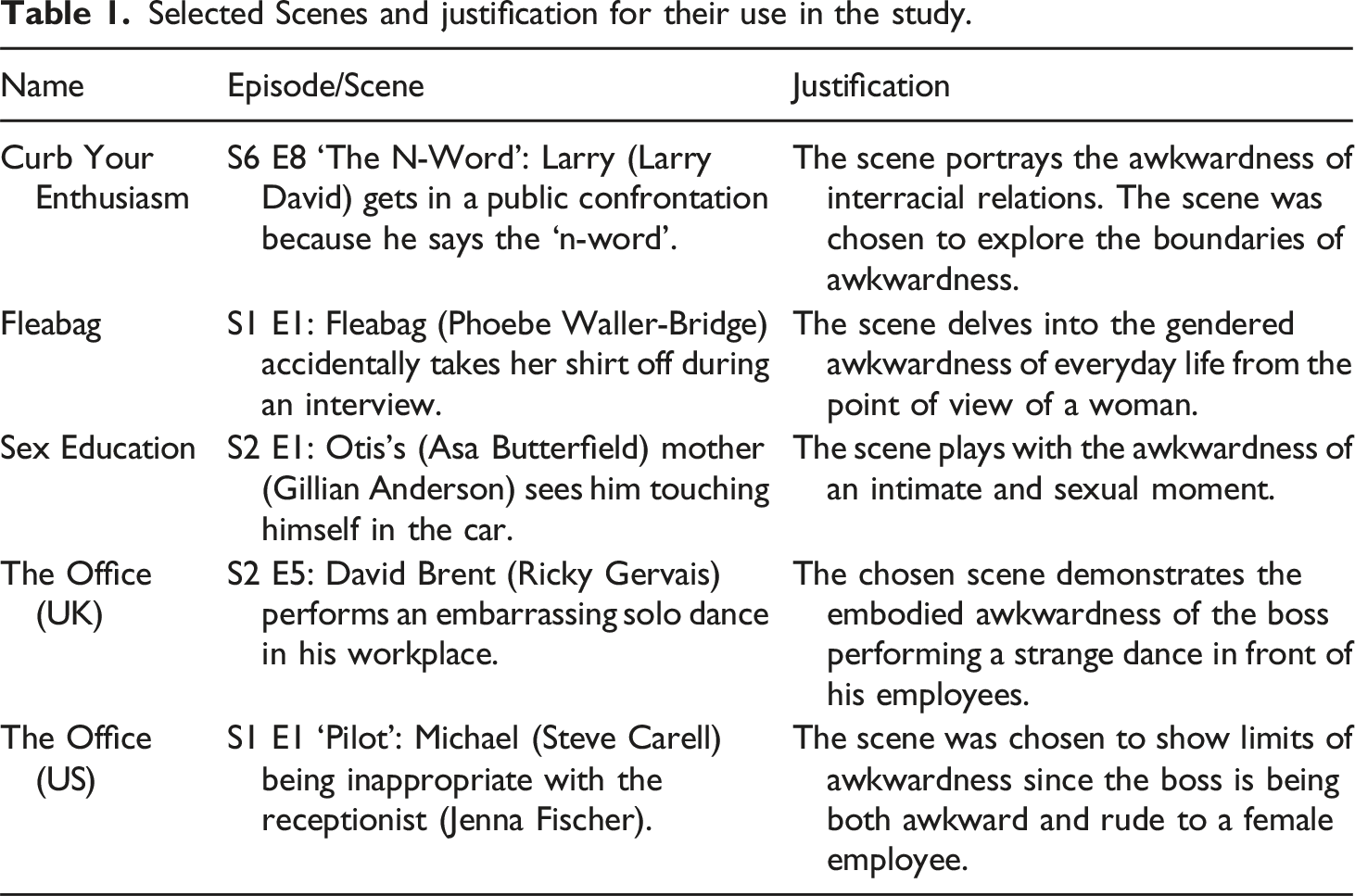
Selected Scenes and justification for their use in the study.
Content analysis was carried out on the transcripts from the interviews. Qualitative content analysis systematically reduces and describes selected patterns of meanings of the qualitative data (Schreier, 2014); in our case, the transcriptions from the interviews. At the heart of the method is the coding frame that the researcher uses to approach the data (Schreier, 2014). In our case, the coding frame was primarily concept-driven, meaning that we approached the data with some categories based on our interview questions such as the participant's opinion on the scene, and their justification for it, as well as the feelings evoked by the scene, their relation to the awkwardness, and whether he or she finds it funny. Nevertheless, the possibility of having some data-driven categories that may emerge from the data itself was open.
The chosen shows are critically acclaimed and English-language TV comedies from the UK and the US characterised by an awkward tone, as a result of the researchers characterisation and desktop research. Each show represents awkwardness in different scenarios and topics such as gender and dating (Fleabag), work (The Office), sex (Sex Education), and inter-cultural relations (Curb Your Enthusiasm). The selected scenes require no previous knowledge of the TV show since the awkward sequence is fully developed within the scene. Nevertheless, participants were asked if they had previously watched the show and their opinions about it. If participants didn’t know the show, a short synopsis was provided by the researcher. Nevertheless, all of the participants had previously watched at least one of the shows and more than half of the participants had previously watched at least three out of the five shows before.
Even though women have been marginalised from TV humour and comedy (Bore, 2010; Mills, 2005), in the last decades there has been an increase in female-leading humorous and awkward TV series such as Girls (2012-7), Fleabag, Insecure (2016-21), among others. Hence, we also included a scene from Fleabag that foregrounds a woman’s point of view. Also, to achieve a certain diversity in the scenes, some older TV series were chosen such as Curb Your Enthusiasm or The Office (UK), and some more recently produced, such as Sex Education.
Results
Our participants’ reported responses to awkward scenes from five different TV comedies follow a similar sequence to Clegg’s (2012) description of awkward experiences: an initial moral or social transgression that becomes explicit and leads to an intensified focus of the participants on a social act or behaviour, and an expansion of the awkward feeling through the characters' reaction to the transgressive act. Following Clegg, the scenes also represent inherently awkward places and situations such as dating, cross-cultural relations, sex, and workplace relations.
The first step is the appearance of a social or moral transgression that becomes explicit and directs the attention of the participants to a particular behaviour (Clegg, 2012). In our chosen scenes, this usually happens when one of the main characters does or says something considered socially wrong, often unintentionally sometimes in a context prompt to awkwardness such as in an office, a public space, an interview, or a date. According to Clegg (2012), awkwardness may seem inevitable in some situations, almost inherent, such as meeting the parents of a partner. For example, in the scene from Fleabag, the main character is having a formal interview with a man to get a loan for her business, a setting characterised by having established social norms and ways of conduct. During the interview, the character takes off her top thinking she has a shirt underneath, but she doesn’t, accidentally showing her bra. As Participant #4 (21, female, South African) mentioned, ‘Well… when she took her top. I think it is the kind of shock that makes you immediately uncomfortable. So probably then [awkwardness started]. And then it is just...more uncomfortable from then on.’ Following Kotsko (2010), even though awkwardness may be started by characters who seem to ‘carry awkwardness’ with them, it remains a social phenomenon since it involves social interactions and an awkward environment. Hence, analysis should focus on the whole social situation that makes awkwardness present.
In this sense, awkward sequences may rely more intensely on (i) an action or a character behaving awkwardly, such as Michael Scott in The Office (US), who some participants described as having a ‘cringe personality’; (ii) the interaction between the characters, for example with an awkward silence or misunderstanding; (iii) the reactions of the characters to the awkward situation, which can ease or enhance the awkwardness; or (iv) the situations which can prompt awkwardness, such as having a family member intrude unexpectedly during an intimate moment. For example, Participant #2 (24, female, Dutch): So, I guess the other scene [Fleabag] was more awkward as the interaction it's just not going smooth and this [Sex Education] is more awkward because I feel I'm watching a very intimate moment of someone.
displays the contrast between a scene where awkwardness relies more intensively on an interaction, and a scene that relies more on the situation. In this sense, in awkward TV shows, morally transgressive or taboo topics such as sexuality or masturbation can rely more intensely on the latency of awkwardness in the situation itself. Sexuality is a common theme in Sex Education, and participants who had watched it before mentioned the fact that it deals with awkward situations. As Participant #2 (24, female, Dutch) stated: ‘with Sex Education, they’re just normal people put into awkward situations.’ In contrast, when talking about shows such as The Office (UK and US version), participants emphasised more the awkward personality of the main character (David Brent and Michal Scott, respectively).
A transgression alone does not create an awkward situation. According to Clegg (2012), once a social or moral transgression becomes explicit and it directs people’s attention to a particular behaviour, awkwardness is expanded through anxious, disjointed, hesitant, dissociative, avoidant or distancing expressions. As one interviewee put it ‘awkwardness is contagious, like if there is one awkward person, then everyone starts feeling awkward’ (Participant #4, 21, female, South African). Similarly, participants mentioned the character’s uncomfortable reaction to the transgressive situation or action as a crucial part of the awkward sequence, and as increasing the awkwardness of the atmosphere. Participants discussed several techniques for creating or prolonging tension, such as creating long silences or having extended shots of characters’ expressions of discomfort, nervous laughs, and disjoint from the situation, among others: Participant #4: These kinds of shows wouldn't be funny if you'd saw their facial expressions for two seconds. You must go for an entire minute, having everyone lengthening out the dance [reference to the scene of The Office (UK)]. Because you know it builds up the tension and that is what kind of what makes it uncomfortable or funny.
Or, Participant #10 (22, male, German): They have this comedy like...getting slower and slower... and then it just completely feeding out of the situation.
Experiencing time getting slower is a characteristic of awkward experiences (Clegg, 2012).
Another characteristic mentioned by participants is the possibility to experience the tension of the situation: Participant #8 (27, male, Mexican): I kind of felt the tension between the two characters after this accident happened [referring to the scene from Fleabag]. But I feel that it adds to the funny part of the situation. It builds up on that.
All parties in the scene will not necessarily be aware of the awkward tension. For example, in both scenes from The Office, the main character begins the transgression by saying something inappropriate or performing a dance without being aware of the awkward atmosphere. In these cases, the expressions of awkwardness happen with the counterparty, which could be a single person or a group. Four participants brought up relating to these situations to watching someone do or say something embarrassing without being aware of it.
Feelings from participants during these situations sometimes include vicarious embarrassment or pity for seeing someone do something he or she is not aware of. As well, the gaze of the other(s) plays an important function in creating a tense atmosphere: Participant #4 (21, female, South African): maybe if people weren't looking, then it wouldn't be such a dramatic, loud, situation happening.
Then, as Clegg (2012) and Kotsko (2010) claim, people will try to resolve the awkwardness by either confronting it (which helps to ease the awkwardness) or by ignoring it (which usually adds up). Similarly, participants mentioned their imperative desire for the characters of the scene to resolve the awkwardness. Here, the focus changes from the expansion of awkwardness throughout the social space to the characters’ ways of dealing with that awkwardness. Some TV scenes opt for an avoidant strategy where at least one of the characters is not collaborating in ‘easing’ the awkwardness. For example, in the scene from The Office (UK) where David performs a bad dance, the employees start to show signals of disjointed and uncomfortable reactions, adding to the awkwardness, instead of easing it. As Participant #2 (24, female, Dutch) said, ‘It’s like “come on guys, just act normal!”’.
Interviewees described these moments as having a ‘frozen atmosphere’ where the characters are stuck in an uncomfortable or awkward situation: Participant #4 (21, female, South African): Yeah, laughing... that usually just allows things to move by quickly but when people are serious, then everyone in the room feels serious and they are all like “ooh” [says uncomfortably] and then you are stuck.
Following Clegg (2012), the ability to act through awkwardness is essential for having ‘smooth’ transactions. For example, depicting a relaxed reaction or directing the awkwardness with humour helps the sequence to resolve and, in the words of the participants, ‘move on’. Participant #6 (27, female, Turkish): Maybe an element of awkwardness that TV shows try to create... is that silence... like when someone is speechless. They don't know what to say and they are both sitting like... that is kind of weird and you don't really know how to react.
As Participant #6 notes, awkward TV sequences rely on leaving the awkwardness unresolved, amplifying awkward feelings and displaying the uncertainty of the characters of not knowing how to behave in the situation. However, participants engaged with these scenes in different ways. The next section will analyse how viewers relate to and evaluate awkward TV scenes and shows.
Reception of awkward TV shows
Mostly, participants quickly distinguished the scenes as a type of comedy characterised by an awkward tone. After watching the TV scenes, participants usually evaluate them in terms of realism, whether the situation could happen in real life or even in their daily lives. As mentioned by Participant #6 (27, female, Turkish): Sitcoms are based on these uncomfortable moments that happen to everyone, but we usually kind of ignore it. And sitcoms or comedies take those moments to make you laugh at them because they're funny, in a way.
Similarly, Bore (2009) finds that viewers of The Office partly evaluated the show in terms of authenticity, comparing the scenes of the show to their daily lives or the reported lives of people around them. For example, an interviewee explained why he liked the scene from The Office: Participant #8 (27, male, Mexican): I think that this sort of experience when you are embarrassing yourself, but you don't realise that you are in that position, and you keep going. That happened to me. That's relatable and makes it funnier.
In contrast, if the scene lacks a realistic aspect, a participant stated: Participant #2 (24, female, Dutch): It's a bit too fake for me. All these shows. It's just like I'm thinking this would never happen in real life. It's not that relatable.
In this sense, participants evaluate the situations against the likelihood that they could happen in real life.
Some participants also find the awkward sequences and feelings of awkwardness from the characters as increasing the realistic aspect of the scene. Even if a scene is not perceived as realistic, the awkward sequences sometimes increase its realistic aspect. For example, when commenting on the scene from the show Fleabag, one female participant mentioned that, even though she didn’t find the situation to be very realistic as if it could happen in real life, she did find realistic the awkward feeling of the characters and their relationship: Participant #7 (23, female, German): That's also why I'm laughing. This would never happen in real life. But still, the awkward feeling is relatable because what makes it awkward is the misunderstanding. She's doing something maybe by accident, and then the awkward thing is their discussion and that of course also happens in real life.
Even if participants didn’t relate the scene to something that could happen in their lives, they sometimes mentioned the awkward sequence and awkward feelings as relatable. In other words, awkwardness can be used as a source of realism. For example, when commenting on the scene from the show Curb Your Enthusiasm, a participant who didn’t find the scene realistic, said that the awkwardness is the only realistic aspect of it: Participant #2 (24, female, Dutch): How would this happen in real life? The way he storms off it's so dramatic and blown up... not relatable. Maybe what's relatable I guess is that, in the last two seconds of the clip, you see everyone watching [him], so I guess that is relatable. If something awkward happens, let's say you work in a supermarket and a client gets mad at you and it's not even that interaction which is awkward, it's more so that everyone else is watching you and you're like, “sorry like I didn't mean, I don't know what happens here”. That's the awkward thing.
As discussed earlier, awkward TV scenes rely on showing the tension and ‘frozen atmosphere’ after a transgression, and, even though Participant #2 judged the characters and the situation as not relatable nor realistic, she relates to and identifies with this social tension of the awkward sequence. The issue of identification has long interested scholars when studying the effects and reception of TV (Cohen, 2001; Morley, 1986) and it takes an important role when viewing awkward TV shows.
During the interviews, participants shifted from relating to the text from the inside, i.e., by taking the characters’ view, feeling, and point of view, and from the outside, i.e., by viewing the characters and situations from their own perspective. For example, even though some participants maintained a distance from themselves as viewers and the characters by claiming that these are fictional TV shows, others mentioned feeling the same as the character: Participant # 7 (23, female, German): Generally, I would identify with that person [the character from Fleabag]. So, if she thinks it's funny and takes a humorous approach, then I would do the same thing. But if she would feel very bad and awkward, then I would also feel awkward.
This demonstrates how identification is a mechanism through which ‘audience members experience reception and interpretation of the text from inside, as if events were happening to them’ (Cohen, 2001: 245). In other words, the audience experiences a loss of self-awareness. However, sometimes participants complement the experience of the character with their perspective: Participant #5 (20, male, Nigerian): If I would find myself in that position, I think I would also feel awkward. So, I would say the man was a bit awkward. Researcher: How could you tell? Participant #5: Because of his responses. Also, as I said, I'm thinking about myself. If I would go through that experience, I would feel awkward as well.
Cohen (2001) states that identification is a mechanism where the audience perceives and interprets the text from inside, that is, from the perception of the character as if the event is happening to them. The author states that identification is a media reaction different from perceptions of liking, similarity, and affinity to characters, where the judgement of the character is based on the perception of the audience, not of the character. As the last quote demonstrates, participants shift between the two views: feeling with the character (loss of self-awareness) and imagining themselves in that situation. Furthermore, the process of comparison between oneself and the character is, according to Cohen (2001) associated with a judgment of realism.
It should be noted that during the interviews participants were shown thirty second clips which could not be sufficient for participants to experience a complete loss of self-awareness and instead shift between their perspectives and the perspective of the character. Nevertheless, the process of comparing personal experiences with the show is predominant feature of our study. Participants regularly evaluated these types of TV comedies in comparison with their personal lives: Participant #9 (24, male, Luxembourg): Curb [Your Enthusiasm] is gold… all these real-life things. People do that and piss you off (...) All the weird things of the show happen every day. They are so relatable.
Moreover, TV formats such as the mockumentary, or mechanisms like breaking the fourth wall, which is seen in awkward TV comedies such as Fleabag or The Office position the viewer in the role of the audience. As Participant #8 (27, male, Mexican) mentioned: Especially the way it is shot, the false documentary-style adds more realism to the awkward situation which makes it even funnier. Especially the close shots to the faces. Because that is how it is usually done in reality shows or documentaries and that makes it very relatable.
Awkwardness and its boundaries
The boundaries of awkwardness with other feelings such as embarrassment, social anxiety, or shame are quite unclear. Even participants sometimes did not have a clear idea of what is awkwardness and how to distinguish it from feelings of social discomfort or unease. The following section will inquire into the boundaries of awkwardness by exploring the feelings evoked by the awkward TV scenes.
A common boundary was noticed when participants did not identify with the characters, nor find the scene realistic. When identification is missing, participants didn’t claim to feel awkward, or enjoy the scene. Hence, if participants maintained a distance from the characters, it is probable that they did not feel awkward, as in this case: Participant #7 (23, female, German): not necessarily awkwardness because I don’t feel that I sympathise with the character. Emm... a little bit of pity.
Participants may not enjoy the transgressive aspect of the scene, which is characteristic of both awkward and comic scenes. For example, above Participant #7 is responding to a scene from The Office (US) where a boss is making inappropriate comments to his employee. In these cases, some participants distanced themselves from the scene while rejecting it. In contrast, when participants sympathize with the characters, it is more probable they find it awkward and enjoyable: Participant #11 (24, male, Dutch): I think a boss making inappropriate comments to the employee is... you can't really say anything because it’s your boss... and you sympathise with her and that kind of makes it awkward.
As Mills (2005) argues, in sitcoms it is possible for viewers to enjoy a racist or inappropriate joke, while simultaneously being offended by it. Participant #11 (24, male, Dutch) also recognized the offensive aspect of the scene from The Office (US) but sympathized with the character, characterizing it as awkward and enjoyable. Specifically, participants who already watched The Office (US) prior to the interview were able to contrast the inappropriate comment with the general context of the show and with a previous affinity to the character of Michael Scott. As Participant #6 (27, female, Turkish) mentioned, even though the character has many negative traits, viewers can relate to and empathise with his struggles: Michael Scott is a horrible character. I don't know how they do it, but you love Michael Scott. When you watch it, for some reason, even though he's awkward or like he's not the nicest person. But he is still somehow charming. You don't hate him for being that way.
Furthermore, as mentioned previously, an important component of awkwardness is the social aspect, its expansion through expressions of awkwardness by the characters. Participants usually looked at several cues such as facial expressions to detect the emotion of the character and complement it with information about how they would feel if they were in that situation. For example, some participants mentioned nervous laughing as a clear sign of feeling awkward: Participant #1 (18, female, Dutch): For her, she was laughing nervously. And she tried talking herself out of it. For him, I feel that he was almost not even bothered. Less awkward than her. I think nervous laughing is a sign of awkwardness.
When viewers detect that the characters are feeling awkward by looking at several cues in their expressions and, sometimes, complementing with projections on how they would feel in that situation, they described the scene as awkward or even felt awkward.
The only scene that some participants claimed was ‘too awkward’ was from Sex Education. As Clegg (2012) mentions, some situations are inherently awkward. For some participants, this applied to watching such an intimate act: Participant #2 (24, female, Dutch): This was too awkward for me like this was too up close and too personal. I'm thinking it's just gross. Also, the ending… [she laughs].
Furthermore, some participants mentioned the context of public masturbation as part of the moral transgression of the scene and, finally, the presence of the mother. At this moment, following Kotsko’s (2010) concept of radical awkwardness, the situation was deprived of all social norms and, therefore, the discomfort was greater for some participants to watch: Participant #7 (23, female, German): I mean, taking your shirt in public is an awkward thing to do [referring to the scene from Fleabag], but having someone witnessing you in that situation is next-level awkward.
Likely due to the morally transgressive aspect of the scene, even though some participants qualified the scene as awkward, funny, and enjoyable others qualified the scene as too weird and not enjoyable.
Conclusion
Kotsko (2010) observed over a decade ago the emergence of an ‘awkward age’, a general breakdown of social norms that tell us what to do in certain situations. In line with this thought, young adults contacted for this research mentioned experiencing awkwardness daily and most of the participants claimed to regularly watch awkward TV comedies such as the ones used for this study. Our findings reveal how students evaluate and relate to awkwardness in TV comedies.
Our results show, participants evaluate the series in terms of realism, i.e., whether they can relate the scene to their lives. Furthermore, awkwardness can function as a source of realism for the show and a pathway for the viewers to relate themselves to the situation or the characters. During awkward scenes, participants constantly shifted between the perspective of the character and their own perspective, either by imagining themselves in that situation and how they would feel or by complementing the characters’ feelings and perspectives with their own.
In this sense, during awkward scenes, participants perceive if one of the characters is feeling awkward or imagine themselves feeling awkward in a similar situation. Nevertheless, the boundaries between awkwardness and other feelings are quite blurry. After watching the scenes, participants mostly felt uncomfortable, sad for the character, and pity (particularly when there is a power imbalance between the characters) or vicarious embarrassment (with, for example, ‘one way’ awkward sequences). Instead, the scenes where participants felt most awkward are situations involving a character doing something embarrassing without him or her being aware of it (The Office [UK]) and a morally transgressive scene involving a taboo topic where the main character is caught by his mother while touching himself (Sex Education).
Finally, the results provide some basic patterns of how TV comedies produce awkwardness. Awkward scenes involve, to a lesser or greater extent: (i) a character behaving awkwardly; (ii) an interaction between the characters not going as expected, for example with an awkward misunderstanding or one party doing something embarrassing; (iii) a reaction not easing the awkwardness, or (iv) a situation with latency for awkwardness, such as a first date. The scenes follow a similar sequence proposed by Clegg (2012): a social or moral transgression in a context usually prompts awkwardness such as a public space, a workplace, or an interview, among others; an expansion of the awkwardness through the characters’ expressions of discomfort, social anxiety, disjointed, etc. which creates an awkward atmosphere and having at least one of the characters not collaboration in ‘easing the awkwardness’. In this sense, and in line with Kotsko (2010), awkwardness has a ‘contagious’ characteristic, where it spreads throughout the social space of the scene and, as well, through the TV screen.
Even though this research did not explore possible cultural or identity differences in the reception of awkwardness, some pointers on gender, culture and nationality differences were noticed and could be a pathway for future research. For example, when talking about Curb Your Enthusiasm a participant from an Asian country mentioned a cultural difference regarding issues of race and racism within his country and Western countries. Also, some differences were noted regarding gender such as a male participant taking the point of view of the man in the scene from Fleabag, in contrast to the female participants who identified with the woman in the scene. Some changing sensibilities were noticed regarding older TV shows which delve into topics considered inappropriate. For example, Participant #1 (female, 18, Dutch) disliked the use of racism to make jokes in Curb Your Enthusiasm. Finally, as the COVID-19 pandemic has had an abrupt impact on social interactions such as social distancing practices or increasing online activities, future research could engage in COVID-19 impact on awkward experiences or its representation in awkward comedy.
Footnotes
Declaration of conflicting interests
The author(s) declared no potential conflicts of interest with respect to the research, authorship, and/or publication of this article.
Funding
The author(s) received no financial support for the research, authorship, and/or publication of this article.

Author biographies