




Abstract
This article analyses the highly popular and critically acclaimed Dutch satirical TV show Zondag met Lubach (2014-2021), using the approach of political aesthetics. Through this approach, which focuses on the form, style and rhetoric of cultural artefacts, and the way in which these elements perform politics, it is shown that Zondag met Lubach was much less critical and progressive than is often thought. Overall, the show mainly defended the existing liberal status quo. It did so by depoliticising its own viewpoint, which was presented as simply reasonable, while ideas and practices that did not fit within this viewpoint were framed as irrational and ridiculous. It also turns out that the solutions it proposed for current social issues were strongly inclined towards individual responsibility, much less towards structural changes. This is another way in which the show acted as a defender of the given socio-political order.
Although political comedy is still considered by many as critical and anti-establishment per se, there has been a growing awareness of its more conformist tendencies in recent years, at least within academia. Following the more general trend of pointing to the ‘dark side of humour’, scholars such as Giselinde Kuipers, Nicholas Holm and Dick Zijp have shown many comedians and instances of comedy to be less rebellious and liberating, and more consensus-seeking and disciplinary than is often thought (Billig, 2005; Holm, 2017; Kuipers, 2011; Nieuwenhuis, 2018a; Zijp, 2019). Thus, they have successfully challenged the popular image of the satirist as the ultimate subversive voice in society, a ‘culture jammer’ with necessarily dissident opinions (cf. Warner, 2007).
At first glance, the Dutch satirical TV show Zondag met Lubach (‘Sunday with Lubach’; hereafter: ZML) does not seem to fit within this new thesis of political comedy as conformist. Arjen Lubach, the host of this highly popular and critically acclaimed show, broadcast between 2014 and 2021, is particularly known for his critical take on both national and global powers and his downright activist political attitude. For example, in the episode of 1 October 2017, he urged his audience to sign a petition for a referendum on a new law that would significantly extend the rights of the Dutch secret services, the so-called ‘Sleepwet’. As a result, the minimum number of 300,000 signatures needed for the petition to qualify for official treatment by the government was reached within days. 1 In the final episode of season 8, aired on 8 April 2018, Lubach discussed the pernicious effects of Facebook on our daily lives, which culminated in the appeal that we should all terminate our accounts on this social media platform instantaneously. These concrete attempts to mobilize the audience have strongly contributed to Lubach’s current public status, which is that of a national celebrity, an opinion leader one could even say, taken seriously not only for his comedy but also, and perhaps even more, for his significant impact on ongoing public debates (Boukes, 2019; Boukes and Hameleers, 2020; Kraak, 2017).
There is, however, something peculiar about ZML’s social and political critique. Where most forms of activist art openly adhere to an ideology – like feminism, environmentalism or Marxism – Lubach always makes his claims in the name of common sense and poses as the voice of reason. Sympathetic as that may sound, this pose of reasonableness, and the matter-of-factual style of arguing that comes with it, tends to obscure that, on most if not all matters of political importance, there is no such thing as one rational solution. In fact, some theorists have argued that the very essence of democratic politics is to let opposing ideologies peacefully collide with each other, without one being a priori superior to the other (Mouffe, 2005; Rancière, 1999). Seen from that perspective, it is not very helpful, and maybe even dangerous, to suggest that your solutions to pressing public issues of the day are the only reasonable ones. This automatically places the views of your opponents in the realm of the irrational and insensible – in other words: as not to be taken seriously. Many ZML items use exactly this logic of rationality versus irrationality.
The emphasis on rationality and factual reasoning makes ZML rather conformist after all. Behind Lubach’s activist comedy lurks the ardent wish to overcome the polarized political landscape that is often said to characterize the Netherlands today, which implies a strong preference for consensus over dissensus and for soothing conflicts rather than inviting them. This preference can moreover be seen as a perfect example of what political theorists have called depoliticisation, a rhetorical strategy through which decisions and statements that are evidently ideological are presented as if they are merely realistic or rational, and hence indisputable for any sensible person. This strategy can be found all over the Western public sphere since the end of the Cold War and is used by academics, journalists, politicians and policymakers alike (Wilson and Swyngedouw, 2015). However, depoliticisation seems to be particularly dominant within Dutch political culture. That, at least, is one of the central premises of Merijn Oudenampsen’s study on this topic, which in turn forms an important point of reference for Dick Zijp’s research into the politics of humour in the Dutch comedy genre of ‘cabaret’ (Oudenampsen, 2021; Zijp, 2014, 2019). 2
With this article, I want to continue this line of research on depoliticisation as a strategy within contemporary Dutch comedy, which I see as part of the more general conformist trend in political humour mentioned at the beginning of this article. My aim thereby is twofold. First, by using the leading Dutch TV-satirist Arjen Lubach as my case study, I intend to offer further proof of the cultural dominance of this often overlooked pro-establishment tendency of comedy in the present-day Western world. Especially of satire, we find it hard to believe that it can also not go against the grain; yet my analysis points in exactly that direction. Second, the outcomes of my research will showcase the scholarly relevance of the ‘political aesthetics’ approach to humour developed by media scholar Nicholas Holm. Political aesthetics here refers to ‘the idea that the aesthetic aspect of a text – its form, style, palette, rhythm, narrative, structure and form – can do political work’, which means that ‘it can intercede in the negotiation, contestation and distribution of power’ (Holm, 2017: 12). This implies a shift away from overt political messages, and, more generally, the content of a given (humorous) artwork, towards an analysis of its formal characteristics – its style, structure and rhetoric – and the political implications thereof. ZML forms a good example of a humorous text in which politics are performed not in the least through rhetoric, both verbally and visually. The show’s emphasis on rationality and reasonableness is primarily a matter of style. My argument, then, is that, in the end, ZML’s political implications lie more in its form than in its content, despite its widespread reputation as an agenda-setting medium, whose main assets are the political ideas that it spreads (cf. Boukes, 2019).
In what follows, I will first situate ZML within the broader context of the contemporary cultural and political moment. Then, I will analyse the political aesthetics of the show, by discussing two items from it in detail: one on the European refugee crisis of 2015, the other regarding the Dutch debate on ‘Black Pete’. This analysis will show the evidently technocratic nature of Lubach’s approach to politics, whereby humour is used to ridicule, and so disqualify, any person or idea that is, in the light of the given topic, deemed ‘irrational’. This emphasis on reason and unreason already connects ZML to the ideology of liberalism, but this connection is further strengthened in the final part of the article. Using the show’s discussion of the #MeToo movement as my third and last example, I will argue that its political aesthetics are mainly aimed at supporting the liberal doctrine of personal responsibility. Despite its rebellious reputation, ZML will appear here first and foremost as a defender of the powers that be.
In the spring of 2022, Arjen Lubach started a new satirical TV show, titled De Avondshow met Arjen Lubach (‘The Evening Show with Arjen Lubach’) and broadcast four times per week. Although the following analysis limits itself to the style and content of ZML, most if not all observations made also apply to this new show.
Political comedy in the age of post-politics
Although an integral part of the contemporary Dutch media landscape, the cultural tradition to which ZML bears the closest relationship is that of American late night satire (Nieuwenhuis, 2018b). Its format resembles popular TV shows like The Daily Show with Trevor Noah and Last Week Tonight with John Oliver. 3 The show is hosted by a male comedian, Arjen Lubach, after whom the show is named. He is sitting behind a desk, wearing a slick suit and delivering monologues in which information, opinion and amusement are smoothly interwoven. Current social and political issues form the main topics that are discussed. The monologues are supported by an abundance of audio-visual material: footage from sources as varied as news bulletins, talk shows and YouTube clips, often cleverly edited by the show’s creative team so as to strengthen its comic potential. As a whole, the show intends to reflect on the week past in a manner that is simultaneously light-hearted and serious-minded.
Notwithstanding ZML’s strong reliance on this American model, which is openly acknowledged by the producers (cf. Smits, 2014), the latter also connects this show to the domestic tradition of satire TV. As early as the 1960s, there were programmes on Dutch television that offered comical yet sharp reflections on the week that was, such as Zo is het toevallig ook nog eens een keer (1963–66), and the many shows produced by Kees van Kooten and Wim de Bie between the early 1970s and the late 1990s. In particular, the programmes of Koot & Bie, as they are commonly known in the Netherlands, show some striking resemblances to ZML. Although very different in style, Koot & Bie roughly filled the same (primetime) Sunday night timeslot, and their shows were broadcast by the same progressive public television network (VPRO) as ZML. Koot & Bie and ZML also share a reputation as being the most important TV satirists of their day, lauded for their critical reflections on politics and society at least as much as for their talent for comedy (Verbraak et al., 2012). 4
Ideologically speaking, ZML can be situated in what Nicholas Holm in his 2017 monograph Humour as Politics calls the liberal moment. This term refers to the historical circumstances in which liberalism, instead of a political movement, has become ‘a cultural dominant among several competing residual and emergent ideological forms, in comparison to which, however, it is frequently cast as the only reasonable choice’ (Holm, 2017: 29; emphasis original). Being liberal forms, in this situation, the status quo and is hence seen as a neutral, apolitical position. Adhering to politics that deviate too much from this status quo leads to the accusation of being (too) ideological, which is in turn equated with unreasonableness, despite the undeniable ideological nature of liberalism itself. Roughly speaking, this depoliticised version of liberalism has dominated the Western public sphere ever since the end of the Cold War, in a period that is often called the post-political era (Mouffe, 2005; Rancière, 1999; Wilson and Swyngedouw, 2015).
Holm’s study focuses more in particular on the anglophone mediascape of the 1990s and 2000s, with a special interest in American cable television, which experienced its golden years in these decades. According to Holm, this period and place are characterized not only by liberalism, but also by the dominant presence of humour, which is ‘so profoundly [. . .] knitted through the fabric of our cultural and social orders, that it is experienced as a demand, rather than an option’ (Holm, 2017: 7). The same could be said for the Netherlands today. Online and on television, but also among politicians and in daily life, humour is omnipresent and unavoidable. The number of amusing and comical TV-shows seems countless, from sitcoms to sketch shows to jocular quizzes. The current Dutch Prime Minister Mark Rutte, who has successfully held this office since 2010, is particularly known for his exuberant laughter (de Vries, 2012).
ZML can be seen as part of this trend of humour abundance. It is remarkable how high the joke density of this show is. The analysis of the secret services law item that I conducted in an earlier paper showed that, despite the serious argument that is being made here, this segment of 13 minutes contains no fewer than 24 jokes, whereby jokes are broadly defined as statements or acts aimed at arousing laughter. Viewers seldom had to wait more than 30 seconds before something amusing happened (Nieuwenhuis, 2018b). This is already one important element of ZML’s aesthetic, the fact that the show is characterized by a smooth mixture of earnestness and fun, of the sharp and profound discussion of topical events, on the one hand, and the obvious intent to make the audience laugh and to let them have a good time, on the other.
Holm introduces the ‘political aesthetics’ approach to reach an understanding of the politics of contemporary comedy that is both ideologically specific, geared towards the aforementioned liberal moment and its depoliticising tendencies, and sensitive to the role of the formal qualities of a cultural text in the production of political meaning. Building on the work of cultural theorists like Jacques Rancière and Raymond Williams, he states that it is not only what texts and artefacts show us about the world, but also the way in which they show us – as well as the priorities and categories of interpretation that we bring to bear – that determine our relation to that world, and the social, cultural and political struggles we encounter there. (Holm, 2017: 13)
Aesthetics in this regard does not refer to beauty or pleasure, but to ‘the cultural and formal existence of any cultural object’ (Holm, 2017: 12). Politics is defined very broadly as ‘all those processes whereby power relationships are implemented, maintained, challenged, or altered in any sphere of activity whatsoever’ (Jeremy Gilbert, qtd in Holm, 2017: 12). In short, then, a political aesthetics approach of comedy focuses on the formal, stylistic and rhetorical qualities of a given humorous utterance and the way in which these qualities perform politics in the broadest sense, that is, how they contribute to ongoing power struggles. This approach is formalistic and historical at the same time. It favours in-depth analyses of individual comic cases, but sees these cases always as an integral part of the social, political and cultural environment in which they were produced and received, and from which they can never be isolated.
In the following two sections, I will use Holm’s political aesthetics approach to offer a more in-depth analysis of ZML’s cultural politics. From the 118 episodes that have been produced between November 2014 and March 2021, I have selected three segments that can be considered as representative for these politics and for the overall style and rhetoric of this show. The samples were chosen on account of the topics they address, which are the European refugee crisis of 2015, the Dutch debate on ‘Black Pete’ and the international #MeToo movement, respectively. These topics share two important features with each other. First, they all led to heated public debate in the Netherlands. Second, they laid bare fundamental ideological fault lines within Dutch society. Both features are hard to reconcile with the neutral, apolitical and ‘reasonable’ position that ZML likes to take in political matters. Hence, Lubach’s treatment of these topics neatly illustrates the untenability of such a position and its ultimate political-ness.
The importance of being reasonable
Depoliticisation – the rhetorical strategy that so cunningly hides ideological concerns behind a veil of seemingly neutral technocratic terms, like reason, common sense and realism – lies at the heart of ZML’s political aesthetic. Key components of this aesthetic are a factual style of reasoning and the recurring insertion of comical gestures: statements, scenes or montages aimed at raising laughter. Factual reasoning forms the basis of almost all ZML items, which are structured as rational arguments and make frequent use of journalistic styles of presentation, such as graphs and the literal quotation of sources. Through this style, the show communicates an ‘objective’ and ‘neutral’ position in the discussion of political matters. Lubach is not simply giving his opinion on a certain topic, he is also performing the role of the investigative journalist, who delivers trustworthy messages based on in-depth research. Throughout this performance, which is essentially earnest in nature, the comic mode is never far away. Every bit of rational arguing or source quotation is accompanied by a joke of some kind. These jokes not only lighten the mood and make sure that the spectator stays entertained, but also on many occasions support ZML’s claim to objectivity and journalistic standards by ridiculing forms of supposedly unreasonable thinking or behaviour.
Both aspects, the factual style of reasoning and the comic gestures supporting this style, can be seen at work in Lubach’s discussion of the 2015 European refugee crisis. When in the summer of that year the influx of refugees from war zones in the Middle East and North Africa peaked, this caused heated public debates in many European countries, including the Netherlands. To accommodate the extra people now entering the country, new refugee centres were created by the authorities, which on several occasions met with fierce resistance, initiated by local communities. However, there were also many Dutch citizens who wanted to offer the refugees a warm welcome.
In the ZML item ‘Vluchtelingen: voor of tegen?’ (‘Refugees: for or against?’), originally aired on 11 October 2015, Lubach complains that the latter two groups, the anti-refugee protesters and the ‘warm welcome’ people, are the only ones heard in the media, thus leaving no room for more nuanced middle positions. He uses the rest of the item to argue for exactly that position, thereby taking the idea that there are indeed two opposing ‘camps’ quite literally. The two groups are visually represented by a green tent (pro-refugee) and a red tent (anti-refugee). Lubach’s own nuanced opinion is identified as the ‘super camp’, visualized as a larger brown tent standing in the middle between the green and the red tent, accompanied by a huge sign (Figure 1). Both the use of tents as pictorial markers and the recurring word ‘camp’ thereby play with the fact that refugees are often housed in camps. The suggestion here is that not only the Dutch public debate but also the refugees themselves deserve a better and supposedly more reasonable camp, namely, Lubach’s super camp.
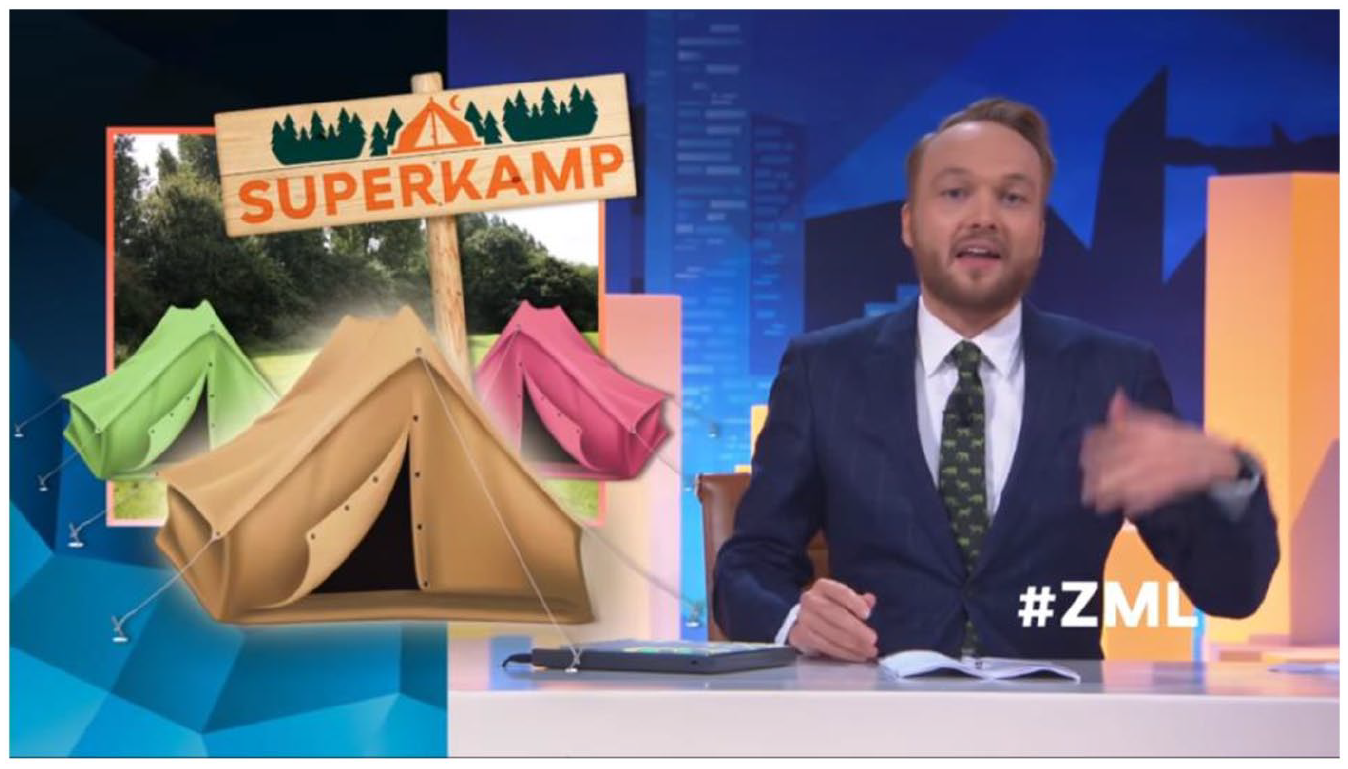
Still from ‘Vluchtelingen: voor of tegen?’.
Throughout this item, Lubach focuses solely on ‘solving’ the conflict between the pro- and anti-refugee groups by analysing and evaluating their viewpoints in an objective, journalistic manner. The idea of the super camp is that it combines the ‘best’ features of both the pro- and the anti-camp. To decide on these features, Lubach uses a checklist. First on that list is passion. The anti-camp has a lot of that, contrary to the pro-camp, according to Lubach. Thus, he says, we should follow the anti’s on this matter. Second are facts and research, which the pro-camp bases itself more on, so we should follow them in that respect. Regarding the third point, concreteness, the anti’s are again scoring better, because they want all refugees out of the country, which Lubach finds a more concrete plan than the vague references to hospitality and common humanity given by the pro-camp. Last but not least, both camps lack the essential feature ‘brainpower’ (in Dutch: ‘denkkracht’, meaning the ability to think), so this is something new to be added to super camp.
Apart from the rather absurd suggestion that public debates can be settled by using a checklist, the latter point is quite telling in that Lubach here explicitly takes a superior stance within the debate by stating that both camps fall short in mental power, unlike himself apparently. Surely, this statement is uttered in a playful and comic context that invites an ironic reading. By taking the idea of camps quite literally, including the simplified visual representation of these camps through a green, red and brown tent, Lubach reduces the Dutch public debate on the refugee crisis to the level of preschool. By using a word like ‘super camp’, he is deliberately being childish and parodies the behaviour of eager toddlers fighting for their territory on the local playground. Following this parodic logic, the claim to brainpower should also be read ironically, as part of the hyperbolic language common in these kinds of quarrels. Paradoxically, however, even in this ironic reading, Lubach retains his rhetorical superiority. His fellow citizens may behave like toddlers, but he symbolically positions himself as their teacher, who only uses the childish metaphor of a super camp because they are not able to deal with the refugee crisis in a ‘grown up’ manner, just like a parent would mimic a child’s language for pedagogical purposes.
This position is also supported by the many jokes present in this item. These are mostly directed against those who do not conform to Lubach’s rational norms. He, for example, shows footage from a street interview with a woman who declares that she read on Facebook that all incoming refugees would immediately get a job. The studio audience responds with laughter to this clip, thus emphasizing how stupid it is of this woman to actually believe such an unlikely story. Lubach adds to this that people who see Facebook as a reliable source of news and information are disqualified from taking part in public debates. As a result, the woman and her viewpoints do no longer have to be taken seriously by the spectator: she is excluded on the grounds of her supposed unreasonableness. Similarly, some ‘unreasonable’ elements of the pro-refugee campaign are also ridiculed and thereby released from further consideration, such as a webpage produced by this campaign that contains rather sentimental texts, which are read out loud by Lubach in a mocking tone of voice and accompanied by a sugar-sweet background music.
Through all this shines the opinion that radical ideological positions are always wrong, or at the very least suspicious, and the only right way to go about a social or political issue is to be as nuanced as possible, to look at it from all angles and then choose what rationally seems best. It is typical, in this regard, that Lubach locates the problem not so much in the actual refugee crisis that is going on, but in the irrational way this crisis, in his view, is dealt with in public debate. This is a sentiment that is heard more often from people who associate themselves with a moderate or middle position in the political spectrum, that it is mainly the heated and polarized tone with which a certain topic is discussed, and not the topic itself that causes conflict and disruption – a phenomenon also known in progressive circles as tone policing. 5 By adhering to this sentiment, ZML fits neatly within the liberal consensus discussed earlier.
Lubach’s treatment of the Dutch debate on the figure of ‘Black Pete’ (in Dutch: ‘Zwarte Piet’) some 2 years later roughly follows the same pattern, but is also different, because here Lubach is ultimately not taking the middle position. This debate revolves around the annual Dutch tradition of celebrating the feast of Saint Nicholas in late November and early December. 6 The story that is told to little children on this occasion is that Saint Nicholas travels from Spain to the Netherlands by steamboat every year to bring them candy and presents. He is thereby helped by his servant Black Pete. Although supposedly black because of his entrance of the children’s houses through the chimney, Pete’s overall appearance closely mimics derivative stereotypes of blackness. Because of this, Black Pete is considered by a growing portion of Dutch society as a racist figure, who should be abandoned or replaced by a less offensive character. Still many others strongly disagree with this point of view, saying that Black Pete is a Dutch national tradition, and traditions should not and cannot be changed. This makes the Black Pete discussion into an ideological struggle par excellence, in which left-wing progressive cosmopolitans clash with right-wing conservative nationalists.
Like with his discussion of the refugee crisis before, Lubach focuses his item on Black Pete, originally aired on 26 November 2017, mainly on the tone of the debate. He deploys several performative devices to express this. Before he starts his discussion, he literally fastens his seatbelt and pours himself a cup of black coffee, thus communicating the message that the debate has become so heated that special precautions are needed before it can be handled (Figures 2 and 3). Subsequently, Lubach repeats this point by making the joke that discussing Black Pete in the Netherlands right now is like visiting a birthday party in war-torn Syria. The idea that the Black Pete debate has gotten out of hand returns again later in the item, when Lubach concludes that it needs to be reset, which he then literally does by pushing a big red button, after which the lights in the studio go out for a few moments, then are turned on again, while at the same time the Windows XP start-up tune is sounding (because ‘as you did not know, the freedom of speech is still running on Windows XP’).
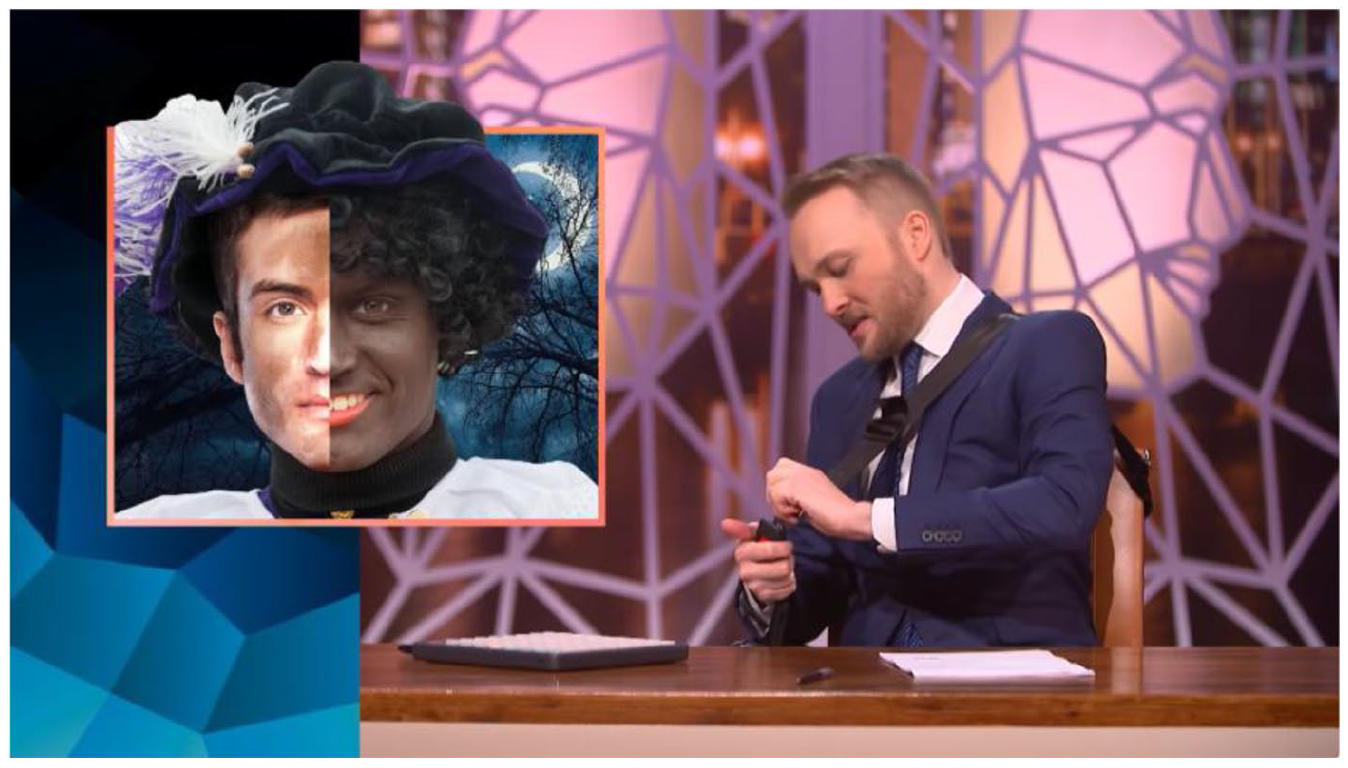
Still from the Black Pete item – Lubach fastening his seatbelt.
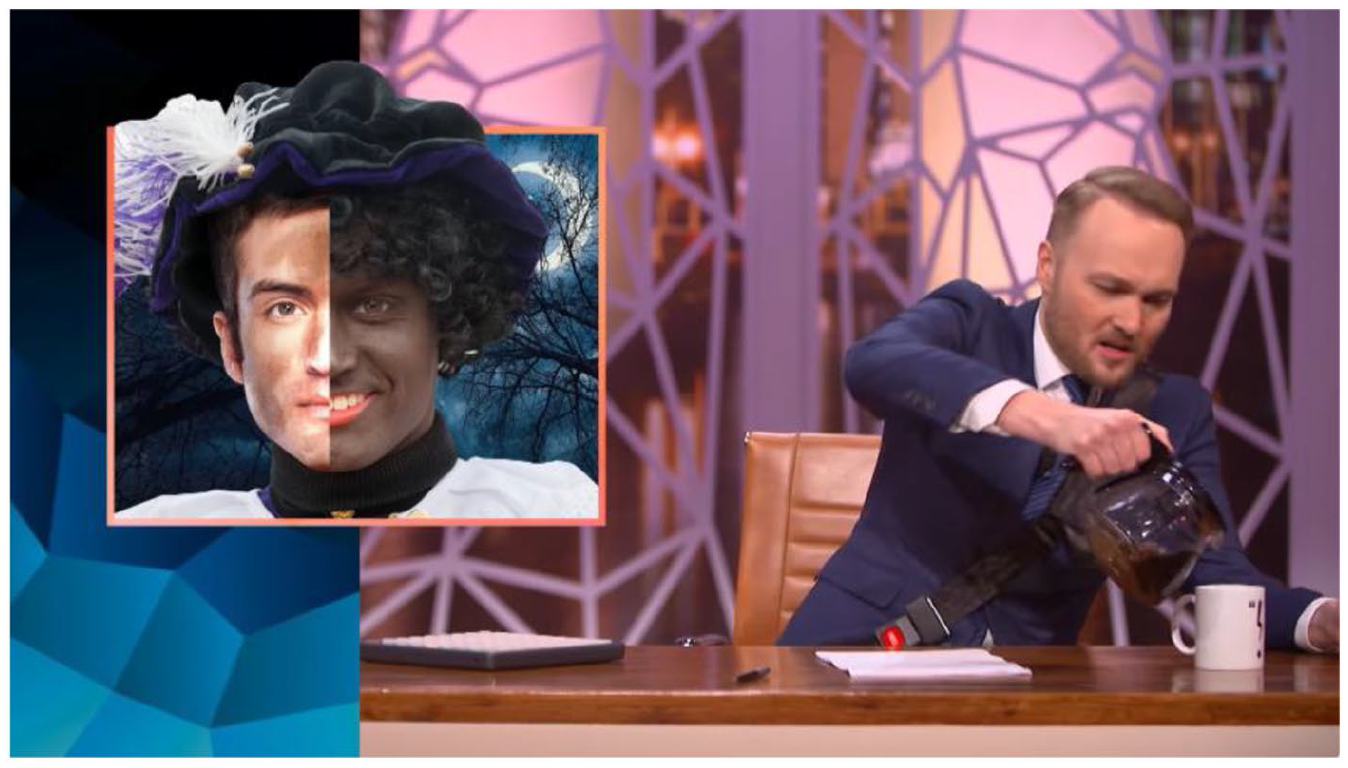
Still from the Black Pete item – Lubach pouring himself black coffee.
Also present in the Black Pete item is the factual style of reasoning we saw earlier. Before Lubach resets the debate, he systematically goes over the arguments brought forward by the advocates of Black Pete and shows why, according to him, these arguments are invalid or doubtful at the least. For example, he discusses the point made by many pro-Pete’s that the feast of Saint Nicholas is a children’s party, by which they mean that such an event should not be bothered by the quarrels of adults. But without Black Pete, Saint Nicholas will still be a children’s party, Lubach says, so this cannot be an argument in favour of keeping the tradition the way it is.
Different from the refugee crisis item, Lubach’s arguments and jokes are this time more explicitly aimed at one group within the debate, namely, the pro-Pete camp. Still, even in this case, he goes to some effort to perform a lack of bias, and so to protect his role of objective journalist. For example, he critically discusses one point brought forward by the anti-Pete movement, namely that Black Pete is a form of racism. Lubach nuances this point by stating that the Black Pete tradition in itself does not have racist intentions, and henceforth that the pro-Pete’s are right when they feel themselves offended by the allegation of being racist. Lubach also makes a metapoint about the way in which journalists have recently begun to frame the Black Pete discussion, namely as a clash between the urban and the rural parts of the country, where anti-Pete’s would be found mostly in the urban centres, and pro-Pete’s mainly in the rural areas of the Netherlands. Lubach states that the supposed divide between these two should be irrelevant to what your opinion is on Black Pete, thus again emphasizing his preference for factual reasoning.
By the very end of the item, after symbolically ‘resetting’ the debate, Lubach makes explicit his own viewpoint on Black Pete. The way in which he does this is again quite telling. He claims that it is too dangerous to openly give his opinion in the studio, and subsequently runs away to the rooftop of the studio building, where a helicopter stands ready to pick him up. This helicopter transports Lubach to a place far from the Netherlands, where he is dropped on a scooter, on which he continues his way. He ends up on a secret location somewhere on the South Pole, way below the ice surface. Only there he dares to say that he is against the Black Pete tradition in its current form. The implicit message that is communicated through this excessive performance of prudence is that such are the precautions that a sensible and reasonable person like Lubach has to take to safely express his opinion in the overheated public debate of today.
In the end, there are more similarities than differences between Lubach’s discussion of the refugee crisis and Black Pete. This is particularly true when we take the perspective of political aesthetics. The ideological messages conveyed by the form, rhetoric and style of these two ZML items all point in the direction of a rational and technocratic vision on politics, in which social issues are treated like mathematical problems. As long as one follows the path of reason, these problems can always be solved. Time and again, Arjen Lubach rhetorically posits himself as the spokesperson of ‘common sense’. In the name of this allegedly rational and neutral common sense, he is fighting all kinds of irrationality and ideological radicalism. Apart from his journalistic method, Lubach also uses humour as his weapon in this struggle against unreasonable politics. The people and practices that do not conform to Lubach’s stringent norms of rational behaviour are ridiculed and thereby excluded from the debate. What remains is a cleansed political community in which any pressing social issue can be tackled, as long as enough ‘brainpower’ is present.
(Do not) fuck the system
It has become clear from the previous analysis that, although Lubach himself may suggest otherwise, his position as a satirist is far from neutral. Rather, he depoliticises his discussion of pressing public issues through a combination of factual reasoning and humour. In this section, I will show what political stance ZML is actually covering through this strategy of depoliticisation, thus further unpacking its ideological meaning. To do so, I return to the idea of liberalism as a cultural dominant in the post–Cold War West that I introduced in the second section. This dominant liberalism not only comes with strong technocratic tendencies but also favours individual liberty over collective action (cf. Holm, 2017: ch. 2; Oudenampsen, 2021: ch. 3–4).
Individual freedom is seen as a key value of Western societies, in general, and of the Netherlands, more in particular. One of the favourite characteristics the Dutch like to ascribe to themselves is that they are and have always been a freedom-loving people (Krol, 2007). It is also often claimed that ever since the remarkably quick secularization of Dutch society in the 1960s, the country has become strongly individualized (Mellink, 2014). But in recent years, there has been a growing concern among both centrist and right-wing politicians that individual freedom is under threat. On the one hand, it is said to suffer from the supposedly backward worldviews of migrants originating from non-Western, mainly Islamic, countries, with their preference for religious commonality over secular individualism (cf. Kuipers, 2011). On the other hand, there is the fear that so-called social justice warriors from the left, who plea for structural changes aimed at making society more just in both economic and cultural terms, are also undermining personal liberties, as they would force people into ‘politically correct’ patterns of collective behaviour (cf. Bakker and Geling, 2018).
Taking into account this emerging discourse of a besieged individual liberty, we can also better understand the paradoxical nature of ZML’s activism. As it happens, the activist agenda promoted by Lubach forms a direct echo of this discourse. Upon closer inspection, his calls to action are always limited to the level of the individual. We are never asked to march the streets together or to collectively strike, but instead to personally sign a petition or to delete our very own Facebook profile. The issues to which these calls are a response are situated on the same personal level. The problem never lies in the system, or in structural power imbalances, but always in ‘stupid’ individuals or institutions who simply lack sense and reason. Behind all Lubach’s jokes and arguments lies the premise that, whatever wrongs there are in society, we will come to a peaceful solution as long as enough reasonable persons take individual responsibility and get the liberty to do so.
One final example from ZML may serve to illustrate this celebration of individual responsibility and lack of structural critique. In the episode of 5 November 2017, Lubach addressed #MeToo, which also impacted the Netherlands. Several Dutch cases of transgressive sexual behaviour were laid bare following the global rise to fame of the #MeToo movement, not least within the media industries. Key perpetrators pointed out in the media were a casting director and the former head of one of the leading Dutch acting schools. Hinting at the latter disclosures, a couple of supposedly regular audience members of ZML start to create some rumour by the end of the episode. When asked by Lubach what is going on, a woman accuses the man sitting next to her of intimately touching her without her consent. The next moment, these audience members turn out to be musical performers, who start singing and dancing ‘Het Masturbatielied’ (‘The Masturbation Song’) (Figure 4). The message of this song is that men who have sexual desires for women who are not interested in them should masturbate, instead of transgressing the women’s boundaries. As sensible – and comical – as that message may sound, it is also a striking example of making sexual transgression into a matter of individual responsibility and nothing more. The problem, according to this song, is not the gender inequality that leads to more men in powerful positions and more women depending on these men, and thus more easily falling prey to sexual and other forms of oppression and demeanour. It is not the system, but individual men behaving stupid, unreasonable one could say, who should change.
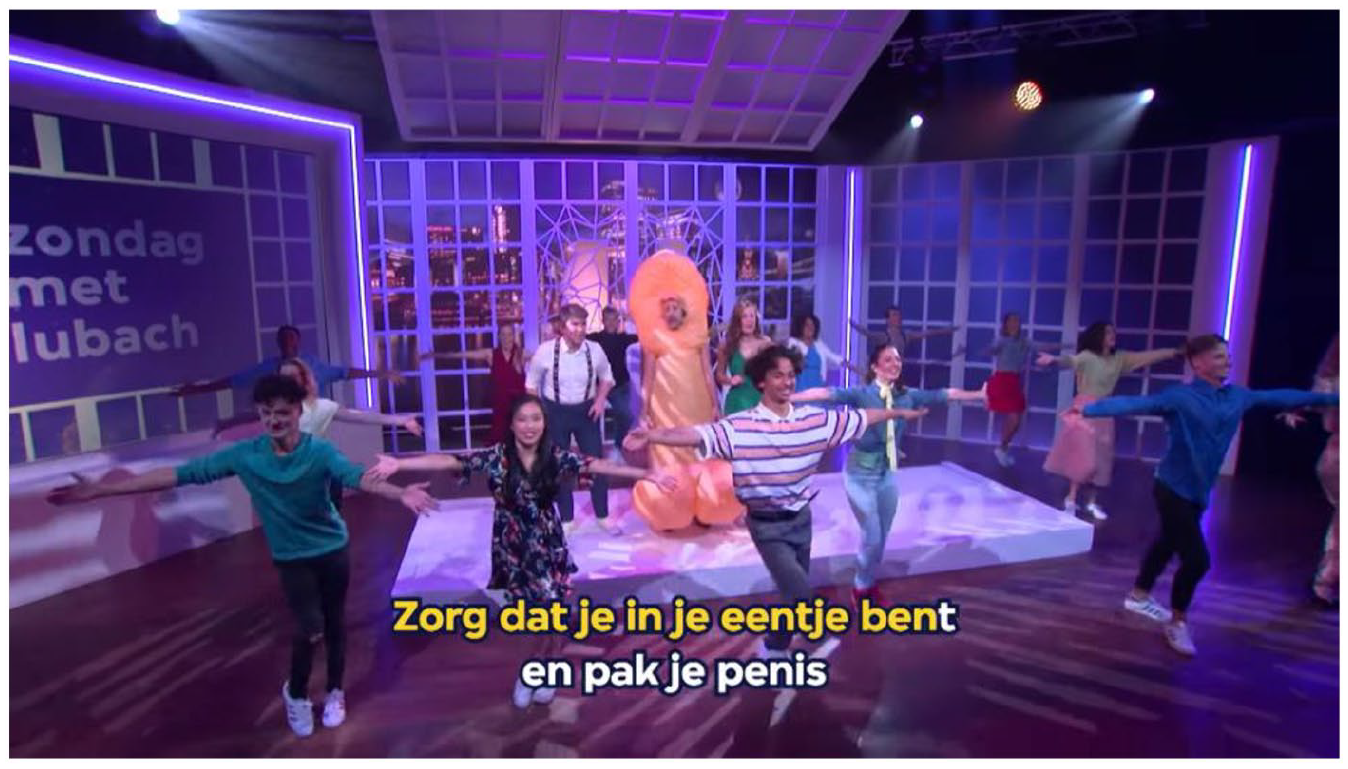
Still from ‘Het Masturbatielied’.
Paradoxically, then, ZML’s critical take on an issue like #MeToo is activist and conformist at the same time. It is activist in that it endorses a prominent social movement that fights against the enduring presence of sexually transgressive behaviour, of which women are the main victim. In this respect, the show takes an openly progressive position. But it is also conformist because the problem of sexually transgressive behaviour is repackaged in such a way that the existing liberal value system, with its favouring of individual freedom over social justice, remains intact. Hence, the common association of activism with subversion, systemic critique and anti-establishment sentiments does not apply to ZML. Lubach’s criticism mainly works to make his audience conform to the liberal status quo, and his activism is limited to proposals that support this status quo, or at least never seriously threaten it.
Conclusion
The analysis conducted in this article has shown ZML to be much more a follower than a breaker of existing trends in contemporary comedy. Looking at this show from the perspective of political aesthetics, we have to conclude that both in its style and in its rhetoric, it performs reasonableness and moderateness in ways that neatly fit within the depoliticising tendencies of the post–Cold War liberal status quo. Being explicitly ideological or arguing for fundamental social change is considered as wrong within this rhetoric (Holm, 2017). Those who do so are ridiculed by Lubach and thus disciplined in the liberal doctrine of individual responsibility and the accompanying strong belief in the power and value of technocracy: the idea that facts, reason and expertise should be the main, if not sole, guidelines in the practice of politics, and in public life in general. Politics, in this view, is reduced to a matter of finding the ‘right’ solutions to social problems, a goal that is best reached by adopting a rational mindset, which puts factual reasoning and in-depth research upfront, and avoids the explicit articulation of political ideas as much as possible. This technocratic view of politics is not only typical for Western societies since the 1990s in general, but also for Dutch political culture more in particular (Oudenampsen, 2021). Last but not least, the emphasis on nuance and middle positions aligns ZML with the overall tendency in contemporary Dutch comedy (‘cabaret’) to pacify and seek consensus (Zijp, 2017).
However, this is not the entire story. The last couple of years, the liberal consensus that dominated the Western public sphere since 1989 has come under growing pressure, both from the left and from the right side of the political spectrum. On the left side, advocates of social justice in matters of race and of gender have gained significantly in visibility as well as in political strength. The same goes for the global movement against climate change. On the right side, we have witnessed the successful rise of alt-right, both online and on the level of state politics, which has given voice to an amalgam of nationalistic, racist and antifeminist ideas that were previously barely uttered in public. These developments have also affected the Netherlands. 7
Despite its strong liberal and technocratic tendencies, ZML can be seen as a critical response to this growing unease with (neo)liberalism as well. By being explicitly activist, the show acknowledges the current need for a more radical politics and for being ideological to at least some extent. In this respect, ZML is arguably less depoliticised and consensus-seeking than many earlier examples of Dutch comedy. As my discussion of the Black Pete item showed, Lubach does not hesitate to openly express his opinion and to take a clear stance on heavily debated issues. On the contrary, ZML can also be considered as more depoliticised than its predecessors, because the solutions it presents for these issues are time and again framed as the only reasonable ones, and those who do not agree with Lubach as unreasonable, ‘stupid’ people. This frame is problematic because it fails to recognize that the polarized nature of the current political landscape is not caused by a lack of reason, but, on the contrary, forms a direct result of the kind of rational, technocratic politics that have dominated the Western hemisphere in the past 30 years. Within these politics, there was no, or at least too little, room for fundamental ideological debate, and many serious political concerns, for example, regarding fading job security and growing economic inequality, were not publicly addressed. It is the neglect of these concerns, not the failure of ‘brainpower’, which brought us in the current situation of rising political radicalism (Mouffe, 2005). Seen from this perspective, ZML presents the wrong solution to an all-too-real problem.
It is particularly via the approach of political aesthetics that I have come to this conclusion. When we would focus the analysis of ZML on its content, we would observe that it usually adheres to a progressive agenda and has criticized the Dutch government on many occasions. The dissident position of the show takes centre stage in such an interpretation (cf. Boukes, 2019; Boukes and Hameleers, 2020). By shifting attention to the aesthetics of ZML – its style and rhetoric – and more in particular to the kind of humour it deploys, the political meaning of the show also changes. It can still be placed in the progressive camp to some extent, but it is also shown to be a much more consensual enterprise than is often thought. 8 Although Lubach and his team usually depart from a critical and anti-authoritarian mindset, the radicalness of their critique and their activism is seriously limited by the fact that they never leave the liberal framework of reasonableness and individual freedom. They are critical liberals at best, where a true challenge to the status-quo would require a wholesale rejection of the depoliticised style of doing politics that has been haunting the Western hemisphere for all too long.
Footnotes
Acknowledgements
I would like to thank Dick Zijp and the anonymous reviewers for their valuable comments on earlier versions of this paper.
Funding
The author(s) received no financial support for the research, authorship and/or publication of this article.

Notes
Biographical note
Ivo Nieuwenhuis is Assistant Professor of Dutch Literature at Radboud University, Nijmegen. He has published widely on the politics of humour and satire in both contemporary comedy and early-modern literature. He also writes comedy reviews for the national Dutch newspaper Trouw, and is currently preparing a book on humour scandals in the Netherlands, 1950s-present.