




Abstract
One area where, along with other UK broadcasters, the BBC has been seen to consistently fail to make headway is in its inadequate representation of minority groups within British society. This study fills a gap in the literature understanding black programming on the BBC. It assesses this programming through a qualitative analysis of the views of 94% of those who produced the current affairs programme Black Britain. It reviews some of the material that Black Britain put on air in this assessment, what impact the programme had on broadcasting diversity and why lessons learned were seemingly lost.
Introduction
For a century, the BBC has progressively acted as the primary national institution shaping the visions of who British people think they are, first on radio, then on television and now online. There’s even an award-winning BBC programme called Who Do You Think You Are? (2004-), such is the power of selective self-reflection in British broadcasting. Through the World Service, the BBC also remains an international journalistic institution that projects Britain’s soft power by reflecting, challenging and investigating the state of the world we live in. With such a colossal global reputation, you would think that as an institution the BBC would have got its house in order after a century of practice and delivery. However, there is one area, along with other broadcasters, where the BBC has been seen consistently to fail to make serious headway. This is not so much in its coverage, but rather its lack of coverage and inadequate representation of ethnic minority groups within British society. I am, of course, referring to the way in which our largest national cultural institution has so poorly served the many minority communities that have come to shape diverse Britain. This article is an exploratory look at how the BBC has attempted to address what its leaders and audience have increasingly recognised as a deficit in its projection of what makes modern Britain tick. The nation is very different from the one where Lord Reith guided the BBC, under Royal Charter, to inform, educate and entertain the great British public and through the overseas services, the Empire. It is a country in permanent demographic transition, which the mediators have often failed to grasp and reflect.
Until the 1990s, the BBC is programming culture largely omitted the lived experiences of minorities unless it was a in the context of problems associated with race relations. In this sense, the important aspects of shifting norms or social interactions within and across British communities were overlooked and undervalued and therefore lost in the public discourse reflected by broadcasters. What was being learned in practice across an emerging multicultural Britain in the 1960s, 1970s and much of the 1980s was ‘forgotten’ because media disseminators failed to engage their audiences with these experiences in the first place. In this way, broadcasters like the BBC were hindering the emergence of a collective multicultural memory, in contrast to a heritage obsession or the deracialised histories of Britain’s past glories.
It was in this context that in 1996 a new magazine format programme, Black Britain (1996–2000), situated within BBC News and Current Affairs (NCA) was launched to bring greater diversity onto BBC screens. It ran to five series across five calendar years of BBC output. Four series were based on a loose magazine format which showed three or four longer films and a round-up of news-in-brief stories, sometimes delivered by a well-known personality. The final series comprised five stand-alone thirty-min documentaries. In 2000, Black Britain ‘housed’ two independent productions under their rubric. It produced around about a hundred stories or items in total and their unique mark was that they were made by ethnically diverse teams of experienced journalists. It is worth remembering that Black Britain was the last of the current affairs programmes on terrestrial television to focus exclusively on a minority audience.
Academic inquiries exploring the processes which led to the output of programmes like Black Britain remain surprisingly limited with exceptions found in the work of Malik (2002) and Cottle (2000). The idea that a robustly cultivated archive ready to be plundered for historical insight into black programming is unfortunately not a reality. The debates on diversity on screen and behind it continue (Henry and Ryder, 2021). In fact, in the wake of the #BlackLivesMatter movement, there has been a veritable explosion of questions asking why the problem persists, not just in broadcasting but across all areas of civic life. This article is an attempt at capturing some institutional memories that reflect on the role Black Britain played in putting the black into the BBC. It is an opportunity to place black programming in the debate about how we have tried to evolve a more representative method of telling our national story. Drawing on the experiences, over a quarter of a century later, of those who have largely remained in the media sector, we can get a sense of perspective on what Black Britain set out to achieve, what it actually achieved and what the legacy of such programme might have been.
The data on which this article has drawn was gathered through thirty-six semi-structured questions across six broad categories in a written questionnaire largely consisting of free text. The survey was conducted between April and June 2021. The final sample consisted of 94% of the individuals who worked on Black Britain production, the majority of whom have remained in television production since 2000. 55% of the respondents were female and 45% male. The questionnaire explored the following: professional background and participants’ self-perception of their identity; how participants felt about the Black Britain project when they considered getting involved; what value they believed the programme might have brought to the broadcasting eco-system; their perception on whether their endeavours impacted on that eco-system and the extent to which that was sustainable; what impact working on the programme had on them as individuals; and the interpretation by those former colleagues of the diversity legacy of the programme.
I am not aware of any other study which has been able to draw on such a strong and representative sample of the experiences of production staff on black programming in British broadcasting. This qualitative research offers an insight into the expectations, experiences and values of these diverse journalists and form an important contribution therefore to broadcasting historiography. As a former reporter on Black Britain, I suggest it is important to fill in the gaps in this analysis to broaden our knowledge and understanding. Black Britain did attempt to shift the content paradigm and therefore represents an important shift in part of broadcasting practice and history and is still relevant to the ongoing debates about broadcasting diversity in current public discourse.
The study of black representation on British television
Let us take a step further back to contextualise the treatment of black people in broadcasting in general and on the BBC in particular. In the News space from the 1950s much of the coverage of black people responded to the perceived impact of immigrant groups on relations with the majority white community (Hartmann and Husband, 1974). There were exceptions to this rule, for example, the trained barrister turned performer Cy Grant used to sing satirical Calypsos about news events on the nightly Tonight (1957–65) programme hosted by Malcolm Muggeridge. He stayed on the programme for a number of year and became the first black person to regularly appear on television. But Grant did not set the agenda of the programme and there was a sense that ‘race’ was an agenda item for programme makers to return to periodically as a consequence of episodes of overt conflict. Hartmann and Husband argue that whilst the frequency of News reports featuring minorities intensified in the 1960s and 1970s, the overwhelming cultural framework was ’more conducive towards hostility toward them than acceptance’ (1974: 208). From the late 1970s, the Glasgow Media Group pioneered the use of content analysis to explore the landscape of News coverage (Philo, 2013). Their work has consistently argued that news tends to focus on effects rather than causes and, as a consequence, manufactures representations under a guise of impartiality. This had the effect of embedding stereotypes and misrepresenting minority communities. It was not until sociologist and cultural studies pioneer Hall (1997) began writing about the impact of portrayal on television and on the racialised relationships that it continued to project, protect and propagate that some of these serious questions began to be asked about the impact of BBC programming on Britain is portrayal of its minority communities. In fact, in the early days of his research, it was difficult to make any meaningful empirical assessment of the history of black portrayal on television, because so little archive material had survived to assist that research. Even today access to BBC black programming archive material remains a challenge because it is poorly catalogued with little detail beyond generic entries.
Stuart Hall developed his hypothesis that television in particular was part of a broad structure of cultural power, and by the late 1980s this power was shifting in mainstream society. The inner-city riots of 1981 in Brixton (London), Handsworth (Birmingham), Toxteth (Liverpool) and St Paul’s (Bristol), and the subsequent 1981 public inquiry chaired by Lord Scarman, highlighted the root causes of the rioting in a sense of disenfranchisement by young British born black and brown people who felt unheard and misunderstood. In 1982, the BBC launched the programme Ebony as a direct response to these claims and the periodic series lasted until 1990. One of its main presenters, Juliet Alexander, would join Black Britain in 1996. Other series like Channel 4’s Black on Black (1982–85) took a more youthful and urban approach to the same issues, recruiting long-time race activist Darcus Howe to its roster of presenters. A similar programme for Asian audiences, Eastern Eye, ran concurrently on Channel 4 (1982–85). When both those programmes were taken off air, they were replaced by The Bandung File (1985–90) on which Stuart Hall himself, Darcus Howe and Tariq Ali would become regular critical voices on British television. This was a more abrasive kind of programming which adopted a multi-cultural and multi-ethnic style of journalism which did not shy away from controversial subject matter. Examples included ‘A Licence to Kill’ (tx 12 September 1995) on racial murders of young Arabs by whites in France, or ‘Too Many Questions’ (tx 19 September 1985), the first substantive look at how British immigration treated those seeking entry to the UK.
Crisis and conflict had by then become a broadcasting leitmotif of how black subjects were approached in these national venues for public exchanges of views. It was another event that grew to challenge public views and approaches to institutionalised racism that sparked a fresh wave of social searching at the BBC in particular. The BBC as an institution realised that its coverage needed more complexity, and this required greater opportunities for people from different communities to work in television and to have an influence on both on screen and production roles. In April 1993, the murder of Stephen Lawrence and the repeated controversies over the way in which the police investigated the crime and dealt with the family accelerated the sense of urgency with which issues or race and ethnicity were being addressed in the BBC’s programming. Studies also began to critique the personnel being used as a factor in determining the programming outcomes (Cottle, 2000).
In the wake of the Stephen Lawrence murder, discussion began within BBC NCA about delivering a programme which could shift the dial on minority representation and show that the BBC recognised the legitimate concerns that all licence fee payers should be served effectively. Tony Hall, Head of NCA, in an internal letter, said at the time, ‘The BBC receives more than £200 m in licence fee from ethnic minority groups but we know from our research that this important audience is not tuning in to our output and that they do not feel that the BBC connects with their lives’ (cited in Malik, 2002: 80). The controller of BBC Two, Michael Jackson, asked for programme departments to come up with formats to cover African Caribbean issues. News and Current Affair management at the BBC were not at all confident that the BBC had the in-house talent to make the magazine format programme that was pitched by a relative newcomer to BBC television news, Patrick Younge. In the academic literature, there was a widely accepted view that the media industry, and broadcasters in particular, had fallen into a trap described by Hall (1997: 245) as ‘a racialised regime of representation’. What Black Britain hoped to collectively bring to the table was a desire to use the experiences of a diverse team that had lived that ‘racialised existence’ to inform their understanding, interpretation and signifying of the behaviour and experience of black Britons. This approach was built on the premise that the black British experience was represented in ways that were distinct from how other communities were portrayed. Through Black Britain, journalists attempted to address this problematised discourse using the same journalistic methods as their white peers. Black Britain set out to recalibrate the disfigured understanding of the UK is black communities, ‘showing that identities are not found but made, that they are not just there waiting to be discovered in a vocabulary of nature, but that they have to be culturally and politically constructed through political antagonism and cultural struggle’ (Mercer, 1992: 427.)
In an essay reflecting on just how challenging the broadcast environment could be, written just after Black Britain was ‘retired’, Simon Cottle noted how, ‘the corporate context and programme-making environment of the BBC according to ethnic minority producers is relatively exclusive, staid and unadventurous and populated predominantly by white middle-class males’ (2000: 103). As the title of his essay suggested, minority production teams often found themselves between ‘a rock and a hard place’. Black Britain was being produced in a general programming context described by Cottle as one in which producers felt, ‘marginalised within the corporation and so adopted a disinterested programme-making stance that disengages from the surrounding field of race and minority ethnicity and which seeks to avoid community backlash and corporate censure by avoiding difficult issues’ (2000: 103). In this context, Black Britain appears positively heroic.
The reality was that much academic work has pointed to the enduring failure of the various projects devised by the BBC to improve the diversity of its people and its output. Campion (2006: 76) argued that ‘there needs to be a critical mass of diversity in terms of class and life experience as in ethnicity and disability, to create production environments which are conducive to people readily sharing different cultural knowledge’. The point of the current study is to interrogate that conception more closely using the experience of one of the main antidotes to this lack of diversity, Black Britain. It appears researchers have overlooked this unique programme as having an impact on the News environment at the BBC, suggesting instead that diversity of perspectives was rare and restricted to storylines which portrayed ethnic minorities as problematic (Campion, 2006: 74). In the words of one News producer struggling to get a particular item on air, ‘we were offered a package about alleged witchcraft amongst the British African community, and they did not want to run it…people think if you are talking about black people, it is a race story. That is the filter. This was not, it was about child abuse’ (Campion, 2006: 74).
Working on Black Britain: career risks and opportunities
An important remedy to misrepresentation is the ability of broadcasters to broaden their recruitment base and to offer up a wider variety of perspectives to interrogate. This is where the recruits to Black Britain had the potential to play a crucial role in change. In the case of Black Britain, 30% of those who joined the team already had a staff position at the BBC. A total of 40% of the eventual team were identified as the right calibre of practitioner by Pat Younge and Sandy Smith and invited to apply for positions for which they were auditioned and interviewed. Other journalists like Hugh Muir were recruited from print and others like Maxine Watson and Marcus Ryder from other areas within the BBC. Given the scarcity of talent within NCA it is not surprising that many of the team arrived from a wide variety of programming backgrounds, often in junior roles. This made Black Britain a clear pathway to progression within or into television production. I, for example, had worked as an assistant producer and producer within NCA and as a radio reporter, but Black Britain became my first opportunity at on screen reporting. It was a unique pooling of talent, which included bringing on board the experience from previous iterations of black programming like Juliet Alexander (Ebony, Black on Black) and Darcus Howe (The Bandung File).
Whilst BBC managers spun the opportunity to prospective staff as a positive development, many of those approached were often wary of signing up because of the comments from other white and black colleagues who thought working on a minority focussed programme might end up being a bad career move. Other managers, not specifically involved in recruitment to Black Britain, hinted that moving to the programme was, from a progression standpoint, the wrong way round: one respondent was told ‘be careful you do not get pigeon-holed, and this becomes a step backwards’. Some black colleagues thought it was a ‘progressive’ move whilst white colleagues described it as a potential ‘ghetto’. This meant there remained an anxiety for some of the team that they were, in the words of one respondent, ‘happy for the opportunity but worried about being typecast’. Others worried that the style of programme seemed to offer a shift away from the values of impartiality and more towards a kind of overt ‘campaigning journalism’, anathema to BBC culture.
It is worth dwelling on the reflections of those who overcame these reservations to work on Black Britain. There appears to have been considerable personal investment in the success of the project, but also a sense of common purpose to make a change to the kind of broadcasting to black and brown communities that the team had individually seen as part of their own lived experiences. Some of the white members of the team were initially nervous about whether they would be accepted. Similarly, an Asian team-member recalled that she was anxious that ‘as an Asian woman, I might not know enough’. There were others who were concerned that the programme might veer towards being ‘left-wing and making excuses about self-inflicted problems’ which shows there was scepticism on the inside of the programme and not just the outside. But as one respondent put it looking back, ‘I was excited to be part of a team of good journalists’. Some found the programme’s approach ‘refreshing and liberating’, while others acknowledged they were ‘proud to target my community’. Others who already worked within the BBC journalism paradigm saw it as ‘an important opportunity to represent the audience it (the BBC) serves’. The respondent who said ‘I was psychologically crushed in my previous role, this enabled me to be myself without apology’, reflects a common theme emerging from a number of the team who had felt isolated as the only black person in the areas they had previously worked in broadcasting. For them it was like ‘coming home and for the first time not being the only person of colour in the room’.
What is clear is that the working environment established by Younge and Sandy Smith, as the main managers for the series, engendered in staff a sense that it was ‘a privilege to learn my craft in a safe and supportive environment’. It established a work ethic where people felt it was ‘an honour to document the black British experience’. As if to confirm some of those initial reservations about the legitimacy of the approach, one respondent quite honestly admitted to ‘opting out of series one, because I thought they would mess it up’. They joined for series two and became a successful contributor to that diverse environment. On balance, from a career progression perspective, 66% of the team had no qualms about joining and this must have been a factor in giving the project the wings to fly.
The Black Britain production team were comparatively young: 48% were under 30 when the series started and 97% were under 40. The majority were born in the UK, so had a perspective shaped by passing through the British education system in the 1960s and 1970s. When asked about their self-defined ethnicity, of the 29 respondents, 16 offered their own categories, 31% regarded themselves as Black British, 10 % White, seven percent Black African and seven percent Afro-Caribbean. Others were of Asian heritage, and some identified as mixed heritage. This is a fair reflection of the complex sense of black identities that Black Britain had to understand. The mixed group of journalists quickly gave the lie to a notion of one ‘blackness’, or to monocultural interpretations of what it was to be black in Britain. Campion (2006) has argued that long after Black Britain was ‘retired’ from air there was still a tendency to see diversity in terms of setting on screen visibility as the key metric to judge progress. On Black Britain itself this was less of an issue than the range of diverse views amongst the Black staff. We called it ‘putting the black into Britain’.
Black Britain’s impact on representation of ethnic minorities in BBC News and Current Affairs
It was often the case that journalist staff sent to events covering minority communities had no lived experience of those communities. There was a distrust of journalists and, as a consequence, there was often miscommunication that led to the dissemination of misinformation of those communities and events, even if this was not ostensibly deliberate. For example, during the 1981 inner-city riots across Britain there were frequent references to the disturbances as ‘race riots’. This rankled with many viewers in those communities worst affected because the television News images seemed to them to be telling a different story. Images of police battling with young people of all ethnicities, but particularly black and white, was not the same as police separating factions divided along ‘race’ lines. I had personal experience of this. Whilst I was studying for my PhD at London School of Economics I became embroiled in the Broadwater Farm riots in North London. It was my sense of the poor understanding of that community reflected in the News coverage of those events that cemented my decision to become a journalist. If there was an ‘agenda’ for Black Britain, it was all about building trust with black audiences in BBC output. Younge believes that in 1996 the Head of Current Affairs, Tony Hall, was instrumental in ensuring Black Britain was viewed favourably by other senior managers: I think Tony was quite far-sighted when they launched Black Britain. They did insist that we were integrated into News and I remember sitting in front of Chris Cramer [Head of Newsgathering] and I said ‘Well it’s called Black Britain and I guess that’s not a very good start’. He said if you bring stories, we’ll take them and if you need support for foreign filming, we are happy to support you.
By giving the programme autonomy over commissioning items within the protected space of NCA, the team were able to be more proactive in the stories they chose to pursue. To me the fundamental thing about Black Britain was power. We had power to set the agenda. This is why most of my focus these days is on the Commissioners who are all powerful. If that group is not diverse in thought and action and colour and creed and class you end up with 57 channels and nothing to watch.
Many respondents found this to be their experience too on the news or feature stories they worked on. More importantly the presumption was it targeted a multi-ethnic audience. It gave a better understanding for white audiences of the Black British experience, as well as a reflection for black audiences of some of the challenges and their life experiences in modern Britain. It was showing that news as we received it came through a selective lens and there were more diverse stories out there. I think for a while we did that to a standard that justified the timeslot.
Though many stories covered by Black Britain would be deemed too ‘specialised’ for general news, there are some examples of stories which would have found their way into the running orders of standard News bulletins. On occasion, a specialised film would break the main bulletin news threshold and appear on the National bulletins. For example, a film about conversions to Islam amongst black inmates at Pentonville prison in London was one of the first to do this. Black Britain was also able to put important black interest stories, like the trafficking of African historical artefacts to the art houses of Europe, on the News agenda. When items made that transition, there was always a sense of triumph in the Black Britain office. It had a personal impact on my career. Not only did I win several national journalism awards for my stories on the programme and main News bulletins, but I was offered a permanent role as a national BBC News Correspondent as a result of the profile created on Black Britain.
The Black Britain team recognised that ‘black audiences, licence fee payers, deserved to see their lives represented in a popular format in primetime’. As another respondent put it, it also helped ‘black Britons understand their value in a broader society.’ There were other examples of shining a light on hidden narratives which ultimately pushed these alternative perspectives into the mainstream. The late BBC reporter Tony Morris produced a film about benefit fraud which avoided the hackneyed ‘spongers’ narrative. Films on discrimination against black nurses trying to work in care homes would presage a shift in the recruitment practices in a sector responding to an ageing population. A story on the practice of private fostering across Nigerian Communities which led to safeguarding issues with young children put an issue on the agenda that took another 15 years to be taken up in the mainstream. Black Britain reopened the case of the historic murder conviction and hanging of Mohamood Mattan, the last man to be hanged in Cardiff prison in 1952 for the murder of Lily Volpert (tx 5 November 1997). His family had longed claimed his innocence and Eddie Botsio took up the case. On 28 February 1998, Mattan’s case was the first to be considered by the Criminal Cases Review Commission and his conviction was quashed. Despite this, it is difficult to assess if there was a lasting impact of injecting these alternative narratives and approaches into public discourse.
Black Britain produced over a hundred News items over several series. Very few of the stories referred specifically to the issue of racism. In fact, it did not warrant its own category in my Black Britain taxonomy (Figure 1). The breakdown in this table reflects the broad range of issues the programme attempted to deal with. Social commentary pieces dominated the agenda but comprised a range of different issues loosely associated with a social affairs theme. Type of news item.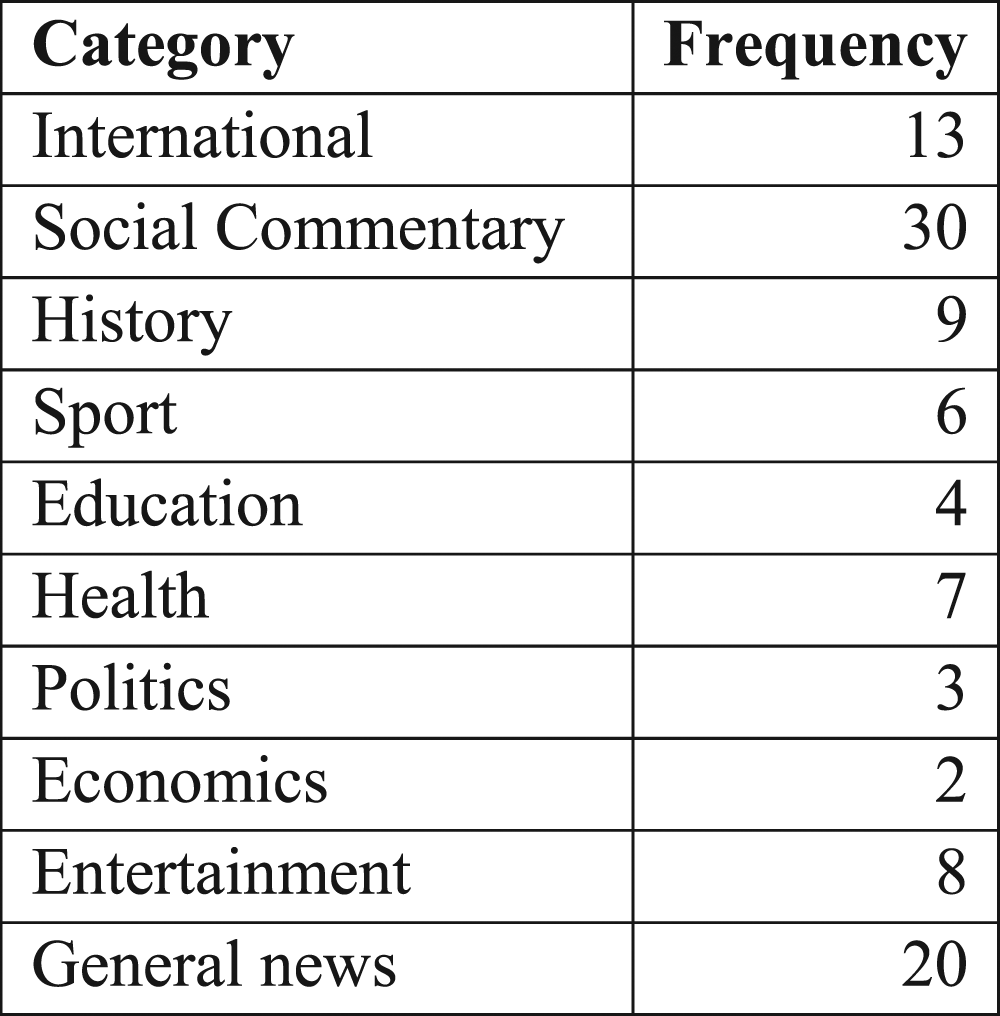
Race and racism were often a subtext to a story, not the story itself. Programme makers were actively trying to avoid stereotyping their subjects on the one hand and equally trying to avoid the trap of dwelling on the perceived wrongs done to black people in Britain. If the programme had dealt with racism as a singular experience of black communities it would have failed to reflect the lived experiences of many in those communities. This was often a delicate balance to strike and led to furious arguments in weekly editorial meetings over ensuring editorial balance and the need to show racism where it existed.
Challenging the ways of working at the BBC
One of the most significant challenges with changing the representation in broadcasting output is sustaining the diverse range of people who produce it. For this to happen, the BBC needs to retain diverse staff. This has been an enduring issue with the overall numbers of minority practitioners both on and behind the camera in production roles, which have looked consistently bleak since the days of Black Britain (Henry and Ryder, 2021). Those who joined the team had few reservations about the important role the programme played in developing black talent: It gave a platform to the black experience, employment to aspiring journalists and presenters. And an authentic view of what it meant to be black here and abroad. I would like to hope that it made the BBC aware of a trained professional group of media workers who they could then draw on. I would like to think that, but I’m not entirely sure looking at its current output. Sometimes the impact is slow, but it grows imperceptibly over time. Looking back, I remember that what seemed like big steps forward then, are no big deal today. And what we see today has built on what went before. Clive Myrie presenting Mastermind, Small Axe (2020) in Sunday primetime, produced by an Oscar winning black director? These stories which would have scarcely made it to a news bulleting turned into riveting drama. I believe that in some small way, Black Britain showed that the black experience is not a turnoff for audiences in the way that it previously had been perceived.
Just as importantly it focussed attention on the importance of diversity of staff to deliver diversity of approach to black interest stories and how they can be framed for a mainstream audience. This offered an opportunity to experiment, but also to recognise the value in challenging norms of what worked in the mainstream: I think for a while it took our stories out of the realm of special pleading. But, as we know, these things ebb and flow. If you make five gains you inevitably lose one or two. I think it made BBC News sit up and consider what constituted a black interest story. Was it just crime, policing and deportations or could it be health, education or business? It helped change staffing in the BBC by introducing a small but influential group of presenters and programme makers to the BBC some of whom have and continue to help change attitudes within the BBC and in broadcasting generally.
Many respondents believed the impact lay in the tone Black Britain set around stories. The team clearly recognised that there was an imbalance in ‘News knowledge’ of black communities (most clearly shown by stories covering the Broadwater Farm disturbances and similar inner-city disturbances) and how that shaped news agendas. This lack of cultural intelligence also fed a bias or misperceptions in mainstream news storytelling when approaching stories about black people. Having a diversity of on screen reporters meant that minority audiences were more willing to participate in BBC output because they trusted the journalists to have a better understanding of their lived experiences. This is still sometimes a challenge for white managers to accept. But in a world where black people face daily discrimination, we must accept that this affects people’s perceptions of who they can trust to interpret their stories. Sometimes the News brand is sufficient, and the BBC brand is very strong. But there are circumstances where confidence is bolstered if the interviewee and interviewer share some lived experience common ground. The Windrush scandal would have broken into the mainstream much earlier had Black Britain been around. I think how differently coverage of Grenfell or the post-George Floyd protests would have been with Black Britain.
Those ripples of change are often slow to flow through the system and as one respondent put it, those Black Britain ripples are probably now imperceptible but still happening.
Black Britain attempted to apply the same criticality to those stories that were expected for their editorial output in the course of their journalistic duties in other news domains. The current Guardian Print Editor, and former Black Britain reporter, Hugh Muir, described this as telling the audience that ‘our issues are your issues, because we are as British as you are’. For example, Black Britain would not side-step stories of deaths in police custody, but the programme would foreground the human and family contexts of these stories and focus rather on how structural and cultural problems impacted on individuals. Stories were not framed by debates on race, but were narratives about people. The decision to have a mixed staff profile helped retain this value of ‘race’ criticality: The staff on Black Britain were not entirely black and working with white and Asian counterparts led to genuine friendships and learning curves. We all grew from the experiences. I have mentored aspiring diverse talent ever since.
Being able to experiment without fear of being undermined was a theme repeated consistently by respondents. Having a place to build practitioner resilience was valuable to the team. This was particularly important in a fiercely competitive industry, not noted for its generosity and with high attrition rates: ‘It had a major impact on my perception of what was possible. I realised I did not have to be crushed by my work environment.’
For some respondents there was certainly an impact on the way they felt about their role and ability to make a contribution within the BBC, without compromising on the type of stories they wanted to tell. One of the lasting impacts seems to have been the willingness to take that experience and channel it later in their careers to support other programme makers to generate more diverse forms of content. It had a completely positive effect. The work was hard but enjoyable and I literally had 20 mentors. I am pretty certain it has helped me become a success and a leader in what can be a harsh world, particularly for a working-class black man. I loved coming to work and being around them all. I loved the way they made me question and fight for what I wanted. I became a happier, more confident woman working on that show…I owe it a lot.
A Black Britain diversity dividend for the BBC?
There is no clear explanation for why Black Britain was discontinued in 2000. It is broadly agreed that the founding personnel needed to progress elsewhere to further their individual careers and with this the programme seems to have lost momentum. This may account for why 48% of respondents said there was real disappointment when the programme ended, though, as one respondent put it, ‘it was inevitable and reflects the way things change.’ However, in other ways, Black Britain did suggest a pathway to sustainability through the talented journalists and programme makers who left the programme and moved with greater confidence to ‘infiltrate’ other areas of journalism and the programme-making business. Of the 28 people involved in the production staff, nearly half went on to relatively illustrious careers. Many of the remaining team, continued as respected and successful practitioners in the business. It certainly makes one wonder what other talent could have been nurtured in what a number of the respondents describe as ‘that safe space’.
It is important that this unique cohort looking back across a quarter of a century still believes the Black Britain experience had a profound impact on their ability to sustain a career in broadcast journalism. From the simple issues of personal confidence and awareness, ‘it built my confidence and allowed me not to have to second guess myself or question who I am and what I was doing.’ Perhaps just as importantly, it provided a fresh perspective and broader context for previous experiences in journalism and how things could be different: before working on Black Britain I was always either the only non-white on the team or one of two at the most often acting as an intermediary in areas where colleagues lacked knowledge or personal experience. It was great to work as part of a team with people who had similar life experiences. It was a pleasure to be part of a team that disrupted the staid corporate atmosphere at the BBC. Professionally I received advice and help in making longer documentaries with the support of experienced programme makers on the team.
For some of the team members who had minimal personal exposure to black issues before working on the programme, it opened up their world to the black experience in a way in which they believe have radically informed their subsequent careers: ‘It made me more sensitive, aware and attuned to the issues facing black communities in Britain and better informed to tell those stories.’
There was a sense from the majority of respondents that, whilst there was a legacy taken forward by those individuals who worked on the programme, there was little systematic or institutional learning from the experience which played out into other areas of programming, recruitment or progression. Of course, this also raises the crucial question: how many other people could have benefited from this talent pipeline had the programme endured? As one respondent put it: Long-running programmes can become a victim of their early success. They are forever chasing the impact they had when they first appeared. The programme would probably never have survived the constantly changing ideas of channel controllers. These ventures are cyclical. Presumably there was a feeling that the job was done and the mainstream news structure could take over, but that was only ever likely to happen to a limited degree.
Like all areas of work, some have had fewer opportunities, but they still recall Black Britain as a high point in their creative careers: ‘The rigour, stories, team and the general vibe of Black Britain was a once in a lifetime experience.’
Was it all worth it for these respondents looking back on Black Britain as part of their career pathway and contribution to a quarter of a century of broadcasting since? Here there is a mixture of sentiment. Whilst 76% of respondents strongly agreed that it was a worthwhile experience and 14% somewhat agreed with that idea, there was less conviction of any lasting impact of the programme itself: There was legacy with talent but not stories. Some have gone on to have influence within and beyond the world of broadcasting. That is a great legacy for those involved. But the BBC dropped the baton.
On the direct impact on representation of black people across TV output subsequently, only 19% thought it definitely had an impact and 24% said it probably had a lasting impact. Over half the respondents reported doubts based on the lack of diversity they observe in current output. Respondents were much clearer about the impact the programme itself had on the representation of blackness on screen with over 60% saying there was some impact. There was, however, an overwhelming acknowledgment that despite the ongoing challenges with reflecting the diversity of black and minority communities on screen, 38% said diversity is much better that it was in 1996, and 57% agreed somewhat with this observation. So, whilst no grand claims can be made for the role of Black Britain in this change, there is an acknowledgement that it did shift the dial.
An unresolved debate on BBC diversity
This study aimed to call on voices from black broadcasting practice who challenged institutional amnesia. What is broadly being described in this paper is what ‘institutional racism’ looks like in broadcasting. Individual success should not cloud an understanding of an absence of real systemic cultural shift. The fact that we are a society embracing many cultures needs to be reflected accurately by mediators if we want to foster a collective multicultural memory. Black Britain arguably represented the ‘birth’ of a generation of practitioner journalists versed in the practices of production diversity at the BBC. The idea was to bring top level production values to black content. We delivered some strong stories and entertaining features. The team was highly motivated and passionate about their work and how it would be received. They stood out from the orthodox BBC current affairs environment in a positive way. The team supported each other and mixed socially to create a strong bond. The hope was it would raise audience awareness of Black British issues and I think it probably succeeded to a degree. But also, to raise the appreciation of the BBC among black audiences which is harder to measure…
The BBC has made steady institutional progress in acknowledging the importance of structural change to its processes in order to make itself a more attractive place to work for programme makers and journalists, but also reflecting the broad changes in British society. However, progress still relies heavily on continuing intervention by individuals rather than the impact of systematic reform of BBC processes. It repeatedly finds itself at loggerheads with those who say that poor decision-making at the top makes change problematic (Chappell, 2021). The BBC has renewed its commitment to a more systematic approach to cultural inclusion, more inclusive employment practices and programme-making. But could it be that enduring prejudice and an absence of power has meant that discriminatory practices were not systematically overcome? Bidol (1970) defined racism as ‘prejudice plus institutional power.’ According to this definition, two elements are required in order for racism to exist: racial prejudice, and social power to codify and enforce this prejudice across an entire society. In this definition, power is responsible for the creation of racial categories, and people favour their own racial groups over others. External pressure clearly remains an important trigger for this focus.
Given the evidence offered in this article, one might ask, with such a breakthrough programme, 25 years ago, why are we still having to discuss a lack of diversity in British journalism and programme-making? It is a question for which there is no easy answer, but what is striking is that Black Britain had autonomy within the organisational structure of the BBC, it had its guaranteed place in the schedule and, in this sense, it had the independence to wield an unusual level of power to deliver diverse programming without interference. Since that time, the ‘cult of the commissioner’ has emerged, a particularly powerful set of gatekeepers who essentially curate what appears on BBC screens, and dictate the type of talent that appears on those programmes. Black Britain was a successful vehicle to encourage greater participation. It also showed that scarcity is not a problem if you make a determined effort to grow the pool of talent.
The study also suggests programme maker/journalists felt they did some of their best work touching on subjects which they would have struggled to get on air elsewhere. It helped develop their confidence in their ideas and who they were as practitioners which has gone on to serve them well throughout their later careers. This is reflected in the inventory of programming. Black Britain was able to address the persistent challenge of ensuring the cultural and lived experiences of ethnic minorities was not a sidebar to a British understanding of the lived experience of all its viewers.
One of the more striking aspects of this study is that many of the journalists have had successful careers, far from being a hindrance it turned into a springboard for success. Whilst it was on air, Black Britain clearly delivered a diversity dividend. It is less certain that any systematic institutional learning was implemented as a result of the innovation. In this sense, the programme shifted the dial, although it is difficult to measure with any degree of specificity the exact impact. The fact that diversity on and off screen remains a hot topic, is perhaps evidence of a lack of lasting change, however, most parties acknowledge there is clearly greater diversity in the sector now than in 1996 (57% of our respondents somewhat agreed with this proposition and 38% strongly agreed), part of that shift inevitably resulted from the personnel and practice of those who delivered Black Britain.
The reality of today’s media eco-system is that the BBC is a much-diminished player in the broadcast environment. However, the BBC remains at the heart of British cultural production and is still able to set the mood music for the industry’s approach to issues of equity. With Black Britain, there remain lessons of power, resourcing and recruitment which may not be applied in the same way now, but which offer us examples of what broadcasters need to be focused on, to move the dial once again on telling a plurality of stories across BBC outlets.
Footnotes
Acknowledgements
An earlier version of this research paper appeared as an essay in Representology 2 (2021). I am grateful to those former colleagues on Black Britain who responded so enthusiastically to my request to be surveyed about the impact of their experience.
Declaration of conflicting interests
The author(s) declared no potential conflicts of interest with respect to the research, authorship, and/or publication of this article.
Funding
The author(s) received no financial support for the research, authorship, and/or publication of this article.
