




Abstract
This is the second more substantial part of the introduction to the final Trans TV special issue, distributed across issues 15.2 and 15.3 of this journal. As well as introducing the contents of this issue, we reflect in this introduction on the Trans TV project as it has developed since 2017, via an engagement with two key televisual texts namely Transparent (2014–2019) and Pose (2018–). We argue that this certainly reflects positive developments in terms of transgender representation and authorship but this progress is more complex when considered in terms of television aesthetics and politics. We also propose, drawing on the work of Koch-Rein et al (2020), a shift form representation towards the concept of ‘transing’ as a reading strategy, and argue that this has been at the heart of the Trans TV project all along.
As already outlined in the last issue (CST 15, 2, 2020), this final special issue of the Trans TV project, split across two issues of Critical Studies in Television, aims to update the questions with which we started regarding the intersections between transformations of television industries, institutions and viewer practices and spaces of trans and queer representation through various transformed spaces of TV practice in the era of streaming and SVOD television. As such, we encouraged authors included in these special issues to reflect on what has changed over the last 4 years in technological and institutional practices, representational politics, audiences and modes of viewing, with a view to better understanding where we might be heading, especially with regard to the treatment and inclusion of gender, sexuality and other forms of diversity. Had the affordances of streaming platforms, no longer based on conventional industrial models of networks or even cable channels, offered new spaces of expression, as seemed to be the case in 2017 with high-profile series like Sense 8 (2015–2018), Orange is the New Black (2013–2019) and Transparent (2014–2017, 2019). Before introducing the authors’ contributions to the second of this two-part special issue, we aim to briefly give our own assessment of these questions, starting with a reconsideration of Transparent. We do so in the light of its #MeToo controversies, musical finale and Jill Soloway’s memoir She Wants It (2018), published in the hiatus between the firing of Jeffrey Tambor from the show and its partial return in the form of its dénouement.
To start, we feel a caveat is necessary regarding our own position as editors. Up to this point, we have refrained from any declarations of identity, but we feel it would be incomplete and insincere not to indicate that we are both cis, white, males. Throughout the course of this project, we have never had any intention of speaking for any others and certainly not for transgender experience, with the use of word ‘trans’ in ‘Trans TV’ indicating a medium in a process of transformation, and a starting point for reflecting on the emergence of prominent televisual representations of transgender characters, as well as, in some cases, performers, writers and producers. This was considered in confluence with the emergence of the new spaces of television made possible by digital streaming platforms and new ways of both producing and consuming television. For this reason, this project has been largely a curatorial one, bringing together both emerging and established scholars, industrial and aesthetic analyses, transnational and local considerations of streaming television, and an intersectional diversity of positions crossing different gender, sexual and ethnic identities. We have tried to reflect the intersectionality of this project in its framing, for example paying attention to issues of transnationality, race and ethnicity alongside gender and sexuality. While we are honoured that we were able to present some brilliant queer scholarship of both emerging and established scholars, we also regret that we did not do more to engage transgender scholars as part of the project which would be essential for any future development. Perhaps slightly facetiously we could say that we replicated several of the problematics of the show that inspired this project more than any other, namely: Transparent. Where perhaps we should have taken more of the approach as seen in Pose (2018–2020). We will briefly reflect further on both of these shows below.
Trouble surrounding Transparent was evident from the start, with it casting decision to have the cis male actor, Jeffrey Tambor, play the role of Maura. While her friend Davina played by Alexandra Billings mitigated the selection to some extent, it simultaneously reinforced the existing tendency to have transgender performers in supporting roles. Moreover, there was a complete lack of transgender representation in the writers’ room. As such, Transparent appears to be very much a product of the ‘proto phase’ of production developments around diversity and inclusion. According to Soloway’s memoir, the writers now realise they were ‘protecting [their] privilege’ (2018: 74), and perhaps should have heeded the words of Jenny Finney Boylan, the transgender consultant brought in to ensure some level of authenticity, who said: ‘you will probably get a fair amount of blowback for not hiring a transgender actor or actress to play the part of Maura […] The transgender community is rightfully crabby about having been portrayed in so many different wrong and insulting ways over the years, that it might never occur to them that anyone could do the story right (in Soloway, 2018: 75).
As Boylan and several perceptive critics noted, despite the title, the series was not really about trans experience as such, as much as the impact of a particular trans coming out to a specific family: a wealthy Jewish West Coast one, as Amy Vilarejo (2016) also pointed out in her affirmative assessment of the show. However, this question of privilege was a thorny one that would indeed create ‘blowback’ and not only because of casting decisions or the make-up of the writers’ room. In the fourth season, the narrative arc was dominated by a trip made by several of the Pfeffermans to Israel, which went down badly with a number of trans and queer viewers, as well as queer and trans activists for Palestinian rights and specifically the BDS (Boycott, Divestment, Support) campaign against filming in Israel in solidarity. After some agonising meetings with artists and activists who supported the Palestinian cause, the decision was taken to recreate Israel in the studio and only shoot some B Roll in the country by Soloway and the show’s cinematographer, Jim Frohna. Of how the show attempted to give representation to the Israel Palestine situation through a queer lens are discussed in Anamarija Horvat’s article in this issue, but it was at best a compromise solution which gave a lip-service representation of these issues as encountered by one Pfefferman character Ali, formally Ari (Gabby Hoffman). Palestinians served more as a backdrop for her own experience of transformation than as subjects with agency in their own right.
Finally, and most significantly, Transparent was implicated in the #MeToo series of exposures of male celebrities in the entertainment industry following in the wake of the Harvey Weinstein expose in the New York Times and would come to include such figures as Kevin Spacey, Aziz Ansari and Louis C.K., significant figures in the contemporary television landscape. Soloway was not only an enthusiastic supporter of the #MeToo movement but felt she had anticipated it with the naming of her production company as Topple, referring to toppling the patriarchy which they saw as intrinsic to the feminist ethos and working practices of both Transparent and I Love Dick (2016–2017). Not only that but Soloway had joined the Time’s Up initiative with a number of leading female producers and performers in the US entertainment industries, which aimed to intervene in these industries to extend #MeToo activism beyond calling out well-known celebrities, to advocate for more equality across the entertainment and other industries, for example, to argue for 50/50 gender representation across roles in film and television by 2020 (see Soloway, 2018: 214).
In the ‘Oh Fuck’ chapter of She Wants It, Soloway moves quickly from the ‘giddy’ excitement of the first #MeToo accusations (2018: 219), and the forming of Time’s Up with such other luminaries from the entertainment world as Reese Witherspoon, Shonda Rhimes, Natalie Portman and even Oprah Winfrey (p. 214), to the revelations that Transparent’s leading performer Jeffrey Tambor, around whom the show is centred, was implicated in not one but two accounts of abusive behaviour towards transgender co-workers: Van Barnes, who had shifted from the costume department to the role of Tambor’s personal assistant, and subsequently Trace Lysette, who played Shea on the show. As Soloway details, the chain of events that unfolded from these revelations and the subsequent investigation, and impact on the show’s already partially written fifth season, it is not without irony: ‘I wanted so badly for it all to be a big misunderstanding. A few days earlier, I’d scrawled “Unlock all NDA’s” on a Post-it at CAA (Creative Artists Agency), and now I was wondering if there was an amount of money that could put an end to all of this before it got out of hand’ (2018: 216). Ultimately, there would be no fifth season, not even one facilitated by the death of Maura, but only a ‘Musicale Finale’ two years later, which shows Shelly Pfefferman (Judith Light) mounting a life-affirming musical in the wake of Maura’s death and its impact on the other characters. As perceptive critics like Vilarejo noted earlier, Transparent was always more about the Pfefferman family’s multiple responses to Maura’s coming out as trans than about Maura herself; and despite the inclusion of transgender writers and producers from the second season to flesh out her story, the focus was largely on the other family members. On this level, the finale’s musical-based structure ‘worked’ based on the absence of Tambor as Maura (see Figure 1 Transparent Musicale Finale). It effectively took to its logical conclusion Maura’s function as the already absent centre of the show: ‘Maura’s process of “coming out” to and comforting her cisgender family and acquaintances merely positions Maura as a non-dominant group member whose function it is to appease the dominant group’ (Funk and Funk, 2016: 901).
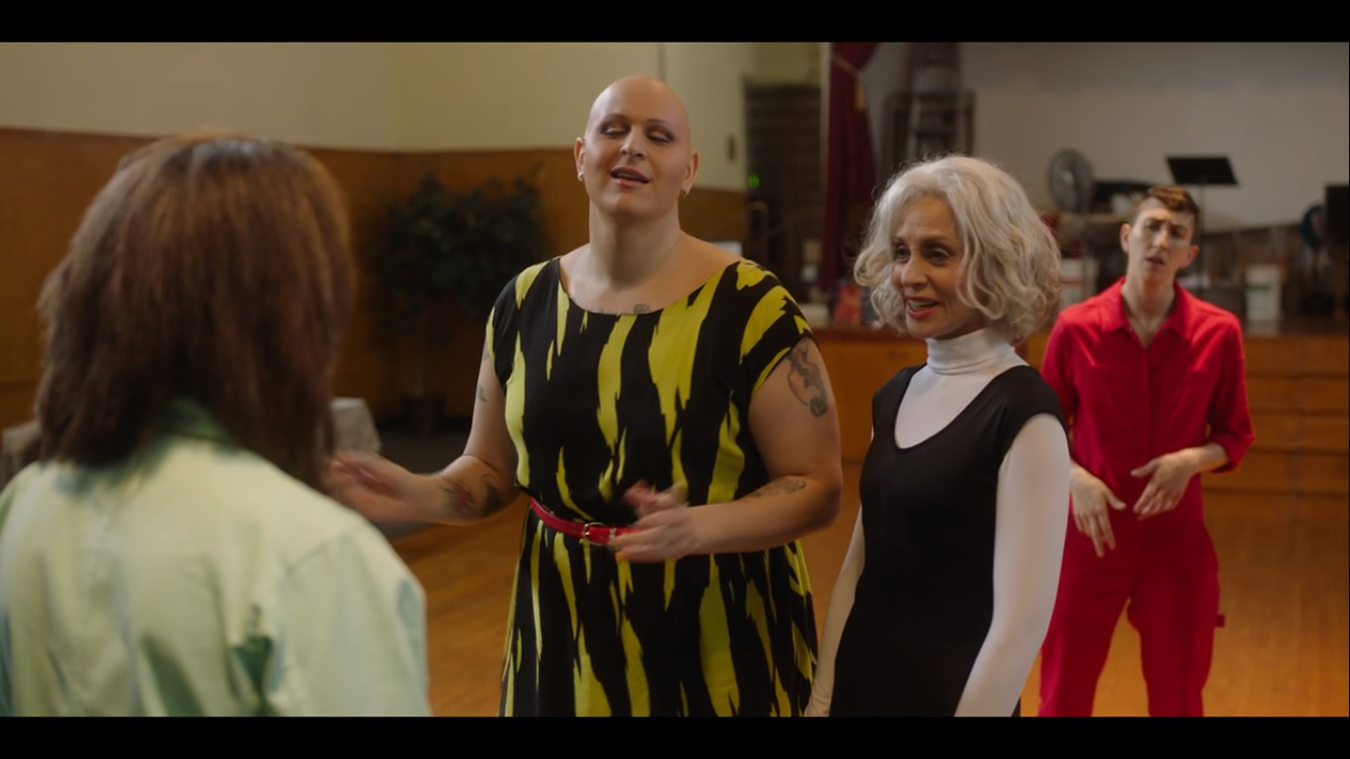
Shakina Nayfack and Judith Light in the Transparent Musicale Finale (Amazon Studios, 2019).
Soloway’s account of the making of Transparent and navigating the above issues has been received favourably by some critics, in high-profile publications like the New York Times and LA Review of Books, which had the following to say: ‘What can the reader of She Wants It take away from the much-plumbed depths of Soloway’s life? If the reader is […] a seeker and/or a teller of modern truth; a proponent and/or a student of feminism; an aspiring artist/activist struggling to find the light — the answer is, a lot’ (Maran, 2018). Trans activist and writer Andrea Long Chu was more scathing and critical however, describing the book in her review entitled, ‘No One Wants It’ as a lightweight piece of bad writing ‘just south of worth purchasing at the airport’ (Chu, 2018b) and goes on to claim that ‘as a book about desire, power, or toppling the patriarchy, it is incompetent, defensive, and astonishingly clueless’ (Chu, 2018b). This review went viral on social media, fuelled by it being composed of highly quotable one-liners that add up to a coherent critique of both the book and the show from a trans perspective. There is unfortunately not the space here to follow this argument in detail, which appraises many of the above-mentioned episodes in Soloway’s memoir in a highly critical way, none more so than her engagement with the #MeToo movement which effectively ended the show: ‘nothing is more cringeworthy than Soloway’s account of the #MeToo movement, with which the book (and indeed, Transparent itself) concludes. “Two years after I’d yelled ‘Topple the patriarchy!’ onstage, it all indeed came tumbling down,” marvels Soloway, breathlessly equating the firing of several famous men with the end of a regime as old as history itself’ (Chu, 2018b). Chu was not one of the trans activists who rejected the show in principle, but rather had a complex relationship to it as expressed in an earlier article ‘Bad TV’ that also engaged with both #MeToo and Transparent as a central example of the phenomenon she calls ‘woke TV’: ‘The third [season] I binged on a few months into transition, popping estrogen and waiting for the sadness to kick in. “I don’t wanna be trans!” cried Tambor’s character, in a bitter argument with her estranged sister. “I am trans!” Me neither; me too’ (Chu 2018a). For Chu, it was the fourth Israel-themed season that put her off watching and, once the allegations about Tambor came to light, watching the show was no longer tenable: ‘The irony was thick and frothy: a transgender actress sexually harassed by a cisgender actor playing a transgender woman, and doing so to tremendous critical acclaim, with a winsome humility it was easy to slip your belief into, like a pair of comfortable shoes’ (Chu 2018a).
Whether or not one agrees with Chu’s assessment of Soloway’s book as bad writing and of its writer as a non-reflective narcissist, what she said certainly hammers home the point that contemporary television still has a long way to go with trans representation. Even given a charitable assessment of the series as an at-times a clumsy step in the right direction in its affirmative presentation of a trans character, and engagement with trans talent in terms of performers, writers and producers through its ‘transfirmative action’ ethos adopted after activist critiques of the first season, it remains a clear product of the aforementioned ‘proto phase’ of production in these regards.
In many respects, the more recent series, Pose, would seem to be a direct response to these issues, and has been presented as such in several articles. According to Joy Press, writing in Vanity Fair: ‘While Transparent was a landmark in transgender visibility on television, for many trans creatives, it felt like a baby step’ (2019). In contrast to Transparent, Pose puts trans talent front, centre and behind the scenes with ‘several trans women of colour as its leads’ (Lawson, 2018) or, as Press puts it, the show ‘fizzes with the energy, longing, and struggle of its heroines, five of whom are played by trans actors of color: Moore, MJ Rodriguez, Dominique Jackson, Hailie Sahar, and Angelica Ross’ (2019). As a review in The Guardian put it: ‘Much has been made of its featuring the largest trans cast in scripted television history, as well as writers and producers including Janet Mock and Our Lady J. The result is the gold standard of representation in action’ (Ramaswamy, 2019). However, it would be misleading to make an absolute contrast between the two series, since it was some of the trans talent identified and developed in the making of Transparent that went on to work on Pose, and none of the three showrunners—Ryan Murphy, Steven Canals and Brad Falchuk—identify as trans.
It is also important to understand several other contexts to fully grasp the significance and aesthetics of Pose. One is the 1980s queer ballroom culture of New York that was captured in Jenny Livingstone’s 1990 documentary Paris is Burning, and strongly referenced in Madonna’s track and video ‘Vogue’ (1990). Ryan Murphy’s original idea was to make a fictional TV series beginning with the world depicted in Paris is Burning, which was not the first idea he’d had for a transgender-themed series. Murphy’s previous one, Pretty/Handsome (2008), about a trans gynaecologist, was never picked up beyond its initial pilot. This idea was combined with one from Canals about a young queer African American coming to New York City to become a dancer and becoming homeless. As such, this fits with a recent spate of retro shows set in New York of the 1980s and deal with specific scenes; unsuccessfully in Vinyl (2016), but more successfully in Baz Luhrmann and Stephen Guirgis’s hip hop-oriented show The Get Down (2016–2017). The latter series bears comparison to Pose. Luhrmann and Murphy share a baroque, performative signature style and construct their respective shows around contrasts between dealing with gritty, social issues and effervescent spectacular performance pieces. The Get Down also pre-empted Pose’s attempts to come to terms with gentrification and the nascent corporate culture in New York at the time as a foil to the vibrant subcultural practices of people of colour.
Pose emerged in the wake of two other media products seeming to indicate a revival of 1980s voguing, namely: the documentary, Kiki (2016), and the Viceland reality TV show, My House (2018), both dealing with the contemporary ballroom scene in New York. In a fairly critical review of Pose in The Atlantic, Spencer Kornhaber questions the idea of voguing coming back into fashion, pointing out that ‘Pose and My House indeed make clear that there are two separate phenomena here: the ballroom, and its cultural portrayals’ (2018). Kornhaber goes on to interrogate Murphy’s avowedly baroque style, claiming that ‘usually it’s as workmanlike as a network procedural’s, spiced up with imitation-Hitchcock camera angles and garish, but unsurprising, musical cues. The dance scenes have promise, but the swooping camera and quick cuts undermine the sustained, graphical momentum of voguing’ (ibid). The problem with the series for Kornhaber is what happens outside the ballroom, where often ‘the characters don’t so much enact storylines as they do parables or lessons’ (ibid). This is particularly the case with the storylines about the few white characters who work for the Trump Organisation and whose Wall Street-type portrayal is extremely heavy handed and one dimensional. Even with the characters who inhabit the upstart House of Evangelista, loaded and cliché melodrama co-exists with storylines of trans activism and vulnerability in an uneasy melange wary of offending the sensibilities of the mainstream popular audience at which it is largely aimed. Even if the series attains a ‘gold standard of representation’ at least relative to television’s so far low level of achievement, it is difficult to argue the same about its narrative or aesthetic sophistication, which, at times, seems little more than a transposing of the dynamics of Glee (2009–2015) to the downtown ballroom scene (see Figure 2 the ballroom scene in Pose). In a sense, Transparent and Pose can be seen as mirror images of each other in which the former is aesthetically sophisticated but representationally compromised, while the latter perhaps has the opposite problem in its lack of an aesthetic adequate to its subject matter. It is interesting to note in this light that the recently produced documentary Disclosure (2020), which examines transgender visibility across a range of film and television texts, cites Sense 8, Pose and even Billions (2016–) affirmatively, while ignoring Transparent altogether. This is quite a striking absence given that several creative contributors to the show such as Aelexandra Billings and Zackary Drucker are interviewed in the documentary, and the role Transparent played in developing some of the creative trans talent that played a key role in the much lauded Pose. We can only infer that the issues discussed above have rendered the show a distasteful object for the trans community, despite its apparent contribution to the development of trans representation on contemporary television.
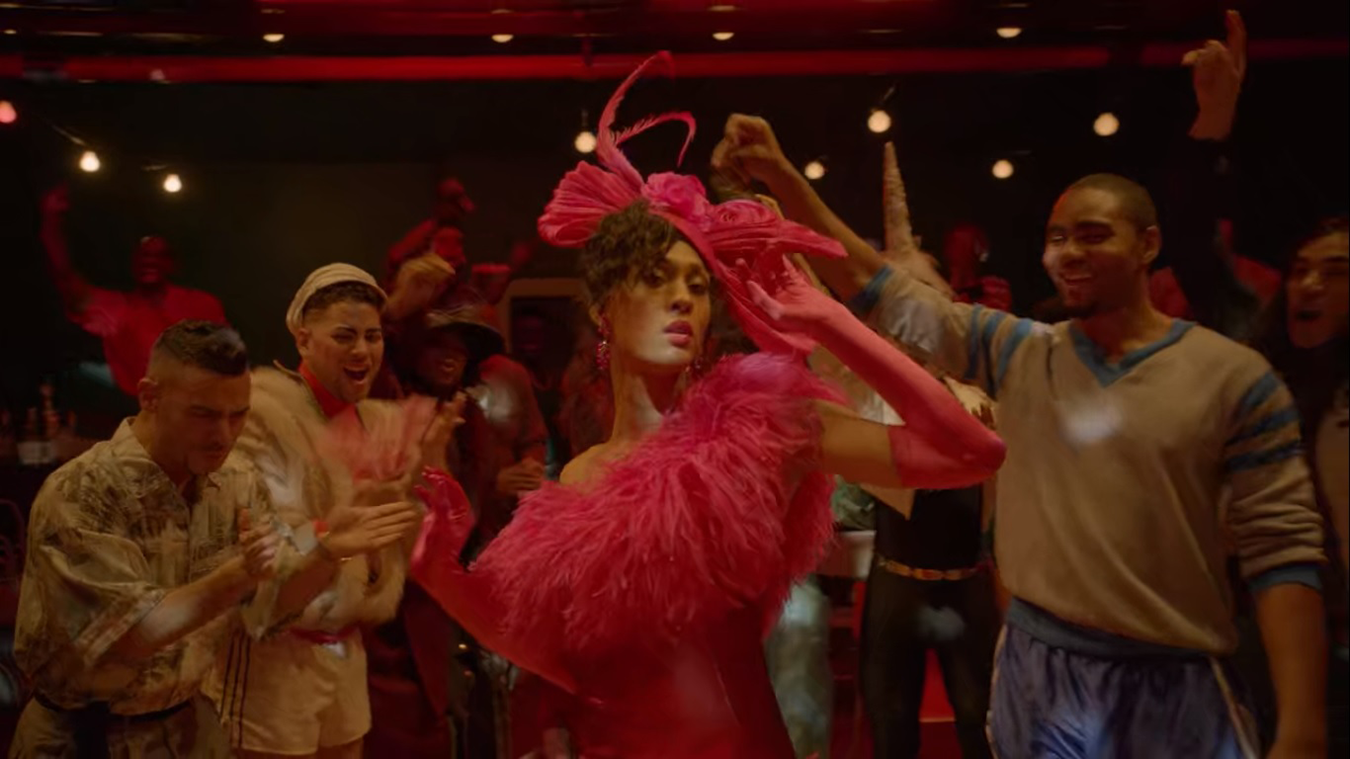
Mj Rodriguez Vogueing in the Ballroom Scene in Pose (Color Force, Brad Falchuk Teley-Vision, Ryan Murphy Television, 2018).
Shifting the discussion of trans from a question of representation to one of reading, Koch-Rein et al’s recent academic article, ‘Representing Trans: Visibility and its Discontents’ (2020), is one of the few to consider both Transparent and Pose, among a range of other trans representations. The authors suggest drawing on work by queer and trans theorists Jack Halberstam and Susan Stryker among others, asserting that they want to foster such an ‘expansive’ interpretation of both terms ‘trans’ and ‘representation,’ which should be considered open for debate and not tied to any clear-cut definition […]. In such an understanding, ‘trans’ itself can be understood as a methodological tool to analyse media. […] In such a ‘speculative’ framing of trans, similar to the notion of queering as a verb […] representing trans is fundamentally tied to the ambivalences of visibility in relation to embodied trans lives (Koch-Rein et al., 2020: 6).
On this basis, the article suggests that the plethora of recent trans representations on television and elsewhere should not just be seen as ‘a progressive signposting of liberal inclusion and a celebration of more “mature” and realistic depictions of trans lives’ (Koch-Rein et al., 2020: 6), but as a veritable ‘transing’ of existing television genres and conventions. They embody this approach by offering a reading of the non-realist aspects of both Pose and the Transparent finale that brings different aesthetic strategies together as a ‘transing’ of contemporary television: Like Pose’s ‘woke’, but at times anachronistic, conversations from the coffin and the splendour of its soapy lip-synched extravaganza, the recent musical finale of Transparent also resorts to defamiliarising aesthetic choices and thus can be read as part of such a queering/transing of form that departs more radically from the confines of realism. Violence and trauma are addressed in these shows in a tonality that – via moments of bursting into song and breaking the fourth wall – resists the confines of realism and instead uses TV as an escapist tool that celebrates trans visibility and resilience and offers hope, sometimes against all odds. […] Consequently, the politics of trans representation are not limited to the notion of ‘authentic’ or ‘good’ trans representations but ideally intervene and trans our ways of looking at the world. (2020: 6–7).
In the first part of this final dossier, published in June 2020, we encouraged authors to investigate such ‘transing’ of the medium from the perspective of the here and now. Indeed, the ongoing nature of dossier delivery for this project has enabled a dynamic means of interrogating rapid transformations in the televisual form in the moment of their happening. In that spirit, Catherine Johnson’s article adopted a more technological and industrial vantage point, considering the ever-growing importance of apps in shaping contemporary television, and tracking the shifting relationships between content providers, digital platforms of delivery and viewers. In so doing, Johnson shed new light on the power dynamics of the current television landscape, with the more consolidated companies who control internationalised content delivery mechanisms and access, largely determining the ‘app-isation’ of television. Balancing this with more textual and reception-focused perspectives, Stéfany Boisvert’s article explored viewer responses to changing representations of LGBTQ+ characters in television drama, utilising Sense8 (2015–2018) and Billions (2016–) as case studies. Boisvert viewed these examples through the lens of queer TV studies, calling into question essentialist conceptions of gender and sexuality. Placing the case-studies in their different settings of delivery, Boisvert reflected on differing viewer readings of the shows’ characters, including forceful debates around connected ambiguities of identity. In so doing, Boisvert concluded that, whilst not determined by SVOD versus cable delivery mechanisms, the distinct ways in which these dramas’ LGBTQ+ characters have been interpreted by audiences were nevertheless influenced by divergent industrial positionings and approaches.
Building on these examinations of Trans TV in this issue, the second and concluding part of the dossier offers two further articles and an interview piece. Mareike Jenner’s article provides an overview of the various ways in which binge-watching is presently interpreted within television studies, through technologies of viewing practices, fan studies, audience reception and narratology. As Jenner recognises, research on binge-watching has links to the research of broader online economies, consequently placing the study of contemporary television viewing practices at the heart of larger debates concerning digital culture. In outlining the different current modes of binge-viewing analysis, Jenner uncovers the inherent flexibility and versatility of ‘binge-watching’ as a term, repeatedly adapted within the contexts of a constantly changing medium and a vibrantly complex and diverse field of scholarship.
Following the pattern of the previous June issue, Jenner’s wider exploratory piece on binge-watching is followed by a more text-focused article from Anamarija Horvat, drawing specifically on the television dramas, Transparent, Years and Years (2019) and Orange is the New Black. Through an attentive consideration of aspects of these shows, Horvat traces the different ways that US and UK contemporary queer television depicts the act of LGBTQ+ border crossing and therefore engages with current political debates surrounding immigration and border control. Horvat observes the gradual expansion of television drama’s representations beyond its traditional concentration on the white middle classes, beginning to encompass a more inclusive exploration of complex migrant identities and the linked concerns of geopolitical borders. By means of nuanced textual analysis, Horvat identifies the ways in which both Orange is the New Black and Years and Years pose explicit critiques of the immigration systems of which they present. Chiming with earlier elements of this introduction, Horvat goes further to examine how Transparent, by contrast, offers – through presenting the Pfeffermans’ trip to Israel and Palestine – a more metaphorical reading of borders, border crossings and diasporic identity. Whilst problematising the notion of borders and signalling the progressive value of LGBTQ+ solidarity across the perimeters of nation and culture, Horvat argues that Transparent’s representations are themselves problematic in prioritising the personal lives of its main US characters over these more expansive concerns. Nevertheless, Horvat asserts that such dramas collectively point towards a new phase of queer television, not only in expanding the inclusion of LGBTQ+ characters, but also in queering the homonationalist traditions of portraying LGBTQ+ identities.
The dossier concludes with an interview piece from Christopher Hogg in conversation with British television actor Julie Hesmondhalgh. Hesmondhalgh became a household name as Hayley Cropper in Coronation Street (1960–) from 1998 to 2014, as the first recurring transgender character in a UK continuing TV drama. In this interview, Hesmondhalgh connects aspects of her own career to larger industry developments in casting and representation, diversity and inclusion. With extended reference to Coronation Street and Doctor Who (1963–1989, 2005–), she reflects on how far UK TV drama has come in addressing systemic inequalities and exclusions, whilst stressing the progress still required, particularly in relation to the complexities of class identity. More fundamentally, the actor insights shared within this piece stress the worth of industry interviews as an aspect of television studies’ methodological scope, in revealing the experiences and perspectives of key creative agents within the production process. As such, the interview adds a further perspective to the Trans TV project’s surveying of a medium in transformation.
Footnotes
Declaration of conflicting interests
The author(s) declared no potential conflicts of interest with respect to the research, authorship, and/or publication of this article.
Funding
The author(s) received no financial support for the research, authorship, and/or publication of this article.
Authors biographies