




Abstract
This article explores recent uses of the tracking shot in various media. Examples drawn from television, video games and video art reveal that recent audiovisual media have frequently used a particular kind of tracking shot that follows an individual through a complex environment. This article argues that this tracking shot contributes to an aesthetic of stealth, that is, a perceptual attunement to notions of imperceptibility and secrecy. The stealth tracking shot can thus be seen as one of the aesthetic principles that articulate discourses of securitisation. The argument proceeds in three steps. First, the article shows that this specific use of the tracking shot takes inspiration from third-person video games. An analysis of the stealth game Splinter Cell: Blacklist (2013) shows how the mobile ‘following camera’ allows the viewer to perceive the avatar in his or her environment. Then, in an analysis of the unbroken tracking shot in True Detective (2014), it is demonstrated how this kind of tracking shot contributes to a reformulation of the notions of law enforcement underlying crime fiction. Specifically, the tracking shot is related to the notion of stealth democracy. Finally, the article considers Hito Steyerl’s video ‘Guards’ to show that the aesthetic principles of stealth operate not only in individual media objects but more generally in public spaces and institutions such as museums and art galleries. To conclude, the article situates the stealth tracking shot in a more general consideration of the politicality of media aesthetics.
Introduction: A contemporary tracking shot
One of the most discussed television scenes of recent years is surely the 6-minute tracking shot from True Detective, in which cop Rust Cohle (Matthew McConaughey) accomplishes a double escape from both the criminal gang that he investigates without authorisation and his police colleagues who might find out about his rogue investigation ( True Detective 2014. 1: 4, see also O’Sullivan, 2017). For 5 minutes and 54 seconds, the camera moves behind and around a body that is precariously placed within an urban battle zone. As the fronts multiply to include opposing gangs and the police, Cohle, whose affiliation to every one of these fronts is temporarily broken, must evade all of them.
This sequence is remarkable for a number of related reasons. First of all, it stands out for its technical and aesthetic virtuosity. True Detective’s tracking shot stands in a long tradition of masterfully composed ‘unbroken shots’ which combine a tracking camera movement and the duration of the long take, a tradition that spans from Hitchcock’s Rope (1948), over Welles’ Touch of Evil (1958) and de Palma’s Snake Eyes (1988), all the way to McQueen’s Hunger (2008) and Cuarón’s Gravity (2013). In fact, the single-take movie in the tradition of Rope has made a noteworthy return in recent years, with films like Sokurov’s Russian Ark (2002), Iñárritu’s Birdman (2013) and Schipper’s Victoria (2015), to name only a few (see Gibbs and Pye, 2017). In all of these examples, the long-take tracking shot requires an extraordinarily complex orchestration of all elements of production including camera movement, sound recording, changing lighting conditions and, of course, the actors’ performance. All of these components must be perfectly attuned to each other. For this reason, this article will suggest that the long-take tracking shot can be said to compose an audiovisual milieu.
Secondly, True Detective’s tracking shot is closely tied to the protagonist’s body and moves with him through an associated milieu, a concept proposed by Gilbert Simondon and that will be further explored in the following section. As a result, the above-mentioned virtuosity of the successful tracking shot is experienced as the extraordinary skill of Rust Cohle. This particular type of tracking shot participates in a modification of the figure of the TV detective: no longer an uninvolved outside observer who re-establishes social order by means of forensic investigation and rationality, the detective is utterly entangled in a complex social field whose management puts his own existence at stake. This article proposes moreover that the mode of action to be favoured in a situation thus changed is that of stealth, understood as furtive action that is efficient mainly because it remains imperceptible. The contemporary detective no longer seeks open confrontation with his opponent in a clear-cut distribution of the ‘good’ upholder of the law and the ‘bad’ criminal. Rather, the stealth detective accomplishes his mission by acting below the threshold of the perceptible and beyond the rule of law. In that regard, contemporary law enforcers – at least as the media imagine them – are suspiciously close to criminals. While the focus of the present argument will be on the specific aesthetic experience of justice to which the stealth tracking shot gives rise, this experience will also be related to political theories of ‘stealth democracy’, a term indicating ‘support for business-type approaches to governing’ that should be accountable on demand, but need not operate publicly or transparently otherwise (Hibbing and Theiss-Morse, 2002: 138). And finally, the scene is remarkable because it imports into television the aesthetics of third-person videogames. True Detective’s long-tracking shot is clearly informed by the aesthetics of the third-person action-adventure and, more specifically, the stealth game. In order to trace this lineage, the present account begins by establishing the specific aesthetics of the stealth action-adventure through an engagement with the videogame series Splinter Cell (Ubisoft, 2002–2013). This will help demonstrate that the securitising secrecy of stealth is an aesthetic trend which works across media and art practices. To further establish this point, the article will conclude by looking at Hito Steyerl’s single-channel video ‘Guards’ (2012), which addresses the militarisation of everyday life and art institutions in particular.
It should be noted that the corpus of this article is strongly grounded in US political culture: True Detective was filmed on location in Louisiana for the US cable network HBO; Splinter Cell: Blacklist was developed in Canada by Ubisoft Toronto, but tells the story of secret NSA “(National Security Agency)” agents; Hito Steyerl is a German artist and author, but her video piece ‘Guards’ explores the work of private security professionals at the Art Institute of Chicago. Accordingly, the article’s scope is limited to the political culture of the United States as received within the United States as well as abroad.
Associated milieus in third-person stealth games: Splinter cell
As of writing, the Splinter Cell series consists of seven video games and seven novels, all published between 2002 and 2013. The series’ protagonist Sam Fisher is an elite agent within a black-ops division of the NSA called ‘Third Echelon’. In the first novel from the series, Tom Clancy’s Splinter Cell, Sam Fisher describes his occupation as follows: Third Echelon agents are called Splinter Cells, and I was the very first one. We physically infiltrate dangerous and sensitive enemy locations to gather the required intelligence by whatever means necessary. Our prime directive, in a nutshell, is to do our jobs while remaining invisible to the public eye. We’re authorized to work outside the boundaries of international treaties, but the U.S. will neither acknowledge nor support our operations. / Thus, Third Echelon, a sub-agency of the NSA, consists of an elite team of strategists, hackers, and field operatives. We respond to crises of information warfare – a war that is hidden from the media and the ordinary man on the street. You’re not going to see our battles on CNN. (Michaels, 2004: 58)
The two dominant perspectives in 3D action-adventures are first-person and third-person, terms that describe the placement of the ‘virtual camera’ in the game space. First-person perspective suggests that the image coincides with the visual field of the fictional character whom the player moves. Thus, camera movement corresponds to the avatar’s turning of the head and directional movement. In addition, the image conventionally shows the avatar’s hands at the left and right bottom of the screen, which also indicates the weapon with which the avatar is currently equipped. The first-person point of view is the most common in shooting games or ‘first-person shooters’. In contrast, third-person perspective uses a ‘following camera’ which places the player’s point of view behind the avatar and ‘follows’ it through the game space at a more or less fixed distance (Nitsche, 2008: 93). In cinematographic terms, then, most third-person, 3D action-adventures present the game action by means of a continuous tracking shot. This aesthetic feature is used in most contemporary blockbuster 3D action-adventures, including the main entries in the Tomb Raider, Grand Theft Auto, Batman: Arkham, Uncharted and Assassin’s Creed series. It is also the perspective chosen in the games from the Tom Clancy’s Spinter Cell series (Figure 1).
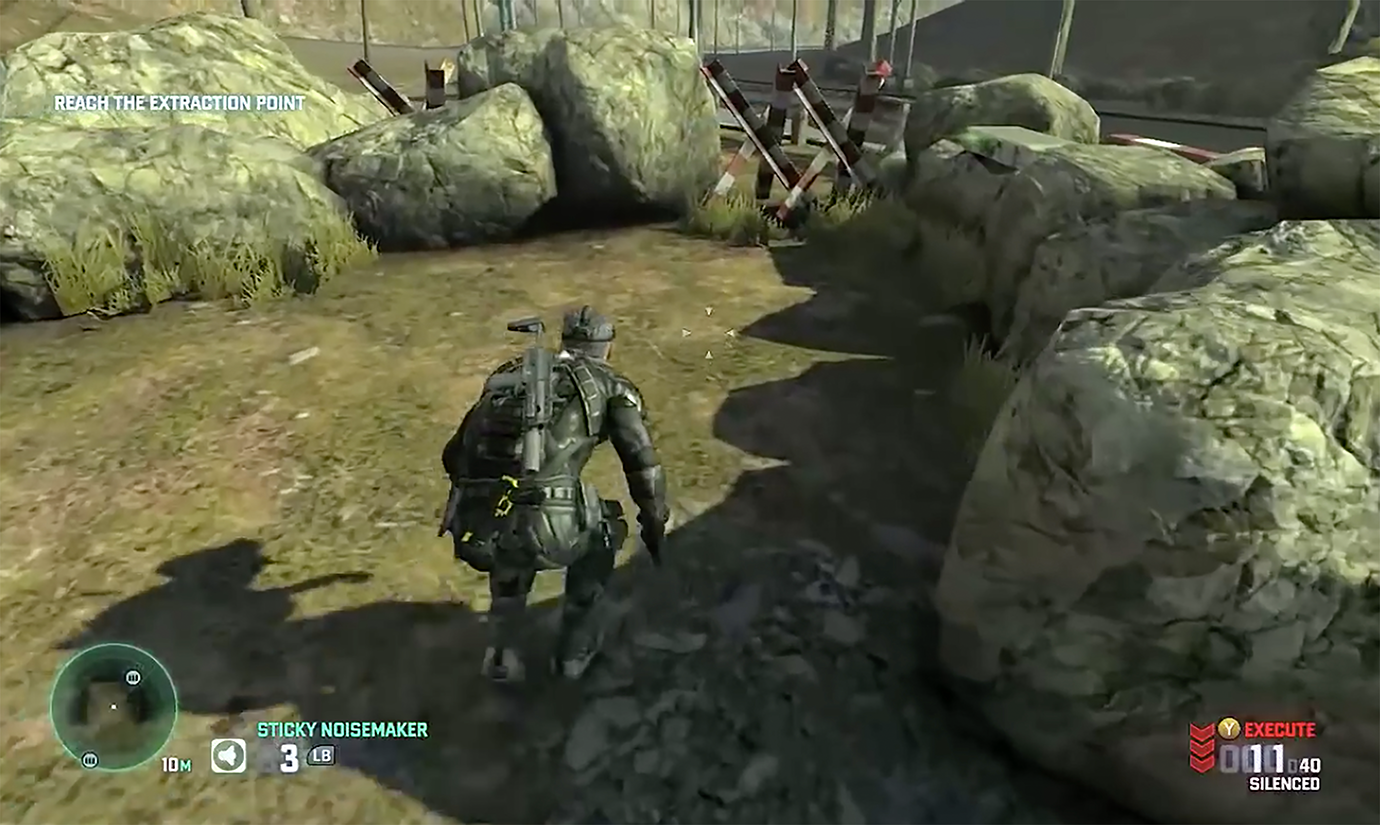
Third-person perspective in Splinter Cell: Blacklist (Ubisoft, 2013).
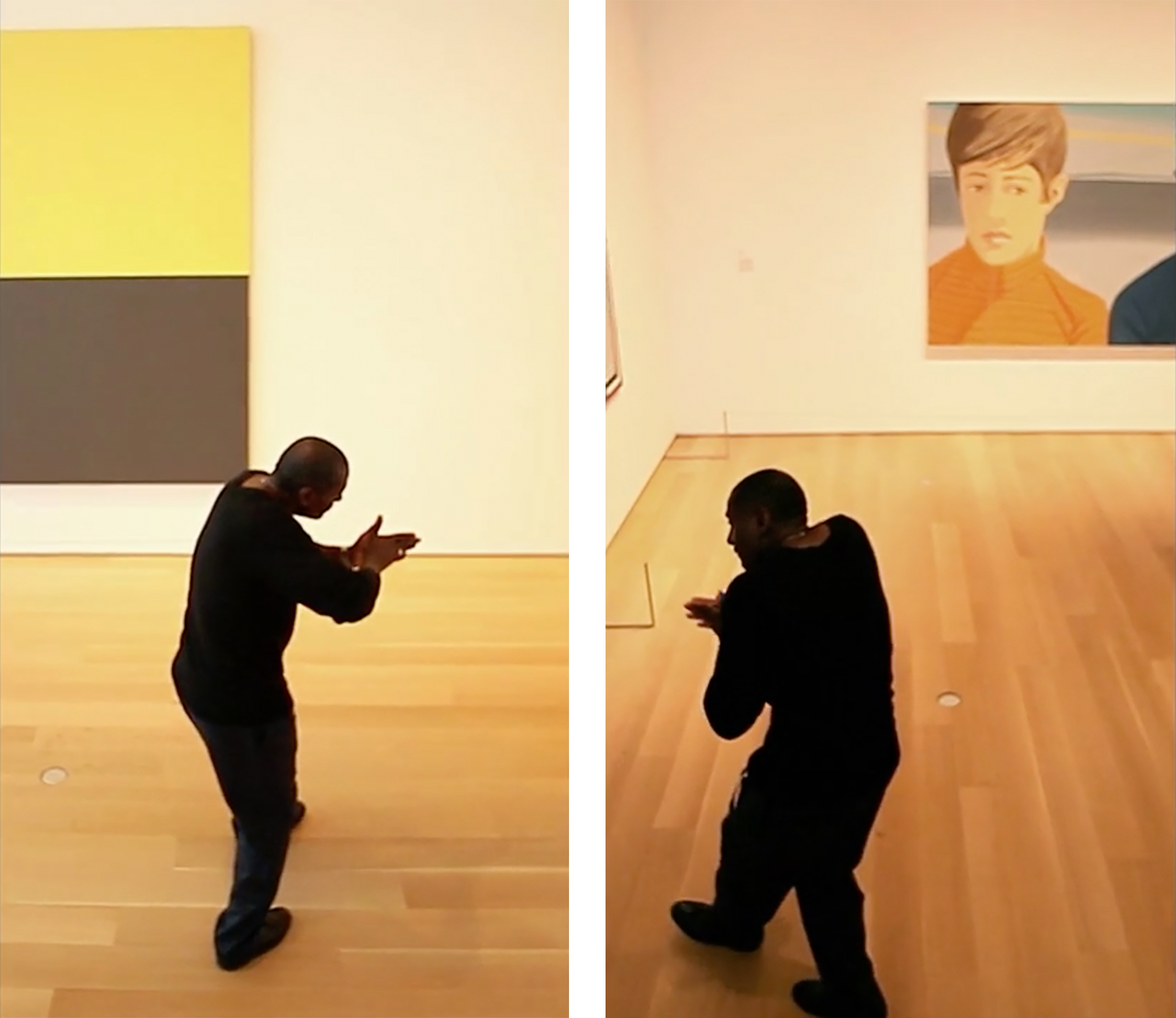
Stills from Hito Steyerl’s ‘Guards’ (2012). Images CC 4.0 Hito Steyerl. Images courtesy of the artist and Andrew Kreps Gallery, New York.
This choice of perspective is crucial because it tethers the camera to the avatar and, at the same time, allows the player to explore the surrounding game space. For, while the distance between the avatar and the camera position is relatively fixed, the position and angle of the camera are not. The player can freely circle the camera around her avatar to scan and analyse the surroundings. As she moves both her avatar and the camera, the player engages in what Michael Nitsche calls a ‘double exploration’ of the game space: ‘as hero and as detached camera operator’ (2008: 98). While this formulation is technically correct, and even though inexperienced players will find the required coordination of their thumbs challenging, in advanced gamers, these two separate movements of avatar and camera experientially fuse into one complex exploration of the environment in relation to the avatar. This aspect is crucial to the stealth tracking shot as it is theorised here: It does not foreground the two separate elements – avatar and game space – that must be considered and navigated simultaneously but, rather, emphasises the shifting relational field that these elements co-compose. In other words, the third-person perspective produces an aesthetic experience of an event ecology (the goal of which is to making nothing happen).
Consider the following example from Splinter Cell: Blacklist. (Ubisoft, 2013; see here for the discussed excerpt: https://youtu.be/HStaqYrafUo?t=2m20s). The video shows an excerpt from the walkthrough of the mission ‘Border Crossing’, which tasks the player to obtain three intel files without being detected. In this particular side mission of the game, detection will lead to an ‘automatic fail’ and respawn the player at the beginning of the mission. This means that the player has to adopt a particular play style of ‘pure stealth’ or what the game refers to as ‘Ghost’ mode: The player remains undetected and bypasses enemies entirely. (Strictly speaking, the mission also allows the ‘Panther’ play style, which similarly requires ‘no detection’ but allows for lethal takedowns as long as they remain silent/undetected.) Indeed, higher mission scores are awarded for leaving enemy guards completely untouched. In the present excerpt, this leads to a suspenseful calmness of the gameplay: There are no gunshots, bomb explosions or any other noise of force-on-force combat. Instead of seeking open confrontation, the player calmly analyses the game space as a material and perceptual ecology by repeatedly circling the camera around the stealth agent. This process of situating the avatar in their milieu not only involves the parsing of the space into, say, cover spots but also an attunement to the position of enemy guards, the direction they look in, their movement patterns and perceptual abilities (e.g. usually snipers are more perceptive than regular guards). All of these factors need to be considered in order to find openings in the perceptual field or what Gibson would call affordances for staying out of sight (2015: 119–135). Before the avatar enters the back of the truck, the player has to perfectly time the short interval in which the four enemy posts, including one sniper, do not look at the truck. This moment is her affordance for stealth. She barely succeeds: The detection warning – a white arrow that points in the direction of the guard that sees her, accompanied by a shrill sound – indicates that the sniper on the roof has almost identified a hostile individual on the premises. Stealth gameplay turns around this ‘almost’ of perception. To accomplish the mission, one must act and thus expose oneself to the risk of detection. But one must do it in such a way as to remain just under the threshold of the perceptible. As the video shows, the openings for stealth are constantly shifting in relation to the changing perceptual ecology (i.e. enemy movement, changing sightlines, etc.). Accordingly, every moment of continued individuation through the surrounding game space must be composed with that immediate environment, the associated milieu. The remainder of the walkthrough video gives an indication of the level of complexity that such a milieu can attain: In addition to various human enemies with a range of perceptual abilities, the player encounters surveillance cameras, laser grids, landmines and – in other missions – guard dogs, all with their own sensory capacities. The crucial aspect for the present argument is that of withness, the relationality that characterises the individual’s existence. The player cannot simply make her avatar move up against the environment and confront her enemies; she must perceive her adversaries’ perception and move along her antagonists’ movements. In other words, she must individuate with and through her immediate surroundings.
When Gilbert Simondon proposed the notion of associated milieu, it was precisely to withdraw from the conception of a pre-constituted individual who exists in an already defined, mechanical space and to foreground the chrono-topological ensemble that constitutes a process of individuation (2005: 63, 149). In the case of stealth gameplay, this implies to a certain extent that one becomes one’s enemies, not at all in the sense that one simply copies them or matches their movement. Rather, as in the present video excerpt for instance, the player extracts from the perceptual ecology and the enemies’ movement a contrapuntal movement that constitutes a possibility of life (or survival). To individuate is to enter one’s environment as a relational field and integrate the available information into another moment of existence. It is important to note that information, as Simondon defines it, is the tension between two disparate realities, it is the signification that emerges when a process of individuation reveals the dimension through which two disparate realities together become a system; information is thus an instigation to individuation, a necessity to individuate; it is never something that is just given. (Simondon, 1992: 311, emphasis in original, translation modified)
It is this activity of making tensions compatible and moving into the next affordance for imperceptibility, only to encounter new tensions within the milieu, that gives stealth gameplay its simmering or lowly pulsating suspense. Stealth acquires this intensity because its success or failure depends on smallest deviations: just one miscalculated step, one badly timed move and the entire perceptual ecology tips from imperceptibility over into open confrontation (or a ‘mission abort’ in the case of the above-mentioned example). Accordingly, stealth gameplay can condition the player’s attention towards minor differences for instance in contrast, as studies in perception have shown (Li et al., 2009). The specific vibrant attention of the stealth gamer encompasses the entire perceptual ecology of the game space to find within it the microscopic opening for disappearance, the split second for the next vanishing act. One could say that stealth gameplay is a bit like a walk on a tightrope to the extent that both can be interrupted by just the smallest mistake. The difference is that, in order to avoid that mistake, stealth gameplay actually requires a lot of variable movement, course corrections and detours. The particular aesthetic achievement of the third-person perspective in combination with the following camera is to allow for this relational exploration of the individual in their associated milieu, the attunement towards smallest deviations and an optimal individuation through the game space.
‘Stealth democracy’: True Detective
This desire to avoid smallest mistakes constitutes a parallel between the aesthetic of the stealth game and the televisual tracking shot in True Detective. As was stated at the beginning, an extended tracking shot like the one in True Detective requires a concerted effort to integrate all elements of production. The smallest mistake will lead to a ‘cut’ and the take will have to be repeated from the very beginning. Of course, many extraordinarily long one-takes are not actually shot continuously. As in Hitchcock’s Rope, recent continuous takes include moments of darkness or extreme close-ups of monochrome surfaces that allow for an edit to go unnoticed; or they are largely animated, as in the case of Gravity’s opening scene. With regard to True Detective, it has been suggested that the sequence in question is broken at the moment where the camera pans up to reveal a helicopter that passes over the scene. In all of these cases, though, the aesthetic continuity of the shot is maintained across technical discontinuities. This is important for the one-take’s aesthetic efficacy because it draws much of its suspense from this apparent capacity for perfect integration. The holding of the same though mobile point of view for several minutes can create a variety of affective intensities relating to paranoia and imminent threat (The Shining), claustrophobia and the impossibility of escape (Children of Men) as well as commanding force and power (Goodfellas). The suspense of True Detective’s tracking shot arises, much like in a successful walkthrough in a stealth game, from the continued individuation of the protagonist through an overwhelmingly complex environment and a cascade of adverse events.
The unbroken sequence begins as an attempted robbery (True Detective 2014. 1:4; the excerpt under discussion can be viewed here: https://youtu.be/s_HuFuKiq8U). The Iron Crusaders, led by gang member Ginger and Rust Cohle in an unauthorised undercover operation, want to rob the members of a rival gang. However, the robbery soon turns into an open shoot-out. When the cops arrive, chaos breaks loose. Cohle is in a most precarious situation: Both the rival gang and the police will want his neck (the latter for his unauthorised methods). In order to escape with valuable information, he decides to blow his cover with the Iron Crusaders and takes Ginger prisoner. His task is now to subdue his captive, who tries to escape from Cohle’s escape, and evade the two rival gangs as well as the cops. Aesthetically, this sequence is rendered through a tracking shot that is tethered to Cohle’s body in the same way that the camera of the third-person stealth game follows its avatar. Although the camera is allowed a somewhat wider range of distance from the protagonist than in Splinter Cell, Cohle is clearly the central point around which the camera revolves as he moves through space. Indeed, the camera freely circles around Cohle to reveal elements of interest such as approaching enemies, a police helicopter and potential escape routes. More importantly, the chain of events presented borrows many elements from video game action, especially in the latter half of the sequence beginning after Cohle has spoken to his partner Marty on the phone. Thus, the influence of video game aesthetics is evident in moments where Cohle has to fend off individual enemies through a combination of dodge/counter/strike; run after Ginger with an urgency reminiscent of tailing or chasing missions and their ‘Reduce distance to target’ warnings; as well as take cover and hide behind bushes to wait until the threat of a police squad has passed. Like the stealth agent whose existence is denied even by her own government, Cohle’s survival strategy is to make tactical use of a complex perceptual and political ecology to find openings for imperceptibility.
The most important aesthetic difference between stealth gameplay as discussed above and True Detective’s tracking shot consists in the divergent speeds and levels of noise that allow for the protagonist’s disappearance. Stealth gameplay can be extraordinarily slow and silent. By way of example, consider the long periods of waiting necessary to proceed undetected in the above excerpt from Splinter Cell: Blacklist; recall the suspense that emerges from the desire to avoid any kind of noise to a point that even the detection warning seems like an unwelcome, startling intrusion. In True Detective, this overall calmness and slowness of stealth gameplay is eschewed in favour of an audiovisual attack on the senses. This is mainly achieved by the sonic environment that the sequence creates without establishing a sense of order or orientation. The viewer’s sonic orientation is disrupted at the same time as Cohle’s when gunshots are fired in the small projects bungalow and the soundtrack is taken over by a high-pitched ringing. When Cohle’s and the viewer’s hearing returns, it is assaulted by screams, sirens and vehicle noise. In addition to this sonic disorder, the viewer is further disoriented by a camera whose movement she cannot control. Instead of following a clear trajectory, the camera erratically jerks into any direction from which light and sound assail it. This happens for instance once the police helicopter can be heard and its searchlights enter the frame: The camera pans up and we briefly lose track of the individual that anchors the shot. In short, whereas the following camera in stealth videogames suggests imperceptibility through a tentative, relational movement with the surroundings, the tracking shot in True Detective makes the individual disappear into a sea of noise. This aesthetic difference is immediately ethico-political in two major respects. The first concerns the ethical potential of the long tracking shot itself, while the second is relevant to the figure of the contemporary detective more generally.
In the essay ‘The Evolution of the Language of Cinema’, André Bazin suggests that the long-take might have a particular potential to activate viewers and foster in them a simultaneously more dispersed and more focused mode of attention: [The long-take or plan-séquence] affects the relationships of the minds of the spectators to the image, and in consequence it influences the interpretation of the spectacle. […] it implies, consequently, both a more active mental attitude on the part of the spectator and a more positive contribution on his part to the action in progress. While analytical montage only calls for him to follow his guide, to let his attention follow along smoothly with that of the director who will choose what he should see, here he is called upon to exercise at least a minimum of personal choice. It is from his attention and his will that the meaning of the image in part derives. (Bazin, 2005: 35–36)
Of course, one cannot simply transpose this argument about the films of Orson Welles and Jean Renoir to the context of contemporary media. The relevance of Bazin’s observations to the present account does not lie in their ‘applicability’ to the following camera in video games or the tracking shot in True Detective but, rather, in the productive tension between these technically related procedures. If Bazin suggests that the long-take liberates the viewer from the predetermination of meaning through editing, surely this is no longer the case in True Detective. It is impossible to assess calmly the various components of the image and linger on those that one might find of interest. The reasons for this difficulty lie partly in the mobility and speed of the camera and partly in the fact that the long-take is indexed to one particular body within the frame. So instead of the editor, it is the cameraman and the protagonist of the sequence who restrict the viewer’s freedom of choice. But none of this diminishes the ethical stakes of this sequence. Rather, the tension between Bazin’s concept and True Detective’s percept discharges into a reconsideration of what can count as an ethics for our time. For Bazin, the ethical achievement of the long-take is to give the viewer agency as the outside observer of a mostly static frame filmed in depth. In today’s mobile long-takes, there is no outside. Nor is there strictly speaking agency. The contemporary tracking shot foregrounds ecology and assemblage. In other words, there is a Simondonian ‘making-compatible’ of tensions in order to create an existential line of flight for protagonists, avatars and viewers. This concern can be articulated at various speeds: It can be slow as in Splinter Cell or fast as in True Detective. In either case, it is an ethics that is no longer based on reflective judgment according to a predetermined moral standard, but one that works through immanent criteria and requires that one adapt one’s capacities to affect and to be affected in such a way as to create possibilities of life (see Deleuze, 1988: 17–29). True Detective suggests by way of plot development that, if Rust Cohle had adhered to the moral and professional standards of the police, his crime investigation would have been unsuccessful (and the scene discussed here might never have occurred). A code of conduct formulates the sanctioned rules and methods by which law enforcement officials are allowed to proceed but, the series suggests, the very strictness of those rules may curtail the investigators’ efficiency. True Detective proposes alternatively that, in order to achieve justice, appropriate modes of moving and behaving need to be continuously (re)invented in relation to a given situation. Establishing ‘the right thing to do’ is always a relational practice; the proposed solution is always provisional. True Detective’s tracking shot articulates this aesthetically by placing a vulnerable individual in a highly complex, threatening environment and by highlighting the multiple and changing requirements for survival through the mobile camera circling around the individual. In this way, the series performs an ethics on the fly for the control society in which the conditions for appropriate intervention constantly shift.
This changed notion of ethics becomes clearer with regard to the figure of the detective articulated in this sequence and in True Detective more generally. Rust Cohle belongs to a group of recent detectives in televisual crime fiction whose commitment to the conventional values of transparency, accountability and objectivity is questionable. A considerable number of contemporary TV detectives – including characters like Dexter, Carrie Mathison and Saga Norén – stand out for being so utterly involved in the complex reality of their cases that they are no longer able to assess objectively a situation as a rational, external observer (see Coley, 2017). Moreover, their outstanding intelligence borders on madness and they disrespect chains of command and protocol. (It should be noted that the disrespect for chains of command and protocol is well established in crime fiction. Detectives in film and television have been breaking with the above-mentioned values of transparency and accountability for a long time. One may think of film noir protagonists such as Sam Spade and Phillip Marlowe or ‘Dirty’ Harry Callahan who informed an entire film genre of corrupt or unconventional detectives. Television has also known its share of unconventional police detectives and mavericks before the turn of the century, for instance in Miami Vice (NBC, 1984–1989). It would be wrong to interpret this trend as the failure and decline of the detective on television. For, at the same time, these characters are utterly efficient. Indeed, they are often presented as the only ones paranoid enough to perceive reality appropriately and unconventional enough to mete out justice. This type of detective – involved and irrational – is a reworking of the figure within the context of the control society and its increased complexity. The morally ‘flexible’ detective is able to insert himself or herself into a changed ecology of powers (see also Barker and Cottrel, 2015).
This ecology has been described as ‘stealth democracy’, a notion that speaks to the widespread sentiment among the US population that politicians are self-interested, that parliamentary debates inflate conflicts and, at the same time, lead to foul compromises (Hibbing and Theiss-Morse, 2002: 130–137; see also MacLean, 2017, for a very different relevant approach). However, what the people seems to want instead is not that power be shifted to them. To their own surprise, Hibbing and Theiss-Morse’s empirical research shows that the US population expresses ‘support for business-type approaches to governing or for turning authority over to something as amorphous and unaccountable as “nonelected, independent experts”’ (138). The underlying assumption is that, in this way, bipartisan quarrelling would be avoided and problems would get solved more pragmatically and efficiently. The government should be ‘visible, accountable, and representative’ on demand but may operate in stealth as long as it does its job properly (2). After 9/11, US governmental procedures have partially adopted this political style: Government potentially illegally bypasses congress (and dissensus) in order to authorise air strikes on foreign territory (Calamur, 2014), wars are fought by private ‘security services companies’ such as Blackwater, opaque surveillance networks span entire regions of the world. Counter to the population’s wishes, however, post-9/11 government has not always provided efficiency and accountability on demand.
The stealth tracking shot and its protagonists perform this new kind of political ecology aesthetically and attune audiences to its functioning. Splinter Cell’s Sam Fisher may be hired by the government but is relieved of any accountability. His very existence will be denied to give him the executive freedom necessary to ‘get the job done’. True Detective’s protagonist effectively acts as a third party that lithely moves between the police and organised crime, not against but beyond the law. Renouncing transparency and accountability, he proceeds in darkness to produce results that none of his law-abiding colleagues can deliver. In the process, crime and law enforcement become indistinguishable. Rust Cohle is a detective for the control society, the hero of stealth democracy. This correlation of the blurry lines between crime and lawfulness on the one hand and the character’s flexibility and responsiveness to the surroundings on the other hand are not coincidental. In The Birth of Biopolitics, Michel Foucault had already argued that ‘the anthropological erasure of the criminal’ (in favour of an interpretation of crime according to economic criteria such as risk, benefit and productivity) ultimately leads to politics as an ecological or ‘environmental type of intervention’ of which stealth is an example (2008: 258–260). The stealth tracking shot as described above performs this new political sphere aesthetically as it takes perception into an ecology of powers and articulates situated modulations of the environment as the way to safety and securitisation. Snaking its way through clearly stated fronts, it shows that the stealth agent’s imperceptibility is what ensures her efficacy (Pape, 2017).
Coda: ‘Guards’
The securitisation of the environment by means of stealth pervades media arts not only as an aesthetic trend; it has also become a modus operandi of art institutions themselves. As public spaces that hold valuable cultural assets and participate in economic circuits of impressive magnitudes, museums and galleries have become high-security areas. (On this specific issue, the reader may also consult Hito Steyerl’s ‘Duty-Free Art’, three-channel HD video, 2015. This piece also contains excerpts from the stealth videogame Assassin’s Creed Unity [Ubisoft, 2014].) This means that security personnel are no longer there only to prevent the occasional misbehaviour of a visitor who might want to touch an artwork or carry food items through an exhibition. Their mandate presently includes the prevention of concerted acts of vandalism and potential attacks on the visiting public. In other words, museum security approaches its site of operation as a complex battle zone. This ‘new normal’ is the subject of Hito Steyerl’s (2012) single-channel video Guards. Focusing on two private security professionals with a military background working at the Art Institute of Chicago, the piece explores the extent to which the privatisation of military services has infiltrated institutions of everyday leisure and education. According to Steyerl, the art world is thoroughly entangled with current developments towards the militarisation of the civilian public sphere and what is here theorised as an aesthetic of stealth.
Guards begins on a blackscreen that shows only the piece’s title accompanied by the sound of slow, measured footsteps. The result of this opening is a playful confusion as the gallery visitor cannot be sure whether these unseen, roaming feet come from the speakers of the video setup or from the very gallery space she finds herself in. Her head may turn to make sure that nobody is approaching her from behind. Thus, as the video temporarily blurs the boundary between the gallery visitor’s own surroundings and the representational space of the video, her spatial awareness heightens and she is bound to think the video’s subject matter through her own embodied relation to the gallery space. By way of this auditory trick at the beginning of Guards, the immediate environment of the gallery visitor is directly concerned by the video’s project. This effect is further increased by the fact that the video with its unusual portrait orientation is projected on a freestanding screen. At Steyerl’s gallery show ‘Left to Our Own Devices’ at KOW Berlin (17 September to 5 December 2015), the screen was placed in a darkened corner of the gallery, which gave the piece itself an obscure and impervious surrounding.
The opacity of the museum space is also the concern of the security agents that Guards presents. In their account, the museum becomes a zone of potential threat and combat not unlike the spaces of Splinter Cell and True Detective: So as I walk through this space and try and determine security aspects of it, some things I keep in mind is the actual set-up of the room: points of view, lines of sight. What are the advantages that we can take in terms of the space, the use of the space? (Steyerl, 2012)
The guards repeatedly demonstrate how they ‘run their walls’ to make sure that no potential threat escapes their observant eyes. As the camera slowly follows the guards tentatively skulking along the walls and around the corners of the gallery, the tracking shot once again foregrounds the individual’s relation to the environment. And once again, this relation is constantly modulated towards the goal of an optimal management of visibilities. Here, vision must not be brought to rest on an art object; it must be dispersed across a dynamic relational field. Where the visitor may see a corner and curiously anticipate the next gallery of masterpieces, the museum guard perceives a potential hiding spot for an ambush. While the former may appreciate the visual pleasures of consuming the exhibited art, the latter is scanning the surroundings for the unexposed and the invisible. The extremely narrow vertical framing of the video increases the felt necessity for the constant reverification of the environment’s security as it severely limits the field of vision and creates an apprehensive tone of visual uncertainty. Through these techniques, ‘Guards’ shows how, in the wake of securitisation processes, the museum as a paradigmatically transparent space of optimal visual consumption must at the same time be conceived as a zone of opacity and imperceptibility. A new perceptual ecology that feeds on assumed obscurity and potential threat has been inserted into the public space of the museum, allowing for it to be controlled and exploited by private security companies. The emphatic assumption of a potential intruder has effectively produced a regime of control. Guards brings out this aesthetic regime of power through the stark contrast between the museum as a site of visual consumption and the security guard’s work at the threshold of the imperceptible. Because their hypervigilence and furtive efforts to secure the perimeter seem so out of place in the calm environment of the empty museum, the agenda of security politics is all the more salient. At the same time, the video’s political stakes draw attention to the aesthetic principles that articulate the securitisation and militarisation of public spaces, begging the question of how media insert themselves into current political ecologies.
The present account has tried to give one answer to this question by presenting the stealth tracking shot as one of the techniques used in contemporary audiovisual media to create an experience of stealthy efficiency. As defined here, the stealth tracking shot is a long take in which a mobile camera follows an individual who is tentatively navigating a space full of adversities with the aim of staying undetected. This kind of tracking shot foregrounds the fundamentally precarious position of the stealthy individual in their associated milieu, the requirements for flexible and relational movement, as well as the necessity for just-in-time solutions. In addition, it has been shown that this aesthetic is immediately political as it performs such values as secrecy and efficient action without accountability. Indeed, it has been argued that the stealth tracking shot articulates some principles of stealth democracy, understood as a popular desire for solution-oriented political actors who operate in less transparent but more efficient ways and are accountable only on demand. Secret agents like Sam Fisher and police detectives like Rust Cohle are the aesthetic figures who embody the hands-on efficiency of law enforcement freed from the burden of public accountability. Finally, it has been suggested through an engagement with video games, television and video art that these audiovisual renderings of secrecy and stealth constitute a cross-media aesthetic. ‘You’re not going to see our battles on CNN’, Sam Fisher states. ‘If you do, then we’ve failed’ (Michaels, 2004: 58). But, of course, we do see these stealth agents in videogames, TV series and other media. We see how they remain invisible: The aesthetics of stealth is precisely about this duplicity of making someone’s invisibility visible. The fact that this aesthetic operates in similar contexts across various media speaks to the increased preoccupation with tactical imperceptibility in contemporary political culture. The tracking shot as presented here, with its generic affiliation to crime fiction and action-adventures, is one of the ways in which media aesthetics can attune us to the political ecology of stealth democracy.
Footnotes
Declaration of Conflicting Interests
The author(s) declared no potential conflicts of interest with respect to the research, authorship, and/or publication of this article.
Funding
The author(s) received no financial support for the research, authorship, and/or publication of this article.