




Abstract
Post 9/11, Muslims in the West have experienced heightened surveillance from the police and the broader public. This suspicion has been associated with Muslims’ lack of trust and confidence in the police. However, there has been no research to date which has explored how expectations of treatment shape these views. This study is the first to introduce the theoretical framework of anticipatory justice, or non-normative treatment expectations, to policing scholarship. Deploying an exploratory qualitative design, this study examines how one stigmatised group – Middle Eastern Muslims in Sydney, Australia – anticipate treatment by the police and the effect of anticipatory (in)justice on trust. The findings suggest that the extent to which people anticipate police discrimination or unfair treatment is associated with their conferral of trust in the police, for both those who have previously had positive and negative experiences with police officers. The study further highlights the duality of individuals’ trust and under which conditions people trust the police to treat them or others fairly.
Introduction
The legacy of the global ‘War on Terror’ has had a range of negative implications for many Muslim groups, particularly those of Middle Eastern heritage (Hafez and Mullins, 2015). Due to increased powers afforded to the police post 9/11, Muslim people have experienced disproportionate contact with the police and other law enforcement officers (Blackwood et al., 2016). For many Muslims in the West, these individual and vicarious experiences have resulted in feeling unjustly stigmatised as a ‘suspect community’ (Breen-Smyth, 2014; Cherney and Murphy, 2016). Feelings of stigma or perceived bias against one’s ethnic/religious group are intimately connected to Muslims’ distrust in the police and unwillingness to engage with police officers (Madon et al., 2022; Madon and Murphy, 2021; Tyler et al., 2010). While the police rely on community members’ ‘buy in’ to effectively respond to crime (Mentovich et al., 2020), for members of marginalised groups, such reluctance to engage with the police can have serious implications for the safety of victims, when distrust serves as a barrier to victims seeking help (Urbanik et al., 2021).
Those who feel that the police and broader society view them as suspect are likely to approach encounters with officers with uncertainty. Yet, we know little about how people anticipate encounters with the police to unfold, or anticipatory justice – and how these expectations relate to their level of trust in the police. Emerging research indicates that citizens’ feelings of stigma can influence how people assess interactions with police officers, even when treated objectively fairly and respectfully (Madon et al., 2022). While police mistreatment or abuse of power will almost certainly result in negative perceptions of the police, it remains unclear whether those who anticipate injustice will perceive fair treatment as just when it is provided. To address this gap, this study examines how Middle Eastern Muslims anticipate being treated by the police during everyday encounters and whether/how anticipatory (in)justice relates to their trust in the police.
Police and Muslim communities
Beginning in the post 9/11 period and continuing in the years after, police agencies in many jurisdictions expanded their reach in the communities they serve through the adoption of counter-terrorism policing practices (Parmar, 2011). These policies facilitated greater stop and search powers and the easing of restrictions on arrest and detention (Roach, 2011). For Muslims and Middle Eastern people more broadly, counter-terror laws resulted in greater contact with the police and other law enforcement officers during street stops, airport security searches and in more serious instances, police raids on homes (Blackwood et al., 2016). Despite waning threat levels from Islamist groups in many Western jurisdictions (Institute for Economics and Peace, 2024), members of Muslim groups continue to experience suspicion and greater police attention contributing to the tenuous relationships between the police and the Muslim communities they serve (Ali et al., 2022).
Relatedly, Muslim people residing in the global west have reported feeling stigmatised, discriminated against and stereotyped as ‘suspect’ by both the police and members of the broader public (Ellis et al., 2020; Pantazis and Pemberton, 2009). Research has found that many Muslim people feel that regardless of their political or ideological beliefs, Muslims in general are viewed negatively and with heavy suspicion (Cherney and Murphy, 2016; Ewart et al., 2017). Such feelings of bias and stigma have been linked to reduced trust in the police and a reluctance to report crime (Ali and Murphy, 2024; Madon and Murphy, 2021; Murphy et al., 2020, Van Craen & Skogan, 2015). Unwillingness to engage with the police and report crime and victimisation has important consequences for the police. Without community ‘buy-in’ and citizen cooperation with the police, officers are unable to effectively respond to crime and the problems in the communities they serve (Mentovich et al., 2020; Sunshine and Tyler, 2003). In this way, understanding how the police can build greater public trust is important. This is particularly so for communities who have had tenuous relationships with the police.
The complexity of trust in the police
Trust has been conceptualised and defined in varying ways within justice scholarship (Kearns et al., 2020; PytlikZillig and Kimbrough, 2016). This study draws on Hawdon’s (2008) notion whereby trust is premised on ‘the belief that a person occupying a specific role will perform that role in a manner consistent with the socially defined normative expectations associated with that role’ (p. 186). When it comes to the police, citizens’ trust is greater when the police are believed to behave in ways that more closely align with how people expect the police to behave. Whether trust is conferred is thus contingent upon the extent to which one believes that the police will perform their duties in a fair, respectful and professional way. Trust, or a lack thereof, is based on an ongoing relationship between police officers and citizens and/or through reputation via vicarious experience (Hawdon, 2008).
Within this relational dynamic, a requisite of trust is vulnerability; to confer trust, one must accept a level of uncertainty (Hamm et al., 2017). This willingness for vulnerability is particularly pertinent in the policing context due to the inherent variability intrinsic to police–citizen interactions and the potential for negative outcomes (Jackson and Gau, 2016). Citizens might believe that experiences with the police may be influenced by an officer’s negative bias based on citizen ethnicity or religion yet may nevertheless choose to interact with the police because they believe that risk is low. However, when people believe that risk is high, it can impact their willingness to engage with or cooperate with the police (Hardin, 2004).
When people belong to a stigmatised group or perceive police bias, they will often display less trust and confidence in the police (Kearns et al., 2020; Madon and Murphy, 2021; Van Craen & Skogan, 2015). Research on Muslims’ trust in the police has similarly indicated that those who feel more highly stigmatised are less likely to trust the police and are less likely to view police treatment positively (Madon et al., 2022; Tyler et al., 2010). Hardin (2004) suggests that those who feel unfairly stigmatised may distrust the police as a means of self-protection from negative labels. While this may confer some situational benefits, it can also exacerbate social distance between communities and the police, increasing uneasiness during interactions. Accordingly, scholars have sought to better understand how to promote greater trust in the police across groups to limit the potential harms posed by strained police–community relations.
A wealth of research has found that procedural justice, via police officers deploying fair processes and respectful treatment, can promote trust and confidence (see Donner et al., 2015). However, the potential subjectivity of procedural justice on individuals or groups has received limited attention (Trinkner, 2023). A recent vignette study of Australian Muslims has begun to unpack procedural justices’ subjective nature. Madon et al. (2022) found that those who entered hypothetical vignette encounters with police officers with heightened feelings of stigma were less likely to trust the officer in the vignette, even when the officer was described as using fair and respectful treatment. While this demonstrates that people’s existing views of the police inform their approaches to police contacts and shape trust in the police, the impacts of subjective expectations of justice on assessments of police officer treatment remain masked.
Anticipatory (in)justice
Anticipatory justice can explain how expectations that people hold can shape their subsequent perceptions of police treatment. The concept of ‘justice’ based on expectations of treatment is not new but has largely been restricted to the organisational change and organisational justice literature (e.g. Bell et al., 2004; Goldman et al., 2016). In these fields, anticipatory justice refers to the non-normative expectations people have of authorities and the extent to which people anticipate just or unjust treatment or outcomes. According to Shapiro and Kirkman (1999), people enter encounters with authority figures with a presupposition of how they will be treated based on prior personal and vicarious experience as well as expectations of the fairness of outcomes that may eventuate from the interaction. Together, this is referred to as anticipatory justice. In the organisational change literature, anticipatory injustice has been associated with employees’ lower expectations of fair outcomes from workplace authorities and reduced decision acceptance (Goldman et al., 2016), demonstrating the importance of expectations on perceptions of justice and future compliance.
In a policing context, anticipatory justice can be used to interrogate how pre-existing beliefs or expectations might shape attitudes about police officers even before an officer has behaved in a just or unjust way. For instance, if individuals anticipate receiving poor treatment due to the belief that the police will view them (or someone from their ethnic/religious group) as a threat, these expectations might shape how they perceive the officer’s demeanour and their subsequent trust, or lack thereof, in the police. As such, anticipating injustice from the police can obscure how people perceive objectively fair treatment, potentially making citizens perceive unfair treatment even when it does not occur. While existing police scholarship has explored how prior experience shapes how people view police (Rosenbaum et al., 2005; Skogan, 2006; Slocum and Wiley, 2018), this taps into some but not all of the elements that anticipatory justice theory proposes. Where anticipatory justice departs is that anticipated views are not just based on prior experience, but also potentially reputation, vicarious experience, and importantly presuppositions about how police might treat someone like them. As such, the effects of anticipatory justice or injustice on police-citizen interactions have yet to be explored or understood.
To date, only one published study has applied anticipatory justice to perceptions of criminal justice authorities. Woolard et al. (2008) assessed young people’s attitudes towards lawyers and judges in the United States. Drawing on 1393 questionnaires and vignettes with youth residing in the community and in detention, Woolard and colleagues found that those with frequent criminal justice system contact were more likely to anticipate injustice from lawyers and judges, which was especially pronounced for African American and Latino youth. Woolard et al. also reported a relationship between greater perceptions of anticipatory injustice and a lower likelihood of compliance with court authorities. The authors highlighted the need for additional research on expectations of justice by other criminal justice actors, particularly concerning different ethnic or racial groups with disproportionate contact with the justice system. The current study is a first step in responding to this call and illuminating the role of anticipatory (in)justice in shaping perceptions of police encounters.
Current study
This is the first known published study to introduce the theoretical framework of anticipatory justice to the study of police–citizen relations. It seeks to understand how members of a stigmatised group – Middle Eastern Muslims – anticipate being treated by the police and how this relates to their conferral of trust in the police. Drawing upon in-depth interviews, this study examines how people’s expectations of how police might treat them in everyday encounters inform the degree to which they (mis)trust the police.
Methods
Participants and procedure
This study is part of a larger, two-phase mixed-methods project examining perceptions of police bias among first- and second-generation Middle Eastern Muslims, Vietnamese and immigrants from the United Kingdom (comparison group) residing in Sydney, Australia. Phase 1 surveyed respondents about perceived police treatment of citizens, contact with police officers and victimisation. Upon completing the survey, respondents were asked if they would be interested in participating in a follow-up study. This formed the initial sampling frame for the interviews conducted in phase 2. From here, both snowball sampling and the author’s own networks were used to recruit subsequent participants.
The current study draws on a subset of semi-structured interviews with 12 Middle Eastern Muslims conducted in 2019. Sydney was selected as the research site due to the higher number of Middle Eastern Muslims residing there (Australian Bureau of Statistics, 2016). The Muslim community subsample was selected because of their unique collective experience of Islamophobia and feelings of being ‘under siege’ in Western society (Cherney and Murphy, 2016).
Participants were advised over the phone about the purpose and scope of the study before agreeing to an in-person interview. Written consent was obtained from each participant prior to the start of the interview. All interviews were conducted in public places such as coffee shops, libraries, and parks. In each location, a quiet area away from other patrons was chosen to ensure participants could share their experiences without concerns about others overhearing. Interviews lasted on average 47 minutes (ranging from 28 to 78 minutes). Each participant received a $50 gift card as an honorarium for their time.
In-depth, semi-structured reflective interviews were used to gather participants’ perceptions about five broad topics: their trust in the police; their experiences with the police; how they anticipated they would be viewed by police officers and treated during informal stops; likelihood of reporting crime/victimisation to the police; and what the police could do to foster trust with members of their community. Field notes were reviewed throughout the data collection period and aided in identifying initial patterns in the data. Participant recruitment ceased once saturation was reached (Small, 2009). This resulted in a sample of 12 participants. While a sufficient starting point to explore and understand how this specific group anticipates being treated by the police, a larger sample and/or one that included Muslim people from different parts of the world could have extended the scope of the study.
All interviews were audio recorded and then professionally transcribed verbatim. Interview transcripts were first reviewed by the author to ensure accuracy. A research assistant, skilled in qualitative research, then commenced an initial review of the transcripts. Using NVIVO to first identify central themes related to anticipatory justice, views of the police and trust in the police, and then engaging in open coding to identify sub-themes. In this way, both an inductive and deductive thematic analysis was performed to break down the data into these theoretically driven categories, while also ensuring that new, unexpected themes could be accounted for (Braun and Clarke, 2006). To ensure consistency and transparency in the coding, the author and research assistant met and discussed initial themes and sub-themes, using a consensus-based approach to develop the codebook. This approach was used to ensure that the identified themes reliably represented the common and divergent themes in the data (Braun and Clarke, 2006). Once themes were agreed upon, the research assistant used the codebook to complete the coding. The themes identified included: acknowledgement of individual differences between police officers; behaviour and appearance modification to avoid negative police attention; expected treatment from the police; perceived police bias based on locality; external impacts on trust; and suggestions on how the police might improve relations with Middle Eastern community members.
As outlined in Table 1, of the 12 participants, 4 identified as women and 8 identified as men. Participants ranged from 18 to 49 years of age. Nearly all were Australian citizens and two were born outside Australia. Most were currently employed and held university degrees or college certifications. All but one participant reported having some form of police-initiated contact, including those who had occasional (or rare) contact in their lifetime and those who had repeated contact with police in the past few years. The variance in frequency and extent of police contact demonstrates a range of encounter types and experiences with police.
Participant demographic and background information.
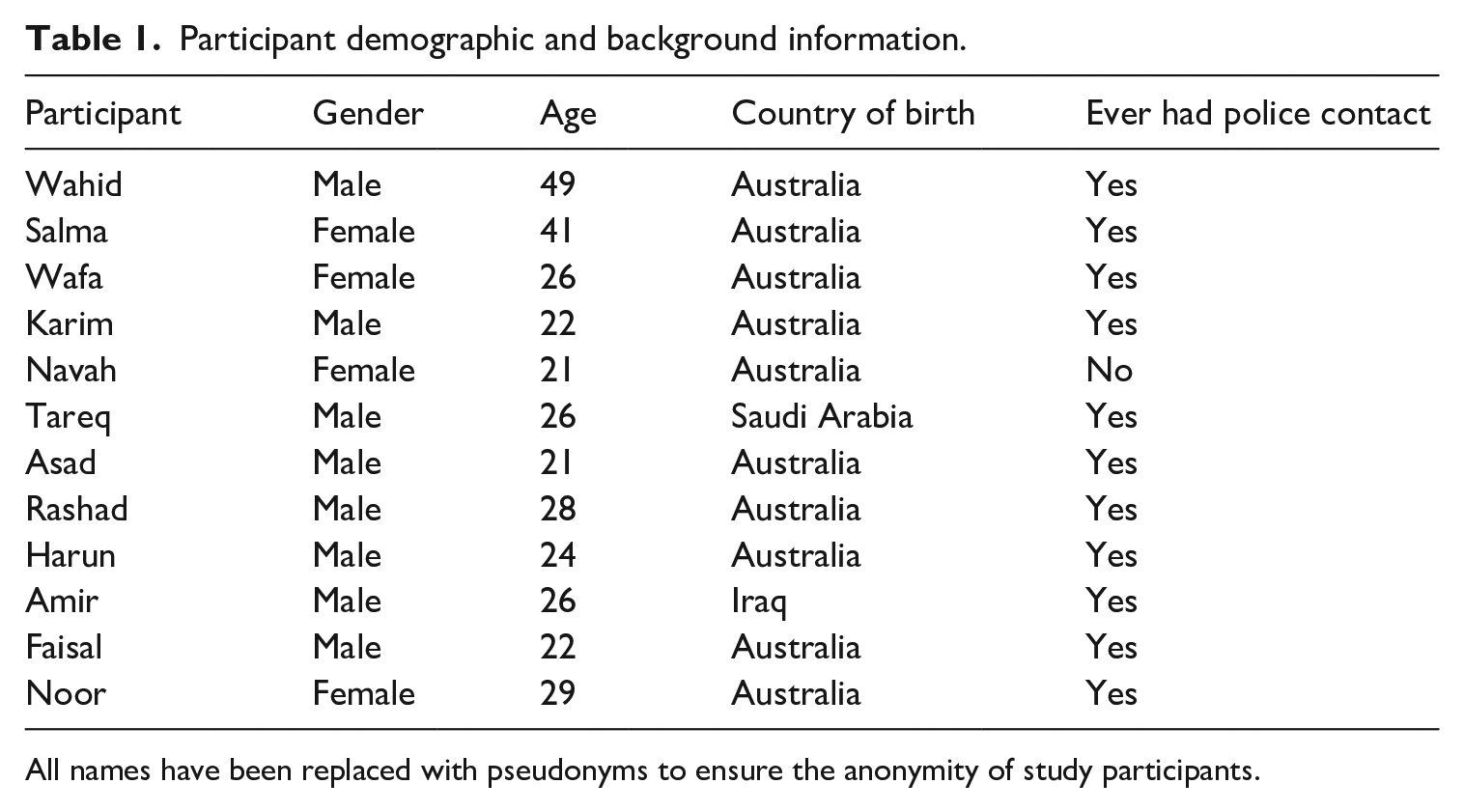
All names have been replaced with pseudonyms to ensure the anonymity of study participants.
Findings
The aim of this study was to explore perceptions of anticipatory justice and how these expectations relate to trust in the police. In addressing this aim, three key themes are discussed below. These themes demonstrate how participants view the police, how they anticipate being treated by police officers and the contingencies or conditions of their trust in the police. They encapsulate participants’ most common views. When applicable, divergent views are presented to provide additional nuance to anticipatory justice.
The tip of the iceberg: Initial views of police
At the outset of interviews, 10 out of the 12 participants indicated they had a moderate to high level of trust in the police. For instance, Amir (24, man) discussed the legitimacy of Australian police and how they could be completely trusted. When asked about his level of trust in the police, Amir explained ‘Ten out of ten . . . I’m in trouble, I will totally rely on them’. Amir predominantly grew up in Iraq. When he talked about trust in Australian police, it was juxtaposed against his lack of trust in Iraqi police, who he had experienced as corrupt and intimidating. In this way, Amir’s past experiences did not taint how he viewed Australian police.
While a quarter of participants reported limited personal experience with the police, they discussed how their views were, in part, also informed by others’ experiences and stories about the police circulating on social media. However, many noted that greater emphasis was given to their own experiences in forming their overall assessments. For instance, Wahid (man, 49) rarely interacted with police officers and discussed the police in largely positive ways. He qualified his positive views of the police as related to his stage of life – not going out to bars or nightclubs nor seen as ‘trouble’ in the same way that younger Middle Eastern males often are. When Wahid did encounter police officers, they generally treated him respectfully. He felt he, in turn, reciprocated. Wahid indicated that he had a high level of trust in the police. He explained,
I think they’re fine. I think they do a good job. Well, I’ve never had any run-ins with the police. Every experience I’ve had with the police has been a good experience.
How much would you say that you trust the police?
It’s probably influenced a lot by media, but probably around, I don’t know, about 80 percent.
While most participants (10 out of 12) echoed Wahid’s sense of trust and confidence in the police, four participants indicated that they were uncertain about the police and consequently cautious about their interactions. This was rooted in perceptions that officers were often aggressive, intimidating and disrespectful, particularly to Middle Eastern people. To illustrate, Harun (24, man) – who contemplated becoming a police officer when he was younger – discussed how he wished he could strike up a conversation with officers he encountered. However, he perceived a tension between the police and members of the Middle Eastern community that made Harun question whether they would welcome being approached by him. He felt the ‘serve and protect’ motto was utopian, explaining: ‘I don’t feel like they’re there for my safety. I feel like they’re there to enforce the law in a way that suits their arrogance’. Despite not having had many direct experiences with the police, Harun explained how his view of the police as arrogant and intimidating was shaped by other Middle Eastern people’s experiences with the police. Other participants viewed officers as allowing their own day-to-day frustrations to impact how they interacted with citizens. For instance, I would say that they’re [laid] back but they can also be pushy and shovey depending on their personal mood . . . I feel like if a cop is in a bad mood, you’re going to get a fine whether you’ve done something actually wrong or not. But if a copper is in a good mood, you have a laugh with him, have a joke with him and he’ll let you go. I really think that their emotions get in the way of their work too much. (Asad, Male, 21)
When asked about their experiences with the police, nearly all (10 out of 12) discussed individual and/or vicarious experiences of informal police stops. Furthermore, for two thirds of participants, being stopped, questioned and searched on the streets near their homes was viewed as unfair and/or humiliating due to the public nature of these experiences. Noor (29, woman) worked as a social worker in a predominantly Middle Eastern area. She routinely interacted with police officers as part of her job, characterising them as generally helpful and effective. Outside of this, she had limited contact with the police, though she recounted a particular encounter a few years prior. Noor was pulled over while driving with her younger brother in his newly restored car. As he was not speeding at the time, they were confused about the reason for the stop. Before the officers approached, she advised her brother to stay calm and do whatever they asked. During the interaction, her brother acquiesced but repeatedly asked the officers to explain why he had been pulled over: He [police officer] just said look, just a random search, and we were like, okay, no problem. Obviously, they didn’t find anything. They searched the [car registration], they searched the car, everything came up as perfectly fine, and then we left. But I think it was just really embarrassing because it happened in our area, and we were sitting on the side of the road. It was just a little bit demeaning, and it’s just really dramatic, just searching the car. It was broad daylight, you know?
While this interaction was relatively ‘routine’ and ultimately without legal consequence, it was engrained in Noor’s mind because of the humiliation she experienced. As one of the only contacts she had with the police outside of her work duties, the possibility that this ‘random’ search could lead others to believe she was involved in illegal activity made her wary of the police.
Other participants also similarly described experiencing random police stops and the consequent feelings of injustice. Faisal (18, man) reported being pulled over while driving near his home. He shared how he was deeply embarrassed when this occurred: Just getting searched for no reason, in front of the public, when your parents could just ride past, family members. You’re just going to the shop to grab something to eat, and you just get pulled over. When you don’t have that record for whatever attracted them, do you know what I mean?
For Faisal, the arbitrary and very public nature of the stop worsened the experience, making him sceptical of the officers’ intentions. Yet even in the face of these experiences, Faisal and Noor generally spoke highly of the police. This nuance is indicative of the common trend in the interview data where even when participants have had negative direct and indirect experiences with police officers, most still characterised the police positively. This nuance in views requires further consideration.
Differentiating between police officers and ‘the police’
When asked about how they viewed the police overall, three quarters of participants were reluctant to make broad generalisations about ‘the police’ as a singular entity. They explained that the local police service was comprised of individual officers with their own personalities, experiences and biases. Accordingly, participants maintained it was neither possible nor accurate to evaluate the service as a homogeneous group. Rather, they explained that the quality of the treatment one receives from a police officer depends on the specific police officer one encounters.
Wafa (26 years, woman), who grew up outside of Sydney in an area with few Middle Eastern people, had limited personal experience with the police, though she often encountered police officers based on the nature of her job. She characterised her experiences with the police in a positive light but similarly avoided making general statements about the police as a whole. Wafa explains: It comes down to the individual . . . Yes, the police are a whole force. But at the end of the day . . . if I do call a police officer out he’s going to have to use his own bag of biases and his own experiences, and that’s probably going to impact the way he’s going to respond to whatever the issue may be.
Noor similarly questioned the appropriateness of assessing the police as a group: I think it’s a really broad question to ask me about the whole – because I think it’s a really individual thing. I’ve met some lovely police officers that have been very helpful, but then I’ve met some that although they’re good at what they do, they lack the interpersonal skills and the communication skills. And it’s just left a bad taste in my mouth.
In this way, holding positive views of the police was not necessarily based on the absence of negative experiences, whether personal or vicarious, but rather, was driven by a belief that a negative experience with one officer was not generalisable to how all police–citizen interactions would unfold. Accordingly, participants’ accounts reveal citizens’ views of police are also shaped by a recognition that police are ‘people like the rest of us’ and may therefore behave in varied ways. This differentiation highlights the multi-dimensional nature of citizens’ perceptions of the police that go beyond simplistic generalisations.
A quarter of participants expanded on this and explained that labelling the police as either ‘good’ or ‘bad’ was akin to others drawing inaccurate and harmful stereotypes about Muslims, often via the Muslim terrorist trope. To illustrate, throughout adolescence and into his 20’s, Rashad (28, man) had frequent encounters with the police both through random stops and due to his involvement in minor criminal behaviour, which on a few occasions resulted in his arrest. He described the quality of his encounters with the police as mixed; characterising some as procedurally just and others as unfair. When asked about his views of the police, he explained: I’ll give you the best example. It’s a Muslim example. Just because one person is a terrorist, doesn’t mean all Muslims are terrorists. Just because one police officer is bad, doesn’t mean all police officers are bad. But if one Muslim is good, people will class them different. If all police officers were good, they treat people right, people would look at them different. Do you know what I mean? Just goes like that.
Like Rashad, Asad (21, male) drew similar comparisons, stating: You shouldn’t throw them [police officers] all in a bucket; they’re not all like that. There are great ones as well . . . it’s the whole thing with the news, the Muslim thing. They show you the bad side, and that’s all you can see, that’s all you believe until you see the other side. It’s very hard to see the other side sometimes. But I’ve seen it, and I know for a fact that there are a lot of good cops out there as well.
Rashad and Asad highlight a sense of reciprocity where they felt it was unfair for Muslims to be judged by the actions of a few radicalised individuals and thus did not want to similarly judge all police officers based on a few ‘bad cops’. Even though participants were asked to comment on their perceptions of the police in Sydney, they clarified that such generalisations could not be made and, more importantly, ought not to be made, in part to avoid perpetuating negative stereotypes or generalisations of highly varied groups. While seeing the police service in this way contributes to a more positive and accepting view of the police, this perspective was also associated with uncertainty about the kind of treatment to expect when they encounter police officers in the future.
Uncertainty
For nearly half of the participants (5 out of 12), imagining a police officer approaching them elicited anxiety. They attributed this to not knowing how that interaction might play out; emphasising the nature of an interaction depends on the individual officer. Notably, participants with greater personal experience with the police reported higher uncertainty about their treatment. Here, the mere possibility of poor treatment and the unpredictability of police encounters was linked to nervousness about police interactions: I don’t know how the conversation is going to turn out. Conversation could turn out great, or it could turn out really bad. My anxiousness is because I don’t know which way it’s going to go. It scares me a little bit that it could go really well, or it could go really bad, and I could just get harassed and arrested for nothing. (Asad) If I see them [police] looking at me and they look like they want to instigate something or start a conversation or whatever I’d be quite confused. Did I do something wrong? I think I’d be a bit paranoid but yeah, I’ll try and handle it as confidently as I can . . . Probably, yeah. Paranoid. Nervous. (Faisal)
For these participants, having had positive and negative direct and indirect experiences with the police fostered a complex understanding of variation in police officer dispositions, including possible biases. This acknowledgement – while allowing for a more refined perspective of police officers and potential interactions – also meant that participants seemingly built apprehension into their dealings with officers as a form of protection against potentially ‘bad’ officers.
Expectations: ‘I trust them, but . . .’
To unpack expectations of treatment or anticipatory justice, participants were asked how they imagined or anticipated being treated if they were stopped by the police in their neighbourhood that day. Overall, nearly half indicated that they thought they would be treated with respect and in a fair manner. Two common reasons were used to explain why. The first related to their own demeanour; some anticipated a respectful interaction because they believed they would be calm and respectful to the officer, which would likely elicit similar behaviour. Harun, for example, shared: ‘Oh, they’d treat me with some respect, I think. I wouldn’t expect any disrespect unless I disrespect them first’. Noor similarly discussed that while she would likely feel unsure about why a police officer was approaching her, she would not feel nervous. When asked how she imagined she would be treated, she stated: ‘I would say 10. I wouldn’t expect anything less, to be honest, unless I’ve given motive, or I’ve disrespected them, or I’ve done anything inappropriate. Then I wouldn’t expect me to be treated less than anything, really’.
Participants also discussed gendered reasons for anticipating fair treatment. All four female interviewees indicated that as women, they believed the police would likely treat them well or better than they would treat a Muslim male. They explained that the police tend to be more suspicious of Middle Eastern men and that Middle Eastern young men often co-constitute a hostile interaction with officers by acting aggressively when stopped. Interestingly, this was echoed by nearly half of the male participants, sharing the view that the police treat Muslim women better and with more fairness than they typically treat Muslim men.
Relatedly, all female participants expressed a duality of trust: a level of trust specific to them (for instance, as a woman) and another, often lesser trust for how the police would treat others. This distinction was discussed by those who expressed both low and high levels of trust in the police. For instance, Noor, who had numerous positive encounters with the police and indicated a relatively high level of trust, highlighted these two opposing views: I definitely trust them . . . I feel like as a female I could definitely trust them, and I would definitely . . . like go to them if I was in need or if I had a situation. But I think it would probably be different for other members of my community – if I was a man or if I was a bit younger. I think I would then have issues . . .
These gendered contingencies of trust in the police also intersected with fears of Islamophobia. Participants again discussed holding a great deal of trust in the police for themselves but clarified that their trust may erode if they presented as a more observant Muslim: I’ll be honest, I guess I’m glad that I don’t wear a hijab and would have to call a police officer. Or I’m glad that my brothers and my dad don’t have beards down to here, and I have to call the police often because I would worry for them about how they are going to be treated. (Wafa, 26, woman)
For some, this intersection of gender and Islamophobia was viewed as worse for men who were believed to be more commonly problematised than women. However, others suggested this preferential police treatment was only available to some women. Nearly all female participants, all of whom did not wear a head scarf, feared they would be treated differently if they donned a hijab. While these participants noted that they trusted the police, this level of trust was reduced when they considered how those who present more clearly as Muslim would be treated, further demonstrating the contingencies of their trust.
Presenting as ‘Australian’/White
The extent to which participants believed they presented as ‘European’ rather than Middle Eastern was often linked to expectations of being treated fairly by the police. For a quarter of the sample, trust in the police and anticipatory justice were contingent upon not being viewed as suspect – or, in this case, as Middle Eastern. They trusted that they would receive fair treatment because they did not present as Middle Eastern or Muslim (i.e. based on their skin tone, style of clothes). Salma (41, woman) explained why she anticipated being treated respectfully by the police: ‘Maybe because I don’t look like a typical Middle Eastern girl, because I’m not wearing a veil . . . That’s probably why’. The belief that appearing Middle Eastern could influence a police interaction was so salient that some participants reported strategically modifying their appearance (e.g. not wearing religious markers) to avoid associations with Islam. This included those who identified strongly as Muslim and with their religious faith. As such, these modifications were used as a form of self-protection to avoid the attribution of negative stereotypes. For example, Navah (21 years, woman) explains, With me – a good thing, I don’t look Muslim, so it wouldn’t be a problem. But if I had a scarf, it would be very obvious to police that I’m Muslim, and they probably would treat me different. I wouldn’t know because I’ve never experienced that. But I think I would probably be treated a bit different.
For Navah, the decision not to wear a hijab was based on presumptions about how others – especially police officers – would view and subsequently treat her. Although she expressed a desire to wear a scarf, she worried about the potential negative attention she would attract if she did.
Wafa grew up outside Sydney in an area with few Middle Eastern people. While she identified as Muslim and had strong ties to her Middle Eastern heritage, she saw herself as different from other Middle Eastern women. Wafa explained that most people did not know she had Middle Eastern heritage, and this gave her greater confidence that she would be treated well by the police: I think with me not having your typical dark complexion as Middle Easterners do, also if I was pulled over in (my area) or had them [police] come up to me . . . I think they would view me as probably a little bit different, ‘oh she’s probably a little more relaxed . . . not as conservative’ . . . I think (I’d be treated) fine . . . I’m not –I don’t have the hijab or anything like that. I’d be fine.
Despite this, Wafa described how she avoided being identified as Muslim by the police: To be honest with you, even for myself in my car, you know how you can hang things off your mirror? A lot of Muslims will put the little Quran just over it. I used to have it in my other car. I came to [this neighbourhood] you know what, I want to take this down . . . I’m like if I ever get stopped by a police officer, I don’t want them to know that I’m Muslim. I know that I don’t look like your traditional Muslim. I will wear singlets, or I’ll wear shorts or whatever or anything like that . . . If I was pulled over, I wouldn’t want them to see that I’m Muslim . . . [cast] a certain view of me and maybe not let me get away with a ticket. I do carry that. Despite me having good experiences with them, I know that there’s crappy people out there. For me, I made a conscious effort of removing anything in my car that would represent that I’m Muslim- just so I’m not treated unfairly by a police officer.
Navah and Wafa’s perception of treatment if officers identified them as Muslim, as well as their efforts to ensure this was less likely, reveal the extent to which Muslim participants recognised or anticipated that they may be treated differently. This was discussed even in the absence of individual negative experiences with the police.
Trust that is explained as: ‘I trust the police to treat me fairly so long as they do not know that I am Muslim’, calls into question the strength of that belief. These contingencies of trust contradict the initial, surface claims participants presented about generally having high trust in the police and unmask the underlying fragility of these views. A careful analysis of participants’ rich accounts of perceptions of and interactions with the police demonstrate the unsteady confidence they have in how they might be treated by the police. By asking people how they anticipated being treated and why, nuances in trust perceptions emerge, providing a more complex understanding of what trust in the police can entail for those who identify as part of a stigmatised group.
Discussion
As the first study to apply the anticipatory justice framework within a policing context, this study sought to explore how people anticipate being treated and how these expectations relate to their trust in the police. The findings presented here shed light on the expectations and uncertainty that people bring with them into interactions with the police. As the data demonstrate, anticipatory justice also offers a mechanism to better understand the nuanced and intersecting nature of trust in the police that often goes undetected when surveying people about their views.
Perceptions of police
When asked how they viewed the police, participants expressed widespread reluctance to generalise experiences with individual officers as reflective of the police as a monolithic group. This is supported by prior research on how people conceptualise police officers in their community (Abu et al., 2017). Urbanik et al. (2021) argue that common unidimensional or homogeneous descriptors of the police lack the nuance of how community residents view, interact with, and/or avoid officers in practice. The findings of the present study align with calls to further untangle residents’ perceptions of and experiences with the police.
At the outset of interviews, most (10 out of 12) participants indicated that they held a high level of trust and confidence in the police. Such views are consistent with, though slightly more positive, than prior survey findings of Middle Eastern people in Australia (Ali et al., 2023; Madon et al., 2017). If the first question about perceptions of trust in the police had been the only question asked, this interview data would have added little to understanding views of the police among a marginalised population. By delving into the factors participants consider in informing their trust in the police, it became apparent that initial assessments were merely the ‘tip of the iceberg’. When asked to elaborate, participants illuminated their variable perceptions of trust in the police and clarified the factors that shaped them. These findings suggest that trust in the police – particularly among those who feel stigmatised – may have other layers of complexity that have not been fully explored in existing empirical work. While trust has been conceptualised in a variety of ways and scholars have acknowledged its multi-dimensional nature (e.g. Pass et al., 2020) to date, limited research has discussed contingencies or conditions of trust (Bell, 2016). This sense of ‘I trust them, but . . .’, as Tareq (26, man) relayed, indicates an additional and yet still largely unexamined facet of trust that requires greater empirical investigation.
Anticipating (in)justice
This study found those with greater police contact carry apprehension about how police officers will treat them in future interactions, supporting Woolard et al.’s (2008) findings on anticipatory injustice views of court involved young people. This study similarly finds that people you have had greater contact with the police are less certain about whether they will be treated fairly. In this way, people do not enter encounters with police officers as ‘blank slates’, but rather bring with them expectations about how the police will treat them (Major and O’Brien, 2005). This is important because while the quality of police treatment is central to assessments of trust and confidence in the police, anticipatory justice theorising suggests that those anticipating injustice are more likely to label treatment as poor, even in the absence of it (Hawdon, 2008; Shapiro and Kirkman, 2002). Mixed-methods and experimental studies offer a useful next step to investigate how anticipatory (in)justice influences citizens’ perceptions of police officer treatment in a specific interaction and whether, even when procedurally just treatment is objectively given, it is subjectively received. The framework of anticipatory justice provides a critical tool to interrogate how individuals’ pre-existing beliefs and expectations can influence the variability of procedural justice effects on citizens’ assessments of and trust in the police.
Extending trust scholarship
The findings of this study suggest that for those who identify as part of a stigmatised group, trust in the police is not as simple as whether people do or do not trust (Goldsmith, 2005). Rather, the conferral of trust may be based on several conditions and may mean different things to different people (Kearns et al., 2020). Frederiksen (2012) asserts that trust in an actor can shift depending on the context and situation at hand. The findings of the present study support these assertions. Specifically, trust in the police may be contingent on various factors related to gender, appearance and the extent to which one can be identified as part of a stigmatised and over-policed group. The sense of reassurance provided by ‘passing’ as someone who is not Middle Eastern/Muslim or based on gender raises questions of how trust can be classified when it exists within these conditions.
Some suggest that trust requires the trustee to accept a level of vulnerability in dealings with the trust seeker (Hamm et al., 2017). However, the findings of this study indicate that for some, this vulnerability is managed by reducing perceived ‘red flags’. This use of ‘innocence signals’ (Stuart, 2016), vis-à-vis camouflaging one’s identity, is arguably the antithesis of vulnerability. Rather than trusting the police to treat them fairly, their trust is reliant on removing any risk of being rendered Muslim. This again calls into question the strength of trust in the police when one can trust only if they have stripped away signs of their group identity.
While this study did not examine police officers’ trust in citizens, many participants perceived the police as being suspicious and wary of Middle Eastern people. Accordingly, police agencies should consider the importance of the reciprocal nature of trust, and that demonstrating trust in citizens could in turn garner citizen trust in the police. As trust scholars have argued, the mutual lack of trust between the police and members of marginalised groups cannot be solved by solely focusing on one party (Pryce and Cheane, 2021). Rather, trust’s bidirectional nature suggests that showing citizens that the police trust them could be an important step towards fostering trust from citizens.
Limitations
Before concluding, there are some study limitations worth noting. The findings are based on a small number of interviews in one area of Sydney, Australia and are in part reliant on snowball sampling. Although interviews were conducted until saturation was reached, given the small number of interviews and the use of snowball sampling one must consider the potential of bias in the views presented. In addition, with a small sample size, there is the possibility that the themes presented here may not cover the full scope of views on these topics. Given the exploratory nature of this study, the findings presented here provide a starting point from which further inquiry can build a broader understanding of how other stigmatised and non-stigmatised groups anticipate being treated by the police.
Conclusion
This study was the first to explore citizens’ non-normative expectations of police treatment. The findings suggest that among members of an often-stigmatised group, informal encounters with police are felt to be uncertain. For many, the quality of police–citizen interactions hinges upon who they are, how they present and whether police officer mood or bias towards their ethnic or racial group will impede fair and respectful treatment. Despite this, most participants indicate that they view the police positively, avoiding making negative attributions to the police as a whole. Although preliminary, anticipatory justice and trust in the police appear to be interconnected and necessitate further empirical investigation to better understand how expectations of police treatment shape how people assess officer treatment.
Footnotes
Acknowledgements
I would like to thank Dr Tariro Mutongwizo and Ms Farrah Bana for their valuable research support. I am grateful to Dr Carolyn Greene, Dr Molly McCarthy, Dr Emily Hurren Paterson, Associate Professor Marta-Marika Urbanik and Mr Kerry Wimshurst for their comments on this paper. Finally, I would like to thank the research participants for their candour and insights.
Declaration of Conflicting Interests
The author(s) declared no potential conflicts of interest with respect to the research, authorship and/or publication of this article.
Ethics Details
Griffith University Ethics Committee (GU ref no: 2017/178).
Funding
The author(s) disclosed receipt of the following financial support for the research, authorship and/or publication of this article: This work was supported by the Australian Research Council (Grant No: DP170101149) and Griffith University’s Arts Education and Law Early Career Research Grant.
