




Abstract
Previous research has documented the effects of uniforms and accouterments on public perceptions of police in acontextual settings. Drawing upon a vignette-based survey, we explored the perceptual effects of various police uniforms and accouterments in the context of five different policing environments: (1) a burglary where the suspect was present, (2) a burglary where the suspect was not present, (3) a foot patrol, (4) a roadblock, and (5) a siege involving a barricaded person. As part of our research design, a sample of Queensland adults (N = 292) rated images of police officers from the Queensland Police Service in different aesthetic capacities in each aforementioned environment along three perceptual outcomes: (1) traits, (2) effectiveness, and (3) procedural justice. The analyses reveal that appearance manipulations can impact public perceptions of officers. The analyses also indicate that the effects of some manipulations can sometimes vary by situational context. We discuss our results with respect to past and future research as well as operational policing practices.
Introduction
Images of police continue to saturate media while debates about the aesthetics of police officers continue to permeate public discourse. Questions surrounding the appearance of officers, and, particularly, the arguably militarized appearance of some officers, have generated tremendous attention in both news media (e.g. Filkins, 2016; Funnell, 2019; Molina et al., 2020) and academic research (e.g. Bieler, 2016; Flores-Macias and Zarkin, 2022; Kraska, 2007). While some of this discourse has called for a “softer look” for police, the uniforms and accouterments worn/carried by officers are often justified by police in light of the risks inherent in certain elements of police work. Indeed, although much police work may be mundane (Rowe and Rowe, 2021) and does not involve the use of force (Bozeman et al., 2018), some demands on police can place officers in high risk environments which present the risk of harm. 1 In such circumstances, officers may rely upon their equipment (e.g. ballistic vests, gloves, batons, less than lethal weapons, firearms, etc.) to help uphold officer and public safety. Equipment can serve many different functions for police, and at times, function may conflict with perception—the equipment that may be perceived as necessary by police could generate negative public perceptions (see Simpson, 2020; Simpson and Sargeant, 2023).
The diverse role of police can thus create a potential conundrum for police. Police agencies typically issue a single, standardized uniform and associated set of accouterments to be worn/carried by all patrol officers in all environments, 2 including those which present very little risk (e.g. attending a business to handle a historical theft report) and those which present very high risk (e.g. attending a business for a report of an active shooter). But, it is possible that uniforms could be interpreted differently by citizens depending upon the situational context in which the officer is observed. Whereas a given uniform may be perceived as satisfactory in one context, it may be perceived as unsatisfactory in a different context. For example, an officer dressed in a more tactical-style uniform may be perceived more negatively when engaged in a routine foot patrol compared to when dealing with a barricaded person. 3 The risk of harm varies in these contexts, and so too may the perceived appropriateness of the officer’s aesthetics. With that being said, the possibility of context-specific effects of appearance manipulations has yet to receive much empirical attention.
Drawing upon a sample of Queensland residents, we thus explore the effects of officer appearance in the context of five different policing environments that vary in their level of risk. Our results suggest that situational context can alter the nature of effects of some appearance manipulations for some perceptual outcomes, but not others. We discuss our results and their associated complexity with respect to research and practice.
The perceptual effects of officer appearance
The topic of officer appearance has received much attention among recent scholarship. In lieu of a detailed review of all related studies, which would be neither possible nor necessary here, we provide a brief summary of the aspects of officer appearance that have been examined in previous research. We then discuss the effects of officer appearance as they relate to perceptions of traits, effectiveness, and procedural justice and legitimacy.
Many studies examining the relationship between officer appearance and perceptions of police have focused on the impact of attire. Within this genre, research has primarily compared uniform versus civilian clothing on public perceptions of officers (Simpson, 2017; Singer and Singer, 1985; Thielgen et al., 2020). These studies tend to find that officers are perceived more favorably when wearing their uniform compared to civilian clothes. In addition, several studies have examined the composition of uniform clothing (Mauro, 1984), uniform color (Johnson, 2005; Nickels, 2008), and uniform presentation (Jenkins et al., 2021) and observed various perceptual effects.
Another set of studies have examined public perceptions of accouterments and related equipment. This body of research is generally more diverse than the former, in large part because there is substantial variation in the items worn/carried by police. For example, previous research has explored the perceptual effects of vests (Blaskovits et al., 2022; O’Neill et al., 2018; Simpson, 2020), hats (Johnson et al., 2015; Simpson, 2020; Volpp and Lennon, 1988), sunglasses (Boyanowsky and Griffiths, 1982; Simpson, 2020), neckties (Johnson et al., 2015), gloves (Sandrin and Simpson, 2022; Simpson, 2020), and weapons (Flores-Macias and Zarkin, 2022; Simpson, 2020; Yesberg et al., 2021). Many of these items have been found to impact perceptions in significant and meaningful ways.
Finally, and as a more recent development, one study has examined the impact of officer facial expression. Unlike equipment, facial expressions are directly manipulated by officers via their bodies. Using an experimental methodology, Simpson (2021) found that participants rated images of police officers more favorably along a range of perceptual outcomes when officers exhibited a smile compared to a neutral facial expression.
Perceptions of police
Positive perceptions of police—particularly perceptions of procedural justice, legitimacy, effectiveness, and satisfaction—enhance public cooperation and compliance with police (e.g. Hinds and Murphy, 2007; Sunshine and Tyler, 2003; Tyler and Fagan, 2008). Given the importance of these outcomes, the focus of most studies regarding officer appearance has been on the perceptual effects of appearance manipulations. Scholars have operationalized and measured perceptions of police in a variety of ways. Given that a detailed review of all possible outcomes is again not possible here, we instead summarize three common outcomes related to public perceptions of police that are most relevant to the present research: (1) traits, (2) effectiveness, and (3) procedural justice and legitimacy.
Traits
One set of judgments that people may make about police officers regard their traits. For example, citizens may observe a police officer and perceive them to be aggressive and/or intimidating. Citizens may also observe an officer and perceive them to be approachable and/or friendly. Assessing trait-based outcomes has formed the subject of much previous research regarding policing, and, particularly, the perceptual effects of officer appearance (Blaskovits et al., 2022; Boyanowsky and Griffiths, 1982; Jenkins et al., 2021; Johnson, 2005; Johnson et al., 2015; Mauro, 1984; Nickels, 2008; O’Neill et al., 2018; Simpson, 2017, 2020, 2021; Thielgen et al., 2020; Yesberg et al., 2021).
For example, Simpson’s (2017, 2020, 2021) line of experimental work assessed public perceptions of officer aggression, approachability, friendliness, respectfulness, and accountability. Johnson (2005) measured the effects of uniform color on public perceptions of police as friendly/unfriendly, gentle/forceful, nice/mean, and passive/aggressive and Singer and Singer (1985) examined the effects of attire on public perceptions of police as unaggressive/aggressive, kind/unkind, and tense/relaxed. Mauro (1984) also connected officer appearance with public perceptions of police as friendly, valuable, and warm. Research that has explored these kinds of outcomes generally suggests that an indirect link may exist between perceptions and behavior, such that the appearance of the officer may change the perceptions and behavior of the citizen, which can then impact the behavior of the officer.
Effectiveness
Another set of perceptual judgments concern effectiveness. These outcomes query participants about their beliefs regarding an officer’s actual or projected performance. This frequently manifests in the dependent variable of competency (Simpson, 2021; Singer and Singer, 1985), but can also be measured via related variables, such as the suitability of officers for the policing profession (Blaskovits et al., 2022), the expected behaviors of officers (Flores-Macias and Zarkin, 2022; Jenkins et al., 2021), and the ability for officers to fulfill the actions of police, like make an arrest (Durkin and Jeffery, 2000). With respect to the latter, field studies that have tested uniform manipulations on public behavior also arguably rely upon effectiveness-based outcomes (Bickman, 1974).
Procedural justice and legitimacy
A third category of perceptual judgments regard procedural justice and legitimacy. Procedural justice and legitimacy, of which share theoretical and applied connections, have been the subject of much research. Procedural justice positions process at the epicenter of police interactions: arguing that people’s evaluations of police vary as a function of their perception of treatment by officers (Mazerolle et al., 2013a). Legitimacy can be defined as a “property of an authority or institution that leads people to feel that [the] authority or institution is entitled to be deferred to and obeyed” (Sunshine and Tyler, 2003: 514).
Despite the growing appeal of procedural justice and legitimacy, much of the research that has explored these phenomena, including that of which has connected them together, has been conducted without specific attention to officer appearance. Nonetheless, recent research has begun to explore the connections between such phenomena and officer appearance. For example, Sandrin and Simpson (2022) examined the relationship between officers’ use of personal protective equipment during the COVID-19 pandemic and public perceptions of officers along the four dimensions of procedural justice: dignity and respect, neutrality, trustworthy motives, and voice. Yesberg et al. (2021) also tested the effects of arming officers on public perceptions of officers as legitimate and Jenkins et al. (2021) teased apart the potential effects of legitimacy as it relates to officer appearance.
Overview of the present research
Previous studies regarding officer appearance exhibit many similarities. For example, many of these studies have employed similar methods, often analyzing participants’ ratings of images of police officers under some form of hypothetical conditions. Many of these studies have also centered around the American experience and focused on similar perceptual outcomes. These similarities have been helpful for facilitating discussion across studies as well as for establishing the validity of results regarding officer appearance. However, the overlap in existing research has been less helpful for bolstering the overall scope of this literature. For example, specific to our work, no known research has explicitly assessed the potential impact of situational context on the effects of appearance manipulations. Given that situational context could affect how some appearance manipulations may be perceived by the public, this gap in the literature warrants attention.
As part of the present research, we thus employ a vignette-based survey to explore the perceptual effects of various police uniforms and accouterments along multiple outcomes in the context of several different policing environments. We embed multiple layers of nuance into our paradigm to help untangle these dynamics. For example, we draw upon a sample of Queensland residents: the natural observers of the officers that we present as stimuli during our study. We explore these residents’ perceptions of uniforms and accouterments along outcomes related to traits, effectiveness, and procedural justice. Finally, we manipulate the risk of the environments in which participants make their perceptual judgments to identify the potential role of situational context in the perception equation.
Data and methods
Participants
We used the Qualtrics sampling panel to recruit adults from Queensland, Australia. Our final sample of 292 participants (all of whom passed at least four out of our five attention check questions, as described below) included 171 self-identified women, 120 self-identified men, and one participant who preferred not to disclose their gender. Participants ranged in age from 18 to 78 years, with a mean age of 40 years. Approximately 85% of participants reported being born in Australia, with most reporting Australian and British ancestries. More than half reported receiving at least some post-secondary education as well as being employed part-time or full-time. Roughly half reported being in a relationship of some form, with a modal household annual income of $50,000 to $99,999. Half of our participants also reported having a contact with the police in Queensland in the last 2 years, with 10% reporting three or more police contacts. See Table 1 for the descriptive statistics.
Descriptive statistics for participants (N = 292).
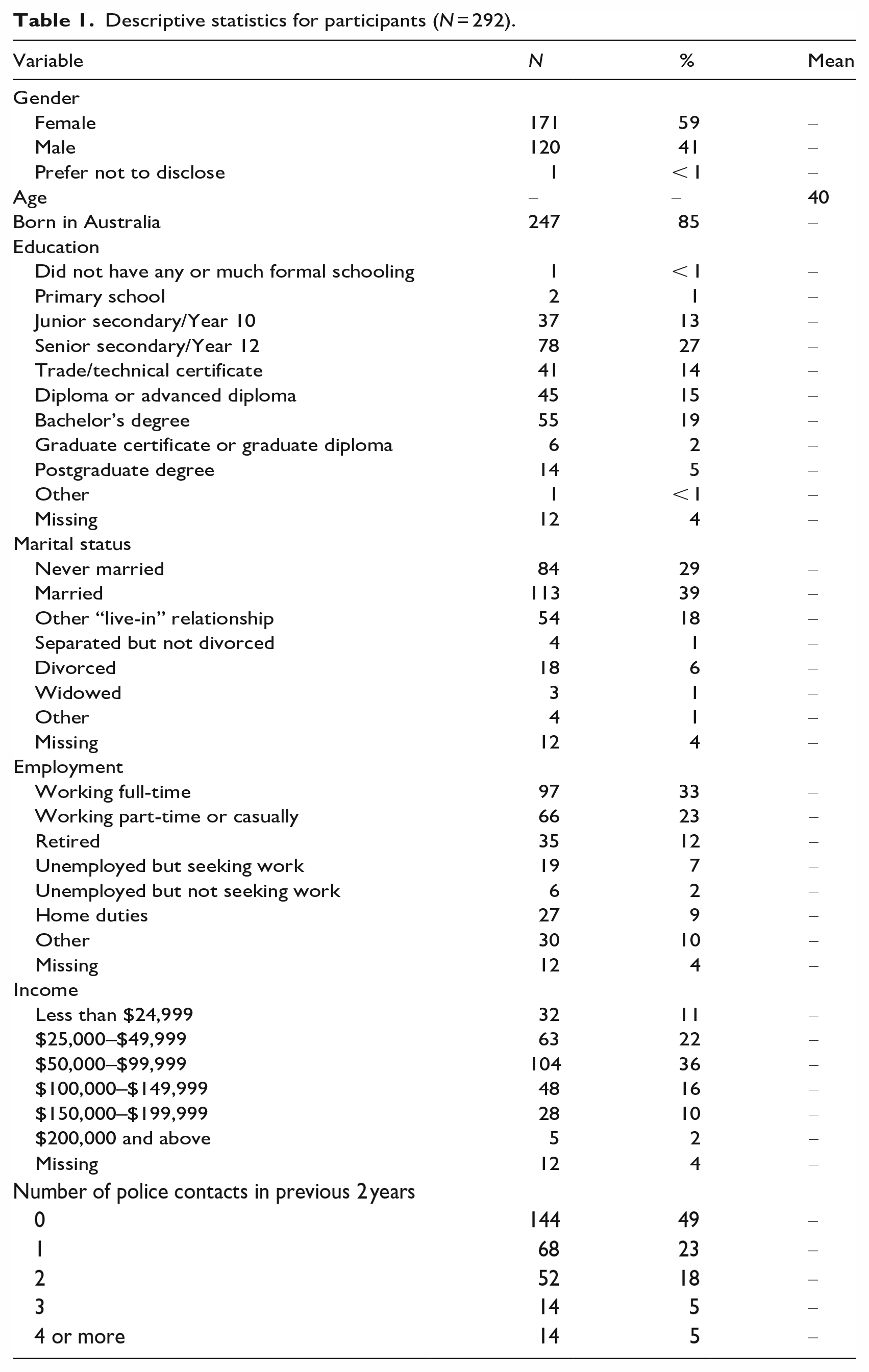
As outlined below, participants were randomly assigned to one of three different groups once enrolled in the study. Analysis of variance (ANOVA) tests indicated no significant differences among the sociodemographic variables by group, suggesting that randomization worked as intended.
Procedure
Using a between-subjects design with within-subject variation, we empirically explored the perceptual effects of various police uniforms and accouterments in the context of different policing environments. Our study paradigm comprised five blocks (or “sections”). Each block asked participants to rate images of a self-identified female officer and a self-identified male officer (presented independently) from the Queensland Police Service 4 (QPS) along several dependent variables in the context of a single policing environment (i.e. five blocks for five environments). Both officers could be described as Caucasian in appearance and were of similar age, height, and build. Participants indicated their ratings of each image via 5-point Likert-type scales, which ranged from “Strongly Disagree” (−2) to “Strongly Agree” (2).
The pictured officers, dependent variables, and policing environments were the same for all participants. The uniforms and accouterments of the pictured officers rated within blocks, however, varied as a function of participant group, which was randomly assigned to participants at the outset of the study. The order of the five blocks was also randomized across participants as was the order of the images presented within each block. These multiple levels of randomization helped to control for order effects and related types of spuriousness that could have otherwise confounded our findings. All study procedures were completed online and approved by the QPS Research Committee as well as university ethics board. We discuss each segment of our paradigm in the sections that follow.
Policing environments
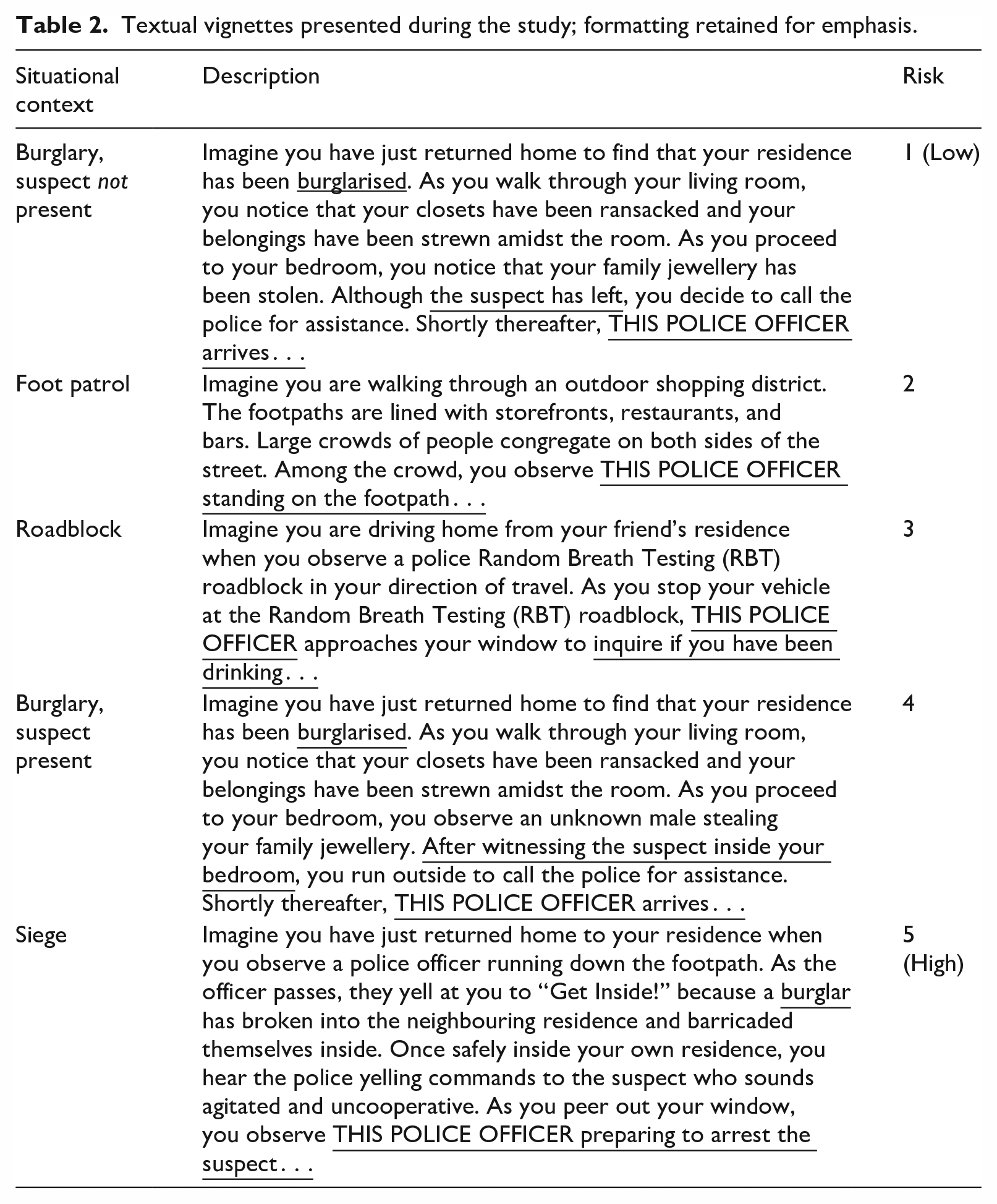
As part of the present research, we sought to explore how situational context may affect participants’ perceptions of officer appearance. In particular, we were interested in how the level of risk that may be inherent in a policing environment could affect participants’ perceptions of officers presented in different uniforms and accouterments in that environment. Risk can be measured by the adversarial nature of an event, which can include the amount of harm that could result for officers and/or citizens from the event (i.e. a greater likelihood of harm would theoretically correspond with a greater level of risk). Using this definition, we created five policing environments that varied in their level of risk (presented from the lowest risk to the highest risk): (1) a burglary where the suspect was not present, (2) a foot patrol, (3) a roadblock, (4) a burglary where the suspect was present, and (5) a siege involving a barricaded person. The first two environments present no obvious engagement with a person suspected of—or engaging in—crime, and hence we classified them as lower risk. In contrast, the last two environments present more obvious engagement with a person suspected of—or engaging in—crime, and therefore, we classified them as higher risk. Although we acknowledge that events can change quickly and without notice, which can make risk classifications both fluid and dynamic, we had to commit to an assumed (static) level of risk for the sake of our paradigm.
Consistent with other criminological research (e.g. Flippin et al., 2019; McLean, 2020), and as shown in Table 2, we manipulated these policing environments using textual vignettes. Before each block, and at the beginning of each question within each block, participants were provided the situational context under which they should be rating the image of the officer. Following completion of each block, participants were asked to confirm the situational context in which they rated the preceding set of images. As noted above, all participants retained for our analyses responded correctly to four or more of these attention check questions. The salience of the vignette’s presentation within the paradigm as well as our use of attention check questions helped to ensure that participants explicitly considered the environmental conditions that the officer would be working when making each of their perceptual judgments.
Textual vignettes presented during the study; formatting retained for emphasis.
Police uniforms and accouterments
To assess the perceptual effects of different police uniforms and accouterments within different policing environments, we manipulated the appearance of the pictured officers. As previously noted, the two pictured officers remained the same across participant groups, however the uniforms and accouterments worn/carried by such officers varied by group.
Upon enrollment in the study, participants were randomly assigned to view and rate one of three different groups of images. Group A (n = 80) observed images of different attire manipulations, including an (1) unobstructed dark blue polo shirt (no vest), (2) light blue shirt (no vest), and (3) civilian clothing (i.e. white t-shirt and blue jeans). Group B (n = 114) observed images of different equipment manipulations, including a (1) body-worn camera, (2) high-visibility vest, and (3) hip firearm holster. 5 Group C (n = 98) observed images of different headwear manipulations, including a (1) baseball hat, (2) forage cap, and (3) sunglasses. All three groups also observed a fourth image of the standard operational uniform of the QPS (i.e. control image), which included a dark blue shirt, dark blue pants, dark load-bearing vest, operational duty belt, thigh firearm holster, and black patrol boots. See Appendix 1 for all images of the female officer.
Aside from the specific manipulations mentioned above, all elements of the pictured officer’s presentation, including their body posture and facial expression, were held constant across the images. All images were presented to participants against a white background in a randomized order. Randomly assigning participants to groups of images was necessary to minimize the total number of images presented to each participant, and hence, reduce participant fatigue.
We note that the uniform and accouterment manipulations tested as part of our paradigm are consistent with related research. All of the equipment presented during the study were also issued by the QPS and therefore are genuine equipment that participants may have been exposed to in their observations of local police.
Outcomes
As outlined earlier, perceptions of police can be measured in many different ways. Previous research has frequently operationalized perceptions of police via independent but related variables. As part of our research, we combine various dependent variables to create three indices, each of which corresponds to a perceptual outcome of policing interest, to use as our outcomes. The first, “traits,” is measured via five variables: (1) accountability, (2) aggressiveness (reverse-coded), (3) approachability, (4) friendliness, and (5) intimidation (reverse-coded). This index reflects how participants may feel about the pictured officer’s traits. The second, “effectiveness,” is measured via three variables: (1) competency, (2) helpfulness, and (3) professionalism. This index reflects how participants may feel about the abilities of the pictured officer. The third, “procedural justice,” is measured via four variables: (1) fairness, (2) politeness, (3) respectfulness, and (4) trustworthiness. This index reflects how participants may feel about the pictured officer’s treatment of people (noting that we were unable to explicitly test the dimension of voice).
Where possible, we rooted the construction of our indices in existing literature. We generated them by summing the scores for each of the respective variables within the index. In all instances, higher scores represent more favorable assessments on that index. Cronbach’s α for all indices generally exceeded 0.75. We note that while the indices are correlated, they regard different constructs. As we demonstrate below, they also exhibit variation in their relationships with our appearance manipulations of interest.
Analytic strategy
We employed several different techniques to analyze our data. To assess participants’ aggregate perceptions of different uniform and accouterment manipulations, we employed a series of t-tests. Each test compared the collapsed mean (i.e. acontextual) of each uniform and accouterment manipulation against the standard uniform (i.e. control image). To assess the effects of situational context on participants’ perceptions of such manipulations, we then employed a series of one-way repeated measures ANOVA tests. Each test compared the mean of each uniform and accouterment manipulation for each outcome by situational context. Here, we note that we do not have a control context for comparative purposes (as no such context arguably exists), and so we compared all contexts against each other using pairwise comparisons (Bonferroni correction applied). All scales are centered around 0 and all tests are assessed against the p < 0.05 standard.
Results
Uniforms and accouterments (acontextual)
As part of this first section of results, we assess participants’ aggregate perceptions of different uniforms and accouterments. These analyses are acontextual and, therefore, similar to those conducted as part of previous research. All uniform and accouterment manipulations are again compared against the standard uniform (i.e. without the specified manipulation). As shown in Table 3, the results reveal a number of significant findings.
Results of t-tests comparing participants’ ratings of images of officers wearing different uniforms and accouterments; values represent means or differences between means (as specified).
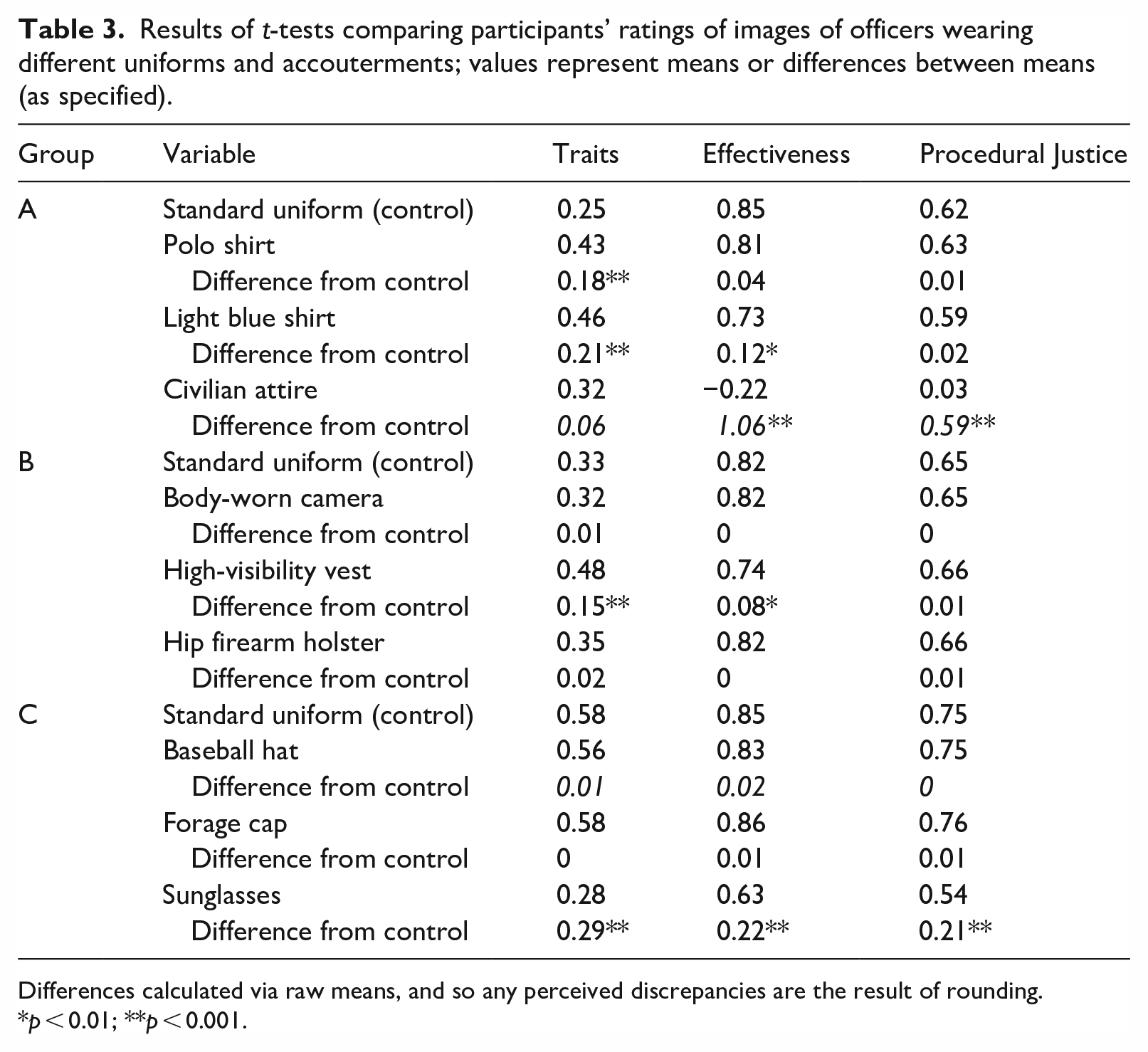
Differences calculated via raw means, and so any perceived discrepancies are the result of rounding.
p < 0.01; **p < 0.001.
First, we explore attire manipulations (Group A). Here we find that different styles of attire can impact perceptions. For example, collapsing across situational contexts, participants perceived officers more favorably in terms of traits when wearing the unobstructed dark blue polo shirt (no vest) or light blue shirt (no vest), although the latter capacity corresponded with lower ratings of effectiveness. Participants also perceived officers to be less effective and less procedurally just when wearing civilian clothing.
Next, we examine equipment manipulations (Group B). In this group, we only find an effect for the high-visibility vest. Collapsing across situational contexts, participants perceived officers more favorably in terms of traits when wearing the high-visibility vest. With that being said, participants perceived officers wearing such vest to be less effective.
Finally, we turn our attention toward headwear manipulations (Group C). Similar to the equipment manipulations, we only find a single effect in this group. However, this effect is unidirectional: participants perceived officers to be less effective, less procedurally just, and less favorable in terms of traits when wearing sunglasses.
Consistent with related research, these initial findings provide additional evidence to suggest that officer appearance—and manipulations to such appearance—can impact public perceptions of officers. As noted at the outset of our article, though, it is possible that the effects of some uniform and accouterment manipulations may be impacted by situational context. To explore this otherwise understudied question, we next transition to our context-specific analyses.
Uniforms and accouterments (by situational context)
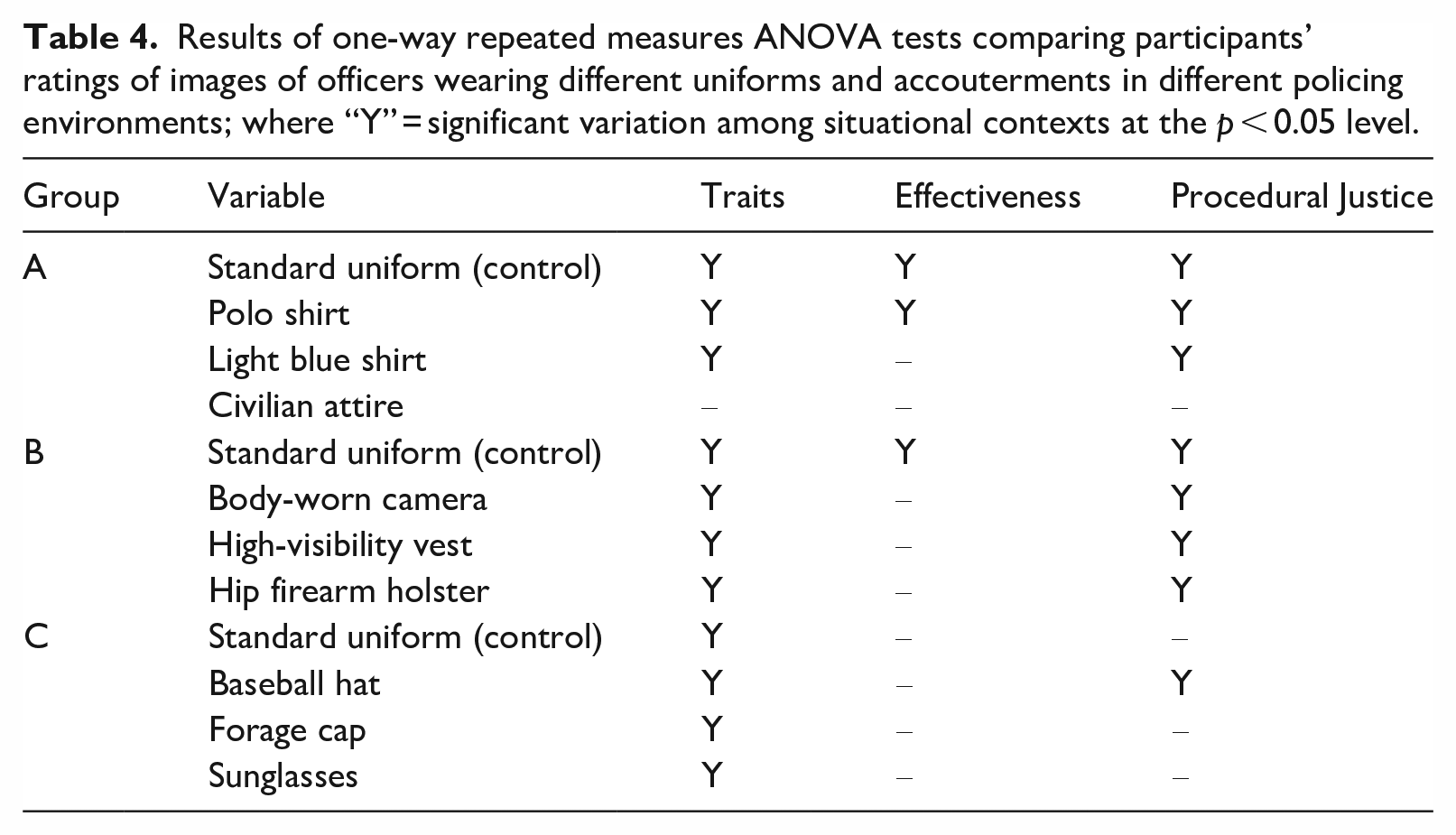
As part of this second section of results, we assess participants’ perceptions of uniform and accouterment manipulations in the context of different policing environments. Rather than comparing differences in perceptions of each uniform and accouterment manipulation against the standard uniform, we now explore variation in perceptions of each manipulation across different policing environments. These analyses allow us to test if, for example, an appearance manipulation is perceived differently depending upon whether the pictured officer would be conducting a foot patrol, working at a roadblock, dealing with a barricaded person, and so on. As shown in Table 4, the results reveal a number of significant findings. Note that for brevity, we only narratively describe key differences observed via follow-up pairwise comparisons for ANOVA tests with significant results.
Results of one-way repeated measures ANOVA tests comparing participants’ ratings of images of officers wearing different uniforms and accouterments in different policing environments; where “Y” = significant variation among situational contexts at the p < 0.05 level.
Attire manipulations (Group A)
We begin, again, with attire manipulations. As we outline below, we find contextual variation for perceptions of officers when wearing the standard uniform (which we present first for continuity purposes), polo shirt, and light blue shirt.
For example, participants perceived officers differently by context along all outcomes when wearing the standard uniform. In this capacity, participants perceived officers least favorably in terms of traits when evaluated in the context of a roadblock. Participants also perceived officers in this capacity as most effective and procedurally just when evaluated in the context of a burglary where the suspect was present.
Transitioning to manipulations, participants perceived officers differently by context along all outcomes when wearing the unobstructed dark blue polo shirt (no vest). In this capacity, participants perceived officers least favorably in terms of traits when evaluated in the context of a siege involving a barricaded person. Participants also perceived officers in this capacity as most effective and procedurally just when evaluated in the context of a burglary where the suspect was present.
Participants sometimes perceived officers differently by context when wearing the light blue shirt (no vest). In this capacity, participants perceived officers least favorably in terms of traits when evaluated in the context of a siege involving a barricaded person. Participants also perceived officers in this capacity as less procedurally just when evaluated in the context of a roadblock. No contextual variation emerged for perceptions of effectiveness.
In our last manipulation of this genre, we removed the uniform from the officer entirely and presented them in civilian clothing. Here we observed no significant variation by context: participants perceived officers wearing civilian clothing similarly regardless of the environment in which they were presented. Consistent with previous research, and our own acontextual findings presented above, participants provided lower ratings of effectiveness and procedural justice when officers were wearing civilian clothing as opposed to their uniform.
Equipment manipulations (Group B)
Similar to Group A, we find contextual variation for perceptions of officers when wearing the standard uniform among this group of participants. We also find variation for perceptions of officers when wearing the body-worn camera, high-visibility vest, and hip firearm holster.
In terms of the standard uniform, participants perceived officers least favorably in terms of traits when evaluated in the context of a siege involving a barricaded person. Participants also perceived officers in this capacity as less effective and less procedurally just when evaluated in the context of a foot patrol.
In terms of manipulations, participants sometimes perceived officers differently by context when wearing the body-worn camera. For example, participants perceived officers in this capacity most favorably in terms of traits when evaluated in the context of a burglary where the suspect was not present and least favorably in the context of a siege involving a barricaded person. Participants also perceived officers in this capacity as most procedurally just when evaluated in the context of a burglary where the suspect was present. No contextual variation emerged for perceptions of effectiveness.
A similar pattern emerged for the high-visibility vest. Participants perceived officers wearing the high-visibility vest most favorably in terms of traits when evaluated in the context of a burglary where the suspect was not present and least favorably in the context of a siege involving a barricaded person. Participants also perceived officers in this capacity as most procedurally just when evaluated in the context of a roadblock: the most proactive enforcement initiative represented in our vignettes and where procedurally just dialogue has been experimentally tested (Mazerolle et al., 2013b). Once again, no contextual variation emerged for perceptions of effectiveness.
Finally, participants sometimes perceived officers differently by context when wearing the hip firearm holster. Participants perceived officers in this capacity most favorably in terms of traits when evaluated in the context of a burglary where the suspect was not present and least favorably in the context of a siege involving a barricaded person. Participants perceived officers in this capacity as most procedurally just when evaluated in the context of a burglary where the suspect was present. No contextual variation emerged for perceptions of effectiveness.
Headwear manipulations (Group C)
Unlike in the former groups, we only find evidence of a contextual effect for the standard uniform in terms of traits among this group: participants perceived officers wearing the standard uniform least favorably in the context of a siege involving a barricaded person and most favorably in the context of a burglary where the suspect was not present.
The manipulations presented to this group also generally exhibited less contextual variation than those presented to the former groups. Of such manipulations, the baseball hat exhibited the greatest variation. For example, participants perceived officers wearing the baseball hat least favorably in terms of traits in the context of a siege involving a barricaded person and most procedurally just in the context of a burglary where the suspect was not present.
Although more subtle, participants also perceived the traits of officers differently by context when wearing the forage cap or sunglasses, with least favorable perceptions in the context of a siege involving a barricaded person. No contextual variation emerged for perceptions of effectiveness or procedural justice for either of these headwear manipulations.
Discussion
Many public observations of police occur in physical settings without ceremonious or formal contact between citizens and officers (Simpson, 2017). Officer appearance exhibits relevance for all such observations of police. In line with related research, we find that simply seeing officers in different aesthetic capacities is enough to elicit changes in public perceptions of them. As previously identified, some of these effects emerge regardless of situational context. For example, participants perceived officers as more effective and procedurally just when they were wearing uniform as opposed to civilian attire. When in uniform, participants perceived officers differently as function of their accouterments. These acontextual findings indicate that similar trends regarding officer appearance exist among Australians, an understudied population within this literature, as elsewhere in the world. Given that our study included new factors not generally tested among appearance-related research, our findings also shed substantive insight into the effects of officer appearance. Specifically, they suggest that appearance manipulations can affect public perceptions of officers’ projected behavior, including as it relates to effectiveness and procedural justice. This is consequential given that public perceptions induced by an officer’s appearance occur even before a formal public-police encounter begins.
The perceptual effects of some appearance manipulations, though, appear to be affected—in at least some capacity—by the situational context in which the perceptual judgment of the officer is made. For example, the standard uniform (i.e. likely the most common capacity observed by residents) exhibited some perceptual variation by situational context. Manipulations to such uniform, including via the addition or removal of certain accouterments, like external vests, similarly exhibited variation. However, these contextual effects did not exist for all appearance manipulations, and even when they did exist, they were often marginal in size and arguably complicated to untangle.
The high-visibility vest provides one illustration of the complexity that may be inherent to situational context. Our results revealed that officers were perceived most favorably in terms of traits when wearing the high-visibility vest in all five policing environments. With that being said, participants’ overall rating of this outcome significantly varied by context, with the largest difference in perceptions relative to the standard uniform in the context of a roadblock. Our results also revealed significant variation for participants’ perceptions of procedural justice by context when officers were wearing the high-visibility vest: officers were perceived as most procedurally just when wearing the high-visibility vest in the context of a roadblock, where it also exhibited the largest difference in perceptions relative to the standard uniform. However, wearing the high-visibility vest exhibited negative effects for perceptions of effectiveness relative to the standard uniform in the reactive crime contexts (i.e. both burglary vignettes and the siege vignette), although the overall perception of effectiveness of officers did not significantly vary by context.
Whereas some perceptual variation emerged by situational context when the pictured officers were presented in uniform attire, no such effect was observed when the pictured officers were presented in civilian attire. Here we found that participants perceived officers similarly regardless of environment. This is a particularly interesting finding as it helps to establish the parameters under which situational context may matter. In instances of extreme alterations, like the complete removal of the police uniform, situational context may no longer impact public judgments of the officer. This finding speaks to the salience of the uniform as an important symbol of police legitimacy (Durkin and Jeffery, 2000; Joseph and Alex, 1972; Simpson, 2017).
In terms of outcomes, we found differences in the amount of variation observed by situational context. This is interesting as well given that it provides insight into what might matter for participants when evaluating officers in various environments. It would appear that the effects of appearance manipulations vary the least by situational context for perceptions of effectiveness. It is possible—perhaps even probable—that participants simply expect a police officer “to do their job” in any environment, regardless of their aesthetics. However, the effects of appearance manipulations vary more by situational context for perceptions of traits. In this case, wearing a different style of vest, as one example, may affect how participants perceive the traits of an officer when such officer is presented in a low versus high risk environment.
In light of our findings, it is possible that acontextual analyses may sometimes mask a degree of contextual variation for some appearance manipulations and some outcomes. Withal, we do not feel as if this observation alters the conclusions of existing literature much. As described earlier, we identified no contextual variation in many instances. In instances where we identified contextual variation, such variation was quantifiably small. Moreover, the direction of such variation was generally consistent with the arguments of acontextual research. Thus, people seem to exhibit—at least under these hypothetical conditions—generally similar attitudes toward the tested manipulations, even when they rate such manipulations in different policing environments.
Before proceeding to a discussion of limitations, we revisit an important caveat regarding our research. At this time, research regarding the effects of situational context on public perceptions of officer appearance remains very much in its infancy. From this perspective, the goal of this article was not to try and narratively describe the nuance of each contextual effect, as doing so would require much greater qualitative insight into the mechanisms that link participants’ judgments about each manipulation to each situational context. Doing so would also require significantly more length than an article of this nature could reasonably provide. Instead, our goal was to assess if situational context may matter, and, if so, to what possible extent. Future research may wish to explore this contextual variation in more detail, addressing questions about why it exists when it does, the specific implications of such variation, and what mechanisms might connect context to judgments of officer appearance.
Limitations
Similar to related research, the present research exhibits several limitations. In addition to the controlled environment in which participants made their perceptual judgments, the situational context of such judgments was hypothetical. Indeed, we asked participants to imagine the pictured officer in each situational context as opposed to physically immersing them in that context, which could have created a dosage problem. Relatedly, we acknowledge that people’s perceptions of risk may be subjective and not everyone may agree with the specifics of our ordinal risk classification scheme.
We also experienced some challenges in interpreting the variation that emerged among our results by situational context. This was, in part, because of the lack of qualitative data regarding participants’ judgments. However, as noted above, unpacking the nuance of the mechanisms surrounding context was not the focus of this article. In light of the dearth of research on officer appearance as it specifically relates to situational context, our work was largely exploratory. Follow-up research may wish to employ more qualitative analyses to better unravel explanatory questions related to situational context.
As a function of including numerous different contexts within our design, we also had to limit the number of appearance manipulations that each participant observed during the study. Assigning participants to groups was necessary to reduce participant fatigue that could otherwise have occurred from asking participants to respond to so many questions. Employing random assignment as part of this process, however, helped to alleviate concerns of group-level differences.
Finally, we note two limitations regarding our stimuli. First, we only presented images of officers who could be described as Caucasian in appearance. It is possible that officers of other demographics may have been perceived differently. Second, given the scope of this article, we did not tease apart the specific effects of officer gender within our analyses.
Conclusion
As part of the present research, we sought to explore the potential variation that may exist among the effects of officer appearance manipulations by situational context. Drawing upon a vignette-based survey, we were able to test the effects of several such manipulations within and across policing environments that varied in their level of risk. Our results, which derived from a sample of Queensland residents, provided multiple important insights. For example, they corroborated the findings and arguments of previous (acontextual) research that has identified the effects of officer appearance on perceptual outcomes. They also supplemented such studies by exploring the effects of appearance manipulations on less tested outcomes within this genre of research, such as effectiveness and procedural justice. Finally, they demonstrated that situational context can in some instances impact the nature of effects for some appearance manipulations and some outcomes, but that such variation is quantifiably small and generally consistent with the arguments of acontextual studies. These results add to the complexity surrounding public perceptions of police uniforms and accouterments, and suggest that it would be unlikely that all people would ever be fully satisfied with the appearance of all police officers at all times.
Footnotes
Appendix 1
Acknowledgements
The authors would like to thank Sergeant Amber Muscat and our anonymous photography models from the Queensland Police Service for their invaluable assistance with this project. The authors also wish to acknowledge the support and assistance from the Queensland Police Service in undertaking this research. The views expressed in this publication are not necessarily those of the Queensland Police Service and any errors of omission or commission are the responsibility of the authors.
Declaration of Conflicting Interests
The author(s) declared no potential conflicts of interest with respect to the research, authorship, and/or publication of this article.
Funding
The author(s) disclosed receipt of the following financial support for the research, authorship, and/or publication of this article: This research was funded by a Griffith University-Simon Fraser University Collaborative Travel Grant, Griffith University Arts, Education, and Law Strategic Grant, and the Griffith Criminology Institute.
