




Abstract
Many, but not all, reconviction studies are undertaken over relatively short periods of time (such as 2 or 5 years) and are usually used to gauge the impact of various disposals against one another. This study, based on one cohort of probationers who started being supervised in England during 1997–1998, takes a different tack, and explores their reconvictions between 1997 and 2022, a period of 25 years, and touches upon a range of topics germane to this field, such as: how many reconvictions were racked up?, who was reconvicted?, which offences were they convicted of? and what accounts for their reconvictions? The second half of the article focuses on the issue of ‘crime-free gaps’ and provides further insight into this recent development in criminal careers research and in so doing builds upon an earlier article by Joanna Shapland.
Introduction
The outcomes of criminal justice interventions are usually measured in terms of how many people are reconvicted within a period of time (often 1 or 2 years). Some attempts to add variety to this outcome have been made, with time to reconviction (Brownlee, 1995; Lloyd et al., 1994; Mair and Nee, 1992; Oldfield, 1996), the degree of seriousness of reconviction, the subsequent disposal (Lloyd et al., 1994; Mair and Nee, 1992; Raynor and Vanstone, 1997) or the frequency of reconviction being used (Brownlee, 1995). Few have studied both officially recorded reconvictions and self-reported data (but see Farrall, 2005). Self-report studies have their own limitations, of course. Graham and Bowling (1995) noted that respondents might conceal (or exaggerate) their offending, that the recall of events may be vague, and that those who refuse to partake in such studies are more likely to be offenders. Furthermore, wider estimates of offending may be biased by the reliance on household or school samples. Nevertheless, many (Farrall, 2005; Farrington, 1989) have found a high degree of agreement when self- and official reports of offending were compared. Farrington (1989) concluded that ‘none of the tests of the validity . . . indicated that [self-reports] were seriously invalid or that there was any serious problem of deliberate distortion or concealment’ (p. 409). Weis’ (1986) review of the literature concluded that ‘there is much more convergence than discrepancy in [self-report and official] representations of the phenomena’ (p. 44). Sampson and Laub (1993) found high levels of agreement between self, parent and teacher assessments of offending, as did Farrall (2005) when comparing self-, probation officer-reported and officially recorded offences. Shapland (2022) also relied on self-reported and officially recorded offences in her study of the offending careers of the participants of the Sheffield Desistance Study, finding that only eight of 113 sample members had avoided reconviction during a 10-year period (2007–2017) – and that two of those eight had only done so by virtue of the fact that they had died (Shapland, 2022: 7).
Shapland’s article, however, noted a previously neglected topic in studies of offending careers; that of ‘crime-free gaps’ (albeit a term first coined by Donald West (1963)). These ‘gaps’ as Joanna pointed out, have important implications for how we think about how desistance ‘starts’, how it may be interrupted (on which see Halsey et al., 2016), and how it may be maintained. Shapland finds that some 85% of her sample had at least one 2-year crime-free gap, and 68% had at least one 3-year gap. Furthermore, 53% had at least one 4-year crime-free gap. Indeed, around 10–12 of the sample of 113 had crime-free gaps of 7 to 9 years. As Shapland (2022) states, ‘We also need to consider why a long conviction-free gap might come to an end. What continues to maintain desistance – and how can desistance be picked up again after a relapse?’ (p. 12).
This article’s contribution is not, however, solely about such ‘crime-free gaps’, although it will devote considerable attention to this matter. I will also explore issues relating to the number of reconvictions a sample of former-probationers received since starting their probation orders (in 1997–1998), the socio-demographic variables associated with reconvictions at various points, the factors associated with being reconvicted during the 25 years since the orders started, the length of time it took for them to be reconvicted, the sorts of offences were they convicted of, if some offence types become less common (or more dominant) over time and what we can tell about desistance from crime from these data. I start, however, with an outline of the study upon which I rely.
Methodology
The project from which the data relied upon herein involved three distinct phases of fieldwork. The first phase of the fieldwork (Farrall, 2002) ran from Autumn 1997 to Autumn 1999. This involved three sweeps of interviews with probationers (also referred to as cohort members) and probation officers recruited into the project from six probation areas in England. In all, 199 cohort members, aged 17- to 35-years old, were recruited into the project, as well as their probation officers. The sample was representative of new-start probation orders in England (Farrall, 2002). The average Offender Group Reconviction Scale (OGRS) for the sample was 58%, just above the national average at the time (55%, Home Office, 1996: Annex 1). 1 Of the 199 sample members, 26 (13%) were female. Eighty-eight were aged 17–23 (44%), 62 aged 24–29 (31%) and 49 aged 30–35 (25%). After the main fieldwork was completed, the official convictions of the sample members up to March 2001 were collected and compared to both the self-report data and the observations of their probation officers (Farrall, 2005). At this stage, of the 199 probationers in the study, the Police National Computer (PNC) found 178 (89%). These analyses suggested that the self-report data was, by and large, a reliable measure of their actual convictions. The second phase of fieldwork saw a quarter of the cohort members followed up for a fourth sweep of interviews. This lasted from October 2003 until July 2004 (Farrall and Calverley, 2006). The third phase of the project involved a fifth sweep of interviews with the cohort members and took place between March 2010 and February 2012 (see Farrall et al., 2014). Again, officially recorded convictions were collected, although these were mainly used as a check on individual cohort members’ claims to have desisted, rather than analysed systematically. The data collected during the third phase related to their officially recorded offending from the start of their probation orders until the end of April 2010. Finally, the Ministry of Justice’s conviction records were again checked in 2022, and covered the period from May 2010 to April 2022. At this point, of the 199 probationers in the study, 190 (95%) were found in the PNC. At present, the project therefore has official conviction histories from 1997 to 2022 (with summaries of previous convictions prior to 1997) and up to five sets of self-reports from each cohort member (as well as up to three sets of reports of the cohort members from their probation officers – although the last of these are now over 20-years old). Since the cohort started their orders in 1997–98, and their reconviction history is available for the period up to April 2022, I divide our analyses into two periods (from the start of their probation orders in October 1997 to March 1998 until April 2010, and from May 2010 to April 2022).
Research questions
This article addresses the following research questions:
How many reconvictions did this sample experience after they started their probation orders in 1997–1998?
Who (in terms of basic socio-demographic variables) was reconvicted between the start of their orders (in October 1997 to March 1998) and April 2010, and again between May 2010 and April 2022?
What explains reconvictions in the 25 years since the orders started?
Which offences were they reconvicted of ?
Who were the desisters? What can we tell about desistance from crime from these data?
How do we explain crime-free gaps? What do these tell us about desistance?
Findings
This section outlines the answers to the research questions outlined above.
How many reconvictions did this sample experience after they started their probation orders in 1997–1998?
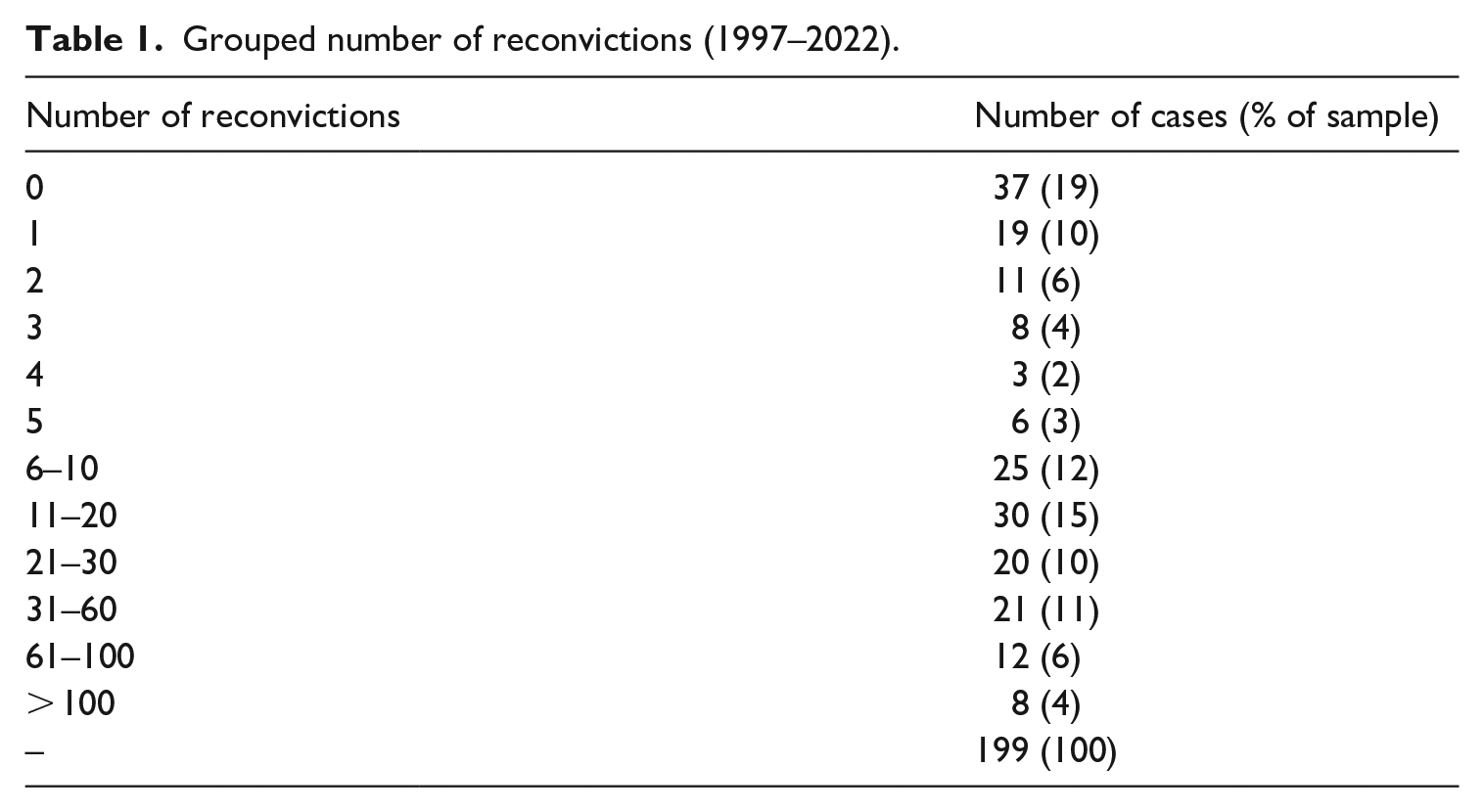
The number of reconvictions produced by the cohort was 1909 between the start of their orders (in 1997–1998) and the end of April 2010 (a period of about 12 years, an average of 9.59 per cohort member), 2193 between the start of May 2010 and the end of April 2022 (again, a period of around 12 years and an average of 11.02 per cohort member) and 4102 for the whole of that 25-year period between 1997 and 2022 (an average of 20.61 convictions per cohort member). Only 37 individuals were not reconvicted. Table 1 reports the grouped number of reconvictions for the sample from the start of their probation orders until the end of April 2022.
Grouped number of reconvictions (1997–2022).
Who was reconvicted?
The first stage in answering this question relied on bivariate analyses (cross-tabulations). I commence by exploring the first half of the period after their probation orders had started (1997–1998) and the end of April 2010. Males were more likely than females to have been reconvicted (80% of males, 46% of females, p < 0.000). Age was not associated with reconvictions (78% of those aged 17–23 (so aged 29–35 in 2010) at the outset of the study had been reconvicted, as opposed to 74% of those aged 24–29 at the outset of the study (and who were 36–41 in 2010)) and 74% of those aged 30–35 at the outset of their probation orders (so aged 42–47 in 2010, p = 0.756). However, for the second period for which conviction data were available, this picture was reversed. Gender was not statistically significantly different in terms of who had been reconvicted in the period from May 2010 to April 2022 (52% of males had been reconvicted, against some 35% of females, p = 0.091). So, while men were more quickly reconvicted than were women, during the second period, reconvictions were more evenly distributed. Younger members of the cohort were more likely to be reconvicted during the second period; of those aged 17–23 at the outset of the study (so aged 42–48 in 2022), 60% were reconvicted during the May 2010 to April 2022 period, while for those aged 24–29 at the outset (and 49–54 in 2022), 38% were reconvicted, and for those aged 30–35 in 1997 (so, 55–60 in 2022) this figure was 48% (p = 0.027). Quite why this patterning with regards to age and gender existed remains a mystery. The obvious explanation is that gender is associated with immediate to intermediate reconviction chances (up to May 2010), but after that, when explaining persistence in offending over 25 years, being of a younger age is a more powerful explanatory variable.
Having an OGRS score of greater than 50% was associated with being reconvicted during the period from the start of their probation orders until May 2010 (86% of those with an OGRS score of greater than 50% were reconvicted, as opposed to 62% for those with a score below 50%, p < 0.000). This finding was replicated when the period from the start of May 2010 until the end of April 2022 was considered; 55% of those with an OGRS of greater than 50% were reconvicted, as opposed to 42% of those with an OGRS lower than 50%, p = 0.045. Looking at the whole of the period available for analysis (from the start of their orders until the end of April 2022), the figures were 90% for those with an OGRS of above 50%, and 70% for those with a score below 50% (p < 0.000).
In the initial write-up of this sample’s experiences (Farrall, 2002), the sample had been divided into three groups: those who were confident that they would stop offending (and whose probation officers shared this assessment); those who thought that they could stop offending, but whose probation officers did not share this assessment; and those who did not feel that they could stop offending. These groups were referred to as the Confident, the Optimistic and the Pessimistic, and these classifications were shown to be key in explaining the extent to which individuals faced problems to stopping offending and (where relevant) were able to overcome these (see Farrall, 2002: 105–107). The current analyses also suggest that there were statistically significant differences in terms of their reconvictions between the three groups, but this declined over time. When we look at the first period (up to May 2010), the likelihood of reconviction is significantly different across the three groups (p = 0.018), the Confident were the least likely to be reconvicted (68%), with the Optimistic and Pessimistic having similar rates of reconviction (respectively, 85% and 86%). So, outlook appears to play a significant part in rates of reconviction in the immediate to intermediate period (i.e. the 12 or so years from the start of their orders in 1997–1998 until the end of April 2010). However, when we look at the period from May 2010 to April 2022, there was no statistically significant difference across the groups (p = 0.140): 44% of the Confident were reconvicted between May 2010 and April 2022, while for the Optimists this figure was 55% and for the Pessimists it was 61%. This suggests that motivational outlooks might be altered over longer periods of time (as one might well imagine, given the ebbs and flows of periods of good fortune and bad luck, which may encourage some into believing that desistance was possible, while suggesting to others that it may not be as easy as they had first imagined).
Looking at the deviant cases (that is, individuals whose subsequent offending careers were at odds with what they had expected), there were 27 cohort members who were coded as being confident of desisting at the outset of their probation orders but who had at least 20 convictions. Of these 27, 19 either had convictions relating to drug use or had reported problems with drugs, suggesting that drug addictions were not overcome as hoped, or were initiated after we first interviewed them. There were four Pessimists (who one would expect to be reconvicted at a fairly high rate) but who had no reconvictions (up to April 2022), and another three with only one reconviction during this period. These cases appeared to have gained work, become embedded in relationships with caring responsibilities and had a degree of good fortune (in that some offences they admitted to us they had committed had remained undetected or were dropped by the police or Crown Prosecution Service). 2
What explains reconvictions in the 25 years since the orders started?
Using a range of both officially recorded data, self-report from the cohort members and data from their probation officers, I attempted to build a logistic regression model to explain reconvictions from the start of the probation orders until April 2022. The resulting model is shown in Table 2. In addition to the variables shown in Table 2, I drew upon the following variables in building the model: the offence for which they commenced probation, their motivation group, their age at the start of the probation order, self and probation officer reported data on likelihood of reoffending within 2 years, assessments of various social and personal circumstances (such as their accommodation, employment, finances, family relationships, drug and alcohol, and so on, and the extent to which these were a problem at the time of the offence, at the time of the first interview and if these were a causal factor in the offence for which they received their probation order), and if the cohort member or their probation officer felt that they faced a particular obstacle to desisting from crime. All of these, however, failed to enter the model.
Explaining reconviction since start of probation order.
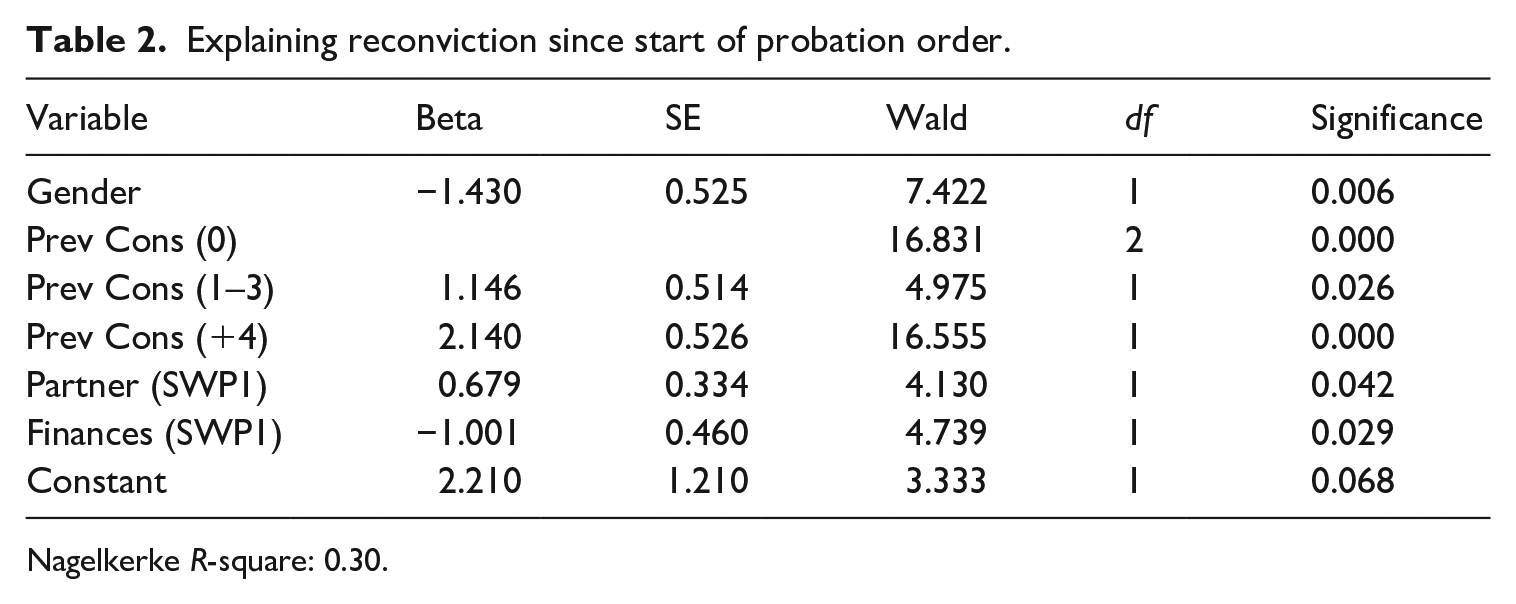
Nagelkerke R-square: 0.30.
The model, which correctly predicted 85% of the cases (n = 192), finds that males are more likely to be reconvicted, as were those who had more previous convictions. Those with four or more convictions at the outset of the order were especially likely to be reconvicted. The data from the cohort members suggested that those who said that their relationship with their partner was good at the start of their order were also more likely to be reconvicted (against what one might expect). Those who reported that their finances were a problem were more likely to be reconvicted. 3 Interestingly, none of the assessments by either cohort members or probation officers about the cohort member’s likelihood of reoffending or their assessments of the part played by their social circumstances in the offence for which they were given probation reached statistical significance. So, gender, previous convictions, finances and family relationships dominated the model. This suggests that there are some ‘fixed’ factors (gender and previous convictions) and some dynamic factors (relating to finances (and therefore, in all likelihood, employment) and families/relationships.
Which offences were they reconvicted of ?
Table 3 reports on the number of reconvictions by offence type of which the sample were found guilty during the period from the end of their probation order until the end of April 2022.
Number and percentage of reconvictions since start of probation order.
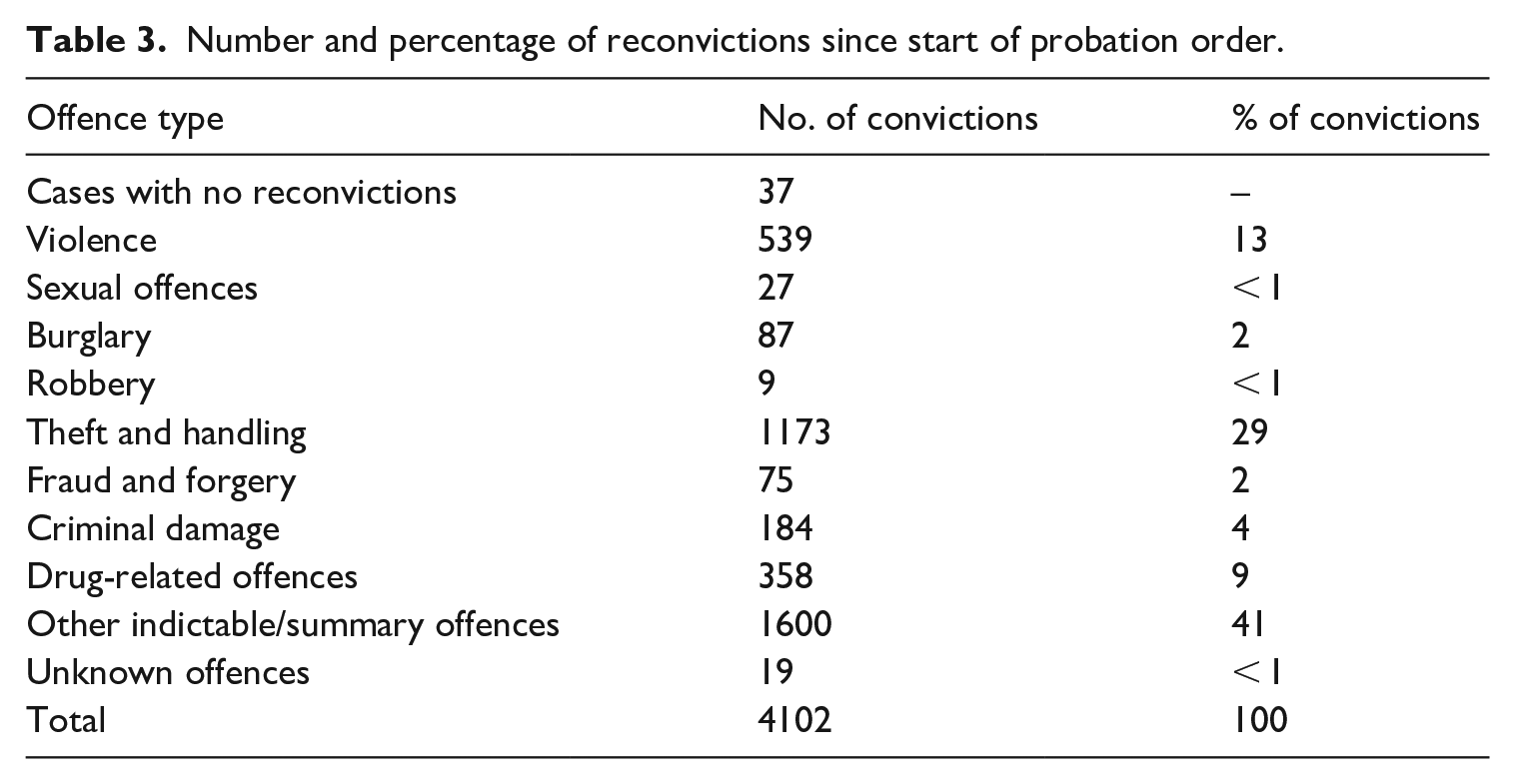
The largest offence types related to Other Indictable and Summary offences (which would have included both a large number of reconvictions relating to breaches of previous orders and motoring offences). Indeed, breaches of various orders account for 486 of the 4102 reconvictions that this cohort amassed (or 12% of their reconvictions since they started their probation orders). There were very few sexual offences or robberies, and only slightly more burglaries. Fraud and forgery, and criminal damage were also fairly rare, with more common offences relating to drug use/possession, violent crimes, theft and handling and other indictable/summary offences.
Do some offence types become less common (or more dominant) over time?
Table 4 reports on the convictions which the cohort had accumulated during three periods of time, namely, prior to the commencement of the probation orders in 1997/1998, in the period from the start of their order until the end of April 2010, and then from May 2010 until April 2022.
Changes in the cohort’s convictions over time.
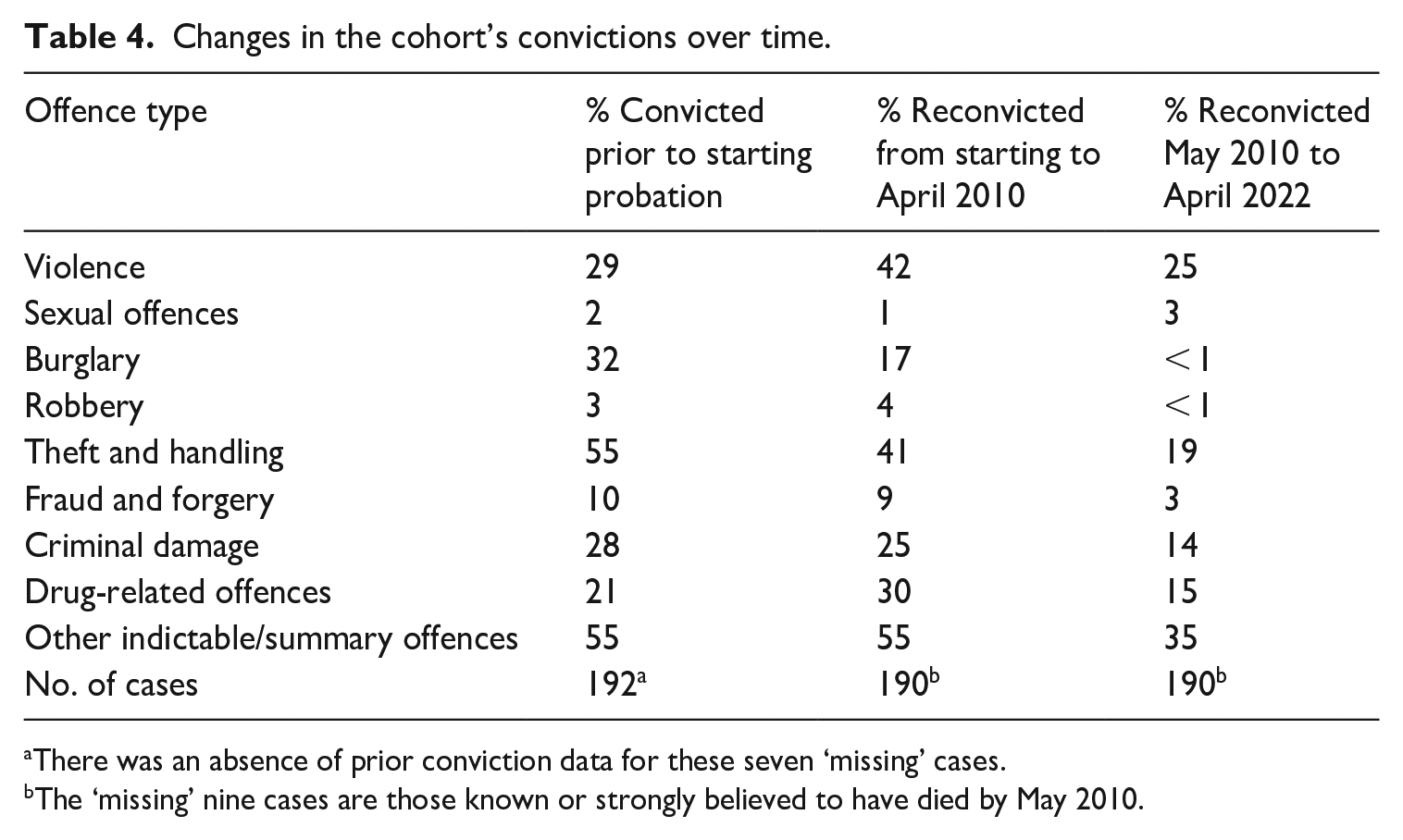
There was an absence of prior conviction data for these seven ‘missing’ cases.
The ‘missing’ nine cases are those known or strongly believed to have died by May 2010.
Table 4 can be used to detect the changes in the occurrence of various offence types and interactions with the cohort’s age. At the outset of the study (in 1997/1998), the cohort’s average age was just over 25 years. By April 2010, this would have been 37 rising to almost 50 years by April 2022. As can be seen, the percentage of those convicted of violent crimes rises from 29% to 42% and then drops to 25% (possibly reflecting an increase in physical strength in the 20s and 30s, followed by a decline in their 40s and 50s). Sexual offences remain relatively uncommon. Burglary drops substantially, from 32% having a conviction for burglary prior to starting their order, to 17% in the 12 years after it started, to less than 1% in the most recent period. Robberies also fluctuate, but then decline substantially, as do convictions for theft and handling. Fraud and forgery and criminal damage also both decline, although this takes slightly longer for these two conviction types. Despite the fact that the other indictable and summary offences made up the largest conviction type for the May 2010 to April 2022 period (see Table 1), these too decline from over 50% for the periods up to May 2010 to 35% thereafter. Notwithstanding the fact that both violent and drug-related convictions declined, these both appeared to be behaviours which the cohort was still being convicted of for many years. The drug-related crimes are relatively easy to explain; drug addiction is never easy to cease completely, and the violent convictions possibly speak to entrenched behaviours or ‘violent’ temperament which some found hard to leave behind. In short, while all conviction types saw declines (as one would expect for a cohort which was ageing from around 17–35 years old to being 55–60 years old), this was especially marked for burglary and associated offences such as theft and handling.
Who were the desisters?
Of the 199 members of the cohort, 37 had avoided any reconvictions up to April 2022, while the remainder (n = 162) had at least one conviction. However, when deaths are taken into account these figures fall to 36 and 154. What distinguished the desisters from those reconvicted? Analyses relying on bivariate analyses (cross-tabulation tables) found significant differences across the three groups in the likelihood of reconviction (p = 0.014), those who felt that they were likely to cease offending (the Confident) were most likely to have avoided any reconvictions (although this was still only 26% of that group, 28 of 107), while both the Optimists and Pessimists were much less likely to have avoided any reconvictions (12% and 7%, respectively). Females were also, as one might imagine, much more likely than males to have avoided further convictions (46% against 15%, p < 0.000). At the fifth sweep of interviews, cohort members were asked about various aspects of their personal and social lives. Those who said that their employment status was ‘not a problem’ (which might have meant, for example, that they were not working and not looking for work, but for the most part would have meant that they were employed) were more likely to have avoided any further convictions (27%) than those who said that their employment situation was a problem (8%, p = 0.011). None of the other circumstances discussed (accommodation, finances, relationships with partners, family, drugs and alcohol, and feeling depressed) were statistically significant.
How do we explain ‘crime-free’ gaps? What do these tell about desistance from crime?
Of interest in studies of individual offending careers over the long-term, especially when desistance is a key concern, is the presence of what have been referred to as ‘crime-free gaps’ (Shapland, 2022; West, 1963). These are periods of time when an individual, who has offended previously does not offend or is not convicted, but subsequently offends again. When analysing official conviction data (which are an incomplete representation of an individual’s offending), we need to make sure that the period of time is sufficiently long enough for the gap not to be an artificial one created by the individual offending but just not being caught or convicted, and to make sure that periods of time spent in prison do not artificially make it look like someone has a crime-free gap. A longer period without convictions increases the chances that the observed ‘crime-free gap’ is a genuine one. In this study, 9 years without conviction was taken as sign that the individual had ceased offending for a period of time for long enough for this to be considered a meaningful gap in their offending career. This seemed like a good place to start, since I had a longer period of time (25 years; 1997–2022) than Shapland (14 years; 2004–2018), a slightly larger sample (199 vs 113), and one which was less likely to be reconvicted given their respective OGRS scores (55% vs 77%). In all, there were 25 cohort members who experienced crime-free gaps of 9 years or more (just over 12% of the cohort). These are listed, and partially described, in Table 5. In some cases, using interview data and knowledge of each individual’s history, we are able to draw some conclusions about what accounted for the re-starting of offending after almost 10 years of non-offending. I have also noted if there were a further crime-free gap since the last conviction.
Cases nine or more years conviction free (1997–2022).
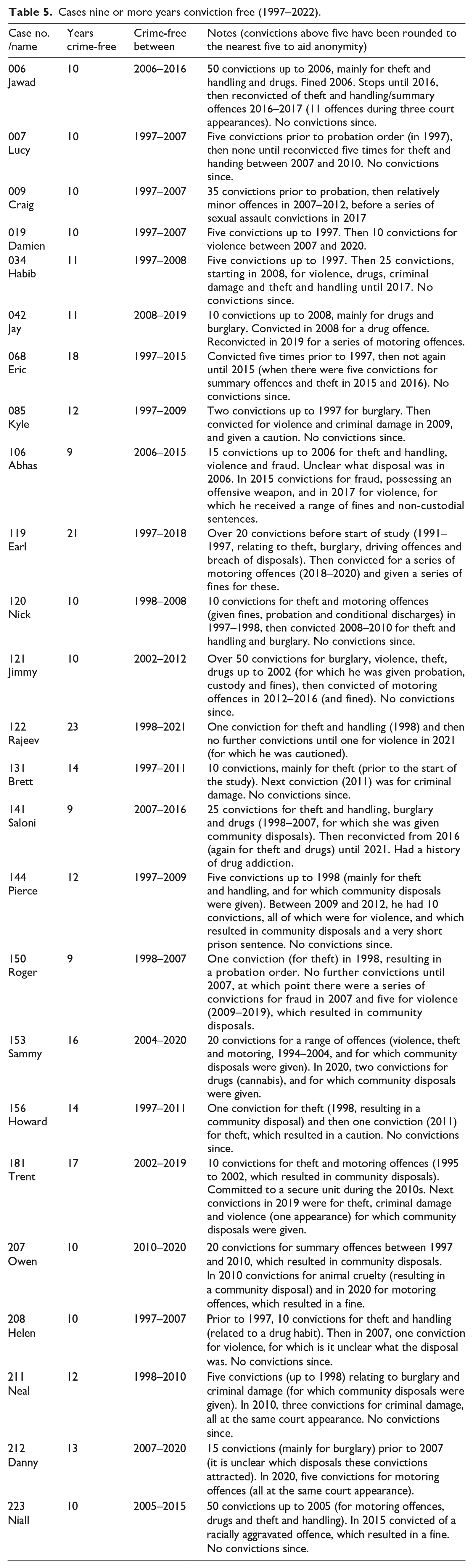
What did the interview data suggest were the causes of these gaps? At least one of the cohort members (Case 007/Lucy) was aware of this gap in her conviction history. When interviewed during the fifth sweep of interviews, she said ‘I had a long period, does it say, have you got my record there, because there’s like a 10 year gap of non-offending, when I was doing voluntary work’, later adding: I did stop for long periods of time when I was doing voluntary work, because I had something to do and I had some meaning and purpose in my life and I felt good about what I was doing because I was getting good feedback. I did a [vocational qualification] in [specific job] and was working in the centre of [city], just up the road. And I loved it, just absolutely loved it.
She attributed her return to offending (and, consequently, reconviction) to an on-going mental health problem (she was bipolar). During one ‘manic’ period, she started a relationship with a man who persuaded her to start using heroin, and started to steal, partly to support her children, but also under pressure from this man (who eventually left her a year or so prior to our interview with her).
Case 034/Habib had a somewhat unusual conviction history. He was placed on probation in 1997 following a conviction for theft (and recruited into the project while on probation). Prior to this, he had received fines for thefts and drug offences. Between starting his probation order in the fall of 1997 and early 2008, he had no convictions. This appears to have coincided with a marriage and him becoming a father for the first time, as well as running his own catering business during this period. This relationship lasted for about 10 years, and survived him becoming convicted for the possession of heroin in 2008 and 2009. Shortly after this, he and his wife divorced and he started to live separately from his family. His ex-wife prevented him from seeing their daughter for a while, which resulted in a fight between Habib and his former brother-in-law (and resulted in Habib being convicted of violence and criminal damage in 2010, and a short custodial sentence). After our last interview (2012) with him, he was then convicted of possession of cocaine in 2013, sexual assault in 2014, the last of which resulted in a 5-year prison sentence. He was released before serving all of his sentence in prison, as he was convicted of a sexual offences notification failure offence in 2017. It would appear that the crime-free gap between 1997 and 2008 was related to his marriage, and his return to drug use and convictions for sexual offences took place after the marriage had ended. What is unclear, however, is how the sexual assault fits into his wider criminal career.
Given that some of the individuals with crime-free gaps of over 10 years (042/Jay, 119/Earl, 121/Jimmy and 212/Danny) had lengthy criminal careers prior to these gaps, and then over 10 years between the ‘end’ of these and subsequent convictions exclusively for motoring offences, it is likely that these individuals had indeed desisted from sustained offending. Their motoring convictions then are fairly unremarkable, and did not appear to be associated with a return to other forms of offending, despite their having had lengthy criminal careers in which drug use, theft, burglary or violence were common. Motoring offences are common. Indeed, in the United Kingdom, some 2.4 million individuals are convicted of motoring offences each year. It is unlikely that these cohort members or others who knew of these convictions, would have seen these reconvictions as indicating that they had started to offend again. Motoring offences, while not wishing to minimise the harms associated with them, are quite common in a general population. These cases now, by all accounts, are similar to many people who would consider themselves to be non-offenders – they have convictions for motoring offences but nothing else. They have become desisters, albeit desisters who commit violations of traffic laws.
Other cases also suggest that, in the main, crime was a feature of the past for those individuals who had experienced lengthy crime-free gaps. Case 153/Sammy, for example, had been an injecting drug user for many years, but had ceased using heroin around 2002. Like many other people in England and Wales, he used cannabis and was convicted of this in 2020, receiving a small fine. In England and Wales, cannabis use was downgraded from a Class B drug (the second most serious of three groups of drugs) to a Class C drug (the least dangerous) in 2004, but was moved back to Class B in 2009. Typically, people caught by the police with small amounts of cannabis (usually considered to be less than one ounce) and which is thought to be for only their use, are given a warning or an on-the-spot fine. As such, Sammy’s cannabis use does not appear to suggest a major change in his offending trajectory, and is a very commonly used drug in the United Kingdom.
Owen (207), was found guilty of animal cruelty (which he referred to in his interview with us in 2010): What happened was, right, the pups, I didn’t even know the pups were going to come and then when I found out [his dog] was pregnant I thought I better try and get rid of the pups, because I don’t want them. So I told my mate and I says “look I’ve got a litter of pups coming, can you try and get shot of them for me?” and he says “just sell them” he’s says “they’ll sell”. I says “oh I’ll try sell them then”. So he asked about for me and I asked about. [. . .] So he had a few customers for me and I had a couple. [. . .] They all wanted their tails docking, everyone who they were sold to [. . .] and they wouldn’t have took them without their tails docked, so I docked all their tails, and then two of the people that wanted the dogs backed out of it. So [my partner] advertised them on a website. One woman came for one of them, who we sold it to. She said “How come the tail’s docked on her?”, I said “’Cause that’s what you do with [this breed]”. And she says “Is there a docking certificate?” and I said “No, I’ve done it myself” and she says “Well, what happens if the vet asks me who’s docked them?”. I said “Just tell them I’ve docked them and tell them my name and address”. So she said “Alright then”, so anyway, vet asked her. Next thing the RSPCA knocked on the door to interview me. I couldn’t believe it.
For this he was fined. Ten years later, he was also convicted of a motoring offence. Again, it is hard to read his account of the ‘animal cruelty’ offence as sustained and wilful criminality (he and his family members had frequently docked the tails of the dogs in the past, were adept at it and it was performed without malice). Others (such as Case 120/Nick) returned to injecting drug use for brief periods after years of abstinence and gave accounts, which spoke to ‘silly’, but one-off episodes of offending: I was going out drinking with my mate and stuff and anyway we did something pretty stupid, we broke in to a bloody shop pissed out of our heads and stuff, and he smashed his finger so they got him on DNA so he grassed me up like he’s never been done by the Police before and stuff [said sarcastically], so, but I got a suspended sentence or something.
Others appeared to return to drug use, but were unable to ensure that such relapses were short-lived. Case 141/Saloni was on probation for a theft. She was an injecting drug user of Asian heritage who was abducted (possibly by her drug dealers and his associates) and gang-raped shortly after starting her probation order. She then received death threats, required an abortion and suffered a nervous breakdown (which resulted in her being sectioned under the Mental Health Act). Based on her criminal record, her injecting drug using career appeared to last until around 2006 or 2007. At around this point, she was given a number of custodial sentences for around 12–18 months (it is unclear exactly how long she served in prison), and upon coming out, remained conviction free, save for one fine for theft (which could have been a pseudo-reconviction; Mair et al., 1997). She was then conviction-free for 9 years, before starting in 2016 a run of 70 convictions for theft and drugs, which she acquired up to 2021 (just prior to the conviction data being released to the author by the Ministry of Justice, she was convicted for the 95th time). It is hard to imagine that Saloni had continued to offend during this 9 years and simply avoided detection (but, of course, this may have happened, or she may have moved abroad for some or all of this time). In sum, it would appear that she had managed to remain conviction-free for 9 years, most likely because she had ceased to use heroin, although why that might have been the case remains unclear. It could be that, like many former injecting drug users she had ceased using only to re-initiate later, or it could be that, as documented by Calverley (2013), her family paid for her to live overseas for some years as part of a home-grown rehabilitation effort, which he found common among those families with links to the Indian subcontinent. Case 181/Trent was convicted of a number of offences between 1995 and 2002, and during the last round of interviews in 2010–2012, spent some considerable time in a secure psychiatric unit. At some point between 2012 and 2019, he was released before he was reconvicted of violence, theft and criminal damage (at the same court appearance). Perhaps his mental health troubles had returned, but at least some of his crime-free gap may have been attributed to detention in a secure unit.
Other cases (006, 009, 019, 068, 106, 122, 131, 144, 150, 156, 208, 211 and 223) are harder to fathom, since their reconvictions (sometimes just the one offence) following a crime-free period after our last interview with them (typically around 2010–2012, but in some cases 2004, or 1997–1999), or when interviewed they claimed not to have been in trouble with the law. It could be that these offences were one-off episodes which came to the attention of the police for some reason (and of these thirteen cases, six had either one conviction, or only one court appearance). Interestingly, of these 13, seven had convictions for violence, perhaps suggesting individuals with ‘short fuses’. As I reflected in an earlier analysis of the reasons for re-offending among this cohort, In some instances, relapses into drug use or offending galvanised the probationer into wanting to desist. One probationer [109] reported having used heroin with an old acquaintance as he “wanted to have sex with her.” However, they did not have sex and he reported that he “didn’t feel good about having used [heroin]” and “didn’t want to have much to do with her” after this episode. Another probationer also reported how he had used heroin again after several months abstinence: “the next day I was really pissed off with myself – I’d gained nothing, just five or six hours of pleasure.” He had not used again since. (Farrall, 2002: 194)
Taken together, these data suggest that, for some (such those with a history of injecting drug use), desistance is a precarious journey, since, as Saloni’s case shows, this can be derailed after even almost a decade of (seeming) non-use. In other cases, the reconvictions relate solely to motoring offences, and without wishing to discount in any way the harms resulting from offences such as speeding, drunk- or reckless driving, are unlikely to disrupt the process or identity-change associated with desistance from crime. Being convicted for a motoring offence after a decade or so without conviction, which was preceded by a period of sustained offending in which one burgled homes, stole from shops and injected and supplied drugs, is unlikely to be seen by either the desister or their friends and relatives as signalling that they have ‘returned to a life of crime’. In other cases, even those with several convictions appear to have maintained periods of more than 5 years during which they were not reconvicted. Perhaps, just as we have come to recognise that even the ‘law-abiding’ commit crimes (Farrall and Karstedt, 2020), we need to acknowledge that the expectation of absolutely no further offending on the part of desisters is too much of an expectation?
What can be learnt by looking at the offences that brought to an end these gaps (that is the first new offence at the end of their crime-free gap)? For 10 (25% of those with gaps), it was a violent offence. Theft and motoring offences were equally common as one another (five instances each), while criminal damage (two cases), drug offences (also two cases) and sexual assault (one case) were much less common. Initially (in 1997–1998), only 10% of the sample had been given probation for a violent offence. Of those with convictions for violence which ended their crime-free gaps, five (085, 122, 181, 208, 223) have had no other convictions since. Were these episodes related to specific relationships or ‘one-off’ incidents? At least one was related to a mental health condition (181), and others were cautioned (122) or simply fined (223), suggesting minor infractions. Were these less serious offences? Are these ‘desisters who ‘slipped up’ once’? Those with more than two convictions for violence after their crime-free gaps (019, 034, 106, 144, 150, many of whom had at least five convictions for violence) are likely to be people for whom resorting to violence was common. It ought to be noted that while violence in general has become less common (ONS, 2022, see Figure 1) and that this was not a terribly ‘violent’ cohort (only 10% were on probation for a violent offence), the reporting of and reactions to violence have hardened, with more people reporting violent victimisation and the police adopting better recording practices. As such, the fact that some of these crime-free gaps were ended by minor and isolated violence episodes might be expected.
Those with exclusively motoring convictions after their crime-free gaps appeared to receive these sometime after very lengthy offending careers (042, 119, 121 and 212). Are these ‘desisters with motoring convictions’ (like many people)? They are essentially non-offenders and their motoring convictions will not affect their sense of self-identity; their ‘wider’ desistant identities will be unaffected. Similarly, case 153 had a conviction for cannabis possession after a lengthy criminal career revolving around heroin use. Is he a ‘desister who uses cannabis recreationally’? If so, and given the widespread use of cannabis, this conviction is also unlikely to affect his internal narratives of change/reform.
What might these individuals’ experiences tell us about how to approach desistance conceptually and theoretically? Maruna and Farrall (2004) introduced the terms primary and secondary desistance to refer to (1) crime-free lulls (similar to the crime-free gaps discussed herein) in the lives of offenders and (2) changes in self-perception. To this, McNeill (2016) added tertiary desistance to highlight the importance of recognition of change by others and of the development of an associated sense of belonging within a community (see also Gray and Farrall (2024) on quaternary desistance). Although, as others have pointed out (Nugent and Schinkel, 2016), the relationship between the first three of these ‘types’ of desistance need not be sequential (for example, sometimes being welcomed into a new social group where offending is not normative might trigger a shift in identity and behaviour). We can, perhaps, see this sample’s ‘crime-free gaps’ as, initially, the start of primary desistance? If so, have these ‘crime-free gaps’ developed into desistance despite individuals being further convicted? One might see new convictions as signs of the individuals giving up or ‘failing’ at desistance. However, it might well be the case that the individuals who experienced these crime-free gaps, at some stage, developed from primary to secondary desistance. The fact that they had re-offended for a rather short period (possibly lasting a few minutes) and for relatively minor crimes, perhaps, suggests that some of these people had progressed so far towards desistance during that time, that these minor episodes of offending did not disrupt their desistance.
If one follows this logic, I would put 042, 085, 119, 120, 121, 122, 131, 153, 207, 208, 211, 212, 223 (n = 13) in this category. The fact that they had remained conviction-free since the episodic convictions that had ended their crime-free gaps of, in many cases for around 10 years, suggests that these new convictions did not completely undo the earlier work. I am, in effect, arguing that the fact that the convictions which came after the crime-free period, taken, crucially, with the absence of a persistent phase of further convictions for many years again, actually ‘validates’, in a rather odd way, their desistance. Like many people, they made mistakes (got angry and involved in altercations, got caught for speeding on the way to work, or for using ‘soft’ drugs such as cannabis) but the progress they had made was not ‘undone’ by this. Their desistance, seen in this light, is confirmed rather than negated by these convictions. This is, of course, conjecture. We do not know for each of them the full circumstances, or what they said in court or how they saw the offences and convictions themselves – all of which we would need to know in order to accept or refute the above argument. Of the remaining cases with convictions since 2019, 019 (ten convictions for violence, 2007–2020), 141 (drug-related offending 2016–2021) and 150 (five violent offences 2009–2019) appear to be returning to a more enduring pattern of offending. In other words, their primary desistance was obliterated by the offences and convictions that they racked up. Again, without knowing the full details, this too remains speculative.
Conclusion
As noted at the outset of this article, reconviction studies tend to be used in programme evaluations, the more nuanced work of establishing desistance needing more detailed, self-report data for obvious, analytical reasons. Nevertheless, using what we know about the reconvictions of this cohort of former probationers, combined wherever possible with insights from interviews with them during the 13 or so years they were followed up, a number of things can be concluded. The first is that the conceptual approach put forward by Maruna and Farrall in 2004 of approaching desistance and having primary and secondary elements is both more complex than they had originally envisaged (a truism, in part, given the development of the concept of tertiary desistance). However, the distinction they outlined recognises that some crime-free gaps end with short-lived offending episodes and a seeming return to continued legal compliance, and that some crime-free gaps end with evidence of a more entrenched return to offending behaviour (even if the schema they outlined does not explain fully why these different pathways may be taken). Just as we start to think we have got on top of desistance processes and the explanation of these, the empirical data send us back to our metaphorical drawing boards, and we are to be thankful to Shapland (2022) for forcing a wider recognition of this matter. Certainly, more research on crime-free gaps is needed not only to understand these theoretically, but also to know how to respond to these when they end. Given that the criminal justice system does not look kindly on re-convictions, knowing which might signal a return to more persistent offending and which are isolated episodes that need to be responded to with greater leniency (which will allow desistance to be re-established over time) would be beneficial.
Footnotes
Acknowledgements
I would like to thank the Ministry of Justice for making available conviction data for the period from May 2010 to April 2022, and the Editors and reviewers for their comments on drafts of the article.
Declaration of Conflicting Interests
The author(s) declared no potential conflicts of interest with respect to the research, authorship, and/or publication of this article.
Funding
The author(s) received no financial support for the research, authorship, and/or publication of this article.
