




Abstract
Risk has become a dominant focus in criminal justice practice. While this can improve the effectiveness of practices for reducing offending, it can also stigmatise and create barriers for those attempting to desist from crime. To explore this apparent dilemma, we applied conversation analysis and discursive psychology to examine risk-talk in 12 video-recorded sessions of a groupwork programme for addressing sexual offending. We found both practitioners and clients oriented to notions of risk in their talk. They drew on risk-talk as a resource to construct narratives that support desistance, emphasising awareness of risks, having control, and gaining hope and agency over the future. However, risk-talk was resisted when it challenged the client’s self-presentation. Building on previous empirical and theoretical work on desistance and criminal justice practice, we found it is possible for people to incorporate aspects of risk into their personal narratives in order to weave a narrative of rehabilitation.
Introduction
Since the end of the 20th century, there has been an increasing preoccupation across society with risk and public protection (Robinson, 2016). This preoccupation has influenced the design and delivery of interventions to address offending behaviour, particularly in Anglophone countries, where assessing, managing and targeting risk is paramount (Kemshall, 2003; McNeill, 2009; Robinson, 2016). The influence of the risk paradigm in criminal justice social work 1 (CJSW) is criticised for perpetuating a predominant focus on the risks around offending which frustrates or even subverts the process of desistance from offending, a key aim of CJSW intervention (McNeill, 2016a; Scottish Government, 2010). The emphasis on risk management and public protection is seen as replacing the traditional rehabilitative ideal of probation (Kemshall, 2003). However, as Robinson (2016) notes, rather than being contradictory, the agenda of risk and the agenda of rehabilitation developed together, influencing each other. Risk-driven practices, under the Risk-Need-Responsivity (RNR) model, are thought to have even improved the ability of criminal justice services to reduce re-offending and promote rehabilitation (Bonta and Andrews, 2016; Andrews et al., 1990; Raynor and Miles, 2007).
In this article, we will explore the role of talk about risk, or risk-talk, in a groupwork programme addressing sexual offending. We highlight that both practitioners and clients treat talking about risk as integral to CJSW, exploring how risk-talk can contribute to clients constructing a self-narrative supportive of change or rehabilitation, in harmony with desistance narratives. We further argue the role of risk-talk in criminal justice interventions as promoting desistance through constructing narratives of rehabilitation has been previously obscured in criminological research on desistance due to the predominant use of research interviews. Through detailed examination of how risk is applied in practice, in this article, we address a key theoretical and practical dilemma: how can a focus on risk in criminal justice interventions both aid rehabilitation and hinder desistance?
Risk, desistance and CJSW
Assessing and managing the risks posed by people who have offended is central in CJSW (HM and Prison Probation Service, 2021; Scottish Government, 2010), heavily influenced by the RNR model (Bonta and Andrews, 2016). Risk in this context refers to risk of re-offending and risk of harm. In the RNR model, eight central risk factors proposed to be predictive of offending have been empirically identified (e.g. employment, substance use), alongside other factors which are considered important for effective intervention (e.g. housing, mental health). These factors are foundational to structured criminogenic risk assessment tools used internationally to aid assessment of and intervention with people who have offended. For example, those used in Scotland include, in relation to general offending, Level of Service/Case Management Inventory (LS/CMI) (Andrews et al., 2004), and, in relation to sexual re-offending, Stable & Acute (SA07) (Hanson et al., 2007). These tools measure static factors, that is, fixed ones such as age, and dynamic factors, that is, criminogenic needs, ones deemed changeable, for example, employment. Importantly, these tools are used to assess how much risk of re-offending a person poses and in turn, ideally, determine the level of intervention. They also inform the focus of intervention by identifying the criminogenic needs to target. Some studies found interventions based on this model are effective in reducing recidivism, a key indicator of desistance (e.g. Bonta and Andrews, 2016; Andrews et al., 1990). Recently, Prins and Reich (2021) questioned the positionality of this research, suggesting that proponents of the RNR model have overreached in their claims about the ability of criminogenic risk assessments to accurately predict risk of re-offending, particularly for high-risk offenders, or to usefully inform interventions, as the factors associated with offending behaviour are not necessarily the same as those associated with desistance or, for that matter, certain measures of recidivism. They are particularly critical that the impact of socio-political factors on offending and desistance are not taken into account.
Desistance is the process of moving away from crime to a non-offending lifestyle. To desist from offending, individuals must build a narrative identity that is inconsistent with offending behaviour, accounts for but disclaims their past actions, and aligns with future prosocial aspirations (Maruna, 2001; Paternoster and Bushway, 2009; Rocque et al., 2016). Central features of these desistance narratives are having a sense of control over one’s future; presenting a good ‘true self’; attributing negative life events (e.g., offending) to unstable, external and specific factors; and a desire to be productive and useful, that is, a sense of generativity (Maruna, 2001, 2004). Desistance does not happen in a vacuum; social supports and structures are necessary to recognise and sustain new desistance identities (McNeill, 2006; Maruna, 2001; Nugent and Schinkel, 2016). Promoting desistance is a key aim of CJSW intervention (Scottish Government, 2010). Recently, we demonstrated how such interventions can be a site for building desistance narratives as practitioners and clients co-constructed clients’ identities in interaction (Mullins and Kirkwood, 2019a).
CJSW interventions with people who have offended, whether structured programmes or one-to-one supervision, are largely talk-based, alongside some practical support, for example, applying for benefits, referring to substance misuse services. Practitioners and clients mostly spend their time discussing, for example, the client’s offending, risks and needs around this, how they can stop and with what support, for example, substance misuse services, family. The RNR model suggests interventions using talk-based cognitive-behavioural approaches are the most effective for addressing an individual’s criminogenic needs (Bonta and Andrews, 2016). Such approaches focus on addressing clients’ thinking. The underpinning assumption is that thinking affects behaviour, where to change offending behaviour, the individual must change their thought processes, attitudes and beliefs. This assumption permeates criminal justice rehabilitative practices, and its influence is particularly obvious in interventions addressing sexual offending (Auburn and Lea, 2003; Maruna and Copes, 2005; Maruna and Mann, 2006; Waldram, 2010). Here, a client’s thinking is characterised as risky or not, and the client positioned as both the cause of and the solution to their offending behaviour (Presser, 2008). As such, rehabilitation is then not about recovery, but encapsulated in a client’s ability to effectively communicate they both understand and unequivocally accept the risks around their offending, and are able to self-monitor and address these (Fox, 1999a; Lacombe, 2008; Waldram, 2010), leading Lacombe (2008) to assert ‘rehabilitation is risk management’ (p. 73).
However, by being overly focussed on risk and risk management, interventions based on the RNR model are criticised for stifling the process of desistance (McNeill, 2016b; Marshall and Serran, 2004; Maruna and LeBel, 2010; Ward and Maruna, 2007). How the language of risk has been refracted into practice, for example, through risk assessment tools or cognitive-behavioural approaches, is thought to construct people who have offended as active, agentic individuals, solely responsible for their own crime. They become risk bearers or ‘risky’ people, reduced to a collection of risk factors which are managed and transformable (or not) through treatment, and the critical role of wider societal structures in criminal behaviour, and desistance, is lost (Fox, 1999b; Hannah-Moffat, 2005; Kemshall, 2003; McAlinden, 2016; McNeill, 2016b; McNeill et al., 2009). Furthermore, the focus on risk is proposed to quash the hope and motivation necessary to promote desistance (McNeill, 2016b).
Regarding interventions addressing sexual offending, previous research suggests men convicted of sexual offences are actively constructed as ‘risky’ and are expected to develop an identity of being constantly at risk of re-offending (Digard, 2014; Lacombe, 2008). Clients are required to talk about the risks around their offending behaviours, including their thought processes, without any form of mitigation (Digard, 2014; Lacombe, 2008; Maruna and Mann, 2006; Waldram, 2010), although they can and do resist (Auburn, 2005). Clients must acknowledge, and show they are capable of managing, their own prevailing risks to be considered rehabilitated and suitable for reintegration (Lacombe, 2008; McNeill, 2016b; Robinson et al., 2012). Digard (2014), Lacombe (2008) and Waldram (2008, 2010) argue, due to the focus on risk, the identity of ‘sex offender’ is constructed and reinforced as the institutionally acceptable narrative is created, to the exclusion of other aspects of clients’ narratives. By overly focusing on risk and offending, interventions may miss aspects of personal narratives, including strengths and seeds of moral identity which could support the development of a desistance narrative (McNeill, 2006, 2016b; Maruna and LeBel, 2010; Waldram, 2008, 2010).
Having an identity as a ‘risky’ person is contrary to a desistance identity of being fundamentally good but with harmful and risky behaviours. Furthermore, being categorised in this way indicates the difficult, harmful and criminal behaviours are internal, stable and global traits, difficult if not impossible to change and therefore permanent and enduring, something to be forever managed (Lacombe, 2008). As such, desistance from offending, in terms of a change in identity, is an unlikely outcome for a ‘risky person’; the best they can hope for is managing their risk. Considering the concerns that a focus on risk potentially subverts the development of desistance narratives, narratives which are constructed during the talk-in-interaction between clients and practitioners (Mullins and Kirkwood, 2019a), there seems to be a tension between addressing risk and promoting desistance in CJSW interventions.
The importance of context
Previous research positions the institutional narrative, proposed as overly focussed on risk, and the client’s personal narrative as at odds, where the client must acquiesce to the institutional narrative (Fox, 1999a; Lacombe, 2008; Waldram, 2007), possibly subverting the creation of a desistance narrative. However, as an evolving life story, narrative identity is shaped by and shapes the social context and interaction (McAdams and McLean, 2013), where people manage their self-presentation (Goffman, 1959). As such, these narratives are not necessarily mutually exclusive but context dependent. Digard (2014) highlights the importance of context, noting the institutional narrative may not be socially acceptable beyond the narrow bounds of the criminal justice intervention. From her observations of a cognitive-behavioural treatment programme addressing violent offending, Fox (1999a, 1999b) noted the language of such programmes constructs institutionally relevant ‘criminal’ types, sustaining the underpinning correctional ideology, that is, one that pathologises the individual’s thinking and ignores the wider social context. Although people who have offended could and did resist this construction of self, this resistance was used as further evidence of the ‘criminal type’ relevant in the context of the treatment programme. Waldram (2010) reported within the ‘relatively safe context of a research interview’ his participants provided different accounts of their offending, reasoning in that context they were not challenged and did not have to engage with the cognitive-behavioural paradigm (p. 270).
Research interviews with practitioners and clients have been the dominant mode of examining clients’ experience of criminal justice interventions and the processes of desistance (e.g. Digard, 2014; Harris, 2017; Lacombe, 2008; Maruna, 2001; Nugent and Schinkel, 2016; Waldram, 2008). However, it is rarely recognised that research interviews are sites of social interaction themselves which will produce certain types of accounts depending on the focus and what is at stake for the interviewee and the interviewer, consequently shaping the findings (Potter and Hepburn, 2005). For example, Presser (2004) noted in her interviews with men convicted of violent offences that participants oriented to her position as a woman or a researcher to produce moral accounts for their offending. Informative as this previous research is, the narratives of the participants and the social context of the interview are mutually constructing and contingent. We are not suggesting that interactions in criminal justice contexts are more ‘true’ or ‘authentic’ than accounts produced in research interviews, but rather that the accounts produced within the context of a research interview will be different from those produced in the institutional context of criminal justice interventions. Interactions that take place within criminal justice interventions are critical sites where narratives and identities relevant to desistance are likely to be shaped and produced. We argue that to understand how discourse about risk is treated within criminal justice interventions and how it contributes to the construction of narrative in this context, it is necessary to examine this talk in situ.
In this article, we address the gap in understanding of how notions of risk are used in criminal justice interventions by examining how risk is talked about in interaction during the sessions of a groupwork programme addressing sexual offending. We build on Fox’s (1999a, 1999b) work showing how, in this context, risk-talk is expected and can be used as a resource by practitioners and clients to promote self-efficacy and hope in a manner consistent with developing desistance narratives. To address the theoretical and practical dilemma of focussing on risk in criminal justice interventions, we show how engaging in risk-talk allows practitioners and clients to orient to the management of risk, co-constructing a narrative of rehabilitation.
Methodology
This study examined sessions of the Scottish national accredited groupwork programme for addressing sexual offending, ‘Moving Forward: Making Changes’ (MF: MC), delivered in a community setting by local authority CJSW services. This rolling programme works with adult men (18+) convicted of sexual offences who are Court mandated to attend. Underpinned by the principles of the RNR model, risk assessment and management are central to this programme, where the treatment plan is individualised to address the particular criminogenic needs identified for an individual (Scottish Government and Scottish Prison Service, 2014). The programme is also influenced by the Good Lives Model (GLM), a strengths-based model positing there are universal goals all humans seek, for example, happiness and relatedness (see Ward and Maruna, 2007), and offending behaviour functions to achieve these goals, albeit harmfully. The GLM proposes clients should be supported to identify and achieve their goals prosocially, building on and developing their strengths and capacities.
Research participants (practitioners and clients) gave informed consent and identifying features were anonymised. The authors’ university and relevant local authority gave ethical approval. The local authority delivers the national MF: MC groupwork programme for five local authority areas, engaging a wide client group from both urban and rural areas. As the MF: MC programme was noted as being delivered broadly in line with the programme design across Scotland (Scottish Government, 2018), this detailed study provides insight into practice more widely. The first author repeatedly watched 12 video-recorded groupwork sessions from three groups, approximately 28 hours, transcribing these orthographically. The local authority routinely records the sessions for internal quality assurance. Recordings were selected for this study on practical grounds, that is, best visual and audio quality. Each group had two groupworkers and 4–6 clients convicted of sexual offences, 18 clients in total. Their offences included accessing indecent images of children, adult rape and child sexual abuse. The groupwork team involved two men and three women, resulting in mixed and same gender groupworker variation per session.
The first author identified extracts relevant for analysing how risk is talked about in the groupwork sessions. Talk about risk in the MF: MC groupwork sessions appeared to encompass a broad meaning, beyond those identified in structured risk assessment tools, to include any aspect of a person’s life that can have an adverse impact, for example, difficult living situations and negative thought patterns. For the purposes of this analysis, the first author identified sections of interaction where risk was indicated, including any talk about past, present or future harm or possible harm; indicators of this (e.g. from the programme materials (i.e., Scottish Government and Scottish Prison Service, 2013, 2014) and structured risk assessment tools (e.g., LS/CMI, SA07; Andrews et al., 2004; Hanson et al., 2007)); and strategies to address these risks. Risk-talk also included discussion about clients’ harmful actions towards others and clients’ experiences of harm, from self, others and structures. Identified extracts were then transcribed in greater phonological detail (Jefferson, 2004) and closely analysed. Both authors analysed these extracts using conversation analysis and discursive psychology (i.e., McKinlay and McVittie, 2008; Potter and Wetherell, 1987), to examine the nature and function of risk-talk and how it contributes to the construction of client’s narratives, including its relationship with desistance narratives. These methods examine the micro-level utterance by utterance sequence of talk, looking at how people make sense of their conversations and what they are doing in their talk; for example, encouraging or censuring. Language is treated as actively constructing social reality and accomplishing social functions (Liddicoat, 2011; McKinlay and McVittie, 2008). Using these methods, we previously demonstrated how desistance narratives are co-constructed in interaction (Mullins and Kirkwood, 2019a) and how expressions of shame are dealt with during the sessions of the MF: MC groupwork programme (Mullins and Kirkwood, 2019b).
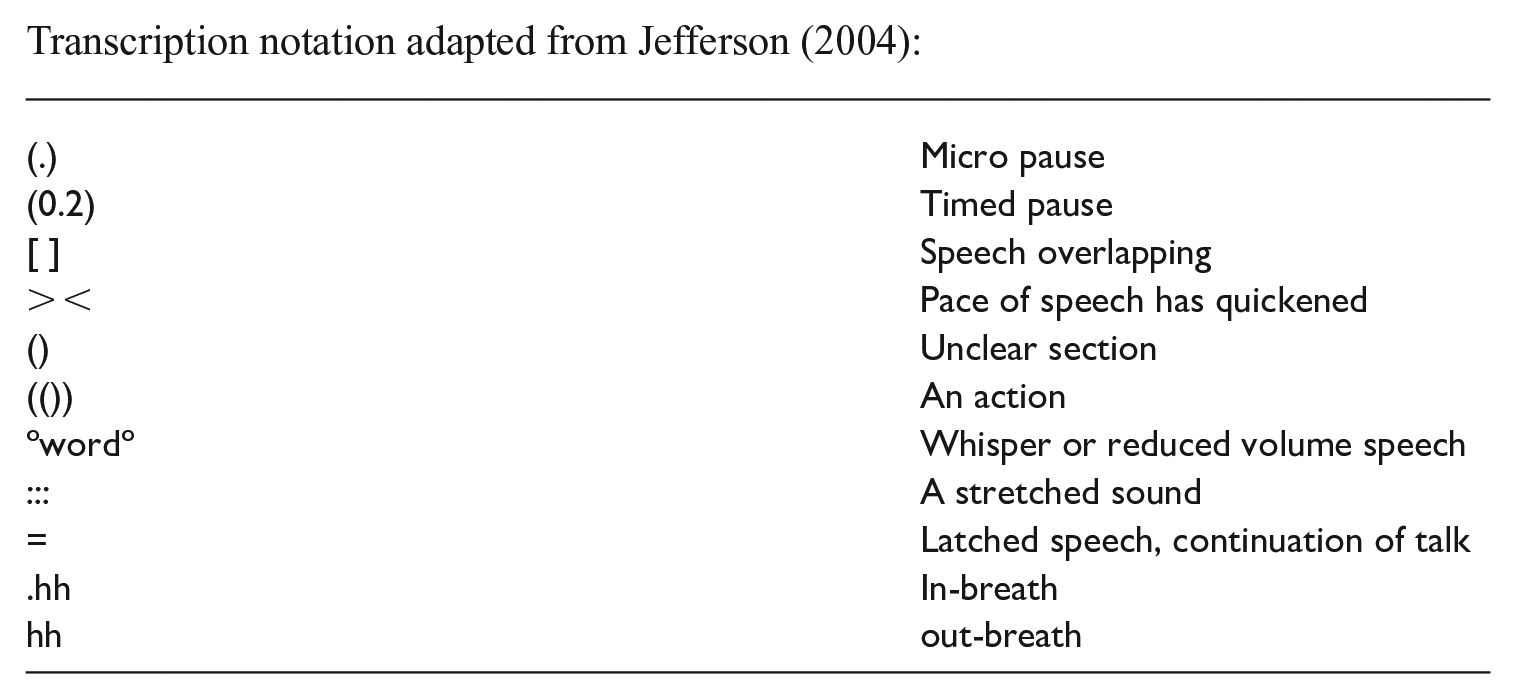
The extracts presented here were chosen for their clarity and brevity, and are representative of a larger sample of similar identified patterns as examples of how such interactions unfolded. In the extracts, all client names are pseudonyms and groupworkers are referenced as G#. The extracts are presented verbatim, allowing the reader to judge the validity of the interpretation themselves, as is convention with the methods of conversation analysis (Liddicoat, 2011), with the transcription symbols explained in Appendix 1. We recognise that this methodological approach is relatively innovative for the field, and many readers may be unfamiliar with this style of transcript. However, we present them in this way as the details of how conversations unfold, including hesitations, repetitions, pauses, repairs and overlapping speech, are important for understanding how accounts, narratives and identities are co-produced within interaction (Potter and Hepburn, 2005; Rapley, 2016).
Findings
Overall, risk-talk appeared to contribute to clients’ narrative identities, in becoming part of how clients told their stories of who they are, and, at times, how they have changed. Both groupworkers and clients referred to risk and made it relevant in their talk. Risk-talk was prevalent and central in the sessions, unsurprisingly given the institutional context and wider pervasive concerns about risk. However, it is through risk-talk that groupworkers and clients evoke the specific institutional aims and the wider construction of sexual offending treatment in interaction.
To illustrate the functions of risk-talk, we present four extracts. Extract 1 outlines how groupworkers direct clients to acknowledge risk, how this can threaten clients’ self-presentation and how clients may resist the negative implications in groupworkers’ comments. Extract 2 shows how clients can resist groupworkers’ attempts to attach risk to clients’ reported behaviours. Extract 3 describes how clients can demonstrate their awareness and understandings of risk, explicitly drawing on the language of the intervention. Extract 4 shows how clients can perform their awareness and consideration of potential risks, using the language of the intervention to justify their actions and indicate positive change, and through interaction with the groupworkers, this functions to reinforce a narrative of becoming a changed person. Overall, the selection of extracts demonstrates risk-talk is integral to CJSW practice, and while it can lead to disagreement within the group, and involve the apparent institutional function of imposing a risky identity on clients, the clients and groupworkers also connect notions of risk to desistance narratives, producing narratives of rehabilitation.

Consistent with previous research (e.g. Digard, 2014; Lacombe, 2008; Waldram, 2008, 2010), there was a clear expectation in the MF: MC programme sessions that clients demonstrate they are aware of risks around their offending behaviour. Being aware of and managing risk was evident in how risk was constructed, discussed and attributed to clients in the talk-in-interaction. Extract 1 highlights how groupworkers identify and encourage clients to acknowledge risk evident in their narratives. Here, at the start of the session, Craig defended his decision to disclose his offending history to a new acquaintance from a community charity, explaining he did not want to invest in a friendship to then be rejected. However, the groupworker orients to the ‘risk’ indicative in Craig’s account, that is, disclosing his offences to someone relatively unknown in an impulsive and unplanned way. This orientation reflects two risk factors empirically identified for sexual offending: ‘impulsive behaviour’ and ‘poor cognitive problem solving’ (Fernandez et al., 2012; Hanson et al., 2007).
G3 and G1’s initial responses acknowledge Craig’s story, rather than agreeing with it, which is further apparent from their other actions, such as G3’s shrug and looking at G1, and G1’s observation of Craig’s behaviour as impulsive. In directly problematizing Craig’s reported behaviour as unconsidered, G1 opens up the possibility for disagreement in the interaction as G1 implies Craig is unaware of relevant risks, inviting him to account for his behaviour. However, such a suggestion can threaten clients’ self-presentation and they may resist characterisations of their behaviours, thoughts or situations as risky, for example, you are impulsive or you have not considered the risks appropriately (Muntigl and Turnbull, 1998). Craig’s resistance and defence here functions to refute the characterisation of his behaviour as unconsidered.
In contrast, others, mostly groupworkers, encourage or persuade clients to acknowledge and affirm the identified problem or risk. This is evident when G1 reformulates Craig’s refutation as a confirmation of his view, seizing on the specific description of what Craig did (‘within five seconds’). Craig is expressly asked to demonstrate his previously unacknowledged awareness of the risks (‘dangers’) of disclosing his offence history to someone he does not really know without sufficient consideration. This is not a neutral question. G1’s use of extreme terms, that is, ‘five second window’ and ‘huge consequences’, asserts and legitimises a strong case that Craig’s behaviour was problematic (Pomerantz, 1986). Given the prevalent negative public attitudes towards people who have committed sexual offences, such a disclosure may pose a significant risk to Craig. Furthermore, his actions are treated as indicating poor problem solving and impulsive behaviour, risk factors associated with sexual offending. Craig demonstrates he understands his actions could have the opposite effect on line 18, echoing G1’s extreme terms, ‘completely backfire’. Craig’s answer enables a return to cooperation in the interaction, as it aligns with and affiliates to the agenda of G1’s question (Stivers, 2008). Although both constructions of the situation are plausible, due to the context and the asymmetry in the relationship, the groupworker’s construction, imbued with his professional and moral authority and aspects of Craig’s own personal narrative, is more persuasive and difficult for Craig to disagree with (Billig, 1996, 1999; Drew and Heritage, 1992; Heritage, 2005). Echoing previous research on the institutional narrative of risk, it is difficult for the client to reject the groupworker’s version (Digard, 2014; Lacombe, 2008; Waldram, 2007). Groupworkers adhere to the expectation that clients demonstrate they are aware of relevant risks by actions in their talk such as pointing out risk, requesting accounts and prompting responses. In turn, by acknowledging risk in their accounts and responses, albeit at times reluctantly, clients demonstrated their self-awareness, as well as their engagement and compliance with the MF: MC programme.
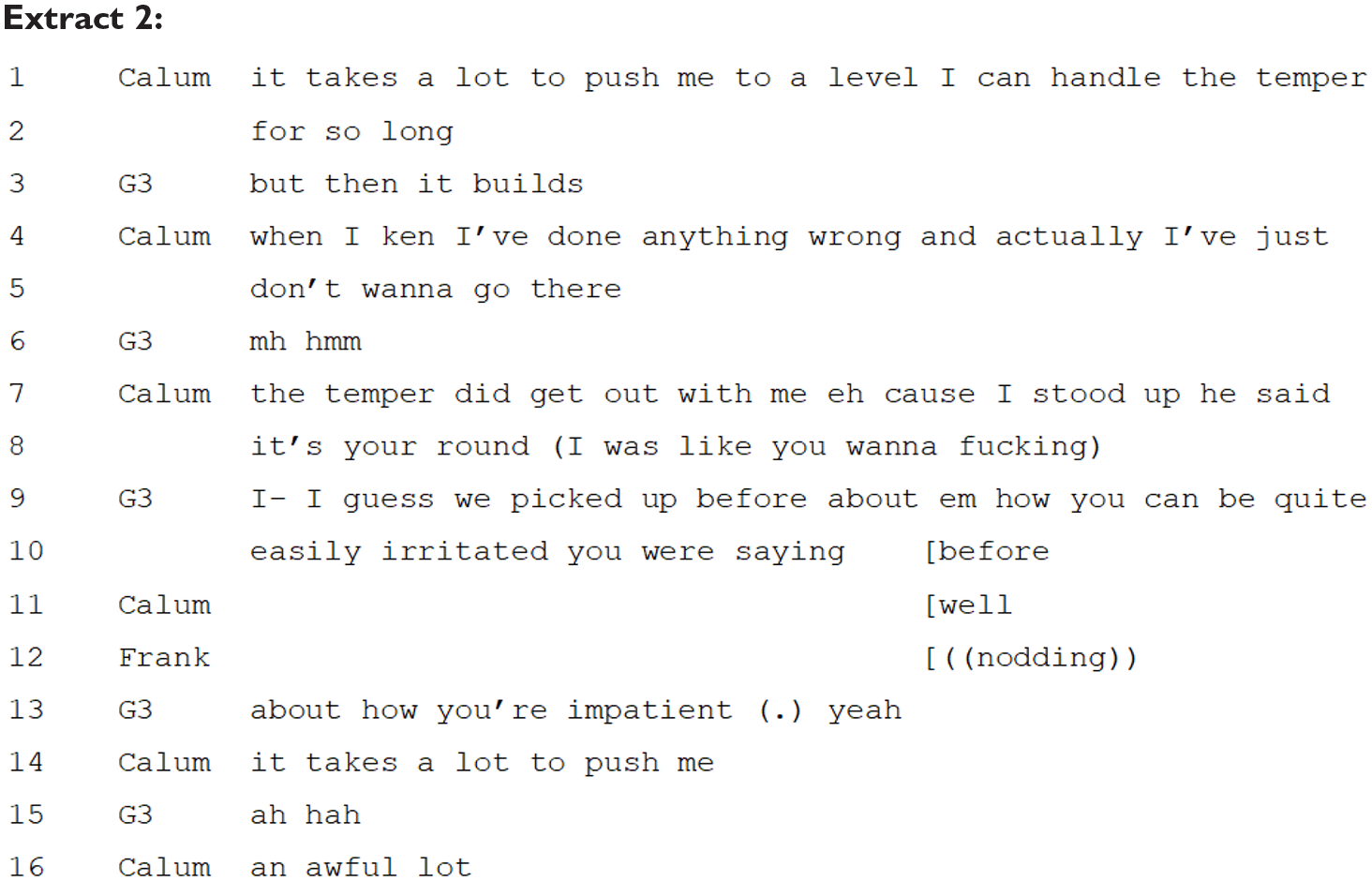
However, clients can and do resist attributions or characterisations associated with risk, refusing to incorporate these into their stories. For example, in Extract 2, Calum’s description of his temper contradicts the groupworker’s. As in Extract 1, the groupworker delicately navigates the contrasting descriptions, attempting to bring Calum round to recognising he is quick to temper, a possible indicator of the risk factor ‘negative emotionality’ or ‘hostility’ (Fernandez et al., 2012).
However, Calum resists this attribution definitively. Rather than accepting the groupworker’s descriptions of being ‘quite easily irritated’ and ‘impatient’, both of which describe internal traits, Calum identifies the source of any outburst as being external and significant: ‘it takes a lot to push me [. . .] an awful lot’. Unlike Extract 1, G3 does not pursue the matter, instead moving into a listener stance (line 15), avoiding direct confrontation. Importantly, instances of resistance are often dealt with like this, where the topic is revisited at another time in another way. This approach aligns with motivational interviewing, as advocated for in rehabilitation research (Vanstone and Raynor, 2012), by ‘rolling with resistance’ rather than confronting it directly.
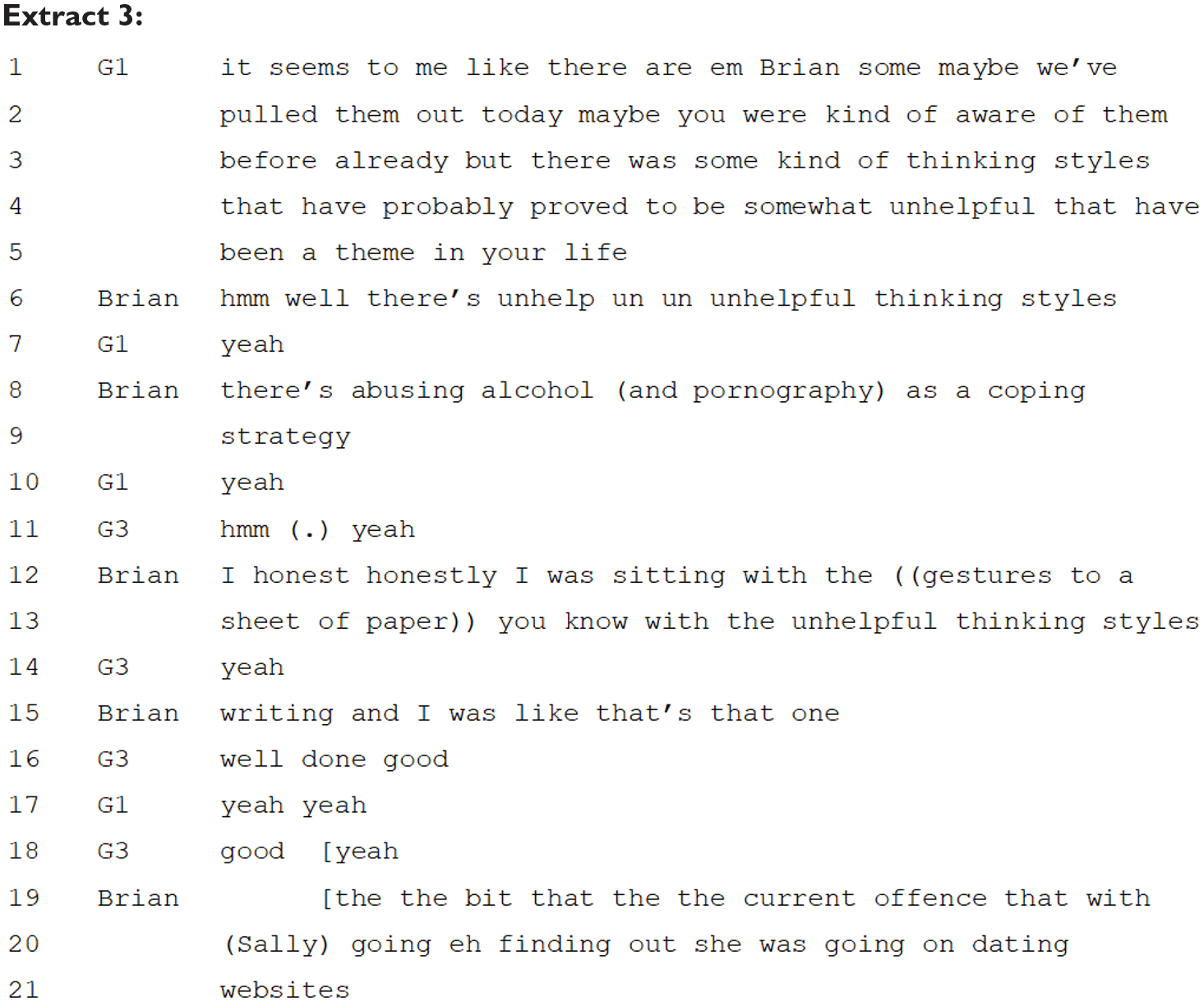
Although sometimes risks to the clients are discussed, as in Extracts 1 and 2, risk is often situated as something underlying to be uncovered in clients, for example, their thoughts or traits, in line with the risk paradigm and cognitive-behavioural approaches that have influenced the shape of interventions addressing offending, particularly sexual offending (Bonta and Andrews, 2016; Kemshall, 2003; Mann and Fernandez, 2006; Robinson, 2016). The MF: MC programme manuals specifically state practitioners ‘. . . should aim to assist offenders in understanding their characteristic thinking patterns which contributed towards the decision to use anti-social behaviour in any situation’ (Scottish Government and Scottish Prison Service, 2013: 50). In this groupwork programme, the language of ‘thinking styles’ or patterns is commonly used, drawing on a cognitive-behavioural approach, for example, overgeneralising and catastrophising. ‘Thinking styles’, particularly unhelpful ones, are targeted for change. They are explicitly constructed in interaction as linked to offending behaviour and persistent or enduring, as demonstrated in Extract 3. This extract concerns a life history exercise, where Brian has outlined how events in his life have shaped who he is today (Scottish Government and Scottish Prison Service, 2014: 116). Throughout this exercise, multiple references were made to unhelpful thinking styles as pervasive and problematic across multiple domains of people’s lives, including sexual offending. Here G1 is giving feedback at the end of Brian’s lengthy contribution.
In highlighting ‘thinking styles’ as both ‘unhelpful’ and a ‘theme’ in Brian’s life, G1 constructs thinking styles as problematic and enduring, that is, recurring or pervasive. G1’s meta-talk (lines 1–4) and hedging (i.e. ‘maybe’, ‘kind of’, ‘somewhat’) indicates the delicacy of suggesting to someone they have a long-standing pervasive issue, even in a context where being aware of these issues is treated positively. Brian affirms G1’s formulation through repetition, agreeing he has a pattern of unhelpful thinking styles and expanding this to a three-part list including other offence-related risks: ‘abusing alcohol and pornography as a coping strategy’. Three-part lists provide a sense of completeness in interaction, that is, these were all the relevant risk factors for his offending (Jefferson, 1991). Brian specifically links unhelpful thinking styles to his offending. He is showing he is aware of the risks around his offending and doing the expected business of the group; he is doing ‘being a client’, demonstrating his learning and engagement in the programme and arguably his own rehabilitation (Sacks, 1984), which is praised by G3.
As in Extract 3, the language of unhelpful thinking styles is used throughout the groupwork sessions to denote risk by both groupworkers and clients, where these are constructed as identifiable, enduring, pervasive, internal, risk relevant and linked to offending. Furthermore, they are targeted as something to be changed, adding to a narrative of risk that positions the client as both a cause of and a solution to their offending behaviour. This has echoes of Lacombe’s (2008) observation that the acceptance of risk becomes the client’s salvation and their prison, as the characterisation of risk as internal and enduring results in constructing an identity of someone who is aware of their risk but can only ever hope to be able to manage rather than eradicate it. At first sight, this construction of risk may appear contrary to narratives of desistance that place offending behaviour as due to external, situational and specific factors (Maruna, 2004). However, in the MF: MC sessions, talk about risk, including reference to unhelpful thinking styles, enabled the co-construction of clients’ narrative identities as people who are actively aware of the risks around their offending behaviour, have learnt from these, and are agentic and in control of managing risk in the future, which echoes narratives of desistance from general offending (Maruna, 2001) and sexual offending (Harris, 2016; McAlinden et al., 2016).
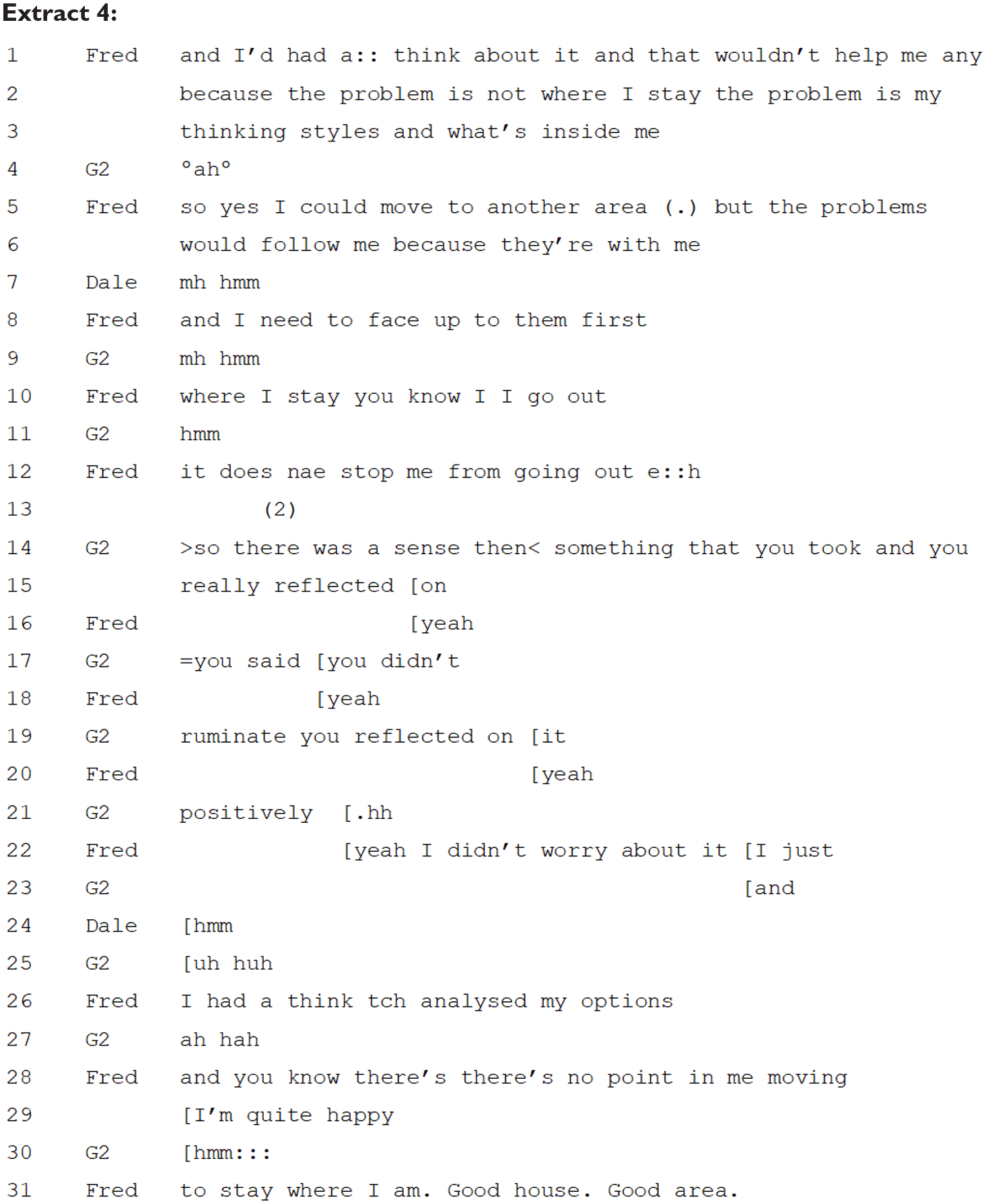
Extract 4 highlights how clients and groupworkers use the discourse of risk to not only demonstrate awareness but also change. During the check-in at the start of the session, Fred updates the group on how his last week has been, reporting he considered another group member’s previous suggestion he should move house.
Here, Fred defines ‘the problem’ as his ‘thinking styles’. As outlined above, the concept of thinking styles is heavily drawn on in the programme, positioned as characteristic of the individual and contributing to them behaving in an antisocial way at any point, including sexual offending. Fred demonstrates acceptance of this idea, noting his ‘thinking styles’ as problematic, characterising them as internal (‘inside me’), pervasive in that they ‘follow’ him and something he needs to address. Although not linked to sexual offending, Fred is demonstrating an awareness of his hazardous thinking, a cornerstone of the programme (Scottish Government and Scottish Prison Service, 2013). Furthermore, in stating ‘I need to face up to them first’, he acknowledges his responsibility for his future progression, demonstrating agency. Fred is presenting himself as appropriately aware of ‘risk’. G2’s formulation notes Fred’s use of appropriate ‘thinking styles’ in dealing with the topic at hand, that is, thinking about moving house, by juxtaposing rumination with positive reflection. This contrast positions rumination as negative, possibly reflecting a wider understanding of rumination as grievance thinking, which has been linked to recidivism (Thornton, 2002). In this way, G2 indirectly acknowledges Fred’s demonstration of risk awareness by orienting towards his described actions, how he considered the other group member’s suggestion. This influences the progression of the conversation as Fred affiliates with G2 (line 22) before outlining his process of ‘reflecting positively’, going beyond showing he is aware of his problematic thinking to showing he is doing appropriate rational thinking.
To an extent, this extract reflects Presser’s (2008) reference to cognitive bias in correctional treatment, where clients are asked to construct narratives that frame themselves as both the problem and solution to their offending behaviour. However, contrary to Presser’s findings, these narratives were common, possibly as clients were doing ‘being a client’ and the business of the group by demonstrating risk. The use of such agentic language may support the development of desistance narratives; although offending behaviour may be attributed to external factors, future behaviour is constructed as within clients’ control, drawing on the concepts of the intervention to develop a narrative of rehabilitation.
Discussion
In this article, we have shown that risk is an integral aspect of CJSW practice. However, the role of risk-talk for desistance is complex. Clearly, talking about risk is institutionally relevant, oriented to by both practitioners and clients. They draw on risk-talk as a resource to construct a narrative which supports desistance, specifically by emphasising awareness of risks, having control, and gaining hope and agency over the future. They will use technical terms, such as ‘thinking styles’, to define and discuss aspects of risk and ways of managing them. By using the professional language, clients can demonstrate their understanding and acknowledgement of risks, show their active participation in the intervention, and embody becoming rehabilitated. However, risk-talk can be also stigmatising and is resisted when it challenges the client’s self-presentation in the interaction. So, rather than the institutional and personal narratives necessarily being in opposition (e.g. Digard, 2014; Lacombe, 2008; Waldram, 2008, 2010; Fox, 1999a, 1999b), or an emphasis on risk being a barrier to desistance (McNeill, 2016b), it is possible for aspects of risk to be incorporated into clients’ personal narratives in order to weave a narrative of rehabilitation. The key distinction between a narrative of rehabilitation and desistance narratives is that an acknowledgement of risks and strategies for dealing with them is built into the account of who someone is and how they go about their life. While this aspect has clear institutional functions, such as demonstrating that someone is properly engaging with a rehabilitative programme, it may play a broader role in sustaining a commitment to going straight. As we have argued elsewhere, the fragmentary accounts produced in interactions within criminal justice contexts can be understood as building blocks of narrative identities (Mullins and Kirkwood, 2019a), and the data and analyses presented here constitute a modest contribution towards understanding how such accounts function in institutional contexts and beyond.
Maruna (2001) highlighted desistance narratives as redemption scripts involve taking responsibility for the future. However, criminal justice interventions are criticised for forcing clients ‘to subscribe to a perpetual, restrictive, and stigmatizing “risk narrative”’ (Harris, 2017: 223) and undertake ‘narrative labour’ to convey themselves in the right way, despite not recognising the person they are treated as being and not knowing who they are meant to be (Warr, 2020). We would tentatively suggest that in accounting for the past and being accountable for the future (Mullins and Kirkwood, 2019a), a narrative of rehabilitation offers people a way of melding a desistance narrative with the institutionally relevant risk narrative, allowing people to account for risk in ways they understand, in relation to a self they recognise. Regarding the dilemma we opened this article with, perhaps a focus on risk, such as in the application of the RNR model (Bonta and Andrews, 2016), is productive when it helps people understand and deal with risk; if stigmatising, it may be unproductive. However, as argued by Maruna and Ramsden (2004: 145), even this may limit the interventions to the ‘individual pathology model’, rather than engaging with broader ‘public and cultural narratives’. After all, rehabilitation does not mean only reforming individuals, but also restoring their rights (McNeill, 2012). As suggested by Harris (2017), desistance is reliant on the acceptance of society, which may be difficult if clients are attempting to change their behaviour without being allowed to change their identities.
Interaction always occurs in a context and is necessarily contingent on that context. The types of desistance narratives found in research interviews are likely to be different from those produced in formal criminal justice settings because the stakes are different. In the context of criminal justice settings, such as groupwork programmes for addressing offending behaviour, accounts of risk are central; therefore, an ‘acceptable’ desistance narrative also needs to be a narrative of rehabilitation, incorporating an understanding of one’s own risks and how these will be managed. Rather than simply a shift from an ‘offender’ to a ‘ex-offender’ (Maruna, 2001), the individual must become a ‘rehabilitated ex-offender’, which involves awareness of risks of re-offending and practical strategies for managing them. However, such identities and narratives may be less obvious in research interviews, where it may not be socially appropriate or desirable to discuss the risks around your offending and how you manage these (Digard, 2014). This highlights the importance of examining interactions in situ.
This study focuses on a particular intervention, in a specific context, with a relatively small number of practitioners and clients; however, examining a national programme provides insight into wider practices. Such interventions have the potential to foster desistance (King, 2013), and what we presented here could be seen as ‘building blocks’ for narrative identities (Mullins and Kirkwood, 2019a). Although we also cannot be sure whether people are ‘walking the walk’ or merely ‘talking the talk’ (Harris, 2016), our study of risk-talk in interaction provides a grounded way of understanding how risk-talk is used in practice, with the potential to connect it to broader processes of desistance.
As highlighted by Raynor (2016), discourses of risk used in criminal justice organisations and by practitioners do not occur in a vacuum; methods of assessing and addressing the risks and needs of people who have offended are more likely to be effective in a politically progressive context, where rehabilitation is the central aim rather than continual punishment, and practitioners understand and believe in their effectiveness. Further research is therefore needed both to explore how risk-talk functions in different criminal justice settings and how this relates to the broader context. This would help establish the relative importance of narratives of desistance compared with narratives of rehabilitation in a variety of contexts, with implications for both criminal justice practice and our understanding of desistance.
Footnotes
Appendix 1
Transcription notation adapted from Jefferson (2004):
| (.) | Micro pause |
| (0.2) | Timed pause |
| [ ] | Speech overlapping |
| > < | Pace of speech has quickened |
| () | Unclear section |
| (()) | An action |
| ºwordº | Whisper or reduced volume speech |
| ::: | A stretched sound |
| = | Latched speech, continuation of talk |
| .hh | In-breath |
| hh | out-breath |
Acknowledgements
We would like to thank Prof. John Devaney and the anonymous reviewers for their helpful comments on earlier drafts.
Declaration of Conflicting Interests
The author(s) declared no potential conflicts of interest with respect to the research, authorship and/or publication of this article.
Funding
The author(s) disclosed receipt of the following financial support for the research, authorship and/or publication of this article: This work was supported by the Economic and Social Research Council as a collaborative studentship with the Risk Management Authority and a local authority, in Scotland (Grant Number 1611091).
