



Abstract
The aims of this study were to (1) highlight the importance of orbital debris as an environmental and green criminological issue, (2) build on recent work in astro-green criminology and (3) analyse orbital debris from an astro-green perspective with a focus on social and ecological harms consistent with green-critical criminologies. Human-made active and defunct debris continues to accumulate in Earth orbit littering near-Earth orbital space. There are a small number of key drivers, including accidental collisions between objects, in-orbit explosions and anti-satellite missile testing. Such activities pollute Earth orbit causing problems for astronomy, space travel and human and non-human populations on Earth. This is a theoretical, literature-based analysis of orbital debris from an astro-green criminological perspective. Criminology has had little to say about space debris because its creation is not a criminal offence. This article makes a unique contribution to criminological literature by applying the emerging perspective of astro-green criminology to orbital debris.
Introduction
While the environmental crises of climate change and biodiversity loss are topics of criminological inquiry, criminology has yet to sufficiently turn its gaze beyond planet Earth. The primary aim of this article is to further address this oversight by highlighting current problems regarding anthropogenic space debris in Earth orbit and critiquing this from an astro-green criminological perspective. Despite important implications for the environment and public health, the accumulation of human-made objects in Earth orbit is an issue that has barely received any recognition in the criminological literature (for some minor exceptions, see Carrabine, 2018; Lampkin, 2021; Takemura, 2015 and Wyatt, 2016).
A further aim of this article is to direct criminological scrutiny towards a previously unconsidered research area (space debris), whereby escalating levels of human activity risk serious environmental consequences for terrestrial and extraterrestrial settings, and for future generations of humans. Consequently, this article will draw the attention of the criminological and, more specifically, the green and critical criminological communities; and will initiate an area of study that seeks to build an understanding of the nature of human actions that lead to the accumulation of orbital space debris (OSD). Without legal and criminological engagement with this issue, debris accumulation will continue unchecked and unchallenged. This presents risks to future space-related activities and space exploration through the inability to safely launch rockets and satellites into space. Furthermore, the continued accumulation of matter in Earth orbit creates a dangerous LEO
1
region where debris could impact the functioning of important satellites that are vital for the functioning of everyday life. As Pelton (2015: 1–2) denotes, Space systems have become so very vital, that if we were suddenly denied access to our space-based infrastructure for weather forecasting and warning, for space-based navigation and timing, for civil and military communications, and for remote sensing and surveillance from space we would be in danger. We would suffer almost immediately – economically, militarily, and socially. Many of our transportation and communications systems would go down along with our weather and rescue services and defense systems. Internet would . . . (lose) its synchronization, credit card validation would no longer work, we would not be alerted to major storm systems, air traffic control, shipping navigation, and trucking routing services would be lost.
We argue that criminologists and, in particular, green criminologists should be concerned with OSD because such items constitute a form of litter and space junk. Groombridge (2013: 396) helpfully imagines litter as a continuum ranging ‘from the accidental individual littering incident to widespread deliberate organized transnational pollution’. This conceptualisation of litter places OSD at the latter end of the continuum, as debris creation is always the result of the actions of nation states or large corporations (such as SpaceX and BlueOrigin). Although there are national policies and regulations that attempt to mitigate the impact and build-up of OSD, such as the Inter-Agency Space Debris Coordination Committee’s Mitigation Guidelines, there is no legally binding international framework that prohibits debris formation or punishes polluters for contributing to the orbital debris population. Consequently, orbital litter continues to accrue in Earth orbit with no consequences for contributors.
Carrabine et al. (2020: 3) loosely define criminology as the study of ‘crime, criminals and criminal justice’. Although criminological definitions are contested (Wolfgang, 1963), crime is, perhaps unsurprisingly considering the discipline name, almost always a feature of criminological definitions. This means that a core focus of mainstream criminology is both crime and criminal justice systems. Due to this fixation on the criminal law, and the absence of a formal criminal mechanism for managing OSD, it is green and critical criminologists who are best placed to study space junk. This is because critical criminologists take a zemiological approach to the study of criminology, where both crime and social harm are considered useful to the study of ‘socially injurious behaviour’ (Schwendinger and Schwendinger, 2013: 115). This thought is shared by Green and Ward (2004: 4) who consider criminology to be the ‘study of deviance and social control’. Green criminology emerged out of the longer established paradigm of critical criminology (Sollund, 2021) and focuses specifically on environmental harms as well as crimes (Lampkin, 2020). Therefore, if one is to conceptualise OSD as a form of harmful litter that develops in the absence of formal criminal mechanisms, this falls comfortably within the remit of a green criminology: the study of ‘crimes, harms and offences related to the environment, different species and the planet’ from an interdisciplinary, open and evolving perspective (Brisman and South, 2020: 40).
This article will debate these issues using the following structure: Introducing astro-green criminology; Sources of OSD; The marine impacts of debris re-entry; and Applying AGC to OSD.
Introducing astro-green criminology
Although it is well recognised that academic engagement with environmental problems well preceded the emergence of a specifically green criminological perspective (Goyes and South, 2017), green criminology has been influential in exposing instances of environmental harm since its conception. The term ‘green criminology’ was coined by Michael Lynch in 1990 ‘at a time when people were becoming increasingly troubled about large-scale environmental disasters’ (Lynch et al., 2017: 2). Due to the narrow concentration of orthodox criminology on distinctly criminal behaviours only, green criminology emerged as a response to the failing of mainstream criminologists to take environmental harms seriously. This is because many environmentally destructive practices were – and still are – lawful. Green criminologists fill this academic void by researching human behaviours that are both legal and illegal. The justification being the fact that environmental laws and regulations often fail to prevent environmental harms, and much destructive behaviour continues within society unabated. As such, green criminology fits well with other criminological offshoots that critique this crime-harm nexus, such as zemiology (Brisman and South, 2018) and critical criminology (Sollund, 2021).
Astro-green criminology (AGC) is a perfect example of a criminological sub-discipline that has arisen as a result of this complex crime-harm relationship and is best situated within the green-critical criminological paradigm. The term was only coined very recently, by Takemura (2019) in his pioneering work on Space Capitalism. This article can be seen as an extension of Takemura’s (2012, 2015) earlier work on OSD, and these were the first two texts to discuss outer space and green criminology in unison. Since then, a few key publications (Lampkin, 2021; Lampkin and Wyatt, 2022) have emerged expanding on the notion of AGC, adding to Takemura’s seminal works.
One of these publications offered the very first definition of AGC. This was explicated as the theoretical and practical study of space-related environmental harms and crimes that are facilitated by human actions. These harms can be Earth-based, atmospheric, or extraterrestrial and may create human victims, non-human victims, and ecological victims both on Earth and in outer space. (Lampkin, 2021: 242)
While definitions are often critiqued, they can also provide a starting point from which to theorise, problematise and debate a new perspective or area of study. It was from this basis that Lampkin (2021) expanded the remit, purpose and subject area of AGC. This was done by, following the first definition of AGC, providing an outline of what some of the key issues are. Specifically, Lampkin (2021) identified five quintessential areas which were OSD, extraterrestrial mining, space industry–related emissions pollutions, the protection of heritage sites on celestial bodies and the future usages of outer space that could have an environmental impact (such as space travel, tourism or colonisation). However, Lampkin (2021) only provides brief analysis of these areas to lay the foundations of astro-green areas of study. As a result, this article expands on these foundations, critiquing only one issue, orbital space debris, in significantly more detail.
Sources of OSD
OSD refers to ‘any object in Earth orbit that does not have a useful purpose’ (Australian Space Academy, 2010: no page) such as defunct satellites and fragments from previous in-orbit collisions (Pelton, 2015). Prior to the launch of the first artificial satellite Sputnik-1 in 1957, there were no human-made objects orbiting Earth. Today, humans have lost track of the number of items in Earth orbit.
There are a vast number of individual pieces of debris currently orbiting the Earth, many of which are extremely small. The exact number of pieces is currently unknown because objects smaller than 10–20 cm are not usually catalogued (Chobotov, 2002), creating an unknown – dark figure – of OSD. This has led to the LEO region being described as ‘the World’s largest garbage dump’ where ‘close to 6,000 tons of materials occupy the area’ (National Aeronautics and Space Administration (NASA), 2019a: no page). Of this debris, the majority is no longer of any use to humans and continues to orbit Earth due to the expense involved with collecting or destroying it. In addition, there is a complete absence of binding law regarding the clean-up of existing OSD, and a lack of a law enforcement presence requiring its removal. As a result, much of the anthropogenic matter in LEO now serves no useful purpose. As Stakem (2018: 6) suggests, ‘of the 7,000 or so satellites placed into Earth orbit so far, 1,500 are still functioning. The rest are zombie-Sats’. Although pollutions of varying kinds on Earth have been subject to much green criminological scrutiny in recent years, including problems surrounding litter (Groombridge, 2013) which has close connections to OSD, the issue of anthropogenic pollution in outer space remains virtually unexplored within criminology.
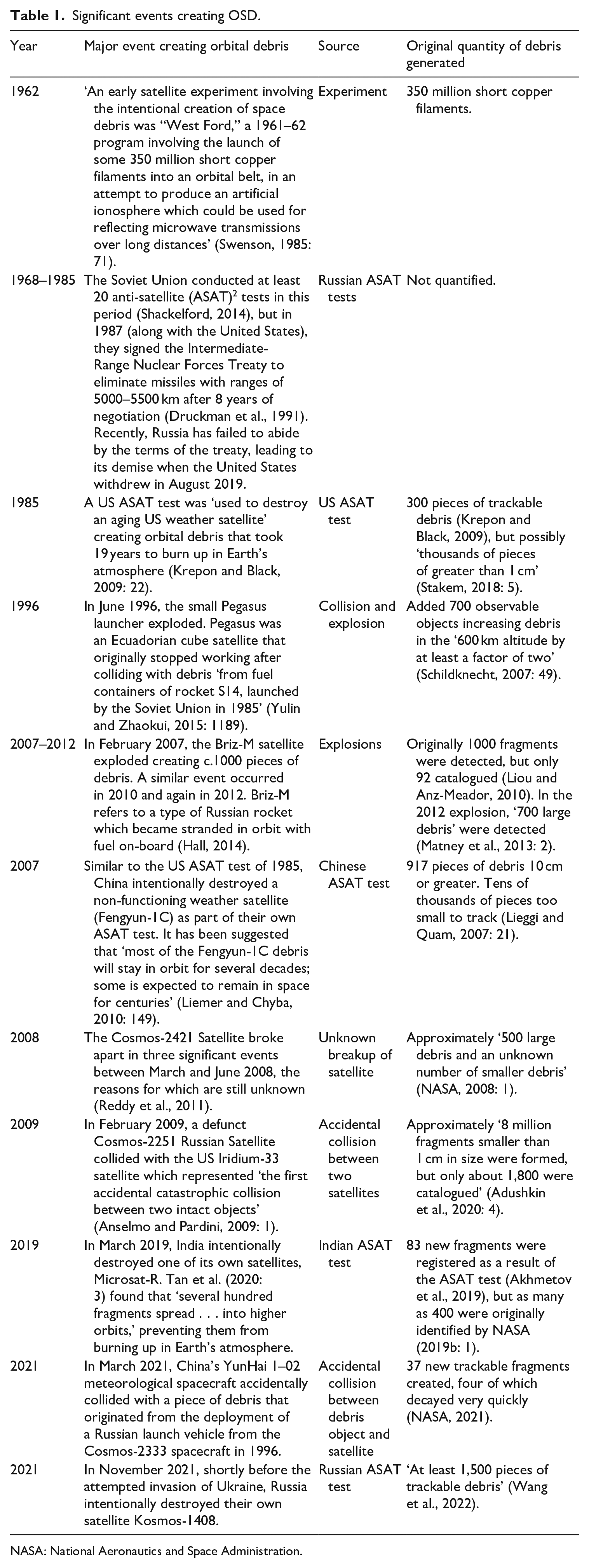
Anthropogenic matter accrues in Earth orbit for a variety of different reasons. As Stakem (2018: 5) recalls, ‘known space debris includes Astronaut Ed White’s outer glove, lost on his spacewalk; Michael Collin’s camera from Gemini-10; a wrench, pair of pliers, and a toothbrush’. These items are clearly the result of humans physically occupying Earth’s orbit in space stations. However, most OSD is the result of a small number of major satellite collisions ensuing from the ‘catastrophic destruction of three intact satellites (Fengyun-1C, Cosmos-2251 and Iridium 33)’ (Pardini and Anselmo, 2017: 23) (see Table 1). These events alone increased catalogued orbital debris by approximately 50% (Pardini and Anselmo, 2013).
Significant events creating OSD.
NASA: National Aeronautics and Space Administration.
Despite the enormous impact of these collisions on the accumulation of OSD in Earth orbit, there have been several other significant collision events, which usually take place every 5–9 years (Stakem, 2018: 5). To demonstrate the contribution of these events to the accumulation of OSD, Table 1 categorises both the specific event and the approximate amount of debris generated according to academic literature.
Table 1 presents a compilation of the most catastrophic and commonly cited debris creation events within academic literature. However, it does not represent every debris-creating event and, therefore, many more pieces of debris exist that are not quantified in Table 1. 3 This is because only objects of at least 10 cm are documented by the US Space Surveillance Network (SNN) 4 fragment cataloguing process (Wang, 2010: 89). Nevertheless, objects and particles smaller than 10 cm still represent a major threat to existing active satellites, spacecraft and space stations. This is because the size of an object has little impact on the speed with which it orbits and so even small objects can collide with enough force to cause a damaging impact, due to their high speed of travel. As Truitt and Hartzell (2020: 876) suggest, sub-centimetre ‘orbital debris is currently undetectable using ground-based radar and optical methods. However, pits in space shuttle windows produced by paint chips demonstrate that small debris can cause serious damage to spacecraft’. Thus, while Table 1 highlights some of the major events that have resulted in a large quantity of debris creation, it only establishes part of the overall picture of debris creation.
What Table 1 does demonstrate effectively, though, is that OSD is generally attributable to a small number of causes. These include accidental collisions between existing satellites, the intentional destruction of satellites (ASAT testing) and other unintended events (such as malfunctions, break-ups and explosions). To more thoroughly understand OSD, it is pivotal to explore these issues in further detail.
Accidental collisions between existing satellites are extremely rare, to the point that only one catastrophic event has ever occurred. This was between the Cosmos-2251 and Iridium-33 satellites in 2009. While unintentional, this event created a massive amount of OSD and highlights the imperfect nature of human scientific and technological endeavour. Accidental collisions with existing orbital debris are more frequent, in part because of the significantly greater number of pieces of debris compared with that of artificial satellites. Furthermore, it is much more difficult to alter the direction of a piece of debris or defunct satellite, as opposed to a functioning satellite where the orbit can be remotely adjusted to avoid a potential collision (Welti, 2012). However, the intentional destruction of satellites may represent an even more serious problem in terms of OSD, as well as in terms of space warfare and weaponization.
To date, the intentional destruction of satellites is more common than two satellites colliding accidentally. Table 1 highlights the four countries known to have engaged in anti-satellite testing thus far: Russia and the former Soviet Union, the United States, China and India. ASAT capability is important in terms of the accumulation of space debris, but also from a criminological viewpoint. This is because ASAT technology presents powerful governments and organisations with the ability to drastically impact satellites from another nation who may rely upon them as part of their critical infrastructure, military or otherwise. Therefore, ASAT missiles serve as a powerful political tool due to the potentially severe consequences of satellite destruction as depicted by Pelton (2015) in the introduction.
Despite such risks, intentionally destroying another nation’s satellite would be viewed as an act of aggression and could result in counter measures against the instigating country (such as a retaliatory attack on its own satellites), which arguably lessens the likelihood of future targeted ASAT missile attacks. However, while such weapons remain a potential threat, it is likely that other global powers will look to achieve a similar level of capability, both to maintain a strong conflict deterrent and to avoid being at a strategic disadvantage should such conflict occur (in much the same way that nuclear weapons can be seen to act as a deterrent). Hence, it is likely that the current proliferation of advanced space weapons will continue. This may explain why ASAT testing is still a feature of contemporary human society, despite the Intermediate-Range Nuclear Forces Treaty (see Table 1). ASAT testing, therefore, is not solely of interest to green criminologists studying environmental harms and crimes, but also to criminologists studying crimes of the powerful (Tombs and Whyte, 2003) and war crimes (Grčar, 2018).
Other than collisions and ASAT testing, Table 1 pinpoints other debris-creating events deriving from technological failure. These include malfunctions, the unknown ‘breakup’ of satellites and explosions. Mission-related debris, such as leaving payloads and rocket bodies 5 in orbit after their useful life, also contributes a significant amount to OSD (Kessler et al., 2010). While the exact amount is unknown, recent calculations suggest that the total mass of space objects in Earth orbit totals more than 6000 tons (NASA, 2019a) and consists of over 128 million objects of 1 mm or greater (European Space Agency, 2020b).
One fear of such dramatic increases in OSD is Kessler syndrome. This is the theory that OSD may become a chain reaction whereby more debris means a greater probability of accidents and collision events, leading to evermore debris pieces and a ‘cascading chain activity’ (Larsen, 2018: 475). This could eventually create an impassable debris belt that obscures the night-sky for astronomers and renders space travel impossible. However, Kessler syndrome is not the only concern regarding OSD. Large objects sometimes reenter Earth’s atmosphere posing a risk to humans (if land is struck), or marine environs (if a splash-landing occurs).
The marine impacts of debris reentry
Large objects that do not burn up in Earth’s atmosphere must crash down somewhere. Point Nemo (or the pole of inaccessibility) is the point on Earth farthest from any Island and, therefore, the most remote and least likely place to have a human impact. As a result, when re-entering the atmosphere, this is the safest place to aim for to safeguard human life.
Point Nemo has accumulated over 260 pieces of space debris, including the remains of several space stations (Stakem, 2018). These splashdowns clearly generate moral and ethical concerns pertaining to the anthropogenic use of Earth environments for outer space exploration and as a location for debris disposal. Furthermore, they pose challenging legal questions. Point Nemo, for instance, is part of the high seas, far from the jurisdiction of any nation. Therefore, there is no legal responsibility or international law requiring a nation or private company to clean-up space junk that lands there. As a result, Point Nemo has been colloquially dubbed the space cemetery in acknowledgement of the final resting place of dead satellites, spacecraft and other large OSD (De Lucia and Iavicoli, 2019).
Such space debris reentry is problematic for a variety of reasons. First, it poses a risk to the aviation sector as the object races towards Earth’s surface. Second, when it gets there, marine vessels are in jeopardy of being struck. These are described as kinetic risks by De Lucia and Iavicoli (2019: 369–370) due to the debris experiencing motion as it moves through Earth’s atmosphere. It is important to note that small changes in the descent trajectory of large objects, while far above the Earth, can change the final landing location by many hundreds of miles. Consequently, reentry needs to be meticulously planned and executed. Even so, operations do not always go as planned.
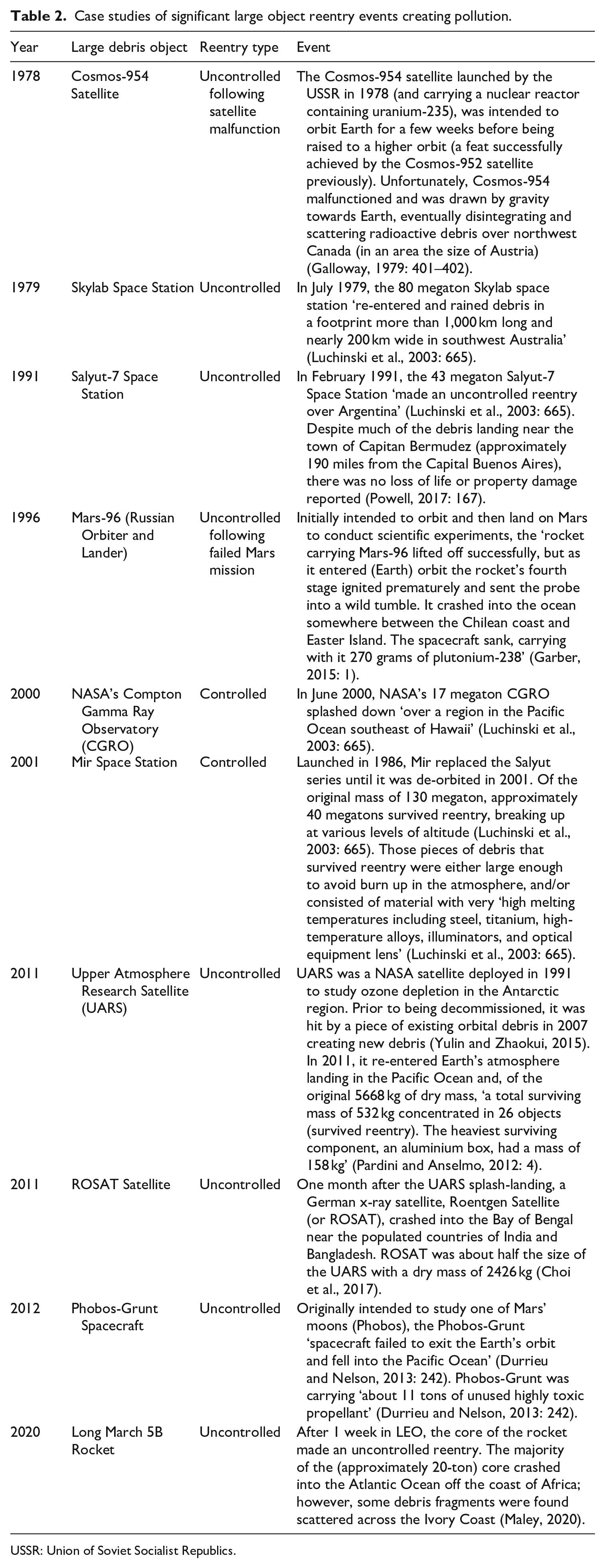
There are also other potential environmental implications for end-of-life reentry of OSD. An obvious implication is the impact that material burnt up upon reentry may have on Earth’s atmosphere. A further consequence results from the larger pieces of debris that do not fully burn up and therefore contaminate environments on Earth’s surface. It has already been suggested that large object reentry is relatively rare as a proportion of the total mass of debris objects re-entering the atmosphere. However, when this does occur, it has the potential to have a large environmental impact. This is best demonstrated through a series of events provided in Table 2.
Case studies of significant large object reentry events creating pollution.
USSR: Union of Soviet Socialist Republics.
As with Table 1, Table 2 does not represent a complete list of all large object re-entries. It does, however, provide an account of the most cited re-entries in the academic literature which serves to highlight the scale of the problem. Although these events are unlikely to create human casualties, they do present a risk to human life, particularly in uncontrolled events. Furthermore, the chemicals aboard large objects present a threat to human and non-human life. As Luchinski et al. (2003: 665) highlight, A danger to people and property on the ground is present in an uncontrolled reentry of large- scale objects and objects containing incombustible, heat-resistant, or hazardous (e.g. radioactive) materials. The large size of a spacecraft means that large pieces of it would survive any reentry and impact Earth, endangering people.
The impacts of OSD on Earth orbital and marine environments demonstrate the connection between OSD issues and green criminology.
Applying AGC to OSD
Takemura (2012, 2015, 2019) is the only author to have discussed space debris from a criminological perspective in any significant detail. However, there has been some other (albeit limited) criminological engagement. For example, South (2017) has recognised that pollution of Earth’s atmosphere does not just stop at fossil fuel combustion, deforestation and industrial activities, but extends to wastes left in human orbit. Similarly, when discussing the impact of hazardous wastes on future generations, Wyatt (2016: 2) considers space debris as a problem that we are only just beginning to experience, but one that will continue to cause problems ‘unless active removal programmes are undertaken’. Carrabine (2018: 455) has also recognised the impact of space debris on future generations: Since the 1960s, hundreds and thousands of objects have been launched into space, many of which are now defunct but are destined to stay there as a belt of debris. This distant layer of debris will become the major ruins of our times, potentially drifting around the Earth for billions of years, outlasting the great pyramids of Giza and the cave paintings of Lascaux.
Lampkin (2021) went further than these works by explaining the link between space debris and criminology, suggesting OSD would be one of the primary areas of study for AGC research.
This article not only suggests that space debris is a problem worthy of criminological attention, but it makes a significant contribution to the (astro) green criminological literature. Table 3 identifies six key areas of focus for green criminologists regarding the issue of OSD, the aim of which is twofold. First, it identifies some of the key problems attributed to OSD with a specific focus on both human and non-human harms and victimizations. Second, it provides a structure and six areas of focus for any future astro-green criminological work in this area.
The harms of space debris.
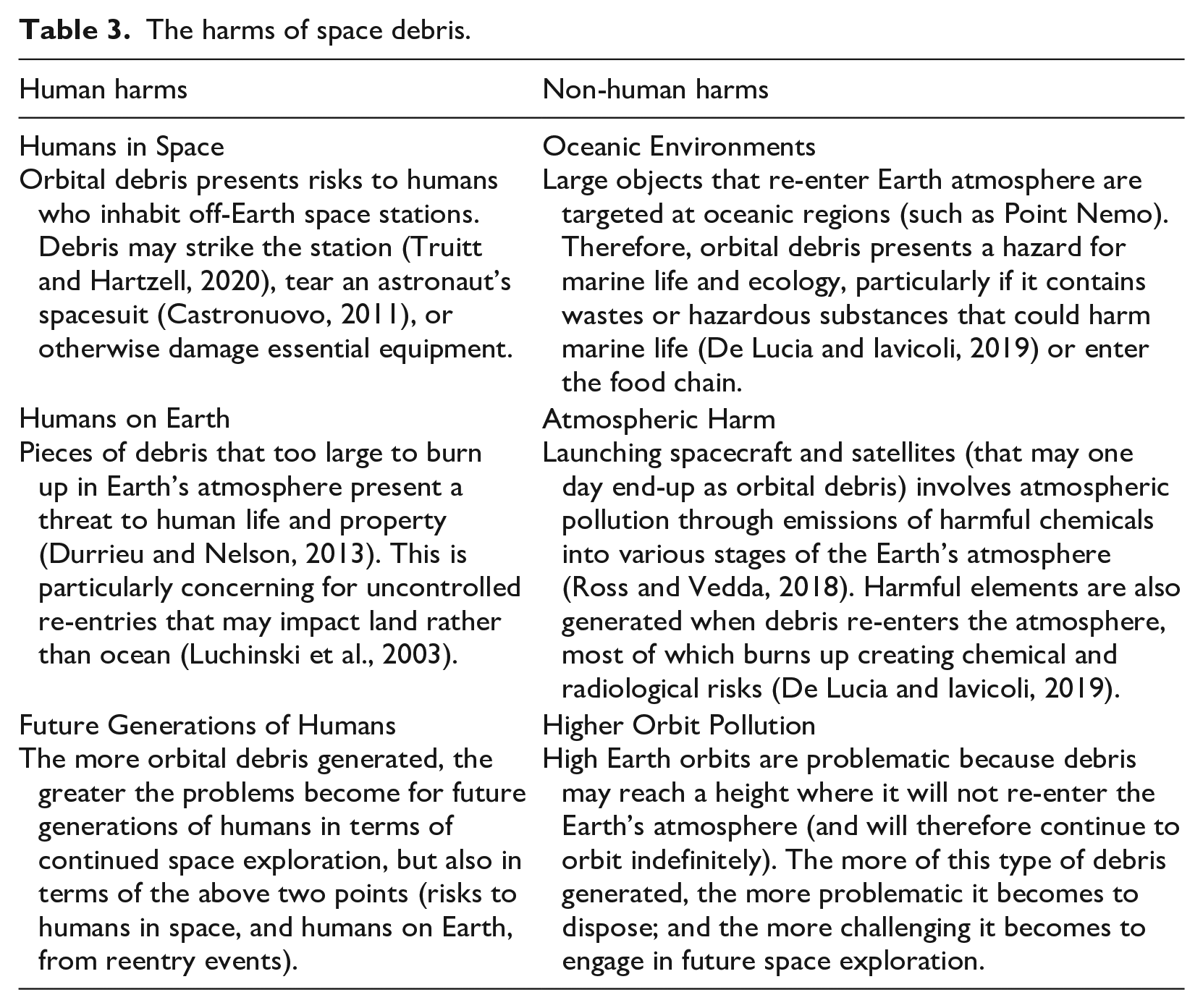
It is clear from Table 3 that only a critical or radical criminological perspective could adequately address the harms associated with space debris because they are legal activities. While some institutions and organisations have produced guidelines intent on preventing and mitigating against the accumulation of debris (such as NASA’s (2018) Handbook for Limiting Orbital Debris), these are not legally binding. Furthermore, although there have been several important developments in international space law such as the Outer Space Treaty (OST) of 1967 and the Committee on the Peaceful Uses of Outer Space (COPUOS) established in 1959, these deal ‘almost exclusively with political and diplomatic issues, which is reasonable as. . . (they) were written during the Cold War’ period (De Paula and Celestino, 2019: 1). Consequently, they have been criticised as outdated and unfit in dealing with contemporary OSD accumulation issues (Ferreira-Snyman, 2013).
The problems surrounding both preventing and disposing of orbital debris can therefore be seen as issues that lack ‘political, legal and economic’ will (Stakem, 2018: 23), rather than technological impossibilities. As a result, it can be argued that Earth orbit has thus far been regarded by humans as a frontier to exploit, rather than a wilderness to protect (Takemura, 2019). The lack of legal accountability and enforcement of guidelines for creating and removing OSD should be a concern to criminologists due to the impacts that debris can have on humans, non-human animals and ecosystems, as outlined in this article. Until more substantial international laws and enforcement practices are implemented, OSD will continue to accrue. Criminologists could play a vital role in instigating such discussions and building a body of academic research calling for more to be done to protect planet Earth from the build-up of anthropogenic orbital pollution.
It is clear that the natural sciences (engineering, physics, cosmology) have placed a greater priority on the commercial development of Earth orbital space than they have on prevention, mitigation and removal strategies. This is due to the continued mass accrual of OSD in Earth orbit and a failure, thus far, to address the issue. Consequently, the critical and green criminological traditions are particularly well placed to lead discussions relating to the human and environmental impacts of OSD, and this is the best place for an AGC to be situated.
There are a number of reasons for this. First, as has been noted, green-critical notions of crime are rooted in a zemiological paradigm where social and ecological harm is observed to be a more inclusive way to approach unwanted deviant behaviours (as opposed to purely criminal notions that are customary in the classical criminological tradition). Second, green-critical criminologists emanate from a place that is usually far removed from academics and practitioners working in the natural sciences. As such, the focus of an astro-green criminologist is not foremost on the technicalities of rocket launching or satellite capability, but on the impact that those activities have on both social life and the natural world. The impact of space exploration and satellite technologies has historically been construed from the effect that it may have on other technologies and other satellites, and how this might impact future technological successes. An example is the historical focus placed by the space exploration community on managing and manoeuvring objects within and between orbital spaces, rather than assessing the impact that the activities are having on human life, atmospheric health and ecological conditions on Earth’s surface (for instance, those harms outlined in Table 3).
Consequently, green-critical (or astro-green) criminologists can use their expertise in social research to contribute to OSD discussions, filling the current void in the social, atmospheric and ecological impacts of rocket launching and satellite technologies. Contributing to the research and debate on orbital space debris from this critical research mindset may help to inform the future policy directions of orbital debris prevention and mitigation. Doing so is, arguably, in the best interests of both public health and ecosystems, and also the scientific community. In terms of the former, astro-green analysis of OSD will give a voice to human and non-human victims (see Table 3), concerns for which may have otherwise been ignored at best, or not brought to the table at worst. In terms of the latter, the scientific community have much to gain from the inclusion of criminologists. Successfully preventing, managing and mitigating OSD will, inevitably, contribute to a safer and cleaner orbital environment for current and future generations.
Conclusion
This article has highlighted the harmful effects of OSD, issues which have received scant attention from the scientific community, and virtually no attention from the criminological community. It is clear, however, that OSD is a social phenomenon worthy of greater academic consideration due to the risks posed to humans and non-humans.
Like many human scientific and industrial endeavours, the formation of space debris appears to have accrued despite the harmful consequences, rather than instigating precautionary and preventive measures at the outset. At some point, we (as humans) will need to prevent or recycle debris rather than disposing of it in graveyard orbits or oceanic environments. Currently, OSD can be seen as a self-created nuisance for the space industry, produced by a series of significant events that have exponentially increased the number of pieces of debris (see Table 1). However, due to the expense associated with debris mitigation, ‘we probably won’t see any action until there is a “major event”’ (Stakem, 2018: 23). Debris capture and reuse is an expensive mitigation option for what is already a costly industry, often relying heavily on public money. Therefore, the initial prevention of debris formation may be the most effective approach to address the problem.
Finally, this article has argued that orbital debris is a concern for green criminologists due to the harms associated with its creation. However, the astronomical community should also be concerned with the environmental impact of space operations, including the generation of space debris, because it is in their best interests. As Andersen (2000: 443) suggests, ‘accelerating man-made degradation of the environment is making the sky and astronomical objects harder to see. Light pollution, radio frequency interference, space debris, and activities in outer space are restricting astronomy, remote sensing, and telecommunications’.
Footnotes
Declaration of Conflicting Interests
The author(s) declared no potential conflicts of interest with respect to the research, authorship, and/or publication of this article.
Funding
The author(s) received no financial support for the research, authorship, and/or publication of this article.
