



Abstract
This article analyses the operation of police vehicle stop checks in England and Wales. In contrast to other common police powers, vehicle checks are remarkably under-regulated and have received little academic attention, but they are regularly used coercive powers supported by criminal sanction. Based upon a 6-year ethnographic study, including observations of 205 vehicle stops, this article sets out how stop checks are used as part of routine policing. We consider their effectiveness in reducing crime and assess their link to stop and search. Our data cast doubt on the effectiveness of self-generated vehicle stop checks for identifying crime and indicate that they may play a role in driving racial disproportionality in stop and search. We conclude that stop checks should be recorded by officers, which will improve the accountability of the power and could provide important data for uncovering the reasons for racial disproportionality in the use of stop and search.
Introduction
Academic research into police powers in England and Wales, and more widely, has focused on stop and search and arrest. Research in these areas has demonstrated a number of features, most notably the extent of police discretion in use of these powers (Bradford, 2017; Pearson and Rowe, 2020) and the way in which these powers are disproportionately used against those from ethnic minority communities, in particular Black males (Bowling and Phillips, 2007). Typically, however, the coercive power of stop and search, particularly for self-generated searches, is only utilised after an initial encounter between the officer and the member(s) of the public, which has then led the officer to develop a level of suspicion which they can use to justify the power and interfere with the liberty of the suspect, albeit briefly. However, these ‘self-generated’ encounters with the public, in contrast to situations where an officer is responding to specific intelligence that the individual is suspected of an offence, are in themselves worthy of attention, because these also raise issues of power, legitimacy, accountability, and disproportionality.
There are two ways in which police on patrol may initiate an encounter with a member of the public. The first of these is known as a ‘stop and account’, whereby an officer will approach a member of the public, ‘to account for their presence, actions and so on’. 1 The stop and account is not a statutory or common law ‘power’; it has no legal definition nor is there any general obligation on the member of the public to either stop or to account for who they are and what they are doing. 2 Furthermore, with the exception of a period between the MacPherson (1999) Report and the PACE (Police and Criminal Evidence) 1984 Order 2008, 3 there has been no obligation on forces to record stop and accounts, and there has been little academic discussion of its use (exceptions include Dixon et al., 1990; Ewing, 2010; Sanders and Young, 2008). The second way in which officers may initiate an encounter with a member of the public is by pulling over a vehicle they are driving and then requesting their details (the power also exists under this section to stop cyclists). This is known as a ‘routine road traffic check’ or a ‘vehicle stop check’ (VSC). The VSC, in contrast to the ‘stop and account’, is a statutory power, supported by the threat of criminal sanction. This article will assess the operation and effectiveness of VSCs, drawing upon an ethnographic study of officers in two forces in England between 2013 and 2019.
Both stop and account and VSCs form a major part of routine police work in England and Wales. They are seen by officers as an invaluable tactic to help gather information and prevent and deter crime, in particular drug dealing and other activities of organised crime groups, although, as with stop and search (Bradford, 2015; Flacks, 2018), there is little to no evidence that they are effective in preventing or deterring crime. During our research, many of the police units under observation utilised VSCs regularly, with the tactic routine for those officers in more proactive roles such as Organised Crime Disruption, Territorial Support, and Traffic, but utilised much less by Neighbourhood and Response officers. 4 For Traffic officers, the VSC is a fundamental tool, largely utilised for driving offences or to check the roadworthiness of a vehicle. In practice, VSCs take place by way of an officer in a police vehicle following the vehicle they wished to stop and, usually, checking the details of the vehicle registration number (a VRN check) either on a Mobile Data Terminal or via the Radio Control Room. They will then alert the driver to pull over, usually by activating the blue lights, sometimes accompanied by the siren. It was exceptionally rare for vehicles alerted in this way to ‘make off’ and, for those that did, police chases were generally short and low risk. Were a vehicle to genuinely try to escape, a ‘pursuit trained’ officer in an appropriate vehicle could make chase (subject to authorisation after an assessment of the conditions and the other traffic), or alternatively the officer would call in the details of the car that had ‘made off’ on the radio to alert other officers. Once the target of the VSC had pulled over, the officer would then leave their own vehicle to approach that which they had stopped, to make enquiries of, initially, the driver, and cross-referencing the responses with what the officer had learnt from the VRN check. A VSC could be as short as a matter of seconds if the officer saw nothing of interest and did not wish to make further enquiries of the driver, or it could escalate into a conversation with the vehicle’s occupants, which in turn could lead to a search of the vehicle and/or occupants (see Pearson and Rowe, 2020: 101–105).
There are a number of reasons why it is important and timely to address VSCs. First, they are a rare example of a coercive legal police power which does not require any record of the individual stopped nor for a reason to be given for the decision to stop. Second, despite this, and despite their common use in everyday policing, they have not been subject to significant academic scrutiny in England and Wales (Bowling and Phillips, 2007 is a rare example of academic focus on s.163). 5 Third, we contend that current debates around ethnic disproportionality in stop and search will benefit from an analysis of VSCs, which often subsequently lead to a search. Fourth, and finally, this discussion is timely following the 2022 release of the Independent Office for Police Conduct ‘National Stop and Search Learning Report’, which called for the police and the Home Office to ‘agree an approach to recording data about the protected characteristics of individuals having other policing powers (such as s.163 and use of force) used on them at the same time as being stopped and searched’ (IOPC, 2022: 25–26), and the subsequent decision of the National Police Chiefs Council and College of Policing to look to implement a recording system for s.163 stops.
After this brief introduction, this article will outline the ethnographic research from which the data we report are derived. We will then discuss the legal basis for a VSC and, in particular, contrast the lack of recording of vehicle stops to the scrutiny of powers to stop and search. The article will then review our evidence that VSCs lead to significant numbers of stop and search incidents, though with very low ‘find rates’. In two subsequent sections, we note the ways in which VSCs are used by Traffic and by proactive officers and the differences in outcomes we observed. In the next two sections, we connect our observations of VSC with debates about disproportionality and argue for the recording of VSC to better inform these debates. We conclude by considering the current proposals to record VSC and what subsequent data might reveal.
Methods and scope
The data underpinning this article are drawn from an ethnographic project conducted between 2013 and 2019 with two police forces in the north of England. The authors conducted observations (‘ride-alongs’) of 163 shifts, covering early, late, and night shifts, with officers drawn from numerous different roles, covering Neighbourhood, Response, and proactive units. Shifts typically lasted 9 hours, with the observer present for the duration. We worked out of 38 different police stations and observed 78 different primary participants, along with many other secondary participants who we encountered each shift. The observations were supplemented by interviews and informal discussions conducted with the officers under observation. The focus of our study was how police officers used their powers in public, focusing on their understanding of law and policy and their use of discretion, and officers were aware we were looking broadly at how they used their discretion in every-day policing. The wider project is disseminated in detail in Pearson and Rowe (2020) but here, for the first time, we dig deeper into the data from our observations specifically on VSCs. It should, however, be noted that what shifts we observed, and how many of them, were the result of opportunity rather than being a representative sample of all possible observable shifts.
During the 163 shifts attended, we observed 205 VSCs, indicating the regularity of the use of this tactic in routine police work. However, many of the observed shifts were not conducive to VSCs; particularly busy Response shifts, where officers were bounced from one emergency call to another, contained little time for proactive or ‘self-generated’ police work. As we will detail later, officers in more proactive roles were more likely to use VSCs; 180 out of the 205 successful VSCs were conducted by proactive teams in Disruption or Territorial Support. However, in keeping with our broader findings about the relative lack of common practice across officers even in the same teams (Pearson and Rowe, 2020), it should not be surprising that some officers favoured the use of VSCs significantly more than others. One prolific Territorial Support officer, for example, was observed making 13 VSCs in a single 10-hour shift (along with three stop and accounts and four stop and searches). 6 There was a high level of compliance by drivers with attempts by officers to perform VSCs, with the vast majority pulling over immediately, and only a few more drawn-out stops. 7
Section 163: A licence to stop traffic
The legal basis for VSCs can be found in section 163(1) of the Road Traffic Act (RTA) 1988 which requires that, ‘A person driving a mechanically propelled vehicle on a road must stop the vehicle on being required to do so by a constable in uniform’. Under section 163(3) it is then an offence to fail to comply with an attempt by a uniformed officer to stop the vehicle. The Act also empowers an officer to require the production of a driving licence from the driver (s.164), and to obtain the name and address of the driver, and evidence of insurance documents or test certificates (s.165) and it is again a criminal offence for the driver not to comply with these requests. There is no requirement that an officer has any grounds, either subjective (honest) or objective (reasonable), to require the vehicle to stop or to request information and documentation from the driver. This contrasts with powers to search under s.1 of PACE Act 1984 and s.23 of the Misuse of Drugs Act (MDA) 1971, which require that in order to search either an individual or vehicle, an officer first needs ‘reasonable grounds’ to suspect that the individual is in possession of controlled drugs (s.23(2) MDA) or that the officer will find stolen or prohibited articles (s.1(2)–(3) PACE). For VSCs, so long as officers are acting in good faith, the courts have supported their right to make random, and suspicionless, stops of vehicles as they see fit. 8 Therefore, unless VSCs are used in a manner that breaches either the Human Rights Act 1998 or the Equality Act 2010, there are no statutory restrictions on how this power is utilised by police forces. Neither does PACE Code A, which provides non-statutory guidance on the use of stop and search, apply to the use of VSCs.
Given that VSCs are coercive in nature, and that their use can lead to potentially risky high-speed chases, one might expect that their use has measures of accountability and scrutiny that reflect those provided by PACE for stop and search. Section 2 PACE places on a statutory footing the requirement for the officer making the search to provide their details, the reason for the search and what the officer is searching for. Furthermore, PACE s.3(6) requires that a record be kept of each search, including the officer’s details, the date, time and location of the search, the grounds for making it and the ‘ethnic origins of the person searched or the person in charge of the vehicle searched’. The individual also has the right to receive a copy of this record (s.3(7)). In addition to these statutory requirements, PACE Code A sets out further requirements on searches, including how they should be conducted; for supervising officers to scrutinise and review their use by officers; for statistics to be used to investigate disproportionate use; and for community scrutiny to ensure, inter alia, the power is not being exercised ‘on the basis of stereotyped images or inappropriate generalisations’ (5.1). These core requirements are supplemented in Code A by five pages of guidance. These rules and guidance apply whether a search follows a VSC or comes about in another way.
In contrast, reflecting practice in stop and account 9 and in common with most of the United States and Europe, there is no requirement that such detailed records are kept of VSCs. However, most officers conducting a VSC will also undertake a check of the number plate of the vehicle in order to ascertain details such as vehicle owner and insurance status. An officer conducting a VRN check, should make a record of this search, detailing their collar number, duties and the location. However, even in this case, there is no requirement to make a record of the occupants of the vehicle, why it was stopped, any conversations the officer had with the occupants, or any information requested. As we will argue, to properly understand VSCs, and in contrast to their legal construction, they should be seen as stops of people, not just of the vehicle they are travelling in. Unsurprisingly, given the lack of required recording, neither are there any statutory obligations, nor requirements arising from the PACE Codes of Practice, that the use of s.163 VSCs are scrutinised by supervisors, senior officers or members of the community, or that any statistical data is kept to support this. This may at least partially account for the relative lack of academic scrutiny of the use of VSCs.
Bowling and Phillips (2007) have been critical of the use of VSCs, arguing that their use is unfair and can have a negative impact on communities. Furthermore, they suggest that the stops ‘yield little in crime detection or prevention’ (pp. 960–961). As we will set out, our research broadly supports these criticisms. VSCs are coercive police powers, supported by criminal sanction, that can have a negative impact upon members of the public who, at the moment of the stop, are not usually suspected of committing any specific criminal offence. While they do not impose the same physical intrusiveness upon suspects as a search, they cause inconvenience and, from our observations, could result in stress, annoyance, and embarrassment.
We also need to understand the relationship between VSCs, stop and account, and subsequent searches. The s.163 power is designed to ensure that checks are made on the driver of a vehicle and on the road-worthiness of that vehicle. An officer making a stop also has powers to request documentation from someone suspected of driving at the time of an accident, or ‘a person whom a constable . . . has reasonable cause to believe to have committed an offence in relation to the use of a motor vehicle on a road’ (s.164(1)((b)–(c)). However, our research suggested that a VSC was seen as an opportunity by an officer not only to make enquiries of the driver, or others covered in ss.163–165, but any other occupant of the vehicle. In this sense, once the vehicle had been stopped, the officer’s actions were a de facto stop and account, usually of the driver and every occupant, but supported by criminal sanction should the vehicle drive off. Stopping vehicles were therefore often ‘fishing expeditions’ (Corn, 2022), in other words based on the hope, rather than expectation or belief, that they would uncover criminal activity. Furthermore, where stops did lead to officer suspicion of criminal activity, they frequently lead to searches.
The link between VSCs and stop and search
During the course of the research, it became apparent that there was an important link between VSCs and the powers of stop and search, under s.1 PACE, but more commonly under s.23 MDA. A total of 30% of successful VSCs observed (61 of 205) escalated into a stop and search of at least one individual in the vehicle and the vehicle itself. Sometimes other occupants in the vehicle would also be searched, and in total we observed 80 individuals being searched as a result of the VSCs. Occasionally, we observed as many as four occupants in a vehicle all being searched because the officer conducting the VSC identified a ‘smell of cannabis’ that they believed justified an s.23 MDA search. Furthermore, when we considered the wider context of stop and search, we could again see the importance of VSCs in the utilisation of this power. 55% of the searches we observed in our research (80 of the 146 individuals we saw being stopped and searched) were the result of a VSC. Although, as we explained above, our observations were opportunistic, rather than the result of selecting a representative sample of all possible shifts or officers, there is a clear relationship between VSCs and searches that needs exploring.
Our research also suggested that the ‘find rate’, in terms of finding prohibited or stolen items as a result of a search 10 was 8%, with an almost identical find rate between searches that resulted from VSCs and those we observed that resulted from other tactics (e.g. stop and account). 11 This figure is significantly lower than those recorded by forces from reported stop and search figures and those recorded nationally by the Home Office. 12 Of the 80 searches of individuals which resulted from VSCs, we observed the recovery of six quantities of prohibited drugs. Of the drugs found, four were small amounts of cannabis deemed for personal use and two Class A (cocaine). The two in possession of cocaine were arrested and one subsequently had his home address searched. A knife and a baton were also found, but in the vehicle rather than on the individual. Our data suggested to us that how, when, and where VSCs are used can tell us much about how stop and search operates more broadly, and that a greater understanding of the operation and targets of VSCs may help shine a light on the reasons for disproportionality in the use of stop and search. We will return to these issues later.
Use of VCSs by traffic or roads policing officers
Our data reveal marked differences in the way in which officers employ VSCs (see Table 1).
VSCs: Finds and Outcomes (by Policing Role).
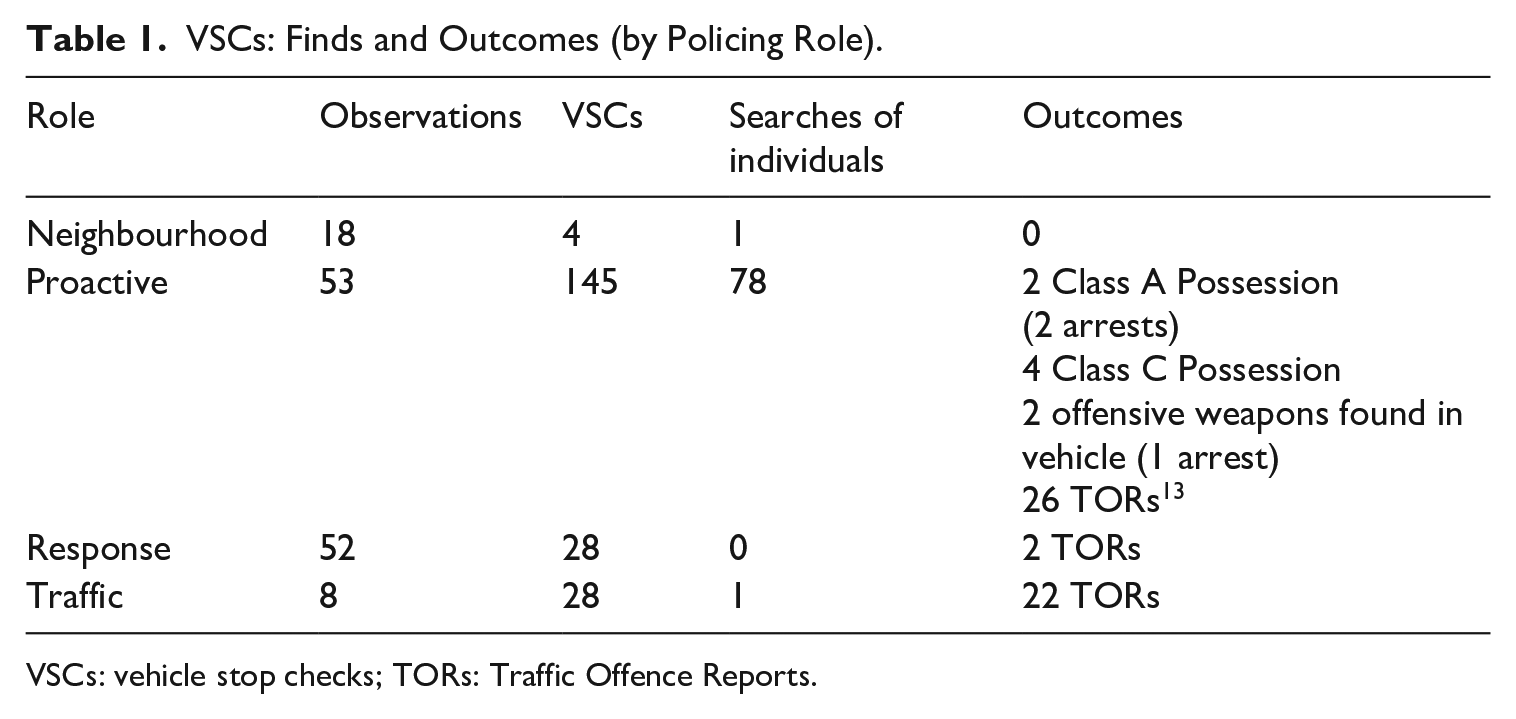
VSCs: vehicle stop checks; TORs: Traffic Offence Reports.
Observations with Traffic officers revealed a pattern very different to those on Proactive duties. Of the 28 vehicle stops 14 conducted by Traffic officers on eight shifts observed, 22 15 resulted in some formal outcome, most commonly a fine. Offences included driving without a seatbelt, with defective lights, at speed, or in a dangerous manner. Once stopped, officers might inspect vehicles for further issues, but for the most part the offence was visible before the vehicle was stopped. Those occasions that did not result in a fine or other outcome included two ANPR (Automatic Number Plate Recognition) ‘pings’ indicating the cars had no insurance. In one case, this was in error and, in the other, the officer allowed the driver to renew the insurance at the roadside. Two other incidents concerned minor driving offences (failure to indicate and being slow to move off at traffic lights) that resulted in ‘words of advice’. In all 26 of these stops, traffic offences were witnessed or suspected.
The remaining two stops conducted by Traffic officers were of a different variety. The first was of a mud-spattered Land Rover on a country road. The windscreen was filthy and it appeared that the driver could scarcely see out of it. However, the officer connected the appearance to intelligence reports of burglaries using farm tracks and off-road vehicles. Once stopped, he recognised the driver as a criminal well known to the police. He pointed out a series of faults on the vehicle and advised the driver of what needed fixing to make it road-worthy, but no fine was issued and the vehicle was not seized. For this officer, the stop produced valuable intelligence to be passed on to a specialist team dealing with stolen vehicles. The stop arose in part from the dirt obscuring the driver’s view, but it was in part speculative, connecting the condition of the vehicle to other reports. The final stop conducted by a Traffic officer that resulted in no outcome was of a Mercedes; the officer had seen the same car the previous night and had been about to check it when his attention was drawn to another vehicle. Seeing it again, in the same place and at the same time, his suspicions were heightened. He also referred to reports of the car being left unsecured at an address the police were watching. The stop was a speculative one, intended to gather intelligence on the driver.
For the most part, then, Traffic officers used s.163 for offences that fall under the RTA. They did not use it routinely for other purposes. At the same time, they were more likely to issue a driver with a fine. In this sense, Traffic officers typically used the s.163 power in the way in which it was intended, to check on the vehicle itself; was it road-worthy, insured, and driven by a qualified individual? Officers on Response duties, on the contrary, were less likely to pay attention to traffic offences and more likely to offer words of advice where they did. However, as we will see in the following section, officers assigned to proactive duties used s.163 as one of their main tools in their efforts to ‘disrupt’ organised criminal activities, in particular, drug dealing.
Use of VSCs by proactive officers
Proactive duties primarily involve patrolling of neighbourhoods associated with criminality. Officers might be deployed in response to specific intelligence, after incidents of serious gang-related violence, or more routinely to areas deemed ‘hotspots’ for drugs and gang activity. Their purpose is often to be visible and to act as a deterrent. Officers acting in this mode will often not know the area or the local gang members very well and so can regard all activity as potentially suspicious. Such deployments might also be accompanied by a s.60 order under the Criminal Justice and Public Order Act 1994, allowing officers to stop and search individuals without the need for reasonable grounds for suspicion. But they will use s.163 routinely to pull over vehicles in order to establish the identity of the driver and of any occupants. Except on the quietest of nights, officers’ attention will be drawn to specific characteristics they associate with those they are tasked to disrupt.
Given that officers are often performing these duties at night, they are principally concerned with the type of vehicle. Particular makes of car, often sporty hatchbacks, were described as a criminal’s ‘vehicle of choice’. Where these were new and/or in good condition, they were connected to drug dealing in the minds of proactive officers. Other vehicles might attract attention when in a particular place or at an odd time of day. Taxis were treated with a degree of suspicion because officers increasingly came to believe that they were being used by drug dealers instead of their own cars, but they were rarely stopped. Commercial vehicles were only worthy of attention if driving at night – they might be used in burglaries. Finally, family cars were of almost no interest to proactive officers. When officers could distinguish something of the occupants of a car (and, at night, this was not usually the case), they treated young men with particular suspicion. Where there were two or more young men in a car, the chances of being pulled over increased considerably. For proactive officers, it is young men they most associate with drug dealing and with gang-related violence. Other drivers might draw attention by their behaviour; the signals that officers responded to included, a driver ‘stiffening up’, ‘fidgeting’ or ‘looking shifty’ when they saw the police vehicle, erratic driving, and being a ‘young lad in a girl’s car’. Where a woman was identifiable as the driver, officers were almost never interested.
Officers described the process of learning to spot a likely target vehicle as one of trial and error. They were rarely acting on intelligence when patrolling in a proactive mode. Instead, they were looking for particular types of car and for young men. Alternatively, they stopped vehicles that looked ‘out of place’, what Sacks calls the police’s ‘incongruity procedure’ (Sacks, 1972; see also Loftus, 2009). Sometimes officers admitted they were simply acting on a ‘hunch’ that ‘something was not quite right’, and on occasion were unable to explain why they stopped one vehicle but not another. One yardstick of an officer’s perceived competence was their ability to make ‘good spots’. When patrolling in a marked van with three or four officers, the role of spotter fell to the driver and the occupant of the front passenger seat. Craning their necks forward at junctions, looking left and right, they would call out cars they thought ‘worth a look’. ‘Bad spots’ were often cause for ridicule. A large family car with both parents and two young children was called out by a Sergeant on one shift. He was noticeably quiet after that because every subsequent ‘spot’ was questioned: ‘Will this one be a load of nuns?’
In the 53 shifts we observed with Proactive officers, 145 VSCs were conducted. The outcomes of these are markedly different to those conducted by Traffic officers. While, on average, Traffic officers stopped more vehicles in each shift, this figure is not a reliable yardstick. We observed far fewer Traffic shifts, and at the same time Proactive officers were often called to other duties, such as search warrants. A more reliable measure of the difference in use of s.163 are the outcomes. Only 18% of Proactive stops resulted in an RTA offence being reported, compared with 79% for Traffic. The focus on the disruption of organised gang- and drug-related crime is evident from the numbers of stop and searches conducted: 78 people, including passengers, were searched. In only six cases were items found on the individual, all possession of drugs. In addition, two offensive weapons were found in vehicles. This is an 8% ‘find rate’ for stop and search and less than 5% of the total VSCs conducted by Proactive officers. Of the RTA offences reported, a number of fines and other outcomes were issued to those also searched. In our observation, actions such as these were often seen as the next best thing available to officers seeking to make life awkward for organised criminals. In the absence of finding anything in their possession, an officer might look for anything they could issue a ticket for.
Disproportionality and stop and search
We noted earlier that 54% of the searches we observed in our research (80 of the 146 individuals we saw being stopped and searched) were the result of a VSC. We have also noted that, for some officers engaged in Proactive duties, s.163 was a useful tool that allowed them to stop any vehicle without the need for grounds for suspicion. In effect, they employ the power to go ‘fishing’ for evidence of criminality and for people to search. When considering the use of police powers, in particular against young Black men, VSCs must therefore be an important factor. We know that stop and search is employed disproportionately against Black men (Home Office, 2022), a fact that has remained stubbornly unchanged through years of reform (Bowling and Phillips, 2007; Bradford, 2017; Holdaway, 1997: 22; McConville et al., 1993). While some racist stereotypes clearly remain in the police, officers do not appear to be ‘culturally homogeneous’ in this regard (Loftus, 2009: 143–144, see also Souhami, 2012; Stenson and Waddington, 2007), and what explains this feature of policing remains the subject of some dispute (Waddington, 1999). However, understanding what precedes a decision to conduct a search will shed some light on the relative weight to be attributed to individual officer bias or more institutionalised features of policing. Given the extent to which searches followed VSCs, further exploration of the use of this power will, we argue, reveal much about questions of disproportionality.
We did not observe any conduct that indicated the deliberate use of this power against Black men (indeed, we observed the policing of largely White working-class communities). In many instances, it was not possible to identify the driver of a vehicle in advance. More often, officers were working from assumptions about time, place, and the make of the car. ‘Bad spots’ were a common feature of much of this type of work, particularly at night. Nevertheless, as we have argued (Pearson and Rowe, 2020), we did observe the disproportionate use of VSC against young men. Because of the communities in which Proactive officers were most commonly deployed, this inevitably meant these were White working-class men (see also Loftus, 2009: 160; McConville et al., 1993: 17; Waddington, 1999: 45). This pattern of proactively policing particular communities associated with crime, drugs and gang-related activity, using VSC to search for evidence and intelligence, or what is commonly termed ‘fishing’, will generate disproportionality in those communities. Conducted in many inner-city Boroughs, such policing tactics will almost certainly drive a good proportion of the stop and search activity and thus racial disproportionality in its use.
Reforming VSCs
Our research, combined with the clear statistical evidence of ongoing racial disproportionality in the use of stop and search, led us to the conclusion that it is time that the use of VSCs is reformed. The starting point for any reform should be a study of how s.163 VSCs operate nationally, in particular who is stopped, and why. These proposals were fed into the Independent Office for Police Conduct (IOPC) investigation into disproportionality in the use of stop and search, who, in April 2022, produced the ‘National Stop and Search Learning Report’ which included a recommendation that ‘the Home Office agree an approach to recording data on the use of Section 163 powers’ (IOPC, 2022: recommendation 13). In July 2022, the Home Office rejected this recommendation but, in a separate response, the National Police Chiefs’ Council (NPCC), supported by the College of Policing agreed to: develop a consistent approach on the recording of the use of section 163 RTA powers by all forces . . . [to] consider data, identifying and challenging any apparent disproportionality . . . implement a trial for inclusion of section 163 RTA monitoring within the annual data requirement . . . [and] monitor the effect of activity in recorded disparities identified within national and force data.
At about the same time, the NPCC and College of Policing (2022) published their ‘Police Race Action Plan’, which also identified the issue of s.163 and racial disparities. At the time of writing, it is unclear exactly what form this recording and analysis will take, but it is likely to draw upon pilots conducted in 2022–2023.
There are a number of reasons why recording s.163 stops is both feasible and necessary. First, there is a strong argument based on legitimacy and accountability that vehicle stops should be recorded. As we have illustrated, and in contrast to the practice of ‘stop and account’, s.163 stops are a coercive police power supported by criminal sanction. Refusing to stop their vehicle is not an option for a member of the public unless they want to run the risk of a criminal conviction. Furthermore, s.163 is an imposition and inconvenience on both drivers and passengers, which is again more serious than the decision of a member of the public to stop in the street when asked and talk to a police officer. The blue lights, and sometimes sirens, necessary to perform the stop are likely to be stressful for the occupants, who will then have the inconvenience of slowing down, finding a safe place to stop and waiting for the encounter with the police officer(s). This encounter, if a VRN check leads to a check of the Police National Computer (PNC), may bring about a significant delay that for the driver of the vehicle will act as a de facto period of detention, while potentially intrusive and embarrassing questions are asked of them. While this is not as serious as a stop and search or an arrest, it is clearly a significant imposition of power over a citizen, and one that requires no reason or suspicion whatsoever. It seems reasonable that, as a bare minimum, the state actors should be expected to provide a reason for their decision and to make a record of the encounter which could provide evidence should a complaint be made by the member of the public about the use of the power.
Second, given what we know about racial disproportionality in the use of stop and search, it is likely that similar trends are occurring in VSCs. If the police service is serious about confronting racial disproportionality, it needs, at the very least, to understand the extent to which this is occurring in the use of all its powers. VSCs currently operate under the radar when it comes to formal recording requirements, but, given both their coercive nature and the prevalence of their use, it is essential that we find out who is being stopped. Furthermore, if racial disproportionality is uncovered through the new data on s.163 stops, then we need to be in a position to confront this, which will also require data on time and location, and reason for stopping the vehicle. If, for example, it is established that stops based on genuine but unreasonable suspicion (i.e. a hunch), or the type of vehicle, are leading to greater levels of disproportionality, then the data would provide the basis for future training and policy on the use of VSCs.
The third benefit of recording s.163 checks would be to provide us with data about how stop and search is utilised and the underlying reasons for the continuing racial disproportionality here. As we have established, VSCs, particularly when carried out by proactive officers, regularly lead to searches under s.1 PACE and s.23 MDA and provide a primary source for stop searches. However, most VSCs resulted from the police following a vehicle, which made it difficult to identify the race of the occupants. Where stops took place at night, our observations suggested that it was virtually impossible to identify the ethnicity of vehicle occupants before the vehicle was stationary and had been approached by the officer(s). Potentially, an analysis of the ethnicity of who is subjected to a VSC, compared with who is subsequently searched, could provide a vital insight into the extent that disproportionate stop and searches are the result of structural features (mainly geographical deployment decisions) or the result of an individual officer’s conscious or unconscious bias.
If the data revealed that a similar level of disproportionality exists in s.163 stops to that in stop and search, this would suggest that the problem is likely to be predominantly structural and can most likely only be resolved by changing where, when, or how officers are deployed. In other words, it would demonstrate that disproportionality is occurring in the use of police powers more widely because officers are put in positions where they are – even blindly – more likely to stop Black people. However, if there is less, or no, racial disproportionality in the use of VSCs, this would provide evidence that the problem was more likely to be the result of officer bias. In other words, that decisions were being made to search individuals only after the officer had established they were Black. The actual outcomes are, of course, likely to be less clear-cut, but we believe the data will be of value in the continued efforts to establish why disproportionality is occurring in the use of police powers, and what steps can be taken to try and reduce it.
Our view, which is reflected in the IOPC recommendation, is that the demographics of all occupants of vehicles that are stopped using s.163 are recorded, whether by officer-defined ethnicity or self-defined ethnicity. Times and locations of stops also need to be recorded, as does whether there was a subsequent search (or use of another power such as use-of-force or arrest). And finally, the reason for the decision to utilise s.163 needs to be recorded. Here, it is not the case that we recommend that officers at this point require an objective reason to stop, simply that these data will help us to understand what is happening. The genuine reasons we uncovered in our observations, such as the vehicle ‘looking out of place’, or the officer targeting particular types of vehicles because they believe they are used by drug-dealers, need to be captured. We recognise that requiring officers to record this information will deter some from conducting VSC and we are aware of the potential for officers to offer reasons other than their genuine grounds for conducting a stop. However, as we have found with stop and search, over time the data are likely to prove useful and become more reliable.
This leads us onto the next question of how these data should be recorded. It is important that the recording of s.163 places as little bureaucracy in the way of officers as possible. Lengthy reports are likely to either dissuade officers from utilising VSCs, or from recording the stops they do make. Moreover, the recording of the stop should also not increase the inconvenience or imposition on vehicle occupants. Given that officers performing s.163 checks typically run the registration plate number through the VRN check system and need to record this, this period would also provide a natural break following the VSC to record the demographics, time, place, reason, and outcome, ideally after the vehicle has been allowed to continue on its way or any further action has been taken.
The future of vehicle stops
While it appears that the recommendation that data from s.163 stops are recorded for the purposes of identifying racial disproportionality in its use will be implemented, what is less clear is the future form and use of the VSC. If the data uncovered indicate either serious disproportionality in the use of the powers, or a low success rate in terms of identifying offences, then we would expect calls for reform of the power itself, or at least severe restrictions in the guidance around how the power is used, for example, through PACE Code A or the College of Policing’s Authorised Professional Practice (APP). The medium-term future of VSCs is, to a great extent, therefore in the hands of the data that come out of the short-term recording and analysis. Furthermore, even these data will not tell us all we need to know about the value or otherwise of VSCs. While it may give us an idea of the success rate of the power in terms of identifying offences or offenders, the data will not, for example, tell us whether VSCs perform an important role in deterring the use of vehicles to carry prohibited items.
Nevertheless, if disproportionality or lack of efficacy is identified, then reform will most likely look to reduce the use of the power where it is least effective or has its greatest discriminatory effect. This would require reasonable suspicion that the driver of the vehicle was committing, about to commit, or had committed a road traffic offence or a criminal offence. An alternative, softer touch, approach to reform would require a reason for the VSC, rather than the current unfettered discretion. Either change could be supported by guidance in PACE Code A or APP, which made it clear that stereotypes based on the appearance of the driver, or the type of vehicle driven, cannot be the basis for the reason to stop or grounds for reasonable suspicion. However, given the continuing disproportionality in the use of stop and search under PACE, the addition of such requirements to the use of s.163 VSCs should not be expected, on their own, to eliminate either disproportionality or unnecessary stops.
Another potential reform would be to clarify the relationship between VSCs and stop and account. At the moment, the lines here are blurred in situations where the vehicle is carrying passengers. While s.163 stops are designed to make enquiries and checks on the driver of the vehicle, we have established how they are also being used to carry out what are effectively stop and accounts of passengers, but stop and accounts that are considerably more coercive, as the only way to avoid the encounter is to leave the vehicle in which they are travelling. It seems to us that, where passengers are subject to questioning in a vehicle pulled over and effectively detained by the coercive s.163 power, they should be given protections that go above and beyond the ability to ignore an officer and walk away that they possess if stopped in the street under a stop and account.
It is likely that the data from recorded s.163 stops will require some reform of how the stops operate for both drivers and passengers. Our research on the impact of restrictions placed on the use of other police powers suggests that such data gathering may in-and-of-itself reduce the extent to which officers choose to use VSCs, but that this will depend on the officer in question, their role, and the instruction they receive from their Sergeant (Pearson and Rowe, 2020). Requirements to provide reasons for stops, or to possess reasonable suspicion of the committal of a criminal offence, would be likely to have a more significant effect in reducing the use of VSCs, although again, depending on these variables. However, even if the use of s.163 is curtailed, experience to date suggests that this alone is unlikely to be enough to reduce any racial disproportionality.
Footnotes
Declaration of Conflicting Interests
The author(s) declared no potential conflicts of interest with respect to the research, authorship and/or publication of this article.
Funding
The author(s) received no financial support for the research, authorship and/or publication of this article.
