




Abstract
This article advances a critical analysis of the concept of ‘vulnerability’ and highlights the ways in which it can work to justify the pre-emptive detention and over-policing of marginalised populations. Building on a historical analysis of the entanglement between public health directives and carceral techniques of securitisation, we provide a contemporary case study of the ‘hard lockdown’ of nine public housing towers in Melbourne, Australia in July 2020, at the start of the city’s second wave of the COVID-19 pandemic. A thematic analysis of media discourses surrounding this event reveals that tower residents were constructed as vulnerable across four interconnecting discourses: spatially, culturally, behaviourally and psychologically. This enabled government actors to frame the exceptional mobilisation of police powers and detention directives to peoples’ homes as caring measures, despite their punitive optics and effects. Our analysis suggests that the pandemic has heightened the securitisation of public health measures, which can extend notions of racial inferiority and pathology, and compound social and economic inequalities. It indicates the need for further interrogation of the nexus between ‘care’ and control and the intensification of police powers in times of crisis.
Introduction
Critical criminologists are beginning to document and analyse how the implementation of government measures to stop the spread of COVID-19 can target and disproportionately impact marginalised groups (Brown, 2021; Suhomlinova et al., 2022; Vegh Weis and Magnin, 2021; Vogl et al., 2021). Pandemic policing has been an important arena where inequalities have unfurled (Boon-Kuo et al., 2021; Fatsis and Lamb, 2021; Lelliott et al., 2021; Stanley and Bradley, 2021; Waight et al., 2021). In Australia, this has included media reports of ‘unfair’ COVID fining practices that amplify existing inequalities experienced by youth, homeless and First Nations people (Fox Koob, 2021); the selective application of restrictions on movement applied to lower socio-economic areas; and detention orders issued without warning to public housing tower residents in Melbourne.
On 1 July 2020, 7 weeks after the end of the state of Victoria’s first COVID-19 lockdown, the state government reintroduced restrictions on movement to mitigate a rise in case numbers that was attributed to the escape of the virus from the hotel quarantine programme (Andrews, 2020a). Initial restrictions were placed on a geographically bounded segment of the population: 10 Melbourne postcodes were named ‘hot zones’ and residents were placed under a ‘Stay at Home’ order in an attempt to prevent what experts warned could progress into a second wave.
1
Next, at 4:08 pm on Saturday 4 July 2020, approximately 3000 residents of nine inner-Melbourne public housing towers were subject to immediate detention directions, authorised by the Deputy Chief Health Officer of Victoria under the state’s Public Health and Wellbeing Act 2008. Issued without warning, the directions confined residents to their flats for an initial period of 5 days. Within the hour, several hundred police officers were deployed to the Flemington and North Melbourne public housing estates and perimeters were formed to prevent residents from traversing the threshold of their dwelling for any reason, creating what the Victorian Ombudsman (2020) called a ‘theatre of policing’ (p. 5). In the independent investigation conducted in the aftermath of the event, the Ombudsman recounted the chaos that ensued after the announcement: people found themselves without food, medication and other essential supports. Information was confused, incomprehensible, or simply lacking. On the ground few seemed to know who was in charge. No access to fresh air and outdoor exercise was provided for over a week. In a particularly unfortunate act, temporary fencing for an exercise area was erected one night, surrounded by police, and although quickly taken down, reinforced the residents’ sense of being imprisoned. (p. 4)
Implemented with ‘more or less immediate effect’, ‘absent further preparation’ and ‘without specific health advice recommending such an approach’ (p. 18), the Ombudsman concluded that the hard lockdown breached the human rights of tower residents – a ‘significant proportion’ of whom came from ‘non-European backgrounds’ (p. 5). Although the Ombudsman was persuaded that the ‘temporary detention of residents . . . may have been an appropriate measure to contain the outbreak of COVID-19 sweeping the building’ (p. 18), it was the manner in which the hard lockdown was implemented and maintained that, in the Ombudsman’s view, caused it to be ‘contrary to law’ and, specifically, to section 38(1) of the Charter of Human Rights and Responsibilities Act 2006 (Vic) (p. 179). One example of this was illustrated by the fact that residents of 33 Alfred Street were required to exercise in an area surrounded by temporary fencing on the evening of 11 July 2020. This, the Ombudsman found, was ‘incompatible with both the protection against degrading treatment and the right to humane treatment when deprived of liberty’ (p. 179). The Ombudsman argued that, ultimately, many of the problems associated with the lockdown appeared to be attributable to the immediacy of the intervention (p. 18). The term ‘hard lockdown’ was used, in this context, to distinguish between the (harsher) restrictions imposed upon tower residents and those imposed on other Melbourne residents at the time.
The hard lockdown of public housing tower residents was justified on the basis that it was necessary to protect the vulnerable from the spread of COVID-19. The Victorian Premier and his health advisors expressed worry that 23 cases across more than 12 households could ‘spread like wildfire’ due to the densely populated buildings and their design features, including frequently used communal spaces that were poorly ventilated, such as laundry facilities and stairwells (Andrews, 2020b). After the initial 5 days, the harshest detention orders were lifted for all but one of the public housing towers due to more than 10% of its residents testing positive to COVID-19, leaving approximately 400 people in isolation for a further 9 days, until 11:59 pm on 18 July 2020.
Using this event as a case study, this article develops a critical analysis of the ways in which state actors attempt to justify the selective application of highly securitised, pre-emptive policing measures during a pandemic through recourse to the twin concepts of ‘vulnerability’ and ‘protection’. Based on a thematic analysis of media discourses of the hard lockdown of the Melbourne towers, we argue that it was rationalised through three interconnected logics: the situation represented a ‘crisis’ that required extraordinary measures; the residents of the towers were ‘vulnerable’ or ‘at risk’; and accordingly, the harsh response was necessary for the ‘protection’ of tower residents and the broader community. Using a conceptual framework that views carceral techniques and public health discourses as overlapping fields of social control (Foucault, 2007 [1977]; Miller and Rose, 2008) – and lockdowns as one spatial expression of the fusion of these two forms of disciplinary power (Young, 2021) – we critically interrogate the construction of ‘vulnerability’ in the specific context of pandemic policing in Australia. Drawing on historical literature that illustrates how public health emerged as a disciplinary technique in the 19th century and has long been implicated in the production and maintenance of racial categories in Australia, we develop an analysis of how state actors construct vulnerability in order to (over)police it, which reinforces the securitisation of spaces occupied by socially and economically marginalised groups.
Through close analysis of the hard lockdown of the Melbourne towers, the article makes two contributions to criminological knowledge of pandemic policing and the broader field of ‘policing vulnerabilities’ (Aliverti, 2020; Asquith et al., 2017). The first is to advance understandings of how the concept of vulnerability is constructed and instrumentalised in media discourse, and its potential effects. As this case study illustrates, the label of vulnerability can be used as a cover for the intensification of carceral techniques targeting select individuals and populations (Shore, 2021). The second contribution is to reaffirm the connections and continuities between public health and crime control approaches to policing contagions. Our historically informed analysis shows that the discipline of public health continues to involve the use of disciplinary powers and carceral techniques of securitisation (Foucault, 2007 [1977]), which have unequal effects on already marginalised groups. The results of this analysis emphasise that, rather than a strict juxtaposition, public health and crime control are in many instances not simply overlapping but mutually reinforcing discourses – an entanglement that has only been reinforced and further justified in government responses to COVID-19.
Policing ‘vulnerabilities’ during COVID-19
The interconnections between crime control and public health discourses are not new; police have often been involved in enforcing public health orders (Bartkowiak-Théron and Asquith, 2017). The declaration of COVID-19 as a global pandemic on 11 March 2020 marked what Sheptycki (2020) has called ‘the first global police event’, set to significantly rework and expand the policing role in the governmental management of communicable disease. In response to the pandemic, nation states across the globe adopted highly securitised measures to contain the spread of the virus, implementing ‘draconian constraints’ on basic freedoms and increasing police powers to enforce ‘stay at home’ orders (McClelland and Luscombe, 2020; Stott et al., 2020). In Australia, law enforcement was given a primary role in state responses to the pandemic, especially in the most populous and affected states of Victoria and New South Wales. Police were mobilised to ‘stop the spread’ of COVID-19 by enforcing social distancing measures and restrictions on movements, including issuing hefty fines and setting up checkpoints within and at city boundaries (Waight et al., 2021). In this fusion of disciplinary powers and viral containment, new police powers converged with existing carceral techniques, intensifying ‘existing patterns of public order policing directed towards the “usual suspects”’ (Boon-Kuo et al., 2021: 76).
The synergies between public health and crime control paradigms are reflected in the common conceptualisation of those on the margins of legal protection and social service provision as ‘vulnerable’ or ‘at-risk’ groups. Even prior to COVID-19, scholars observed that the language of vulnerability has become increasingly prevalent in criminal justice policy, practice and research (Aliverti, 2020; Bartkowiak-Théron and Asquith, 2017). Both complementing and reworking more traditional concerns surrounding ‘dangerous’ others, the mobilisation of the rhetoric of vulnerability allows decisions about criminalisation, detention and other coercive measures to ‘become framed in terms of protection from vulnerability to harm’ (Aliverti, 2020: 1121). Some critical scholars argue that the notion of vulnerability has been co-opted by state agents as a cover for instances of state violence, which can now be carried out ‘under the guise of protectionism of and from unruly subjects’ (Rodriguez et al., 2020: 537). The recourse to vulnerability makes the exercise of state power appear ‘benevolent’ (Barker, 2017) and justifies its expansion into ever more intimate realms, including the home. While conjuring the ‘soft power of kindness’ (Canning, 2019), vulnerability discourse is ‘dovetailing with punitive rationale and practices’ (Aliverti, 2020: 1117).
The institutionalisation of vulnerability in policing, including efforts to identify, manage and respond to it, has co-occurred with a burgeoning field of research (Asquith et al., 2017; Bartkowiak-Théron and Asquith, 2017). While definitions of vulnerability vary across institutions and contexts, Aliverti (2020) contends that in the criminal justice context, it typically indicates: ‘an individual condition that enhances the risk of harm and is produced by personal (such as mental health) and situational factors (i.e. poverty); it activates a duty of care and requires specialised support’ (p. 1119). However, vulnerability is not a neutral concept, nor is it static or without multiple historical and cultural meanings. As Munro (2017) argues, ‘claims to vulnerability are typically attached to identities marked by precariousness’ (p. 421). The label itself is ‘loaded with associations of fragility, weakness, non-agency and femininity’ (Aliverti, 2020: 1121). Increasingly, socio-legal scholars are documenting the ways in which government and other authorities’ framing and manipulation of ‘vulnerability’ often intersects with other agendas, such as punitive crime control and exclusionary border policies (Barker, 2017; FitzGerald, 2012; Rodriguez et al., 2020). Frameworks of vulnerability have ‘become increasingly powerful levers for initiatives that alter in myriad and complex ways the balance between freedom and coercion, autonomy and protection, self and other, and citizen and state’ (Munro, 2017: 421). While the arrangements and techniques of power that coalesce around the concept may be evolving in the arenas of policing and law, the notion of vulnerability has a long history in public health control measures.
Regulating vulnerabilities through public health
Public health is often characterised by criminologists as a more humane paradigm that can overcome some of the discriminatory excesses associated with traditional approaches to policing social order (e.g. Bucerius et al., 2021). Yet historically, public health initiatives have differentially targeted lower socio-economic and ethnic ‘others’ since their emergence in England in the early 19th century. In the wake of a cholera outbreak in London, public health reformers depicted urban ‘slums’ and the noxious trades associated with those locales, such as slaughterhouses, piggeries and canneries, as ‘vectors of disease’, due to ‘overcrowding and filth’ (Gill, 2000; Trabsky, 2014). The eventual introduction of sanitary laws to enhance hygiene in urban slums became viewed as an objective paradigm for managing outbreaks of infectious disease. However, it also led to the construction of labouring and migrant populations (and their densely packed neighbourhoods) as inherently vulnerable, dangerous and ‘risky’ segments of society.
Racialised and class-based notions of public health ‘risk’ were transported to British colonies through the imperial project of empire building in the 19th and 20th centuries, and were used to manage, control and restrict the movement of Indigenous, migrant and indentured populations (Bashford, 2004). Throughout the 20th century, colonised populations and non-European migrants were labelled responsible for disease outbreaks including tuberculosis, the Spanish flu and ebola, which led to heightened surveillance of those communities and racialised immigration policies (Kraut, 1995; Shah, 2001). In the Australian context, the management of outbreaks of communicable diseases through the Western public health paradigm has long been understood as a colonial technique for controlling the movements of Indigenous and migrant populations. In early 20th century Australia, public health’s ‘lines of hygiene’ were simultaneously racial lines materialising as exclusionary borders such as the historical quarantine stations at Australian ports, the ‘leper line’ in Western Australia and the boundaries of Aboriginal ‘protectorates’ (Bashford, 2004). Indeed, in Australia and elsewhere, public health is an ongoing source of institutionalised racism, often indistinguishable from the paternalistic acts of the colonial state (Bassett and Graves, 2018; Bond, 2005; Came, 2014; Henry et al., 2004; McPhail-Bell et al., 2015).
In more recent Australian history, pandemics have been used to justify expanding extraordinary public health laws with little parliamentary oversight in the name of ‘community safety’. Coercive public health orders have been enacted in ‘emergency’ situations, such as the emergence of HIV/AIDS in the 1980s in Australia, with infected individuals or groups deemed to be a ‘risk’ to the community and mandatorily detained in hospitals, community housing or their own homes by public health authorities – sometimes indefinitely (Carter, 2016). Typically implemented without transparency or an adequate evidence base, these public health orders have been used to pre-emptively confine ‘risky’ populations, especially individuals from ethnic minorities and low socio-economic communities (Carter, 2020). Indeed, Weait (2007) notes that the enforcement of public health orders ‘may – rather than being a “soft option”’ – amount to criminalisation by the back door’ (p. 12).
Like discourses of criminal control, the discipline of public health often deploys the paradigm of vulnerability to describe marginalised communities that are ‘at risk’ of illness and death, which can result in the reification of racialised hygienic discourses. While vulnerability can be used to draw attention to systemic inequities faced by disadvantaged groups and make a case for the redistribution of resources (Katz et al., 2020; McLaren et al., 2020), the dissemination of this idea, particularly through the media, can give rise to paternalistic discourses of individual or communal deficiency that are devoid of structural context (Donohue and McDowall, 2021). For instance, in their analysis of Australia’s federal COVID-19 policy response for Aboriginal and Torres Strait Islander communities, Donohue and McDowall (2021) argue that the construction of First Nations people as vulnerable reinforces the colonial idea that they ‘must be controlled for the sake of their own health’ (p. 656). By imputing a lack of agency and self-responsibility, projections of vulnerability can thus readily invite law and order or ‘carceral protectionist’ responses (Rodriguez et al., 2020). Instances of the authoritative mobilisation of vulnerability or protection as pretext for over-policing and detention orders thus require closer scrutiny.
Method: A case study of the hard lockdown of the Melbourne towers
The empirical basis for our analysis principally derives from a thematic analysis of media discourses of the hard lockdown of nine public housing towers in Melbourne, Australia, in July 2020. As an interdisciplinary team working across the disciplines of criminology, public health, history and law, this research aimed to examine the discourses that rationalise the intensification of carceral techniques and police powers during the coronavirus pandemic, as well as the nature and historical precedents of the emerging regulatory regimes that they produce. To explore these topics, we used a local place-based case study to answer the following research questions:
Research Question 1. Who are the primary definers of the media discourse of this event? and
Research Question 2. How are the targeted and selective application of these exceptional measures framed and justified in media discourse?
Data were collected through a search conducted in the digital news database, Factiva. We selected national and state-based sources to capture how the popular press reported on the hard lockdown at both a local and national level. In Victoria, we drew data from the states’ two major newspapers: The Age, which is owned by Nine Entertainment Co and is generally considered to adopt a centrist politic; and The Herald Sun, a tabloid owned by News Corp that is known for ideologically conservative reporting (Hobbs and Owen, 2016). Also included in our search were the two top ranking Australian online news outlets, the Australian Broadcasting Commission (ABC) and news.com , as well as the national broadsheet, The Australian. Both news.com and The Australian are also owned by News Corp. We limited our search to English-language articles published during July 2020 that included our key search terms (terms relating to ‘public housing tower’ and ‘lockdown’) in the headline or lead paragraph of each article. This ensured that the results of our search would be analysable and highly relevant to our study. 2
This search generated a dataset of 193 articles, 40 of which were automatically identified and removed by Factiva as identical duplicates resulting in a dataset of 153 articles. Non-identical duplicates, articles that have been updated, extended or amended after their initial publication, were then manually removed. Potential non-identical duplicates were identified by having identical or similar titles and identical author/s, publisher and publication date and being of a similar word length. Twenty-one articles were found to be non-identical duplicates and were extracted from the dataset. This resulted in a final sample of 132 articles.
The final dataset was imported into the qualitative data analysis software programme NVivo, where it was prepared for coding. Initially, a sample of five randomly selected articles were closely read, analysed and discussed by all authors. With careful attention to the research questions, we used inductive methods (Azungah, 2018) of thematic and content analysis whereby key themes, patterns and concepts emerge from the data. Based on this initial process of reading and analysis, we developed coding schemes to respond to Research Questions 1 and 2. The coding scheme for the latter comprised six thematic codes that reflected the various, and often overlapping and mutually reinforcing, ways in which the hard lockdown was framed and justified in the media. These codes were crisis and the need for extraordinary measures; tower residents as vulnerable; tower residents as dangerous, unruly, non-compliant; tower residents as vectors of disease; the state as protector, caregiver or warden; and tower architecture and design including crowding. Upon confirmation of this coding scheme, author three then coded all articles in the dataset and, upon completion, this was reviewed and confirmed by the other authors. The results of the coding enabled us to refine our theoretical framework and develop an analytical schema for understanding the multiple meanings ascribed to the concept of ‘vulnerability’ and their political effects. As we outline below, the tower residents’ vulnerability emerged as the dominant discursive theme in the media coverage of this event.
Findings
The hard lockdown of the public housing towers in Melbourne was deemed highly newsworthy and garnered significant attention from all major news outlets. Like the coverage of COVID-19 more broadly, the reporting of the situation was both sensationalised – represented as a crisis – and politicised, with tower residents, their supporters and members of the opposition Liberal party regularly critiquing the Labour government’s handling of the events. Many of the articles quoted key actors and decision-makers, as illustrated in Table 1. Tower residents’ voices were most prominent across the sample, appearing in 40% (n = 53) of articles, closely followed by politicians. Victorian Premier Dan Andrews was the most frequently quoted individual and politician; his statements appeared in 35% of articles (n = 46). Police perspectives were strongly represented in the coverage, appearing in 36% (n = 48) of the articles. By contrast, public health officials were quoted less often across the sample (23%; n = 30) and there were relatively few references to medical and other experts (8%; n = 11), which highlights the privileging of policing as a solution to the problem.
Key actors in the coverage.
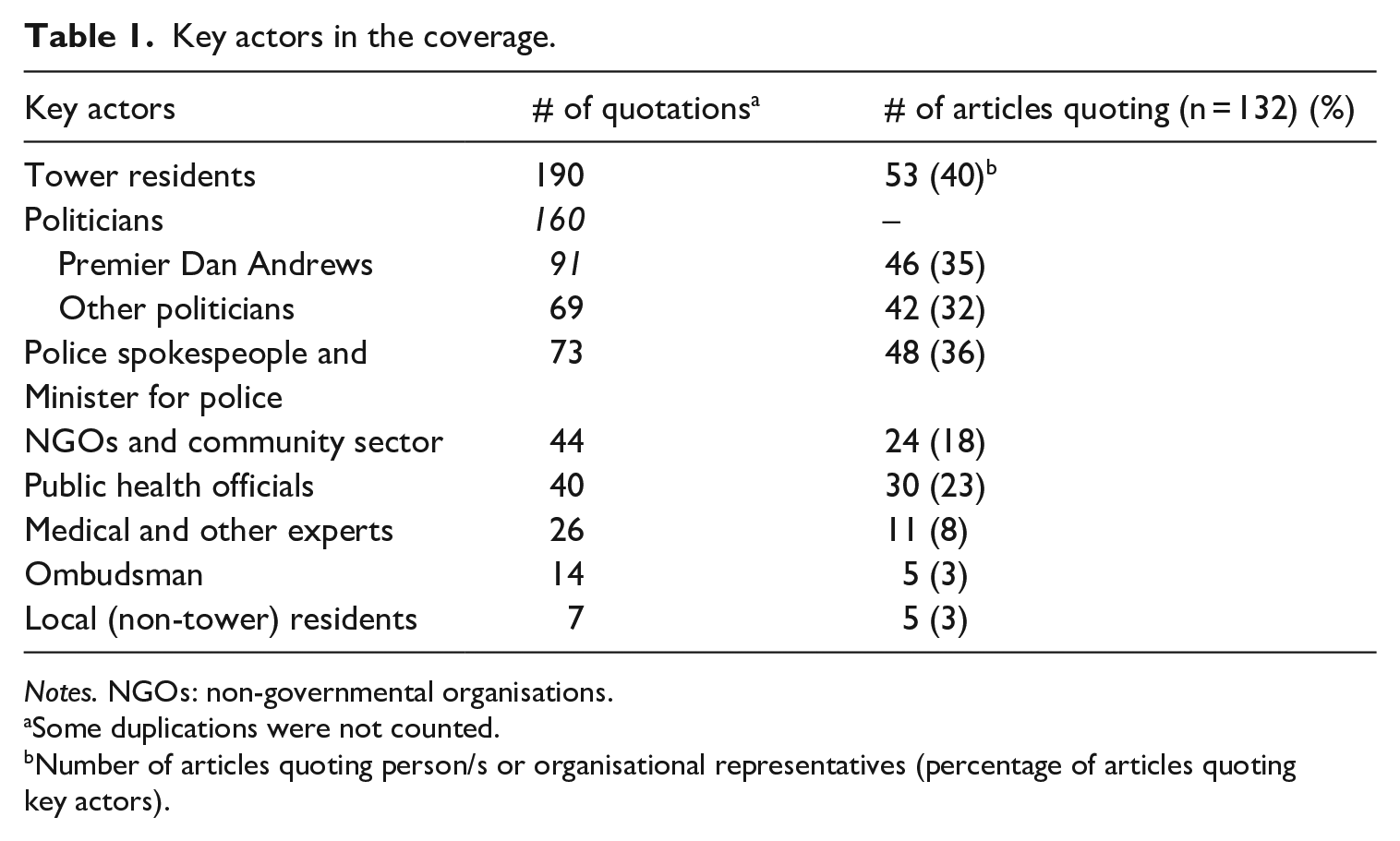
Notes. NGOs: non-governmental organisations.
Some duplications were not counted.
Number of articles quoting person/s or organisational representatives (percentage of articles quoting key actors).
Our thematic analysis of media content in response to the second research question found that the hard lockdown of the towers was rationalised through three main interconnected logics. First, the residents were constructed as ‘vulnerable’ or ‘at risk’. Second, the situation was framed as a ‘crisis’ which ostensibly called for extraordinary measures. And third, these two logics combined to make the harsh response seem necessary to ‘protect’ the residents and the broader community. The salience of these themes is illustrated by a content analysis of the frequency with which the key terms associated with these themes were used across the sample of media reporting, outlined in Table 2.
Frequency of keywords.
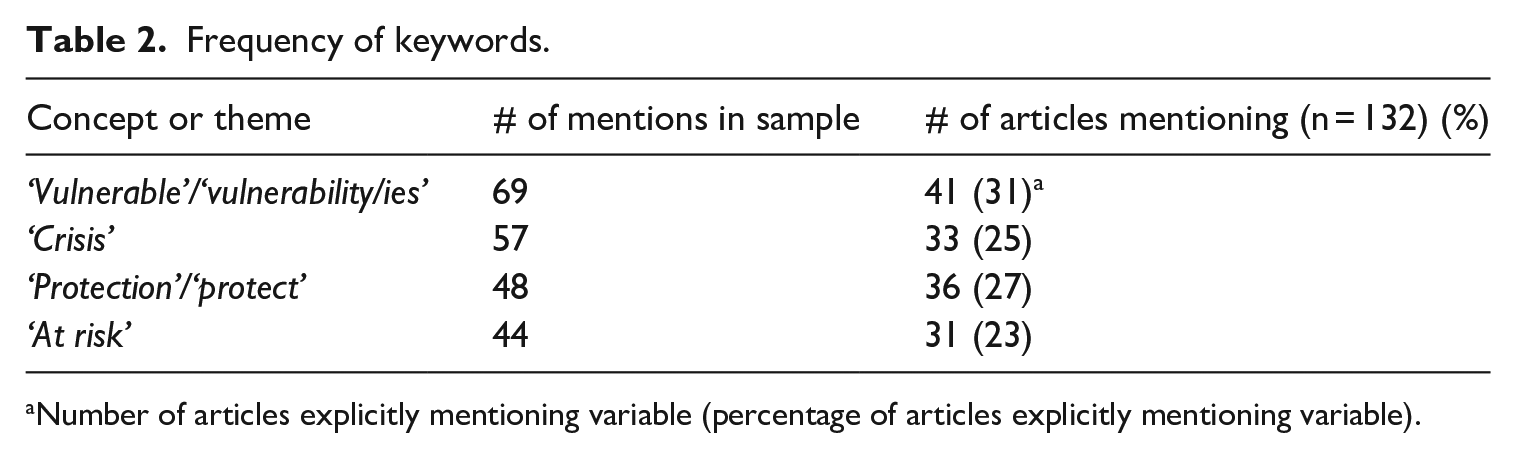
Number of articles explicitly mentioning variable (percentage of articles explicitly mentioning variable).
Below, we address the tropes of crisis, vulnerability and protection in turn. Our analysis highlights that these frames, although contested by some, served to justify the police response and preclude or silence alternative and community-led responses to the outbreak (see e.g. Stanley and Bradley, 2021).
Constructing the crisis
The spread of COVID-19 in Melbourne and its alleged causal links to the nine public housing towers were consistently cast as a ‘crisis’ that constituted a severe threat to community health and safety, which required urgent intervention. This was typified in the following newspaper article quoting the Victorian Premier Andrews: Mr Andrews said ‘unprecedented’ actions were necessary to try to keep people safe. (Herald Sun, ‘We have no plans’: Claims public housing lockdown was sprung on police, 5 July 2020)
To emphasise the gravity of the threat posed by COVID-19, government commentators cited in the media strategically drew upon the metaphor of a bushfire. Bushfires were a locally resonant analogy, since they had raged throughout Victoria and other states of Australia during the previous summer, forcing the evacuation of hundreds of thousands of people, the loss of hundreds of homes, and 34 deaths. Premier Andrews explicitly referenced this disaster to reinforce the imminent danger presented by the spread of the virus, referring to the situation as ‘[. . .] much like a bushfire and this is a public health bushfire’, he said. ‘We need to contain it and ultimately put it out’. (Herald Sun, High-rise lockdown: Police patrol nine housing towers after virus cases spike, 4 July 2020)
Here, the immediate detention of tower residents in their units is framed as an obvious and necessary measure to ‘put out’ a fire and minimise the loss of lives. There was frequent reference to this being in the ‘best interests’ of the broader Victorian community, which lent moral weight to the intervention and glossed over the uncomfortable inequalities inherent in the targeting of the tower residents specifically.
The bushfire analogy was similarly used by opponents to criticise the government’s management of COVID-19 in the lead up to the hard lockdown of the towers. Referring to an earlier scandal over the failed hotel quarantine programme, an OpEd in the Herald Sun claimed, [. . .] rather than deploying the water bombers and tankers, the government’s abject mishandling of Victoria’s first-line of defence [. . .] has been the equivalent of hosing down the flames with petrol. (Herald Sun, OpEd, 5 July 2020)
On one level, this quote/article represents a critique of the structural issues that led to the outbreak in the towers. However, the bushfire analogy reinforces the idea that the state is facing a disaster that needs decisive action from emergency services, which contributed to naturalising a police response.
While the ‘crisis’ rhetoric justified the lockdown of the towers, the lockdown itself then came to reinforce the perception of a crisis – creating a self-fulfilling prophecy. This cyclical logic is reflected in the following quote: The hard lockdown of 3000 at-risk public housing residents, largely comprising migrant families and the elderly living in high-density, high-rise towers, has dramatically illustrated how close to out-of-control the crisis in this state has become. (Herald Sun, OpEd, 5 July 2020)
The notion of an ‘out-of-control’ crisis produces a form of ‘disaster politics’, which is often used to justify the suspension of democratic safeguards (Klein, 2007). In this instance, the optics of police saturation of the public housing towers reinforced the ‘crisis’ framing and spoke to a longer trajectory of highly politicised investments in the expansion of the police force in Victoria. Indeed, governments and other powerful actors often use crises as an opportunity to legitimise or advance pre-existing agendas (Saltman, 2007). At a time of increasing scepticism of over-inflated police budgets – sparked by renewed Black Lives Matter movements in North America and Australia (Cobbina-Dungy and Jones-Brown, 2021) – the ‘theatre of policing’ at the public housing towers represented an opportunity for the government to justify its unprecedented investment in policing that began four years’ earlier, with more than $2 billion in funding and 3100 extra police representing the largest single increase in police numbers in the state’s history (Andrews, 2018). The high-profile mass mobilisation of police to enforce the hard lockdown was thus also tied to the law and order politics that the state had been embroiled in for more than a decade (Russell, 2017). In the lockdown of the towers, the crisis rhetoric worked in tandem with discourses of vulnerability to frame the differential treatment of tower residents to their fellow Victorians.
Policing and producing ‘vulnerability’
Throughout the reporting of the lockdown, tower residents were continually framed as vulnerable – a term used interchangeably with ‘at risk’ – in four overlapping ways: spatially, culturally, behaviourally and psychologically. These tropes created a picture of complex and inherent vulnerability, which in turn nurtured the perception that the tower residents required control and containment for their own protection.
Spatial and cultural vulnerability
One of the ways in which the hard lockdown of the towers was rationalised was through the idea that tower residents were more ‘at risk’ of contracting and spreading the virus than the broader population. This notion was constructed through two mutually reinforcing logics: first, tower residents were spatially vulnerable to infection due to overcrowding and shared communal spaces, and second, those living conditions arose not simply from poverty but from their ethnic backgrounds and cultural values.
Tower living conditions were frequently referred to as ‘cramped’ and ‘crowded’: [The premier] cited the crowded living in public housing and many communal spaces, meaning community transmission was high risk. (news.com, ‘Not fair’: Trapped Victorian’ anger, 5 July 2020)
On one level, this point highlights the risks of infection inherent in high-density living and communal spaces, which present structural barriers to social distancing and other protective behaviours. However, in explaining these living conditions, there was little mention of the cramped space being related to architectural design or disinvestment in public housing. One notable exception from ABC News reported that residents had been ‘fretting about how they will cope in tiny apartments with no outdoor space, no open windows, and fear they are surrounded by others with corona virus’ (Clayton, 2020). There was almost no discussion about the poverty that had prevented residents from affording more spacious accommodation elsewhere, nor the larger crisis of housing affordability in Melbourne. Rather, the media implicitly and explicitly connected the overcrowding of public housing towers to the race and ethnicity of tower residents: The entrapped residents are a mix of refugees from countries such as Somalia and Ethiopia as well as Aboriginal and Torres Strait Islanders, many with large families sharing small apartments. (The Australian, Chaos, stress as families are ‘boxed in’, 6 July 2020) The 12-storey block is occupied by families including a Somalian family with 11 children in a four-bedroom flat. (Herald Sun, Luck of the Draw in Tower Hotspots, 9 July 2020)
Perhaps the most striking example of this rhetoric was in an article from The Australian. The headline ‘Overcrowded towers are virus incubators’ echoed the language used to describe the slums of London during the 1830s cholera outbreak (Gill, 2000). The Victorian Public Tenants Association Executive Officer was quoted as saying: We’re talking about large families because that’s their culture by and large. You might find five or six kids and mum and dad living in a pretty crowded apartment. They live in cramped conditions. (The Australian, Overcrowded towers are virus incubators, The Australian, 6 July 2020)
This rhetorical connection between spatial vulnerability and ethnicity echoes an historically entrenched and racialised overpopulation discourse that often blames people from the ‘Global South’ for having too many children, typically explained by a perceived lack of education and ‘poor family planning’ (Dyett and Thomas, 2019). The emphasis on the problems of high-density living and ‘cramped’ conditions tended to attribute blame to extended families or intergenerational living; yet single people living in the towers were also constructed as vulnerable. Media articles routinely returned to the tower residents’ ethnic backgrounds, creating a perception of cultural inferiority and poor choices that not only affirm racialised ideologies, but obscure the lack of adequate support and investment for public housing infrastructure. Similar dynamics were witnessed in the media coverage of COVID-related supply chain issues, which disproportionately blamed ethnically diverse and low socio-economic communities for ‘panic buying’, while veiling the structural reasons behind the stock shortages (Phillips et al., 2021).
Furthermore, cultural traits assigned to the nationalities and ethnicities of tower residents – such as communitarian living and the heightened importance of extended families – were deemed to render them more vulnerable to the virus and to spreading infection: The Government’s decision to lock down all nine towers was made because of ‘patterns of movement, friendship groups, family groups’ the Premier said. (news.com, ‘Not fair’: Trapped Victorian anger, 5 July 2020) Extended family members often share the accommodation. ‘What we tend to find with those high rises, because of where they are, they get a lot of larger families [. . .]’. (The Australian, Overcrowded towers are virus incubators, The Australian, 6 July 2020)
The discursive link between spatial and cultural vulnerability had the dual effect of constructing the tower residents as both inherently at-risk and risky. The effect was to downplay the structural inequalities that lead to their cramped living arrangements and position immediate securitisation as the necessary response to the outbreak.
Behavioural risks
A third trope within the media reporting of the hard lockdown was the idea that tower residents were more ‘at risk’ of COVID-19 infection than other Victorians due to a higher likelihood of residents being non-compliant. One way in which this behavioural risk was expressed was through constantly reinscribing the tower’s connection with drugs, violence and frequent interactions with police.
Several [towers] are drug-dealing hubs and violence is common. Some residents have uneasy relations with the police. (The Australian, Is Social Housing Worth the Cost?, 13 July 2020)
The vague description of ‘uneasy relations with police’ nudges readers to indulge in racialised imaginaries of violent drug dealers and thugs, recalling well-established associations between Indigeneity, Blackness and criminality in Australia (e.g. Cunneen, 2001; Porter, 2015; Weber et al., 2021). The newspaper’s silence on the extensively documented pattern of racial profiling and over-policing experienced by African-Australian residents of these towers (Hopkins, 2020) reproduced the supposed neutrality and ‘racial innocence’ (Murakawa, 2019) of the police presence that surrounded the residents’ homes.
In another example of self-fulfilling logic, the mobilisation of police to enforce the public health orders was used as further evidence that the tower residents were likely to be non-compliant. The decision to utilise police officers both signals and ascribes dangerousness and unruliness to the tower residents: Dr Duckett, from the Grattan Institute, said sending police rather than security guards or community workers indicated there were likely concerns of potential quarantine breaches. (ABC News, How does Melbourne’s coronavirus lockdown compare with overseas responses to community transmission?, 9 July 2020)
Some reports used the more humane language of residents requiring ‘support services’. While often well-intended, calls for increased support for tower residents had the overall effect of further reinforcing the notion of residents’ vulnerability by inadvertently reinscribing the connection between tower residents, substance abuse and mental instability, as illustrated by this report: Some of Victoria’s most vulnerable people live in the nine towers and Housing Minister Richard Wynne said they would be offered mental health and drug and alcohol support. (The Age, More suburbs in lockdown as Victoria records 108 new coronavirus cases, 4 July 2020)
Importantly, not all media reports concurred with this representation. Some residents were quoted speaking out against this discriminatory portrayal of them and their neighbours. As one noted, Right now we look like the only people in Australia, we are poor, we are not heeding the restrictions, we are spreading the virus, we don’t care about anybody else. And that is far from the truth. (ABC News, Public housing tenants caught out by Victoria’s sudden COVID-19 lockdown of tower blocks, 6 July 2020)
Others explicitly critiqued the language of vulnerability: Many former and current residents hit back at descriptions of the estates’ vulnerability, citing the wealth of experiences and work ethic represented among the estates’ population. (ABC News, Melbourne’s tower lockdowns reveal the precarious future of Victorian public housing, 16 July 2020)
To counter the imposed powerlessness implied by the term ‘vulnerability’, residents asserted their strengths, in part drawing on the rationality of individual responsibility, or ‘work ethic’, to promote their deservedness and reject the representations of tower residents as incapable, helpless and non-compliant. This is a discursive strategy to prove their behaviour aligns with supposedly ‘Australian values’, which demonstrates the deep-rooted racism that underlies how they are frequently represented.
Psychological vulnerability
A final, interconnected element of the construction of tower residents’ supposed vulnerability came through the emphasis on trauma. This trope appeared in statements from government actors that were relayed in the media; but it was also utilised by tower residents as an attempt to expose and challenge the compounding harms of the hard lockdown by drawing attention to the continuities of state violence that many residents have experienced. The theme of psychological vulnerability was frequently tied to residents’ geographic origins, with many having arrived in Australia as refugees. One resident was quoted as stating, There is panic through the building. Members have come from refugee camps, a lot of them have underlying health issues. (Herald Sun, We are free at last, 10 July 2020)
Several tower residents and former residents quoted in the media emphasised the way in which residents’ past traumatic experiences (whether due to persecution in their countries of origin, or mistreatment by border force and/or police after migrating to Australia) would be compounded by the law and order approach to the outbreak: ‘Especially with what’s happening in the current situation with the police and the African background, all the youths are very terrified of the police’, Mr Hailu [a tower resident] said. ‘And especially now they’re coming around, getting them to be under a lockdown, it’s obviously going to trigger a lot of trauma’. (ABC News, Melbourne public housing tower resident says community is being ‘treated like criminals’ amid coronavirus lockdown, 4 July 2020) A large proportion of them are vulnerable elderly who need care, families who don’t speak English and who may have come from countries where there has been significant trauma and the presence of police and being in forced lockdown can trigger all sorts of emotions and psychological issues. (The Age, Tower lockdown raises so many questions, with few answers, 5 July 2020)
As illustrated, some of these arguments were expressed to caution the government about the pitfalls of using policing to enforce public health orders, and these arguments may well have contributed to building the strong public criticism of the detention orders themselves. Yet, when presented in conjunction with the other forms of vulnerability outlined above, the emphasis on residents’ psychological traumas serves to reinforce the notion that tower residents are unstable and unpredictable, and thus, by implication, a strong police presence was required to contain the risk of their non-compliance.
Spatial, cultural, behavioural and psychological vulnerabilities were combined to present a picture of complex and inherent vulnerability among tower residents and to imagine the towers as a perfect storm for the virus to spread. This was typified by Victoria’s Chief Health Officer Brett Sutton, who referred to the towers as having ‘explosive potential’: ‘The reason why these measures are in place . . . is because this environment, this specific setting has genuinely explosive potential for the spread of this virus’, he said. ‘It’s about the entire environment and the way that people interact and the issue of how easily that virus spreads so I think this is an appropriate public health response’. (news.com, No rent for lockdown public housing tenants, 5 July 2020)
This dramatic metaphor of ‘explosivity’ and image of vulnerability conveyed in this reporting epitomises the government’s attempt to rationalise the targeted hard lockdown under the pretext of protection. It shows how discourses of public health fused with language of risk and threat provide moral validation for the appropriateness of the government’s response.
Detention as protection
The construction of tower residents as vulnerable in media discourse supported the government’s attempt to frame the mobilisation of police to enforce home detention orders as a form of protection.
‘This is not about punishment but protection’, [the Premier] said. ‘We have to do everything we can to contain the virus [. . .]’. (news.com, No rent for lockdown public housing tenants, 5 July 2020) [. . .] it is for the protection of those residents and the broader community that we take this very difficult step. (Herald Sun, Nine housing towers in total lockdown as cases spike by 108, 5 July 2020)
The notion of protection, here, provides a cover for the state’s forceful intervention and adoption of securitisation measures. It re-casts the government and police force as benevolent, and the intervention as being in the ‘best interests’ of the towers’ ‘vulnerable’ residents. In another article, Housing Minister Richard Wynne was quoted, Many of [the residents] are subject to co-morbidities and we want to ensure that we wrap around them all of the services that they are going to need [. . .]. (Herald Sun, 108 new cases, new postcodes, public housing towers in lockdown, 5 July 2020)
This language creates an infantalised image of the residents and positions the state as caregiver, on the one hand. On the other hand, the use of well-established criminalisation and securitisation measures in practice reinforces an image of the state as warden. The notion of ‘services’ helps to reframe the government’s approach as caregiving, motivated by concern for residents’ welfare, even though it relied principally on the threat of legitimate violence embodied by police power. The attempt to rebrand policing as caregiving was particularly notable in the media emphasis on acts of police kindness, such as reports that ‘police officers have been walking the dogs of the residents’ (The Australian, Investigation into tower lockdown, 17 July 2020).
In the latter stages of the hard lockdown of the towers, in which only one tower remained in quarantine, there was renewed recognition that police presence could be counterproductive. Police Minister Lisa Neville was quoted as saying that there would be [. . .] a reduced police presence at the towers and an increased number of care workers and health workers [. . .] ‘It will be much more a health response than a police response’. (The Age, One public housing tower to remain in lockdown, restrictions to ease on others, 9 July 2020)
This reflects the contradictory and inconsistent messaging from authority figures that circulated around the hard lockdown. Although largely framed as a health emergency that required urgent protection, here the police minister appeared to concede that control measures and public health responses are incompatible, distinguishing policing from other ‘caring’ professions. Moreover, she appeared to accept that the latter is more appropriate for the situation at hand. And yet, in the same breath, Minister Neville reassured the readership that ‘some police will remain on-site to ensure public order’, once again reinforcing an image of unruly tower residents that require securitisation through carceral techniques.
Conclusion
Our examination of media discourse of the hard lockdown of nine public housing towers in Melbourne found that crisis, vulnerability and protection were the dominant frames for interpreting this event. While these notions were in many ways contested and rejected by tower residents and their supporters, in other instances these same groups may have reproduced them. In conventional media coverage of this event, the interlinked constructs of crisis, vulnerability and protection worked in tandem to justify a highly securitised public order approach to managing the risk presented by COVID-19 and to preclude or silence alternative and community-led responses.
Our analysis revealed that carceral techniques and public health discourses are not diametrically opposed but instead capable of being fused through the concept of vulnerability to produce new forms of securitisation. While criminologists have pointed out that increasing policing and criminalisation during a global pandemic is a harmful response to a public health crisis, this article has shown how public health discourses of vulnerability can intersect, reinforce and justify pandemic policing. Although rationalised by moral discourses of state protection and ‘care’, the media portrayal of the hard lockdown of the towers suggests that pandemic policing represents an extension of the normalised racial violence of policing, rather than a break with it. Moreover, there is a long history of infectious disease outbreaks reinforcing authoritarian and racialised control measures that target marginalised and disadvantaged populations. This occurs not just through law-and-order policing but also increased public health surveillance and intervention, both of which draw on the lexicon of vulnerability to rationalise the extraordinary measures. This obscures the precise ways in which power imbalances and structural injustices cause and exacerbate health inequalities, particularly in working-class and migrant communities. Moreover, it is notable that these problematic logics are disseminated and reinforced through government authorities and media platforms. We hope our analysis may prompt journalists and government commentators to be more careful in their mobilisation of concepts of vulnerability, because, as we outline here, it can have unintended consequences.
The construction of ‘the vulnerable other’, deemed inherently or always already vulnerable, elides the cycles of state neglect, disinvestment and over-policing that create the social and economic exclusions that underpin the very inequalities in question. The techniques of spatial governance utilised during the hard lockdown of the towers reflected and reproduced the racialised lines (and racial categories) that have historically been tied to moral constructs of hygiene. Rather than juxtaposing crime control and public health, criminological researchers can attend to their continuous and overlapping logics, techniques and effects. As the language of vulnerability is increasingly absorbed into policing discourse and practice – and used to rationalise hyper-surveillance and pre-emptive measures – critical scholars should further investigate the material implications of efforts to reframe carceral control as care and protection, and contest the kinds of pathologising and criminalising discourses that we have unpacked here.
Footnotes
Declaration of Conflicting Interests
The author(s) declared no potential conflicts of interest with respect to the research, authorship, and/or publication of this article.
Funding
The author(s) received no financial support for the research, authorship, and/or publication of this article.
