




Abstract
Vulnerable individuals are increasingly coming into custody. One safeguard implemented by the Police and Criminal Evidence Act and Codes of Practice is the Appropriate Adult measure. However, little is known about how the Appropriate Adult constructs and understands their role and the implications this may have for the enactment of their role. The current study aimed to explore how Appropriate Adults and others experience and understand their role when working with vulnerable individuals. Semi-structured interviews were conducted with 14 Appropriate Adults and analysed using interpretative phenomenological analysis. Overall, two superordinate and six subordinate themes emerged from the data that highlighted the complex and confusing role of the Appropriate Adult. In addition, Appropriate Adults suggested that they may be less likely to perform their duties if faced with excessive conflict from others working in custody. The research raises implications regarding the understanding and utilisation of the Appropriate Adult role and for the treatment and outcome of the vulnerable adult in custody. That is, if the Appropriate Adult remains passive in their role, the vulnerable individual in custody is not being appropriately safeguarded and remains at risk of providing unreliable, self-incriminating information or even a false confession.
Introduction
Vulnerable individuals entering the criminal justice system (CJS) face a number of difficulties. Not only are they more likely to be arrested (Hartford et al., 2005), but also they tend to spend longer periods of time in custody (Hiday and Wales, 2003). Furthermore, the vulnerability of the individual can pose a risk factor, including suicide ideation (Forrester et al., 2016) and/or unwittingly providing unreliable, self-incriminating information or even a false confession (Gudjonsson, 2010). Such challenges within the CJS are faced across the world and there is now increasing attention being paid to how vulnerable individuals who enter custody navigate the CJS worldwide. For example, the European Court of Human Rights recognises that some individuals are to be considered ‘particularly vulnerable’ and while distinctions are made between children and adults, they also recognise that a number of factors may render an adult in custody vulnerable, and thus may need procedural safeguards. In England and Wales, it is the Police and Criminal Evidence Act (PACE) (1984) and the associated Codes of Practice (particularly Code C) which legislate and regulate police powers in England and Wales. This highlights that an adult may be vulnerable as a result of having a mental health condition or disorder (see PACE, Code C, guidance note 1G). In addition, reference is made to the impact of the mental health condition or disorder on the detainee. For example, the legislation highlights how the vulnerable detainee may have difficulties in understanding or communicating effectively, will not necessarily be able to understand the significance of what they are told, the questions they are asked or their responses and may thus provide unreliable or misleading information and demonstrate suggestibility and compliance (see PACE, Code C, para. 1.13(d)). Empirical evidence also suggests that effective participation in police investigations may be limited due to the barriers that vulnerable individuals may face (Bath and Dehaghani, 2020). Juveniles, those under the age of 18 years, are also deemed to be vulnerable. When a vulnerable individual enters custody, they should be provided with the appropriate safeguards to reduce the risk of the aforementioned issues; in Europe, procedural safeguards are implemented (European Parliament, 2016), whereas in America and Canada, they adopt the Crisis Intervention Team (CIT) model whereby specialised police officers partner with community and health organisations to assist with vulnerable individuals (particularly those with mental health illness) that enter custody (Ghelani, 2022). In England and Wales, it is the Appropriate Adult (AA) measure that is implemented to assist and safeguard a vulnerable adult in custody (Home Office, 2018a).
The introduction and implementation of the AA in England and Wales
The role of the AA was introduced in England and Wales in 1984 and is defined by the Police and Criminal Evidence Act (PACE) (1984), Home Office (2018b) ‘Revised Code of Practice for the detention, treatment and questioning of persons by Police Officers’ as a parent, guardian, social worker, or other person aged 18 years and above, who does not have any association with the police (para. 1.7). The AA role is to ‘safeguard the rights, entitlements and welfare of juveniles and vulnerable persons’ (para. 1.7A, p. 7). Other duties include supporting, advising and assisting the vulnerable detainee, observe whether the police are acting properly and fairly and inform a more senior officer of Inspector rank or above if they are not, assist with and facilitate communication and ensure that the vulnerable detainee understands their rights. Thus, the role of the AA is important for those who may have a limited understanding of the police custody process, especially the police interview and the significance of providing unreliable or incriminating information (Jessiman and Cameron, 2017; Medford et al., 2003).
The AA must be independent of the police; initially, it meant that family members, social workers and other members of the public took on this role often with little or no training. While vulnerable individuals in custody have reported the importance of knowing their AA and thus being able to trust them, conflict about a family member or known person acting as their AA was also reported (Leggett et al., 2007). Other research has found that when parents enact the role of the AA, their contributions are consistent with punishment and assisting the police in obtaining a confession (Dixon et al., 1990). More recent work has highlighted the concerns of adults with a learning disability in custody relating to how much practical support a family member or carer could provide (Howard et al., 2015).
As knowledge and understanding regarding vulnerability has developed, so too has the AA role. There now exists some AA schemes across England and Wales that operate under the National Appropriate Adult Network (NAAN) where individuals are trained specifically for this role and perform it as a paid AA or a voluntary AA depending on the region. The NAAN is a registered charity and is currently funded via membership fees, Home Office grants and funding from the delivery of training and other charitable trusts and foundations. They identify as an independent centre of expertise providing training to approximately 100 member organisations (National Appropriate Adult Network (NAAN), 2023). However, provision is patchy – in one report, 14 of 43 police force areas highlighted that a sub-contracted private or third sector organisation fulfilled the AA role (some trained by the NAAN, others not), 12 areas relied upon social services (either through a dedicated team of AAs or via social services staff providing the support as part of their role), with other areas indicating that there was no provision for vulnerable adults. The report stated that it was ‘not possible to provide an overall picture of the need for AAs . . . or understand the level of “familial AAs undertaking the role”’ (Perks, 2010: 5).
Regardless of how the provision is provided, AAs are now utilised not only in custody settings but also when supporting vulnerable individuals during interviews with organisations, such as the Job Centre and the Department of Working Pensions (DWP). That said, there remains a disparity in AA schemes and the provision available. Currently, there is no statutory duty for any agency to provide an AA for a vulnerable adult (Jessiman and Cameron, 2017) and research consistently documents how some police forces have little or no access to an AA scheme (Bath et al., 2015), despite an earlier report recommending that there should be trained individuals available to take on this role (Bradley, 2009). Thus, while the AA safeguard was introduced over 30 years ago, there still remain issues in their effective implementation.
Understanding of and working with the AA
Seeking the assistance of an AA suggests that there must be an understanding of their role. However, this is not always the case. Early researchers highlighted that the definition of the AA role is ambiguous and contradictory (see, e.g. Fennell, 1994). This has been reported much more recently (Bath, 2014) with some characterising the role as a complex and demanding one (Cummins, 2011). Some scholars have attempted to interpret the role of the AA. Pierpoint (2006), for example, refers to four main threads within the AA role, including crime control (the AA is ‘pro-police’), due process (the AA preventing unfair processes, ensuring the fair treatment of and supporting the vulnerable individual), welfare (the AA responding to the emotional and physical needs of the vulnerable individual) and crime reduction (the AA exploring the alleged offence) (see Pierpoint, 2006, for a full discussion). Other scholars have reported that given the lack of an underpinning conceptual framework and the fact that the role can be interpreted in many ways, the efficacy of the AA role is undermined (Dehaghani, 2022).
To work effectively as an AA, some may argue that a good working relationship with the police is essential. Indeed, Code C indicates that the AA should not act simply as an observer. While this may be the legal position, in reality, research has documented the opposite. Evans (1993) reported that the AAs in his sample of police interviews were simply observers and made no contributions whatsoever. Similar findings have been reported by more recent work (Bradley, 2009; Farrugia and Gabbert, 2019; Pierpoint, 2001). However, this is not completely surprising. As Dehaghani (2022) and Jessiman and Cameron (2017) highlight, the AA can be actively discouraged from completing their duties during the vulnerable suspects’ interview and can be asked to leave if they are deemed to be obstructive (see Code C, para 11.17A). In addition, Dehaghani reports that the AA may be affected by a power dynamic in that the AA must maintain a good working relationship with the police. Thus, further work is required to explore these issues and the role of the AA in more depth.
Research aims
Little work has explored the AAs perspective of working in the CJS and how they understand their role and the impact it can have on being able to conduct it effectively. As such, the current study aimed to explore the experiences of AAs when working in custody with vulnerable individuals and how their role is understood and perceived by themselves and others.
Method
Ethical approval was gained from the Human Research Ethics Committee of the University of Sunderland (ethical approval number: 0030580).
Design
A qualitative design was utilised to allow for the collection of rich and in-depth data. An interpretative phenomenological analysis (IPA) was adopted given the influence of phenomenology and hermeneutics; the former focussing on understanding the human experience and the latter, trying to interpret the human experience (Shaw, 2019). Thus, the focus was to understand the AAs experience of their role and to make interpretations of those experiences.
Sample
Overall, six organisations that train individuals as AAs (under the guidance of the NAAN) were approached and provided with information of the current study. Organisations were identified from the author’s research contacts within the NAAN. Three of these organisations registered their interest and the sample was obtained via a purposive sampling method; adverts were sent to each organisation and those who were interested in participating emailed the author to register their expression of interest. There was no adverse impact on those who did not wish to participate. Participants were required to have completed their training as per the training and guidance highlighted within the NAAN and thus work as an AA within an AA scheme (either voluntarily or paid). Participants were also required to have completed a minimum of three callouts to ensure an appropriate level of experience. The sample consisted of 14 participants (seven males and seven females), with an average age of 60.2 years. This number is consistent with what is required in qualitative research (Vasileiou et al., 2018). The mean length of service reported was 3.28 years and participation covered seven large police forces areas in England and Wales.
Materials
A semi-structured interview schedule comprising open and probing questions was developed to encourage long and detailed responses from the participants regarding their experiences as AAs (King and Hugh-Jones, 2019). Such questions are typically favoured in IPA (Smith et al., 2009). Nine questions were formulated for the interview schedule, which were based on gaps in the literature relating to the AAs lived experience. Example questions included: ‘Tell me about your role as an Appropriate Adult’ and ‘Appropriate Adults are required to intervene during the suspect interview or on other occasions as part of their role. Explain a time when you had to do this’. The interviews were conducted by the author in 2019 and lasted an average length of 36 minutes. All participants agreed to participate.
Procedure
Following an expression of interest, each participant was emailed an information sheet and consent form to read, complete and return. Given the geographical spread of the participants, a suitable day/time was agreed to conduct the semi-structured interview via telephone. At the start of the semi-structured interview, each participant was encouraged to provide a pseudonym to ensure anonymity. The participant was then asked each question on the interview schedule and was encouraged to provide as much detail as possible to ensure in-depth and rich data were collected. Following the conclusion of the semi-structured interview, each participant was thanked for their time and provided a debrief sheet. Each interview was audio-recorded on an iPad and then transcribed verbatim.
Data analysis
Following the transcribing of all interviews, all data were analysed using IPA. The aim of IPA is to explore the meaning of a lived experience through in-depth reflective inquiry (Smith et al., 2009). It is used when developing understanding in under-researched areas (Peat et al., 2019). Initially, this involved becoming familiar with the data by listening to the audio recording and re-reading the transcript of each interview. Initial themes were then identified; this was completed in two stages – first, descriptive summaries were recorded (phenomenological coding), and second, initial interpretations of the summaries were identified (interpretive coding) to try and understand the participants’ experience (Shaw, 2019). Following this, the data were further reduced by clustering the themes together. This was achieved by exploring connections and commonly occurring concepts between the initial themes. The final superordinate and subordinate themes were then derived from the clusters with supporting extracts from the interviews representing the core concepts of the participants’ experience. Each participant was analysed one at a time.
Throughout the analysis, the quality of the data analysis was considered through criteria relating to reflexivity and triangulation. Reflexivity was conducted through engaging in reflexive practice whereby pre-existing beliefs, experiences and knowledge of the research area that may inform the way that the research was conducted are acknowledged and reflected upon (Willig, 2013). The author reflected on her experiences of working with vulnerable individuals in similar settings by recording memos throughout the data analysis to ensure that no bias or pre-existing beliefs were introduced into the data. This was particularly important given the practical and academic knowledge the author has; recording memos allowed the author to consider her expectations of what should happen in the justice system compared to what the participants were reporting. Triangulation was achieved through an independent researcher conducting analysis on a sample of the interview data. Identified as one type of triangulation, investigator triangulation is important for decreasing bias in gathering, reporting and analysing data (Merriam, 2009). The independent researcher identified the same themes.
Findings
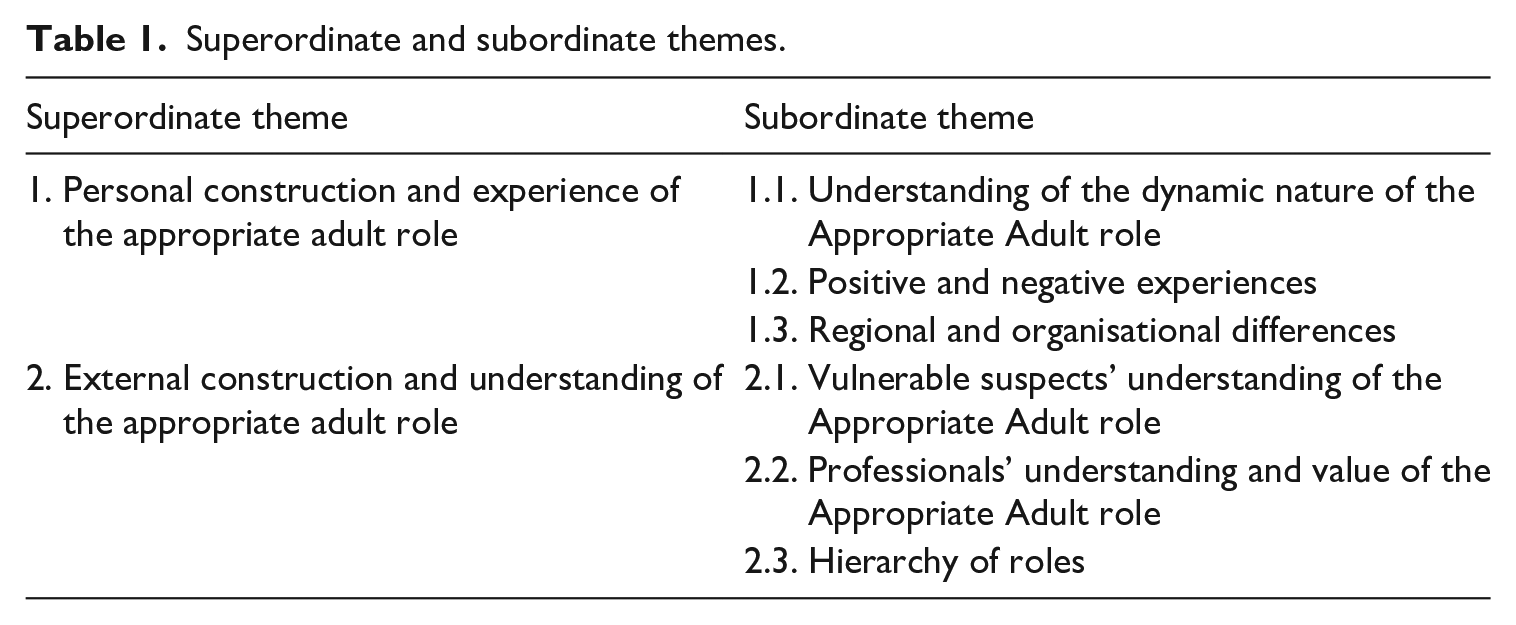
Overall, two superordinate and six subordinate themes emerged from the data that explored the experiences of AAs and how they (and others) understand and perceive their role (see Table 1).
Superordinate and subordinate themes.
Personal construction and experience of the AA role
This theme explores what AAs personally understand their role to be, their lived experience and the regional and organisational differences they report they experience. It is examined through three sub-themes.
Understanding of the dynamic nature of the AA role
Participants highlighted their role as supporting the vulnerable individual in custody by acknowledging that they are there to assist the police. For example, a participant stated: Well first and foremost I’m there for the detained person. . .But I’m also there oh to I’m there for – for the, the – the officers as well, in that I can make life a bit easier for them sometimes if I can represent the – the detained person and say well you know, this is what the problem is (Helen, p. 9, lines 277–285).
Participants also highlighted that they do not have a working relationship with the police, and suggested a level of misunderstanding in some of their AAs colleagues when interpreting the role of the AA: We’re there to do a job, and I think sometimes you have great voluntary people, but you also have voluntary people who aren’t really aware of what the actual full responsibility of the role is (Elizabeth, p. 20, lines 664–667).
This was evident when participants claimed that their role is to be a friend to the vulnerable individual: Well, I think that the . . .your main duties are to if you like be the – be the detained person’s or – or – or the interviewees er friends – frien – friend and er if you like . . . (Neil, p. 2, lines 50–53).
Thus, the participants’ understanding of their role as an AA is mixed in terms of the working relationship with police officers and the level of involvement with the vulnerable individual.
Participants alluded to the dynamic nature of their role by indicating that they can often assist with more than one vulnerable individual at a time. Participants frequently reported the types of vulnerabilities and cases that they assist with: . . . from affray to murder (Elizabeth, p. 8, line 263).
Participants indicated that: . . . every single case is different so, you can’t go in with a set scenario, it just wouldn’t work (James, p. 24, lines 792–797), and you never know what you’re gonna walk into until you walk into it (Tony, p. 18, lines 595–596).
Participants reported that they work with organisations outside of custody. For example, one participant indicated: . . . we could be called to Job Centres, or the most recent one I was involved in was a – an RSPCA callout, which actually was to attend someone’s home (Foster, p. 3, lines 757–77).
Another participant reported: . . . and I very recently did my first interview at a job centre, under caution delivered by the Department of Work and Pensions (Mary, p. 2, lines 59–61).
This suggests the dynamic and complex nature of the AA role with participants indicating the type of relationship they have with the police and the various cases they generally assist with. Such variance in experiences can be explained by the different types of cases and police organisation the AA works with, as well as the organisations they work with outside of the justice system, such as Job Centres or the Royal Society for the Prevention of Cruelty to Animals (RSPCA).Thus, the dynamic and complex nature of the AA is dictated by the type of call out they may receive.
Positive and negative experiences
Participants reported mixed experiences when working in custody and highlighted how they explain their role to the vulnerable individual by stating how they are not police officers: . . . the first thing we say to them is look, we’re not the police. So . . . we’re not siding with the police (Patrick, p. 6, lines 201–203).
In doing so, participants reported their views of the police to the vulnerable person: . . . the police can be very dominating to a vulnerable person, they can appear to be to a vulnerable person (Donna, p. 8, lines 246–248).
This suggests attempts at ensuring the AA is viewed as being independent of the police. When reflecting upon their experiences, participants made references to positive experiences when working in custody in terms of working effectively with the police to ensure the best outcomes for the vulnerable individual. This was especially the case if the individual in custody was a juvenile. For example, a participant reflected upon a case whereby: . . . everybody, the solicitor, the Appropriate Adult and the police do the job and the person in custody is dealt with accordingly . . . (Donna, p. 30, lines 1006–1008).
However, participants reported a substantial number of negative experiences; these related to custody processes being repeated in front of them, such as the rights being read to the vulnerable individual when it was already reportedly done – for example, a participant made reference to the processing of the suspect and the impact it can have: the bits in between, if you’re not there they’ve got to wait for you. I think that they find that . . . they probably find that frustrating.
Such negative experiences were not limited to entering custody but reported to occur when intervening in the interview. For example, a participant reported: There have been times, there have been times when I’ve been called out of the interview and spoken to severely by the officer who says I shouldn’t be intervening and then we’ve had to agree to differ or take it to the custody sergeant or you know whatever because that is exactly what my role is (Chloe, p. 9, lines 290–295).
These negative experiences were reportedly not limited to police officers but when working with solicitors and when assisting other organisations. Consequently, participants have reported the impact that it can have on the enactment of their role, such as not intervening any further to try and maintain the working relationship with the police officer and reduce the subsequent detrimental impact on the vulnerable individual. A participant made reference to the relationship between themselves and the officer in charge (OIC): . . . not wanting to disturb the relationship – to upset the relationship between me and the OIC I think as well, because I’m that wouldn’t be good for anybody (Chloe, p. 20, lines 668–671).
Thus, the participants that report conflicts with other professionals in custody highlight how they alter their subsequent behaviour as a response to these conflicts, thus impacting on the enactment of their role as an AA, and the treatment and outcome of the vulnerable person.
Regional and organisational differences
Participants reported working across several different police areas and identified a variability in the way that they were treated when carrying out their role. For example, a participant reported observing an instance of institutionalised racism and stated: . . . other example in [LOCATION] is that some of our Appropriate Adults experience I suppose what you call institutionalised racism so I’ve had Appropriate Adults that are black particularly one guy whose a brilliant Appropriate Adult and they tried to arrest him and there is more times than I count and luckily he has a good sense of humour but they’ve tried to put him back in the cell because they’ve assumed as he’s sat in custody that he’s the actual detainee rather than the Appropriate Adult (Chloe, p. 14, lines 442–454).
Such differences in the treatment of the AA were also reported by participants across different organisations with comparison made between the different settings in which they worked. For example, a participant reflected: So yeah, the RSPCA definitely want you there when you’re doing working with social services with illegal immigrants yeah they, they like you to help them when they’re doing age assessments etc., the police know you have to be there as opposed to them wanting you there I think (James, p. 13, lines 405–410).
Thus, participants indicated that their role as an AA was valued differently dependent upon the type of organisation they were working in and the type of individual they were working with.
Variability in the level of understanding of the AA role was reported dependent upon area too. For example, a participant reported: And some police forces think we do nothing and just there, we’re there just being busy body’s or just not, are a complete waste of time . . . (Donna, p. 19, lines 618–620).
Participants further reported the lack of understanding of the Police and Criminal Evidence Act (PACE) (1984) by the police officers they were working with: How, how naïve and uneducated some police forces are on PACE (Donna, p. 16, lines 516–517).
Participants explained how this lack of understanding can relate to how their role is perceived by others: I have heard stories, you know, one talks around the business as is work, and I’ve heard stories about different police forces, how the requirements. . .in different ways (George, p. 17, lines 554–557), and So they don’t all have one hundred percent knowledge of what an AA does, and some – some will treat you with the greatest respect, and some – some probably think you’re just there surplus to requirements (Patrick, p. 10, lines 331–334).
The regional and organisational differences reported by the participants suggest that how they enact their role may be as a result of where they are operating and the level of understanding regarding the AA role. For example, participants suggested that should they feel valued and encouraged to assist by an organisation, then they do so. However, participants also reported a variance in the understanding of their role, which subsequently impacts upon how they are treated and thus how they may then carry out their role.
External construction and understanding of the AA role
Participants reported their beliefs regarding how others understand and construct their AA role, including the vulnerable individual themselves and other professionals working in custody, such as custody staff, and the subsequent impact on the AA experience. This is explored through three sub-themes.
Vulnerable suspects’ understanding of the AA role
Participants highlighted that despite informing vulnerable suspects of their role, there still remained some confusion. One of the most common misperceptions was ambiguity between the AA role and the solicitor, with participants highlighting that vulnerable individuals do not believe that they require both. For example, a participant reported: . . . I definitely think that I think if they . . . there’s a – an Appropriate Adult there they feel they don’t need to have a lawyer (Tommy, p. 13, lines 420–422).
Such reflections were reported throughout: . . . sometimes people will, will assume that I’m there for everything that they may need, including giving them legal advice, and – and of course I’m not (George, p. 7, lines 206–209).
Participants highlighted that even when the vulnerable suspect does understand the difference between an AA and a solicitor, they still assume the AA to have more knowledge/power than their role allows, and seek more information from the AA than they can provide. A participant highlighted: . . . they normally understand what it is, but they a – they always turn around and say yeah, but when – when – when am I gonna be getting out of here, do you know . . . (Elizabeth, p. 6, lines 173–176).
As such, participants indicated that the vulnerable suspects’ understanding of the role of the AA can be rather confused with that of the solicitor, despite the AA describing their role at the start of their involvement and highlighting their independence from the police and the solicitor. This is perhaps indicative of the impact of the vulnerabilities of such individuals when they enter custody in terms of their understanding of the custody processes and professionals involved.
Professionals’ understanding and value of the AA role
Participants reported that there was mixed understanding regarding their role as an AA. For example, a participant reported: Yes, the majority of the police do understand your role as an Appropriate Adult and are indeed grateful that you’re there cause they see the benefit of it (Elizabeth, p. 6, lines 190–192).
However, participants indicated that the value of the AA was procedural. That is, regardless of the police wishing or not wishing for the AA to be present, there is a need to have the AA in attendance to be able to conduct their investigations in accordance with the appropriate legislation and policy. Participants reported: They do value our role because they can’t do their job without it, if they want to interview and they haven’t had an Appropriate Adult and they haven’t followed the guidelines, then they’ve lost their case, cause the case they have to do it properly. So from that point of view they do value it (Slippers, p. 8, lines 244–249).
Participants further explained what they believe to be the solicitor’s perception of the AA role and highlighted both positive and negative perceptions and experiences. For example, a participant reported: And so I – I spoke up then, and the solicitor when I did speak up, the solicitor said I’m so glad you’ve done that because I valued what you’d day because I felt exactly the same (Veronica, p. 11, lines 343–346).
However, negative experiences were reported by participants too: . . . solicitors are very variable. Some of them – some of them don’t want you there. Some of them are like you’re not . . . you-re – you’re there because you have to be there, but don’t say anything, don’t do anything, and certainly don’t – don’t – get into a conversation with – with my client (Neil, p. 7, lines 215–220).
Thus, participants report that some solicitors view AAs within a procedural context (much like some police officers) rather than the safeguard they seek to provide to the vulnerable individual. As such, it is reported that those working within custody seem to have mixed levels of understanding of the AA role and that the value of the AA is one of procedural value.
Hierarchy of roles
Participants alluded to a hierarchical order of roles when working in custody. They reflected upon a positive and equal working relationship resulting in trust and being more included within the police group. This tended to relate to occasions when AAs were included in discussions with the police officer. For example, a participant reported: And I’ve found that very reassuring because they – they’ve included you in their conversations (Veronica, p. 9, lines 275–277).
Participants reflected upon more negative experiences, indicating that there is a hierarchy if you are not part of the ‘in-group’. For example, a participant stated: . . . we’re in the background saying well, we need to talk about that Sergeant because you know, PACE says different. And then you – you could get into a situation when the Sergeant which he said that to me, he says well I’m the Custody Sergeant and I’m saying what this guy can have (Patrick, p. 10, lines 309–314).
Thus, even though the AA attempted to demonstrate their independence from the police when explaining their role to the vulnerable adult (see Theme 1.2), they reported the impact that independence can have on their ability to effectively enact their role as an AA.
Participants raised concerns regarding the perceived hierarchy for the more recently qualified AAs. For example, a participant reported: . . . some of the new Appropriate Adults, if they were a new Appropriate Adult, they could really be put off by some attitudes of police officers (Donna, p. 33, lines 1079 1082).
Such concerns were not limited to police officers but to solicitors too with participants reporting the following: I have more difficulty actually, with legal representatives than anybody else that I work I think in this job . . . some of them can be quite high handed and sort of I can’t imagine why you’re here, you know (Donna, p. 11, lines 345–348), and And then you have to wait for the solicitor very often. . .the solicitor doesn’t want to be waiting for you. We have to wait for the solicitor, but they don’t want to be waiting for us (Slipper, p. 5, lines 136–143).
Thus, participants reported negative experiences when they did not perceive themselves to be part of the ‘in-group’ despite their demonstrations of independence to the vulnerable individual.
Overall, it appears that there still remains some confusion with how the AA role is understood and this is expressed by the participants. This is not perhaps not surprising given the vulnerabilities of those the AA assists with. However, the variability in professionals’ understanding and the impact upon the AA’s experience when working with the vulnerable person and the professionals is indicative of the difficulties that the AA can face when working in this arena, and adds to the complex and dynamic nature of the AA role.
Discussion
The current study explored how AAs experience, understand and perceive their role when working in custody with vulnerable individuals and how their role is understood and perceived by others. Two superordinate and six subordinate themes emerged from the data that described how participants construct and experience their role as well as how they perceive that others construct and understand their role.
Issues pertaining to vulnerability within the CJS are a worldwide concern with various countries and jurisdictions adopting their own procedural and practical safeguards. In England and Wales, the role of the AA is documented in the PACE (1984) and the associated Codes of Practice (see Home Office, 2018b). Participants described their role in line with this thus reflecting the due process thread in Pierpoint’s (2006) work – that is, the role of the AA is to prevent unfair processes and support the vulnerable individual. However, participants demonstrated some confusion when defining their role – with references made to being a ‘friend’ to the vulnerable individual and thus falling into the welfare category that Pierpoint discusses in her work. Such ambiguity was also seen in how the vulnerable individual perceived the role of the AA, often assuming an overlap with that of the legal advisor. Confusion regarding the AA role has been previously documented by vulnerable individuals (see Jessiman and Cameron, 2017). In addition, participants reported their experiences relating to police officers and custody staff not understanding the AA role, although this reportedly varies depending on region and organisation. Indeed, other research work has found the opposite – that professionals interpret the role of the AA as supporting the vulnerable individual (Jessiman and Cameron, 2017). Thus, this work provides new contributions to the discussion of the AA role with participants reporting not only their understanding of their role, but how they believe others interpret it. There is much more work to be done to ensure that all those involved with vulnerable individuals in custody understand the safeguard that is the role of the AA.
Participants also highlighted the dynamic nature of their role, and reported a number of different working environments, including the Job Centre, the RSPCA and the Department of Work and Pensions. Although this is not strictly the role of the AA as defined by Home Office (2018b), this reflects the varying nature of the AA role that the local AA service has opted to offer in such cases. Participants reported a mixture of positive and negative experiences, with a particular focus on the latter. While participants highlighted that the police value their role given the necessity to have them present, they also reported conflicts with police officers, custody staff and legal representatives and highlighted the impact that it would have on the subsequent performance of their role, for example, reducing the number of interventions so as not to upset working relationships. Previous work has indicated that AAs can remain passive in their roles (e.g. Evans, 1993; Farrugia and Gabbert, 2019; Pierpoint, 2001). The findings from the current study provide a unique insight into the reasoning why.
Such findings are not surprising given the conflict that AAs have reported to face. As Dehaghani (2022) has previously highlighted, AAs can be discouraged from engaging with their duties in the interview stage specifically (see Code C, para 11.17A) and so may be likely to be affected by the power dynamic in trying to maintain a good working relationship with the police. Indeed, participants in the current study explicitly stated that they do not intervene so as to maintain good working relationships with the police and avoid further conflict with those that they are working with. This is exacerbated depending on which region and on which organisation that they are working with. This is evident in the participants accounts when they describe the ‘push and pull’ in their working relationships with the police and legal advisors and raises concerns for safeguarding the vulnerable individual in custody.
The findings from the current study have two main implications for practice. The first relates to the difficulties in understanding the AA role. If this important safeguard is not well understood by the AA themselves then their ability to perform the role may be impaired. Research has documented how vulnerable adults value an AA who can explain what is happening and enable communication with the police (Jessiman and Cameron, 2017). In a similar vein, if other professionals working in the CJS do not understand the role of the AA, they may be less likely to engage with this safeguard. The literature regularly reports on the varied implementation rates of the AA (see, e.g. Bradley, 2009). The findings from the current study provide new contributions to these discussions; it is evident that further education is required to ensure that the role of the AA is understood, particularly given the limited information provided in Code C (Dehaghani, 2016). More rigorous collaboration between police force areas and AA providers should be encouraged and AAs should be invited to participate in multi-disciplinary meetings with other professionals working with vulnerable individuals in police custody.
The second implication for practice refers to the passivity of the AA. While research has continuously reported this (e.g. Farrugia and Gabbert, 2019), very little research has explored why this may be happening. An insight into the AAs experiences provides an understanding as to why this may be occurring. If AAs are faced with regular and excessive conflict when trying to perform their role, then they may be less likely to intervene and become passive to avoid further conflict. This has implications for the safeguarding of the vulnerable detainee, and so that, better communication and working relationships must be encouraged between those working in custody to ensure that vulnerable individuals are receiving the support they need.
The current study is novel in that it has explored how the AA experiences, understands and perceives their role when working in custody with vulnerable individuals. While previous work has explored the role of the AA previously (see Hodgson, 1997; Nemitz and Bean, 2001; Pierpoint, 2006), this safeguard has continuously evolved and developed since its implementation especially with the increasing numbers of the AA schemes now operating, and the recently updated Home Office (2018b). Thus, this study adds new contributions to the AA research base and provides a unique insight into the complex role that the AA plays when working within custody and assisting vulnerable individuals, and why they may become passive in their role. Some limitations of the study relate to generalisability – the sample consisted of 14 AAs, and were drawn from organisations that were trained by the NAAN. However, this number is consistent with what is required in qualitative research (Vasileiou et al., 2018) and participants were recruited from a large geographical spread and had a range of experiences. Further work should explore the perspectives of police officers, custody staff and legal representation, and vulnerable individuals in custody to further conceptualise and understand the complex and dynamic role of the AA. In addition, comparisons between the types of AAs (trained by NAAN vs independent organisation) should be explored to examine any differences in their own perceptions and experiences of their role.
Conclusion
In sum, little is known about how the AA constructs and understands their role (Miller, 2015), and so that, this study adds new value to the literature base and an up-to-date understanding as to how the AA role is understood and why AAs may become passive and not be fully performing their role. Given the high prevalence rates relating of vulnerable individuals entering custody, there must be further work conducted around this. It is important that vulnerable individuals are afforded the appropriate safeguards, and that those safeguards are able to perform their role appropriately.
Footnotes
Data Availability
The data sets generated during and/or analysed during the current study are available from the corresponding author on reasonable request.
Declaration of Conflicting Interests
The author(s) declared no potential conflicts of interest with respect to the research, authorship and/or publication of this article.
Funding
The author(s) received no financial support for the research, authorship and/or publication of this article.
Ethical Approval
The methodology and materials for this study was approved by the Human Research Ethics Committee of the University of Sunderland (ethical approval number: 003058).
