




Abstract
Although UK public inquiries garner huge amounts of public attention, there have been few systematic studies of their role in scrutinising and reforming criminal justice policy and practice. This is despite a growing number of inquiries, held under the Inquiries Act 2005, into critical matters relating to policing, justice and home affairs. This article explores the contested nature of statutory inquiries as mechanisms for accountability and opportunity for policy reform. We suggest that inquiries provide fertile grounds for criminological analysis, if we understand them as sites of contestation where political priorities compete over questions of procedure, scope and participation. Our focus is on the Brook House Inquiry into the mistreatment of detainees in a British immigration removal centre. The analysis shows a tension between the public-facing nature of inquiries and their legalistic processes.
Introduction
In many common law jurisdictions, public inquiries are government-sponsored investigations into areas of major public concern, such as accidents or policy failures. In the United Kingdom, their current statutory framework is provided by the Inquiries Act 2005, which grants powers to government ministers (including those of the devolved administrations) to appoint statutory inquiries (Beer et al., 2011). Typically chaired by a senior judge, they provide a rich source for social scientific analysis in a range of fields.
Criminology, as an area of study that has seen a rapid expansion since the 2005 Act, has not yet grasped the full potential provided by public inquiries. The latter tend to be protracted affairs that command significant resources, release vast amounts of documentation and can generate expansive volumes of testimonies and witness statements. This can set them at odds with the time and financial constraints that typically structure academic research. Nonetheless, a number of UK statutory inquiries in recent years represent invaluable resources for developing our understanding of accountability processes surrounding institutions of the state. 1 They should garner much more attention from criminology and criminal justice researchers than they currently do.
In this article, we advance the criminological study of public inquiries by focusing on the Brook House Inquiry into the mistreatment of immigration detainees in a privately run immigration removal centre near Gatwick airport. 2 We find that the process of inquiring into institutional failure is guided by adversarial arrangements between competing interests that sit at odds with the inquisitorial form of the statutory inquiry. Conflict and contestation during the course of the inquiry, specifically during its early stages, set the parameters for the investigation. This shifts our focus away from inquiry findings, towards inquiry processes and interactions.
The article therefore advances a framework for analysis that can usefully be applied to a majority of past, current and future inquiries held under the 2005 Act, as well as commissions of inquiry in other jurisdictions. Our framework suggests that the study of inquiry reports ought to be enriched by an analysis of the processes of collaboration and contestation within, and at the outset of, a given public inquiry. In particular, we propose that the preliminary stages of a public inquiry – the processes of determining remit and scope, designating core participants and legal representation, setting the parameters for the conduct of public hearings and setting expectations around the inquiry costs and timeline – are of great significance. Preliminary matters matter, because they impact the ways that inquiries may investigate events, apportion blame and learn lessons. Most of all, they matter because they determine the parameters by which we can judge a public inquiry as a legitimate, inquisitorial process of accountability.
Our article begins by setting out the background to the Brook House Inquiry, which is still hearing evidence at the time of writing this article. We then explain our methodology and methods, drawing on a range of qualitative sources including interviews with charities offering detainee support and observations of preliminary inquiry hearings. In our analysis, we then situate our findings within the existing and emerging literature on public inquiries in the United Kingdom, connecting perspectives from criminology and political science.
Following our thematic analysis of the data generated, we zoom in on three interrelated issues of contention: core participants’ expectations for the inquiry, which we describe as ‘cautiously optimistic’, reservations among core participants and their legal representatives expressed during the course of preliminary hearings and, finally, the centrality of scope and participation that would set the public inquiry apart from other forms of accountability in immigration detention.
Background
A public inquiry into the Brook House immigration removal centre, situated near Gatwick airport, was announced on 5 November 2019 by the Home Secretary, Priti Patel. It followed reports of mistreatment of immigration detainees in the BBC Panorama programme Undercover: Britain’s Immigration Secrets, which was broadcast on 4 September 2017. The programme had used covert footage filmed by a recently recruited detainee custody officer and revealed a toxic culture of verbal and physical abuse of detainees at the hands of G4S staff.
There is a growing research base now on the practices and policies of immigration detention in the United Kingdom, including on the harms experienced by detainees. Much of this is central to the burgeoning field of ‘border criminology’, which concerns itself with ‘the growing convergence between criminal justice and immigration control’ (Bosworth, 2017: 373). This research agenda shifts attention to issues of race, racism, post-colonialism and citizenship in the study of security and punishment. Often, the experiences of detainees have been put front and centre in studies of detention centres, such as in the formative text by Mary Bosworth (2014; see also Turnbull, 2016), despite difficulties in conducting research in such settings (Bosworth and Kellezi, 2017). 3 Here, our discussion is informed by this literature, yet it skirts around the issue of detainee experiences.
The documented abuse of detainees in Brook House was unsurprising given the particular vulnerabilities inhabited by those liable to deportation and removal. While the extremity of the abuse exceeded the structural violence of detention (Canning, 2017), we are interested in the aftermath of the BBC documentary. In this way, we hope to add to the question of accountability and the possibility of detention reform through the medium of a public inquiry.
While there is no standard form of statutory inquiry in the United Kingdom, its powers and responsibilities are provided for by the 2005 Inquiries Act. Inquiries may be established where a government minister believes that an event or series of events have caused significant public concern. This, however, was not the case with the events around Brook House. Here, the government actively tried to avoid the establishment of a full inquiry.
Instead, in September 2018, the Home Office commissioned a special investigation by the Prisons and Probation Ombudsman (PPO) to look into events at Brook House. This decision by the Home Office was challenged by two former detainees, known only as MA and BB, who brought a judicial review to the High Court arguing that a non-statutory inquiry could not sufficiently investigate the alleged human rights abuses in Brook House. The High Court agreed and effectively ordered the conversion of the PPO special investigation to a full statutory inquiry under the Inquiries Act. 4
The 2005 Inquiries Act affords Inquiry Chairs the power to compel witnesses to give evidence and appear in public sessions and for the Chair to take reasonable steps to ensure members of the public are able to attend the inquiry. Crucially, this means that former employees of G4S, the security firm at the centre of the investigation, cannot avoid scrutiny. However, inquiries are not adversarial and do not have the power to establish any person’s criminal liability. The function of a public inquiry, unlike that of a criminal trial, is primarily inquisitorial. The role of the Inquiry Chair is to gather information and make recommendations, rather than responding to specific complaints.
For this study, we have been specifically interested in exploring contestations arising in inquisitorial processes. Here, we were struck by the apparent mismatch between the high expectations placed in the Brook House Inquiry and the equally persistent cynicism directed at such legalistic arenas. The latter is a notable feature of much of the policy literature on statutory inquiries, with one study finding that ‘a widespread view exists that the public inquiry is an ineffective means of lesson-learning’ (Stark, 2019: 397). The former was expressed by BB, a former detainee who is shown as suffering abuse in the Panorama documentary and a claimant in the legal challenge against the Home Office. Writing in the Guardian, ahead of the public inquiry, BB said, . . . a judge ordered an inquiry that will make sure the voices of people like me are heard, and make sure our abusers will finally face justice . . . So many obstacles have been thrown in our way as we fought to get this inquiry. I brought this case because I need to tell my story and people need to know the truth about indefinite immigration detention. I did this for the thousands of people still in there. There’s still a long way to go, but we just got a step closer to justice. (BB, 2019)
While BB recognises that the establishment of a public inquiry is just ‘a step’ towards what they perceive as justice, the following analysis considers how ‘obstacles’ continue to structure the experiences of many of those engaged in the Inquiry proceedings.
Opening the public inquiry on 21 April 2020, the Chair Kate Eves issued a call for evidence, including from former detainees and governmental, non-governmental and corporate witnesses. She forcefully set out the Inquiry’s purpose: The treatment revealed in the Panorama documentary was shocking and has no place in a decent and humane immigration detention system. It is this Inquiry’s role to examine what took place at Brook House and how treatment of the nature experienced was able to happen. (Eves, 2020)
There is, perhaps, something revealing in the Chair entertaining the notion of a ‘decent and humane immigration detention system’, the possibility of which is roundly dismissed by many critical criminological researchers (Canning, 2017), campaigners and detainees who attest to the administrative violence of a system designed to discriminate on the basis of nationality. Nonetheless, Eves asserted the importance of an inquiry that would learn directly from the experiences of (former) detainees: I want to take this opportunity to ask anyone who was detained in Brook House between 1 April and 30 August 2017 to contact the Inquiry. I very much want to hear about your experiences of being detained. I need to hear from people with first-hand experience of life inside Brook House at that time in order to understand as fully as possible the extent and nature of the mistreatment. (Eves, 2020)
By February 2021, the Brook House Inquiry had received 38,000 different documents to assess for relevance, held 218,000 pages of written documents and was reviewing unseen BBC footage that had been obtained as part of the Panorama investigation. It had appointed, by November 2021, three experts to the Inquiry and 24 core participants, including the Home Office, G4S, former detainees and former custody officers. Core participant status was also granted to the charity and support organisations Medical Justice and the Gatwick Detainee Welfare Group, although applications by Detention Action, Bail for Immigration Detainees and INQUEST were refused. Crucially, the Inquiry considered a range of preliminary matters and held, remotely via videoconferencing, two preliminary hearings. Finally, after a 2-year wait, public evidence hearings commenced on 23 November 2021 at the International Dispute Resolution Centre, London.
Data and methods
This article reports on a qualitative, interpretative study of the Brook House Inquiry. Our analysis draws on interviews with key actors in the charity and migrant support sector and preliminary matters considered by the Inquiry over the course of 24 months, from November 2019 until November 2021. 5 Emphasis is placed on the potential for contestation within the Inquiry as opposed to a textual analysis of the final report (which is not yet available at the time of the analysis). Key stakeholders and core participants who were interviewed for this project expressed a desire for the Inquiry to investigate the details of detainee abuse in Brook House. At the same time, they hoped that a forensic investigation into the particular time period would not preclude the addressing of more systemic issues and the question of legitimacy itself.
During the first half of 2020, the first author conducted detailed, semi-structured interviews with representatives of seven organisations working to support detainees in Brook House, and in other IRCs, and who campaigned for the reform or abolition of immigration detention. Respondents were selected from a small pool of non-governmental organisations that support immigration detainees during or after detention and on the basis of their familiarity with Brook House. Some were later designated as core participants in the Inquiry. Most of the interviews were carried out using video conferencing software, as the data collection phase of the research coincided with the onset of Covid-19 restrictions in the United Kingdom. The audio of all but one of the interviews was recorded. One interview went unrecorded at the request of the respondents. Therefore, detailed notes were taken during the interview to log their responses and this appears later in the text as an ‘unrecorded group interview’. The study received approval from the first author’s university ethics committee. Participants’ consent was given and interviewees have been anonymised. The interview schedule and subsequent data analysis aimed to investigate the main sticking points of the public inquiry; for example, do participants see the Inquiry as sufficiently detailed; do they feel included in the process; is there enough opportunity for input to the process? The only named interviewee is Kate Eves, the Chair of the Brook House Inquiry. The first author conducted a telephone interview with her on 23 April 2020. In this interview, the Chair was able to clarify matters raised during her opening statement a few days earlier and expand on her organisation of the Inquiry process.
In addition to interviews, we observed the two preliminary hearings on 25 September 2020 and on 14 December 2020 and studied the submissions made on behalf of core participants, including former detainees, detainee support groups, the Home Office and G4S. These included the applications from organisations and individuals for recognised core participant status and representations on the scope of the Inquiry. The hearings were held via video link and streamed live on the Inquiry’s YouTube channel, to comply with Covid-19 restrictions at the time.
On completion of the data generation phase, qualitative thematic analysis (QTA) was utilised to analyse the interview transcripts. We followed suggestions that QTA needs to be clearly demarcated as a research tool (Braun and Clarke, 2006) and after transcription, we pursued a typical process of data familiarisation, coding and theme development. The thematic analysis could be described as ‘theory-driven’ or deductive, in that the themes selected are closely matched to the questions we asked in interviews and the selection is informed by our theoretical understanding of accountability mechanisms in public administration. A danger with using such forms of theme development is that the coded data are being viewed out of context and potentially ‘compared with other similarly decontextualised sections of data’ (Mason, 2002: 158–159). It was therefore vital to identify and not dismiss the context in which respondents’ accounts were being given.
One difficulty that presented itself in the coding of our data related to the wide variety of knowledge among our interviewees. The majority of respondents were not legally trained but had extensive experience in advocating for immigration reform. While all respondents had a good working knowledge and clearly defined expectations around the Brook House Inquiry, they clearly focused on very different aspects of their work relating to immigration detention and on their involvement with or expectations for the public inquiry. They also explored their roles and positions within a wider landscape of, often volunteer, support work in detention centres, reflecting the range of political leanings identified in this sector (see Kemp, 2021).
Theorising public inquiries
Critical discussion of public inquiries and royal commissions has frequently featured in criminological and socio-legal research, though not as extensively as one might expect. An Institute of Government report identified 68 public inquiries from 1990 to 2017, at a combined cost of £639 m (Norris and Shepheard, 2017). It classified 11 of them as inquiries into issues of justice, investigating such matters as deaths in custody, forensic evidence and police killings. To these we could add a number of significant statutory commissions of inquiry that have sparked criminological interest, including those into Bloody Sunday, press ethics, child sexual abuse, undercover policing and the Grenfell Tower fire, as well as the non-statutory Taylor inquiry into Hillsborough. Figure 1 shows a selection of relevant inquiries, both concluded and ongoing, held under the provisions made by the Inquiries Act 2005 and the Inquiry Rules 2006.
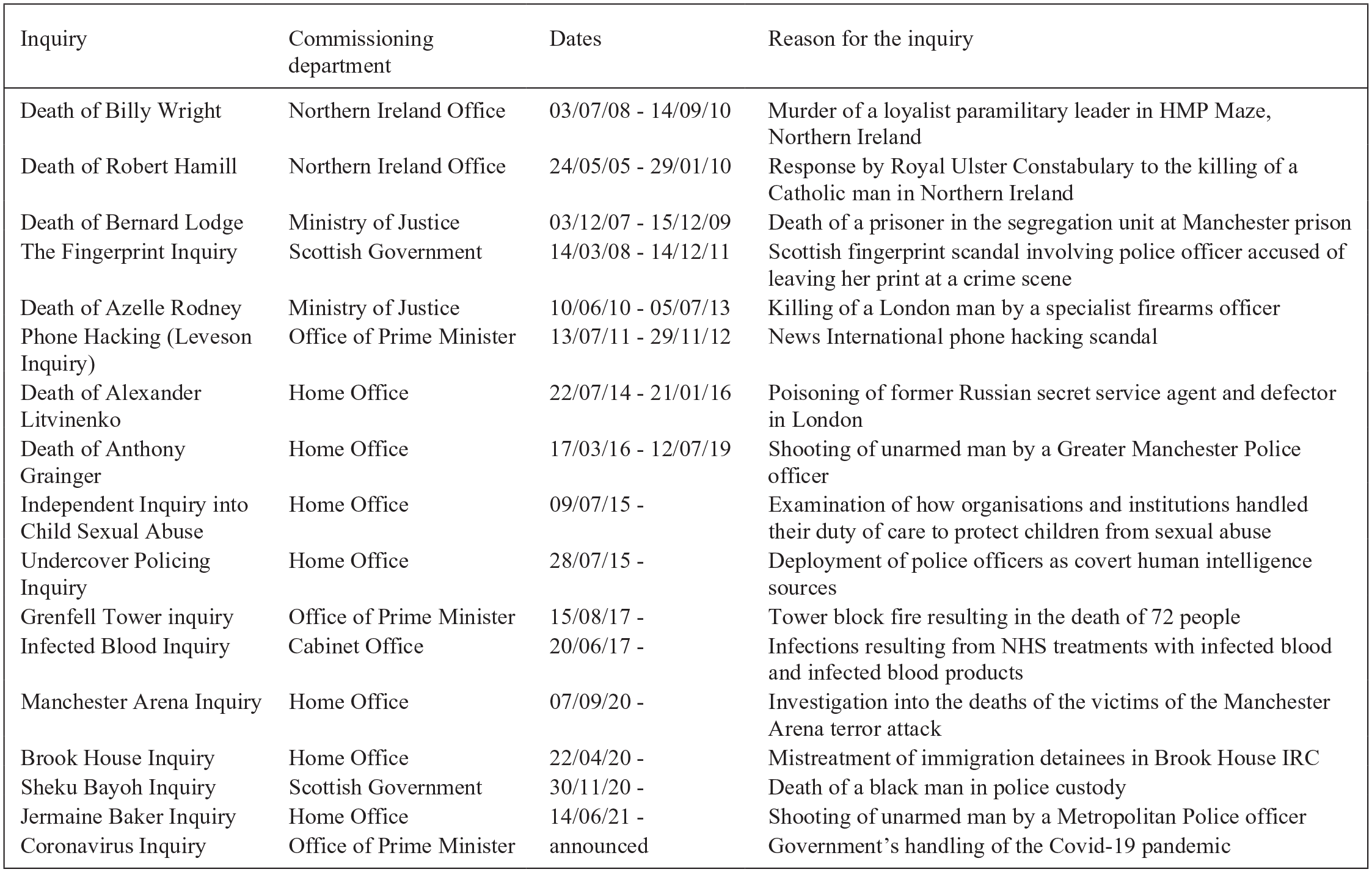
Selected relevant inquiries established under the Inquiries Act 2005.
What much criminological research into such commissions has in common is that it notes public inquiries as methods for the establishment of facts and the recovery of trust in institutions of the state and public life (e.g. Burgess, 2011; Burton and Carlen, 1979; Gilligan and Pratt, 2013; Greer and McLaughlin, 2016; Mawby, 2014; Rolston and Scraton, 2005; Tuitt, 2019; White, 2010). Public inquiries then provide a form of independent accountability, unlike that provided by parliamentary or watchdog scrutiny. Notwithstanding this sustained engagement from an admittedly small group of scholars, research into public inquiries is rarely carried out systematically. It is also beset by another important limitation: with a few exceptions, research into matters that are the subjects of public inquiries rely on final reports written by Inquiry Chairs or Panels after witness statements have been given and documentation scrutinised. That is, criminological research into inquiries frequently omits an analysis of the interactive processes and procedures that shape inquiry findings. The focus on written reports, frequently employing textual analysis of power discourses, is also evident in the literature on institutions and organisations (e.g. Ainsworth and Hardy, 2012; Boudes and Laroche, 2009; Brown, 2004; Kenny and Dochartaigh, 2021).
In our approach, we have aimed to shift the perspective away from reports or outcomes and instead treat public inquiries as sites of contestation. The foregrounding of contestation also takes our focus away from the legal framework of public inquiries – where they are instituted as inquisitorial processes – towards the social interactions present in inquiry processes. Rather than inquisitorial mechanisms to learn lessons for the future, public inquiries present themselves to us as adversarial from the outset. We do not want to belittle important lessons-learned reports and recommendations (Stark, 2018, 2019), but to assist us in foregrounding interaction and contestation we have concentrated our analysis on the preliminary matters with which the Brook House Inquiry was concerned, rather than on the evidential phase. While conflict over Terms of Reference or levels of participation do not necessarily undermine the inquisitorial nature by which the statutory inquiry gathers evidence, it is in these preliminary matters and in their ‘quasi-legal format’ that we detect an ‘adversarial climate’ (Stark, 2018: 50). Our study then pertains to the time period from its conversion from a PPO special investigation to a statutory inquiry in November 2019 up until the first public evidence hearing in November 2021. It is in this 2-year period that we collected and analysed data from interviewees, Inquiry determinations and submissions to preliminary hearings. In the following sections, we present our findings on three overarching themes that structured the process, as far as it was public-facing, during this period: a cautious optimism for the success of the Inquiry, reservations about its Terms of Reference and contestations over scope, delay and participation.
Cautious optimism
While some statutory inquiries remain largely under the radar of public scrutiny, a small number have generated vast amounts of critical discussion. Although the Brook House Inquiry struggled to get wider traction, our interviewees from non-governmental organisations were well-informed about some of the controversies that had marred recent, statutory inquiries such as those into the Grenfell Tower fire, into undercover policing or into child sexual abuse. As interested parties and potential core participants in the Brook House Inquiry, our respondents displayed a sense of unease about encountering similar obstacles to their participation. Claire, a campaign coordinator, compared the Brook House Inquiry to that into the Grenfell Tower fire: [I am] a member of the public who can sense the frustration from people involved [in inquiries such as Grenfell] as to why it takes that long and yeah, again I guess there hasn’t been a tradition or a history in this country of these inquiries you know, really bringing about the justice for the people that it is always hoped that they will bring . . . (Claire, campaign coordinator)
The Brook House Inquiry therefore did not carry out its work in a vacuum but in an environment in which an informed public would make comparisons with other inquiry investigations. The Chair of the Brook House Inquiry was quite aware of this context from the start, as she told one of the authors of this article: Obviously every inquiry is very different . . . in terms of the scope, the volume of material, the nature of the material, the size of the inquiry, . . . the length of time that it’s projected to take and all of those issues, so I think it’s very difficult to draw parallels between them. However I do think there are also many of the same concerns around some of the processes, around the accessibility to the system and making sure that, you know, we kind of do everything we can to inform people about how to be involved . . . (Interview with Kate Eves, 23 April 2020)
Many public inquiries then start from the point of being contested instruments, with competing interests attempting to influence their directions early on. Despite their relative autonomy from political control or interference, this is nothing new. On a shifting terrain of relations between state and non-state actors, ‘[m]edia pressures and government accommodation to these pressures in some cases [has] a direct impact upon inquiries’ (Burgess, 2011: 24). And yet, the statutory inquiry by its nature of being public and inquisitorial represented for our interviewees a specific opportunity for transparency and reform that could not be achieved by non-statutory investigations. One of our interviewees, Claire, described their view as cautiously optimistic in this regard: So I suppose . . . my optimism is because I don’t see the inquiry in itself as being a means to an end. I think it’s an opportunity that we can build upon in a way that the other reports and inquiries haven’t been able to because they’ve not been in the public . . ., you know, those kinds of things don’t really strike in the public consciousness in the same way. (Claire, campaign coordinator)
We found that expressions of this nature highlighted the importance of both the statutory powers of inquiries and their relative independence from government. There is a sense that the public inquiry, by virtue of its position as a well-funded, inquisitorial tool with statutory powers, can do what previous inquiries could not. One interviewee commented, Despite all the reports that have been produced since 2017, most of the response so far has been to tweak operational policies and to make small technical changes to policies around what happens inside detention. There hasn’t really been anything that has really scrutinised the system you know, so I think it [the Brook House Inquiry] is an opportunity, I hope it’s an opportunity. (Anne-Marie, charity director)
This view was echoed by Jude, a charity trustee: And, you know, I mean, I’ve just been talking to you about what my, sort of, dream would be in relation to immigration detention. I know that that’s unlikely to happen in my lifetime, certainly not under the current Government and Home Office leadership. So, you know, actually, I think the Inquiry gives scope for sort of significant tinkering, if I can put it like that, tinkering that could really make a difference to people’s lives. (Jude, charity trustee)
Our research participants perceived the Inquiry as an opportunity to reform the immigration detention system. But more than that, the Inquiry process itself was regarded as a significant exercise in bringing voices to the table that would otherwise not be heard.
In the academic literature and frequently in media coverage, high-profile public inquiries have been subjected to criticisms over fears that they may represent ‘whitewash’ exercises that shield decision-makers from meaningful accountability or delay and hinder criminal investigations. Already before the 2005 Act strengthened ministerial influence over the terms of investigation, commissions of inquiry were considered to have the ‘capacity . . . to act as a convenient mechanism of legitimation for the state’ (Gilligan, 2013: 18). Within this context, it was surprising to us to find considerable anticipation that the Brook House Inquiry would be different. When we dug further, our interviewees made frequent references to the Inquiry’s background story.
The fact that the statutory inquiry was a result of a successful judicial review brought by two former detainees had a considerable impact on its perceived legitimacy. It came about despite obstacles put in place by both the Home Office and the private contractor. One charity worker described the route to the public inquiry; recalling evidence given by G4S to parliament’s Home Affairs Committee: They [G4S executive/senior staff] obfuscated as much as they could, they generally tried to avoid answering questions and said they didn’t have particular data on them or that they hadn’t been made aware of specific issues, but they acknowledged that what was shown in the Panorama documentary was unacceptable. That parliamentary group headed by Yvette Cooper MP has continued interviewing people and that’s kind of transitioned I suppose into a more official inquiry, which the Home Office was trying to obstruct as much as it could, and until the summer of this year refused to accept that it would be useful for the inquiry to have the power to compel witnesses. (Ethan, volunteer coordinator)
Its statutory framework therefore set the public inquiry apart from previous investigations into the allegations raised by the Panorama documentary, including the parliamentary inquiry and the PPO’s special investigation. The 2005 Inquiries Act gives public inquiries the power to compel witnesses to give evidence and permits the compulsory provision of documents. Limitations and exemptions to these powers are provided for, yet in the eyes of many core participants and interested parties, these and the relative autonomy of public inquiries to pursue their own lines of questioning grants the public inquiry a special legitimacy and advantage over ad hoc or non-statutory investigations. 6
Reservations
All our respondents stressed during interviews that they planned to engage with the Inquiry proceedings with an open mind, and, frequently, with considerable expectations. However, their positions were by no means naïve. Even before they had the chance to see the Inquiry in process, they expressed varying levels of caution or even cynicism. For example, members of one campaign group made it clear that they saw the Inquiry as a legalistic route to, at best, limited accountability and that they had, in one person’s view, ‘not much faith in the law’ (unrecorded group interview). A key limitation that was identified related to the Terms of Reference. Public inquiries are set up with precise Terms, issued by a government minister. While they are unmovable, in questions of scope, the Chair has significant room for interpretation in how to fulfil them. The Brook House Inquiry, for instance, invited submissions from core participants and held a preliminary public hearing to help determine the precise remit entailed within the scope of the investigation.
The Brook House Inquiry’s purpose is to investigate the allegations of physical and psychological abuse as shown on the BBC Panorama programme and to make recommendations to the Home Office. Beyond instances of mistreatment by individual custody officers employed by G4S, the Inquiry is set to examine policies, practices and management arrangements. Other Terms are focused on issues of clinical care and monitoring and complaints procedures. While there is little provision for a systematic fact-finding mission into the purpose and practice of immigration detention more widely, this is not necessarily excluded from the scope. As we discuss below, many of those with an interest in the Inquiry’s work – charities, campaigns or visitor groups, for example – wanted to see an investigation that would touch on issues of alternatives to detention and time limits. Yet, they had considerable reservations about the Inquiry’s ability to achieve this. Most respondents felt that the Terms of Reference were too narrowly set and would constrain the ability of the Inquiry to shed light on the wider, structural questions about indefinite detention. As one campaigner argued, These Terms of Reference are specifically about what happened in Brook House, you know, . . . they do kind of look at lessons to be learned about, generally about the Home Office and contractors, and, you know, methods, policies, practices and management arrangements. So, hopefully [the inquiry] will be able to look at immigration detention as a whole and not just Brook House . . . We also don’t want the inquiry to be limited by that time [the period covered in the BBC Panorama exposé], because it’s not like, it’s not as if those bad things happened only during those three months you know, you don’t get that kind of thing just happening, and it didn’t happen before and it never happened afterwards, do you know what I mean, that’s unrealistic. (Claire, campaign coordinator)
Public inquiries enjoy a relative autonomy from political interference, even though the appointing ministers set the Terms of Reference and they are sponsored by government departments. Despite this, inquiries are interpreted to be primarily technocratic mechanisms for addressing public concerns. The criminological literature, for example, is often influenced by Frank Burton and Pat Carlen’s classic work on public discourse, in which they consider the establishment of royal commissions or similar inquiries to be a ‘routine political tactic directed towards the legitimacy of institutions’ (Burton and Carlen, 1979: 13). Following this, Phil Scraton’s work on the Hillsborough Independent Panel, which revisited the official Taylor inquiry, has addressed the fact that public inquiries are habitually reliant on the expertise of middle-of-the-road judges and other esteemed professionals, ‘achievers within the status quo’ in Scraton’s words (Scraton, 2013: 48). Others have argued that public inquiries into state crime, such as those committed by the British state in Northern Ireland, were ‘essentially mechanisms for re-establishing the legitimacy of the authoritarian state’ (McGovern, 2013: 11).
Yet, despite such criminological concerns expressed over the possibilities of public inquiries to absolve public institutions from blame, those who are engaged in the processes of the public inquiry accord it a level of attention and respect not enjoyed by other investigations.
Scope, delay and lack of participation
However, we found that the cautious optimism expressed by our respondents at the start of the Inquiry gave way to a much more adversarial attitude once proceedings had begun. If the interview responses showed a desire for a systematic and thorough scrutiny of immigration detention policy, the preliminary hearings allowed us to observe how the Brook House Inquiry’s approach was contested in these early stages.
One example revolved around the projected timescale for the investigation. The Inquiry’s Terms of Reference signalled the Home Office’s intent for a focused investigation, stating that ‘the Inquiry will make its best endeavours to complete work and produce a final report to the Home Secretary, setting out their findings of fact and recommendations, within 12 months’ (Brook House Inquiry, n.d.). It came as no surprise, therefore, that the time passed between the conversion of the PPO’s special investigation into a public inquiry and the beginning of evidence hearings, 2 years later, were a serious matter of concern.
Those in the charity sector felt that a thorough, systemic investigation should not come at the expense of a swift conclusion.
I hope it’s not been kicked into the long grass. It seems you know, if you think 2017, we’re now at 2020, that’s three years and the themes in the documentary are so, so shocking and it doesn’t feel that people have been held to account. (Claire, campaign coordinator)
During the preliminary hearings, such concerns were expressed in no uncertain terms by legal representatives for former detainees. Stephanie Harrison QC, representing former detainee MA, submitted that It is important to put the delay in the context of the legal obligations that are attendant upon an Article 3 compliant investigation. . . . That context which was in large measure a result of intransigence and opposition from the Home Office to any effective independent investigation does mean that the Inquiry had a particular important and heavily responsibility to act speedily and effectively in getting this Inquiry up and running, and by admission and acceptance it has failed to do so. . . . the Inquiry should be under no illusions as to how disappointing and dispiriting this delay and lack of communication has been. (Brook House Inquiry, 2020a: 60–62)
While there has been limited public communication from the Inquiry’s team about the reasons for the delay, government restrictions on public gatherings due to the Covid-19 pandemic have played their part. However, the delays also speak to a different issue, one that puts the efficiency and speed with which an inquiry can be conducted at odds with its aim of thoroughness. This is expressed again in Harrison’s submission: . . . it is critically important that this Inquiry does do its work in public in the way in which it was anticipated, public hearings being a central part of the effectiveness of the Article 3 investigation and has a key role in terms of holding public authorities and those responsible for the abuse that occurred to account, to demonstrate public objection to such conduct, and of course, as was identified by the judge in the judicial review proceedings, to provide to MA and others the ability to confront abusers on an equal basis, and to do so publicly is an important aspect of the restorative function that this Inquiry can have in returning to him his human dignity and self respect that was taken away by the abusive treatment to which he was subject. (Brook House Inquiry, 2020a: 62–63)
Public accessibility to the Inquiry is seen as central to its legitimacy in the eyes of former detainees, a view reflected in the growing concern about the level of participation from those individuals and groups that are seeking forms of acknowledgement and redress in inquests and inquiries. In some public inquiries, such as the ongoing Undercover Policing Inquiry, full participation has been restricted in terms of the Inquiry’s reliance on Sections 19 and 20 of the Inquiries Act 2005. These permit the Chair to restrict the disclosure of documents and/or hold evidence hearings in private.
Participation was also seen as key to the procedural success of the Brook House Inquiry. Nick Armstrong, representing the former detainee known as BB, emphasised this point during a preliminary hearing: Of course the pandemic circumstances are exceptional, but participation in a process is absolutely key to the fairness of a process and the feeling of fairness in a process, and the detainees in particular, but all those who we represent, need to feel that they are participating so that they can feel that they are being heard and that they are influencing. (Brook House Inquiry, 2020a: 65)
By referring to ‘feelings of fairness’, ‘communication’ and its ‘restorative function’, these submissions invoke a sense of legitimacy of the public inquiry, not in terms of its outcome but in terms of its process. We do not want to overstate this point. Our respondents from the migrant support sector were clearly interested in outcomes – they wanted policy lessons to be learned and reform to be enacted on the basis of the eventual inquiry report. Nonetheless, for our interviewees, the possibility of a satisfactory outcome appeared inherently linked to the procedural side of the inquiry. This twofold interest – in the procedural attributes of the inquiry as well as in its policy consequences – is commonly related to claims of institutional legitimacy accorded to crisis inquiries (e.g. Sulitzeanu-Kenan, Holzman-Gazit, 2016). Yet, while legitimacy in the eyes of a wider public may stem from preferences for political independence and the appointment of senior judges as inquiry chairs, those with specific stakeholder interests in our study showed more nuanced preferences for procedural workings perceived as fair, participatory and thorough.
The Inquiry Chair, Kate Eves, opened the preliminary hearing on the scope of the Inquiry by highlighting the importance of her recommendations having a tangible effect.
I will also say again that it is my view that the principal focus of the Inquiry will be the treatment and mistreatment of detainees once they had arrived at Brook House. However, I do also want to reiterate my view that any recommendations made as a result of this Inquiry must be capable of bringing about change to prevent mistreatment in IRCs now and in the future. They therefore should not be recommendations that only have relevance to the specific time and place of the mistreatment shown on Panorama. (Brook House Inquiry, 2020b: 3)
Eves’ statement, reaffirmed in her later ruling on the matter, made this focus on the Inquiry’s outcomes paramount to its success. Our interviewees, as well as the submissions made to the Inquiry on the matter of scope, agreed in principle that lessons should be learned from the mistreatment of detainees at Brook House and that these lessons should change the direction of detention policy and practice.
But the issue of scope was also tied up with the salience of full participation and with the acknowledgement of the lived experiences of immigration detention, in a way that the Inquiry failed to appreciate. For example, referring to her client, MA, and his Article 3 case, Harrison QC presented the case for a much wider and inclusive definition of the Inquiry’s scope, one that would be able to capture the full experiences of detention, beyond those shown on the Panorama programme. In short, she presented the case that immigration detention presented systemic forms of mistreatment: Those failures, i.e. of policy and of safeguards, are not isolated to his case, nor isolated to Brook House. The evidence is clear, [. . .] you see that those are in fact systemic issues and cannot be in any way seen as an aberration relating to this individual. That therefore means it is fairly and squarely within the Inquiry’s terms to need to look at both the terms of and operation of the policy, which is a national policy and not, obviously, peculiar to Brook House. (Brook House Inquiry, 2020b: 17) That critically – I think this is important to emphasise – when [the Inquiry’s Lead Counsel] says what the task of the Inquiry is, to identify what happened and learn lessons, that’s missing out one critical key stage in this process, and that’s the question: why did this happen? (Brook House Inquiry, 2020b: 23)
Not surprisingly, such submissions contrasted sharply with those made on behalf of state and corporate core participants. The Home Office’s legal representative made this abundantly clear: It is important to keep in sight what the Inquiry was set up to achieve. We have become very used to vast public inquiries, often over many years and costing millions of pounds. The Brook House Inquiry however was set up as an investigation, a targeted investigation, into mistreatment that occurred at Brook House between April and August 2017. It is by no means a small investigation – we have heard already today about the vast disclosure exercise that has already been involved – but it is a targeted investigation. . . . at the heart of this investigation are not broad political questions but individuals. (Brook House Inquiry, 2020b: 55)
In her determination on scope, the Chair of the Inquiry rejected the submissions made on behalf of the former detainee MA that an Article 3 compliant investigation should scrutinise the decision to detain and the wider conditions of detention. For her, the starting point of the investigation should remain the deliberate abuse directed at vulnerable individuals as documented by the Panorama documentary. With such a narrow interpretation of her Terms of Reference, the Chair was able to circumvent the more systematic and political questions of immigration detention – the ‘why’. Nonetheless, her determination on the scope of the Inquiry left the possibility open that questions of policy could arise out of the evidence to be collected.
Taken together, the Chair’s directions and determinations on issues including scope and core participant status have disappointed many non-state, non-corporate participants in the Inquiry. They demonstrate the significance of the preliminary matters with which an Inquiry is concerned, prior to it obtaining witness statements and other evidence. The inquisitorial process as legislated for by the 2005 Inquiries Act is then an internally contested tool, with issues of participation, remit and timeliness all central to its success.
Conclusion
Public inquiries are, by their nature, controversial. (Cowie, 2021, House of Commons Library Briefing on the Inquiries Act 2005)
Despite growing interest in the contested and ‘controversial’ nature of public inquiries, remarkably little criminological attention has been paid to their internal dynamics. This article has sought to address this methodological gap by presenting analysis of the preliminary phase in the Brook House Inquiry.
We have argued that despite reservations, immigration policy reformers place significant value on the public inquiry as a site of acknowledgement, accountability and justice. The inquisitorial nature and the statutory powers granted to inquiries under the 2005 Inquiries Act and the 2006 Inquiry Rules set them apart from civil litigation or criminal trials and these qualities were often mentioned in support of the Brook House Inquiry by charity workers and campaigners. More than that, the establishment of a public inquiry by the High Court, against the case argued by the Home Office, lent the Brook House Inquiry a level of legitimacy not enjoyed by other investigations and reviews into immigration detention and it set a high mark in terms of hopes and expectations among the migrant support sector.
Furthermore, we have proposed to focus attention on the processes of power and contestation in such inquiries. This approach was informed by the experiences of conflict that have characterised other public inquiries (see, e.g. Blom-Cooper, 2017; Ireton, 2018). Both the Grenfell Tower Inquiry and the Undercover Policing Inquiry, to name just two current examples, have experienced significant disruption and contestation due to actual and perceived power asymmetries in the process. Victim voices were seen to be subordinated to the interest of corporate and state parties in both cases (Ohana, 2021; Schlembach, 2016). The focus on conflict and contestation during the preliminary stages of inquiries therefore provides essential context to the understanding of the eventual report and recommendations.
With our close reading of such power dynamics in the first 2 years of the Brook House Inquiry, we have sought to reveal how non-governmental organisations placed an emphasis not just on the potential for the Inquiry’s findings to influence future policy; they also stressed that meaningful participation and an investigation into systemic failures of immigration policy were key to how the Inquiry was perceived. This framework of analysis adds a distinct tool to the repertoire for the study of public inquiries. To complement the frequent observation that recommendations made by inquiries lack an obvious translation into policy implementation (recently, e.g. Flinders et al., 2021; Mansfield, 2022), our criminological analysis seeks to highlight the importance of victim voices, public participation and effective accountability. The successes of public inquiries are therefore tied up with much more than their legal framework or the authority of their final report and recommendations. They are sites of contestation where power is exercised. This makes them inherently subjects for criminological enquiry.
Footnotes
Acknowledgements
Beth Hudson provided invaluable research assistance during a student research internship in June 2020. The authors are grateful to their interviewees and to Kate Eves for talking to them at the start of the project. The authors also thank two anonymous reviewers for their insightful comments on this article.
Declaration of Conflicting Interests
The author(s) declared no potential conflicts of interest with respect to the research, authorship, and/or publication of this article.
Funding
The author(s) disclosed receipt of the following financial support for the research, authorship, and/or publication of this article: Raphael Schlembach received a 2019-20 Research Grant from the Socio-Legal Studies Association.
