




Abstract
Most quantitative sentencing research treats women and men as a homogeneous group leading to gaps in the literature regarding women’s experiences of sentencing procedures. This is problematic given the vast array of known harms that result from incarcerating women, particularly those with caring responsibilities for children. This exploratory article shares the findings from a quantitative study which considers the sentencing of women, with a particular focus on the ‘sole or primary carer for dependent relatives’ mitigation when applied to mothers. Using data from the Crown Court Sentencing Survey 2011–2015, a sample of 18,314 women defendants was derived and investigated using descriptive, bivariate and regression analysis to explore the relationship between the ‘caring’ mitigation and non-custodial sentences. The findings suggest that when the mitigation is applied to sentences of women who are carers of dependents, it does not have a strong enough relationship with non-custodial sentences. This article provides hitherto unknown statistical data and highlights the need for further research.
Keywords
Introduction
Women make up only 4% of the total prison population in England and Wales (Prison Reform Trust, 2021). However, incarcerated women are one of the fastest growing prison populations. Since 1993, the number of women in prison has more than doubled reaching 3130 in January 2021 (Prison Reform Trust, 2021). Many of these women are likely to be mothers as although data are not collected about whether women in prison had dependent children living with them prior to their imprisonment, recent inspections in Her Majesty’s Prisons and Young Offender Institution Bronzefield and Peterborough (HM Chief Inspector of Prisons, 2017, 2018) estimated that between 50% and 60% of women in prison were mothers to children under 18 years. In the general population, statistics on sole or primary carer status are not readily availble. However, a recent report suggests that more women than men fulfill this role as it states that 75% of mothers with children are in work compared to 93% of men (Office of National Statistics, 2019).Therefore, it is very likely that women in prison who are mothers are also the primary carer for their children. The combination of increased punitiveness and attention to sentencing mothers and its consequences (Breger, 2012; Minson, 2015, 2019a) has created an opportune time to statistically explore the effectiveness of any mitigations in place to avoid such unwanted consequences.
In the Crown Courts of England and Wales, the recognition of a person’s sole or primary caring responsibilities can be applied as a mitigating factor in sentencing and has been included in the list of mitigating factors in every sentencing guideline published since the Assault Guideline in 2011 (Sentencing Council, 2011). An ‘expanded explanation’ for this mitigating factor was set out in the General Guideline: Overarching Principles which became effective in 2019 (Sentencing Council, 2019). This mitigation can affect where the conviction sits within a category range, potentially lowering a sentence from custody to a non-custodial punishment. Such a reduction enables a person to continue to fulfil their caring responsibilities alongside their punishment. Although there will be offences where the sentencing range excludes non-custodial options, 82% of women in prison have been sentenced to less than 2 years, meaning that a non-custodial or suspended sentencing option would be available to the sentencer (Ministry of Justice, 2020). In addition, Sentencing Guidelines do not regulate when and how a judge must apply any factor in mitigation. This is concerning when the application of a mitigating factor could, in the case of a primary carer, impact not only the defendant but also non-offending third parties who require full-time care from the defendant.
The influence of mitigation is under-researched, with a focus on this particular factor being rarer still (Minson, 2014). Studies centred around maternal sentencing have been qualitative in nature, focussing on when judges take caring responsibilities into account, the context surrounding these decisions and the impacts (Epstein, 2013; Minson, 2020; Minson and Condry, 2015). Their findings include that sentencers are unsure when they should apply mitigations for motherhood, can be reluctant to acknowledge the impacts on children, and may not rate the caring mitigation as important compared to other factors. While the findings of these studies have provided key insights into the field of maternal sentencing, there is still a need to explore how frequently the mitigation is applied and its relationship to non-custodial sentences.
The research discussed in this article statistically explored the application of the mitigating factor ‘sole or primary carer for dependent relatives’ (‘the caring mitigation’) and its effect on the likelihood of a woman receiving a non-custodial sentence. The effect is measured in relation to other relevant mitigating factors. It is important to note that even though the theoretical focus of this study is mothers in sentencing, the caring mitigation’s mandate encompasses more than parental responsibilities. As it is impossible to know which caring responsibility the mitigation was applied to, conclusions will be drawn about mothers but will also inevitably include other types of carer.
In the next section, we review the literature before outlining the methods of data collection and analysis. Descriptive statistics contextualise the sample before the results of bivariate and regression analysis are presented. The analysis shows that caring mitigations are applied to 22% of cases, and that there is a 120% increase in the odds of receiving a non-custodial sentence if defendants have a caring mitigation. From this we provide insight into the application of this mitigation and how many women it is applied to in practice. Furthermore, we deduce that there is room for its relationship with non-custodial sentences to grow stronger, especially when compared to the addiction mitigation which, when applied, means the odds are three times greater that defendants will receive a non-custodial sentence.
Literature review
The significance of gender
Men may also have this mitigation applied to their sentences, but there are several reasons why the focus of this article is on women.
First, when studying criminogenic women, comparisons with men support the idea that ‘general knowledge is male knowledge’ (Gelsthorpe, 1988: 94). Comparisons risk diverting the attention of the study and reinforce the notion that research must compare results to male-centred norms for validation. Women’s sentencing experiences differ from men’s due to extra-legal factors such as marital status, socio-economic status, race, employment and familial status (Tillyer et al., 2015). Grouping genders together generates potential for overlooking these intricate differences.
Second, the number of incarcerated women has doubled over the last 30 years (The Bromley Briefings, 2019). The Statistics on Women and the Criminal Justice System (Ministry of Justice, 2018) recorded that conviction rates were higher for women than men, and women are more likely to receive short-term prison sentences rather than non-custodial alternatives.
Finally, the ‘pains of imprisonment’, outlined by Sykes (1958) as the loss of liberty, desirable goods and services, relationships autonomy and security, are experienced differently by women than men. Incarcerated women are 135% more likely to self-harm than men (Ministry of Justice, 2018). Additionally, as women are most likely the primary carer for children (Office National Statistics, 2019) and parenthood increases the impact of pain, exacerbating the loss of liberty as mothers cannot see their children, and familial relationships are strained (Rees et al., 2017). Through the application of the caring mitigation, judges can account for these harms, preventing punishment from moving far beyond its theoretical goal and leaking out to unconvicted third parties.
It is unhelpful to analyse sentencing as if it induces identical damage across genders. Judith Resnick (1995) states that gender has a strong influence ‘inside and outside of prison, in and outside of families, in and outside of courts. Law cannot wish away the inequalities of treatment but must instead explore what substitutive equality entails and then how to achieve it in practice’ (p. 135). For that reason, a study of women’s sentences with a particular focus on caring responsibilities will make a significant contribution to criminology (Cook, 1995).
What’s the harm?
More severe sentences create wide societal harms, regardless of the convicted person’s personal situation. Community sentences have financial benefits over custodial sentences (Killias et al., 2010). The overall cost of sentencing mothers who commit non-violent offences equated to £17 million over the last 10 years (Minson et al., 2015). Beyond their economic appeal, non-custodial sentences enable convicted people to maintain community ties, provide reparations to the wider community, and increase the prospect of rehabilitation by providing a stronger resettlement period, while still reducing liberty (Knapp et al., 1992). For women with caring responsibilities, non-custodial sentences can be vital in upholding family ties and providing care for child dependents (Morris, 1987).
The imprisonment of a woman with caring responsibilities carries an additional array of harms. Mothers can suffer increased pains of prison leading to stress and mental illness (Minson, 2019a). Due to there being few women’s prisons, mothers are commonly held far away from their homes so visits are infrequent, which can lead to breakdowns in familial relationships. The loss of such relationships impacts finances, housing, and emotional support (Minson et al., 2015). These harms stretch beyond the custodial term. Problematic relations do not evaporate on release as ‘renegotiating motherhood after prison is a long, tortuous route for which many women are largely unprepared’ (Brown and Bloom, 2009: 219). Often familial and legal barriers are present which make reinstating the parental role difficult and emotionally exhausting.
There are also harms to third parties. The replacement caregivers (frequently grandparents) are put under intense pressure at a time when they may not be in a position to provide care without experiencing significant loss and personal sacrifice (Minson, 2017). Children with incarcerated mothers have a higher chance of a disrupted education and stigmatisation from peers. The experience can induce ‘distress, disruption, deprivation and developmental effects’ (Millar and Dandurand, 2018: 232). They are at risk of suffering from disenfranchised grief which occurs ‘when persons experience a loss that is not or cannot be openly acknowledged, publicly mourned, or socially supported’ (Arditti, 2012). Adults who have experienced a mother in prison as a child are more likely than their peers to die before the age of 65 (Van de Weijer et al., 2018).
In light of these wider harms, it is concerning that the use of community sentences continues to decline, falling by 11% between 2008 and 2018 (Ministry of Justice, 2019). Consequently, there is good reason to analyse the extent to which the caring mitigation may lead to an increased and appropriate use of non-custodial sentences.
Sentencing guidelines in England and Wales
With a move towards proportionality and rationality at the forefront of governmental sentencing goals, the role of the Sentencing Council is to . . . promote greater transparency and consistency in sentencing, while maintaining the independence of the judiciary. The primary role of the Council is to issue guidelines on sentencing, which the courts must follow unless it is in the interests of justice not to do so (Sentencing Council, 2021).
Guidance from the Sentencing Council provides statutory sentencing factors alongside guidelines for extra-legal factors (Roberts, 2015). The guidelines have produced an increase in consistency and higher averages of personal mitigating factors applied (Roberts et al., 2018). However, there are issues regarding the mitigating factors and their applicability, weighting, and relativity, as judicial discretion remains.
Mitigating factors take two forms: offence-specific factors reducing the seriousness of the offence, or personal mitigations - and both play a role in decreasing sentence severity. The caring mitigation is a personal mitigation. At the time the data utilised in this study were collected, there was no broad explanation for the understanding or application of the caring mitigation. Since then, an expanded explanation has been published but the Sentencing Council has not published a separate guideline for this mitigation, although the benefits of this have been highlighted (Minson, 2019b; Sentencing Council, 2019).
In quantitative research on sentencing, caring status remains in the background, and in qualitative research its impact on actual sentence severity has not been analysed. Understanding how this important mitigation works in practice could inform the way the Sentencing Council provides instruction for its use.
Method
Crown Court Sentencing Survey
The dataset used in this study is the Sentencing Council’s Crown Court Sentencing Survey (CCSS). It is a form of court-based statistics provided by Crown Court judges. Sentencers were asked to complete and return a survey for each sentenced case. The survey is unique as it aims to provide a census of sentencing decisions (Roberts, 2015). The survey also accounts for the factors that sentencers have considered when deciding the sentence for the defendant. They are asked to specify which mitigating and aggravating factors they applied, whether guilty plea discounts were given, some basic demographic factors of the defendant (age and gender) and the offence committed. The survey was conducted from 2011 to 2015, encapsulating many changes in guidelines.
While there are positives to this dataset, there are also drawbacks. The survey captures most, but not all, factors which influence sentencing decisions. Factors such as race and ethnicity of the defendant are not recorded, nor are judge or victim characteristics (Curry et al., 2004). Although the survey aimed to provide a census of data, a varying response rate across courts (with the overall rate being 60%) still resulted in a sample (Sentencing Council, 2014). Finally, when sentencers were asked to report their use of mitigations, there was no option to state that no mitigation was applied. This meant that if a judge chose not to respond, it was recorded as no mitigation applied rather than a missing value. Preliminary analysis uncovered 7015 cases in which no mitigations were recorded, which could be a legitimate response or a signal that this section was not filled in. Of these 7015 cases, only 719 were impacted by missingness in other variables. Therefore, with no other information available, it is fair to assume a lot of the cases are legitimate responses, so no data were dropped from the sample on this basis. However, there may still be cases in which mitigations were applied but not recorded as such.
Data collection
The majority of cases in the dataset relate to men. As this study focuses only on women, the number of relevant cases was reduced significantly. CCSS results are divided first into year categories, then by crime type within each year. To make full use of the data available, all years and crime types were pooled. This ensured enough data relating to women could be gathered, as they make up such a small proportion of the overall sample. As a result of this, 46 individual data files were utilised in this study. The task of combining all 46 of the datasets had not previously been explored in the literature and posed several challenges. First, not all datasets had consistent variables, as one offence such as fraud may contain different relevant aggravating factors to another offence such as arson. Even when variables were consistent, the release of new guidelines for specific crime types came with the production of new surveys which coded the same variables differently. Before gathering a sample, the variables present across as many years and crime types as possible had to be recoded consistently, then the files were merged.
Before removing men, the gender split was noted to compare the sample derived from the CCSS to the wider population. There was a 90-10 split between men and women, respectively, showing a smaller proportion of sentenced women than dealt with by the wider Criminal Justice System (27%; Ministry of Justice, 2019). This is most likely due to the sample only comprising of Crown Court data, excluding cases tried at the magistrates’ courts. Preliminary analysis found that only 4% of men had the mitigating factor of sole or primary carer applied to their sentence as opposed to 22% of women. This substantial difference lends support to removing men from the sample as it clarifies that the number of men to whom this mitigating factor is applied is significantly lower than women. That is not to say that this should be the case, or that this factor should be applied to women more frequently due to a greater responsibility for their children. It merely points to the reality that the caregiver role was more frequently recognised as being held by women. After men were removed, a sample of 22,311 remained. Further reductions were made to reduce the variability of the offence variable in order to aid analysis, by first dropping the least common crime types (arson, driving, fraud and sexual offences – collectively only making up 6% of the sample). Offences with low case numbers (less than 100) were removed as although the crime or offence type is an influential factor in terms of applying mitigation, there can be significant variation within its potential values. The final sample size was 18,314.
Variables
The dependent variable chosen was sentence outcome, initially in six categories but recoded to a binary variable stating whether the sentence was custodial (immediate custody) or non-custodial (fine, community order, discharge, other and suspended sentence order). This categorisation was theoretically driven, as when sentencing mothers the consequence is especially severe if sentencing results in custody. Suspended sentences were coded as non-custodial as they can be served in the community, preventing some of the most severe harms to women with caring responsibilities. The presence of a caring mitigation already existed in the dataset as a variable showing whether or not it had been applied to the sentence. This made the selection and coding of the main predictor straightforward.
The choice of the remaining independent variables was theoretically driven, taking advantage of an in-depth dataset which provides the ability to control for a multitude of contextual factors. Mitigating factors of age, illness, addiction and remorse, along with the defendants’ age, their previous convictions and the application of a guilty plea discount, were included in the analysis. Specific aggravations could not be considered due to variation across crime types, but a variable stating whether or not any aggravations were applied was utilised. Year was included as it is a proxy for changes to sentencing approaches over time, and specific offence types were accounted for as judges may be more or less likely to apply mitigation depending on the offence committed. The existence of new guidelines was included as an independent variable as the new guidelines aim to increase consistency, in turn, influencing outcome (Pina-Sánchez and Linacre, 2014). However, as judges did not always switch to the new survey as soon as the guidelines were available, there are some instances where the variable is coded as old even though new guidelines had been released. This could impact the effect of the variable, potentially under-representing the relationship new guidelines have with non-custodial sentences.
Analytical strategy
Bivariate analysis was undertaken between the dependent variable and main predictor, as well as all other independent variables against the dependent variable and main predictor using cross-tabulation. Relationships were observed and measures of significance were calculated using chi-square tests. During this stage, large amounts of missing values were observed in the previous convictions and guilty plea discount variables. The missing cases across these variables amounted to 2399 and 3174, respectively. Considering that this is a substantial number of missing values, a listwise deletion (a process of removing entire cases due to missingness in one variable) would have removed valuable information from the sample. Therefore, a multiple imputation process was undertaken using the mice package in R via predictive mean matching (Buuren and Van Groothuis-Oudshoorn, 2011). The mice algorithm matches each missing case’s regression-predicted value to k cases which have the closest regression-predicted values (k = 5). One of the five values from the cases with data present is chosen at random and assigned as the missing value. As these matches are made based on similarities between the remaining variables which represent case characteristics, the imputed values are derived from relevant case information including the step 2 factors in the dataset (aggravating and mitigating factors).
Subsequently, a logistic regression model was built using imputed data, controlling for all independent variables. A logistic regression model utilising listwise deletion was included to acknowledge the impact dropping cases from the model can have on the results. Finally, the effects of all aggravations and mitigations are represented in terms of odds ratio to determine and compare the effect sizes and relativise the relationship between the caring mitigation and non-custodial sentences for women.
Results
Descriptive statistics
A brief overview of the distribution of the data is useful at this point to provide an insight into the sample. Table 1 reports counts and proportions of all variables used in the study; 33% of sentences resulted in custody, which is higher than the wider population, as according to the Ministry of Justice’s (2016) Women and the Criminal Justice System report, 20% of sentenced women receive immediate custody. This could be because the sample consisted entirely of Crown Court data. As stated previously, caring responsibility mitigations were applied to 22% of cases and 78% did not have the factor applied. As the caring mitigation does not just cover parents, this 22% accounts for those with responsibilities for any relatives from the defendant.
Counts and proportions of all variables.
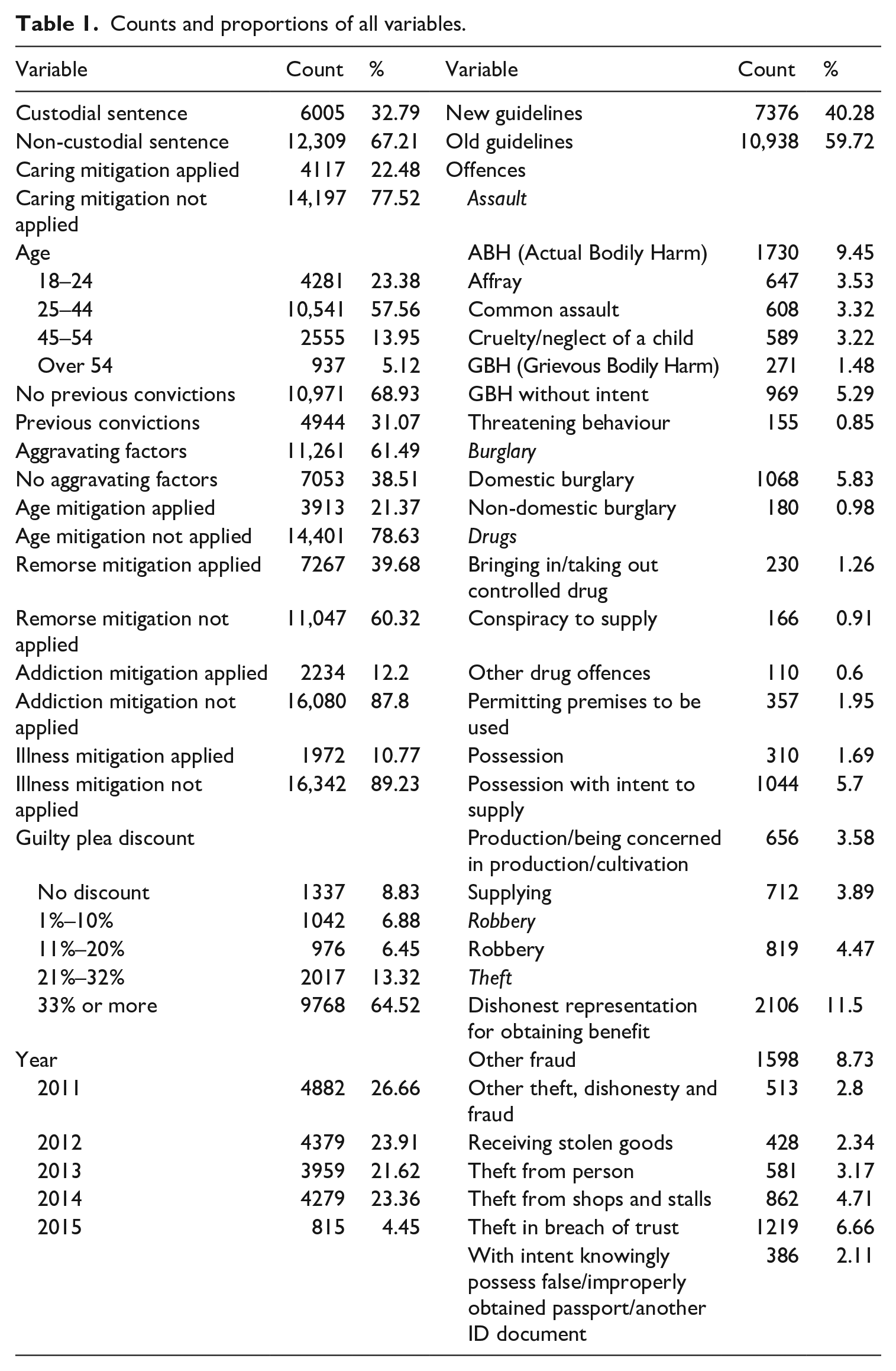
Remorse was the most commonly applied mitigating factor at 40%. Factors of age, addiction, and illness were applied in 21%, 12% and 11% of cases, respectively, making caring responsibilities the second most commonly applied mitigation. However, it is possible that this high ranking would not be the case if it was only concerned with parental caring responsibilities, but it is not known how many of the mitigations are applied to parents. In terms of crime type, theft accounted for 42% of cases. The most common offence types were dishonest representation for obtaining benefit, Actual Bodily Harm (ABH), other fraud and theft in breach of trust (12%, 9.5%, 9% and 7%, respectively). Serious or violent crimes such as supplying drugs or Grievous Bodily Harm (GBH) with intent amounted to a very small proportion of cases (1.5% and 4%). The sample consists of primarily non-violent, financially driven crime types, which is a surprising finding given the high proportion (33%) of custodial sentences.
Bivariate analysis
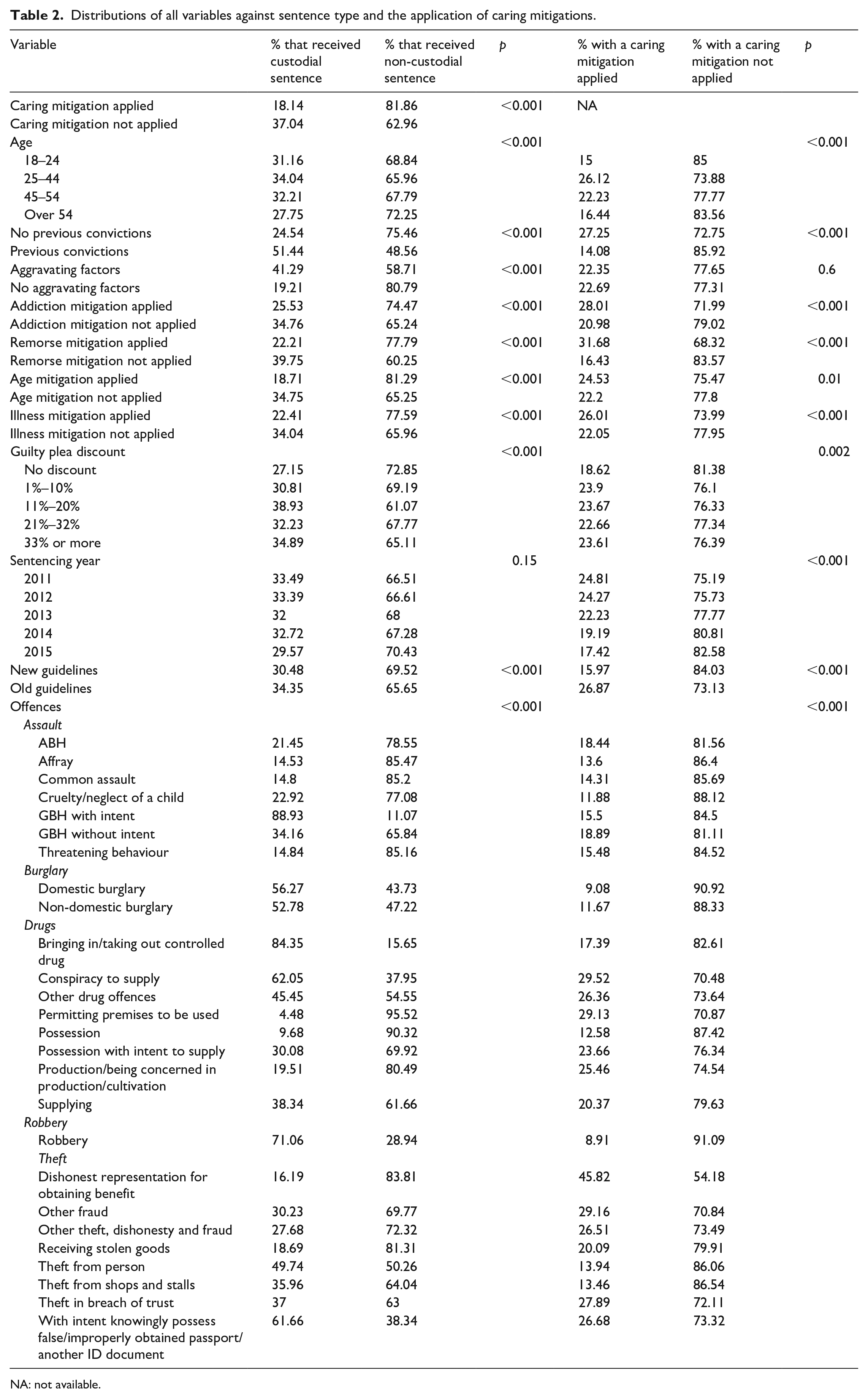
In reference to the dependent variable of custody, contingency tables were built (Table 2); 18% of those who had a caring mitigation applied received a custodial sentence, with 82% receiving non-custodial sentences, and 37% of defendants who did not have a caring mitigation applied received a custodial sentence, with 63% receiving non-custodial sentences. This relationship proved to be statistically significant, clarifying that custodial sentences were more common for those who did not have a caring mitigation applied to their case. A larger proportion of cases with the caring mitigation resulted in non-custodial sentence than any other aggravation or mitigation, although all are fairly similar (roughly 75%–80%) and cases with an addiction mitigation were extremely close to those with a caring mitigation (81%).
Distributions of all variables against sentence type and the application of caring mitigations.
NA: not available.
Relationships between the main predictor and control variables were also observed and summarised in Table 2. In the age category, the caring mitigation is applied most commonly in groups where you would expect mothers to have full-time responsibilities for their children (25–44). As far as aggravations are concerned, those with previous convictions receive the caring mitigation less than those without (14% and 27%, respectively). Most mitigations hold similar distributions, with around 30% of cases with caring mitigation application having other factors present and 20% without other mitigations present. Between 2011 and 2015, the percentage of cases in which a caring mitigation was applied incrementally decreased from 25 to 17. It is possible that this decline has continued over the 6 years since the survey data were collected. Offence types which had the largest percentages of cases with caring mitigation applied were dishonest representation for obtaining benefit, conspiracy to supply drugs, other fraud and permitting premises to be used for drug-related activities (45.82%, 29.5%, 29.2% and 29.1%, respectively). These are all non-violent offences, with the assault offences having the fewest cases where the caring mitigation was applied.
Logistic regression
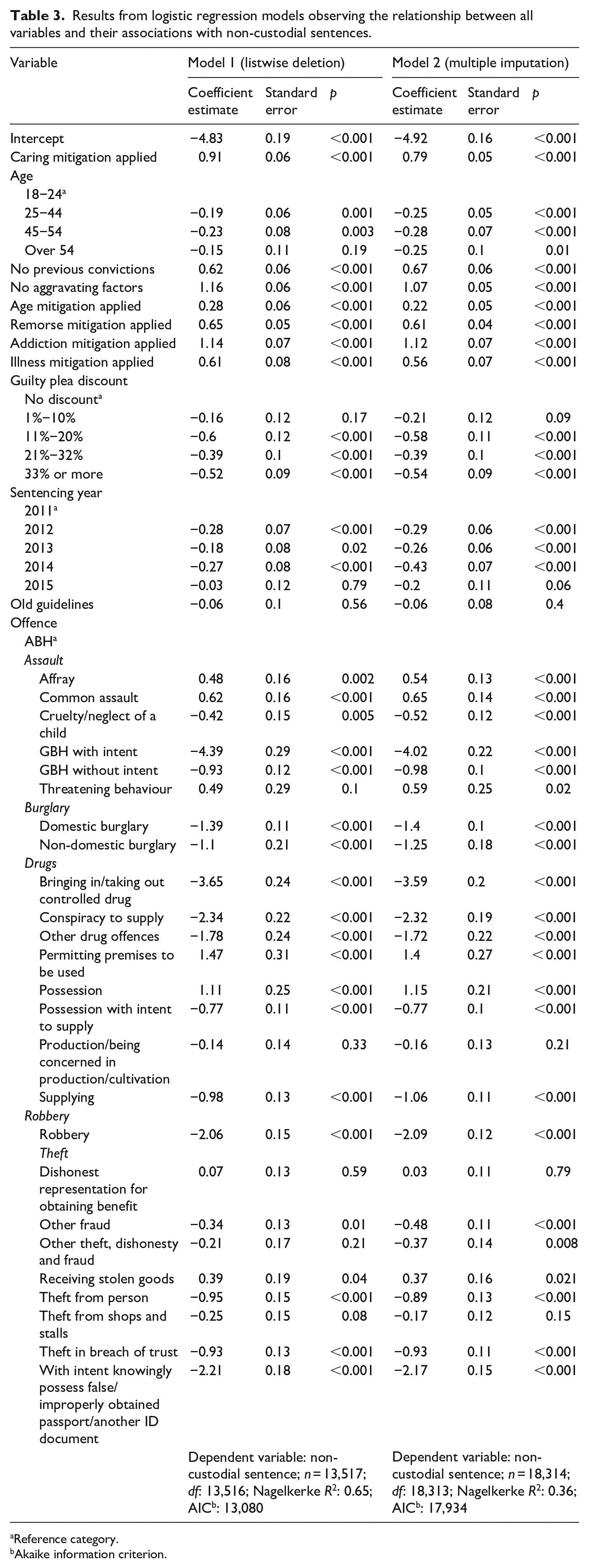
Two models are presented in Table 3: Model 1 shows the relationship with non-custodial sentences accounting for controls using listwise deletion, and Model 2 with controls and imputed data. Subsequently, the odds ratio values of all dichotomous variables are derived from Model 2 and presented in Figure 1 to further understand the effect sizes. Model 1 shows the caring mitigation has a significant impact on sentence severity, with a coefficient of 0.91. This is a predictable result and confirms a positive association between a non-custodial sentence and the application of the caring mitigation. However, this model utilises a listwise deletion process which drops any case with a missing value (over 3000 instances overall). If these cases were accounted for a there is a chance that the presented relationship between the variables and non-custodial sentences would change.
Results from logistic regression models observing the relationship between all variables and their associations with non-custodial sentences.
Reference category.
Akaike information criterion.
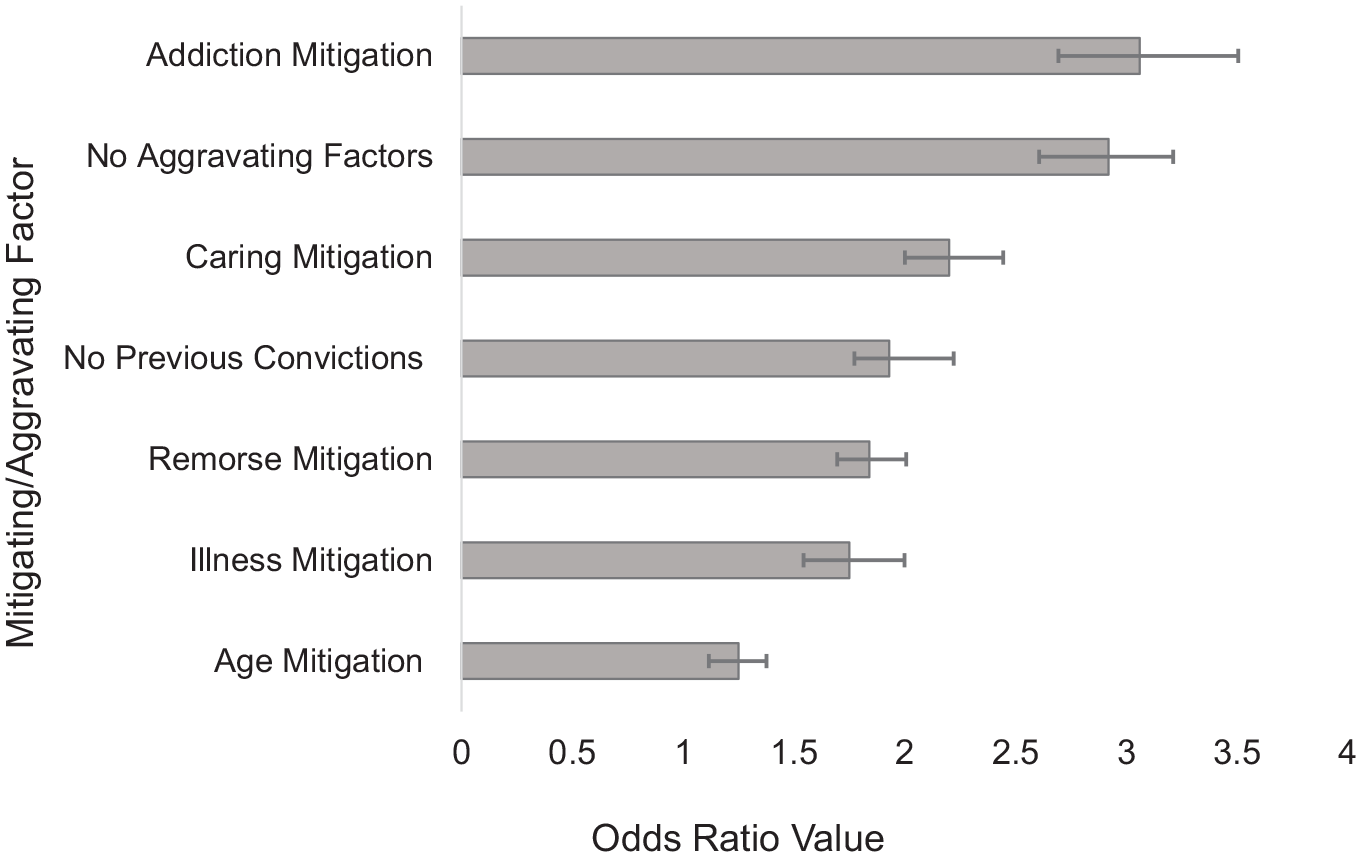
The effect of aggravating and mitigating factors on the likelihood of receiving a non-custodial sentence in terms of odds ratio.
Model 2 uses an imputation process to consider the cases which are impacted by missing data. When cases with missing data are not dropped from the model, the effect lessens to 0.79, showing that the strength of association between caring mitigation application and non-custodial sentences was overestimated. Ideally one would take measures to account for missing data, as dropping cases in which small amounts of information are missing can misrepresent variable relationships. However, it is important to note that the model fit indicators are stronger in Model 1, with a higher R2 and lower Akaike information criterion (AIC).
To fully contextualise and relativise the caring mitigation results, comparisons can be made with other factors and their relationships with sentence severity. Figure 1 presents the relationship of other aggravating and mitigating factors to the likelihood of receiving non-custodial sentences, in terms of an odds ratio. The odds of getting a non-custodial sentence are 2.2 times greater for those with a caring mitigation than for those without. Cases with the mitigation of addressing addiction have the highest odds of receiving a non-custodial sentence, exceeding the impact of caring mitigations with an odds ratio of 3.06. The lack of aggravating factors present in a case has an odds ratio of 2.92 associated with non-custodial sentencing. As aggravating factors increase the severity of an offence, a lack of these would understandably relate to an increased liklihood of a non-custodial sentence. When compared to age, remorse and illness, cases with a caring mitigation have stronger odds of receiving a non-custodial sentence. An important aggravating factor is previous convictions, said to be ‘one of the most important aggravating factors in the sentencing of any offender’ (Amirault and Beauregard, 2014: 79). Its influence is still less than caring mitigation in relation to sentencing severity, with an odds ratio of 1.93.
The goal of comparing mitigating factors is not to say that one factor holds more theoretical or practical importance than another. Comparisons have been made to contextualise the caring mitigation’s relationship with non-custodial sentences, as due to the lack of data around this factor and its application to women there is no other way to contextualise its impact. These comparisons demonstrate that in spite of the relationship being relatively high compared to some other factors, it is significantly lower than others. There is the potential for factors to hold a stronger relationship with a non-custodial sentence being used as punishment, and the caring mitigation is not reaching this potential.
Summary
From this data analysis, we now know how different aggravating and mitigating factors are linked to the passing of custodial sentences for women. Due to a lack of data on the number of women being sentenced who are sole or primary carers of dependent children, we cannot yet determine whether the caring mitigation is under applied, but the finding that it was applied to 22% of women in the Crown Court over the period of the CCSS fills a knowledge gap in a statistically under-researched area. There have been recommendations, and indeed commitments, from government that data about child dependents of sentenced women will be collected, and when those data are available, it will allow further exploration of the use of mitigations in sentencing. We would hypothesise that it is likely that the caring mitigation is under applied as research has found that judges have a lack of understanding of the impacts of maternal imprisonment on dependent children and do not properly consider it when sentencing (Minson, 2019a). Moreover, the sample is not made up of large amounts of crimes directly related to a dependent relative, such as violent or sexual crimes towards children. Therefore, it is not the case that the application of the caring mitigation is lowered by the severity of the crimes resulting in it becoming an unfitting mitigation.
With regard to the link between mitigating factors and non-custodial sentences, it is of note that willingness to address addiction has a much stronger association with receiving a non-custodial sentence than the caring mitigation. It is possible that this is because sentencers are aware of the non-custodial support and treatment programmes available for women with addiction issues, which can be a requirement of a non-custodial sentence. Judges can see a clear link between the mitigation and the punishment. This may not be the case with the caring mitigation, and the pathways for support in non-custodial sentences for defendant mothers are not as clear.
Discussion
Limitations
A limiting factor of this study is the time frame. Since 2015, the last year the CCSS ran, there have been changes in the field of maternal sentencing which could potentially impact the results of this research if it were to be replicated now. On 1 October 2019, the Sentencing Council published an expanded explanation in an online guideline on the caring mitigation. Important aspects include an emphasis on the consideration of this factor in mitigation when an offender is ‘on the cusp of custody’, and clarification that the court should ensure they have all relevant information regarding dependent children prior to sentencing (Sentencing Council, 2019). These measures may have an effect on recognition and application of the mitigation. In addition to this, sentencers who are aware of the rights of the child when passing their decision may be inclined to avoid custody. However, without more up-to-date data, it is impossible to account for these changes within the analysis.
As the data were collected by combining many different crime types to produce the largest sample size possible, there is a large variation of offences included in the analysis. The effect of caring mitigations may depend on the crime type, for example, mitigations may be granted less frequently to violent offenders, and this could be explored in further research, building a model with interaction terms between caring mitigation application and offence type. This assumption is supported in the ‘Bivariate analysis’ section, which shows that the mean percentage of cases in which a caring mitigation was granted among assault offences is 15%, but 25% for theft offences.
Recommendations
There is an obvious data gap regarding the number of women in custody who have dependent children. This information could enhance not only this study but all research in maternal sentencing. There should be a commitment to collecting up-to-date data on how many women with children go through the CJS to properly understand their experience of sentencing and mitigations.
Furthermore, it is clear that the factor ‘sole or primary carer for dependent relatives’ is used to mitigate the sentence for some women, but more could be done to ensure this factor is used to its full potential in terms of reducing sentence severity. Steps should be taken by the Sentencing Council to ensure that the factor is applied as widely as possible, with the aim that it gains a stronger association to non-custodial sentences. This could be achieved through various methods. First, for the factor to be considered and applied, it must be understood. Judicial understanding of this mitigation is varied and inconsistent (Minson, 2017). An alteration of the wording could clarify its relevance, for example, ‘sole or primary carer to children and/or other dependent relatives’. The specific naming of children would ensure a direct link to their third-party involvement and makes the statement more child-centric.
Second, the findings of this article support recommendations for a separate step in the sentencing guidelines to improve the application of this factor (Minson, 2020). A separate step would be more visible and reach a wider group of sentencers. It could provide more detail as to why this mitigation is so important, helping strengthen the relationship to non-custodial sentences.
A third method could be to strengthen the expanded explanation. The explanation could state that the ‘court should ensure that it has all relevant information about dependent children before deciding on sentence’, and that this information must be considered, as well as gathered, before passing the sentence. This point could be linked more directly with considerations for cases on the cusp of custody. This refinement would clarify the relevance of the factor, linking dependent considerations directly with the imposition of a non-custodial sentence, thus associating the consideration of the factor more strongly with non-custodial sentences.
It is also important to bear in mind that the Female Offender Strategy (Ministry of Justice, 2018) set out a commitment to divert more women from custody, therefore a more consistent application of the caring mitigation in all cases where the defendant is the sole or primary carer for dependent children should be welcomed. There is, of course, a broader point about diversion of all women from custody, given all that is known about women’s offending and the evidence that a woman is more likely to reoffend following a custodial rather than a non-custodial sentence.
Concluding thoughts
The importance of studying women in the criminal justice system should not be underestimated. This article contributes knowledge to the field of maternal sentencing from a quantitative study which focused on the mitigating effect of caring responsibilities on women’s sentences and has provided vital information and an estimation of the number of women who have this mitigation applied. The usefulness of the application of this mitigation has been tested, observing the effect it has on the likelihood of receiving a non-custodial sentence. While there are some promising findings, showing greater applications and relations to non-custodial sentences relative to some other factors, the mitigation’s application is not as high as we would expect, and compared to the addiction mitigation, there could be a stronger association with non-custodial sentences. To increase the mitigation’s application and strengthen its ability to reduce sentence severity, there is a need for broader awareness and further acknowledgement of the benefits of avoiding custody when this factor is present. The findings from this research provide a rationale to achieve this, presenting the merits of an under-applied mitigation with the potential to have a great impact on reducing sentencing severity to defendant mothers in the Crown Courts.
Footnotes
Acknowledgements
The authors thank Jose Pina-Sánchez and Katrin Mueller-Johnson for their comments on previous drafts of this paper.
Declaration of Conflicting Interests
The author(s) declared no potential conflicts of interest with respect to the research, authorship, and/or publication of this article.
Funding
The author(s) received no financial support for the research, authorship, and/or publication of this article.
