




Abstract
This article is based on interview data (N = 16) collected in a medium security men’s English prison (HMP Wandsworth). It begins with an introduction of the Incentives and Earned Privileges scheme and outlines the amendments to Incentives and Earned Privileges that have transformed prisoners’ requirements for progression during their sentence. As the article demonstrates, the policy alteration increases the need for prisoners to be visibly compliant by staff in order to advance through the scheme; it is no longer sufficient to be invisibly compliant. To this end, I present a typology of visibility that illustrates prisoner compliance and outcomes to the Incentives and Earned Privileges scheme. The article situates the revisions made to Incentives and Earned Privileges against the backdrop of neoliberal informed penal politics. The article concludes by summarising the key theoretical and practical implications of the study.
Introduction
In the early 1990s, the English prison system went through major redevelopment marking a significant turning point in penal policy and practice. On 1 April 1990, there were large-scale disturbances at Strangeways prison in Manchester, where prisoners protested over the course of 25 days, making it the longest prison riot in British history. Following Strangeways, the British government announced a judicial investigation known as the Woolf enquiry which introduced key recommendations of the Prison Service to induce reforms into the prison system. Central to this report were proposals of justice that would seek to extend the rights and facilities available to prisoners. To maintain future control, the Prison Service, like the Woolf report itself, saw merit in the development of a properly structured system of incentives. The main aims for implementing an incentive-based approach to prisons were to improve the overall regime and prisoner performance in each establishment, to develop more constructive regimes and to achieve better control (Bosworth and Liebling, 1994; Bottoms, 2002; Liebling et al., 1997).
In 1995, the Prison Service Instruction to Governors (IG 74/1995) was implemented in prisons across England and Wales. The National Framework stated that the introduction of ‘earnable and losable’ privileges will seek to encourage ‘responsible behaviour’, ‘hard work’ and ‘progress through the system’, creating ‘a more disciplined, better controlled and safer environment’ (IG 74/1995) for prisoners and staff. Five specific aims underpinned the Incentives and Earned Privileges (IEP) policy:
‘to provide that privileges generally are earned by prisoners through good behaviour and performance and are removable if prisoners fail to maintain acceptable standards’;
‘to encourage responsible behaviour by prisoners’;
‘to encourage hard work and other constructive activity by prisoners’;
‘to encourage sentenced prisoners’ progress through the prison system’;
‘to create a more disciplined, better controlled, and safer environment for prisoners and staff’. (IG 74/1995)
IG 74/1995 required prisons to introduce ‘basic’, ‘standard’ and ‘enhanced’ privilege levels, each of which reflected the individual’s behaviour over time. Prisoners who wished to be considered for privileges above ‘basic’ had to demonstrate ‘good and responsible’ behaviour. The policy asserted that privileges ought to ‘be acceptable to reasonable public opinion’ and ‘justifiable in the face of informed criticism’ and ‘above all . . . not bring the Prison Service into disrepute’ (IG 74/1995). In this light, Woolf and Tumin (1991) developed a structured system of incentives, centred on a rational-choice economic model, which sought to encourage responsible prisoner behaviour and prevent future disorder: ‘those who have a high investment in the system are not likely to seek to destroy it’ (p. 374). Behavioural expectations and the rights and responsibilities within IEP guidelines were primarily concerned with addressing offending behaviour. Partly in response to media concerns about ‘cushty prisons’ (see Liebling, 2008), the scheme sought to reinforce austerity measures. In doing so, it should be understood as part of a more punitive approach to penal policy. What Garland (2001) describes as ‘penal sensibilities’ altered the emotional tone of penal practice, situated against the backdrop of prison overcrowding, fiscal restraint, punishment instead of rehabilitation and heightened emphasis on risk-centred interventions, driven by responsibilisation, managerialism and probability.
In 2013, the Prison Service revised the IEP scheme for prisoners in the first review of the policy for over 10 years. The revised IEP system provided an extremely detailed framework and reformulated the guidelines to widen behavioural requirements. Currently, the IEP system designates six ‘key earnable privileges’ which are awarded or removed according to prisoners IEP status: ‘access to private cash, eligibility to earn higher rates of pay, access to in-cell television, opportunity to wear own clothes, time out of cell for association and extra and improved visits’ (Prison Service Instruction (PSI), 2013: 17). The extent to which these privileges are granted is dependent on prisoners’ IEP level, as outlined in the Prison Service Instruction 30/2013. There are three 1 IEP levels relevant to this study:
Basic: This level is assigned to prisoners who have ‘demonstrated insufficient commitment to rehabilitation and purposeful activity, or behaved badly and/or who have not engaged sufficiently with the regime to earn privileges at a high level’ (PSI, 2013: 9). Prisoners on ‘basic’ status receive the least amount of privileges.
Standard: ‘Standard’ level is for prisoners who have ‘successfully completed the “Entry” level requirements and those who are considered to be meeting rehabilitation expectations, participating in the regime and behaving well’ (PSI, 2013: 10).
Enhanced: The highest status in the IEP system ‘reserved for those prisoners who have demonstrated, for a minimum period of three months, that they are fully committed to their rehabilitation, seeking to reduce their risk of reoffending, complying with the regime and meeting the behavioural expectations’ (PSI, 2013: 11).
Under the revised IEP scheme, prisoners are, inter alia, ‘expected to demonstrate a commitment towards their rehabilitation, engage in purposeful activity, reduce their risk of reoffending, behave well and help other prisoners and staff members’ (PSI, 30/2013). Such revisions mark a radical change in what is required from prisoners, whereby ‘good and responsible’ behaviour is no longer sufficient to progress within the system.
The reforms made to the IEP scheme have attempted to nurture self-governance in prisoners. The aim of this article is to demonstrate how these reforms have placed unrealistic demands on prisoners to be actively involved in their rehabilitation, and that by basing IEP progression on what this article defines as ‘visible compliance’ the system imposes new burdens and implications for particular types of prisoners. Such policy requirements can be contextualised within the changes inaugurated by neoliberal informed penal politics.
Literature
It is now widely understood that the early 1970s marked an economic shift from the decline of social democracy in the wake of post-Fordism to the rise of neoliberalism in Western liberal societies. Reiner (2007) has canvassed the move within an institutional framework characterised by market efficiency and free trade policies, underpinned by minimalist government intervention in social and political affairs. Neoliberalism champions that state interference with economic activity should be reduced to eliminate barriers that constrain individual freedom. In contrast to more protectionist and welfarist forms of government, ‘each person is held accountable for their own actions and well-being in the domain of the market’ (Harvey, 2005: 65).
Penologists indicate that neoliberal ideologies, which have become deeply engrained in British prisons, have played an adverse role in penal matters (Garland, 2001; Rose, 1999). Harcourt (2009) defines neoliberal penality as ‘marginalising and pushing punishment to the outskirts of the market, unleashing the state on the carceral sphere’ (p. 3). From this perspective, punishment seeks to legitimise rationality outside political economy and reasserts the nexus of capitalist production ‘from above’, enforced by high-ranking politicians and state officials. By conceptualising the role of the state as governed by a natural order, ‘the government is relegated to the boundary, and given free rein there – and there alone – to expand, intervene, and punish, often severely’ (Harcourt, 2009).
The ‘punitive minimalism’ (see Liebling and Crewe, 2012) of existing prison regimes came to fruition in Britain following Tony Blair’s ‘New Labour’ manifesto, which adopted key aspects of the neoliberal agenda. Resultantly, increasingly austere policies defended on financial grounds were built on neoliberal doctrines of small government, fulfilment of key performance indicators and entrepreneurialism (Harvey, 2005). Government intervention takes a backseat to intensify the economic conduct of the rational actor, encouraging them to self-actualise through their own labour. Neoliberalism thus depicts offenders as ultimately accountable for their offending, rather than understanding criminality as a by-product of social and economic structures.
For the purpose of this study, one of the most significant aspects of neoliberal discourse is that it is predicated on the ability that individuals are to take accountability for their own actions to determine their progression within the system. This article will therefore explore neoliberal constructions of selfhood rather than on macro-level analyses of neoliberal penality. Applying this lens to the prisons context indicates that prisoners are to self-manage behaviour according to prison norms and operate as architects of their future. According to Crewe (2011b), this ‘soft power’ encapsulates new prison pains which relate to far-reaching behavioural competencies, ambiguous internal system processes and an increasing effort to utilise risk-centred interventions to regulate prisoner profiles. He argues that ‘whereas the welfarist dimensions of soft power encourage closer relationships between prisoners and staff, its neoliberal policies hinder them’ (Crewe, 2011b: 463). Staff have the ability to exercise power from a distance and make decisions without needing to directly engage with prisoners. Since IEP regulations encourage prisoners to self-govern behaviour in pursuit of compliance to the regime, ‘order can be achieved without the need for either hard intervention or deep engagement’ (Crewe, 2011b).
Given the centrality of the IEP system to prison life, it is surprising that the literature on it remains sporadic. The largest study on IEP was conducted by Liebling and her colleagues in 1999 and further consolidated nearly 10 years later (Liebling, 2008). Both accounts found the old IEP system had negative impact on prisoner behaviour, perceptions of fairness and the quality of staff–prisoner relationships. More recently, there have been two important studies critiquing IEP regulations on prisoners’ access to visitation from a human rights and socio-legal perspective (Hutton, 2017), and the contrasting approaches of England and Wales with Scotland, where governmental approaches to prison visitation have been implemented in diverging forms (McCarthy and Adams, 2017). While the IEP focus of these studies are on prison visitation, this article aims to build on current literature by exploring one of the policy’s fundamental behavioural requirements, the increasing need for prisoners to be visibly compliant to progress within the system and what implications this poses for invisibly compliant prisoners who, despite their passive compliance, no longer advance through the scheme. The article frames the discussion in the context of neoliberal imperatives which encourage prisoners to become self-governing agents of their incarceration and will highlight the normative dimensions of visible compliance for system progression.
Research context and methodology
This study draws on material 2 collected as part of a qualitative study of a medium security prison for men, HMP Wandsworth, in the London region, England. Wandsworth is an adult Category B prison, with one of the largest operational capacity in the United Kingdom, holding at the time of study approximately 1650 prisoners. As part of its resettlement regime and collaboration with external bodies, Wandsworth facilitates a range of educational and vocational training courses which include but are not limited to creative writing, business administration, web design and construction. 3 The access to the majority of these interventions is dependent on prisoner IEP level.
The selection of the research site was based on three factors: security level, geographic proximity and, in particular, the Trinity unit. The Trinity unit is a resettlement facility, holding around 350 Category C prisoners in a separate building of three wings. Increasing emphasis is placed on interventions to improve employment prospects and support prisoners’ rehabilitative pathways. Trinity was selected to ensure variation of prisoner IEP levels, so that comparisons between them could be drawn. Access was sought by preliminary discussions with the Governing Governor, who was willing to facilitate the research, and a subsequent application to Her Majesty’s Prison and Probation Service (HMPPS) National Research Committee (NRC).
This qualitative study has been grounded within an ontological research position that aligns closely to what Hammersley (1992) terms ‘subtle realism’. That is, we acknowledge that an external reality exists independently of our subjective beliefs and interpretations but that it is only knowable via participants’ socially constructed meanings and through researchers’ understanding and representation of these perspectives. In this light, data comprised 16 semi-structured interviews with prisoners (N = 16), six of whom were on enhanced, four on standard and six on basic privilege levels. While the sample size is relatively small, it will go some way towards contributing knowledge and understanding of the operation of amendments to the IEP scheme to further encourage prisoner engagement in their own rehabilitation.
Although initially selecting the Trinity unit was pragmatic – because it allowed prisoners to make comparisons between the former and present IEP scheme, for instance – difficulties emerged as there were only three prisoners on the Trinity unit who were on basic IEP level. With the highest employment rates in Wandsworth, around three quarters of Trinity’s prisoners were occupied, with the majority of these working part time. One of the Trinity wings is designated for enhanced prisoners only, which presented less opportunity to recruit prisoners on basic status, particularly given the relatively small Trinity population. Consequently, three prisoners on basic were recruited from B wing, a constituent of the main prison block housing remand and convicted prisoners, to provide a more evenly distributed sample. A stratified purposive sampling technique (Ritchie et al., 2003) was used to draw a representative sample among prisoners on different IEP categories. Thirteen of the sixteen respondents initially approached, and who agreed to take part in the interview, participated in the research study.
The interview questions were divided into two broad sections: ‘incentives and earned privileges’ and ‘staff-prisoner relationships’. Each interview began with basic preliminary questions about how long prisoners had been in Wandsworth, how long they had left before release, whether this was their first time in prison, and what IEP level they were on. These questions were followed by more open-ended questions about their experiences of the IEP scheme which allowed the men to draw on relevant themes without me prompting or influencing their responses. In the final series of questions, participants were asked to describe the nature of staff–prisoner relations in Wandsworth, their own relationships with and views of prison officers, and how they felt they were perceived by staff according to their IEP level.
The interview length ranged between 31 and 82 minutes with an average duration of 41 minutes. All interviews were recorded using an audio recording device and transcribed verbatim. Pseudonyms have been used to replace prisoners’ names for the omission of any potential revealing information that would compromise the security and privacy rights of participants. Data analysis followed Layder’s (1998) notion of ‘adaptive theory’, which involves combining existing theory (deduction) with emergent data (induction). Each transcript was analysed individually using ‘open’ and ‘axial’ coding (Strauss and Corbin, 1998), to organise the interview material. ‘Open coding’ was used to identify language or phrases that are related to IEP, such as ‘fairness of decision making’, as well as those relating to staff–prisoner relationships. ‘Axial coding’ was then used as a ‘bottom up’ technique to identify latent themes that strongly corresponded to the data themselves. This analytical approach informed the conceptual framework outlined in the study and is discussed in detail below.
A typology to understand the interactions between IEP and staff–prisoner relationships
The different types of prisoner compliance and the influence of staff–prisoner relationships in determining IEP outcomes highlight the significance of the revised IEP scheme’s objectives in shaping prisoner progression within the system. The visibility categories are schematically presented in Table 1, where (+) ‘confirms participation’ 4 and (−) indicates ‘withdrawal’ 5 – for instance, lack of motivation and despondence – however withdrawal can be achieved unintentionally and referred to as invisible compliance.
A framework showing prisoner compliance and outcomes to the IEP scheme.
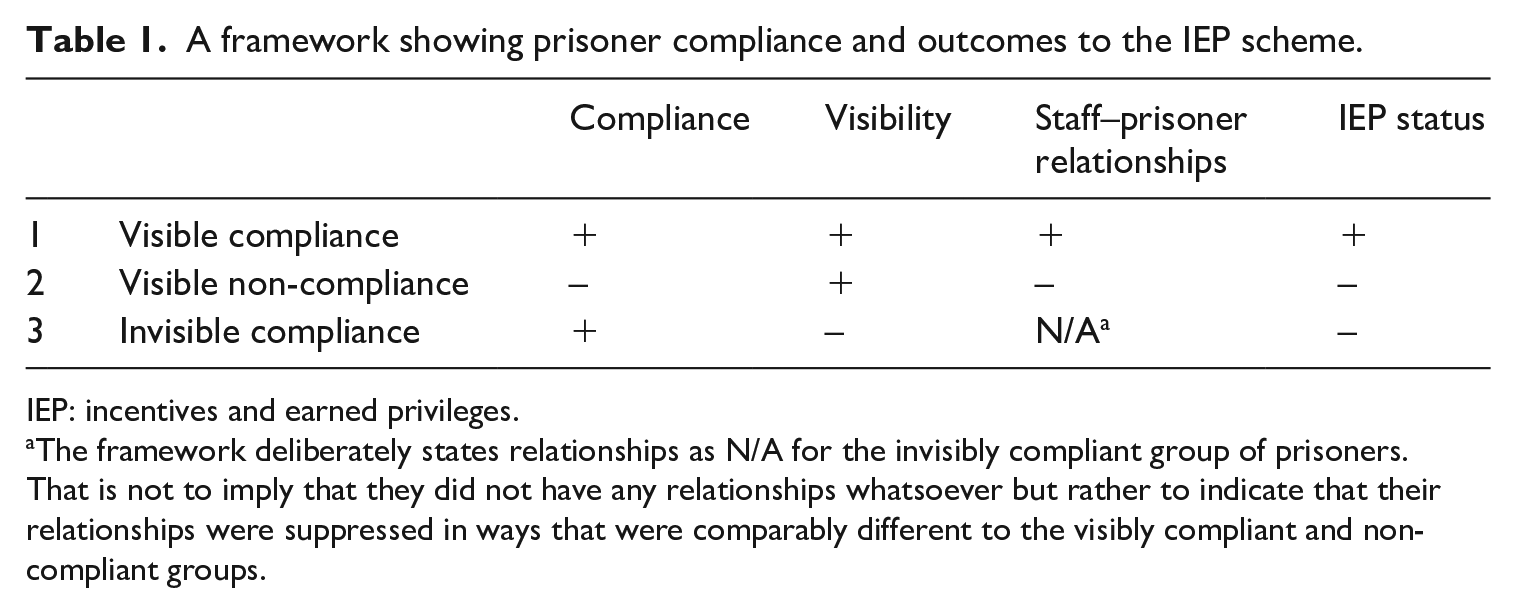
IEP: incentives and earned privileges.
The framework deliberately states relationships as N/A for the invisibly compliant group of prisoners. That is not to imply that they did not have any relationships whatsoever but rather to indicate that their relationships were suppressed in ways that were comparably different to the visibly compliant and non-compliant groups.
Visible compliance refers to prisoners who comply with prison regulations and are actively involved with the IEP scheme. These prisoners are visibly compliant and because their compliance is conspicuously noticed by prison officers, they benefit from being compliant and therefore progress through the scheme. Visible non-compliance indicates complete withdrawal from compliance to IEP rules and engagement. In this group, prisoners detach themselves from the scheme and, in doing so, demonstrate this process visibly and do not progress within the scheme. The final category is invisible compliance 6 which involves compliance to IEP regulations but due to the nature of contrasting social characteristics, prisoners are not visibly recognised by staff as engaging with the scheme. These types of prisoners remain unnoticed as a result of their invisible personal traits and therefore do not advance through the scheme.
The explanation of these prisoner types and their responses to the IEP scheme are categorised in relation to positive–negative prisoner reactions and specifically encapsulates IEP progression. While the IEP guidelines set out an extensive list of requirements for system progression under each privilege level, these criteria are not always receptive to what prisoners perceive as constituting positive and negative behaviours. The identification of these visibility types has therefore been conceptualised in tandem with the core behavioural expectations of the IEP scheme that influence prisoner progression within the system. The experiences of these prisoner types are examined in turn below.
Findings
The contribution of existing staff–prisoner relationships in shaping IEP experience: Visible compliance
No matter what level they were on, the prisoners I interviewed in Wandsworth, like Harry and Walter below, described that their existing relationships with staff directly affected the opportunities they had under the IEP scheme:
If you have a good relationship with staff even if you’re on basic and you got a TV it’s not going to be for the time you’re supposed to have it. You can just get put on enhanced if you’re alright with officers. You don’t have to be there for three months before they put you on enhanced. (Harry, basic) I’ve got the equalities rep now and an officer asked me to do that because she knows me and that I can talk to people [. . .] If I just come on and nobody knew me, that would’ve been me gone straight away but because I built that relationship up, there’s a bit more leverage. (Walter, enhanced)
According to the men, notwithstanding the allocated timeframe for IEP reviews, prisoners who had built rapport with officers were more likely to have prison rules altered for them. The revised IEP regulations on reviewing incentive levels for new prisoners within 3 months sought to build relationships with staff and increased the duration prisoners could be in possession of certain privileges at officers’ discretion. In such instances, established staff–prisoner relationships would circumvent formal IEP guidelines. The increasing importance of being visibly compliant, engaging with prison officers and the scheme, enhanced working opportunities and created positive accounts of imprisonment for these prisoners. For Harry, ‘good relationships’ stemmed from prisoners’ engagement with staff and perceptions of the decisions imposed on them, which could generate specific material benefits. Walter’s interaction with one officer in particular echoes Price and Liebling’s (1998) description of a ‘right’ relationship, which may be ‘good’ (fair, honest, close) but also vigilant. This is redolent of Warr’s (2008) assertion that the process of stereotypically categorising prisoners into a recalcitrant person has an innately damaging effect whereas the officer that acknowledges who they are dealing with, and treats them humanely, will have a positive impact.
For Walter, being an active member of the scheme became a daily routine because of the long-term benefits and upwards movement within the prison system:
It’s a huge amount of pressure to take part in IEP but having the equalities rep and other courses I did before like construction means that I can ask for a character reference which looks good on your sentence plan [. . .] Most officers will help me out because they know I get on with nearly every member of staff on Trinity. (Walter, enhanced)
Being on enhanced status and having established relationships with staff provided Walter with a sense of hope that his release would be expedited and increased exposure to extra-curricular activities outside of the IEP framework. Visible compliance played a key role in the development of prisoners’ IEP profile and enabled prisoners like Walter to test the boundaries of non-compliant behaviour:
I have excellent rapport with officers and I got my enhanced straight away [. . .] When you’re on a wing and regular officers see you’re in your cell when it comes to bang up and doing what you’re told then they’ll give you a positive IEP entry. (Daniel, enhanced) Some staff will give you an IEP for not going to your room quick enough and others will give you one for pushing someone [. . .] If you’ve built a good relationship with an officer then you’ll be able to push the boundaries a bit, do your own thing that don’t relate to being seen as good all the time so there’s more discretion about what you can do and you’ll get a bit more back from them. (Walter, enhanced)
Prison officers on the wings deployed ‘soft power’ (Crewe, 2011b) to support prisoners’ requests, ignore minor deviations from IEP rules, provide incentives and privileges, while simultaneously encouraging compliance and self-governance. For men like Walter, power was continuously negotiated with officers, to ascertain what modes of responsible behaviour could be evaded, ‘to test and discover the limits of obedience and disobedience’ (Moore, 1978: 18). Existing staff–prisoner relationships exerted less pressure for prisoners to fulfil the scheme’s expectations of self-accountability, entrepreneurship and self-governance.
Some prisoners were motivated to establish relationships with staff for instrumental reasons where self-interest was driven by calculated rationality (Bottoms, 2002). These men, like Jeffrey, who was on enhanced, claimed that ‘to play the game’ – an expression for doing their sentence – certain aspects of IEP which had direct benefits motivated them more than others:
The motivation is the extra money to spend because if I lost that then it would make my time a lot harder. But I had to work up to that, talk to officers and show them that I’m doing all these courses [. . .] Don’t get me wrong though, that doesn’t mean I enjoy it, I just know I have to do it. (Sam, enhanced) You take the game innit [. . .] For me, my sentence is affected more because I got children. So being on basic you’ll get half an hour visits and that’s not much time. My kids are what probably make me behave and talk to officers more so I can get the visits and try to get my D cat [. . .] That’s how I play the game. (Jeffrey, enhanced)
Particularly for those who had children, maintaining enhanced privileges was an important factor in navigating through their sentence. Such Kantian ideals of treating privileges as ‘means to an end’ highlight prisoners’ rational ability to manipulate the terms of their incarceration to turn actions into opportunities. Crewe (2011b) argues that such neoliberal strategies encourage prisoners to self-regulate behaviour in accordance with penal norms – engaging in purposeful activity, addressing their offending behaviour – or risk the consequences of ‘irresponsible behaviour’. For Sam and Jeffrey, visible compliance formed a tactical means to satisfy their desires where relationships were often motivated instrumentally and superficially driven to expedite outcomes. Established staff–prisoner relationships meant that prisoners had more opportunity to participate in a range of prison interventions. Resultantly, this group of prisoners became visibly recognised as engaging in constructive activity and therefore progressed through the system. However, there were a group of prisoners who reported negative experiences of the IEP scheme and their relationships with staff.
The role of IEP in shaping staff–prisoner relationships: Visible non-compliance
Functioning within an ethical and normative framework that is procedurally fair and neutral is often seen to validate power ownership in the eyes of citizens (Sunshine and Tyler, 2003; Tyler, 1990). Prisoners who felt that they were treated unfairly, and perceived a sense of injustice, altered their actions and behaviour in subsequent interactions with staff:
If there’s a gov that keeps giving me IEP’s, you’re not gonna listen to him [. . .] You wouldn’t go ask the one that’s been giving you IEP’s for help because you know he’s just gonna say no and that’s gonna piss you off even more. You’ll talk to the ones that you’ve already got a bit of rapport with. (Jimmy, basic) Half of the IEP’s I couldn’t even work out why I had them. It’s just put through my door without warning [. . .] When those screws give you an IEP, you’re gonna tell them to fuck off. There’s a few officers who’ll help you out so you’ll just go to them when you get a screw giving you constant IEP’s. (Kyle, enhanced)
The determination of visible non-compliance was twofold. Prisoners who perceived the implementation of IEP as procedurally fair and justifiable, in relation to the manner of decision making, would selectively target officers whom they trusted and believed would treat them impartially. The process also had a reverse effect where treatment by certain officers was seen as unjustified, particularly around decisions on IEP warnings. The language cited by these prisoners suggests that IEP was used by staff as a mode of punishment rather than having any therapeutic or rehabilitative effect:
They keep threatening you with IEP’s and basic. That’s all you hear them shout so freely, IEP, IEP, IEP and all you hear him say 23 times a day. (Jimmy, basic) Most of the time you get an IEP you don’t get an explanation. I’ve given up asking why because the IEP system is set up to punish not rehabilitate. [. . .] It’s just used as a power tool now and officers just throw it about without thinking how it’s going to affect our lives. (Michael, basic)
A combination of unfair decision making and interpersonal treatment led to prisoners’ perceived illegitimacy of the IEP scheme. This was generally more frequently associated with prisoners on basic IEP levels who were more sensitive to issues of defiance and resentment towards the scheme in comparison with their enhanced counterparts. Prisoner compliance was largely determined by the level of transparency of IEP decision making and the consistency and legitimacy of the rules and regulations imposed on them. The study found a group of prisoners, who, even though they complied with IEP regulations, felt powerless to affect their IEP status and progression within the system due to their ‘invisible traits’.
‘The forgotten incarcerated’: Invisible compliance
When I was on the wing for the first 4 months, no one even knew my name because I kept myself to myself. It’s hard to get positives if you’re quiet even if you’re not causing any trouble because staff don’t notice you. (Jeffrey, enhanced) They say yeah he’s not getting involved in fights or drugs and gets on with it but they’re not gonna give you positive reports. How are you able to move through the system? (Tom, basic) It’s like double jeopardy in here, they’ve already taken our freedom and now because you’re not ticking their IEP boxes you just end up rotting on basic in your cell for 23 and a half hours a day without education or work. Lucky for me I have my books otherwise I would go mad in here. (Robert, basic)
As the above excerpts indicate, prisoners who possessed introverted traits and were passively compliant to IEP regulations were not visible to staff as engaging with the scheme, despite their compliance to IEP and ‘good and responsible’ behaviour. This invisibility was compounded for new prisoners who had insufficient time to establish relationships with staff or gain understanding of how the system worked. While Jeffrey was able to attain enhanced status, the beginning of the sentence was crucial to understand that progression was possible. Tom’s obedience and passive compliance to the scheme impeded any hope for progression, while Robert sidestepped what he perceived as just another punitive facet to the institutional regime, resorting to reading books as psychological survival and to alleviate the pains of imprisonment. Invisible compliance therefore hindered prisoners’ ability to establish relationships with staff and their development within the scheme. Prisoners serving minimum sentences of 5 years recognised the stark differences between the old and revised IEP scheme:
In the old system you could get enhanced without much effort but now they’ve made it so hard because you got to take part in all these courses and activities and still be seen as staying out of trouble. That’s not really who I am. (Adam, basic) The biggest problem with the new IEPs is that they’re trying to change who you are as a person. I understand that in society we have to work to make a living but it’s all up to us now to make all these decisions [. . .] I don’t want to pretend to be someone I’m not. (Jimmy, basic)
In the original IEP scheme, prisoners would earn additional privileges by demonstrating obedient behaviour and staying out of trouble. Passive compliance to IEP and responsible behaviour for a period of 2–3 months would normally suffice to grant enhanced status. Under the revised IEP structure, prisoners have to actively ‘demonstrate a commitment towards their rehabilitation, engage in purposeful activity, reduce their risk of reoffending, behave well and help other prisoners or staff’ (PSI, 2013: 9). The policy guidelines stipulate that a minimum of 3 months is passed before a prisoner can be considered for promotion to enhanced level. However, as the article illustrates, prisoners are able to subvert policy requirements through established relationships with staff, which exemplifies the importance of staff–prisoner relationships in determining the quality of prison life and system progression.
These institutional practices were perceived by prisoners as promoting a self that was incompatible with their true self-conception. Unlike Goffman’s (1961) ‘recruits’, who underwent a ‘series of abasements, degradations, humiliations, and profanations of self’ (p. 4), these experiences were characterised by less destabilising modes of prison pains (see Sykes, 1958), and were more attuned to Crewe’s (2011a) notion of ‘tightness’. Such demands encouraged the ‘self-regulation of all aspects of conduct, addressing both the psyche and the body’ (Crewe, 2011a: 522) and increasing the need to be visibly compliant to experience any benefits within the system. For others, such normative dimensions of compliance to IEP were evident:
When they made the changes to IEPs it wasn’t really clear what had changed from the old system. Now you look around and you can see so many of us running around playing the game to get our enhanced. They know exactly what they’re doing but it takes two to play the game. (Jimmy, basic) For the first few months, I knew straight away that this IEP thing would help me get through my sentence because of the extra perks [. . .] Now they expect you to do more than just be good, you’re expected to do as much IEP activity as you can and to help others as well. This is standard practice now. (Daniel, enhanced)
This terminology of acknowledging the revisions made to IEP were understood by some prisoners as a routine aspect of Wandsworth’s regime. In other words, demonstrating an active commitment to their rehabilitation necessitated visible compliance for system progression. These requirements acted as a double penalty for this group of prisoners in light of the apparent staff shortages reported:
When they’re always changing staff, you might not get the same officers all the time so how are you gonna get someone to notice you? (Tom, basic) What they do here if they’re short staffed on the main prison they’ll call them over from Trinity to the main prison [. . .] Most of the officers are always busy running about doing something and if they keep changing officers or pulling them onto different wings then that changes the whole officers. How can officers get to know people on there? (Robert, basic)
The constant movement of staff within the prison hindered the ability for prisoners to develop relationships with staff. The lack of time for prisoners to familiarise themselves with officers diminished their ability to become visibly compliant and restrained the capacity to obtain benefits within the system. This extra disadvantage for the ‘forgotten incarcerated’ derives from the neoliberal ideology of demonstrating visible compliance in order to progress within the IEP scheme; it is no longer sufficient to be invisibly compliant.
Discussion
As the article demonstrates, visible compliance seeks to fashion a new kind of self-rehabilitating prisoner in accordance with neoliberal ideals, while simultaneously encouraging prisoners to depict a somewhat alien version of the self. In other words, traditional associations between incentives and instrumental compliance, driven by rational calculations of self-gain, are supplemented with new policy requisites based on ‘normative’ commitments to be demonstrated by visibly compliant prisoners in tandem with established staff–prisoner relationships and negotiation with uniformed staff who possess enhanced penal power.
Garland (2001) situates responsibilisation strategies as operating in conjunction with wider socio-political forces like state authorities and non-state actors, where the nexus of security and control is transferred from public services to individuals. From this perspective, the functioning of the IEP system can be conceived as the penal archetype of the more general process of ‘responsibilisation’, which is manifested by the surge of privatisation and managerialist approaches to effectively regulate levels of deviance. Such developments in crime control gave impetus to the rise of neoliberalism, resulting in the demise of community welfarism and an increased fixation on rampant individualism and self-governance (Etzioni, 1993).
As should already be evident, the IEP scheme’s requirement for visible compliance, which shifts the responsibility from prison management to prisoners, raises key implications for prisoner progression within the IEP system. Where prisoners actively complied and engaged with the regime and IEP regulations, they were exposed to various educational and employment activities, which all contributed to their rehabilitation and individual progress within the system. Addressing offending behaviour and demonstrating an active commitment to prisoner rehabilitation are also important factors in psychological, risk-based assessments and Release on Temporary Licence (ROTL) evaluations. In regimes such as Wandsworth, where there are effective enhanced wings such as Trinity, centred on rehabilitation and resettlement, prisoners have additional time out of cell for association and participation in further activities that stretch beyond the IEP policy. Such facilities can offer further opportunities to constructively engage with the scheme, offering more than what standard prison units provide. It also highlights the lost opportunities and benefits for prisoner rehabilitation as a consequence of visible non-compliance and invisible compliance. Pertinent to the study’s findings is the high plausibility that visibly compliant, enhanced prisoners, will advance through the prison system quicker than visibly non-compliant and invisibly compliant prisoner groups.
There are empirical synergies with existing literature on IEP. The centrality of staff–prisoner relationships to prison life and the ways in which staff exercise power through relationships echo aspects of Liebling’s (2008) evaluation of the IEP policy in five establishments. There was an association between privilege removal and weak staff–prisoner relationships, while prisoners with close working relations with staff evaded the frequent withdrawal of privileges. Decisions flowed through relationships and often supplanted formal regulations, highlighting the ‘important link between relationships and rule enforcement’ (p. 38). Power operated both upwards and downwards. Wandsworth’s visibly non-compliant prisoners exerted resistance to the scheme and applied pressure on staff, while visible compliance prompted staff to deploy their power strategically. A fundamental shift is that quiet, passively compliant prisoners who ‘stood more chance of getting noticed and rewarded’ (p. 33) in the old IEP policy is superseded by the challenges facing invisibly compliant prisoners for progression under the revised structure. Another divergence is that findings illustrate the normative commitments to IEP for upwards movement, an extension of the policy’s ‘instrumental approach to human motivation’ (p. 40).
Furthermore, there are parallels with Hutton’s (2017) analysis of the IEP policy’s detrimental effects on the rights of prisoners’ families. Hutton argues that ‘gaining enhanced status requires an element of performance management that some prisoners may be more capable of than others’ (p. 93), such as prisoners with mental health issues who are not able to self-regulate behaviour to align with IEP requirements. In this respect, Hutton states that non-compliance to IEP guidelines should not be interpreted as prisoners’ irrational behaviour or ‘a reluctance to engage with the regime’ (Hutton, 2017). Wandsworth’s visibly compliant prisoners were more able to display such behavioural expectations, albeit often a product of artificial interpersonal relationships to expedite release and maintain privileges. Thus, although prisoners are expected to ‘behave honestly and openly with staff, other prisoners and visitors to the prison in a way that promotes trust and integrity’ (PSI, 2013: 32), this requires an element of impression management to showcase visible compliance. This expectation is intensified by the need for prisoners to ‘co-operate with staff in the performance of their duties including complying with orders and requests’ (PSI, 2013), particularly for invisibly compliant prisoners who, despite their compliance, are marginalised from the scheme for failing to self-manage emotions in a way that pro-actively adhere to institutional norms. Moreover, Hutton observes that prisoners serving short sentences of 6 months or less are automatically precluded from ‘enhanced levels of family contact’ (p. 93) due to the policy’s requirement of demonstrating visible compliance. For prisoners serving shorter sentences, the study demonstrates how visible compliance can bypass the 3-month status review period for prisoners who establish rapport with staff.
The revisions made to IEP, which demand prisoners to become self-fulfilling actors in their penal management, can be situated against the backdrop of neoliberal informed penal politics. Returning to Crewe’s (2011a) concept of ‘tightness’ is useful to situate this neoliberal thrust which encapsulates IEP functioning:
[Tightness] gives a sense of the way that power is experienced as both firm and soft, oppressive yet also somehow light. It does not so much weigh down on prisoners and suppress them as wrap them up, smother them and incite them to conduct themselves in particular ways. (p. 522)
These modes of adaptation and adjustment to the IEP scheme, encapsulated by the totalising tendencies of ‘soft power’ within the prison space, were achieved through a repudiation of institutional norms, without getting confined to expansive IEP regulatory guidelines. In the broad context of neoliberal economies, examples of this type of agency-within-constraint include the ways in which consumers, entangled by the web of corporate processes, bureaucratic administration, and top-down operating models, are able to flourish with the resources available to them, so that their outputs – far from being passive – become part of the institutional machinery of production. This is in contrast to the ‘hard’ power formerly relished by some prison officers over prisoners (Scraton and McCulloch, 2009) manifested through unregulated discretion, unprovoked hostility and intimidation. Similar to Crewe’s (2009) ethnography of Wellingborough prison, where ‘autonomy was offered with a smile but backed by a threat’ (p. 144), power in Wandsworth was not authoritarian or coercive as much as enticing prisoners to self-regulate conduct and address their offending behaviour in particular ways. Thus, where IEP was perceived to be exercised as a threat, this was predominantly psychological rather than physical (Sykes, 1958).
While visible compliance was often motivated by the scheme’s incentives, the intention was to direct effort on viable forms of resistance, the ability to test irrational behaviour, whereby prisoners stay true to their perceptions and value commitments while aiming to fulfil self-interests. For example, visible compliance enabled prisoners to stretch the boundaries of IEP regulations and test decision making as a result of existing relationships with staff. Others were able to meet self-ascribed objectives by securing employment and educational opportunities, maintaining visits and expediting release, while simultaneously evaluating the power exercised on them. The visibility framework illustrates the role of human agency in the formation of penal policies. Findings demonstrate that visibly compliant and non-compliant prisoners acted as agents of their own conduct, placing themselves in a position that could be plausibly conceived as consistent with the decisions that affected them. The personal values and meanings attached to staff action influenced their mode of compliance to combine in forming, maintaining and reshaping IEP routines and practices.
For some invisibly compliant prisoners, the active pursuit to gain higher privilege status was insignificant as it exerted minimal impact on their lives because there were no incentives to gain:
There’s not really much of a benefit on enhanced [. . .] You get a little extra money when you work, it’s about £1 or something like that and you can spend a bit more on the canteen and that’s like £6 but you get the same sort of time. There’s no extra benefits or luxuries and I think standard is the same as enhanced [. . .] It’s not something which motivates me. (Alex, standard) The IEP system is there as an incentive but it’s not an incentive really because there’s a lot of people like me in this prison that don’t get anything, don’t get any money sent in, don’t get any visits, so why should I be enhanced? [. . .] If you don’t have connections outside like with family or friends then you won’t be bothered with IEP. (Richard, standard)
For prisoners like Richard, who did not have any family ties or social bonds outside prison, the scheme lost its novelty. There was a generic association between levels of IEP engagement and sentence length:
If you’re in a position where you’re going to be moved or recategorised then you’ll live by the rules but if you’re on a long sentence you know another IEP warning won’t affect you so with the longer sentences it doesn’t work as much as shorter sentences. (Richard, standard)
This sentiment points to the major limitations of rational-choice models in the implementation of penal policy. Woolf and Tumin’s (1991) assumption that incentives would motivate prisoner behaviour according to material advantages is dependent on prisoners’ subjective value placed on the extra benefits to be gained. For Alex, the differences between incentive levels were minimal for any persuasion to engage with the scheme’s offerings. The consequential implications for invisibly compliant prisoners are brought to attention in two interrelated ways. First, the recognition by staff as not engaging with the scheme exacerbates prisoners’ ability to progress through the system. Second, from a rational-utilitarian perspective, the lack of motivation by perceived benefits in achieving enhanced level ceases for some prisoners to be the optimal goal; the additional effort required to visibly demonstrate an active commitment to self-rehabilitation is not equal to the extra perks they would receive. Critical to these assessments of penal policy initiatives are the role of staff–prisoner relationships in shaping prisoners’ experiences and progression within the system. It also illustrates the idea that simply gaining or losing IEP status is not as straightforward as compliance to institutionally defined norms.
Conclusion
This exploration of Wandsworth’s social world has drawn our attention to the theoretical and practical implications regarding the capacity of rational-choice based models in the application of IEP policy and the various ways they interact with staff–prisoner relationships and modes of compliance. The IEP scheme reinforces aspects of ‘soft power’ (Crewe, 2011b), comprising ‘treatment and regulation that are accomplished directly through staff-prisoner relationships and indirectly through policies that officers assist or put into effect’ (Crewe, 2011b: 456). It encourages prisoners to self-regulate behaviour, act rationally to dictate the terms of their incarceration, address their offending behaviour and demonstrate visible compliance to progress through the system, while accepting responsibility for any shortcomings. Throughout this article it has been shown how and why these prisoner visibility types function against neoliberal informed penal politics, elements of what Garland (2001) and others describe as ‘responsibilisation’ (see Rose, 1999).
The visibility framework introduced raises important questions about how far prisoners can and should take responsibility as self-rehabilitating agents to advance through the IEP system. Invisible compliance highlights an important way in which the implementation of IEP could lack fairness and fail to achieve distributive justice across the population of a single establishment. The broader point is that the expectation to convey a visibly compliant self has become a normative institutional practice as part of the internal workings of prison life, exerting varying degrees of impact on prisoners’ experiences of incarceration and implicating their progression within the IEP scheme.
Given the large number of people within the general prison population who are likely to fall in the visibility categories, a key challenge will be to strike a balance between enforcing policy guidelines that are both realistic and fair in practice while taking into consideration the introversion and passive obedience among invisibly compliant prisoners who do not possess the desired institutional social characteristics derived from neoliberal ideology to visibly demonstrate an active commitment to their rehabilitation. This raises important questions for the development and implementation of criminal justice policy and practice. The typology of prisoner compliance to the IEP scheme highlights the neoliberal-inspired demands on prisoners to become self-rehabilitating actors to experience a better quality of life behind bars and accelerate their progression through the prison system and release into society. In doing so, it hopes to offer a platform to conceptually advance the way we think about contemporary penal practices and provide further insight into the ongoing developments of penal policy initiatives and prison studies more generally.
Footnotes
Acknowledgements
I would like to thank Professor Mary Bosworth for her helpful comments on an earlier version of this manuscript. I am also grateful to the editors and the anonymous reviewers for their valuable feedback.
Declaration of conflicting interests
The author(s) declared no potential conflicts of interest with respect to the research, authorship and/or publication of this article.
Funding
The author(s) received no financial support for the research, authorship and/or publication of this article.
