




Abstract
John Baldwin Buckstone took over the management at the Theatre Royal Haymarket in 1853, assuming control from Benjamin Webster who had been manager since 1837. They had both served in the company of David Edward Morris, the proprietor who had overseen the building of the new Haymarket Theatre in 1821. When Morris died, his estate passed into a trust on behalf of his widow, Maria Sarah. A lease dating from 1871 (now in the Library at the Garrick Club) describes the agreement between Buckstone and Maria Sarah. Not only does the lease detail the arrangement between the two parties, it also includes an extensive 214-page room-by-room inventory of the Haymarket Theatre, revealing hundreds of items accumulated throughout half a century of constant use. This article outlines the peculiarities of the lease and pays special attention to the music and dance holdings which feature prominently in the inventory. The lease is remarkable not only for the diversity, breadth, and specificity of its contents, but also because it serves as a rare document of theatre business and tells us more about the day-to-day life of one of London's most important theatres in the mid-nineteenth century.
Keywords
In 1853, the popular comic actor and playwright John Baldwin Buckstone (1802–79) assumed management at the Theatre Royal Haymarket, taking over control from Benjamin Webster (1797–1882) who had been leasing the theatre and managing it since 1837. They had both served in the company of businessman David Edward Morris (1773–1842), who as proprietor and manager had overseen the building of the new Haymarket Theatre in 1821. 1 When Morris died in 1842, his estate passed into trust on behalf of his widow, Maria Sarah Drummond (1794–1872). 2 The 1871 lease of the Haymarket, now in the private library of London's Garrick Club, formed an agreement between Buckstone and Drummond. 3 This lease, an extraordinary document of ordinary theatre business, outlines the arrangement between the two parties. It also includes a 214-page room-by-room inventory of the theatre, revealing the items accumulated throughout half a century of constant use in a building noted more for continuity of theatrical practice than for spectacular change. 4
This important surviving document of nineteenth-century British theatre describes decades of accumulated items by location and serves almost as a kind of ‘virtual tour’ through the Haymarket building in 1871, from the new gas fittings to the extraordinarily detailed piles of old properties. Probably because the lease remained uncatalogued until 2022 in the Garrick Club's extensive library, its wealth of information has not yet received attention from scholars. We will therefore outline the peculiarities of the arrangements of the lease and give special attention to one of the lease's richest resources, a description of the music and dance holdings that feature prominently in the inventory.
The Haymarket's Proprietors and the 1871 Lease
Buckstone (see Figure 1) was an actor, playwright, and manager of the Haymarket Theatre from 1853, so if his terms were usually five years, as in this 1871 lease, then this would be his fifth contract with the proprietors. 5 As the Era announced on 19 March 1871: ‘The patrons of the “little Theatre” in the Haymarket – i.e., the whole of the Metropolitan playgoing public and their country cousins – will be rejoiced to hear that their old and popular friend, Mr. John Baldwin Buckstone, has just renewed his lease of the house which he has so ably and successfully managed for the last eighteen years.’ 6 To work out the names of the proprietors of the house in 1871, however, we need to look back over half a century.
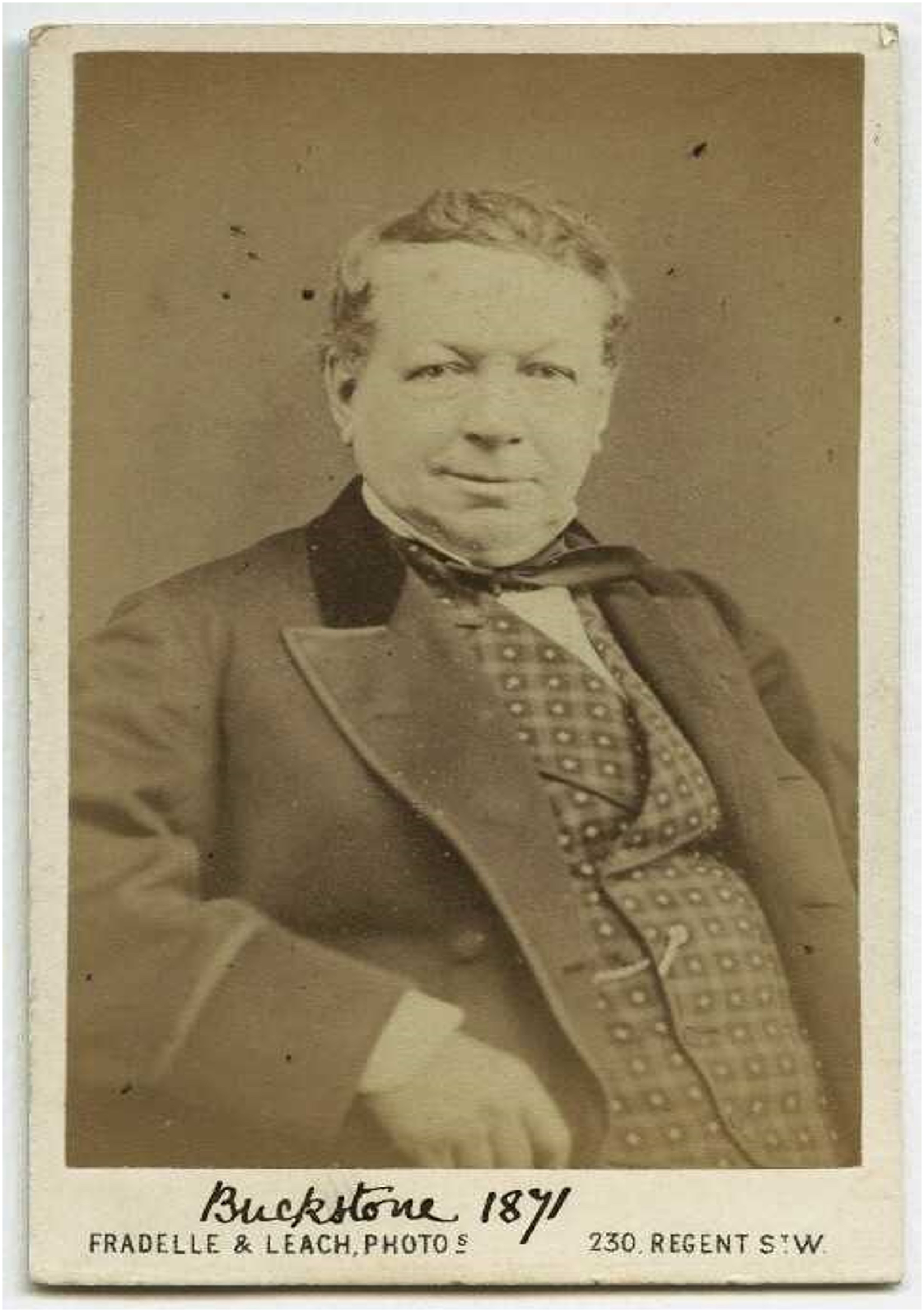
John Baldwin Buckstone in 1871, the year of the lease. Albumen Carte-de-Visite by Fradelle & Leach. National Portrait Gallery.
George Colman junior (1762–1836) had managed the old Theatre Royal, Haymarket from the King's Bench Prison where he was confined for debt (inherited from his father). He was forced to sell his shares to his brother-in-law, David Morris, giving Morris control. 7 Morris sadly had a reputation of being a despot towards his actors, not paying his writers, and whilst being an astute businessman, was not recognised as a ‘man of the theatre’. However, Morris was able to secure a lease dated 20 June 1821, for a plot of ground adjacent to the old theatre for ninety-nine years at a rent of £356 9 s 6d. A new, larger theatre – with today's surviving exterior, the distinctive Corinthian portico designed by John Nash – was built up against the south side of the previous theatre, and the earlier building was turned into shops (see Figure 2). 8 This new Haymarket Theatre opened on 4 July 1821 with The Rivals by Richard Brinsley Sheridan (1751–1816) as the main entertainment, and Morris continued to run it under its summer licence until his death in 1842.
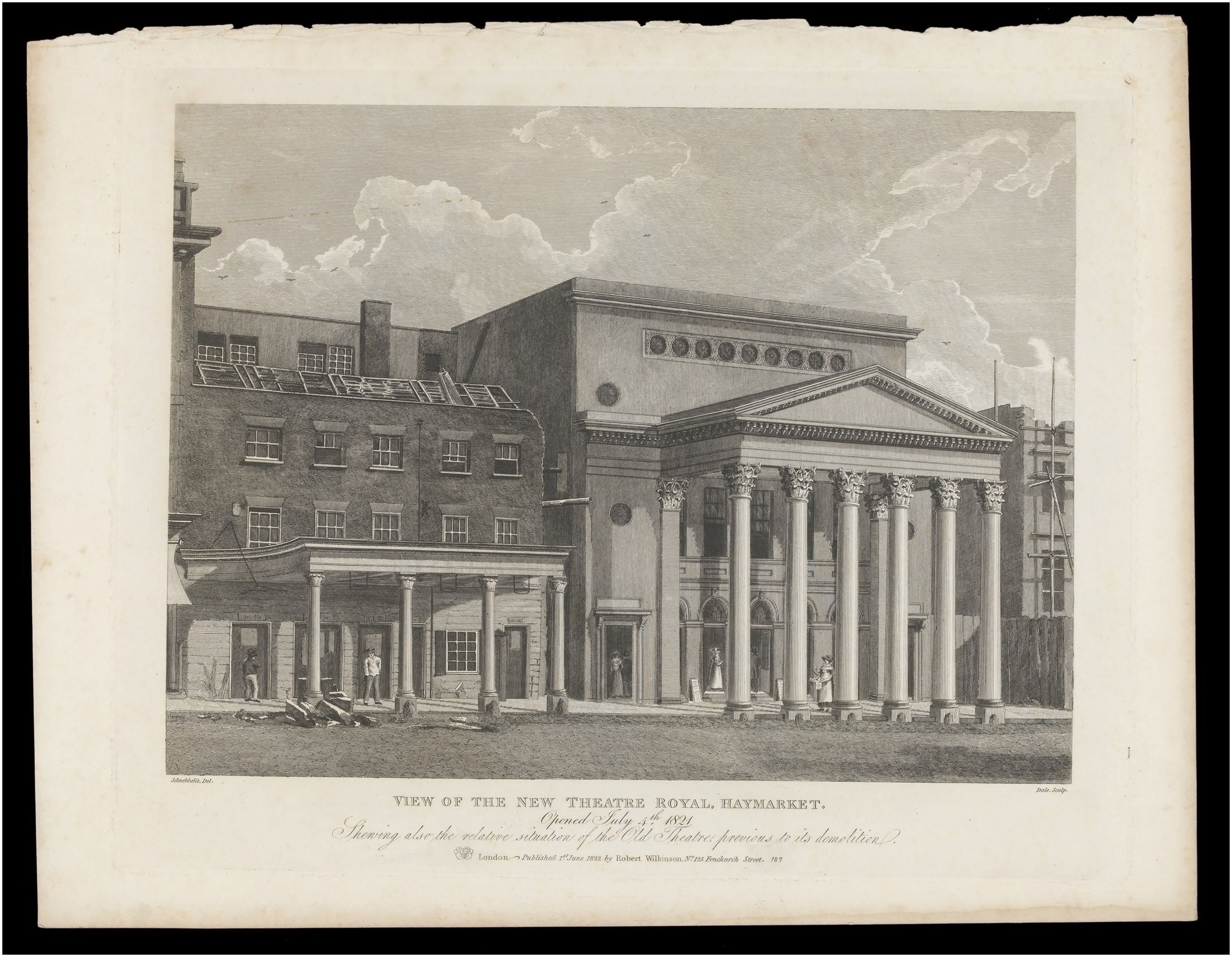
The exterior of the new Haymarket Theatre in 1821, with the old building beside it. Harry Beard Print Collection, V&A Theatre and Performance Collection.
At the time Morris died the Haymarket was managed by the actor, manager, and playwright Benjamin Webster and he agreed to take over the lease, arranging quite favourable terms from Mrs Morris. 9 The theatre prospered under Webster, who in turn handed the management over to Buckstone in 1854. ‘Bucky’, a perennial favourite with audiences, had been acting at and writing plays for the Haymarket since first appearing there in 1833. 10 Under the terms of Morris's will, the estate had passed to his widow, as his only daughter Frances Anne had died in 1849 at the age of sixteen, and his only son Edward was also deceased, having died in 1852 at age thirty. Maria Sarah Morris had remarried in 1844, to Henry Drummond, whom she also outlived, so it is her name that appears as proprietor on the 1871 lease (see Figure 3).
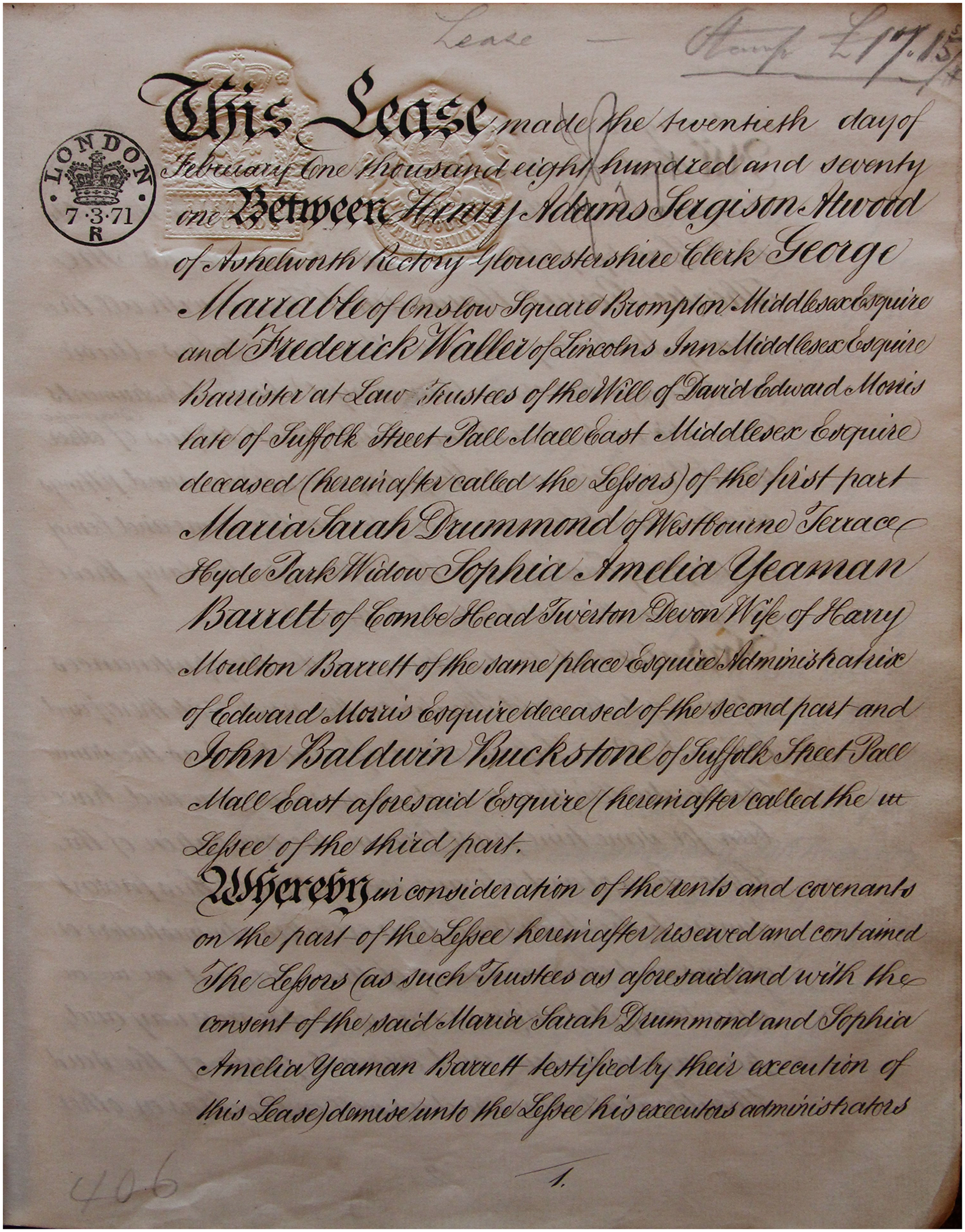
The first page of the lease, which contains the names of the proprietors. Courtesy of the Garrick Club, London.
Before he died, Morris's son Edward had married Sophia Amelia Morris Holland (1826–87), who remarried in 1860 to Henry Moulton-Barrett (brother of Elizabeth Moulton-Barrett Browning). 11 Sophia Amelia Yeaman Barrett is named as administratrix of the estate on the lease. Thus by 1871, control of the theatre had passed to Morris's widow, as well as his son's widow. It was therefore these two women who made the agreement of the terms of the Haymarket with Buckstone.
The terms of the lease give free admission to a box for both Maria Sarah and Sophia Amelia (see Figure 4). 12 Sometime after the signing of the 1871 lease, perhaps upon Maria Sarah's death in 1872, free admission is transferred to Maria Elizabeth Moulton Barrett (formerly Morris, though her relationship is unknown). She had become the second wife of Octavius Butler Barrett (another brother of Elizabeth Browning) in 1865, suggesting a certain familiarity between the Morris and Moulton Barrett families; indeed, the Morris home on Westbourne Terrace was not too far away from Wimpole Street.
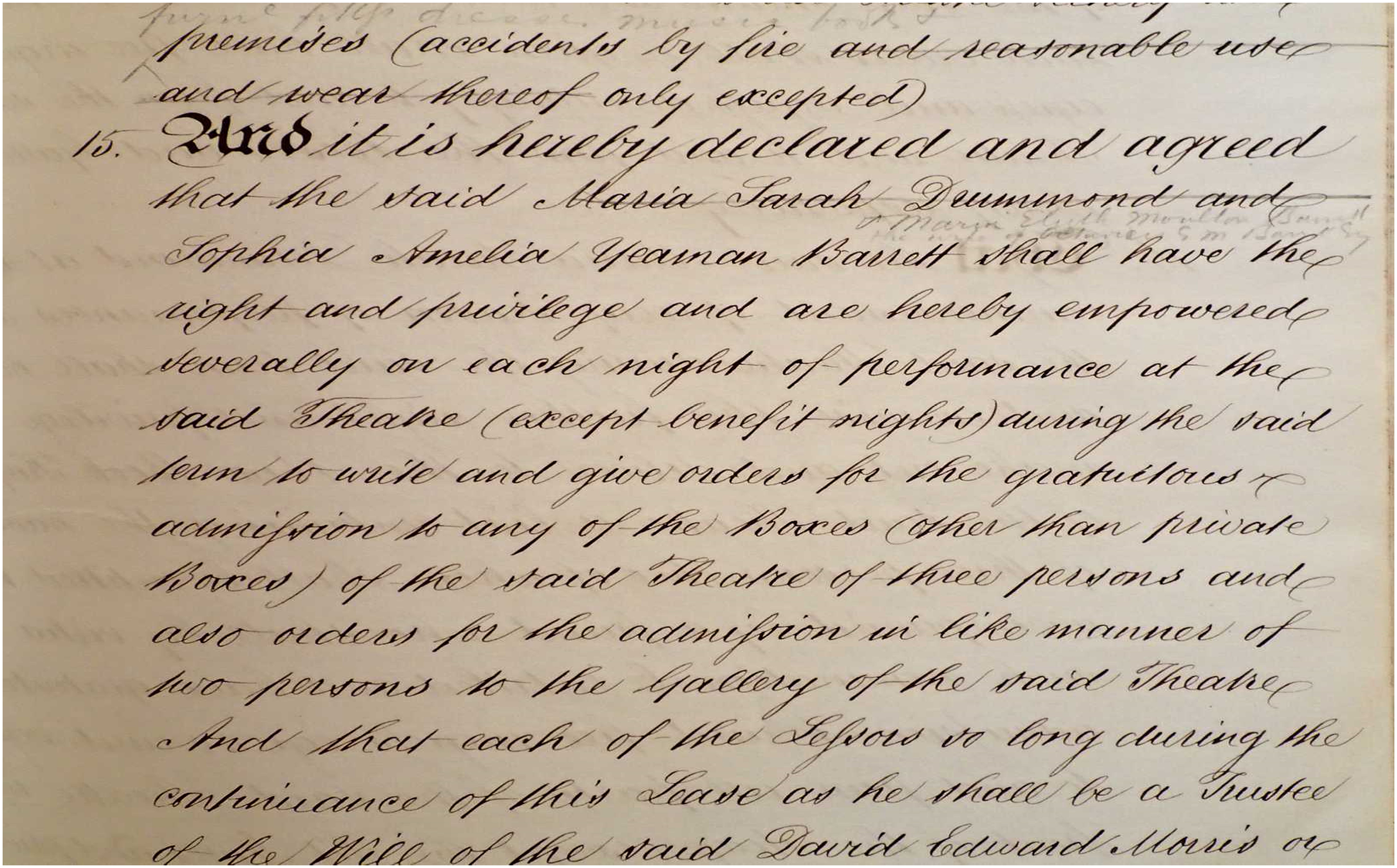
The lease stipulates free admission to the theatre for surviving Morris family members. Courtesy of the Garrick Club, London.
A second schedule of employees attached to the theatre is listed in the lease, together with their salaries. These include a George Morris, ‘Property Man and Painter’, and a Barrett (no first name given), the ‘Principal Man's Wardrobe Keeper’; both are presumably related in some way to the family (see Figure 5). 13 Those mentioned in the second schedule must be retained, according to the terms of the lease. In this way Morris's familial influence over his theatre was still being felt for many years after his death.
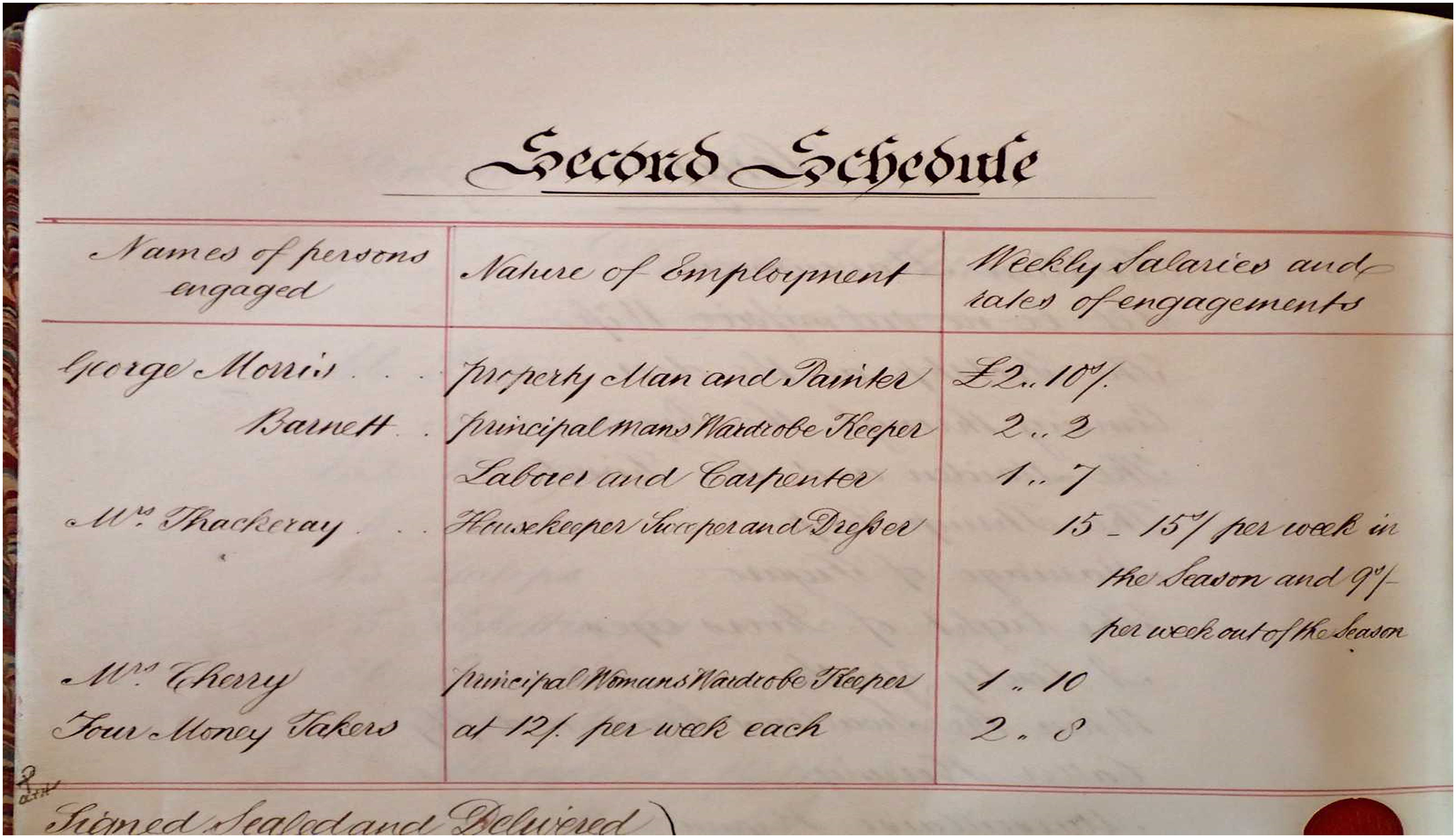
The ‘Second Schedule’ of theatre employees. Courtesy of the Garrick Club, London.
The London Gazette of 23 April 1872 reported the winding up of Maria Sarah's estate following her death. 14 Buckstone took this opportunity to extensively redecorate the theatre. However, in 1877 ill-health and financial troubles forced his retirement from the stage, and he was declared bankrupt in March 1878. At this point John Sleeper Clarke (1833–99) assumed management, albeit only briefly. Squire Bancroft (1841–1926) took on the theatre in 1879, now freed from the constraints of the Morris Estate, and completely gutted and remodelled the theatre's interior.
Did the lease constrain activities at the theatre throughout Webster and then Buckstone's management? The annual rent was £3,510 in 1871, and the payment of this rent gave the management the use of the theatre and its contents, including ‘Scenery Machinery Furniture Wardrobe Dresses Music (whether printed or in Manuscript) Musical Instruments Dramatic and other Manuscripts printed Copies of Dramatic Works Decorations and Stage properties fixtures and fittings’. 15 These are listed in detail in an inventory attached to the lease running to over two hundred pages. Everything remained the property of the proprietors. Nothing was to be removed without permission. The lease also demanded that the building and its contents should be kept in good order by the management, that they were liable for all damage, that nothing be done that might lead to the loss of its licence as a theatre, and that any new fittings or alterations be removed.
This last clause seems to have caused some issue to Webster when in 1843, the year he assumed management, he installed gas lights to the theatre. The Haymarket was therefore the last major theatre in London to have made the transition (a full twenty-five years after the first gas was installed at the Royalty Theatre). The ‘Gas pipes and fittings which have been laid down by and purchased of the Lessors’ are given particular mention in the lease. 16 It would seem that Webster had to not just have special permission for installing gas but had to pay for it himself and then gift the fittings, including the large chandelier, to the proprietors. In his farewell speech upon handing over the management to Buckstone in 1853, he suggested he had spent some £12,000 on redesigning and refurbishing the auditorium. 17 By 1871 the gas fittings are finally listed as the property of the proprietors. Buckstone's bankruptcy suggests the theatre placed a similar strain over his finances. Yet the installation of gas by Webster does show the theatre changing and adapting to new circumstances. This was the year the Theatre Regulation Act ended the patent theatres’ monopoly over the drama, and the Haymarket now would no longer be restricted to just the summer season. Yet at the same time the theatre would be faced with new direct competition from the minor theatres, and perhaps this is how Webster persuaded the proprietors to allow him to install gas, so as to level the playing field with the newly permitted drama houses.
Another clause in the lease asserting Morris's influence from beyond the grave ensures that the management should not ‘sanction or allow by … the representation of any of the Plays the Copyright in which belonged to the said David Edward Morris deceased to take place or be made at any other Theatre’. 18 The physical plays belonged to the estate as property, as did the performance rights. 19 The titles held in the manuscript library (see Figure 6) represent a wide historical span of productions first produced at the Haymarket, from The Agreeable Surprise (1781), a comic opera by Samuel Arnold (1740–1802) with libretto by John O’Keefe (1747–1833), to Colman's play The Actor of All Work (1817), and Buckstone's Adventures with a Polish Princess (1855), a farce by George Henry Lewes (1817–78) written especially for Buckstone. 20
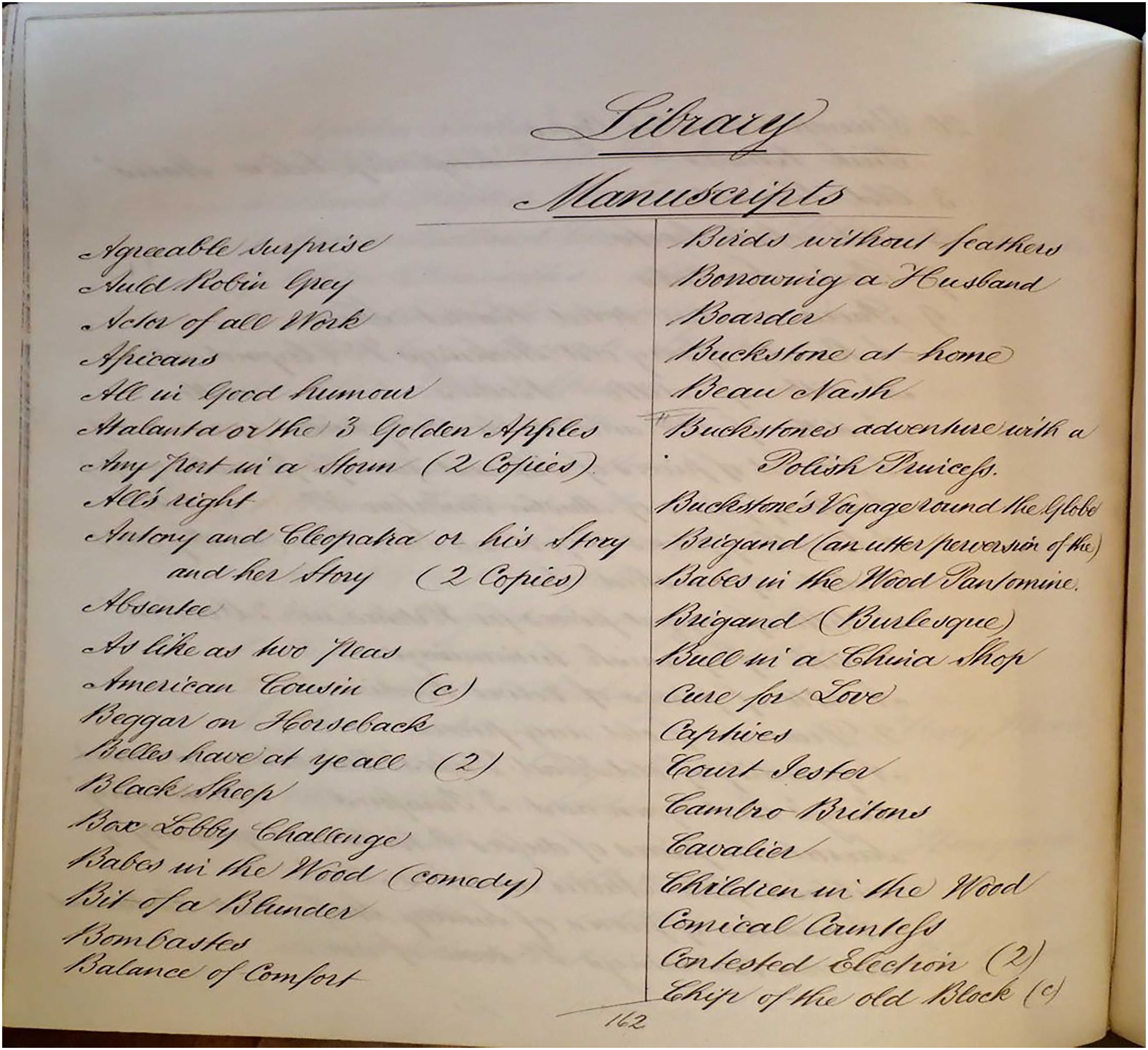
Manuscript plays in the Haymarket's library. Courtesy of the Garrick Club, London.
The lease also stipulates that the Haymarket managers must also not operate, manage or be involved in any other theatre, other than in the capacity of actor. And finally, the proprietors even used the lease to set the prices of admission (see Figure 7).
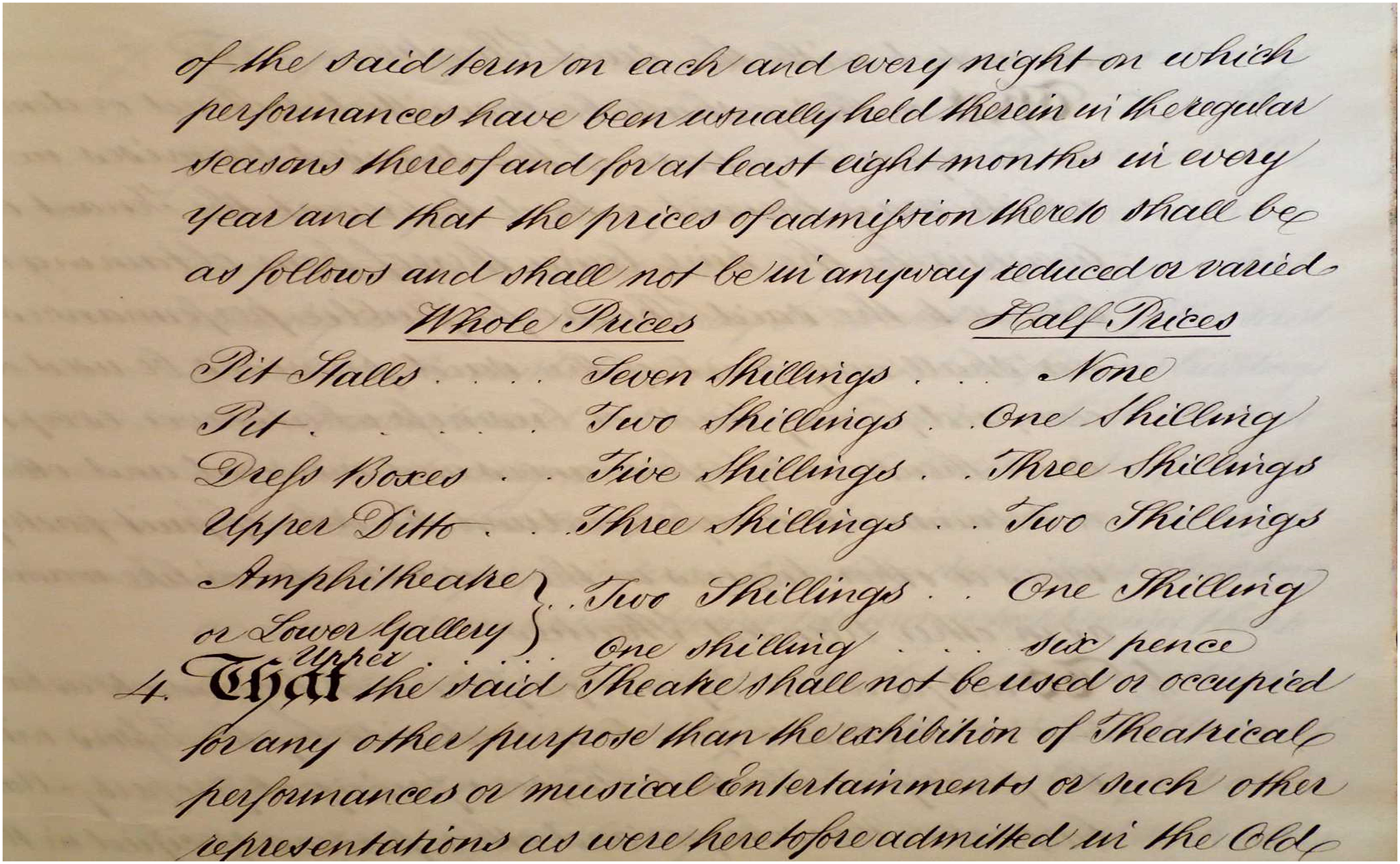
Stipulating the prices of admission to the theatre. Courtesy of the Garrick Club, London.
The inventory attached to the lease lists a wealth of properties and dresses. Occasionally these are associated with a specific production; one page (see Figure 8) mentions for example a ‘Suit of Brown Cloth Coat and vest and Satin Trunk’ for The School for Scandal, as well as another suit of men's clothes for She Stoops to Conquer and costumes for Misses Wright, Howard and Prosoe for Orpheus. 21 Dozens of other costumes have descriptions that identify their intended use, for instance the entry describing an ‘Old Blue Coat, 4 Jackets, 1 Vest, Pair Trunks and old Hat (Irish things) [for Tyrone] Power as [Paddy] O’Rafferty’ or the Suit of Green Velvet Jacket, Gold trimming, Crimson Silk Cape trimmed with black and gold, Purple Satin Coat, Gold trimmings, Satin trunks and Gaiters, white Satin Vest and 2 Hats – Miss Wright in “Brigand”’. 22
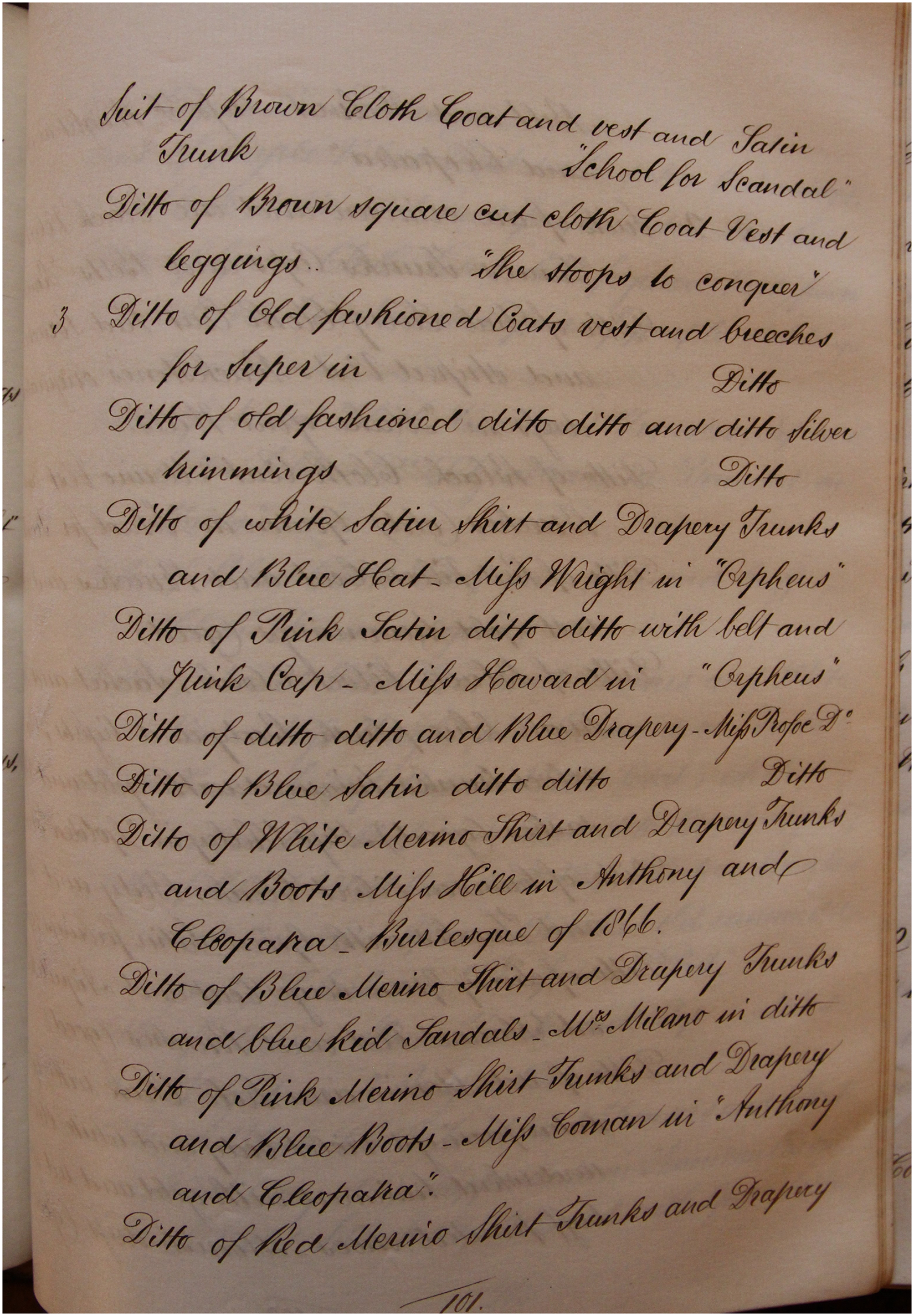
A page of ‘Theatrical Properties’ described in the lease. Courtesy of the Garrick Club, London.
The extensive list of properties and effects seem to be an accumulation of stuff, suggesting perhaps this is a theatre where not much is ever thrown out (not least because it remains the property of the proprietors): 142 pieces of framing of various descriptions, small quantity of carpenters’ stuff on stage, some old iron cog wheels, quantity of old stuff and pieces fit only for fire wood. The old fittings of dress circle and stalls. The old stairs to Dressing Room over Porters Lodge … Winding staircase from old theatre.
23
It is notable that throughout a period of management by men – both Webster and Buckstone's periods – the economic power behind the theatre appears to be controlled by a woman. How interested or disinterested were they in the day-to-day operation of the theatre? Maria Sarah deserves further study, not least because of her family relationship to the Moulton-Barrett clan and Elizabeth Barrett Browning. 26
The Musical ‘Theatrical Properties’
The detailed music holdings of the Theatre Royal Haymarket in 1871 are a particularly rich area for future musicological research. These include not only the music in the theatre's library but also prop instruments and equipment for the theatre's orchestra. In the middle of the nineteenth century, the Haymarket's emphasis was on mixed bills of comedy, melodrama, and comic opera, and they also put on pantomimes and ballets – so they needed a large orchestra. At this point in the century this was typically twenty to thirty regular players. 27
A sample of the entertainments on offer at the Haymarket can be found on a contemporary playbill for a performance on 30 October 1871 (nearing Buckstone's retirement). Plays included Sheridan's The Rivals (1775) along with John Maddison Morton's (1811–1891) newer comic drama One Good Turn Deserves Another! (1862) and a farce, W. T. Moncrieff's (1794–1857) Spectre Bridegroom (1821) (see Figure 9). The bill announces that ‘The Band, under the direction of Mr. SCHMUCK, will, during the evening, perform’ a somewhat international ‘selection of Music’ including the Overture to La Barcarolle by Auber, Strauss's ‘Promotionen Waltz’ and operatic medley piece ‘Künstler Quadrille’, Josef Gung’l's ‘Delaware-Klänge Waltz’, a selection from Gounod's Faust, bandleader Daniel Godfrey's ‘Barbe-Bleue Quadrille’, and Hertel's ‘Fantaska Galop’. 28 Upcoming performances are announced: Oliver Goldsmith's (1728–74) eighteenth-century comedy She Stoops to Conquer (1773) and a ‘new and original comedy’ by W. S. Gilbert (1836–1911) for Buckstone's benefit performance, Pygmalion and Galatea (1871).
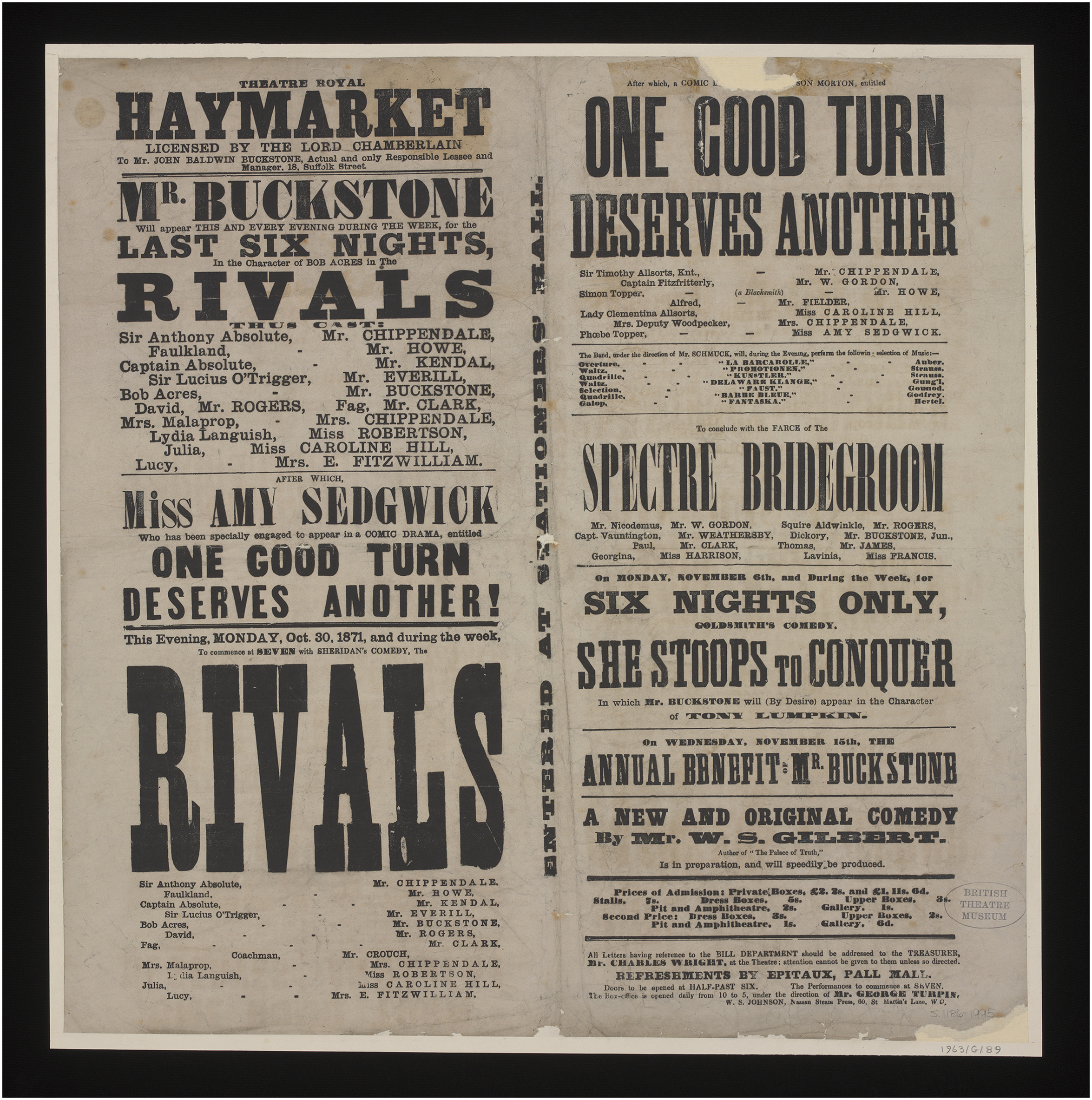
A poster for an 1871 performance at the Haymarket. V&A Theatre and Performance Collection.
The orchestra at this time was still out in front of the stage, just before the audience, and not yet lowered into an orchestra pit. (The orchestra was not moved under the stage until after Squire and Mrs (Marie) Bancroft took over management of the theatre in the 1880s). 29 According to the 1871 inventory, this space (described as ‘Orchestra’) held ‘2 Conductors Seats, 8 Stools, 13 Chairs, 12 Music Stands, 1 Conductor's ditto [music stand] and small hanging shelf side of same, 10 Stuff Cushions to Chairs, Speaking tube from Prompt Box’. 30 The size of the orchestra space fits the number of players that we know made up the season's orchestra numbers, as the number of seats (two conductor's seats, thirteen chairs, and eight stools) accommodates twenty-three people.
Musical activities at the Haymarket, like at other theatres, were not just confined to the orchestra area in the auditorium, however. These additional spaces (according to the lease), include the ‘Prompt Box’, the ‘Band Leader's Lobby’, a ‘Property Room near Orchestra’, the ‘Music Room’, the flies of the stage, and the ‘Supers Dressing Room on Site of old Carpenters Shop’.
The prompt box, the centre of operations during any show, is minutely described in the inventory. First, there are ‘3 [signal] Bells, [and] 1 knocker as fixed’. 31 The prompter closely supervised all of the cues and needed to signal the stage manager and the stagehands – it was also necessary to signal the orchestra to start the music. 32 The Haymarket's prompt box used up-to-the-minute technology. Not only does the inventory list two desks and seats in the prompt box, indicating a large space, but there are also regulators for the gas system, a clock, two speaking trumpets, and the ‘tube &c. complete to Flies and Orchestra’, which the inventory emphasises is ‘new’.
The ‘Band Leaders Lobby’ (possibly under the stage, near where the orchestra is commonly seated) contains only two fixtures: ‘1 Folding Counter top to turn up’ and ‘1 Gas bracket and shade’.
33
We have also a report of the contents of the ‘Property Room near Orchestra’ – perhaps this is where instrument cases were kept during performances? The room is nearly empty, according to the description, except for: ‘2 Counter tops and 2 drawers, 2 wide shelves at end of Room, 4 Small shelves in Recess, Closet with 4 drawers and shelves, 2 Small Shelves, 2 Gas Brackets’.
34
The ‘Music Room’ was presumably also located under the stage. It was made up of Seats as fixed round two sides of Room, One Desk with one Drawer (1 Drawer missing), 1 Deal [cheap wood] table and Drawer, 1 Enamelled iron wash basin with supply and cock complete as fixed in angle of Room, Stove as set and Fender, 10 Chairs (two broken), 1 Gas pendant with 1 Burner, Large Press with two doors and shelves, Ditto [large press with] four ditto [doors] and with two iron Bars Staples and Padlocks, 4 Rails with nine pegs as fixed, 2 Wooden brackets as fixed to wall with moveable rail for hanging bells.
35
Various musical instruments were scattered in unlikely spaces throughout the theatre. In the flies we find ‘3 Drums’, 37 and in the ‘Supers Dressing Room on [the] Site of [the] old Carpenters Shop’ there are ‘2 Kettle Drums and [a] portion of old pianoforte’. 38 The ‘Supers’ would be the wardrobe superintendents, and this room was likely situated next to the wardrobe rooms and other dressing rooms. 39 Why a broken-down piano and kettle drums are in a dressing room is unknown, but it is likely that it was being used as a property store at this time.
One space in which we might have expected to find an instrument would be the theatre's green rooms. Green rooms were public spaces for the company; most theatres used to have more than one for different levels of performers; and most had a piano. An 1826 description of Drury Lane refers to ‘The inferior Green Room, which contains a piano-forte, for the use of the performers and choristers’. 40 Often read-throughs would happen in these spaces, and audience members of high status could have access to these rooms in order to interact with performers. However, according to the inventory, the single green room listed does not contain a piano.
Fully twenty pages of the inventory are dedicated to detailing the ‘Theatrical Properties’.
41
Some of the interesting items include props for operas and noisemakers for the spectacular effects of melodramas and pantomimes. Music-related ‘Theatrical Properties’ include 1 Thunder Box and Shoot, 2 Lightning Boxes, 3 Large Rain Boxes, 1 Crash Box, 1 Sheet Iron for Thunder, 1 ditto [sheet iron] for Steam, 1 Long Steel Bar for Bell, 1 Lime Box for smoke, 2 Rows of 6 small Cannons and covers, 1 Gong Box and 2 Gong Beaters, 1 Whip Smack.
42
3 Property Pianofortes, 1 Pianoforte case, 2 Property Harps, 1 Harp Case, 5 Violins, 3 Property Drums, … Old Hurdy Gurdy and a piece of one, 2 Guitars, 3 Bagpipes, … 1 Anvil and Stand …1 Property Trombone, 1 Old Cornet, 1 French Horn, 1 Property Clarionet, 1 D.o [ditto] Violin … 6 Pans Pipes … 6 Trumpets, 1 Lute … 20 Hunting Horns and Chairs … 2 Bells, 3 Small hand bells … Tambour Frame broken … Pianoforte Tuner … 2 Triangles … 1 Music Stool, 3 legged Stool, 1 Foot Stool … 3 Music Books, Envelope Case, 4 Bells various, 2 Gong ditto.
43
There are also seven full pages of ‘Stage Furniture’ in the inventory, in which we find one ‘Music Stool…Old Harp Table…2 Choral Screens (one with Glass in)’. 47 There is a separate list titled ‘Pantomime Properties &c.’, which presumably were not used for other types of shows. This list includes ‘5 Bells and 26 Tambourines, 4 Guitars, and 18 Small Lyres….Hand Organ…2 Bladders and Sticks – Tub’. 48 These have long been common instruments in early British pantomimes and burlesques. 49
Contents of the Haymarket Library in 1871
The inventory divides the contents of the Haymarket Theatre's library into seven categories: ‘Manuscripts [plays]’, ‘Printed Books [plays]’, ‘Library Music’, ‘Entr’Actes Marches &c.’, ‘Overtures’, ‘Dance Music’, and ‘Songs’.
The inventory shows us that there was a sizeable number of musical scores in the theatre's library (see Figure 10). It lists 296 individual scores, and ‘Pantomime music’ is itemised under the ‘Library Music’ heading, but without discrete titles. The music for the most part is listed in alphabetical order by title. Not every one of the 296 scores can be easily identified, but we are able to make some general remarks.
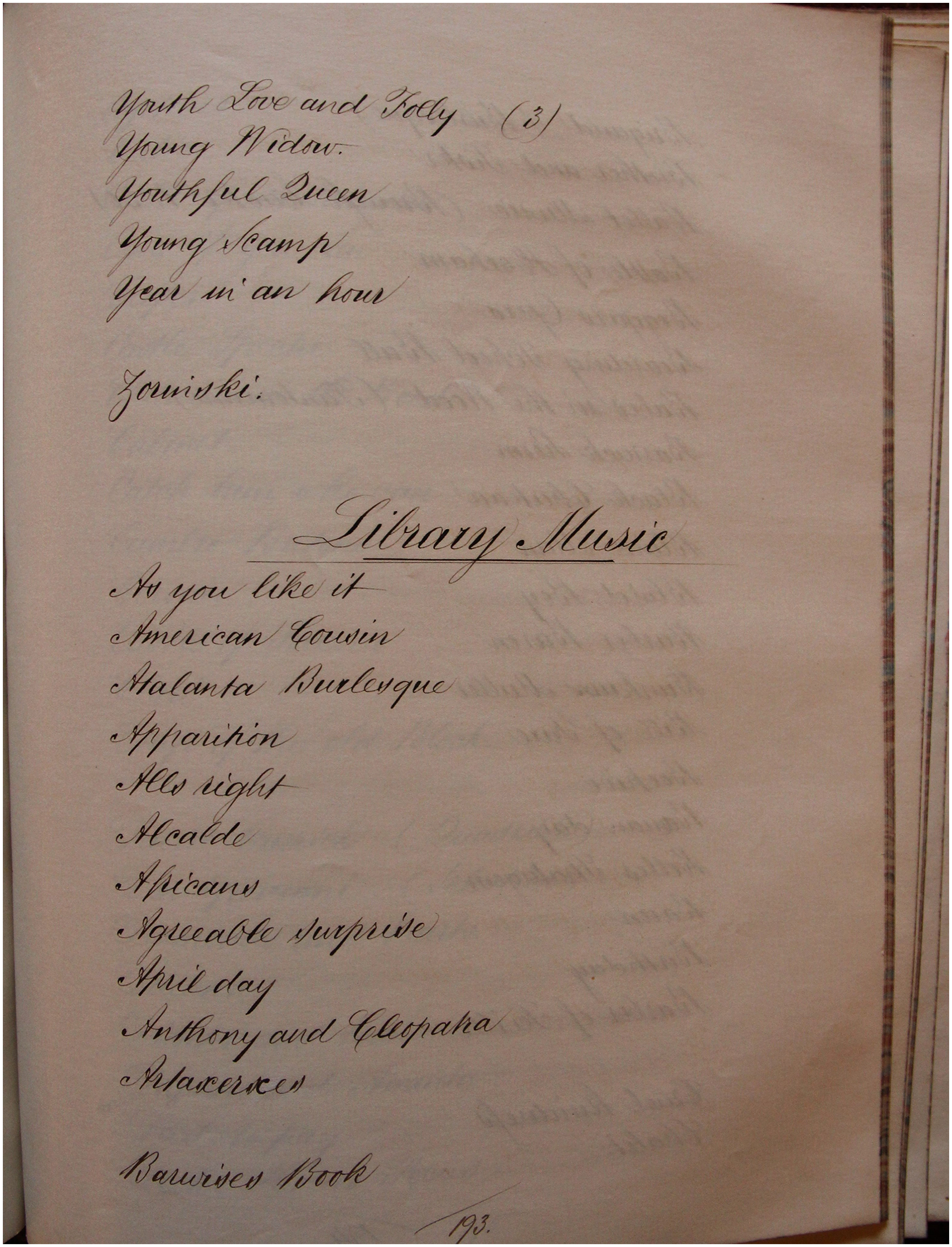
First page of ‘Library Music’. Courtesy of the Garrick Club, London.
The scores encompass adaptations of foreign operas (e.g. W. A. Mozart's (1756–91) Don Giovanni, 1787, and Joseph Weigl's (1766–1856) Die Schweizer Familie, 1809); music for plays (e.g. Goldsmith's She Stoops to Conquer, 1773 and Buckstone's Good Husbands Make Good Wives, 1835); old comic operas (e.g. John Davy's (1763–1824) What a Blunder!, 1800, and Bate Dudley's (1745–1824) The Woodman, 1791, with music by William Shield, 1748–1829); and other genres of old repertory pieces (Sheridan and Stephen Storace's (1762–96) revolutionary opera The Iron Chest, 1796, and Kane O’Hara's (c.1711–82) silly musical burletta Midas, 1760). Most of Buckstone's comedies have scores in the library. There are also additional scores by British composers such as Samuel Arnold (1740–1802), the Dibdins (including father Charles, 1745–1814, and sons Charles Isaac Mungo, 1768–1833 and Thomas John, 1771–1841), William Reeve (1757–1815), Thomas Arne (1710–78), M. P. King (c.1773–1823), James Hook (1746–1827), Tom Cooke (1782–1848), Michael Kelly (1762–1826), Thomas Attwood (1765–1838), Charles Smith (1786–1856), and many others.
There are problems identifying some of the music that was held in the library. First, the scribe usually has written only one or two words of the title. Sometimes the word indicates a rather obvious piece, such as ‘Figaro’ or ‘Freischutz’. 50 However, it is more difficult to determine a precise production from a title like ‘Anthony and Cleopatra’ (see Figure 10) – is this music for a revival of Shakespeare's tragedy or is it the score for the Grand New and Original Burlesque Entitled Anthony and Cleopatra, or His-Story and Her-Story in a Modern Nilo-Metre (1866) by F. C. Burnand (1836–1917) and Buckstone? 51 The shorthand use of one-word titles in the inventory – like ‘Undine’ or ‘Prize’ – are especially frustrating, as they could refer to any number of pieces.
The category ‘Entr’actes and Marches &c’ seems to be a catch-all for everything performed in between the acts of the theatre that was not a popular dance or a stand-alone song or overture (see Figure 11). Here we find everything from ‘Hadyns symphonies’ to tarantellas and selections from Don Giovanni.
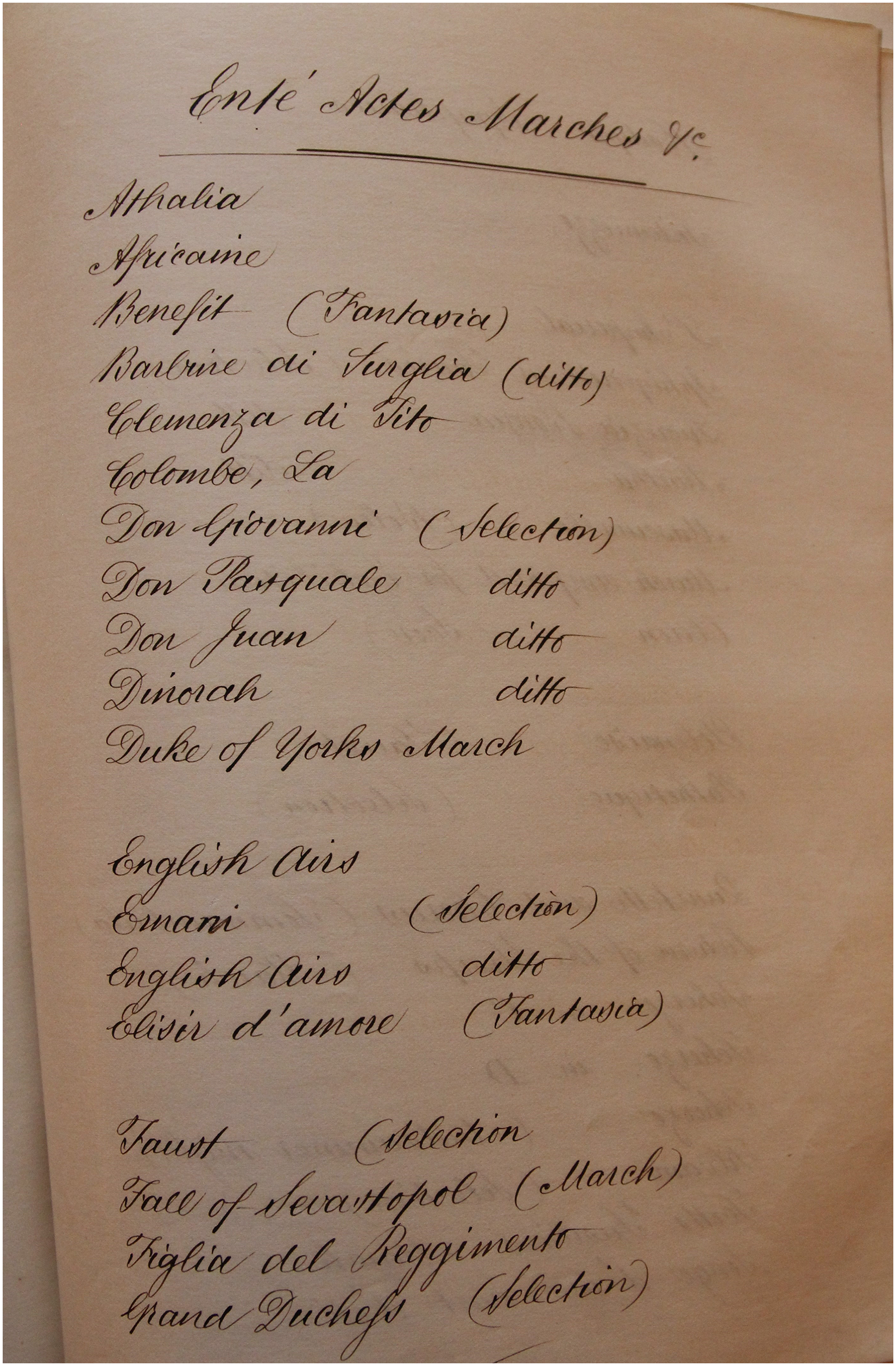
‘Entr’actes and Marches &c.’ Courtesy of the Garrick Club, London.
The overture section of the inventory has an even larger number of items registered: there are fifty-nine individual overtures listed, along with ‘12 books Mozarts and Rossini's overtures’ and ‘God Save the Queen’. Most of the overtures are for French opéras-comiques and Italian and German operas not listed in the ‘Library Music’ portion of the inventory. The composers most commonly recorded are Daniel Auber (1782–1871) (fifteen overtures, with one opera overture listed three times), Mozart (four individual entries, plus the book of overtures), and Gioachino Rossini (1792–1868) (five individual overtures listed in addition to the book, with two opera overtures listed twice) – these three composers alone make up fifty-eight per cent of the overtures listed. The overtures could be used to introduce plays or burlesques, but (according to surviving bills) were more frequently employed as entr’acte entertainment.
Audiences were passionate about dance and so a variety of dances were on hand to ensure a successful theatrical evening (see Figure 12). David Haldane Lawrence quotes journalist Dutton Cook complaining in 1876 that ‘No connection is ever sustained between the nature of the play and the character of the music’. He cites as an example the Independent Theatre's revival of John Webster's (c.1578–c.1632) Jacobean tragedy The Duchess of Malfi, in which the orchestra played ‘sprightly polkas and selections from the … operas’ in between the acts. 52 The Haymarket playbill described above (see Figure 9) likewise shows that the 1871 performance of The Rivals and the Spectre Bridegroom was surrounded by a number of popular quadrilles and waltzes.
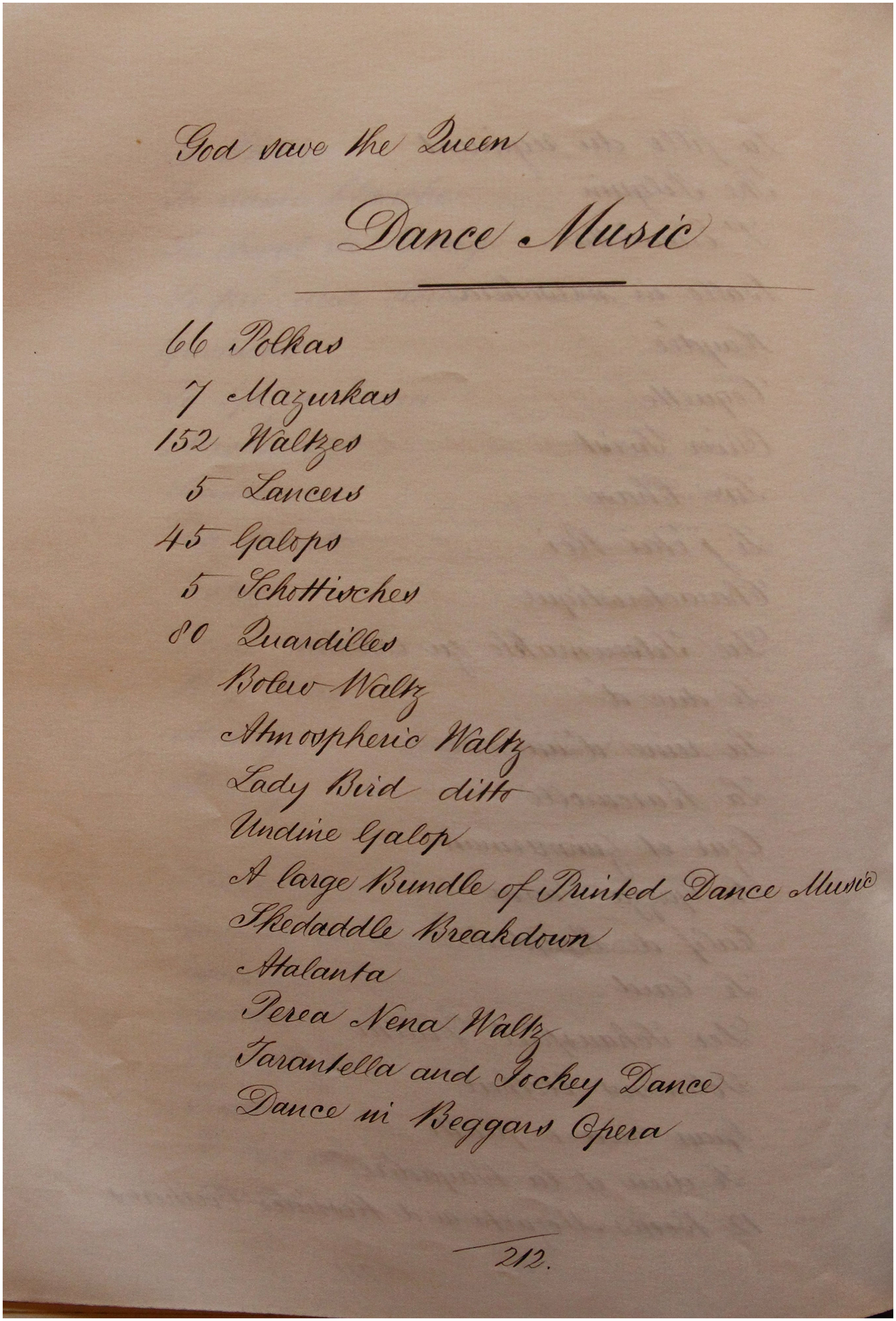
‘Dance Music’. Courtesy of the Garrick Club, London.
Waltzes have by far the most entries in the inventory of dance music, followed by quadrilles, polkas, and galops. A few dances were inventoried separately, possibly due to their extreme popularity or uniqueness in some way (perhaps they were in manuscript, since ‘a large bundle of printed dance music’ is listed as a separate item). 53 For example, the ‘Dance in Beggars Opera’ (see Figure 12) is likely the ‘dance of Prisoners in Chains, &c.’ in the third act of the famous 1728 ballad opera, still in the repertory in the nineteenth century; this is the scene where Macheath is condemned in the hold of Newgate Prison, just before his soliloquy. Thomas Arne wrote a hornpipe for it in the 1769 edition of the music, and it could be this music which is listed. 54 It could also possibly be the mysterious dance that concluded the opera in the eighteenth century, for which no music survives. Out of the nine named dances on this list, only three were definitively published; the loss of this ephemeral popular music is eminently regrettable.
The final part of the library inventory includes fifteen separately inventoried songs. 55 These stand-alone songs are not related to any of the other musical works held in the library, or they would be part of the other scores. It mistakenly might be assumed that these were the fifteen most popular stand-alone songs performed frequently at the Haymarket in 1871, if it were not part of this final entry in the music inventory: ‘6 Books and 210 pieces vocal and Instrumental Music’, and then ‘574 Pieces ditto ditto’. 56 At the end of the listing of all of this music, it seems as if the cataloguer just gave up listing each sheet song separately after recording only the first fifteen titles.
This lease, with its detailed 214-page inventory, has a great deal to offer theatre historians, dance scholars, and musicologists. Not only does the document illuminate more for us about the ‘business of the theatre’ in the 1870s and the long influence of Morris's estate, but its inventory also allows scholars to learn more about the inner workings of the Haymarket, giving us a clearer idea of the needs of the productions, the way the space was used within the building, and the dizzying amount of music heard at the Haymarket in the middle of the nineteenth century.
Footnotes
Acknowledgements
This paper was first presented at ‘The London Stage in the Nineteenth-Century World II’ conference at New College, Oxford (5–7 April 2018) as ‘The 1871 Lease of the Theatre Royal Haymarket to John Baldwin Buckstone: An Extraordinary Document of Ordinary Theatre Business’. Special thanks to Chandler Hall, who contributed research on the operas in the inventory, and especially Moira Goff and Marie Hawkins at the Garrick Club of London, who have greatly assisted the authors with the preparation of this article.
