



Abstract
An office on the first floor of the Theatre Royal, Haymarket has six images painted directly on the walls that have remarkably survived many redecorations. This room was actor-manager Cyril Maude's dressing room between 1896 and 1905 when he was joint manager of the Theatre Royal alongside Frederick Harrison. To its fullest extent, Maude's exceptional dressing room was adorned with a gallery of forty images created in greasepaint by fellow actors and friends. Famous cartoonists Phil May, Harry Furniss, Bernard Partridge, Leonard Raven-Hill and Leslie Ward left their mark. The greasepaint gallery can be read as an extension of the fashion for collecting autographs; most of the images were signed and some dated. Equally, the gallery acts as a nostalgic scrapbook commemorating productions and recording famous visitors who were granted entrée behind the scenes. The gallery signalled Maude's standing in artistic, literary and social circles and thereby reinforced his own celebrity status.
An office on the first floor of the Theatre Royal, Haymarket has six images painted directly on the walls that have remarkably survived many redecorations. This was the dressing room of actor-manager Cyril Maude (1862–1951) between 1896 and 1905 when he was joint manager of the Theatre Royal alongside Frederick Harrison (1853/4–1926), who was the lessee. Photographed in situ on the walls of the dressing room they can be identified as follows: Mortimer Menpes, Constance Collier in One Summer's Day; Leslie Ward (‘Spy'), Portrait of Lord Salisbury (Figure 1); Robert Baden-Powell, Pig-sticking; Joseph Harker, A Winter Landscape; Phil May, ‘Thank God I've finished’, caricature self-portrait (Figure 2); Harry Furniss, caricature of William Ewart Gladstone (Figure 3).
1
Scenery painter, Joseph Harker, described his contribution in his memoirs published in 1924: Talking with the stage doorkeeper at the Haymarket a few evenings ago, I was reminded of the existence in that theatre of what at one time was, and possibly still is, the most remarkable dressing-room in stageland, and my own modest contribution to its uniqueness. It was several years ago that Cyril Maude greeted me with the request that I should add to the collection of grease-paint pictures in his dressing-room. Helping myself to the contents of his make-up box, I ‘painted’ a winter landscape on one of the walls of the room, which was decorated with pictures done in this medium by famous artists, among them Phil May, Tom Browne, Holman Clark, Harry Furniss, Raven-Hill, ‘Spy’, and Arthur Collins, of Drury Lane, who is spending his retirement in giving full rein to his passion for painting. Nowadays, I understand the best of the pictures are preserved under glass panels affixed to the walls.
2
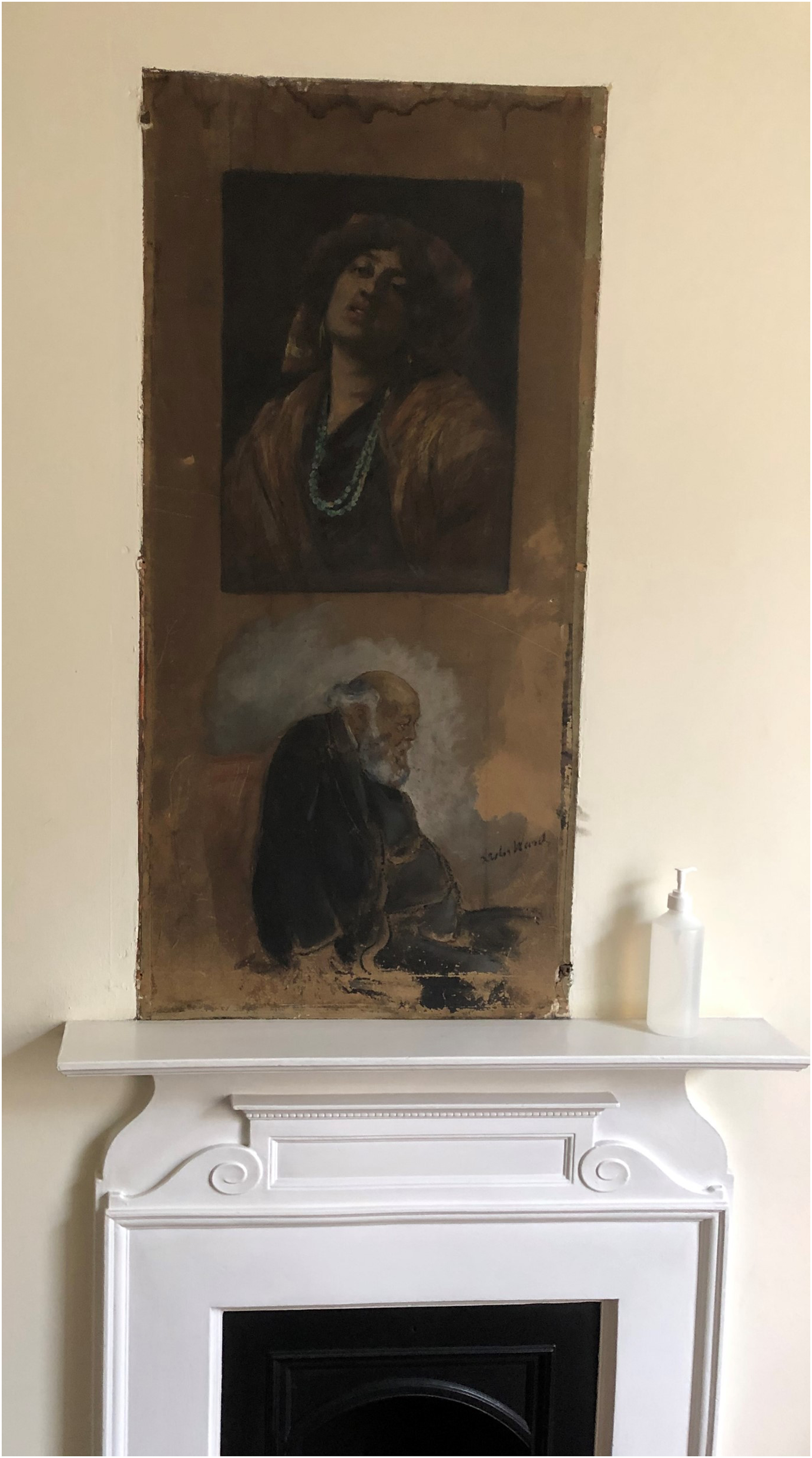
Above, Mortimer Menpes, Constance Collier in One Summer's Day; Leslie Ward (‘Spy’), Portrait of Lord Salisbury. The wall paintings are shown in situ recording their actual condition. As they were created using greasepaint, they have darkened with age. The individual images have been digitally enhanced.
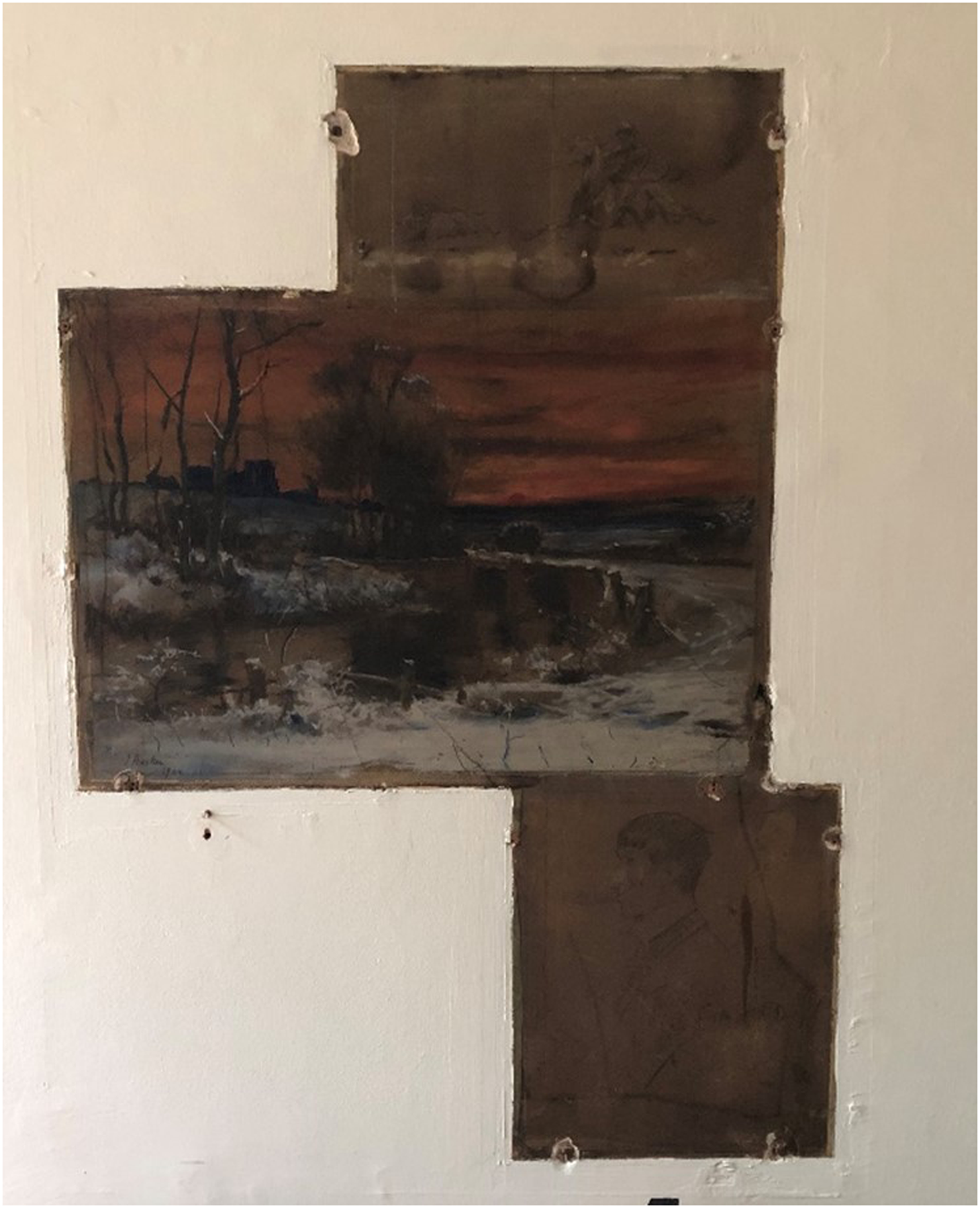
Top, Robert Baden-Powell, Pig-sticking, signed with the initials R.B.P (very indistinct); middle, Joseph Harker, A Winter Landscape, 1902; bottom, Phil May, `Thank God I've finished', caricature self-portrait.
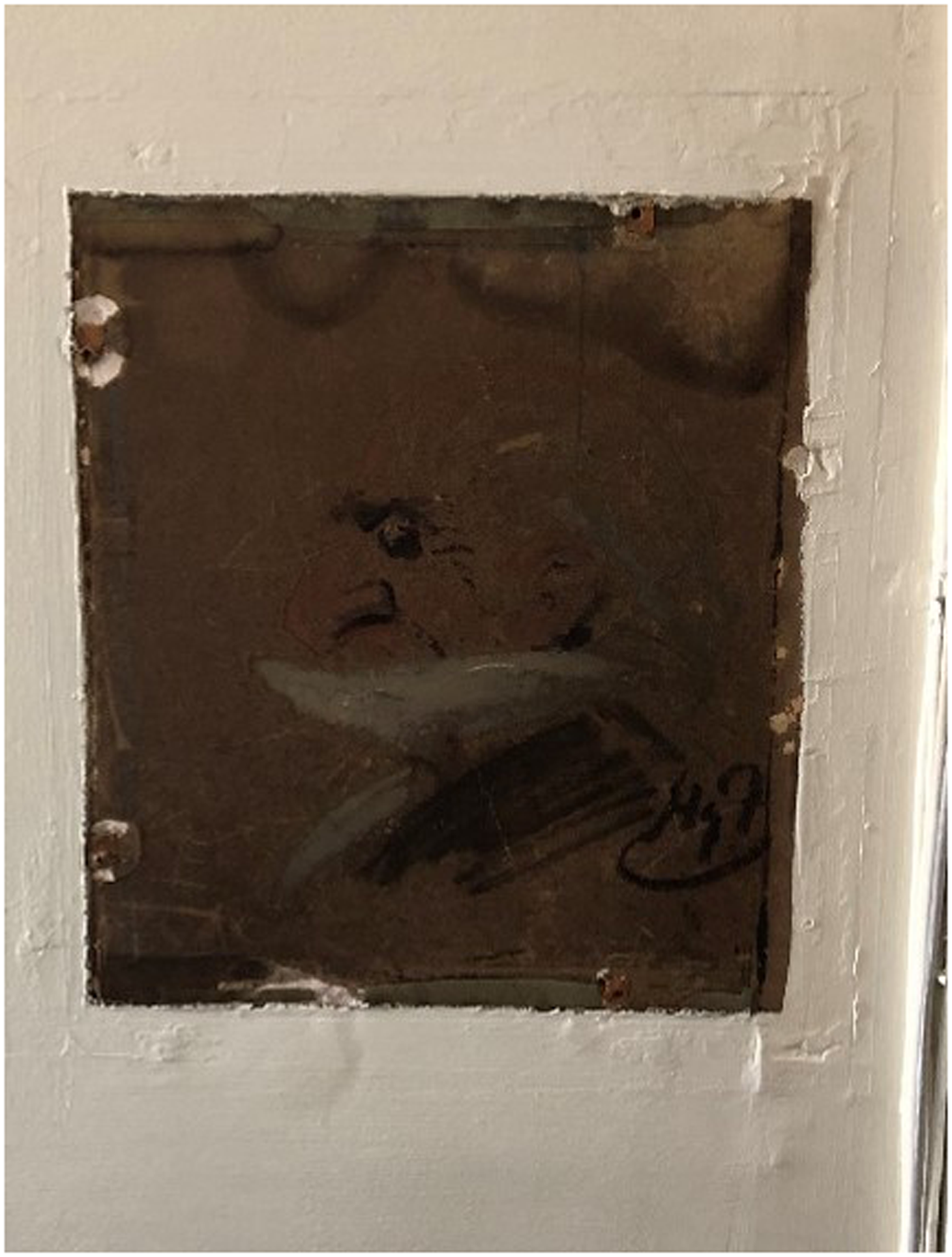
Harry Furniss (1854–1925), Caricature of William Ewart Gladstone.
Harker's account provides significant information; the medium was greasepaint, and the ‘best’ were protected by glass panels. 3 Harker confirms May, Ward and Furniss as fellow contributors, adding Tom Browne, Holman Clark, Leonard Raven-Hill and Arthur Collins, manager of the Theatre Royal, Drury Lane. Evidently, at one time, there were many more images painted directly on the walls. Several accounts of Maude's novel art gallery were published at the time, indicating it achieved considerable notoriety. These sources can be used to reconstruct the extent of Maude's greasepaint gallery and evaluate its significance, particularly the light it throws on dressing room culture.
Writing in March 1899, journalist G. S. Edwards's attention was caught by ‘many curious drawings made upon the walls by well-known artists’ as well as Maude's autograph board, ‘which contained the names of quite a multitude of celebrities’, those who had ‘been privileged to visit the actor-manager behind the scenes’. 4 The article also illustrated one of the wall paintings, Winifred Emery (1861–1924), Maude's wife and leading lady during the Maude-Harrison partnership, as Babbie in The Little Minister (Figure 4).
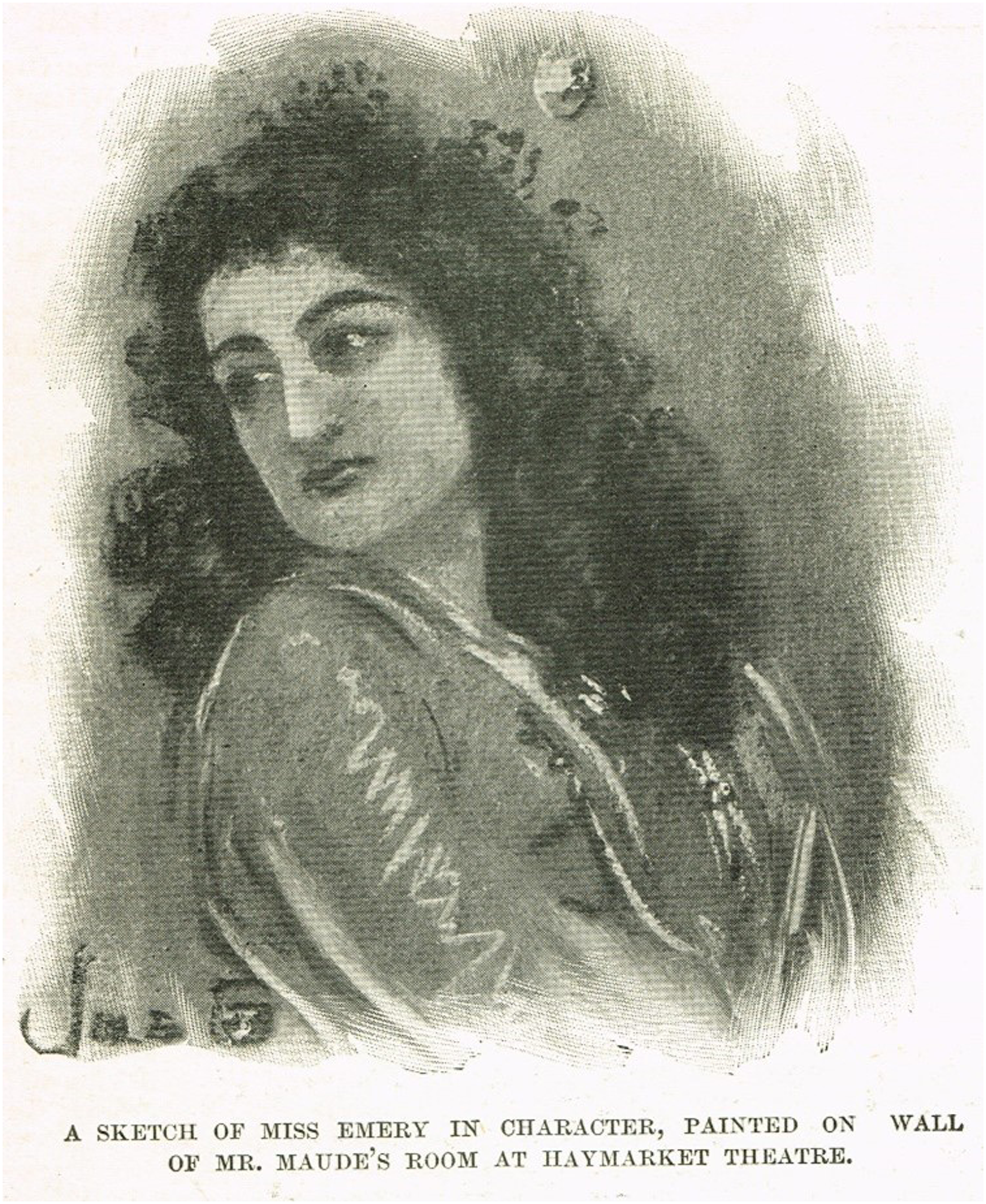
‘A Sketch of Miss Emery in character, painted on the wall of Mr Maude's room at Haymarket Theatre' from G. S. Edwards, ‘Concerning Mr and Mrs Cyril Maude (Miss Winifred Emery)’, The Illustrated Sporting and Dramatic News, 15 March 1899, p. 134.
Published some eighteen months later, in November 1900, actor-journalist Rudolph de Cordova's ‘Famous Dressing Rooms ‒ Where Noted Actors Make Up’ appeared in the Harmsworth London Magazine.
5
This provides further details: Mr Maude's is a long, narrow room, whose single window looks on to Suffolk Street. It is his ambition to convert it into a grease-paint gallery of pictures, and the walls are already adorned with many works of art in this curious medium, which is usually only used for treating the face of the actor for the stage. These are not framed pictures, however, but are done direct on the wall itself, so that they can never be taken away, and furnish a silent proof that Mr Maude evidently intends to make the Haymarket his permanent abode. Prominent in the gallery is a portrait of Miss Emery as Lady Babbie in the rags of the Egyptian
6
, by Julius Goodman
7
; a sketch of a Pierrot against a red background by Mr Bernard Partridge, of which Jan Van Beers might be proud;
8
sketches by Mr Holman Clark of himself and Mr Maude in A Marriage of Convenience; and of Mr Gladstone, by Harry Furniss, over which last is a remarkable picture by a clergyman friend [Canon Norris] of Mr Maude's whose fag he was at Charterhouse. It represents a street scene, with the Houses of Parliament in the distance, the building being suggested without any paint at all, the grey colour of the wall being used for the purpose, and the effect being obtained by the way the clouds are made to hang in the picture.
9
In Behind the Footlights (1904), published in the year before Maude left the Haymarket, Mrs Alec-Tweedie, the nom de plume of Ethel Brilliana Tweedie, alludes to the existence of many more images: Cyril Maude has a particularly interesting dressing room at the Haymarket Theatre. It is veritably a studio, for he has persuaded his artistic friends to do sketches for him on the distempered walls, and a unique little collection they make. Phil May, Harry Furniss, Dudley Hardy, Holman Clark, Bernard Partridge, Raven-Hill, Tom Browne are among the contributors, and Leslie Ward's portrait of Lord Salisbury is one of the finest ever sketched of the late Prime Minster. It is a quaint and original idea of Mr Maude's, but unfortunately those walls are so precious he will never dare to disturb the grime of ages and have them cleaned.
10
Finally, an anonymous article, ‘Mr. Cyril Maude's Dressing-Room and Its Pictures in Grease-Paint’ in The Strand (July 1904), would appear to offer a definitive account of the gallery. 11 Taking an archaeological approach, this charts the images wall by wall, providing written and photographic illustrations (Figures 5–9). Using this source, the scale of the gallery, comprising forty works at its fullest extent, can be reconstructed: Maude's fellow actors, famous cartoonists, illustrators and artists and close friends left their mark.
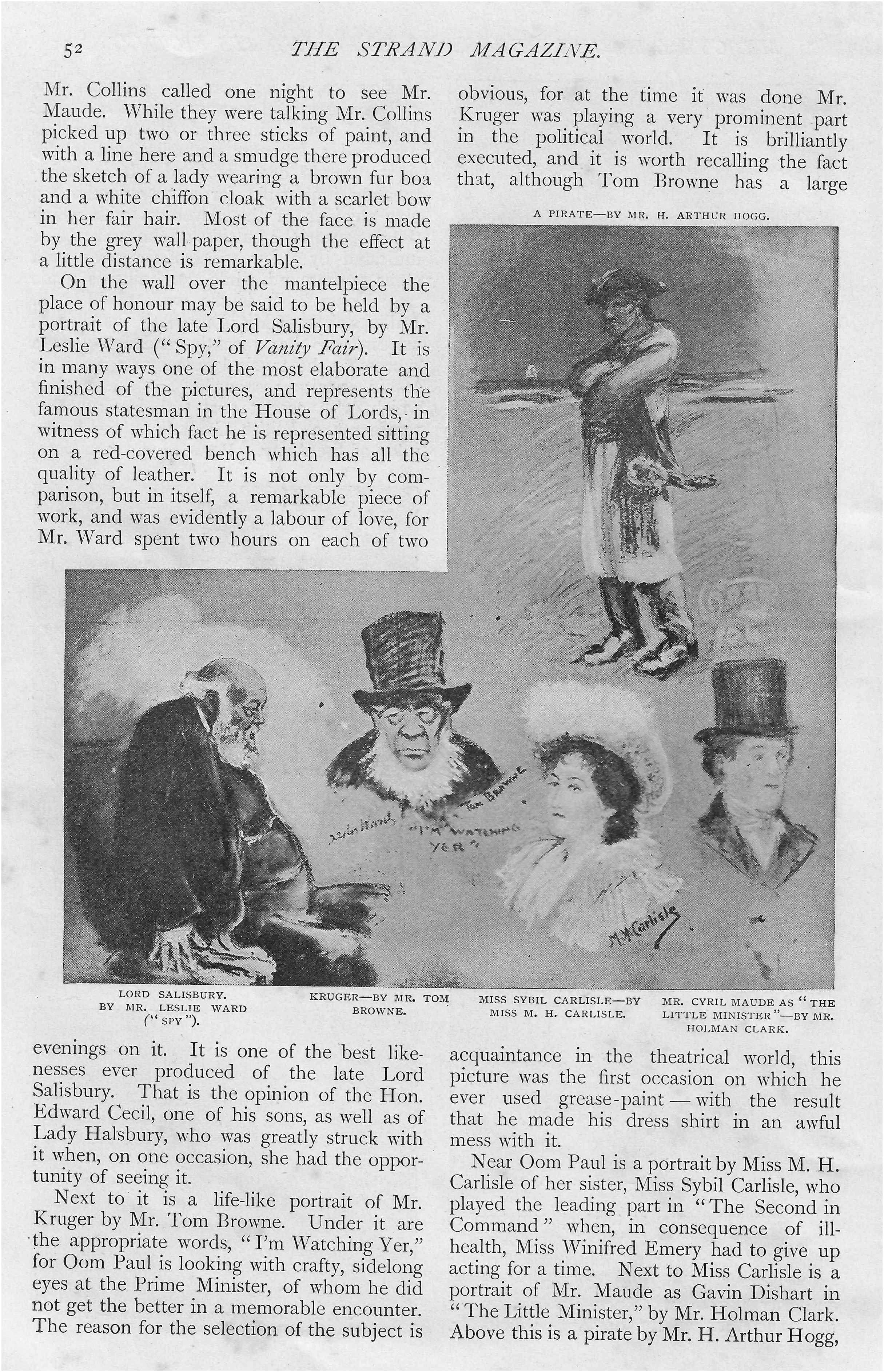
Images Over the Fireplace of Maude's Dressing Room from ‘Mr. Cyril Maude's Dressing-Room and Its Pictures in Grease-Paint’, Strand, July 1904, p. 52. Lord Salisbury by Mr Leslie Ward (‘Spy’); Krueger by Mr Tom Browne (“I’m Watching yer”; Miss Sybil Carlisle by Miss M H Carlisle; A Pirate by Mr H Arthur Hogg; Mr Cyril Maude as the Little Minister by Mr Holman Clark.
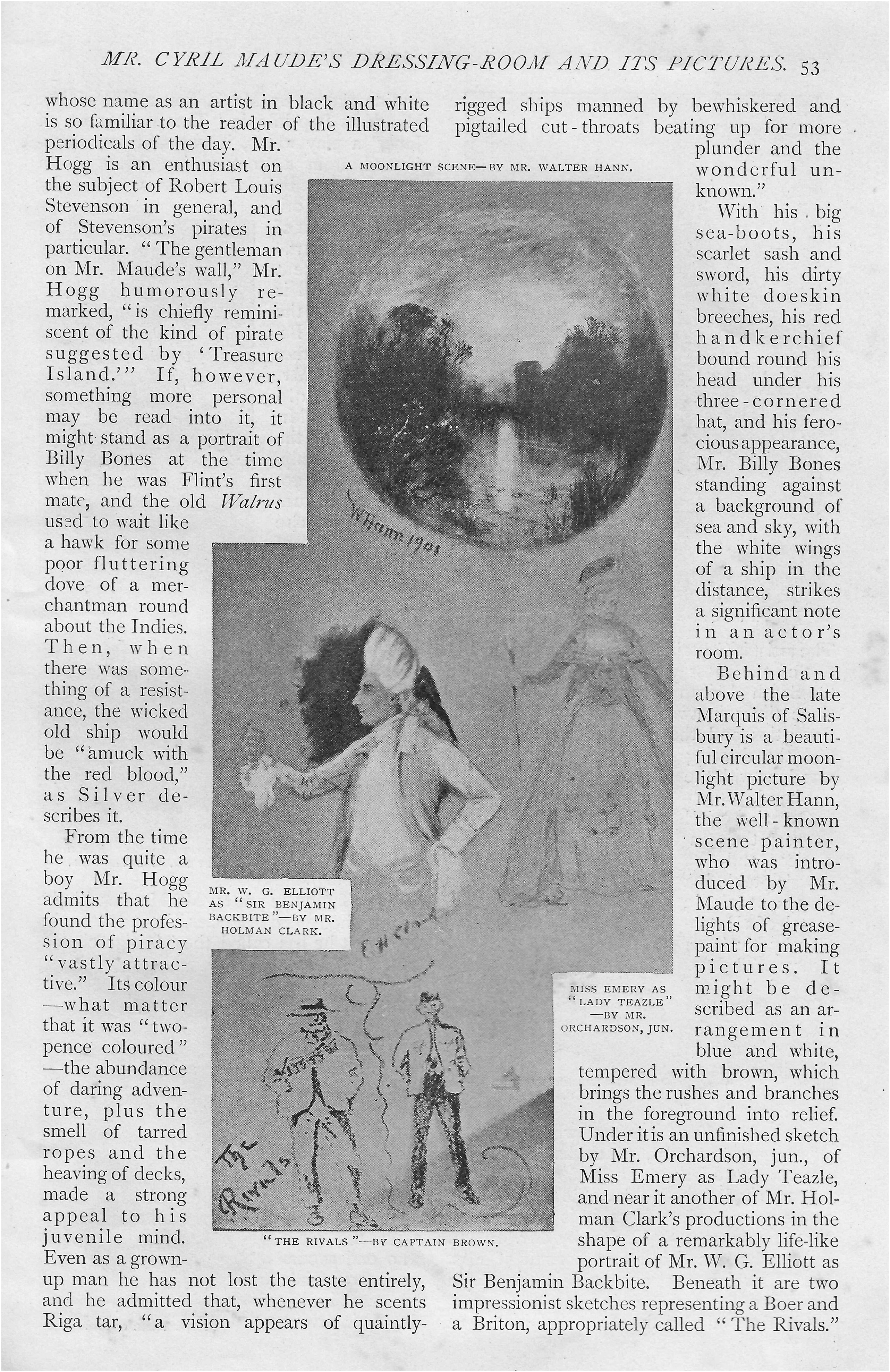
‘Mr. Cyril Maude's Dressing-Room and Its Pictures in Grease-Paint’, Strand, July 1904, p. 53. A Moonlight Scene by Mr Walter Hann (signed and dated 1900); Mr W G Elliot as ‘Sir Benjamin Backbite’ by Mr Holman Clark; Miss Emery as ‘Lady Teazle’ by Mr Orchardson, Jun; ‘The Rivals’ by Captain Brown.
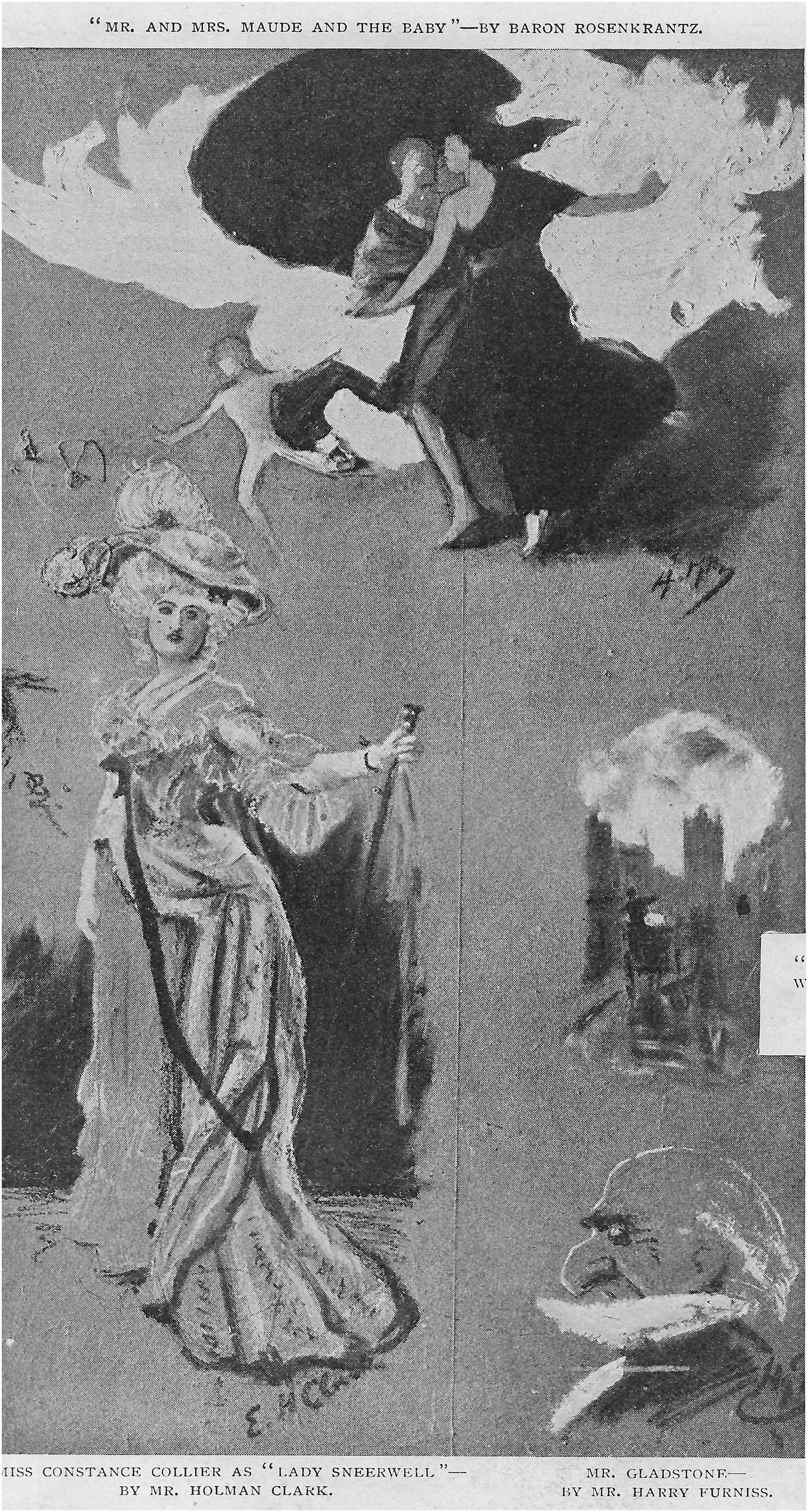
‘Mr. Cyril Maude's Dressing-Room and Its Pictures in Grease-Paint’, Strand, July 1904, p. 55. Miss Constance Collier as ‘Lady Sneerwell’ by Mr Holman Clark; ‘Mr and Mrs Maude and the Baby’ by Baron Rosenkrantz’; ‘A Street in Westminster’ by Canon Norris; Mr Gladstone by Mr Harry Furniss.
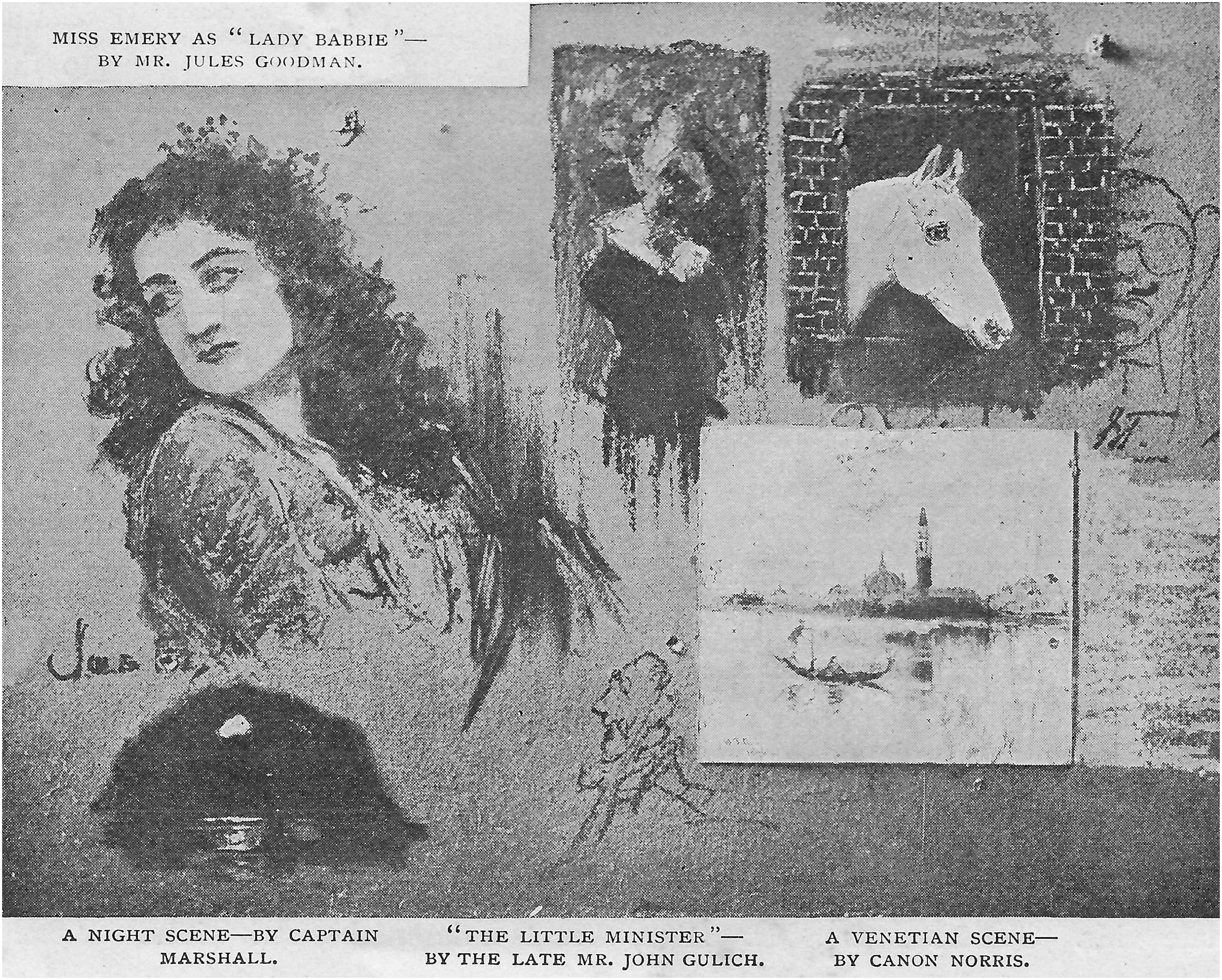
‘Mr. Cyril Maude's Dressing-Room and Its Pictures in Grease-Paint’, Strand, July 1904, p. 56. Miss Emery as ‘Lady Babbie’ by Mr Jules Goodman; A Horse's Head by Major John Matthews; A Night Scene by Captian Marshall; ‘The Little Minister’ by the late Mr John Gulich; A Venetian Scene by Canon Norris.
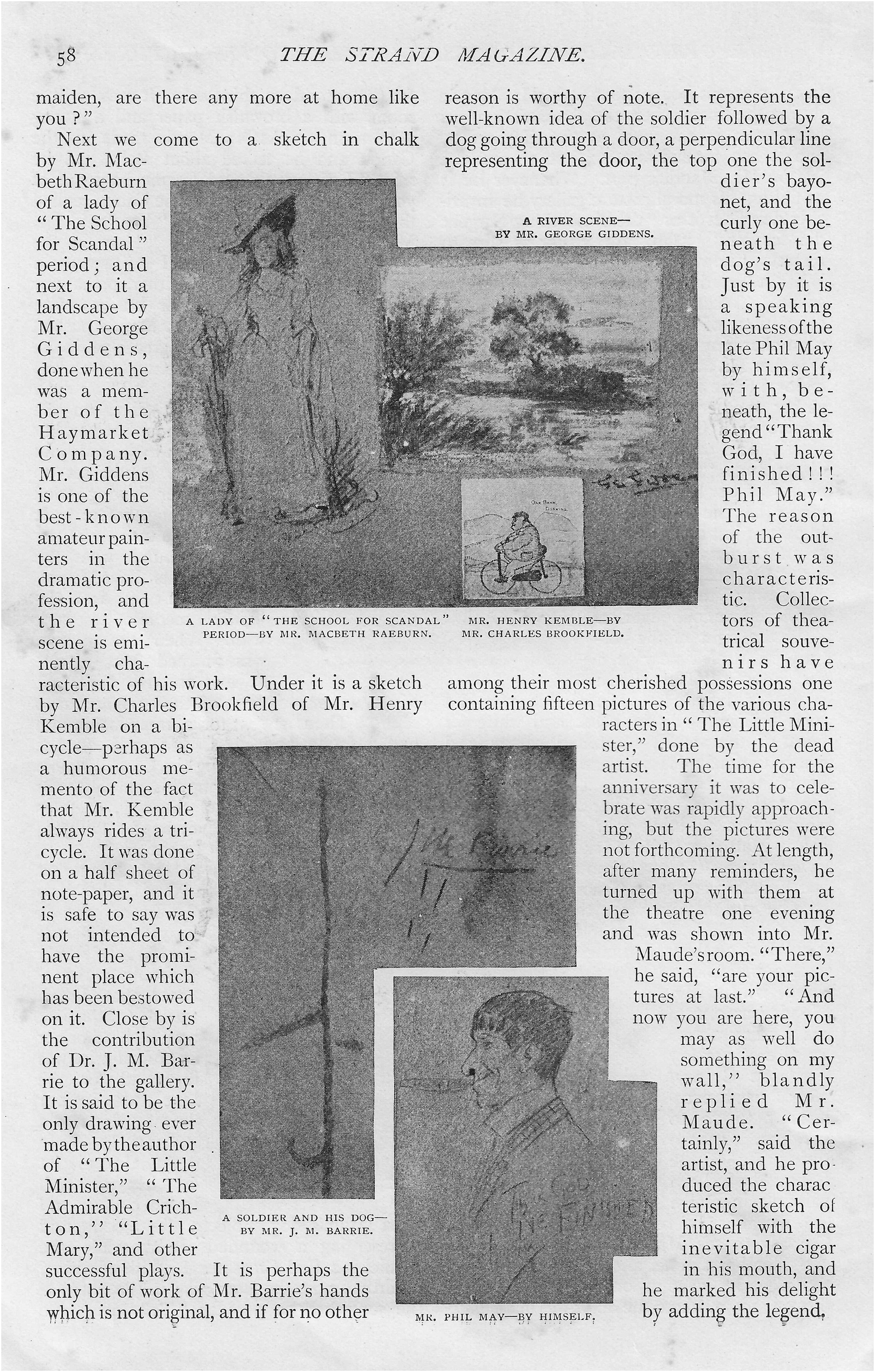
‘Mr. Cyril Maude's Dressing-Room and Its Pictures in Grease-Paint’, Strand, July 1904, p. 58. A River Scene by Mr George Giddens; A Lady of ‘the School for Scandal’ Period by Mr Macbeth Raeburn; Mr Henry Kemble by Mr Charles Brookfield; A Soldier and His Dog by Mr J M Barrie; Mr Phil May by Himself.
However, there are two notable omissions from this source: Constance Collier by Mortimer Menpes and Robert Baden-Powell's Pig-sticking. These must have been the last additions to the gallery, painted between July, when the Strand article appeared, and December 1904, when the end of the partnership between Maude and Harrison was announced. In her reminiscences Recollections of a Victorian Childhood: Worlds Away (1964), Maude's daughter Pamela mentions both images: The door of the dressing room was generally ajar as a flow of people passed through it… The room was as familiar to us as our own home with its jumble of grease-paints on the table and the wig on its stand near the window. Snapshots of the family were stuck, carelessly, into the mirror. Friends, and artists who were friends, had drawn pictures on the walls in grease-paints; an old gentleman with a beard sat humped in a chair and he was called Lord Salisbury ‒ Mortimer Menpes had painted him. Papa took us to see Mr Menpes one day; he stood among his pictures wearing a kimono, and Margery [Pamela's elder sister] said that showed that he was a famous artist. Phil May had drawn Mr Gladstone, hook-nosed with a hank of hair on his forehead and a long cigar in his mouth; and he had drawn his own portrait. Those were our favourites.
Friends from the front of the house were ushered in after the play… [Maude] showing them another picture by Mr Menpes, of Miss Constance Collier. ‘What does that mean?’ asked a lady pointing at some writing at the bottom of Phil May's self-portrait. ‘Thank God, it's finished!’ ‘He meant the Little Minister drawings ‒ he did the whole cast, and it took him a long time, poor fellow!’
A gentleman with a beard was examining a picture of pig-sticking, his nose so close he looked as if he was smelling it. ‘Who did that?’ he asked, and when he was told: ‘B.P.’ he said, ‘Did he, by Gad! It's good, you know’…. ‘Not Holman Hunt?’ said a lady, impressed. ‘No, Holman Clark,’ said Papa. ‘You saw him with me as Clon in Under the Red Robe’. They admired pictures by Raven-Hill, the artist who drew for Punch’ and another by Mr Harker, the scenery painter. 12
Drawing on her childhood memories, Pamela Maude can be forgiven for muddling up the authorship of some of the images, but she correctly identifies the subject of Menpes's contribution as Constance Collier and refers to Baden-Powell's Pig-sticking, thus anchoring both of the surviving images within the greasepaint gallery. Pamela Maude's recollections are particularly illuminating as they record reactions to the greasepaint gallery, a visitor's surprise at Baden-Powell's ‘pig-sticking’ and confusion over Phil May's inscription.
When Maude left the Haymarket in July 1905, he obviously had to leave his gallery behind. However, he was able to salvage his ‘Autograph Board’, which bears the signatures of many of those who contributed to his gallery. 13 The greasepaint gallery can be read as an amplification of the fashion for collecting autographs; most of the images were signed and some dated. Equally, the gallery acts as a nostalgic scrapbook commemorating productions and recording famous visitors who were allowed entrée behind the scenes. ‘I suppose you’ll be awfully sorry to leave this room of yours’ observed Frank Richardson who allegedly interviewed Maude during the run of his last play at the Haymarket. ‘Yes, yes,’ Maude replied. ‘You see, I can’t possibly take these frescoes with me. They were all done by friends of mine, and they really make a sort of record of our management here’. 14 The ‘frescoes’ also signalled Maude's standing in artistic, literary and social circles and thereby built and reinforced his own celebrity status (Figure 10).
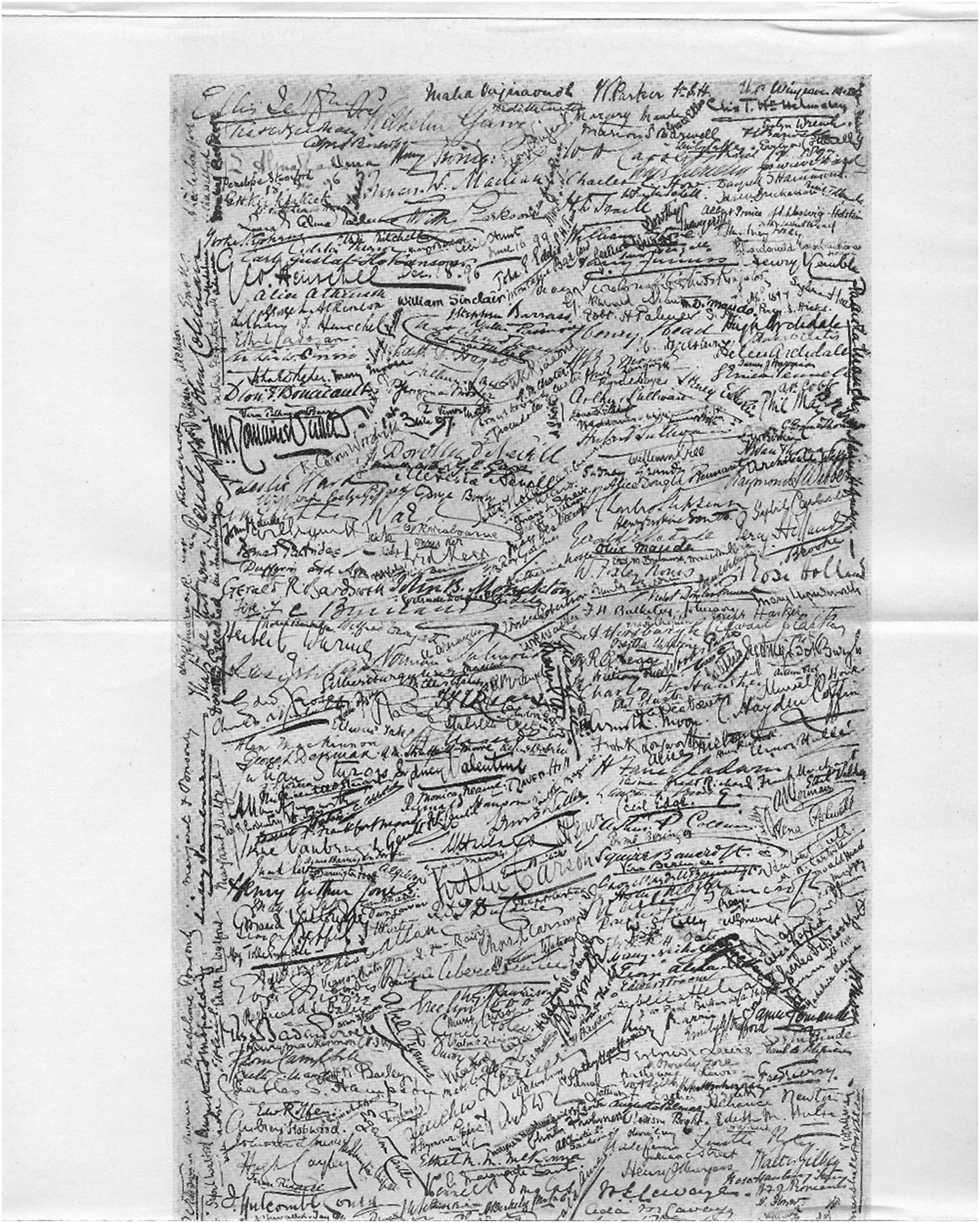
Section of the ‘Autograph Board which hung in my dressing room at the Haymarket during the nine years I helped to manage that theatre’, Cyril Maude, Behind the Scenes with Cyril Maude, London: John Murray, 1927, p. 112.
Maude's gallery offers us a unique insight into London's theatrical world at the turn of the twentieth century. Several contributors were members of the Haymarket company. Among the successful productions commemorated were: Under the Red Robe (1896), The Little Minister (1897), The Manoeuvres of Jane (1898–99), The School for Scandal (1900), The Second in Command (1900) and Caste (1902). The gallery also reveals the intertwining of the theatrical and artistic worlds with contributions from illustrators Bernard Partridge, Phil May, Harry Furniss, Leonard Raven-Hill, Tom Browne and Leslie Ward. Punch cartoonist Bernard Partridge carved out a career in both worlds, acting under the name Bernard Gould in Under the Red Robe. Maude's circle of friendships was formed largely through ‘clubland’, the Beefsteak, Savage and the Garrick Club. However, before considering the surviving images, their context needs to be addressed.
The Culture of Dressing Rooms
By the close of the nineteenth century, the private lives of the stars, famed actor-managers, leading ladies and matinee idols, had been commodified, providing ideal copy for the burgeoning monthly journals and weekly newspapers. The Strand, a monthly which offered its readers a diverse miscellany of factual articles, short stories and gossip, was founded by George Newnes (1891–1950). Serialising Arthur Conan Doyle's Sherlock Holmes mysteries, The Strand enjoyed a circulation of almost 500,000 copies a month during its heyday. Holding its position in the market until the 1930s, The Strand still had to ward off rivals. Having been acquired by the Harmsworth Brothers, the long-running London Magazine was relaunched as the Harmsworth Magazine in July 1898. Under Cecil Harmsworth, then proprietor of the Daily Mail, it reverted to the Harmsworth London Magazine in 1901. Offering a wide variety of articles, suiting many tastes, these magazines carried numerous theatrical features from ‘Pantomime Masks and Properties’ (The Strand, 1894) to ‘Would You be an Actress?’ (The Strand, 1902) which featured Marion Terry, Mrs Patrick Campbell and Irene Vanbrugh. 15
As a ‘home from home’, accounts of theatrical dressing rooms fall into the same category as ‘Celebrities at Home’, a regular feature in Edmund Yates’ The World, which took the reader into the private domains of public figures. Begun in 1876, the series has been credited with introducing British readers to the American style of ‘interview journalism’. These celebrity profiles described not only physical environments – furniture, works of art, gardens and places of work ‒ but also personal and professional habits, the latter offering reasons for their success. Concerns were raised about the intrusion into the private lives of public personages, and Yates was accused of printing ‘garbage’, ‘American journalism’ and ‘flunkeydom’. 16 He defended himself by claiming that his profiles had a historical value: ‘We would exchange all our “Lives” of Shakespeare for such an account of him as almost any of his friends could have furnished in a single evening’. 17 Whatever their historical value, they certainly appealed to Yates's aspiring middle-class readers, the fashionable and would-be fashionable ladies who longed to know more about the rich and famous. The profiles included several theatrical stars ‘Sarah Bernhardt in the Avenue de Villiers’, ‘Mr Henry Irving in Bond Street’, ‘Mr Toole at Orme Square’ and ‘Mr Sims Reeves at Beulah Hill’, the foremost English operatic tenor of the mid-Victorian era. By revealing such intimate insights, Yates convinced his readers that they were privy to how celebrities really lived their lives. 18
‘Actor's Dressing Rooms’, published in The Strand (February 1891), penetrated an erstwhile private sanctum, taking readers into the mysterious world ‘behind the scenes’: Henry Irving at the Lyceum, John Lawrence Toole at Toole's Theatre; Herbert Beerbohm Tree at the Haymarket; John Hare at the Garrick and Charles Wyndham at the Criterion. Commonalities emerge; a preponderance of pictures of actors past and present, highly interesting relics, notably costumes and theatrical properties, old playbills and programs and the customary horseshoe to ward off bad luck. Tree's dressing room was protected by ‘a gigantic horseshoe, measuring at least a couple of feet from top to bottom’. 19 Now conceived as an extension of the actor's persona, the dressing room was filled with memorabilia commemorating past performances. The space enshrined an actor's career and authenticated their fame.
A ‘priceless collection of theatrical reminiscences’ met the eye everywhere in Toole's dressing room: the ‘veritable umbrella’ used in Paul Pry, many white satin programs, and countless portraits.
20
Close to the fireplace was ‘a rickety armchair in brown leather’: ‘The springs are broken, but what matter? That chair is Toole's, sir, and Royalty has occupied it many a time…. It is just a cosy parlour, and with Toole in the chair by the fireside one would be loath to leave it’.
21
Toole’s room was ‘exactly what everybody imagines it to be–cosy and homely, like its genial occupant’. Irving's room showed ‘a reverence for anything which is a connecting link with old associations’: Look at the costumes, for instance, hanging behind a door…There hangs the clothing of The Master of Ravenswood.
22
The two Spanish hats with long feathers, the velvet coat and waistcoat with innumerable buttons, a quaint old crimson waistcoat, with elaborate silver work. Mr. Irving clings to an old coat so long as it will cling to him. He makes his clothes old – wears them during the day. That old beaver hat was worn in ‘Charles I’ and ‘The Dead Heart’ – now it is the characteristic head-gear of The Master of Ravenswood. The hat worn in the last act did duty ten years ago in ‘The Corsican Brothers’.
23
Apparently, worn both on and off stage, costumes were a means to connect with a character and make it ‘one's own’. Irving owned a striking collection of rings; a great ‘stage’ emerald worn by ‘Louis XI’ and ‘Richelieu’. Make-up was equally important in creating a role, with ‘a great tin box of crepe hair’ at hand as Irving made all his own moustaches.
Stage properties also had a double life, functioning both on and off stage. The old-fashioned oak dressing table had done duty in Macbeth in one of the banqueting scenes. On it were various ‘curiosities’ such as the looking glass tied up with string, which had ‘reflected its owner's face for fourteen years’. This had travelled across the Atlantic with Irving. The quaint old bull’s-eye lantern, which tradition claimed the infamous Eugene Aram carried on the night he murdered Daniel Clarke, was ‘a highly interesting relic’. 24 Famed for his performance of Hamlet, Irving had received gifts from Denmark; a picture of Elsinore, sprays of leaves from ‘Ophelia's brook’ and pebbles from ‘Hamlet's Grave’. The walls were covered with famous actors denoting ‘ancestor worship’ and placing Irving in a theatrical lineage; Charles Fechter, who also starred in The Master of Ravenswood, ‘Garrick in the Greenroom’ and the ‘one and only’ Joey Grimaldi, the most popular comic actor of the Regency era.
Old costumes also characterised Beerbohm Tree's dressing room; the peak cap worn as Demetrius in ‘The Red Lamp’ and the cloth cap ‘gaily decorated with poppies, corn and feathers’ used in ‘The Ballad Monger’. 25 John Hare's rooms were similarly loaded with memorabilia, notably, the suit worn as Benjamin Goldfinch in A Pair of Spectacles, with ‘the long black coat which flaps about so marvellously- the actor finds plenty of “character” even in a coat’. 26
De Cordova's Famous Dressing Rooms – Where Noted Actors Make Up described the professional domains of Irving, Charles Wyndham, George Alexander and Augustus Hare. However, Ellen Terry, Mary Moore, Irene Vanbrugh, Edna May and Winifred Emery are notable additions acknowledging their celebrity status. Terry was watched over by engravings of Mrs Siddons as the ‘Queen of Tragedy’, Mrs Cibber as Cordelia (c. 1755) painted by Pieter van Bleeck and other famous leading ladies. 27 Emery's room was ‘really more a boudoir’ with its Chippendale furniture, ‘flowers scattered with a lavish hand’ and photographs of her husband and children. 28 Despite this foregrounding of Emery's femininity, the pink-papered walls were hung with interesting photographs of Irving and Squire Bancroft, actor-managers who had facilitated her rise to leading lady. Although comfort and homeliness are reiterated, the lines between professional and domestic space, public and private realms, are blurred.
However, for de Cordova, the dressing room also had agency, being a magical space of transformation. Here ‘our actors put off the semblance of their individuality, in order to clothe themselves in the spiritual and material garments of the part they are about to act’.
29
Through costume and make-up, the actor metamorphosised himself into a character: ‘now into the debonair man about town and now into the old man, reputable or disreputable, polished or battered’.
30
In her chapter on dressing rooms, Mrs Alec-Tweedie concentrates on the art of illusion: ‘How an actress dresses’, ‘A Grease-paint Box’ and ‘Clara Morris on Make-up’. In his reminiscences Studio and Stage (1924), Joseph Harker valorised the ability to transform through the application of greasepaint, offering Herbert Beerbohm Tree and Henry Irving as masters of the art: No one who was at all intimately associated with him [Tree] behind the scenes could fail to be struck by his mastery of the art of making-up. It took Irving an hour or more to apply his make-up. Tree could change his whole appearance and, it seemed, his whole character with a few deft touches of grease-paint. Ten minutes was the time he allowed himself for the task, with, as a rule, five minutes donning his stage clothes. To me it seemed that he employed the methods of the portrait painter, for he would plant himself in front of the mirror and at once start applying his ‘colours’. Very quickly his pale, ascetic face, with its…deep furrows, would be transformed into the jovial countenance of Falstaff or the suave, benevolent features of the Abbe Dubois in A Village Priest. The physical characterisation was always as nearly perfect as it was possible to make it.
31
The photograph in G. S. Edwards's article catches Maude in the act of making up at a dressing table lit by impressive electric lights reminding us of the ‘limelight’ on stage. The actor is seen assuming the role of the elderly Professor Horace Courtley in A Golden Wedding, which premiered at the Haymarket in November 1898. The image validates Maude's mastery of acting, capturing his transformation. The actor is surrounded by the tools of his trade, with various hats and collars hanging on a series of hooks. A real top hat interacts with the image of Maude as Gavin Dishart in The Little Minster painted on the wall by his fellow Haymarket actor Holman Clark. Nearby, Maude's autograph board can be seen below a wig stand. Another board mounted on the wall is covered with Maude's collection of postcards. Whether carefully staged studio portraits or memorialising performances, postcards built a fan base and fed celebrity culture. The cheapest cost only a penny. These may also have acted as an aide-mémoire for the artists. Holman Clark contributed several paintings alluding to Haymarket productions such as Maude as ‘Le Chevalier de Valclos’ in A Marriage of Convenience. Holman Clark's additions to the gallery were personal, illustrating his own roles, Clon in Under The Red Robe, as well as those of Maude and his leading lady Winifred Emery. The framed watercolour of Maude as ‘the Fop in A Marriage of Convenience’ would have interacted with the wall paintings. Such images memorialised the theatrical milestones of his career. Spy's (Leslie Ward) Vanity Fair caricature of Herbert Beerbohm Tree, Maude's predecessor at the Haymarket, reminded readers he was continuing the tradition of the great actor-managers. For visitors, these images reinforced Maude's professional success. Other images added by celebrities such as Baden-Powell and J. M. Barrie demonstrated the illustrious circles in which Maude moved. Yet despite such fame, Maude was still a family man, as evidenced by a photograph of his two children. The dressing room is framed as a complex space, being both professional and domestic. This staged image is a performance of what it meant to be an actor (Figure 11).
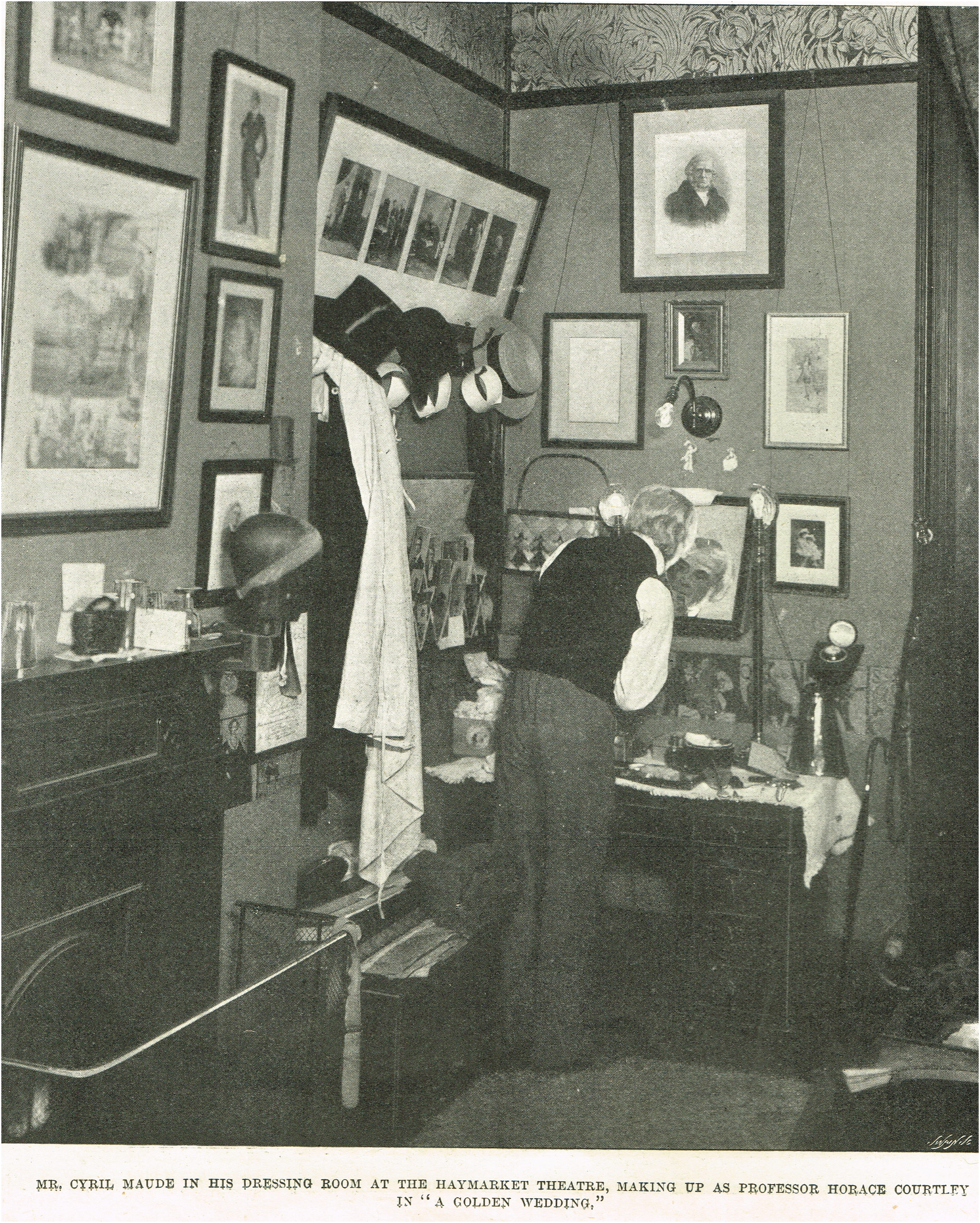
‘Mr Cyril Maude in his Dressing Room at the Haymarket Theatre Making up as Professor Horace Courtley in “A Golden Wedding”. G.S Edwards, ‘Concerning Mr and Mrs Cyril Maude (Miss Winifred Emery)’, the Illustrated Sporting and Dramatic News, March 15, 1899, p. 132.
The illustration in de Cordova's article also focuses on Maude's dressing table: Framed around the top of the room are Vanity Fair's caricatures of actors, managers, and authors, and a dado is made by many sporting pictures, while hanging on the wall opposite the mantelpiece is Mr Maude's autograph board, covered with all the signatures of celebrities in all walks of life.
32
Holman Clark's portrait of Maude as The Little Minister is again visible on the left, with Raven-Hill's sketch of Maude as the young bashful Lord Bapchild in The Manoeuvres of Jane on the right (Figure 12).
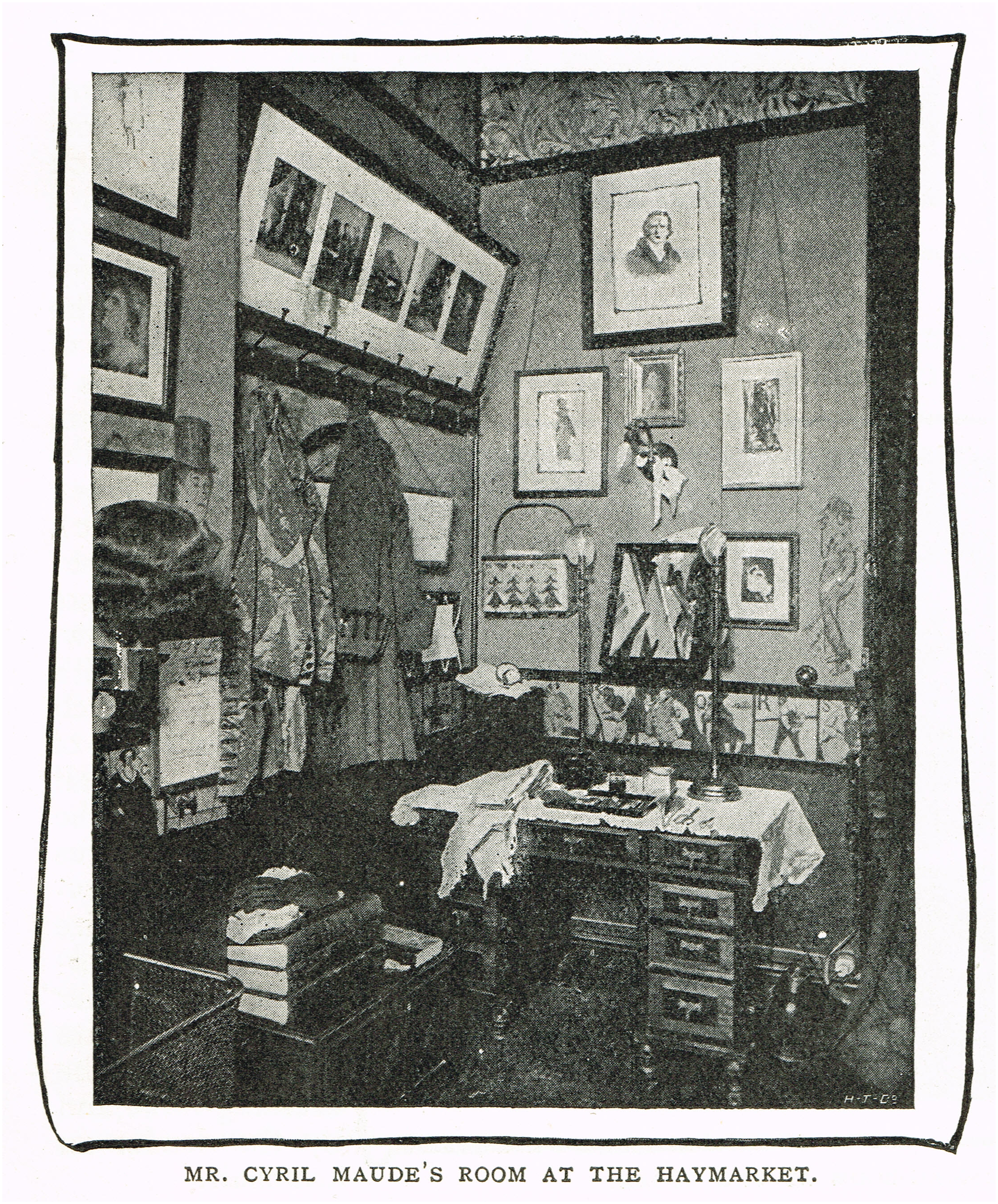
‘Mr Cyril Maude's Room at the Haymarket’, Rudolph de Cordova, ‘Famous Dressing Rooms where noted actors make up’, Harmsworth London Magazine, November 1900, p. 309.
Maude delighted in deceiving his public through make-up and costume, hoping audiences would not recognise him on the stage. He chose to play old men such as ‘Hardcastle’ in She Stoops to Conquer (1900), ‘old Eccles’ in Caste (1902) and ‘Captain James Barley’ in Beauty and the Barge (1904). Maude adopted a form of ‘method’ acting: as soon as I feel that I have grasped the nature of the character, I prepare my ‘make-up’ in accordance therewith, fix it on, and imagine in my own mind exactly the kind of man I have to represent. I also wander about London, looking for the particular type of man I want, so that my study may be modelled as close to nature as the exigencies of the stage permit… It is always my endeavour to present an entirely fresh type of man in each part I am cast for, and I strive to the utmost of my ability to play with a new voice and new manner, as well as with a new face … in my own line of ‘business’ the art of ‘making-up’ is of vital importance. I find making-up exceedingly interesting work indeed, and it may interest readers to know that I usually take an hour to transform myself into the living picture of an old man.
33
Whether a period piece or a modern stage setting, these elaborate ruses demanded wigs, moustaches, beards and layers of greasepaint. With greasepaint used as the medium to create the gallery, a direct connection was forged between the illusory arts of performance and painting. Maude was not alone in recognising the artistic potential of greasepaint beyond painting faces. The mirror in Beerbohm Tree's dressing room at Her Majesty's Theatre bore two greasepaint portraits valorising the art of making-up.
34
One, by Sir Philip Burne-Jones, depicted Tree as Svengali in Trilby; the other, by Tree himself, featured Lionel Brough as Bardolph in King Henry the Fourth Part 1: For this sketch reveals one of Mr. Tree's talents that is little known, his extraordinary skill as an impressionist artist. Tree, as a fact, is a marvellous caricaturist. He will catch a speaking likeness with half-a-dozen strokes. And in this talent lies one of the chief reasons of his success in ‘making-up’. Tree should be numbered among the greatest portrait painters. His masterpieces are done on a smooth, thin, pallid, ascetic face, with high forehead, a straight nose and a big, mobile mouth… with a few strokes, he will transform the pallid face into the heroic mould of Ulysses – or into the face of an age-stricken Rip Van Winkle.
35
The concept of the greasepaint gallery predated Maude's arrival at the Haymarket. The starting point was a visit by Rev. Canon Foxley Norris, an old school friend, to Maude's dressing room at the Comedy (now the Harold Pinter) Theatre: As Mr. Maude made up, the Canon and he talked about Italy, and he said, ‘I wish you would let me have one of your sketches of Venice’. The Canon replied that he would with pleasure. ‘Yes,’ said Mr. Maude, ‘but do it now’. ‘How in the world can I do that, when I have neither paint nor colours nor brushes with me?’ Mr. Maude pushed the tray of grease-paints he used for making-up over to his friend. ‘There you are; do it here, on the wall’. Without brushes, but merely with his thumb and fingers, the canon set to work, never having tried such a thing before.
36
When Maude moved from the Comedy to the Haymarket, the stage carpenters, knowing how much he liked the image, prized it off the wall and reinstalled it in Maude's new dressing room. Norris also contributed to Maude's gallery at the Haymarket, A Venetian Scene, and A Street in Westminster, neither of which survive. 37 Below is a catalogue raisonné of the surviving works arranged according to their proximity. The lost works are discussed in an Appendix, available as a supplement online, where a full list of all the contributors can be found, listed alphabetically by name of artist.
Catalogue Raisonné of the Surviving Works
Lord Salisbury by Leslie Ward (‘Spy’ of Vanity Fair)
The two most striking images, which confront the viewer on entering the room, are the portraits of Lord Salisbury by Leslie Ward and Constance Collier by Mortimer Menpes. These are painted one above the other in a prime position on the chimney breast of the wall facing the door (see Figure 1).
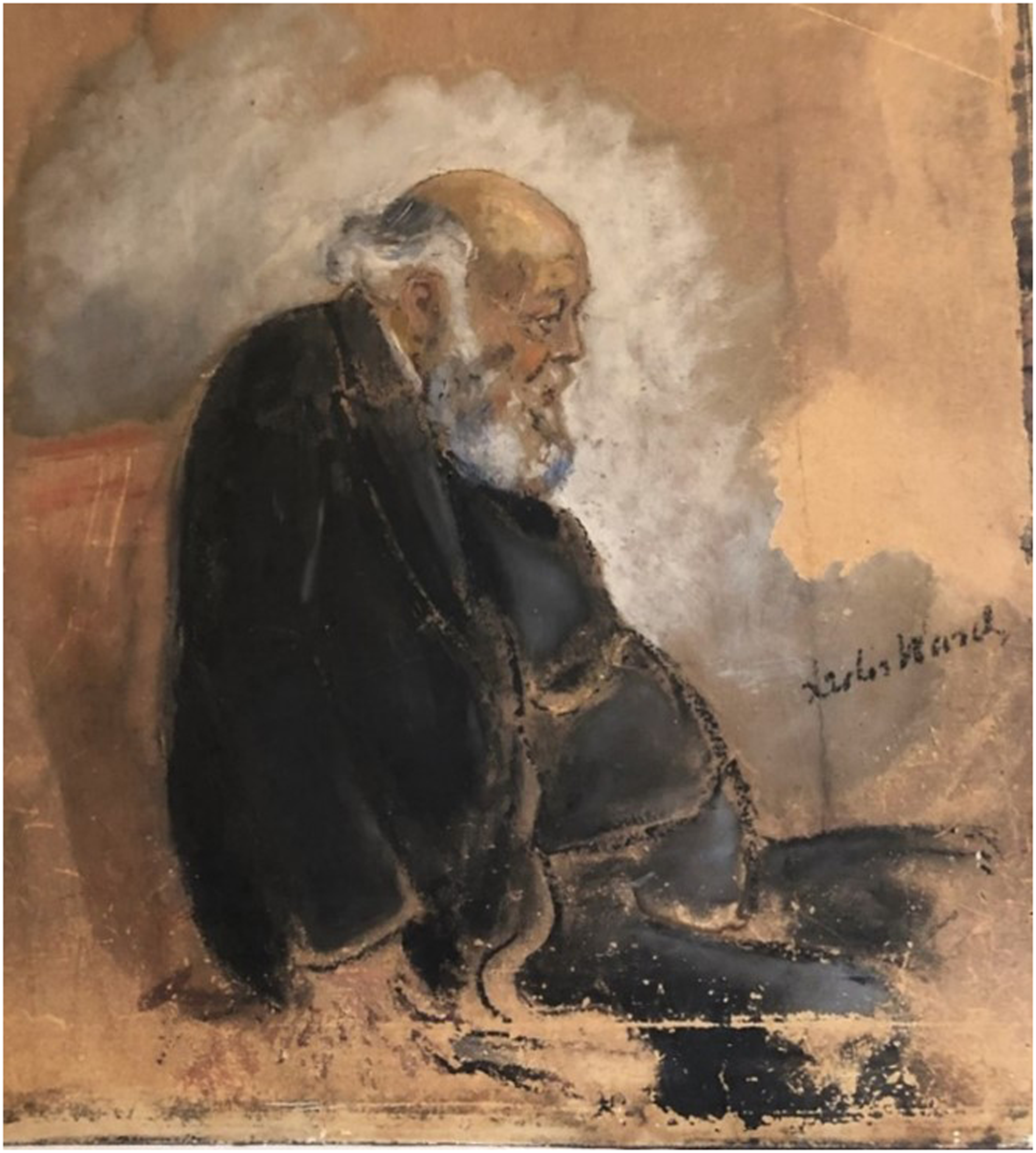
Leslie Ward (‘Spy’), ‘Lord Salisbury’, Cyril Maude's Dressing Room, Theatre Royal, Haymarket. Detail of Figure 1.
The portrait of Lord Salisbury, leader of the Conservative party, is signed by Sir Leslie Matthew Ward (1851–1922), better known by his ‘nom de crayon’ ‘Spy’ or ‘Drawl’: It is in many ways one of the most elaborate and finished of the pictures and represents the famous statesman in the House of Lords, in witness of which fact he is represented sitting on a red-covered bench which has all the quality of leather. It is not only by comparison, but in itself, a remarkable piece of work, and was evidently a labour of love, for Mr. Ward spent two hours on each of two evenings on it. It is one of the best likenesses ever produced of the late Lord Salisbury. That is the opinion of the Hon. Edward Cecil, one of his sons, as well as of Lady [Wilhelmina] Halsbury, who was greatly struck with it when, on one occasion, she had the opportunity of seeing it.
38
Ward was rather proud of his depiction of Lord Salisbury, three times Prime Minister, and he left an account in his autobiography, Forty Years of Spy: I was fortunate with sketches of the late Lord Salisbury, as a lady, a great friend of his [Lady Halsbury?], said that a grease-paint picture I made of him, in Cyril Maude's dressing-room at the Haymarket Theatre, was quite the best she had ever seen of that distinguished statesman. In 1902, I made another, after watching him again in the House of Lords.
39
From 1873 to 1911, ‘Spy’ contributed caricatures, under the heading ‘Man of the Month’, to Vanity Fair, the most successful society magazine of the era. He is said to have produced around 1,200 portrayals, capturing the best-known figures of the day. Ward came from an impeccably artistic background as both of his parents were respected artists, Edward Mathew Ward RA and Henrietta Ward. London's artistic elite, namely Edwin Landseer, John Everett Millais and William Powell Frith, were regular visitors to his parents’ studios. Educated at Eton and a member of several clubs, Ward mixed in the best social circles. ‘Constant attendance’ at the Beefsteak Club brought him into contact with ‘many of the most interesting and entertaining men of the day… soldiers, actors, diplomats, legislators, sporting men, artistic and literary men and so on’. 40 Many amusing evenings were spent at the ‘jolly’ Lotus Club, which was patronised by the ‘Gaiety Girls’ ‒ Nellie Farren, Kate Vaughan and Kate Munroe. 41 The Fielding Club also attracted ‘actor chaps’: Toole regularly came to play cards alongside comedian Corney Grain and the versatile Alfred Thompson, librettist, set and costume designer, theatre manager, journalist and artist, who contributed to Punch and Vanity Fair. 42 At the Punch Bowl Club, founded by sculptor Percy Wood, ‘one met a variety of good fellows and plenty of clever entertainers’. 43 Leonard Raven-Hill was also a member. Ward fostered a variety of cultural networks that facilitated his professional career.
Working in watercolours, Ward's portraits were published as coloured chromolithographs. After inclusion in Vanity Fair, they were regularly sold as independent prints. Ward chose ‘Spy’, meaning ‘to observe secretly, or to discover at a distance or in concealment’, to imply he was revealing the true man.
44
Favouring full-length portraits, initially, he distorted the proportions of the figure, placing a large head on a disproportionately small body. Not wishing to cause offence, Ward moderated this approach, developing what he called ‘characteristic portraits’. Losing their satiric edge, more complementary than insulting, Spy's portraits were ‘not based on any personal venom, but in the artist's detached observation of life and character’.
45
Ward homed in on distinctive traits such as fellow caricaturist Phil May's predictable bowler hat and cigar (‘Phil’, Vanity Fair, 21 February 1895, ‘Men of the Day No. 613’; NPG D44739). In March 1897, while Maude was starring in Under the Red Robe, his first co-production with Harrison, Ward made him the ‘Man of the Month’, depicting him in three-quarter profile, hand on hip, sporting a top hat and monocle (‘Squirrel’ [a pun on Cyril], Vanity Fair, 11 March 1897, ‘Men of the Day. No. 676’; NPG D44846). Ward admired Maude's theatrical skills: Under the mirth and mirth-provoking art of this gifted actor there always runs that magic touch which has been defined as ‘serious without being earnest’! In character parts, especially those associated with the typical old gentleman, he is of course, incomparable, but whether he is cast for an old or a young or a middle-aged part he can always draw the smiles and the tears of his audience. Of course, when sketching him I was most anxious to catch his characteristic expression which can only be caught through his smile.
46
In his autobiography, Ward ventured to prophesy that ‘when the history of the Victorian Era comes to be written in true perspective, the most faithful mirror and record of representative men and the spirit of their times will be sought and found in Vanity Fair’. 47 ‘Spy’ was duly rewarded, receiving a knighthood in 1918.
Mortimer Menpes, Portrait of Constance Collier
Constance Collier (1878–1955) was born Laura Constance Hardie to theatrical parents, Auguste Cheetham Hardie and Eliza Georgina Collier. Their marriage was blighted by the disapproval of Hardie's family, who disowned him for marrying a performer. After trying unsuccessfully to establish himself as an actor, Hardie turned to drink and disappeared from his daughter's life. Mother and daughter had a difficult time touring the provinces with Constance appearing on the stage from the age of six. Appearing opposite Beerbohm Tree as Pallas Athena in Ulysses (1901, Her Majesty's Theatre) marked a turning point in Collier's career. She became Tree's leading lady, building up a formidable repertoire of parts including Nancy in Oliver Twist, Poppaea in Nero and Cleopatra in Antony and Cleopatra. Developing into a ‘dark’ beauty (her maternal grandmother was a Portuguese emigre), with looks variously referred to as ‘Latin’, ‘Mediterranean’ or ‘Arab’, led to a succession of ‘gypsy queen’ roles culminating in Collier playing the Gypsy Queen in the silent film version of The Bohemian Girl (1922). 48 (Figure 14).
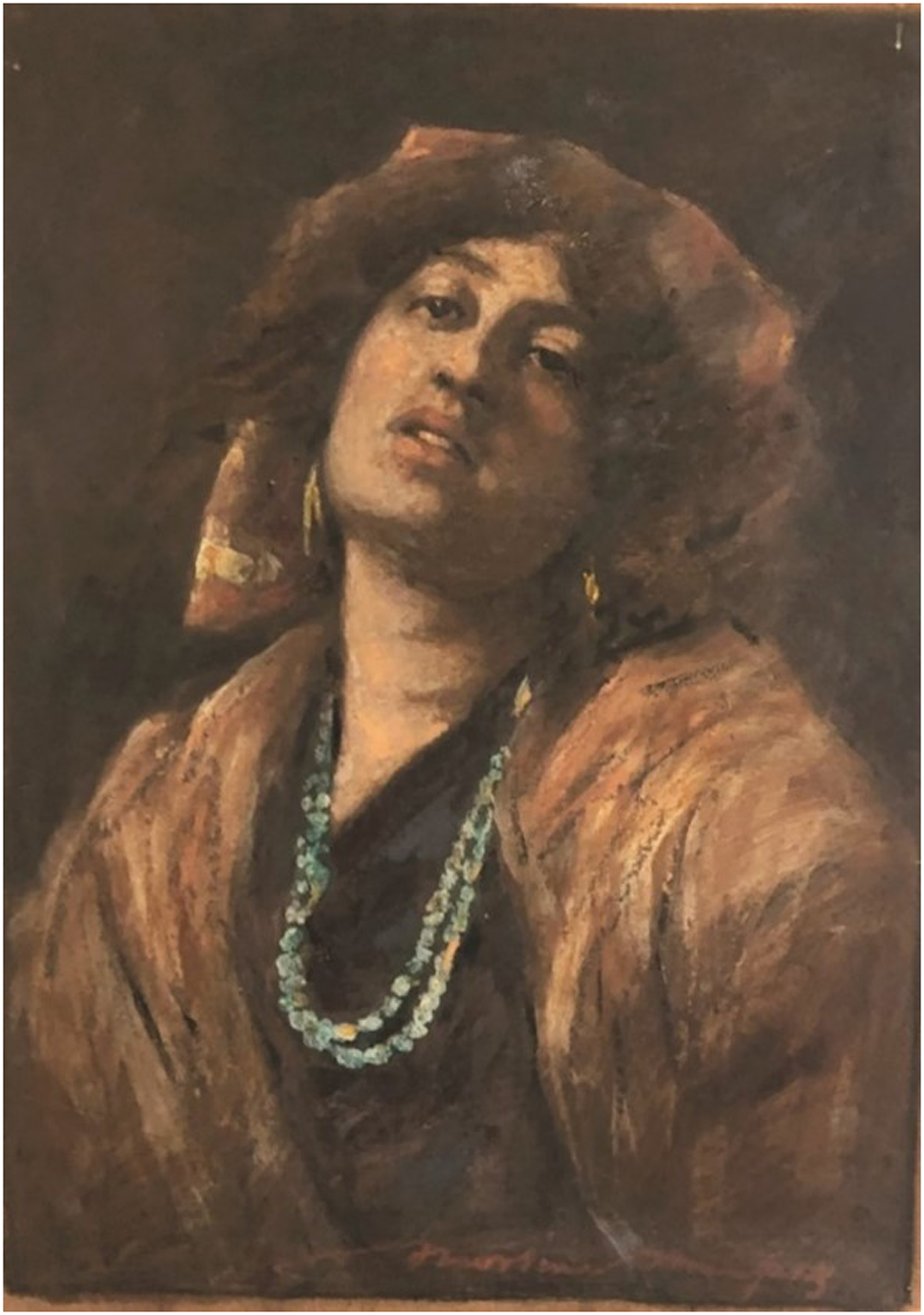
Mortimer Menpes, Constance Collier as the Gypsy in One Summer's Day, Cyril Maude's Dressing Room, Theatre Royal, Haymarket.
However, Collier was initially one of the famous ‘Gaiety Girls’, performing at the Gaiety Theatre under the management of George Edwardes. She appeared in the biggest hits, A Gaiety Girl and The Shop Girl (both 1894) but eventually tired of being ‘only a Gaiety girl’ and determined to make a name for herself as an actor.
49
She struggled to find parts until one day in 1897, while boating on the Thames, she was spotted by the actor and playwright H. V. Esmond. Taking her turn with the punt-pole, Collier took off her shoes and stockings; with her hair dishevelled, ‘I suppose I must have looked rather picturesque’.
50
Esmond declared, ‘Young woman you look exactly like the gypsy girl in my new play, can you act?’
51
Rehearsals of One Summer's Day had already begun at the Comedy Theatre with no one cast for the part of the gypsy girl, Chiara. Lauded for her performance, Collier achieved her first reviews: Visitors to the Comedy Theatre cannot fail to be struck with the picturesque and forceful representation that Miss Constance Collier gives of the unprincipled gypsy girl in One Summer's Day. Without making the part repulsive, she yet contrives to invest it with a certain suggestion of coarse voluptuousness that makes one realise the sort of influence she obtained over the unfortunate young fellow who fell victim to her luxuriant charms.
52
The Northern Whig declared her performance was ‘one the greatest successes of the season’. 53 For W. B. Findon it marked a ‘coming “star” in the theatrical firmament’. 54 Postcards of Collier as the gypsy girl, issued by Elliot and Fry, were soon in circulation (NPG x127905) and like many beautiful actors, she developed a fan base (Figures 15 and 16).
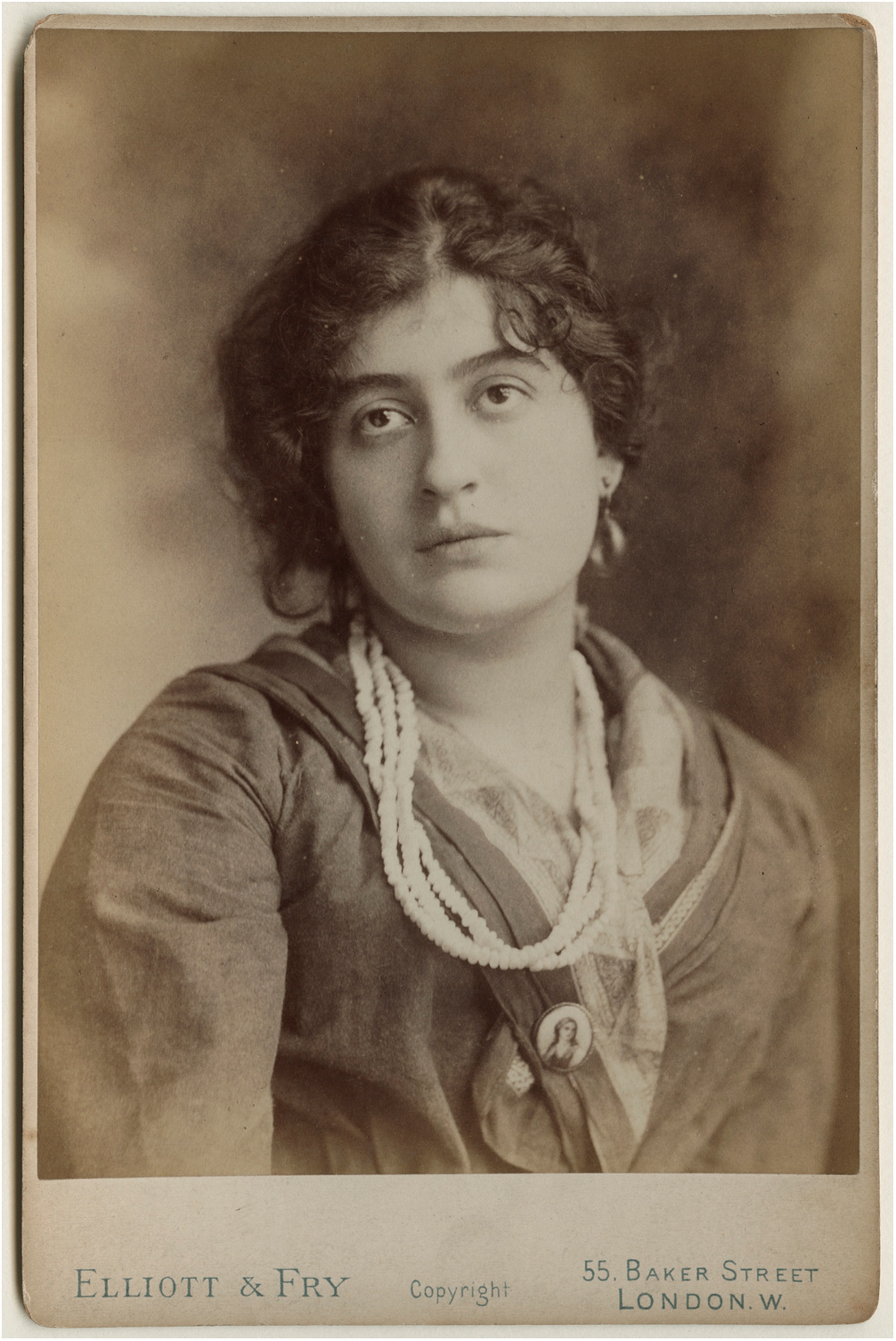
Constance Collier, by Elliott & Fry, Albumen Cabinet Card, Late 1890s NPGx127905 @ National Portrait Gallery.
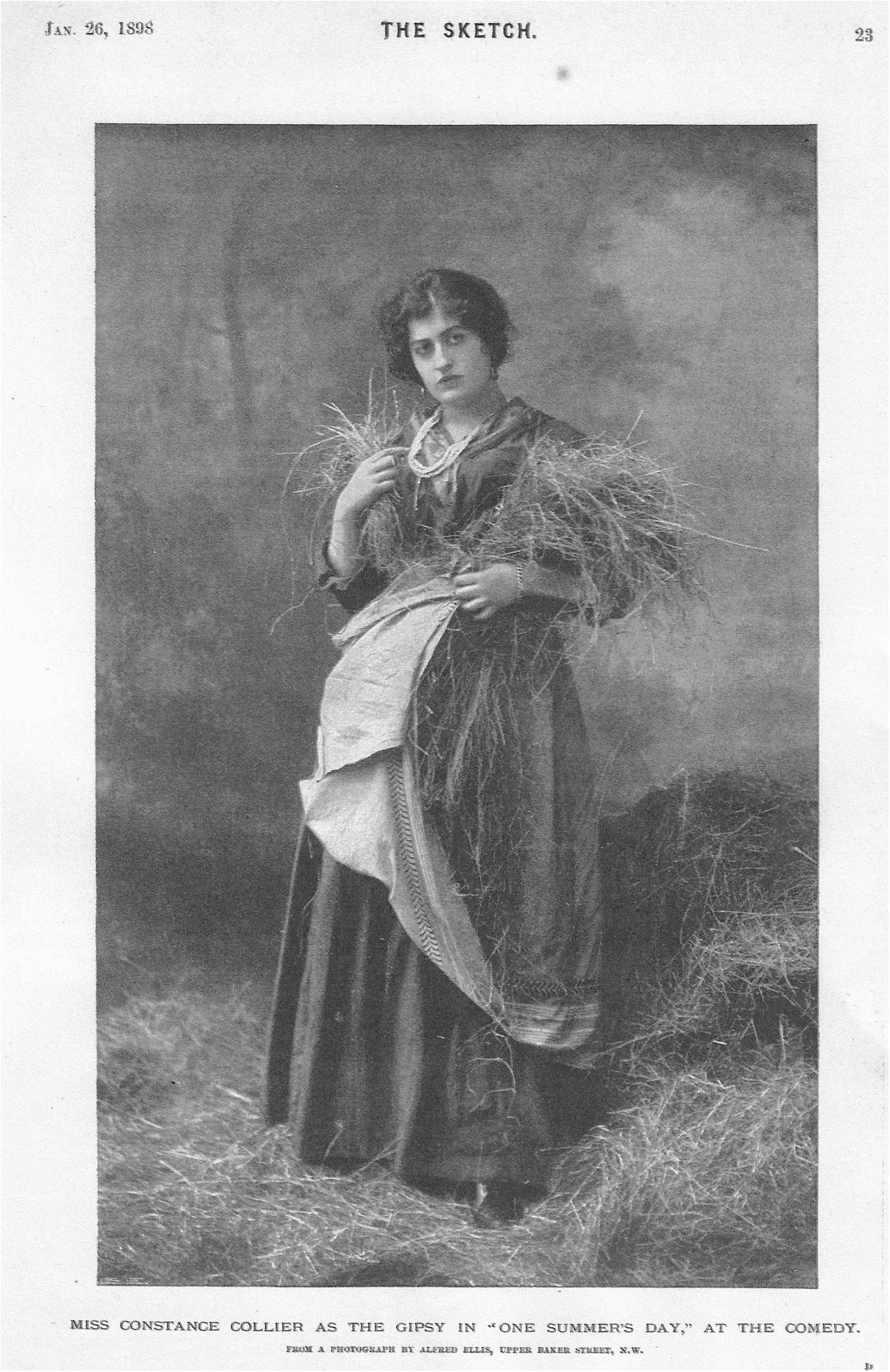
Miss Constance Collier as the Gypsy in ‘One Summer's Day’, at The Comedy, The Sketch, 26 January 1898, p. 23.
It was during the run of One Summer's Day (15 September 1897 to 26 February 1898) that Collier came to the attention of the Australian-born artist Mortimer Menpes (1855–1938), who had a penchant for actresses and socialites. Menpes's daughter, Dorothy, recorded in her diary that her father saw the American actor Mrs Brown-Potter (a.k.a. Mary Cora Urquhart), who settled in London in 1886, almost daily either dining together or visiting the theatre with friends. Those friends included author and playwright Lady Colin Campbell and Lady Dorothy Nevill. 55 A man of many enthusiasms Menpes’ described himself as ‘a painter, etcher, raconteur and rifle-shot’. 56
Having met James McNeill Whistler in 1880, Menpes abandoned his formal art training. He became the artist's pupil and acted as his studio assistant. Taught etching by Whistler, Menpes became a major figure in the etching revival producing some 700 works. For around three years, Whistler and Menpes remained close, etching, painting and travelling together. Whistler stood as godfather to his second daughter Dorothy. During the 1880s, Menpes was part of the Whistler/Wilde/Tite Street coterie, being asked to stand as godfather to the Wilde's second son Vyvyan in 1886. Yet, in Son of Oscar Wilde (1954), Vyvyan Holland gives a poor account of Menpes: My god father was Mortimer Menpes, an artist of some repute in the eighties; I still possess some of his etchings which he bestowed upon me in lieu of a christening mug; the etchings are not very good and there was always some element of doubt as to whether Mortimer Menpes did them himself. He was a man of private means, something of a dandy, and a friend of Whistler and all the Pre-Raphaelites.
57
Holland’s barbed comments reflect a prejudice against Menpes that was widely held in the art world. It may have been prompted by Menpes’ colonial origins or the fact he was highly successful. The respected art critic M. H. Speilmann acknowledged that Menpes was the victim of blatant discrimination. 58 Apparently, he possessed qualities that ‘appear to have had an irritating effect upon a certain coterie of artists’. His individuality and independence, alongside a passion for novelty, had led him to practise his art in many mediums and methods, including etching, dry-point and lithography. His success had ‘only added to the resentment of the unhappy coterie’. Although elected to the Royal Society of Painter-Etchers and Engravers and the Royal Society of British Artists, Menpes remained an outsider.
After 1900, Menpes spent over fifteen years travelling the world, visiting Japan, India, Mexico, Burma, Morocco and Egypt, and successfully producing books illustrating the life and customs of countries he visited. It was during this globe-trotting period, towards the end of 1905, that Menpes added to the greasepaint gallery, being given the best remaining space on the walls. Menpes might have been the last contributor. The choice of Constance Collier in One Summer's Day was unusual for several reasons. One Summer's Day was not a Haymarket production. It ran at the Comedy Theatre, around the corner in Panton Street. 59 Collier, despite playing the small part of Lady Sneerwell in The School for Scandal in 1900 (Holman Clark added a sketch of her in the role) had never been closely associated with the theatre. By this stage, Collier was Beerbohm Tree's leading lady at Her Majesty's, on the other side of the road.
However, Collier's performance as the gypsy in One Summer's Day made such an impression on Menpes that he created at least four images of her in the role. Evidently, the ‘gipsy force of Miss Constance Collier’ was ‘seized in “A Zingara”’ (Italian gypsy). 60 The artist favoured depicting actresses in their stage roles, as he deemed costume an important element in portraiture. His one-man show, entitled ‘Beautiful Women’, held at the Dowdeswell Galleries in 1899, featured these images of Collier. The London Evening Standard noted: ‘The beauty of most of the women, as well as of the artist's vision and record of them, is placed beyond a doubt’ 61 ; the Duchess of Sutherland, Miss Pamela Plowden, Lady Colin Campbell and Miss Constance Collier were conspicuous entries. This placed the former ‘Gaiety Girl’ in illustrious social circles. Moreover, she was now cast as the artist's muse, not just a ‘professional beauty’ traded through commercial postcards. Speilmann's ‘Mortimer Menpes as a Portraitist’, published in the prestigious Magazine of Art, featured a full-page reproduction of Collier as the gypsy in One Summer's Day. Such reproductions could be removed and framed, transforming Collier's image into a work of art (Figure 17). 62
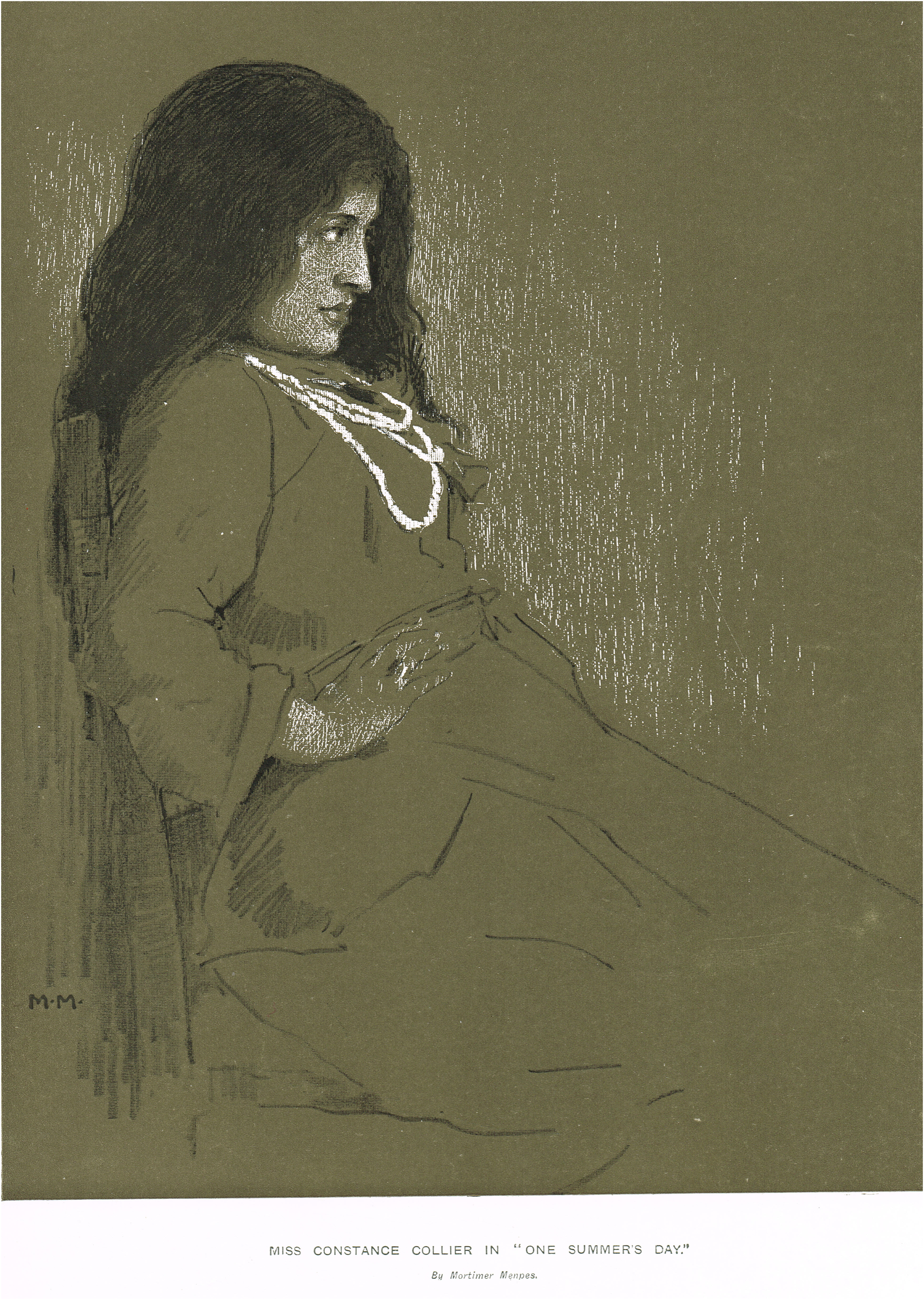
Mortimer Menpes, ‘Miss Constance Collier in “One Summer's Day”, Seated’, Drypoint Etching, the Magazine of Art, 1899, Opposite p.102.
Harry Furniss, Caricature of Gladstone
To the left of the door leading from the corridor into Maude's dressing room is a caricature of William Ewart Gladstone, three times Prime Minister, signed ‘Hy F’ for Harry Furniss (1854–1925) (Figures 18 and 19).
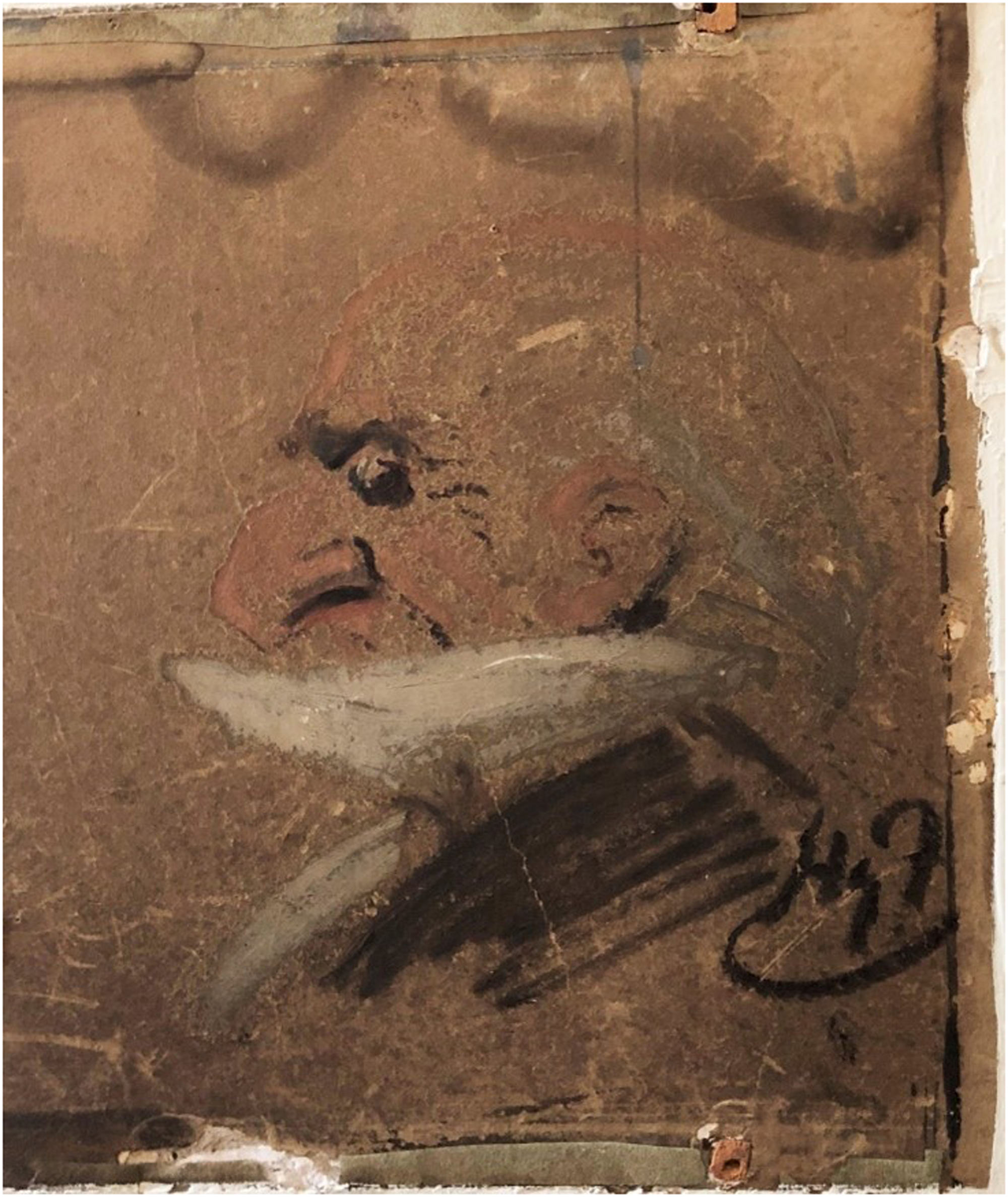
Harry Furniss, caricature of Gladstone, Cyril Maude's Dressing Room, Theatre Royal, Haymarket.
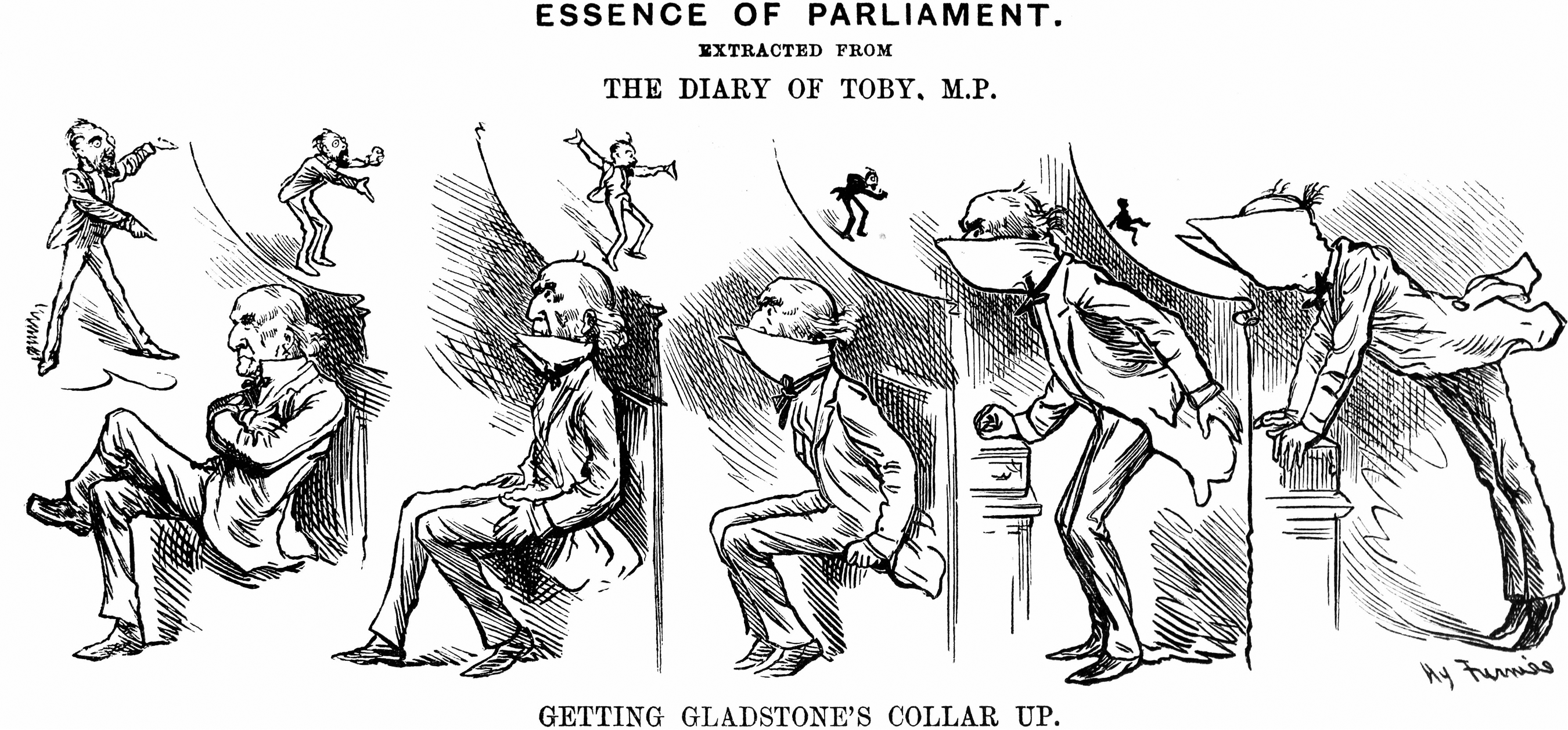
Harry Furniss, ‘Getting Gladstone's Collar Up’, Punch or the London Charivari, 8 April 1882, p.160.
Despite growing up in Dublin, Furniss never saw himself as an Irishman as his father hailed from Yorkshire and his mother was Scottish, nor did he lean towards Irish nationalism. ‘With a quick eye and ready pencil’, he showed a propensity for drawing from an early age, as one of his playmates observed, ‘constantly amusing himself and his friends with clever reproductions of each humorous character or scene that met his eye in the ever-fruitful gallery of living art’. 63 Having launched his career as a caricaturist at the tender age of twelve and realising that his prospects in Ireland were limited, Furniss ‘bade adieu to “dear dirty Dublin”’ and headed for London in 1873. 64 Working for The Graphic, he wrote and illustrated a series of supplements entitled ‘Life in Parliament’. Joining Punch as a regular contributor in 1880, his name would become synonymous with Henry Lucy's weekly political column Essence of Parliament extracted from the Diary of Toby, M. P. Featuring leading parliamentary figures, Furniss exploited the emerging ‘politics of personality that relied on various forms of performative appeal… a platform culture in which speech-making, performance, and politics were […] closely linked’. 65 Public figures were now ‘marketed as commodities to be circulated and consumed’. 66 Furniss left Punch after fourteen years due to the sale of one of his cartoons to Pears Soap for advertising purposes, which he regarded as an infringement of his copyright. 67 In October 1894, Furniss launched his own humorous magazine Lika Joko as a rival to Punch. Unfortunately, it failed and closed after six months. He then took to the road with an illustrated lecture called The Humours of Parliament, touring throughout Britain, North America and Australia during the 1890s.
Although his political caricatures secured his reputation, in some ways they limited Furniss's scope. He disliked being pigeon-holed as ‘a conventional comic draughtsman of funny ill-drawn little figures’. 68 However, he admitted, that as a caricaturist he was an ‘artistic contortionist’ being ‘grotesque for effect’. 69 Furniss's pen and ink caricature of Cyril Maude (NPG 4095(8)) emphasises his beaming smile, slightly protruding eyes and curly hair. A ‘constant theatre-goer’, Furniss counted among his theatrical acquaintances Toole, Irving, Squire Bancroft, and playwright and noted ‘man about town’ Henry James Byron. 70 Like Ward, Furniss observed his victims in Clubland, at the Garrick, the Savage and the Beefsteak Club. According to the cartoonist, here Bohemian society, a heady mix of artists, authors, actors and journalists, behaved ‘without restraint’; Clubland was the ideal spot to catch celebrities unawares. 71 However, as Furniss shrewdly noted, artists had been eclipsed by actors as popular society favourites. 72
Having ‘mused under the shade of his collars, and wondered at the cut of his clothes, sketched his three hats and his historical umbrella’, Furniss fastened on Gladstone's collar as the element to exaggerate for comic effect. 73 It began with a series of cartoons in Punch (April 1882) called ‘Getting Gladstone's Collar Up’ (a play on ‘choler’, meaning fury), in which, under the onslaught of a speech in the House of Commons, Gladstone's collar grows in proportion to his anger until it sweeps him onto his feet to address the house. 74 Offering insight into Gladstone's character and personality, Furniss concluded: ‘it will be the caricatures, or, to be correct, the character sketches, that will leave the best impressions of Mr. Gladstone's extraordinary individuality… When the glamour of his personality is forgotten, what will be remembered? His figure, his face ‒ and shall I say his collars?’ 75 Furniss naturally chose ‘Gladstone's Collar’ as his contribution to the greasepaint gallery: ‘the famous collar of the Grand Old Man being even more of a caricature than usual, a sin – if it is a sin – which may be forgiven the artist, seeing that it was he who invented the “Gladstone collar”’. 76 The date of Furniss's sketch is uncertain but it is mentioned in Rudolf de Cordova's 1900 article.
Phil May, Self-Portrait
To the left of Harry Furniss's caricature of Gladstone, there were originally two closely connected images. The one which has survived is a ‘speaking-likeness’, by his own hand, of Phil May. It was close to what can only be described as a school boyish scribble by the author J. M. Barrie, who was responsible for May's contribution (Figures 20–22).
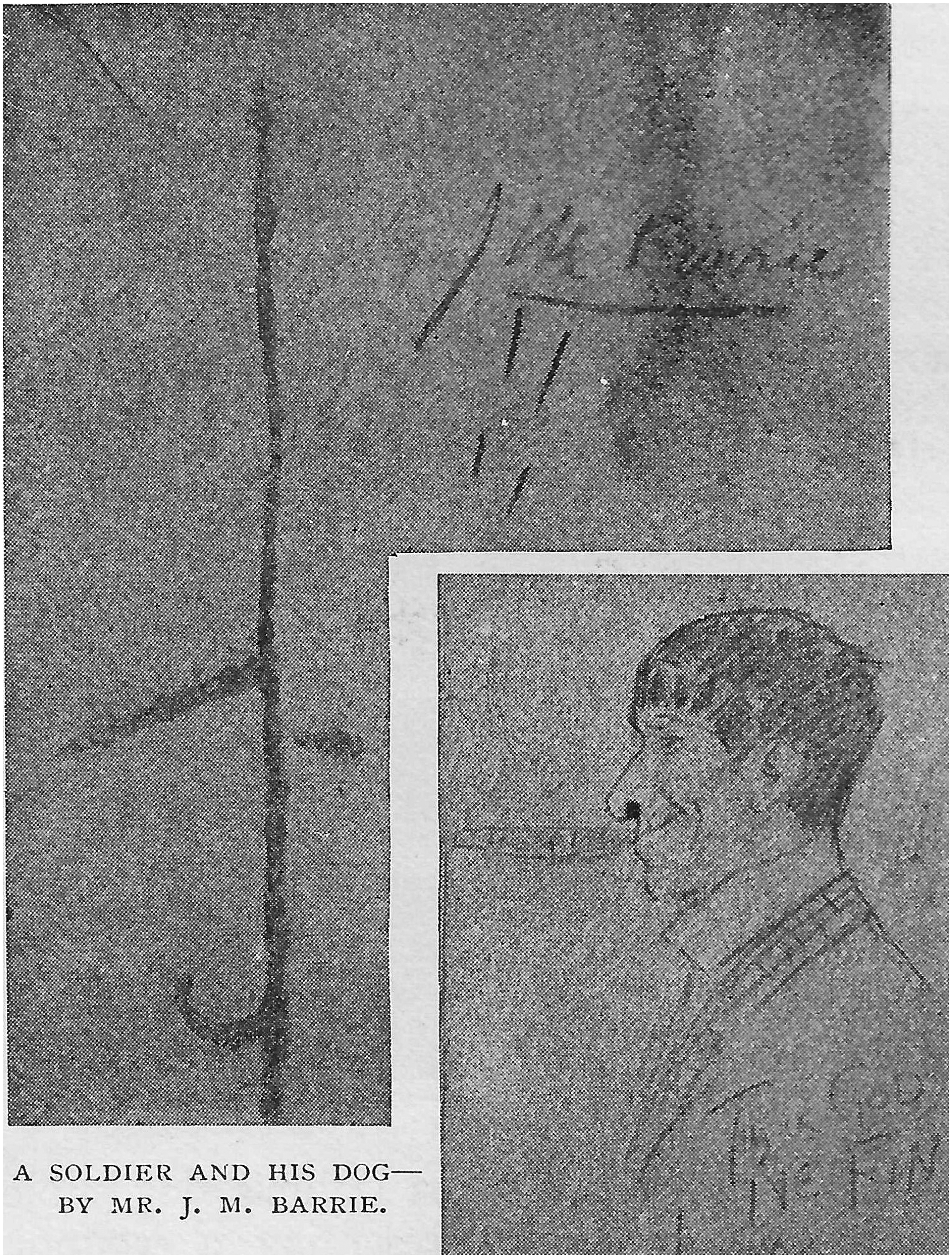
A Soldier and His Dog by Mr J M Barrie; Mr Phil May by Himself. Mr Cyril Maude's Dressing–Room and Its Pictures in Grease–Paint', Strand, July 1904, p. 58.
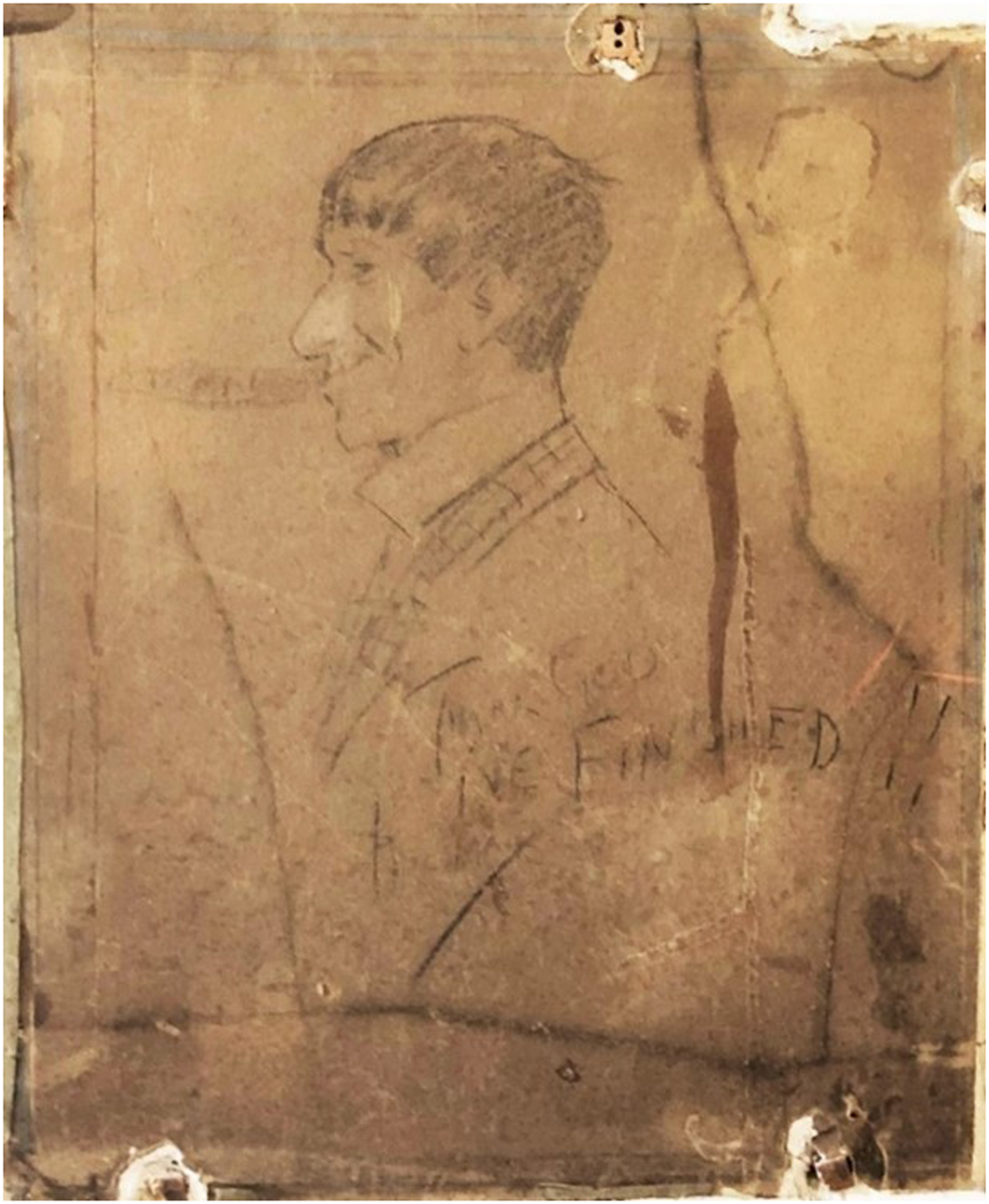
Phil May, ‘Self-Portrait’, Inscribed: ‘Thank God I’ve Finished!!! Phil May’. Cyril Maude's Dressing Room, Theatre Royal, Haymarket.
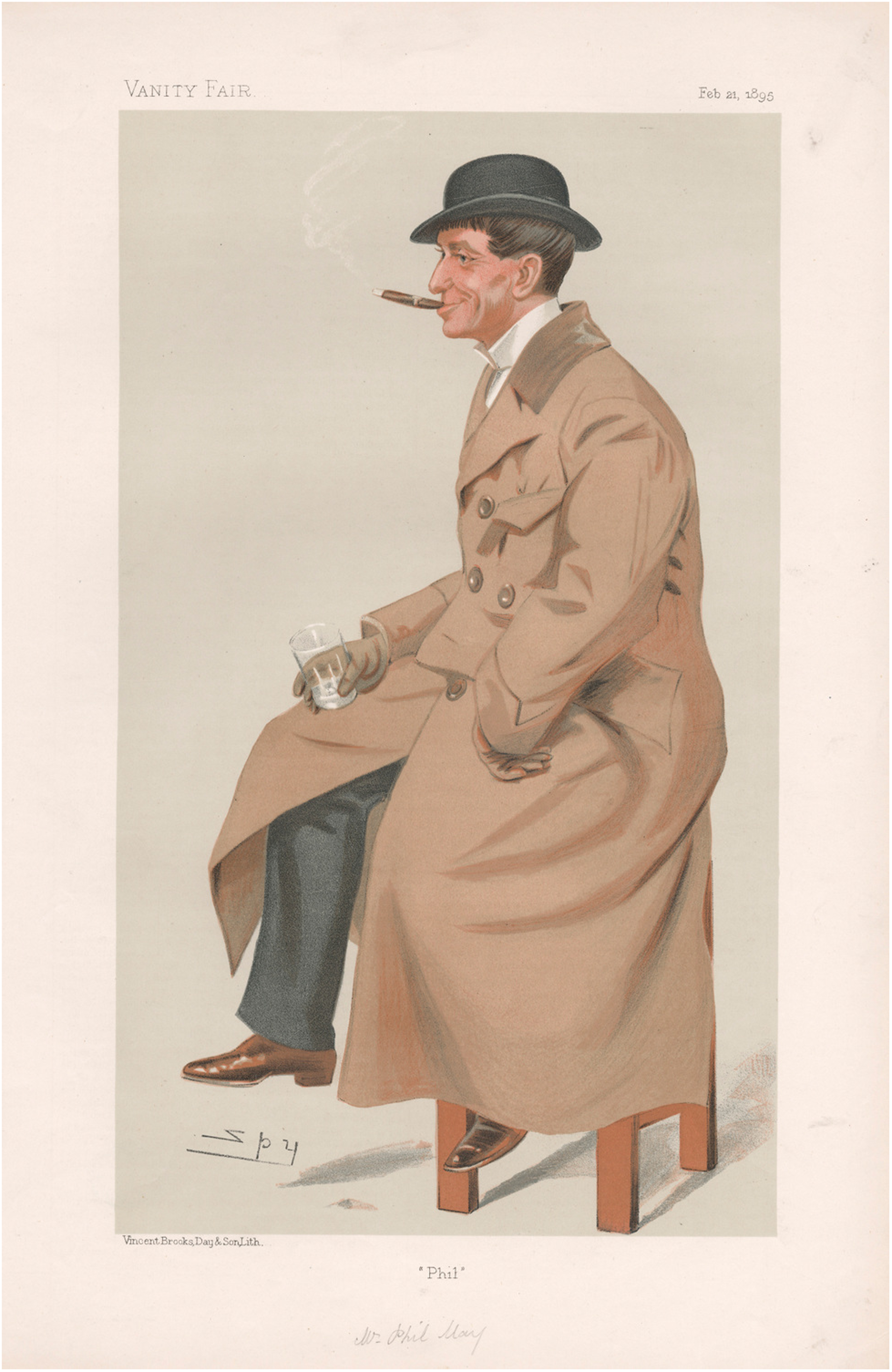
Leslie Ward (‘Spy’), ‘Phil’, Vanity Fair, February 21st, 1895, NPG@ National Portrait Gallery.
As Under the Red Robe, Maude's first success at the Haymarket, drew towards the end of its eight-month run, it was announced in May 1897 that it would be followed by a stage version of J. M. Barrie's novel The Little Minister, adapted by the author. 77 Barrie's dramatisation of his own novel would become the most successful production of the Harrison/Maude management, running continuously for almost a year ‒ a very unusual achievement in those days. It was Barrie's first big stage hit, seven years before Peter Pan, and, apart from two Peter Pan spin-offs, he gave up writing novels. However, The Little Minister was a risky choice at the time because Barrie was known as a best-selling novelist and short story writer having only two short farces to his credit. As The Times critic pointed out, very few writers succeeded as novelists and playwrights, and ‘few novels seemed less adaptable than The Little Minister’. 78
Set in 1840s Thrums, a Scottish weaving village based on Barrie's birthplace Kirriemuir, Angus, the plot of The Little Minister centres on the plight of the local weavers who rebel against a reduction in their wages. A beautiful and mysterious gypsy called ‘Babbie’ warns the weavers that the militia has been summoned by Lord Rintoul, the local Laird. Predictably ‘Babbie’ turns out not to be a gypsy at all but the Earl of Rintoul's respectable, English-educated ward in disguise. Inevitably Gavin Dishart, the newly appointed minister of Thrums’ Auld Licht church, outrages his mother and everyone else in the village when he falls in love with Babbie. Maude played the title character, Gavin Dishart, with his wife Winifred Emery, taking the role of Babbie (Figures 23 and 24).
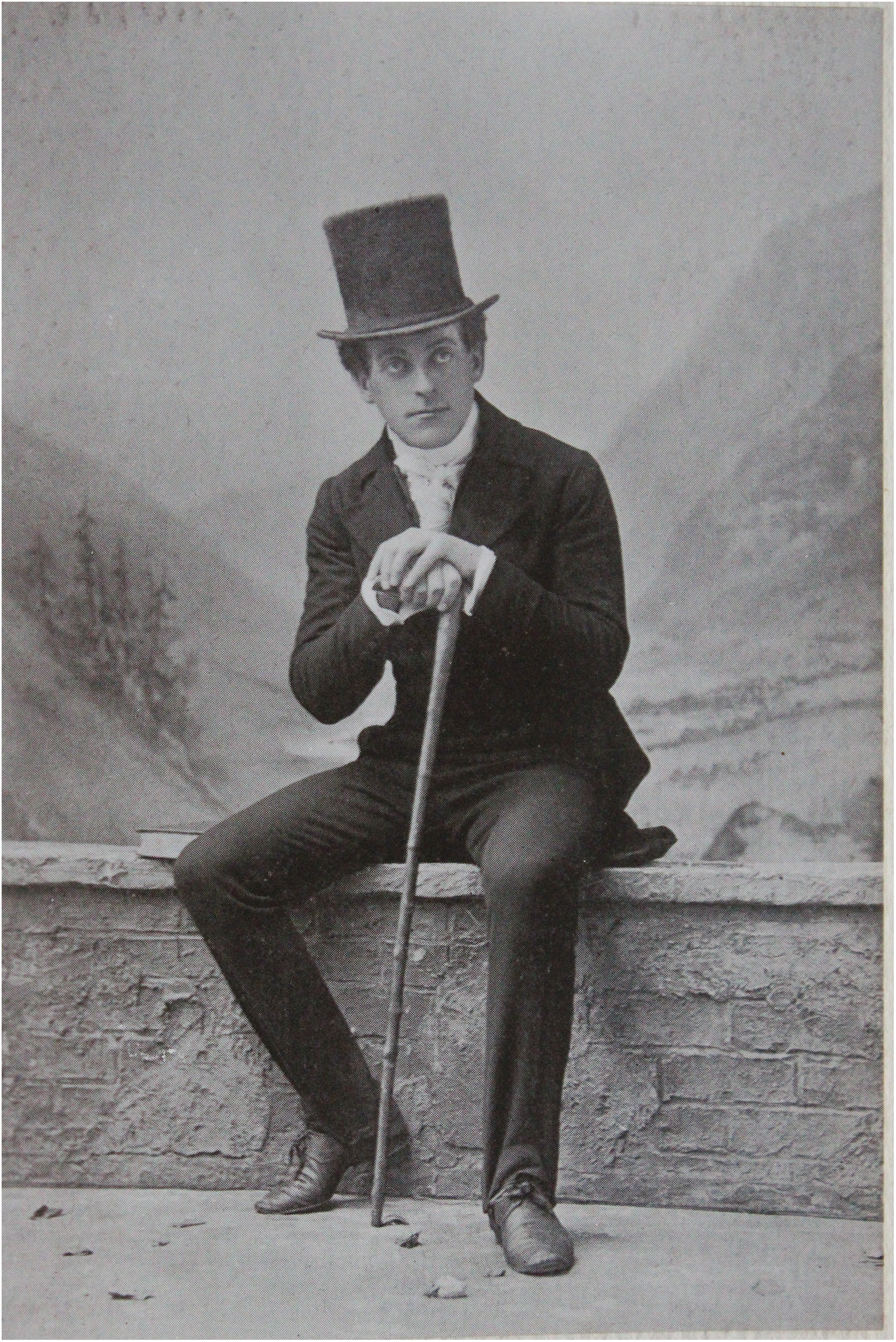
Mr Cyril Maude as Rev Gavin Dishart in the Little Minister, premiered at the Theatre Royal, Haymarket, 6 November 1897. Mr Cyril Maude and Miss Winifred Emery, A Souvenir on the Occasion of the Opening of the Playhouse, Monday 28 January 1907.
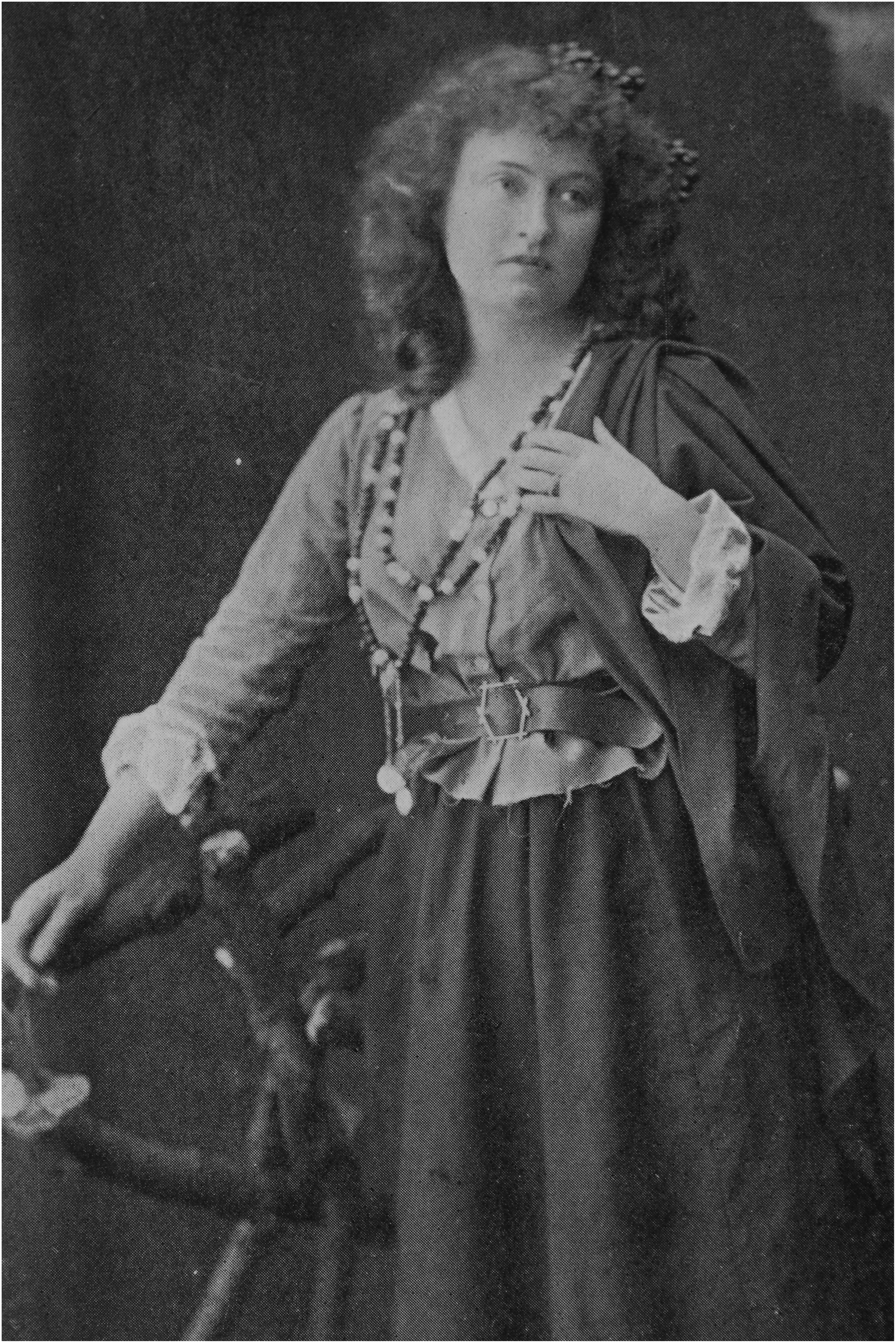
Miss Winifred Emery as Lady Babbie in The Little Minister. Mr Cyril Maude and Miss Winifred Emery, A Souvenir on the occasion of the opening of The Playhouse, Monday 28 January 1907.
To mark the success of the play, Harrison and Maude commissioned Phil May (1864–1903) to produce a portfolio of drawings of the main characters to be sold in the theatre for one shilling. May was one of the leading illustrators and cartoonists of the day, joining the Punch staff in 1895. He was so popular with the public that albums of his drawings were produced every year from 1892 until 1905, two years after his death ‒ thirteen winter and three summer editions. Although his line drawings appear to have been boldly sketched with ease, they were the result of a very keen eye and accomplished hand. As his biographer James Thorpe observed, editors ‘clamoured for his work because, apart from the humour and merit, it could be reproduced so easily and satisfactorily on any sort of paper, and his prices rose accordingly’ (Figures 25 and 26). 79
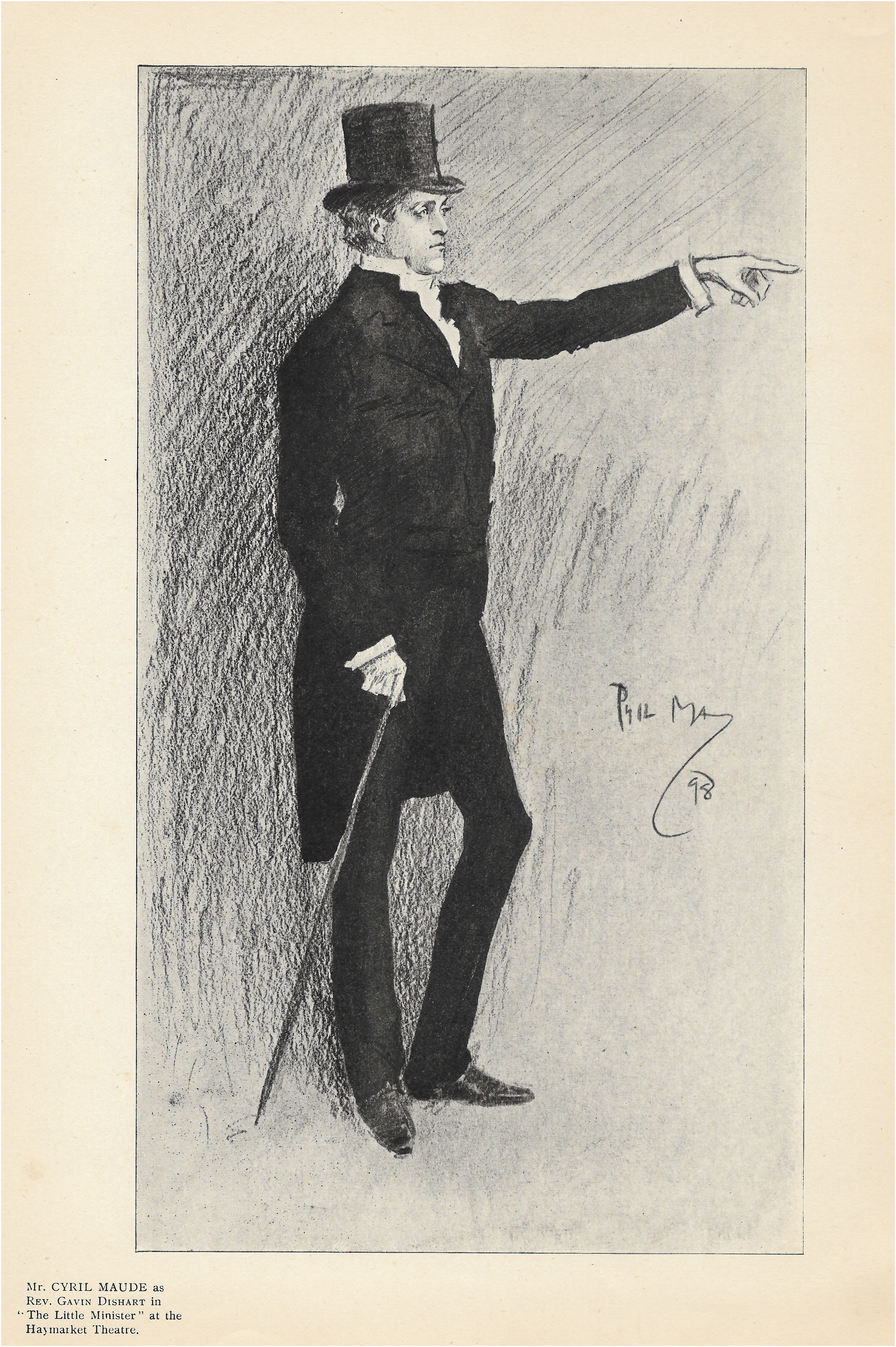
Mr Cyril Maude as the Rev Gavin Dishart in the Little Minister at the Haymarket Theatre. Theatre Royal, Haymarket, the Little Minister, Drawings by Phil May, 1898, London: Nassau Press, 1898.
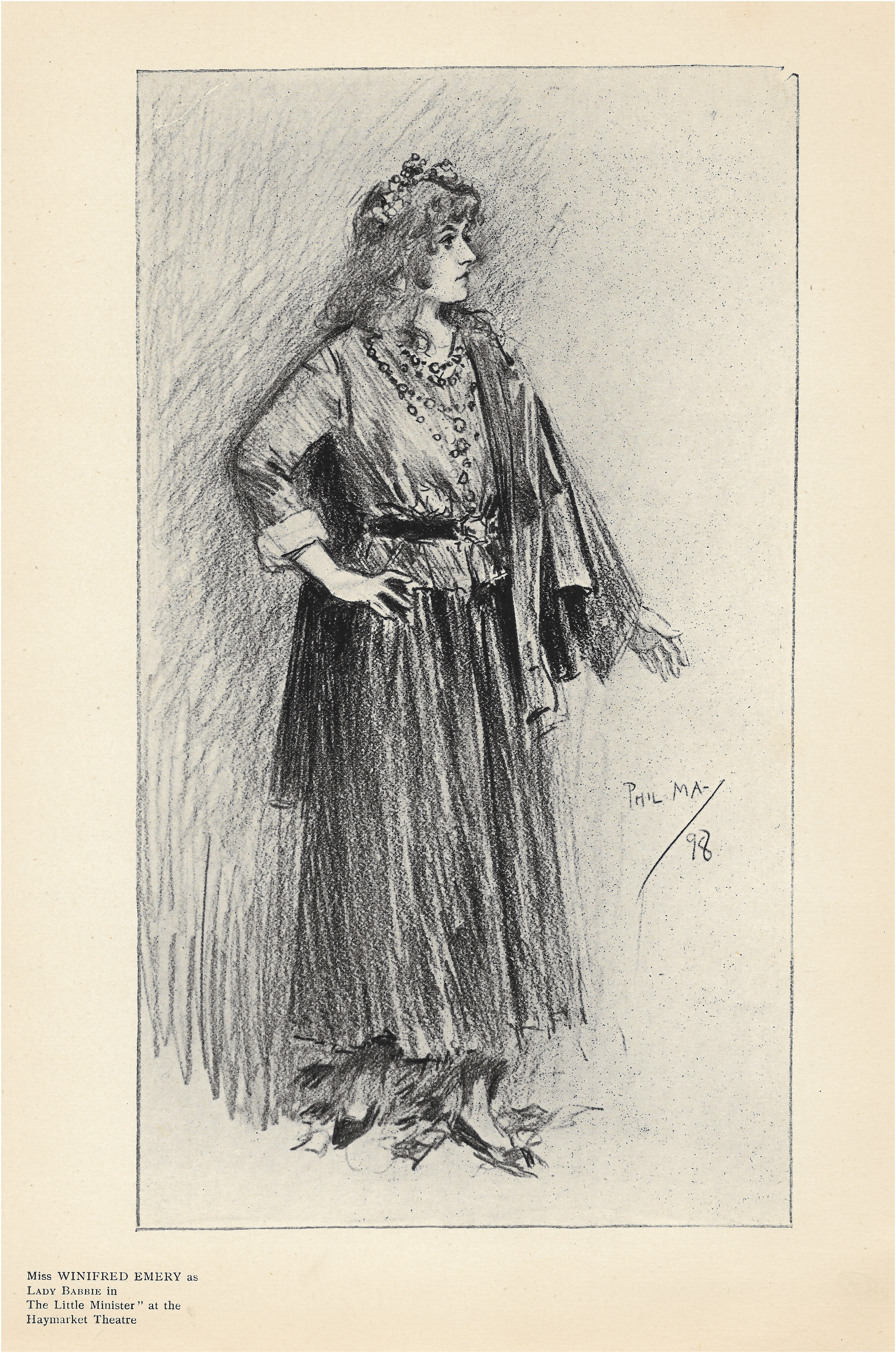
Miss Winifred Emery as Lady Babbie in The Little Minister at the Haymarket Theatre. Theatre Royal, Haymarket, The Little Minister, Drawings by Phil May, 1898, London: Nassau Press, 1898.
However, like many ‘black-and-white’ artists, May received little by way of official recognition. After the publication of Gutter-snipes (1896), he was elected a member of the Royal Institute of Painters in Watercolours, the only other graphic artist who shared this honour being Hugh Thomson. Although Lord Frederic Leighton, then President of the Royal Academy, wished to see him proposed for election as an Associate, nothing came of this idea due to Leighton's untimely death. Apparently, ‘no other academician of that time had the temerity to adopt’ the proposal. 80 However, May had the distinction of having forced ‘on that august corporation’ the concept of black-and-white drawing as ‘a form of art’: ‘Once at least he contributed to the annual exhibition. Item No, 1558 in the 1898 catalogue was described as “Drawings illustrating J. M. Barrie's play of The Little Minister”’. 81
Unfortunately, May was the victim of his own success: a combination of overwork and heavy drinking led to his premature death at only thirty-nine. By the time May received the commission for The Little Minister, he was a chronic alcoholic, unable to meet deadlines or work regular hours. Moreover, he was known for his generosity and ‘became surrounded by a crowd of sponging parasites’: ‘actors’ who had never been seen on any stage, ‘journalists’ who had been kicked out of every office in Fleet Street and ‘sportsmen’ on whom the racecourse police kept a sharp eye…. undesirable loafers who preyed on him for drinks, cigars, and other cadgings.
82
Unluckily, the building immediately next door to the Haymarket Theatre was the popular Pall Mall Restaurant, which had a bar at the front. Bill Leverton, who was the box office manager of the Haymarket for over fifty years, describes in his memoirs how difficult it was to keep May out of the bar and on the job: he was an erratic worker, and only drew when he ‘felt like it’. He was in and out of the theatre a great deal during this period, and sometimes at night he would go to the Pall Mall Buffet next door to refresh…. An artist in the difficult black-and-white, poor Phil May was, of course, a genius, but those who enjoyed his acquaintance valued his heart even more highly than his art. He was essentially a good fellow – too good, too kindly, and too large-hearted for his own welfare. At the height of his fame he earned big sums, but he was almost invariably surrounded by parasites on his good nature and sponges on his ever-open purse.
83
Eventually, after many reminders, May finished his drawings and took them to Maude in his dressing room: ‘There,’ he said, ‘are your pictures at last’. ‘And now you are here, you may as well do something on my wall,’ blandly replied Mr Maude. ‘Certainly’ said the artist, and he produced the characteristic sketch of himself with the inevitable cigar in his mouth.
84
J. M. Barrie's sketch, which has not survived, was appropriately drawn close to May's self-portrait. It was said to be ‘the only drawing ever made by the author of The Little Minister, The Admirable Crichton, Little Mary, and other successful plays’: It is perhaps the only bit of work of Mr Barrie's hands which is not original, and if for no other reason is worthy of note. It represents the well-known idea of the soldier followed by a dog going through a door, a perpendicular line representing the door, the top one the soldier's bayonet, and the curly one beneath the dog's tail.
85
It is plausible that Barrie added his contribution during the run of The Little Minister. Although other plays by Barrie were produced at the Haymarket (Mary Rose [1920]; Quality Street [1922]), they were long after Maude's departure.
Joseph Harker, ‘Winter Landscape’
Above Phil May's self-portrait is a ‘Winter Landscape’ by Joseph Harker (1855–1927), one of the most celebrated stage-set designers of his day: … an exceedingly elaborate winter scene by Mr Joseph Harker, whose work on the stage audiences at the Haymarket have so often had occasion to admire. The picture represents a deserted stretch of snow-covered road where a sluggish stream meanders beneath a little bridge. In the background stands a castle, like a rugged rock in the gathering gloom, which is relieved by the red glow of the setting sun.
86
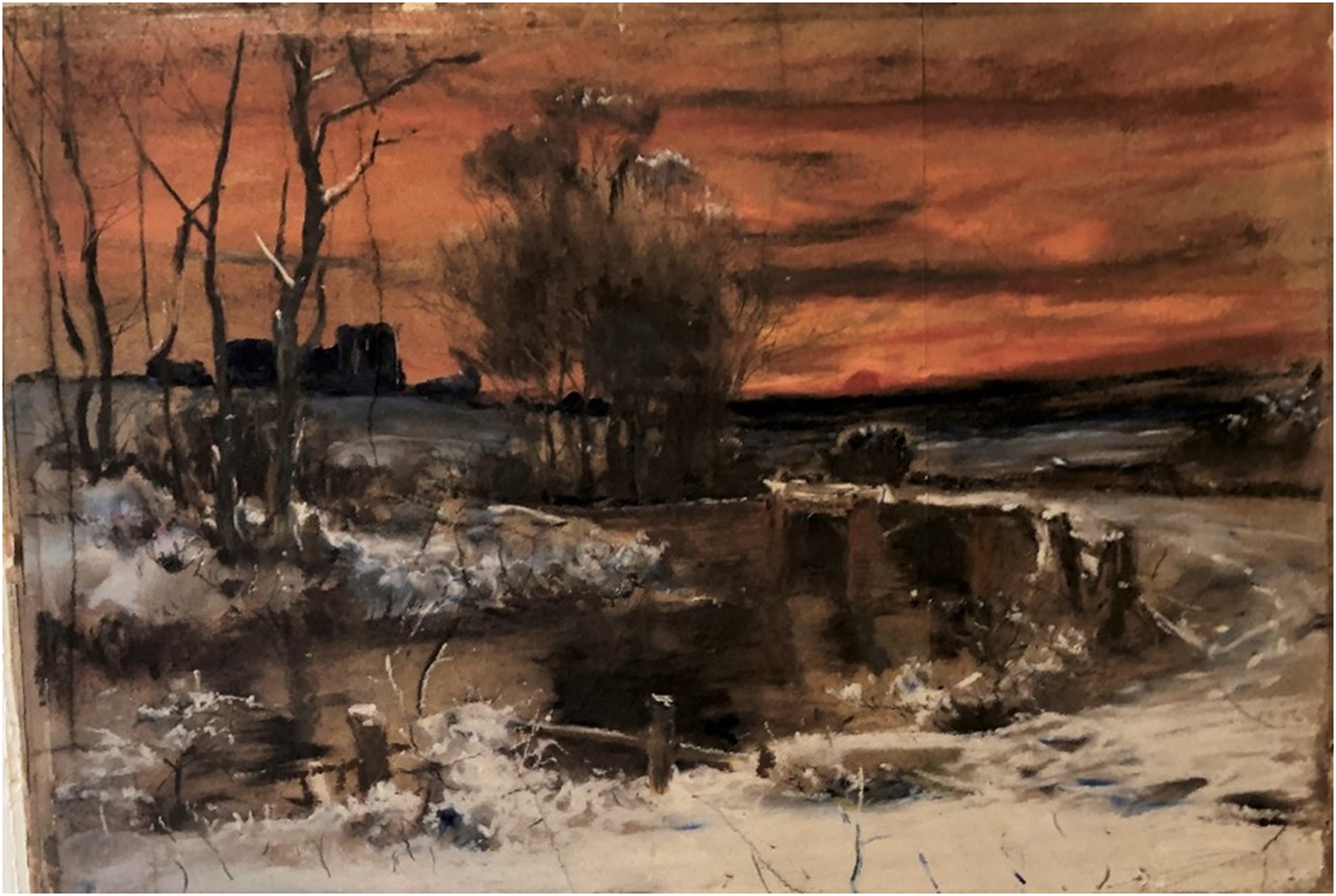
Joseph Harker, A Winter Landscape, Cyril Maude's Dressing Room, Theatre Royal, Haymarket.
Born into an Irish theatrical family, Harker was only three when his father died, leaving his mother to support three children. He was propelled onto the stage playing child parts such as Fleance in Macbeth and the young Duke of York in Richard the Third. In Studio and Stage, Harker recalled it was a tough life ‘on the boards’, touring from one end of the country to the other: ‘I doubt if any child ever spent more time in trains than I… What a wretched business train-travelling was too!… a perfect nightmare’.
88
As a stagehand, it was Harker's responsibility to look after the ‘properties’; help set the scenes; clean out the hall ‘or whatever building chanced to be doing duty as a theatre’; scrub down the stage; take the money at the door and stick bills.
89
The job of ‘fitting-up’ led Harker to choose a life behind the scenes: ‘I was keener than ever, if that were possible, on scenic work’.
90
His mother approached her brother John O’Connor, ‘undoubtedly one of the greatest scene-painters of the day’: Up to then scene-painting had not been conceded a very conspicuous place among the arts, scene-painters with social pretentions and aspirations seldom if ever being heard of… they were looked on in the earlier days of the craft as being unimportant and possibly even rather contemptible persons.
91
Navigating his way through society, working for the Duke of Westminster and tutoring Lord Ronald Gower, O’Connor ‘gave the scene-painter status’. Harker's long association with the Haymarket began when he assisted his uncle with the painting of the scenery for W. S. Gilbert's Pygmalion and Galatea which opened in December 1871. When Beerbohm Tree took over the ‘fine old theatre’ in 1887, he staged a series of ‘brilliant and highly spectacular productions that gave me a scope that can have fallen to the lot of but few stage artists’. 92 The staging of Hypatia (1892–93) enabled Harker to cement a long friendship with the neoclassical painter Lawrence Alma-Tadema. Although he sometimes executed designs by others, including Alma-Tadema and Ford Madox Brown, Harker was usually both the designer and executor of his own scenes. He resented the revolution in stage design that was replacing the canvas backdrops and wings with three-dimensional sets. Much of Harker's autobiography dwells on his denigration of such changes. He also claimed that scene painters were artists, not artisans or hired hands, and he resented the fact that anyone working on a canvas larger than six feet by four was not considered an artist. 93
Harker refused to work exclusively for one management, preferring to retain his independence as a freelancer and status as an artist. He worked for many years at the Lyceum creating sets for Irving. Bram Stoker, Irving's business manager, purloined his surname for the character of young Jonathan Harker in Dracula (1897). Harker returned to the Haymarket to create the stage sets for The Little Minister, working alongside Walter Hann, who contributed a ‘beautiful circular moonlight picture’ dated 1901 to Maude's gallery. Harker and Hann also painted scenes for Richard Brinsley Sheridan's The Rivals and The School for Scandal (both 1900) and Sydney Grundy's Frocks and Frills (1902). As Harker's Winter Landscape appears to be dated 1902, it was probably added during the run of Frocks and Frills. In 1904, Harker painted the ornate ceiling (still in situ) of the new Haymarket auditorium.
Robert Baden-Powell, ‘Pig-Sticking’
Above Harker's landscape is a very faint image of an army officer in tropical uniform pursuing a wild boar on horseback in a sport known as pig-sticking or hog-sticking. The image carries the initials R. B. P. which stands for Robert Baden-Powell of ‘Boy Scout glory and fame’ 94 (Figures 28 and 29 – see also Figure 2).
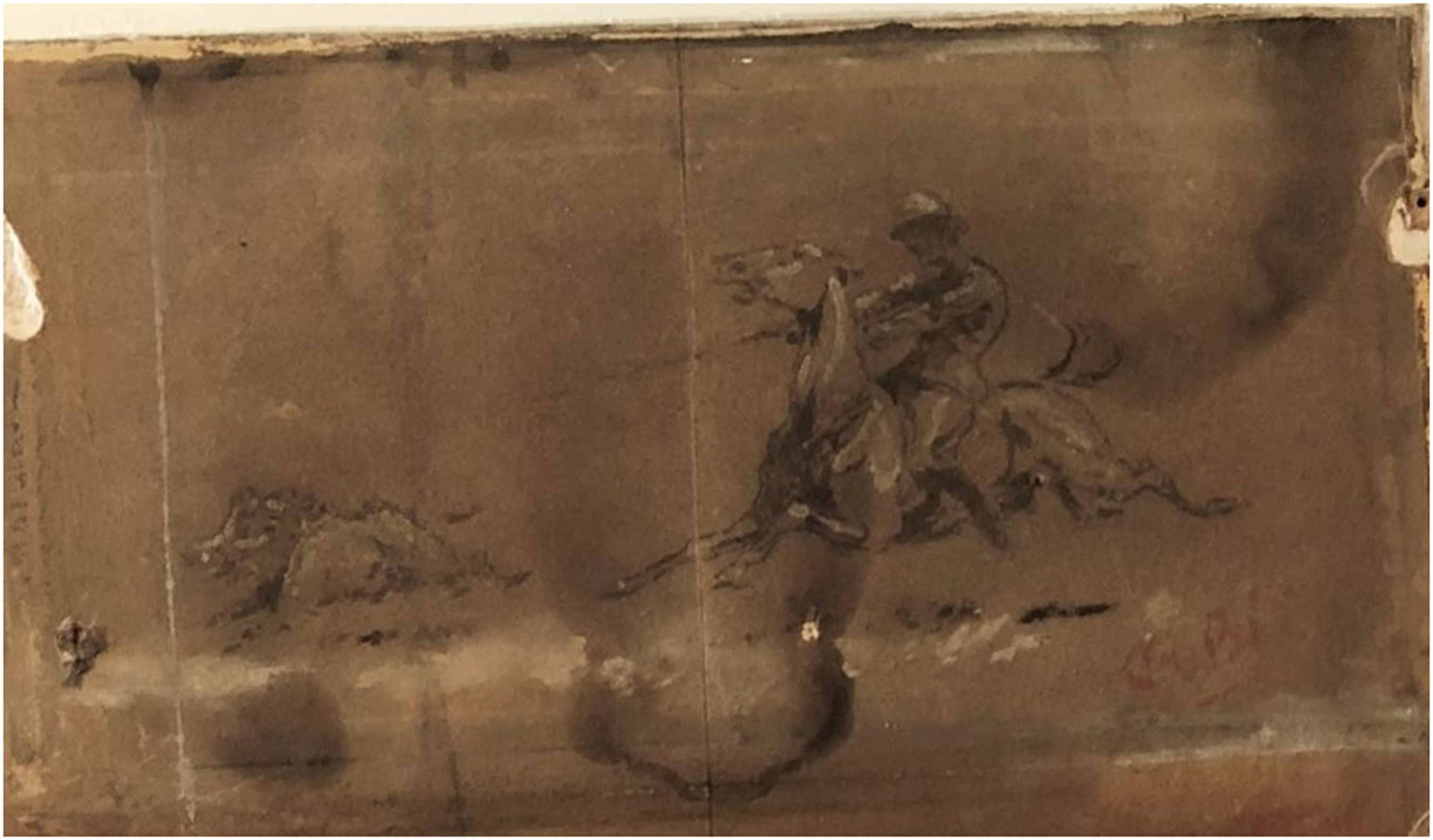
Robert Baden-Powell, Pig-Sticking, Cyril Maude's Dressing Room, Theatre Royal, Haymarket.
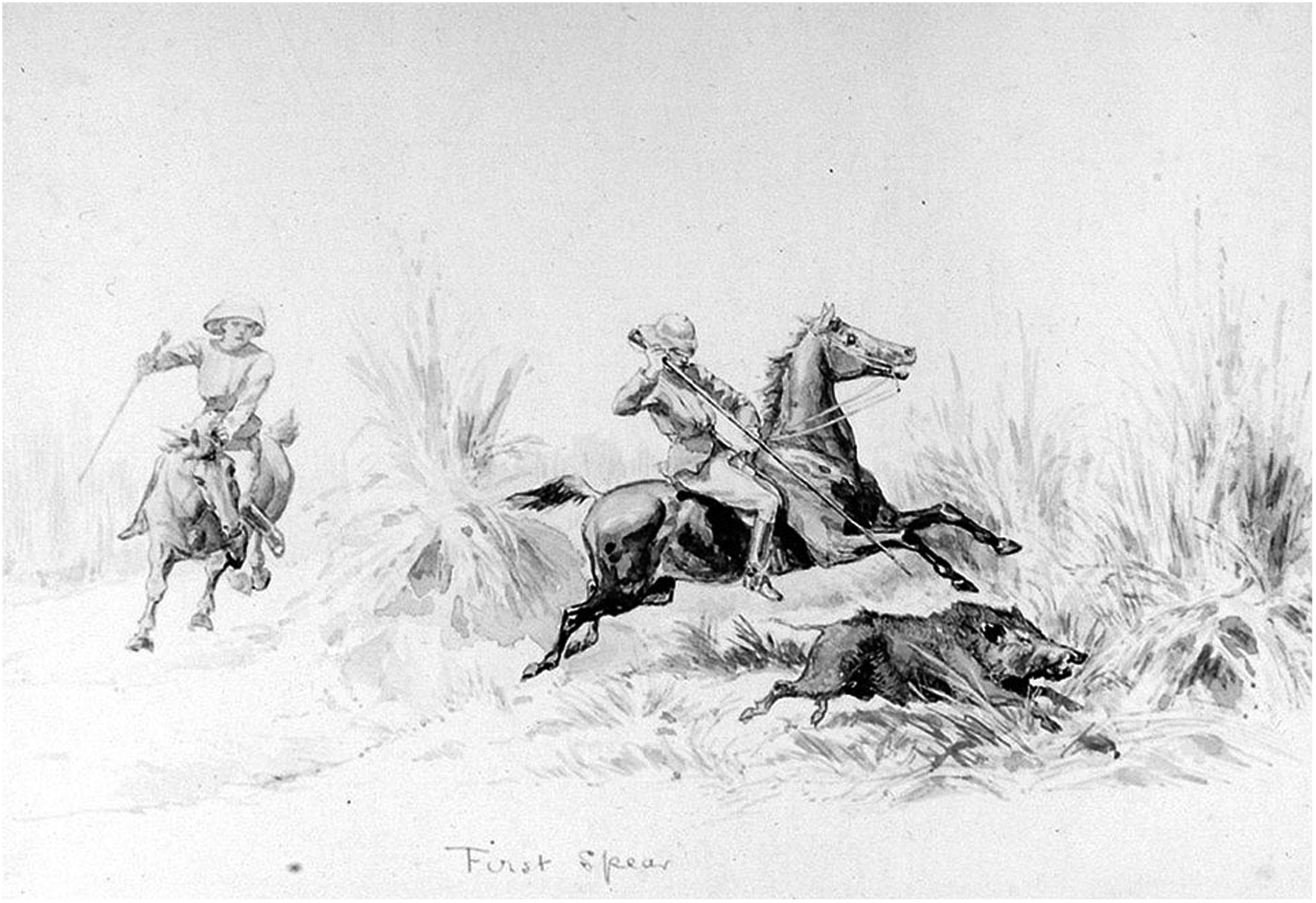
Robert Baden-Powell, ‘First Spear’ Pig-Sticking, India, 1889, National Army Museum.
As mentioned by Pamela Maude, Baden-Powell's drawing is not included in The Strand article of July 1904, so it must have been added between July and December 1904. Its position, close to the ceiling, reflects the lack of available wall space at this time, with some forty images already in place.
Major, then General, Baden-Powell served as an officer in the British army in India and South Africa. In 1897 he returned to England as something of a celebrity after putting down the uprising in Matabele Land in Southern Rhodesia (now Zimbabwe). He was also a talented artist selling his drawing to various newspapers: ‘Soon after my first arrival in India, the Graphic offered me remuneration for sketches of interest from the front…. this was the beginning of a long and happy connection with that journal’. 95 Thus, swelling his slender income as a subaltern, Baden-Powell was able to take his ‘share in polo and pig-sticking, which would otherwise have been impossible’. 96 Although he liked ‘trying to draw’, Baden-Powell never took lessons at school as it was an ‘extra’ and ‘could not be afforded’. 97 He taught himself by studying and copying pictures. Elected an honorary member the London Sketch Club, Baden-Powell joined the ranks of John Hassall, Dudley Hardy, Lawson Wood, Heath Robinson, Harry Rowntree, Starr Wood and F. Shepherd. He ‘got the kindest help and criticism’ as well as the ‘inestimable privilege of watching them at work and noting their methods’; ‘what a clever, brilliant, and jovial crew they were ‒ and are, bless ‘em’. 98
The image drawn on Maude's wall resembles Baden-Powell's ‘First Spear’, Picking-sticking India (1889) from an album of twenty-five sketches now in the National Army Museum (NAM. 1963-10-352-4). This album formed the basis for Pig-Sticking or Hog-Sticking: A Complete Account for Sportsmen and Others which was first published in 1889. A popular but extremely dangerous recreation for British officers stationed in India, Baden-Powell confessed: ‘I never took the usual leave to the hills in hot weather because I could not tear myself away from the sport’.
99
Cavalry officers competed in pig-sticking events, the most famous being the Kadir Challenge Cup which Baden-Powell carried off in 1883. In his Lessons from the ‘Varsity of Life (1933), Baden-Powell defended the sport, which was savage: Try it before you judge. See how the horse enjoys it, see how the boar himself, mad with rage, rushes wholeheartedly into the scrap, see how you, with your temper thoroughly roused, enjoy the opportunity of wreaking it to the full. Yes, hog-hunting is a brutal sport – and yet I loved it, as I loved also the fine old fellow I fought against…. Do what we will and say what we like, although we have a veneer of civilisation, the primitive man's instincts are still not far below the surface.
100
Like Maude, Baden-Powell attended Charterhouse School. Several of his schoolfellows went on to become well-known actors, and Baden-Powell enjoyed ‘many warm and lasting friendships in their charming circle’. 101 Although Maude was five years younger than Baden-Powell they became great friends; Baden-Powell was Maude's best man when he married Winifred Emery in 1888. 102 When Maude organised a charity matinee at the Haymarket on 26 June 1899 to raise funds for the Charterhouse School Mission in South London, ‘B. P.’ joined Maude in a ‘song and dance’; ‘He was a capital actor. We did our song and dance together with great success… He was as keen a worker on the Haymarket stage as on the South African veldt; in fact, I don’t think I ever saw an actor, amateur or professional, work with greater good will’. 103 He presented quite a sight, turning up for rehearsals in his cavalry colonel's full uniform: ‘It was distinctly funny to see him dancing about the stage in full kit to a tune which has now become quite a standing dish at our own theatre… and which we have dubbed “B.P.'s” anthem’. 104 Baden-Powell confessed: ‘You will class me rather as a mountebank for advocating as I have done the role of comic singer or actor or dancer. You will be inclined to say: “Have you no sense of dignity?” and all that sort of thing. But I am unrepentant’. 105
When B. P. was sent by Lord Wolseley to take command of the British troops on the eve of the Second Boer War, Maude declared that: ‘it was with no little pride and affection that we of the Haymarket Theatre watched “B. P.'s” career throughout the war. On Mafeking night, the whole staff collected on the stage after the performance to drink his health’. 106 They were addressed by William Haig Brown, headmaster of Charterhouse when both Baden-Powell and Maude were schoolboys, who declared B. P. ‘would be equally at home nursing either a baby or a cannon!’ 107
Conclusion: The End of the Greasepaint Gallery
In ‘Famous Dressing Rooms’, de Cordova drew what must have seemed an obvious conclusion: These are not framed pictures… but are done direct on the wall itself, so that they can never be taken away, and furnish a silent proof that Mr Maude evidently intends to make the Haymarket his permanent abode.
108
What material Fate will give to succeeding chapters of its life-story no man can tell. But I can promise that so far as I am concerned there shall be nothing left undone to make them bright and happy.
109
It is with no desire to be snobbish that I emphasise the fact that, during the phenomenally successful Harrison and Maude regime, the Haymarket was under the control of two men of a type unfortunately rare in theatrical management – men of wide culture, of high social standing, and with high theatrical ideals.
111
It had certainly been an extraordinarily successful management. In his ‘Dramatic Dialogues’ (1905), Frank Richardson asserted: ‘Many of them [wall paintings] represent Mr Maude in one or other of his successes. There are no pictures of him in his failures ‒ because he has never had any’. 112
So, what brought this partnership to an end? Maude was vague in his autobiography, merely referring to ‘circumstances (over which, owing to a lack of foresight, I had but little control)’ which had forced him to leave the Haymarket. 113 However, in an interview that Maude gave to the Pall Mall Gazette only a few months before the end of the partnership, when the wounds were fresher, he was more forthcoming. He wanted to deny the rumour that the falling out was over the roles to be played by his wife, Winifred Emery. Maude implied that he had been doing more than his fair share of work in the partnership as not only co-manager but also artistic director and star of most of the shows. It also appears that Maude opposed the rebuilding of the auditorium, which had been constructed under the auspices of Squire and Marie Bancroft in 1880; ‘The alterations will have made a different place of it altogether, beautiful, no doubt, but not the theatre as I loved it’. 114 He returned to this point in his memoirs, twenty-two years later: ‘I returned there [after the building work] to find the auditorium entirely altered as to shape, which, as a great lover of Bancroft's original design, I cordially disliked. But ‒ well, there is no need to tell the whole story!’ 115
Unlike Maude, Harrison disliked personal publicity: he shunned interviews and wrote no memoirs, so we will probably never know ‘the whole story’. However, Maude's opposition to rebuilding an auditorium that was only twenty-four years old probably had less to do with nostalgia than with the costs, which would come out of the theatre's profits and would therefore affect his share as co-manager. Those who inherited Maude's dressing room probably pondered over the greasepaint gallery; apparently no actors added to it.
Maude's unusual gallery adds to our understanding of dressing room culture. Drawing on Susan Stewart's ‘On Longing’, the costumes and stage properties preserved clearly fall into the category of memorabilia and souvenirs. 116 Each actor curates their own collection, building a stage persona through ephemera and creating a transitory autobiography based on personal things. Portraits, in a wide variety of media from framed watercolours and prints to postcards and posters, pay homage to actors past and present. They also situate the actor within their profession and the history of stagecraft. Maude's greasepaint gallery went further, turning the walls of his dressing room into a nostalgic scrapbook chronicling stage roles and performances. Those added by celebrities, such as Baden-Powell and Barrie, endorsed and bolstered Maude's own fame. Being invited ‘behind the scenes’ into Maude's dressing room, to see the gallery, denoted acceptance into a privileged class.
Time has not been kind to the greasepaint images. The author of the Strand article was enthusiastic about the novel medium, claiming that: ‘Those who have used greasepaint aver that it is even superior to pastel, as the colours cannot dust off’. 117 Unfortunately being wax based, the images have darkened to the point at which only fragments can be seen. In 2007, the art historian Christopher Wood was asked to assess the remaining images and he listed seven: Raven-Hill's sketch of Cyril Maude as Lord Bapchild in The Manoeuvres of Jane was still visible. The image is still there but so dark it is only partially visible.
Maude made one last appearance at the Haymarket. On 24 April 1942, there was a celebration of his eightieth birthday and retirement from the stage to raise funds for the RAF Benevolent Fund and the Actors’ Benevolent Fund. Maude played a very elderly Sir Peter Teazle to Vivien Leigh's Lady Teazle in the quarrel scenes from The School for Scandal. A weekday matinee in wartime must have felt very different from those glamourous Victorian nights in the old auditorium. Nevertheless, it seems more than likely that Maude put his head round the door of his former dressing room to see how many greasepaint pictures survived.
Supplemental Material
sj-docx-1-nct-10.1177_17483727231160225 - Supplemental material for The Most Remarkable Dressing Room in Stageland: Cyril Maude's Greasepaint Gallery in the Theatre Royal, Haymarket
Supplemental material, sj-docx-1-nct-10.1177_17483727231160225 for The Most Remarkable Dressing Room in Stageland: Cyril Maude's Greasepaint Gallery in the Theatre Royal, Haymarket by Anne Anderson and Robert Whelan in Nineteenth Century Theatre and Film
Footnotes
Acknowledgements
The authors thank Sir Leonard Blavatnik, Chairman of Access Industries, Danny Cohen, President of Access Entertainment, Nigel Everett, General Manager of the Theatre Royal, Haymarket and Mark Stradling, Theatre Manager of the Theatre Royal, Haymarket, for their support and assistance in the preparation of this article. Also, the authors thank Julie Robinson, Senior Curator of Prints, Drawings & Photographs, AGSA, Adelaide, for additional information on Mortimer Menpes.

Supplemental Material
Supplemental material for this article is available online.
Notes
Supplementary Material
Please find the following supplemental material available below.
For Open Access articles published under a Creative Commons License, all supplemental material carries the same license as the article it is associated with.
For non-Open Access articles published, all supplemental material carries a non-exclusive license, and permission requests for re-use of supplemental material or any part of supplemental material shall be sent directly to the copyright owner as specified in the copyright notice associated with the article.
