




Abstract
Publicity materials heralded the New York Hippodrome as the world's largest theatre and the National Theatre. Managers Elmer Dundy and Fred Thompson based their claim for national status on the venue's size. Their ideology considered big to be better because it proclaimed success, efficiency, and the organisation and consumption of pleasurable experiences to be the responsibility of every American citizen-consumer. Using publicity, costume designs, sketches, illustrations, production stills, newspaper reports and a scrapbook, I explore their nationalistic vision. I demonstrate how the opening's entertainments performed Dundy and Thompson's populist Americanness through narrative, design aesthetics and moments that exceeded the dramatic frame. The first of the two night's productions, A Yankee Circus on Mars (1905), presented Mars as an idealised surrogate America. The production deliberately centred circus to designate their venue as ‘American’ due to circus's status as an intrinsically American entertainment. Circus provided practical benefits in filling the vast interior with spectacle and covering long stage waits. Presenting circus end-on in the New York Hippodrome designated the venue ‘American’, but created an experience that was akin to circus. Focusing on responses to aerial acts, I demonstrate the visual gains and visceral losses to experiencing aerialists within the Hippodrome space.
On 12 April 1905, the New York Hippodrome opened its doors and proclaimed itself the largest theatre building in the world. If the managers, Fred Thompson and Elmer ‘Skip’ Dundy were to fill their over 5,200-person house, with its vast stage and auditorium, they would need to be strategic in how they attracted audiences, satisfied their investors and remained solvent. Their underpinning vision for the venue and traces of the approach they employed to address the commercial challenge of filling such a large house are evident both in promotion materials and in the opening programme that saw A Yankee Circus on Mars and the Civil War spectacle Andersonville, The Story of Wilson's Raiders entertain packed houses of New Yorkers. 1 Central to their nationalistic strategy was their reliance on the cultural image of the circus and entertainment predominantly associated with it. Thompson and Dundy conceptualised their new venture as the ‘National Theatre’ at a time prior to any formal American national playhouse. Circus played a key role in their aspirations and their need to fill their vast performance space. These entertainments had the advantage of being perceived as intrinsically American and performed useful, practical purposes in production that included filling the vast interior with spectacle.
In this article, I begin by demonstrating the grounds on which Thompson and Dundy claimed their venture as the ‘National Theatre’, drawing on publicity materials used to launch their huge venue. Their aim of building the largest theatre in the world embodied the American principle of big being better, where working on a large scale was about success, efficiency and organisation. Consuming the pleasurable experiences provided by such productivity was the responsibility of every citizen because it had the power to contribute to America's economic might. Costume designs, sketches, illustrations, production stills, newspaper reports and a scrapbook demonstrate their nationalistic vision realised in performance and in moments of performed patriotism that exceeded both productions’ narratives. One large question looms over this evening's entertainment: why invoke so strongly the competing entertainment of ‘circus’ in the opening production of Thompson and Dundy's ‘National Theatre’? Particularly, when ‘National’ implies elite cultural status and the circus form implies popularity. This question seems especially pressing as early Spring was the time the large American circuses such as Barnum & Bailey started their tenting circuit by temporarily occupying Madison Square Garden 2 for five or six weeks. The response that emerges is that circus had the cultural power as an unequivocally popular and competitive American entertainment. Invoking ‘circus’ supported their patriotic and commercial vision on grounds broadly similar to Thompson and Dundy's nationalistic ideology. It also provided practical benefits that included encouraging repeat business and dealing with some of the production challenges that were created by such a vast stage and lavish productions. Although ‘circus’ acts were advantageous for the New York Hippodrome, I will finish by considering how the Hippodrome circus experience differed from railroad circus experiences. ‘Circus’ acts performed in the vast Hippodrome space were presented end-on, within or in front of the proscenium frame, rather than around a circular ring. This end-on format may have privileged visual rather than physical experiences, but their performance in this venue supported the manager's aims of becoming a national institution.
An American Institution: Thompson and Dundy's Vision of a National Theatre
Prior to the New York Hippodrome opening, Thompson and Dundy set out their vision for their venue becoming America's National Theatre in posters
3
and a full-page advertisement in the New York Times,
4
later restating their claim in advertisements during their first season.
5
Both these pieces of their pre-opening promotion make their statement strongly, using the heading: ‘NEW YORK HIPPODROME, THE NATIONAL THEATRE’. Both assert that the New York Hippodrome is the ‘National Theatre’ by locating the claim as the first set of words under the heading and venue name. However, the full page of newspaper advertising makes their claim most assertively using the visual tactic of uniting both venue and statement in the only place on the entire page where white text on a black background is used. Following on from this heading, both poster and advertising make Thompson and Dundy's ‘MANAGEMENT'S PROCLAMATION TO THE PUBLIC’. In this surprisingly long text, they extol the principles underpinning their national theatre whilst also highlighting the grounds for its success: NEW YORK's Permanent New Amusement Institution, the Hippodrome, is the Largest, Safest, Costliest Playhouse in the World, and First, Single and Independent of its Kind. America's only real representative amusement institution. Representing a Triumphant Alliance of Capital, experience and genius and an outlay of $3,500,000. In equal nowhere in the World. Ushering in a Glorious New Era in Amusement History and Framed for the Tastes and Pleasures of the Whole People. Dispossessing the Bygone old Age of Theatrical Routine and Circus Monotony with Stirring Progress and Rousting Reform. Breaking free In Method, Style and Price of Performance, and Different and Distinct from every other playhouse in construction, equipment and conduct. Human capacity and Healthy Aspiration Exhausted in a Magnificently Blended Festival of SPECTACLE, MUSICAL EXTRAVAGANZA, DRAMA, CIRCUS and SPECIALITY and ZOOLOGICAL DEMONSTRATIONS. Two installments of double entertainment. COLOSSAL PRODUCTIONS
MADE POSSIBLE BY THE EXPENDITURE OF FORTUNES
6
At first glance, and from my perspective as a non-American, the New York Hippodrome appears to embody a simplistic brash American stereotype that ‘big is better’ in terms of venue size, capital outlay, spectacle and length of programme. However, that cursory reading belies the complexities' ‘bigness’ represented as a commercial American driving principle at the turn of the twentieth century. It is true that by visiting the New York Hippodrome audiences had the opportunity to experience one of the largest theatre venues in the world, opulently furnished and not just for one performance but for a ‘Festival’ of entertainment that guaranteed visitors value for money at an affordable ticket price. Yet, Thompson's biographer, Woody Register, demonstrates that this association with bigness should be understood as culturally contingent: ‘the Hippodrome was not overweening bigness, but Progressive bigness that did everything continually better and attended to the wants of the masses rather than the demands of the elite or lowly few’. 8 Although I would hesitate to situate Thompson and Dundy as strongly within the politically driven ‘Progressive’ movement as Register does, his words demonstrate that they tied their bigness to productivity. Their ‘Reform’ and ‘Progress’ were less focused on addressing the problems caused by industrialisation, immigration and urbanisation and more on mobilising the benefits and innovations modernity provided to democratise pleasure for mass audiences. The scale of the venue was conceptualised as more than just a novelty, it was a ‘controlled, organized bigness’ 9 that sought to secure success through economies of scale and the opportunities these provided to streamline processes. The high costs of mounting the lavish and immense spectacles Dundy and Thompson staged at the Hippodrome required that productions continue to recoup their investment by going on tour to cities with large enough stages that the production could be adapted to them – something at least one contemporary newspaper assumed would happen. 10 Yet another reporter, The Red Book's Acton Davies, considered the size of the venue and its ‘colossal series of attractions’ as confirming its national status because it would attract more than just New Yorkers. 11 His words suggest that the Hippodrome represented American progress as an emblem of productive modernist bigness but that its novelty status would also encourage tourists desiring a nationally significant theatre experience.
Big being better was a component of Dundy and Thompson's commercial Americanness that was routed in an ideal of democratic consumption. The high levels of investment proclaimed in this promotional copy are positioned as a central reason why the venue will succeed and a key selling point for audiences that communicated value for money. Yet, this desire to stress their bigness as productive rather than purposeless is evident in their proclamation's need to highlight their industry ‘experience’. Showy over-investment could be perceived as dangerously imprudent if managers were too fresh in the entertainment business. Dundy and Thompson, however, could demonstrate their ‘genius’ and experience through their successful management of Coney Island's Luna Park. Reinforcing this point about experience and expertise, the Hippodrome's opening productions’ programme stresses how they both ‘regenerated Coney Island’ in a full page of text that cross-publicised the entertainment complex to their potential new theatregoers. 12
Beyond communicating a track record in expertise, such high levels of investment had experiential implications for the mixed, but predominantly middle-class, patrons that the Hippodrome sought to attract through both the stage experiences and those within audience spaces. Thompson deliberately set the prices at the Hippodrome to attract those whom, he felt, had been prevented from New York theatregoing because they could not afford the prices charged at the best Broadway theatres, with tickets starting at just twenty-five cents and peaking at one dollar. On average, this made the Hippodrome's prices fifty cents cheaper than the most elite Broadway theatres. 13 Although the Hippodrome inhabited a liminal place between the varied entertainments it presented on its stage (and despite the distinctness emphasised in this promotional text), the mix of spectacle, speciality acts and comedy presented on a proscenium stage bore the strongest similarity to vaudeville audience-going experiences. The New York Hippodrome prefigured one of the ‘Pleasures’ of attending a vaudeville performance in later years, when opulent vaudeville houses became more common. 14 Here was the opportunity to experience higher levels of comfort and luxury than most audiences could encounter in their everyday life. Reporting on the venue's opening programme, the Washington Post reviewer Franklin Fyles noted this opulence, considering ‘its architectural beauties comparable with those of the most elegant of the smaller theaters … distinguish[ing] it from such barnlike inclosures [sic] as our Madison Square Garden’. 15
Fyles's reference to Madison Square Garden could have been predicted. This was the venue which Barnum & Bailey Circus started each season from in early Spring. As a venue, Madison Square Garden held somewhere between eight thousand and ten thousand audience members and was the largest temporary venue for performances in New York. Audience viewing experiences were affected by the site's broader purpose as a sports and entertainment venue, forcing them to view circus performances through the building's internal structure of pillars, struts and girders. 16 Thompson and Dundy's democratised approach to audience-going was designed into the architecture, setting itself apart from this other larger, temporary circus venue. Like Fyles, Billboard's reviewer also invokes the shadow of the Garden, stating that the ‘house is built on the most modern plan, every seat being a view-point of vantage. There are no posts nor pillars to obstruct the view’. 17 This largest theatrical venue was designed to improve on the other large, New York City performance experience.
Yet, as articles such as those that featured in The Scientific American and American Architect and Building News highlighted using text, photographs and architectural plans,
18
the much-publicised money spent on the building's fabric was as much about the cutting-edge technologies and innovations used to create stage illusion as the audiences’ comfort, safety and luxury. In his analysis of Thompson's public persona, Register argues that Thompson was committed to an early-twentieth-century Peter Pan commercial culture of pleasure that: promised middle-class men that there were profits as well as pleasures awaiting them in the marketplace of goods – if, that is, they overcame their foolish aversion to pleasure and spending money and embraced the good life of play by seeing the world through the marveling, desiring eyes of childhood.
19
Performing Patriotism
Their ‘Proclamation to the Public’ promised pleasurable, illusory entertainment, but what would that actually look like? Both the poster and full-page advertisement went on to outline the ‘Two instalments of double entertainment’ that would launch their new national theatre for the masses. 20 At the surface level, both the titles A Yankee Circus on Mars and Andersonville, The Story of Wilson's Raiders display their interest in issues of nationality. Without even reading the narratives printed on posters, in full-page advertising and in programmes, we can gain a sense of the patriotic impetus of both productions: American circus followed by a dramatisation of Civil War events still current within the public imagination. 21 What is not immediately evident is the amount of time afforded to each production or the moments of performed patriotism that occurred outside each narrative's frame. A Yankee Circus on Mars and its associated entertainments comprised the bulk of the running time. When cutting some material became necessary due to the evening's excessive first-night duration, half an hour was cut from Andersonville, resulting in its name becoming The Raiders. 22 Circus-infused spectacle was clearly deemed more important to this National Theatre than a patriotic Civil War drama depicting the victories of the Union.
Programme notes give a more detailed description of the circus ‘narrative’ and set out what audiences should expect: The opening view discloses a traveling circus of the familiar type picturesquesly [sic] encamped for the day on a village ‘lot’. It is ‘circus day’, with all its manifold, exuberant joys. An attachment for debt is followed by a sheriff's sale of the enterprise and the flashing upon the scene of a Messenger from Mars, commissioned by His Majesty of the Planet to purchase a ‘Yankee Circus’ and convey it to the kingdom. The transaction being completed then and there the journey is begun by airship as the scene changes. In the Royal Courtyard of Mars, before His Imperial Highness and his dignitaries and retinue, the ‘Yankee Circus’ provides entertainment which is designed to set a new standard in acrobatic, gymnastic, equestrian and specialist endeavor – an athletic tournament embracing the sensational triumphs of the age and of the world. The effort is made to preserve the romantic fascinations of the circus without the wearying confusion and commonplace; in scenic surroundings of wondrous splendor; with vision clean, distinct and undisturbed, and relieving and lightening with mirth, music and word, march and ballet.
23
Arthur Voegtlin's detailed scenery 25 and Alfredo Edel's costumes were an important part of establishing the circus experience as drama, creating production aesthetics that transported audience-goers from middle America to Mars. Although much of the production's appearance is lost, it is possible to reconstruct a general sense of the illusory mechanisms that transported theatregoers. Archival evidence reveals tactics broadly reminiscent of pantomime spectacle in drawing on an eclectic range of aesthetic influences that conflate times and places in service of fantasy. 26 There is a reimagining of heraldic history supplemented with futuristic touches, animal imagery and reference to a non-specific, Orientalised, East. Two large Oriental beasts that appeared a cross between a ‘dragon and a serpent’ 27 provided the central focus of the stage for the second ‘scene’ in Mars, their large mouths open and facing each other. A pagoda features somewhere with attendants waving large palm leaf fans, suggesting the Indian sub-continent. Edel's costume designs depict Grand Dignitaries who fuse broadly Oriental imagery with futuristic conceits. They wear serpents emblazoned across the chests of brightly coloured robes with large triangular sleeves and headdresses that swop hair for structured fabric and finish in fur-trimmed golden points that are vaguely reminiscent of a radio transmitter antenna. In a nostalgic reimagination of European history, heralds are bedecked in armour with flamboyantly feathered helmets and hold trumpets draped with banners, whilst troubadours are uniformed in military-style jackets that are augmented with leopard-skin-trimmed cloaks and ostentatiously feathered hats. Martian guards are anthropomorphised as monkeys who either wear a red pillbox hat that secures in place a larger red and white headdress or hold a red and white umbrella patterned in a similar motif. The comparison of moving from a small-town American circus lot to this eclectic cacophony of animal-orient-heraldic-future provided the foundation for imaginative transport.
It is significant that the colourful aesthetic most noted by audiences was ‘Oriental’, 28 probably because – as The New York Sun's reviewer noted – it echoed the architectural style of the auditorium. 29 As Edward Said has influentially argued, when the Western Occident flattens ‘Oriental’ countries into a non-specific amalgam, such as those represented here, important cultural differences are lost and controlled by the dominant cultural and imperial power. 30 Combining Chinese and Japanese (with Indian) aesthetics fused cultures that could evoke very different responses from the American populace. At the turn of the twentieth century, the craze for exoticised Japonaiserie was widespread, at the same time as fear of Chinese immigrants overwhelming the US was embodied in the rhetoric of the ‘yellow peril’. 31 As Carmen Birkle has argued when looking at American fin-de-siècle literature and opera, the terms ‘Orientalism and Asian American are … intricately intertwined … namely the fictional creation of the Other who is geographically and culturally distanced from the Self, and the actual immigration and presence of these Others within the US’. 32 Representing Mars as a futuristic place of possibility, beyond the ‘commonplace’, was to frame it as a place of ‘Progress’ – to quote Thompson and Dundy's proclamation that acted as a mission statement for their National Theatre. Mars appears as a surrogate progressive America where Orientalising aesthetics and nostalgic reimaginings of European history are the basis for a united Imperial court, suggesting anyone can be accepted as an American/Martian citizen; anyone can participate in, what would later become termed, the American Dream. 33 Yet, in creating an image of the ‘Orient’, the production simultaneously demonstrates how those Americans of white European descent were likely to understand the complexities of identity obscured by the umbrella term ‘Asian-American’.
Sadly, I have not been able to find any photographs or costume designs depicting the genial mad-haired, red-nosed Martian King who presides over this eclectic court and scours the Universe to find the very best entertainment: American circus. However, examining A. Merrick's black and white caricature (Figure 1) in the New York Times, which heads Zoe Anderson Norris's review, alongside a hand-coloured sketch (Figure 2) completed by Burns O'Sullivan, a Hippodrome employee, a clearer picture of a costume emerges that reinforces Mars as a surrogate for America. The costume invites strong associations with the American flag: the Martian King's bodice is made of red and white stripes with one single star at the centre of his chest. His cloak is made from white stars set against a dark background which, I am left imagining, can only be blue. His cloak is the American States, his bodice the Stripes with one single federal star uniting all. As the protagonist driving the Hippodrome's showcase opening production's action and the rotund King of this fantasy realm, he is an emblem of prospering America and its imperial or cultural might. This performance was only a couple of years after America had forcibly expanded its territories between 1898 and 1902 through the Spanish-American War over Cuba, Guam and Puerto Rico, the Philippine-American War and the coup in Hawaii that led to its annexation. The new citizens that these new territories and protectorates produced were often not afforded the same rights as mainland Americans. Fighting shoulder to shoulder against a common foe in the Spanish-American War has been credited as healing some of the remaining rifts between Northerners and Southerners that stemmed from the Civil War. Yet, as David Mayer has demonstrated in his article in this special issue, those forty-year-old rifts still simmered under the surface. 34 Depicting the horrors of the Confederate prison so dishonestly in the second drama of the night, Andersonville caused enough offence that the prison scene was one of three that were eliminated from the The Raiders’ shortened production. This uncut circus drama, however, presented an unproblematically-united America to audiences under the rule of the stars-and-stripes bedecked Martian King.
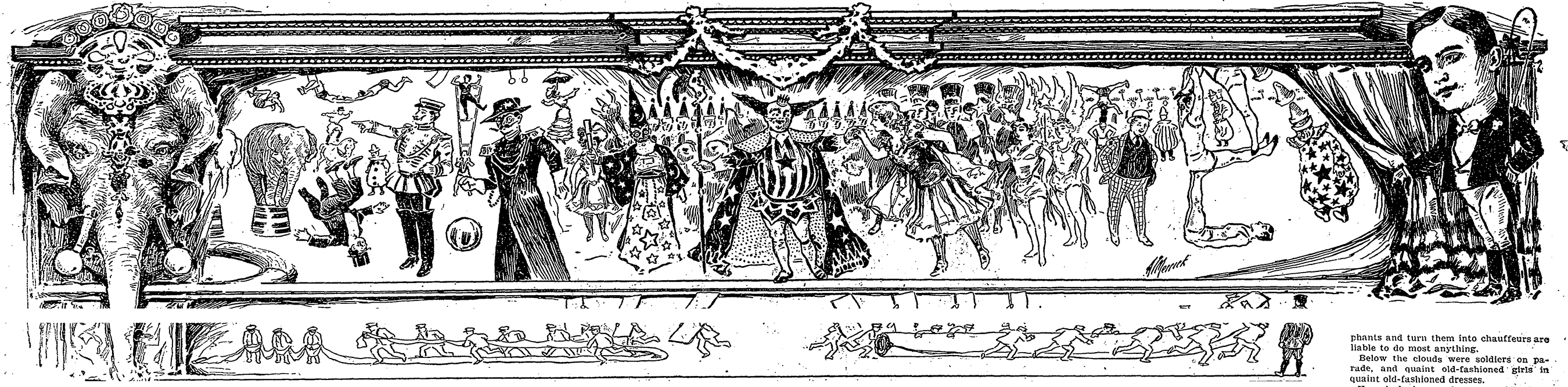
A. Merrick's caricature that headed Zoe Anderson Norris’s ‘One Woman's Impressions of the “Hippo's” Opening Night’ New York Times, 16 April 1905, X6 [Access at: https://www.nytimes.com/1905/04/16/archives/one-womans-impressions-of-the-hippos-opening-first-night-of-this.html].
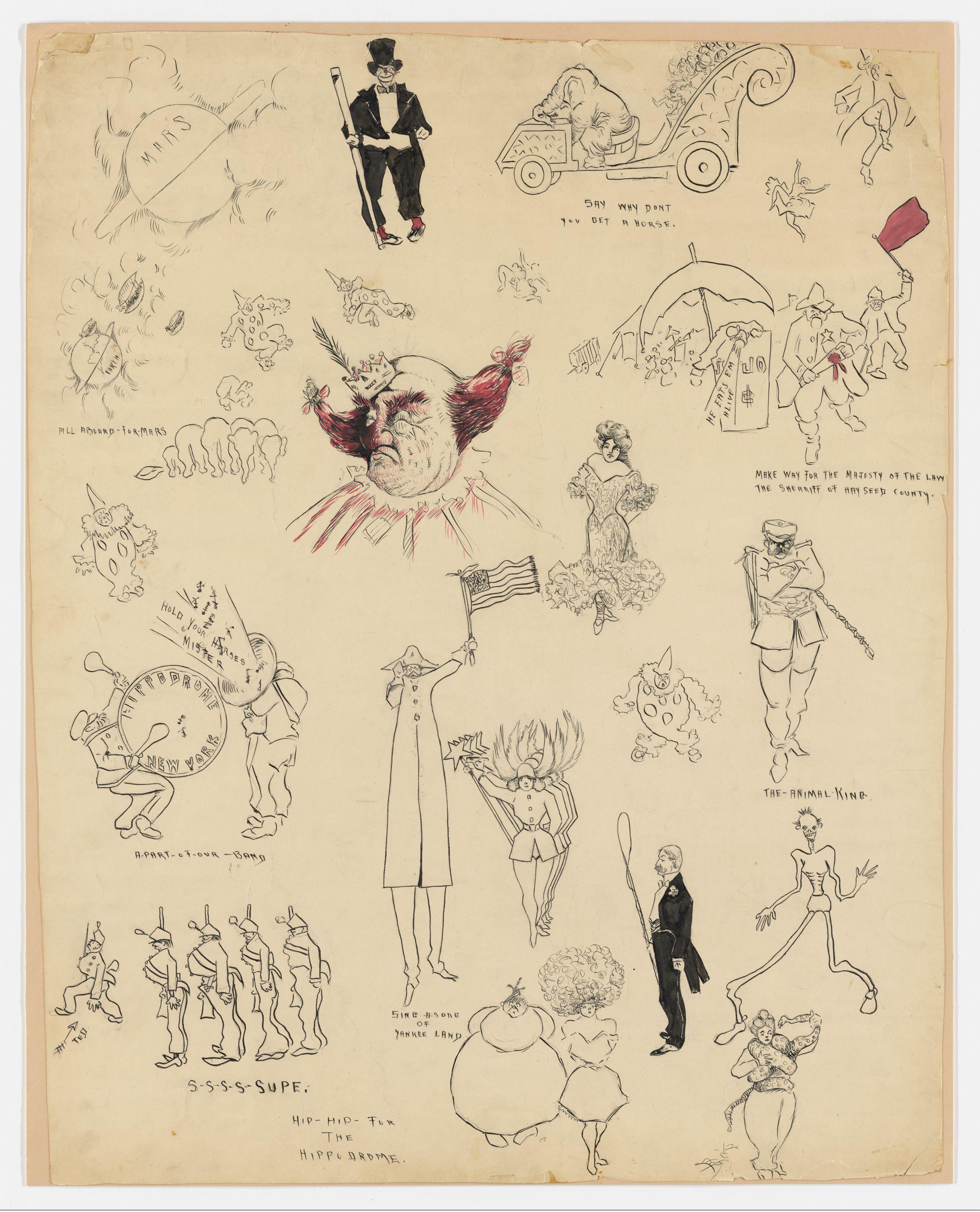
O'Sullivan Burns, untitled (A Yankee Circus on Mars), drawing, undated, The New York Hippodrome: Drawing, 1905–8, MS Thr 1716 – Folder 1, Houghton Library, Harvard University, Cambridge, MA.
This Imperialist American Martian King, with his single star, is free of any lingering legacy of Northern Union and Southern Confederate allegiances but instead presides over history/future, East/Europe and human/animal. At the same time, as he claims ownership of these oppositions, the slipperiness between them provided space for audiences to engage their imaginations in fantasies of transportation. Thompson and Dundy's aims of democratising through pleasure adds another layer of egalitarian interpretation. This Americanised Martian King presides over and provides the type of pleasure that can make anyone a good American citizen. In this American Dream, consumption and enjoyment can confer citizenship; yet the performers privileged by being on stage were unlikely to be anything but white-skinned.
Some audience members may simply have enjoyed being transported to the circus and to another world, and some might have read it within the frame of American territorial imperialism, or as an embodiment of the American Dream myth, or others might have enjoyed experiencing their pleasure as supporting American international commercial progress – if they could afford to conceptualise their spending that way. Others may have slipped in and out of these modes throughout the performance or experienced them all at once. Yet, it is hard to imagine that anyone could have avoided the nationalistic message. Invoking the Stars and Stripes as heavily in design and Thompson and Dundy's status as mass-market Coney Island proprietors demonstrate that their brand of national entertainment was far from subtle. Theirs was a populist patriotism that co-opted the most obvious national signifiers to designate their entertainment, and the venue that houses it, as intrinsically American. Further confirming this point were two explicit performances of patriotism: in the first scene of A Yankee Circus on Mars, a man on stilts waves a large silk American flag during the ‘Boogie Man’ song (see Figure 1), causing the audience to cheer 35 ; whilst the second was ‘The Star-Spangled Banner’ being played before the curtain rose for the first time. On the first night, Billboard found the moment noteworthy, suggesting the national anthem was not a regular feature of an evening at the New York theatre, stating how ‘the people rose of one accord and after the deep silence born of a thrilling reverence for the air and occasion, broke into tumultuous applause’. 36 Interpretations of America's international influence would have been most explicit when this second event was used to demonstrate the theatre's presidential support. At the end of August, at least one performance of ‘The Star-Spangled Banner’ included the unfurling of Theodore Roosevelt's portrait alongside the flags of Japan and Russia, around the time he was facilitating the final stages of the peace treaty that ended the war between the two countries. 37 It is hard to imagine Thompson and Dundy could have staged two more jingoistic practices within their opening programme than waving the American flag and playing the national anthem.
Beyond moments of performed nationalism, A Yankee Circus on Mars placed circus at the centre of its form while also incorporating a range of elite and popular entertainments. Reviewing the acting style, Franklin Fyles considered ‘most of the [dramatic] action is pantomime, and not crude, but of expressive excellence’. 38 In light of the size of the auditorium and the stage, it seems unlikely that any other acting style could have communicated across the vast space with audiences prior to vocal amplification. The right music and performers, however, could bridge this gap. Musical numbers interspersed the action with a range of songs written by Jean Schwartz with lyrics by William Hobart. Choral arrangements and incidental music were arranged by the musical director and conductor, Manual Klein. 39 When it came to circus accompaniment, Klein made the deliberate choice not to use a stage circus band but, instead, to use the Hippodrome's forty-piece orchestra with the aim of providing a more refined auditory experience. 40 Circus was not the only spectacular movement form presented; 144 dancers filled the stage in what was titled in the programme the ‘Ballet of the Hours’ and was an adaptation of Emilcare Ponchielli's ‘Dance of the Hours’ from La Gioconda for the vastness of the Hippodrome stage. 41 The programme's error appears a deliberate one, aimed at emphasising in its pages the elite nature of the form of dance presented. This mix of entertainment builds a picture of A Yankee Circus on Mars as much more than just circus or as a more elevated version of it. Yet, here, I also find myself struggling with the slippery issue of genre definition because most of the ‘circus’ acts seen at the Hippodrome would be defined as vaudeville acts if they were performed in other New York venues with a proscenium stage. What made these ‘freak’, wild and domestic animal acts, clowns, 42 equestrians and aerial performers ‘circus’ was Thompson and Dundy's choice to name them as such.
Why ‘Circus’?
So, why did Thompson and Dundy name their first showcase production ‘circus’? What was to be achieved by association with this competing entertainment form? Especially as they seemed at pains to ensure that the news outlets understood that their entertainment was more than just an indoor circus. 43 Why did they at once want to be circus and not? Considering their nationalistic ideology and the vast Hippodrome space, they were drawing on the significant cultural power in the word ‘circus’ as an incredibly popular American institution, one that had the power to fill vast spaces with spectacle and unite varied popular entertainments. Although the largest global circuses at the turn of the twentieth century, such as Barnum & Bailey and Ringling Bros. often referred to their performances as ‘shows’, they were understood as circus. These huge circuses travelled America under canvas, providing access to other associated popular entertainments such as the grand spectacles staged by the Kiralfy brothers, sideshows, menageries and, sometimes, midway games and/or dark tents presenting early short films. Within A Yankee Circus on Mars, ‘circus’ was being used as an umbrella term that, at the New York Hippodrome, was capable of encompassing more varied and refined entertainments that could fill a large empty space with spectacular performance.
Circus was also an entertainment that was popular with a broad range of demographics including those who visited theatres, attracting precisely the audience that Thompson and Dundy desired. It was observed in the run-up to the Hippodrome opening by Oscar Hammerstein that circus in the city had the power to significantly dent the takings of New York theatres when it performed at Madison Square Garden. 44 The ability for audiences to view themselves in the round, configured around rings and stages, enabled individuals to perceive circus as catering to a mixed demographic. This was particularly true as ethnic groups often sat together in areas where their choice would have been guided by ticket price. 45 Invoking the term ‘circus’ enabled Thompson and Dundy to attract the mixed demographic of New Yorkers whom, reports indicated, 46 they successfully attracted to their mass entertainment.
More significantly, circus was perceived as quintessentially American according to the same principles that Thompson and Dundy conceptualised for the Hippodrome's Americanness: large, streamlined, industrial processes that facilitated organised, efficient and pleasurable audience experiences, and whose consumption contributed to American economic might. Janet M. Davis has argued that the ‘evolution of the circus into a distinctly American popular form was inextricably tied to national expansion and industrial maturation’ throughout the nineteenth century. 47 She describes how the circus relied on the technological innovations of the tent and the railroad's growing infrastructure that pushed back frontiers to tie coasts together. These processes achieved international significance when Barnum & Bailey undertook its five-year European tour under canvas in 1897, permitting the German Army to examine the circus’ logistical systems as a potential model for moving large numbers of men and heavy equipment. 48 (The American Army had been doing this periodically since the 1890s, considering the circus to demonstrate the most up-to-date methods of mass transport.) 49 Davis also defines other features of circus that enabled it to become a ‘harbinger of modern mass culture’ that included ‘its complex advertising system, its compelling impresario narratives of rags-to-riches and moral-free agency, its patriotic content and its saleable respectability’. 50 Reflecting on this list, only the ‘rags-to-riches’ element is missing from Thompson and Dundy's enterprise. It is striking that the publicist they employed, ex-New York Telegram employee William C. Thompson, was selected to promote both Luna Park and the New York Hippodrome after having recently written a book on circus that included a significant portion on publicity. 51 Unsurprisingly, the marks of this expertise are visible in the marketing strategies and tactics used by the Hippodrome. Circus publicity relied on quoting figures such as the numbers of horses in a grand display, ‘stars’ in the show, or trains transporting the entertainment, in a similar way that Thompson and Dundy quoted ballet dancers or electric bulbs in their own press and publicity. 52
Publicity also frequently lauded the power of circus infrastructure and organisation, framing circus enterprises as moveable white cities of canvas 53 that audiences could see emerge from a field if they chose to go to the circus lot early on Circus Day. In the absence of the visible spectacle of gangs of men erecting a tent, Thompson and Dundy were able to provide their own spin on the spectacle of male Americans working together to erect an entertainment. At the Hippodrome, where heavy scenery required efficient movement by mechanical means and men, ‘It was a show in itself to see the way the white-uniformed army under Boss Scene Shifter Wakefield's command flew at their task and whisked things out of the way’. 54 American circus also offered a form of transport that A Yankee Circus on Mars amplified: ‘the railroad circus collapsed the world under canvas’ 55 and promised Americans the opportunity to experience international performers without moving an inch from their small-town or city seats. This display, set on the Hippodrome stage, as part of this programme, performed American cultural power, efficiency and organisation using very similar tactics to those previously established by the circus.
Thompson and Dundy activated the cultural association of circus with Americanness, but circus also served a number of practical purposes within the performance that included encouraging repeat audiences, reducing stage waits and filling space. In 1905, the New York Hippodrome held just over 5,200 people, twice a week from Monday to Saturday, with the city providing a potential audience of 3,500,000 New Yorkers. 56 Recouping the significant financial investment made in Thompson and Dundy's lavish productions and the luxurious building required them to attract repeat audiences. Periodicals mention how A Yankee Circus on Mars ‘yields new charms each week’ as a result of the varying ‘circus and speciality performances’, demonstrating Thompson and Dundy perceived their ability to switch in new ‘circus’ acts, exclusive to the venue, as a key part of encouraging returns. 57 Thompson also wove the idea that he personally vetted acts sourced from Europe into his public persona in a similar way that circus impresarios presented themselves as travelling the world to source the world's best acts for their circuses. 58 In co-opting this particular circus strategy, Thompson was cementing his publicity's claim that the Hippodrome ‘circus’ set standards for the world.
Although Wakefield's white-clad army and mechanical scenery could cover shifts in staging within a scene, the transformation from America to Mars needed a different approach to provoke wonder. This required a relatively long stage wait, the curtain to close and reopen with the grand reveal. Circus acts provided a solution. Programmes show a ‘BRIEF INTERMISSION, during which’ a different act would feature each week on, or over, the proscenium apron and in front of the closed stage curtain. 59 One week it might be the Ty-Bell Sisters aerial act, another, ‘Coco’ the human monkey, or maybe Barlow's and Power's elephants combined with a performance by sharp-shooter Colonel Gaston Bordeverry. 60 Separated from the main ‘CIRCUS TOURNAMENT’, this rotation of acts provided a solution to the stage wait created by the production's desire to evoke wonder by transporting audiences from America to Mars using such large-scale production techniques. 61
As I have already touched upon, I find it a little strange to call these acts ‘circus’ when they were presented end-on and on a proscenium stage. A key characteristic of the turn of the twentieth-century circus was spectacular competing action performed with the audience sitting in the round. Part of the experience involved being able to see other audience members across the space. For the British mid-twentieth-century circus writer, Antony Hippisley Coxe, it was this seating configuration and the fact it facilitated communally seen audience responses that were both core characteristics of the visual spectacle of circus. 62 Thompson and Dundy may have stated their production was circus but the main ‘circus’ portion of A Yankee Circus on Mars was diegetic, primarily framed in performance as representation. Conforming to the American convention of multiple rings, it placed two large rings on the stage, rather than the usual European single ring. The spectacle created was similar to what went on in an American circus tent in that it was created from competing action that stretched from the ground to the top of the Hippodrome stage. Photographs of Andersonville's West Point scene demonstrate that aerial action occurred in front of the proscenium arch with flying trapeze rigging visible, if paged away to one side. 63 This created a different experience for theatre audiences that was more in the realm of vaudeville than circus.
That is not to say that viewing these acts at the New York Hippodrome did not have experiential advantages, but that it was distinct. Aerialists performing in vaudeville gave audiences a different, more democratic experience of their performances. Those located in the cheaper seats, higher in a theatre auditorium, were able to experience aerial performance at a level with their action and a closer proximity than American circus's vast tents or Madison Square Garden afforded. 64 Acton Davies confirms this was the experience from the Hippodrome's orchestra seating located nearest the stage, whilst also highlighting that theatres afforded higher-level production techniques than circus. He remarks ‘on the charm of being so close to the performers, who have the immeasurable advantage of the lighting effects only a great theater can supply, [this] gives these acts a realism and sensationalism that enhances them immensely’. 65 Although I would argue aerialists democratised visceral experience most strongly in smaller vaudeville venues where everyone could experience proximity, visual gains would have been made watching large acts on the Hippodrome stage, such as the elephants. Looking at the majority of the opening night's programme, 66 nine of sixteen acts appear to be programmed to fill the Hippodrome's interior height: the Ty-Bells iron jaw act (more on this later), Barlow's Elephants, Power’s Elephants, Clark’s Jockeys (high-speed somersaulting on horseback), Calcedo (high-wire), Kenyon & De Garmo (‘perch’, a pole-like structure which one acrobat holds from below, supporting the other's balancing acrobatics), Teims Troupe of Gymnasts (who, promotion suggests, performed flying trapeze featuring at least one woman 67 ), Cleodoras on ‘trapeze’ and the Clarkonians 68 male duo somersaulting on flying trapeze. It is unlikely that Thompson and Dundy would have selected acts to provide ‘democratic’ audience experiences in the way I have conceptualised it, but it is reasonable to assume they designed the first night's programme to fill ground-to-roof of their large performance space with spectacular action.
Yet, I argue that something was likely lost in terms of the visceral experience of witnessing some acts, such as aerialists. The most powerful spectacle is one that prompts physical responses as well as visual amazement. Usually, I would expect to see those reviewing flying trapeze to mention some physical reactions, such as held breath, particularly as the Clarkonians were the most important and impressive flying trapeze performers of their generation. Reporters remark on the great feat that flyer Ernest Clarke and his brother Charles were perfecting: the triple somersault.
69
But, the visceral responses that I would expect to see reported in the press, had they appeared at the circus in Madison Square Garden, are strangely absent. It appears that end-on proscenium arch performance in such a large space had done something to the electric experience Antony Hippisley Coxe valued so much from circus acts surrounded by their audience: The almost hermetic feeling produced by an unbroken ring of spectators sets up a reaction, not only between the public and performer, but also within the audience itself. Emotion is intensified and runs round the arena like an electric current.
70
Only one of the aerial acts from the opening programme was enough of a ‘thriller’ to leave traces of audience experience in press reports. The Billboard describes the Ty-Bells Sisters’ iron-jaw performance, where aerialists hang from their teeth, as ‘a real thriller’.
71
In an act, that both challenged and re-established conventional femininity, Villetta and Edythe began in a full costume of red dresses, hats and parasols. After bowing to the audience, they were whisked upwards, where they disrobed to reveal close-fitting silvery-white costumes. They then began their first iron-jaw presentation, with one sister holding the other's weight as she ‘went bicycling through a cloud or two’.
72
However, it was only when iron-jaw strength combined with dynamic whirling action that thrill took hold. In the words of The New York Sun: The Ty-Bell sisters contributed a few cold chills and sympathetic toothaches to the audience by a performance of their tricks in midair while suspended by their teeth. The thrills became acute when one of the sisters, suspended by her teeth forty-five feet above the stage, so wriggled her form that she wound up the rope above her and then relaxed, letting herself be whirled at the end of it at the imminent peril of her own life and of the folks in the front rows of the orchestra.
73
A National Institution
For Thompson and Dundy, there was a lot to be gained by framing the acts that appeared on and above their stage as ‘circus’. It comes as no surprise that their next double bill in December included another production that invoked the popular entertainment's cultural associations in its title: A Society Circus. 75 It is also noteworthy that its paired production was a more explicitly Orientalist spectacle: The Romance of the Hindoo Princess. ‘Circus’ speciality acts provided tactical gains for the Hippodrome by filling the vast performance space with visually spectacular action that covered the long stage waits enforced by moving the Hippodrome's large-scale scenery into place. It also provided a blueprint for publicity techniques. However, this was not the same as a circus experience but was akin to circus; it was more visual – less visceral – spectacle. Hippodrome circus used the cultural power of this more established umbrella entertainment to attract a wide demographic of audiences and in its fantasies of global transportation. Framing speciality acts as ‘circus’ named them as ‘American’ according to the ideology that Thompson and Dundy conceptualised their National Theatre as fulfilling. The Hippodrome offered the type of organised and efficient entertainment that was only available in America. Enthusiastically consuming their grand-scale patriotic spectacles involved participating in the nation's consumer economy and furthering the international economic power of America. Thompson and Dundy's Americanness invites me to argue that another aspect of what configured circus as an American institution in the cultural imaginary be added to Davis's astute list mentioned earlier: the concept of pleasure in consumption as an obligation of American citizenship that contributed to the economy and furthered America's economic might.
This second A Society Circus/The Romance of the Hindoo Princess double bill 76 would become Thompson and Dundy's last, partly as a result of circus. When Thompson went to Europe to source acts, their investors raised ticket prices to a level similar to elite theatres, prompted by fears about the impact that such high production costs would have on profits. Unsurprisingly, this deviation from the managers’ democratic vision of affordable mass entertainment hit sales and the old ticket prices were restored on Thompson's return. This was particularly bad timing, as it was around the time Barnum & Bailey were about to provide New Yorkers with a large authentic circus experience at Madison Square Garden. This competition and disagreements, which included an ill-judged publicity war with the circus that investors felt advertised Barnum & Bailey as much as the Hippodrome, led them to remove Thompson and Dundy as managers. On 7 July 1906, Lee and J. J. Schubert and Max C. Anderson signed a lease for the New York Hippodrome. 77 With the removal of Thompson and Dundy, the New York Hippodrome no longer claimed to be the ‘National Theatre’, but their aim of catering to national tastes on a mass scale would remain until the venue's size finally became unprofitable in 1939. In the 1910s, Charles Dillingham would bill his Hippodrome ‘A National Institution’, 78 filling it with musical revue, whilst E. F. Albee would reconfigure his 1920s Hippodrome to become a conventional vaudeville house, or what he considered ‘our most national representative form of amusement’. 79 Thompson and Dundy's short managerial term set the tone for the Hippodrome's future, implicating the vastness of the space into large-scale visions of what made an ‘American’ entertainment.
Footnotes
Acknowledgements
My thanks to Dr Sunny Stalter-Pace, Professor David Mayer and Dr Kirsty Sedgman for providing insightful comments on versions of this essay. Thanks also to the peer reviewers and editor, Dr Sharon Aronofsky Weltman, whose generous feedback further improved this essay. Conducting archival research for the late, and much missed, Professor Mayer provided me with an opportunity to consult materials in archives I would otherwise have struggled to visit as an independent researcher. This study did not generate any new data.
