



Abstract
This article demonstrates how nineteenth-century Scottish touring circus sits at the intersection of the National Drama and the imperial spectacle of the circus. It offers a timely analysis of how Scottish (inter)nationalism and nation formation were interwoven with imperialist discourse in popular public imaginaries. By analysing the deployment of and investment in Unionist-nationalist Scottish imagery in playbills, newspapers, and life-writing accounts, and in archives this article newly brings to light, I argue two things: firstly, that the continuities between rural touring and metropolitan permanent circuses helped bridge the historic cultural and ethnic divide between Highland and Lowland communities; and secondly, that this creation of a unified Scottish identity engendered and reflected an (inter)nationalist and imperial sentiment in diverse Scottish audiences. This article, therefore, complicates current conceptions and historiographies of Scottish nationalism which overlook how commitment to Unionism and the empire was often a prerequisite for nationalist feeling.
Introduction
In 1903, a Mr A. S. Cook penned and published an article in the Aberdeenshire magazine Bon-Accord, detailing his memories of his first visit to Cooke's Circus some sixty years earlier. While, as he wrote, the arrival of the circus was ‘a great event, and was looked forward to by me with delight and great expectation’, Cook's observation that the circus show did not match its billing—did not feature the same set pieces, routines, or hippodramatic sequences, nor live up to the lustre of its advertisement—will be familiar to anyone in the business of piecing together and analysing performances of the past. He is worth quoting at length: On the bills after the circus arrived a winged horse was exhibited, and on this my first visit I was much disappointed that this animal, which was a novelty in Natural History, and, to me, one of the greatest inducements to be present, was not visible. The wood engraving, which I have before me as I write, and which so attracted my fancy and wonder, is the figure of a prancing horse rearing on his hind legs, with the forelegs greatly elevated and pawing the air …. The wings are partly outspread, as if the animal were to fly, and a broad belly band encircles the fiery steed. In the distance there is a pyramid in rough outline, giving the picture an Eastern look, and portraying, as I afterwards found out, a horse with an existence as real as the lamp of Aladdin or the fairy palaces so minutely described in the Arabian Nights Entertainments.
1
Most striking about Cook's description is his fascination with the ‘Eastern look’ of the circus, and his allusion to Aladdin and The Arabian Nights. For Cook, the Egyptian ‘pyramid’ is the emblem of an exotic, yet real and existing world in a far-flung corner of the globe. The ‘lamp’ of Aladdin and the ‘fairy palaces’ are disappointingly fake adjuncts to this Arabian world. Yet there are two levels of fictionalisation at play here. Unbeknown to Cook, Aladdin is itself a tale fabricated and added to The Arabian Nights by a Frenchman, and thus a product of colonial capitalisation on the culture of another country. 2 Writing his own version of the ‘Orient’ in his reading of the playbill, Cook's overt fascination with orientalism, I argue, wears a special significance in the provincial setting of mid-nineteenth-century Aberdeenshire. Cooke's Circus is capitalising on the ‘otherness’ of the apparently Arabian setting of the circus's fiction, and this exoticism itself becomes an agent for upholding the British empire's imperialist sentiment in the outer reaches of the British Isles. As Kurt Koenigsberger notes, in engaging with modes of display such as the menagerie, zoo, royal exhibition, or pageant, ‘even the poor provincial labourer could feel himself part of a powerful nation’; these popular forms of entertainment ‘facilitated a distinctive brand of imaginative travel across global expanses’ for subjects throughout the home nations of the British empire. 3 Like Koenigsberger, though writing specifically of the touring American railroad circus, Janet M. Davis states that the ‘circus could seemingly collapse physical and temporal boundaries’ by ‘bringing foreign cultures to one's doorstep’; the travelling circus ‘presented to its audiences a global sensory blitz … that mirrored the nation's position in the modern world’. 4 Those living far from metropolitan centres could feel that they benefitted from the spoils of the empire, and thus become invested in its ideology: even if the images in question, like A. S. Cook's ‘fairy palaces’ and winged horse, were exaggerated or concocted caricatures. The projection of this ideology by touring circuses in rural Scotland, I suggest, contributed to the formation of a Unionist-nationalist Scottish identity, which presented Scotland as England's ‘sister kingdom’ in the United Kingdom and the empire. 5
The nineteenth-century circus's reliance on clear iconography and symbols of foreign nationhood makes it a locus of the British nation-building project. Accordingly, investigations of the intersection between nation formation and imperialism(s) are not new to Circus Studies. Davis's explorations of the American fin de siècle railroad circus demonstrate how circus spectacles ‘promoted nationally recognizable themes which contained a heavy dose of American patriotism’ to appeal to diverse audiences, and in turn sculpted the expansionist ideology at the heart of American national identity. 6 Building on Davis's account of circus spectacles as unmistakably imperialistic and orientalist, Peta Tait argues that their juxtaposition with aerial circus acts ‘validated nineteenth-century ideas of empire and spatial domination’ with ‘expansionist stories of conquered geographical space’. 7 Conversely, scholarship on contemporary circus has turned towards investigating circus as a global and corporate phenomenon, which eschews the ‘nation’ altogether as a radical rejection of the traditional ring circus's imperialist overtones. As Jennifer Harvie and Erin Hurley remind us, Cirque du Soleil, the most conspicuous success story of the nouveau cirque, presents itself as having come from an ‘imagi-nation’. 8 Circus troupes have historically been international spaces featuring performers of diverse national and ethnic origins; but contemporary circus has ostensibly moved beyond the nation as organising principle, attempting to distinguish itself from a nineteenth-century circus tradition which capitalised on advertising interactions with the ‘other’ and often presented their performers as national, ethnic, or continental ‘types’ (in ‘freak shows’ and human exhibits, hippodramatic re-enactments of imperial conquests, or ‘Wild West’ spectacles) to attract audiences—regardless of whether circus actors actually shared the ethnicity or nationality of the roles they performed. 9
Most relevant to this article, however, is the Circus Studies literature on performances of nationality which were not shirked on or off depending on the day's programmed spectacle. Aastha Gandhi shows how the feminine body in twentieth-century Indian circus had a ‘new role to play in solidarity with the nation's struggle to assert its nationalist image’ in imagining ‘Mother India’ in the 1940s. 10 Gillian Arrighi's study of the FitzGerald Brothers' Circus's ‘unpretentious embrace of its Australian identity’ is similarly a vital model for my exploration of national circus imagery as performed by citizens of that nation, to that nation. 11 Scholarship on Scottish circus has not yet taken this approach. Although Kim Baston has shone a light on the performance of Scottish nationality by the Edinburgh Equestrian Circus in the 1790s, she analyses performances of Scottish identity by troupes transferred from London to Edinburgh. 12 This article instead focuses on Scottish-owned touring circuses, and how these itinerant productions reached beyond Lowland metropolitan centres to foster a pan-Scottish, hybrid Highland–Lowland identity which could flourish within the context of the British empire. I also demonstrate how the capacity for the circus to reflect and reinforce national imaginaries intersects with a particular popular theatrical tradition in Scotland: the National Drama.
Scottish Contexts: Unionist-Nationalism and the National Drama
Ongoing historiographical and critical debates around Scotland and the British empire make the Scottish touring circus a particularly fascinating nexus of inquiry. Colin Kidd has argued that by establishing itself as a ‘sister kingdom’ in ‘imperial copartnership’ with England, Scotland was able to assert its influence on the global stage in the nineteenth century.
13
This international prestige was both achieved by and reciprocally fed into what John M. MacKenzie describes as a ‘reconciliation of Scottish ethnic nationalism’, whereby the integration of Highland and Lowland racial and cultural identity provided Scotland with a newly united front with which to encounter the empire and the wider world. MacKenzie makes the case that a cunningly contrived amalgam of Highland and Lowland elements, neatly represented in the Burns societies and Highland games, Caledonian and St Andrews organisations that sprang up around the Empire, in colonies of settlement, India and dependent territories, helped to satisfy what was already clearly perceived as the basic geographic, ethnic and cultural problem in a Scottish nationalist identity. And by the mid to late nineteenth century, the Scots had a very considerable stage upon which it could be worked out.
14
The circus's performance of a culturally unified Scotland through depictions of its historic and literary national figures places it within a distinct tradition of Scottish theatre history. The National Drama emerged in the nineteenth century as a dramatic genre centred around the performance of repertoire from adaptations of Walter Scott's Waverley novels. Their popularity, Barbara Bell notes, arose from the ‘perceived cultural and institutional drift towards reducing the status of their nation to “North Britain”’. She continues: [the novels] made Scotland's history an acceptable subject for representation … for the first time in many years, Scotland's actual history and character were considered serious subjects for plays and players …. Once the floodgates were open, the Scots, hungry to reassert their shared cultural identity in a public arena, returned again and again to see their national heroes and heroines played in authentic Scottish settings by Scottish actors with Scottish accents.
16
That the circus in particular was able to bear the ideological freight of empire, as well as carry national stories to diverse audiences across Scotland, makes it uniquely illuminating of the ways in which Scottish Unionist-nationalist and imperialist global identity were negotiated in popular, public spaces. The aim of this article is thus twofold: firstly, to demonstrate how the work of the open-air Scottish touring circus sought to unite the division between the Lowlands and Highlands, within a wider project which is consistent with both a Unionist and imperialist context; and secondly, to expand the methodology with which we approach research on the Scottish circus, which I propose bridges two theatrical and corresponding critical traditions in equestrian circus and the Scottish National Drama. In doing so, I unearth and examine what is at present a critical lacuna: the role of the circus in shaping national identity and attitudes to empire in the home nations of ‘Great Britain’. 20 I use the term ‘(inter)national’ throughout, as a working concept that encapsulates the complexity of Scotland's developing identity in the nineteenth century: a place at once concerned with evolving a nationalistic sense of cohesive character between Highlands and Lowlands; a separate but sister nation to England and the home nations within Great Britain; and a country keen to assert its international influence across the empire, in part through the confluence of these other identities. Such a study of the development of (inter)nationalism in Scotland also contributes to debates around Scottish national and cultural identity today by suggesting that these conceptions need to be complicated by a historical understanding of the (inter)national and ethnic dimensions of the Union and empire—particularly, in this case, as articulated through circus performances.
A note on methodology. Like A. S. Cook in Bon-Accord magazine, we are dealing with imaginaries and projections here—of nation, of self, and of the desired impact or meaning of a given circus performance. It is not the aim of this article to reconstitute or reconstruct rural circus performances in all their intricate detail; not least because many villages and rural townships did not have local newspapers in the early-to-mid nineteenth century, with only county-wide general advertisers featuring the occasional notice and projected programme (itself not always accurate). Corroborating actual events and acts as they were performed with advertising material is all but impossible. Yet the memoirs, life-writing accounts, and newspaper letters studied in this article—sometimes written half a century after the recounted circus performance—offer much valuable insight into how the circus presented itself and was most frequently and enthusiastically remembered. Through these discursive productions, we can witness how the circus hoped to make itself attractive to audiences; how successful the use of national imagery was in producing long-standing, memorable performances; and how compelling the growing sense of a national and imperial identity was to a rural Scottish public usually unaccounted for in such investigations. 21 By analysing the neglected accounts of visits to Cooke's Circus and Thomas Ord's Circus, which appear mainly in memoir, epistolary, and poetry form, I examine how those living in small, rural Scottish townships experienced the circus as a place of escape. The first part of this article suggests that the open-air travelling form of the circus created a space of potential disorder and questions whether this resulted in the breaking of formal circus convention and the subversion of hierarchies both within and without the circus ring. 22 However, through an analysis of National (hippo)Drama and other equestrian performances around the country, which both reflected and engendered an (inter)nationalist and imperial sentiment in their audiences, in the second part I suggest that discursive remembrances of different iterations of the circus indicate that the circus was instrumental in the attempted construction of a unified cultural identity between the Highlands and Lowlands. I argue that although the iterant nature of the touring circus at first glance invites emphasis on the locatedness of performance, in fact, performances even in specific topographies transcend the local and instead highlight (inter)national issues. Ultimately, far from being a space for subverting the Unionist and imperial project in the home nations of the British empire, the circus as experienced by its provincial and metropolitan audiences was a space for Scots to carve out an image of a culturally unified Scotland which would flourish within the British empire.
In the Sticks: Topography and Recollections of ‘Escape’
It is vital to consider the restraints placed on the touring circus by topographical particularities when investigating circus performances in rural Scotland. Large tenting circuses struggled to access small townships with troupes which sometimes exceeded eighty performers.
23
In a bid to attract paying audiences all year round, circuses would usually build a permanent residence in a city or populous town for use in the winter, before splitting into smaller troupes to target separate parts of the country between March and October, ready to amalgamate again the following winter.
24
From the 1830s, the railway was used to transport circus animals and equipment, but towns in the Scottish Borders and remote Highlands were often late to become connected. Writing a history of Galashiels, Robert Hall notes that in 1844 (only half a century before he was writing), there were ‘comparatively few public entertainments at this period’; the railway only arrived in 1849.
25
As such, according to Hall, the arrival of Ord's Circus in the town with his reduced, open-air touring troupe was the ‘great event of the season’ to townspeople who were ‘[i]gnorant to a large extent of what went on in the great world around them’.
26
It is important not to paint the entirety of rural Scotland with a brush which perpetuates a certain view of provincialism as cut off from the rest of the world and its amusements, but this is a recurring image in the life-writing from the late nineteenth century that retrospectively surveys village life of mid-nineteenth-century Scotland. Life-writers recounting their youth frequently figure themselves as ‘cut off’ from a thriving external world and portray the open-air touring circus as a mode of transportation to a fantasy—often paradisal—location. Upon the occasion of his circus's arrival in Ballater in February 1843, local shoemaker George Moir presented a poem to Ord which emphasised the isolation of the Aberdeenshire town. It opens by tying the psychological trouble of the townspeople to the starkness of the land, and presents Ord's Circus as the remedy: ‘All welcome, Ord; beloved sire, we hail thy visit here / Unto those bleak and barren wastes, our care-worn minds to cheer’. There follows:
Like wild flowers gaily sprinkled o’er the weedy path of time, Thou sooth'st the furrowed crease of care and renders life sublime. Then welcome to these Highland glens, thy gaudy tinselled throng, Diffusing gay hilarity, and harmless mirth along. With venerated anxiousness we wait thy coming here, Thou ‘Kean of the Arena’ termed, we justly thee revere.
27
Ord is ‘hailed’, ‘revered’, and ‘welcomed’ to a Highland location which is repeatedly emphasised. The poem ends with another localised welcome: ‘Then welcome to our stormy wilds, tho’ deep immersed in snow, / Our Highland hearts will give thee praise and what we can bestow’. The inaccessibility of the snowy Cairngorm mountains is juxtaposed with a circus which is ‘soothing’ and ‘harmless’. The arrival of Ord's troupe is figured as the coming of spring: anxiously awaited, the bringer of ‘wild flowers’ radiates gayness and mirth.
John Hutton Browne similarly compares his (or is it another boy's?) first experience of Ord's Circus with the arrival of springtide in The Golden Days of Youth: A Fife Village in the Past: To one who witnessed a [hippodramatic] play for the first time it was a fascinating sight. Those men and women to him were the real persons of the story. His emotional nature, fresh and unalloyed, without any contact with the outer world, was fertile soil on which Ord and his little company could sow and reap the reward of their dramatic labour. This was long treasured by the message boy, and served as an impetus to discover the hidden treasure which fortunately came to his hand.
28
Apparently key to the success of Ord's Circus performances in becoming sites of transformation and escape (as indicated by village memoirists) was their open-air setting.
34
Thomas Newbigging remembers a ‘programme of horsemanship under the canopy of heaven’ in Galloway;
35
James Turnbull reminisces how Ord's visit ‘had this very great advantage—the youngsters could witness the whole performance for nothing, as it was held in the open air’.
36
An anonymous chronicler in the Weekly Scotsman explains how the circus ring was carved into the ground, rather than being a tenting structure settled atop it: A circle or ‘ring’ was made by digging out the earth in order to form a soft foundation for the hoofs of galloping steeds, and the spot was near to the Malt Barns, close by the river Tweed, at Kelso. The situation was somewhat secluded, but in the summer daylight nights Mr Ord brought forth his troupe of trained horses and clowns and acrobats to delight the people of Kelso …. There were no places for the rich and places for the poor in the large gathering there; all were alike free at Mr Ord's entertainments in the open air …. It was an entertainment that certainly had many natural beauties surrounding it.
37
In contrast, permanent winter circus residences charged separate prices for the boxes, gallery, and pit. Marcello Truzzi writes that such structures demonstrate how the circus is ‘essentially an extension of the theatre’, in opposition to the carnival which is ‘an extension of the medieval fair’.
39
Helen Stoddart also reminds us that Philip Astley was formative in constructing the circus as a private theatrical space, in which any chaos concocted during an act is quelled and forbidden to stretch beyond the temporal and spatial bound of the circus experience. The permanent or tenting circus is far from being a carnivalesque space in which disorder, illegitimacy and inversion reign, but rather one in which there is an incorporation but also a hierarchical ordering of both the forces of chaos and inversion and those of order, ascendancy and power in which the latter invariably maintain the upper hand.
40
A fitting example of the simultaneous continuity and discontinuity between the permanent urban and touring rural circuses in audience recollections comes with another anonymous retrospective account of Ord's Circus visiting a village in the Scottish Borders. The author remembers the entertainments held ‘in the open air, beneath the blue skies of summer, and without enclosure or covering of any kind’. But, they say, ‘[u]nder such an arrangement, the admiring spectators closed in so frequently upon the ring that the performers had, once and again, to stop and beseech the onlookers to “retire a little”’. Although a clown asks the audience to step back, the horse he rides begins to ‘speak’ to the young memoirist: [she] caught my eye and said, or seemed to say, ‘Isn’t he a funny fellow this clown of ours?’ …. So expressive were these looks and winks on the part of the cream-coloured beauty that I clothed them in language, and interpreted them as easily as if they had been conveyed in the plainest English.
43
This idea of interdependence and continuity between modes of circus performance invites a number of questions. Firstly, if formal conventions remain more or less unchanged between rural and urban Scottish circuses despite great changes in topography and accessibility, can the same be said for the contents of these performances? And, whether yes or no, what can the differences or similarities in the remembrances of these iterations of the circus tell us about diverse or consistent audience expectations and preoccupations of town versus country, and Highland versus Lowland folk, especially across a nation historically carved up along political, religious, and racial lines? 46 The following sections of this article investigate how both urban and rural, and Highland and Lowland Scottish circuses performed a unified sense of Scottishness in their repertoire, using both historic and fictional figures from the National Drama. The outdoor setting of Ord's Circus discussed in this section aligns touring hippodrama with the geggies which would take the National Drama to remote Scottish locations. As Adrienne Scullion and Alasdair Cameron write, these geggies, ‘in a relaxed and informal atmosphere’, provided Scots ‘with plays about their own country, spoken in a familiar accent for audiences who could not afford the London touring shows or lived in the country and could not travel to the large city theatres’. The circus, doing this same work, also ‘preserved a distinctively Scottish dramatic tradition’. 47
Thomas Ord, Unionist-Nationalism, and the National (Hippo)Drama
Thomas Ord was known as a master equestrian. His most celebrated act—according to how frequently it is recorded in memoirs and discussed between members of the public in newspaper letters—was his execution of ‘protean horsemanship’. Ord first performed the role of ‘Bailie Nicol Jarvie, On Horseback!’ on 2 August 1831, the playbill of which details both how the sequence may have appeared, and how the circus appealed to townsfolk and attracted them to shows. Capitalising on the success of performances of Rob Roy in theatres, Ord constructed a new narrative around a well-loved character, advertising the new act as ‘[i]nvented and performed by him only’. 48 Corroborating the playbill's description, James Turnbull of Hawick recounts how, in the Bailie Nicol Jarvie act, Ord would ‘stand on a bare-backed steed going at a good pace round the [outdoor] ring, and would impersonate about eight different characters. He generally started as an old fishwife, and finished as Rob Roy’. 49 The same act is recollected by memoirists and other writers across Scotland; in a 1903 magazine and subsequent ‘letters to the editor’, remembering mid-nineteenth-century performances in Banffshire; 50 and once again in an extended account by John Morrison, of Inverness in the 1840s. 51 Ord also performed as the eponymous Rob Roy in recurring performances of hippodramatic adaptations of the play. 52 Significantly, these memoir accounts also suggest that Ord did not tend to change the programmes of his shows depending on their urban, rural, indoor, or outdoor location. The same performance of Rob Roy or Bailie Nicol Jarvie is remembered by Scots from Glasgow (a city in the central Lowlands), rural Banffshire (a Lowland historic county on the far north east coast of Scotland), and Inverness (then a Highland town; it only gained city status in 2000). There are of course elements of nostalgia at play in these remembrances, written either in published memoirs of nineteenth-century life or to newspapers to garner further correspondence; but analysing such nostalgia can be a useful tool, helping us observe which public performances and enactments stayed in public memory and elicited strong feelings of national pride in retrospective accounts.
The popularity of Ord's ‘protean’ National Drama act and the fondness of its remembrance across the country—it encouraged a two-month-long exchange between multiple correspondents in a 1903 weekly newspaper, as well as newspaper letter panegyrics in 1887, 1889, 1893, 1897, 1899, and 1905, almost fifty years after Ord's death—demonstrates popular entertainment's role in forging a cultural movement towards a unified Highland–Lowland identity, and diverse Scottish audiences’ shared appetite for such an imaginary. 53 Ord's advertisement of the 1831 performance describes how ‘Mr Ord’ appears as ‘Bailie Nicol Jarvie, on his way to Aberfoyle … escaping from the Red Coats’. 54 Many Glasgow audience members would have recognised the story described on the playbill, either from reading Walter Scott's novel (1817) or more likely from watching its adaptation in Edinburgh or on tour in the geggies. Indeed, they may even by 1831 have seen Bailie already played on horseback by Charles (‘The Real’) MacKay in his renownedly popular adaptation of Scott's novel, blurring the boundaries between what we now consider as the ‘National Drama’ and circus hippodrama. 55 In Scott's Rob Roy, Bailie Nicol Jarvie is a Glasgow magistrate and businessman, representative of the new commercial development of eighteenth-century post-Union Glasgow. He is also a cousin of Rob Roy who became embroiled in his adventures at Aberfoyle; both Scott and Ord present Jarvie as a charismatic vagrant who dupes and escapes from the Hanoverian redcoats, alongside the eponymous hero. That the Lowland businessman Bailie and the Highland cattle drover-cum-rogue Rob Roy are united in their adventure is significant in the formation of a unified Scottish identity, integrating Lowland and Highland versions of Scottishness.
Morrison, meanwhile, fondly remembers how Ord's Rob Roy ‘protean horsemanship’ act in Inverness was completed with the appearance of a host of Scottish heroes, beginning with ‘Scotland's darling hero, “Sir William Wallace”’: The next change portrayed ‘Bruce of Bannockburn’ brandishing the fatal battle-axe that killed Sir Henry De Bohun, and as an illustration of history the rider was seen looking with concern at the edge of the axe as if regretting having blunted it on the knight's skull.
56
Such examples of Unionist-nationalism in Scottish circus performances reverberate across the archive. To Robert Hall, Galashiels is a town which, ‘unlike most of the towns on the Scottish Border, has little or no ancient history; it inherits no proud traditions of heroic deeds performed by its sons; legend and song are nearly alike silent concerning it’. But hippodramatic performances of Highland and Lowland heroes could give such an ‘obscure country village’ a sense of investment in a broad Scottish history, condensing years of inter-clan and (inter)national disputes into one distilled contemporary Scottish national identity.
60
Hall's claim is somewhat erroneous, given Galashiels was made a burgh of barony in 1599 and was a parliamentary burgh from 1869, in part due to the town's centuries-old reputation as a centre of the Borders textile industry.
61
Hall himself mentions Galashiels's own long and ‘heroic’ Anglo-Scottish history in the annual Braw Lads ceremony, during which horse-riders run the burgh's borders in commemoration of the town's first mention in the history books, when Galashielians attacked English raiders for thieving ‘soor plooms’.
62
But his re-mythologisation of Galashiels as ‘obscure’ and de-emphasis of the Braw Lads ceremony perhaps speaks of an investment in a more mythically holistic, less Galashiels-specific sense of Scottish identity. Displaying a similar merging of local and national identities near the border in Galloway, Ord appeared as ‘Tam O'Shanter on his mare Maggie and other characters followed, and finally he appeared in the dress of a Highland Chieftain with claymore and buckler’.
63
The figure of Ayr-born Tam, a creation of the Scots-language poet Robert Burns who became and remains a cultural symbol of Scotland as a whole, is corporeally merged with Ord clothed in the archetypal Highland dress of Findlay's hybrid ‘Highland-Lowlander’—all performed in a Lowland town which feels itself sufficiently culturally unified with the Highlands to celebrate its traditions together. The Borderland settings of Galashiels and Galloway in these accounts should not be overlooked. In his chapter which seeks to redress the historiographical emphasis on Highland culture as a ‘repository of unpolluted national virtue’, Paul Readman argues that Borderland identity was emphatically unionist in ideological complexion … it could accommodate Scottishness and Englishness too, being an important site for the commemoration, preservation, and celebration of different—but now happily compatible—narratives of nationhood north and south. This illustrates the capaciousness of unionist-nationalism.
64
The recollections of the memoirists whom we visited in the opening section of this article remind us that, while the circus presented a place of escape and potential disorder for inhabitants of small Scottish villages and townships, it was not a place for political or social subversion. Indeed, a further example of this comes in a 1903 account of a meeting of the ‘London Morayshire Club’, whose members spent their meeting in Fleet Street remembering how the circus ‘used to be patronised regularly by our late beloved Queen [Victoria] when she would be at Balmoral:’ After [Ord's] departure the local children tried to emulate his acrobatic and gymnastic feats, in some cases they ransacked the upper regions of the house (the garrets), where in many homes a goodly number of the ‘45 Jacobite outfits of the rebellion had been secreted away from the redcoat scouts. Having dressed in these outfits of their rebel ancestors who had fought for Bonnie Prince Charlie they might be observed with sword and pistol, kilts, bonnets and feathers careering round the ring ‘just like Maister Ord’.
65
Aside from Rob Roy, Ord also performed as other key figures from the repertoire of Scott adaptations which constituted part of the National Drama, including the Bride of Lammermoor and the ‘Goodman of Ballengeich’ from Scott's Tales of a Grandfather vol. II (1829): the story of an attack on a vulnerable James V, and a local man's offering of a basin of water and a towel in assistance, oblivious to the king's status.
68
The latter is especially emblematic of Scott and the National Drama's place in a literary and dramatic tradition, after David Hume and James Thomson, which presented a Hanoverian Scotland accommodating aspects of Jacobitism, so often identified with Highlandism. Scott's orchestration of the 1822 royal visit of George IV, which Ian Brown describes as ‘an act of post-conflict hybridity’ and which included a re-enactment of the washing of the royal hands in the Ballengeich basin, demonstrates how elements of the National Drama and its performance of a proud Scottishness consistent with Unionism bled into the performance of Scottish identity beyond the stage or circus ring.
69
As Cairns Craig writes of the royal visit, [t]he iconography of the Highlander, adopted as a badge of national identification by the Lowland Scot in the nineteenth century, is not the iconography of a separate Scottish identity: it is, in fact, the iconography of the unity of the British state.
70
Embracing Empire
Iain Hutchison paints a picture of a Scottish politics which was ‘firmly British in scope’ by the mid-nineteenth century. 72 Paul Maloney's work on public attitudes to the British empire as portrayed by popular songs of the Scottish music hall similarly suggests a generally positive view of the empire, especially in cities where the economic benefits of the empire's trade routes were felt most keenly. Given that ‘from the Scottish public's point of view empire translated into investment, jobs, work, and a degree of emancipation from the overweening influence of England’, Maloney concludes that there is a link between ‘support for the cause of [e]mpire, and the economic reality of Scottish industry's reliance on export markets for continued industrial growth’. 73 Like the music hall, circus performances in metropolitan centres stage an advocacy of the British empire and its benefits. More specifically, in line with Maloney's model, the empire is figured as a structure through which Scottish interests could be centred and flourish. Cooke's Circus ‘Conundrum Nights’ in Aberdeen serve as a case in point. 74 Conundrum questions were sent in by the audience to be read out on the stage; the joke that received the biggest laugh was crowned the winner, while the runners up were printed in the city's newspaper. The recorded conundrums in newspaper reviews thus reveal the local preoccupations of the city dwellers, while they simultaneously spread these preoccupations to an audience beyond those who watched the live performance. For example, an 1879 conundrum satirises the monumental financial failure of the Glasgow banks of the previous year: ‘What is the difference between Cookes’ Royal Circus and the City of Glasgow Bank? The one is directed by the Cookes and the other was cooked by the Directors’. 75 Another conundrum mocks the British government and its failure to resolve the Anglo-Zulu War, which had been prolonged by a two-month siege: 76 ‘Why are the Cooke Brothers more popular than the present Government? Because they brought their Zulu war to a satisfactory conclusion’. Note that the ‘Zulu War’ was a much-performed hippodramatic sequence of Cooke's Circus, following the vogue for ‘staging grand patriotic spectacles or hippodramatic battle re-enactments’ which, Stoddart states, created ‘near hysterical patriotism, in an attempt to marshal their audiences’ support in the name of the national interest’. 77 The conundrum issues a clear criticism of Britain's colonial rule, but one stemming from Britain's failure to quash an uprising, rather than any explicit commendation of the Zulu rebels. It also demonstrates in the Scottish audience a sense of superiority to the Zulu people: as does the ongoing commercial success of and desire for hippodramatic performances of the Zulu War sequence.
Another such example comes in a ‘Conundrum Night’ of 1883: ‘Why do the Aberdeen coal labourers resemble the brave heroes of Tel-el-Kebir?—Because they fought their battle bravely, stood to a man, and at last they won the day’. 78 The joke refers to the Aberdeen coal labourers’ strike—again embedding the performance in its local context—and to Britain's victory over Egyptian rebels in colonial Egypt. 79 It thus does double work, suggesting satisfaction in Britain's suppression of nationalist uprising, while putting local Scottish issues on a par with international concerns through their explicit comparison. More broadly, it indicates that to late nineteenth-century audience members, support of socialist causes was not mutually exclusive with what we might retroactively call ‘conservative’ imperialism. 80 Most importantly, this example illustrates support for the British empire's colonial rule, while showing a Scottish ambition to elevate the intensely local to the importance of the global, so that local Scottish issues were discussed alongside those of the empire. As Lindsay Paterson asserts, by the mid-nineteenth century Scots ‘prided themselves on being partners with England in the [e]mpire …. They continued to maintain this sense of union by asserting their national identity … [but] they felt no need to push further for fundamentally new national institutions’. 81 Paterson's connection of a pride in the empire with a consequent assertion of an overtly Scottish national identity is particularly relevant to the circus, in which national imagery was used to generate a sense of shared cultural unity between the Highlands and Lowlands.
In August 1844, Cooke's Circus performed for the benefit of the Celtic Dispensary, a Glasgow charitable institution formed ‘to provide medical advice and medicine for poor strangers coming from the Highlands in quest of employment’. 82 Analysing playbills can be tricky, since woodblocks for printing would often be reused and do not necessarily always reflect the show actually performed. Yet it is worth considering the imagery in which Cooke's Circus invests to bring audiences in their droves. Explicit emphasis on the Scottishness of the event in its advertising—the ‘Grand Scottish Night’—tended to be reserved for benefit occasions. But circus acts mentioning various versions of the ‘Highland Lad and Lowland Lass’, usually as double-act routines on the tightrope or on horseback, proliferate in the archive of Cooke's circus playbills. 83 Today, such proudly Scottish imagery might tempt readers to presume a firmly Anglophobic sentiment in this playbill, with nationalism currently perceived as irreconcilable with Unionist politics. Yet, coupled with the evidence of Scottish pride in ‘home nation’ status explored above, the playbill offers another story: that when a Scottish national identity is overtly carved out by the Scottish circus, it is not with explicitly anti-English intentions. Rather, it is to highlight and encourage the assertion of national identity which Paterson describes, within the broader context of the Union and empire. Alasdair Cameron and Adrienne Scullion argue that tartaned and ‘totemic images’ of the ‘Scotch’ figure in popular theatre were ‘approved and even celebrated symbols of a nationality which, under normal circumstances, audiences were never allowed to express’. 84 Here, we see circus marketing also following this model, capitalising on the popularity of the National Drama, and building upon the burgeoning public interest of representations of Scottishness onstage. Cooke's playbill (Figure 1) features the ‘Highland Lad’ and ‘Lowland Lass’ dancing the ‘Double Highland Fling’. Each is clothed in tartan dress, balances on one leg, and clasps the hand of the other; this is an image of unity between two peoples who had historically been considered opposites—a subversion of a well-recognised historic distinction. 85 Additionally, in both the playbill's image and the charitable event it advertises, there is evidence of what Findlay describes as the ‘hybrid Highland-Lowlander’. As explored earlier, the ‘Highland-Lowlander’ wore Highland garb, arising as a recognised cultural figure due to the ‘migration of Highlanders into the developing urbanised centres of Central Scotland’. 86 Cooke's ‘Grand Scottish Night’ for the Celtic Dispensary utilises this same imagery to fundraise for the very characters it depicts. Since, as Cameron and Scullion suggest, explicitly celebrating these symbols of nationality was rare for the audience outside a theatrical setting, the circus imagery of the amalgamated figure of ‘Scottishness’ was instrumental in establishing a sense of pan-Scottish cultural legitimacy within the context of the empire: a form of (inter)nationalism.
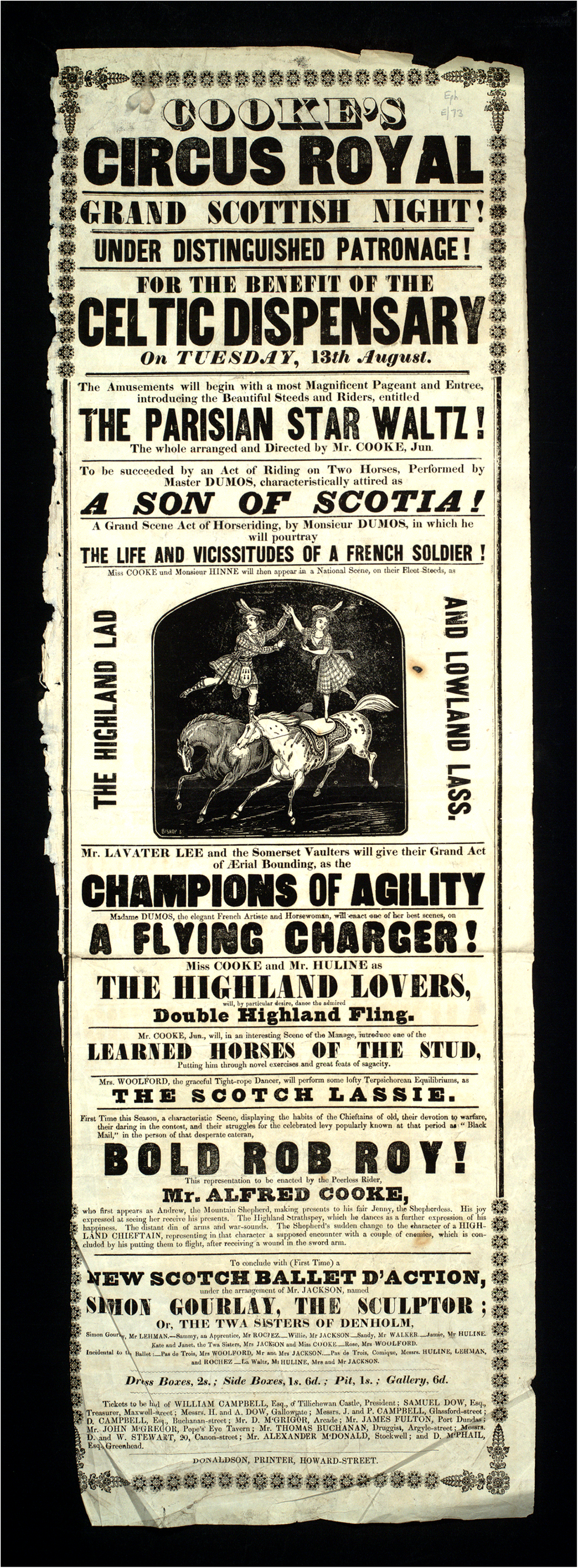
‘Playbill, Cooke's Circus Royal’ (1844). Scottish Theatre Archive, University of Glasgow, Eph E/73, 13 August 1844. Reproduced by permission of University of Glasgow Library, Archives & Special Collections.
The circus's mode of performance, setting National (hippo)Dramas next to equestrian tricks next to imperial spectacles in a single evening's entertainment, brings Kidd's designation of Scotland being in ‘imperial copartnership’ with England more starkly into light. The circus was uniquely positioned to highlight Scottish (inter)nationalism. In February 1836, at the end of a two-month run at Aberdeen's Union Street, Cooke's Circus's delivered the ‘Grand Eastern Pageant of the Revolt of the Harem!’, which was well reviewed, with Cooke ‘much admired; as was also, Mr E. Woolford's performance as an East Indian’.
87
During this run, we know that ‘Mr Woolford’ was also featured heavily in advertisements of explicitly Scottish performances, attempting ‘an entirely new Comic Sketch, entitled Tam o’ Shanter. Likewise, a new National Equestrian Scene, called St Andrew, the Champion Knight of Scotland, with a sudden transition to The Genius of Harmony and Peace’. These he performed alongside his wife, Mrs Woolford, with ‘her elegant Feats on the Tight Rope, as The Highland Lassie’.
88
Although we cannot be sure exactly what occurred in each performance, this demonstrates that the Aberdeen public were accustomed to watching performers shape-shift between representing different nationalities, and to witnessing Scottish performers’ mastery over the representation of the ‘other’. Indeed, to have the ‘Dashing White Sergeant’ in this Winter 1835–6 season performed in the same evening, by the same players, as a ‘Burlesque Parade and Military Picture’ of Napoleon, makes a statement about Scotland's distinct national identity including space for implicit loyalty to British overseas military campaigns, even twenty years after the last conflict of the Napoleonic Wars.
89
Similar examples can be seen in Ord's Circus. Although performing almost exclusively in Scotland, the troupe would very occasionally cross the border into the historic counties of Cumberland and Northumberland. In the same year as Cooke's performance of the ‘Revolt of the Harem’ featuring Woolford as the ‘East Indian’, Ord took ‘The Indian War Dance’ and the ‘Indian Hunter’, alongside ‘The Highland Fling, in Character’ to the Market Square of Whitehaven, in modern-day Cumbria. The newspaper advertisement claims: to surpass all who have preceded him, he [Ord] has brought forward a Stud of Arabian, Hanoverian, Spanish, and Scotch Horses, which in point of numerical strength, beauty, agility, all that can delight the eye or astonish the auditor, can compare with that of any other in Great Britain.
90
Conclusion
The image of Ord in his Highland–Lowlander garb was well-recognised and enjoyed across various and diverse communities in Scotland, as were Cooke's Circus performances of Highland–Lowlander figures juxtaposed with characterisations of the exotic ‘other’. The pervasive continuities between circus performances in diverse locations across Scotland, in part due to the far-reaching popularity of the National Drama, demonstrate that circuses were sites which fostered hegemonic socio-cultural responses to the Union and the wider British empire. Although the circus was a site for fantastical reimaginings of village life, these were not motivated by anti-establishment intentions, nor did they produce anti-establishment sentiment. The open-air provincial touring circus in both remote Highland and Lowland spaces, as well as the metropolitan circus, instead propose a vision of Scotland which projects a common cultural identity for its citizens. The touring circus's ability to reach geographical extremities and its consequent potential for performance of content peculiar to the local community belies the actuality of the homogeneous performance sequences in each touring location, as remembered by memoirists and other writers. The Scottish circus is instead populated by scenes which symbolically present Scotland as England's equal, forming a vital constitutive part of the home nations of the British empire, and sharing in its profits, thus presenting an (inter)nationalist Scottish identity. This type of imaginative nation formation is apparent in performances such as James Thorpe Cooke's ‘Seven Champions of Christendom’, performed in Aberdeen in January 1836, where figures of St Andrew of Scotland, St David of Wales, St Patrick of Ireland, and Tom of Coventry (among others) processed on horseback together; in the same show's portrayal of ‘Three Ye One’, representing England, Scotland, and Ireland as a united team of equestrians; 92 and in a later performance in Dundee where ‘representatives of different nationalities … appropriately dressed in pretty costumes’ appeared in the arena ‘much applauded, more particularly those representing the British Isles’. 93 In this last example, a chorus of children sang a rendition of ‘Rule Britannia’, a song urging British imperial dominance, and written by the Scot James Thomson as part of post-Union propaganda for the Hanoverian settlement. These instances of a simultaneous celebration of empire and the carving out of a space for unified Scottish interests proliferate from each iteration of the circus as recorded in newspaper advertisements and reviews, playbill archives, and life-writing. Life-writing and newspaper letters in particular reveal the lasting impression of this type of nation formation as projected to the outer reaches of the British Isles by touring circuses, demonstrating the circus's investment in and contribution to Unionist-nationalism in its imagery and imaginary. In correlation with historiographic accounts of Scottish national politics, the circus both reflected and produced a form of (inter)nationalist nation-building in which being a sincere nationalist was not mutually exclusive with being an advocate of the Union and empire. 94 On the contrary, support of Unionism and the empire was in fact often a prerequisite for nationalist feeling.
Footnotes
Acknowledgements
I am grateful to Kélina Gotman and Paul Readman for their generous feedback and support, and to Eleanor Lybeck for her encouragement.
Funding
Research carried out for this article was funded by the Arts and Humanities Research Council.
