



Abstract
In this article, a methodology is proposed to implement fractional-order analog wavelet filters in the frequency domain. Under the proposed scheme, the fractional-order transfer function of the linear time-invariant system is used to approximate the Gaussian-like wavelet functions. Firstly, we construct a causal, stable, and physically achievable fractional-order mathematical approximation model. Then, the fractional-order mathematical approximation model is transformed into an optimization problem, and a hybrid particle swarm optimization algorithm is exploited to find its global optimal solution. At the same time, constraint terms are introduced to ensure the desired stability. The simulation results show that the fractional-order analog wavelet filters have higher approximation accuracy than the traditional integer-order analog wavelet filters. Furthermore, fractional-order analog wavelet filters can provide more precise control of the stopband attenuation rate, which is a key issue for many engineering applications.
Keywords
Introduction
Analog wavelet filters have become a powerful tool for analyzing nonstationary transient signals because of their multiresolution and mathematical microscope characteristics. 1 They have been widely used in speech signal processing, fault detection, biomedical engineering, and other fields.2–5 Among them, the need for ultra-low power biomedical signal analysis represented by the electronic cochlea, implantable cardiac pacemakers, and wearable dynamic electroencephalogram systems has promoted the development of analog wavelet filters.6–8 However, with the continuous expansion of research objects and scopes, the limitations of analog wavelet filters in dealing with some problems are gradually exposed. For example, due to the extremely complex nature of electrophysiological signals, analog wavelet filters with a limited number of scales are difficult to meet the needs for more detailed nonstationary characteristics analysis of biomedical signals. 9 In Dai et al, 10 it is also mentioned that the analysis results of analog wavelet filters are often unsatisfactory for nonoptimal aggregated signals with frequency domain energy that is common in nature and artificial situations. Meanwhile, the specifications required by many emerging applications make noninteger-order analog filters a better choice. However, to facilitate the implementation of this type of filters, the existing technical method is to round the required order to the nearest integer. 11 It is because of this approximation that the precise requirements for frequency response and stopband attenuation cannot be achieved.
Fortunately, the fractional-order circuit, which has received increasing attention in the field of filters in recent years,12–15 may be able to provide a good response strategy for the above-mentioned challenges. Shi et al. 16 pointed out that using a more general fractional domain plane can effectively analyze frequency-domain energy nonoptimal aggregated signals. As a generalized form of classical analog wavelet filters, fractional-order analog wavelet filters extend the time-frequency domain plane in the traditional wavelet theory to the time-fractional domain plane. Therefore, they not only inherit many advantages of traditional wavelet filters, such as linear characteristics, multiresolution analysis but also have the characterization function of the fractional domain. This can effectively solve the problem that traditional wavelet filters cannot analyze frequency-domain energy nonoptimal aggregated signals. Research results presented in Mahata, Kar, and Mandal 17 show that using the additional degrees of freedom provided by the fractional-order system can improve the modeling accuracy of physical systems. The primary task of implementing analog wavelet filters is to construct an analog wavelet base with high approximation accuracy. The application of fractional-order theory may be able to effectively solve the problems of low model accuracy and high-order transfer function when using traditional integer-order models to describe wavelet filters. In Langhammer et al., 18 it is indicated that the stopband attenuation rate of a fractional filter is 20(n + α), where n is a nonzero integer and α is a fractional parameter. Therefore, the stopband attenuation rate of the fractional-order analog wavelet filters can be precisely controlled with a small change step. This may be able to break through the application bottleneck of existing wavelet filters in some scenarios such as biomedical applications.
Obviously, studying the application of fractional-order theory in analog wavelet filters has very important theoretical significance and application value. For example, possible application scenarios include improving overall circuit performance, increasing system design flexibility and sophisticated signal analysis capabilities, and better meeting the needs of low-power real-time applications. However, judging from the existing related references and reports, the research on fractional-order analog wavelet filters is quite limited. There are few existing practical applications, and there are almost no related references that directly discuss and research the design and implementation of fractional-order analog wavelet filters. The reason may be that the approximation network of the fractional-order analog wavelet filters in the time domain is difficult to construct, and the fractional-order component has not been commercialized.
As analyzed above, there is still a lack of efficient analog wavelet filters that allow for finer analysis of complex signals. To fill this gap, a design scheme of a class of fractional analog wavelet filters is proposed, and the main contributions of this article are as follows:
Based on the existing research on fractional-order analog filters,19–24 we try to generalize the design of classical analog wavelet filters to the fractional-order domain. In general, the introduction of additional free parameters can effectively improve the approximation accuracy and flexibility of the wavelet filter. What’s more, fractional-order systems provide more precise control of stopband attenuation, which enables engineers to obtain precise requirements for delay and frequency response in the time and frequency domains, respectively. A mathematical model for designing fractional-order analog wavelet filters was constructed. Using mathematical approximation methods in the frequency domain, the minimum L2-norm error between the amplitude-frequency characteristics of fractional order analog wavelet filters and the amplitude-frequency characteristics of commonly used wavelet basis functions is used as the objective function. The construction process of this mathematical model is actually a mathematical optimization problem. Simultaneously, causality, stability, and wavelet tolerance conditions are used as constraints for the optimization problem. An improved hybrid particle swarm optimization (PSO) algorithm was proposed and used to design two types of fractional order analog wavelet filter transfer functions. The algorithm takes the global solution searched by the standard PSO algorithm with strong global optimization ability as the initial value and then uses the steepest descent method (SDM) for fine search to finally obtain the global optimal solution. Then, the fractional order Gaussian and Marr simulated wavelet filter transfer functions were designed using this algorithm.
As we all know, there are two key steps in the realization of the analog filter of wavelet transform (WT): the construction of the analog wavelet base and the circuit design of the wavelet filter. The fractional-order analog wavelet filters can effectively improve the approximation accuracy and effect of the basic wavelet filter function. More importantly, the additional free parameters provided by fractional-order wavelet filters allow engineers to mathematically model system characteristics more efficiently.
17
However, as far as the current manufacturing level of fractional-order components is concerned,25–30 the complexity brought about by fractional-order circuits is an inevitable problem. Because we often need to use existing integer order devices to build RC networks to effectively simulate the behavior of fractional order capacitors.
31
However, if commercialized fractional-order components appear in the future, the complexity of fractional-order circuits can be greatly reduced.
The remainder of this article is organized as follows. In the second section, we present some basic conceptions about Gaussian-like WT in an analog circuit and preliminarily give the general approximation formula of Gaussian-like wavelet bases in the fractional frequency domain. In the third section, we construct a complete mathematical approximation model of the Gaussian-like wavelet bases from three key issues and introduce the optimization algorithm for searching. In the fourth section, we evaluate the effectiveness of the proposed fractional-order analog wavelet filter through two application examples. Finally, conclusions are drawn in the last section.
Gaussian-like wavelet transform in analog circuit
Generally, the continuous WT (CWT) of input signal f(t) at a scale a and at time b is defined as


Fractional-order analog wavelet filters to realize multiscale CWT.
Generally, since the basic expression of wavelet is a time-domain function, the time-domain approximation method is more accurate than the frequency-domain approximation method. However, most of these studies focus on one type of wavelet basis and rarely involve a specific wavelet series. 33 In addition, the high-dimensional complexity of the fractional-order WT makes it difficult to construct the time-domain approximation function of the wavelet base. Therefore, we will directly construct the general approximation model of Gaussian-like wavelet bases from the fractional frequency domain, which is very important for selecting the optimal wavelet base and realizing the fractional-order analog wavelet filters.
Gaussian-like wavelet bases are embodied in the differential form of the Gaussian function, and the time-frequency expression of the Gaussian function is shown as follows


Fractional-order wavelet approximation model construction
Mathematical approximation model
In this section, we will start with the three key issues of causality, stability, and wavelet admissible condition, and derive the fractional-order mathematical approximation model of Gaussian-family wavelet bases. To evaluate the performance of the approximation method, the L2-norm is used to measure the error between the approximation function Hn+α,a(jw) and the function Ψ
τ
(n)(jw) to be approximated. So, the rational approximation of the wavelet bases can be defined as the optimization problem to minimize the L2-norm of the objective function Firstly, constraint conditions are introduced in the optimization process to ensure that the constructed analog wavelet bases meet the causality, which makes the impulse response of the analog wavelet bases only appear at t > 0. Secondly, the approximate effects of amplitude-frequency response and phase-frequency response correspond to the waveform similarity and time lag of the approximation function in the time domain, respectively. Therefore, the high-precision amplitude-frequency response approximation makes the approximation function very similar to the impulse response of the ideal wavelet base.
Considering the above two points, the impulse response of the ideal wavelet base approximation function constructed in this article can be regarded as the ideal wavelet base for the delay. According to the theory that the best approximation of the maximum frequency response can generate the best time delay,
6
this method can not only ensure the small distortion of the wavelet base itself but also approximate the wavelet base with a lower order filter.

Stability is one of the most important characteristics of filters. At present, most of the researchers focus on the stability determination of integer order systems, but the traditional stability determination method is no longer suitable for fractional-order circuits. To study the stability of fractional circuits, it is necessary to transform the s-plane into a general plane with fractional characteristics (W-plane), 35 to determine the stability of fractional-order circuits according to the amplitude Angle relationship between the s-plane and W-plane. The mapping relationship of s-W is shown in Figure 2.

The mapping relationship of s-W: (a) s-plane and (b) W-plane.
From the figure above, it can be seen that the first and fourth quadrants D1∼D4 of the s-plane are mapped to S1∼S4 of the W-plane respectively. The positive and negative real axes in the s-plane are mapped to the positive real axes and dotted lines A2 and A4 in W-plane, and the positive and negative virtual axes in the s-plane are mapped to dotted lines A1 and A3 in the W-plane. In addition, the area sandwiched between the dashed lines A2 and A4 is called the main Riemannian surface 36 while the area S5 is the non-Riemannian surface. Since S5 has no corresponding region in the s-plane, it is also called the nonphysical area. According to the criterion of integer order circuit stability, S2 and S3 regions located on the main Riemannian surface in W-plane are the stable regions of the fractional-order circuit.
Let the Fourier transform of ψ(t) be Ψ(w), if x(t), ψ(t)∈L2(R), and Ψ(w) satisfy

Based on the above analysis, the rational fractional approximation process of Gaussian-family wavelet bases can be transformed into a nonlinear optimization problem with high dimensions and multipeaks. Meanwhile, to ensure the stability of the approximation model, all poles of Hn+α,a(s) should be located in the left half-plane of the s domain, which is reflected in the denominator coefficients in equation (6) is greater than zero. Therefore, the complete fractional-order mathematical approximation model of Gaussian-like wavelet bases can be constructed as

Constrained hybrid PSO algorithm
To solve the multipeak, complex, and high-dimensional optimization problems as shown in equation (9), we adopt the hybrid PSO algorithm combining the elementary PSO algorithm and the SDM. As a global search algorithm, the elementary PSO algorithm has strong global searchability, but it has some disadvantages such as poor local search ability, slow convergence rate, and prematurity. Local search algorithms such as SDM can find the local optimal solution quickly but have a great dependence on the selection of the initial solution. Therefore, the hybrid algorithm proposed in this article first uses the elementary PSO algorithm as the optimizer in the initial stage to provide a good initial point for SDM and then uses SDM with a stronger local search ability to conduct optimization in the second stage. When SDM setting conditions are met, the current optimal value is output as the optimal value of F(x).
The elementary PSO algorithm is a stochastic optimization algorithm designed to simulate the process of birds looking for food. Suppose there are N particles in a D-dimensional search space, and each particle has two properties: position vector X and velocity vector V, then the position of the ith particle is expressed as Xi = (x1, x2, …, xD) and velocity is expressed as Vi = (v1, v2, …, vD). In each iteration, the particle updates itself by tracking the two optimal solutions of individual extreme value pbesti(k) and group extreme value gbest(k). When finding these two optimal values, each particle will update its current velocity and position according to

As a traditional local optimization method, SDM has the advantages of fewer storage variables, fast convergence, and strong local searchability. When searching the minimum value of F(x), the modification direction selected in each iteration is the negative gradient direction of F(x), and the final search result is also the local optimal solution rather than the global optimal solution. The specific steps are as follows.
38
Given the initial point x(k) and the accuracy requirement ε > 0. Calculate the search direction d(k) = −∇f (x(k)) where ∇f (x(k)) represents the gradient of F(x) at point x(k), if
To ensure that the constructed fractional-order analog wavelet bases have strict and stable poles when searching equation (9) based on an optimization algorithm, we use the penalty function method
39
to transform the constrained optimization problem into an unconstrained optimization problem to obtain a new objective function. Specifically, since the sufficient and necessary condition for the stability of a linear system is that all poles are in the left half-plane, F(x) with at least one pole not in the left half-plane will be punished. F(x) that does not meet the stability condition is artificially set to a larger value, forcing the search algorithm to leave the search area in the optimization process, so that the global optimal advantage always points to a more stable position. Therefore, F(x) with penalty term can be expressed as


Gaussian-like wavelet function approximation
To verify the effectiveness of the fractional-order analog wavelet filter model proposed in this article, the (5 + α1) order Gaussian wavelet base and the (6 + α2) order Marr wavelet base of scale a = 1 are taken as examples to analyze the solution process of the approximation model in detail. In addition, the parameters of the constrained hybrid PSO algorithm are set as the pending optimization coefficient Bi is optimized within the range of (0, 6), the initial population size N = 1000, the maximum iteration times iteration = 4000, and the accuracy requirement ε = 0.001.
(1) For the (5 + α1) order Gaussian wavelet base, given frequency range w∈[0∼10 rad/s], frequency interval Δw = 0.01 rad/s, and sampling point M = 1001. The fractional-order approximation model of the ideal Gaussian wavelet base can be expressed as follows by calculating the L2-norm error of F(x),
The final optimization results of searching (5 + α1) order Gaussian wavelet base based on a constrained hybrid PSO algorithm are shown in Table 1.

Comparison between (5 + α1) order Gaussian wavelet base approximation model and integer order model.

As can be seen from Table 1, with the increase of noninteger order α1, the approximation accuracy of the fractional model gradually increases. After using the same algorithm, the approximation effect of the 5.183-order Gaussian wavelet base with the worst approximation effect is still better than that of the 5-order Gaussian wavelet base, while the approximation accuracy of the fractional-order model with a better approximation effect is better than that of the 6-order model. Therefore, compared with the traditional integer-order wavelet approximation model, the fractional-order wavelet approximation model has higher approximation accuracy and a better approximation effect. Specifically, the parameters to be optimized of order 5.995 Gaussian wavelet base are optimized by a constrained hybrid PSO algorithm, as shown in Table 2.
5.995-order Gaussian wavelet base optimization results.
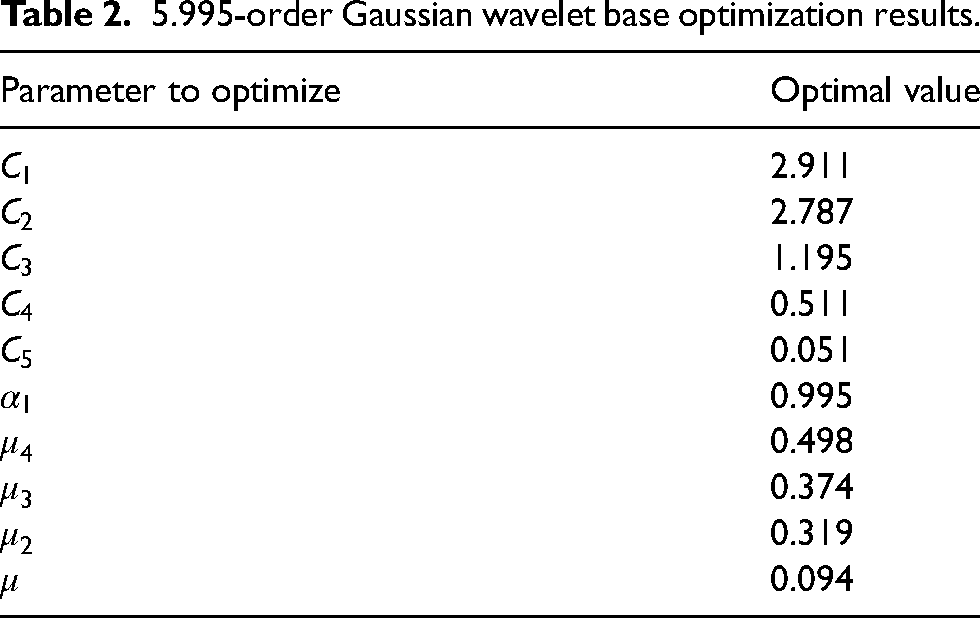
The results show that the L2-norm error of order 5.995 Gaussian wavelet base is only 0.1906, which is not only much lower than the approximation error of the order 5 model but also better than the approximation effect of the order 6 model. Substitute the optimized values obtained in Table 2 in equation (13), then the transfer function of the simulated Gaussian wavelet base of order 5.995 is (2) For the (6 + α2) order Marr wavelet base, given frequency range w∈[0∼7 rad/s], frequency interval Δw = 0.01 rad/s, and sampling point M = 701. The fractional-order approximation model of the ideal Marr wavelet base can be expressed as follows by calculating the L2-norm error of F(x)

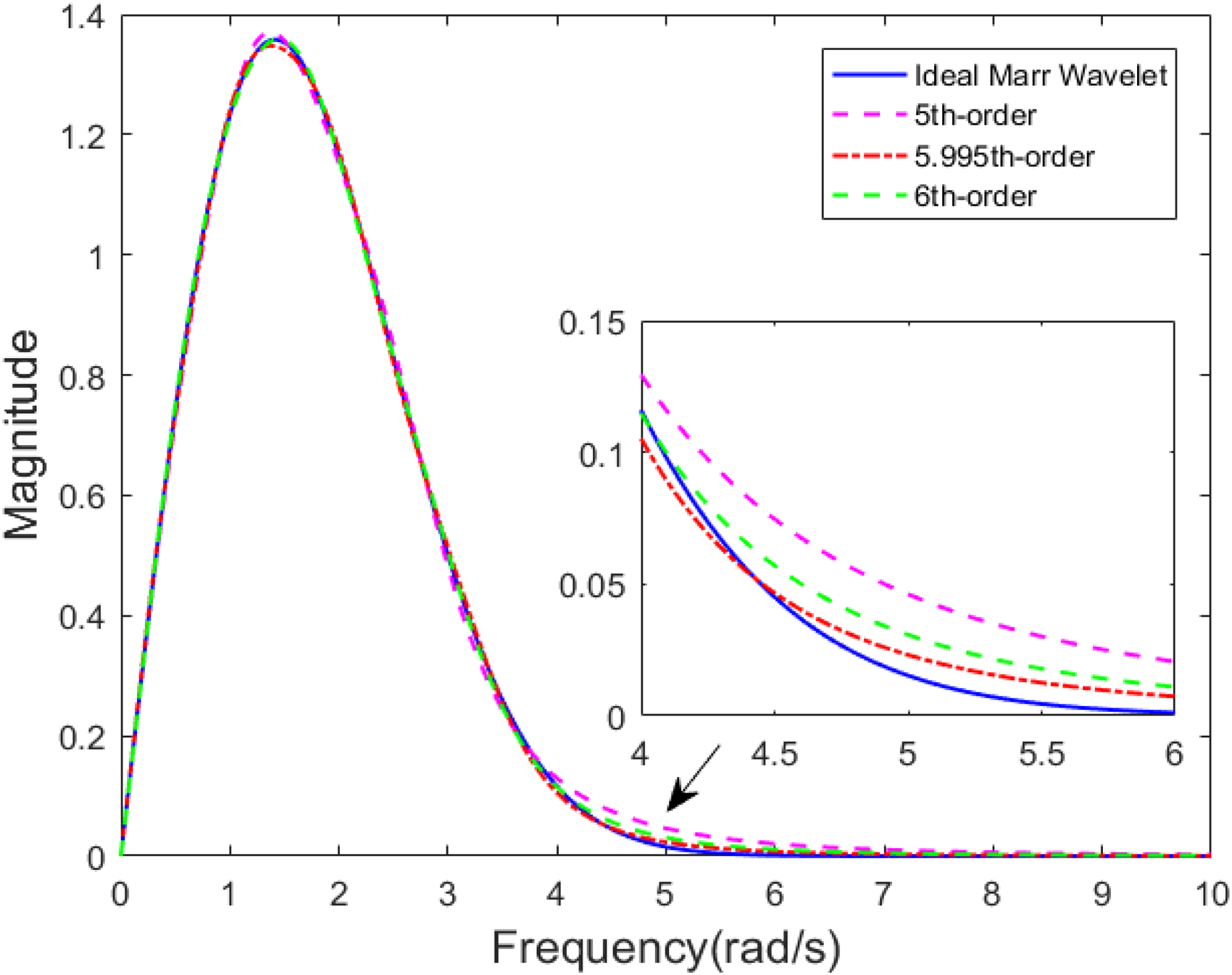
Comparison of frequency-domain approximation between Gaussian wavelet approximation model of order 5.995 and integer-order approximation model.

Comparison of time-domain approximation between Gaussian wavelet approximation model of order 5.995 and integer-order approximation model: (a) 5.995-order Gaussian wavelet base impulse response and (b) 5-order Gaussian wavelet base impulse response.
The final optimization results of searching (6 + α2) order Marr wavelet base based on constrained hybrid PSO algorithm are shown in Table 3.
Comparison between (6 + α2)-order Marr wavelet approximation model and integer order model.

Table 3 also proves that introducing fractional order theory into the wavelet base approximation model can improve the approximation accuracy. Table 4 shows the final optimization results of searching 6.413-order Marr wavelet base by constrained hybrid PSO algorithm.
6.413-order Marr wavelet base optimization results.
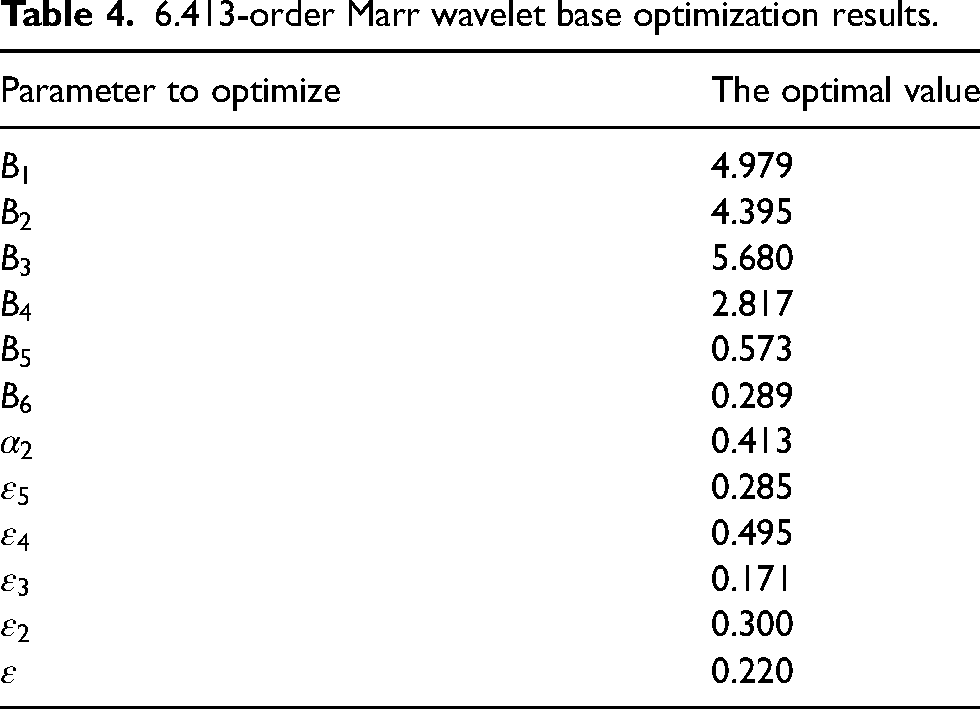
Substitute the optimized values obtained in Table 4 into equation (15), and then the transfer function of the simulated Marr wavelet base of order 6.413 is
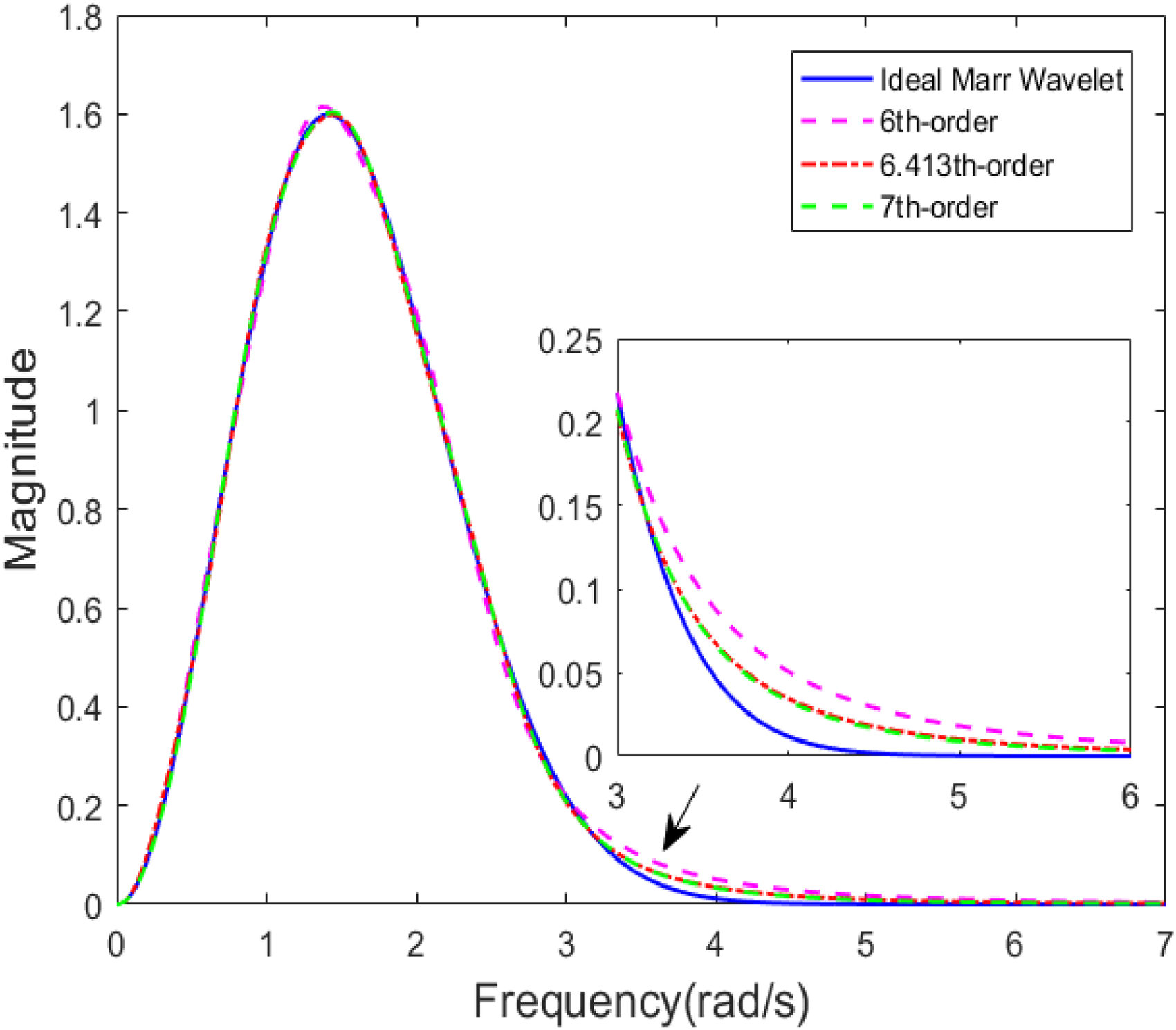
Comparison of frequency-domain approximation between Marr wavelet approximation model of order 6.413 and integer-order approximation model.

Comparison of time-domain approximation between Marr wavelet approximation model of order 6.413 and integer-order approximation model: (a) 6.413-order Marr wavelet base impulse response; (b) 6-order Marr wavelet base impulse response.
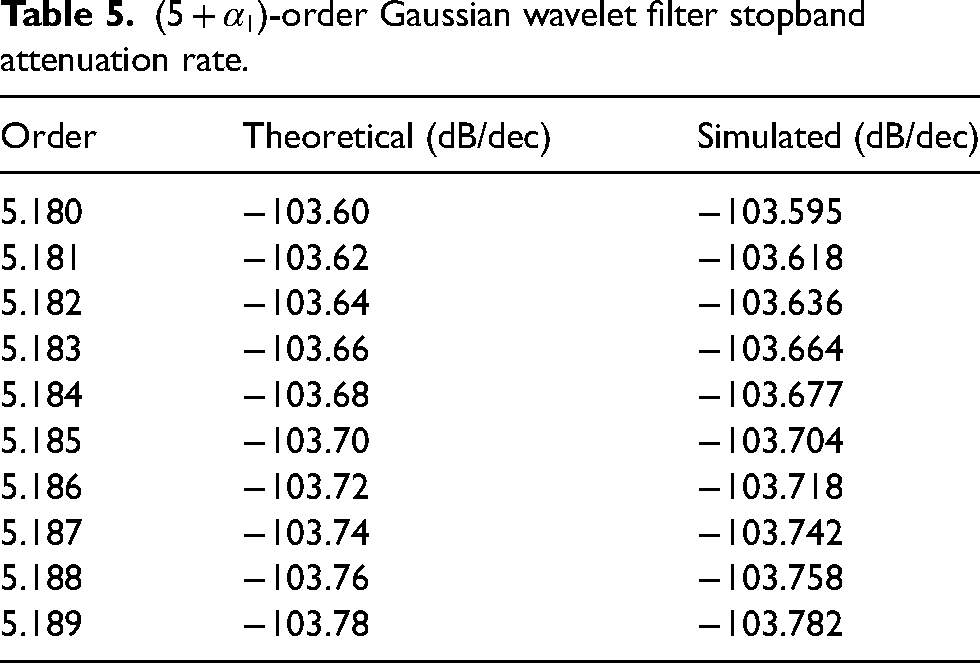
It is worth noting that, after repeated experiments and calculations, Tables 5 and 6 respectively summarize the change of stopband attenuation rate of (5 + α1) order Gaussian wavelet filter and (6 + α2) order Marr wavelet filter. The experimental results show that the stopband attenuation rate is positively correlated with the order of the fractional wavelet filters, and has a continuous step. When α1 = α2 = 0.001, the stopband attenuation rate of the fractional-order wavelet filters can be controlled precisely by 0.02 dB/dec step. When α1 = α2 = 0.1, the stopband attenuation rate can be precisely controlled by a step of 2 dB/dec. This shows that we can realize Gaussian wavelet filter with arbitrary order of stopband attenuation rate in the range of (100 dB/dec, 120 dB/dec) and Marr wavelet filter with arbitrary order of attenuation rate in the range of (120 dB/dec, 140 dB/dec).
(5 + α1)-order Gaussian wavelet filter stopband attenuation rate.
(6 + α2)-order Marr wavelet filter stopband attenuation rate.

In addition, due to the constraint term introduced into the hybrid PSO algorithm, the proposed method can guarantee the strict stability of the constructed wavelet base, which solves the problem that the existing models and methods are difficult to construct the stable approximation network. Figures 7 and 8 show the partial pole positions of the fractional-order Gaussian wavelet base and Marr wavelet base. Obviously, according to the previous analysis, the approximation model constructed in this article is a strictly stable system (all poles are located in the left half-plane of the s-domain).

Partial pole positions of (5 + α1)-order Gaussian wavelet base: (a) 5.183 order and (b) 5.995 order.

Partial pole positions of (6 + α2)-order Marr wavelet base: (a) 6.140 order and (b) 6.950 order.
Conclusion
In this article, we design a class of fractional-order analog wavelet filters to approximate Gaussian-like wavelet functions. Considering that the correlation operation of fractional-order equations in the time domain is very complicated, we construct the mathematical approximation model by approximating Gaussian-like wavelet functions in the frequency domain. At the same time, in order to design a physically realizable CWT circuit, we ensure that the filter meets the requirements of causality, stability, and wavelet admissible condition. Then, the parameters of the fractional transfer function are optimized by the improved constrained hybrid PSO algorithm, so that the amplitude characteristics are approximated to the ideal response of the Gaussian-like wavelet functions. Finally, we have completed the design of the transfer function of the fractional-order analog wavelet filters that meet the requirements. The numerical simulation results show that the fractional-order analog wavelet filters approximate the ideal Gaussian-like wavelet functions well in both time and frequency domains. And the approximation accuracy of the filter in the frequency domain is also better than the traditional integer order filter. More importantly, the stopband attenuation rate of fractional-order analog wavelet filters can be precisely controlled in smaller steps, which allows greater flexibility in designing wavelet filters. Therefore, it can be considered as a competitive candidate in practical applications that require precise control of stopband attenuation rate with small steps. In the future, with the development of science and technology and the expansion of application scenarios, fractional-order analog wavelet filters will provide a new research approach when integer-order analog wavelet filters cannot meet research and engineering needs. Compared with traditional integer order analog wavelet filters, fractional order analog wavelet filters have advantages such as higher system accuracy, more flexible design methods, and fine-tunable stopband attenuation rate, greatly expanding the research field and application scope of integer order analog wavelet filters. Therefore, it is of great significance and value to study the design and circuit implementation of fractional order analog wavelet filter design.
Footnotes
Declaration of conflicting interests
The authors declared no potential conflicts of interest with respect to the research, authorship, and/or publication of this article.
Ethics
The authors declare their responsibility for any ethical issues that may arise after the publication of this article.
Funding
The authors disclosed receipt of the following financial support for the research, authorship, and/or publication of this article. This work was supported by the Hunan Provincial Natural Science Foundation of China, Scientific Research Fund of Hunan Provincial Education Department, Research Foundation of Education Bureau of Hunan Province of China, Research and Innovation Project of Graduate Students of Hunan Institute of Science and Technology, Science and Technology Program of Hunan Province, Science and Research Creative Team of Hunan Institute of Science and Technology under Grant (grant numbers: 2020JJ4338 and 2019JJ40109, 19C0864, 20A219, YCX2021A13, 2019TP1014, 2019-TD-10).
