



Abstract
The mean curvature-based image deblurring model is widely used to enhance the quality of the deblurred images. However, the discretization of the associated Euler–Lagrange equations produces a nonlinear ill-conditioned system which affects the convergence of the numerical algorithms such as Krylov subspace methods (generalized minimal residual etc.) To overcome this difficulty, in this paper, we present three new circulant preconditioners. An efficient algorithm is presented for the mean curvature-based image deblurring problem, which combines a fixed point iteration with new preconditioned matrices to handle the nonlinearity and ill-conditioned nature of the large system. The eigenvalues analysis is also presented in the paper. Fast convergence has shown in the numerical results by using the proposed new circulant preconditioners.
Introduction
In the last two decades, nonlinear variational methods have received a great deal of attention in the field of image deblurring. Two main difficulties arise while applying nonlinear variational techniques to large-scale noisy, blurred images. One of them, of course, is nonlinearity and the other is the solution of the large system which arises from the discretization after linearization. The main focus of this paper is to handle these two computational difficulties. The most well-known nonlinear variational image deblurring model is the total variation (TV) model.1–5 It has nice properties such as edge preserving. But the main drawback of the TV model is that the resulting images look blocky. Because this model converts smooth functions into piecewise constant functions, which create staircase effects in resulting images. To reduce the staircase effects, one remedy is to use the mean curvature (MC)6–18-based regularization models.
The MC-based regularization models are widely used in all image processing problems. In image deblurring, the MC-based models are very effective. These models not only preserve edges but also remove the staircase effect in the recovery of digital images. However, the discretization of the associated Euler–Lagrange equations produces a large nonlinear ill-conditioned system which affects the convergence of the numerical algorithms such as Krylov subspace methods (generalized minimal residual (GMRES), etc.). Furthermore, the Jacobian matrix of the MC-based nonlinear system is a block banded matrix with a large bandwidth. The MC-based regularization methods are effective, but due to the high nonlinearity and ill-conditioned system, a robust and fast numerical solution is a crucial issue. To overcome these difficulties, in this paper, we introduce three new circulant symmetric positive definite (SPD) preconditioners. So instead of applying the ordinary GMRES method (without preconditioner), we use preconditioned GMRES (PGMRES) method (with new preconditioners) for the solution of the system. A fast convergence has been shown in the numerical results by using the proposed new preconditioners.
The contributions of the study include the following: (i) our work presents an efficient algorithm for an MC -based image deblurring problem, which combines a fixed point iteration (FPI) with new circulant preconditioned matrices to handle the nonlinearity and ill-conditioned nature of the large system; (ii) presents a better treatment for the computationally expensive higher-order and nonlinear MC regularization functional. The paper is organized into different sections. The first section includes an introduction while the second section includes a problem description of an image deblurring model. In the third section, we present a nonlinear system of first-order equations and cell discritization. In the fourth section, we introduced our proposed circulant preconditioners for the PGMRES method. The properties and eigenvalues analysis of the proposed preconditioned matrices are discussed in the fourth section. The numerical experiments are also in the fourth section. The conclusions about the proposed PGMRES method are discussed in the last section of the paper.
Problem description
The focus of the paper is on the image deblurring problem, so we start by presenting its concise description. Mathematically, the relationship between



The MC-based model not only preserves edges but also removes the staircase effect in the recovery of digital images. However, fourth-order derivatives appear in the Euler–Lagrange equations, which create problems in developing an efficient numerical algorithm. One key problem in presenting the method is to give a proper approximation to the nonlinear MC functional. We have treated this difficulty by reducing the nonlinear fourth-order Euler-Lagrange equation into a system of first-order equations.
The first-order nonlinear system
Equation (3) can be expressed as a first-order nonlinear system:




Cell discretization
For an MC-based image deblurring problem, the domain





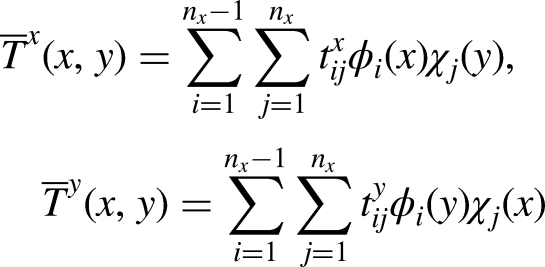
The cell-centered finite difference method
Here, we present the cell-centered finite difference (CCFD) method for the MC-based image deblurring problem. By considering lexicographical ordering of the unknowns


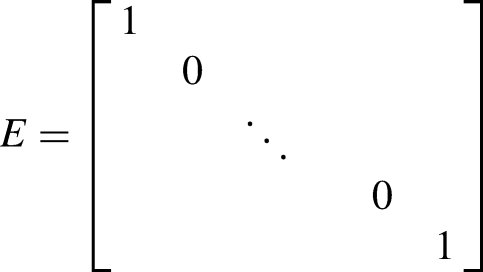


Now if we eliminate


In the literature, one can find a number of numerical methods that have been investigated to MC-based nonlinear image minimization problems.20,6,21,14,4,22,16–18 Since MC-based models produce a large and ill-conditioned nonlinear system, so almost all these standard methods get quite slow convergence. Furthermore, the presence of higher-order and nonlinear MC regularization functional in the governing equation of the models makes these highly nonlinear systems harder for calculation. MC is very much computationally expensive, that is why most of the existing methods perform quite poorly. To make a robust numerical method for the MC-based nonlinear image deblurring problem, now we present a new preconditioned numerical method.
Numerical implementation
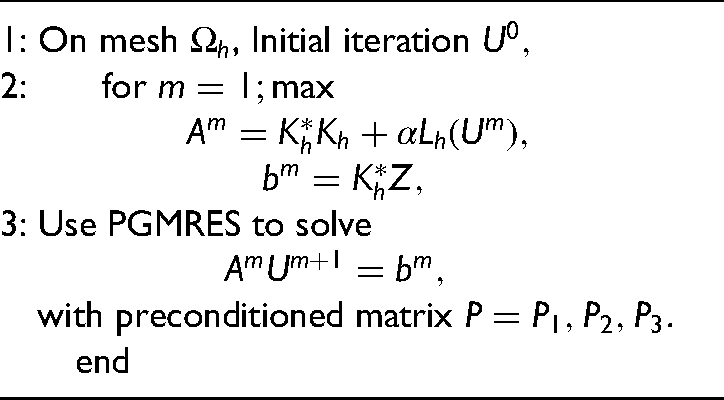
Here we introduce the algorithms to solve the MC-based nonlinear system (16). First, we apply a discrete version of the FPI to (16) to handle the nonlinearity of MC. The approach taken here is called the “lagged diffusivity” scheme.
4
Its rate is just linear but in practice, it has a quite rapid convergence. Furthermore, this scheme does not depend on the initial guess to converge globally. This is why globalization is not an issue for this scheme. So by FPI, we have the following linear system:

Properties
Before proceeding further, we discuss some important properties of our system (18).
The Hessian matrix The first term The second term
Preconditioned matrices
According to the properties of our system (18), mentioned above, the GMRES method is suitable for the solution of system (18). Due to an ill-conditioned system, GMRES can be quite slow to convergence. So we use the PGMRES method. For an effective solution, the preconditioning matrix must be SPD. Here we introduce the following three SPD circulant preconditioned matrices. The first preconditioning matrix




The preconditioned matrices
The PGMRES method
Eigenvalues
Now, let the eigenvalues of 


Now we present four numerical examples for the MC-based image deblurring problem. We have used different values of
In this example, we have used Lena image. This is a complicated image, because it has a small-scale texture part (hat) and a large-scale cartoon part (face). The different aspects of the Lena image are presented in Figure 1. The size of each subfigure is Lena image: (a) exact image, (b) blurry image, (c) deblurred image by generalized minimal residual (GMRES), (d) deblurred image by GMRES and PGMRES convergence at an FPI 

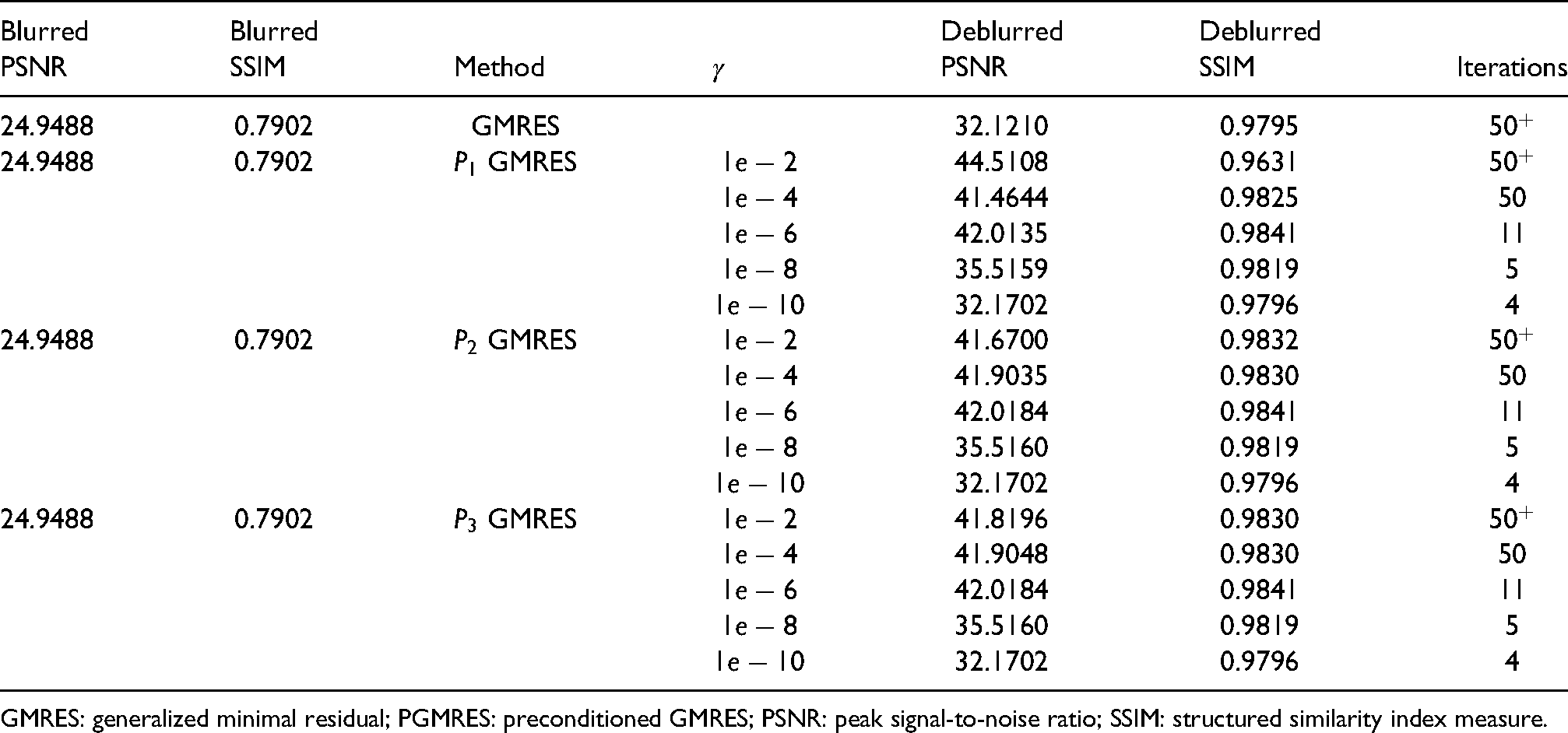
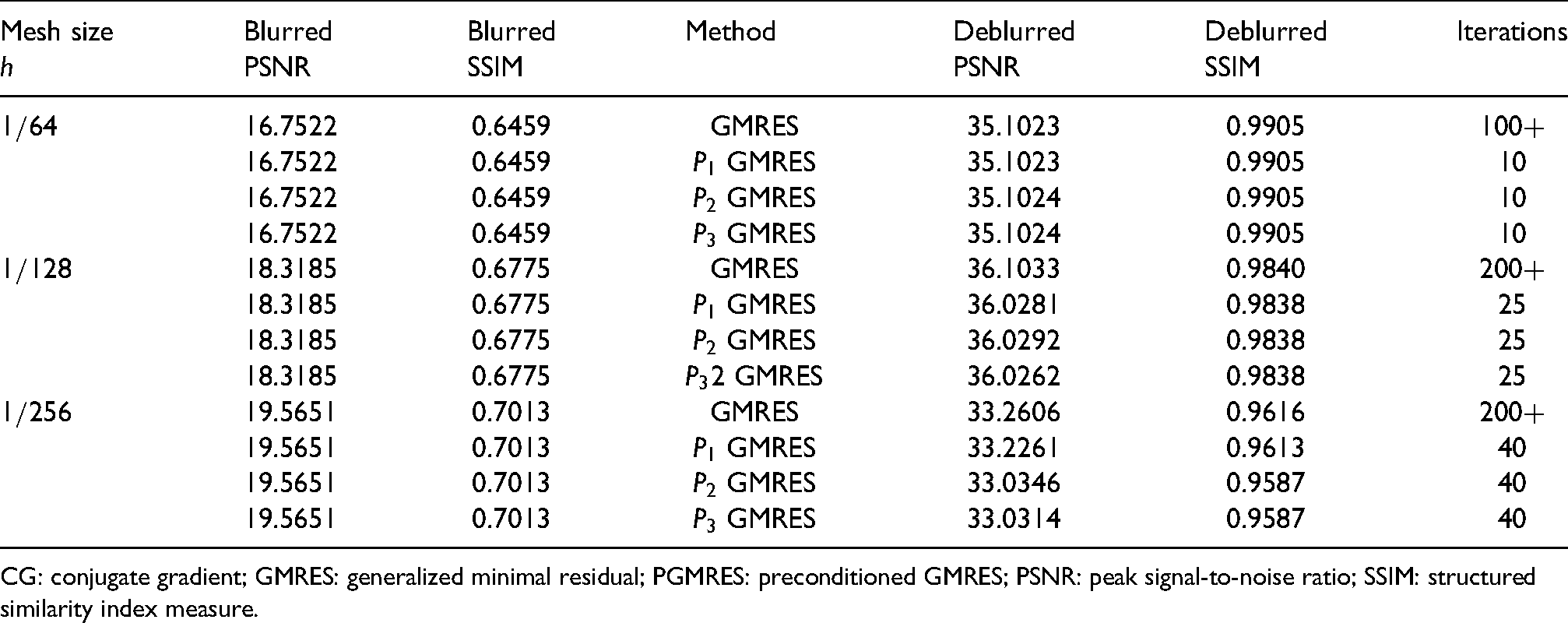
One can notice that Figure 1(d) to (f) is having much better quality as compared with Figure 1(c). This means the PGMRES ( From Figure 2, one can clearly observe the effectiveness of preconditioning. Here, the result was presented using an FPI count From Figure 2, this can also be observed that PGMRES is getting rapid convergence when the value of From Table 1 and Figure 2, one can observe that the PSNR and SSIM by using the PGMRES method is much better as compared with the ordinary GMRES method. But the PGMRES method is producing better PSNR and SSIM in quite less iterations. The It is also observed that although the Comparison of GMRES and PGMRES for Example 1. GMRES: generalized minimal residual; PGMRES: preconditioned GMRES; PSNR: peak signal-to-noise ratio; SSIM: structured similarity index measure.
Here we have used a nontexture Peppers image. The different aspects of the Peppers image are presented in Figure 3. The size of each subfigure is Peppers image: (a) exact image, (b) blurry image, (c) deblurred image by generalized minimal residual (GMRES), (d) deblurred image by 
Figure 3(c) to (f) is almost similar, so all methods are generating same quality results. From Figure 4, one can clearly notice the effectiveness of preconditioning. For all values of From Table 2, it is observed that the PSNR and SSIM by the PGMRES method are almost the same as compared with the ordinary GMRES method for all values of From Table 2 and Figure 4, it is observed that the performance of all the preconditioners ( The GMRES and PGMRES convergence at FPI Comparison of CG, GMRES, and PGMRES for Example 2. CG: conjugate gradient; GMRES: generalized minimal residual; PGMRES: preconditioned GMRES; PSNR: peak signal-to-noise ratio; SSIM: structured similarity index measure.

In this example, we have used a Goldhills image. This is a real and synthetic image. Here we have compared our MC-based algorithm with TV-based algorithm. Since the TV-based model generates an SPD matrix system, so for the solution we have used the conjugate gradient (CG) method. The different aspects of the Goldhills image are presented in Figure 5. The size of each subfigure is Goldhills image: (a) blurry image, (b) deblurred image by CG, (c) deblurred image by GMRES, (d) deblurred image by 
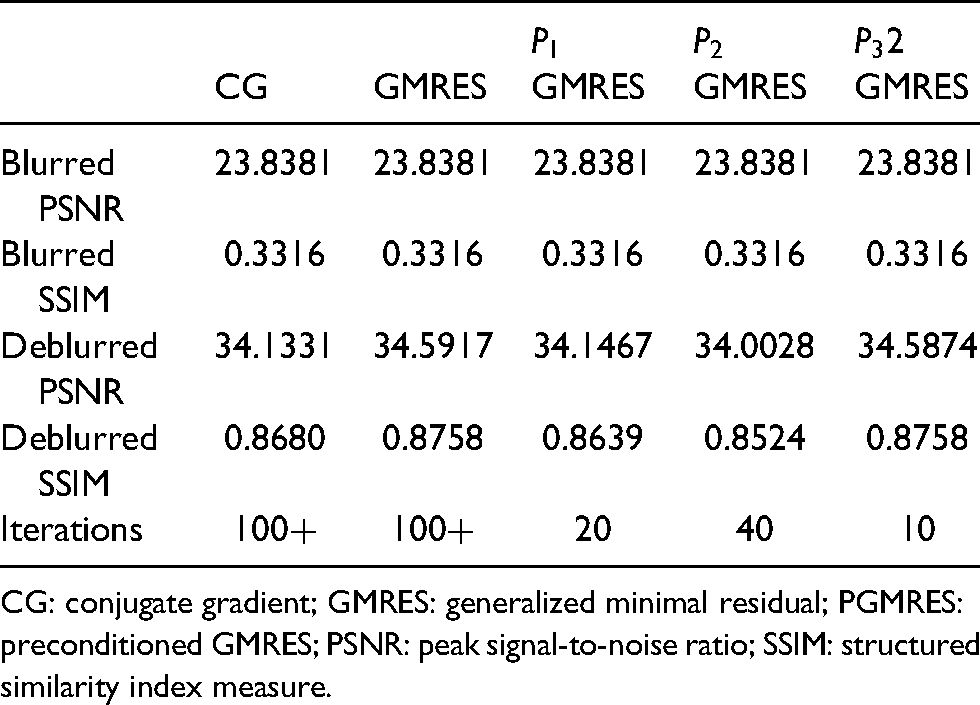
From Table 3, it is observed that the PSNR and SSIM by MC-based (GMRES and PGMRES) methods are a little higher than the TV-based CG method. The same comparison can be observed from Figures 5(b) to (f). So MC-based (GMRES and PGMRES) methods are generating better quality results. From Figure 6, one can clearly observe the effectiveness of preconditioning. The number of MC-based PGMRES iteration is much lesser than as compared to both MC-based GMRES and TV-based CG methods to reach the required accuracy From Table 3, it is observed that the PSNR and SSIM by MC-based PGMRES method are almost the same as compared with the ordinary MC-based GMRES method. But PGMRES method is generating the same PSNR and SSIM in quite less iterations. To achieve the same PSNR and SSIM, the The CG, GMRES, and PGMRES convergence at an FPI Comparison of CG, GMRES, and PGMRES for Example 3. CG: conjugate gradient; GMRES: generalized minimal residual; PGMRES: preconditioned GMRES; PSNR: peak signal-to-noise ratio; SSIM: structured similarity index measure.

In this example we have applied our MC-based (GMRES and PGMRES) algorithms on a blurry image with a high level of Gaussian noise ( Cameraman image: (a) noisy image, (b) denoised image by CG, (c) denoised image by GMRES, (d) denoised image by 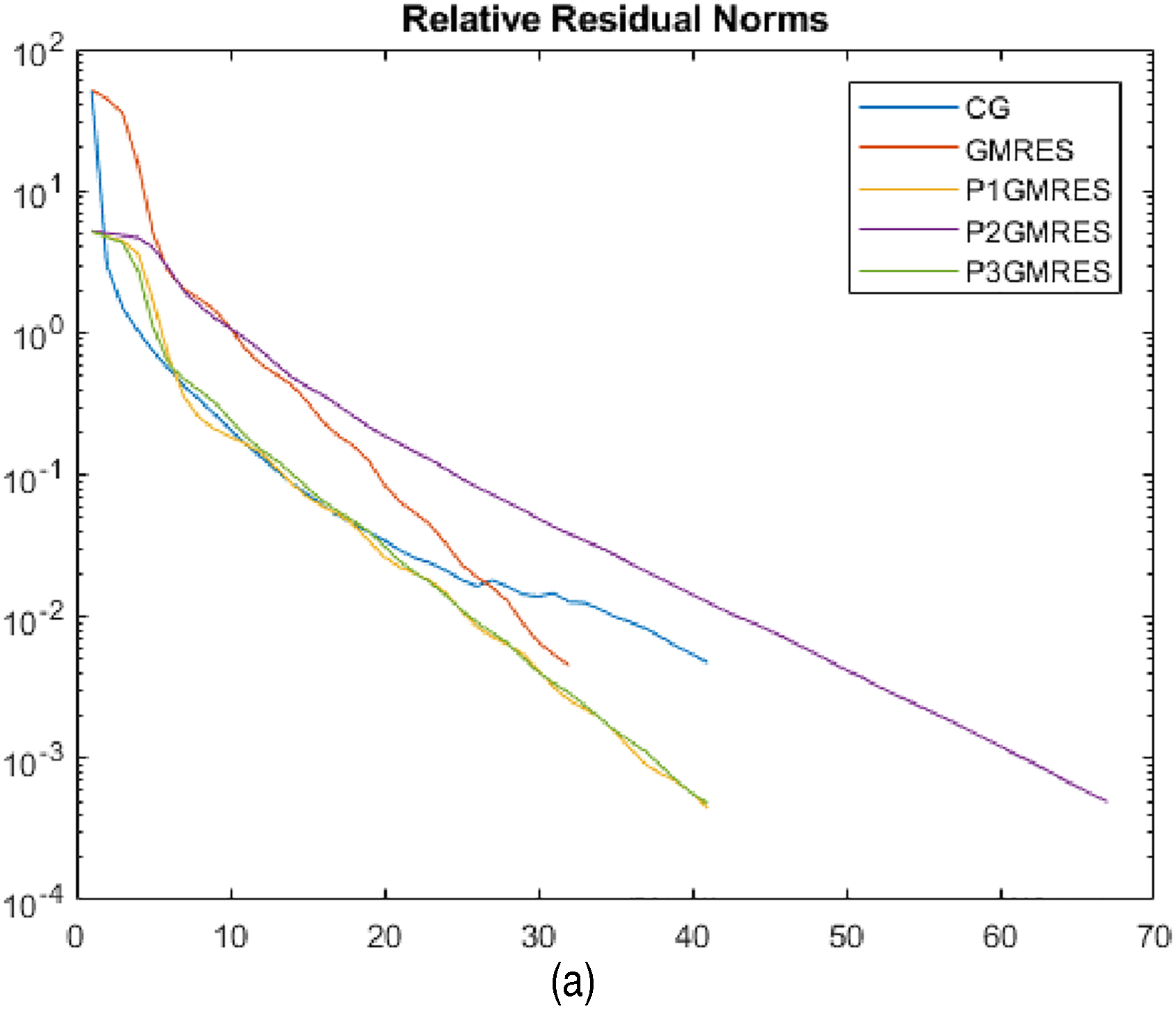
From Table 4, it is observed that the SNR and SSIM by MC-based (GMRES and PGMRES) methods are quite higher than the TV-based CG method. The same comparison can be observed from Figure 7(b) to (f). So MC-based (GMRES and PGMRES) methods are generating better-denoised images. From Figure 8, one can clearly observe the effectiveness of preconditioning. The number of MC-based PGMRES iterations is lesser than as compared to both MC-based GMRES and TV-based CG methods to reach the required accuracy From Table 4, it is observed that the SNR and SSIM obtained by using the MC-based PGMRES method are almost the same as compared with the ordinary MC-based GMRES method. But the PGMRES method is generating the same PSNR and SSIM in quite less iterations. To achieve the same PSNR and SSIM, the The CG, GMRES, and PGMRES convergence at FPI Comparison of CG, GMRES, and PGMRES for Example 4. CG: conjugate gradient; GMRES: generalized minimal residual; PGMRES: preconditioned GMRES; SNR: signal-to-noise ratio; PSNR: peak signal-to-noise ratio; SSIM: structured similarity index measure.


Conclusion
A numerical algorithm (PGMRES) is presented to solve the primal form of MC-based nonlinear image deblurring problem. Three new circulant preconditioned matrices (
Footnotes
Acknowledgements
The authors would like to acknowledge the support and funding provided by the Deanship of Scientific Research (DSR) at KFUPM through a small business project (SB181013).
Declaration of conflicting interests
The authors declared no potential conflicts of interest with respect to the research, authorship, and/or publication of this article.
Funding
The authors disclosed receipt of the following financial support for the research, authorship, and/or publication of this article: This work was supported by the Deanship of Scientific Research (DSR) at KFUPM through a small business project (SB181013).
