In this article, the presented study is based on a modification in Gegenbauer wavelets method. The modeled problem is presented to analyze the phenomena of transfer of heat of rotating nanofluids in which the flow is produced by an exponentially stretching sheet. The purpose of this study is to examine the simultaneous effects of rotation of nanofluid and exponentially stretching on the shear stresses and heat transfer rate, cooling proficiency of water-based nanofluids containing Ag, Cu, Al2O3, TiO2, and CuO nanoparticles, and modification in Gegenbauer wavelets method to obtain the numerical solution of the said problem. A comparative analysis is presented among the outcomes obtained by modified Gegenbauer wavelets method, Runge–Kutta method of order-4, and already existing methods. The comparison shows that this modification is extremely efficient, and proposed technique could be extended for other physical problems.
Motivation in the rotating flows originates from different applications in engineering and geophysics, for example, rotating machinery, anti-cyclonic flow circulations, magma flow in earth’s mantle, centrifugal filtration process, geological stretching of tectonic plate beneath rotating ocean, food and chemical processing, rotor-stator system, viscometry, and dynamics of hurricanes and tornadoes. Wang1 was the pioneer, who explored flow adjacent to a stretching surface immersed in rotating fluid. Such flow problems contain a parameter that is the ratio between stretching rate and rotation rate of the sheet. He used a perturbation approach to determine the velocity distributions for the small values of parameter . Takhar and Nath2 made numerical analysis for Magneto hydro dynamics (MHD) rotational flow over an unsteady stretching sheet. Nazar et al.3 studied an induced unsteady flow due to a stretching surface in a rotating fluid. They used Keller-box scheme to analyze the solution of said problem. The unsteadiness in the flow is due to the sudden stretchiness of the surface. Asymptotic solutions for higher values of resulted and found in a qualitative agreement with the numerical results. Kumari et al.4 analyzed the rotating flow of power-law fluids over a stretching surface. They found that power-law index n is non-monotonic for variation in the velocity distributions. Javed et al.5 provided the local similarity solutions for rotating viscous flow over an exponentially stretching flat surface. Zaimi et al.6 numerically analyzed the boundary layer flow over a stretching surface in a rotating viscoelastic fluid and solved the proposed model by means of the Keller-box method. They concluded that both the velocity and skin friction coefficients in the direction of increased with an increase in the rotation and viscoelastic parameters. Turkyilmazoglu7 studied the conventional Bödewadt flow when the disk is exposed to uniform stretched in the radial direction. He adopted spectral Chebyshev collocation technique to obtain the numerical results. Khan et al.8 studied the MHD squeezing flow between two infinite plates. Transfer of heat in the rotating flow via the Cattaneo–Christov heat flux theory that defines the features of imperative thermal relaxation time was examined by Mustafa.9 He provided an HAM-based solution and described that both analytical and numerical results are well-matched. Rotating flow over an exponentially shrinking sheet with suction is investigated by Rosali et al.10 Stefani and Kirillov11 studied the disruption of rotating flows besides positive shear by azimuthal magnetic fields. Patel models of thermal conductivity and Hamilton Crosser for rotating flow induced by exponential variable velocity of the surface were presented by Ahmad and Mustafa.12 They simulated the problem for five various types of water-based nanofluids.
Recently, the developments in nanotechnology have opened new areas to study the phenomena of heat transfer in the nanofluid. The nanoparticles which are distributed in the base fluid normally selected from oxides and metals that increase the convection and conduction coefficients and hence increase the transfer of heat rate for coolants. Nanofluids have special application in the transfer of heat for example coldness of nuclear reactor, heating of solar water, hybrid-powered engines, domestic chillers/refrigerators, grinding, cooling the electronic systems, heat exchangers, storage of thermal energy, drag reduction, and many other. The prospective applications of nanofluids can be found in the following works.13–17 Nanofluids containing the iron-based nanoparticles (also stated as ferro-fluids) are more beneficial due to their thermophysical characteristics and can be modified by the magnetic field. Moreover, ferro-fluids also perform in some biomedical situations like in contrast agent enhancement in magnetic resonance imaging, the removal of cancer tumors, bleeding reduction during surgeries, and heat conduction in tissues. First, Buongiorno18 gave an idea about two-component nanofluid transport model accounting for the mutual effects of thermophoresis and Brownian diffusion. Later, single-phase model by conveying nanofluid characteristics as functions of the base fluids properties and its constituents are presented by Tiwari and Das.19 The research community has constantly used these transport models for the past several years. Nield and Kuznetsov20 used Buongiorno’s model to address the Cheng–Minkowycz problem for natural convection in nanofluid filling a porous space. Using Buongiorno’s model, Mohyud-Din et al.21 studied the heat and mass transfer of nanofluids arising in biosciences. Recently, Mushtaq et al.22 numerically investigated the rotating nanofluids flow caused by an exponentially stretching sheet. Some recent and qualitative study in the domain of nanofluids has been cited by Sheikholeslami et al.23,24 and Usman et al.25,26
The theoretical investigation by using mathematical techniques has a significant role. Previously, many techniques developed or extended to find the better solution of above-discussed physical problems and successfully applied to many problems.27–33 On the other hand, these methods involve some deficiencies to obtain the better solution for these problems. Literature survey witnesses that the wavelets theory and related methods are very rare to find the solution of physical problems especially when problem contains infinite boundary conditions. In the current work, we introduced a modification in Gegenbauer wavelets method. Previously, the Gegenbauer wavelets method is used by various authors.32–35 Here, we analyze the boundary layer flow of water-based nanofluid driven by exponentially stretching plate via Gegenbauer wavelets coupled with the method of moments. The flow problem composed of five various kinds of nanoparticles including Ag, Cu, Al2O3, TiO2, and CuO. Numerical solutions obtained via modified Gegenbauer wavelets method (MGWM). A comparison between results via MGWM, already published5,22 and RK (order-4) is presented. Observation shows that these results are in good agreement and compatible. Physical changes also deliberated via graphical plots. Moreover, error and convergence analysis has been presented to show the efficiency of MGWM. This proposed method could be extended for other nonlinear problems.
Mathematical and geometrical analysis
Let us explore the effects of heat transfer process of nanofluid over an exponentially stretching surface along the x-axis, prevailing in the plane where and the fluid rotate with an angular velocity along the z-axis in which L is the characteristic length and is an average angular velocity. Let indicates the fluid temperature at the ambient and let is the constant temperature at the surface. The geometry of the problem is provided in Figure 1. The flow includes five various types of nanoparticles: i.e. Ag, Cu, Al2O3, TiO2, and CuO. Assuming the Tiwari and Das19 nanofluid transport model and after using traditional boundary layer approximations, the conservation equations can be stated as
Flow analysis and diagram of the problem.
Associated with BCs
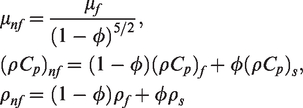
Brinkman36 proposed the effective dynamic viscosity for nanofluids. Moreover, the effective heat capacitance and effective density are stated in equation (8)37
Maxwell model expected the effective thermal conductivity of nanofluid stated under Khanafer et al.,37 in which indicates the nanoparticle volume fraction and subscripts and show solid and fluid phase, respectively
The thermophysical properties of water and considered nanoparticles are stated in Table 1. The following non-dimensionless variables are used5
Thermophysical properties of base fluid and nanoparticles.5,22
In the above expression, indicates Water’s Prandtl number and the rotation parameter, respectively. The local Nusselt number and skin friction coefficient are defined as follows
The wall heat flux and the shear stresses for the wall given below
By means of the similarity transformation in above physical quantities, we get the following expression, wherein shows local Reynolds number
Gegenbauer polynomials and their properties
In this section, Gegenbauer polynomials, its connection with other polynomials, and properties are discussed. Gegenbauer polynomials are of order which satisfy the following singular Sturm–Liouville equation in [–1]
and defined on the interval [–1] and can be calculated using subsequent relations
Rodrigues formula for the Gegenbauer polynomials is given as32–35
Here, is the Pochhammer symbol. Moreover, the Gegenbauer polynomials orthogonal32–35 with respect to the inner product on the interval
with weight function . Chebyshev polynomials of the first kind and the second kind , Jacobi polynomials and the Legendre polynomials, all are special cases of Gegenbauer polynomials and have the following relations32–35
and
An explicit formula to calculate the Gegenbauer polynomials is given below32–35
The curves of first 10 Gegenbauer polynomials for the fixed value of are presented in Figure 2, and Figure 3 indicates the curves of 10th-order Gegenbauer polynomials for different values of .
Curves of first tenth-order Gegenbauer polynomials with
Curves of the 10th-order Gegenbauer polynomial for different values of .
The Gegenbauer polynomials have the following properties32–35
Wavelets and Gegenbauer wavelets
There are four influences which are involved in Gegenbauer wavelets over the interval [0,1] i.e. , where , , is the order of Gegenbauer polynomials, and is the normalized time. It can be defined as
where
where and . In the above expression, are Gegenbauer polynomials of order , and the coefficient in equation (13) is for orthonormality. It is important to remember while dealing with Gegenbauer wavelets that the weight function has to be dilated and translated as given below
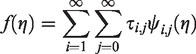
A function from -space express in [0,1) may be expanded35 as the Gegenbauer wavelets
where
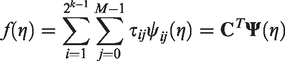
where the expression represents the inner product space in . Since the above expression is an infinite series, and for approximate solution, we should truncate it; therefore, it can be written as
where the matrices and are of order and given by Iqbal et al.35
Convergence of Gegenbauer wavelets
Theorem: The series solution converges to the solution as .
Proof: We can write the inner product of and w.r.t the weight function as in the form
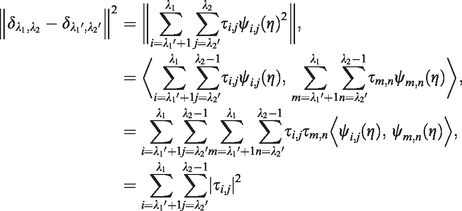
Now, consider that where and represent the level of resolutions, and and shows the order of Gegenbauer polynomials. Let the sequence of partial sums of is given by , we prove that is a Cauchy sequence in Hilbert space and then afterward, we show that converges to when
To show is a Cauchy sequence, we first assume that be any arbitrary sums of with
Since from the Bessel’s inequality, we found that is convergent and hence
This implies that is a Cauchy sequence, and it converges to a function say . Now, we need to show that
Hence converges to as . This completes the proof.
Solution procedure
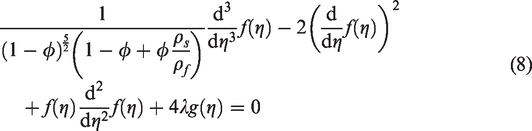
This section is devoted to discussing the methodology and implementation of the MGWM to find an optimal solution of the said problem (equations (8) to (12)). The proposed modification has two major advantages over the Gegenbauer wavelets method: first, it has less computational work since it condenses the unknown present in trial solutions, and second, the trial solution suggestion in modified version must satisfy the boundary conditions. The proposed method has the following steps to solve equations (8) to (12).
Step 1: Consider the nonlinear system (8–10)
Step 2: Consider the following trial solutions to investigate the nonlinear system (14–16) via Gegenbauer wavelets method35
where
and
The trial solutions (17–19) stated in above can be rewritten as
The matrices in above expression (20) are defined as
for and
where
To reduce the unknown constants, we introduced a new set of constants as i =1,2,3, which must satisfy the following expressions
Using the expressions (21) and (22) into equation (20), we get
Since the trial solution suggested by the proposed method must fulfill the boundary conditions, the trial solution (23) takes the following form after applying the boundary conditions
where .
Step 3: Putting the trial solutions (24–26) into equations presnt in step 1, we found the following system of algebraic equations
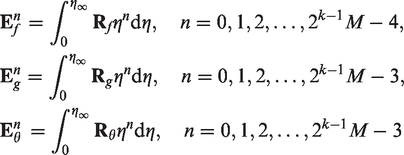
Step 4: The method of moment’s concept is used to investigate the set of unknown constants and deliberated as
A system of nonlinear algebraic equations is generated with the help of above system.
Step 5: The solution nonlinear system found in step 4 leads to the values of ’s. For the investigation of ’s inserting the values of ’s in equations (21) and (22) and solve it by backward substitution. Finally, approximate solution is obtained by using the values of ’s in equations (8) to (12).
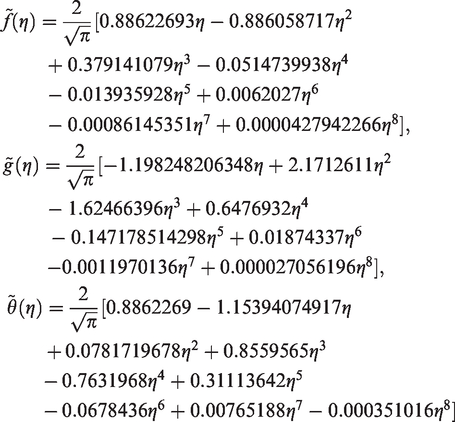
The solution of discussed problem by means of the proposed methodology is given below when , and the order of approximation is k =1 and M =9
Results and discussion
Modified methodology based on Gegenbauer wavelets coupled with method of moments is proposed to explore the numerical solution of the rotating flow of nanofluid due to exponentially stretching surface. In this section, Figures 4 to 9 have been plotted to investigate the variation in the velocities “,” “” and temperature “” profiles for various values of the physical parameters involving the nanoparticles volume fraction “” and rotation “” parameters along with a comprehensive discussion and graphical representation. Figures 10 to 15 demonstrate the behavior of physical quantities, coefficient of skin friction, and Nusselt number under the influence of nanoparticle volume fraction and rotation parameters. Figure 16 plots to explain the study of square residual error for various values of order of approximants. Comparison of the achieved results via proposed method with numerical method RK-4 is depicted in Figure 17.
A comparative analysis of the obtained results via MGWM with the existing techniques5,22 is also presented. The thermophysical properties of the base fluid and different nanoparticles are given in Table 1.
Figures 4 and 5 are plotted to show the behavior of the dimensionless x-component of the velocity profile “” for different values of the non-dimensional parameters, nanoparticle volume fraction, and rotation parameters by considering silver and copper nanoparticles, respectively. It is observed that as increasing the volume fraction of silver and copper nanoparticles, the velocity profile and the thickness of boundary layer are gradually decreased. Same behavior obtained for copper oxide nanoparticle while the opposite behavior is noted when volume fraction of alumina and titania nanoparticles is increased.
Behavior of for numerous values of and for the case of Ag-water.
Behavior of for numerous values of and for the case of Cu-water.
In all the cases, variation in the rotation parameter causes a decrease in the velocity profile and the thickness of the boundary layer. The oscillatory behavior obtained nearby the wall due to the rotation effect while velocity reduces as increases.
The effects of different values of nanoparticle volume fraction and rotation parameters on the y-component of the non-dimensional velocity profile are illustrated in Figures 6 and 7. As enhancing the volume fraction of silver and copper nanoparticles, the y-component of velocity profile and the thickness of boundary layer is decreased gradually. Copper oxide nanoparticles of the y-component demonstrate the same behavior although the opposite behavior is observed while increasing the volume fraction of alumina and titania nanoparticles.
Behavior of for numerous values of and for the case of Ag-water.
Behavior of for numerous values of and for the case of Cu-water.
An increase in rotation parameter reduced the magnitude of velocity field. Moreover, parabolic behavior of the velocity field is obtained when is sufficiently small and oscillatory behavior is observed when is sufficiently large near the wall.
Figures 8 and 9 are plotted to show the behavior of the nanoparticle volume fraction and rotation parameters on the non-dimensional temperatures profile for silver and copper nanoparticles, respectively. In all the cases, the nanoparticle volume fraction and the rotation parameters give the similar behavior. As both parameters enlarge, the temperature profile increases. The thickness of the boundary layer is also increased with an increase in the parameters. Physically, the enhancement of the rotation effects causes the viscous forces within the fluid to increase and resists the motion of the fluid, leading to increase the temperature of the fluid.
Behavior of for numerous values of and for the case of Ag-water.
Behavior of for numerous values of and for the case of Cu-water.
The behavior of Nusselt number and coefficient of the skin friction with increasing values of nanoparticle volume fraction and rotation parameters are depicted in Figures 10 to 15 for all nanoparticles. Figure 10 demonstrates the behavior of skin friction coefficient for the numerous values of nanoparticle volume fraction. An increase in the nanoparticle volume fraction causes a decrease in the skin friction coefficient . The least value of the skin friction coefficient is obtained in the case of silver-water nanofluid, and the highest value of skin friction coefficient is obtained in the case of alumina-water nanofluid. The effect of rotation parameter on the coefficient of the skin friction is illustrated in Figure 11. It is observed that the absolute values of coefficient of the skin friction enlarge as the rotating effects are increased.
Behavior of skin friction coefficient .
Behavior of skin friction coefficient for numerous values of and .
Again least and highest values of the coefficient of the skin friction are achieved for the case of silver-water and alumina-water nanofluid, respectively. According to an industrial source, the alumina-water nanoparticles are more feasible than the others because they preserve the uniform stretching least force. Figures 12 and 13 are plotted to see the variation coefficient of the skin friction for different values of nanoparticle volume fraction and rotation parameters.
Behavior of skin friction coefficient for numerous values of and .
Behavior of skin friction coefficient for numerous values of and .
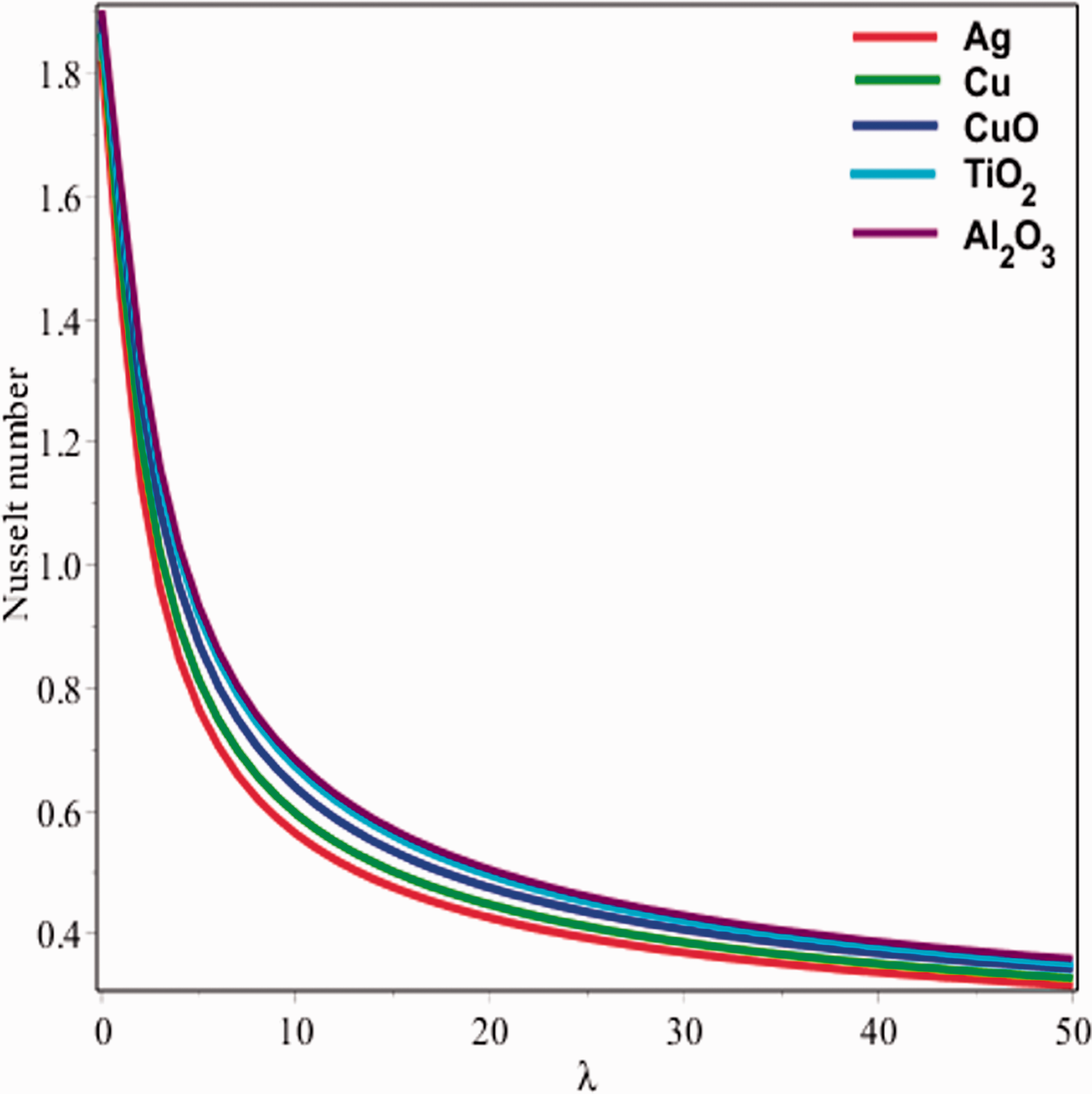
It is observed that almost similar variation in coefficient of the skin friction is found as in Figures 10 and 11. Figures 14 and 15 deliberate the effect of the nanoparticle volume fraction and rotation parameters on the dimensionless Nusselt number for silver, copper, copper oxide, alumina, and titania nanoparticles. Almost linear behavior of the Nusselt number obtained as varying the nanoparticle volume fraction. The Nusselt number increases while increasing the nanoparticle volume fraction. Reverse variation of Nusselt number under the influence of rotation parameter is obtained in Figure 15, that is Nusselt number decreases while increasing the rotating effects. In both Figures 14 and 15, the least and highest values of the Nusselt number are obtained for the cases of silver-water nanofluid and alumina-water nanofluid, respectively.
Behavior of Nusselt number for numerous values of and .
Behavior of Nusselt number for numerous values of and .
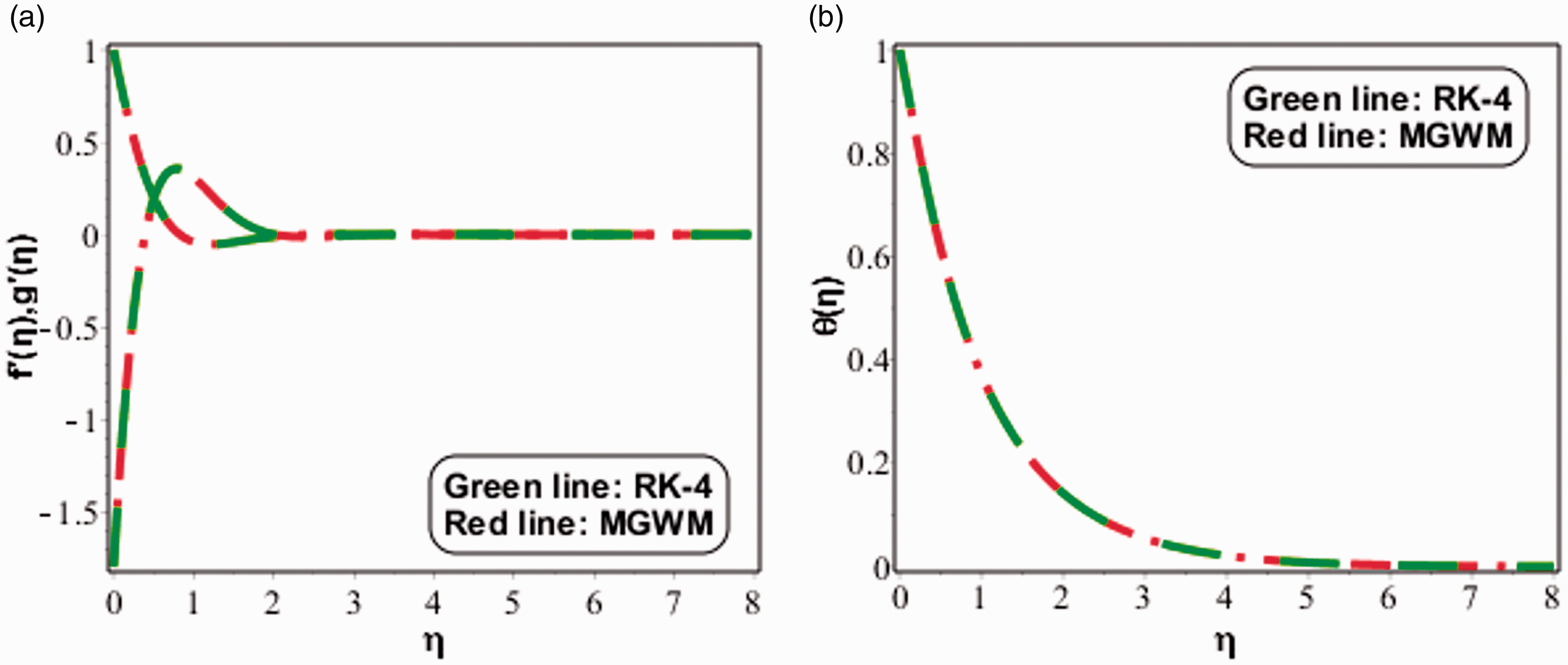
Figure 16 deliberates the graphical behavior of the square residual error of and for the numerous values of M. As varying the order of approximation M, it is noted that the residual error of velocities and temperature goes to zero, which witnesses that the solution convergent. Comparison of the solution found by means of MGWM with the numerical method RK-4 is demonstrated in Figure 17. The obtained solution is well agreed with the numerical solution, which shows the efficiency of the proposed method.
(a)–(c): Analysis of square residual error for different values of M. (a) M = 10; (b) M = 20; (c) M = 30.
(a), (b): Comparison of the obtained result with RK-4.
Tables 2to 4 have been generated for the sake of comparison. These tables show the comparison of the obtained results for and Nusselt number with already published results.4,22Tables 2to 4 evidence that the proposed method is highly effective, well-matched, and accurate to investigate the optimal solution of the above-discussed problem. Table 5 depicts the estimation of square residual error for different approximations. In this table, and are calculated from the following expressions
Comparison of the obtained results via MGWM with already existing results.2,52
Square residual error estimation for the various order of approximations.
M
Time (s)
5
2.8907444 × 10–03
2.2943543 × 10–03
1.7002889 × 10–02
0.73
8
5.3294394 × 10–08
3.1854304 × 10–08
5.5359494 × 10–06
1.99
12
2.4643280 × 10⁻¹⁴
3.9660942 × 10⁻¹⁶
1.5953697 × 10⁻¹¹
2.73
17
6.9262944 × 10⁻²³
1.0422840 × 10⁻²⁵
5.6251525 × 10⁻²⁰
10.25
22
2.9222723 × 10⁻³²
5.5511678 × 10⁻³⁴
1.3098590 × 10⁻²⁶
34.13
30
1.2563410 × 10–49
3.5621401 × 10–51
5.1478012 × 10–40
105.25
One can clearly observe that the square residual for velocities and temperature tends to zero while increasing the order of approximation. It is endorsing that the suggested method is reliable and accurate to find the solution of nonlinear physical problems. Moreover, the proposed method contains less computational work as compared to the traditional Gegenbauer wavelets method.35 The proposed modification reduces the unknown constant present in the trial solutions. These constants depend upon the total order of the system of differential equations like in our case total order of the system (8–10) is (3 + 2 + 2=) 7 which means in proposed method, seven fewer constants as compared to the original Gegenbauer wavelets method35 for arbitrary selection of M and k.
Conclusion
A model study is conducted to analyze the transfer of heat in rotating flow of nanofluids over an exponentially stretching surface. We examined the simultaneous effect of nanofluid rotation and exponential stretching on the shear stresses and heat transfer rate at the sheet that have noticeable role in polymer extrusion and metal-working processes. We also analyzed the cooling proficiency of water-based nanofluids containing Ag, Cu, Al2O3, TiO2, and CuO nanoparticles for the said problem. The governing equations have been reduced to set of nonlinear ODE via appropriate transformations. The solution of the said model obtained by means of modified version of Gegenbauer wavelets method. Hence, major findings of our study are stated below:
Nanoparticle volume fraction efficiently provisions the rate of heat transfer from the sheet.
The minimum and maximum values of wall shear stress occur, respectively, for Ag-water and Al2O3-water nanofluid.
Hydrodynamic boundary layer becomes thinner, and wall shear stress becomes larger when the rotation rate is increased.
Rotational influence severely decreases the rate of cooling from the sheet.
Maximum/minimum heat transfer rate is observed for Al2O3 Ag-water/water nanofluids.
The rate of cooling for metal-oxide kind nanoparticles is efficient than the metallic nanoparticles.
Comparative study presented among outcomes obtained by MGWM, RK (order-4), and already existing results. The comparison between methods, graphical plots, convergence, and error analysis endorses the credibility of this modification. The proposed technique can be extended for other physical problems.
The results disclose the appropriateness of nanoparticles inside water that enhance the cooling process of stretching surface, which would be advantageous in coating-related applications and polymer extrusion processes.
Footnotes
Acknowledgement
The authors are highly grateful to the referees for their valuable comments.
Declaration of conflicting interests
The author(s) declared no potential conflicts of interest with respect to the research, authorship, and/or publication of this article.
Funding
The author(s) received no financial support for the research, authorship, and/or publication of this article.
References
1.
WangCY.Stretching a surface in a rotating fluid. Z Angew Math Phys1988;
39: 177–185.
2.
TakharHSNathG.Unsteady flow over a stretching surface with a magnetic field in a rotating fluid. Z Angew Math Phys1998;
49: 989–1001.
3.
NazarRAminNPopI.Unsteady boundary layer flow due to a stretching surface in a rotating fluid. Mech Res Commun2004;
31: 121–128.
4.
KumariMGrosanTPopI.Rotating flow of power-law fluids over a stretching surface. Techn Mech2006;
26: 11–19.
5.
JavedT, et al.
Non-similar solution for rotating flow over an exponentially stretching surface. Int J Num Meth HFF2011;
21: 903–908.
6.
ZaimiKIshakAPopI.Stretching surface in rotating viscoelastic fluid. Appl Math Mech-Engl Ed2013;
34: 945–952.
7.
KhanUAhmedNZaidiZA, et al.
MHD squeezing flow between two infinite plates. Ain Shams Eng J2014;
5: 187–192.
8.
TurkyilmazogluM.Bödewadt flow and heat transfer over a stretching stationary disk. Int J Mech Sci2015;
90: 246–250.
9.
MustafaM.Cattaneo-Christov heat flux model for rotating flow and heat transfer of upper-convected Maxwell fluid. AIP Adv2015;
5: 047109.
10.
RosaliHIshakANazarR, et al.
Rotating flow over an exponentially shrinking sheet with suction. J Mol Liq2015;
211: 965–969.
11.
StefaniFKirillovON.Destabilization of rotating flows with positive shear by azimuthal magnetic fields. Phys Rev E2015;
92: 051001.
12.
AhmadRMustafaM.Model and comparative study for rotating flow of nanofluids due to convectively heated exponentially stretching sheet. J Mol Liq2016;
220: 635–641.
13.
WangXQMujumdarAS.A review on nanofluids, part II: experiments and applications. Braz J Chem Eng2008;
25: 631–648.
14.
WenDLinGVafaeiS, et al.
Review of nanofluids for heat transfer applications. Particuology2009;
7: 141–150.
15.
WongKVLeonDO. Applications of nanofluids: current and future. Adv Mech Eng. Epub ahead of print 26 January 2015. DOI: 10.1155/2010/519659.
16.
YuWXieH. A review on nanofluids: preparation, stability mechanisms, and applications. J Nanomater. Epub ahead of print 1 January 2012. DOI: 10.1155/2012/435873.
17.
SoleimaniSSheikholeslamiMGanjiDD, et al.
Natural convection heat transfer in a nanofluid filled semi-annulus enclosure. Int Commun Heat Mass Transfer2012;
39: 565–574.
18.
BuongiornoJ.Convective transport in nanofluids. J Heat Transfer2006;
128: 240–250.
19.
TiwariRKDasMK.Heat transfer augmentation in a two-sided lid-driven differentially heated square cavity utilizing nanofluids. Int J Heat Mass Transfer2007;
50: 2002–2018.
20.
NieldDAKuznetsovAV.The Cheng–Minkowycz problem for natural convective boundary-layer flow in a porous medium saturated by a nanofluid. Int J Heat Mass Transfer2009;
52: 5792–5795.
21.
Mohyud-DinSTUsmanMMohsinBB.A study of heat and mass transfer of nanofluids arising in biosciences using Buongiorno’s model.Int J Comput Meth2016;
14: 1750018.
22.
MushtaqAMustafaMHayatT, et al.
Numerical study for rotating flow of nanofluids caused by an exponentially stretching sheet. Adv Powder Technol2016;
27: 2223–2231.
23.
SheikholeslamiMRashidiMMHayatT, et al.
Free convection of magnetic nanofluid considering MFD viscosity effect. J Mol Liq2016;
218: 393–399.
24.
SheikholeslamiMGanjiDD.Influence of magnetic field on CuO–H2O nanofluid flow considering Marangoni boundary layer.Int J Hydrogen Energ2017;
42: 2748–2755.
25.
UsmanMHamidMKhanU, et al.Differential transform method for unsteady nanofluid flow and heat transfer.Alexandr Eng J2018;
57: 1867–1875.
26.
UsmanMHaqRUHamidM, et al.
Least square study of heat transfer of water based Cu and Ag nanoparticles along a converging/diverging channel. J Mol Liq2018;
249: 856–867.
27.
SheikholeslamiMGanjiDDAshorynejadHR, et al.
Analytical investigation of Jeffery-Hamel flow with high magnetic field and nanoparticle by Adomian decomposition method. Appl Math Mech-Engl Ed2012;
33: 25–36.
28.
HamidMUsmanMZubairT, et al.Comparison of Lagrange multipliers for telegraph equations.Ain Shams Eng J2018;
9: 2323–2328.
29.
PourmehranORahimi-GorjiMGorji-BandpyM, et al.
Analytical investigation of squeezing unsteady nanofluid flow between parallel plates by LSM and CM. Alexandr Eng J2015;
54: 17–26.
30.
Mohyud-DinSTUsmanMWangW, et al.
A study of heat transfer analysis for squeezing flow of a Casson fluid via differential transform method. Neural Comput Appl2018;
30: 3253–3264.
31.
Mohyud-DinSTUsmanMAfaqK, et al.
Examination of carbon-water nanofluid flow with thermal radiation under the effect of Marangoni convection. Eng Comput2017;
34: 2330–2343.
32.
EcuacionesPMOrdenDMDS.Gegenbauer matrix polynomials and second order matrix differential equations. Divulg Matemát2004;
12: 101–115.
33.
KhanMAKahmmashGS.A study of a two variables Gegenbauer polynomials and second order matrix partial differential equations. Int J Math Anal2008;
17: 807–821.
IqbalMAShakeelMMohyud-DinST, et al. Modified wavelets–based algorithm for nonlinear delay differential equations of fractional order. Adv Mech Eng. Epub ahead of print 5 April 2017. DOI: 10.1177/1687814017696223.
36.
BrinkmanHC.The viscosity of concentrated suspensions and solutions. J Chem Phys1952;
20: 571.
37.
KhanaferKVafaiKLightstoneM.Buoyancy-driven heat transfer enhancement in a two-dimensional enclosure utilizing nanofluids. Int J Heat Mass Transfer2003;
46: 3639–3653.