




Abstract
Copyright law underpins the modern music industry, with performing rights organisations (PROs) playing a crucial role beyond compensating creators. They act as gatekeepers, shaping access to music, influencing industry structures, and mediating relationships between artists, publishers, and digital platforms. This paper examines how the PRO sector adapts to technological disruptions and evolving market dynamics, particularly in the United States. The U.S. landscape, marked by multiple competing PROs, regulatory oversight, and complex licensing, serves as a key case study for global industry trends. Analysing six organisations-BMI, ASCAP, SESAC, Merlin, AMRA, and ICE-the study identifies distinct organisational cultures: traditional PROs emphasise growth, advocacy, and partnerships, while digital-native PROs prioritise transparency, innovation, and efficiency. The findings suggest that digitalisation fosters specialised PROs that challenge incumbents and reshape global music licensing. This study contributes to discussions on copyright management, industry gatekeeping, and the implications of digital transformation for music rights governance.
Keywords
Copyright law is the foundation upon which the modern music business is built. It provides the legal mechanism through which music works can generate economic value. Performing rights constitute a critical element of music copyright, and have sat at the heart of the music rights regime since the early 20th century. These rights allow copyright owners to be compensated when their works are broadcast, performed in public or streamed. While performing rights generate less revenue than sound recordings and live concerts, they remain significant: global revenue is estimated at $2.6bn in 2023, excluding the share paid from the $28.7bn in revenue generated by digital music streaming (data from PwC, 2024).
Traditionally, academia has largely overlooked PROs (Rogers et al., 2022). However, with the increasing focus on copyright exploitation and the growing number of revenue opportunities, the role of PROs has gained prominence, meriting increased academic interest. While the three core music industry sectors – namely, phonographic recording, music publishing, and live concerts – all remain oligopolistic in structure, digital platforms have dramatically diversified the music ecosystem (Negus, 2019; Wikström, 2020). Where PROs once operated as relatively homogeneous, monopolistic entities in their local contexts, they now compete in a multi-faceted market that spans local and global contexts. This fundamental change has forced established organizations to reorganize, adopt new technologies, expand the range of their activities, and compete with innovative new entrants specializing in distinct market segments.
This paper examines how the PRO sector adapts to technological disruptions and evolving market dynamics in the increasingly global and digital music industries. We categorize new and incumbent players, analyse their organizational cultures, and explore their priorities, development paths, and market dynamics. This analysis contributes to discussions on PROs as key gatekeepers and their impact on the broader music ecosystem. The United States provides a case study of this ongoing transformation that is both distinctive and forward-looking. Unlike other countries, the U.S. market features an unusually diverse array of PRO types – ranging from local to international, and from comprehensive to specialized. This complexity is epitomized by significant recent developments, such as Broadcast Music, Inc. (BMI) changing to a for-profit model after nearly 85 years as a nonprofit organization (Christman, 2022), a shift that could potentially cascade through PRO markets worldwide.
Our analysis focuses on six organizations: BMI, The American Society of Composers, Authors, and Publishers (ASCAP), the Society of European Stage Authors and Composers (SESAC), the Merlin network (MERLIN), Amra Music (AMRA), and International Copyright Enterprise (ICE) Services Ltd. By analysing their organizational cultures, communication strategies, and strategic priorities, we offer distinctive insights into how these key PROs are navigating an increasingly complex digital landscape. These organizations are not merely administrative bodies but crucial gatekeepers who shape music accessibility, artist representation, and the economic possibilities for music rights holders. They must balance traditional industry practices with rapid technological change, all while maintaining their fundamental mission: collecting payments from music users on behalf of their members.
Emerging trends reveal interesting distinctions. As we illustrate below, newer (mostly, non-United States) PROs are evolving to emphasize different sets of values and priorities more specifically focused on the challenges and opportunities arising from recent technological innovations compared to their traditional and well-established counterparts. As digital platforms continue to mature and reshape (and get reshaped by) creative industries and cultural markets, understanding PROs becomes crucial. These organizations are not just responding to change – they are key actors in determining who gets heard, who gets paid, and how ‘value’ is created and recognized in an increasingly digital world.
The analysis is structured as follows: first, we provide an overview of the fundamental structure of music rights and the role of PROs in ensuring fair compensation for creators. Next, we unpack the historical development of PROs, particularly in the U.S. market, which serves as a case study for global industry trends. We then introduce our research questions and theoretical framework, focusing on espoused organizational values as proxies of organizational cultures and indicators of strategic differentiation. The methodology section details our approach to data collection and content analysis, followed by a comparative analysis of six key PROs, highlighting distinctions between traditional and digital-native players. Finally, we discuss the broader implications of these findings, emphasizing how shifting values influence the competitive dynamics of the global music licensing ecosystem. The paper contributes to ongoing discussions about the future of music copyright, the role of PROs as industry gatekeepers, and the broader implications of digitalization on music rights management.
The evolution and structure of music rights and PROs in the U.S. music industry
Music rights can be complex, but they fall into distinct categories that ensure various stakeholders in the creative process are compensated fairly. Composition rights protect the underlying song itself, including the melody, lyrics, and musical composition. They are typically owned by songwriters and composers and managed through publishing rights. Composition rights generate royalties whenever a song is performed, reproduced, broadcast or used in media in various ways. Performing rights are a subset of composition rights and grant the right to publicly perform or play a musical work. Managed by PROs like ASCAP, BMI, and SESAC, these rights apply to live performances, broadcasts, streaming, and public uses of music. Songwriters and composers receive royalties through PROs whenever their music is played in public spaces or on media platforms, making performing rights a vital revenue stream.
Both mechanical and sync rights originate from the core composition rights, representing different specific ways the musical composition can be used and monetized. Mechanical rights allow for the reproduction and distribution of musical composition in recorded formats, including physical (like CDs) and digital (like downloads and streaming). Songwriters and publishers earn royalties for each reproduction, with these rights often managed by mechanical licensing agencies, like the Harry Fox Agency (HFA) and Music Reports Inc (MRI). Sync rights cover the use of music and songs in audio-visual productions such as films, TV shows, commercials, or video games. These rights are often negotiated on a case-by-case basis, and songwriters and publishers receive licensing fees for the use of the works under their control in these contexts.
Phonographic recording rights (master rights) cover the specific recorded version of a song. Unlike composition rights, they represent the actual audio recording and are primarily owned by record labels, or in some instances, the recording artists themselves. These rights generate royalties when the recording is reproduced, distributed, streamed, or used commercially. Print rights govern the reproduction of sheet music or printed lyrics. They generate royalties from the sale of sheet music and other printed reproductions, serving a niche but important aspect of the music rights ecosystem. Combined, these various rights constitute a framework that encompasses the full spectrum of revenue-generating opportunities that exist for music rights owners across the plethora of platforms, spaces and places where music is used.
The administration and protection of performing rights have been central to shaping the modern music industries, with the development of Performing Rights Organizations (PROs) in the United States offering a key example of how these rights are managed and monetized globally. While the modern PRO originated in mid-19th-century Europe (Laing, 2004), it was shaped in early 20th-century America, creating a template for global organizations (Napier-Bell, 2023). The expansion of performing rights in the United States during the early 20th century was closely linked to the era's capitalist developments, reflecting dynamics such as standardization, mass production, and the rise of corporate structures. Notably, the formalization of music copyright laws emphasized property rights. While the U.S. Copyright Act of 1831 first recognized musical compositions, it was the 1909 Copyright Act that brought significant transformation. Heavily influenced by music publishers, it introduced crucial changes: compulsory mechanical licensing for recordings, extended copyright terms, and the ‘works for hire’ doctrine that enabled corporate copyright (Kanellopoulou, 2021; Patterson and Lindberg, 1991; Vaidhyanathan, 2001). The Act effectively helped publishers control rights to songs created by their staff writers and established strict liability for copyright infringement.
This legislation laid the groundwork for modern music licensing models and led to ASCAP's formation in 1914, marking a shift from music as merely a product to a licensable service. BMI was subsequently formed in 1939 as an alternative to ASCAP. It was created by radio broadcasters in response to ASCAP's increasing licensing fees and what they saw as monopolistic practices. BMI brought competition to the performing rights marketplace and notably provided opportunities for genres like rhythm and blues, country, and rock and roll that had up to that point been largely overlooked by ASCAP. By that point, SESAC had already been founded by Paul Heinecke as an organization focused on representing European publishers and writers, particularly in classical and gospel music, but later expanded to represent American creators across all genres (Kernochan, 1985). As such, performing rights established the music business as a copyright business. PROs played, and continue to play, a pivotal role in upholding copyright regulations by issuing licenses for music across diverse settings.
At this pivotal moment in time, the U.S. market provides an important case study, when digital innovations – including artificial intelligence, streaming, and other forms of digital distribution – hold the potential to radically reconfigure both the creative and commercial dimensions of the music business. The United States has several distinctive aspects regarding performing rights for music, particularly in comparison to other countries. These distinctions revolve around its legal framework, industry practices, and the form and nature of the performing rights organizations operating there.
The United States distinguishes between two separate copyrights: musical composition, relating to written music and lyrics, typically managed by PROs, and phonographic recording, relating to the recorded performance of the music and usually handled by record labels. This dual system leads to separate licensing requirements for performances that involve both the composition and the recording. The United States features multiple competing PROs. Unlike some countries with a single national PRO, U.S. PROs operate independently and compete for members, offering composers and publishers the freedom to choose representation. The competitive environment adds complexity for music users who may need agreements with multiple PROs. Additionally, ASCAP and BMI operate under consent decrees with the U.S. Department of Justice, which regulate how they can license and collect fees. These decrees were established to prevent monopolistic practices and ensure fair access to music. The consent decrees require these PROs to offer non-exclusive licenses and submit rate disputes to federal court (Kernochan, 1985; Sukenik, 2018).
In most countries, terrestrial radio stations pay royalties for the public performance of both musical compositions and sound recordings. In the United States, terrestrial and internet radio stations only pay for the performance of the composition, not the sound recording. This exemption does not apply to digital, interactive streaming services, which must pay royalties for both.
The Mechanical Licensing Collective (MLC) and SoundExchange highlight the peculiarities of the U.S. music licensing system, which divides responsibilities for royalty collection across multiple entities. The Music Modernization Act (MMA) of 2018 established the MLC as a nonprofit organization to oversee a new blanket licensing system for mechanical rights in the United States. This system simplifies the licensing process for interactive digital services, such as Spotify and Apple Music, which allow users to select tracks on demand. Operating since 2021, the MLC collects and distributes these royalties to songwriters and publishers.
SoundExchange, another nonprofit organization, administers royalties for the public performance of sound recordings via non-interactive digital services, such as satellite radio, internet radio, and webcasting. Unlike interactive platforms, non-interactive services provide users with curated or algorithm-driven playlists without direct song selection. The 1995 Digital Performance Right in Sound Recordings Act (DPRA) introduced, for the first time, a limited performance right for digital transmissions of sound recordings, marking a significant milestone in U.S. copyright law. The 1998 Digital Millennium Copyright Act (DMCA) further refined this framework by introducing statutory licenses for these transmissions and designating an entity to collect and distribute royalties. In 2003, this entity became SoundExchange, an independent nonprofit organization.
The division of responsibilities between the MLC and SoundExchange reflects a unique aspect of the U.S. copyright system, which differs from many countries where a single rights organization handles all types of royalties. This system ensures specialization but can also create complexity for rights holders and service providers navigating the licensing landscape. Overall, the U.S. performing rights system is characterized by its complexity, competition, and balance between regulation and market-driven solutions. The interplay of PROs, unique exemptions, and dual copyright distinctions reflects a blend of innovation and legal tradition, making the system distinct from those in other countries.
Understanding the U.S. PRO market specifically means acquiring knowledge about how PRO markets around the world could develop in the near future. Moreover, given the important influence of PROs on other actors in the music industries, research that provides insights into the development of PROs has the potential to support research on the music issues related to this sector that are of particular interest to academics. These include the question of democratization and the increasing or decreasing representation and market access of composers and performers of niche music, as well as the role of digital platforms as new gatekeepers.
Research design
Research questions and objectives
This paper examines how the PRO sector adapts to technological disruptions and the digitalization of the music industries by analysing the strategies, values, and impacts of six key organizations: ASCAP, SESAC, BMI, Merlin, AMRA Music, and ICE Services. While these organizations share common foundational characteristics, we assume that they exhibit cultural differences, particularly between traditional PROs, established before the advent of digital distribution, and newer PROs, which focus on rights collection from digital music platforms. All newer PROs in our sample were founded after 2008, and we refer to them as ‘digital natives’. Driven by competition, each organization seeks to differentiate itself through distinctive values and operational approaches, and we assume these differences to emerge from their public communications. Hence, our research questions are the following: What values shape PROs’ organizational cultures? Are there differences in terms of organizational cultures between traditional and digital native PROs? What other key differences exist between PROs?
Theoretical framework
To better understand the differences between PROs, we examined the concept of organizational culture. Since the early 1980s, organizational or corporate culture has been a prominent topic in management literature (Hofstede et al., 2010). Although definitions vary, Hofstede et al. (2010) emphasize a general agreement that organizational culture is a cohesive system influenced by historical context and social constructs, reflecting shared assumptions, beliefs, and behavioural norms across different levels of an organization.
As explained in Chaudhry et al. (2016), research and writings on the evolution of organizational culture and its antecedents have progressed along two separate streams. One perspective sees organizational culture as uniquely shaped by internal organizational factors. This includes the values held by chief executives, the shared vision and behaviours of leaders, and the leadership and Human Resources practices within a firm. The other perspective adopts a contingency approach, suggesting that culture is influenced by contextual factors such as broader societal values and the characteristics of the industries in which organizations operate.
Organizational values have been defined by Rokeach (1979) as socially shared, cognitive representations of institutional goals and demands, serving as decision rules and guidance for interpreting a complex environment. Typically, organizations hold a few values forming a system, acquired by members through experience and learning (Schwartz, 1992), that guide them in selecting or evaluating behaviour and can reflect a consensus on what is important for the organization's aims and collective welfare (Bourne and Jenkins, 2013). They are also fundamental for organizations, as they influence their strategies and management decision making more generally (Bourne and Jenkins, 2013). From Hofstede et al. (2010), Chaudhry et al. (2016), cited above, but also many others, including Armstrong and Grobbelaar (2023), Leidner and Kayworth (2006), Grover et al. (2022), we learn that organizational culture is a broader concept than organizational values, with the latter playing a critical role in defining the former.
Bourne and Jenkins (2013) distinguished between four forms of organizational values: espoused, attributed, shared, and inspirational. Attributed values are those that members typically see as embodying the organization. These values stem from recognizable patterns of past decisions and thus mirror the organization's history, without necessarily conveying future aspirations or intentions. They represent collectively agreed-upon social structures which, though not universally shared by all members, are established and accepted within the organization (Bourne and Jenkins, 2013). Shared values refer to the collective organizational values that arise from aggregating the values of its members. This aggregation is shaped by socialization processes, where individuals are influenced by the customs, norms, and practices of their societies, organizations, and groups, which are then reflected in their values. However, this form of organizational values does not account for asymmetric power relations within organizations and thus overlooks the disproportionate influence of the personal values of more senior and centrally positioned members compared to those on the periphery (Bourne and Jenkins, 2013). Aspirational values are those that members believe ought to be the values of the organization, representing ideas of what should exist in the future. These values tend to align closely with the personal values of those advocating for them, and often signal a departure from historical patterns and emerge at the level of the members, not necessarily endorsed by top managers (Bourne and Jenkins, 2013).
As mentioned earlier, we concentrate on articulated or espoused values, and use these as representations of different organizational cultures, and more generally, to find and explain differences between PROs. Espoused values are the publicly stated values of an organization, often found on company websites and in formal documents (Jonsen et al., 2015). These values are typically sanctioned by top managers, who have the authority to impose them (Bourne and Jenkins, 2013), and are intended to represent what the organization ought to hold to achieve its aims. While espoused values may not always correspond to the actual lived values within the organization (Jonsen et al., 2015), they carry a degree of intention and forward-looking orientation (Bourne and Jenkins, 2013).
Espoused values are collective social structures that exert power and influence; although individual executives might privately disagree with them, they are accepted as appropriate for the organization as a whole (Bourne and Jenkins, 2013). They often mirror the founders’ intentions and serve as a social control mechanism, reflecting the ideology of entrepreneurship (Arroyo et al., 2024). Additionally, they can enhance an organization's reputation, legitimacy, and identification, serving as a calling card to recruit talent and demonstrate good citizenship (Jonsen et al., 2015).
These values convey important signals to stakeholders, influencing their perceptions and decisions regarding the firm. Thus, espoused values can reflect both organizational practices and strategies, enhancing legitimacy by aligning with the cultural milieu and supporting differentiation as a competitive strategy. Organizations can strategically manage these values to align with the expectations of key stakeholders and the public's perception (Jonsen et al., 2015).
Methodology
We conducted a content analysis to identify and examine the espoused values disseminated by key leaders within PROs. The data were drawn from leadership statements made available on official channels, including company websites, LinkedIn profiles, YouTube channels (when available), and interviews published in the specialized press. The press outlets consulted were Music Business Worldwide (www.musicbusinessworldwide.com), Digital Music News (www.digitalmusicnews.com), and Music Week (www.musicweek.com). Only articles and content published after 2019 were considered to ensure the analysis reflects the current values of these organizations.
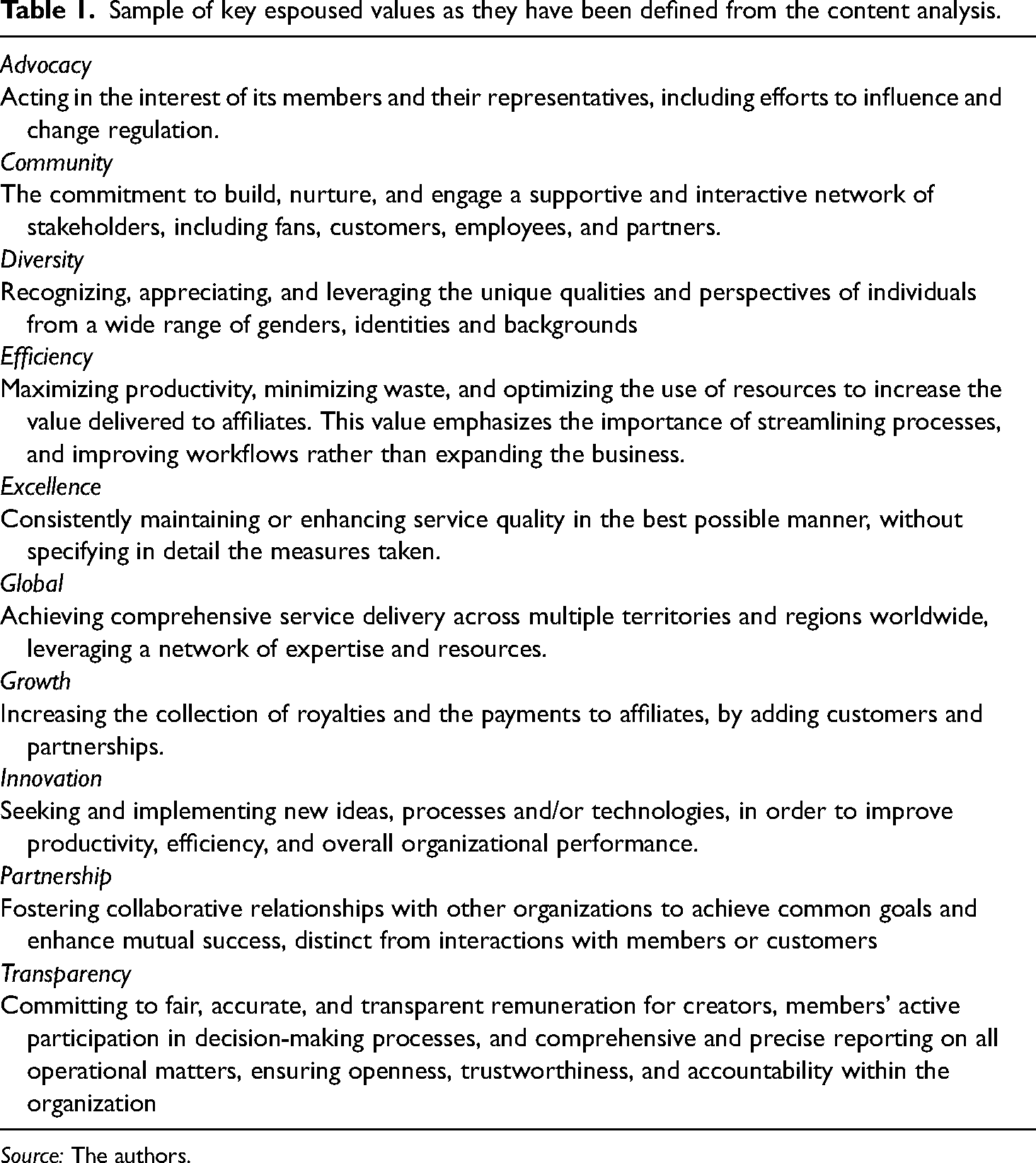
We collected and analysed a total of 143 short texts across the aforementioned sources. Espoused values were coded inductively from the statements without a predefined list. In total, values were coded 290 times. The coding process was performed by one author to maintain consistency, with validation carried out by the second author. The validation process also produced a table containing a definition for each value identified. Table 1 contains both the value labels and the definitions based on the agreed interpretation of the texts. For each organization, the number of times a particular value appeared was recorded. However, due to the varying number and length of texts collected for each organization, simple counts could not be used for direct comparison. Instead, we calculated frequencies by dividing the number of occurrences of each value by the total number of coded values for the respective organization (see Figure 2). This normalization allowed for a more accurate comparison across organizations with different sample sizes.
Sample of key espoused values as they have been defined from the content analysis.
Source: The authors.
Furthermore, as part of our analysis, we sought to compare the values between traditional PROs and digital native PROs. To do this, we calculated the average appearance of each value within both groups. Figure 1 shows the frequencies for each group of the top 13 values. This comparison between groups helped illustrate cultural differences between the two types of organizations within the industry. To further test our hypothesis regarding the presence of two distinct clusters, we utilized the K-means clustering method. K-means is a straightforward and widely used algorithm that employs a squared error criterion. It begins with a random initial partition and iteratively reassigns data points to clusters based on their similarity to the cluster centres. This process continues until a convergence condition is satisfied, such as no further reassignments of data points between clusters or minimal reduction in the squared error after a certain number of iterations (Jain et al., 1999).
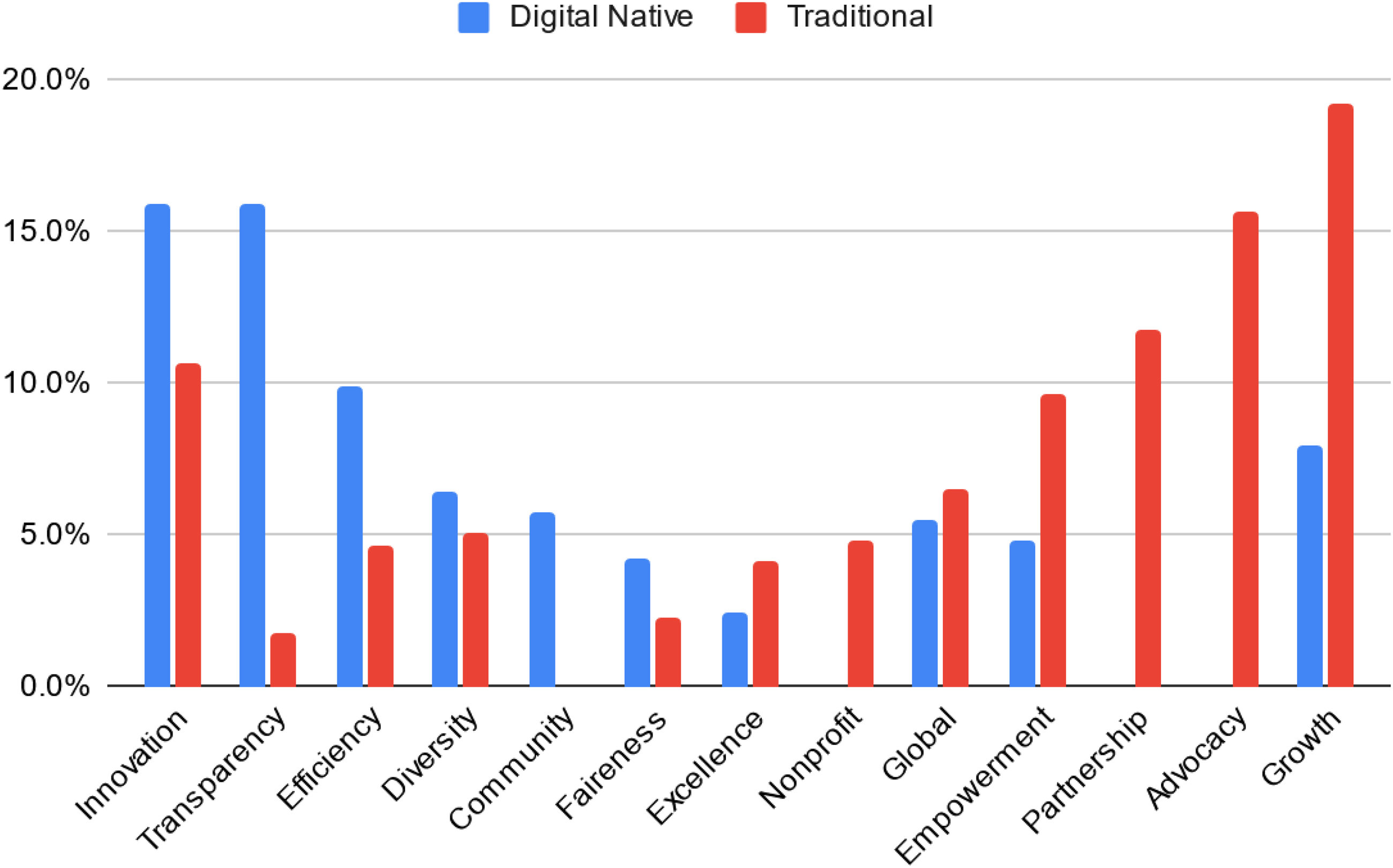
Frequencies of selected espoused values of traditional and digital native PROs. Source: The Authors.
Based on our hypothesis, we set the number of clusters, i.e., the parameter k, to 2. We employed the software R to determine the cluster assignments for each organization, calculate the centroids, i.e., the average position of all points within each cluster, and generate a cluster plot. The K-means algorithm was executed with 25 random initializations (nstart = 25) to mitigate the risk of local optima. Additionally, we employed Euclidean distance as the similarity measure to assess the proximity of observations. To enhance the robustness of our analysis, as outlined in the next section, we compared and discussed the results obtained by setting the value of K to 3 and by using only the 14 most frequently observed values (Figure 3).
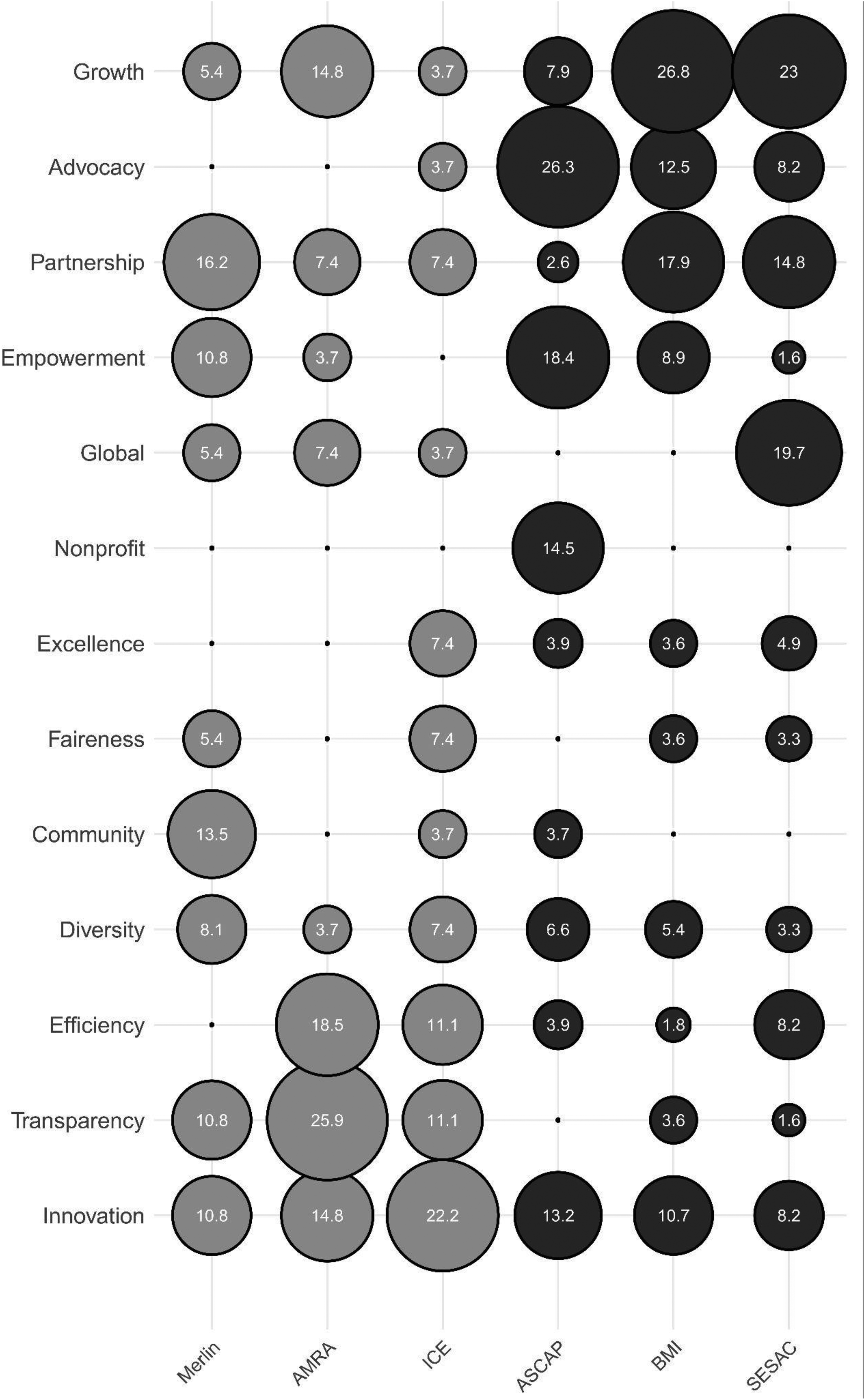
Value frequencies for all organizations sampled. Source: The Authors. Note: the size of the bubbles is expressed in percentages.
Analysis and results
This section presents the results of our study. First, it offers a detailed examination of the organizational characteristics and, second, the analysis of the cultural dimensions of the sampled PROs.
Distinct characteristics of the sampled PROs
Three of these organizations in our sample dominate the U.S. performing rights landscape. BMI is the largest PRO in the United States, representing 1.4 million members and 22.4 million registered songs (BMI.com, n.d.), with total revenues of $1.573 billion in the fiscal year ending in June 2022 (BMI.com, 2022). ASCAP is the oldest and currently second largest PRO in the United States representing 960,000 members with a combined repertoire of more than 19m registered songs or musical compositions. ASCAP's gross revenue collections exceeded $1.737bn in 2023, with a net distributable income of $1.592bn (www.ascap.com, n.d.). Both of these organizations claim to license rights for the public performance of music to businesses operating in more than 60 different categories within the United States. SESAC, the third traditional incumbent, is significantly smaller, representing approximately 15,000 songwriters and 1.5 million copyrighted works (SESAC, n.d.). Unlike BMI and ASCAP (both of which were traditionally non-profit until recently), SESAC operates as a for-profit company and is owned by Blackstone Investment Group. Notwithstanding its size, it counts popular acts such as Bob Dylan, Neil Diamond and Ariana Grande among its members. SESAC operates also as a music label, with recorded music and music publishing divisions. While Blackstone paid close to $1 billion to acquire SESAC from Rizvi Traverse Management back in 2017, it is currently exploring the sale of the company for a sum in the region of $3bn (Dredge, 2025).
The sample of digital native PROs is more diverse. The Merlin Network is a non-profit digital music rights licensing organization founded in 2008 by independent music groups, representing 15% of the global recorded music market and supporting independent record labels from over 70 countries (Light, 2024). It has steadily grown to support a diverse membership of independent record labels, but also distributors, label services companies, and other rights holders. Similarly, AMRA, founded in 2014 by Kobalt, operates in approximately 200 territories globally, though it does not collect royalties within the United States (amra, n.d.). ICE, formed in 2010 as a joint venture between performing rights societies in the UK, Sweden, and later Germany, represents almost 300,000 songwriters and 31,000 music publishers, distributing €3 billion in royalties by 2022 (ICE Services, n.d.). Each of these organizations plays a distinctive role in managing and administering the evolving landscape of digital music rights and international licensing (Table 2).
Characteristics of the PROs considered in the sample.
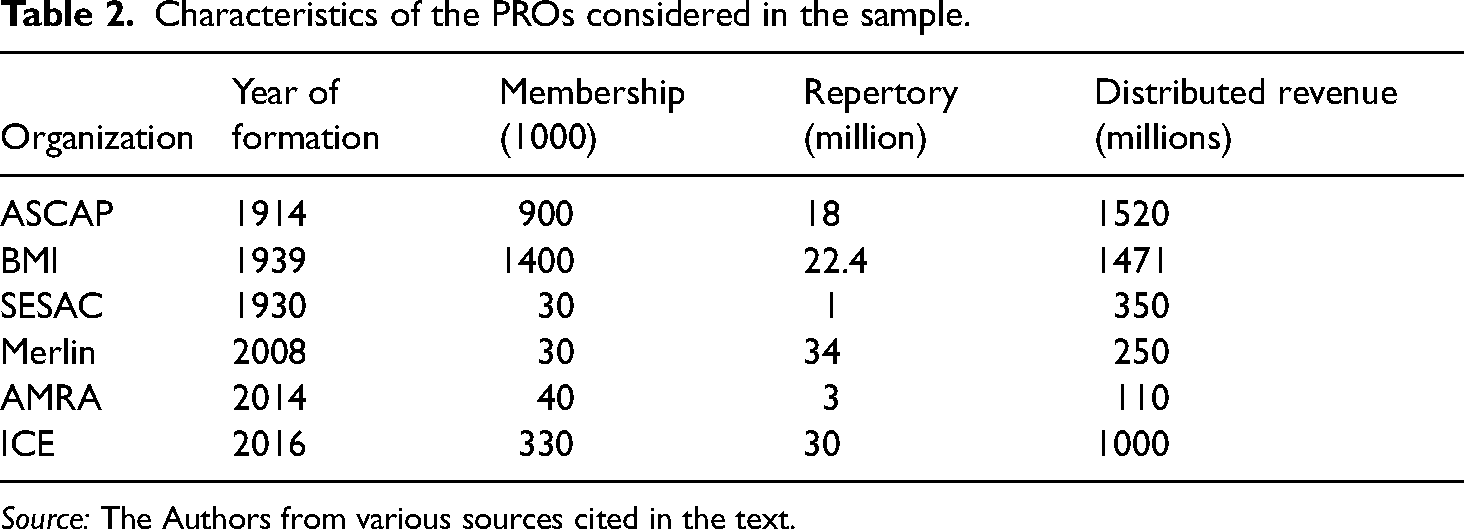
Source: The Authors from various sources cited in the text.
U.S.-based music creators, individuals and organizations, can also deal with one or more of the following three organizations which, for different reasons, have not been selected for our sample. The MLC, SoundExchange (both introduced above), and Global Media Rights (GMR). As explained above, both the MLC and SoundExchange are nonprofit organizations established and regulated by law, playing a particular role similar to and/or related to the PROs chosen for our sample. However, they are not part of our sample because they do not compete for market shares, as their mission is to fulfil the role established by the law. Alternatively, GMR is a U.S.-based PRO like ASCAP, BMI and SESAC. It was formed by Irving Azoff, the former Chair of MCA Music, CEO of Ticketmaster, and earlier, manager of acts such as REO Speedwagon and The Eagles. Azoff developed GMR as an ‘alternative to the traditional performance rights model … in the current performance rights marketplace’ (Global Music Rights, n.d.). The organization currently administers rights for a small, handpicked number of very successful musical acts, such as Bruce Springsteen, Bruno Mars, Prince, Drake, and Pharrell Williams (Christman, 2024). This company was excluded from the analysis for two main reasons: first, its limited public communications restrict the feasibility of conducting a meaningful content analysis. Second, its reliance on the founder's personal relationships with a small, select group of musical acts makes it an atypical organization within the landscape we have categorized into digital natives and traditional PROs.
Emerging cultural differences through the analysis of espoused values
Digital native PROs
In analysing the espoused values of the digital native PROs, we identify five core values consistently highlighted across different organizations: Transparency, Innovation, Efficiency, Growth, and Diversity. Additionally, Community stands out as a key value for the Merlin network. Each of these values reflects the newer PROs’ response to the challenges and opportunities posed by the evolving music industries, positioning them in contrast to incumbent, traditional organizations.
Transparency emerges as one of the two most important values, appearing in the top five for every digital native PRO organization in our study and ranking as the most frequent value for AMRA. This emphasis on transparency reflects a desire to address the industry's long-standing issues related to royalty collection and distribution. Robin Davies, the Chief Operating Officer of AMRA since 2022, articulates the importance of transparency in combating the lack of clarity in royalty payments: One of the problems with the current collection landscape is an almost total lack of transparency, coupled with an inability to ensure you are receiving the correct royalties as a songwriter or publisher, a problem which is made even more complex by the exponential growth in the number of transactions. (Ingham, 2024)
Davies further highlights how AMRA has set itself apart by offering its clients the ability to audit their royalty statements regularly, a practice that is uncommon in the industry. This direct, client-facing transparency is designed to increase trust and ensure that artists and publishers receive their due earnings. This value is not only significant for AMRA but also serves as a broader trend among digital native PROs, signalling an industry-wide shift towards communicating the intentions of providing greater accountability and openness.
Innovation also ranks ex-aequo as the most important espoused value for digital native PROs. It is the most frequent value we find in the content related to ICE Services. Innovation in this context refers to efforts spent seeking and implementing new ideas, processes and/or technologies, to improve productivity, efficiency, and overall organizational performance. Peter de Mönnink, CEO of ICE, emphasizes the importance of innovation for scalability and long-term success: To support our ongoing efforts, and address the complexities of royalty management, ICE has a very strong focus on scalability facilitated by its ongoing platform development. Whilst this innovative undertaking presents significant challenges, we are pleased with the progress we have made. (Smith, 2024)
By investing in scalable, advanced technological platforms, ICE intends to address the increasing number of royalty transactions brought on by digital streaming services.
The third most important espoused value is Efficiency. Efficiency is critical for reducing operational costs, which directly translates to lower fees and higher payouts for members. Traditional PROs have often been criticized for their inefficiency, leading to delays and higher costs in the royalty distribution process (e.g. Anonymous Writer, 2024; Kanakia, 2024; Martinez Jr, 2024). By focusing on efficient systems, the new PROs aim to streamline operations and provide better service to their members. Hence, despite similar objectives, Efficiency in this context is distinct from Growth, the fourth most frequently espoused value. PROs pursue Growth by expanding their catalogues to new digital platforms and entering markets where they have not yet directly collected royalties. This strategy of expansion is also aimed at increasing the financial returns for both the organizations and their members. Growth enables PROs to stay relevant in an industry where the proliferation of streaming platforms creates new opportunities for royalty collection and distribution.
The fifth key espoused value is Diversity. This value is particularly significant in the context of promoting equity within the music industries. For instance, Merlin, one of the organizations studied, has taken concrete steps to encourage diversity through initiatives like its ‘Female Mentorship Programme’. This programme invites female executives from independent labels to mentor and train other women in the sector (Merlin, 2024; Paine, 2023).
While Community is not one of the five core values across all new PROs, it is particularly prominent for the Merlin network. For Merlin, Community reflects the organization's dedication to supporting independent labels and musicians. This commitment is evident in its partnerships, such as the collaboration with Audiomack, which focuses on enhancing visibility and fan engagement for independent artists. As noted by Merlin: ‘Merlin says this collaboration with Audiomack underscores its strategic approach to expanding the digital footprint of independent music by partnering with platforms that prioritize artist visibility and fan engagement’ (King, 2024).
Traditional PROs
The most frequently cited espoused value for traditional PROs is Growth. It is particularly relevant in the communications by SESAC and BMI's leaders. Growth was frequently highlighted as a key justification for BMI's transition from a non-profit to a for-profit organization and its acquisition by the group led by the private equity firm New Mountain Capital. For example, BMI's president and CEO, O’Neil, articulated this focus on growth as follows: New Mountain shares our vision to build value for our affiliates and invest in their future success (…) With their support, advanced level of innovation, and resources, we are now in the best possible position to accelerate our growth plan and explore new opportunities to benefit our creative community. (Stassen, 2024b)
There are different strategies to achieve Growth, often aligned with the third and fourth most prominent espoused values for traditional PROs: Partnership and Innovation, respectively. We defined Partnership as fostering collaborative relationships with other organizations to achieve shared objectives and enhance mutual success. A strategy combining Growth and Partnership often involves expansion through new collaborations. For instance, SESAC has demonstrated Growth through partnerships and acquisitions, particularly in an international context. In 2023, Music Business Worldwide reported on SESAC's involvement in the creation of the Asian Alliance Music Rights Organization (AAMRO), a music rights hub headquartered in Liechtenstein established to manage music licensing and royalty distribution of the combined repertories of FILSCAP (Philippines), WAMI (Indonesia), MACP (Malaysia), MCT (Thailand), and VCPMC (Vietnam) (Stassen, 2023c).
Similarly, a strategy combining Growth and Innovation often focuses on organizational changes, the adoption of new processes, or technological advancements. Mike Oshinsky, a director at New Mountain Capital, which led the acquisition of BMI, highlighted this approach: While the music industry has undergone a technology-driven transformation over the past two decades, music infrastructure, including the performing rights ecosystem, has been slower to transform. There is tremendous opportunity to modernise this critical part of music infrastructure and ensure that long-term royalty collections for songwriters, composers, and publishers continue to grow. (Stassen, 2023b)
The second most frequently espoused value for traditional PROs is Advocacy, which is particularly dominant in ASCAP's communications. Advocacy is defined here as acting in the interests of members and their representatives, often involving efforts to influence regulations. Traditional PROs, for example, advocate for a free market (Smith, 2023b) while also pushing for the regulation of emerging challenges, such as the use of Artificial Intelligence in music creation (Smith, 2023a).
Advocacy is certainly central to the identity of traditional PROs. These organizations emphasize their role as advocates for music creators rather than for large corporations such as major music labels or broadcasters, despite these organizations being among their most powerful affiliates. The governing boards of traditional PROs include many representatives of the music and entertainment corporate world. As the interests of music creators and corporations can diverge, some topics and issues can trigger tensions and controversies. Hence, as we noted from our sample, the strategy adopted by PROs is to advocate for all affiliates when their interests align, while specifically highlighting their support for the weaker music creators.
An example of this is ASCAP's CEO, Elizabeth Matthews, thanking Universal Music Group for renegotiating its deal with TikTok, which allowed for better payments to songwriters (Stassen, 2024a). Similarly, SESAC describes its mission as ensuring that artists and songwriters are paid fairly for their work (How Music Licensing Works for Your Business, 2022). In BMI's case, president Mike O’Neil highlighted the organization's role in protecting the interests of songwriters and composers, going so far as to claim that BMI was ‘fighting on their behalf’ against concert promoters who allegedly exploit musicians (Smith, 2023c). BMI also defends its shift to a for-profit model as being in the best interests of songwriters and beneficial to their financial success (King, 2023). In contrast, ASCAP distances itself from BMI by emphasizing its nonprofit status and its focus on serving the interests of music creators rather than shareholders. ASCAP's promotional materials underline this distinction with statements such as ‘ASCAP. We pay songwriters, not shareholders’ (Stassen, 2023a).
Furthermore, Empowerment ranks as the fifth most cited value among traditional PROs. This value focuses on improving members’ conditions by creating opportunities for music creation, career growth, and revenue generation. Examples of Empowerment initiatives include conferences such as ASCAP Experience (Music Business Worldwide, 2019), workshops, grants, scholarships, awards like the ASCAP Vanguard Award, and recognition events like BMI's Happy Black Music Month (American Society of Composers, Authors and Publishers, 2024; Broadcast Music Inc. (BMI), 2024; Nevins, 2024). These initiatives aim to support and reward music creators, fostering both personal and professional growth.
The value Global is highly prominent in SESAC's communications, emerging as the second most frequently cited value in its sample. This emphasis is both notable and logical, given the organization's international focus from its foundation. We defined Global as the mission of delivering comprehensive services across multiple territories and regions worldwide, leveraging a network of expertise and resources. Notably, Global is often coded alongside Partnerships, particularly when SESAC establishes new collaborations with international stakeholders. However, the Global value also underpins many communications that do not involve new partnerships. For instance, in 2024, SESAC announced the appointment of Andy Bodkin as ‘President, International’, a role specifically dedicated to ‘securing services for clients outside of the US’ (Dalugdug, 2024).
Testing the homogeneity of organizational cultures
To test our hypothesis regarding the existence of two distinct organizational cultures that differentiate digital natives from traditional PROs, we employed the K-Means algorithm on data gathered from our content analysis. Given the limited sample size, which impacts the robustness of the results, we conducted four different scenarios and compared the outcomes.
In the first scenario, we set the number of clusters to 2 (K = 2), aligning with our assumption, and included all 24 variables (i.e., the espoused values). In the second scenario, also based on two clusters, we reduced the variables to 14, selecting only those with at least three observations (i.e., Advocacy, Community, Diversity, Efficiency, Empowerment, Excellence, Fairness, Flexibility, Global, Growth, Innovation, Nonprofit, Partnership, and Transparency).
In the third scenario, we set the number of clusters to 3 (K = 3), using all 24 variables. In the fourth and final scenario, we again used three clusters but limited the variables to the same 14 as in the second scenario. The cluster plots in two dimensions are shown in Figure 3.
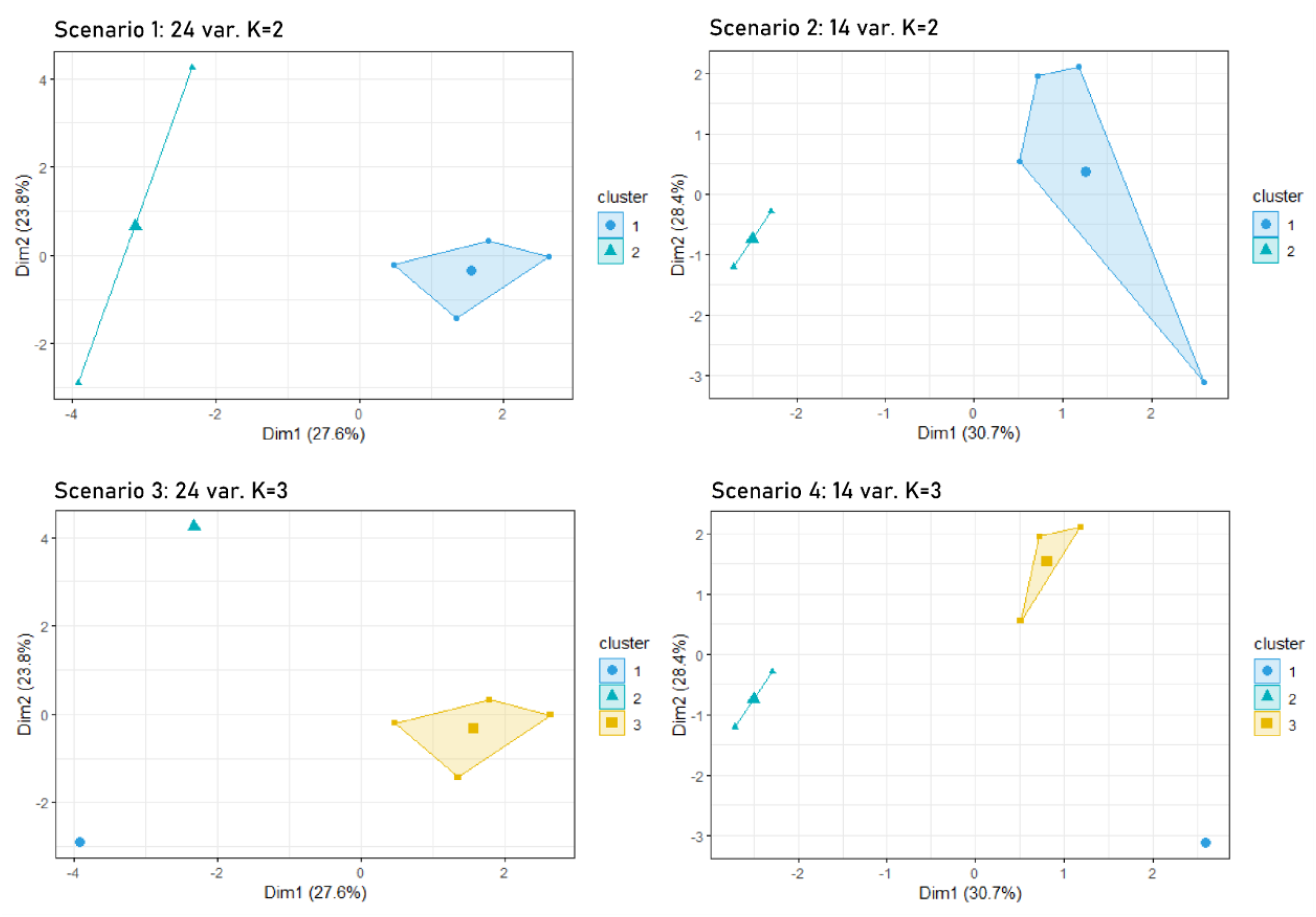
Clusters’ plots. Source: The authors. Note: in Scenarios 1 and 2, cluster 1: AMRA, ASCAP, BMI and SESAC, and cluster 2: MERLIN and ICE. In Scenario 3, Cluster 1: ICE, Cluster 2: MERLIN, and Cluster 3: AMRA, ASCAP, BMI, and SESAC. In Scenario 4, Cluster 1: ASCAP, Cluster 2: MERLIN and ICE, Cluster 3: AMRA, BMI and SESAC.
While the analysis falls short of fully confirming our hypothesis, it provides supportive indications. In the first scenario, the algorithm places MERLIN and ICE in one cluster and AMRA in the second cluster alongside the traditional PROs. However, when considering the Euclidean distances between the organizations and the clusters – after converting the centroids back into their original units – we observe that the distances between AMRA and the two clusters are quite similar. Specifically, the Euclidean distance between AMRA and the first cluster is 25.04%, while the distance to the second cluster is 26.73%, yielding a difference of approximately 1.7%. For comparison, the organization closest to the ‘other’ cluster is ASCAP, with a larger difference of 9.40%.
Interestingly, the second scenario confirms these results, although the difference between AMRA's distances to the two clusters is slightly larger, approaching 2%. The third and fourth scenarios further confirm that the value frequencies found in AMRA's communications align more closely with those of BMI and SESAC than with the other organizations classified as digital native PROs. Conversely, ASCAP stands out as the most atypical among the traditional group. The results of the fourth scenario suggest that, when only core espoused values are considered, ASCAP forms its distinct cluster.
Conclusions
This study set out to explore how the PRO sector is adapting to the technological disruptions and digital transformations reshaping the music industries, through the analysis of six key players. Espoused values were employed as proxies for organizational culture, offering a lens to interpret PROs’ strategic decisions and positioning. The connection between these two concepts lies in how espoused values serve as outward representations of an organization's priorities, providing insights into their operational and strategic orientations. By analysing the espoused values and strategies of the sampled organizations, this study identifies significant distinctions in how traditional and digital native PROs operate.
Traditional PROs, such as ASCAP (founded in 1914), BMI (founded in 1939), and SESAC (founded in 1930), distribute, collectively, over three billion dollars in royalties each year. They emphasize growth, advocacy, and partnership as their core values. Growth is the most frequently cited value among traditional PROs, exemplified by BMI's for-profit transition and SESAC's extension of international partnerships. Advocacy, the second most common value, highlights PROs’ claimed efforts to protect the interests of their members with particular attention to the artists and creators, rather than the large organizations.
In contrast, digital native PROs such as AMRA (founded in 2014), Merlin (founded in 2008), and ICE Services (founded in 2010) distribute less than 1,5 billion dollars a year. They emphasize transparency, innovation, and efficiency. The choice of values set them as a new and different breed of representative and collection agencies, proactive in expanding revenues from digital use and distribution of music, reducing costs for their members, while being transparent, and so trustworthy and reliable.
Hence, we consider the following to be key takeaways of this study: the digitalization of music distribution has led to the emergence of new PROs, or organizations incorporating performance royalty collection into their activities. These entities arise from the additional market space created by increased revenues due to the growth of digital distribution, yet they also tend to be more specialized and culturally distinct from the incumbent players. This finding also contributes to discussions on organizational values, highlighting how external factors – such as technological advancements, market conditions, and existing stakeholder values – shape the key values adopted by these new organizations.
Footnotes
Declaration of conflicting interests
The authors declared no potential conflicts of interest with respect to the research, authorship, and/or publication of this article.
Funding
The authors received no financial support for the research, authorship, and/or publication of this article.