




Abstract
Musicians are believed to increasingly “optimize” their music to positively influence discoverability and engagement on music and social media platforms. Common examples of such optimization strategies are skipping intros, quickly moving to the chorus, or inserting danceable “hooks.” But to what extent are optimization strategies actively considered in the creative production process? And, if so, in what stage of production? In this article, we explore how professional musicians reflect on the opportunities and constraints that optimization strategies offer in the creative music production process. Based on 20 in-depth interviews with early to mid-career professional musicians and songwriters, we identify four different positions between “pure” artistic autonomy and “pure” commercialism that musicians typically take on in relation to these optimization strategies. We demonstrate that musicians are aware that sonically “working towards” platforms may bring economic success, while simultaneously maintaining a general reluctance towards outright commercial, “full optimization” ideologies.
Keywords
Introduction
In 2021, it turned out that one of the most-streamed artists on Spotify was an artist called “Sleep Fruits Music” (Leight, 2021). Rather than churning out hit songs by the likes of Drake, Olivia Rodrigo, or Taylor Swift, Sleep Fruits Music is an independent music production company that releases fragments of rain sounds, ambient electronics, and other “music” that people consider as relaxing. The fragments are generally just above 30 seconds in length, making sure that each play reaps the streaming royalties that Spotify offers at the 30-second mark. Capitalizing on inactive music consumption during sleep or auxiliary activities, the playlists that Sleep Fruits Music’s parent company creates are easily streamed for the duration of someone’s night rest. Sleep Fruits Music received criticism for capitalizing on streaming services’ royalty system and turning algorithmic music selection systems in their favor. Similarly, earlier in 2017, Spotify itself was accused of inserting songs into high-performing playlists that were produced by ghostwriters under contract by Spotify (Petridis, 2017). These alleged “fake” artists allowed Spotify to take a piece of the royalty-pie that would usually go to artists.
These examples are extremes of a broader practice in which musicians look for strategies to “optimize” their musical work (Morris, 2020; Morris et al., 2021) and make platforms “work” for them and gain streaming revenues (Hesmondhalgh, 2021; Prey, 2020a). These strategies are perceived to potentially influence chances of getting songs into high-performing playlists, lists of recommended artists, or increased social media traction on platforms such as TikTok. This is nothing new: it happened with entrepreneurial social media use (e.g. Baym, 2018; Hagen, 2022; Haynes and Marshall, 2018a) and most sound media before the advent of digitalization—so-called “phonographic effects” (Katz, 2010). Today, artists commonly stand accused of thinking along such lines (Leight, 2022; Singh, 2022), but to what extent are optimization strategies actively considered in musicians’ creative production process? As a highly creative endeavor that is not even fully understood by most successful songwriters, it is crucial to explore to what extent musicians indeed include these considerations in their creative process, or actively distance themselves from them. In addition, usage of optimization strategies often supposes a clear-cut, commercial agenda—but at what point in the creative music production process are such strategies typically considered?
Based on 20 in-depth interviews with early- to mid-career musicians, in this article, we explore how professional musicians reflect on the opportunities and constraints that optimization strategies toward music and social media platforms offer in the creative music production process. We identify four different logics that musicians move between in the creative process of writing and recording, in relation to the technologies that are perceived to (partly) determine access to, and economic success of, their work. These logics and when and how they are activated in the different phases and contexts of the creative process, may help explain how technological advances in music distribution affect the music itself, also without musicians consciously adhering to an outright commercial logic as sometimes assumed (e.g. Leight, 2022; Singh, 2022).
Opportunities and challenges of the digital music economy
The digitalization of music, particularly the rise of social media and streaming platforms, has brought about a shift in which information technology companies, like Apple, Spotify, TikTok and YouTube, have gained a central role in the dissemination of recorded music (Hesmondhalgh and Meier, 2017; Negus, 2018). A key consequence of this is that music is now often discovered by music consumers through algorithmically created recommendations (Hagen, 2015; Seaver, 2022), which gives substantial power to these platforms in shaping musicians’ success (e.g. Aguiar and Waldfogel, 2021; Dinnissen and Bauer, 2022; Prey, 2020a). For musicians, these algorithmically fueled user-recommendation systems present a challenge, as it is difficult for creators to know exactly what properties influence their songs to get “picked up” on platforms (e.g. Hodgson, 2021; O’Dair and Fry, 2020) or social media (e.g. Bucher, 2012; Tintiangko et al., 2023). Because of this, these systems are often perceived as a “black box,” meaning that it is unclear for musicians why certain songs do “work” on streaming platforms and why others do not (Eriksson et al., 2019; Seaver, 2022). Even in cases where they are potentially understandable, a lack of “algorithmic literacy” may hamper enactment on this knowledge (Oeldorf-Hirsch and Neubaum, 2023).
Beyond understanding the technical side to user-recommendation systems, traditional human-focused considerations remain in place (Maasø and Spilker, 2022). For example, on most streaming platforms, there still is a concentration of gatekeepers in the form of human playlist-curators who rely on data like skip rates when making choices what to include, exclude or remove from popular playlists (Bonini and Gandini, 2019: 4–5). The exact imperatives of such playlist-curators—in contrast to considerations of “traditional” gatekeepers such as critics and DJs—are rather blurred however, as decision-making has become a largely computational or “hybrid” task (Bonini and Gandini, 2020; Maasø and Spilker, 2022; Seaver, 2022) and also spills over into human-curated social media (cf. Prey et al., 2022). Other studies on, for example, the influence of listeners’ background characteristics (Kischinhevsky et al., 2023), demonstrate this lack of transparency for both listeners and musicians. To mitigate problems of non-visibility on platforms, musicians are hence implicitly encouraged to think as software developers (Morris, 2020) and “optimize” their music to achieve success in the music streaming economy.
Cultural optimization strategies
Morris et al. (2021) define cultural optimization as the process of measuring, engineering, altering, and designing elements (e.g., interfaces, metadata, features, functions etc.) of digital cultural goods (e.g., music, games, apps, podcasts etc.) to make them more searchable, discoverable, usable, and valuable in both economic and cultural senses. (pp. 162–163)
In other words, optimization can be understood as actively and consciously “altering” creative work—such as music—in a way that it “caters” to the platforms the work is planned to be distributed on. Optimization has a long history, as different media (e.g. vinyl singles, cassettes, CD’s, radio, MTV) have persistently played a role in shaping creative opportunities and constraints for musicians. These so-called “phonograph effects” (Katz, 2010) affected aspects such as song lengths (e.g. Berland, 1990) or the dynamic range and volume of recordings (e.g. Devine, 2013). So, while creative considerations propel gradual cultural change (Askin and Mauskapf, 2017; Lieberson, 2000), these more banal technical aspects are an important source of such change as well (Peterson and Anand, 2004).
Cultural optimization can thus have a profound effect on the creative process of music production as the distribution media are (supposedly) taken into consideration during the production process itself. Moving to the contemporary music economy, Morris (2020) illustrates how musicians can try to “optimize their music for the platform” (p. 2) finding loopholes within these systems. This can pertain to instances such as making music that would sonically fit the platform (e.g. establishing fit with certain “mood” playlists) or approaching song or album titles with “the platform in mind”—similarly as how Search Engine Optimization (SEO) works on search engines (Seaver, 2022). Occasionally, producers simply overproduce a huge number of songs, with similar sonic properties, in the hope that one of these will perform well. Yet, studies show that such conscious commercial considerations that directly affect the perceived creative autonomy of artists, are historically met with reluctance and/or disdain (Haynes and Marshall, 2018b; McIntyre, 2008).
Musicians as reluctant entrepreneurs
As a result of an oversaturated and marginally differentiated music market, many working musicians (a minority of successful cases aside) are forced to perform a broad range of ancillary activities that co-exist with—what are perceived as—the core creative and artistic tasks. Haynes and Marshall (2018a) illustrate this by investigating the ways that musicians make use of social media, which is delineated as one of the most important non-musical activities. Yet, these tasks are, like management and bookkeeping tasks (Everts et al., 2021; Thomson, 2013), often met with reluctance (Gross and Musgrave, 2020). In addition, Hagen (2022) demonstrates that musicians are also often relatively unaware of the potential advantages of understanding and acting on datafication in recorded music practice, showing that “data-literate actors are the winners, and service and data providers are the rulers” (p. 197). Taken together, this fosters a situation in which musicians perform activities that are very similar to those entrepreneurial tasks of everyday labor within other creative industries. Musicians are, however, typically reluctant in labeling themselves as entrepreneurs (Haynes and Marshall, 2018b) and sometimes experience these activities as debilitating to their (mental) health (Gross and Musgrave, 2020).
In summary, the omnipotent role of contemporary music and social media platforms within music distribution has instilled a broad range of ancillary activities that musicians often yet reluctantly engage in during their day-to-day work and has allegedly resulted in a discursive change toward the datafication of creative, musical practice. As such, it is important to empirically investigate to what extent professional musicians indeed take these optimization strategies into account in the creative process and, if so, at what point in the creative process—which may affect whether it is met with reluctance or not.
Data and methods
Sample
For this study, we interviewed 20 Dutch early to mid-career musicians who spend most of their time in music production as a songwriter or producer. As is general practice in artistic work, this main occupation often co-exists with other activities like teaching, studio-engineering, and managerial and promotional tasks. Our sample is hence representative in terms of the wide variety of activities and international aspirations that professionally trained musicians indulge in within the Dutch context (Everts et al., 2021). To establish that all respondents have a primary aspiration toward a career in music, all respondents have at least finished a college/BA-level music program. While entry into a career in popular music typically does not necessitate a professional degree, this educational decision demonstrates a clear sense of intent toward establishing such a career. Moreover, this ensured that respondents were able to reflect on common practices regarding streaming platforms among professional musicians (including their teachers and fellow students) in the current digital music economy. Importantly, Dutch higher music education institutes are inclined to be internationally (English-language) focused and, like most of their European and American counterparts, mainly draw from British/American popular music in their programs (Coppes and Berkers, 2023). This tends to exclude local and classed subgenres such as “levenslied” or Dutch rap which are typically perceived as less legitimate tastes (cf. Vandenberg et al., 2021).
Recruitment took place through purposive sampling, with the authors using their professional network to find initial respondents. Through snowball sampling, a wide net was cast among popular music alumni across major cities in the Netherlands, ensuring that respondents have diverse regional backgrounds and have been enrolled in various professional music schools. The mean age of respondents is 27 with a standard deviation of 5 years (see Table 1). Moreover, diversity in terms of genre and gender was taken into consideration, ensuring that there was equal representation of men and women in the sample and that most major genres within popular music were represented. Major genres that are underrepresented are electronic dance music (EDM) and hip-hop, which is arguably because there is still relatively little institutionalization of both genres in (Dutch) higher music education institutions and European ones more generally (cf. Coppes and Berkers, 2023), making it uninteresting for aspiring musicians in these genres to take this route towards a potential career. This is a limitation of the study, which we will engage with, in the “Discussion” section.
Characteristics of respondents (n = 20).
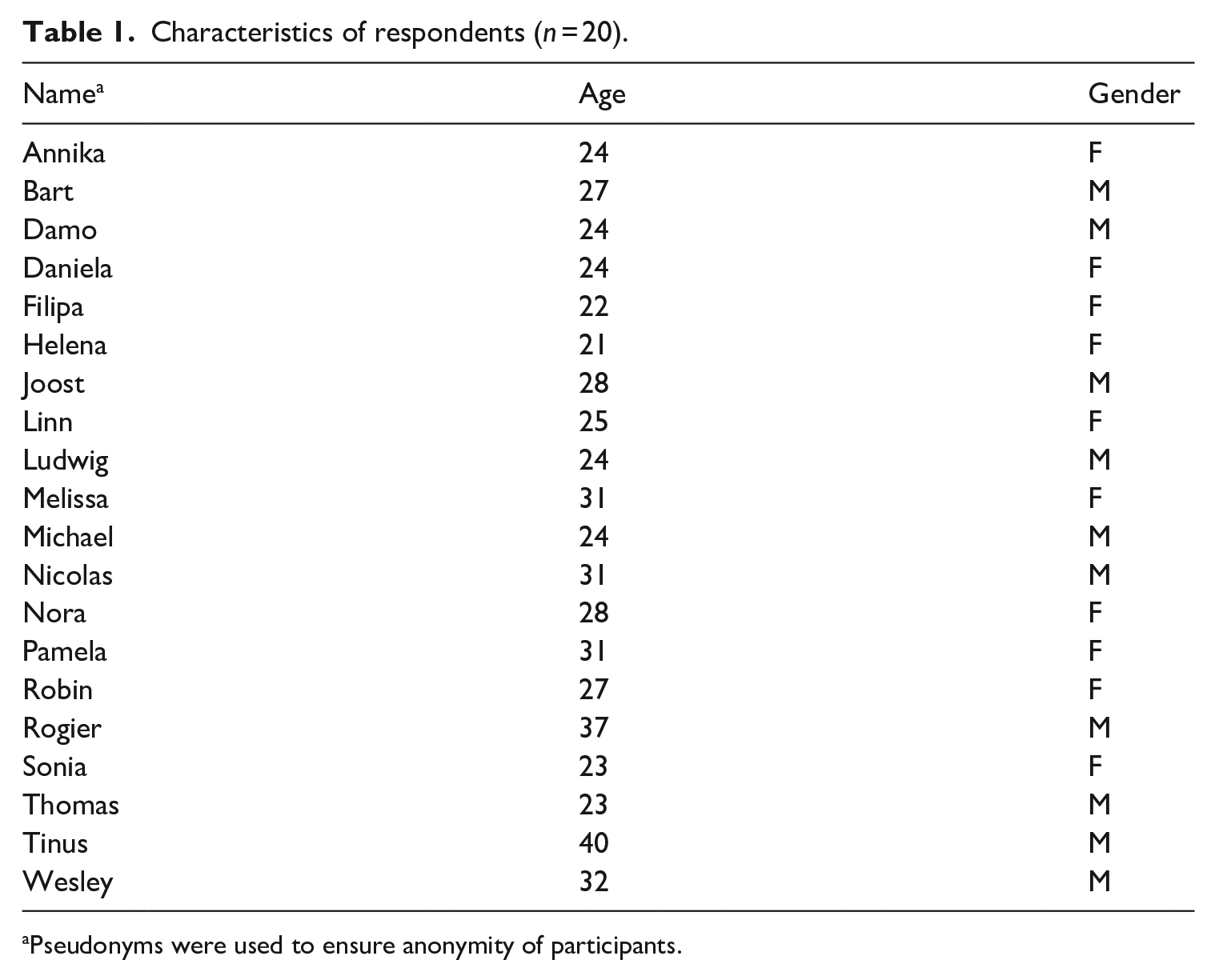
Pseudonyms were used to ensure anonymity of participants.
Data collection and analysis
Interviews were conducted by the first author between May 2021 and January 2022, each taking between 60 minutes and 120 minutes. Due to these taking place during the COVID-19 pandemic, half of the interviews were conducted through video conferencing software. Participants read and signed an informed consent form before the interview. An interview guide was established that (1) gauges the activities and ambitions of the musician and how these are weighed in terms of artistic and economic goals, (2) assesses their attitudes toward the entrepreneurial activities that they indulge in, mainly in regard to social media, (3) assesses their experiences with various forms of (modern) music distribution, and most importantly, (4) explores how these attitudes and experiences pertain to instances within the creation process of their music. All interviews were transcribed verbatim and coded in Atlas.ti, after which an iterative process of open, axial, and selective coding was followed (Glaser and Strauss, 1967). This brought forth four dimensions that formed the basis for four “logics” that artists typically move between, which we outline below.
Results
Overall, most interviewed musicians demonstrate awareness of optimization strategies in the contemporary digital music landscape that are perceived to potentially increase audience engagement with music. Several respondents note that they feel this is the consequence of digital distribution platforms and social media practices, because “listeners have a short attention span, and Spotify’s algorithms take note of that” (Damo, 24) and “people can fit it into their overstimulated lives” (Pamela, 31). Practices such as actively shortening songs and intros to cater to streaming rates and playlisting, but also adding “hooks” or specific choruses to aid TikTok video’s or Instagram reels, are known to them, although many also report that digital-only incomes through streaming are generally low—even when songs are considered successful (cf. Hesmondhalgh, 2021). However, respondents often maintain one specific “logic” toward these practices depending on the music production context they find themselves in. While some musicians easily shift between different logics dependent of what project they are engaged in and perceive these boundaries as fluid, others state that they (desire to) keep in line with one overarching logic. Importantly, in some cases, musicians seem to perceive the production process itself in a temporal fashion in which some “phases” are autonomous and others more commercial—as exemplified by what we dub the “post-artistic” logic. Below, we outline the four logics we have identified among our respondents, and to what extent and why musicians (are able to) shift between them.
Artistic logic
The artistic logic refers most to a “pure” artistic logic that is strongly tied to the autonomous or “restricted” pole in the field of cultural production (Bourdieu, 1993). In contexts that respondents adhere to this logic they report that they are not concerned with contemporary conventions about what would supposedly “work” on streaming platforms or social media, within their creative production or songwriting process. Within this logic, such conventions are disregarded and sometimes met with antagonism. This is demonstrated by a lack of concern for, for instance, sonic optimization such as shortening songs or intros, or data optimization strategies such as the “unbundling” of albums or Extended Play records (EP’s) into separate singles when they release their work. Instead, adherents of this logic are convinced that artistic quality and, subsequently, success, are strongly linked to the continual maintenance and protection of artistic autonomy.
For example, 25-year-old r&b/pop songwriter Linn reports being aware of the expectations to consider what “works” well within the contemporary media landscape, but explains being reluctant to actually do so, “because otherwise you, by definition, are compromising. [. . .] I think that kind of opposes the freedom that I want to experience when making music.” She immediately adds however that this does hinge on her ability to remain independent from the common commercial doxa of music labels and managers: “Of course I am independent and I don’t have a label or whatever. And that actually gives the freedom to do the things as I see fit.” So while Linn demonstrates awareness of these practices in the popular music field, and is not explicitly antagonistic toward them, she actively distances herself and her creative practice from them. Similarly, 23-year-old alternative pop producer Thomas reports that “no, I’m totally not occupied with where it ends up or how it’s received. I think that if it just sounds dope, and feels dope, there must be someone in the world who also thinks it’s dope.”
Nicolas, a 31-year-old pop music songwriter, explains that he is aware of the increasing expectation within the online music economy to consider releasing songs single by single, and trying to gain the attention of playlist-curators by creating a coherent and good-looking visual package. However, those are all things of which I think “fuck off,” you know? I don’t want to do that, I don’t feel like doing that. I just want to make music and stand on a stage and. . . that’s it. And what this or that Spotify curator thinks of that, I actually think is. . . really not important!
In some instances, this “pure” artistic logic is actively engaged with to provide a counterpoint to popular commercial practices, with an implicit goal to artistically stand-out among fellow musicians who are using these commercial strategies. As Helena, a 21-year-old folk songwriter explains, The EP that I’m now starting to think about is really a kind of story throughout the songs, so to say, that would fit together. And I think that’s an interesting way of releasing, because I don’t see a lot of people just releasing an EP like that, but first a single, then another single, and then the EP. That’s why I think it’s an interesting way to just immediately put the EP online.
In this instance, Helena opposes now-popular strategies to increase “engagement” with songs by spreading out single releases over time before launching the full album or EP. Instead, she sacrifices this opportunity in favor of creating an EP that is artistically coherent. This is similar to Tinus, a 40-year-old progressive rock musician, who maintains a preference for releasing full-length albums. In defense of his choices, he argues that the primary means for reaching an audience for him is to perform the music live, adding, I mean, there’s nothing more efficient than that, you know. Then you have, every night, hundreds of new people in front of you. And we have thought a lot about alternatives to that, in a digital sense or whatever [. . .] But we can’t really come up with a good answer to that. I don’t think there really is an alternative to it.
However, adhering strongly to this artistic logic does raise the issue for respondents that they may need to act commercially at times and engage with entrepreneurial activities, in order to achieve or broaden their success. Artists preferring this logic often hope to be able to delegate such work to support personnel after the artistic work itself has been completed, to protect artistic integrity. As Linn states, so, you do automatically think about, like, “oh, how could I ‘dress’ this song to make people like it, or that people get it, or that people can box it in somewhere.” [. . .] And I do find it interesting to think about that. But yeah, I prefer to just be a musician, and would like to work together with someone else who’s really good in those things and cares about them, you know, so I can make music.
Finally, musicians are able to move between various logics, dependent on the creative role that they are performing, and demonstrate awareness of doing so. Sonia, a prolific 23-year-old r&b/pop songwriter who writes directly for and with artists but also indirectly through artist briefings through labels, tends to maintain an artistic logic when writing together with artists, but a commercial one when working with label briefings. She argues, When it [the request to work together] comes from the artists themselves, then they always want to make something that’s authentic, that springs from their heart, and they want to tell a story. And then it’s actually always like, “there are no indicators,” commercially, length-wise for the songs, or in terms of instruments. More like “we just need to produce, and this is what inspires me, and these are subjects I’d like to talk about,” but there aren’t any commercial restrictions, so to say.
In other words, the artistic logic can be drawn from at will when the circumstances allow for or suggest its engagement or disengagement. This process is further highlighted in the post-artistic logic, outlined below.
Post-artistic logic
In the second logic, songwriters and producers do take commercial opportunities offered by new media into account, but only after they perceive the songwriting process—which they initially approach from a “pure” artistic logic—as completed. Often, this mainly entails data optimization strategies that do not regard the music itself but rather metadata such as song titles and other metrics (Morris, 2020; Prey, 2020b), but not exclusively so. They believe that taking sonic optimization into consideration in the post-artistic process could help boost their streams, getting picked up on playlists, or getting radio time, but without “sacrificing” their artistic integrity. Important to note then, is that musicians operating through this logic rarely approach their songwriting process with this in mind but rather consider such opportunities after the initial creative process during which a song is crafted and arranged, or, sometimes, when finishing a song with a producer. In other words, the songwriting process is perceived as having specific phases which are bounded from each other in terms of autonomous and commercial considerations, and govern their perspective on songwriting (cf. McIntyre, 2008). When asking songwriters about their creative process, they mention that, especially in what they identify as an “early” phase, they do not think about “where their music is going to end up” at all. In this sense, it is still a process that they describe as “artistic” or “intuitive.” It is still about crafting a good song which they believe to sprout from their personal artistic vision first and foremost. However, many respondents who use this logic mention that they do take this into account when finishing a song, or when working on a mix with a producer, or thinking of ideal singles or “hooks” that may work well on social media platforms—all cases in which the initial autonomous phase is perceived to be concluded. As such, the perceived temporal aspect within this logic is key, as they adapt this logic during the “post-artistic” part of the production process. Songwriters, and sometimes producers, then explicitly alter their songs to fit within contemporary conventions, with the means of contemporary music distribution and the platforms appurtenant to these in mind.
For Annika, a 24-year-old Alternative Pop songwriter, this logic is her main approach to making music. Describing the process of writing a song, she explains, I think it’s the first thirty seconds [of a song], if those are listened to then it counts as a stream. So if you have a longer intro then people might feel like skipping to the next song, so then it would be better to shorten the intro and start with vocals, and to, so to speak, place the chorus within the first thirty seconds [. . .]. But do I take this into account while writing? Not necessarily, but I might do when finishing a song. So I might think “let’s cut out the intro,” or “oh, what if we do start with the chorus?”
In her work, Annika clearly foregrounds artistic considerations in the initial production process, but explicitly considers potential commercial opportunities during the post-artistic process. She also adds that this depends on the intended medium as well, making shorter edits for radio but making longer versions for streaming platforms. This is very similar to the production process described by 24-year-old Indie songwriter Damo: Especially at the end, that you are like: Okay, this is really the single and those other tracks are, I don’t know, “alternative,” and you didn’t have to revise those. But this is the single and that has to reach everyone so that more people will listen to your EP. Are we going to keep that intro one minute or one minute and a half, or do we cut it back to half of that so that it’s more digestible, so it fits better with the algorithms?
For Thomas, this means that it is important to actively consider the internationally acclaimed artists and songs that would be in direct competition for listeners’ attention with his music and image, as offered on streaming services and social media platforms. As he explains, Actually, you should always aim to—also in photo shoots and music-wise and everything—to make the quality “international.” Because in the end, yeah, if someone can listen to Kendrick Lamar, why would they listen to your record? So, you just have to think: “guys, we have to join them on that level.” Because, yeah, actually a big album will be recommended next to your album, why would someone not click on that big album?
For 27-year-old electronic dance music (EDM) producer Bart, commercial considerations are more ingrained through the final production process. For him, this means actively thinking about how songs are made accessible to people, which would increase the play-rate: We want people to recognize the vocals, that you can sing along, you know? It’s just a bit more accessible. And that indeed is with the idea in mind that we would get a bit more streams and end up on the radio.
This is extended to artistic collaborations as well, as Bart actively looks for more popular vocalists to record vocals for his music and “who also write a nice top-line for that track, making two [musical] worlds collide, making it just a bit more accessible, so to say.” In the end, for Bart, the moment commercial considerations enter the production process is also dependent of the genre he is operating in and what the specific goals are for a song. For ending up on playlists in EDM, he reflects that songs should be shortened during the post-artistic process. He explains, Look, if it concerns a kind of hip-hop playlist then you have to deal with certain sounds, making it more of a production thing. [. . .] If you do that in the right way—checking around sounds and stuff—because then it’s very much like “checking what’s there already” and “how can we change that a little but keep it similar enough so that it stands out while remaining similar,” because in the end that’s what the consumer wants. And then you actually change the sound, increasing the likelihood that you get your [playlist] placements.
The process described by Bart has often been found a driving engine for musical innovation in the commercial music industry known as “optimal differentiation” (Askin and Mauskapf, 2017) or “optimal distinctiveness” (Brewer, 1991). Maintaining a high rate of convention increases the likelihood striking a familiar chord with listeners and being placed adjacent to other (well-)known artists, while adding a layer or veneer of innovation helps a song stand out from these conventions. As our interviews attest, processes of optimal differentiation have adjusted to new media technologies in similar ways as they have done with past media innovations.
Commercial logic
A handful of respondents explain that occasionally their production process is fully, from start to finish, influenced by commercial considerations offered by new media technologies. In other words, these songwriters take optimization strategies into consideration throughout the production process. Interestingly, however, this is always reported in relation to “writing jobs” for other artists or production companies, such as the briefings by major labels, to which songwriters can respond. Musicians who attest to occasionally engaging with this logic always do so by splitting their personal artistic goals from the commercial goals inscribed by the “job” at hand. As such, these respondents seemingly shift between the various logics dependent on the intended goal and audience.
As a songwriter, Annika is used to shifting between these positions. She explains, My own music is much more a platform for my artistic ambitions. So that is why writing for others feels much more like a craft, not like something very artistic. That is more about being a chameleon, sort of, about being able to adopt someone else’s colors.
Opposed to the implicit commercial logic, artists can actively identify commercial from artistic considerations and include these in the production process at will, as determined by the job at hand. Similarly, Sonia explains that this is something that songwriters like her learn to identify when engaging with external production opportunities: The message is always like “can you make something that can be played on the radio,” so it shouldn’t be longer than two and a half minutes or something. It is always like . . . they could just as well say something in the message like “we want to have cash quickly, can you please help us.” [. . .] It is never a briefing—at least not with the commercial companies—in which they are like “oh, we really want you to make something very artistic.”
Working within this logic means constantly keeping in check with the latest developments in streaming and social media platforms, to write songs in such a way that these systems cater to more exposure and streams, and hence, more income. Unlike the relative clarity provided by the ideal length for a radio hit, for example, these musicians also struggle in keeping up with constantly accelerating technological developments that can affect a song’s success. For Rogier, a 37-year-old songwriter with several Dutch hits to his name, this is an endeavor stifled by uncertainties, as optimization strategies can constantly and rapidly change in the digital music economy. He explains, “Yeah, there is a lot going on around Spotify and then I hear it’s going in the right direction and then . . . yeah, we all don’t really know, you know? [. . .] We all just must wait and see.” This means that his work consists of constantly identifying and pursuing commercial opportunities in work of others who may pursue a more artistic logic. As he explains, It often happens that album tracks are written by the artists themselves, those are maybe more personal songs, less poppy, less radio-friendly [. . .] And for singles they recruit songwriters, you know, who are a bit more skilled in coming up with hooks, or make sure that we’re in the first chorus before the 45-second mark.
Implicit commercial logic
Finally, some respondents report that they are sometimes simply unaware to what extent their production process is or is not affected by commercial considerations offered by new media technologies. Within this logic, the artistic logic still generally prevails according to these artists, but they admit that they are also music consumers of this day and age, deeply influenced by commercial music and viral song snippets. Consequently, the commercial logic is more implicitly embedded in these artists’ production processes. This makes it difficult for them to disentangle where their “pure” artistic contributions begin or end, as—in McIntyre’s (2008) words, these musicians are aware that they “work within a structured system that shapes and governs their creativity while they contribute to and alter that system” (p. 49). Key aspects such as conventional pop song structures, chord progressions, and song-lengths are implicitly considered. Whereas artists working in this logic still indulge in the same explicit commercial practices (e.g. shortening intros later in the songwriting process) described earlier, for these artists, this seems to happen more automatically and less consciously.
A 22-year-old Pop songwriter, Filipa, exemplifies this logic when explaining her writing and production process. She explains that she is heavily influenced by what she listens to and “with me it just becomes quite commercial quite quickly, because that just is my writing style at the moment, and because I listen to that [kind of music] a lot.” Reflecting on her writing process, she adds, I’m not really occupied with “oh, now I need a verse, oh now I need a pre-chorus, oh now I need a chorus.” No, I’m more or less automatically writing verses and choruses, because that’s the way I write. So that’s much more something automatic than that I actively consider it—it’s ingrained in there.
In a similar way, 24-year-old r&b/Pop songwriter Daniela explains that overtly commercial aspects are rooted in her songwriting because music that uses these also comprises the bulk of what she listens to herself. She explains that “some things I recognized when I was learning them [at the conservatoire], realizing that I was already doing that, probably because it was something I was used to based on the music I listen to.” Like Filipa, this is mostly implicitly part of the songwriting process, because “many [commercial songwriting] things I already did automatically, probably because I was so used to hearing that.”
Interesting about this logic in comparison with the artistic logic described earlier, is that here, musicians recognize and identify the potential influence of both artistic and commercial considerations by other artists, underlining that a “pure” artistic logic may be unattainable in actual music production practice. Attesting to this, 28-year-old songwriter Nora explains, Due to the fact that I am, of course, also just a music consumer of this era, and that I am also influenced by things that are happening [in music] right now, means that my inner dynamic intuition and dynamic sense is also partially shaped by my influences and what I listen to. So are they conscious commercial considerations? No. Are they subconscious commercial considerations, created by the fact that I am in turn inspired by “commercial music”? Yes.
Discussion and conclusion
In search of high streaming rates (or low “skip rates”) and virality, artists are supposedly actively optimizing their music to instantly grab listeners’ attention (Morris, 2020; Morris et al., 2021) by shortening songs and adjusting song structures for ideal cross-platform integration and exposure. In this article, we assessed to what extent this is indeed the case among aspiring professional popular musicians and songwriters, and how optimization strategies are (not) integrated and/or considered in the music production process. Based on 20 in-depth interviews, we show that musicians are indeed keenly aware of these practices in the contemporary popular music landscape, yet only a handful report to also engage with these practices explicitly in their work. Importantly, we learn that optimization is not simply a binary switch, but a consciously considered potential ingredient to the production process that varies in included amount, based on contextual variations.
Musicians typically shift between four logics when considering optimization strategies in relation to the contemporary digital music landscape that their music will end up in. First, a preferred logic by many songwriters is a “pure” artistic logic, that is based on an artistically autonomous ideal. Here, we see that musicians are aware of practices to cater to social media and streaming platforms, but actively attempt to keep this out of their creative process from the initial creative ideas behind a song or album, to the final product as it is offered to audiences. Maintaining this logic has the benefit of experienced artistic integrity, which is supported by the idea that high-quality music will find a way to people’s ears (and wallets) without adding or changing aspects that are perceived as catering to the digital landscape. However, this logic comes with drawbacks as respondents report awareness on how engaging with such commercial practices does seem to reap benefits.
In relation to this latter consideration, a second logic can be employed which we have identified as a “post-artistic” logic. Here, musicians identify concrete phases in the songwriting process in which the artistic logic is used throughout the initial writing phase—sustaining the treasured artistic integrity—but are open and willing to later make amendments in the songs, release form or strategy, to achieve the best possible outcome for playlists or virality on social media platforms after this artistic phase is considered completed. In other words, by identifying two temporal phases within the music production process that are distinct from each other. Artists use this logic to actively shield their experienced artistic integrity in the first phase while the second is explicitly guided by (often, limited) sonic optimization strategies and considerations of data optimization (Morris, 2020; Prey, 2020b).
In the third, “commercial,” logic, we find the explicit focus on commercial success in the contemporary digital music consumption landscape, by actively writing, producing, and releasing music in such a way that it caters ideally to various platforms. Interestingly, zero respondents indicate that this logic is abided to when creating music for their own musical projects: the logic is exclusively activated when working for other artists and/or when responding to label briefings. In this way, musicians attempt to maintain their artistic integrity found in the first logic, while delegating commercial “work” to this logic which they have high knowledge of. Instead of assigning phases—as we saw in the “post-artistic” logic—here it is the context of production that assigns the preferred logic.
Finally, a fourth logic which we have labeled “implicit commercial logic,” is employed when musicians feel less convinced that the sharp boundary drawing that happens in the first three logics can in fact be made. Respondents report that their music taste and by extension their music production must be influenced by music that has been created with explicit commercial considerations, which will, by definition, find its way into their own artistic work (cf. McIntyre, 2008). So, while these respondents maintain an artistic logic, they simultaneously demonstrate that the boundaries between autonomy and commercialism are extremely porous and that they may be participating in the drive toward brief and hook-heavy songs, without actively aspiring to do so. Looking at the relatively small number of artists reporting to do so explicitly, it must be within this group that we find the most substantive explanation for why songs and song structures seem to be changing in the digital music age. This is strengthened by the fact that this logic is built on musician’s self-reflexivity on their status as influential musicians and influenced music consumers simultaneously. Arguably, many musicians adhering to the “pure” artistic logic may in fact operate on a similar basis, minus this self-reflexivity.
This article offers several contributions to media studies on music production processes in relation to digital platforms. First, by shedding light on how musicians and songwriters themselves consider the digital music landscape that their productions end up in, we demonstrate how new media platforms and practices do not, by definition, shape music productions irrespective of artistic and creative pursuits. Instead, we see that musicians actively strike a balance between artistic autonomy and commercial viability, as offered by streaming and social media platforms—where autonomous creativity and attention for metrics can both have a place. In doing so, we demonstrate that technological changes can affect the music production and distribution process for musicians (Peterson and Anand, 2004), but do not do so in a singular way—sometimes even between a musician’s various projects. Second, we extend research on musicians (and creative workers more broadly) and their supposed reluctance toward work that is considered entrepreneurial or commercial (Hagen, 2022; Haynes and Marshall, 2018b). While this research shows that people in creative occupations sometimes approach the “selling” of their work with reluctance or antagonism, our research demonstrates that—when present—this does not necessarily propose a zero-sum game. Instead, among professional pop music songwriters, there is an awareness and experienced possibility of contextually shifting between a commercial and artistic logics. This demonstrates that, at least for these musicians, shifting between logics can be a way to achieve a “best of both worlds” situation where engaging with supposed success-inducing strategies for new media platforms is kept within the brackets of everyday “work,” whereas artistic integrity is preserved for personal projects that have no explicit goal of commercial viability. Seeing that all respondents have enjoyed formal music education at a Dutch college/BA level music program, this seems a normalized strategy for professional creatives to maintain commercial viability in the digital music economy while simultaneously engaging with meaningful musical practice.
Importantly, due to our selection procedure, our sample lacked musicians working in one of the most popular music genres on streaming services, rap/hip-hop (Musical Pursuits, 2023), and other notable genres such as country, EDM, k-pop, or reggaeton. For these genres, the found logics may function differently, in a different guise, or not at all, in their genre-specific practices. Further research should explore whether these logics can also be found among amateur and/or (semi-)professional autodidact musicians. Finally, our article demonstrates that these boundaries are more fluid in practice than often assumed—also by musicians themselves—and that strategies that are considered as “catering” to the algorithm today, may be perceived as part and parcel of songwriting practices and song structures, tomorrow (McIntyre, 2008). As such, the implicit commercial logic that we identified is perhaps more prevalent than discussed here, as many (starting) artists may not be able to reflect on where “their” artistic integrity begins—or ends.
Footnotes
Acknowledgements
The authors thank Priscila Alvarez Cueva, Michaël Berghman, Pauwke Berkers, Thomas Calkins, Didier Goossens, Kristina Kolbe, Timo Koren, Britt Swartjes, Femke Vandenberg, and the members of the Rotterdam Popular Music Studies (RPMS) group at Erasmus University Rotterdam for their feedback on earlier versions of this paper. They also thank the three anonymous reviewers for their constructive comments and suggestions. Finally, they are grateful to the 20 musicians who were willing to share their time and insights with them.
Declaration of conflicting interests
The author(s) declared no potential conflicts of interest with respect to the research, authorship, and/or publication of this article.
Funding
The author(s) received no financial support for the research, authorship, and/or publication of this article.
