



Abstract
Emerging crises such as the 2023 US–China balloon incident present opportunities for states to leverage murky events to justify their behaviors, rally political support, and promote favorable worldviews through projecting strategic narratives. This study examines narratives deployed by the US and China and evaluates their diffusion in the international media environment. International news coverage of the balloon incident (N = 776) was analyzed by a human-in-the-loop machine-learning narrative analysis. Results show the US set the tone by framing the incident as a matter of surveillance, linking the issue to identity narratives, and forcing China to engage in narrative contests on spying. The US remained dominant in the international narrative sphere although China attempted to project alternative storylines. Implications for other countries are discussed. Findings illuminate the utility of strategic narratives in unpacking strategic interactions in the flow of international political communication, in an absence of major escalations.
Keywords
Introduction
Looking up in the sky, residents in Montana noticed an unexpected white object hovering above them on February 1, 2023. Soon after the sighting reports, the U.S. Department of Defense quickly responded, telling the press that it was a high-altitude surveillance balloon from China and that they had been tracking the balloon since it approached Alaska on January 28, 2023 (U.S. Department of Defense, 2023). The Chinese Ministry of Foreign Affairs also reacted quickly and suggested that the balloon was a civilian airship for meteorological research, which was deviated by the Westerlies and entered into US airspace due to force majeure (Ministry of Foreign Affairs, 2023). The balloon drifted over nuclear missile silos in Montana, and then off the Atlantic coast in South Carolina before the U.S. Air Force shot it down on February 4, 2023. The U.S. did not explain the surveillance component of the balloon in detail, while the Chinese side did not disclose the civilian organization or company that was involved. Without concrete evidence from both sides, the balloon incident presents an opportunity for a contest of narratives where both sides try to convince the global audience of their versions of stories.
The international news environment was the frontline of this narrative contest. When the world was looking for answers to this mysterious balloon, breaking news quickly set the tone for this incident and established the basic understanding of the event for the global audience. Because narratives help explain the causes and effects of complex problems in international relations for the audience to build perspectives and formulate policy preferences, international political actors typically seek to project stories about murky events quickly in the media environment to rally political support (Roselle et al., 2014). These narratives are told strategically with purposes, with the goal of convincing the audience to interpret the event according to the worldview that promotes the political interests of the storyteller (Miskimmon et al., 2013, 2017). The national media in a country often carries the role of disseminating strategic narratives, not only because they are more easily accessible internationally but also because they present news frames from the high office (Entman, 2003) while embodying the national consensus on geopolitics (Kluver et al., 2019). Therefore, this study examines the English-language international coverage of the balloon incident to unfold the contest of strategic narratives between the U.S. and China, thus illuminating how the two rival nations attempted to shape the perceptions of the incident for the international audience.
Through analysis of international news coverage (N = 776) of the U.S.–China balloon incident, this study examines the strategic narratives used by the two rival states to explain the incident and assesses how those competing narratives diffused into international news coverage in other countries. In doing so, this study demonstrates how the U.S. and China used the balloon incident to shape international perceptions toward the incident and their rival by projecting different narratives that justify their behaviors and rally political support. This study also evaluates the strategies and mechanisms that helped the U.S. and China to leverage the incident to reinforce the identity narratives both countries had been projecting. The pervasiveness and patterns of these narratives in the international media environment were analyzed by a multistep human-in-the-loop machine-learning narrative analysis. Findings illustrate the flow of international political communication in the news environment.
This study makes three contributions. First, the strategic narratives framework helps analyze the news coverage that sets the tone for a murky international crisis. Because strategic narratives connect events from the past to the future, findings suggest storylines not only explain the causes of the balloon incident but also engage the identities of surveillance states to undermine the image of their strategic rival. The patterns in the narrative contest demonstrate the struggle for soft power in the news environment. Second, findings provide evidence that demonstrates narrative diffusion from the U.S. and China. Amid the contest between two major powers in a scenario without significant escalation, narratives became a tool that rallied international support. Evidence helps illustrate how U.S. and Chinese narratives provided sources for potential narrative hedging in other countries (Hagström and Gustafsson, 2021). Third, the multistep human-in-the-loop machine-learning narrative analysis provides qualitative insights into the storylines while outlining the patterns in narrative projection. This study advances the understanding of how strategic narratives in the media forge perspectives on international crises and national identities.
Literature review
Strategic narratives in international political communication
The concept of strategic narratives provides a comprehensive theoretical framework to explain the flow of international political communication in the contemporary media environment by conceptualizing political actors as storytellers who shape politics and public opinion with narratives (Miskimmon et al., 2013, 2017). The narrative approach suggests humans mainly communicate through meaningful stories but rarely use logical arguments (Fisher, 1984). In a world where political actors and the public interact at the crossroad of legacy and new media, actors seek to exert influence in the hybrid media environment by telling stories (Chadwick, 2013; Hoskins and O’Loughlin, 2015). Narratives are persuasive because they explain the relationships between actors and events, illuminating goals and outcomes of actions (Shenhav, 2006). Because narratives convey perspectives on social events by explaining their causes and effects, they collectively construct values and identities in society (Brockmeier and Carbaugh, 2001). Therefore, storytellers can influence public perceptions by articulating “end states” and suggesting “how to get there” (Miskimmon et al., 2013, p. 5). In other words, strategic narratives may suggest a desired future and propose policy solutions to reach that goal.
Scholars started to pay more attention to the power of narratives in international relations in the late twentieth century (Roberts, 2006). The definition of state power was expanded from the conventional hard military and economic power to what Nye (1990) coined as soft power, a persuasive force of ideas and identities that shape geopolitics. Political actors can cultivate soft power by engaging in public diplomacy, including the efforts of listening, advocacy, cultural diplomacy, exchange, and international broadcasting (Cull, 2008). Strategic narratives are embedded in the messages communicated through these public diplomacy processes. Actors can shape perceptions of the foreign audience on a country or an international event by persuasion through storytelling, thus altering their foreign policy preferences (Roselle et al., 2014). The framework of strategic narratives recognizes the role of communication of ideas in international politics, which explains the sources of gaining and contesting soft power. In other words, persuasive strategic narratives add to the soft power of an actor because they yield noncoercive force on other actors.
The theoretical framework of strategic narratives
Strategic narratives can be categorized into system, identity, and issue narratives (Miskimmon et al., 2013, 2017). System narratives are stories that make sense of how actors are structured in the international community and the rules governing the interactions between actors. For instance, the Cold War narrative suggests a bipolar zero-sum world (Livingston and Nassetta, 2018). Identity narratives are stories that suggest the goals and values of a political actor. Singapore provides a good example of how a government shapes the identity of a state, where “Asian values” for prosperity were chosen over an ethnocentric identity for a newborn multiethnic state to avoid intergroup tensions (Ortmann, 2009). Issue narratives are stories about individual events and relevant policy responses. For example, the Trump administration portrayed the COVID-19 pandemic as a threat from China and mobilized nationalism to support policy solutions (Kuteleva and Clifford, 2021). This study examines how the U.S. and China leveraged the raw material (Kluver et al., 2019; Miskimmon et al., 2017), which was a murky situation in an international event that can be interpreted differently, in the balloon incident to construct issue narratives that engaged identity and system narratives. Strategic narratives work best when the stories on the three levels suggest a coherent worldview (O'Shea, 2019; Ringsmose and Børgesen, 2011).
The process of communicating strategic narratives generally follows three steps, from narrative formation to projection and to reception (Miskimmon et al., 2013, 2017). Narrative formation describes the forces that forge a narrative. It concerns the negotiation between domestic political forces and the communication skills actors employed to form narratives (Ringsmose and Børgesen, 2011). Narrative projection is the process of delivering messages to an international audience in the media environment. Studies of narrative projection not only concern what messages are transmitted through what media but also the contestation between strategic narratives that suggest alternative worldviews by rival political actors who seek to compete for soft power (Miskimmon et al., 2013). Narrative reception concerns audience interpretation and response. This study focuses on analyzing the projection of strategic narratives as it informs what perspectives on the balloon incident from the U.S. and China were communicated to the international audience, as well as the dissemination and contestation between these narratives. This study also examines narrative projection by other countries to demonstrate how the world responded to the U.S.–China contest. The literature suggests that states could engage in hedging to mitigate risks in uncertain situations, between two global powers, through a mix of cooperative and confrontational behaviors (Ciorciari and Haacke, 2019). In the context of strategic narratives, hedging involves browning and balancing narratives elements from rival powers to advance national interests of the home state (Hagström and Gustafsson, 2021). Therefore, other countries could play the role of narrative “sponsors,” similar to “frame sponsors” who advocate and negotiate frames according to their own agendas (Wichgers et al., 2021).
The strategic narratives framework can be enriched by incorporating framing theory and considering media frames as crucial narrative elements (Coticchia and Catanzaro, 2020). A widely acknowledged definition by Entman (1993) conceptualized framing as “to select some aspects of a perceived reality and make them more salient in a communicating text” (p. 52). Identifying media frames in the text helps illustrate which part of an international crisis is highlighted to convey perspectives. Nevertheless, the theoretical scope of framing theory is “less ambitious” that it lacks the temporal and causal features to explain causal effects in political events (Livingston and Nassetta, 2018; Miskimmon et al., 2013). The concept of strategic narratives also better captures the intentionality in political communication as it suggests stories are always projected purposefully, while framing is “sometimes purposeful, sometimes accidental, and sometimes instinctive” (Castells, 2009, as cited in Coticchia and Catanzaro, 2020, p. 436). Scholars propose that media frames can be conceptualized as building blocks in strategic narratives to bring nuances in analyses, where frames are analogous to the weather that construct the climate of strategic narratives (Coticchia and Catanzaro, 2020; Livingston and Nassetta, 2018). Therefore, this study first employs computational methods that are designed to identify media frames, which inform narrative discovery in the next step.
Strategic narratives in news media
This study focuses on the strategic narratives in the news environment because they showcase the immediate efforts of political actors in responding to current international affairs. National media typically embody the consensus of stakeholders in a country (Kluver et al., 2019). In democracies such as the U.S., foreign policy perspectives in the news are influenced by the administration. The Cascading Activation Model suggests that the activation and spread of interpretive frames follow a stratified structure, where the administration decides which frames to deploy (Entman, 2003). News frames flow through a cascade of Washington elites, journalists, and news, before reaching the public. Nevertheless, while the administration holds more framing power, domestic political opposition and journalists can push back against the official narratives to a certain extent, bringing diverse perspectives to their coverage (Hayes and Guardino, 2010). The overall news coverage in national media reflects the negotiated view on foreign policy issues. In authoritarian states such as China, national media represent the perspectives of the ruling elites. Because the news environment is likely heavily regulated and censored by the government, state power can project strategic narratives more consistently. Particularly, some authoritarian states deploy English-language news media to engage the international audience for propaganda purposes (Moore and Colley, 2022). Therefore, an analysis of the news coverage in the English-language international news, which is more likely to reach a global audience, would demonstrate the direct projection and contestation of strategic narratives on international crises between rival states.
Previous research suggests that the U.S. has an upper hand in projecting narratives in the international news environment. Scholars generally agree that news coverage is unequal between developed and developing states. First, the economic, social, and political power of a state influences the coverage it gets in international news (Galtung and Ruge, 1965). From a world-system theory perspective, core countries such as the U.S. enjoy more news coverage as a reproduction of the power dynamics in international politics (Chang, 1998). Among various factors, economic power such as trade volume and GDP better explain the dominance of the U.S. in international news coverage, both in legacy and online media (Segev and Blondheim, 2013; Wu, 2000, 2003). Secondly, news outlets in the global South historically show dependency on the West, where news media rely on Western newswires as information sources because news outlets in developing countries may not be able to afford foreign correspondences (Meyer, 1989). As a result, the presence of international news agencies affects the volume of news coverage an international event may receive (Wu, 2000). Thirdly, U.S. news values influence international news coverage and journalism practices globally because of its strong cultural influence, where the Western approach is considered “better” (Kotišová and Deuze, 2022). For example, the emphasis on confrontation and violence in reporting global conflicts created a style of war journalism that could escalate tensions (Galtung, 1998). A similar practice was observed globally (Baden and Tenenboim-Weinblatt, 2018). In summary, the U.S. historically had greater influence in the international news environment, facilitating the projection of U.S. strategic narratives.
Meanwhile, China has been cultivating its soft power by pouring resources into public diplomacy since the 2000s (Hall and Smith, 2013). The objective was to counterbalance the U.S.-dominated media environment that portrayed China as a growing global threat; as well as gain international recognition for the Chinese social and political system (Zhao, 2015). State-owned news media turned their faces to the global audience with the mission to project soft power (Zhang, 2010). Early efforts to promote a positive image of China were less successful as the reporting style remained overly positive on Chinese news while international news coverage was lacking (Sun, 2009). The strategy evolved in the 2010s, when the state-owned China Global Television Network (CGTN) adopted Western reporting styles and employed foreign journalists, following the success of Al Jazeera (Thussu, 2018). Nevertheless, the content was “gatekeeped” by Chinese editors to ensure the news aligned with state interests (Umejei, 2018). Their news coverage tried to establish a positive image of China, which was considered to be distorted in international news (Rawnsley, 2015). When covering foreign events such as the U.S. presidential election in 2020, CGTN adopted an impression of impartiality while injecting China-friendly narratives into the news (Kotišová and Deuze, 2022). Overall, the literature suggests that the English-language Chinese news media projects strategic narratives to challenge the existing “China threat” image and promote a friendly China identity.
Research questions
The U.S.–China balloon incident in 2023 demonstrated how a suddenly emerged international crisis between two global powers required strategic narratives to justify their behaviors and rally political support. Because the situation in the balloon incident was unclear at the beginning, it allowed the U.S. and China to construct their strategic narratives relatively freely in the media environment. Therefore, the case provides an optimal opportunity to observe how international news conveys strategic narratives to set the tone for an international crisis. English-language news from national media outlets was studied, because English news is more likely read by a global audience and referenced by news in local languages. Local news that is intended for the global audience was also more likely to be translated and published in English. Thus, English-language news demonstrated strong potential for narrative projection.
This study asks how strategic narratives were projected in a murky international crisis to shape identities and worldviews in the media environment. In the first step, it is essential to identify relevant strategic narratives projected by both the U.S. and China. The news coverage from the rest of the world also provides insights into the diffusion of strategic narratives, as well as potential alternatives that help countries hedge the risk of betting on either side in the contest between two great powers (Hagström and Gustafsson, 2021). RQ1: What were the major strategic narratives in the global news coverage of the balloon incident? How did global news coverage interpret the balloon incident?
In the second step, this study is interested in how these narratives were projected by the U.S. and Chinese media, as well as the circulation of these narratives in the rest of the world. The patterns of the projection of strategic narratives, such as co-occurrences, inform how narratives were employed collectively to forge perspectives. The patterns entail how the balloon incident was leveraged by the U.S. and China to engage the narratives about the identities of countries and worldviews relevant to an international crisis. Again, it is equally important to assess the news coverage from other countries to examine the co-construction of the storyline that described the balloon incident. It helps evaluate how the international community was handling the narrative contest, such as engaging in narrative hedging. RQ2: What were the patterns of the projection of strategic narratives in the balloon incident? How did the strategic narratives compete?
Data
This study sampled English-language national media news articles from the U.S., China, and the rest of the world (34 other countries, as available in the databases used) as they reflect the consensus of strategic narratives in their country (Kluver et al., 2019). The time frame of the sample is between January 28, 2023, when the U.S. military first detected the balloon, and February 17, 2023, when the U.S. concluded the debris recovery operation of the balloon that was down on February 4, 2023. Data were sampled from Nexis Uni, an archive of news sources for academic research. The sampling scope included all countries available to provide the widest perspective on the international news coverage as possible. The initial official responses from both countries termed the flying object as a “balloon” (U.S.) or “airship” (China). Therefore, the query started with the keywords of “China” AND “United States” AND “balloon” OR “airship” in the headline and lead section of the news articles to ensure the sampled articles focused on the balloon incident. A filter was applied to include only the articles from English-language international news in newspapers and web-based publications. The query yielded 1014 articles. To compensate for the lack of some major U.S. national news media in Nexis Uni, a similar search was conducted in Factiva, a Dow Jones & Company news archive. A filter of news sources was applied to include results only from the New York Times, Wall Street Journal, Washington Post, USA Today, New York Post, and Fox News. The query yielded 253 news articles. After removing duplicates, a total of 776 articles were included in the sample (see Appendix A for the number of sampled news articles from each country). This study recognizes the small sample size in some countries may not accurately reflect the perspectives in those countries individually. Nevertheless, they collectively shaped the English-language international news environment that shows how states other than the U.S. and China responded to the balloon incident. The sample included 196 articles from the U.S., 90 articles from China, and 490 articles from 34 countries across the globe to provide a snapshot of the strategic narratives that flowed globally. The full text of all 776 articles was extracted for analysis.
Methods
This study contributes to the development of a multistep human-in-the-loop machine learning approach to identify strategic narratives in the sampled news articles. In the first step, because the theoretical framework of strategic narratives considers news frames as the building blocks of narratives, this study leveraged the latest methodological innovations in computer-assisted frame identification, which suggested that unsupervised topic modeling helps discover the elements of frames (Guo et al., 2022; Hubner, 2021). Topic modeling is a type of natural language processing technique that classifies hidden structures of word distributions (Jelodar et al., 2019; Liu et al., 2016). Topics are collections of words that are frequently clustered together in individual documents. This study employed Structural Topic Modeling (STM) which allows the algorithm to model with the covariate of countries in the sample (Roberts et al., 2014). A 15-topic model was selected as it shows a better balance between semantic coherence and exclusivity than other numbers of topics. This result informs the following step of narrative identification.
In step 2, this study followed a similar human-in-the-loop approach as the literature on frame identification suggests (Guo et al., 2022; Hubner, 2021), but expanded the scope to narrative identification. By examining the related words and full text of each topic and article that are likely to contain that topic, the authors extracted narrative elements such as frames, actors, and events. Informed by both the topic structure obtained from STM and close reading of the topic-related news articles, 13 strategic narratives in the sample were identified. The following steps classified all articles in the sample with supervised machine learning. It is similar to the process suggested by Guo et al. (2022), albeit this study identifies narratives.
In the third step, a subsample of 156 news articles (20%) randomly sampled evenly from the U.S., Chinese, and international sources was analyzed manually to generate a coded sample for computer classification in the next step. This step resembles a conventional content analysis, where the authors first reviewed a small sample of articles together to establish the criteria for the codebook. Next, the authors coded 81 articles individually with an average agreement rate of 96% (SD = 0.028) and very good intercoder reliability where the average Gwet's AC1, a better measurement for coding skewed classes (Gwet, 2008), was 0.94 (SD = 0.054). The rest of the articles in the subsample were coded by the authors individually.
In step 4, supervised machine learning was employed to code all 776 articles. The performance of algorithms including the Naive Bayes classifier, support vector machine, random forest, and neural network was assessed using the coded data. Random forest yielded the best precision and recall. It is a method of classification with multiple decision trees, which is a nonparametric method that classifies a document, based on document features, through a series of decisions made in a hierarchical structure (Ho, 1998). The random forest shows optimal performance for data with significantly more predictive variables (text features in this study) than observations (Biau and Scornet, 2016). The average agreement rate between human and random forest classification was 90% (SD = 0.053), with Gwet's AC1 of 0.84 (SD = 0.106). Although the intercoder reliability was lower than between humans, it remains in an acceptable range. The remaining 620 articles were coded by the same random forest model.
To answer RQ1, a qualitative analysis of the strategic narratives focuses on showing the perspectives and worldviews that the U.S. and China projected in the news coverage, accompanied by the analysis of news from other countries to demonstrate how strategic narratives flow internationally. For RQ2, this study conducted an exploratory factor analysis (EFA) to discover the patterns of narrative projection in the news environment. One strategic narrative was excluded in EFA due to its low measure of sampling adequacy (MSA < 0.5). The Kaiser–Meyer–Olkin Measure of the final 12 items was 0.71 and the null hypothesis in Bartlett's test (χ2 = 2157.46, p < 0.001) was rejected, suggesting the data were fit for EFA (Dziuban and Shirkey, 1974). Parallel analysis suggests four factors in the data. EFA was conducted with a tetrachoric correlation matrix as the data were binary measurements of narratives coded. These factors show the strategies of using combinations of strategic narratives to engage the balloon incidents. Implications are discussed.
Results
Strategic narratives identified
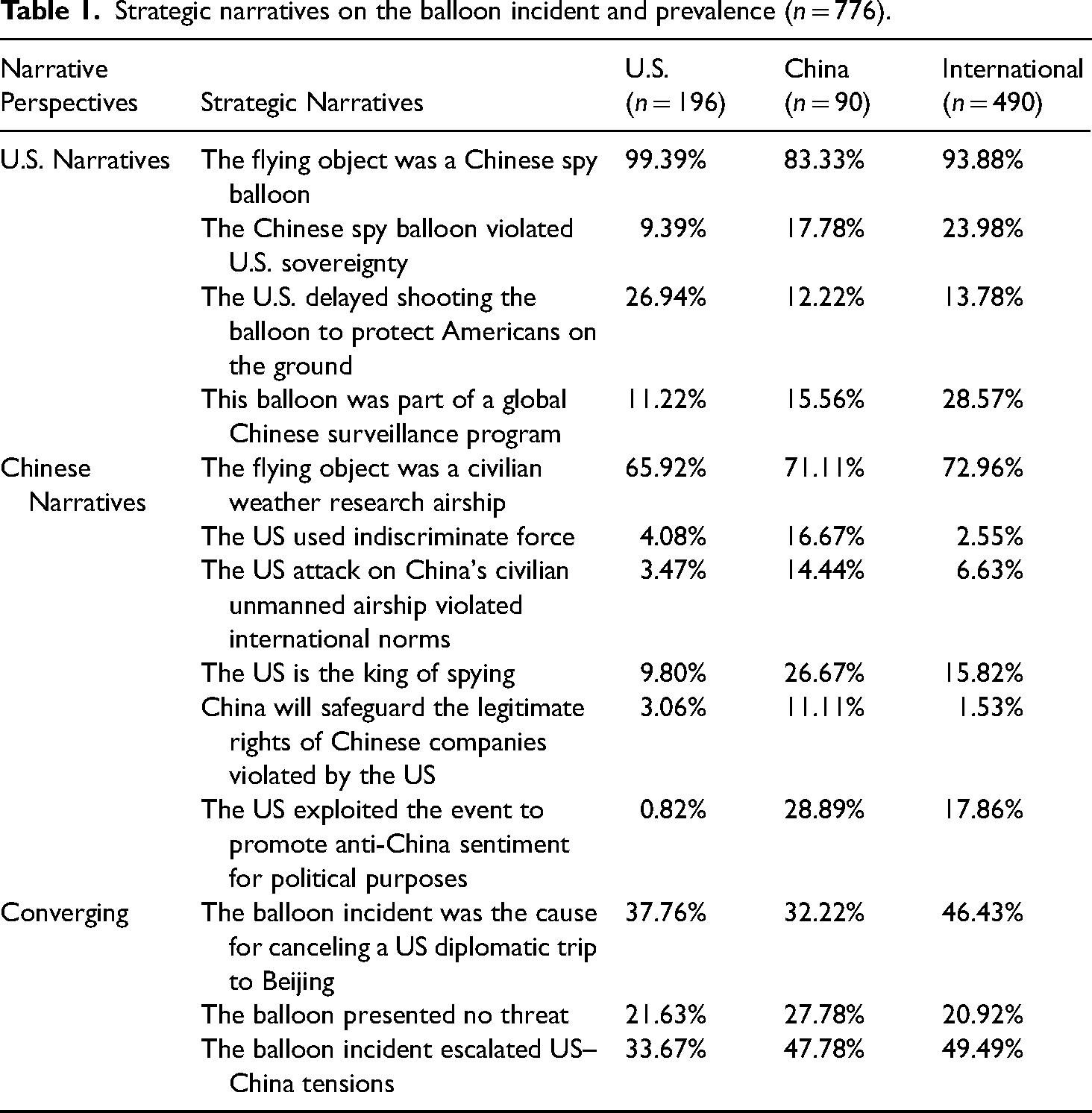
In response to RQ1 which sought to examine major strategic narratives in the global news coverage of the balloon incident, a multistep narrative analysis was conducted. There are 13 strategic narratives identified in the sample (N = 776). They were categorized according to their perspective of supporting the U.S., China, or converging. Table 1 shows the strategic narratives on the balloon incident and their prevalence in the U.S. (n = 196), Chinese (n = 90), and international media (n = 490). The following section analyzes the strategic narratives qualitatively in detail (see Appendix B for the metadata of the analyzed news articles).
Strategic narratives on the balloon incident and prevalence (n = 776).
U.S. Narratives
The flying object was a Chinese spy balloon
The dominant U.S. strategic narrative advanced the notion that the object spotted flying over Montana was a Chinese surveillance balloon that entered U.S. airspace, which can obtain intelligence over sensitive locations. The balloon was interpreted as a machine for surveillance, described in the news as a “surveillance satellite,” a “spy balloon,” “a surveillance vehicle,” and a “Chinese surveillance balloon.” The event was framed as a matter of spying, where terms such as “Chinese spy balloon fiasco,” “spy balloon row,” “spy balloon drama,” and “spy balloon episode” emphasized the nature of espionage. This was the most prevalent US strategic narrative. Almost all of the U.S. (n = 184, 99.39%) and international (n = 487, 93.88%) samples, and more than four-fifths of the Chinese news articles (n = 75, 83.33%) circulated this narrative.
The Chinese spy balloon violated U.S. sovereignty
Closely related to the marking of the balloon as a Chinese surveillance tool was the narrative that described the balloon's entry into U.S. airspace as a violation of U.S. sovereignty. This narrative provided nuance on the implications of a Chinese spy balloon flying over U.S. airspace, where the frame of national security elevated the severity of the incident. For example, the Wall Street Journal quoted then U.S. House Speaker Kevin McCarthy describing the event as a “brazen disregard for U.S. sovereignty,” (S1) while a Bangladeshi newspaper reported that U.S. lawmakers were demanding China be held accountable for “an unacceptable violation of U.S. sovereignty” (S2).
The U.S. delayed shooting the balloon to protect Americans on the ground
This narrative rationalized U.S. action, or inaction, in the aftermath of the discovery of a suspected Chinese spy balloon flying over its airspace. It argued that the U.S. tracked the balloon for nearly a week, but delayed any forceful action against it, in the interest of not harming residents on the ground. For example, the Washington Post cited U.S. officials who stated that the government delayed shooting down the balloon due to “concerns about the potential for debris to hit people or property on the ground,” (S3) while India Today Online circulated this U.S. narrative that the delay was intentional since “2000 people in Montana could have been in danger from scattered debris” (S4).
This balloon was part of a global Chinese surveillance program
The spying frame of this incident was further woven into a narrative that suggests a systematic global espionage program carried out by China against dozens of countries across five continents. For example, the Wall Street Journal stated that U.S. officials believed the balloon spotted flying over U.S. airspace was in fact “one craft in a fleet of spy balloons,” (S5) while a New York Times article reported that the balloon was “part of a global surveillance fleet directed by China's military” (S6). This narrative also featured claims that the U.S. was not the only victim of this “broad surveillance program by Beijing” (S6). Qatar's Gulf Times reported that a White House spokesperson had “accused China of violating the sovereignty of the United States and more than 40 other countries across five continents with surveillance balloons linked to its military” (S7). This strategic narrative highlighted the identity of China being a surveillance state, where the spying frame allowed the storyline to expand beyond a single incident to a more widespread practice of China, thus illuminating the characteristics of the regime.
Chinese narratives
The flying object was an unmanned research airship
The dominant narrative from China followed the official account that defined the flying object as a weather research airship and adopted the frame of accident. The storyline suggested that a civilian airship, whose purpose was meteorological research, had accidentally flown into U.S. airspace due to “force majeure,” the Westerlies. This narrative was found in the majority of the Chinese (n = 64, 71.11%), U.S. (n = 143, 65.92%), and international (n = 323, 72.96%) news articles. The nature of the flying object was framed as harmless “airship,” “meteorological vessel,” “unmanned weather airship,” “weather balloon,” and “unmanned civilian airship.” For example, China's Global Times quoted a Chinese Foreign Ministry spokesperson stating that “the unintended entry of the unmanned Chinese civilian airship into US airspace [was] due to force majeure” (S8).
The US used indiscriminate force
China also advanced a narrative that framed U.S. action, specifically the shooting down of the civilian airship, as an overreaction and an unnecessary forceful use of military power. For example, the New York Post cited Chinese Foreign Ministry spokesman Wang Wenbin accusing the U.S. of “overreacting in shooting [the airship] down with a missile fired from an F-22 fighter jet off the coast of South Carolina” (S9). Similarly, China's Macau Daily Times reported that China had “accused the United States of indiscriminate use of force” in shooting down the balloon and quoted Chinese Vice Foreign Minister Xie Feng stating that China had lodged a formal complaint with US authorities over the US “attack on a Chinese civilian unmanned airship by military force” (S10).
The US attack on China's civilian unmanned airship violated international norms
China also framed the shootdown in legal terms, as a violation of Chinese sovereignty and international norms. For example, China Daily quoted the Foreign Affairs Committee of China's top legislature stating that the U.S. had “violated ‘the spirit of international law and basic norms in international relations’ by insisting on using force to shoot down the airship and hyping up the incident,” (S11). Similarly, The New York Post reported that China had warned it would “retaliate against the US for allegedly undermining its sovereignty after the Air Force downed a spy balloon” (S9).
The US is the “king” of spying
China advanced a narrative that accused the U.S. of conducting surveillance missions against not only China but many other countries. The spying frame was employed to illuminate the identity of a surveillance state, similar to the logic in U.S. strategic narratives. For example, the South China Morning Post reported that “some U.S. balloons have flown over Xinjiang and Tibet without Beijing's permission,” while Ireland's Irish Independent reported the accusations from China that suggest U.S. “high-altitude balloons have undergone more than 10 illegal flights into Chinese airspace,” in the last one year (S12). The spying frame helped extend this narrative to incorporate previous incidents involving global surveillance networks operated by the U.S. into the storyline, such as the PRISM surveillance program. The New York Times, for example, quoted a Chinese foreign ministry spokesman who stated the U.S. operated the “largest spy network in the world” (S13). These narrative elements reinforced the characterization of the U.S. being the “king” of spying.
China will safeguard the legitimate rights of Chinese companies violated by the U.S.
Another narrative that emerged from China indicated that the country intended to protect the rights of Chinese companies that had found themselves in the middle of the U.S.–China furor. This narrative emerged in response to a decision by the U.S. Commerce Department to impose trade restrictions against six Chinese entities that were alleged to be working with the Chinese government to surveil the U.S. A New York Post article quoted Chinese officials stating that the U.S. had used the balloon incident as “a pretext to illegally sanction Chinese companies and institutions” (S9). Likewise, China's Global Times cited a former Chinese senior trade official who stated that “the airship incident has given the U.S. yet another excuse to abuse export controls targeting Chinese businesses” (S8). This narrative also featured threats of retaliation by China against U.S. companies. The New York Times reported that China would take “countermeasures” against “relevant American entities” (S5).
The U.S. exploited the event to promote anti-China sentiment for political purposes
This narrative framed U.S. responses as malicious, where it exploited the balloon incident for political purposes but not for a just cause. The storyline in this narrative highlighted the internal divisions in the U.S. and accused the Biden administration of trying to get a rally-round-the-flag effect for elections. China was the victim in this story. For example, a China Daily article reported the U.S. “inflamed public political animosity toward China” (S14). The same article stated that “hawks in the U.S. saw the incident as a gift allowing them to smear China” adding that the U.S. exploited the event “to appease voters” (S14).
Converging narratives
Balloon incident was the cause for the cancelation of a US diplomatic trip to Beijing
This narrative attributed the cause of the cancellation of a planned China trip by U.S. Secretary of State Anthony Blinken to the balloon incident. The U.S. and China framed the cancellation of the landmark event in repairing diplomatic relations slightly differently. The U.S. national security frames suggested it was impossible to go ahead with the trip after an attack on U.S. sovereignty. News coverage also articulated concerns that the Biden administration would face criticism of being soft on China if Blinken's trip continued. Meanwhile, Chinese frames suggested that U.S. behaviors were disingenuous. It implied that the U.S. did not actually intend to repair relations with China, and the balloon incident became a “convenient excuse” for postponing Blinken's trip (S14). For example, a China Daily article reported that Sec Blinken had “revealed his insincerity in the pursuit of a healthy relationship with China by postponing his visit” (S14).
The balloon presented no threat
The U.S. and China both circulated a narrative that positioned the object spotted in U.S. airspace as being harmless, albeit employing different frames. The U.S. used this narrative to justify why the balloon was not immediately shot down, while China tried to fend off claims of espionage. For example, the New York Times reported that the Biden administration believed “the vessel posed no threat to Americans,” (S6) while a China Daily article quoted a Chinese Foreign Ministry official stating “the airship poses no threat to any country” (S15). Other coverage dismissed the security threat posed by the balloon suggesting China has more sophisticated options at its disposal such as satellite equipment.
The balloon incident escalated US–China tensions
This narrative suggests that the balloon incident had caused harm to U.S.–China relations. For example, the New York Times reported that “tensions between the United States and China escalated on Monday as the two nations traded fiery accusations over spying programs,” (S16) while the South China Morning Post reported that relations between the two countries had reached “a new low” (S17). The actions taken by the U.S. and China—including the shootdown of the balloon, U.S. trade sanctions, canceled diplomatic trip, refusal of Chinese officials to hold telephone conversations with the U.S., and the trading of accusations about global spy programs—were framed as causing an escalation of tensions between the two countries.
Strategic narratives projection patterns
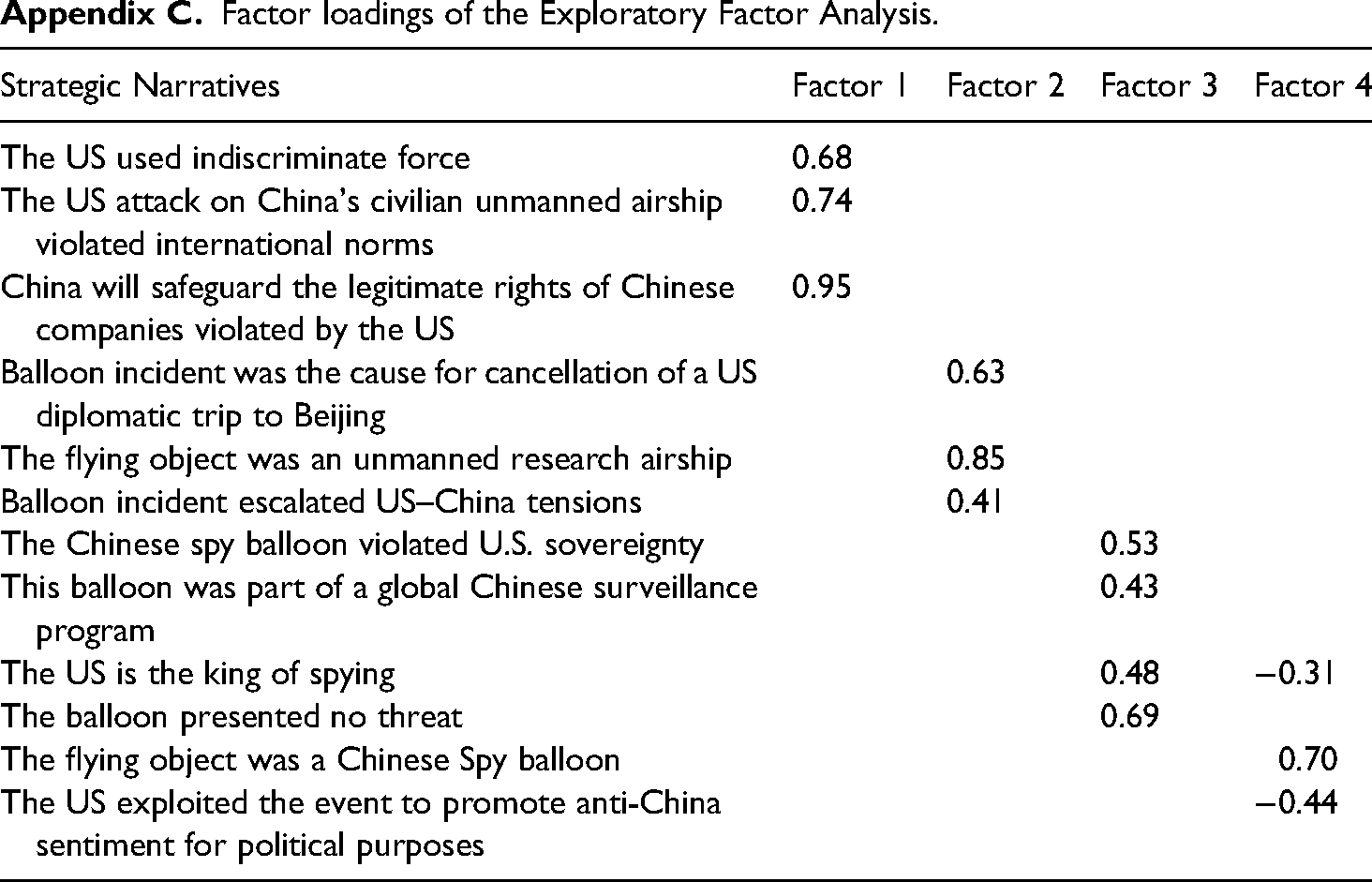
To answer RQ2 which sought to examine the patterns in the projection of strategic narratives, the patterns of narrative projection were quantitatively assessed with exploratory factor analysis (EFA). The narrative The U.S. delayed shooting the balloon to protect Americans on the ground narrative was excluded from this analysis due to a low MSA = 0.46. Four factors were identified (see Appendix C for factor loadings), suggesting four patterns in the projection of strategic narratives in the news environment.
The first pattern suggested the attempted projection of three Chinese strategic narratives, The U.S. used indiscriminate force, The U.S. attack on China's civilian unmanned airship violated international norms, and China will safeguard the legitimate rights of Chinese companies violated by the U.S. As informed by the prevalence of these narratives (see Table 1), they were more exclusively observed in Chinese news articles but not in the U.S. or international sample (all in single-digit percentage). It reflected a failure of the projection of this combination of strategic narratives.
The second pattern concerns the implications of the balloon to U.S.–China relations, which includes the strategic narratives of The balloon incident was the cause for canceling a US diplomatic trip to Beijing, The flying object was a civilian weather research airship, and The balloon incident escalated U.S.–China tension. They were the narratives most prevalent in the international media. The prevalence of the weather research airship narrative agrees with the findings above, suggesting that the dominant Chinese narrative was widely picked up by the international media. The spy balloon narrative was not included in this narrative likely due to its overall prevalence in all news sources. International media also frequently mentioned the cancellation of a US diplomatic trip (46.43%) and U.S.–China tension (49.49%) narratives. The combination suggests that international news media tends to reference the dominant strategic narratives from the U.S. and China while projecting strategic narratives that concern the escalation of the situation. As narrative sponsors, other countries might have negotiated the global coverage by supplying an alternative view that concerns the detreating U.S.–China relations and its impact.
The third pattern sees a direct contest on the concept of spying between the U.S. and China. Although the balloon was considered not a threat by the U.S. (21.63%) and China (27.78%), both countries argue over the symbolic meaning of spying. The co-occurrences of the following strategic narratives show that both countries referenced and argued against each other. The U.S. established that the balloon violated its sovereignty and built on the balloon incident to suggest a global Chinese surveillance program that targeted other countries. China rejected this storyline and proposed that The US is the king of spying. Strategic narratives from both countries try to make a connection to the identity of their counterpart. In terms of narrative projection in the international media, the U.S. narratives of violated sovereignty (23.98%) and Chinese surveillance program (28.57%) were stickier than the Chinese king of spying narrative.
The fourth pattern shows an indirect contest of mutually exclusive strategic narrative projections. The EFA result suggests that while the Chinese spy balloon narrative was positively loaded into the fourth factor, The US is the king of spying and The US exploited the event to promote anti-China sentiment for political purposes narratives were negatively loaded. It means that if news articles mentioned the latter two narratives, it is less common to see the spy balloon narrative. Because the latter two narratives were much more prevalent in the Chinese coverage (26.67% and 28.89%, respectively) than in the U.S. coverage (9.8% and 0.82%, respectively), it suggests a Chinese effort to ignore the spy balloon narrative and insert an alternative storyline. Nevertheless, the U.S. did not reciprocate these narratives, although these Chinese strategic narratives gained slightly more traction in international media (15.82% and 17.89%, respectively).
Discussion
This study demonstrates the utility of the strategic narratives framework in untangling the flow of international political communication in the news environment and contributed to the development of a systematic machine-learning-aided method to analyze strategic narratives. This approach gives nuances while informing a general pattern in strategic narrative projection. Strategic narrative contests may happen directly and indirectly to negotiate the balloon incident.
The U.S. continues to dominate the international media environment with the spy balloon narrative which set the tone for the event. It means that global responses to the balloon incident were largely based on this narrative, to concur or to reject, registering the incident as a matter of surveillance internationally and forcing China to engage in the spying storyline. China proposed an alternative narrative, suggesting that the balloon incident was a civilian weather research airship affected by strong winds. The narrative utilized internationally recognized legal concepts such as “force majeure” to describe the event, trying to make a connection to the international system narratives of the rule of law. As an official narrative, it was widely circulated internationally. The two narratives above were the backbone of two contesting storylines.
The findings suggest how this strategic narrative contest shapes worldviews. In an attempt to leverage the balloon incident to engage identity narratives, both countries contested directly in attributing the image of a surveillance state to each other. The EFA result shows that the balloon violated U.S. sovereignty and Chinese surveillance program narrative co-occurred with the king of spying narrative in part of the news coverage, while the prevalence of these narratives suggests that the former two U.S. strategic narratives were more common internationally. The U.S. may have won this contest by projecting its version of the spy story to the international media environment. First, this phenomenon illustrated the spy balloon issue narrative successfully engaged the identity narrative of China being a surveillance state. Second, it provided evidence that shows the U.S. dominance in narrative projection. Third, the Chinese counternarrative was less effective, even though explicit references were made to the U.S. PRISM surveillance program. This pattern implies that the framing in the initial issue narrative could be crucial in the following narrative contest that expands to the identity and system levels (Miskimmon et al., 2017; Ringsmose and Børgesen, 2011). Accordingly, the Chinese king of spying narrative did not gain traction because it does not align with the civilian weather research airship narrative which forms the backbone of Chinese storytelling. From a soft power point-of-view, the United States’ relative success in diffusing narratives about the balloon and connecting it to the state identity of China illustrates the noncoercive power of the U.S. in co-constructing an international image that was beneficial for the U.S.
An indirect strategy for contesting strategic narratives was identified. While ignoring the spy balloon narrative, China deployed aggressive strategic narratives that accuse the U.S. of being the king of spying and explained the balloon incident as a “political manipulation” that promotes an anti-China sentiment for domestic U.S. politics. Instead of establishing a counternarrative to redefine the nature of the balloon incident, this strategy targeted the motivation behind the spy balloon narrative. Specifically, the anti-China sentiment narrative perceived U.S. politicians played tough on China to gain “political points” for elections. This narrative engages the national image of the U.S. being a divided bipartisan state, and a broader depiction of democracy where foreign relations were sacrificed for domestic political competition in democratic systems. Nevertheless, it should be noted that this narrative was not widely circulated internationally. It is likely that this strategy targeted the Chinese diaspora abroad (Yan and Li, 2021), especially because the lack of contextualization of the spy balloon narrative suggested an assumed knowledge of the U.S.-dominant narrative. Findings illustrate the inertia of U.S. soft power that might not be easily challenged by alternative narratives that describe a worldview against the hegemon. It might require long-term cultivation of consistent counternarratives from China to change global perceptions, which was initiated as China grew its international influence (Zhao, 2015).
This study provided evidence to evaluate the narrative strategies of other countries in responding to an international crisis. Hagström and Gustafsson (2021) suggest that political actors in other countries try to mitigate the risks in the U.S.–China rivalry by narrative hedging, the act of relaying narratives from both sides and advancing alternative strategic narratives. Kluver et al. (2019) suggest that political actors in other countries can utilize the raw material in an event for generating their own strategic narratives. A similar pattern was observed, while the spy balloon narrative was widely circulated internationally, the patterns found in EFA suggest that the international media balanced that with the Chinese civilian weather airship narrative. Meanwhile, the international media also played a role of narrative sponsor by projecting alternative narratives concerning the deteriorating U.S.–China relations. Findings support the narrative hedging theory while showing the fundamental differences in hedging the narrative risks in geopolitical and international crises. Hagström and Gustafsson (2021) investigated strategic narratives in COVID-19, which is a global pandemic that every country needs to handle. It gave incentives to political actors to project strategic narratives that aligned with their policy objectives. Nevertheless, the balloon incident only involves two major powers, presenting a situation where the U.S. and China contest for international support for their case. Most of the other countries were not stakeholders but narrative sponsors in this scenario. Quantitative findings suggest that strategic narratives did get relayed substantially by the international media. This finding adds an extra dimension to evaluating hedging in narrative projection, suggesting that strategic narratives could be projected more easily in geopolitical events than in global crises.
Limitations
Limited by the scope of Nexis Uni, there are more news articles sampled from news media in English-speaking liberal democracies. It suggests that the sample does not represent an overview of how media in all parts of the world reported the balloon incident. Constrained by the databases, this study sampled news in 34 other countries from most continents, except South America. Meanwhile, this study only sampled English-language media because they were more likely to be read and referenced globally. It showed the big picture painted by the circulation of the U.S. and Chinese narratives internationally. Future research can improve by sampling news in other international languages, such as French or Spanish, as they also contribute to strategic narrative projection, especially in Africa and the Americas. Meanwhile, the authors were aware that factors identified in the EFA may not demonstrate a clear structure in technical terms, where some item loadings were relatively lower and the king of spying narrative cross-loaded into two factors. Instead of generalizing a theory of strategic narrative projection from the results, results should be interpreted as an inductive effort to map the patterns in the balloon incident coverage which informs tendencies in narrative projection strategies in this case.
Conclusion
This study analyzed strategic narratives projection in the U.S.–China balloon incident in the international news environment. The findings suggest that strategic narratives projection reflected the power dynamics in the international system, where China tried to counterbalance the U.S. global narrative power. The U.S. continued to dominate the media space with the spy balloon narrative that was circulated by most countries, reinforcing the identity of China as a surveillance state. China challenged it by supplying an alternative civilian weather airship narrative but failed to align with the identity narrative that depicted the U.S. as promoting an anti-China agenda. Thus, it became difficult to challenge the spy balloon narrative. The soft power advantage of the U.S. was maintained. Internationally, evidence supports the narrative hedging theory where countries try to balance the narratives from two major powers while presenting narratives that work for their national interest. The findings contribute to the understanding of the mechanisms in strategic narrative projection contest and demonstrate the utility of the theoretical framework in unfolding the flow of international political communication in the news environment. The adaptation of a human-in-the-loop machine-learning narrative analysis opens the avenue for nuanced large N studies in the future.
Footnotes
Declaration of conflicting interests
The author(s) declared no potential conflicts of interest with respect to the research, authorship, and/or publication of this article.
Funding
The author(s) received no financial support for the research, authorship, and/or publication of this article.

Appendix
Factor loadings of the Exploratory Factor Analysis.
| Strategic Narratives | Factor 1 | Factor 2 | Factor 3 | Factor 4 |
|---|---|---|---|---|
| The US used indiscriminate force | 0.68 | |||
| The US attack on China's civilian unmanned airship violated international norms | 0.74 | |||
| China will safeguard the legitimate rights of Chinese companies violated by the US | 0.95 | |||
| Balloon incident was the cause for cancellation of a US diplomatic trip to Beijing | 0.63 | |||
| The flying object was an unmanned research airship | 0.85 | |||
| Balloon incident escalated US–China tensions | 0.41 | |||
| The Chinese spy balloon violated U.S. sovereignty | 0.53 | |||
| This balloon was part of a global Chinese surveillance program | 0.43 | |||
| The US is the king of spying | 0.48 | −0.31 | ||
| The balloon presented no threat | 0.69 | |||
| The flying object was a Chinese Spy balloon | 0.70 | |||
| The US exploited the event to promote anti-China sentiment for political purposes | −0.44 |