




Abstract
In response to the COVID-19 pandemic, health- and civil-contingency agencies—referred to here as public health authorities (PHAs)—in Sweden, Norway, and Denmark turned to social media to disseminate pandemic recommendations and information. This study explores the social media crisis management strategies employed by Scandinavian PHAs. Specifically, we apply a multiplatform research approach to assess communication objectives (Instruct, Support, Manage Reputation, and Solicit Interaction) across three social media platforms—Facebook, Instagram, and Twitter (currently known as X). Introducing a series of hypotheses based on previous scholarship, we detail the prevalence of different objectives across platforms and countries. The results indicate prominent use of reputational management, particularly on Twitter, while instructive information emerged as a highly used communication objective in Sweden and Denmark. Overall, the communicative trends remained parallel across nations, despite Sweden implementing a more relaxed crisis management strategy. The main distinction in Sweden’s approach manifested in a relatively lower emphasis on the pandemic by its PHAs compared to Denmark and Norway. National differences in crisis communication objectives indicate that Norwegian PHAs stand out in terms of using reputational management, while Sweden stands out in employing more supportive information on Instagram.
Introduction
Crises related to health, especially pandemics, generate significant levels of uncertainty and fear in populations. Government institutions and public actors tasked with managing the resulting confusion need strategic and effective communication strategies to foster cognitive, emotional, and behavioral learning to encourage individuals to adopt evidence-based self-protective measures and mitigate risks (Soares et al., 2022). Indeed, effective strategic crisis communication from public health authorities (PHAs), while operating as health experts, can be a vital aspect of public crisis management—especially as information and guidance increase citizen empowerment and the public’s self-efficacy, thereby reducing the overall threat (Ihlen & Vranic, 2024; Palttala et al., 2012). During the COVID-19 pandemic, online platforms and hyperpartisan sources became important channels for news consumption (Larsson, 2023; Nord et al., 2021). Social media, in particular, emerged as a preferred tool for information dissemination and social interaction (Lilleker et al., 2021; Piltch-Loeb et al., 2021)—especially so, it would seem, in Denmark, Norway, and Sweden—three countries that are often described as high-choice media environments or hybrid media systems (Nord et al., 2021). To be precise, platforms such as Facebook, Instagram, and Twitter (currently known as X) became important channels where authorities could disseminate information regarding COVID-19 mitigation measures, including mandates, recommendations, and outbreaks. These platforms also served as a tool for PHAs to engage with the public (Lindholm et al., 2023) and solidify their status as trusted sources of information.
Although the three Scandinavian countries are often viewed as quite similar, they adopted different approaches to managing the COVID-19 pandemic. Sweden adopted a more lenient strategy, avoided strict lockdowns, and primarily relied on voluntary guidelines (Ludvigsson, 2020). In contrast, Norway and Denmark implemented stricter lockdowns, closed non-essential businesses, and restricted mobility (Ihlen, Johansson, & Blach-Ørsten, 2022). As alluded to previously, public health agencies and civil contingency agencies (collectively referred to as PHAs) in the three Scandinavian countries used social media to disseminate information on infection control, quarantine, vaccination, and related topics (Ihlen, Just, et al., 2022). They also used interactive platforms to maintain credibility and legitimacy, engage public interest, and encourage compliance with public health measures. Building on this, this study explores how Scandinavian PHAs communicated crisis mitigation information on social media during the COVID-19 pandemic and investigates the extent to which different communication objectives (Inform, Support, Manage Reputation, and Solicit Interaction) were employed. Specifically, we apply a double comparative analysis across countries and platforms to assess communication objectives across three social media platforms—Facebook, Instagram, and Twitter. We take a longitudinal approach, studying these issues during a 2-year time period starting in February 2020—the start of the pandemic.
Exploring the use of social media as tools for crisis communication during a public health emergency, the study presents the following research questions:
RQ1. What types of communication objectives were featured across different social media platforms?
RQ2. What types of communication objectives were featured across different countries?
Thus, the study presents a comparative understanding of public health crisis communication on social media, and how Scandinavian PHAs communicative patterns evolve over a protracted crisis. As such, it provides insights regarding crisis communication prioritizations and practices of use for researchers as well as practitioners.
The remainder of the article is organized as follows. After this introduction, our literature review introduces previous research on crisis communication objectives, public health management in Scandinavia, stages in crisis communication, and multiplatform communication. Based on this, we introduce our hypotheses. Next, we discuss our methods and analytical approach, followed by a presentation of our findings. These findings are subsequently discussed, leading into a final section presenting limitations of the work performed and suggestions for future research.
Literature Review
Objectives of Crisis Communication
Effective crisis communication, led by credible sources, is essential for preventing and alleviating the various challenges that emerge during pandemics. A well-planned communication strategy can reduce public anxiety and fear, promote adherence to mitigation measures, lighten burdens, and enhance the management of a crisis (Coombs, 2023). According to Sturges (1994), crisis communication has three core objectives. First, at the beginning of a crisis, the primary goal is to offer instructive information that guides the public on recommended behaviors and actions and explains the current situation. After, crisis managers should provide adjusting information, that is, information that provides psychological coping, emotional support, sense-making regarding the crisis, and encouraging resilience. Finally, toward the end of the crisis, the objective is to provide internalizing information designed to repair reputational damage caused by the crisis, thus restoring trust and credibility (Lindholm et al., 2023; Sturges, 1994).
Sturges’ (1994) foundational approach as laid out above emphasizes the need for a broader understanding of crisis communication. So far, crisis communication literature has primarily focused on the third objective as key findings from scholars such as Coombs (2023), Zheng et al. (2018), and Christensen and Lægreid (2020) emphasize how critical reputation is in crisis communication due to its potentiality in eliciting positive responses from stakeholders, thereby maintaining relationships. However, authors like Olsson (2014), in line with Sturges (1994), argue for the necessity of a more comprehensive approach, rather than solely focusing on reputation and blame avoidance. For example, research by Domschat et al. (2023) on the impact of blame attribution during terrorist attacks on brand image underscores the importance of ethical and instructive communication. Their findings indicate that providing sympathy, guidance, information sharing, effective organizational rhetoric, and demonstrating systemic organizational learning can lead to positive public responses. Indeed, they argue that appropriate communication immediately after a terrorist attack can enhance brand image, even surpassing the pre-attack level image, which highlights the importance of instructions in crisis communication. Ozanne et al. (2020) adds to this notion by arguing that instructive information is particularly effective in crises where stakeholders attribute little responsibility to the organization, such as in natural disasters or “victim crises.” Schoofs et al. (2022) further highlight the role of empathy in crisis responses, suggesting that a crisis communication strategy that resonates with stakeholders’ mental states through sensitivity and concern can alleviate suffering and should be reflected throughout the crisis response.
Beyond Sturges’ model, the introduction of social media has made it necessary for contemporary crisis communication to adapt to the interactive nature of platforms such as those studied here. While experiencing quarantine and lockdown measures, citizens turned to online platforms to seek and share near-instant information about the pandemic (Manias-Muñoz & Reber, 2022), thus interacting within different networks and directly with the PHAs. However, research indicates that interactive communication from government sources often remains superficial, with limited comments and restricted dialogue (Tang & Lee, 2013). Despite this, studies show that user interactions with social media posts, such as likes, play a critical role in determining the algorithmic relevance of messages and their subsequent dissemination on social media platforms (Bucher, 2012; Jost, 2023). Moreover, Chen et al. (2020) suggest that government agencies should utilize social media’s interactive features, such as mentions (@) and hashtags (#), to address citizen inquiries and foster more robust interaction.
Starting from the threefold typology suggested by Sturges (1994), Table 1 shows how this initial suggestion has been expanded and complemented in a series of later studies following the original 1994 conception. Taking the influx of social media into account, our typology as presented in Table 1 thus differentiates between four public health crisis objectives: (1) Instruct about pandemic intelligence, emergency recommendations, mitigation actions, accessing resources, and safeguarding actions and behaviors; (2) Support individuals and organizations with advice on how to adapt and adjust, encouraging treatment for physical and mental health, offering emotional support, and fostering a sense of community; (3) Manage Reputation by promoting campaigns and activities, reinforcing its identity (core values and ethical principles), promoting new or past collaborations or studies, transparency regarding shortcomings or mistakes, and corrective measures; and (4) Solicit Interaction by prompting or encouraging responses or discourse by asking for likes, comments, shares, and offline or online discussion regarding the information provided.
Communication Objectives.

With our typology in place, the next section reviews previous, similar scholarship and introduces our hypotheses.
Crisis Mitigation During COVID-19 in Scandinavia
In response to the pandemic, the Scandinavian countries differed in crisis approach. However, Denmark and Norway responded somewhat similarly by implementing swift lockdown measures and enforcing strict infection prevention protocols (Carlsen et al., 2021; Kalsnes & Skogerbø, 2021). Denmark’s strategy, often called the “hammer and dance,” featured rapid government action and relied on Scandinavian cultural values that emphasize respecting personal boundaries (Mens et al., 2021; Olagnier & Mogensen, 2020). Similarly, in Norway, key government figures highlighted the seriousness of the pandemic (Fiskvik et al., 2023) and encouraged a collective sense of responsibility, linking cultural values like trust and “dugnad” (voluntary communal work) to effective crisis management (Shapiro et al., 2023).
Sweden, in contrast to Denmark and Norway, took a different approach to the COVID-19 pandemic, relying more on “nudges” and recommendations to “flatten the curve,” focusing on containment rather than outright prevention (Johansson & Vigsø, 2021). At the time, Sweden faced criticism for inconsistency, lack of transparency, imprecise recommendations (Rasmussen, 2022), and a disproportionately high number of deaths among residents in elder care (Carlsson et al., 2020). Altogether, this led to a questioning of the efficacy of the PHAs as trusted health experts.
In the first wave of the pandemic (March 11 to June 10, 2020), Lindholm et al. (2023) observed that Scandinavian health agencies primarily delivered instructive messages on Twitter, aligning with Sturges’ (1994) model to instruct in the initial stage of a crisis. However, when contrasting the findings from each Scandinavian country, the Danish Health Authority focused more on providing emotional support in comparison to its counterparts, while Norwegian health authorities concentrated on managing their reputation more than Denmark and Sweden. According to Sturges (1994), reputation management is generally best addressed in the later stages of a crisis, making Norway’s early emphasis noteworthy. Lindholm et al. (2023) and Kalsnes and Skogerbø (2021) suggest this focus on reputation management might stem from rumors of disagreements between government officials and PHAs over pandemic management. In addition, Fiskvik et al. (2023) noted that Twitter saw extensive discourse from the Norwegian public concerned with civic responsibility, alternative viewpoints, and questioning of established expertise regarding COVID-19, possibly prompting Norwegian health agencies to take proactive steps to rebuild their reputation. In the case of Sweden, as Seeger and Griffin Padgett (2010) argue while a crisis can have identifiable victims, such as the elderly, the wider audience can also be deeply affected and traumatized. As such, restoring trust in the system is crucial to effective crisis response. Based on the above, we assume that:
H1. Across all three studied countries and throughout the studied time period, PHAs prioritized the objective of managing reputation.
With Sweden’s more relaxed approach, at the onset of the COVID-19 pandemic, the virus was portrayed as a significant threat to high-risk groups (such as the elderly and those with underlying health conditions), and as a lower risk to the general population, and the guidance advocated for self-isolation when exposed, while schools, restaurants, shops, and factories continued their operations (Johansson & Vigsø, 2021). It thus stands to reason that the PHAs in Sweden paid less attention to the pandemic compared to Norway and Denmark where the pandemic was depicted as an ongoing societal danger and that therefore:
H2. Swedish PHAs posted less about COVID-19 than their Scandinavian counterparts throughout the studied time period.
Stages of Crisis Communication
Similar to Sturges (1994) and Zhao et al. (2018), our study follows a three-stage approach to crisis development, with an initial phase, a middle or maintenance phase, and an end-stage or resolution phase. Although the COVID-19 pandemic was a public health crisis that lasted for over 3 years, previous scholarship still suggests certain trends. Indeed, as Lindholm et al. (2023) demonstrated, a prioritization of instructing the public about the novel coronavirus occurred in the initial phase of the crisis. Following Sturges’ (1994) recommendations, as the crisis progresses, the PHAs’ focus should shift toward supporting the public, as maintaining motivation becomes crucial. Then, at the resolution of the crisis, we expect to see more emphasis on reputational management to restore stakeholder relations and public trust. Thus, we hypothesize:
H3. Across all three studied countries, PHAs prioritized the objective of instruct during the initial phase.
Cross-Platform Risk Communication
In Sweden, in 2022, Instagram was the most popular social media platform, with 60% of the population as active users (Ohlsson, 2023). Facebook was used by 54% of Swedes, while Twitter had a much smaller user base, at just 12% (Ohlsson, 2023). In Norway, in 2022, Facebook was the leading platform, with 69% of users, followed by Instagram with 45% (Ipsos, 2023). Likewise, in Denmark, Facebook was the most prominent social media platform, with 84% of the population actively using it, followed by Instagram at 56%, and Twitter with a 13% user penetration rate (Danmarks Statistik, 2023). Given that Facebook was the most widely used platform in both Denmark and Norway in 2022, and the second most popular in Sweden, PHAs should likely prioritize Facebook for disseminating information and engaging with a broader audience, and we hypothesize that:
H4. PHAs disseminate COVID-19-related content more frequently on Facebook.
Different social media platforms attract users from various socio-demographic groups, based on factors like gender, age, and income (Wawrzuta et al., 2022). Consequently, no single social media platform attracts a fully representative cross-section of society. This implies that to understand how PHAs communicated with the public via social media during the pandemic, it is necessary to consider how each platform’s unique characteristics influenced communication strategies. By comparing communication patterns across platforms and nations, we can obtain a more nuanced view of how crisis communication was perceived and disseminated (as suggested by Liu et al., 2020; Matassi & Boczkowski, 2023). Notably, Facebook and Instagram tend to appeal strongly to younger generations and women (Danmarks Statistik, 2023; Ipsos, 2023; Ohlsson, 2023). Twitter, in contrast, attracts users who are more likely to be men and highly educated (Danmarks Statistik, 2023). Twitter also plays a significant role for media organizations, serving as a key channel for news dissemination and community building (Rega, 2021; Russell et al., 2023). Given that Twitter is a platform where PHAs can connect with the press, media personalities, and organizations (Larsson & Christensen, 2017), we propose the following hypothesis:
H5. Twitter was primarily used to manage reputation.
Methodology
Data Collection
To help illustrate the statements of PHAs, data from three platforms (Facebook, Instagram, and Twitter) are presented. The data consist of content by seven Scandinavian PHAs with public health crisis communication responsibilities, posted between February 1, 2020 and February 1, 2022—a time frame comprising the most prominent stages of the crisis in Scandinavia (G.S.S.O., N. G. S., & S. O, 2023). Table 2 provides an overview of our data.
Overview of Collected Data.

The data selection for this study is based on previous research on the communication strategies of health authorities and government actors, including studies by Lindholm et al. (2023) and Almlund et al. (2023). In addition, consideration was made regarding public institutions responsible for disseminating information in cooperation and coordination with the national public health agencies through government press conferences, such as updates on the crisis, vaccination strategies, and recommendations (Ihlen, Just, et al., 2022).
A total of 4,569 posts were retrieved from the selected period. Specifically, 2087 tweets, 1832 Facebook posts, and 650 Instagram posts were downloaded from the official accounts of the Scandinavian PHAs, using CrowdTangle (for Facebook and Instagram) and the Twitter Academic API. Table 2 also shows that despite having Instagram accounts, the Danish Medicines Agency and the Public Health Agency of Sweden did not use this platform during our studied time period.
Data Analysis
This study utilized quantitative content analysis to examine data, where each social media post served as the unit of analysis. A codebook was constructed to guide the coding process. Posts were first coded for their relevance to the pandemic. We employed a broad lens, including references that did not specifically mention the pandemic but alluded to a corresponding consequence of the pandemic (e.g., increased loneliness, pressured health care workers, and vaccination hesitancy). After this initial classification, we assessed the use of communication objectives by developing four dichotomous variables—one for each part of our typology (see Table 1). Thus, we coded for the presence or absence of the four mentioned communication objectives—(1) Instruct, (2) Support, (3) Manage Reputation, and (4) Solicit Interaction. All posts were coded for these four variables, regardless of the post dealt with the pandemic or not (as decided by the previous variable). Coding was performed so that each post could include any number of objectives. In practice, however, the vast majority of posts contained were found to feature one (N = 3030, 66.3%) or two (N = 1362, 29.8%) objectives.
Inter-coder reliability for these variables was assessed by having the first author code all 4,569 social media posts. The second author re-coded a random 10% sample of the full data set. Employing Krippendorff’s α (Krippendorff, 2008), α measured reliability at .8 and upward, suggesting a high level of inter-coder reliability.
Findings
For our findings, we turn first to looking at how the PHAs in the three studied countries prioritized between the three studied platforms.
National Uses of Social Media Platforms
As illustrated in Figure 1, the data indicate that in Norway and Sweden, Twitter took precedence over Facebook and Instagram. The Danish PHAs in contrast prioritized Facebook more than Twitter. Instagram emerged as the least utilized social media platform across all three nations. Thus, Sweden and Norway prioritized platforms that are not the most popular among the population, as Instagram was the most popular platform in Sweden and Facebook was the most popular in Norway.

Number of social media posts per platform and country.
Beyond the assessment of overall use, we now turn to the degree to which the different platforms were used to feature issues related to the pandemic. Figure 2 provides insights in this regard.
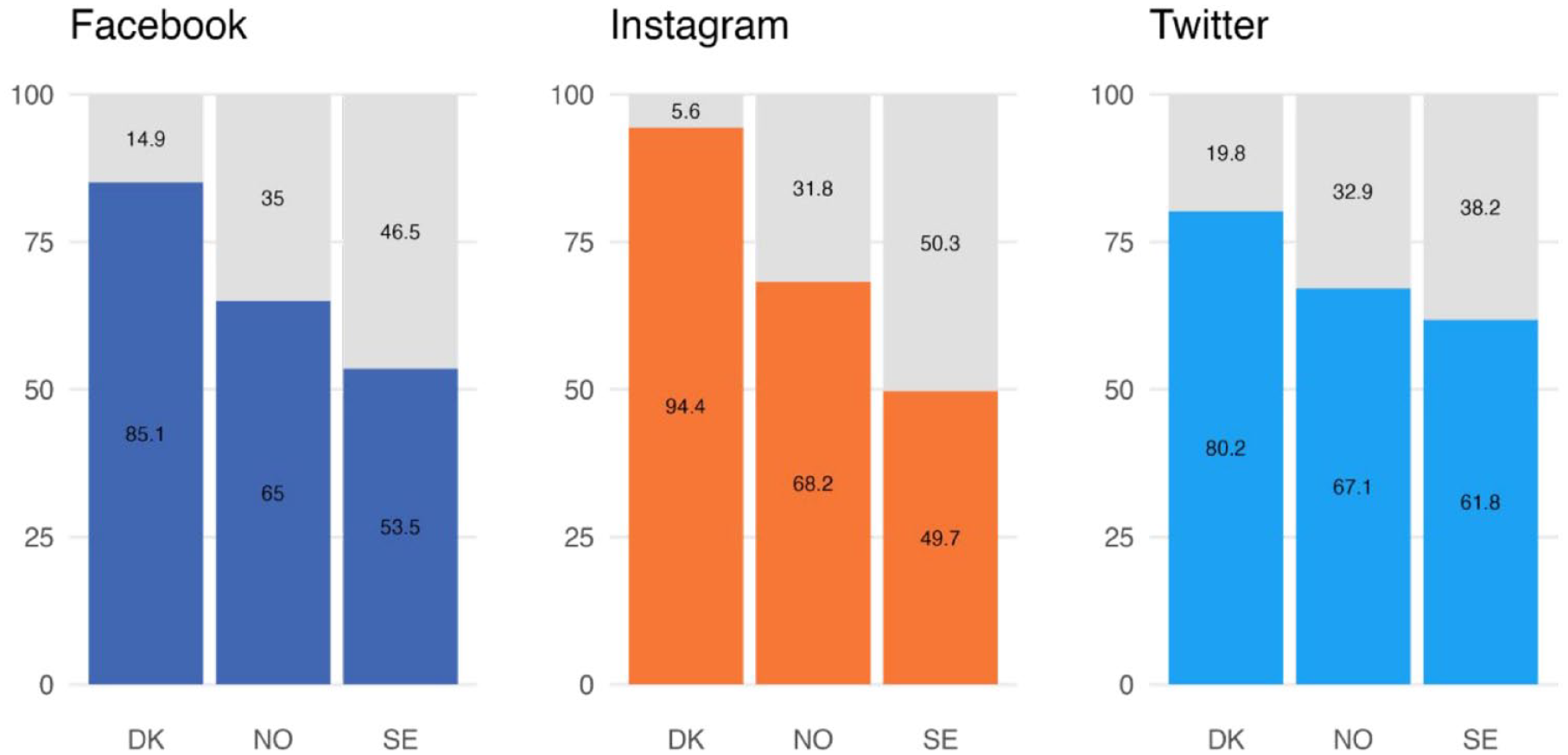
Percent of social media posts depicting COVID-19 per platform and country.
Frequency analysis of posts containing COVID-19 information demonstrates that the Danish PHAs were most active in discussing the pandemic, as depicted in Figure 2. Indeed, with 85.1% (N = 751) of Facebook posts, 80.2% (N = 652) of tweets, and 94.2% of Instagram posts (N = 72), the Danish PHAs had their priorities settled. The same steadfastness is apparent in the Swedish case. With 53.5% of Facebook posts (N = 432), 49.7% (N = 198) of Instagram posts, and 61.8% of tweets (N = 581) dealing with the matter at hand, Swedish PHAs posted less about the pandemic than their Scandinavian colleagues. As Figure 2 indicates, Norway falls somewhere in the middle, and the Swedish PHAs were least inclined to discuss the pandemic across all three social media platforms.
PHAs Use of Crisis Communication Objectives
Given our interest in the usage of communication objectives concerning the pandemic, the forthcoming analysis will focus on only those social media posts that dealt with COVID-19 as shown in Figure 2. With this in mind, Figure 3 details communication objectives usage in posts across countries and platforms, and Figure 4 details how these objectives were utilized across the pandemic. We have included both figures below and will discuss the results presented in combination.
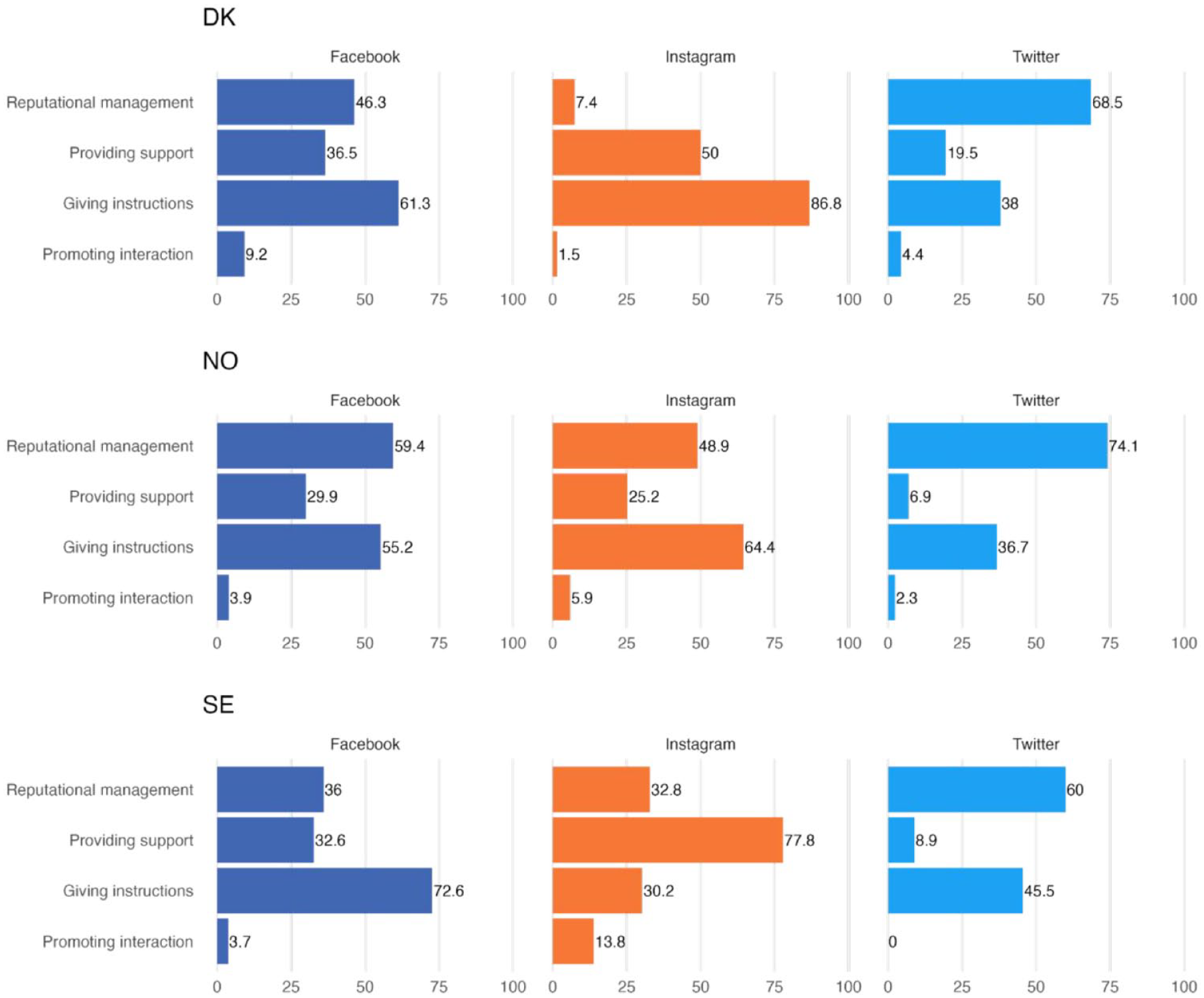
Use of communication objectives across countries and platforms.

Presence of communication objectives across countries and platforms over time.
Findings from the Danish PHAs on Facebook, as shown in Figure 3, indicate prioritization of instructions (61.3%). Figure 4 suggests that this appears to have been a priority primarily at the initial phase of the crisis, a focus that decreased over time. Figure 3 again indicates that both managing reputation (46.3%) and providing support (36.5%) were almost equally utilized, with peaks of use in the maintenance phase and a decrease toward the end of our time period (see Figure 4). Regarding Danish PHAs’ use of Instagram, no longitudinal changes are reported as the PHAs only started posting in the later stages of the pandemic. However, the overall use of Instagram reveals similar results to Facebook as seen in Figure 3 (instructions 96.8%; support 50%; managing reputation 7.4%). Finally, for Twitter, unlike Facebook and Instagram, Danish PHAs viewed managing reputation (70.7%) as their primary communication objective (see Figure 3), with a sharp increase in use in the annual quarters in the middle of the pandemic, with a slow decline toward the end (see Figure 4).
Findings from the Norwegian PHAs on Facebook (Figure 3) indicate prioritization of reputational management (59.4%). Giving instructions is almost as commonly used (55.2%), followed by providing support (29.9%). As seen in Figure 4, most communicative objectives emerged in the initial phase, with a steady decline as the pandemic progressed. Moving on to Instagram and starting with Figure 3, instructions emerge as the primary objective (64.4%), followed by reputation management (48.9%) and support (25.2%). Similar to Facebook, the findings indicate primary use in the first stage of the pandemic, followed by a steady decline. Finally, Twitter, similar to Facebook, saw managing reputation (74.1%) as the primary communication objective (see Figure 3), with instructions as the second most used (36.7%). On Twitter, we see a steady use of instructive and supportive objectives across the pandemic, but for reputational management, we see spikes of usage in the initial and middle phases, followed by a lesser spike in the end stage (see Figure 4).
Finally, for Sweden, Figure 3 suggests that the Swedish PHAs were rather similar to Denmark, in that the objective to instruct was most common on Facebook (72.6%). Reputational management emerged as the second most used objective (36%), closely followed by providing support (32.6%). For Instagram, providing support was found to be the most prolific objective (77.8%). Reputational management was the second most used objective (32.8%), closely followed by providing support (30.2%). Per Figure 4, instructive and supportive objectives emerge most frequently in the first three annual quarters and then decline on Facebook. Instagram sees a sharp spike in usage of support in the beginning, and a smaller spike in reputation management and instructions, followed by steady usage for the rest of the period. For Twitter, the same pattern in Figure 3 emerges in the Swedish case as was evident in Denmark and Norway—with the dominant communication objective as reputational management (60%), followed by instructions (45.5%). As seen in Figure 4, reputational management is most frequent initially, with a spike in usage at the end of the period. Instructions are most frequent in the middle period of the crisis followed by a decline.
Across all countries and platforms, the objective to solicit or promote interaction was scarcely used by the studied PHAs. Thus, while Chen et al. (2020) suggested the usefulness of such communication content to foster trust and engagement, this was not heeded by the organizations studied here—perhaps due to the difficulties associated with handling the comments and responses raised by such efforts (e.g., Koc-Michalska et al., 2021).
In sum, while some similarities could be discerned across countries and platforms—perhaps most notably the tendency for Twitter as mentioned above—the results presented here suggest somewhat differing strategies for our studied PHAs. Overall, we see notable differences in communication priorities per platform and nation, as Instagram is characterized by a high prevalence of instructions for Denmark and Norway and support for Sweden, whereas Twitter is primarily used to manage reputation. We also see a higher prevalence of instructions on Facebook for Swedish PHAs compared to Norway and Denmark. Furthermore, the findings indicate that the communication priorities of PHAs on social media platforms evolved throughout the pandemic in a sporadic and fluctuating pattern. While Sturges (1994) recommends prioritization of instructions at the beginning of a crisis, followed by support, and reputational management toward the end of the crisis, no country or platform followed such a pattern.
Discussion
This article has presented interesting findings regarding comparative Scandinavian public health crisis communication objectives on social media. Summing up our results, we can see that first, Twitter emerged as the preferred platform for disseminating reputational management content, utilized sporadically over time, while instructions were more frequently used on Facebook and Instagram. Second, Sweden, whose crisis mitigation approach relied on more voluntary guidelines, mentioned the pandemic less comparably on all three platforms. Finally, despite operating on social media, PHAs rarely engaged in soliciting interactions or asking for feedback from their audiences.
Turning to our first hypothesis, which proposed that PHAs would focus on managing their reputations, the results in Figure 3 indicate that Twitter was used predominantly for this purpose. In addition, Norway’s PHAs seem to favor using Facebook for reputation management, with instructions coming in as a close second among their communication objectives, echoing similar results from Lindholm et al. (2023), of Norwegian PHAs utilizing reputational management to a higher degree than their counterparts during the first pandemic wave on Twitter. Considering the sometimes contentious or critical discourse on Twitter in Norway (Fiskvik et al., 2023), it is possible that Norwegian PHAs were trying to address potential issues that could erode trust. However, Ihlen, Just, et al. (2022) argue that Norwegian PHAs exceeded both Sweden and Denmark in perceived transparency. Thus, the Norwegian aim of transparency may explain why findings from Norway include more information about the PHAs’ studies, collaborations, planned events, and so on.
Moving on to our second hypothesis, which stated that Swedish PHAs would post less about COVID-19-related messages than their Scandinavian counterparts. The results presented in Figure 2 do indeed demonstrate that the Swedish PHAs were the least frequent in posting such messages on all three platforms. Considering the prevailing perception of COVID-19 as a low-level threat to low-risk individuals (Johansson & Vigsø, 2021), the PHAs’ communication approach indicates a preference for maintaining regular operations over updating the public on developing crisis management measures.
For our third hypothesis, which proposed that PHAs would post more instructions in the first initial stage, looking at longitudinal changes in the communicative patterns of the PHAs (see Figure 4). Our findings support this for the first annual quarter in Sweden and Denmark. However, Norway shows equal use of reputational management and instructions. Looking at how the usage of communication objectives progressed, Figure 4 illustrates a more sporadic and overlapping use of communication objectives contrary to Sturges’ (1994) recommendation of delineating the crisis in three distinct stages. Instead, based on the coding process and our findings, we assert that the communication objectives of PHAs may align more closely with communication campaigns, given the peaks of usage of each objective as visible in Figure 4. Furthermore, as was noted by Ihlen and Vranic (2024), PHAs are likely to face scrutiny over their expertise in managing the pandemic, and given the active and occasionally contentious or lacking nature of social media discourse (Carlsen et al., 2021; Fiskvik et al., 2023), we can suspect a need for the agencies included in our study to continuously attempt to maintain their reputation as public health experts—a suspicion that is seemingly visible in our findings. While this study scrutinizes the broad utilization of communication objectives by PHAs, delving into each peak to ascertain its relation with specific communication campaigns would therefore be an interesting approach for future research.
Our fourth hypothesis suggested that Facebook would be used more to disseminate messages related to COVID-19 than Instagram and Twitter. Findings from the Danish PHAs did show a preference for Facebook over Twitter and Instagram in this regard (see Figure 2). However, both in Norway and Sweden, Twitter was the most utilized platform. Considering Twitter’s smaller user penetration (approximately 15%), and its user segment of key public figures, it can be inferred that Sweden and Norway both prioritized positioning themselves with public actors, while the Danish PHAs who were most active on Facebook, the most popular platform among the general public, prioritized direct communication with the public.
Our fifth and final hypothesis suggested that Twitter would primarily be used for reputational management. As has been discussed previously, the findings support the hypothesis. Previous research from Scandinavia has pointed to Twitter as a platform populated by elites, engaging in discussion and critique of societal actors such as government agencies (Larsson & Christensen, 2017; Larsson et al., 2017), making the platform well-suited for providing internalizing information such as promoting websites, sharing statistics and analytical findings, advertising events, or fostering collaboration with other important actors and organizations in the public arena. While in the first wave of the pandemic (Lindholm et al., 2023), tweets from PHAs were found to primarily contain instructions, our findings which span across 2020 to 2022, instead suggest that Facebook and Instagram were the preferred platforms for this aim, with Sweden’s approach to Instagram standing out by focusing on support. Given the popularity of Facebook and Instagram in Scandinavia during the pandemic, it can be argued that the PHAs strategically utilized Twitter to engage with the type of stakeholders whom reputational management might be best suited for, such as the media, while Facebook and Instagram were used to directly provide the public with updates on current regulations and behavioral guidance.
Beyond our hypotheses, some other interesting tendencies can be noted regarding the communication objectives under investigation—namely the invitation to interact. Our typology expands on Sturges’ (1994) model, which does not include soliciting interaction with those receiving the messages sent. Indeed, the use of social media by the PHAs under scrutiny would suggest an increased adaptation to the interactive affordances of the platforms included, leading to the incorporation of two-way communication during the pandemic. Despite operating on social media, our findings imply that the PHAs prioritized managing their reputations and disseminating behavioral guidance to the public over soliciting interactions and feedback from the audience. This result mirrors previous studies where the government and other similar actors are shown to be hesitant to adopt the interactive possibilities offered by social media (Koc-Michalska et al., 2021; Magin et al., 2017).
Limitations and Future Research
While this study has provided important insights into PHAs’ social media strategies in Scandinavia, it has limitations that should be addressed. First, this study was delimited to Facebook, Twitter, and Instagram, excluding other popular platforms like TikTok, Snapchat, and WhatsApp (Danmarks Statistik, 2023; Ipsos, 2023; Ohlsson, 2023). The three platforms included differ in sociotechnical formats as Facebook typically involves lengthy messages and a mixture of illustrations, whereas Twitter primarily serves as a microblogging platform with a 280-word limit per message. Instagram, on the contrary, relies more on visual communication. Given the differences between the architecture of each platform, future research might benefit from contrasting platforms that are similar in use and with similar user bases. Related to the issue of platform architecture is the issue of what type of data we can get from each platform. Social media data collection opportunities such as those featured here are in constant flux. Further insights into the online activities of PHAs would be possible if data on the activity of those actors in the comment fields of their posts were readily available. However, as such data are currently unavailable via the application programming interfaces (APIs) employed by researchers, such a study remains for now an interesting opportunity for future research.
The theoretical framework employed in this study is focused on what are arguably broader communication approaches. While this allows for a comprehensive, overall examination, it falls short of providing nuanced and specific crisis communication strategies. Effective crisis management requires specified messages aimed at diverse subsets of stakeholders. To expand on the findings from this article, the authors plan to detail user engagement to the studied objectives. Furthermore, additional research should consider analyzing the strategic approaches of the PHAs to target specific stakeholders such as the elderly or school children and dialogue with vulnerable people to address the observed inequities in pandemic outcomes (Altmejd et al., 2023; Backholm & Nordberg, 2022; Gele et al., 2022).
It is important to note that the public organizations included in the study operate under different national health care systems (Sandberg, 2023). They are also affected by external factors such as governmental policies, assignments, and public perceptions, which may have influenced the outcomes of our research. To address this limitation, future studies should consider conducting a comparative analysis of organizations operating with similar expectations and in similar contexts. Relatedly, similar approaches to those featured here could be used to study the social media use by political actors during the pandemic, providing interesting comparisons of the prioritization of different actors.
Footnotes
Declaration of Conflicting Interests
The author(s) declared no potential conflicts of interest with respect to the research, authorship, and/or publication of this article.
Funding
The author(s) received no financial support for the research, authorship, and/or publication of this article.
