




Abstract
Countries in the Middle East go to considerable lengths using mass media to try to maintain or improve their images among the U.S. public. The same countries often engage in negative media campaigns in the U.S. against each other, attempting to bring down public support for regional rivals. This study examined diplomatic evaluations of five Middle East countries—rating Saudi Arabia, Israel, Palestine, Qatar, and UAE as an ally, neutral, or enemy of the U.S.—among a large, representative sample of U.S. adults (N = 2059), and assessed measures of news use, social media use, political partisanship, and demographic variables as predictors of the evaluations. News use and other media use predicted little variance in diplomatic ratings; the strongest predictors of positive ratings of a given country were having rated one or more of the other countries positively also—what we term a “regional halo effect.” A key implication of this study is that attempting to harm public perceptions of a regional rival may be self-defeating for a given country, as negative attitudes toward the former country are associated with poor attitudes toward the latter.
Several Middle East countries go to great lengths using strategic communication to bend hearts and minds in the U.S. (Ulrichsen, 2020). The media have been used to persuade Americans that Israel (Mearsheimer and Walt, 2007) and the Arab Gulf states (Hammond, 2020) are allies and to generate other favorable attitudes. The 2022 FIFA World Cup in Qatar alone was a $200 billion global branding exercise (Plumley and Wilson, 2022), though an analysis of more than four million tweets about Qatar questions whether the mega-event was successful (Dun et al., 2022).
Such efforts are often exerted in U.S. mass media, particularly news, via interviews granted by public officials and promotional op-eds placed in news outlets (Mogensen, 2015). During a visit by Donald Trump to Riyadh, Albishri et al. (2019) showed that the most salient public relations promotions were also prominent in the respective U.S. and Saudi media agendas. Not only do Middle East governments work with public relations firms to promote positive evaluations of their own countries (Kiousis and Wu, 2008) they also commission companies in the U.S. to impugn regional rivals (Ulrichsen).
This study examined Americans’ diplomatic ratings of five countries in the Middle East—Saudi Arabia, Israel, Palestine, Qatar, and the UAE—as well as respondents’ news consumption and social media use as predictors of the evaluations. We use the term “diplomatic rating” in the study, which, while used informally in prior research (see Williamson, 2013, p.172), we use formally to refer to our outcome variable of respondents’ ratings of a country as an ally, neutral, or enemy of the U.S. (adapted from Monthly Harvard-Harri Poll, 2021, p. 216).
The study also examined the extent to which respondents’ positive ratings of each of the five countries are correlated with evaluations of the other countries—a potential regional halo effect. This research adds to literature on U.S. media use and political attitudes toward foreign entities, on U.S. public opinion toward several Arab countries, and on media and public diplomacy generally and place branding specifically. And the findings suggest that laypersons, at least in the U.S., may evaluate countries in the Middle East collectively more than individually, and also that the countries may benefit by promoting neighboring nations, while disparaging them could be counterproductive.
The Halo effect
Since the seminal halo effect study by Nisbett and Wilson (1977) showing that one's overall evaluation of a person leads to positive assessments about otherwise unknown attributes, the concept has expanded. The halo effect, a term coined by Thorndike (1920), showed an overestimation of favorable qualities of higher-ups in one's profession—a consistent error that was like a halo and demonstrated a frequent lack of objective criteria in evaluating personal qualities.
In recent years, the halo effect has been studied in public relations, as it relates to favorable attitudes toward a nation that go beyond a particular attribute. For example, public diplomacy efforts to promote a country with regard to a specific culture (an LGBTQ-friendly locale, e.g.,) or with regard to a specific policy (legal recreational marijuana in, say, Colorado) is often referred to as “place branding” (van Ham, 2008). The UAE has, for example, promoted itself as a comparatively liberal tourist destination in a conservative region (Saberi et al., 2018). Given the halo effect, favorable attitudes toward a country for one attribute or characteristic may have the potential to generate favorable attitudes in other areas as well.
Organizational communication scholars have found the halo effect to have public diplomacy implications (Jin et al., 2016; Oh and Ramaprasad, 2003); a halo effect exists in cases where a country's image combines with that of a private business to increase favorable perceptions, such as in the case of American Airlines promoting trips to the U.S. among foreign consumers (Jin et al.). Oh et al. found that the country of origin of a multinational corporation was a trait that can lead to a favorable evaluation of the company. Such prior research, though, has tended to focus either on the effect that a rating of a product can have on ratings of the country the product is from (Lopez and Balabanis, 2020) or vice versa (see Woo et al., 2017), rather than how positive ratings of one country may or may not be associated with ratings of its culturally proximate regional neighbor, as the current study examines. An exception to this could be the E.U., which, according to Ham, has promoted the region as a single entity, perhaps knowing that governments and consumers who view, say, Germany positively, may also evaluate Belgium, Hungary, and the E.U. broadly in a favorable light.
Israel and Saudi Arabia are countries that are featured in U.S. news reporting somewhat frequently, likely making the judgment of whether the countries are U.S. enemies or allies an easy one for some U.S. respondents. However, respondents may know less about countries such as Qatar and the UAE, given smaller amounts of news coverage of those countries. Evaluations of lesser-known countries in the Middle East might be tied to perceptions of more prominent countries, a heuristic known as “attribute substitution,” or the tendency, when faced with a difficult question—like whether Qatar is an ally—to envision and answer instead a related but easier question, like whether Saudi Arabia is an ally (Kahneman and Frederick, 2002).
For example, if a person has a negative view of Saudi Arabia due to critical news reporting and deems the country a U.S. enemy, but knows little about Qatar or the UAE other than that they are countries with some attributes similar to Saudi Arabia, when asked about Qatar or UAE the individual may simply repeat their evaluation of Saudi Arabia. After all, the halo effect involves using available knowledge to evaluate an unknown.
Although the amount of coverage a country receives is often positively associated with favorable attitudes toward that country, Wanta et al. (2004) found exceptions among some countries in the Middle East. Notably, Israel and Kuwait were viewed as similarly vital to U.S. national interests even though Israel generated 195 news stories in the U.S. in October 1998 and Kuwait generated just 30, suggesting that a country's prior reputation, not just the amount of recent coverage the country gets, plays a role in public opinion. Again, when asked to evaluate a lesser-known country, like Qatar (in 2020 at least, when data in the current study were collected, two years before the Qatar World Cup), respondents may instead invoke coverage they recall of a geographically nearby, culturally proximate country.
News use and political socialization toward foreign entities
Research on political socialization studies ways that “systems inculcate appropriate norms…in citizens [or] residents” (Sapiro, 2004, p. 2) and holds that mass media have consequential effects on political attitudes and behaviors. Media can exert powerful socializing effects (Kononova et al., 2011). University students in Russia who get news from just one state-aligned news source expressed greater anti-Western sentiment than students who did not use a pro-Kremlin outlet (Szostek, 2017). The specific news medium often matters; Belgian adolescents’ exposure to TV news coverage of immigration was associated with negative attitudes toward immigrants, but immigration coverage in other media formats did not generate any association (Vissenberg et al., 2021).
Some news coverage of foreign affairs has been found to influence consumers’ attitudes toward foreign entities. Perry (1990) found that consuming news about five foreign countries was associated with greater knowledge about, and more positive attitudes toward, those countries. Perry concluded that news media can help reduce ethnocentrism and xenophobia by demystifying foreign countries through reportage. News use has not always been found to predict favorable ratings of countries, though. Martin (2011) found that TV news use was associated with negative views of the U.S. among young Jordanian adults. Risso (2018) discussed the role of Cambridge Analytica targeting certain consumers with “Leave”-supportive Brexit news, which fanned negative attitudes in the UK toward the E.U. After the 2001 attacks in the United States, Americans’ perceptions of how much the U.S. could trust other nations were low but fell even lower a year after the attacks (Brewer et al., 2005), and news consumption in the interim may have played a role in the worsened opinions. More recent research has found that, more than legacy news consumption, social media use is negatively associated with attitudes toward other people, including ethnic minorities within the U.S. (Croucher et al., 2020).
Media coverage of the Middle East and U.S. public opinion
Jamal (2012) claims that U.S. foreign policy has four main goals in the Middle East: countering Iran, supporting Israel, obtaining oil, and weakening Islamists, and these objectives are often reflected in U.S. news coverage of the region. Amer (2022), for example, found that CNN and The New York Times portrayed Israel's 2021 war in Gaza as a war on the Islamist militant group Hamas, even though at least half of the 236 Palestinians killed were civilians, not combatants (Trew, 2022). Broadly, international news in the U.S., especially about the Middle East, often emphasizes conflict (Fahmy, 2009).
Substantial coverage of the Middle East in U.S. news outlets also focuses on human rights issues. Saudi Arabia, especially, receives attention in U.S. media for cases such as Jamal Khashoggi's assassination (Abrahams and Leber, 2021) and reprisals against political and social activists (Elyas and Aljabri, 2020). Although U.S. coverage of Qatar increased in the lead up to the 2022 World Cup, in 2020 coverage of the country was reduced, while news coverage of UAE was also not particularly routine. Coverage of Palestine tends to increase when Israeli forces move on Palestinians in the West Bank or Gaza. Countries in the current study pay close attention to U.S. media coverage of their nations, and some even base military actions on U.S. news cycles; Durante and Zhuravskaya (2018) found that Israeli military actions against Palestinians are more likely the day before major, predictable news in the U.S.
Narratives about the Middle East are conveyed to American audiences through mass media more than via other means, such as travel or in-person communication. Most Americans will never travel to the Middle East and in 2020 less than half of Americans held valid U.S. passports (U.S. Department of State, 2020). Our study, therefore, examining whether and how media use is associated with perceptions of Middle East countries, reflects the means by which Americans tend to learn about them.
The five countries were selected for inclusion in the study because of their close ties to or reliance on the United States. The U.S. has its massive Al Udeid air base in Qatar, which has been there since 2003 (Ulrichsen). Saudi Arabia provides energy to countries around the world, including to the U.S., which helps keep U.S. gas prices low (Gross, 2022). Saudi Arabia, Israel, Qatar, and the UAE are all substantial purchasers of U.S. arms (Jones and Guzansky, 2020), and all are deemed important allies of the U.S. in its tensions with Iran. The four countries are allied with the U.S., and Israel's military occupation of Palestine is an important matter standing between several of the countries. In Washington, while Palestine has historically received limited support from U.S. lawmakers that started to change somewhat after the 2018 and 2022 midterm elections, which saw three Palestinian Americans elected to the House of Representatives (The New Arab, 2022).
Hard news and soft news about the Middle East
Both hard news consumption and soft news consumption are among the variables used to predict diplomacy evaluations—ratings of a given country as an ally, neutral, or enemy of the U.S. (see Harvard-Harris Poll)—in the current study. Hard news involves coverage of things such as politics, international affairs, and business, is often breaking, or recent, news, whereas soft news typically covers topics such as entertainment, sports, and fashion (Curran et al., 2010), and is defined by immediacy.
Using FOX, CNN, and MSNBC is among the predictors of country ratings examined in this study. FOX is staunchly pro-Israel (McGreal, 2014), and while it has just three news bureaus outside the U.S.—paltry compared to CNN's 25 and MSNBC's 22, the latter of which MSNBC shares with CNBC and NBC—one of them is in Jerusalem, FOX's only bureau outside the U.S. or Europe (FOX News, 2023; CNN, 2023). In general, though, U.S. news outlets, not just FOX, are pro-Israel. When there's an Israel–Palestine conflagration, such as Israel's 2014 attacks on Gaza's population, Israeli officials dramatically outnumber Palestinian interviewees on major U.S. networks (Qiu and Sanders, 2014).
CNN employs about 1,000 reporters and editors around the world (Sherman, 2022), while FOX does not currently disclose the size of its journalistic staff. FOX's total number of employees, according to the company's LinkedIn profile (2023), is between 1,001 and 5,000. FOX has a tradition of providing a high ratio of opinion to news reporting (McDermott, 2010). Although FOX News dominates the big three networks in U.S. in primetime viewership (Mastrangelo, 2022), it comes in last in online reach. CNN's website had an average of 166 million monthly unique visitors in 2022, whereas the numbers for NBC and FOX were about 82 million and 76 million unique users, respectively (CNN, 2022). FOX leads in primetime U.S. TV viewership (2.3 million) compared to MSNBC (1.2 million) and CNN (730,000) (Mastrangelo).
Several Arab countries have their own, major English-language news operations meant to expand their influence abroad (Fahmy et al., 2012), such as Qatar's Al Jazeera and BeIN Sports properties and the Saudi-funded Al Arabiya (Hammond, 2020), the latter of which is based in the UAE and promotes both Saudi and its host country. Al Jazeera has multiple English TV channels broadcast in the U.S. as well as online outlets (AJ+, e.g., in addition to Al Jazeera English), while Al Arabiya has only online news in English. Interestingly, Hammond points out, Al Jazeera and Al Arabiya were launched in the 1990s and originally broadcast in Arabic, to counter U.S. influence, specifically CNN's dominance in Arab countries during and following the first U.S. war in Iraq; more recently, the outfits also produce English news meant, in part, to influence audiences inside the U.S.
Strategic relationships among countries assessed in the study
The current study comes at a consequential time for the countries examined therein. At the time of data collection, Saudi Arabia and UAE were several years into an air, land, and sea blockade of Qatar, which began in June 2017 and initially included plans to invade Qatar and overthrow its leadership (Emmons, 2018). In early 2021, Saudi Arabia, UAE, Egypt, and Bahrain agreed to end the blockade of Qatar, achieving none of the 13 demands the Saudi-led alliance sought (Gardner, 2021)—which included shuttering Al Jazeera and shunning Iran. Substantial rivalries, though, still exist between several countries (Ramani, 2021).
Countries examined in the study often conduct media campaigns against each other. Pro-Saudi media outlets in the region launched anti-Qatar PR campaigns and TV ads to try to justify its blockade of Qatar (Heibach, 2021). In 2017, UAE also financed an ultimately unsuccessful media campaign to strip Qatar of its FIFA World Cup hosting rights (Montague and Panja, 2019). Qatar, too, has run media campaigns against the UAE; one such effort, for example, criticized UAE's 2020 normalization treaty with Israel (Hassanein, 2020), arguing that it was another injustice to Palestinians.
Although relationships between Israel and Arab nations have historically been tempestuous (Jones et al.), several major developments have taken place in the region since 2011. In the decade after the Arab uprisings, several Gulf states worked with Israel against groups and movements that threatened a generation of autocratic leaders (Ulrichsen, 2018). Historically, the Gulf states—with the exception of Oman—not only supported hostile state policies toward Israel but also provided aid to Palestinians fighting Israeli occupation (Ulrichsen, 2018) and the refugee crises it has produced, but in 2020, in agreements dubbed the Abraham Accords, UAE and Bahrain signed normalization agreements with Israel, establishing formal economic and security ties between the countries (Lynfield, 2022). Called a “peace deal” even though the countries had never fought each other in an armed conflict, normalization was nonetheless novel. For Palestine, the UAE- and Bahrain–Israel agreements were largely considered betrayals, as most Arab countries had previously pledged no normalization with Israel until sovereignty for Palestinians is achieved. Israel's peace and normalization agreements with Arab countries have all been brokered by the U.S., and the countries included in this study publicly express interests in maintaining positive ties with the U.S. government and its citizens.
Research question and hypotheses
This study examined diplomatic ratings of five Middle East countries and whether and to what extent they were predicted by news use, social media use, political partisanship, and demographics. Correlations between ratings of the countries were also a key focus of the study. A representative sample of U.S. adults (2,059) rated each Saudi Arabia, Israel, Palestine, Qatar, and UAE as an ally, neutral, or enemy of the U.S.
The research question involves whether favorable ratings of one country are associated with favorable ratings of one or more of the other countries—a halo effect on countries from the same region. With the exception of the EU, research on place branding has found that countries, from the U.S. and Denmark to Kazakhstan, often promote themselves singly (see Van Ham, 2008), rather than as part of a region of nearby, culturally proximate countries. Hence, the term “place” branding as opposed to “region” branding is used. The research question here asks about associations between respondents’ attitudes toward multiple “places” in the same region. Saberi et al. (2018) have examined the UAE's campaigns to brand itself as an investment locale and tourist destination, and Zeineddine and Nicolescu (2018) noted that both Qatar and the UAE attempt to place-brand themselves as distinct from regional neighbors. The RQ asks whether, despite such efforts, respondents in the U.S. who might view one of the countries as an ally, or enemy, tend to assess the other countries similarly.
Israel typically receives substantial news coverage in the U.S. (Lewis, 2012), particularly considering the country's small population. Indeed, as mentioned earlier, FOX News has just one bureau, Jerusalem, outside Europe or North America. In one 2021 Harvard University-Harris Poll, 50 percent of Americans said they had a favorable attitude toward Israel, the same as said they had a favorable disposition toward Vice President Kamala Harris (Harvard-Harris Poll, May 2021). H1 states that Americans’ diplomatic ratings of Israel will be more favorable than that of four Arab countries.
Prior research has found that news coverage of foreign countries is often associated with favorable ratings of those countries (see again Perry). Additionally, four of the countries assessed in this study (Qatar, Israel, UAE, and Saudi Arabia) operate sustained P.R. campaigns in the U.S. to positively influence hard news coverage and public sentiment (Ulrichsen, 2020). H2 states that consumption of hard news will be positively associated with ratings of the countries:
News media in the U.S. are often deferential to Israel over Palestine and other Arab countries (Mearsheimer et al.), but FOX News is particularly pro-Israel. Primetime FOX personalities have been observed shouting down Palestinian interviewees and even terminating the interviews (McGreal). So rare is FOX's opposition to Israel military action against Palestine that such a stance by a FOX personality generated both controversy at the outlet and international media attention (Helmore, 2021).
Method
This study examined diplomatic ratings—categorizing a country as an ally, neutral, or enemy of the U.S.—of five Middle East countries among a representative sample of U.S. adults (N = 2,059) and assessed measures of news use, social media use, political partisanship, and demographic variables as predictors of the evaluations. Respondents evaluated Saudi Arabia, Israel, Qatar, Palestine, and the UAE.
Data collection and survey context
Two of the study's authors commissioned data collection from The Harris Poll's Harris On Demand (HOD) survey, a twice-weekly online survey of verified respondents in the U.S., recruited for representativeness regarding geography and demographics. Respondents were paid less than $10 for participating. Data were collected September 9–10, 2020. This was in the two days before the anniversary of 9/11. However, September 2020 was the height of the Covid pandemic in the U.S. and also a presidential election season, so coverage of the 9/11 attacks was minimal, and physical gatherings to mark the anniversary were limited (Lantry, 2020).
The survey used no extramural funding, only resources from one author's research budget. Regarding human subjects protocols, the survey fell under the common rule, and the IRB to which two of the authors reported did not require full IRB approval for the study, because the dataset HOD provides clients does not include identifying markers. The IRB did, however, review the questionnaire to ensure that the contents were covered by the common rule.
Outcome variables
The outcome variables in this study were Americans’ ratings of five countries. “Do you consider the following an ally, an enemy, or neutral toward the U.S.?” 1 = enemy, 2 = neutral, and 3 = ally. Asked for each Saudi Arabia, Israel, Palestine, Qatar, and UAE. Question wording was adapted from the Monthly Harvard-Harris Poll (2019, p. 216). The order of the countries was randomized to minimize priming effects.
Predictors
Acknowledging that countries may be discussed more favorably or unfavorably in different media—Israel, for example, is likely covered favorably in hard news reporting in the U.S. (Qiu et al.) but may be discussed more critically on social platforms—we include a wide range of news consumption and media use measures in the regression models.
Hard news consumption
Three-item index: “How often do you get the following types of news?” 1 = never, 2 = less than once a month, 3 = monthly, 4 = weekly, 5 = once a day, and 6 = several times a day. Asked for each political, international, business/financial, and crime/legal. Cronbach's alpha = .81. Hard news has been defined as reportage that is timely and highly newsworthy, including news about politics, international relations, and economics (Curran et al., 2010).
Soft news consumption
Three-item index: wording and response range was the same as for hard news. Asked for each entertainment, lifestyle/fashion, and sports. Cronbach's alpha = .71. Soft news is reporting that is less time-bound, providing both amusement and information, such as sports news, celebrity news, and entertainment coverage (Curran et al.).
Digital news use
Three-item index. “How often do you get news or news headlines on any of the following?” Asked for each smartphone, computer, and tablet. Cronbach's alpha = .54. Same question and responses posed for digital news were also asked for each TV news use, newspaper use, and radio use.
Use of FOX news, CNN, and MSNBC
FOX News has been found to cover Israel positively, so we ask about use of this news outlet. We also queried respondents on the use of CNN and MSNBC. “Which of the following do you get news from more than once in a typical week?” 0 = no, 1 = yes. Same questions and responses were used for CNN and MSNBC.
Intrinsic need for orientation
Individuals’ “newsjunkie” characteristic, their intrinsic need for orientation (INFO), have been found to be associated with political attitudes (see Martin and Sharma, 2022). Another study (Martin and Sharma, 2023) also found that newsjunkies consume more news about foreign affairs than non-newsjunkies do, another reason we control for INFO. Four-item index: (1) “One of the first things I do each day is check the news”; (2) “When I have downtime I check news or news headlines”; (3) “I feel discomfort when I don’t know what's going on in the world”; (4) “Keeping up with the news makes me feel more connected to other people.” 1 = strongly disagree; 5 = strongly agree. Cronbach's alpha = .83.
Social media use
Facebook. “How frequently do you use each of the following social media platforms?” Facebook; 1 = never, 6 = several times a day. Other social media use. Four-item additive index (Note: the following variables were so strongly intercorrelated that they introduced multicollinearity, so we combined them as one index. Cronbach's alpha = .79). “How frequently do you use each of the following social media platforms?” Instagram, Twitter, TikTok, and LinkedIn. 1 = never, 6 = several times a day. Time spent online. “Please indicate how much time you spend on the internet in an average week.” 1 = less than one hour; 2 = 1–4 h; 3 = 5–9 h; 4 = 10–19 h; 5 = 20 h, or more.
Political partisanship
Support or opposition to countries such as Saudi Arabia and Palestine may differ along partisan lines, particularly given the Trump administration's public support of Saudi Arabia (Ulrichsen, 2020). Political party identification. “Regardless of how you may vote, what do you usually consider yourself?” Republican, independent, and Democrat. Included as two dummy variables; Republicans are the reference group. Political ideology. “How would you describe your own political philosophy?” Conservative, moderate, and liberal. Included as two dummy variables; Independents are the reference group.
Demographics
Age. “What is your age?” Interval-ratio measure. Gender. “Are you…” 1 = male, 2 = female. Education. “What is the highest level of education you completed?” 1 = no formal education, 8 = completed graduate school (M.S., M.D., or PhD). Income. “Which of the following categories reflects your total annual household income before taxes?”1 = less than $15,000, 11 = $250,000 and higher. Identifies as person of color/non-white. 1 = respondent considers themself a person of color/non-white, 0 = respondent considers themself white.
Analyses
Analyses were run in SPSS 28. Ordinal logistic regression models were built for each country, using measures of news use, social media use, political partisanship, and demographics as predictors. For a model predicting diplomacy ratings in a given country, the ratings of the other four countries were also included, to test for a regional halo effect. Nagelkerke R² compares models across countries. Paired-samples t-tests compared ratings across countries. The Appendix lists descriptive statistics for all predictors and outcome variables.
Bonferroni correction
Bonferroni's correction helps reduce the likelihood of Type I Errors when more than one regression model is run on the same dataset (Spiegelhalter, 2019). The change involves adjusting a p-critical value by dividing it by the number of regression models conducted. Our p-critical value would have been the standard .05, but which we divided by five (we ran five regression models), so we imposed a p-critical = .01.
Results
This study examined U.S. respondents’ (N = 2059) diplomatic evaluations of Saudi Arabia, Israel, Qatar, UAE, and Palestine and assessed measures of news use, social media use, political partisanship, and demographic variables as predictors of the evaluations.
RQ asked if ratings of one country would be associated with ratings of one or more of the other countries, after controlling for other variables. They were evidence of a regional halo effect was observed. The strongest predictors of diplomacy ratings in the study for all countries were positive diplomacy evaluations of all or some of the other countries (Table 1). Ratings of all countries were significant positive predictors of ratings of Qatar and the U.A.E. Ratings of Israel and of Saudi Arabia were each positively predicted by ratings of all other countries but Palestine. Ratings of Qatar and UAE positively predicted ratings of Palestine. Within the Arab Gulf, ratings of each Arab Gulf country—Saudi Arabia, Qatar, and UAE—were positively correlated with ratings of the other Gulf countries.
Ordinal logistic regression predictors of rating countries as enemy, neutral, or ally toward U.S.
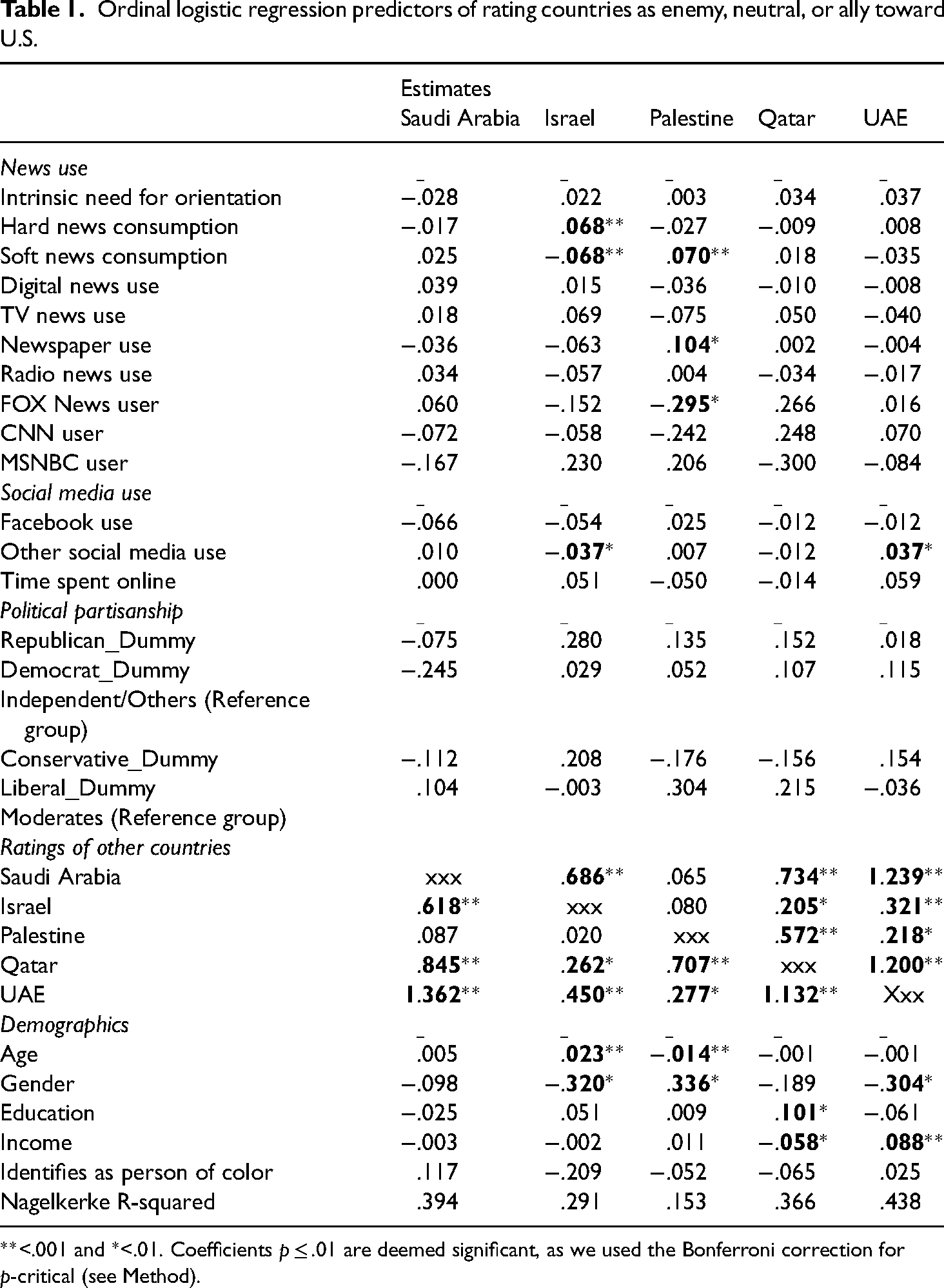
**<.001 and *<.01. Coefficients p ≤ .01 are deemed significant, as we used the Bonferroni correction for p-critical (see Method).
H1 said Americans’ ratings of Israel would be more positive than their ratings of Saudi Arabia, Palestine, Qatar, and the UAE. H1 was supported. Table 2 shows means and t-test comparisons for ratings of the countries. Israel had significantly higher ratings than each of the four other countries. The UAE registered the second-highest diplomacy ratings, followed by Qatar, which was statistically tied with Saudi Arabia, and then Palestine. All possible pairwise comparisons indicated significantly different means, except for the Qatar–Saudi dyad.
Means and paired-samples t-tests comparisons of diplomacy ratings of countries.
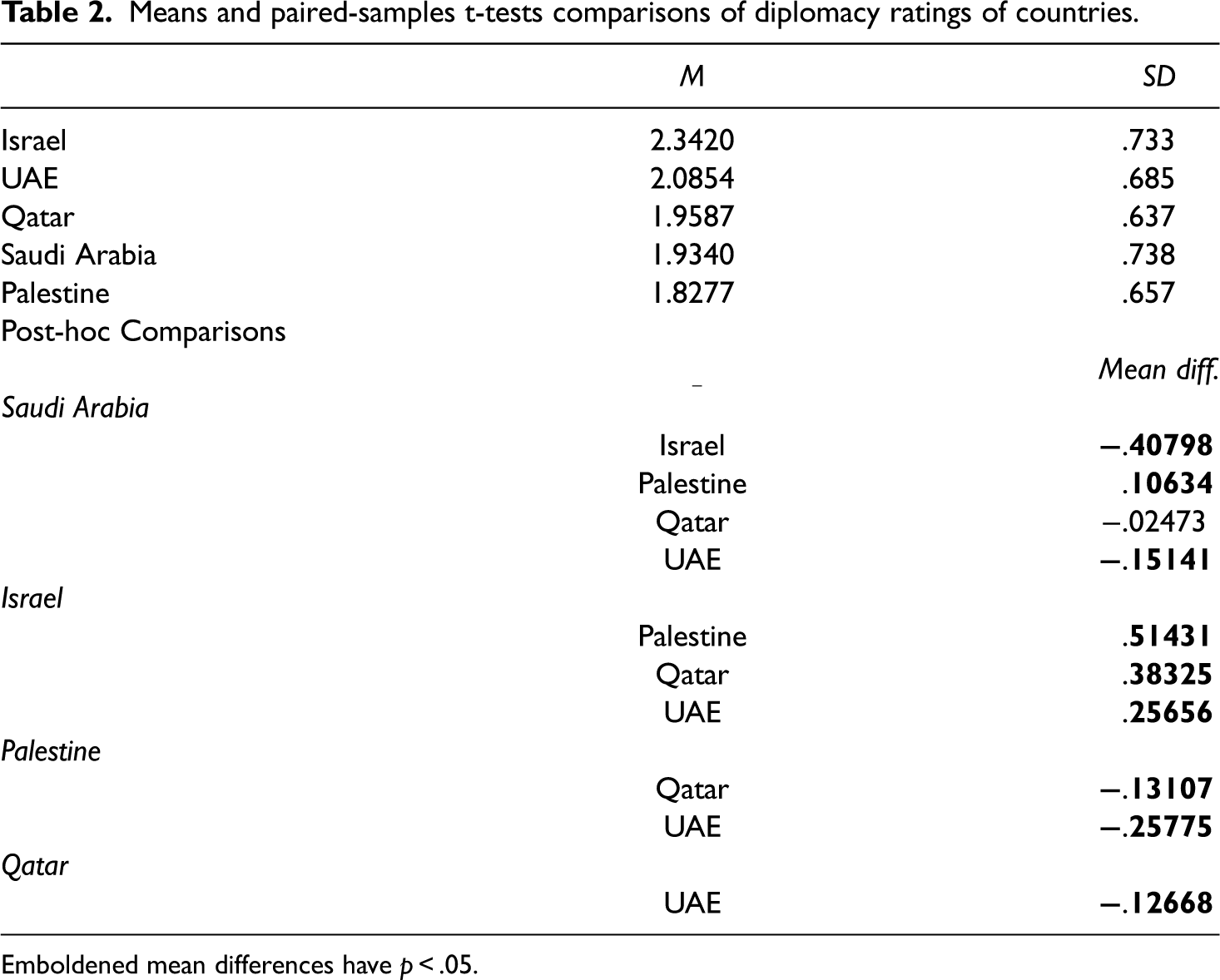
Emboldened mean differences have p < .05.
Differences between Israel and the other countries, though, are larger than the differences among any pair of Arab countries. The difference between Israel and the second-highest-scoring country, UAE, for example, is roughly the same as the difference between the UAE and the worst-performing country, Palestine. Within the Arab Gulf, two of the comparisons—UAE–Qatar and UAE–Saudi Arabia—are significantly different, with the UAE outperforming both neighbors.
H2 said hard news consumption would be positively associated with diplomatic ratings of the countries. H2 was mostly unsupported. Hard news consumption predicted positive ratings of Israel alone. Soft news consumption was negatively associated with ratings of Israel and positively associated with ratings of Palestine. Newspaper use specifically was positively associated with ratings of Palestine, though not associated with ratings of other countries.
H3 said use of FOX News would positively predict the diplomacy ratings of Israel and negatively predict the ratings of Arab countries. H3 was mostly not supported. Although FOX users reported much lower ratings of Palestine than did non-FOX users, the variable was not significantly associated with ratings of other countries, including Israel. The use of MSNBC and CNN was not associated with country ratings in any direction.
There are other noteworthy findings from the regression models. Some social media use (combined index of Twitter, LinkedIn, Instagram, and TikTok—again, a single measure because the variables were strongly intercorrelated) was negatively associated with ratings of Israel but positively correlated with ratings of the UAE. The use of Facebook was not associated with ratings of the countries. Older respondents rated Israel more favorably than did respondents, while age was a negative predictor of ratings of Palestine. Women rated Israel (and the UAE) more negatively than men did, while women rated Palestine more positively than men did. Political partisanship measures—party identification and political ideology—were not a predictor of diplomatic ratings of any of the five countries.
Discussion
This study examined U.S. respondents’ diplomatic evaluations of five Middle East countries and assessed measures of news use, social media use, political partisanship, and demographics as predictors of the assessments.
Our findings identified a regional halo effect, whereby people in the U.S. who view one country in the Middle East favorably, or unfavorably, tend to hold most, or all, other countries in that region in similar regard. By far, the strongest predictors of positive ratings of any one country were positive ratings of the other nations. For example, positive ratings of Saudi Arabia, Israel, Palestine, and UAE were all positive predictors of ratings of Qatar. For all countries except Palestine, the ratings of Saudi Arabia, Israel, Qatar, and the UAE positively predicted diplomacy ratings. The ratings of Israel were more favorable than those of the Arab countries, unsurprising given that U.S. media tend to cover Israel favorably and as Congress provides Israel with a level of funds, arms, and public support that it does not grant any other country (Lewis; Mearsheimer et al.). Worth reiterating: we used the Bonferroni correction, and imposed a significance threshold of p < .01 in the regression models, so the probability that any of the reported significant associations in those models are Type I errors is less than one percent.
A key application of our finding of a regional halo effect is that Middle East countries might not benefit, and indeed may be harmed by, information and strategic media campaigns designed to impugn their regional rivals. Such rivalries may harm attitudes toward the entire region. This finding is a contribution to literature in both political socialization and public diplomacy. In the context of the current countries under study, Saudi Arabia and the UAE engaged in documented campaigns against Qatar during those former countries’ blockade against Qatar (Ulrichsen, 2020). The research here suggests that, by promoting negative perceptions of a regional rival, Saudi Arabia and the UAE may harm their own reputations.
The finding may also have implications about how a given country in the region promotes itself. The UAE has aggressively place-branded itself as a progressive tourist destination compared to its regional neighbors (see Saberi, 2018), and while the research here does not suggest that one country promoting itself is a bad thing, it could indicate that a country might benefit, at least with regard to public opinion in the U.S., from promoting certain nearby countries as well. Qatar and the UAE place-brand themselves and attempt to distinguish themselves from regional neighbors (Zeineddine et al.), though there may be benefits to more collaborative promotion.
The existence of a regional halo effect with regard to the Middle East may prompt future studies in the U.S., querying, say, attitudes toward countries in South Asia or sub-Saharan Africa—regions which, like the Middle East, are not geographically or culturally proximate to the U.S.—to explore whether a halo effect is observed for other regions. Even the most homogenous regions contain countries with key political, linguistic, and cultural differences, so countries would have to be chosen carefully. Countries such as India, Pakistan, and Bangladesh might be appropriate South Asian inclusions, while African countries examined could perhaps hail from a locale such as West Africa: Ghana, Nigeria, and Cameroon.
Brewer et al. (2004) found that generalized “international trust”—believing the U.S. can, generally, trust other countries—predicted favorable attitudes toward countries such as Iran, Iraq, China, and others. Future studies could control for international trust as a predictor variable when testing for a regional halo effect. Findings from the current study may be a regional iteration of international trust; respondents either tend to trust countries in the Middle East, or they do not—a generalized trust toward that region.
It will be interesting to learn if such “regional trust” applies to other locales. Brewer et al. found that international trust was associated with deeming China and Japan as less threatening to the U.S., but the same was not the case with threat evaluations of the UK and Canada, suggesting that international trust better predicts evaluations in some regions more than in others. Mogensen (2015) argued that Brewer et al.'s concept of international trust should be separated into individuals’ trust in foreign countries and trust in foreign people, a distinction addressed in the current study as respondents rated individual nations, as friends or foes. Moreover, as Palestine is not a country recognized by many major multinational bodies, Mogensen's recommendation is additionally addressed in the current study, as “Palestine,” to most Americans, may suggest a group of people rather than a nationality.
The use of FOX News, CNN, and MSNBC did not predict diplomatic evaluations of any of the countries, with the exception that using FOX was associated with negative evaluations of Palestine. Surprisingly, using pro-Israel FOX (Qiu et al.) was not positively associated with ratings of Israel, though it was strongly associated with negative ratings of Palestine. Of course, Americans’ ratings of Israel were far more favorable than those of the other four countries; perhaps ratings were so high that it does not matter whether one watches FOX. Still, from a pro-Israel stance, a variable that increases negative assessments of Palestine could be viewed as a pro-Israel finding.
That use of major news brands in the U.S. is not associated with attitudes toward Saudi Arabia, Qatar, Israel, or the UAE has public diplomacy and place-branding implications and suggests that efforts by Middle East countries to garner favorable media coverage from some of the best-known news outlets in the U.S. may have limited success, at least regarding Americans’ diplomatic ratings of those countries. As mentioned, our questions on using FOX, CNN, and MSNBC for news were purposefully medium-agnostic; we eschewed words such as “TV” or “cable.” And while FOX dominates U.S. primetime TV news, CNN's core website has more than twice as many monthly unique users as FOX. Should future variables distinguish between, say, “the following TV networks…” or “the following online news outlets…” news brand reliance may predict diplomatic evaluations in more Middle East countries than just Palestine.
The regional halo effect does not appear to affect all Middle Eastern nations equally. The ratings of Qatar and UAE were positive predictors of attitudes toward Palestine, but assessments of Saudi Arabia and Israel were not. The strongest predictor of favorable ratings toward Israel was favorable ratings of Saudi Arabia, while the strongest predictors of favorable ratings toward Saudi Arabia and UAE were, respectively, ratings toward UAE and Saudi Arabia. The strongest variable predicting positive ratings of Qatar was, likewise, positive ratings of the UAE. The strongest correlate of a positive disposition toward Palestine was favorable ratings of Qatar.
Given the regional halo effect observed, dueling P.R. campaigns between Saudi Arabia–Qatar (see Pinnell, 2018) and UAE–Qatar, which peaked during the 2017–2021 blockade of Qatar, may harm attitudes toward all three countries, as well as other countries in the region, especially as data in the current study were collected in 2020, before the blockade ended. In public opinion, regions of countries may rise or fall together. Indeed, Cayla and Eckhardt (2007) found that in Asian countries, albeit while researching marketing outcomes, “advancing the [Asian] region as an important unit of analysis…contributes a better understanding of the opportunities and challenges associated with a regional positioning and development,” (p. 444). Regional branding may yield more positive outcomes than discrete, singular nation-branding. Although Cayla et al. studied commercial branding in east Asia, countries such as Qatar, UAE, and Saudi Arabia not only market themselves individually as investment, banking, aviation, and tourism hubs but they also market themselves individually as diplomatic brokers of international agreements (see Wong, 2022). Our study suggests they may get more lift by, say, promoting the Arab Gulf as a region that facilitates treaties or other international agreements.
Another key finding was that just a few modes of news consumption or media use were associated with country ratings, and no media use variable predicted the ratings of Saudi Arabia. The findings depart somewhat from Perry, who found that Americans’ consumption of news coverage of five countries—though none from the Middle East—was associated with favorable attitudes toward each of those countries. Some interesting relationships were observed, however, among Palestine and Israel. Hard news consumption was associated with favorable ratings of Israel, while soft news consumption was negatively correlated with ratings of Israel. Soft news use predicted positive evaluations of Palestine, however, as did newspaper use. Newspaper coverage of soft news topics about Palestine, then, such as arts, music, and heritage, may resonate positively with U.S. news consumers. The strongest media use predictor of ratings of any country was FOX News, the use of which was a strong, negative predictor for Palestine. Prior research reports that FOX News is resolutely pro-Israel; the current study suggests that the use of the outlet may at least encourage anti-Palestine sentiment.
From the Israeli government's perspective, media campaigns might attempt to increase hard news coverage of Israel in the U.S., while limiting soft news coverage. An example of the latter might be when a prominent entertainer refuses to perform in Israel because of its occupation of Palestine (see Eglash, 2018). Conversely, Palestine might attempt to bolster its presence in soft news reportage, such as, for example, when a major award goes to a Palestinian filmmaker (see McFarlane, 2020).
Although some prior research has found that support for Israel is stronger among Republicans than among Democrats (Cavari, 2013), neither political party identification nor political ideology was associated, positively or negatively, with diplomacy ratings of the countries, a result that would not surprise Mearsheimer et al., who note that members from both major political parties, with few exceptions, support Israel. The finding also suggests that countries in the study should perhaps employ public diplomacy measures in the U.S. in a bipartisan or nonpartisan manner, something which Israel has done but that several Arab governments recently have not; efforts by Saudi Arabia and the UAE to closely align with the Trump administration and with Trump family businesses (see again Ulrichsen 2020) were miscalculations, with costs that extended to relationships with the Biden administration.
Darwich and Kaarbo (2020) explain that international relations research often does not account for publicly unpopular events that occur in other countries. Americans’ perceptions of Saudi Arabia may be based on characteristics (like its treatment of journalists) that differ from Saudi Arabia's relationship with the U.S. government. By promoting via P.R. campaigns its military and energy ties to the U.S., Saudi Arabia may be using resources inefficiently. If a country is known to have killed a U.S.-based journalist and imprisoned activists, perhaps any P.R. campaigns are limited.
“Other social media” use—the index of Twitter, Instagram, LinkedIn, and TikTok use—was a negative predictor of Israel ratings, but a positive predictor of ratings of the UAE. The UAE's control of social media content directed at global audiences may be effective. Like some other Arab nations, UAE has prosecuted individuals who criticize the country on social media, and even had a law criminalizing positive speech about Qatar (Qiblawi, 2017). Further, the UAE mandates that social media influencers and creators of commercial content have government permits to operate, thereby ensuring their work promotes, or at least does not harm, the national image (Al-Balushi, 2018). Such strategies may be successful in shielding U.S. social media users from negative information about the Emirates.
Limitations and subsequent research
Using cross-sectional, not longitudinal, data, we cannot demonstrate causal priority, but the study does meet the other primary criteria for causality: correlation among respondents’ ratings of the countries; and controlling for potential alternative explanations. Time-series data are needed in the future to test temporal precedence.
Diplomacy ratings are just one measure of attitudes toward a country, and an individual can deem, say, Israel or Saudi Arabia as U.S. allies, while holding the same countries in contempt for their poor human rights records. Just because someone views a country as an ally of the U.S. does not necessarily reveal a favorable disposition toward the country, though it may. (Of course, being labeled an enemy of the U.S. is a bad thing from the perspective of most countries, including those studied here).
Another limitation: when data were collected, Israel and UAE had just announced an agreement to recognize each other via trade, diplomacy, security, and other means. Thus, the ratings of the two countries, which were higher than the ratings of the other three countries, could have been boosted due to the diplomatic agreement. Still, given September 2020 featured wide media attention to Covid and the U.S. election, we find it unlikely the Abraham Accords played a major role in the current findings. Related to “Abraham” branding, religiosity was not measured. The way many Americans evaluate Israel and Palestine is influenced by beliefs from evangelical Christianity (Cavari) and Judaism. Future research on attitudes in the U.S. toward Middle East countries should include a measure of religious identification.
Sampling also took place in the two days before the anniversary of 9/11. However, if respondents were answering the ally question through the lens of 9/11, we would expect Saudi Arabia to have lower ratings than the other countries, as it has been widely reported in the U.S. that most of the 9/11 hijackers were Saudis. Instead, Saudi Arabia was statistically tied with Qatar (and none of the hijackers was Qatari).
Although we have data on what kinds of news respondents consume, and even data on the use of three, specific news outlets, we do not have data on the tenor of coverage of the five countries in U.S. news outlets. Future research could employ content analysis to better understand the nature of such reportage. Additionally, future research that tests the regional halo effect by querying participants’ attitudes toward countries from a given region—say, countries from within the Asian subcontinent—respondents can be asked about levels of news, if any, they consume about each country.
Another possibility is that, while Americans’ do not seem to diplomatically evaluate Middle East countries based on their patterns of news use, they may instead base such evaluations of Muslim-majority nations and a Jewish-majority nation on portrayals of Muslims and Jews in entertainment media. This would likely be problematic, as Jews and especially Muslims (Hawkins et al., 2022) are often portrayed in entertainment media in negative, stereotypical ways. Future research might examine entertainment media use measures as correlates with diplomatic ratings, especially assessments of Middle East countries.
Despite its limitations, our study contributes to research in international communication, public diplomacy, place branding, and international relations by examining the interplay of U.S. evaluations of countries from the same geographic region, while also scrutinizing the ability of numerous media use and news consumption variables to explain such ratings. What we found is that the media might not be the whole message on the reputations of foreign countries; a country's neighbors and neighborhood might matter more.
Footnotes
Acknowledgment
The authors thank the Doha Institute for Graduate Studies for providing open access funding for this publication.
Declaration of Conflicting Interests
The author(s) declared no potential conflicts of interest with respect to the research, authorship, and/or publication of this article.
Funding
The author(s) received no financial support for the research, authorship, and/or publication of this article.
