



Abstract
This article explores the dynamic relationship between international news organisations and politics in the United Kingdom and Russia. Using the 2014–15 Ukraine conflict as its case study, this research argues that humanitarianism has been applied to set the news agenda by RT. The BBC, on the other hand, used relatively less human rights frames but depicted Russia and Russia-backed separatists as responsible for the conflict. Despite the concepts of manufacturing consent and indexing may not capture the arguments in journalistic practice comprehensively, they are useful in explaining and revealing broader insights into the market and politics-driven media industry and the illiberal tendency in the reporting of international war/conflict in that news framing constitutes a vital soft power tool. This also raises the question that where should we draw lines of distinction between the state-sponsored soft power media RT and the publicly funded BBC.
Introduction
Just 3 days after officially recognising the self-declared republics of Donetsk and Luhansk in Eastern Ukraine as independent states, Russian forces launched full-scale invasion of Ukraine on 24 February 2022. The renewed conflict has indeed shaken the world with many asking what the world holds in the coming years. This combined with the years-long battle with the COVID-19 global pandemic – with freedom of movement across the contact line further restricted – has inevitably worsened the already dire humanitarian conditions. Only a year ago, Rosemary DiCarlo, Under-Secretary-General for Political Affairs of the United Nations, expressed concerns over humanitarian access that had remained a significant challenge in Eastern Ukraine, with more than 3.4 million civilians, mainly women and elderly persons, in need of sustained assistance (UN News, 11 February 2021). Fears already ascended over the revealed shelling, shootings, deadly skirmishes and mutual recriminations along the breakaway Donbas frontline (Oliphant, 2021), and that the renewed conflict would develop into a full-scale regional war (Felgenhauer, 2021). But how did the Ukraine conflict all play out along with the role of the media in times of crisis?
This comparative study aims to make an important contribution to the contentious subject, and its comparative nature provides insights into how both British and Russian news media approached the major crisis of 2014–15, by examining the extent to which the media paid attention to and the way in which they framed the conflict. In doing so, it compares the intricacies and variabilities of media's utilisation of news frames, and uncovers the potentially buried stories and data about the Ukraine conflict. The events examined in this study are relevant to what has happened since – and what is set to come. The study poses three research questions:
To what extent have UK and Russian media paid attention to the 2014–15 Ukraine conflict?
This question regarding the media's attention will be measured by the quantities of coverage in each country, which may reveal the level of interest in the Ukraine conflict (see Liu, 2020).
Which frames have been dominantly adopted by UK and Russian digital media when making sense of the 2014–15 Ukraine conflict over time?
What are the key factors impacting UK and Russian journalistic practices during the 2014–15 Ukraine conflict?
This article is structured into five sections. First, there is a brief introduction of the 2014–15 Ukraine conflict. Second, a theoretical background of the role of the media is offered. Third, a methodology section introduces the theories informing the method. The fourth section shows the results of the first two quantitative analyses in terms of press attention and frames used. The final discussion section provides a qualitative analysis to identify key factors that help explain UK and Russian journalistic practices during the 2014–15 Ukraine conflict.
The 2014–15 Ukraine conflict
After Russia formally annexed Crimea on 21 March 2014, Western governments criticised the move as breaching international law and imposed a flurry of sanctions on Russia followed by a suspension of its membership in the Group of Eight (G8). It was alleged that about 40,000 military formations from Russia appeared on the border with Ukraine in late March (The Guardian, 31 March 2014), with pro-Russia sentiment spread across Eastern and Southern Ukraine and federalisation forces expressed their intention to form independent republics of Donetsk, Kharkov and Luhansk in early April (De La Pedraja, 2019). The pro-Russia forces occupied government buildings and took over television stations to restore Russian broadcasts cut by order of Yatsenyuk 1 -led Kyiv (interim) government established following the collapse of Victor Yanukovych regime in February 2014 (Salzman, 2019). The following day, having replaced local personnel in the Ukrainian Security Service and governors with Kyiv loyalists including billionaire oligarchs, the Yatsenyuk government regained control of the second largest city of Kharkov (D’Anieri, 2019).
Soon after, Kyiv started its first official military action known as Anti-Terrorism Operations (ATO) against the separatists (Black and Plekhanov, 2016). Pro-Russia demonstrators were growing in several Eastern cities, resulting in clashes in places including the coastal city of Odessa that left dozens of pro-Russia activists killed in a building fire and hundreds injured. Despite Russian President Vladimir Putin's call for the scheduled referenda to be suspended, Donetsk and Luhansk announced independence in the context of escalating conflict between Kyiv and pro-Russia forces (Maltseva, 2016). In the aftermath of billionaire Petro Poroshenko being elected president of Ukraine in mid-May and was sworn in on 7 June, the Russian military were seen to have not only transferred weaponry to the rebels but also entered the Eastern region of Ukraine – the Donbas which had become a major battleground between the forces (Yekelchyk, 2020). More than 8 months after former president Yanukovych suspended the treaty, Poroshenko signed the landmark EU Association Agreement as well as the Deep and Comprehensive Free Trade Agreement, while Russia cut off gas supplies to Ukraine after the failure in reaching a consensus over gas price during talks mediated by the EU.
The MH17 atrocity was central to the escalation of the Ukraine conflict. The Malaysia Airline flight that departed from Amsterdam was downed over Eastern Ukraine on 17 July, killing all aboard. It was allegedly shot by the rebels, with Putin denying any connection between Russia and the crash while insisting it was Kyiv's responsibility for the tragedy (Davidson and Yuhas, 2014). In response to which, the EU joining the United States imposed further sanctions on Russia, with the latter inflicted retaliatory sanctions on food products from several Western countries. During the 2014 NATO summit, Western leaders vowed their support for Kyiv and announced a new round of sanctions on Russia, prior to a ceasefire agreement – Minsk I – was eventually signed by parties in Minsk in early September.
The Minsk Accord envisioned to end the violence and ‘committed the government to extensive decentralisation of the Donbass’ (Svyatets, 2016: 170). However, conflicts continued within Ukraine while Russian troops were reported to continually cross the border. Peace talks lasted a few months until they collapsed in the beginning of 2015. The United States declared that it has considered offering lethal assistance to Ukraine, and then Defence Secretary Phillip Hammond stated that Britain did not rule out offering ‘lethal force’ to assist Ukraine (Dominiczak, 2015). The Minsk Accord II – designed as the basis of a peaceful resolution of the conflict – was signed by leaders from Russia, France, Germany and Ukraine in February 2015, envisaging a measure of autonomy and Russian identity of the Donbas region. But over the coming years, the Minsk Accords have proven to be practically unworkable, with conflicts continuing in Eastern Ukraine.
The role of the media: Soft power
The media's key role as informing and educating about everyday issues can empower the public to debate and make informed decisions, as part of the democratic processes. Importantly, the media are expected to hold government and politicians accountable by playing a watchdog role (McNair, 2011). However, arguably political and financial orientations have transformed the media into an agency of manipulation, privileging private and political interests that have invaded the public sphere, where citizens are better understood as news consumers than democratic participants (Kellner, 2000). The rapid digitisation of media sources since the mid-1990s, on one hand, were seen by some as to have reinforced the democratising role of the media by both providing the public with more access to information and allowing them to have their voices heard (Boczkowski, 2004; Curran, 2002). On the other hand, the resultant decline in the number of (investigative) journalists and the collapse of local newspapers combined with the focus on commercialism contributed to media's simplification of subject matter, reliance on public relations material, and de-contextualisation of news (Balabanova, 2019; Bennett, 2003). Within this increasingly globalising mediascape, war often poses the ultimate challenge to the normative frameworks (Herman and Chomsky, 1988), as international media outlets and broadcasters are seen to have played a ‘soft power’ role for their respective states in wartime (Miazhevich, 2016).
Soft power is often discussed in the juxtaposition with ‘framing’ power (Entman, 1989; Nye, 2011), which helps to understand the role of both the media and government in modulating perception in communication, the origin of which can be traced back to the work of Edward Bernays. The attempts became particularly apparent today when the internet is characterised by the centrality of soft power in international politics (Jamal, 2012; Rawnsley, 2021), which is largely dependent on stories/frames circulated among nations and representatives for diplomatic, propagandistic, public relations or war-mongering purposes (Briant, 2020; Hamelink, 2015). This brings to mind efforts made by governments to (re)frame reality and to mould consciousness in competing for power and influence in the international stage, especially in times of war, where international broadcasting has become a central soft power tool (Hearns-Branaman, 2017; Jimenez-Martinez, 2021; Price, 2003; Wright et al., 2020). Of particular importance has been the idea of ‘state action designed, directly or indirectly, to promote state objectives’ (Sparks, 2016: 63). Writing about today's propaganda, Rawnsley (2015: 281–284) noted that ‘the renewed competition for access to the global media space is transforming how producers, audiences and governments interact’, which has been most evident in Russian international broadcaster RT's ‘oppositional’ approach to soft power in the hope of presenting an alternative to long-established ones such as the BBC.
Among the most important expansion of international broadcasting has been the creation of RT in 2005 – previously known as Russia Today – aiming to, in the words of President Putin, ‘break the monopoly of the Anglo-Saxon media’ (Bidder, 2013), with financial support coming from the Federal Budget of the Russian Federation (Liu, 2020). Russia's actions in Ukraine since 2014 and the alleged interference in the 2016 US Presidential election have put RT in a place of ‘infertile credibility’ by many (Flew, 2018; Rawnsley, 2021). The station's propaganda role is suggested not only by its content, style and motivation of broadcasts, but also from its close relationship with the government (see Nelson, 2019; Rawnsley, 2015). Perhaps the most alarming revelation is the concentration almost entirely on international events in relation to other governments’ ‘wrongdoings’ with seldom critical reflection on Russian government's policies (Rawnsley, 2021). Its ideological-based and Cold War-style approach has led two of its foreign correspondents to resign during the Ukraine crisis 2014 in the cases of RT ‘whitewashes the actions of Putin’ and ‘disrespect[s] for facts’ about the downing of MH17 in July (cited in Rawnsley, 2021: 33).
The rise of non-Western media channels has led many to wonder if old media stalwarts such as the BBC could retain, if not extend, their historical status and international influence? The BBC, as the largest international broadcaster, is publicly funded through a licence fee dating back to 1923. Its World Service has long been considered Britain's attempt to access the global media space and influence the local population (Jamal, 2012). As an important soft power tool of propaganda in the 1930s and especially during the Cold War, it had received subsidies from the Foreign and Commonwealth Office until 2014 (Rawnsley, 2021). The use of such media has become a common practice among global media channels. RT and the BBC World Service as vehicles of their nations’ soft power efforts are considered, among others, soft power media organisations (Hearns-Branaman, 2017).
Media and conflict
International affairs are about a matter of ‘whose story wins’ (Arquilla and Ronfeldt, 2001). At issue is power and control in the formation of media-politics alliances and in the legitimation of military action (Roselle et al., 2014). Global media players such as Cable News Network (CNN), having been able to expand its broadcasting reach to countries worldwide, became a global phenomenon in the early 1980s. Some scholars (Shaw, 1996) subsequently argued that war coverage using images of human suffering could raise public awareness and created domestic pressure to ‘do something’ – halt humanitarian crises – among politicians and NGOs, referring to this as the CNN effect theory (Gilboa, 2005). Namely, the notion that the global flow of news and the visual representation of distant suffering lead to humanitarian interventions especially in the 1990s – the media as powerful and influential to drive foreign policy. On the other hand, academic research into the media's role during wartime shed an important light on the contested idea of humanitarianism as well as the different variables in determining the power of Western media (Robinson, 2002). Balabanova (2015) makes the point that while human rights protection was (enthusiastically) set onto international agenda, it became an important tool of authority and legitimating ideology with which to justify the projection of U.S. power and hegemony. The disappearance of communism as a direct threat to US security, following the end of the Cold War, enabled US arms industry to expand and to maintain its hegemonic status. The US and Western allies’ subsequent readiness to define humanitarian crises ‘as threats to international peace and security that required a collective response in accordance with the UN Charter’ (Balabanova, 2015: 64), accounted for the rise of US-led humanitarian intervention often in the name of transforming from ‘barbarism’ to ‘civilisation’. Namely, humanitarian justifications as a common and politically relevant tool (Maxey, 2020), were key to mobilising domestic and international coalitions, especially if there existed political consensus, endorsement from international organisations (Grillo and Pupcenoks, 2017), and support from influential members of society (Staub, 2013). In this justification process, the media played an important role in the build-up to intervention as those framed as humanitarian missions signifying moral and political imperative were more likely to gain support from the public (Maxey, 2020). As Robinson (2002) argued with regards to media–politics relation, the evidence to corroborate the CNN effect theory in fact remained contradictory due to various contextual factors discovered in relevant empirical studies: levels of policy certainty (Entman, 2004; Robinson, 2002; Shaw, 1996), national interests (Jakobsen, 1996, 2000), types of media system (Balabanova, 2007), political opponents’ ability to influence international media coverage to support their course (Freedman, 2000); and level of political value proximity (Yarchi et al., 2013). In opposition to the CNN effect, these studies suggested that the manufacturing consent theory (Herman and Chomsky, 1988) and the indexing thesis (Bennet, 1990) were particularly useful in explaining the media's (complicit) role in favour of government actions during wartime.
From the political-economy perspective, Herman and Chomsky (1988: xxii) pointed to media biases that ‘arise from the preselection of right-thinking people, internalized preconceptions, and the adaptation of personnel to the constraints of ownership, organization, market, and political power’. Despite the fact that Western governments and establishment media expressed commitment in principles such as to human rights and international justice, they were biased by not following those principles in the domain of national foreign policy. Agenda-setting (McCombs and Shaw, 1972) and framing (Entman, 1993) are important prisms through which to interpret and understand the way media promoted salient issues and amplified messages associated with war and conflict. The more the media paid attention to an issue by framing it one way or another, the more important it might become in the eyes of the audience, reinforcing particular perceptions and understandings of the conflicts. For example, Balabanova (2007) examined the UK and Bulgarian news coverage of the 1999 NATO military action and uncovered that UK media paid significant attention to the suffering of people in Kosovo and supportively framed the subsequent NATO air strikes. Nevertheless, the selective reporting on human suffering may run a risk at missing some real human rights stories or generating public perceptions that human rights violations were exclusive to distant conflict (Balabanova, 2017).
Bennett's (1990) indexing hypothesis also broadly follows this that mass media news was indexed to the dynamics of governmental debate – when there was general consensus on the objectives of foreign policy for instance, media were less likely to criticise this consensus or to highlight independent voices (1990: 106). Robinson (2002) termed it the ‘elite version’ of manufacturing consent theory, accentuating news media's general conformity to the interests of political elites in the context of political consensus over war policy. During times of elite dissensus, news media simply responded to the debate by either taking on a critical position against policy or taking sides of politicians or non-elites. For instance, Entman (1991) studied US news reporting of the shooting down of the Korean Airline and Iran Airline flights in the 1980s and discovered compliance between media coverage and policy interests of the two governments. Later, Entman (2000) argued that the media actually influenced US foreign policy for the 1991 Gulf war and the 1992 Somalia crisis in the name of humanitarianism. However, the end of the Cold War was key to understanding the change in media's role; that elites were able to criticise policies without looking unpatriotic in the absence of communist enemy, whilst journalists could ‘apply their own evaluative criteria as much as indexing elite opposition’ (Entman, as cited in Robinson et al., 2009: 539).
Other research demonstrated the importance of national interests to shed light on why Western media paid selective attention to the 1999 Kosovo crisis but disproportionately overlooked the deadliest conflicts and humanitarian emergencies in Africa such as in countries of Congo and Sierra Leone. Hawkins (2004, 2008, 2011) looked at war coverage in the 1990s and 2000s and explained that the chosen conflicts – ‘select winners’ – were in association with the US interests (e.g. belligerent and benefactor), which continually manifested in the 2000s when conflicts in Afghanistan, Iraq, Israel-Palestine and Pakistan were the ‘select winners’. In Balabanova's (2015) study on the media's role in creating a cosmopolitan connection with the distant other, she argued that while the media had the potential to engage in symbolic actions to play a positive role preventing violence from taking place, their response to human rights abuses in Darfur since 2003 was rather avoidant along with reluctant commitments from the international community, the UN Security Council and individual Western states due to competing political priorities.
The advances in communications technology was another important lens through which some emphasised the increased number of ‘spontaneous’ news that might lead to governments losing control over information. Research studies suggested that the technological factor did not alter the construction of news (Bennett, 2003), but rather caused stricter restrictions on media movement in war zones (Robinson, 2004). As Wolfsfeld (2011) and Livingston and Bennett (2003) have noted, journalists tended to go for authoritative information first when a distant conflict took place. Chief International Correspondent for BBC Doucet (2018) talked about the Syrian crisis during the proliferation of social media that served as both informing the public and a tool of propaganda. The lack of foreign journalists on the ground due to visa restrictions resulted in a lack of sustained eyewitness and investigative reporting, as well as a great reliance on activists’ videos that have been picked up by many mainstream media as main source of information. The often-focused horrific suffering, however, was only part of a complex story. Doucet (2018) and Boyd-Barrett (2019) with respect to the means of intelligence-gathering argued that Western governments and government-linked agencies have provided significant funding to boost the profile of a particular group in Syria – the so-called ‘moderate armed opposition’ and to create ‘credible’ sources of information used by most Western media. Although the opportunities provided by technology and the internet may have changed and improved journalism practices, official involvement still played a significant role in setting agenda in wartime (Robinson et al., 2010). Carruthers’ (2011: 9) observations seemed accurate that wartime ‘invariably prompts fresh reminders to media personnel […] of their critical function in keeping the wheels of democracy spinning by satisfying the public's “right to know”’. […] Yet in wartime we’re apt to see how starkly media practice contradicts liberal theory’ in the case of their rather positive enthusiasm to act as war's cheerleaders. This is equally true of the world of digital, social media as it is true of legacy media, with the former being a highly concentrated market in terms of ownership that signifies control over algorithms thus determining news sources, the order of news feeds and search engine ranks for a large number of the population (Zollmann, 2019). While the media may sell audience meta-data to other corporations (Boyd-Barrett, 2021), the credibility of traditional sources of news is questioned as never before (Rawnsley et al., 2021).
Methodology
Framing analysis
A mixed-methods approach is adopted, including quantitative analysis and interpretation-focused qualitative analysis, to assess the frames used by the BBC and RT. Entman (1993: 52) defined framing as a process of selection and salience in order ‘to promote a particular problem definition, a causal interpretation, a moral evaluation, and/or treatment recommendation’. To reflect the four important components, the current study followed Godefroidt et al.'s (2016) approach, using generic, diagnostic and prognostic frames to scrutinise the news framing of the 2014–15 Ukraine conflict. Generic frames deliver general features of news, consisting of six pre-defined – conflict, human–interest, economic consequences, morality, responsibility and nationalisation frames (Semetko and Valkenburg, 2000; Van Cauwenberge et al., 2009).
The conflict frame is particularly favourable in foreign news coverage (De Vreese, 2005), which highlights conflict between individuals, groups, institutions or countries (Semetko and Valkenburg, 2000). Frequent use of the conflict frame may indicate the media's attempt to balance between the conflicting positions (Neuman et al., 1992). Nonetheless, previous studies suggest that it may also contribute to the public support for political decision making (De Vreese and Tobiasen, 2007). The human–interest frame relates to human examples on the issue, which could generate emotional responses. The economic-consequences frame signifies financial losses or gains for individuals, groups, organisations or countries (Semetko and Valkenburg, 2000). The morality frame revolves around morality, religious tenets or social prescriptions (Godefroidt et al., 2016). While responsibility frame makes references to individuals, groups of people or governments’ ability to and/or responsibility for alleviating the issue, it may also suggest the issue requires urgent action and in need of solution. Finally, the nationalisation frame is often linked to the idea of ethnocentrism, denoting journalistic practice in terms of covering foreign news from a domestic angle (Godefroidt et al., 2016; Van Cauwenberge et al., 2009).
In addition to the six pre-defined generic frames described above, diagnostic and prognostic frame are equally important and often used by journalists in news coverage stressing the broader context of an issue and identifying solutions to the issue respectively (Benford and Snow, 2000). Drawing upon Godefroidt et al.'s (2016) example, the researcher inductively and deductively determined the potential diagnoses and prognoses by reading relevant news articles and research studies on the topic (e.g. Sakwa, 2015) to help diagnose what is politically, socially and democratically problematic about the Ukraine conflict. The diagnoses included political, socio-economic, religious factors, human rights abuse, geopolitical factors, specific triggers (and/or other causes), while the prognoses comprised of military action, change in government, financial intervention, internal reforms, removal of the military weapons arsenal and external assistance (and/or other solutions) (Appendix II). The analysis of the frames involves a number of yes/no questions originating from Semetko and Valkenburg (2000) and Van Cauwenberge et al. (2009) (Appendix I).
The sample
The analysis included 11 months’ worth of news coverage of the Ukraine conflict between 21 March 2014 and 28 February 2015 from the BBC and RT. The timeframe was divided into 21 March to 17 July 2014 (119 days) and 18 July 2014 to 28 February 2015 (226 days). This was designed to identify the dynamic of news framing, driven by the nature of events and developments taking place on the ground. The MH17 case (17 July 2014) was used to demarcate the timeframe between the Crimean Annexation (21 March 2014) and the end of February 2015 when Minsk Accord II came into force. Given that MH17 as a critical discourse moment that media reporters often used as a ‘peg’ to identify time periods (Gamson, 1992), the case here is to help track the dynamics of news framing and thus comparing the two periods. The selection of the BBC and RT is based on the fact that they both are international news organisations with multimedia services available to a number of countries and regions. They are prominent representatives of distinct voices in global media and produce their output first of all for international audiences.
The analysis focused on textual coverage from the BBC and RT retrieved from their respective websites. To maximise the search results, the researcher included relevant articles embedded via hyperlinks and used two large sets of keywords. The keywords used to search for relevant articles for the first period are: Donetsk, Luhansk, Kharkiv, Ukraine, Russia, NATO, referendum, MH17, Donbass, Sloviansk, Odessa, Poroshenko, G7 and Sanction. For the second period, the researcher used the keywords: Russia, Russian aid, humanitarian, NATO, ceasefire, Debaltseve, shelling, separatists, Minsk talk, Kharkiv, Luhansk, Donetsk, Mariupol, and Russian convoy. For each period, the researcher used each keyword to retrieve relevant articles. Each news article was read thoroughly to check for relevance. Among the irrelevant material were updates, timetables, and news in brief. As a result, 636 items from the BBC and 1126 pieces from RT were selected for the final analysis.
Results
Press attention
The first period covered a duration of nearly 4 months’ worth of news coverage from 21 March to 17 July 2014. A total of 807 articles were selected for analysis, with 264 articles from the BBC and 543 from RT. The BBC labelled what had been going on in the South-Eastern Ukraine as a result of President Putin's support for pro-Russia separatists on the ground both militarily and financially. In contrast, RT was critical of the West's involvement and Kyiv military actions, while suggesting that the refugees from war zones had been resettled in Russia (Table 1).
Press attention by the BBC and RT.
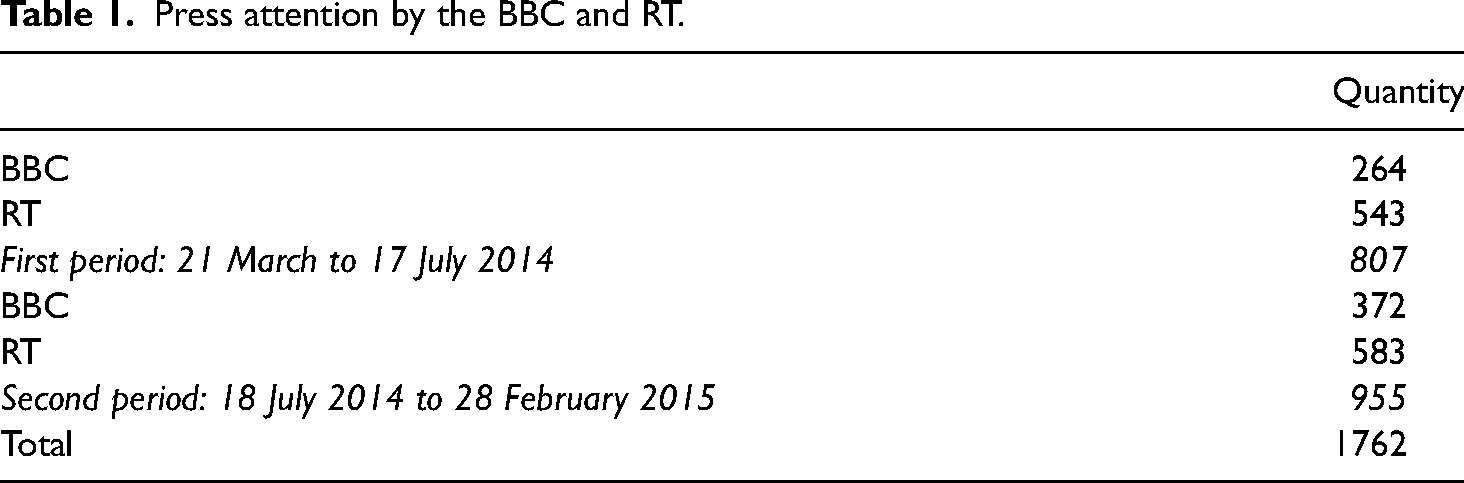
In the following time period from 18 July 2014 to 28 February 2015, the overall media attention paid to the conflict amounted to 955 articles. The BBC was responsible for 39% of the news on the subject (372 pieces), continuing to accuse pro-Russia rebels of intensifying the conflict and criticising Russia for its involvement. RT published 583 pieces of news occupying 61% of the whole sample. RT's extensive attention given to the conflict is characterised by a sense of distancing Russia from what the media presented to be domestic affairs in Ukraine. These included the downing of MH17 and the continuing battling on the ground between Kyiv and pro-Russia forces. More importantly, while RT focused on the ATO carried out by Kyiv government using chemical weapons, the BBC did not see this as a major concern but regarded Russia and pro-Russia rebels as accountable for worsening the situation in Ukraine. This will be explained and analysed in greater detail in the following section focusing on the specific frames used by the two media outlets when making sense of the Ukraine conflict.
News framing of the Ukraine conflict
Generic frames: 21 March to 17 July 2014
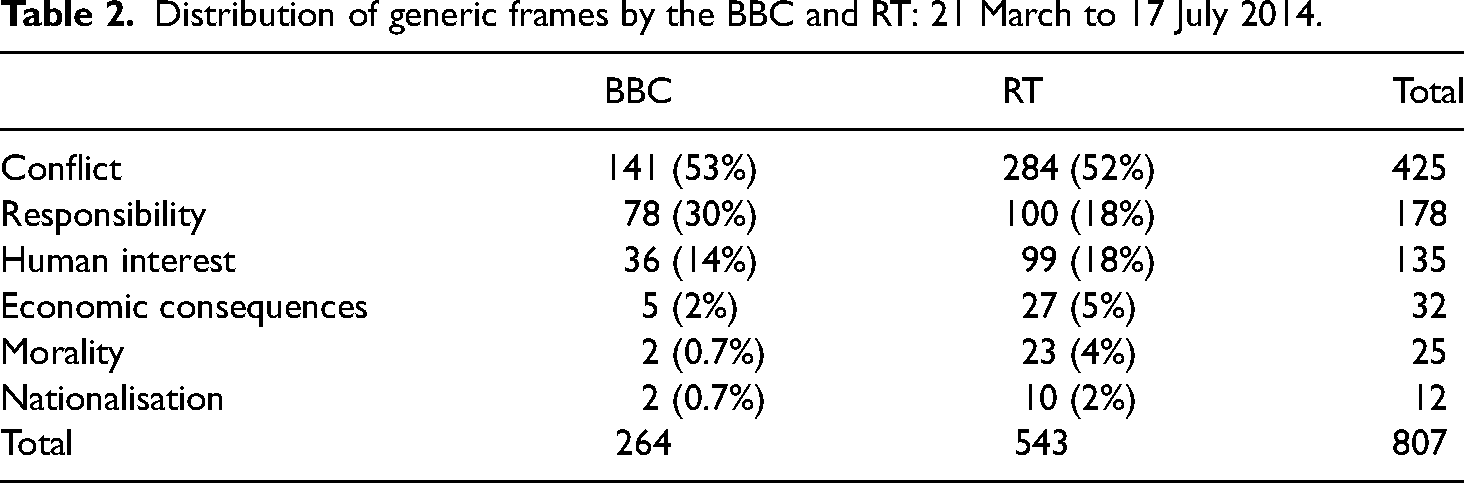
Table 2 shows that both the BBC and RT used predominately the conflict generic frame in reporting the conflict, and the difference lies mainly in the uses of responsibility and human–interest frames. Among the responsibility frames, the BBC largely viewed Russia as being involved in Ukraine including the annexation of Crimea. Quite different from RT regarding the Ukraine offensive in the South-Eastern city of Slavyansk, the BBC talked about Russian military support of pro-Russia forces and quoted then acting President Turchynov accusing pro-Russia forces as ‘hiding behind civilians and hostages’ (2 May 2014). In the reporting of the tragic events that occurred in Odessa leading to dozens of deaths of ‘separatists’ (pro-Russia/anti-Kyiv protesters) on 2 May 2014, the media quoted U.S. President Obama warning ‘further sanctions against Russia if it did not “change course”’. The next day, the BBC quoted the then Ukrainian Deputy Foreign Minister Danylo Lubkivsky insisting that ‘Russia was behind the violence’ and ‘the security situation is threatened by Russian special agents’: The [Kyiv military] operations come a day after running battles between pro-Kiev groups and separatists in Odessa. […] The exact sequence of events is unclear, but reports suggest separatists had barricaded themselves inside the building and both sides were throwing petrol bombs. […] One protester called Albu, who said he had been barricaded in the building, told Russia Today the Ukrainian ultra-nationalist Right Sector was to blame for the attack. (BBC, 3 May 2014)
Distribution of generic frames by the BBC and RT: 21 March to 17 July 2014.
Two days after the Odessa, as the event continued receiving attention by RT, the BBC from the human–interest angle quoted Yatsenyuk blaming ‘pro-Russian groups for “provoking the unrest”’ (4 May 2014) and citizens calling the anti-Kyiv protestors ‘terrorists’ (4 May 2014): Some people are crying, many are angry. […] The protesters believe the killings were planned by the new government in Kiev and carried out by right-wing radicals […] - a stance echoed in the Kremlin. But one elderly woman […] says she saw pro-Russian activists attack the rally of those who support Ukrainian unity. […] “They are terrorists, brought here from elsewhere”. […] “I support the unity of Ukraine. If you want to live in Russia - buy a ticket, pack your bag and go to Russia”. (BBC, 4 May 2014)
In contrast, RT ascribed responsibilities to Poland, Ukrainian nationalists, the United State, the West, and Ukraine authorities as illegitimate: Following months of deadly protests, Ukrainian President Viktor Yanukovich was ousted and replaced by a self-appointed government on February 22. Russia slammed the coup-appointed government as illegitimate and said it had violated the Ukrainian constitution by setting elections for May 25. (RT, 16 April 2014)
Compared to the BBC that centred its coverage on the human–interest frames around Russia and its involvement, RT highlighted the far-right violence, Kyiv authorities and their role in treating foreign journalists and in launching the ATO which resulted in the suffering. This is perhaps best exemplified by the Odessa tragedy and Kyiv's military action in Slavyansk. RT emphasised that following the so-called ‘February coup’ in Kyiv, thousands of anti-Kyiv protesters rallied in Odessa, carrying ‘Ukrainian, Russian, and Crimean flags and chant[ing] slogans such as “Ukraine and Russia are together” and “Odessa is against Nazis and tycoons,” as well as “Referendum!”’ (RT, 23 March 2014). Months later, Ukrainian nationalists set fire to burn the protestors alive in a building fire, with 39 reportedly burned to death or suffocated from smoke (RT, 2 May 2014). In the reporting of the civilian casualties in Slavyansk, RT wrote: Many of the people gathering in central Slavyansk told Phillips [RT's stringer] that they are frightened for their lives and do not want any Ukrainian military sent by the “Kiev junta” in their city. One woman interviewed by Phillips appealed to Russia and personally to President Vladimir Putin for help, saying the people are getting desperate. The others had a message for US President Barack Obama, whom they blame for the chaotic developments in Ukraine. (RT, 2 May 2014)
Diagnostic and prognostic framing: 21 March to 17 July 2014
In accordance with the responsibility frame discussed above, RT attributed blame to Kyiv for the ATO, the Ultra-nationalists for violence, and the ‘Nazi Kyiv junta’ for the escalation of the Ukraine conflict. The use of global dimensions frame (53 articles) was to imply NATO and the EU's Western expansionism had reduced security for Russia. With the overall message and tone remaining similar, RT talked about how the Ukrainian government's revoking of Russian language, banning of Russian TV and Russian journalists’ entrance to Ukraine, and conducting of criminal ATO in Eastern Ukraine violated human rights and international laws in 42 articles (Table 3).
Distribution of diagnostic frames by the BBC and RT: 21 March to 17 July 2014.
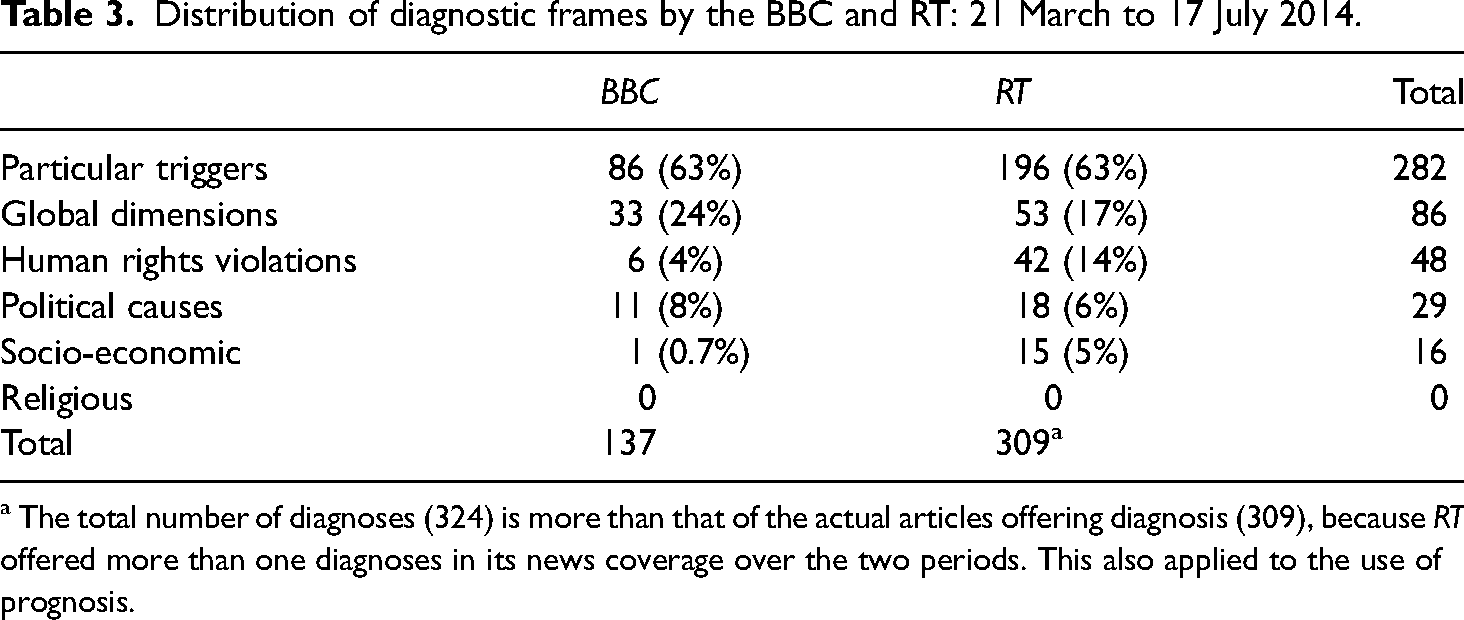
a The total number of diagnoses (324) is more than that of the actual articles offering diagnosis (309), because RT offered more than one diagnoses in its news coverage over the two periods. This also applied to the use of prognosis.
Examples are that ‘Human Rights Watch (HRW) says Ukraine's military and security services are “dangerously interfering with press freedom” by detaining journalists working with Russian news agencies and denying others entry into the country’ (22 May 2014), and ‘Ukraine military “dropped incendiary bombs” on Slavyansk’ – ‘designed to start fires using materials such as napalm, white phosphorus or other dangerous chemicals – is strictly prohibited by the UN’ (12 June 2014). The political causes frame was used to indicate the political coup in February assisted by the West – Washington in particular while the socio-economic diagnose referred to Ukraine's continuing gas price negotiation with and unpaid gas bill to Russia. These were identified as directly influencing the overall Ukraine conflict, in addition to the already difficult situation for the people in terms of safety and poverty in the region.
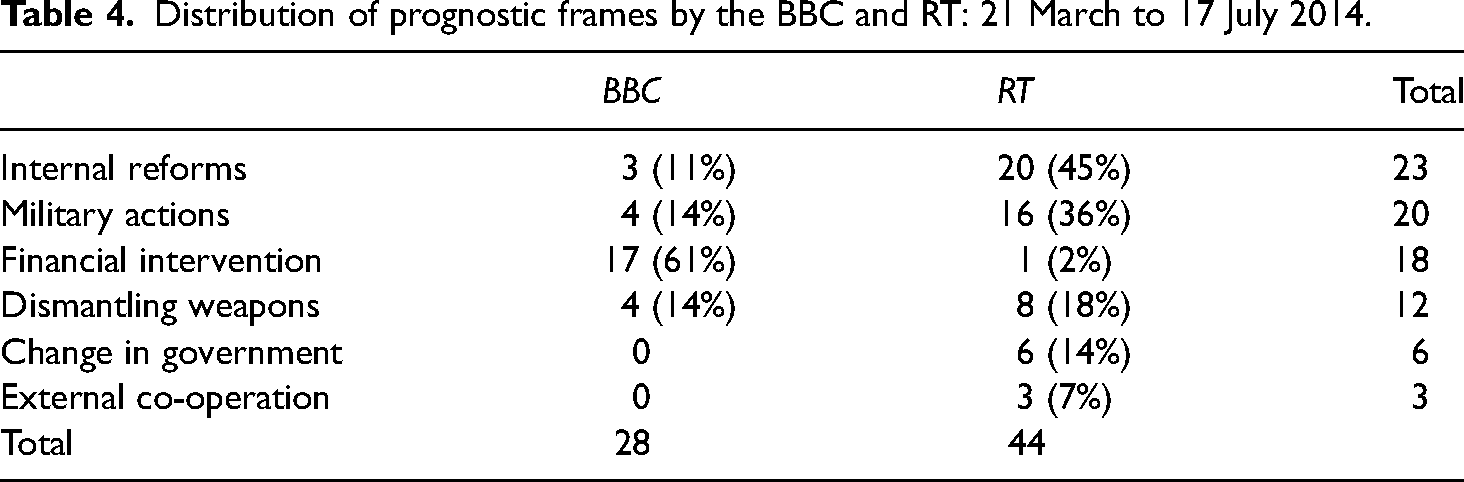
Distribution of prognostic frames by the BBC and RT: 21 March to 17 July 2014.
The BBC mainly viewed the violent unrest in Eastern Ukraine as the main reason for exacerbating the conflict in Ukraine. Russia was also regarded as to be responsible for it. RT's dominant view that the ATO carried out by Kyiv deteriorated the Ukraine conflict was mentioned by the BBC in a small number of 14 stories. By using global dimensions frames, the BBC presented Russia as de-stabilising by illegally annexing Crimea, militarily threatening Ukraine at the border attempting to boost its economic and political influence in Ukraine, the region, and the world in 21 items (64%). Six articles (18%) implied that the Ukraine conflict was fundamentally a battle between NATO and Russia. Five items (15%) spoke to the referenda introduced by the separatists in the South-Eastern region of Ukraine. One article (3%) viewed the West's meddling as responsible for the worsening of the conflict. The BBC used the political causes diagnosis suggesting that the on-going conflict was initially caused by the former president Yanukovych's suspension of the EU Agreements. This view was aided by the use of the human rights violations diagnosis where Russia was accused of breaking international law by annexing Crimea.
RT predominately encouraged internal/constitutional reform/federalisation to focus on the interests of all Ukrainian regions; whereas the BBC mainly suggested financial intervention – economic sanctions on Russia – as a solution to the conflict (Table 4). While the BBC did not mention the external co-operation and change in government frames, RT used the frames suggesting all parties needed to work together and the Kyiv authorities should be removed from power in order to obtain peace. RT used the military action prognosis mainly resisting the idea of any military action while the BBC suggested using military action to assist Ukraine. The use of the dismantling weapons frame revealed further opposing views from the two media. RT called on all sides and especially nationalists to disarm, the BBC suggested pro-Russia rebels disarming in three out of its four stories, with one item stating that no inflow of weapons from Russia was the solution (BBC, 8 July 2014).
Generic frames: 18 July 2014 to 28 February 2015
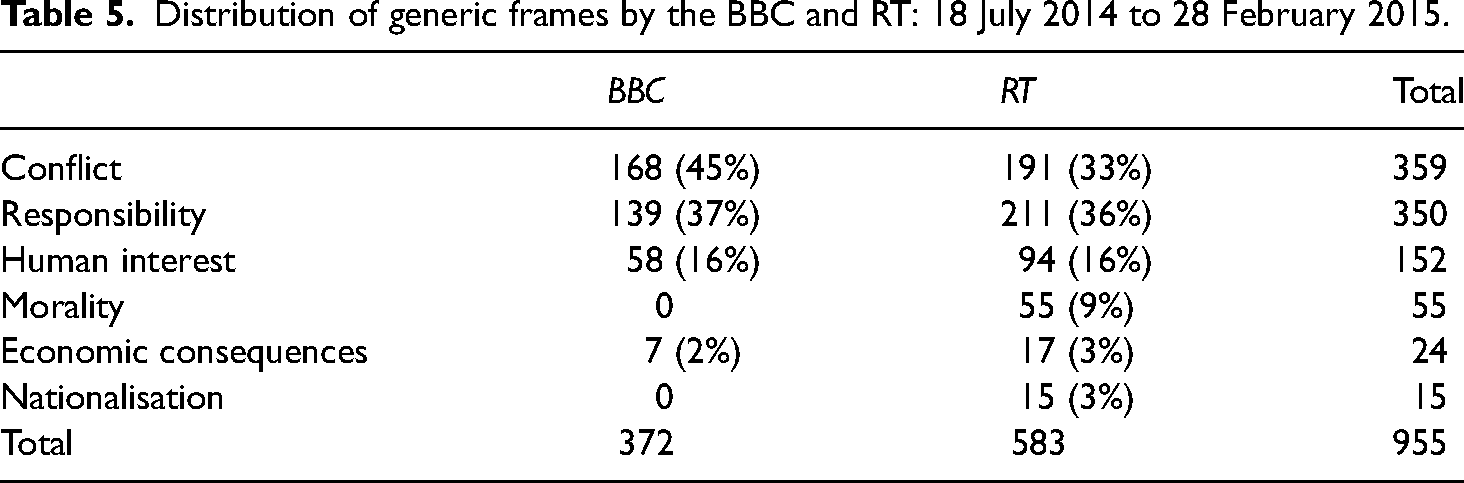
The second time period examined news reporting of the Ukraine conflict from 18 July 2014 to 28 February 2015 (Table 5). The general trend in the use of the generic frames is shown in Figures 1 and 2. Noticeably, the BBC believed that Russia – especially President Putin – and the Russia-backed separatists as the enemy of both Ukraine and the West, should be responsible for the Ukraine conflict. One example from the BBC titled: ‘Russia “to alter military strategy towards Nato”‘ talked about the presence of Russian troops in Ukraine, before quoting Putin as saying: ‘If I want to, I can take Kiev in two weeks’ (2 September 2014).
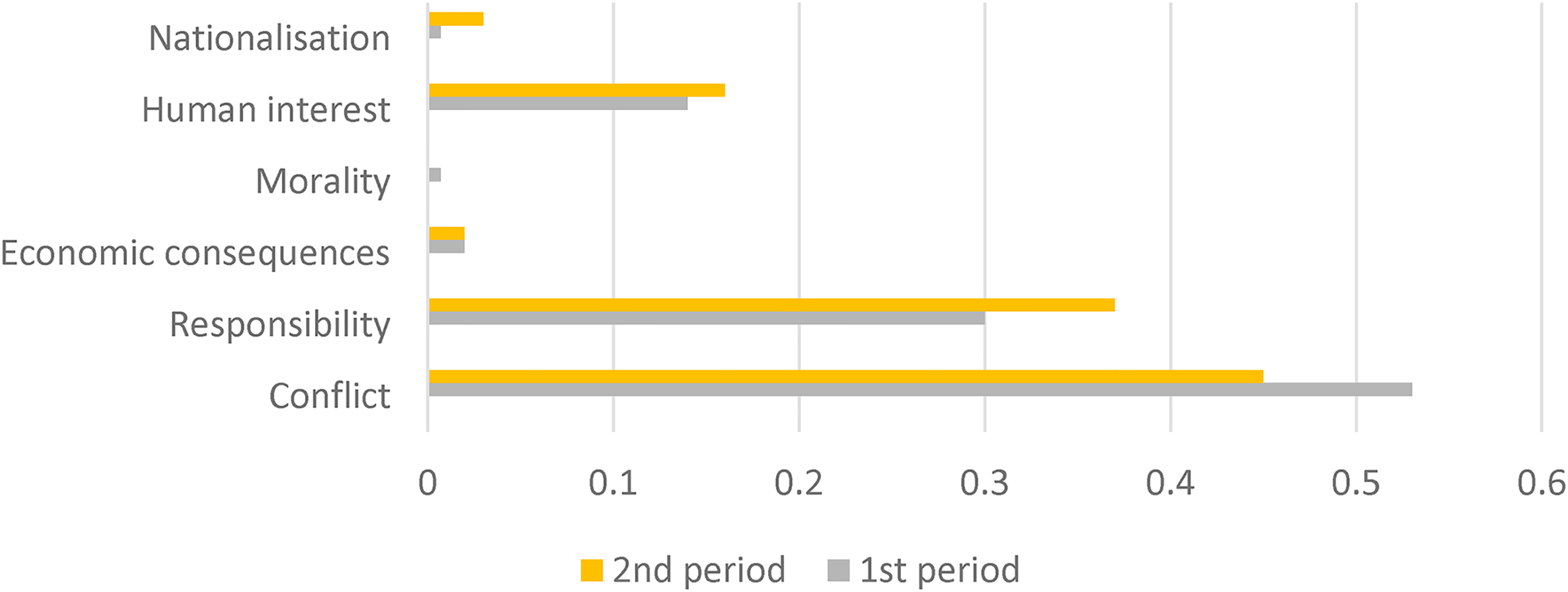
Dynamics of the generic frames by the BBC.
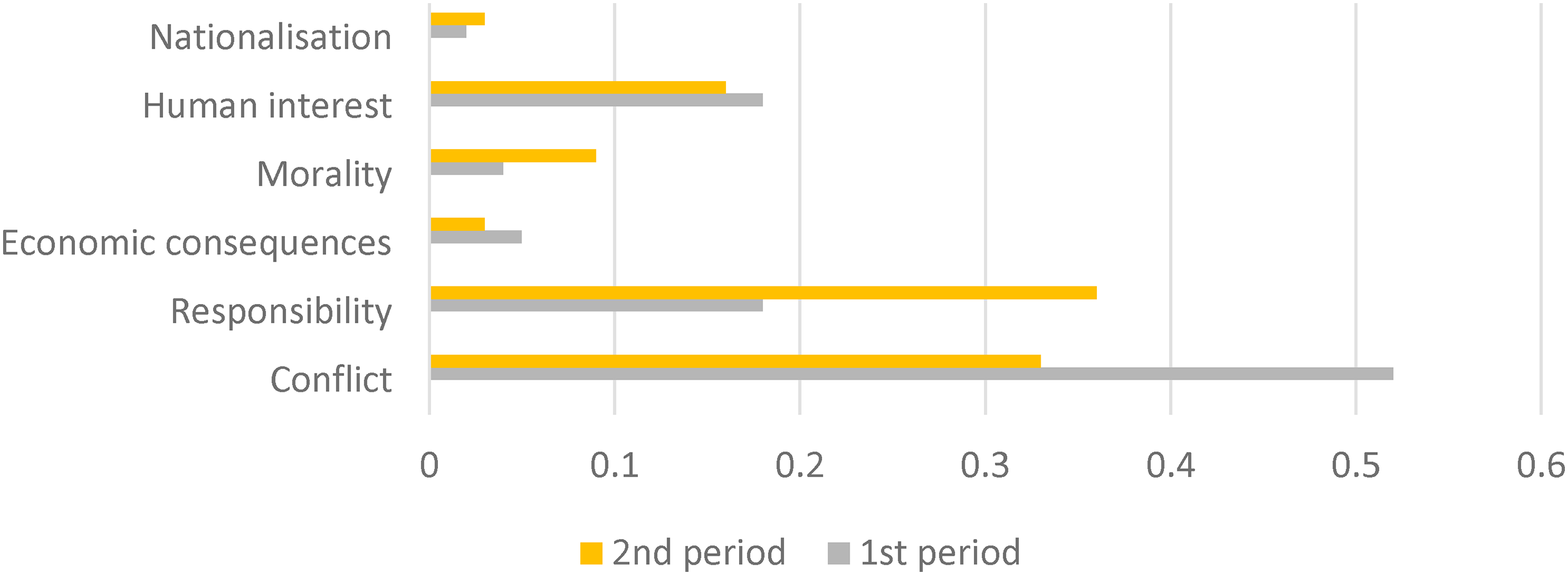
Dynamics of the generic frames by RT.
On its part, RT continuously laid responsibility on the U.S. and the West for covering up the truth, and the Yatsenyuk and Poroshenko governments for conducting war crimes. For example, RT insisted that the Ukrainian civil war caused thousands dead and wounded due to the continued war campaign including a chemical threat by the Ukraine side: ‘Human Rights Watch alleged that Kyiv is using indiscriminate Grad missiles to attack densely populated areas in Donetsk, which violates international humanitarian law, and also blames the militia for taking cover in the same areas’ (RT, 28 July 2014). The media later wrote: ‘Kiev fires ballistic missile at Donetsk’ which ‘can also carry nuclear, biological or chemical warheads’ while ‘Russian humanitarian aid distribution begins in E. Ukraine’ (RT, 25 August 2014).
Diagnostic and prognostic framing: 18 July 2014 to 28 February 2015
The particular triggers frame remained most used diagnosis for both media outlets (Table 6). Overall, the BBC presented the idea that the violence between the two sides – with the pro-Russia forces’ initiation for most part – escalated the Ukraine conflict, while the Russian media believed that the Kyiv army shelling in the region made it impossible for a cease fire. Furthermore, there was a slight increase in the use of the global dimensions frame by RT (Figure 3) signifying the US and NATO's interests in the region. This is in sharp contrast to the BBC (Figure 4) which increased the use from 24% to 47%, suggesting Russia's geopolitical interests in the region. The NATO's expansionism interpreted by RT did not come across in the BBC news coverage. In addition, Kyiv's use of chemical weapons was barely discussed by the BBC, in comparison with RT that used this storyline in most of the human rights violations frames.
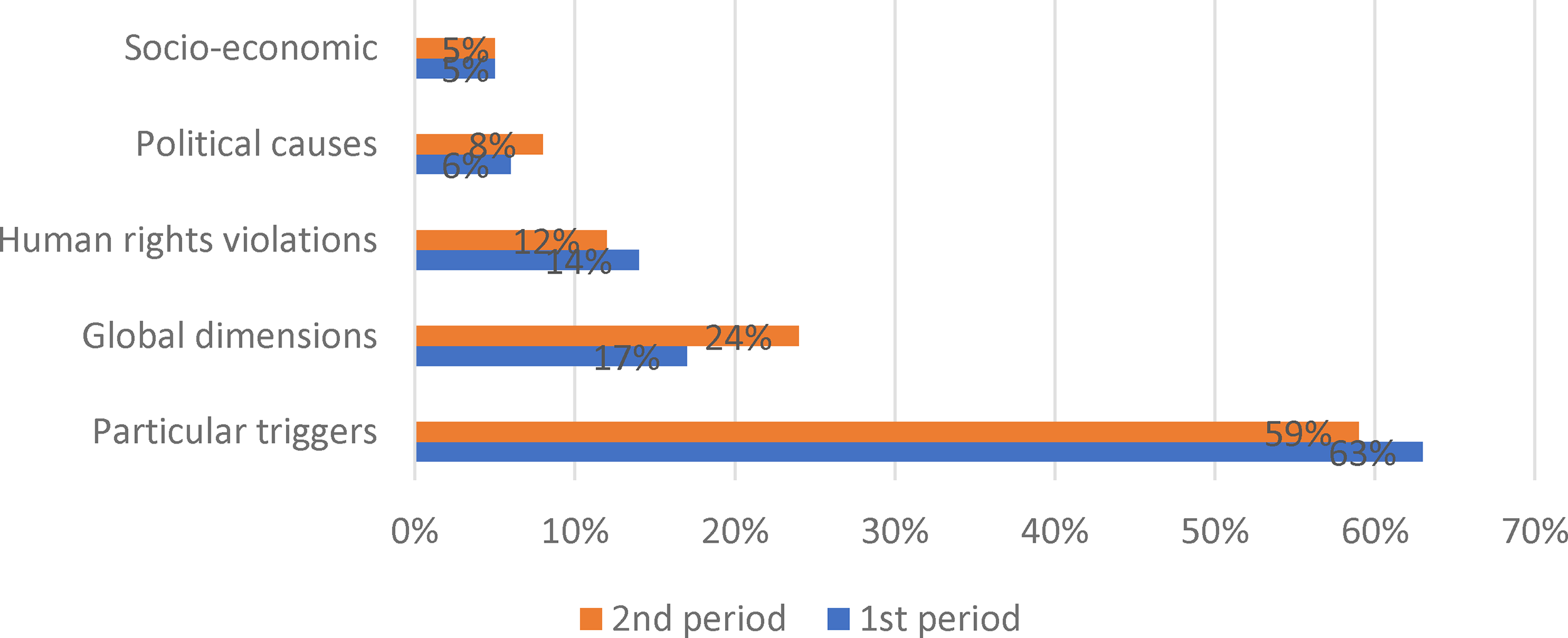
Dynamics of diagnostic frames by RT.
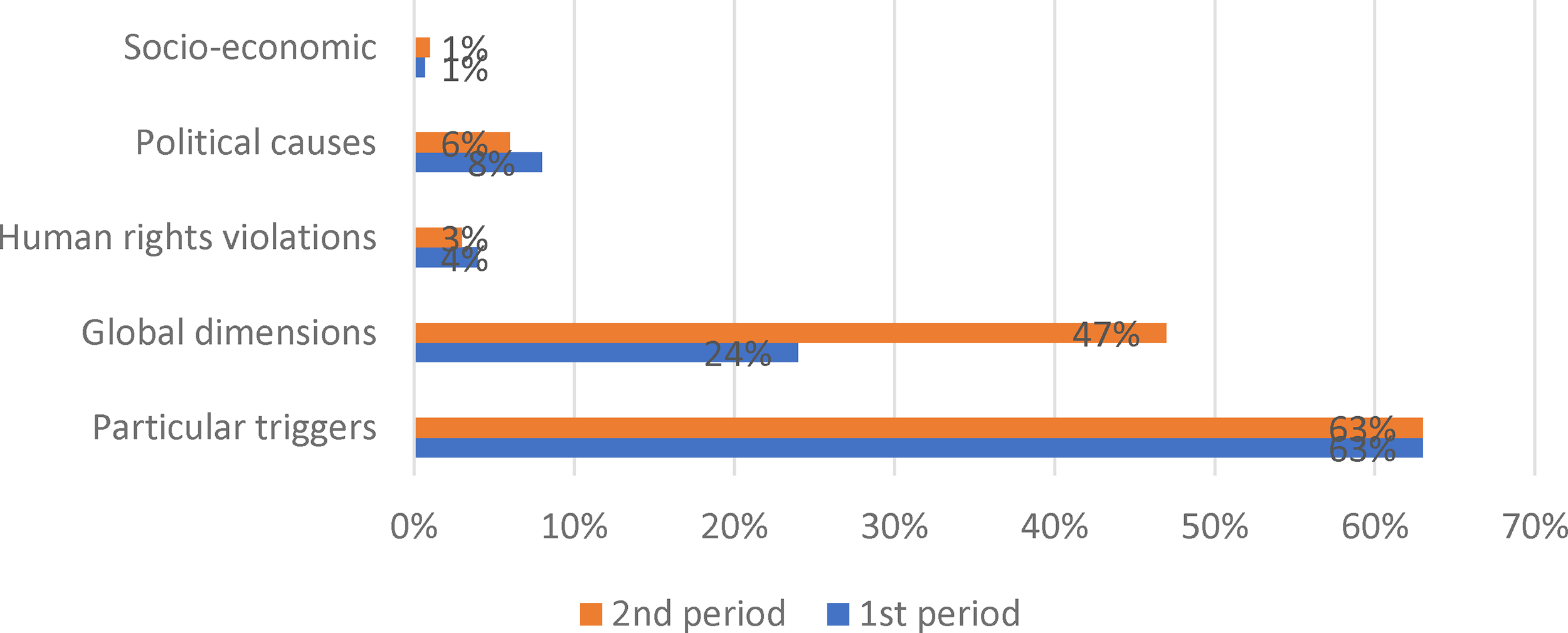
Dynamics of diagnostic frames by the BBC.
Distribution of generic frames by the BBC and RT: 18 July 2014 to 28 February 2015.
Distribution of diagnostic frames by the BBC and RT: 18 July 2014 to 28 February 2015.
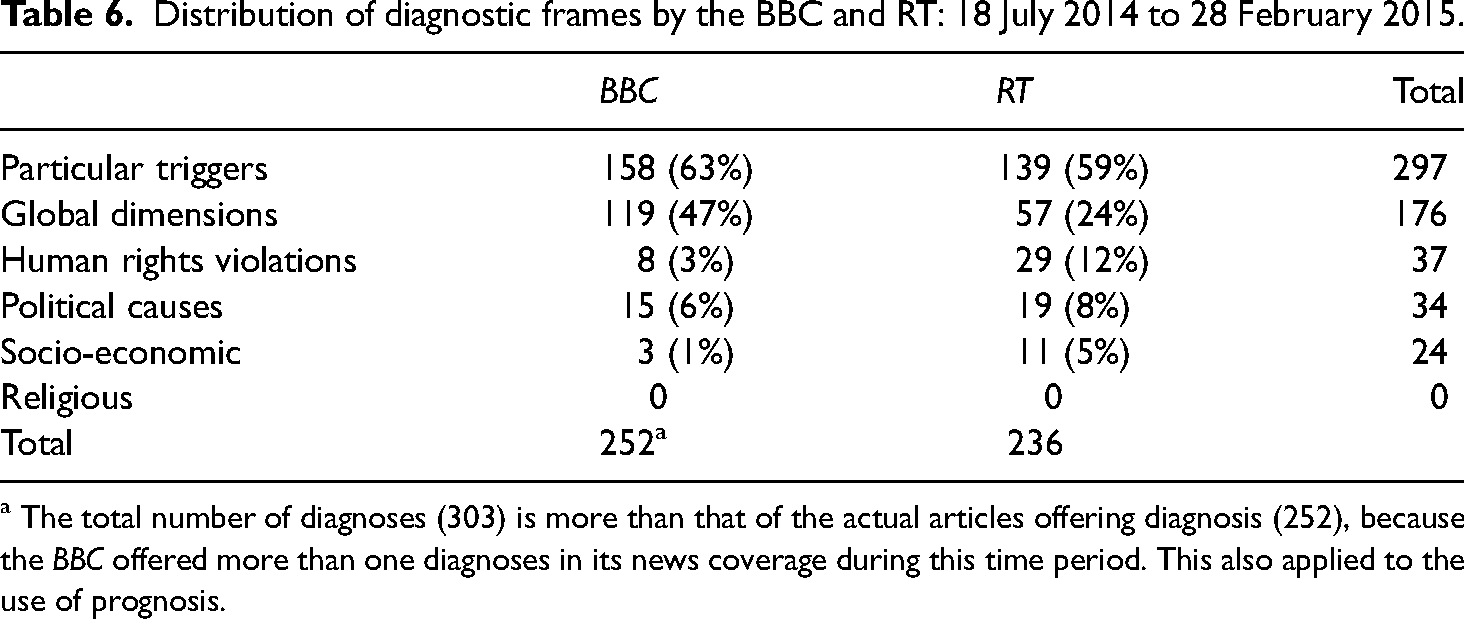
a The total number of diagnoses (303) is more than that of the actual articles offering diagnosis (252), because the BBC offered more than one diagnoses in its news coverage during this time period. This also applied to the use of prognosis.
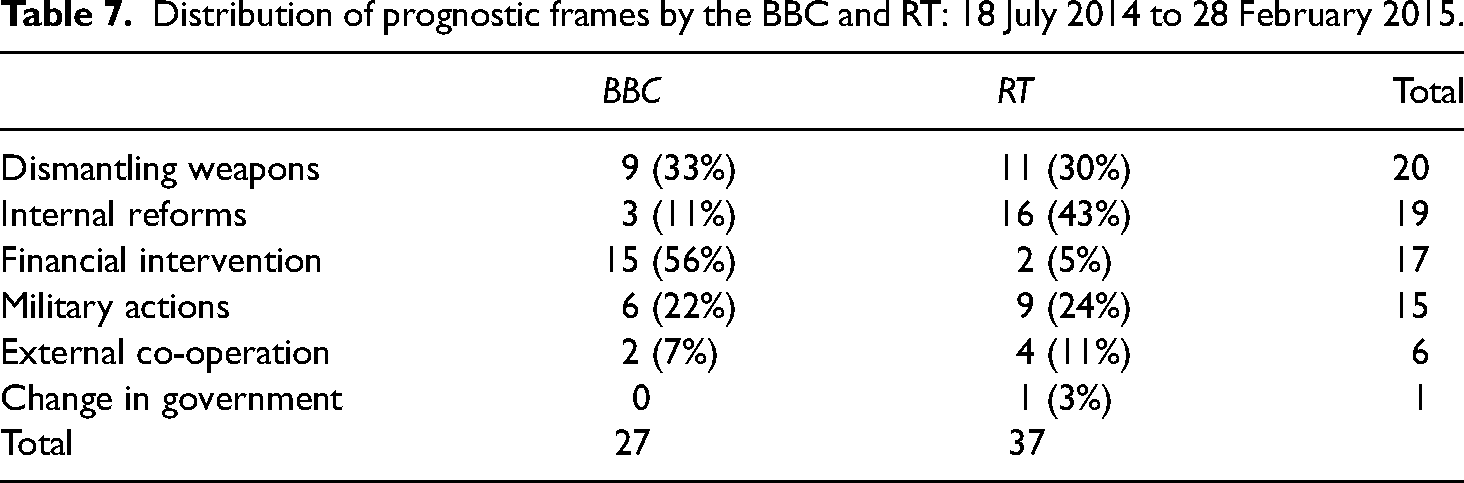
The table below (Table 7) presents the general breakdown of the prognostic frames used during the final period. With the most used internal reforms frame, RT repeatedly suggested decentralisation/autonomy/federalisation as the solution to the conflict – which was also included in the Minsk Accords, giving special status to the South-Eastern region of Donbass. Moreover, RT resisted any inflow of weaponry and soldiers or intervention from outsiders, and suggested collaborations by all parties. The financial intervention prognosis remained favourable to the BBC, suggesting economic sanctions on Russia. This was followed by the use of the dismantling weapons frame calling for a removal of heavy weaponries by both sides and for Russia to stop supplying weapons to rebels. The military actions frame was used less but implying that NATO should consider assisting Ukraine.
Distribution of prognostic frames by the BBC and RT: 18 July 2014 to 28 February 2015.
Discussion and conclusions
The data answered the first two research questions about press attention and news framing, by measuring the overall quantities of news reporting and revealing a set of news frames used by the two media outlets to target the English-speaking world. Although RT was more interested in the Ukraine conflict than the BBC, the latter was more likely to offer prognoses over the two time periods. Furthermore, RT used more diagnostic frames from 21 March to 17 July 2014 while the BBC provided more diagnoses from 18 July 2014 to 28 February 2015. The revealed frames used showed alignments between the politics and the media in both the United Kingdom and Russia, indicating the establishment-oriented constructions which mattered more than material reality and signifying the importance of the media to policymakers (Bennett et al., 2007). The key findings will be highlighted to shed light on their significance to the developments of news framing of war/conflict and theories on war reporting, thus feeding into the third research question exploring why the UK and Russian media framed the 2014–15 Ukraine conflict the way they did.
The human-oriented coverage from RT was prominent over the examined time periods. While it is essential to examine the presented textual ‘facts’ which could have been sanitised in language, it is equally important to ask what the media did not talk about. The invisible and downplayed areas may be as important as the inclusions (Entman, 1993; McCombs and Shaw, 1972; Robinson et al., 2010). Mirroring previous studies (Khaldarova and Pantti, 2016; Liu, 2020; Roman et al., 2017), the findings here show that RT has latched onto the Kyiv government and the presence of pro-Ukraine far-right extremists and labelled them as ‘fascists’ and ‘Nazis’. In the framing of the so-called ‘civil war’, RT portrayed Kyiv in a negative context, making references to human rights stories such as Kyiv's use of chemical weapons. This was assisted, as RT claimed, by the West that played an ‘immoral’ and ‘supportive’ role in ignoring such facts yet blaming Russia. In contrast, the Novorossiya (new Russia) that consisted of Donetsk People's Republic and Luhansk People's Republic was presented in a positive light. They were believed to be defensive in nature due to the Kyiv government that rose to power through the ‘political coup’, the Ukrainian army shelling, and the far-right violence. The coverage, deeply rooted in human values, brought forth the humanitarian rationale by constructing and emphasising selective atrocities (Balabanova, 2015, 2017), suggesting how radical nationalists pushed the ‘self-defence’ forces in Eastern Ukraine further away from supporting Kyiv and contributed to the war in Donbas (Ishchenko, 2018). The media provided a springboard for thinking about these particular issues (McCombs and Shaw, 1972). However, to make political and moral judgements, the media ought to maximise the inclusiveness on the basis of accuracy. Its utilisation of humanitarianism elements, endorsement of the internal reform/decentralisation/federalisation solution and preference to overlook other factors contributing to the conflict, implied the conservative attitude to the purposes of news, aiming to provoke an emotional response from the global audience thus blurring the real and imaginary (Khaldarova and Pantti, 2016).
In the case of the MH17 tragedy which received less significant press attention, RT followed the country's political line denying its involvement. It can be best explained by its editorial synchronisation/gatekeeping process (Livingston and Bennett, 2003; Nelson, 2019; Oates, 2007) and its alleged inaccurate way of reporting which may incorporate misleading elements without factual evidence, as suggested by former RT broadcaster Sara Firth (Rawnsley, 2021). Later, at the time of the ‘humanitarian crisis’ in Eastern Ukraine, there was a clear spike in the coverage of responsibility and morality referring to human suffering in August 2014, potentially reflecting Russia's motivation to offer ‘humanitarian aid’ that was criticised by the West as an ‘invasion’. It is worthwhile to note that Ukraine as a site of ongoing conflict presented a difficulty and complexity for newsgathering, especially when there were various events going on in parallel and Russian journalists faced dangers – from RT in particular – and were banned from entering the country (Human Rights Watch, 2014). This dilemma could have contributed to the lack of sources. Nevertheless, it does not amount to rationalising the media's propagandistic function when selection and exclusion – with or without in-depth reflection along verified sources – became vital components in its news production and distortion. RT's reporting of the ‘humanitarian sentiment’ by capturing the important ‘truth’ in its international news agenda, speaks directly to its war mobilisation efforts to justify and cover for the country's political motivation, national interests and military involvement in Eastern Ukraine (Balabanova, 2015; Hammond, 2018; Miazhevich, 2016), reflecting the (elite version of) manufacturing consent theory (Herman and Chomsky, 1988; Robinson, 2002) and Bennett's (1990) indexing thesis.
The one-dimensional way in which RT framed the conflict, in line with existing studies (Lehtisaari, 2015; Nelson, 2019; Nygren et al., 2018), can be attributed to several factors, including Russian national peculiarities such as the hybrid political regime system where the mainstream media are under strong political control (Liu, 2020), financial subsidies (Slavtcheva-Petkova, 2018), clientelistic dependencies, journalists’ role perception, self-censorship and editorial gatekeeping (Oates, 2007, 2013). Despite its commitment to being counter-hegemonic by offering various perspectives in opposition to the Anglo-Saxon media (Miazhevich, 2018), RT is seen by many as Putin's ‘soft power tool’, critically reporting on events associated with the West and the United States in particular (Rawnsley, 2015, 2021), or monopolised propaganda machine equipped with the clientelism in bringing Russian views to the world (see Miazhevich, 2016, 2018). The state broadcaster serving as distributing national political agenda and foreign policy significance, underlies the fundamental difference between RT and the BBC – on account of its independence from the government as a public service broadcaster. Nonetheless, the BBC was found to have created news distortions in the form of selectivity and omission (Schlosberg, 2017).
The BBC identified Russia and the Russia-backed separatists as the villain, while downplaying the ‘good’ guys’ offences to both externalise responsibilities on Eastern ‘separatists’ and legitimise Kyiv's (non)military attacks to alleviate the crisis (Boyd-Barrett, 2017a, 2017b). As Herman and Chomsky (1988) claimed sympathetic news coverage was contingent upon the media's association and level of friendship with the individual government. The nature of the news framing evolved from silencing the role of the far-right to briefly and ‘reportedly’ mentioning the potential existence of far-right involvement in Odessa while frequently reminding the audience of anti-Kyiv ‘separatists’ and Russia's perceived disruptive role. This was, as existing studies (e.g. Miazhevich, 2016) suggest, possibly a result of the BBC's adherence to the principle of ‘impartiality’ stipulated in its Charter. However, this ‘impartiality’ needed to be prudently interrogated to question the extent to which the BBC indeed safeguarded the distinct nature of the service as the events unfolded. In the case of Russian journalists’ arrest – including Phillips from RT – by Ukrainian security services, the BBC made references to Phillips's ‘controversial reputation’ in light of the suspected anti-Ukrainian bias and false claims in his reporting, while clarifying that RT has ‘long been regarded by many as the Kremlin's propaganda mouthpieces in Ukraine’ (23 May 2014). When Kyiv's use of chemical weapons was disclosed and confirmed by Amnesty International, the BBC briefly blamed both sides for the ‘discriminate use of heavy weapons’ in conjunction with its increased framing of Russia's geopolitical interests relating to the Ukraine. The superficial attempts to be ‘objective’ in constructing negligible equal representation of ‘both sides’ was rather a reluctance to admit the human rights abuses from Kyiv, including the presence of far-right, the asymmetrical nature of violence in Odessa, and Kyiv's use of ‘chemical weapons’ as well as its conduct of war crimes. This reinforced the one-sided nature of the media construction, which came in parallel with the Western establishment's (e.g. the EU) allyship with the Yatsenyuk and Poroshenko-led Kyiv authorities (Bennet, 1990; Herman and Chomsky, 1988; Robinson, 2002). The media's shift from focusing on the change in (Yanukovych) government as a solution at the beginning of the crisis in late 2013 (Liu, 2020) to disseminating what the Western allies have constantly suggested of sanctions uncovered in this study was the pithiest expression of this.
The BBC was meticulous in its (re)construction of events, deliberating ‘liberalism’ by articulating Western policies on the conflict to hold Putin's Russia accountable. The constant accusation would fit in with the existing public perception of Putin as ‘the culprit and aggressor’ (Ojala and Pantti, 2017) and therefore with their editorial and journalistic narrative that had been prescribed since late 2013 (Liu, 2020). This does not suggest the illiberal activities from Russia including its instrumental use of RT are legitimate, but to raise awareness of the necessity to self-examine while questioning and taking into account perspectives of all sides, especially in the context of an incoherent state of Ukraine (Oskanian, 2014). Through framing and agenda-setting tradition backed by selective evidence in its favour, the BBC – as a public service broadcaster – could hardly be proved to be independent of the government or to play its information role in public interest (Aalberg and Curran, 2012; Schlosberg, 2017). Different from RT and Russian peculiarities, the BBC may be largely influenced by its corporate interests (Cushion and Lewis, 2017), particular working and bureaucratic culture (Freedman, 2018), interrelate relationship between the corporation and the state with the latter exercising a constant top down pressure through appointments and funding freezes, making it akin to a paternalistic media outlet that shares an elite culture within the corporation entangled in the world of Westminster and the ruling party (Chivers, 2021; Mills, 2016, 2019). As Curtis (2020, 2021) commented in relation to the media and state coalition on the subject of UK foreign policy, while UK's official enemies such as Russia have been disproportionately and constantly criticised by the state and the media, there was a pattern of news avoidance of repressive regimes the United Kingdom was supporting and complicit with (also see Balabanova, 2015; Boyd-Barrett, 2017b; Hawkins, 2004, 2008, 2011; Herman and Chomsky, 1988; Robinson, 2017, 2019; Yarchi et al., 2013). This may be an indicator of war journalists’ self-censorship and gatekeeping dimensions including their role perception as an extension of the state at the individual level, and marks the importance to question the corporation's hidden political agenda at the institutional level. The historical secret political vetting of BBC staff by UK intelligence service (MI5) from the 1930s to the 1990s (Leigh, 2010), and selective pool of employees – dominated by those having private school and Oxbridge background and knowing the long-term benefit for its establishment orientation (Mills, 2016, 2019), makes it difficult to discern.
This comparative study concludes that the selectively framed stories disclosed the same logic of omitting some subjects while pursuing others, revealing illiberal trend under a manufactured common banner of national foreign policy. While this study does not examine whether and how the media coverage influenced public perception, it argues that when the audiences were exposed to a plethora of non-analytical and historically shallow information about international politics associated with the Ukraine in the digital era, they were likely to know more but understand less. The roots for this were deeper than what was represented, underlining the historically normative disagreements and conflicts of interest between Ukraine, Russia and the West (D’Anieri, 2019; Sakwa, 2015). Moreover, the simplification of the conflict, reducing it to a single proposition of one party's responsibility along the establishment line, not only failed to resolve existing tensions but simultaneously fed the spiral of aggression, thus failing in seeking constructive contributions to the Ukrainian state-building project to date (Baysha, 2018).
Finally, while the majority of the frames used in this study were applicable, the religious diagnosis was not applied at all or seen as a major concern in the context of the Ukraine conflict. This may both explain and prove that the conflict was fundamentally a political one. It is interesting to note that while the approaches and intentions of the BBC and RT framing efforts may be different, the nature of bias is similar in that their soft power and framing in propagating ideas have become a very central dimension of state power. The study also has its limitations, which could have been aided by conducting questionnaires and interviews to first, examine whether the BBC's frequent use of the conflict frame, as De Vreese and Tobiasen (2007) suggested, contributed to the public support for political decision making – the decision to continue economic sanctions on Russia in this study. Second, conducting interviews with war journalists could add values to our understanding about how media performance was shaped and influenced by news environments and how the professional ideology intersected with their wider surrendering. This could include themes such as ideological system, journalists’ role perception, relationship between career and truth-bringing, internalised and externalised pressures. Given that most of the stations’ activities are now imbedded in the sphere of social media, future studies could focus on RT and the BBC reports on Twitter to enhance our understanding of international broadcasting, as well as the role of social media in comparison to that of traditional media.
Footnotes
Declaration of conflicting interests
The authors declared no potential conflicts of interest with respect to the research, authorship, and/or publication of this article.
Funding
The authors received no financial support for the research, authorship, and/or publication of this article.
