




Abstract
In May 2018, hundreds of websites located outside the European Union (EU), including USAToday.com, became completely or partially unavailable to EU citizens as a number of publishers decided to comply with an EU data protection regulation (GDPR) by blocking access. Several of the sites that started to exclude EU users continued to do so for months or years, even though some of their competitors, like the New York Times, never adopted a policy of exclusion. These differing strategies allowed us to conduct a quasi-experimental study on the effects of temporary product unavailability and temporary rationing. We find that both temporary product withdrawal and temporary rationing can have long-term effects. In our case, monthly unique visitors in the months and even years after full access was restored were between 44% and 61% lower than they had been before the restrictions were imposed, with a wider market contraction explaining only part of these falls. We also find distinct differences between the effects of temporarily rationing and temporarily withdrawing websites. Although both strategies lead to a long-term loss in visitors, rationing appears to increase a website's desirability for some consumers. After rationing was lifted, USAToday.com's reduced audience consumed the title more deeply and frequently than had been the case before rationing was imposed.
Keywords
Introduction
In May 2018, over a thousand websites and apps located outside the European Union (EU)—including from well-known news brands like the Los Angeles Times, the Chicago Tribune, and USA Today—became fully or partially unavailable to EU citizens (O’Connor, 2019). This was not a technical glitch, like the one that took Facebook down on 5 October 2021. Rather, it was a deliberate decision by some publishers to reduce or eliminate their product offering to hundreds of millions of users based on their location. And unlike Facebook's downtime, which lasted only six hours, many of the sites 1 that started to discriminate against EU users continued to do so for months and even years, even though some of their competitors, like the New York Times and the Washington Post, never discriminated.
The differing strategies taken by US websites towards their EU customers offer an opportunity to conduct a quasi-experimental study on the long-term effects of temporary product withdrawal and temporary rationing. We use real-world behavioural tracking data from Comscore to create time series that begin in July 2017, 11 months before the intervention, and end in July 2021, more than three years after, giving our study strong external validity and the ability to look beyond the immediate and medium-term impacts.
We find that both temporary product withdrawal and temporary rationing can have long-term effects. In our case, monthly unique visitors in the months and even years after full access was restored were between 44% and 61% lower than they had been before the restrictions were imposed on EU visitors, with a wider market contraction explaining only part of these falls. We also find distinct differences between the effects of temporarily rationing and temporarily withdrawing websites. Although both strategies lead to a long-term loss in visitors, rationing appears to increase a website's desirability for some consumers. After rationing was lifted, USAToday.com's reduced EU audience consumed the title more deeply and frequently than it had before rationing was imposed.
The reason that so many US websites started to discriminate against EU users was the introduction of the European Union's General Data Protection Regulation (GDPR), which was passed in 2016 (EU, 2016), and came into effect on 25 May 2018 (Wolford, n.d.). The intention of the regulation was to ensure that EU citizens ‘had more control over how their information was being used’ (Novak, 2018). It replaced the European Data Protection Directive of 1995, with the EU stating that ‘rapid technological developments and globalisation’ meant the scale of personal data collection and sharing had ‘increased significantly’, creating ‘new challenges’ for the protection of that data (EU, 2016). The regulation allows stiff penalties for those who violate it, with fines of ‘up to 20 million euros’ or ‘4% of a company's global turnover’ (BBC, 2018). In the UK, which left the EU in 2019, the legislation was incorporated into the 2018 Data Protection Act with ‘minor changes’ (BBC, 2018).
The GDPR regulations include a requirement for EU citizens to provide consent for ‘the processing of personal data’ (EU, 2016). They also mean that citizens now have ‘the right to see what information companies have about them, and to have that information deleted’ (BBC, 2018). In addition, organizations must ‘tell all affected users about any data breach, and tell the overseeing authority within 72 hours’ (BBC, 2018).
The data covered by the regulations includes ‘any information that relates to an individual who can be directly or indirectly identified’, with examples including names, email addresses, location information, web cookies, and political opinions (Wolford, n.d.). It includes pseudonymous data if identifying someone from that data is ‘relatively easy’ (Wolford, n.d.).
The regulations apply to all organizations that handle data on EU citizens (Novak, 2018). This means not just organizations based within the EU, but those outside the EU that handle EU citizens’ data (Fox, 2018).
Organizations’ responses to the regulations were varied. While Twitter ‘introduced granular controls that let people opt out of targeted advertising’ (Fox, 2018), various US news sites, including the Chicago Tribune and the Los Angeles Times, made themselves unavailable or partially unavailable to visitors from European countries to bring themselves into compliance (BBC, 2018). Indeed, a study of over 500 US news sites conducted one year after the implementation of the regulations found that over half blocked ‘access from users in Europe entirely’ or offered ‘reduced content’ (GDPR Associates, 2019).
Whether a US news site blocked EU visitors or not seems to have had little to do with its size and much more to do with institutional and management factors. For example, all the newspaper sites owned by Tribune Publishing, New Media Investment Group, and Lee Enterprises blocked whereas those owned by Gannett, McClatchy, Advance Publications, and Digital First Media did not (South, 2018).
Some publishers explained why they decided to block EU visitors. For example, Lee Enterprises, owner of scores of daily newspapers in the US, implied that embracing the GDPR would not be in the ‘best interest of [their] local media clients’ who constituted a much larger market than was generated by the ‘de minimis’ internet traffic they received from the EU (Dent, 2018). The publisher of the entertainment news site Topix also spoke of Europe not being ‘a big-enough market’ to be worth taking unknown risks for (Moses, 2018). According to a New York-based trade association for digital content companies, the lack of clarity for US digital publishers around those risks included not knowing ‘which tech solutions for gathering and storing consent data’ would meet regulatory approval (Moses, 2018).
Literature review
This article primarily draws on the literature on the impact that unavailability has on products’ desirability. This is most comprehensively discussed by Verhallen and Robben (1995) who, with reference to economic theory and experimental evidence, suggest that the evaluation of products may change when the products become unavailable in a variety of circumstances. They suggest that, under some conditions, an unavailable product will be evaluated more highly, treated like the proverbial forbidden fruit; and under other conditions unavailability will frustrate consumers, resulting in a decreased evaluation, as was the case with the fox in Aesop's fable, who, unable to reach bunches of ripe grapes, turned ‘away in sadness’ and declared that they were nothing to him, the fruit having soured in his mind (Keller and Keating, 1993).
The article also draws on status quo bias, also referred to as ‘lock-in’, ‘state dependence’, ‘loyalty’, and ‘switching costs’, where unavailability prompts a consumer to switch to, and stick with, a different product, even when the unavailable product returns to market.
In this article, our use of the terms ‘unavailable’ or ‘fully unavailable’ in relation to websites in our sample means that they completely blocked EU users. Our use of the terms ‘partial unavailability’, ‘partial exclusion’, ‘partial blocking’, and ‘rationing’ in relation to one website in our sample, USAToday.com, refers to how it (temporarily) offered EU visitors a site with reduced content and functionality. Our use of the term ‘rationing’ is in line with Neary’s (2008) definition of the concept as occurring when ‘economic agents’, in this case website visitors, ‘face constraints on their demand for … particular commodities’. The commodity in our case being the content and functionality offered by USAToday.com.
Verhallen and Robben (1995) suggest that an unavailable product may become more desirable under a variety of conditions. Firstly, ‘if a product is no longer available due to nature … the typical reaction of individuals is to regret the impossibility to have that product and to reevaluate that product more positively’ (p. 375). Secondly, if a product is only available to members of a particular group then the access those members have to the good can arouse feelings of social prestige in them and cause them to value the product more highly. Thirdly, Verhallen and Robben (1995) suggest that unavailability might make a product more valuable through scarcity, where a product that is seen as rare will be more highly valued as a result.
With our case, the first condition does not apply, as the GDPR-inspired blocks were not due to nature. With regard to the second condition, the members of the in-group were non-EU visitors, so, although their valuation of the sites that blocked EU visitors could theoretically have increased, EU visitors’ valuation of those sites would not increase as they were members of the out-group. Scarcity, the third condition, does not apply to our case, as there is practically no limit to the number of people who can consume a virtual product such as a website.
Alternatively, Verhallen and Robben (1995) suggest that unavailability might decrease the evaluation of a product. Firstly, they distinguish between responses to unavailability caused by ‘nature’—’with no one special to blame’—and unavailability caused by ‘a person or institution’ who ‘can be held responsible … e.g., due to regulations’. In the latter case, Verhallen and Robben (1995) say, ‘the typical reaction would be to feel frustrated and to devaluate the product’. Secondly, when a product is only available to certain individuals, those in the out-group, whose access is blocked, may feel jealousy and frustration, negatively influencing their evaluation of the product.
In our case, the two circumstances in which unavailability may lead to devaluation both apply. Institutions can be held responsible for the blocks, most directly the website owners, who, despite advance notice of more than two years and unlike some of their competitors, decided to comply with the GDPR by blocking EU users. Furthermore, EU consumers found themselves in an out-group, with non-EU consumers’ access to the websites unaffected.
Although a body of research exists on changes in consumer behaviour during a period of rationing (see, e.g., Tobin, 1952), very little exists on the effects of rationing once restrictions are lifted. An exception is Costa’s (2013) study, which found that a temporary period of electricity rationing in Brazil led to a persistent reduction in electricity use even ten years later.
A second theory that might help guide our expectations is status quo bias. There is an extensive literature—summarized well by Dean et al. (2017)—showing that people are more likely to choose an option when it is the status quo.
Two of the most influential papers on this theme are by Samuelson and Zeckhauser (1988) and Madrian and Shea (2001). Samuelson and Zeckhauser (1988) demonstrated the impact of status quo bias in an experiment with 486 college students that involved the choice of health insurance plans among Harvard employees, and the way in which college faculty from across the US chose to invest their retirement funds. Madrian and Shea (2001) examined the behaviour of workers at a large US firm after the company made changes to their retirement plan, finding that many workers simply stayed with the new default proposed by the company, an option that was rarely chosen before the changes were made.
Both papers highlight a variety of psychological explanations for status quo bias, including: tangible switching costs, the tendency to weigh the downsides of switching more heavily than the upsides (loss aversion), the common practice of simply delaying a decision (procrastination), and the desire to maintain consistency in your decisions so as to avoid losing sunk costs or experiencing regret about past choices.
When we think about status quo bias in relation to the GDPR-inspired blocks, we can see that when EU visitors started to be excluded from a website outside the EU, they may have switched their attention to one or more other websites, which then became the status quo. When the blocked site unblocked, status quo bias would suggest that some people would stick with the other website/s, which had become the status quo, whereas prior to its blocking, the original website would have had an advantage, as at that point it represented the status quo.
We are aware of just one study that has investigated the effects of a period of unavailability on the consumption of websites. Goldfarb (2006) analysed the consequences of the brief unavailability of the websites of Yahoo, CNN, and Amazon as a result of denial of service (DoS) attacks that took place on 7–8 February 2000. The attacks lasted between one and three hours. Goldfarb acquired data on every website visited by 2651 households from six weeks before the DoS attacks until 53 days after. In general terms, he found that ‘consumers reduce their preference for a website after a DoS attack’ (p. 170). More specifically, he found that the DoS attacks ‘hurt the attacked website[s] in the weeks that followed and that the attacks helped competitors’. In particular, the rivals of Yahoo and Amazon ‘gained from the attacks’ (p. 155). For at least one of the websites—Yahoo—the effect of the attack decreased over time, and Goldfarb (2006) estimates it would have completely dissipated after 91 days. The study attempts to quantify to what extent the fall in daily visits that the attacked sites suffered was due to status quo bias—that is, visitors getting locked-in at rival sites—and to what extent it was due to a change of preference. The results show that, for Yahoo, the effect of lock-in to rivals had dissipated after 11–15 days, whereas the overall effect of the attacks lasted at least 53 days (the end of the study window). Goldfarb (2006) also found that users who had personally experienced the sites’ unavailability were less likely to return (p. 162).
Overall, then, general theory on product unavailability would lead us to expect the GDPR-prompted temporary unavailability of US websites to EU visitors would decrease the desirability of those websites for those consumers. This is because, firstly, the blocks were not ‘natural’ but instead the result of decisions taken by the site owners, and, secondly, the fact that the sites were unavailable only to EU visitors meant that an in-group of non-EU visitors continued to have access.
The evidence on the effects of status quo bias would suggest the websites that blocked EU users, in addition to becoming less desirable, may also have suffered as a result of some of their users visiting rival sites and getting locked-in in the process.
Goldfarb’s (2006) study offers some empirical evidence that the temporary unavailability of websites could have negative effects on future visits as a result of both reduced desirability and lock-in to rivals, although, for Yahoo, the lock-in effect dissipated within two weeks and the overall effect, he estimated, after around three months. There is, however, an important difference between the DoS attacks Goldfarb studied and the GDPR-prompted blocks.
The unavailability caused by the DoS attacks lasted between one and three hours compared with periods of unavailability resulting from the GDPR-prompted blocks that lasted between six and 28 months. Goldfarb (2006) found users who had personally experienced a site's unavailability were less likely to return. The length of the GDPR-prompted blocks means that a much higher proportion of the users in our case would have experienced the unavailability first-hand, potentially making its consequences more profound and longer lasting.
It is also worth noting that, for the respondents in our study, almost an order of magnitude more 2 websites were available during and after the blocks than were available to Goldfarb's respondents back in 1999/2000. This is likely to make it harder to observe any displacement to, and lock-in at, rival sites.
In sum, this leads to the following research question: What effects have the GDPR-prompted temporary unavailability and temporary rationing of news websites had on their consumption?
Methodology
Research design
To investigate our research question, we used a quasi-experimental approach. For reasons that are explained later in this section, the websites in our sample are all from the US, and, although visitors from all EU states were subject to the periods of temporary restricted availability, this study focuses on visitors from the UK. We use ‘restricted availability’ to refer to both the total and, in the case of one website, partial exclusion of UK visitors from sites’ content.
The specific quasi-experimental approach we use is interrupted time series analysis (ITSA), with multiple measurements before, during, and after the US websites restricted their availability for EU visitors. A common threat to the validity of ITSA with a single unit of observation (like a website) is history—‘the impact on the time series by an event outside the intervention may be mistaken for a treatment effect’ (Linden, 2017). However, history ‘can be controlled for by using a comparable control group to serve as the counterfactual’ (Linden, 2017).
In this study, two control groups are used. Firstly, the Canadian visitors to the sites that temporarily or partially blocked EU visitors. Canadian visitors did not experience any interruption to the availability of the websites because the GDPR applied only to visitors based in the EU. Canadian visitors were chosen over US visitors because Canada, like the UK, represents a non-US, English-speaking market for US websites. The demand for US websites from visitors in two non-US English-speaking countries may be more similar than demand from visitors in one non-US English-speaking country and demand from domestic US visitors.
The second control group were visitors to US sites that complied with GDPR and did not restrict their availability to EU visitors. Using the first control group has the advantage of controlling for historical factors specific to the individual websites in our treatment group, such as any changes over time in the quality of their content, their paywall policies, their marketing efforts, and any externally driven changes in demand for their content, such as Covid-19 (see, e.g., Benton, 2020). Using the second control group has the advantage of taking into account any differences there may be between the behaviour of UK and Canadian consumers. For example, a news story of interest within Canada, but not the UK, may temporarily cause a spike in traffic from Canadian visitors, or vice versa.
Sampling
In order to construct the sample of sites for our treatment group—those that temporarily restricted their availability for EU visitors—desk research was conducted. Two sources proved particularly useful. Firstly, a dataset compiled by O’Connor (2019) that lists 1129 websites that were blocked to EU visitors soon after the GDPR came into force. Secondly, a shorter list of 112 US newspapers, compiled by South (2018), showing 36 newspapers that were blocking EU visitors around 10 weeks after the implementation of GDPR, and 76 that were not.
These lists and other sources (e.g. Sentance, 2018) were combined to produce a long list of sites—all from the US—that restricted their availability for EU visitors when the GDPR came into force. All the sites on this long list were then checked to see if they had subsequently unblocked (as of May 2021). Those that had were shortlisted for inclusion in the final treatment group. Whether they were included was dependent on the availability of internet audience data from our data source, Comscore.
As we checked data availability, two limitations became clear. Firstly, that data on EU visitors was available only for larger non-EU websites, such as LATimes.com. Secondly, that even for larger non-EU websites, adequate data was not available on the consumption of those websites by residents in many continental European countries (as opposed to residents of the UK).
The reason for these limitations is to do with the size of the panels of users whose internet consumption Comscore tracks. For example, even though Comscore has around 55,000 panellists in the UK (Rebecca Crow, personal communication, 30 September 2021), too few of them visited the website of the Tuscaloosa News—a daily newspaper in the US state of Alabama—for Comscore to have reliable data on its UK visitors. So, even though the Tuscaloosa News initially blocked EU visitors and subsequently unblocked, it was not included in our treatment group.
This data availability limitation was especially pronounced for countries in the EU where English is not the first language. For this reason we limited our analysis to UK visitors of the US websites in our final sample. Websites based in English-speaking countries have a higher reach in other countries where English is the first language than in countries where it is not, likely for linguistic and cultural reasons (Thurman et al., 2021).
This process resulted in a treatment group consisting of the websites of three US newspapers, the Los Angeles Times, USA Today, and the Chicago Tribune; and one US entertainment magazine, Us Weekly (which, online, uses the URL, USMagazine.com). Three of them fully blocked EU visitors immediately after the GDPR came into force in May 2018 (O’Connor, 2019), while USA Today rationed EU users’ access, redirecting them to an inferior, bare-bones ‘European Union Experience’ website (JuneYourTech, 2018; Kivimäki, 2018). However, the dates on which these sites lifted restrictions differed, resulting in interventions of between about 6 and 28 months (see Table 1).
Websites in the treatment group, all of which temporarily blocked visitors from the EU (or, in the case of USA Today, offered EU visitors a bare-bones site) to comply with the EU's General Data Protection Regulation (GDPR).
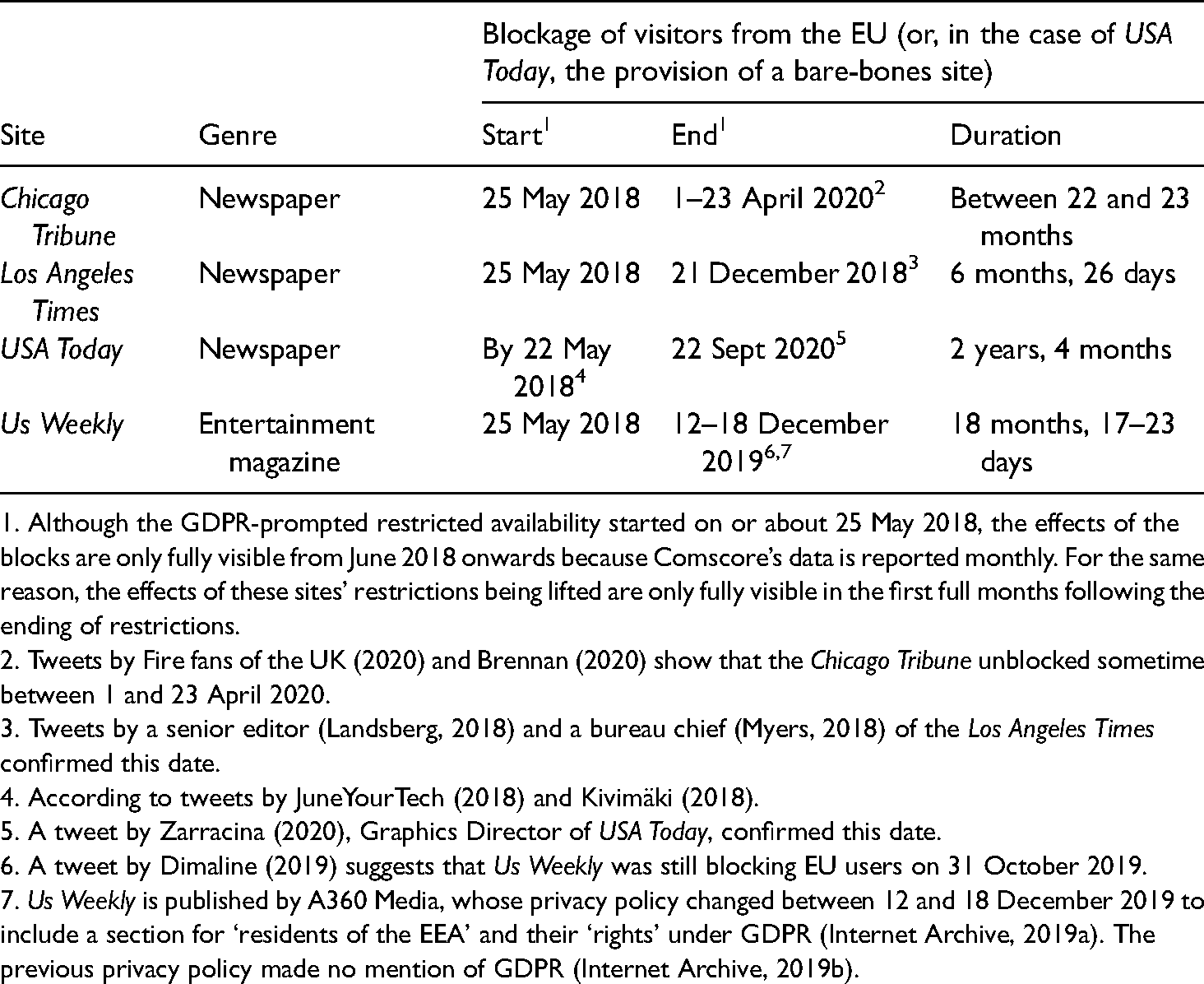
1. Although the GDPR-prompted restricted availability started on or about 25 May 2018, the effects of the blocks are only fully visible from June 2018 onwards because Comscore’s data is reported monthly. For the same reason, the effects of these sites’ restrictions being lifted are only fully visible in the first full months following the ending of restrictions.
2. Tweets by Fire fans of the UK (2020) and Brennan (2020) show that the Chicago Tribune unblocked sometime between 1 and 23 April 2020.
3. Tweets by a senior editor (Landsberg, 2018) and a bureau chief (Myers, 2018) of the Los Angeles Times confirmed this date.
4. According to tweets by JuneYourTech (2018) and Kivimäki (2018).
5. A tweet by Zarracina (2020), Graphics Director of USA Today, confirmed this date.
6. A tweet by Dimaline (2019) suggests that Us Weekly was still blocking EU users on 31 October 2019.
7. Us Weekly is published by A360 Media, whose privacy policy changed between 12 and 18 December 2019 to include a section for ‘residents of the EEA’ and their ‘rights’ under GDPR (Internet Archive, 2019a). The previous privacy policy made no mention of GDPR (Internet Archive, 2019b).
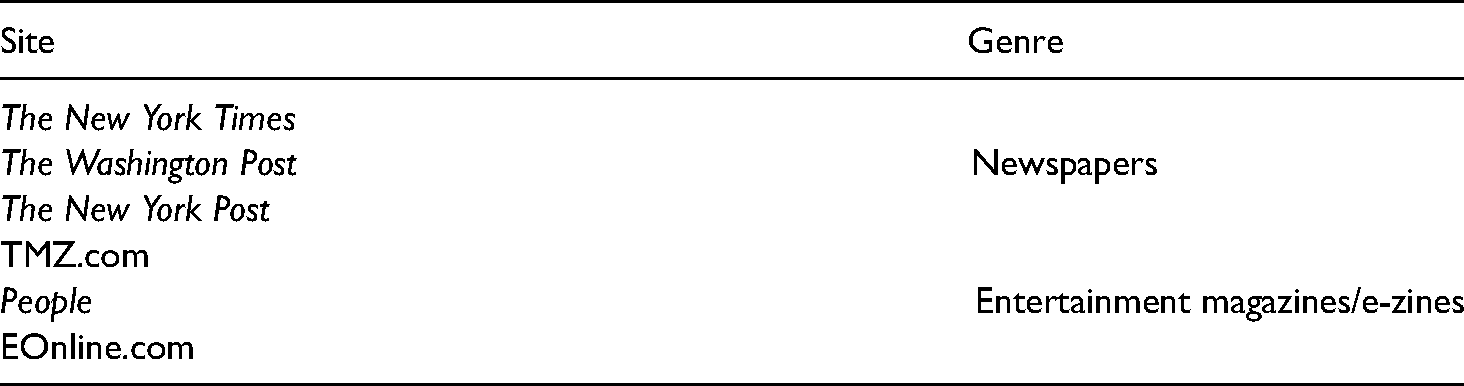
Once the treatment group was finalized we sought suitable sites for the second of our two control groups. Each of the six sites that were included in this control group (see Table 2) never blocked EU visitors, a fact that was confirmed with reference to O’Connor’s (2019) dataset. In addition, they matched the status and genre of one of the sites in our treatment group, and were sufficiently visited for data about their consumption to be available from Comscore.
Websites in the second control group, all of which complied with the EU's General Data Protection Regulation (GDPR) and did not block or impose rationing on visitors from the EU.
Data source
Broadly, online audience data can be collected either passively, for example via JavaScript tracking code and cookies; actively, for example using online surveys; or by using a mix of passive and active methods (Bermejo, 2007). The sites in our sample almost certainly collect and store data on the browsers of their websites through web analytics tools such as Google Analytics, Parse.ly, or Chartbeat. Such passively collected data was not considered an option for this project, primarily because, for commercial reasons, it is highly unlikely that it would have been released by the owners of the sites in our sample.
Comprehensive online audience data is, however, available from a number of third-party audience measurement organizations, though some of these only measure the national audiences for online publications, 3 and even when publications’ international audiences are measured, those international audiences are not always broken down by country or region. 4
This study required online audience data about the UK audiences for websites based in the US. Transnational, longitudinal, and country-specific online audience data is only available from a small number of suppliers. The suitability of the data available from three of the most promising suppliers—Similarweb, Alexa.com, and Comscore—was checked. Although Similarweb's data is transnational, covering 57 countries, their historical data only dates back 37 months, not far enough to provide adequate data from before the sites in our treatment group restricted their availability for EU visitors. Alexa.com's data is also transnational and up to four years’ worth is available via their API, a time-span that would have been adequate for this project. However, historical data acquired via Alexa.com's API is not country-specific, making it impossible to separate EU and non-EU visitors. Comscore provides data on how thousands of websites around the world are consumed by online audiences in about 43 individual countries. Because their current methodology was launched in 2009, sufficient longitudinal data is available to provide adequate data from before the sites in our treatment group restricted their availability for EU visitors. Our analysis uses data from 1 July 2017, 11 months before the implementation of the GDPR, to 31 July 2021, 38 months after.
Articles that use Comscore as a primary data source have been published by researchers in fields including marketing (see, e.g., Chesnes et al., 2017), medical informatics (see, e.g., Kim et al., 2016), and communication (see, e.g., Taneja and Webster, 2016).
Comscore uses a methodology that integrates data collected from samples of panellists in each country it covers with, when available, server-centric census data that is collected via the use of ‘tags’ that publishers may place on their websites and mobile apps. Internet consumption from PCs (home and work desktop and laptop computers) and from smartphones and tablets is measured using panels of internet users who have ‘installed Comscore meters on their devices which track their online behaviour’ (Comscore, 2018). In the UK, Comscore's data is produced with reference to the activity it records on the PCs and mobile devices of 55,000 panellists (Rebecca Crow, personal communication, 30 September 2021). In Canada, Comscore's desktop and mobile panellists number 37,000 (Vit Smékal, personal communication, September 2021). Data produced by Comscore's panels is weighted to appropriate population demographic targets in order to make it more representative (Comscore, 2018, p. 11).
Dependent variables
Although the measurement of online audience behaviour is possible using dozens of different metrics, there are four basic measures: unique visitors, visits, pages viewed, and time spent. These can be reported over different time periods and at different levels of analysis: for the market as a whole, for an individual website or webpage, for the average visitor, or for the average visit (Zheng et al., 2012).
Our primary dependent variable is the number of monthly unique visitors the websites in our sample received. Although the size of a media outlet's total audience—or segments thereof—is a fundamental performance metric, it is a measure of exposure rather than attention, and gives no information about how often visitors visit within the reporting period, the number of pages they look at, or the amount of time they spend on a page. Therefore, we also analysed the total number of monthly minutes spent with the sites in our sample, a metric that reflects the number of monthly visits per visitor, the number of pages viewed per visit, and the time spent per page. 5
It should be borne in mind, however, that for this study the use of these additional metrics has limitations because of the relatively few visits many websites receive from an average visitor each month, the relatively few pages consumed during an average visit, and the relatively short duration of an average page view.
This phenomenon is even more pronounced with transnational web traffic (see, e.g., Thurman et al., 2021). For example, our Comscore data shows that even before they blocked UK visitors, ChicagoTribune.com and LATimes.com were receiving an average of just 1.4 visits per UK visitor per month.
The number of monthly web 6 visits per visitor can never fall below 1, meaning that these two sites could experience, at most, a 29% fall in average monthly web visits per UK visitor as a result of blocking them. The average number of page views per visit to these sites from UK visitors before the block was similarly low, around 1.6. Again, because the number of views per visit can never fall below 1, the extent of any change in page views per visit from blocking UK visitors is naturally limited. Pre-block, the average time spent per page view at these two sites by UK visitors was just over one minute. Even during the block, a visit to these sites to check whether they were available again would likely be recorded as lasting several seconds, and longer—up to two minutes (Comscore, 2021, p. 64)—if the user left the tab open while away from their device. So, again, post-block falls in time spent are naturally limited.
Undoubtedly some UK visitors to the US websites in our sample visit more frequently, at a greater depth, and for longer periods of time than others. However, because Comscore's data is averaged across all users, it is not possible to analyse groups of heavy and light users separately. This averaging process makes it difficult or impossible to detect what might be significant post-block changes in visit frequency, depth, and length among heavy users.
In sum, for this study, the exposure-based metric of ‘unique visitors’ has fewest limitations. ‘Total minutes’ may offer some additional insights into the effects of the restricted availability. However, because three of the values used to calculate this variable (‘visits per person’, ‘pages per visit’, and ‘time per page’) were already close to the minimum possible values pre-restrictions, we expect any changes in ‘total minutes’ to be highly correlated with any changes in ‘unique visitors’.
Data preparation and analysis
Missing values. The Comscore data on the consumption by UK visitors of two of the four US sites in our treatment group contained some missing values (nine months for USMagazine.com, and eight months for ChicagoTribune.com). Comscore has a set of Minimum Reporting Standards (MRS) to determine whether a website is available to be reported during a given month. For example, a minimum of 31 panellists have to visit a website in a month from a PC for data about the consumption of that website via PCs to be reported (Comscore, 2021, p. 66). All of the missing values were in the periods during which the sites blocked EU visitors, probably because the blocks reduced the number of panellists visiting these sites to below the minimum reporting standard. In the case of both sites, the missing values were replaced with the lowest reported value during the block, which may represent a slight overestimation of the true values.
Analysis. To control for historical factors specific to the individual websites in our treatment group—such as changes over time in their paywall policies or in the quality of their content—for each month in our time series we divided the number of UK unique visitors by the number of Canadian unique visitors. Because the Canadian visitors never had restrictions imposed on them, we believe the resulting time series provide useful evidence on the specific effect of the restrictions on the number of UK unique visitors, with other website-specific impacts controlled for, to some degree.
However, this method does not control for historical factors affecting the market as a whole, such as any increase or decrease in the general level of interest in US news websites by UK consumers: hence our second control group of six sites that did not impose restrictions on EU visitors. As with our treatment group, we divided the number of UK unique visitors by the number of Canadian unique visitors for each month in our time series to control for historical factors specific to the individual websites. These time series provide useful evidence on the general trends in consumption of US newspaper and entertainment websites and apps by UK visitors, unaffected by GDPR-inspired restrictions and with the historical factors specific to individual websites controlled for.
Results and discussion
Unique monthly visitors
Newspaper sites. During the GDPR-inspired restrictions, and with site-specific historical factors controlled for, the numbers of unique monthly visitors to the newspaper sites that fully blocked UK visitors (ChicagoTribune.com and LATimes.com) were suddenly and drastically reduced. Although falling by 89% and 82% respectively, the numbers of monthly visitors did not fall to zero because visitors who visited the ‘Unavailable in your region’-style pages that the sites carried were still counted as visitors. There is some fluctuation in the number of monthly visitors during the blocks, perhaps due to natural variations in the referrals the sites received from search engines and social media platforms, as well as visitors checking periodically whether the sites were available again (see Figures 1 and 2).
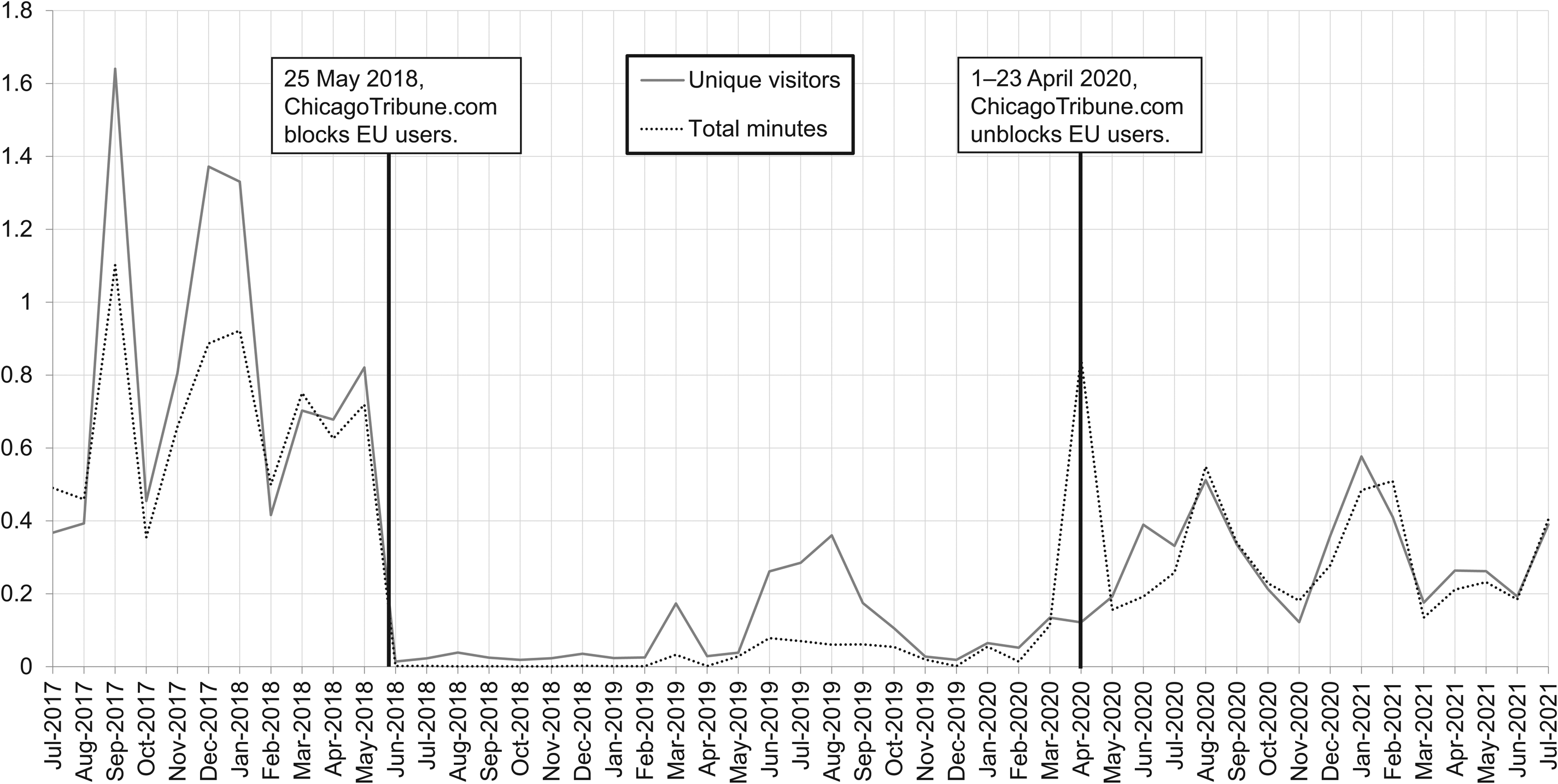
Numbers of monthly unique visitors to, and total minutes spent with, ChicagoTribune.com from the UK divided by the numbers from Canada, before, during, and after ChicagoTribune.com blocked UK visitors to comply with the EU’s General Data Protection Regulation (GDPR). Source: Comscore.
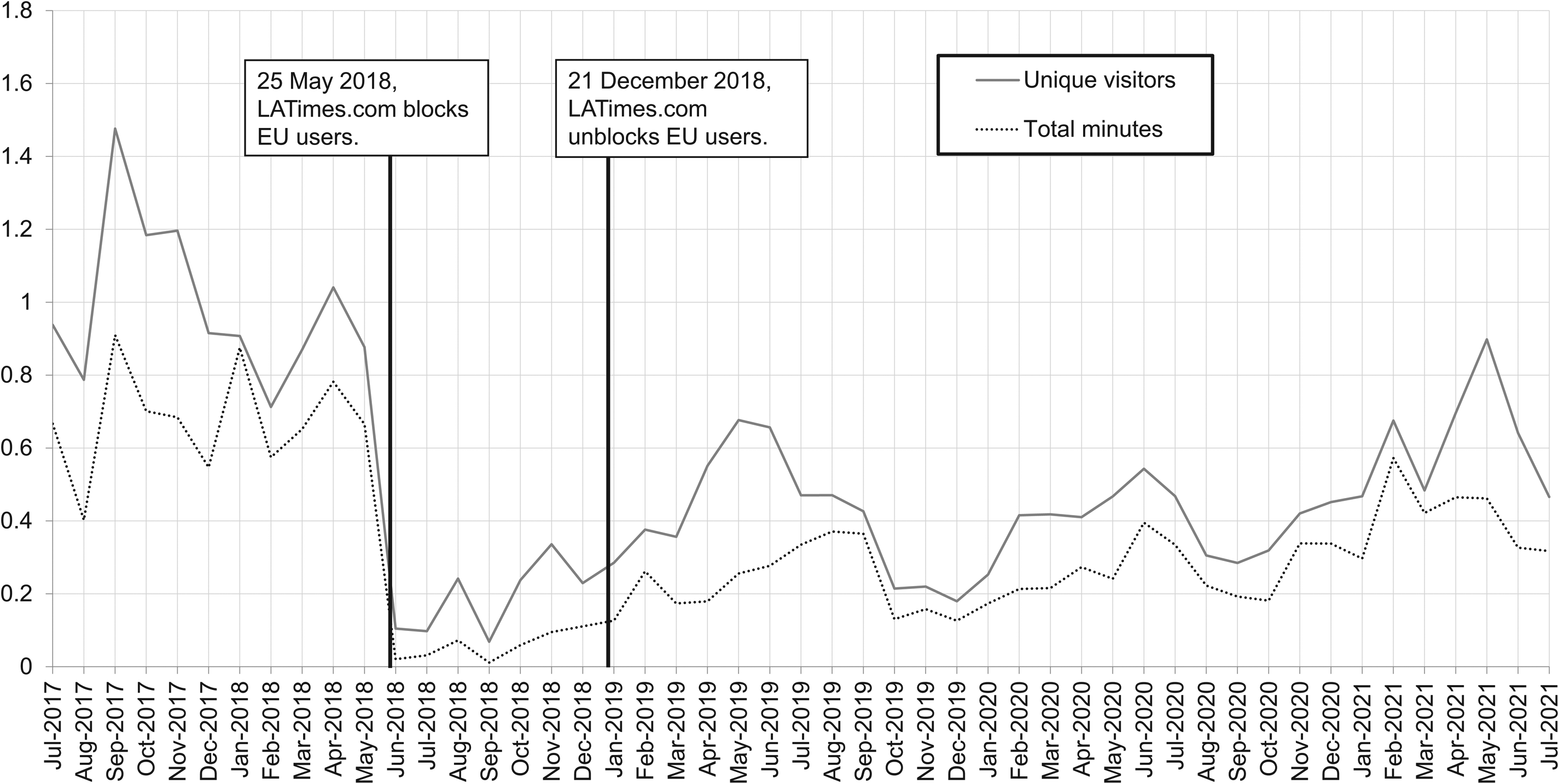
Numbers of monthly unique visitors to, and total minutes spent with, LATimes.com from the UK divided by the numbers from Canada, before, during, and after LATimes.com blocked UK visitors to comply with the EU’s General Data Protection Regulation (GDPR). Source: Comscore.
Comparison against the demand from UK consumers—again controlling for site-specific historical factors—for US newspaper websites that did not block makes it clear that the sudden and drastic falls in UK visitors to ChicagoTribune.com and LATimes.com were overwhelmingly the result of their GDPR-inspired blocks (see Figure 3).
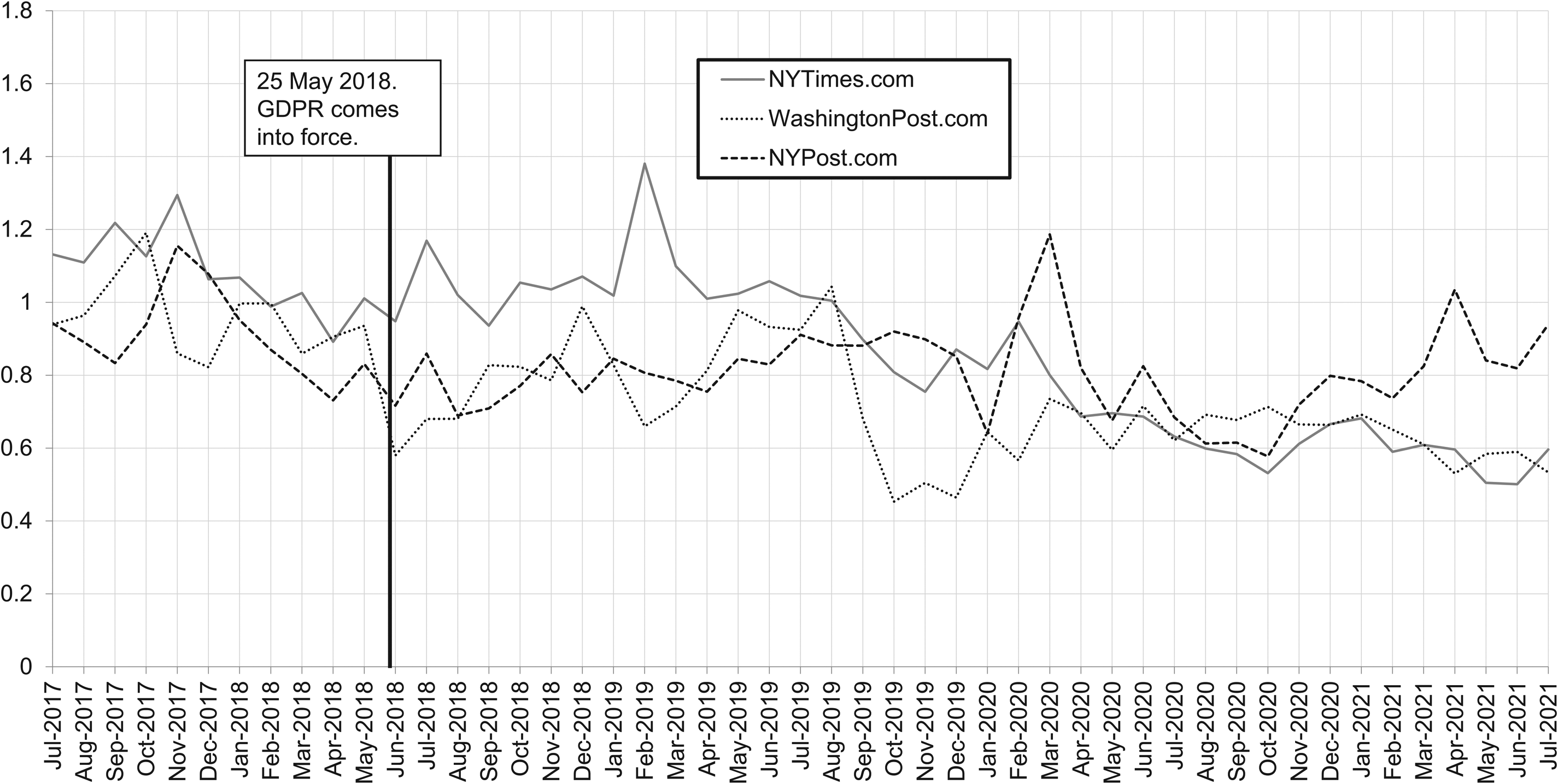
Numbers of monthly unique visitors to NYTimes.com, WashingtonPost.com, and NYPost.com from the UK divided by the numbers from Canada, before, during, and after the introduction of the EU’s General Data Protection Regulation (GDPR). All of these sites complied with GDPR and continued to allow visitors from the EU. Source: Comscore.
Rather than fully excluding EU visitors from its content upon the implementation of the GDPR, USAToday.com redirected users to an ‘EU Experience’ site with reduced content and functionality, stripped-down formatting, and—in order to comply with the GDPR—most tracking scripts and ads removed (Freinbichler, 2018). Although some praised the EU Experience site for its lack of user tracking and fast loading time (see, e.g., Baker, 2018), it is clear from our results that this strategy had a detrimental effect on the number of monthly visitors from the UK. Although the reduction in visitors was less than observed at ChicagoTribune.com and LATimes.com, the fall—controlling for site-specific historical factors—was still a considerable 59% (see Figure 4). Again, comparison against demand for US newspaper websites that continued to offer their EU visitors a full range of content and functionality (see Figure 3) shows wider market factors were not a significant contributory factor.
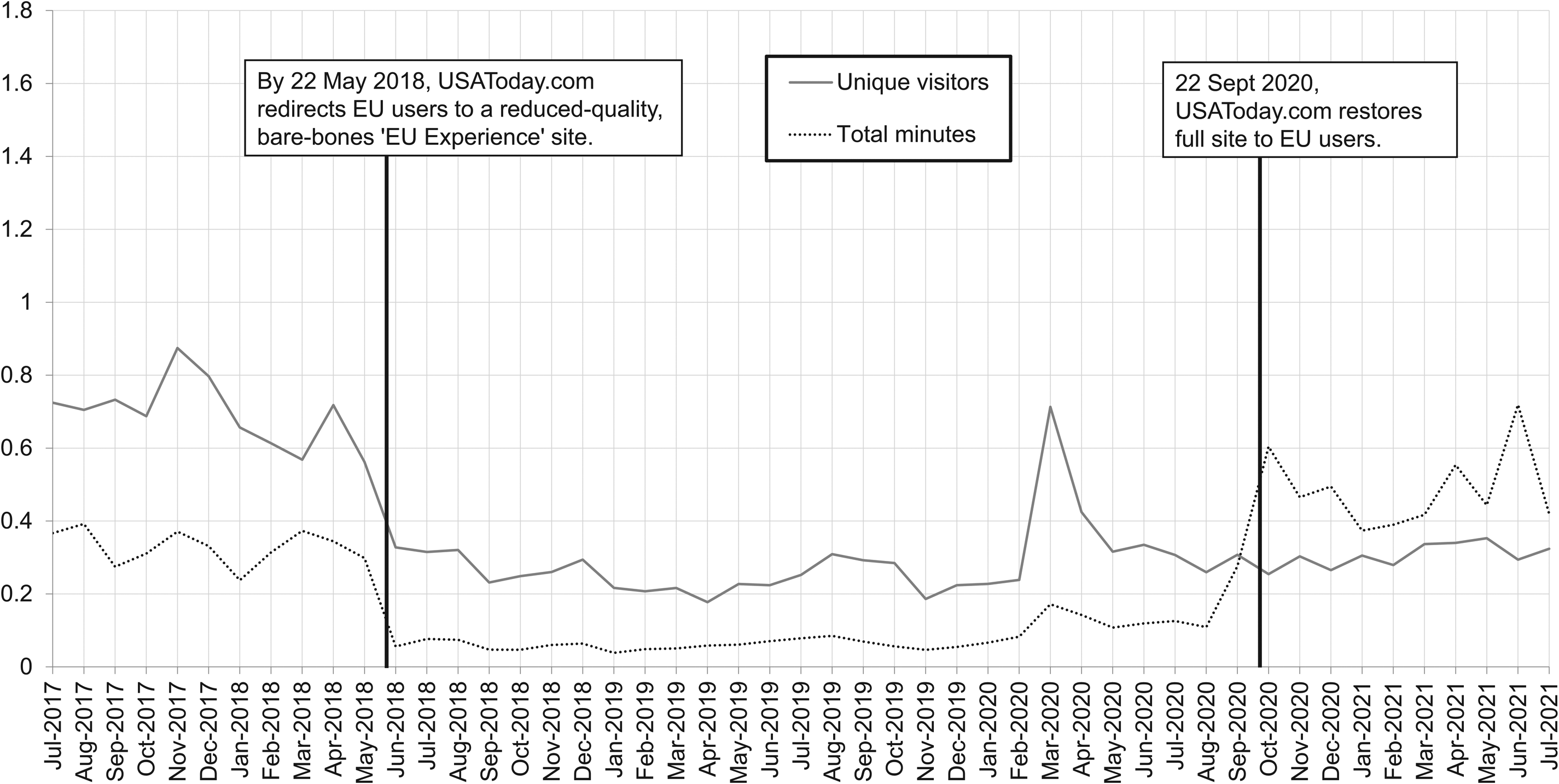
Numbers of monthly unique visitors to, and total minutes spent with, USAToday.com from the UK divided by the numbers from Canada, before, during, and after USAToday.com redirected EU users to an EU Experience version of its site with reduced content, functionality, and design as a response to the implementation of the EU’s General Data Protection Regulation (GDPR). Source: Comscore.
Turning to after the blocks were lifted, and again controlling for site-specific historical factors, we see at ChicagoTribune.com an increase in UK visitors, although not to the level the site was getting before the block (see Figure 1), with average monthly visitors 61% less in the 15 months after the block was lifted than in the 10 months before it was imposed, and no discernible upward trajectory.
A similar pattern can be seen at LATimes.com (see Figure 2) even though it was unavailable to EU visitors for ‘only’ seven months compared with the 22–23 month block imposed by ChicagoTribune.com. With site-specific historical factors controlled for, average monthly visitors were 55% less in the 31 months after the block was lifted than in the 10 months before it was imposed, although there is a slight upward trajectory.
In the case of USAToday.com, and again with site-specific historical factors controlled for, the restoration of a full range of content, functionality, and design to UK visitors after 28 months had but a marginal effect on visitor numbers, with average monthly visitors just 8% more in the 10 months after restoration than in the 27 months that USAToday.com's EU Experience version was offered, although there is an upward trajectory (see Figure 4).
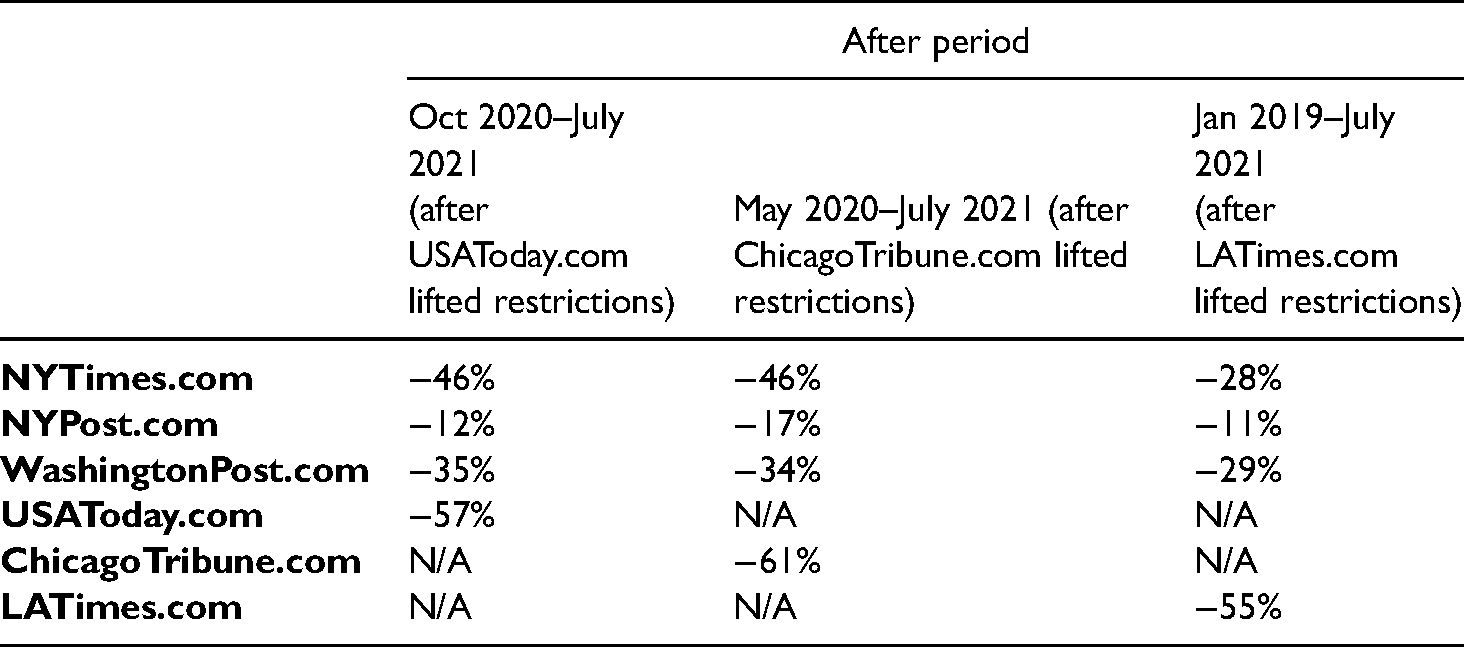
When considering the long-term changes in visitors at the newspaper sites, we must consider to what extent their failures to regain the numbers of visitors they enjoyed before the restrictions were imposed are a consequence of the sites’ temporary unavailability or rationing, and to what extent they are due to wider market conditions. Looking at the demand from UK consumers—and again controlling for site-specific historical factors—for US newspapers that did not impose restrictions (see Figure 3) shows that the average number of visitors to NYTimes.com, WashingtonPost.com, and NYPost.com has been falling, indicating a general reduction in UK visitors to US newspaper sites (see Table 3). However, this market-level factor does not fully explain the loss in average UK monthly visitors suffered by USAToday.com, ChicagoTribune.com, and LATimes.com after they restored full access (compared with average monthly visitors before restrictions were imposed). In the case of USAToday.com, this market-level factor may explain 21–80% of the loss in visitors, at ChicagoTribune.com 28–75% of the loss, and at LATimes.com 20–53%.
Change in average monthly UK unique visitors divided by average monthly Canadian unique visitors between the 10 months before the introduction of GDPR-prompted restrictions on EU visitors and three periods after these restrictions were lifted. Source: Comscore.
We find no evidence that the restricted availability of the three US newspaper sites in our sample has benefitted our sample of US newspaper sites that did not restrict their availability to EU users. Comparing a period of six months during which the availability of LATimes.com and ChicagoTribune.com and USAToday.com was restricted for EU users—June to November 2018—against a period of 10 months before those restrictions came in—July 2017 to April 2018—and controlling for site-specific historical factors shows that all three of the US newspaper sites that did not restrict their availability to EU users suffered falls in average monthly unique visitors from the UK: −6% for NYTimes.com,−24% for WashingtonPost.com, and −17% for NYPost.com. However, it is possible that these declines would have been steeper if other US sites hadn't restricted their availability for UK users. Furthermore, because we don't have individual-level data over time, we cannot say whether the particular users who had their access restricted did or did not start to go elsewhere.
USMagazine.com. Turning to the entertainment site in our sample, USMagazine.com, we see a similar pattern to the newspaper sites. Firstly, a sudden and drastic (−96%) reduction, upon blocking, of UK visitors (see Figure 5), even when site-specific historical factors are controlled for. Wider market factors are not a significant contributory factor (see Figure 6). Secondly, like the newspaper sites, USMagazine.com experienced only a partial recovery post-block, with the increase in visitors coming more slowly than the initial reduction. Average monthly visitors were 44% less in the 19 months after the block was lifted than in the 10 months before it was imposed, although there is a pronounced upward trajectory.
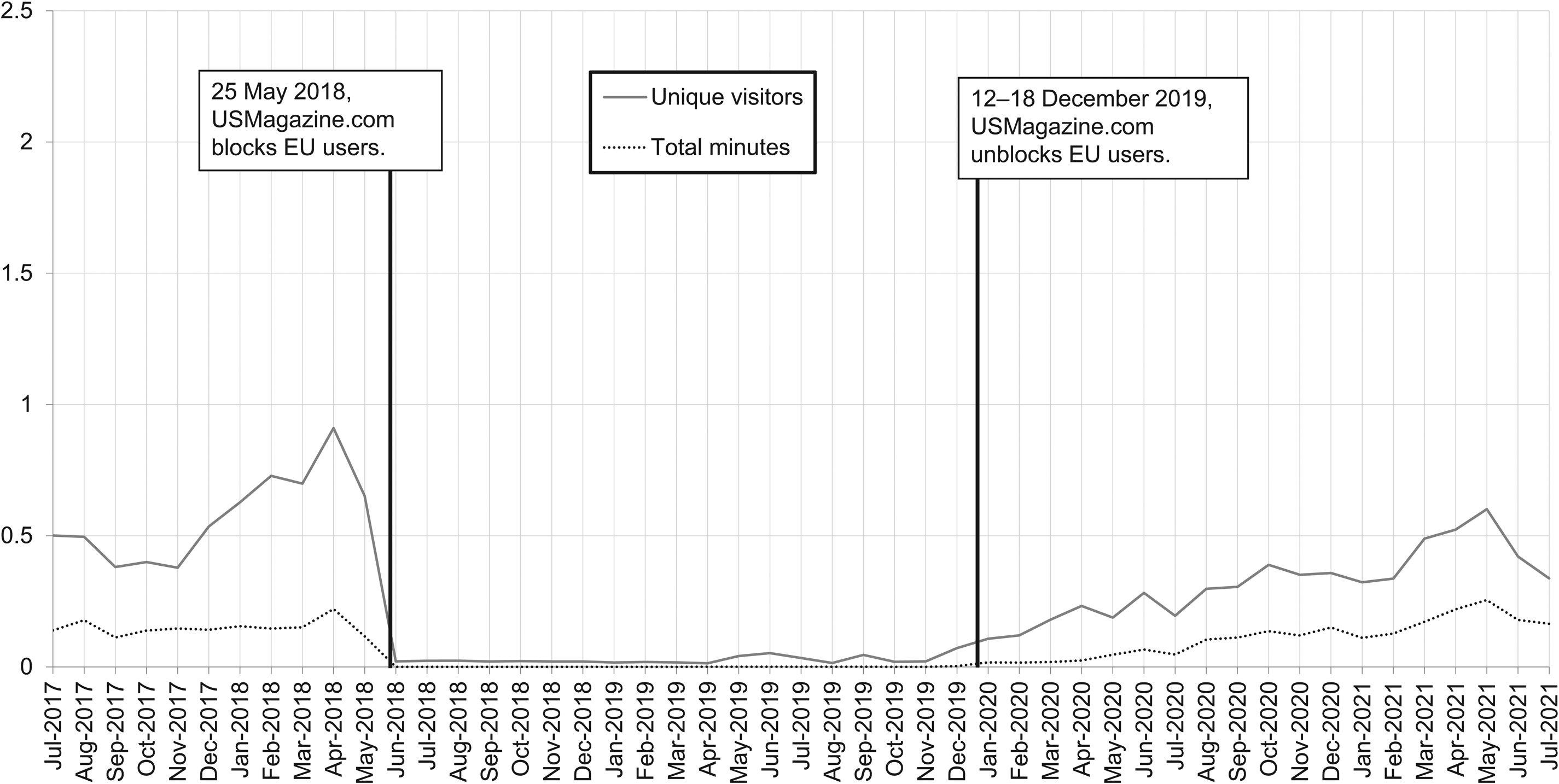
Numbers of monthly unique visitors to, and total minutes spent with, USMagazine.com from the UK divided by the numbers from Canada, before, during, and after USMagazine.com blocked UK visitors to comply with the EU’s General Data Protection Regulation (GDPR). Source: Comscore.
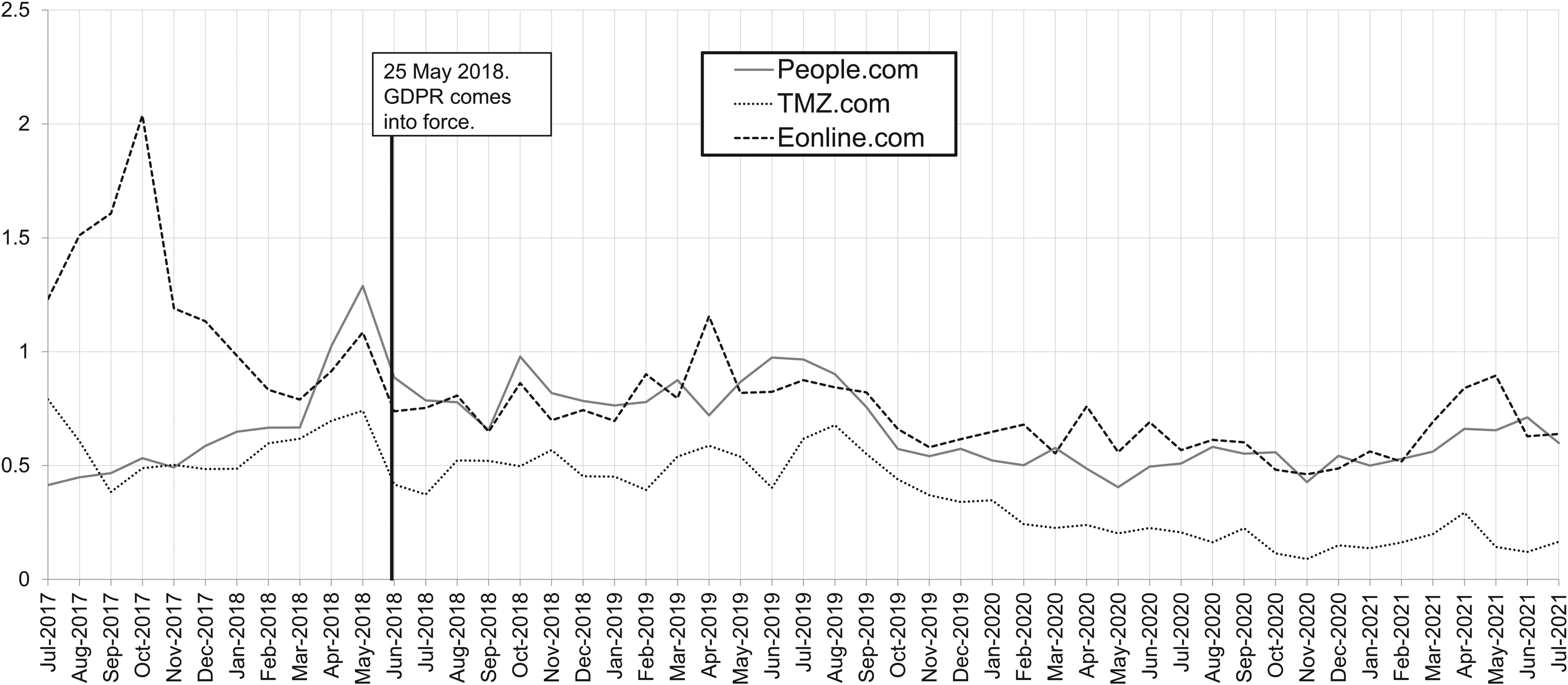
Numbers of monthly unique visitors to People.com, TMZ.com, and EOnline.com from the UK divided by the numbers from Canada, before, during, and after the introduction of the EU’s General Data Protection Regulation (GDPR). All of these sites complied with GDPR and continued to allow visitors from the EU. Source: Comscore.
Again, a key question is the extent to which the site's failure—thus far—to recover its pre-block visitor numbers is due to its temporary unavailability and the extent to which it is due to wider market conditions. Looking at the trends in the number of monthly unique UK visitors to US entertainment sites that did not block (see Figure 6)—again controlling for site-specific historical factors—shows that People.com, TMZ.com, and EOnline.com differ considerably in their performance. While People.com had an average of 11% fewer visitors in the 19 months after USMagazine.com unblocked compared with the 10 months before it blocked, TMZ.com and EOnline.com had 64% and 49% fewer respectively. If TMZ.com and EOnline.com are more representative of a general decline in preference for US entertainment sites from UK visitors, then it may be that USMagazine.com's failure to recover its pre-block visitor numbers is due to wider market conditions. However, if People.com is more typical, then, as with the newspaper sites, USMagazine.com's temporary unavailability may mostly be the cause.
We find no evidence that the unavailability of USMagazine.com has benefitted two of our sample of three US entertainment sites that did not block EU users. Comparing 18 months during which USMagazine.com was unavailable to EU users—June 2018 to November 2019—against a period of 10 months before the block came in—July 2017 to April 2018—and controlling for site-specific historical factors shows that TMZ.com and EOnline.com suffered falls in average monthly unique visitors from the UK of − 12% and − 35% respectively. However, it is again possible that these declines would have been steeper if USMagazine.com hadn't blocked UK users. People.com did see a rise of 35%, leaving open the possibility of displacement from USMagazine.com, although because we don't have individual-level data over time we cannot say whether the particular users who were blocked by USMagazine.com started to visit People.com.
Total minutes
In addition to analysing trends in monthly unique visitors, we also analysed the total number of monthly minutes spent with the sites in our sample, a metric that, unlike unique visitors, reflects how often visitors visit, the number of pages they look at, and the amount of time they spend with each page. For reasons explained in the Methodology section, we expected that any changes in the total minutes attracted by a site would likely be correlated with any changes in its monthly number of unique visitors. For most sites this was the case (see Figures 1, 2, and 5).
However, for USAToday.com, there were notable differences between the changes in unique visitors and the changes in total minutes (see Figure 4). Firstly, while USAToday.com's EU Experience site was available, average total minutes per month from UK users were (after controlling for site-specific historical factors) 76% lower than in the 10 months before it was introduced, a greater decline than that in the number of UK unique visitors, which was − 59%. This is because (after controlling for site-specific historical factors) the UK visitors who continued to browse the site visited 12% less frequently, viewed 12% fewer pages per visit, and spent 26% less time viewing each page. So, although some praised the EU Experience site for its lack of user tracking and fast loading time (see, e.g., Baker, 2018), it seems that, even for the UK visitors it retained, the site's reduced content offering outweighed any other benefits, making USAToday.com's EU Experience a less engaging destination than the site EU visitors previously had access to.
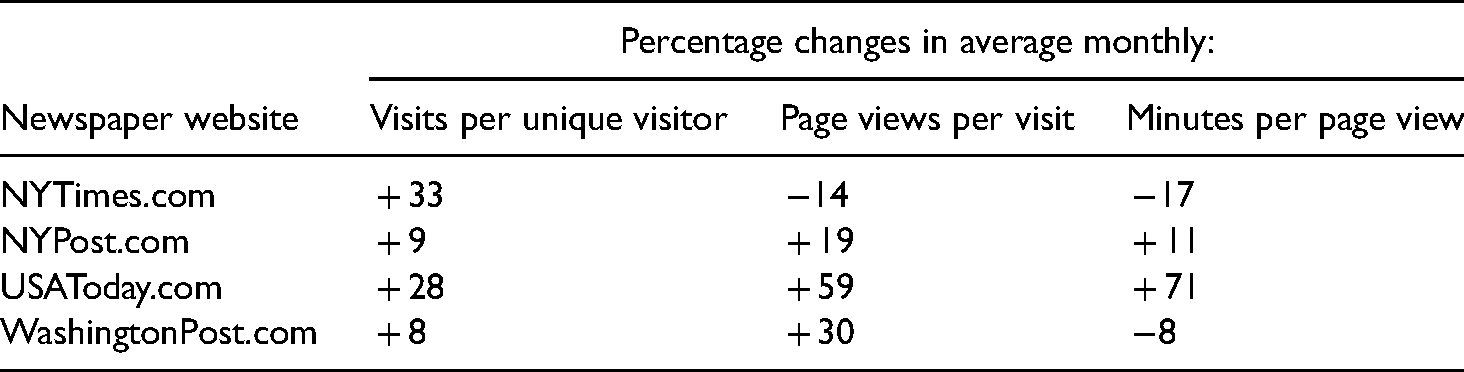
Secondly, after USAToday.com restored full access, total minutes from UK users jumped, with (after controlling for site-specific historical factors) the monthly average for the period after full access was restored 536% higher than it was while the EU Experience site was available. The 8% increase in average UK unique visitors played but a small part in this jump. It was mostly due to (after controlling for site-specific historical factors) increases in monthly visit frequency ( + 45%), page views per visit ( + 80%), and time spent viewing each page ( + 130%). Indeed, average monthly total minutes was (after controlling for site-specific historical factors) 47% higher after USAToday.com restored full access than it had been before the EU Experience site was introduced, despite there being 56% fewer unique visitors, due to higher (after controlling for site-specific historical factors) average visit frequency ( + 28%), page views per visit ( + 59%), and time spent viewing each page ( + 71%).
It is interesting to speculate why, among some UK visitors, USAToday.com became a more regular destination—and one visited in more depth and for longer—after the period during which it offered those visitors a reduced service. Looking at these same metrics for the newspapers that continued to offer UK visitors full access to their sites, and controlling for site-specific historical factors, shows that none of the three sites in our control group could match the increases that USAToday.com showed in page views per visit and time spent viewing each page, and only NYTimes.com matched USAToday.com's increases in visit frequency (see Table 4).
Changes between August 2017–April 2018 and October 2020–July 2021 in average monthly visits per unique visitor, page views per visit, and minutes per page view by UK visitors divided by Canadian visitors to four US newspaper websites. Source: Comscore.
It may be, then, that by temporarily offering its EU visitors a restricted diet of content and functionality, plainly presented, USAToday.com was able to keep its residual UK visitors hungry for more, such that when it restored full access, those visitors, able to consume fully again after more than two years of having their access rationed, consumed the site for longer, more deeply, and more regularly than before.
Conclusion
This study provides empirical evidence that may support the general theory, as outlined by Verhallen and Robben (1995), that, under a combination of two conditions, a product's unavailability can reduce its desirability, affecting future choices. Those conditions being, firstly, when the unavailability is caused by a person or institution as opposed to ‘nature’, and, secondly, when a product, unavailable to some—an out-group—continues to be available to others, an in-group.
Of course, the negative long-term effects of the temporary, GDPR-inspired unavailability that we observed could, in theory, be entirely due to some of the former users of the sites in our treatment group switching to, and sticking with, other sites (lock-in). In other words, a site's temporary unavailability may not have affected how its former users thought of it, but rather switching costs were such that the former users simply stuck with whatever sites or activities had replaced the time they used to spend with the site that became unavailable, even when it became available again. Because we were not working with respondent-level data, it was impossible to distinguish between the effects of any lock-in and of any changes in consumers’ preferences. However, there are two reasons why we believe that, in our case, changes in preferences played a part. Firstly, because of the evidence Goldfarb (2006) found—using respondent-level data—that both changes in preferences and lock-in played a part in the medium-term effects of the temporary unavailability of sites in his sample. And, secondly, because we found, at least with the newspaper sites in our sample, no evidence of displacement from the temporarily unavailable sites to those that were always available. This is not to say that there was no displacement to other sites: the number of alternative websites available to respondents in our case was so much larger—around 8.5 times2—than was available to Goldfarb’s (2006) respondents that any displacement is likely to have been spread more widely and, therefore, is more difficult to detect.
Our study has shown how longer periods of unavailability may result in longer-lasting negative consequences for temporarily unavailable sites. The effects of the brief—three hour—outage suffered by Yahoo dissipated, Goldfarb (2006) estimates, within three months. By contrast, the longer periods over which the sites in our sample were unavailable had effects that lasted considerably longer, perhaps because more users personally experienced those sites’ unavailability, which would, Goldfarb’s (2006) results suggest, make them less likely to return.
Perhaps the most original contribution this article makes is a result of its inclusion of one site—USAToday.com—that did not fully block EU visitors but rather temporarily rationed their access, reducing the content, form, and functionality of the product made available to them. In line with Costa’s (2013) finding that ‘temporary rationing’ can have ‘a lasting impact on people's behavior’, our study suggests that when a brand is temporarily rationed, just as when it is fully unavailable for a period, a long-term loss in consumers can result. We also find, however, that rationing and full unavailability may have different effects on the consumers who use the brands after restrictions are lifted. The rationing of USAToday.com appears to have increased the site's desirability among some UK users, such that once it was no longer rationed they consumed the title for longer, more deeply, and more regularly than had been the case before rationing was imposed. This finding suggests a variation between individuals in the behavioural impact of temporary rationing that may not have been described in the literature to date.
Footnotes
Acknowledgements
Neil Thurman would like to thank the following students at LMU Munich for their contributions to this study: Ashkhen Arakelyan, Daria Artemova, Julia Berhami, Leonie Bradl, Ana Cruz Saco Lesevic, Roberto DiMichele, Elena Dimitrova, Helena Drewalowski, Felicia Jung, Magdalena Keller, Line Kipp, Marie Knoke, Julia Kriegl, Aleksandra Kruglikova, Luana Laba-Godri, Felix Lassen, Jinyu Liu, Elisavetta Lokhanova, Lea Lugscheider, Camila Magaña Vázquez, Maximilian Mayer, Korin Mima, Yannik Müllers, Sophie Nellies, Samuel Odenwald, Lukas Schugens, Jennifer Söllner, Magdalena Sumser, Curtis Taverna, David Viehbeck, Raisa Yogiaman, and Xinyue Zhao.
Declaration of Conflicting Interests
The author(s) declared no potential conflicts of interest with respect to the research, authorship, and/or publication of this article.
Funding
This research was supported by Google UK as part of the Google News Initiative.
