




Abstract
Migration is one of the most pressing, divisive issues in global politics today, and media play a crucial role in how communities understand and respond. This study examines how UK newspapers (n = 974) and popular news websites (n = 1044) reported on asylum seekers throughout 2017. It contributes to previous literature in two important ways. First, by examining the ‘new normal’ of daily news coverage in the wake of the 2015 ‘refugee crisis’ in Europe. Second, by looking at how asylum seekers from different regions are represented. The content analysis finds significant variations in how asylum seekers are reported, including terminology use and topics they are associated with. The article also identifies important commonalities in how all asylum seekers are represented – most notably, the dominance of political elites as sources across all media content. It argues that Entman’s ‘cascade network model’ can help to explain this, with elites in one country able to influence transnational reports.
Introduction
Migration is one of the most pressing and divisive issues in global politics today. In the past decade, the debate around refugees, asylum seekers, immigrants and migrants has become increasingly charged and heavily politicised. These groups are now frequently attacked and demonised by political elites as a means to build their popularity, and advance their political agenda (KhosraviNik, 2009, 2010). Donald Trump credits his tough stance on refugees with helping him win the US Presidency, for example. And asylum seekers were one of the most salient issues during the Brexit referendum in the United Kingdom, when the public narrowly voted to secede from the European Union. During the campaign, the ‘Vote Leave’ group frequently portrayed these migrants as both economic and security threats, setting boundaries between ‘us’ and ‘them’ (Stewart and Mason, 2016; Virdee and McGeever, 2018).
Researchers have paid significant attention to the role of the news media in supporting and reinforcing negative depictions of refugees, asylum seekers, immigrants and migrants. Studies show that news media frequently portray those seeking asylum as an economic and security risk, for example (Caviedes, 2015; Esses et al., 2013; KhosraviNik, 2010; Parker, 2015; Philo et al., 2013). In the UK news media, refugees, asylum seekers, immigrants and migrants are often framed as ‘dangerous criminals’ and articles suggest ‘that Britain is under attack from migrants, particularly asylum seekers and refugees’ (International Policy Institute, 2004: 42).
Despite this deep research literature, it is not clear how the news media represent different types of asylum seekers. We know that in some circumstances the media construct ‘good’ and ‘bad’ refugees, asylum seekers, immigrants and migrants differentiating between those that are deserving of assistance, and those that pose a risk (e.g. Blinder and Allen, 2016; Parker, 2015; Phillips and Hardy, 1997; Steimel, 2010). But there is as yet limited research on when or why these boundaries have been drawn in the aftermath of the 2015 refugee crisis. Our article adds important nuance to the research literature by exploring how representations of asylum seekers vary, depending on the nation/geographic region that they originally come from, and the nation/geographic region where they are currently based. Importantly, by examining source use, our study questions the potential transnational power political elites have in shaping the news reporting of other countries – in this case the UK.
The article is based on a large-scale content analysis of more than 2,000 news articles drawn from 15 newspapers and 11 news websites in the UK, from across the year 2017. Articles with major mentions of asylum were coded for: terminology (use of refugees, asylum seekers, immigrants and migrants); the topics they focused on and the sources that were quoted. These variables were analysed by where those identified in stories about asylum were originally from, and where they were currently located. This analysis identified a number of very important differences in how those featured in stories about asylum are portrayed. One notable finding was that those from the Middle East and North Africa (MENA) region were far more likely to be portrayed as associated with security risk and terrorist activities. We also found that refugees, asylum seekers, immigrants and migrants currently in Europe were more likely to be associated with terrorism and violence than those in other regions. This may reflect the succession of terror attacks in Europe between 2015 and 2017 – although significantly the perpetrators of these attacks were not always migrants. In addition to these differences, the article also identifies important commonalities. Most notable was the dominance of political elites as sources within news texts; refugees, asylum seekers, immigrants and migrants, regardless of their country of origins, were rarely quoted within news reports.
These media representations matter. It is widely acknowledged that journalists and media organisations play a crucial role in mediating public conversation around refugees, asylum seekers, immigrants and migrants – and may prompt public hostility or support for those seeking sanctuary (Banks, 2012; Bates, 2017; International Policy Institute, 2004; Philo et al., 2013; Smart et al., 2005). In particular, the rapidity and scale of the 2015 crisis meant that politicians and the public often relied on mediated narratives to understand what was going on (Chouliaraki and Zaborowski, 2017).
At times of crisis, normal journalistic routines can be interrupted and new interpretations of a story produced, particularly if the journalist is reporting from the scene (Horsti, 2008). But it is important to look beyond crisis coverage alone. While many researchers have looked at media coverage of the key moments during 2015, there is much to be said for looking at the aftermath of the crisis and over a longer time period when longer term trends can be established away from trigger moments. As Scott (2017) notes when considering coverage of Africa, academic research has tended to focus on crisis moments, and this may distort our understanding of mediated contexts.
Geography and representation
The 2015 refugee crisis saw a million refugees, asylum seekers, immigrants and migrants arrive in Europe (European Parliament, 2017). At the beginning of the crisis, most arrivals were coming from Syria, followed by Afghanistan and Kosovo (Poptcheva et al., 2015); by 2017 the main source countries were Syria, Iraq and Afghanistan (EASO, 2018). While the inflow of asylum seekers had declined in 2017 (the period of our content analysis) down from the 2015 high, numbers still remained well above 2013 levels and funding was substantially increased to deal with this (European Parliament, 2018).
Previous studies have shown that the news media represent refugees, asylum seekers, immigrants and migrants as a ‘threatening homogeneous collective’ (Innes, 2010: 461). There are common uses of metaphors such as ‘waves’ or ‘floods’, suggesting the host country will be overwhelmed by the numbers of asylum seekers (Esses et al., 2013; Parker, 2015). This discourse of the ‘threatening refugee’ has been shown to occur across the UK print media – regardless of the political stance of the newspaper (KhosraviNik, 2010).
Other studies have identified variation in how different national media represent migrants and asylum seekers. For example, Phillips and Hardy’s (1997) work on UK news media found that news content distinguished between ‘bogus’ vs. ‘legitimate’ asylum seekers, while Steimel (2010) identified three main frames in her work on US articles: refugees as prior victims; refugees in search of the American dream and refugees unable to achieve the American Dream. Parker (2015) found similar approaches in coverage of both UK and Australian newspaper treatment of asylum seekers: that of unwanted invaders, ‘dishonest’ asylum seekers or ‘tragic’ asylum seekers; the difference being that the UK news media then constructed an argument of ‘removing them [migrants]’ whereas Australian newspapers constructed an argument of ‘keeping them out’.
More recently, with the 2015 refugee crisis, Greussing and Boomgaarden (2017) used computer-assisted content analysis to look closely at Austrian newspapers and found that despite the size of the crisis which might have been expected to challenge journalistic approaches and provide a reinterpretation of asylum issues, the newspapers mainly employed ‘established, stereotyped narratives of security threat, economisation, and – to a lesser extent – victimisation’. (Greussing and Boomgaarden, 2017: 1763)
Some studies have looked across cross-national boundaries. Chouliaraki and Stolic’s (2017) study of the 2015 crisis performs a semiotic analysis across broadsheets in eight European countries to assemble ‘regimes of visibility’ across the countries. This looked for common themes rather than contrasts, although previous research suggests that there is significant variation among different national press examples (Berry et al., 2016; Caviedes, 2015).
During the 2015 crisis and its aftermath, refugees, asylum seekers, immigrants and migrants came from a range of countries, as noted above. While cross-national comparative analyses have proved useful for understanding differences between media systems, we wanted to add to the literature by looking at variation within media systems. Specifically, how the geographical origin and current location of those seeking asylum affected coverage in the UK press.
The way that the news media frame those coming to live in a new country is often closely related to the terminology used. And yet the categories of refugee, asylum seeker, immigrant and migrant are frequently used interchangeably by journalists (Gabrielatos and Baker, 2008; Philo et al., 2013), despite having very different meanings. Asylum seekers are those who have applied for asylum and are waiting for a decision from government authorities on their status (Stevens, 2004). Refugees are those who have been compelled to leave their home and cannot be returned because they are at risk of persecution on grounds of race, religion, nationality, sexuality, gender identity, social group or political membership (UNHCR, 2016). An immigrant is someone who permanently relocates to a country for reasons that can be personal, economic or political (Hatton, 2005). Finally, a migrant is a broader term that can refer to movement both within and between countries, temporary or permanent for different reasons (UNHCR, 2016).
The use of terminology within news reports is often inexact. For example, a content analysis of US articles found that conflation of the words refugee and immigrant was common, and that when refugees were incorrectly described as immigrants they were more likely to be associated with terrorism (Hoewe, 2018). Conversely, in a longitudinal study of Canadian media, Lawler and Tolley (2017) found that refugees were described more negatively than economic immigrants. But as was seen in both these cases ‘the media can operate as a symbolic environment where “in-groups” and “out-groups” are initiated’ (Mastro, 2003: 100).
One of the most valuable recent studies is that of Blinder and Allen (2016) who captured collocates of migrants in British newspapers 2010–2012, before the 2015 ‘crisis’. In the light of the 2004 decision by the UK to open its labour markets to citizens of the new EU states, the researchers looked at whether media portrayals aligned with public perceptions of migrants, how different terms (immigrant, migrant, refugee, asylum seekers) were used and whether there was a difference in broadsheet, midmarket or tabloid approaches.
In a study of the UK national press, they found that the L1 collocate (i.e. the word that appeared directly before the term examined) most associated with ‘immigrant’ was ‘illegal’ and ‘failed’ with ‘asylum seeker’ but that refugees were seen as distinct from the other three terms, with different collocates. For immigrants, another significant L1 collocate was Eastern European, although no other terms had a specific geographic location in this way.
The c-collocates (words which were within ten words of the significant term) did often mention the origins of the asylum seeker, refugee, immigrant or migrant alongside familiar terms such as influx, terrorist and sham. Again, refugees had more diverse geographic terms used, compared to the other three categories. However, this research was conducted in the midst of concern over the Accession 8 countries and it is unclear how relevant its findings are today. In addition, Blinder and Allen’s work focused on Eastern European migrants. Those caught up in the 2015 refugee crisis were predominantly Syrian but came from Afghanistan, Kosovo and other countries too (Poptcheva et al., 2015).
Other studies have shown that news coverage varies depending on the migrant’s country of origin. Phillips and Hardy (1997) noted that the Cold War gave the original post-war discourse around refugees a strong ‘east–west’ dimension, which by the 1990s changed to south/north with Yugoslav refugees receiving more favourable reactions from the public than Somalis. But when the media treatment is contrasted in greater depth – for example Albanian/Kosovar versus Pakistan/Bangladeshi refugees, this is often by looking at quite different events such as KhosraviNik’s (2009) comparison of the 1999 Balkan conflict and the 2005 UK general election. Discussion around constructions of ‘othering’ of different races is well established (Said, 1995). Most obviously this has been via skin colour (Entman, 1992; Modood, 1994; van Dijk, 1991, 2000, 2013), but the accession of East European countries to the EU, and changes to freedom of movement meant that Caucasian ethnic groups have also become the focus of hostile media attention in recent years (Balabanova and Balch, 2010; Balch and Balabanova, 2016; Light and Young, 2009; Todorova, 1997; Wolff, 1994).
Moreover, in a post-9/11 world with a succession of terrorist attacks by Al-Qaeda, and then ISIL in Europe and North America, race and geographical origin in the media have often become a proxy for Islam (Moore, Mason and Lewis, 2008; Poole, 2002; Said, 1997), or put more bluntly: ‘brown skin equals Islam in the media’ (Joshi, 2016: 137).
Based on previous research, which shows that asylum terminology differs by geographic region (e.g. Hoewe, 2018; Lawler and Tolley, 2017), this study’s first research question asks whether asylum terminology is linked to the current location of the asylum seeker.
News topics found in asylum coverage
News reports about asylum seekers reference a wide range of social, political and cultural topics. This study looks at which topics are amplified in UK news coverage about asylum, and whether this varied by where the subject originated from, and their current location.
Innes (2010) noted asylum seekers in the UK press were often covered in relation to: security, economy and cultural identity. Consequently, negative news coverage about asylum was not directed at disliking the individual asylum seeker, but rather the threat asylum seekers posed to British society (Innes, 2010). Similarly, Chouliaraki and Zaborowski (2017: 626) found the majority of European news coverage during the 2015 refugee crisis included economic, geopolitical (terrorism), cultural or moral (deceit) arguments against refugees and asylum seekers.
As noted above, security issues have been particularly emphasized in news coverage of asylum (KhosraviNik, 2009; 2010). Since 9/11, refugees and asylum seekers have increasingly been associated with terrorism (Esses et al., 2013). There have been refugees and asylum seekers who commit terrorist acts, such as in 2016 when a Tunisian asylum seeker (described as failed) drove a truck into a Berlin Christmas market and killed 12 people (Eddy, 2017). But it is important to examine whether this association is over-stated, and how this pattern may vary over time.
News topics can also be empathetic to refugees and asylum seekers, focusing on past victimisation and current social and economic challenges (Steimel, 2010) though Chouliaraki and Stolic (2017) note journalists’ ambivalence towards refugees and asylum seekers in presenting them as victims and threats can also lead to the dehumanisation of refugees and asylum seekers within news coverage.
Based on previously identified topics of security, economy, culture and victimisation, the next research questions seek to understand if these topics appear according to geography:
Source use and asylum seekers
Finally, representation is often affected by the sources within reports. One common observation is that refugees, asylum seekers, immigrants and migrants are often only present within news coverage as a statistic (Fotopoulos and Kaimaklioti, 2016) and rarely presented as full and complex humans – with jobs, education, histories and families. Indeed, asylum seekers rarely appear within news stories at all. One study analysed three weeks of UK newspaper coverage of asylum seekers and found that, of a total 249 sources, only 17 were asylum seekers (International Policy Institute, 2004). Another study, looking at the height of the 2015 crisis (July to November) found that refugee voices were only 16.6% of the sample of eight European newspapers compared to politicians making up 66% (Chouliaraki and Zaborowski, 2017).
Source use is a fundamental journalistic routine in which journalists glean information from credible or relevant persons or resources (Shoemaker and Reese, 2014; Shoemaker and Vos, 2009). In liberal media systems, journalists heavily rely on interviews and direct quotes for their reporting (Hallin and Mancini, 2004). A large body of research shows that journalists routinely rely on politicians and those in power as their sources (e.g. Entman, 2007; Hall et al., 1978), and that the result is that the particular frame and interpretations that these political elites adopt cascades down to the public through the media which helps shape public opinion (Entman, 2004). This practice marginalises dissenting voices, and operates to erase the agency of those who have less power, in this case asylum seekers (Leudar et al., 2008).
More precisely, Entman’s (2004) ‘cascading network activation model’ illustrates how frames start with the head of state (originally identified in the US context as the White House) and flow down through elites, journalists and finally the public. Though identifying frames is beyond the scope of this study, cascading activation explains the potential influence elite sources like politicians have in shaping reports about asylum. In an updated version of cascading activation, Entman and Usher (2018) propose that online and social platforms (and other factors) enable actors to bypass the network to communicate directly with the public or elites. But such developments do not mitigate power structures (Dylko et al., 2012) – for example, the widespread practice of the traditional media quoting Trump’s tweets in their coverage. Previous research has suggested that the ‘cascade’ can also occur across countries with international reports replicating elite statements (e.g. Dimitrova and Stromback, 2005).
In a pre-internet age, Hall et al. (1978) argued professional demands around deadlines and objectivity meant those in institutional positions were privileged – so-called ‘primary definers’. Put bluntly, the president of the United States has instantaneous access to all news media whenever s/he wants it – ‘the powerless must resort to civil disobediences to obtain it’ (Gans,2004/1979: 119).
Hall’s thesis – that the media only give access to certain privileged social groups – has been challenged in various ways over the years (Anderson, 1993, 1997; Schlesinger, 1990; Schlesinger and Tumber, 1994). But even when individuals outside powerful institutions are used as sources – when the refugees, asylum seekers, immigrants and migrants are given a direct chance to speak for example – they are often talking in a personal capacity about their own experience, as opposed to having a more analytic role (Manning, 2001). Cottle (2000) agrees; he argues that, while ‘ordinary voices’ often find their way into news items, they are rarely granted an opportunity to develop their arguments or points of view at length – or challenge political or expert authorities. Instead, they become ‘the voices of the side effects’ (Beck, 1992; Cottle, 2000: 30) – to do nothing more than symbolise the human face of a news story.
The next group of research questions seeks to understand how sources are used in news coverage based on the current geographic location and the geographic origin of the asylum seeker:
Method
This study is a content analysis (Krippendorff, 2019) of UK newspapers (n = 974) and popular UK news websites (n = 1044), for a total sample of N = 2018. The a priori process consisted of developing a codebook of explicated variables, coding the sample and analysing the results using SPSS.
Sampling
The sampled time period is the entire 2017 year. Articles were collected through the search term ‘asylum’. LexisNexis was used for print articles with the ‘major mentions’ filter on. Online articles were collected via each website’s archive. Once articles were collected any unrelated or duplicate article was eliminated. In total, 15 UK national newspapers were sampled: The Times (194), Daily Mail (109), The Telegraph (106), The Guardian (102), The i (88), Daily Mirror (75), Financial Times (71), The Sun (51), Metro (46), Daily Express (39), The Sunday Times (29). London Evening Standard (22), The Sunday Telegraph (16), The Observer (14) and Daily Star (12). Online sources consisted both of traditional news organisations as well as digital only sources. Eleven news websites were chosen by popularity (Schwartz, 2016), as well as ability to access archived materials: Daily Express online (193), Mail Online (169), The Independent (165), The Sun online (128), HuffPost UK (93), BBC.com (85), Buzzfeed (52), Mirror Online (51), Breitbart News (50), Sky.com (48) and The Telegraph online (10).
Code development
Once the research questions were identified, a three-part codebook was designed which consisted of an overall introduction, a definition for each variable and instructions for coding (Riffe et al., 2019). This was a deductive approach because all of the variables were predefined before coding began. Below is a description on how the variables were developed based on existing literature.
The first set of variables was geography related. These identified where the asylum seekers feature in the news article was originally from; and where they were currently based. Nine dichotomous variables (presence or absence) were developed for country of origin of asylum seeker, based on UNHCR figures (unhcr.org): Syria (17.5%, n = 257), Afghanistan (12.7%, n = 257), Iraq (9.2%, n = 186), Iran (10.1%, n = 203), Pakistan (4.1%, n = 83), South Sudan (3.2%, n = 65), Ethiopia (1.6%, n = 32), Myanmar (.4%, n = 8) and other (41.2%, n = 706). Coders also listed the specific country for the other variable. A second variable was created which grouped country origins by region in a categorical variable: MENA (39.4%, n = 795), Sub-Saharan Africa (12.4%, n = 250), Europe (5.6%, n = 112), Asia (3.1%, n = 62), South America (1.7%, n = 34), North America (.6%, n = 12) and no specified location (37.3%, n = 753). A final categorical variable was created which classified asylum seekers according to their current geographical location or country of asylum: Europe (42.2%, n = 851), UK (40.6%, n = 820), Australia (6.1%, n = 123), North America (4.7%, n = 94), MENA (2.2%, n = 44), Asia (1.4%, n = 29), Sub-Sahara Africa (.6%, n = 13), South America (.3%, n = 6) and no specified location (1.9%, n = 38).
Next, we coded the terminology used to describe asylum seekers. We noted the use of five different terms: refugee, migrant, immigrant, detainee or other. Note that asylum seeker was not used because the search term was based on the term ‘asylum’. This means that the sample was collected using the term asylum seeker as a reference category. In total, 99% of articles included the term asylum seeker. The terms illegal and failed were also included.
The source use within articles was also coded. The categories for sources were: UK public sector, international public sector, UK Conservative politician, UK Labour politician, UK other politician, EU politician, international politician, civil society (NGO, activist, professor, expert or religious leader), elite member of society (business figure or celebrity), other media (any outside media use), refugee, asylum seekers, immigrant and migrant (direct quote or information from), ordinary citizen (non-asylum seeker) and other. A source was coded by direct quote use or attributed information.
Finally, we coded the general themes of the news articles. The research literature identifies four common themes associated with asylum in the news: security, economy, culture and victimisation (Chouliaraki and Stolic, 2017; Innes, 2010; Parker, 2015; Steimel, 2010). We also added government to account for possible Brexit themes. We broke these five themes down further, coding for 10 dichotomous variables. Three related to security: police/crime, terrorism, and violence by refugees, asylum seekers, immigrants and migrants. For economy, an economic variable was used, which included any explicit use of the word economy and any related topics such as jobs, the stock market, money, taxes and so forth. For culture, a cultural variable was used, which included any explicit use of the word culture and related topics such as entertainment, sports, music, language, religion and norms. For victimisation, two variables were included: violence experienced by refugees, asylum seekers, immigrants and migrants and health-related topics such as poverty, healthcare and other social issues. Additionally, three government-related variables were used: Brexit, UK government (non-Brexit) and international government.
Intercoder reliability
Three coders were used, one of the main authors and two graduate assistants. Once the codebook was finalised, one of the authors trained the graduate assistants on each variable. The sub-sample coded for intercoder reliability consisted of 140 articles from various print and online sources. Recal2 (dfreelon.org) was used to calculate Krippendorff
Results
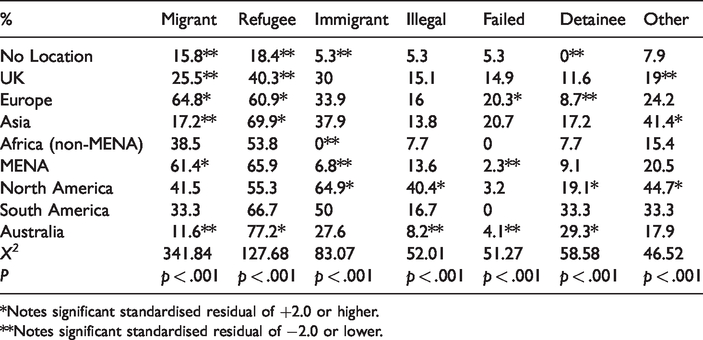
To answer the research questions, a series of statistical analyses were run in SPSS. Firstly, RQ1a asked how terminology was dependent upon current geographic location of the refugees, asylum seekers, immigrants and migrants. To test this, a chi-square test was run between current location and terminology, with significance. Table 1 outlines the chi-square results by percentages and significant standardised residuals (±2.0 or higher). It is important to note that percentages for all tables included are presented by total use of the variable by region. For example, Table 1 shows that of the articles about asylum in the UK, 25.5% of them included the term migrant.
Chi-square results of terminology according to current geographic location (df = 8). Percentages calculated by total use of variable by region (N = 2018).
*Notes significant standardised residual of +2.0 or higher.
**Notes significant standardised residual of −2.0 or lower.
Overall, no specified location produced the least significance for the terminology, followed by the UK. Refugee was significantly associated with Europe, Asia and Australia. Migrant was also significantly associated with Europe, as well as the MENA region. The term failed was significant to Europe, and the terms immigrant and illegal with North America. Detainee was also significant in North America and Australia.
In articles with major mentions of asylum, the UK media were more likely to categorise those currently in Europe as failed asylum seekers, migrants or refugees, while those who were in the MENA region were more likely to be categorised as migrants. Those in North America were likely to be described as illegals, detainees and immigrants. This suggests that the UK media – perhaps relying on initial copy from newswires – is adopting the language of the political elites in the countries referred to (Hoewe, 2018).
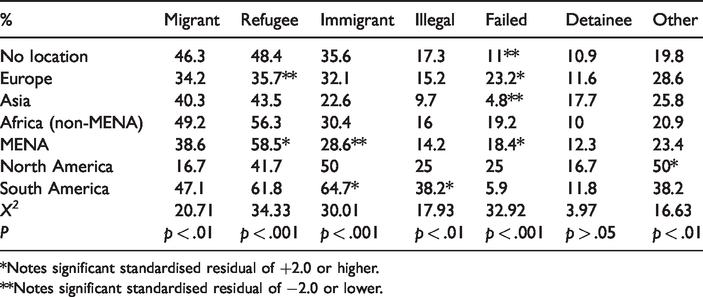
RQ1b asked how terminology manifested according to origin of refugees, asylum seekers, immigrants and migrants. Table 2 outlines chi-square test results between origin regions and terminology, percentages and standardised residuals (±2.0 or higher). The significance was less pronounced than terminology according to current location. Those from the MENA region were categorised as refugees and failed significantly. South Americans were categorised as immigrant and illegal significantly. Europeans were also significantly labelled as failed.
Chi-square results of terminology according to geographic origin (df = 6). Percentages calculated by total use of variable by region (N = 2018).
*Notes significant standardised residual of +2.0 or higher.
**Notes significant standardised residual of −2.0 or lower.
The significance was less pronounced than with current geographical location but it seems clear that the UK media has a fixed idea what a ‘refugee’ is – someone fleeing a war-torn region. In this case, those from MENA, which includes Syria and Iraq (the two countries with the highest number of displaced people), was the one origin which was positively associated with this, while Europeans were seen as far less likely to be seen as refugees.
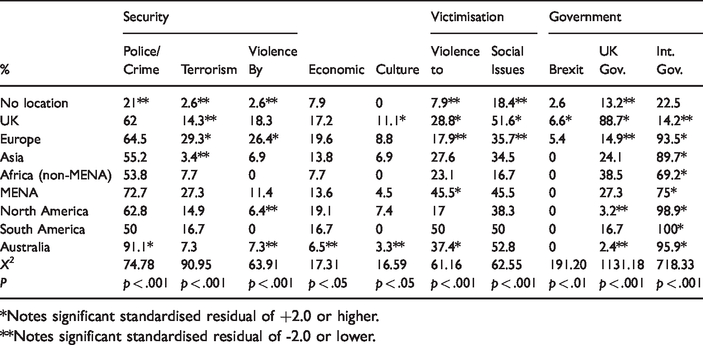
The next set of research questions looked at topics used in relation to geography. RQ2a asked by current location of refugees, asylum seekers, immigrants and migrants. Chi-square test results show significance for all possible topic variables. Table 3 outlines topics, percentages and standardised residuals (±2.0 or higher). The most common topic related to governments. Not surprisingly, Brexit only appeared as a topic for no location, UK, and Europe, but only on average of 4.9% of articles (n = 102). In terms of security, Europe had the highest overall use of the three variables (40.1% average, M = 342), but Australia, reported police and crime 91.1% of the time (n = 112). The economic and culture variables did not have much variance, though UK had significantly more use of the culture variable (11.1%, n = 91). The victimisation variables were significantly higher in the UK (M = 330) and significantly lower in Europe (M = 228).
Chi-square results of topics according to current geographic location (df = 8). Percentages calculated by total use of variable by region (N = 2018).
*Notes significant standardised residual of +2.0 or higher.
**Notes significant standardised residual of -2.0 or lower.
All three security variables – police/crime, security/terrorism and violence by refugees, asylum seekers, immigrants and migrants are significantly associated with those who came from the MENA region. For those from other regions – North and South America and Asia for example – international government was statistically significant, while for stories which mentioned those coming from Europe, the most significant factor was stories around the UK government, suggesting that the ongoing negotiations between the UK and Europe over border control in the run-up to March 2019 was key.
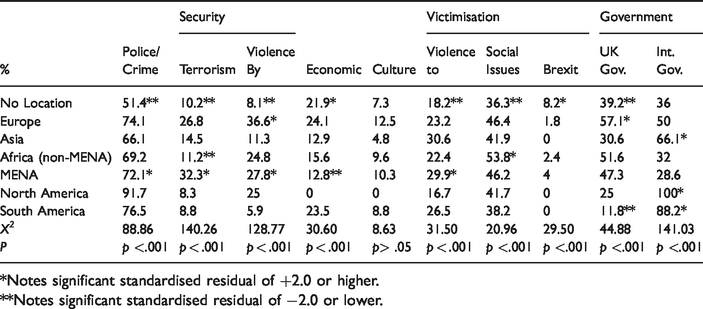
RQ2b looked at topics by geographic origin. Table 4 shows the chi-square test results, which showed significance for all topic variables except for culture. Europe was significantly higher for the ‘violence by’ (n = 41) and the UK government variable (n = 64). Asia (n = 41), North America (n = 12) and South America (n = 30) all had significance for the international government variable. Africa (non-MENA) was the highest for social issues (n = 134). The MENA region had significance for all three security variables, but also the ‘violence to’ variable.
Chi-square results of topics according to geographic origin (df = 6). Percentages calculated by total use of variable by region (N = 2018).
*Notes significant standardised residual of +2.0 or higher.
**Notes significant standardised residual of −2.0 or lower.
When the UK media wrote about asylum in Europe, the topics of terrorism and violence perpetrated by refugees, asylum seekers, immigrants and migrants was statistically higher than would be expected – reflecting perhaps the succession of terror attacks in France in 2016 and 2017 and the controversy over rapes and sexual assaults allegedly perpetrated by asylum seekers in Cologne in New Year 2015/6, which then became an issue in the German 2017 elections. It is worth noting that terrorist attacks have often been blamed on asylum seekers – but only 5% of those responsible for attacks in Europe and North America between 2014 and 2017 were asylum seekers or refugees (Vidino et al., 2017).
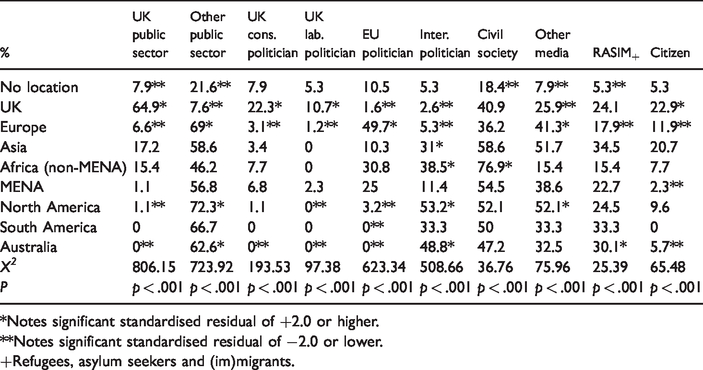
The final group of questions explored source use by geography. Firstly, RQ3a sought to understand source use according to current location. Table 5 shows chi-square test results between current geographic regions and 10 possible sources. Public officials (public sector and/or politicians) were the most commonly used source for each region, except for in Africa non-MENA region where civil society sources were the most common. In total, public officials were present in 79.7% of articles (n = 1608). On average, refugees, asylum seekers, immigrants and migrants were used as a source in 21.6% of articles. They were a significant source in Australia and significantly under-represented in Europe and no location. Ordinary citizens had the most input in the UK. Other media significantly contributed in Europe and North America.
Chi-square results of source use according to current geographic location (df = 8). Percentages calculated by total use of variable by region (N = 2018).
*Notes significant standardised residual of +2.0 or higher.
**Notes significant standardised residual of −2.0 or lower.
+Refugees, asylum seekers and (im)migrants.
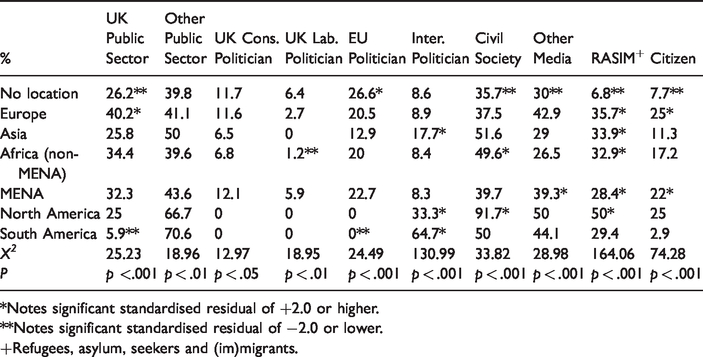
RQ3b asked how sources were used according to geographic origin. Table 6 shows chi-square results. This breakdown shows that refugees, asylum seekers, immigrants and migrants from Europe, Asia, Africa (non-MENA), MENA and North America were significant sources. Within the refugees, asylum seekers, immigrants and migrants variable, 51.8% of sources were from the MENA region (n = 226). Politicians were significant sources in no location, Asia, North America and South America. Civil society significantly contributed in Africa (non-MENA) and North America. When the story was about a particular area there tended to be more asylum voices heard. So, for example, in a third of stories about Asia and asylum, the voice of an Asian refugee, asylum seeker, immigrant or migrant would be heard (n = 21). Most of the different regions were around 30%, although half of all stories specifically about North American asylum featured the voice of a North American seeking asylum (n = 6).
Chi-square results of source use according to geographic origin (df = 6). Percentages calculated by total use of variable by region (N = 2018).
*Notes significant standardised residual of +2.0 or higher.
**Notes significant standardised residual of −2.0 or lower.
+Refugees, asylum, seekers and (im)migrants.
Discussion
The 2015 crisis and its aftermath were unusual in that the UK and Europe were confronted by a refugee crisis close to home. The numbers may have been small compared to international migration generally – for example the ongoing mass displacement of the South Sudanese (UNHCR, 2018a), or the current Rohingya crisis (UNHCR, 2018b). But the sudden influx of displaced people from many different countries exposed weaknesses in the EU’s asylum policy of the time, caused previously fluid boundaries to be strengthened, and helped fuel a rise in nativist and populist politics in the UK, Europe and US.
The mediated boundaries were also important. As Chouliaraki and Zaborowski (2017) have shown, there were various permutations of the way refugees, asylum seekers, immigrants and migrants were regarded during the 2015 crisis itself – from sympathy/empathy in the summer/early autumn of 2015 to suspicion/hostility following the Paris attacks of November 2015. But we wanted to look at what happened outside a crisis situation when normal journalistic routines can be interrupted (Horsti, 2008; Scott, 2017; Wright, 2018). While the number of asylum seekers slowed post 2015, governments in Europe still had to accommodate and deal with the issues that the crisis had brought and we wanted to look at how journalists were covering the story in the long term.
The results of our study found that geographical location does matter when it comes to the way the UK media categorises those seeking asylum (see Table 1) with those currently in Europe more likely to be categorized as failed asylum seekers, migrants and refugees, while those in the MENA region seen as migrants. With origin (Table 2) it is clear that the UK media saw refugees as coming from a war-torn region (MENA) – whereas Europeans were far less likely to be seen as refugees.
Despite clear international laws and conventions that require countries to assist the refugees of conflict and humanitarian crises, asylum seekers are frequently attacked by political leaders, and portrayed as a threat to security and financial stability. Caviedes’s (2015) comparison of UK, French and Italian broadsheets between 2008/2009 and 2012 (i.e. pre the 2015 crisis) found that, contrary to other studies, in all three countries there were more concerns over the economic impact (im)migrants made than overt references to physical crime or security, although within each country there were different emphases. Our research suggests that in the aftermath of the 2015 crisis and the recent terror attacks in Europe, this remains the case when we looked at geographical origin of those mentioned in stories about asylum. Economic concern remains high (Brexit is also significant) and security is low when no geographical origin is mentioned. However, there is a significant change when we drilled down. As Table 3 makes clear those from the MENA region were associated with all security variables.
This changed when we looked at articles that mentioned asylum and the current geographic location of those who could be refugees, asylum seekers, immigrants or migrants (Table 4). When the UK media wrote about those who were currently in the UK, terrorism was statistically lower than expected. Instead the topics associated with asylum in the UK were political (the UK and international governments), Brexit, social issues and culture, suggesting that coverage of those who are closer to home reflects concerns around proper integration into British culture. But there was also a more sympathetic approach – stories around violence towards refugees, asylum seekers, immigrants and migrants was statistically higher than would be expected – which may reflect that when newspapers/websites write about individuals close to home they are more likely to give an empathetic view – such as the ongoing coverage of the Syrian refugees who settled on the Scottish island of Bute (BBC, 2017; McKenna, 2017).
One of the crucial aspects of constructing an empathetic viewpoint is source use: whose voices are heard, and our research found that two years after the crisis, refugee voices are far less likely to be heard compared with politicians and public officials (Table 5). By choosing authority sources, and failing to give asylum seekers a voice, it dehumanises and marginalises those at the centre of the story and privileges politicians and public officials and their narrative. This, as described earlier, may reinforce a narrative that portrays asylum seekers as an economic or security risk. The use of civil society voices such as NGOs may seem more sympathetic to an asylum cause, but again by choosing an NGO rather than refugees, asylum seekers, immigrants and migrants to speak, denies them the ability to tell their own stories.
When we looked at voices heard according to geographic origin, there was at least some improvement (Table 6). While these figures sound high, it must be remembered however that this is a small percentage of the whole number of articles we looked at; it shows however that when journalists personalise articles by using case studies for example, then more opportunities for refugees, asylum seekers, immigrants or migrants to have a voice emerge.
But between the over-emphasis of political and official sources and the adopted terminology in UK coverage to match terminology of the origin country (e.g. illegal and immigrant in reference to North America), Entman’s (2004) cascading activation appears to be relevant.
The cascade flowing through the system of elites continues via news media to the public. In this case however, the cascade is transnational, meaning that the cascade expected within a country can also occur across countries thanks to international reporting. Previous research confirms this, though transnational influence can vary. For example, Dimitrova and Stromback (2005) found similarities in US and Swedish coverage of the Iraq war, but Sweden was more critical and the US relied on more officials.
Some have challenged cascading network activation in examples like stem cell research (Fahmy et al., 2010) and eventual media attention to counter narratives in the Iraq war (Klein et al., 2009). Moreover, Entman and Usher (2018) acknowledge power structures have evolved as a result of digital technologies. Indeed there were powerful public responses at the end of 2015 in response to the picture of Alan Kurdi that went viral (Walsh, 2015) and the popularity of hashtag #refugeeswelcome (BBC, 2015). However, in our sample, there is little evidence that citizen and asylum seekers are able to input in the coverage. Further research is needed into the transnational influence of non-elite actors in international reporting; but preliminarily, it appears that the influence of bottom up actors (activists, citizens, etc.) does not transfer between countries like the influence of elites. Consequently, in the UK itself citizen input was the highest (22.9%), but that fell dramatically in other places (with the exception of Asia).
Limitations and future research
This study has several limitations. First, it focuses on the UK only where other studies have looked cross-nationally. In addition, though content analysis systematically analyses news, and this particular study was spread across an entire year, it can lack the nuances that qualitative investigation provides. Content analysis alone cannot tell us why the news content looks this way or why some voices, themes and topics dominate. Therefore, future research in qualitative approaches such as textual analysis, and interviewing news journalists could supplement what was found here to give further insights.
Conclusion
As noted migration has been one of the most divisive topics since the 2015 ‘crisis’. We set out to understand how asylum seekers were characterised in the UK press and websites in 2017. We conclude that two years on, when the numbers have slowed significantly, asylum remains a topic where boundaries are still being mediated and mediatised in the UK press. By looking over the space of a year, and coding for geographical location and origin, we attempted to nuance more carefully how different asylum seekers are represented.
While economic concerns were dominant when considering different geographic regions and origins of those mentioned in stores about asylum, the data clearly showed that those originally from the MENA region were far more likely to be associated with terrorism, violence and crime in the media, despite some research that suggests terror crimes perpetrated by asylum seekers was a very small percentage (Vidino et al., 2017). When refugees, asylum seekers, immigrants and migrants were in Europe, they were linked to violence and terrorism – probably as a result of a succession of terror attacks since 2015.
Attempts to counter these narratives of security – as well as ones around social issues and culture – were limited, in part because of the very low number of stories in which refugees, asylum seekers, immigrants and migrants actually speak. Only one in five stories featured such a voice – compared with four in five, which featured a politician or a public official (N = 2018). While refugees, asylum seekers, immigrants and migrants voices are excluded from the mediated debate, there can be an absence of empathy and understanding about the migrant experience, which is urgently needed – particularly given the influence of transnational elites on terminology in UK media coverage.
Footnotes
Declaration of Conflicting Interests
The author(s) declared no potential conflicts of interest with respect to the research, authorship, and/or publication of this article.
Funding
The author(s) received no financial support for the research, authorship, and/or publication of this article.