




Abstract
The core function of the intelligent multistation manufacturing system is to continuously and stably output a specified number of qualified products which can meet the requirements of production tasks through the machine at each station. Consequently, only the analyzing and modeling of the physical failure of the machine cannot realize the functional healthy state evaluation of the manufacturing system oriented to product quality, nor can it describe the phased degradation characteristics during the task execution. Therefore, a novel evaluation approach of the functional healthy state based on phased state task network (PSTN) theory for the intelligent multistation manufacturing systems is proposed in this study. First, the connotation of a functional healthy state of the intelligent multistation manufacturing system is expounded in combination with the performance state of each component in the system from the perspective of system engineering. Second, the PSTN of the intelligent multistation manufacturing system is established, and an integrated mission reliability model of the system is built on it. Third, a functional healthy state evaluation approach is proposed on the basis of the integrated mission reliability model and fuzzy evidence theory. Finally, a cylinder head manufacturing system is taken as an example to verify the proposed method, and sensitivity and comparative analyses are carried out to illustrate its effectiveness and advantages.
Keywords
Introduction
Under the background of the fourth industrial revolution, big data, and industrial Internet, various advanced technologies, such as cyber physical system (CPS), sensoring and prediction, 1 and big data analysis, 2 have emerged. The CPS can realize the efficient coordination of 5M1E factors (man, machine, material, method, measure, and environment) in the information and physical spaces, thus providing various services, such as real-time data processing, dynamic control, and information feedback, which can bring development opportunities for the manufacturing industry from traditional manufacturing to intelligent manufacturing. 3 In comparison with traditional manufacturing, the core goal of intelligent manufacturing is to process and mine a large amount of data to obtain rich and effective information, 4 which can provide additional scientific decision support for manufacturing management. 5
Given that a large number of sensors are widely used in the manufacturing process, data-driven reliability modeling methods are gradually introduced into the field of intelligent manufacturing. Gouriveau et al. 6 analyzed the basic steps and technical researches of health diagnosis and assessment under the big data environment brought by the use of a large number of sensors in the industry 4.0 era. Zeng et al. 7 collected state monitoring and statistical fault data during operation and proposed a dynamic data-driven risk evaluation method that can completely and accurately describe the system to realize real-time assessment of the healthy state of the manufacturing system. However, these reliability modeling techniques based on the binary state assumption, which divides the system into normal and failure states, are no longer applicable to modern intelligent manufacturing systems with the increasing scale and complexity of intelligent manufacturing systems.8–10 Meanwhile, the early reliability modeling techniques only focus on the failure mode and the inherent law of single machine due to the lack of a comprehensive understanding of reliability, 11 thus ignoring the dynamic change of the 5M1E in the intelligent manufacturing system and the functional characteristics of the multistate, multiphase, and multitask of the system. Thus, these techniques have some limitations.
The healthy state of the system, which is an important indicator to measure the production performance, is of great significance to effectively guarantee the high quality and reliability of the manufactured products and the production efficiency of the system. Accordingly, the healthy state evaluation of the system has become a major topic in the industry in recent years 12 . Aiming at the multi-state characteristics of the multi-station manufacturing system, He et al. 13 proposed a new task reliability modeling technology for multi-station manufacturing systems, to realize reliability-oriented production scheduling and maintenance decisions. Dockree et al. 14 proposed a new manufacturing quality control method named error chain analysis method to reduce the increasing time and production costs caused by manufacturing defects. In view of the limited maintenance time and maintenance resources, Su et al. 15 quantified the influence of internal components of the system on the overall reliability and total maintenance cost of the system, and developed a multi-objective imperfect selective maintenance optimization model. Hesamian et al. 16 proposed a process capability indicator and its estimation method based on fuzzy random variables to identify the special causes of changes and improve productivity and quality. This initiative is carried out to solve the problem wherein the elements of quality control process are inaccurately observed or defined. However, the above methods do not consider the feedback of product quality to the healthy state of the system from the perspective of functional output.
Traditional healthy state evaluation methods mainly describe the continuous degradation trend of the overall state of the system through studying the fault behavior of single machine. However, the performance states of the machine can irreversibly appear in the operational process, such as abrasion, aging, and other continuous degradation, due to the uncontrolled quality change in the operation. These conditions can affect the execution ability of the production tasks of the intelligent manufacturing system and be eventually manifested as a quality change of the product as a functional output of the system. Moreover, the existing system health evaluation methods still have some deficiencies. Each task execution in a modern manufacturing system usually has different phases, the multi-state phased-mission (MS-PM) model is often used to study the system performance state in multiple, continuous and non-overlapping phases, 17 so the task in each station can be divided into different phases through the above model, which makes it easier to analyze the state of a system. However, the complexity and multistate of manufacturing system determine that there are complex and changeable material flow and information flow in the operational process, which the above model cannot describe. And some network theory models, 18 which can clearly describe the operational process of manufacturing system, can be often used to describe the dynamic manufacturing process and assist in production scheduling modeling due to its accuracy and simplicity. However, these network theory models cannot reflect the phased degradation characteristics of manufacturing system during the task execution. Therefore, there is still a lack of the model that can visualize the operational process of the system and describe the phased degradation characteristics of the system.
The uncertainty caused by the complex manufacturing and the changeable external environment can inevitably affect the overall performance of the system and the quality of the product as a functional output. 19 Fuzzy speculation can provide an expression of uncertainty. 20 In addition, Dempster-Shafer (D-S) evidence theory is also an effective method to express and deal with uncertainty and can be widely used in decision-making, 21 risk analysis, and reliability analysis. 22
Given that the intelligent multistation manufacturing system is composed of stations performing different functions and tasks, overall healthy state evaluation results of the system are difficult to obtain by analyzing and modeling only a single independent component. 23 The existing evaluation technique of the system holistic healthy state has rarely been combined with the functional feedback of the system, so it can be the failure to understand the healthy state from the perspective of system function. At the same time, the continuous transmission and accumulation of manufacturing defects in the production process are uncertain and complex, so existing methods are limited to a certain extent. 24 Therefore, this paper proposes a new approach to evaluate the functional healthy state of intelligent multistation manufacturing systems on the basis of phased state task network (PSTN) theory from the perspective of system engineering. In comparison with previous studies on manufacturing system healthy state modeling, the main contributions of this study are as follows:
(1) A connotation of functional healthy state of an intelligent multistation manufacturing system that considers machines, production tasks, and output products is proposed based on the perspective of system engineering.
(2) A PSTN model is proposed to describe the operational characteristics of an intelligent multistation manufacturing system. On this basis, the integrated mission reliability model of the system is established.
(3) A functional healthy state evaluation approach that can fully consider the multistation and multitask functional characteristics of an intelligent multistation manufacturing system is proposed on the basis of a PSTN and fuzzy evidence theory.
The rest of this paper is organized as follows. Section 2 expounds the new connotation of the functional healthy state of intelligent multistation manufacturing system. Section 3 proposes a PSTN to simplify the operational process of the intelligent multistation manufacturing system. Section 4 discusses a functional healthy state evaluation approach. Section 5 shows a case study of a cylinder head multistation manufacturing system. Section 6 provides the conclusion and the future research direction.
Basics of the functional healthy state for intelligent multistation manufacturing system
Operational mechanism of intelligent multistation manufacturing system
With the development of modern intelligent multistation manufacturing system toward scale and complexity, the functional characteristics and user requirements of manufactured products are also constantly improving, not only for the increase of output quantity of products, but also for the improvement of quality and reliability of products. Moreover, the input raw materials are processed by the corresponding machine in each station; thus, these systems often take on the characteristics of multistation. Therefore, an intelligent multistation manufacturing system can be defined as a dynamic system driven by different production tasks and functional requirements to convert raw materials into finished or semi-finished products automatically through machine in each station.
Figure 1 shows a simplified operational process of the intelligent multistation manufacturing system with an example of a processing station. The raw material input from the outside can be processed by the machine in the form of work-in-process (WIP), which can be inspected after processing and must be input into the machine to rework if the WIP quality cannot conform to specified requirements of the production task. Only qualified WIPs can transmit into the next station. If there is no checkpoint in a station during the operational process, it can be assumed that all WIPs pass the quality checkpoint and the inspection process is virtual. The above analysis shows that the functional characteristics of the system need to be realized by machines, reflected by WIPs, and guided by production tasks. Therefore, the integrated mission reliability modeling considering the machines, production tasks, and output products is an objective reflection of the functional healthy state of an intelligent multistation manufacturing system.
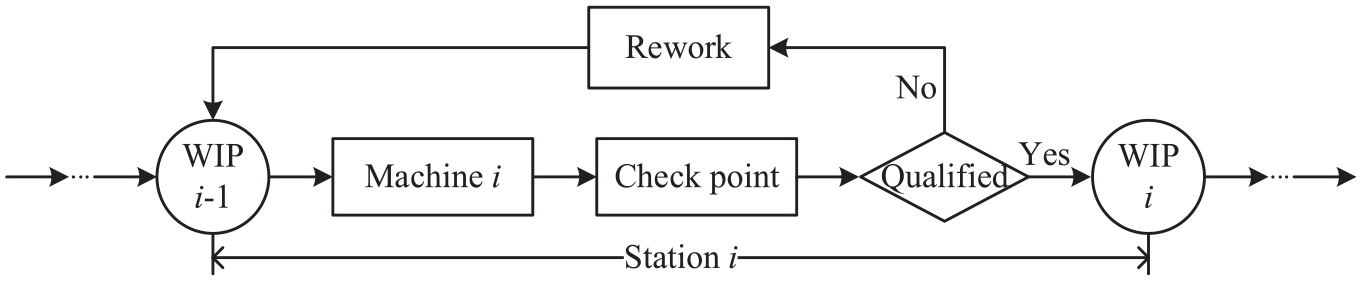
Operational process for the intelligent multistation manufacturing system.
Given that the intelligent multistation manufacturing system is composed of different stations, the specified functions and tasks must be completed in different stations. Meanwhile, the functional healthy state of the intelligent multistation manufacturing system can show the different degradation trends over time. Therefore, the model that can describe the functional healthy state of the intelligent multistation manufacturing system must be explored from the perspective of integrated reliability assurance and functional performance realization.
Connotation of the functional healthy state for intelligent multistation manufacturing system
The core function of the intelligent multistation manufacturing system is to meet the requirements of production tasks and produce a specified number of qualified products, where it is also a development trend of system health standard conforming to the prospect of intelligent development. From the perspective of ensuring functional outputs, the connotation of the functional healthy state for the intelligent multistation manufacturing system must be introduced. Figure 2 shows that the variations of the 5M1E input from the outside can be continuously transmitted and accumulated along the station in the intelligent multistation manufacturing system and eventually inevitably lead to the degradation of the functional healthy state of the system. On the one hand, the machine, as the material carrier of the production task, can have uncontrollable quality changes in each station, such as abrasion, aging, and corrosion. These system anomalies can have an effect on the execution of the production task by the machine manufacturing capacity, thereby leading to the degradation of the task execution state in different phases over time, then come out the potential problems of the output WIP quality in the station. On the other hand, when the WIP is transmitted along the machine in each station, the degradation of its state can be reflected by the quality deviations of the manufactured products. The key quality characteristics (KQCs) deviations in the previous processing station due to the phased degradation of the production task or unqualified process can be transmitted to the next station, eventually resulting in the degradation of the functional healthy state of the system.
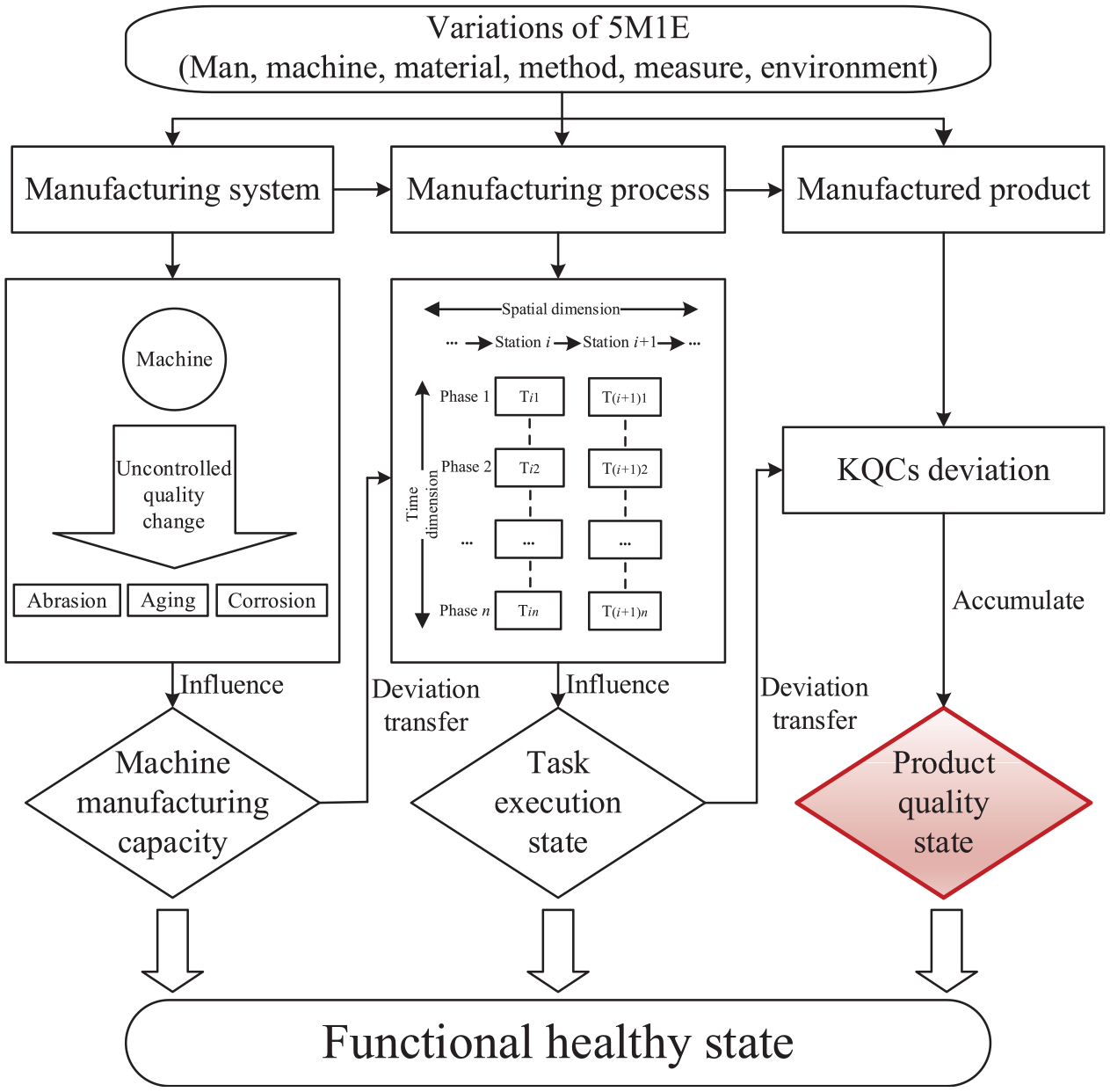
Fusion framework of the functional healthy state for an intelligent multistation manufacturing system.
From the perspective of the degradation mechanism of the functional healthy state, the manufacturing capacity of the machine, the execution state of the production task, and the quality state of the manufactured product should be considered when defining the connotation of the process quality-oriented functional healthy state. The combined influence of such factors can determine the ability of the system to complete the production task executions and realize the functional characteristics. An intelligent multistation manufacturing system in a good functional healthy state needs to continuously process and transmit materials and eventually output qualified products through the machine in each station according to the production task requirements. In conclusion, the manufacturing capacity of the machine, the execution state of the production task, and the quality state of the output product must be considered when focusing on the quantitative modeling of the functional healthy state of intelligent multistation manufacturing systems.
Integrated mission reliability model based on PSTN
PSTN of an intelligent multistation manufacturing system
A state task network (STN) is a directed graph which is often used to describe the operational process of the manufacturing system due to the merit of its simplicity. However, the STN cannot clearly reflect the phased degradation characteristics of the system. Therefore, a graphical representation called PSTN is established to describe the production process of a multistation manufacturing system. Figure 3 shows a simplified PSTN of the intelligent multistation manufacturing system, where I and O represent the input of raw materials and the output of qualified products, respectively.
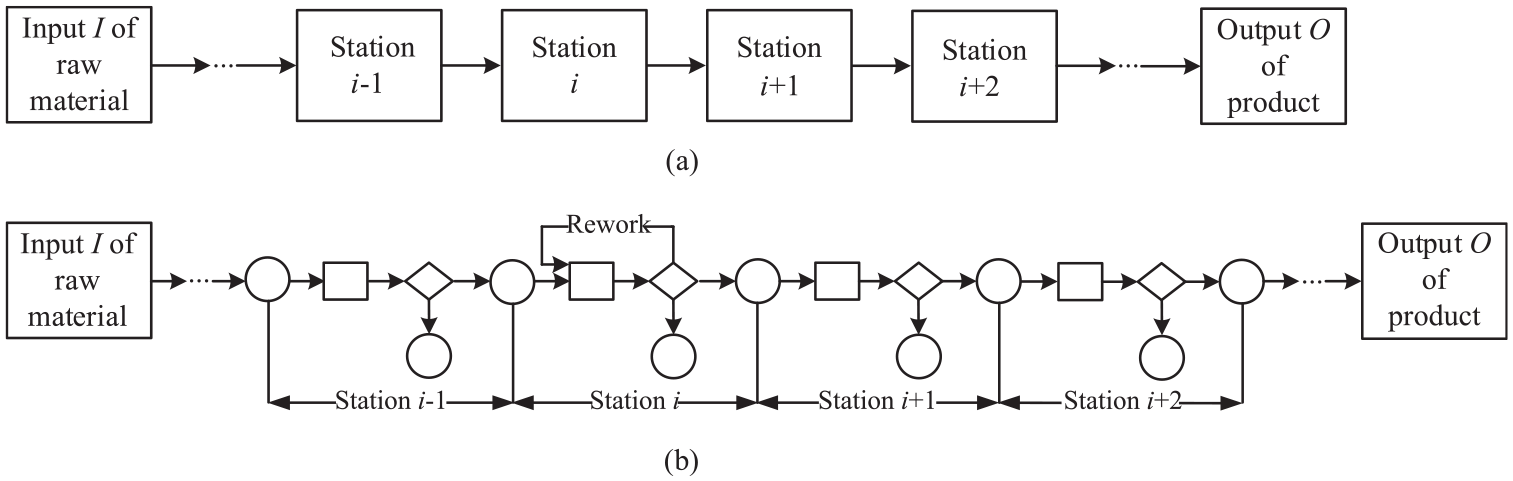
Simplified PSTN representation of a simple intelligent multistation manufacturing system. (a) an example of a simplified intelligent multistation manufacturing system with a rework station and (b) the PSTN model.
Figure 3(a) shows an example of a simplified intelligent multistation manufacturing system with a rework station. Figure 3(b) shows the PSTN model of Figure 3(a). In Figure 3(b), the performance state of the machine is represented by a rectangle, the quality state of the WIP is displayed by a circle, and the checkpoint is shown by a diamond.
The following assumptions are provided to ensure the rationality of the established PSTN:
(1) The intelligent multistation manufacturing system is composed of M stations. The task execution state in each station can be evaluated based on the degradation state of each phase, which can be expressed as
(2) The proportional relation of each state appearing in each phase at any time is constant, and the corresponding phased state probability is
(3) Each machine is physically and statistically independent of each other;
(4) Each WIP in repairable condition is allowed to be reworked only once. If still unqualified, then such WIP can be discarded;
(5) The checkpoints set after each machine in PSTN are absolutely reliable, and only qualified WIPs can enter into the next station;
(6) If there is no checkpoint in a station, it can be assumed that all WIPs can pass the quality checkpoint and the inspection process is virtual.
Integrated mission reliability model based on PSTN
The PSTN, as a model that can describe the operational process of the system, can clearly reflect the complex relationship of each component in each station. Therefore, an integrated mission reliability model based on PSTN for an intelligent multistation manufacturing system is proposed. The key parameters in the model are defined as follows:
Definition 1: Quality state (
Definition 2: Task execution state (
Definition 3: Demand task quantity (T). A series of production subtasks
Definition 4: Integrated mission reliability. The mission reliability of integrating five variables is expressed as follows:

where


An integrated mission reliability model based on PSTN can be established through the above definition (see Figure 4). In Figure 4, for station i without rework process, the machine can process materials to output WIPs. There are two quality states (qualified state
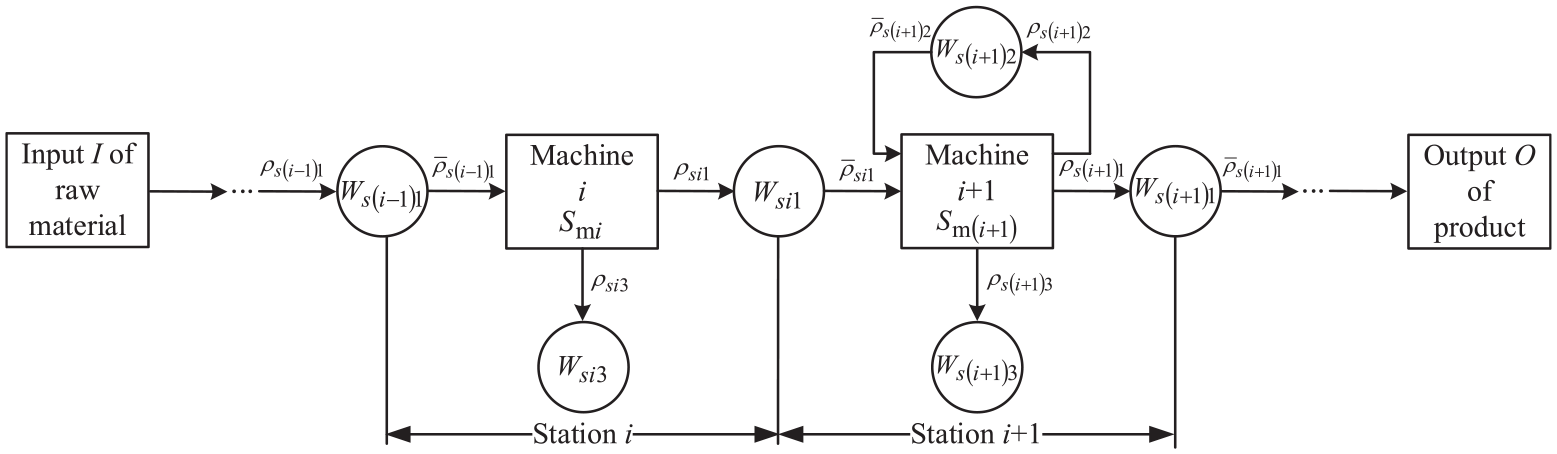
Integrated mission reliability model based on the PSTN for an intelligent multistation manufacturing system.
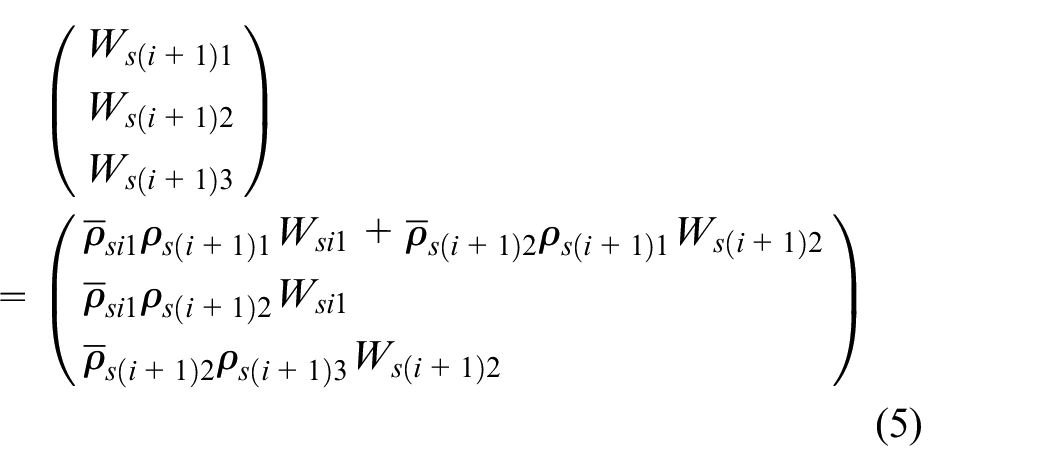
In Figure 4, the complex quantitative relationship among variables that can represent the integrated mission reliability of the intelligent multistation manufacturing system in the model can be expressed as follows:

Functional healthy state evaluation approach for intelligent multistation manufacturing system
PSTN-based functional healthy state evaluation framework
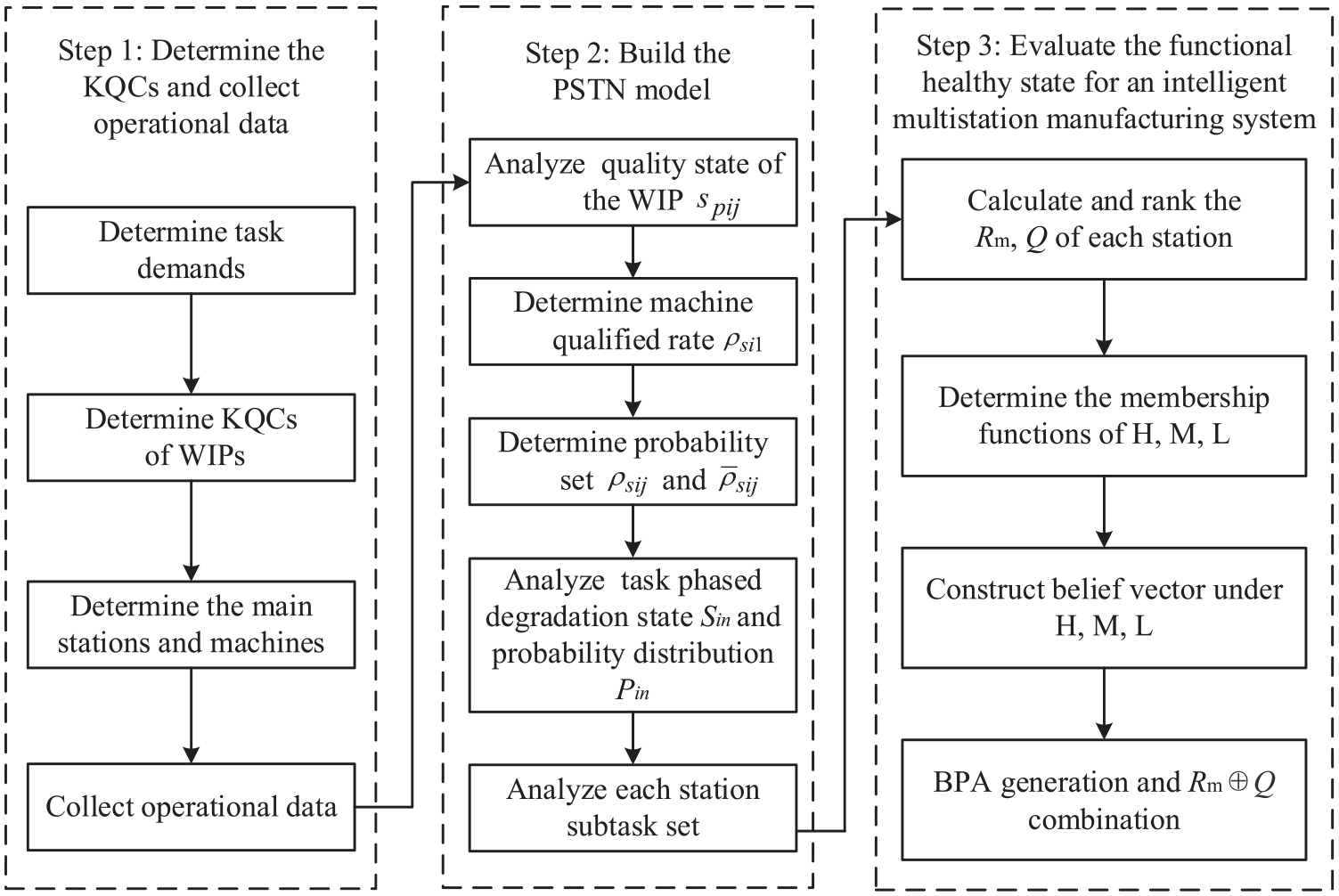
According to the theory basics and model proposed in Sections 2 and 3, a functional healthy state evaluation framework for the intelligent multistation manufacturing system is proposed as shown in Figure 5. And each step is briefly described below.
Functional healthy state evaluation framework for the intelligent multistation manufacturing system.
Step 1. Determine KQCs and collect operational data
Task requirements and KQCs are determined, and main stations and machines are identified to perform the corresponding functions and tasks. Then the operational data required for functional healthy state evaluation are collected.
Step 2. Build a PSTN model
After the first step, we can analyze the quality state of WIP
Step 3
Evaluate the functional healthy state of the intelligent multistation manufacturing system.
The machine mission reliability (Rm) and WIP quality state (Q) are calculated according to the PSTN model established in step 2. The membership functions corresponding to the three functional healthy states (H, M, and L) are determined based on the fuzzy mapping. And the belief vectors of H, M, and L are constructed. Finally, the evaluation results of the functional healthy states can be obtained by the basic probability assignment (BPA) of fuzzy evidence combination, thus realizing the evaluation of the functional healthy state of the system.
Quantitative modeling of the mission reliability of machine
The manufacturing capacity represented by the machine qualified rate can be characterized by the probability that the measured value of the sample in any inspection batch is within the design value threshold. When the number of products goes to infinity, the qualified rate is

where
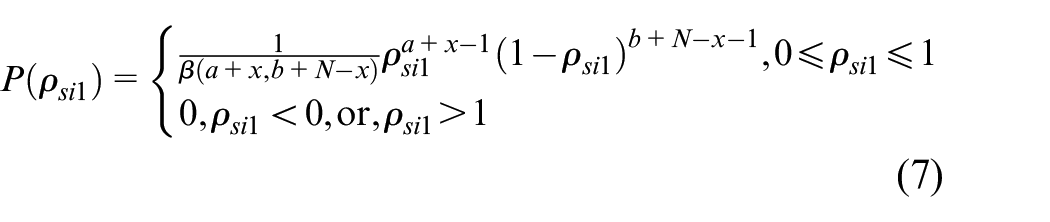
where a, b are parameters of standard beta distribution, and
Therefore, the expression of
To meet the production requirement, the input quantity of raw materials must be determined. When there is no rework station, the ratio of input and output can be expressed as

The degree of the incompleteness of a task can be expressed as the ratio of execution ability under the phased degradation to the execution ability under the optimal state as follows:

where e is a variable related to phased degradation degree of task execution ability.
The failure state of the task can cause shutdown during production. Accordingly, the degree of incompleteness

where
Combining equations (9) and (10), the expression of variable e can be obtained:
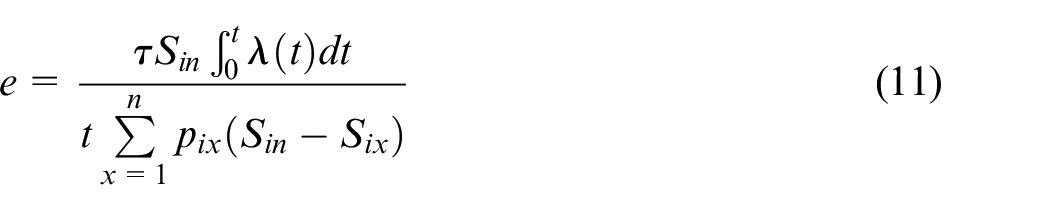
From the perspective of flow conservation, the machine mission reliability Rm can be expressed as the minimum task input to meet the maximum task execution ability state in the station i under normal operation:

Quantitative modeling of the quality state of WIP
A process model is introduced to represent the KQCs deviations Yk(t) when modeling and analyzing the quality state of WIP:

where
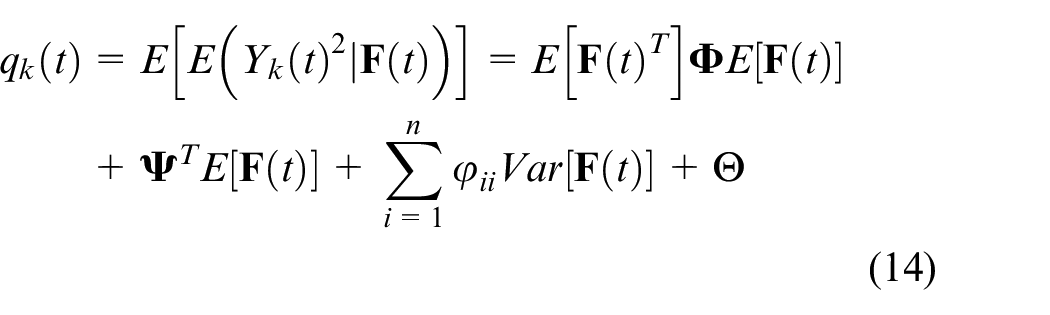
where
Gamma distribution can be used to describe the controllable process variable



Functional healthy state evaluation of intelligent multistation manufacturing system based on fuzzy evidence theory
Fuzzy evidence theory can effectively provide reasonable expression and explanation to the heterogeneous evidence, and divide the functional healthy state into three levels: low (L), medium (M), and high (H). In addition, fuzzy evidence theory can also integrate multisource information. The final functional healthy state evaluation result of the system is determined by the fusion decision-making process (see Figure 6).
Step 1: Construct the membership function. We define
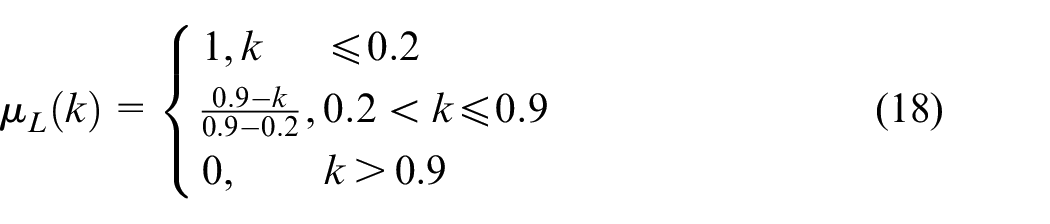
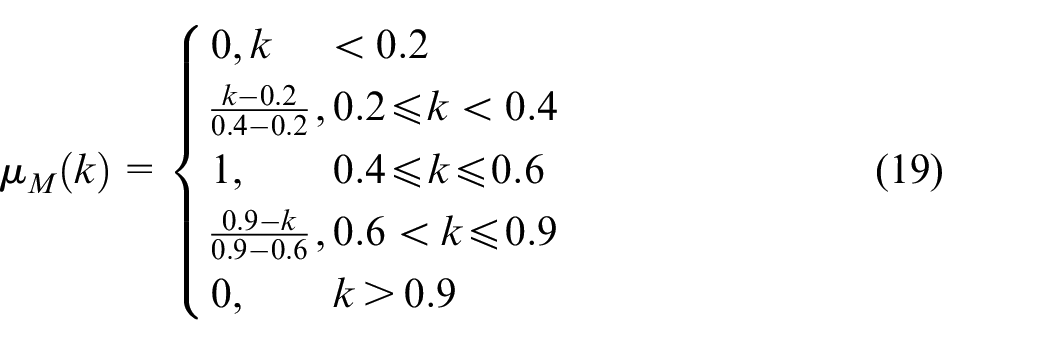
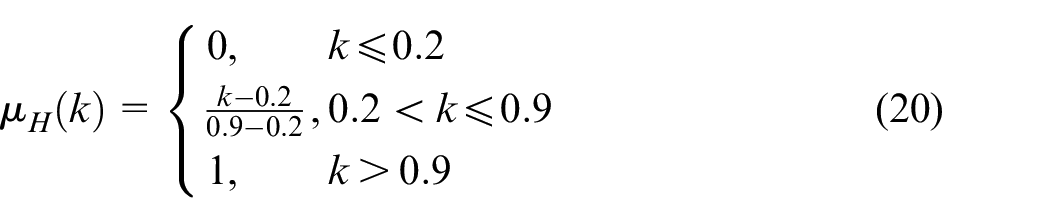
Step 2: Construct the belief vector. The different importance of evidence has diverse effects on decision results, and we define this factor as follows:


Functional healthy state evaluation based on fusion decision-making process.
where
To obtain the new importance index of BPA,

The final functional healthy state values for the three levels can be described from the perspective of the belief vector as
Step 3: Generate BPA and obtain functional healthy state levels. BPA is known as the mass function, and the bigger the quality of the functional healthy state level in BPA, the higher the probability of occurrence in the aggregation process. For example, if the vector of Rmi is (0.1, 0.5, 0.3), then the BPAs of Rmi are m(M) = 0.5, m(M,H) = 0.3, and m(L,M,H) = 0.1.
The combination of evidence in Dempster’s combination rule is called

Then we introduce pignistic probability transformation to convert BPA into a probability function by equally allocating BPA to each subset, and its probability distribution is expressed as

where
Case study
Background
Cylinder head is the core and most basic key component of an engine. The processing of the cylinder head can be seen as an intelligent multistation manufacturing system composed of different stations. In each station, machine needs to perform the corresponding production task to output qualified WIPs and transmit them to the next station automatically. Thus, components in different stations of the cylinder head manufacturing system are closely related with the quality state of the final output products. In this case, the KQCs of the cylinder head mainly focus on the dimensions of each hole independent of each other. “Fine boring of camshaft hole,”“Processing conduit hole,” and “Fine boring rocker shaft hole” are the main processes of the cylinder head processing. Therefore, the functional healthy state evaluation of the cylinder head manufacturing system mainly involves three stations, each of which contains the corresponding machine. Figure 7 shows a simplified intelligent multistation cylinder head manufacturing system.
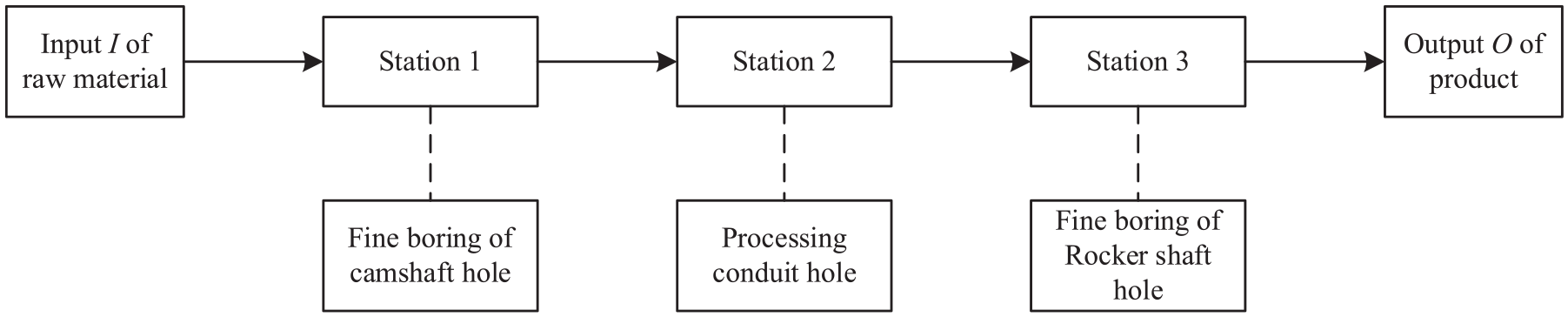
Simplified intelligent multistation manufacturing system of the cylinder head.
Numerical example
According to the method proposed in Section 4, the evaluation method can be mainly divided into three steps: preparation for modeling, building the PSTN model, and evaluation for the functional healthy state. A numerical example of this case for a cylinder head manufacturing system is provided below.
Step 1. Preparation for modeling
With the help of quality function deployment (QFD), KQCs and specifications can be obtained by mapping process to determine the manufacturing processes according to the design principle and the expert analysis (see Table 1).
KQCs and specifications of the cylinder head manufacturing system.

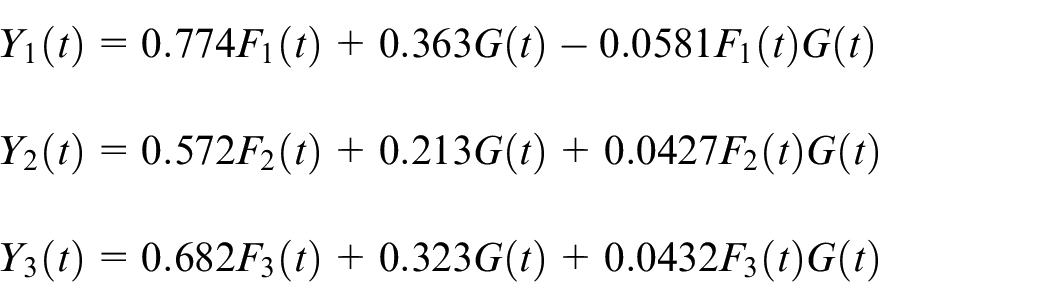
The three KQCs in the three production stations of the cylinder head manufacturing system are coaxiality, diameter, and aperture accuracy. The deviations of these three KQCs are represented by Y1(t), Y2(t), and Y3(t). Therefore, the KQC deviations can be represented by a process model established as follows:
Step 2. Building the PSTN model
An intelligent multistation manufacturing system of the cylinder head can be characterized by three main stations and corresponding machines determined in step 1. Station 2 has a rework process to allow one rework; hence, the quality states of the WIP output from machines are
Probability distribution of the task phased degradation state in each station.
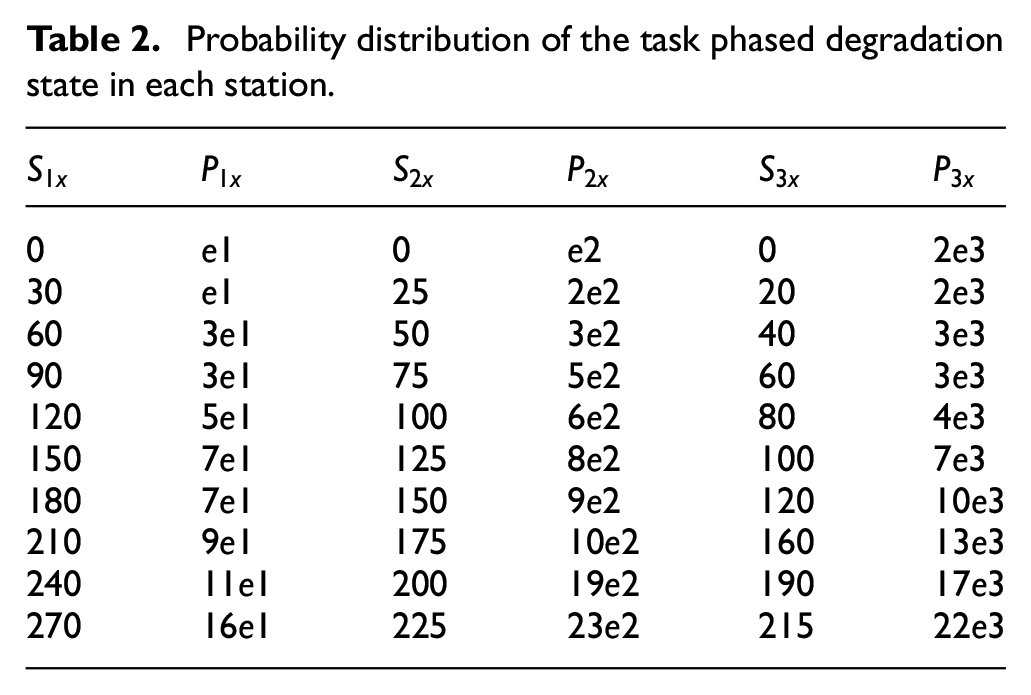
According to Table 2, the variable related to task state e in each station can be calculated by using equation (11):
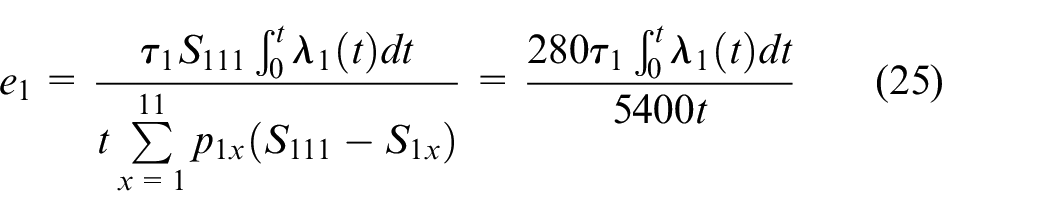
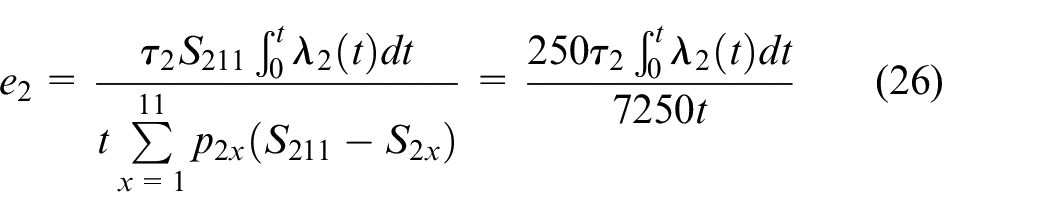
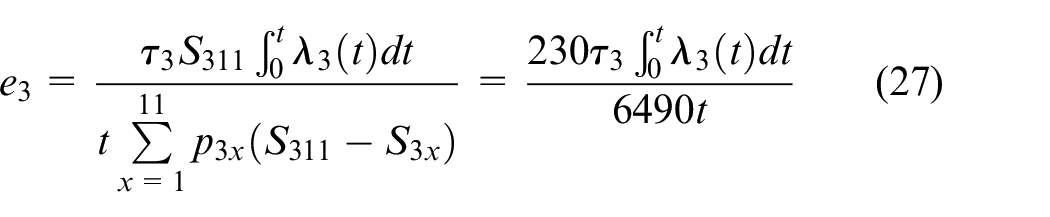
Since the modeling of failure rate function is not the focus of this paper, in order to simplify the process of case verification, we assume that the failure rate of each machine is constant at the current stage, and based on the failure data obtained from the quality management department, we can obtain that

The PSTN model of the intelligent multistation manufacturing system of the cylinder head can be constructed on the basis of the indicators determined from the previous analysis and calculation (see Figure 8). Given that we regard the cylinder head processing as a series system consisting of three stations in this case,
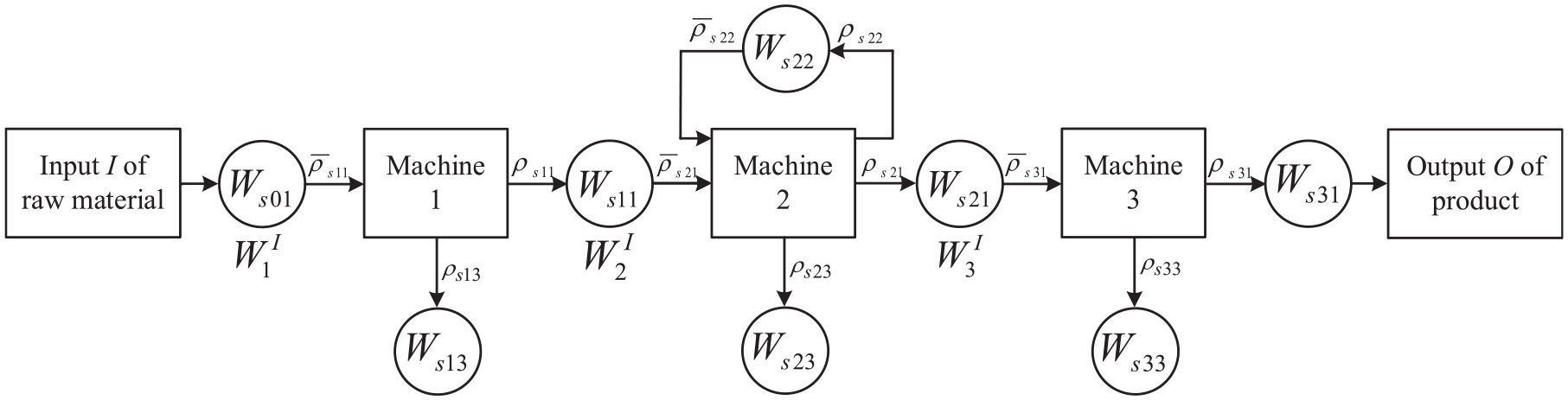
PSTN model of the intelligent multistation manufacturing system of the cylinder head.
Step 3. Evaluation for the functional healthy state
According to the specified production plan, the task requirement T is 200 in this case, that is, the number of WIP output from the third station of the intelligent multistation manufacturing system




Therefore, the minimum task states that can meet the input material amount required by different stations are Smin1 = 240, Smin2 = 225, and Smin3 = 215. The machine mission reliability in each station can be obtained by equation (12):



We need to analyze and calculate the quality state of WIPs. According to the equations of the three process models in step 1, the KQC deviation can be expressed as follows:



According to Equation (7), the quality thresholds are a1 = 0.0051, a2 = 0.0031, and a3 = 0.0037. When the operational time is 100, the quality states of WIPs can be obtained as follows:

After the calculation of Rm and Q in each station is completed, the membership functions of the three functional healthy states can be determined by equations (18)–(20). Then, the importance of the evidence for the fuzzy evaluation of Rm can be obtained by equation (21):
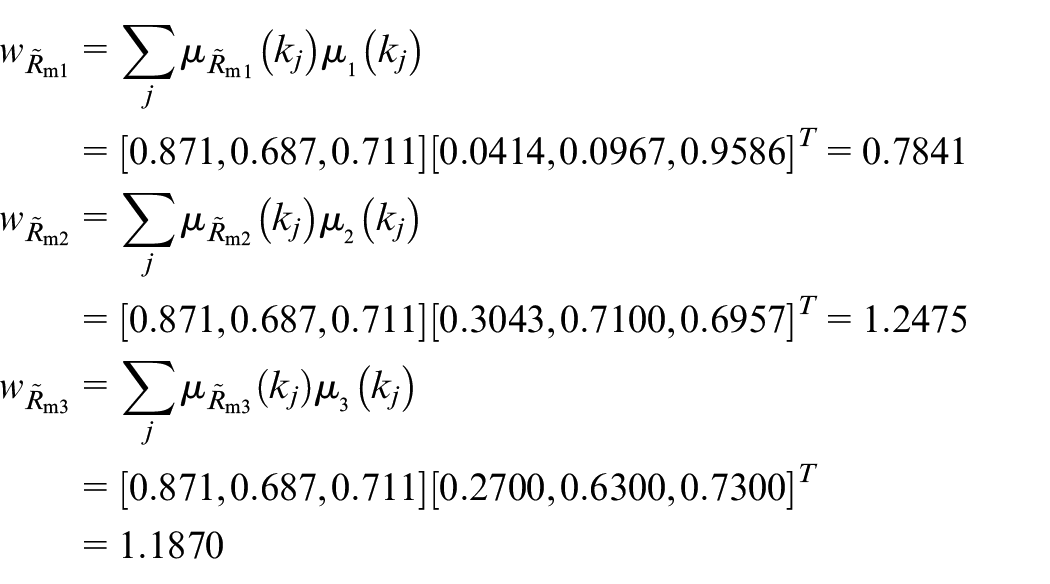
Therefore, the belief vectors of Rm and Q are
BPAs of the three functional healthy state factors.
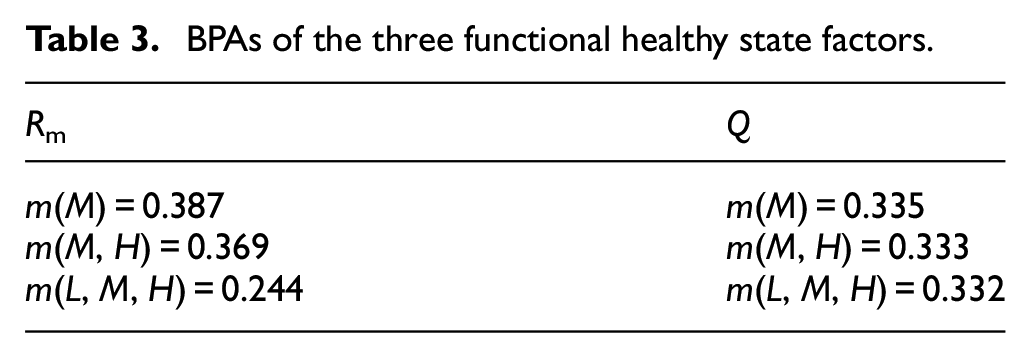
The BPAs of the functional healthy state factors in Table 3 can be aggregated by using Dempster’s combination rule as follows:
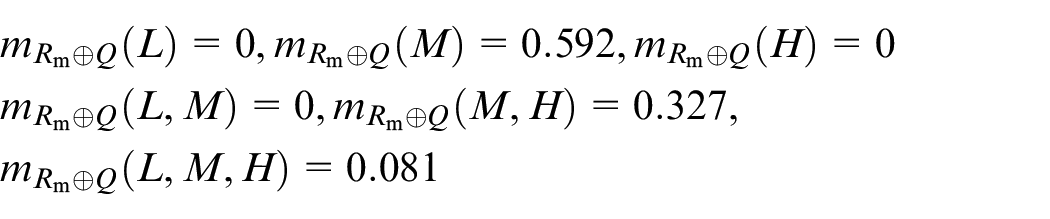
According to the pignistic probability transformation shown in equation (25), L, M, and H can be aggregated as follows:

Therefore, the functional healthy state of a cylinder head intelligent multistation manufacturing system can be obtained when the operational time is set at day 100.
Results and discussion
The above calculation results demonstrate that the functional healthy state of the cylinder head intelligent multistation manufacturing system is at a medium level followed by a little bit high when the operational time is set at day 100. The results show that the functional healthy state of the system can be acceptable; thus, functional fault diagnosis and preventive maintenance activities are not necessary. The product quality of an intelligent multistation manufacturing system in each processing station can be continuously degraded over time. Meanwhile, the value of machine mission reliability obtained by integrating two key factors of the system, the machine and task, can have phased degradation over time. In addition, since the core function of a manufacturing system is to consistently and stably output qualified products that can meet the task requirements, the product quality is also an important indicator to measure the system state, which needs to be considered. And the system functional healthy state can be obtained by integrating it with the machine mission reliability, as shown in Table 4.
Product quality state and functional healthy state in different operational time.
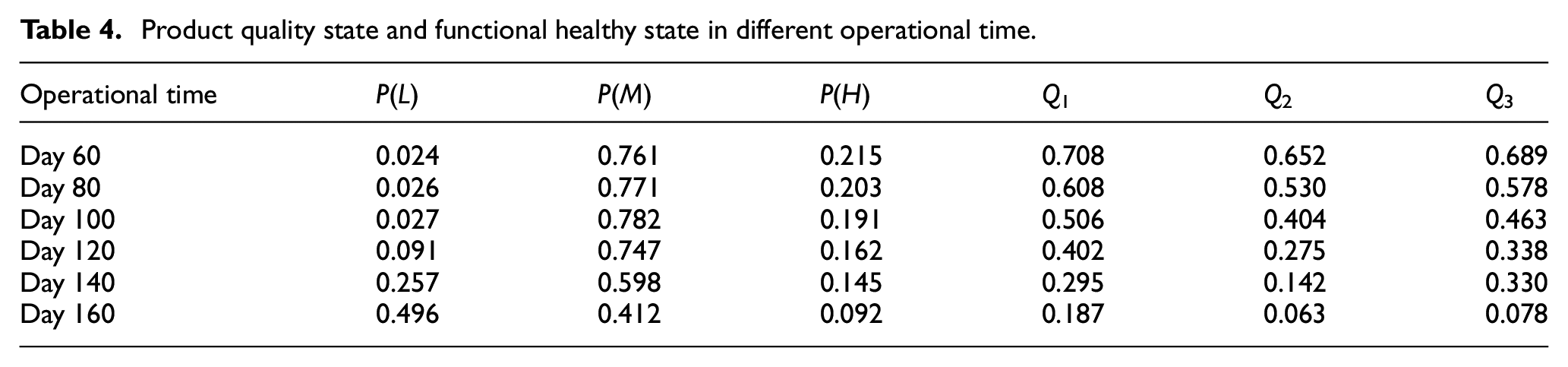
Table 4 demonstrates that the product quality degrades with time, and the probability of a low functional healthy state of the intelligent multistation manufacturing system significantly increases, which is specifically manifested in the degradation of the functional healthy state of the system. However, the reasons for the degradation of the system’s functional healthy state are also from their respective priority in each processing station. For example, the product quality state of the third station needs to be closely monitored when the operational time is set at day 100 because it has the highest priority. This notion means that the uncontrollable quality factors are likely to be substituted into the system during the processing station, thus affecting the functional healthy state of the system.
Sensitivity analysis is performed to illustrate the influence of product quality state on the functional healthy state of the intelligent multistation manufacturing system under different quality deviation thresholds. As shown in Figure 9, the results show that the requirements on product quality can become stringent with the reduction of the quality deviation threshold. In a given production task plan, the low functional healthy state of the system can increase with the decrease in the quality deviation threshold. The high function can decrease with the decrease in the quality deviation threshold. The medium functional healthy state can also vary with the change of the quality deviation threshold. Therefore, sensitivity analysis can help manufacturers in determining the different production strategies and maintenance decisions.
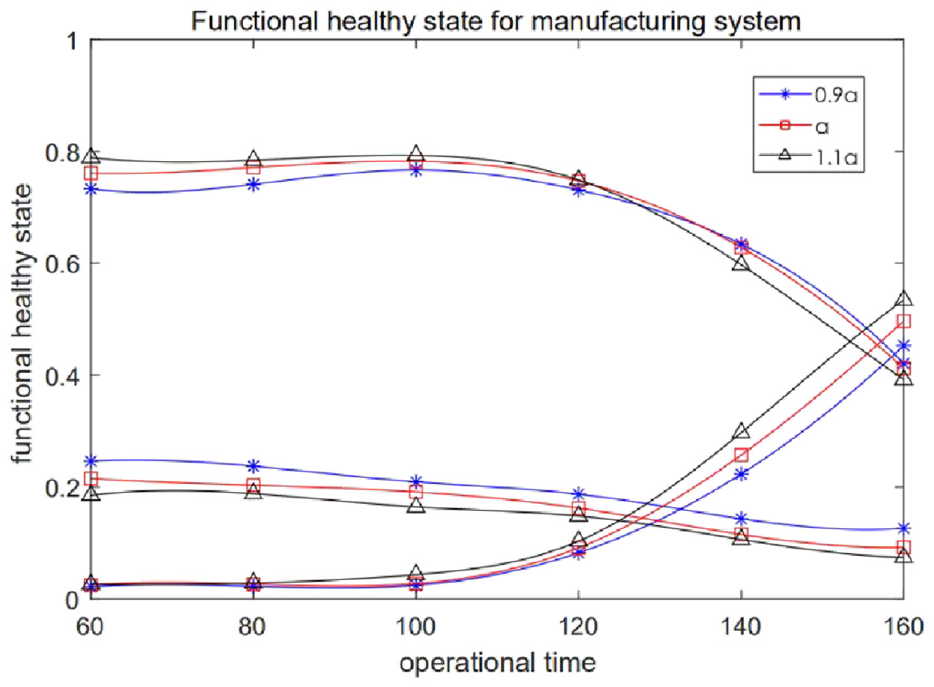
Sensitivity analysis of functional healthy state under different quality deviation thresholds for intelligent multistation manufacturing systems.
The comparison of machine mission reliability, product quality, and system functional healthy state in different processing stations are shown in Table 5:
Comparison of the functional healthy state and other characteristics states.
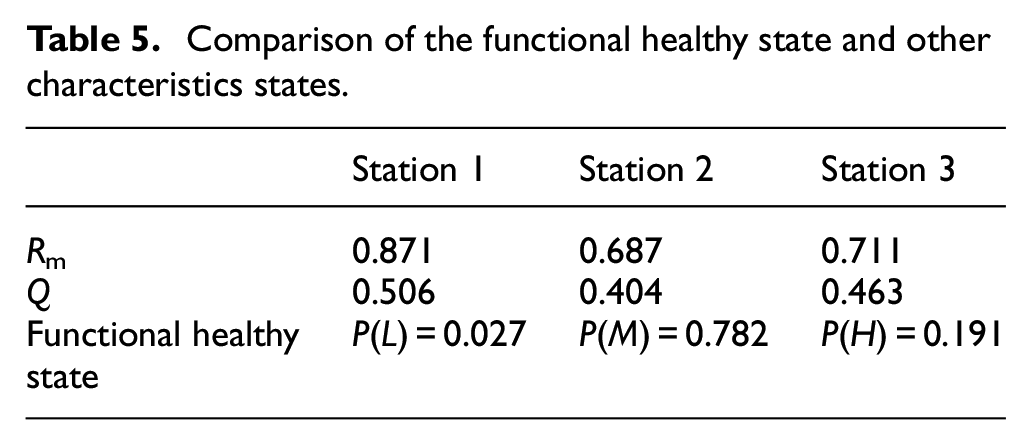
From the perspective of system functional output, the product quality state of station 2 is poor, and the corresponding quality inspection and process improvement should be carried out. From the perspective of integrated task state and production material, the machine mission reliability of station 2 is lower than those of other stations, and preventive maintenance activities need to be considered. However, the machine mission reliability and product quality in other processing stations are within the acceptable range, making the system as a whole in a medium state of a functional healthy state. The actual production results also show that the cylinder head intelligent multistation manufacturing system can complete the specified quantity and quality function output according to its production task plan.
Conclusions
This study developed a functional healthy state evaluation approach based on PSTN for intelligent multistation manufacturing system by analyzing the machines, production tasks, and output products. Compared with traditional health evaluation methods, the approach proposed in this paper has the following advantages. First, based on the perspective of system engineering, the proposed functional healthy state connotation of the intelligent multistation manufacturing system comprehensively considers the relationship among the machines, production tasks and output products in the system. Second, the PSTN is established to visualize the operational process of the system, and based on its function of data integration and fusion modeling, the integrated mission reliability model is established. Finally, a functional healthy state evaluation approach is proposed, which can not only fully consider the phased degradation characteristics during the task execution of the intelligent multistation manufacturing system, but also have a guiding significance for monitoring the quality of the product in effectively reducing the product quality loss and enabling manufacturers to formulate reasonable decisions. On the basis of this study, in-depth research can be conducted from the following two aspects in the future:
(1) The indicators that affect the functional health of the system can be quantitatively modeled as the key indicators of functional risk based on PSTN. And a risk-oriented functional fault diagnosis method of the intelligent multistation manufacturing system can be developed by using some type of control chart, such as TBE (Time between Events) control chart.
(2) Preventive maintenance and production scheduling decisions of the intelligent multistation manufacturing system based on system functional healthy analysis.
Footnotes
Declaration of conflicting interests
The author(s) declared no potential conflicts of interest with respect to the research, authorship, and/or publication of this article.
Funding
The author(s) disclosed receipt of the following financial support for the research, authorship, and/or publication of this article: This study was supported by the National Natural Science Foundation of China (Grant Nos. 72071007 and 71971181).
