




Abstract
The paper develops an important method related to using algebraic inequalities for uncertainty and risk reduction and enhancing systems performance. The method consists of creating relevant meaning for the variables and different parts of the inequalities and linking them with real physical systems or processes. The paper shows that inequalities based on multivariable sub-additive functions can be interpreted meaningfully and the generated new knowledge used for optimising systems and processes in diverse areas of science and technology. In this respect, an interpretation of the Bergström inequality, which is based on a sub-additive function, has been used to increase the accumulated strain energy in components loaded in tension and bending. The paper also presents an interpretation of the Chebyshev’s sum inequality that can be used to avoid the risk of overestimation of returns from investments and an interpretation of a new algebraic inequality that can be used to construct the most reliable series-parallel system. The meaningful interpretation of other algebraic inequalities yielded a highly counter-intuitive result related to assigning devices of different types to missions composed of identical tasks. In the case where the probabilities of a successful accomplishment of a task, characterising the devices, are unknown, the best strategy for a successful accomplishment of the mission consists of selecting randomly an arrangement including devices of the same type. This strategy is always correct, irrespective of existing uknown interdependencies among the probabilities of successful accomplishment of the tasks characterising the devices.
Keywords
Introduction
Algebraic inequalities, have been used extensively in mathematics. For a long time, simple inequalities have been used to express error bounds in approximations and constraints in linear programming models. The properties of a number of useful non-trivial algebraic inequalities, such as the Arithmetic mean – Geometric mean (AM-GM) inequality, Cauchy-Schwarz inequality, the rearrangement inequality, the Chebyshev’s inequalities, Jensen’s inequality, Muirhead’s inequality, Hoelder’s inequality, etc., have also been well documented.1–8
In reliability and risk research, inequalities have been used exclusively as a tool for reliability and risk evaluation and for characterisation of reliability functions.9–15 It is important to guarantee that the reliability of a system meets certain minimal expectations and inequalities have been used 9 for obtaining lower and upper bounds on the system reliability by using minimal cut sets and minimal path sets. Xie and Lai, 10 for example, used simple conditional inequalities to obtain more accurate approximations for system reliability, instead of the usual minimal cut and minimal cut bounds. By using improved Bonferroni inequalities, lower and upper bound of system reliability have been derived. 11 Inequality-based reliability estimates for complex systems have also been proposed. 12
In the reliability and risk research, algebraic inequalities have also been used to express relationships between random variables and their transformations to generate insight into the structure of reliability distributions. Simple inequalities with relation to reliability prediction have been used 13 ; inequalities involving expectations have been used for characterising some well-known reliability distributions. 14 Well-known inequalities about a random variable with unknown probability distribution are the Chebyshev’s inequality and Markov’s inequality. 16
The reliability-related applications of inequalities however, are very limited and oriented towards measuring the reliability performance of the systems, instead of providing direct input to the design process by reducing uncertainty and risk and improving the reliability of components, systems and processes. In standard reliability textbooks17–20 there has been a big gap in applying algebraic inequalities to improve reliability and reduce risk. Recently, this gap has been reduced 35 by demonstrating the use of algebraic inequalities for reliability imrovement and risk reduction.
Applications of inequalities have also been considered in physics 21 and engineering.22,23 In the mechanical engineering design literature,23–31 for example, there has been a lack of discussion on the use of algebraic inequalities to enhance systems and process performance. In engineering design, there is also a big gap in the application of algebraic inequalities for systems and process enhancement. The application of algebraic inequalities has been mainly confined to trivial inequalities linking design variables required to satisfy various trivial design constraints in order to guarantee that the design will perform its required functions. 23 Recently, this gap in using algebraic inequalities has been reduced 36 by demonstrating the use of algebraic inequalities for improving the performance of processes described by a power-law dependence. It was shown that the application of inequalities in engineering is far reaching and is not restricted to specifying design constraints.
A formidable advantage of algebraic inequalities is that they present an effective tool for dealing with deep,unstructured uncertainty related to key reliability-critical parameters of systems and processes. Algebraic inequalities do not require knowledge related to the distributions of the variables entering the inequalities and this makes the method based on algebraic inequalities ideal for handling deep uncertainty. 35 In this respect, algebraic inequalities avoid a major difficulty in the conventional models for handling uncertainty – lack of meaningful specification of frequentist probabilities or lack of justification behind the assigned subjective probabilities and probabilistic models.
Thus, by using inequalities, the reliabilities of two systems can be compared in the absence of knowledge about the reliabilities of the separate components or in the presence of partial knowledge only, for example, that a particular type of component is older (less reliable) than another type of component. 35 It needs to be pointed out that algebraic inequalities not only permit ranking two systems in terms of reliability but also identifying the optimal (most reliable) system.34,35
Algebraic inequalities provide a strong support for risk-critical decisions under deep, unstructured uncertainty. Despite that the distributions of the risk-critical parameters remain unknown, the method of algebraic inequalities can still establish the intrinsic superiority of one of the competing options.
Algebraic inequalities can also be used for determining tight upper or lower bounds for the variation of risk-critical parameters. Complying the design with these bounds helps maximise performance and avoid faulty products and failures.
These advantages of algebraic inequalities have already been demonstrated.32–35
Unlike algebraic equalities, which establish that two different configurations of a system or a process are equivalent, an algebraic inequality establishes that one of the compared configurations is superior. In this way, the use of algebraic inequalities opens wide opportunities for enhancing the performance of systems and processes.
The applications of algebraic inequalities discussed earlier32–36 are based on the forward approach which includes several basic steps: (i) detailed analysis of the system (e.g. by using reliability theory), (ii) conjecturing an inequality about the competing alternatives or an inequality related to the bounds of a risk-critical parameter, (iii) testing the conjectured inequality by using Monte Carlo simulation and (iv) proving the conjectured inequality rigorously. This way of exploiting algebraic inequalities has already been demonstrated,34,35 with comparing systems with unknown reliabilities of their components.
Another formidable advantage of algebraic inequalities is that they also admit meaningful interpretation that can be attached to a real system or process. Furthermore, depending on the specific interpretation, knowledge applicable to different systems from different domains can be released from the same inequality. This is the essence of inverse approach 37 in applying algebraic inequalities, which starts with a correct algebraic inequality, continues with creating relevant meaning for the variables and the different parts of the inequality and ends with formulating undiscovered properties/knowledge about the system or process. This approach has been illustrated in Figure 1.
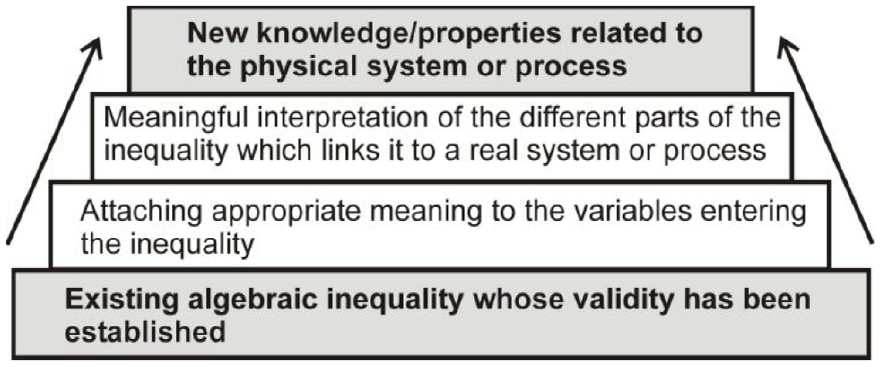
Deriving new knowledge/properties by meaningful interpretation of a valid algebraic inequality.
The inverse approach effectively links existing correct abstract algebraic inequalities with real physical systems or processes and not only opens opportunities for enhanced performance of systems and processes but also leads to the discovery of new fundamental properties.
The inverse approach related to creating meaningful interpretation for existing non-trivial abstract inequalities and attaching it to a real system or process has only been partially explored in Todinov.36,37 Thus, an interpretation of a multi-variable algebraic inequality with respect to real systems has been conducted in Todinov 37 but it was confined to simple electrical circuits and systems of capacitors arranged in series and parallel.
This paper builds on the research on the inverse approach in using algebraic inequalities initiated in Todinov36,37 and contributes a number of new applications of non-trivial multi-variable algebraic inequalities for reducing risk and enhancing the performance of mechanical systems. These contributions are as follows: (i) improving the reliability of a parallel-series system by interpreting a new non-trivial algebraic inequality, (ii) maximising the probability of a successful accomplishment of missions composed of identical tasks by interpreting non-trivial algebraic inequalities; (iii) increasing the accumulated stain energy in components subjected to tension and bending by interpreting the Bergström’s inequality and (iv) avoiding the risk of overestimating profits by using the Chebyshev’s sum inequality.
The principle of non-contradiction
The inverse approach related to algebraic inequalities is routed in the principle of non-contradiction: if the variables and the different parts of a correct abstract inequality can be interpreted as a particular system or process, in the real world, the system or process exhibit properties that are consistent with the abstract inequality. In other words, the realisation of the process/experiment yields results that do not contradict the algebraic inequality.
The deep connection between physical reality and algebraic inequalities can be illustrated with the next simple example.
Consider the common abstract inequality

which is true for any real numbers a, b because this inequality can be obtained from the obvious inequality

Consider the positive quantities a, b (

Dividing the numerator and denominator of the right hand side of (3) by

Now, inequality (4) can be given meaningful interpretation by noticing that if a and b denote the resistances of two elements, the left hand side of inequality (4) is the equivalent resistance of the elements connected in series. The right hand side of inequality (4) is the equivalent resistance of the elements connected in parallel, multiplied by 4.
Inequality (4) effectively formulates a physical property: the equivalent resistance of two elements connected in series is at least four times greater than the equivalent resistance of the same elements connected in parallel, irrespective of the resistances of the individual elements.
If physical measurements of the equivalent resistances of series and parallel arrangement are performed, they will only confirm that for any combination of values a and b of the resistances of the two elements, the equivalent resistance in series is more than four times greater than the equivalent resistance of the same elements connected in parallel. The physical experiment cannot possibly possess knowledge of algebraic inequality (4) yet all experimental outcomes are in perfect agreement with inequality (4). Why does such an agreement exist? Apparently, the mathematics of inequalities is interwoven in the fabric of the real physical world and the course of physical phenomena and processes is inherently consistent with the predictions of correct algebraic inequalities. A meaningful interpretation of the variables and various parts of a correct algebraic inequality which does not lead to a relevant physical manifestation is therefore not possible. This is the essence of the principle of non-contradiction which underlies deriving new knowledge from the meaningful interpretation of algebraic inequalities.
The principle of non-contradiction not only infers the existence of particular properties but also forbids the existence of other properties that are not consistent with the inequalities.
Increasing the capacity for absorbing elastic energy during dynamic loading on the basis of a meaningful interpretation of the Bergström inequality
Inequalities based on sub-additive and super-additive functions
Multivariate sub-additive functions have been discussed in Rosenbaum. 38
In the Euclidean space of one dimension, the sub-additive function

for any pair of points
If the direction of the inequality is reversed, the function

In the Euclidean space of two dimensions, the multivariate sub-additive function

for any pair of points
If the direction of the inequality is reversed, the function

Consider now n pair of points
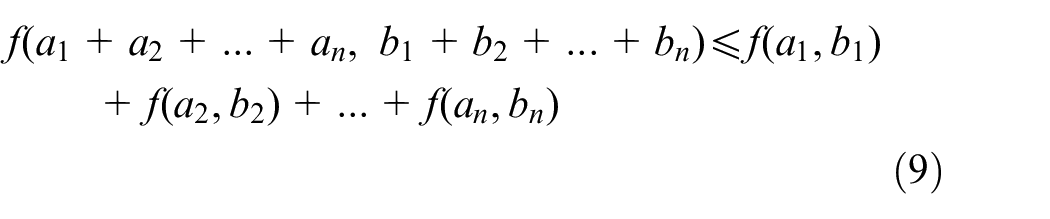
while from definition (8) it follows that
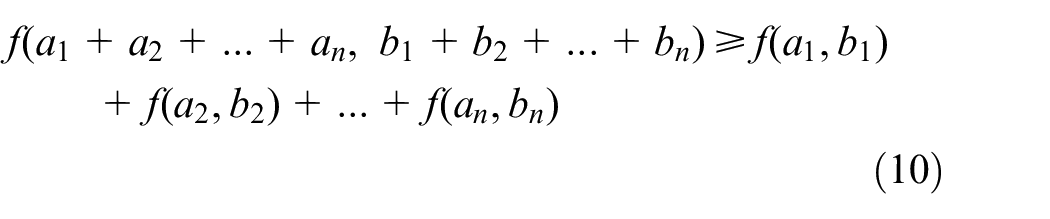
Relationships (9) and (10) can be obtained by mathematical induction and, for the sake of brevity, details have been omitted. Inequalities (9) and (10) do not change direction upon any permutation of
In order to apply inequalities (9) or (10),
Inequalities similar to (9) and (10) can be derived for any number of factors by using the definition of sub-additive/super-additive functions.
Increasing the accumulated strain energy for components loaded in tension
A special case of the general sub-additive function (9) is the Bergström inequality

valid for any sequences
Bergström inequality7,8 is effectively a transformation of the well-known Cauchy-Schwarz inequality
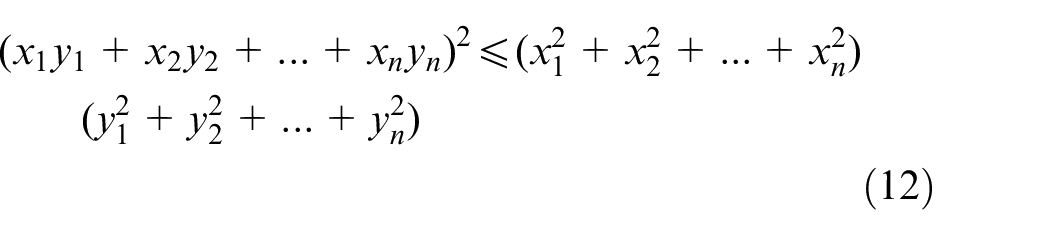
valid for any two sequences of real numbers
In inequality (12), equality is present if and only if for any
If the substitutions
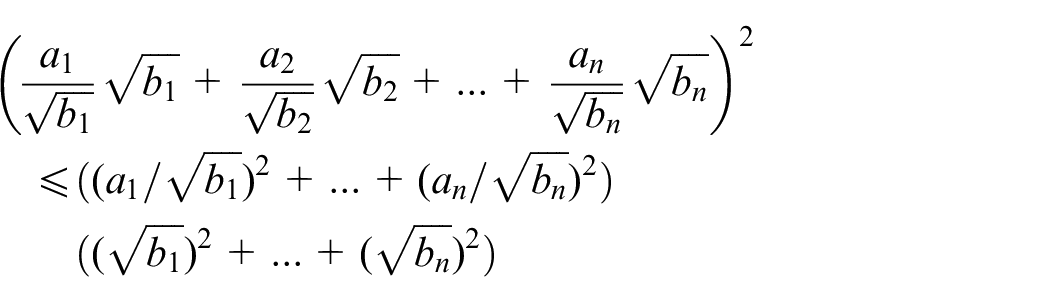
which leads to inequality (11). Equality in (11) is attained only if
Inequality (11) is a special case of the general class of inequalities based on sub-additive functions which have a number of interesting potential applications related to increasing the effect of additive quantities (factors). In order to apply inequality (11),
Inequality (11) has a universal application in science and technology as long as
As an example, relevant meaning can be created for the variables
It is a well-known result from mechanics of materials31,39 that the accumulated elastic strain energy U of a linearly elastic bar with length L and cross-sectional area A is given by the equation:

where E [Pa] denotes the Young’s modulus of the material and P [N] is the magnitude of the loading force. The elastic strain energy U [J] is an additive quantity.
Equation (13) can be written as

where
Consider the two system configurations in Figure 2. In the system configuration in Figure 2(a), a single force P acts on a single large bar with cross-sectional area A. In the system configuration in Figure 2(b), the original bar has been segmented into n individual bars with smaller cross sections
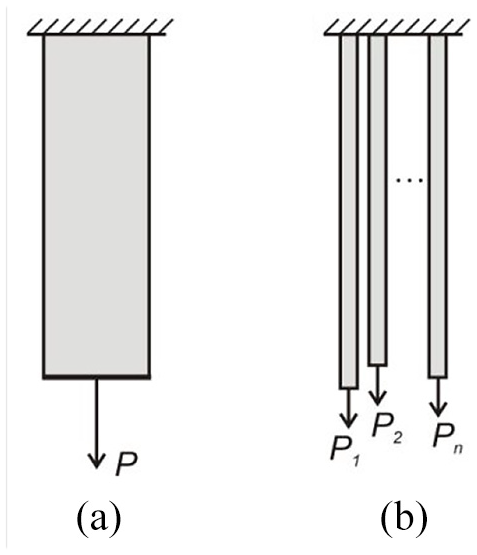
(a) A force P applied to a single bar and (b) segmented forces
A question of interest is which system configuration in Figure 2 is capable of accumulating more elastic strain energy.
Let
The systems in Figure 2(a) and (b) are not equivalent mechanically and the equivalence is not the purpose of the load segmentation. The purpose of the load segmentation and the section segmentation is to increase the strain energy stored in the system. This is why, there is no requirement about equivalence of moments. The only requirement is the sum of the magnitudes of the segmented forces
Because the supports in Figure 2(a) and (b) are rigid, no deformations exist in the support and the elastic strain energy of the system of bars is a sum of the elastic strain energies
The elastic strain energies of the two system configurations can now be compared through inequality (11). Inequality (11) can be rewritten as

The left- and the right-hand side of inequality (15) can now be interpreted meaningfully in the next result:
The accumulated elastic strain energy from a force loading a single bar in tension, is smaller than the accumulated strain elastic energy resulting from segmenting the force into smaller forces loading the bars into which the original bar has been segmented.
It needs to be pointed out that not every load segmentation of the original bar leads to an increase of the accumulated elastic strain energy. If all loaded bars have the same displacement, no increase in the accumulated strain energy is present. Indeed, in inequality (15),
Since,
Inequality (15) holds irrespective of the magnitude of the separate forces into which the initial force P has been segmented and the cross sections of the individual bars. The inequality provides a method of increasing the capacity for absorbing elastic strain energy upon dynamic loading.
This is unexpected result. To illustrate its validity, consider an example of a steel bar with cross-section 10 mm × 20 mm and length 1 m, loaded in tension with a force of 50 kN. The Young’s modulus of the steel is
According to equation (14), the accumulated elastic strain energy in the bar with stiffness
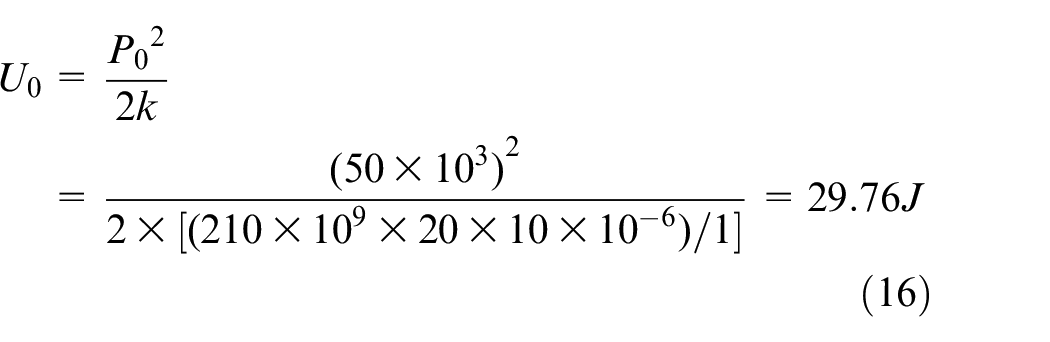
Now, suppose that the bar has been segmented into two bars with cross-sections 10 mm × 10 mm and length 1 m, and the force
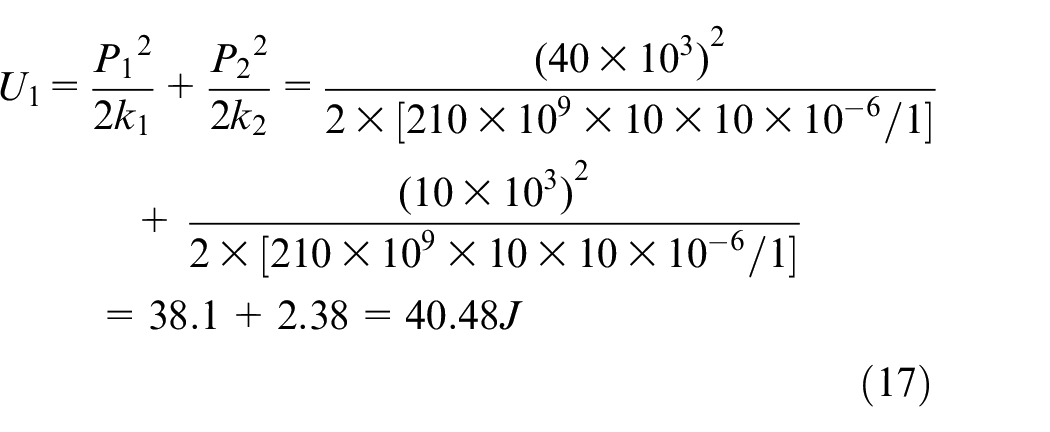
This is about 36% larger than the elastic strain energy of 29.76 J accumulated in the single bar.
Increasing the capability of accumulating elastic strain energy is important not only to prevent failure during dynamic loading but also in cases where more elastic strain energy needs to be stored.
If the bar had been segmented into two bars with cross sections 8 mm × 10 mm and 12 mm × 10 mm and the force had been segmented into two forces with magnitudes 20 and 30 kN, the accumulated elastic strain energy characterising the segmented bar and loading would be equal to the elastic more elastic strain energy characterising the original bar and loading:
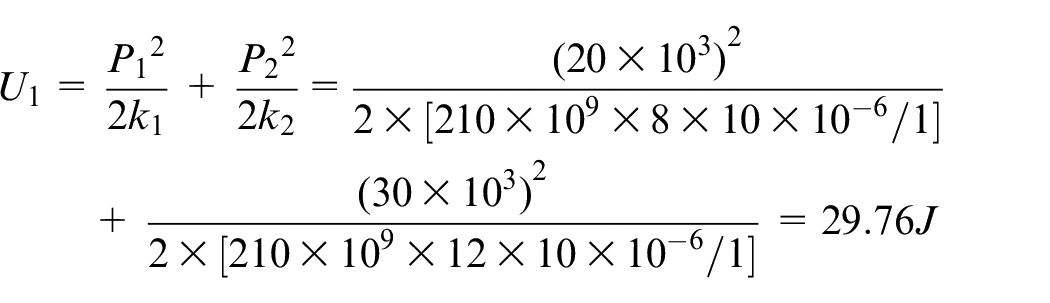
This is because the displacements of the segmented bars are equal (the ratios
If the bar had been segmented into two bars with cross sections 10 mm × 10 mm and the force had been segmented into two equal forces with magnitude
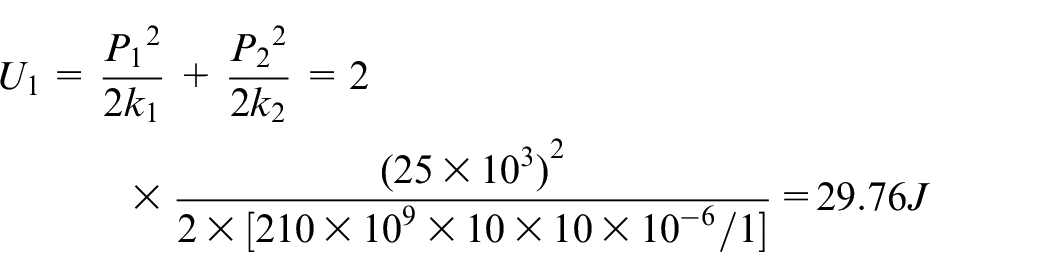
because the displacements of the bars
In order to obtain any advantage from inequality (15), asymmetry must be present in the system so that the displacements of the bars are not equal:
The asymmetry requirement to achieve increased energy storage is rather counterintuitive and makes this result difficult to obtain by alternative means bypassing inequality (11).
Consider the sequence {
For the second sequence, it is easy to see that

As a result, the right-hand side of inequality (15) is maximised if the ordered in ascending order segmented loads
Increasing the accumulated strain energy for components loaded in bending
An alternative interpretation of inequality (11) can be created if variable
It is a well-known result from mechanics of materials that the accumulated elastic strain energy U in a cantilever beam (Figure 3(a)) with rectangular cross section

where P [N] denotes the loading force and f [m] is the elastic deflection at the point of application of the concentrated force P.
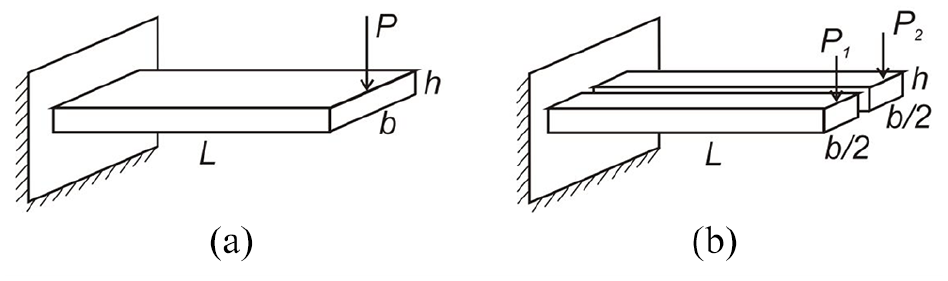
(a) Cantilever beam loaded with a single concentrated force P and (b) segmented cantilever beam loaded with two forces
From mechanics of materials,31,39 for a cantilever beam with rectangular cross-section, the deflection f can be determined from

where E is the Young modulus of the material and

According to equation (18), the accumulated elastic strain energy U in the cantilever beam is then given by

By introducing the value

Suppose that the load P and the cantilever beam have been segmented into n loads
According to inequality (11),
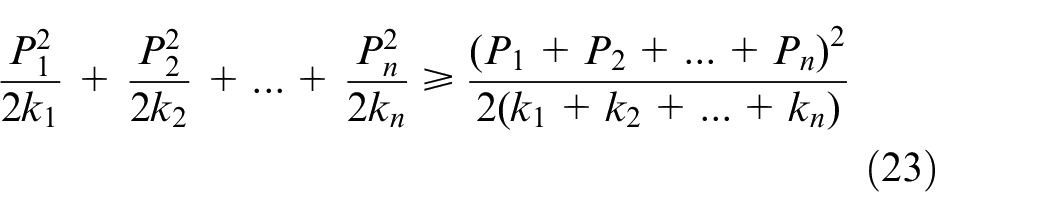
The expression
Inequality (23) then predicts that the accumulated elastic strain energy due to a load applied on a cantilever beam, is smaller than the accumulated elastic strain energy from loads resulting from segmenting the original load into smaller loads, and applying the smaller loads on the cantilever beam segments.
Similar to the previous examples related to bars loaded in tension, not every segmentation of the beam and the load leads to an increase of the accumulated elastic strain energy. If the smaller cantilever beams have the same displacement under their loads, no increase in the accumulated strain energy will be present. Indeed, in inequality (23), the value
Again, the requirement for asymmetry to achieve the effect of increased elastic strain energy is rather counterintuitive and makes this result difficult to obtain by alternative means, bypassing the use of inequality (11).
The meaningful interpretation of the abstract inequality (11) helped to find overlooked properties in the mature field of mechanical engineering. No such results have been reported in modern comprehensive textbooks in mechanical engineering and stress analysis23–30,39
By interpreting inequalities, new results can always be obtained, without the need of any forward analysis. The generated new knowledge can then be used for optimising various systems and processes in any area of science and technology.
Constructing a system with superior reliability
Often, additional manipulation must be applied in order to make the algebraic inequality interpretable. Consider the non-trivial algebraic inequality

where
Using the symmetry of the inequality, without loss of generality,
Inequality (24) can be proved if the equivalent inequality

can be proved.
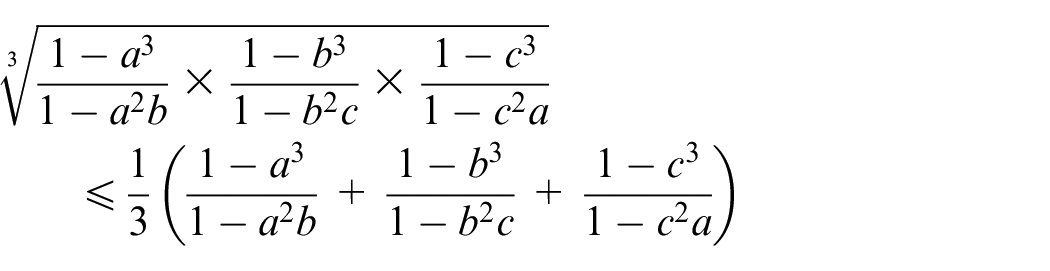
From the AM-GM inequality, it follows that
Consequently, if inequality (26)

can be proved, inequalities (25) and (24) will follow.
Proving inequality (26) is reduced to proving the equivalent inequality

which is equivalent to the inequality

To prove inequality (27), the techniques ‘introducing mutually exclusive cases’ and ‘proving an intermediate inequality’ will be applied.
Consider two mutually exclusive cases, related to the variables a, b and c: (i)
Let
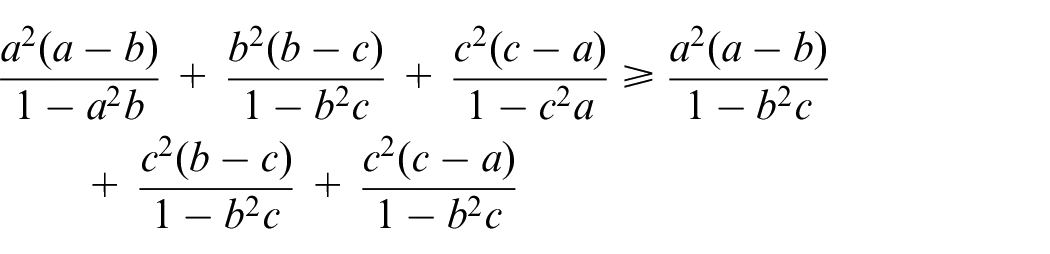
holds. Factoring
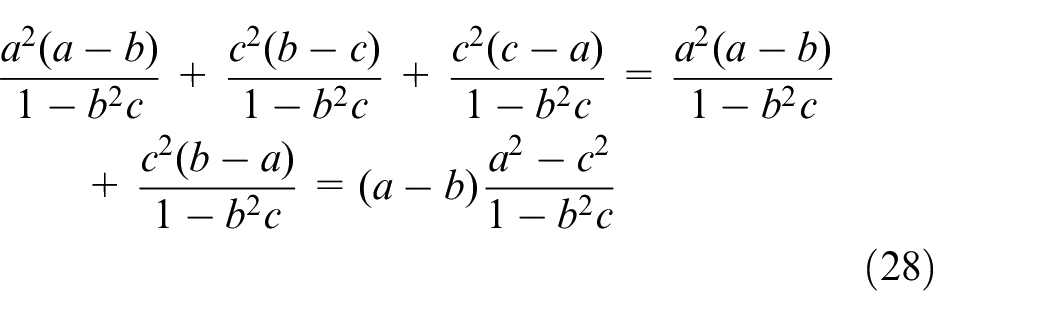
for the right-hand side.
Since
Now let
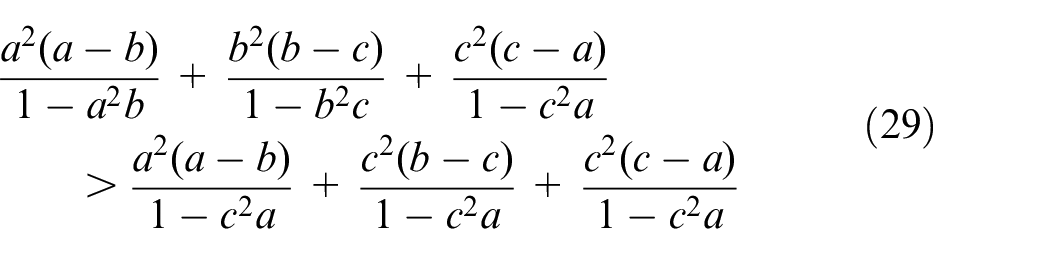
holds. Factoring
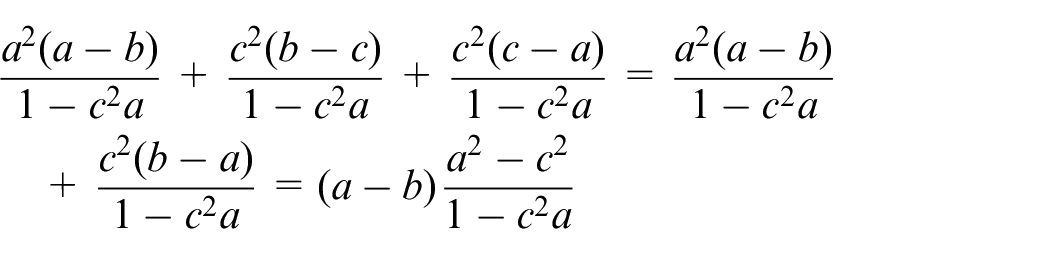
Since
Multiplying the left and right part of (24) by ‘-1’ reverses the direction of the inequality and adding ‘1’ to the left and right side of inequality (24) yields the inequality

An interpretation can now be given to the resultant inequality (30) which is equivalent to inequality (24).
Consider the system configurations in Figure 4 built on three different types components A, B and C. A system from Figure 4 is in working state if there is path through working components from any of the source nodes s1, s2, s3 to the end node CR. In other words, all three components from at least one parallel line must be in working state for the system to be in working state.
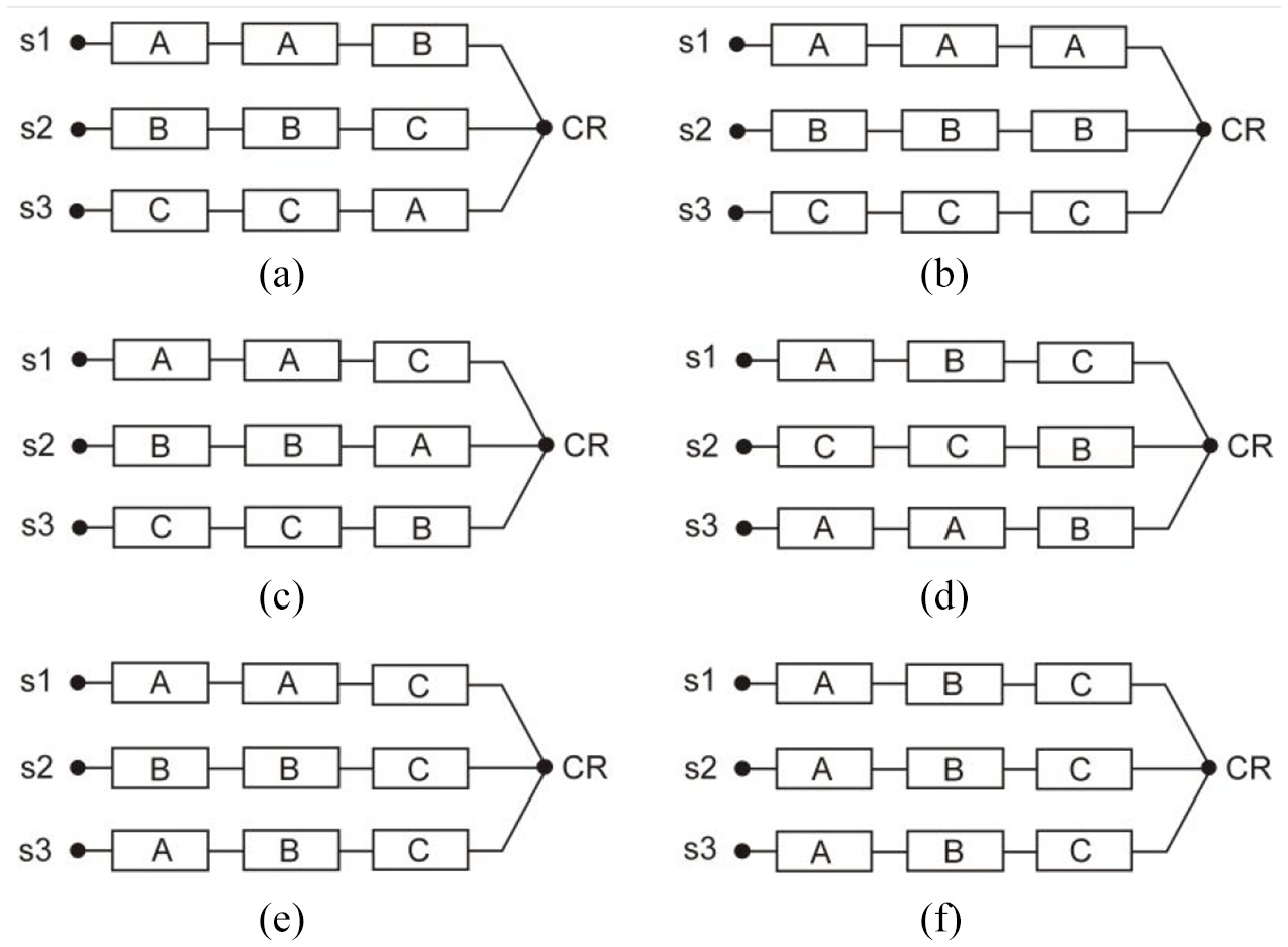
A parallelseries cooling system with different system configurations: (a), (b), (c), (d), (e) and (f).
Systems with parallel-series arrangements of the type in Figure 4 are very common. Lines cooling a reactor by working in parallel are examples of such systems. In a cooling line, the building sections are logically arranged in series (which means that a cooling line is working if all sections of the cooling line are in working state). The chemical reactor is adequately cooled if at least a single cooling line is in working state and delivers cooling fluid from any of the sources s1, s2 and s3 to the chemical reactor CR. As a result, with respect to cooling the reactor CR, the cooling lines are arranged in parallel.
Now suppose that each cooling line contains three sections, each of which can be of different type: type A, type B or type C. Let a, b and c in (30) stand for the reliabilities of components of types A, B and C in the system configurations from Figure 4. The left-hand side of inequality (30) now represents the reliability of the system configuration in Figure 4(a) while the right-hand side of inequality (30) represents the reliability of the system configuration in Figure 4(b).
Inequality (30) predicts that the reliability of the system configuration in Figure 4(b) is greater than the reliability of the system configuration in Figure 4(a).
The difference in the reliabilities of the two competing system configurations is significant and this can be seen after substituting specific values, for example,

is obtained for the reliability of the system configuration in Figure 4(b) while from the left-hand side of inequality (30), the value

is obtained for the reliability of the system configuration in Figure 4(a).
In a similar fashion, it can be shown that the inequalities




are also true.
The left-hand side of inequalities (31–34) is the reliability of the system configurations in Figure 4(c) to (f), correspondingly, while the right-hand side of inequalities (31–34) is the reliability of the system in Figure 4(b).
As a result, a general conclusion can be made that the parallel-series system configuration in Figure 4(b) is intrinsically more reliable than the system configurations in Figures 4(a), (c) to (f), composed of the same components.
For example, for a cooling system composed of three new sections A, three medium-age sections B and three old sections C, arranging all new sections A in the same cooling branch, all medium sections B in another cooling branch and all old sections C in a separate cooling branch (Figure 4(b)) maximises the reliability of the system.
Inequality (30) can be generalised easily for more than three types of components in a branch.
Increasing the probability of successful accomplishment of tasks by devices with unknown reliability
The approach based on meaningful interpretation of algebraic inequalities can also be applied to ranking alternative decisions. Consider the non-trivial abstract inequalities:


Both inequalities can be proved by invoking the Muirhead’s inequality. 4
The Muirhead’s inequality states that if the sequence

Consider two non-increasing sequences
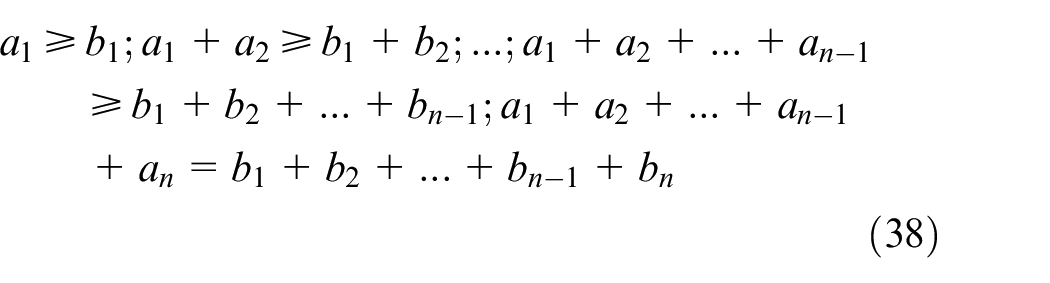
For any set of non-negative numbers

If

Consider now the sequences

where
Since the sequence
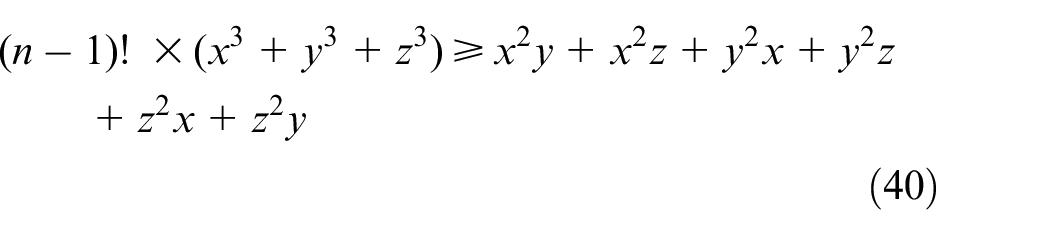
which, for n = 3 gives inequality (36).
If the left and the right hand side of inequality (35) are multiplied by

is obtained, which can be interpreted by using the total probability theorem for mutually exclusive events. The factors 1/3 on the left hand side of (41) can be interpreted as probabilities of selecting any of the three arrangements (Figure 5(a), arrangements 1, 2 and 3). Each arrangement includes three devices of types X, Y and Z assigned to a mission including three identical tasks. The probabilities x, y and z of successful accomplishment of a task by a device of type X, Y and Z, are unknown.
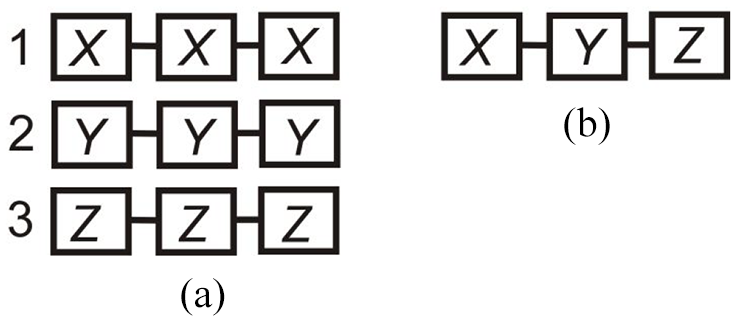
(a) Selecting an arrangement of three devices allocated to three identical tasks and (b) an arrangement that includes three devices of different type assigned to three identical tasks.
A mission is considered to have been accomplished successfully, if all three tasks assigned to the devices have been accomplished successfully.
According to the total probability theorem, the left-hand side of inequality (41) represents the total probability that a randomly selected arrangement consisting of three devices of the same type, allocated to three identical tasks (Figure 5(a)), will successfully accomplish a mission.
Indeed, a successful accomplishment of a mission by devices of the same type can occur in three different, mutually exclusive ways: (i) arrangement 1, including three devices of type X is randomly selected and all devices successfully accomplish their tasks, the probability of which is
The right-hand side of inequality (41) is the probability
If the left- and the right-hand side of inequality (36) are multiplied by
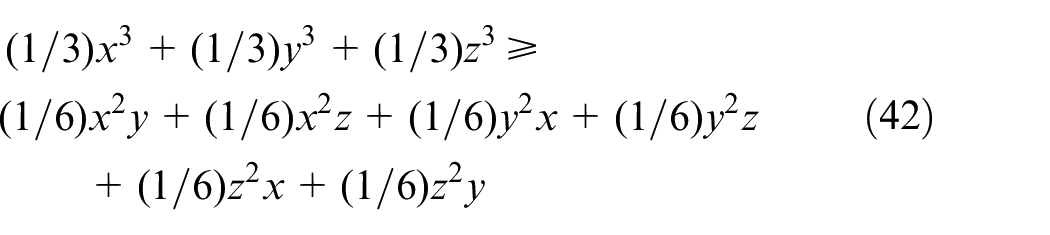
is obtained, which can be meaningfully interpreted again by using the total probability theorem for mutually exclusive events. According to the total probability theorem, the left-hand side of inequality (42) represents the total probability that a randomly selected arrangement consisting of three identical-type devices will successfully accomplish the mission (Figure 6(a)).
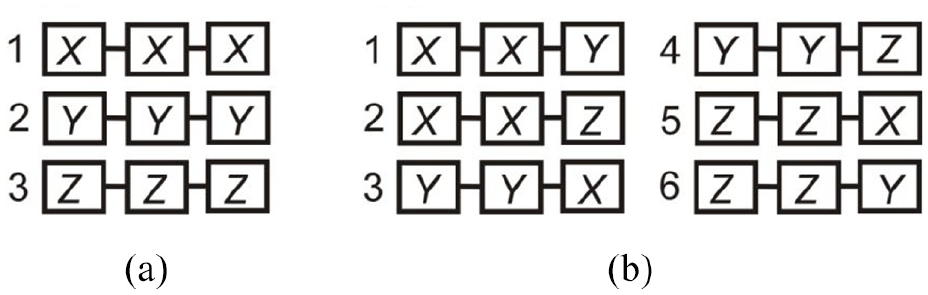
(a) Selecting an arrangement that includes three devices of the same type and (b) selecting an arrangement that includes three devices two of which are of the same type.
The right-hand side of inequality (42) represents the total probability that a randomly selected arrangement composed of three devices, two of which are of the same type, will successfully accomplish the mission. A successful accomplishment of a mission including three devices, two of which are of the same type, can occur in six distinct ways (Figure 6(b)): (i) the device arrangement (X, X and Y) is randomly selected, and all three tasks are successfully accomplished by the devices, the probability of which is
Despite that the probabilities x, y and z of successful accomplishment of a task by the devices of different types are unknown, according to the predictions of inequalities (41) and (42), the strategy of randomly selecting an arrangement composed of three devices of the same type is characterised by a higher chance of successful accomplishment of the mission compared to selecting an arrangement composed of three different types of devices or an arrangement composed of three devices two of which are of the same type.
This is a counter-intuitive result considering that the probabilities x, y and z of successful accomplishment of a task by the different types of devices are unknown. Why should a particular strategy provide an advantage, if the probabilities x, y and z are unknown? It seems that in such a situation of deep uncertainty, no particular strategy matters, yet this impression is wrong. Despite the existing deep uncertainty related to the probabilities of successful accomplishment of the tasks by the devices, selecting randomly an arrangement composed of the same type devices is always the best strategy. This conclusion holds irrespective of existing unknown interdependencies among the probabilities of successful accomplishment of the tasks from the devices.
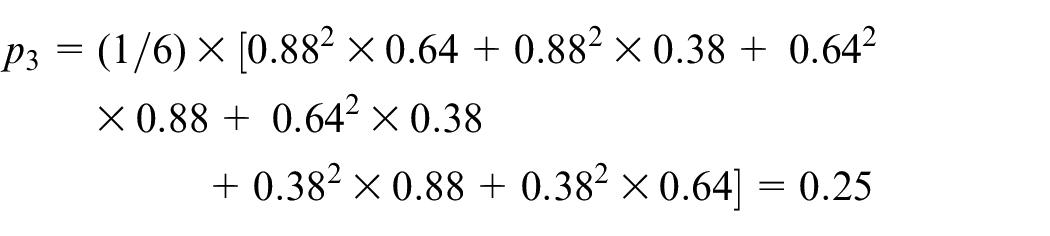
The significant advantage provided by the superior strategy can be illustrated by a numerical example. Suppose that the probabilities of accomplishing the tasks characterising the different device types X, Y and Z are

while the probability of accomplishing successfully the mission by three devices from different types is
According to inequality (42), the probability of accomplishing the mission by a randomly selected arrangement consisting of three devices two of which are of the same type is:
By using the Muirhead’s inequality for n > 3, these results are naturally generalised for
The predictions from the inequalities of this paper have been confirmed by Monte Carlo simulations, each of which involved 10 million trials. The method based on meaningful interpretation of algebraic inequalities is truly domain-independent; it works in any domain of human activity. The presented results have never been suggested in the literature which indicates that the lack of knowledge of the method of algebraic inequalities made these results invisible to domain experts.
Avoiding overestimation of the expected return from investments by a meaningful interpretation of the Chebyshev’s sum inequality
Algebraic inequalities can be interpreted to avoid an overestimation or underestimation of a particular factor. This application will be illustrated with the Chebyshev’s sum inequality.
Chebyshev’s sum inequality
Let

If the number sequences are oppositely ordered, for example, if

Chebyshev’s sum inequality possesses a great advantage. It provides the opportunity to segment an initial complex expression into simpler expression. Thus, the
The segmentation capability provided by the Chebyshev’s sum inequality will be illustrated with an example related to the risk of overestimating the expected potential return from risky investments by using average values.
Suppose that in inequality (44), the variables the variables
The right-hand side of inequality (44) can now be interpreted as an estimate of the expected profit per investment by using the average return from an investment
Inequality (44) predicts that estimating the expected return per investment, by using the average return and the average probability of return from an investment, leads to an overestimation of the expected return per investment.
The overestimation of the expected potential return from an investment can be significant and this will be illustrated by a very simple numerical example involving only two investments: an investment with potential return of

which is significantly smaller than the prediction of
Conclusions
Inequalities based on sub-additive multivariable functions can be interpreted meaningfully if their variables and separate terms represent additive quantities. The generated new knowledge can be used for optimising systems and processes in diverse areas of science and technology.
Meaningful interpretation of the Bergström inequality, which is based on a multivariate sub-additive function, can be used to increase the accumulated strain energy in components loaded in tension and bending. For components loaded with a single external force, the amount of stored elastic strain energy can be increased by segmenting the component and the external force and applying the smaller forces to the segmented components.
Existence of asymmetry is essential for increasing the system’s performance by using the Bergström inequality. Segmented components which experience the same displacement do not yield an increase of the amount of stored elastic strain energy. The requirement for asymmetry to achieve beneficial effects is counterintuitive and makes these results difficult to obtain by alternative methods bypassing the use of inequalities.
The meaningful interpretation of non-trivial algebraic inequalities yielded a highly counter-intuitive result related to assigning devices of different types to missions involving identical tasks. In the case where the probabilities of successful accomplishment of a task characterising the devices are unknown, the best strategy for successful accomplishment of a mission including several identical tasks consists of selecting randomly an arrangement including devices of the same type. This is always the best strategy irrespective of existing unknown interdependencies among the probabilities of successful accomplishment of the tasks, characterising the devices.
An interpretation of a non-trivial algebraic inequality has been used to construct the most reliable parallel-series system and reduce the risk of system failure.
An interpretation of the Chebyshev’s sum inequality can be used to avoid an overestimation of average potential returns from investments.
Footnotes
Declaration of conflicting interests
The author declared no potential conflicts of interest with respect to the research, authorship, and/or publication of this article.
Funding
The author received no financial support for the research, authorship, and/or publication of this article.
