




Abstract
More attention has recently been given to Human Factors in petroleum accident investigations. The Human Factors areas examined in this article are organizational, cognitive and physical ergonomics. A key question to be explored is as follows: To what degree are the petroleum industry and safety authorities in Norway focusing on these Human Factors areas from the design phase? To investigate this, we conducted an innovative exploratory study of the development of four control centres in Norwegian oil and gas industry in collaboration between users, management and Human Factors experts. We also performed a literature survey and discussion with the professional Human Factors network in Norway. We investigated the Human Factors focus, reasons for not considering Human Factors and consequences of missing Human Factors in safety management. The results revealed an immature focus and organization of Human Factors. Expertise on organizational ergonomics and cognitive ergonomics are missing from companies and safety authorities and are poorly prioritized during the development. The easy observable part of Human Factors (i.e. physical ergonomics) is often in focus. Poor focus on Human Factors in the design process creates demanding conditions for human operators and impact safety and resilience. There is lack of non-technical skills such as communication and decision-making. New technical equipment such as Closed Circuit Television is implemented without appropriate use of Human Factors standards. Human Factors expertise should be involved as early as possible in the responsible organizations. Verification and validation of Human Factors should be improved and performed from the start, by certified Human Factors experts in collaboration with the workforce. The authorities should check-back that the regulatory framework of Human Factors is communicated, understood and followed.
Keywords
Introduction
The development and use of new technology is like a ‘double-edged sword’; it has changed and increased production but also increased the complexity of systems and organizations. Complexity has increased risks for human beings (such as operators and system users), leading to new challenges of risk management. Risk management and safety have become a critical task for many industries, particularly for those that are technology-driven. In the oil and gas industry, safety boundaries are challenged by several factors, such as more challenging fields, need for increased efficiency, moving operations onshore, use of new technology and increased complexity in how to organize the work between onshore and offshore. 1
Since World War II (WW-II), Human Factors (HF) has developed as a multi-disciplinary science. Based on domain specializations, three major areas in the HF discipline are as follows: organizational ergonomics, cognitive ergonomics and physical ergonomics. 2 Organizational ergonomics refers to issues relevant to responsibilities, work process, operational philosophies and non-technical skills. Cognitive ergonomics refers to issues relevant to task analysis, human–machine interface (HMI), workload and alarm philosophies. Finally, physical ergonomics refers to issues relevant to workplace layout and working environment (WE).
There has been different awareness of the importance of using HF knowledge in design and operation to support resilience and safety. HF has been considered a key area in some industries when designing and improving safety critical equipment. HF has been assessed as a causal or contributing factor in many incident and accident surveys. The assessment and consideration of HF as a cause varies. It is suggested to be a cause in between 40% and 90% of accidents, depending on the industry,3–6 Although HF has been widely addressed in many fields (such as aviation, nuclear industry and railway industry), its application and implementation vary. The prioritization of HF has been particularly evident in aviation, where it has been an important part of design and accident evaluation since WW-II. It should be noted that the aviation industry has achieved an impressive reduction of accidents, and that in 2012 there were no catastrophic accidents such as hull losses, among the members of The International Air Transport Association (IATA). The use of HF in the oil and gas industry is explored in this article, with specific focus on the Norwegian sector. The application of HF has sometimes been explored late (or cursory) in the design processes in the oil and gas industry. The papers by Sætren and colleagues7,8 documented an insufficient focus on HF in the design phase of new automated technology in drilling, creating the need for substantial rework in later phases.
Recent accidents and investigation reports have created more focus on HF in the oil and gas sector. One example is the Deepwater Horizon (DH) drill, involved in the Macondo blowout. The disaster took place in 2010, killed 11 workers, released 4.9 million barrels of oil and generated expenditures of more than US$61.6 billion (Washington Post 15 June 2016). In the latest accident report,
9
HF was highlighted, that is, ‘Industry’s focus must shift from correcting individual “errors” identified post-incident to a systematic approach for managing human factors’. Furthermore, the report highlights that
the lack of effective integration of human factors into the design, planning, and execution of drilling and completions activities … and it illustrates a demonstrable gap in US offshore regulation and guidance to incorporate more robust management of human factors.
Some specific areas mentioned were the importance of HF engineering in design and use of safety critical systems, the need for focus on non-technical skills (such as communication, teamwork and decision-making between different actors) and assessment of safety critical tasks and identification of controls that could maximize the likelihood of successful human performance. A better HF-based design giving advanced warning of a blowout in combination with HF-based training concepts (such as training for ‘non-technical’ skills, CRM) may have mitigated the accident. HF design activity includes the design of HMI and is a part of cognitive ergonomics. The International Association of Oil & Gas Producers (IOGP) has identified ‘more attention paid to HF’ as one of four prioritized areas after the DH disaster. 10 Furthermore, IOGP has suggested more focus on ‘non-technical’ training such as Crew Resource Management (CRM) training. 11 CRM has been conceptualized to cover areas like communication, situational awareness, teamwork, decision-making, leadership and personal limitations (stress). These areas are based on a sixth generation CRM concept from aviation, identifying and preventing threats to safety at the earliest time.
The HF discipline has been introduced into the petroleum industry in Norway through regulation and practice. HF is addressed in health, safety and environment (HSE) regulations from the Norwegian Petroleum Safety Authority (PSA), such as the Facility Regulations, 12 for example, §20 concerning ergonomic design and §21 concerning HMI. The oil and gas industry is trying to use internationally recognized standards such as ISO11064 13 and standards ensuring appropriate alarm design such as EEMUA-191. 14 These two standards are referenced as good practice in this article.
However, when looking at the actual implementation of HF, there seems to be imprecise definitions of HF, poor focus initially in projects and poor structure of the HF work. Incident investigations have revealed that cognitive and organizational ergonomics seldom are mentioned or explored sufficiently.15,16 Several cognitive and organizational problems in the driller’s workplace were identified by PSA15,17 indicating insufficient focus on HF both in design and in operations. In recent years, safety barriers have been addressed and prioritized as an important topic by PSA. In Skogdalen and Vinnem, 18 it was pointed out that risk analysis seldom includes human and organizational factors, and it is suggested that the regulator should perform more safety audits to speed up the development.
In the oil and gas sector, few studies have been conducted to explore HF in the development phase. To improve the knowledge of HF in the design phase of projects, we have performed a study to explore the current status of HF (organizational ergonomics, cognitive ergonomics and physical ergonomics), the challenges to HF use and consequences related to safety and resilience of missing HF.
Methodology and approach
HF impacts many areas of oil and gas production, from how technical equipment is designed and operated (such as how oil valves are designed and operated by humans) to the design and operations of complex control systems (such as control centres).
HF in control centres and control cabins is typically a focal point of operation and safety between the production process and the human operator. Therefore, HF work in control centres and drillers’ control cabins is selected as a focus in this study. The exploration study consists of the following five areas, detailed in subsequent sections:
Review of research strategies (i.e. framework conditions) in the petroleum field;
A participatory review of HF in design of four control centres, evaluating the focus on physical, cognitive and organizational ergonomics. In addition, a check of non-technical skills training such as CRM in 10 projects;
A review of HF status in drilling based on relevant and recent incident reports as published by the authorities;
A discussion of the findings in a network of HF experts;
An analysis of impediments to use of HF and the safety consequences of missing HF focus.
The assumed relationships between these factors is based on the socio-technical model of safety management as described in Rasmussen, 19 assuming that research focus/framework conditions impacts requirements/design that again impacts engineering/operations and safety.
Review of research strategies
The establishment of framework conditions such as competence building, knowledge, innovation and research is sometimes financed and supported by strategic research grants from the research council. Research grants are an important strategic vehicle to prioritize key issues. To check the level of strategic support of HF from the Research Council in Norway, we explored the level of HF-based projects/activities in the oil and gas programme PETROMAKS. This programme has been established to support research and development in the oil and gas area. We search for the key term HF (Human Factors) in all the PETROMAKS projects in the time period 2001–2012 found in the status report from the research council. 20 Data were only available for the period 2001–2012. In addition, we checked through the network of HF experts whether there were any relevant HF-based research projects that were initiated or had HF involvement.
Participatory review of HF in design of four control centres
Participatory action research (PAR) 21 is a participatory form of qualitative action research, which combines participation and action with research to create a joint learning process between researchers and the various stakeholders holding interests in the problem under study. Involvement of the stakeholders is supporting joint learning and joint prioritization of the findings. In this study, a participatory review of HF in the design of four control centres was carried out, that is, control centres under design and development. Workshops with experts from management, safety, work environment (WE), automation, telecom, HF, control room users, operations and designers were carried out. The number of participants varied from 6 to 26. The workshops lasted for 2–4 days, with intensive reviews and discussions of HF issues. The blunt end, the early phases, was the focus of the study. Organizational, cognitive and physical ergonomics were in focus during the review process. We adapted the suggested questions as described in the CRIOP method. 22 All the findings were documented and described together with the stakeholders, to ensure common understanding. The findings were prioritized ‘bottom-up’, together with the participants, based on individual assessments (weighting of findings) and a summing up of all assessments. This common prioritization was done to ensure that there was common agreement from the workforce and management on the importance of implementing the mitigating actions.
Review of HF status in drilling
A focused literature review on HF status in drilling operations (with special focus on control centres/drilling cabin) was conducted, based on searches in Science Direct and Google Scholar using the terms ‘Human Factors’; ‘Safety’, ‘Design’ and ‘Drilling’. Accident/incident reports from the authorities and IOGP that discussed HF issues in the drilling environment were searched and reviewed. The HF-based reviews from PSA were of special interest. Major accidents discussing HF, such as the DH accident, were examined. In addition, we explored the BP Texas refinery explosion 23 since the operations and complexity of the control rooms in offshore operations can be compared to process operations in the onshore oil and gas industry.
Professional discussion within Norwegian HF network
The Norwegian HF network (at www.hfc.sintef.no) is a professional forum consisting of around 500 stakeholders with expertise in HF. The network consists of researchers, teachers, regulators and consultants from different industries, many from the oil and gas industry and shipping.
The participants were asked to give input to key HF issues and HF methodology in the oil and gas industry, through an invitation. The criteria to give input were knowledge and participation in actual HF design activities or participation in verification/validation of HF in drilling cabins or general control centres. A total of 17 participants from key operators and suppliers within oil and gas participated and provided comments. In addition, interviews were conducted with five HF experts in order to get an impression of how HF has been prioritized in other relevant projects and activities, more specific large projects that involved HF design and expertise.
Analysis of impediments to the use of HF and the safety consequences
The impediments to use HF are defined as the factors or constraints in the framework conditions or design process affecting the actual use of HF. The impediments are based on the socio-technical model of safety management as described in Rasmussen, 19 where we are trying to identify main impediments for the use of HF in:
Research/framework conditions;
Requirements in design (from vendors and operator);
Engineering and operations.
The impediments are findings from the participatory review processes, based on a structuring of the mitigating factors agreed on, through the review process. To help identify and prioritize the relevant impediments, they are based on discussions in the network of HF experts.
Safety consequences of poor HF are discussed at two levels – the blunt end (i.e. planning and design) and the sharp end (i.e. handling of the event and reduction of consequences).
The blunt end creates the framework for awareness and behaviour. Possible errors can be classified as active errors (in the sharp end) and latent errors (from the blunt end). Active errors are related to the performance of operators of a complex system (e.g. control room operator and driller), for which the effects are felt almost immediately. Latent errors are related to designers, high-level decision makers and managers, where the adverse consequences may lie dormant within the system for a long time and only becoming evident when combining with other factors to breach the system’s defences. 24 The Texas City Refinery explosion 23 documented several latent HF issues such as poor/inadequate instrumentation, poor human–computer interface design of the unit control board in addition to workload/staffing, distraction and fatigue. Such latent HF issues can be fatal – a result of the Texas City Refinery explosion was 15 deaths and 180 injuries.
The sharp end is focused on human behaviour such as unsafe acts and situational awareness. When looking at unsafe acts, human behaviour is divided into unintended action and intended action. Looking at error types, they can be classified into three basic error types: 25 skill-based (SB) slips and lapse, rule-based (RB) mistakes and knowledge-based (KB) mistakes.
Results
Review of research strategies
In the operating period of PETROMAKS, from 2001 through 2012, 447 research projects were awarded grants, Research Council. 20 However only four minor projects, approximately 1%, were related to HF research. This is a small percentage of projects, since most accident mention HF as causes and since HF can be considered as the bridge between technology and the human element. The perception is that the PETROMAKS programme founded by The Research Council in Norway has not sufficiently focused on HF in the oil and gas industry. This impacts perception of the importance of HF and knowledge of HF.
Participatory review of HF in design of four control centres
We have reviewed the HF status in four projects of control room design (e.g. workplace design and HMI). The review was based on control centres involving use of new technology such as remote operations and remote support,1,26,27 The oil and gas industry in Norway has focused on remote collaboration and remote operations. Examples are through implementation of not normally manned (NNM) operations. Due to NNM and need for more collaboration and sharing, the use of Closed Circuit Television (CCTV) systems has increased, and we have checked the HF design of CCTV.
In addition, we performed an expanded survey of the need for non-technical training (i.e. CRM), including six more projects, getting a response from a total of 10 projects. All the projects involved extensive collaboration between onshore and offshore. The 10 projects used the development standard ISO 11064 13 and the CRIOP method. 22 In six of the 10 projects, the participants prioritized the need for CRM training in new control centres. However, CRM training has not been examined, prioritized, adapted or implemented in any of the projects from management. The common issues found are listed in Table 1.
HF problems identified in control room design.
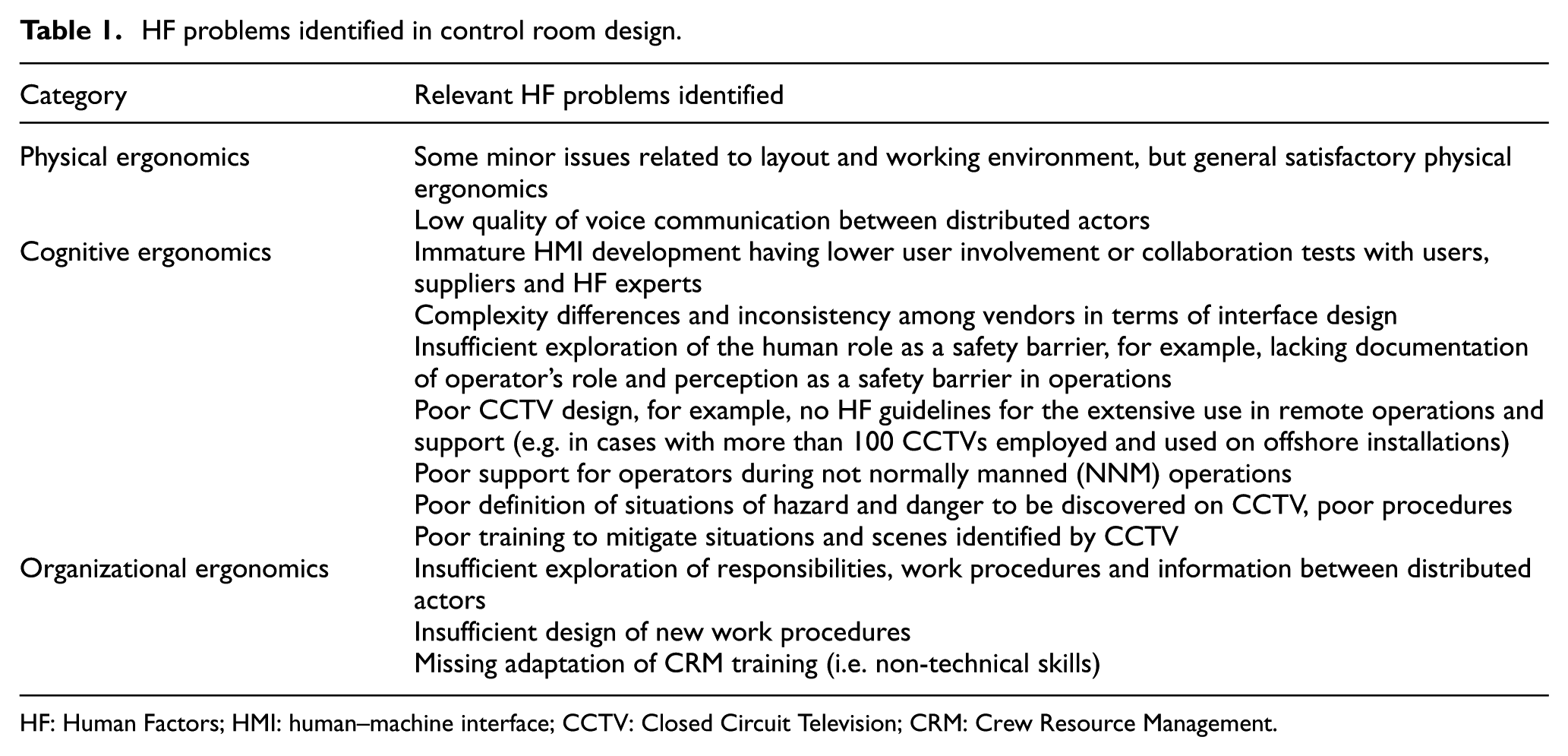
HF: Human Factors; HMI: human–machine interface; CCTV: Closed Circuit Television; CRM: Crew Resource Management.
The findings revealed significant weaknesses and latent problems. HF knowledge and awareness vary in the project teams and the operating organizations. Of the four operators involved, only one petroleum operator company had a broad set of HF experts integrated in their organization, while the other operator companies had outsourced most HF activities. Outsourcing removes critical safety knowledge from the organization. During the discussion about cognitive and organizational ergonomics, it was found that the operator companies had little expertise and lack of relevant knowledge. An external HF consultant with expertise on physical ergonomics was initially given as reference to cover cognitive and organizational ergonomics at one operator – but he made it clear that he had no competence in the area. The result was that cognitive and organizational ergonomics were not satisfactory addressed in that specific project.
In general, our finding was that cognitive and organizational ergonomics are not satisfactorily addressed during design. Knowledge and maturity of these areas are missing.
Review of HF in drilling
The review of drilling has been focused on the drillers’ cabin and control rooms controlling drilling activities. We found some articles related to the assessment of safety and HF such as PSA’s survey on drillers’ work situation in Norway 17 and general incident and accident analyses. Recent analyses of large-scale disasters such as the DH accident 9 have been explored. The articles focused on the sharp end, exploring stress, fatigue and other specific issues in the WE and not so much discussion of the blunt end (i.e. design creating the conditions). In a more general analysis, 28 it was documented a need for improved HF analyses of incidents and accidents in the oil and gas industry, and a taxonomy for reporting was suggested. The database MARS 28 was mentioned since it is collecting information on worldwide major industrial accidents, listing the underlying causes of accidents as Managerial, organizational omissions (insufficient procedures, relating to design inadequacies, insufficient operator training and lack of a safety culture), Design inadequacies and Shortcuts. These issues related to design inadequacies and insufficient operator training can still be found as significant causes in accident investigations 20 years later, such as the DH and BP Texas disaster.
Several papers discuss the sharp end, exploring stress, fatigue and situational awareness. Situational awareness was measured, 29 and it was found that lower work situational awareness was related to increased participation in unsafe behaviour. Issues impacting situational awareness from the blunt end are design of alarms, workload analysis, HMIs, design of procedures and organizational issues.
We compared the HF assessment of drillers’ workplace (from the PSA survey 17 ) with the findings from the DH disaster. 9 This was done in order to identify similar design inadequacies and missing HF in design of safety critical systems. We examined organizational and cognitive ergonomics in information contents of procedures, situational awareness and support of deviations through alarms, as summarized in Table 2.
HF problems in drilling area identified in PSA’s survey. 17
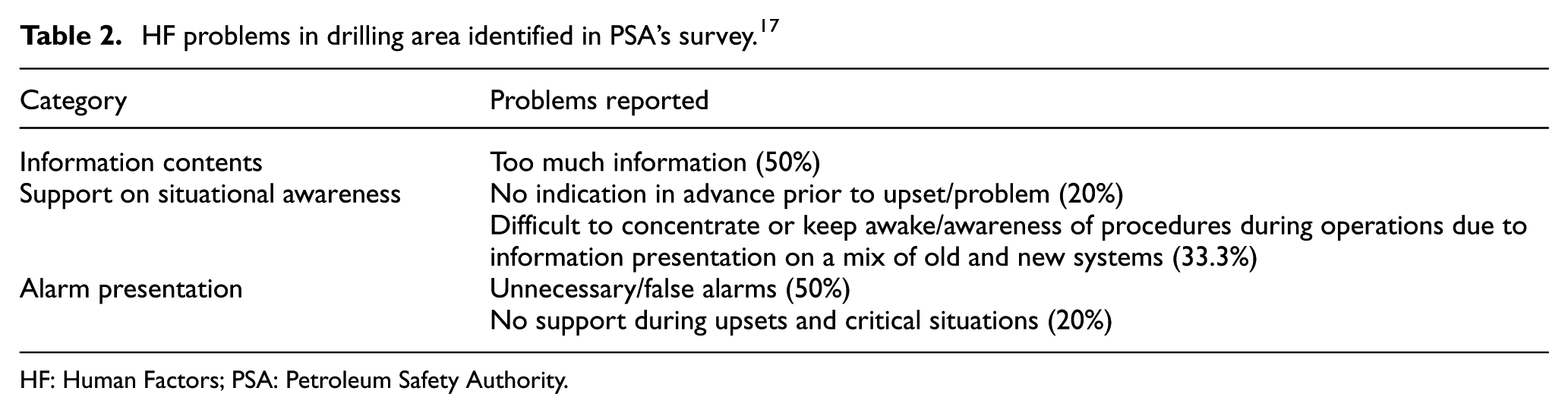
HF: Human Factors; PSA: Petroleum Safety Authority.
In addition, the discussion of well control incidents 15 revealed that there was a need to improve systems for presenting safety critical information, as well as to improve alarm presentation and physical ergonomics (e.g. improved layout of driller’s cabin). In a discussion about an incident related to stability, 16 the following was pointed out: ‘Several HMI shortcomings have been identified, especially with regards to legibility and to the way information of low operational value is emphasized on the safety system’s HMIs’. The poor design of HMI interface in combination with poor training can make an incident more serious.
The reports and cases indicate that there are significant challenges to perform design using HF expertise in general and specific areas of cognitive and organizational ergonomics. The reviews support the accident report from DH 9 and the view from IOGP, 10 that is, increased safety in drilling must be based on more attention to HF in design and operations. It is a clear finding that HF should be in focus in the early phases of design of drilling equipment, and that more HF knowledge is needed in general.
Professional discussion within Norwegian HF network
The discussion within the HF network indicated a poor focus on cognitive and organizational ergonomics in general. HF is sometimes ignored in the early phases from the management level to engineering level, with poor focus on the importance of cognitive and organizational ergonomics. It was mentioned that in a review of Plan for Development and Operations of New Oil and Gas fields (PUD), only physical ergonomics was in focus. There is also room for improvement in HMIs and HF outside the control rooms. As an example, touch screen HMIs outside control rooms include alarm lists that do not distinguish between the various alarm states (i.e. whether an alarm is active unacknowledged, active acknowledged or return-to-normal unacknowledged).
It was pointed out that the HMI design and information presentation in control rooms and drilling systems do not comply with consistency principle across different systems. Inconsistency across different systems is often identified late in the design phase, typically after the systems have been selected. It is quite common to see that the driller must use systems from various vendors with different user interfaces. For instance, a finding from the HF network discussion was that the same kind of graphs goes from top to bottom in one system and from left to right in another system. Such consistency design principle should have been addressed when the requirements for the systems were established, by specifying the need for common HMI design prior to the design phase. Other design defects and weaknesses were also found in the drilling systems, examples being inadequate design of displays, control panels, alarm and data systems.
HF knowledge is usually outsourced, and necessary key knowledge is not integrated in the responsible organizations. To ensure the right competence, there are several HF certification schemes internationally, such as Centre for Registration of European Ergonomists (CREE) and Board of Certification in Professional Ergonomics, which can be considered for qualification of conducting HF work. There is at least one certified HF expert in Norway (as of 2015), but it is difficult to find professionals having HF certification. Certification of HF experts and formalized training and education (on university level) should be established in Norway.
Analysis of impediments to use of HF and the safety consequences
In the following, we have discussed impediments related to research/framework conditions, requirements in design and in engineering and operations.
Impediments in research and framework
The framework conditions are important since they are setting the stage for activities. HF is sometimes ignored in the strategic early phases of projects, establishing the foundations for activities. This missing focus on HF is mainly seen as due to poor knowledge leading to missing prioritization. This weakness in the strategic end is evident in the research priorities in the PETROMAKS programme. The HF perspective is often missing in PUD, later requirements and formal audits. HF is formulated in local Norwegian standards (such as NORSOK S-002) as a WE condition. Related to the structure and position of HF in projects, the HF discipline is put as a subsidiary section under HSE in many engineering projects supporting a focus on physical ergonomics. Key elements from HF may be missing in requirements and specifications. The missing focus on cognitive and organizational ergonomics (the prerequisite to physical ergonomics) may create weaknesses and holes in defences/barriers as described by Reason30,31 creating brittle defences and thus reducing safety and resilience. These issues have not been properly addressed in new versions of the NORSOK standard planned to be published in 2017. The improvement work of NORSOK S-002 does not follow the guidelines for the development of NORSOK standards, NORSOK A-001N, such as a broad co-opting process with agreement on key issues and development/improvement based on agreement among the HF experts involved.
Neglecting the importance of HF in research, in regulation and audits gives negative influences on vendor’s/manufacturer’s prioritization and impacts the organizational culture. This missing focus might lead to deficiencies in rules, audits, understanding of accidents, design and in safety management.
Impediments related to missing HF requirements
During the participatory review of HF, poor knowledge and awareness of HF were identified as a key impediment during engineering. In one project, the supplier had not involved HF experts in the design of their systems, due to missing HF expertise. The preliminary version of the system did not address remote issues in a satisfactory manner, not addressing the need for common situational awareness between distributed teams. However, since this was identified through the PAR in early design, it was possible to involve HF experts and users in the design of the system. When HF competent users are not involved in the design process, the system may contain significant deficiencies, as documented in Sætren. 8 The deficiencies of the alarm system design in the drillers’ cabins are typical issues from the product design process. The requirements should specify how the different users can react in an appropriate manner to the alarms, constrained by human limitations (i.e. HF design principles).
Poor knowledge and understanding of HF from vendor include poor design process both from the organization specifying the system and from the supplier building the system. A poorly designed system lacking HF qualities (such as poor HMI design) is a potential design defect in vendors’ products, which will influence the interaction quality.
Impediments related to missing understanding of HF in engineering and operations
We have observed that CCTV is designed without relevant HF standards and HF prioritization, and that CRM (non-technical skills) are not assessed in engineering and operations. Poor knowledge and understanding of HF in engineering process appears as bias, prejudice in the organizational culture or missing understanding of HF work (in terms of contents, coverage and significance of HF work). Symptoms that we often see are insufficient attention to cognitive and organizational ergonomics in the HF work, overlooking the importance of HF in terms of need for human resource and management attention. Results of this are poor HF design (creating possibilities for errors or poor situational awareness). Improvement of knowledge and understanding of HF in the engineering process will increase the quality of HF work in the engineering process and improve safety and resilience in operations.
We have structured the safety consequences from the prior reviews according to the blunt and the sharp end. The possible error-types that are identified have been summarized and sorted in Table 3. The main issue is to point out that poor design in the blunt end may lead to SB, RB and KB errors. These are important issues to be aware of during accident reporting.
Errors identified and the link to safety consequence levels.
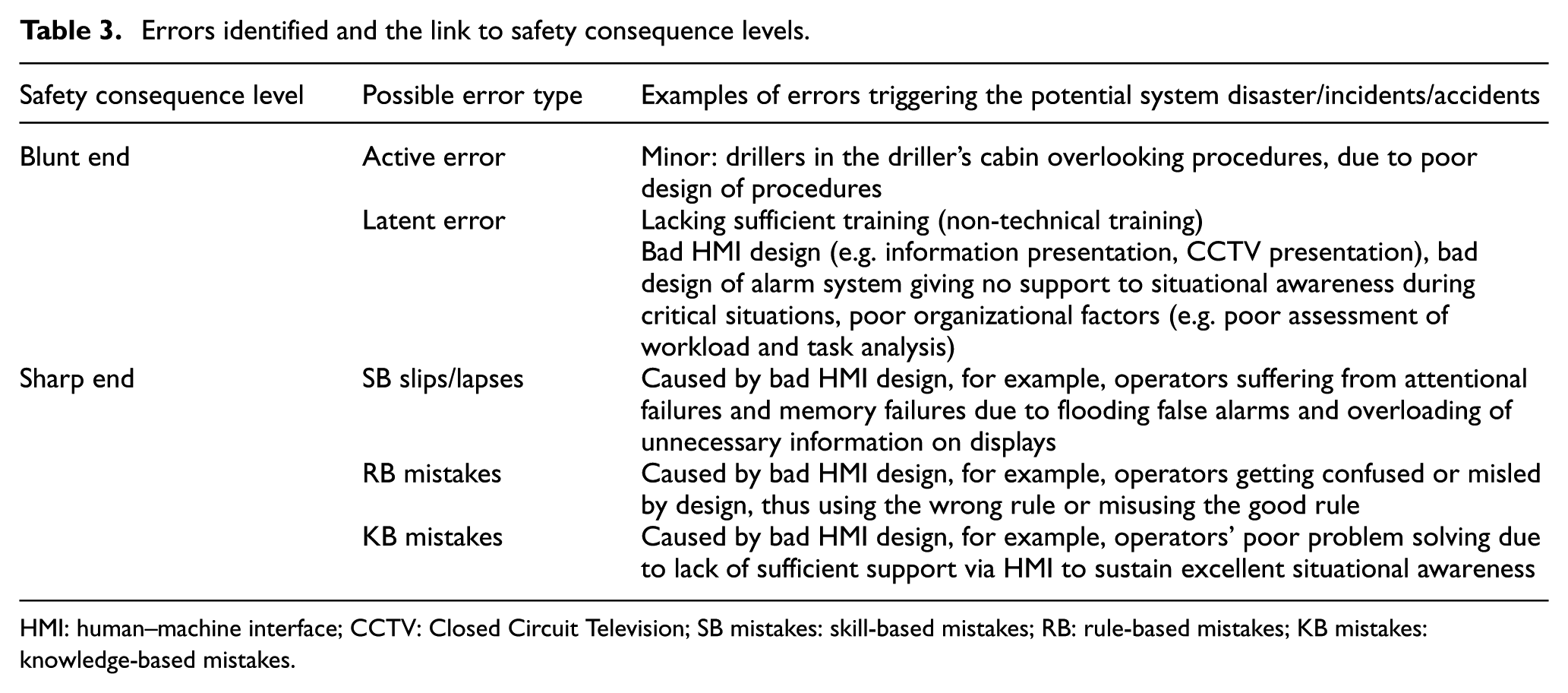
HMI: human–machine interface; CCTV: Closed Circuit Television; SB mistakes: skill-based mistakes; RB: rule-based mistakes; KB mistakes: knowledge-based mistakes.
Key issues impacting safety emerges from the blunt end as latent errors establishing the possibilities to blame the operator in the sharp end when an incident happens. Key issues that have been identified are poor strategic prioritization of HF, poor requirement of HF and poor focus on HF in engineering and operations.
Discussion
There is a complex relationship between societal and organizational conditions and later events, thus it is difficult to list all the causes for the missing HF focus. Based on the prior results, the following section will discuss how to improve safety and resilience through strategic prioritization of HF, improved requirement of HF and how to focus on HF in engineering and operations.
Integrating HF in strategies and framework conditions
In Norway, technology innovation has often been seen as the key enabler for production increase and increased safety, giving more attention to the technology aspect than HF aspects such as ease of use, organizational and cognitive issues. Our impression is that research on HF has been marginalized. Missing governmental research investment, poor awareness/knowledge and poor prioritization from management are all reasons for the current unfavourable status.
It seems there are more understanding of HF in the aviation industry and automotive industry where there is a need for HF experts to explore the critical interplay between humans and technology. United Kingdom and Sweden have an aviation industry and automotive industry. HF research and education is more in focus in the United Kingdom and Sweden. In Norway, we have earlier not had the same industrial conditions making it necessary to focus on HF. Thus, many HF professionals (in academia and industry) have been recruited from the United Kingdom and Sweden. This indicates a missing focus on HF in education and research, which are a challenge in the age of remote operations, with computer-based systems and automation – increasing the need for human intervention and situational awareness when needed. The poor research funding related to HF in the oil and gas industry implies that more efforts and work should be made to create an understanding and awareness concerning the importance of HF engineering in the concept and design teams. HF research should be prioritized and should be more than 1% of research grants.
Physical ergonomics (i.e. WE) has been seen as a major part of HF and HSE in the Norwegian oil and gas sector, which is positive. However, this has led to less attention to organizational and cognitive ergonomics. Organizational and cognitive ergonomics establish the framework and requirements for WE and physical ergonomics. HF experts on organizational and cognitive ergonomics should be a part of the project-team in large activities and in oil and gas organizations. The organizations should employ HF experts with this background in their own organizations, in order to create a stronger focus, knowledge and ownership.
The unique Norwegian perception of HF as a subordinate part of WE has created challenges in design and operations and during establishment of HF standards such as NORSOK S-002. 32 It is an important HSE standard for offshore installations. However, only two small sections (Sec. 4.4.5 and Sec. 5.2.2) are addressed for HF relevant use. The consequence of this is to lay undue emphasis on WE issues and discipline, and neglect the importance of the whole HF discipline that consists of physical ergonomics (i.e. WE), organizational and cognitive ergonomics. These misconceptions may create misunderstanding of the scope of the HF discipline, i.e. that HF is existing as a subordinate of WE discipline and having poor autonomy or precedence related to WE. Since organizational and cognitive HF must create the requirements and framework for WE (physical ergonomics), this perception creates difficulties for HF to play an efficient role in the engineering process. WE must be seen as a consequence of requirements from the design of organizational and cognitive ergonomics. These issues have not been properly addressed in new versions of the NORSOK standard to be published in 2017. The improvement work of NORSOK S-002 does not follow the guidelines for the development of NORSOK standards, NORSOK A-001N, such as a broad co-opting process with agreement on key issues.
Improved requirement of HF
In most projects within the oil and gas sector, it is common that technical systems (e.g. control systems and consoles) are outsourced to third-party vendors for design and production. The poor requirements will emerge in cases where the vendors have insufficient HF/HMI knowledge/skill in their product design process and the customers have poor HF requirements. These potential design defects will create challenges in the project engineering process. They should be identified via HF verification and validation as early as possible. Corrections might not be easy to implement due to economics, contracts or project time schedule. However, the right HF focus in the preliminary phases and involvement of HF professionals as early as possible should mitigate this. A simple set of HF guidelines and standards should be used to ensure early HF focus, supported through design and implementation.
Missing knowledge of HF might exert a subtle influence on management’s thinking, in all aspects and must not be ignored. To control or prevent missing knowledge, the only way is to strengthen framework conditions, training, regulations, inspections from safety authorities, public dissemination and information via media and education. The HF perspective must be explored in accident investigations and in successful recoveries – such as it has been done in the latest DH report, 9 a perspective that has been missing in Norway. The authorities should check-back that the regulatory framework of HF (especially of organizational and cognitive issues) is communicated, understood and followed. Missing HF requirements from user can be reduced or even avoided given that management and organization have good understanding of HF. They must give sufficient attention to HF work, as well as provide good support from the organization.
Integrating HF in engineering process and operations
Integrating HF in the project engineering process has been mentioned in the Facility Regulations §20, §21 12 and in the NORSOK S-002 standard. 32 However, there is poor focus on organizational issues, such as poor documentation of organizational responsibility, poor focus on team collaboration and poor focus on non-technical skills (CRM). Knowledge and awareness of HF seem poor in the responsible organizations. HF is often conceptualized as physical ergonomics (layout and WE); thus, the necessary steps are not taken to perform cognitive analysis and organizational analysis. Lacking HF theories and knowledge might lead to various problems and poor outcomes, such as poor definition of organizational philosophies and responsibilities, poor task analysis and poor assessment of workload assessment (low and high load).
CCTV has recently been implemented on a larger scale in the oil and gas sector. However, HF guidelines are seldom referenced or used in the implementations due to a lack of common agreement on CCTV standards. We have also observed poor or missing HF design as a result of poor task analysis and poor agreement of the criticality of CCTV. User training has been missing and operators do not know what to do when the CCTV shows an area that must be investigated. The criticality assessment affects the maintenance philosophy of the CCTV. If the actual use and criticality are not taken care of through regular maintenance, the reliability of the CCTV system can be poorer than needed.
Poor design of alarms and HMI in the drilling area lead to missing advance alarms, spurious alarms or false alarms, which gives poor support to the situational awareness of the drillers. Drillers received insufficient training and were not always aware of work procedures. This can impact margins and safety during operations, especially during unanticipated incidents.
Insufficient knowledge and misconception of HF engineering may lead to poor HMI design and biased engineering outcomes. Poor HMI design of control systems or products, for example, design defects on presentation of safety-critical information, and bad implementation of consistency principle in HMI design, does not support the operator’s situational awareness during critical situations. It may even confuse or mislead operators in making appropriate judgement and decision. In some instances, new projects have not been aware of a simple set of HF guidelines, thus it seems important to focus on standards such as ISO 11064, 13 HF guidelines for the use of CCTV and guidelines for team training on non-technical skills such as CRM. Critical scenarios, based on the role of humans, should be explored prior to the design phases in order to ensure that sufficient safety barriers are established to support HF design. The role of humans as a safety barrier is often poorly explored in design and operations.
An inexpensive way to ensure adherence to HF is to perform validation and verification of HF in the early phases of all projects, from PUD (Plan for development and operation of a petroleum deposit) through conceptual design and FEED phase (Front End Engineering Design) preferably by performing external validation and verification from certified HF experts.
Reliability and credibility
By reliability in this article, we mean the extent to which another researcher would find the same answer and describes the repeatability of the research that has been performed. The article is based on review of open material; thus, other researchers would find the same basic information. We have also performed systematic data gathering in the industry and performed discussions with a broad set of experts; thus, the results are based on multiple sources. We have used the open method CRIOP, 22 to select questions and gather data, to ensure that a common method has been used. The findings and results are similar to findings in the latest accident report 9 from U.S. Chemical Safety Board (CSB). We have used PAR in order to reflect the view of a broad set of the relevant industry actors. The data collection and assessments have been done in open workshops where the stakeholders (safety experts, HF experts, users and management) have been involved in describing issues, accepted the identified issues and participated in the prioritization of issues and mitigating actions.
Credibility demonstrates the match between the constructed realities of stakeholders and the reconstructions as being attributed to the stakeholders. Key techniques to verify credibility from Guba and Lincoln, 33 Chapter 8, are as follows: Member checks (as the most important technique testing hypothesis and interpretations with the stakeholders), prolonged engagement, progressive subjectivity, persistent observations, peer debriefing with a disinterested peer and negative case analysis. Member checks are based on involvement of the key stakeholders in reflections and interpretations. The findings and actions have been formulated and discussed in an open and participative manner with the key stakeholders. Suggested mitigating actions have been prioritized together with the involved stakeholders in an open and participatory manner, based on individual input from each participant. Prolonged engagement is to participate together with the stakeholders in a sufficient period of time (in this case more than 10 years) to be able to understand the research issues, the culture and industry setting in depth. We have engaged and discussed the important issues with key stakeholders in different settings. We have observed that suggested mitigating actions have been implemented. Thus, the work has been based on prolonged engagement. Progressive subjectivity has been done to identify the developing understanding. An important initial activity has been to discuss and document possible findings prior to a workshop and presenting the results in open discussions and discuss the final suggested findings. This is done to ensure that the conclusions are based on member checks and to check that preconceived ideas are not influencing the results too much and to be able to reflect on developments of suggested findings. The work has also been based on persistent observations, focusing on important issues in a substantial period of time with many different stakeholders. Peer debriefing with a disinterested peer has been done after the conclusions together with the expert network and as a natural part of presenting results and suggestions during research in conferences. Negative case analysis is the process of testing the results against new data in a continuous manner; this has been done through exploration and finding of new incidents/accident analysis, such as new discussion from DH accident – that has supported our results.
Conclusion
Although HF (as physical ergonomics) has been accepted as a discipline in Norwegian offshore oil and gas industry, the importance of HF work has not been sufficiently prioritized in practice from safety authorities, management and engineering. Cognitive and organizational ergonomics must be more in focus. HF activities and recommendations are not as good as it should be in the design in many projects. Poor framework conditions, poor HF focus in the vendors’ product design process and during the project engineering process, hinder the HF implementation. The poor prioritization of HF has been highlighted in the latest accident report from the DH. The latent conditions (i.e. poor HF) found in DH are also found in the oil and gas industry in Norway and could be latent causes leading to an accident in Norway.
It must also be pointed out that engineering projects increasingly are conducted outside Norway. Complex engineering projects across borders may lead to more difficulties in communication between disciplines and organizations as well as poor implementation of HF activities. This creates a greater need to improve the HF focus from concept, requirements to engineering – based on international HF standards and guidelines including organizational ergonomics, cognitive ergonomics and physical ergonomics.
HF must be prioritized through coordinated actions on many levels, from regulatory actions, research and increased focus by the responsible organizations that require/buy and operate equipment.
The following conclusions can be drawn from this study:
In order to remove the impediments to HF in the oil and gas industry, efficient and intensive actions/efforts should be exerted in research, public education, training and media to emphasize the significance of HF engineering; HF research should be prioritized when new technology is designed and implemented;
A focal point is to ensure HF knowledge in the organizations that are responsible for concept, specification and operation of equipment (i.e. the buyers). The organizations should employ HF experts within own organizations, in order to create stronger focus and ownership; in addition, the regulator should employ HF experts in order to sustain focus in regulation and audits;
A simple set of HF guidelines and standards should be used to ensure early HF focus, supported through design and implementation. There must be increased attention to HF from safety authorities in regulations and audits. The HF perspective must be explored in accident investigations and in successful recoveries;
The development of NORSOK-002 should be improved with better involvement and co-opting processes – the development of NORSOK S-002 should follow the guidelines for the development of NORSOK standards, NORSOK A-001N.
In order to sustain safety, resilience and a positive WE, cognitive and organizational factors should be prioritized and validated/verified in the early phases of all projects (i.e. from PUD through conceptual design and FEED phase), preferably by performing external validation and verification from certified HF experts as early as possible to minimize cost of change and maximize impact;
HMI design for presentation of safety-critical information and alarm design must be improved to sustain situational awareness and sensemaking; Common HF design should be an early requirement from the concept phase and onwards, such as common HMI and user interfaces, to ensure consistent HF and HMI across different suppliers;
It is necessary to explore critical scenarios prior to the design phases in order to ensure that sufficient safety barriers are established to support HF design; the role of humans as a barrier to handle surprises and the unexpected should be described and be more in focus.
There is need for further research. Technology innovation is sometimes slanted towards technology aspects, and HF such as ease of use, organizational and cognitive issues are marginalized. There is a need to discuss why this has happened and how to mitigate this technology slant to support a more balanced collaboration between technology/automation and HF.
Footnotes
Acknowledgements
The conclusions and results have been thoroughly reviewed by the HF expert Yuanhua Liu (PhD), who has extensive experiences from HF design and operations. The authors greatly appreciate the input from Yuanhua Liu.
Declaration of Conflicting Interests
The author(s) declared no potential conflicts of interest with respect to the research, authorship and/or publication of this article.
Funding
The author(s) received no financial support for the research, authorship and/or publication of this article.