



Abstract
Physical literacy (PL) is an emerging framework aimed at promoting children's holistic development through sport. Despite widespread recognition of the benefits of sport participation on physical, mental, and social wellbeing, the extent to which coaches understand and can foster PL remains unclear. Guided by constructivist and interpretivist paradigms, semi-structured interviews were conducted with 11 male football coaches in England, exploring their understanding of PL, barriers to its implementation, and its role in promoting holistic development. Reflexive thematic analysis revealed a predominant lack of knowledge of PL among coaches, with many associating it narrowly with physical skills and overlooking its cognitive, social, and affective dimensions. Nevertheless, coaches reported implicit use of PL-related practices aligned with child wellbeing, although explicit adoption of PL frameworks was limited by knowledge gaps and resource constraints. Findings suggest the need for targeted coach education to bridge theoretical and practical understandings of PL, enhancing coaches’ capacity to promote wellbeing through community sport. Future research should focus on developing practical, accessible resources for coaches, exploring how governing bodies and sport organisations can collaborate and support PL integration through policy and training, and evaluating the long-term effects of PL-based coaching on children's sustained participation and holistic physical, mental, and social wellbeing.
Growing concern over the physical, mental, and social wellbeing of children has brought renewed attention to the role of community sport in promoting holistic development,1,2 including approaches such as physical literacy (PL), defined as the motivation, confidence, physical competence, knowledge and understanding to value and take responsibility for engagement in physical activities for life. 3 Sport participation benefits for children are well reported and aligned to the multifaceted nature of wellbeing, including physical (improved strength, balance, movement and motor competency4–7), mental (reduced symptoms of depression and anxiety 8 and subjective wellbeing9,10), and social aspects (increased social-connectedness9,10).
Football is the most participated sport for children in the United Kingdom (UK), with 4.2 million participating per week in England in 2024, giving it significant potential to not only develop physical skills but enhance child wellbeing.11,12 In the UK, grassroots football participation contributes over £10 billion annually in social and economic value, playing a potentially pivotal role in improving quality of life, happiness, confidence, and social wellbeing.13,14 However, coaches’ approaches are critical to ensuring participation yields positive outcomes for youth, 15 making insights into coaches’ behaviours and practices essential to understanding impact on children's wellbeing.
One approach relevant for sport practice which supports multiple domains of development, and aligns with existing coaching frameworks, is PL. For two decades, PL has been positioned as a gateway to lifelong physical activity participation and a determinant of holistic health, 16 although definitions vary across cultural and national contexts. 17 A recent Sport England 18 consensus statement, aimed to create a shared understanding across sport, health, education, and community sectors, defined PL as “the degree to which individuals have a positive and meaningful relationship with movement and physical activity”. Sport Australia 19 developed a similar definition prior and designed a PL framework structured across four interconnected domains: physical, psychological, cognitive, and social. Within coaching, PL is best understood through coaching practices, including activity design, communication, and environment creation that support confidence, motivation, competence, and positive relationships with movement. Coaches’ knowledge, behaviours and attitudes thus play a central role in shaping how PL is experienced and enacted in community sport.
PL has been associated with physical, psychological, and social wellbeing benefits. A meta-analysis of 26 studies found positive correlations between PL and physical activity. 20 Cross-sectional research with students in Canada linked higher PL to favourable health indicators and physical wellbeing, including increased activity participation, fitness, and quality of life. 21 Recent findings from a meta-analysis also linked PL development to increases in cardiorespiratory fitness among children and adolescents. 22 Another cross-sectional study observed associations of PL with physical wellbeing but also reported beneficial associations with psychosocial wellbeing. 23 Furthermore, PL was positively associated with sport participation and emotional and social wellbeing, including self-esteem, life and body satisfaction, and overall wellbeing. 24 While findings from the last study are based on adolescent populations and may not reflect the developmental needs of younger children, they underscore the potential of PL approaches to enhance child wellbeing in community sport and make recommendations for those working in these settings, such as sports coaches. 24
Grassroots coaching practices vary in quality and focus, with children's long-term development and wellbeing dependent on coaches’ prioritising holistic growth over competitive performance goals. 25 Despite calls for a shared understanding of PL within education and health discourse, 24 its application within UK community sport settings, remains underexplored, particularly from coaches’ perspectives. 26 This is not to suggest that principles aligned with PL are absent from coaching practice; rather, established frameworks within football (e.g., FA four corners) reflect several PL domains, though these connections are not made explicit within coach education. Researchers have suggested that this may be attributed to a knowledge gap concerning sport educators’, coaches’, and programmers’ understanding of PL,27–29 highlighting a need to establish clear frameworks for sport organisations to prioritise PL and upskill stakeholders (e.g., clubs and coaches). 30 This gap is concerning given the increased efforts of governing bodies to support PL development through coaching practices and the pivotal role coaches can play in enhancing children's wellbeing. 31 Without understanding how coaches perceive and foster PL, current promotion efforts may be limited or unsustainable. Yet, no study has examined how grassroots coaches understand and apply PL, despite its potential to contribute to their role in supporting children's wellbeing through community sport.
Much research on PL knowledge and understanding is based in schools among teachers.32–36 Studies with indigenous Canadian coaches’, educators’, and mentors’ reported PL was described synonymously with being active for life and physically active, overlooking it's holistic nature. 36 Confusion in terminology was also recognised amongst educators when defining PL 32 which was attributed to tensions in conceptual understandings of PL and the resources available to practitioners. 29 An Irish study found that 86% of teachers reported understanding PL, compared to 47% of sports coaches, with those in education 67% more likely to identify as experts compared to 12% of coaches. 28 Only one study has examined solely sports coaches’ knowledge of PL in community settings, with none focusing specifically on grassroots football in England. 37 Findings from a self-report survey of 521 coaches of different sports, including football and swimming, concluded participants most commonly defined PL through physical movement skills and sport. Although there was scope to consider how PL approaches can be supported through coaching practices, potential barriers, and implications for child wellbeing. Survey techniques may also have limited in-depth responses which could be better explored through qualitative methodology.
Many coaches perceive their role as supporting psychosocial outcomes such as confidence and self-esteem. 38 However, only 34% of grassroots coaches across all sports in the UK, according to a national report by UK Coaching, explicitly identify health and wellbeing as a focus. 38 Despite coaches’ intentions to support wellbeing, they may lack appropriate knowledge and resources to foster PL effectively and thus maximise benefit in terms of children's wellbeing. This gap is significant given the accessibility and reach of grassroots football, and its potential for supporting holistic wellbeing. Therefore, this study aims to a) examine English grassroots football coaches’ knowledge and understanding of PL, and b) explore the barriers and facilitators to supporting PL development through coaching practices.
Methods
Design
Guided by a constructivist epistemology and interpretivist ontology this research views knowledge as co-constructed through participant-researcher interactions, and reality as socially constructed. 39 This aligns with the study's aim to explore coaches’ subjective experiences and interpretations of PL, shaped by their own unique contexts, beliefs, and practices. Qualitative research facilitates access to participants lived experiences and the meanings they construct,40,41 making it well suited to examine complex, context-dependent concepts such as PL, which may be understood and applied differently across coaching environments. 42 Ethics approval was obtained from the Deakin University Human Research Ethics Committee (2024/HE000546) and followed the Consolidated Criteria for Reporting Qualitative Research (COREQ) checklist 43 (Supplementary material 1).
Participants
A purposive sample of 11 grassroots male football coaches, within the County FA, Warwickshire were recruited, guided by Braun and Clarke 44 recommendations for reflexive thematic analyses, which prioritise analytic purpose over numerical saturation. Recruitment was informed by the scope of the study and access to the coaching population, until 11 interviews were considered adequate to capture diversity in experiences and provide sufficient depth for interpretive analysis. For inclusion, participants required (a) a licensed coaching qualification (minimum UEFA Introduction to Coaching or equivalent) and (b) more than two years’ experience coaching boys and girls. Participants were recruited through Coventry University's Young Footballers programme, an outreach scheme for football clubs in the West Midlands, UK. Coaches were invited to participate via email from the lead researcher, and no incentives were offered. Demographic data were collected on coaches’ age, gender, experience, and qualifications, along with the age group and sex of children they currently coach (see Table 1). All participants were male, aged 18–54 years. Seven coaches held the minimum UEFA Introduction to Coaching qualification, and four coaches held higher qualifications. Years of experience ranged from 2–3 years (n = 3), 4–6 years (n = 2), 7–10 years (n = 1) to more than 10 years (n = 5). There was an almost even inclusion of coaches of boys versus girls and older versus younger age groups.
Demographic characteristics of participants.

Data collection
Semi-structured interviews, allowed for in-depth exploration of coaches’ perspectives while providing flexibility to probe relevant topics and elicit detailed responses that may be difficult to obtain through observation. 45 Prior to interviews, participants received a demographic questionnaire, plain language statement and online consent form via Qualtrics Online Surveys, (CPP Investments, Seattle, Washington) outlining the study's purpose and procedures, and provided written informed consent. Interviews were conducted online by the primary researcher using Microsoft Teams and lasted between 28–73 min. Audio recordings were made via Teams, with verbal consent reaffirmed prior. An interview guide (Supplementary Material 2) facilitated data collection, initially asking participants to describe their understanding of PL to capture unprompted knowledge. This was followed by the presentation of the Sport England 18 consensus definition and the Australian PL Framework (APLF), 19 included to provide both a nationally relevant and multidimensional understanding of PL. Both definitions, alongside a diagram of the APLF, were embedded within the interview guide as a shared visual reference point. Their inclusion supported participants in making explicit links between coaching practices and PL domains, while potentially guiding the focus of reflections. Participants were then asked open-ended questions exploring: (a) understanding and use of PL in coaching; (b) barriers and facilitators to integration; and (c) PL-related approaches to child wellbeing. The interview guide was developed using PL theory (APLF and Sport England Consensus) and prior research on PL knowledge among teachers 32 and coaches 46 and the questions used, alongside identified gaps in the literature. 33 Minor refinements were made after two interviews to improve clarity and relevance. During interviews, the lead researcher used consistent prompts and follow-up questions to ensure coverage and depth, while remaining reflexive and responsive to participants’ perspectives. Field notes were compiled throughout data collection, including analytic reflections and thoughts.
Data analysis
Audio recordings were transcribed verbatim and imported into NVivo 15 (Lumivero, Colorado, USA) for analysis by the corresponding author. Pseudonymisation was applied to safeguard participant identity. Descriptive statistics (frequencies) were calculated for demographic data. Guided by a constructivist-interpretivist paradigm, a hybrid deductive–inductive reflexive thematic analysis was conducted following Braun and Clarke's44,47 six-stage model and the principles outlined by Fereday and Muir-Cochrane. 48 Transcripts were read multiple times for familiarisation, leaving time between each reading to absorb, reflect and write reflexive ‘sense-making’ notes. Deductive coding involved developing an initial table of codes informed by the APLF, 19 which provided a structured theoretical lens to identify key PL elements (e.g., movement competence and confidence), while inductive line-by-line coding captured unanticipated concepts and practices. Inductive insights were iteratively worked into the table of codes as analysis progressed (Supplementary material 3). Corresponding field notes were reviewed alongside reflexive notes to provide deeper contextualisation. Codes were then reviewed and grouped into overarching themes through a non-linear process, ensuring themes captured both deductively identified PL domains and inductively generated insights on coaches’ experiences, barriers, and facilitators. This process recognised the researcher's central role in constructing meaning from the data while ensuring that themes were grounded in participants’ accounts. For example, the “Implicit PL Practices” theme was identified during analysis as participants described coaching behaviours aligned with PL domains after being presented with definitions of PL, so the theme reflects both their implicit practices and connections made following the definitions.
Theme refinement was supported through researcher discussions, and a thematic map was developed, edited and revised to highlight the relationship between themes and how these informed coaches’ knowledge and understanding. Consistent with the applied aims of the study, analysis was primarily semantic and descriptive in focus, while remaining reflexive and interpretive in meaning construction.
Reflexivity statement
The research team brought diverse positionalities, including experience in community sport coaching (football and other sports), motor skill development and qualitative research. Two male co-authors, a football and track-and-field coach, occupied contextual insider positions, while the first author and another co-author, both swimming coaches, alongside remaining authors, contributed more distanced disciplinary and methodological perspectives that supported critical reflexive dialogue. Reflexivity was embedded throughout analysis via journaling, analytic memos in NVivo, and team discussions. These practices actively shaped interpretation: for example, a theme labelled “Recommendations for practice” was revised to “Coaches’ suggestions towards explicit PL practice”, to better foreground participant's voicing and avoid implied researcher-led prescription. Member checking supported the resonance of this interpretation.
Results
Four major themes were constructed: (a) lack of knowledge and understanding of PL, (b) implicit PL practices, (c) barriers to supporting PL development through coaching practices and (d) coaches’ suggestions towards explicit PL practice. Themes, subthemes, and their associations are presented in Figure 1. In brief, despite participants’ limited knowledge and understanding of PL (theme a), coaches’ practices were implicitly aligned to its domains (hence theme b). Participants discussed constraints for explicit integration (theme c) and made recommendations for support (theme d). Importantly, these suggestions were framed by participants as mechanisms for addressing their own and others’ limited knowledge and understanding of PL, thereby linking Theme D back to the initial knowledge gap identified in Theme A. Addressing coaches’ suggestions towards explicit PL coaching practice is one way to address the existing knowledge gap in sports coaches. Coaches reflected on their insights towards PL in line with developing child wellbeing as the key outcome
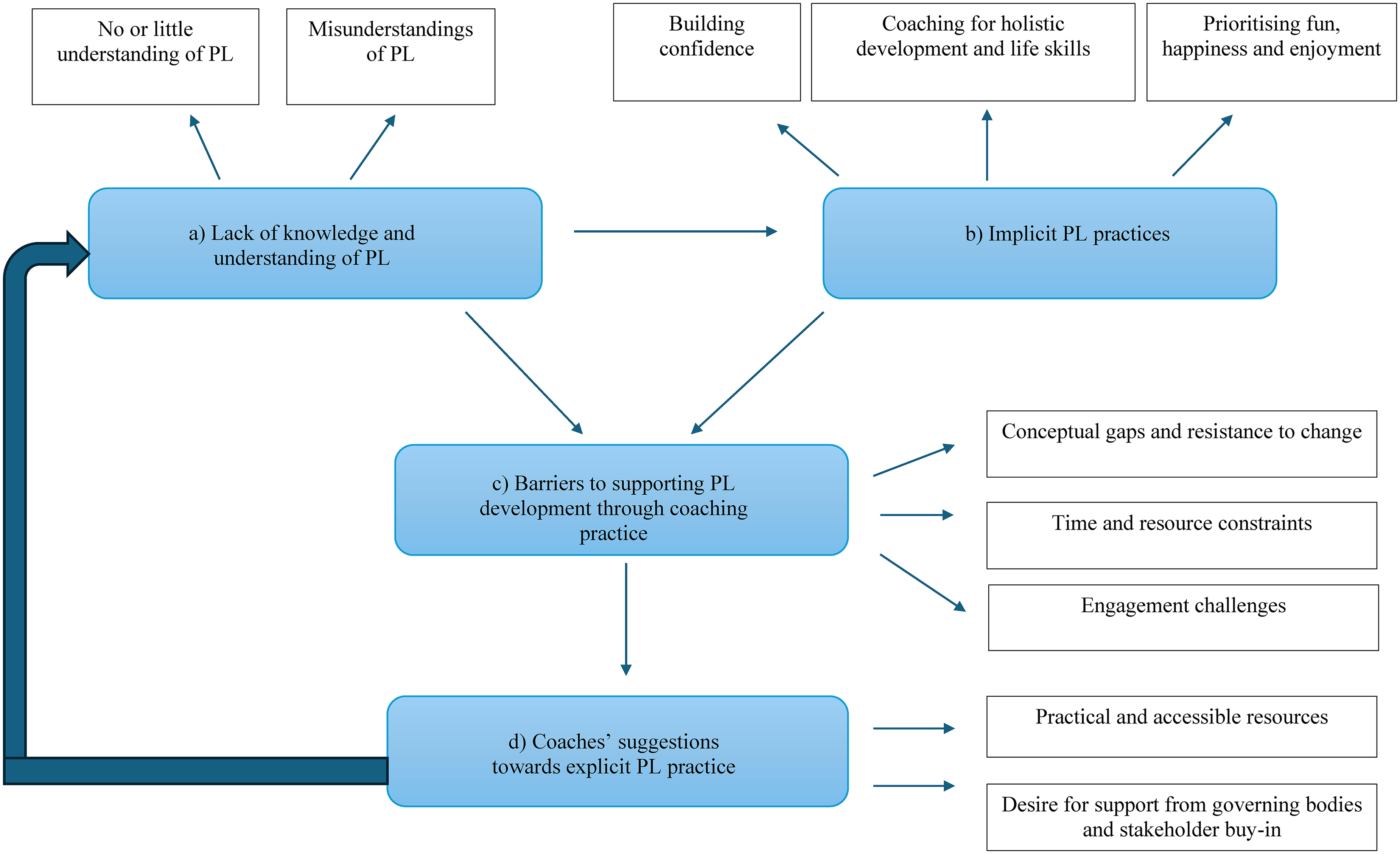
Diagram of themes and subthemes.
A lack of knowledge and understanding of PL
This theme captures how PL was positioned as unfamiliar or ambiguously understood within coaches’ professional discourse, regardless of coaching experience. While some coaches attempted to infer meaning, PL was mostly framed as either unknown or narrowly defined through existing coaching knowledge.
No or little understanding of PL
All but one participant had minimal or no knowledge of the term PL, irrespective of experience and were unable to provide a definition. One coach stated, “PL. Well, that has stumped me straight away…I've never heard that term before.” [C4]. Another explained, “Yeah, no. I could guess, but I haven’t had any brief or knowledge on it. It wouldn't be a term that I’ve come across or heard within what I do” [C2], suggesting that PL was not embedded within participants’ formal or informal coaching education
Misunderstandings of PL
Some had heard of PL, although their interpretations or guesses often reflected a narrow understanding, defined by physical competencies or movement skills. One coach explained, “PL would be the ability to complete basic motor skills like jumping, throwing, kicking, running… things that everybody should be able to do” [C1]. Another stated, “I assume it's to do with understanding body function, the movement of joints, muscles and things to enhance it… but I’m unsure, that's a guess” [C2]. These accounts positioned PL as a physical or technical construct, overlooking the cognitive, affective, and social dimensions central to widely accepted definitions. In some cases, PL was also misinterpreted as football tactics or game understanding, in terms of “understanding how to play, the structure and the game itself” [C10]. This was also reflected in participants differentiations between PL and physical activity with all coaches acknowledging a difference, labelling physical activity as ‘the doing’ and PL as ‘the understanding behind what they’re doing and why…’.
Implicit PL practices
Although most coaches were unable to define PL, many described coaching practices that implicitly aligned with its broader domains. PL was enacted through practice rather than language
Building confidence
More than half described coaching practices that supported confidence development and emphasised the importance of helping children feel “competent, supported, and empowered” within football environments. Confidence was seen as fundamental to children's engagement, motivation, and wellbeing. One coach commented, “Confidence is massive for wellbeing. If they believe they are good, then they will be good players” [C3]. Another reflected on its broader developmental role, stating, “It gives children the confidence to speak to you if they’ve got any issues or troubles in other aspects of their lives” [C8]. Confidence-building was often tailored to individual needs as one explained, “It's really understanding the person…what kind of individual they are,” [C11]. Another noted, “Confidence building is a problem in kids’ sport because many children are not confident…it's something that must be built” [C5].
Praise, encouragement, and leadership opportunities were commonly used to promote confidence. One coach described: “Every game…I tell them something positive that they've done…you can see after, they are buzzing with that praise” [C4]. Captaincy roles were used intentionally to encourage expression and leadership: “Everyone gets a turn at captaincy…a lot of them are shy, but I do push them to input” [C6]. Participants also linked confidence to autonomy, communication, and skill development, giving children freedom to choose positions or contribute to decisions. “We ask them where they want to play…” [C10]. One coach shared how belief and persistence helped a quiet player thrive: “That child…I persevered with him; his confidence was low… that's my role as a coach to develop other skills too” [C7]. Collectively, these accounts illustrate how confidence was treated as a foundational outcome of coaching practice, extending beyond football performance alone.
Coaching for holistic development and life skills
Participants viewed their role as encompassing the broader development of children as individuals, including mental and emotional wellbeing, social skills, and moral development. One coach explained, “You're not just focusing on kicking a ball… you're focusing on everything, their quality of life, wellbeing, enjoyment levels” [C1]. Several coaches expressed a desire to help children become “good people,” recognising the likelihood of producing elite athletes was minimal compared to the opportunity to shape respectful individuals. One explained, “The chances of me coaching someone who's going to play in the Premier League… it's 0.03%. So, let's make good people and what will be will be” [C8]. Another coach repeated, “I will teach them about being a good person, so looking after each other on the pitch, […] and, how to act as a decent young human being” [C3].
Many emphasised football to be a valuable context to instil life skills transferable to other areas of life, such as school, relationships, and future employment. For example, one coach highlighted the role of sport in developing communication and social adaptability: “If you can help a child express themselves in communication through something they enjoy like sport… it will help in other areas of life, school, making friends, future employment” [C11]. These accounts positioned football as a relational and developmental space, rather than solely a performance-oriented environment.
This holistic approach was also seen as a preventative and supportive tool for children's wellbeing. Several reflected on the “state of society” and the growing pressures faced by youth, describing sport as a means of offering stability, positive role models, and safe, inclusive spaces. As one coach put it, “If you feel part of the team and included, that's going to help children express issues in other areas of their life” [C6]. Insights reflected how many coaches already contribute to holistic development, supporting the social, emotional, and moral dimensions that underpin PL, even if they do so without using the terminology.
Prioritising fun, happiness and enjoyment
Almost all coaches placed fun, happiness and enjoyment as central to their coaching philosophy, framing these elements as essential for sustained engagement and wellbeing. Coaches described fun as a protective factor for emotional wellbeing, that reduced pressure and stress for young players One coach explained how pre-match messaging was used to reframe participation: “Every single match… I say to them, what's the most important reason we’re here? ‘To have fun.’ Go and enjoy yourself. It doesn’t matter if you make mistakes” [C7]. This emphasis on enjoyment was often informed by coaches’ own negative childhood sporting experiences, which they sought to avoid reproducing. As one participant shared, “I look back, I was far too bothered about winning… it was detrimental for my own enjoyment, I don’t want that for my teams” [C5]. Another coach linked enjoyment to motivation as key to prolonged engagement in sport: “They might really enjoy football, but if you run it like a drill sergeant, they're not going to come back, and motivation will drop naturally” [C7].
Participants described adapting activities to ensure enjoyment remained central across age groups, with one coach acknowledging: “There's different ways to make it fun, it just changes for older kids” [C1]. For younger players, this included imaginative, play-based approaches: “Sometimes they don’t realise they’re doing football. They think they’re running around pretending to be knights or superheroes, but they’re developing physical skills at the same time” [C1]. With older players, coaches prioritised intrinsically rewarding activities, such as small-sided games and shooting: “It's less about the play phase as the FA say, but that doesn’t mean it can’t be fun. I include things they enjoy…, they’ll give more back” [C10]. Across accounts, enjoyment was consistently framed as a prerequisite for wellbeing, development, and continued participation. One coach mentioned: “If they’re not enjoying it, they won’t come back… so then, there's no wellbeing, no development, nothing” [C10].
Barriers to supporting the development of PL through coaching practice
Despite demonstrating commitment to child wellbeing and implicitly aligning with many of the broader PL domains, coaches identified barriers that limited their ability to support PL consistently in practice.
Conceptual gaps and resistance to change
Coaches’ limited understanding of PL (as highlighted earlier) posed a significant barrier to integration. Without clarity on what PL entails, many communicated difficulties to see its relevance or how to foster it into sessions. One coach explained, “I guess coaches’ knowledge and understanding of PL would affect how they support it… some just want to run the session, do drills and have fun” [C3].
This uncertainty was compounded by resistance to change, particularly from coaches accustomed to more traditional or performance-focused approaches. Several participants noted that new concepts like PL were sometimes met with indifference or scepticism: “There's a bit of a mindset of ‘we’ve always done it this way” [C11]. If you start talking about PL, some people just “switch off, we’re here to make footballers”. One participant reflected, “Probably don’t mean this in a horrible way, but ignorance… people just get on with the coaching they’ve always done, and do it as they think best” [C6]. Another coach echoed this sentiment: “Coaching when I was a kid was different. We were just chucked on the pitch and left to it… so if it's worked before, why change your approach now?” [C5].
Time and resource constraints
A lack of time emerged as a key barrier for almost all participants, with most coaches volunteering alongside full-time jobs, family life, and other responsibilities. As one explained, “Work Monday-Friday, matches at weekends… I have a life outside coaching” [C6]. The short contact time with players and limited time for planning also inhibited opportunities to deliver holistic sessions, “Do I really have the time to sit down and plan a session and think, this activity aligns to this domain of PL?”, [C8] especially when “we only have them one hour per week” [C9]. Voluntary status and minimal qualifications among grassroots coaches further constrained capacity. “Most are just parents… they’ve done a level 1 online and turn up to help” [C7]. Clubs were reluctant to place additional expectations on volunteers: “So many clubs are just happy to have someone… it's hard to ask them to keep learning and changing” [C2]. Coaches also described a lack of easy-to-use resources that could support PL delivery. As one put it, “It's great talking about holistic development, but we need something simple that works… not an email update or textbook” [C5].
Engagement challenges
Some coaches were motivated to develop their skills, while others were less engaged, with one noting, “Some just want to coach and go home… they’re not interested in anything else” [C5]. Coaches described the difficulty of holding children's attention when focusing on developmental goals that were not perceived as “fun” or “game-like”. One coach explained “Sometimes kids just want to shoot or play a match… it's hard to slow it down and work on communication or confidence without losing them” [C9]. Another coach added, “At 7 years old, their attention span is short, if they get bored, they’ll lose interest fast” [C2]. This was especially challenging when trying to balance PL elements with traditional football drills, as one coach explained, “You want to develop their skills beyond kicking the ball, but if you remove game time, they disengage” [C1].
Parent engagement was a recurring challenge for coaches, particularly when progressive methods were met with resistance. Some parents valued traditional, “game-focused sessions” over broader skill development, which influenced coaches’ choices. As one coach noted, “You want to try new things, but if parents don’t see immediate results, they question your approach” [C4].
Coaches’ suggestions towards explicit PL practice
While coaches showed a clear willingness to support PL and child wellbeing, they highlighted a need for greater structural support. Two key recommendations emerged: access to practical resources and guidance from governing bodies.
Practical and accessible resources
Coaches consistently called for easy, accessible, time-efficient resources to help embed PL into grassroots sessions. Preferences included “short-video demonstrations”, flashcards, session plans, or app-based content that could be quickly referenced during or before training. One coach explained, “Just having the ability to go on my phone for a quick look and reminder during a session would be useful” [C8]. Others highlighted that video content would be more widely used than printed cards, particularly for less experienced coaches. Tools linked to wellbeing or PL domains were seen as helpful, especially if “paired with equipment lists and session outcomes” [C2]. Coaches also expressed frustration towards overly theoretical content, emphasising the need for straightforward explanations and real-life examples: “We don’t need reams of research…just something that talks you through how to apply it practically” [C3].
Desire for support from governing bodies and stakeholder buy-in
Coaches expressed a need for stronger leadership and support from governing bodies such as the FA and affiliated clubs, to embed PL within grassroots football and develop understanding amongst coaches. Several recommended introducing PL at the earliest stages of coach education, describing it as “coaching basics” that “should go in at the first level… it's not the hardest thing to teach” [C8, C11]. Others emphasised that widespread adoption depends on it being seen as a valued and shared priority, “It has to be driven through the clubs as a team approach… otherwise it won’t get picked up” [C4]. Six out of eleven participants felt they would be more likely to engage if the FA or their affiliation visibly encouraged PL as part of best practice, noting that “you get more traction when it's coming from a recognised body” [C10]. Suggestions included integrating practical guidance and refresher information into CPD courses or existing FA frameworks such as the four corners model and offering online and face-to-face training workshops. Coaches also acknowledged the need for a “combined message” and clear, practical examples to help address challenges such as parental buy-in and to support coaches without formal coaching qualifications.
Discussion
This study is the first to explore grassroots football coaches’ knowledge, understanding, and application of PL in relation to child wellbeing. Unlike prior research that has focused on teachers or relied on survey methods, this study provides qualitative insights from coaches, highlighting implicit PL practices alongside the practical barriers and supports needed to translate PL concepts into everyday coaching. These findings are significant as they highlight the barriers coaches encounter when fostering PL, offering critical insights that may help bridge the gap between knowledge and practical application in youth sport. Although PL has gained prominence in policy and academia, it remains inconsistently understood in community sport, particularly among grassroots coaches. Consistent with previous research identifying gaps in PL awareness among deliverers, including stakeholders, teachers and coaches,28,32,37 this study extends existing knowledge by illustrating how PL is enacted implicitly in practice and where support is needed to translate PL knowledge into actionable, wellbeing-focused coaching.
Lack of knowledge and understanding of PL
A primary finding was the limited understanding of PL among coaches, many of whom could not define PL or associated it narrowly with physical movement skills. This builds on earlier studies reporting confusion and inconsistent interpretations of PL across education and sport contexts.28,32 The absence of PL in football coaching may reflect limited dissemination within its infrastructure, despite the Sport England consensus being widely endorsed at policy level. Football's national governing body (FA) has not formally integrated PL into coaching qualifications or policy frameworks, unlike sports, such as British Fencing, which have embedded the Sport England consensus into coaching philosophies and developed programmes, e.g., ‘Fencing for Change’.
49
This lack of awareness of PL in football, may be attributed to PL being primarily promoted by Sport England, a government funding body, rather than the FA itself. This highlights the need for cross-organisational collaboration to embed PL within coach education pathways, policy guidance, and coach-facing resources to support translation into everyday coaching practice
Implicit PL practices
Although many coaches were unfamiliar with the term PL, their self-reported practices often reflected key PL domains, particularly social and psychological development
Discussion of barriers
The knowledge gap of PL is not solely theoretical; it is compounded by practical barriers, including time and resource constraints and engagement challenges that limit the explicit adoption of PL-informed practice. This results in challenges for coaches to embed PL practices into their coaching in a meaningful way. With over 3 million UK sports coaches, 52% lack formal qualifications, 40% are unpaid volunteers, 38 and 30% have never accessed continued professional development suggesting that learning is informal or based on personal experiences. 53 This context makes the fostering of holistic, pedagogically informed concepts like PL challenging. Given that 91% of coaches volunteered alongside full-time employment and had limited session time, complex or heavily theoretical frameworks are unlikely to be adopted without simplified, practical tools. Prior research highlights coaches often feel ill-equipped to deliver beyond technical instruction without greater support, however the present study goes beyond this by providing explicit recommendations for support. 27 Moreover, the challenge of engaging parents and children with developmental goals, rather than game results, illustrates the cultural tension between participation and performance that pervades much of youth sport. 15 These barriers underscore the need for a cultural shift from outcome-focused models towards child-centred, developmentally appropriate approaches that support the integration of PL and child wellbeing. 30 Behaviour change frameworks, such as the Capability, Opportunity, Motivation and Behaviour (COM-B) model, may help explain why coaches struggle to translate PL knowledge into practice, guiding interventions to support the sustainable adoption of holistic coaching approaches.
Coaches’ suggestions towards explicit PL practice
Coaches were enthusiastic about support to embed PL more explicitly. Our findings align with Hurter, Essiet, 31 who found that community coaches benefit from “ready-to-use”, bite-sized resources cupped with policy-level, institutional support. Uniquely, this study pinpoints the exact format of practical tools and resources which would be useful to football coaches, such as short videos, session cards and activity plans. Such tools can help translate theory into actionable practice, particularly when embedded within familiar models like the FA Four Corner framework. By aligning PL with existing frameworks, alongside wellbeing-focused coaching practices, governing bodies can create an environment where child wellbeing is prioritised alongside performance.
Coaches also stressed the need for visible leadership from governing bodies. As Belton and Connolly 28 note, coach education and policy drive behavioural change. Suggestions to integrate PL into introductory coaching qualifications are consistent with recommendations from Sport England, 18 who advocate for embedding PL into coach development systems. For success, PL must be presented not as an academic ideal, but as a practical philosophy that supports coaches’ existing values, around child wellbeing and sustained sport participation. Coaches’ enthusiasm for practical resources reflects the need to operationalise the Sport England consensus in accessible, context-specific ways bridging policy, education, and practice.
Strengths and limitations
This study is the first to explore community sport coaches’ subjective experiences, providing nuanced insights into their knowledge, practices, and challenges in promoting PL. The qualitative approach enabled in-depth exploration beyond what surveys typically capture. Using the Sport England consensus provided a lens for understanding coaches’ practices and perspectives in relation to a nationally recognised definition of PL, supporting future alignment and potential collaboration among relevant governing bodies and sport organisations. However, prior exposure to these definitions during interviews may have influenced participants’ descriptions as discussions progressed, particularly in the “Implicit PL Practices” theme. The study benefits from a diverse sample in terms of coaching experience and age groups coached, providing a broad perspective of coaching practices. Limitations include recruitment through a university-linked outreach programme, which may have attracted more development-orientated coaches. This should be considered when assessing the transferability of findings to broader grassroots coaching contexts. The sample size was geographically limited to coaches in Warwickshire, UK, limiting the generalisability of findings to other regions or countries. The study also exclusively included male coaches, which may overlook potential sex differences in coaching approaches and perspectives, albeit reflecting the actual demographics of football coaches. 54 Focusing solely on football means findings may not transfer directly to other sports, suggesting the need for broader research across different sports.
Future directions
The findings highlight important implications for the future of PL in community sport. Coach education should prioritise a clear understanding of PL, aligned with Sport England, 18 and integrate it into grassroots coaching qualifications. Future research could develop and test practical, accessible resources tailored to the needs of coaches, such as pocket cards or video demonstrations, to better support the development of PL into coaching practices. Involving coaches in the development of resources is essential, as co-creation has been shown to increase practical relevance and thus likely to lead to real-world uptake. 55 The role of governing bodies in supporting PL informed coaching practices warrants further exploration. Research should explore how national and local sports organisations, like the FA, can facilitate PL adoption through training, policy development, and resource provision, to enhance coaching quality and promote the benefits of PL in supporting children's holistic development. Longitudinal studies should examine PL-based coaching approaches’ effects on sustained participation and child wellbeing, to understand its potential as a framework for practice.
This study explored grassroots football coaches’ experiences and understanding of PL in supporting child wellbeing. While coaches often promote key PL elements implicitly, explicit awareness and consistent application are limited, influenced by practical barriers. These insights underscore the need for accessible, practical resources and organisational support to enhance PL adoption in community sport.
Supplemental Material
sj-pdf-1-spo-10.1177_17479541261443098 - Supplemental material for Grassroots football coaches’ knowledge and perspectives of physical literacy to improve child wellbeing through community sport
Supplemental material, sj-pdf-1-spo-10.1177_17479541261443098 for Grassroots football coaches’ knowledge and perspectives of physical literacy to improve child wellbeing through community sport by Lara Vella, Johannes Carl, Matteo Crotti, Lisa M Barnett and Michael Duncan in International Journal of Sports Science & Coaching
Supplemental Material
sj-docx-2-spo-10.1177_17479541261443098 - Supplemental material for Grassroots football coaches’ knowledge and perspectives of physical literacy to improve child wellbeing through community sport
Supplemental material, sj-docx-2-spo-10.1177_17479541261443098 for Grassroots football coaches’ knowledge and perspectives of physical literacy to improve child wellbeing through community sport by Lara Vella, Johannes Carl, Matteo Crotti, Lisa M Barnett and Michael Duncan in International Journal of Sports Science & Coaching
Supplemental Material
sj-docx-3-spo-10.1177_17479541261443098 - Supplemental material for Grassroots football coaches’ knowledge and perspectives of physical literacy to improve child wellbeing through community sport
Supplemental material, sj-docx-3-spo-10.1177_17479541261443098 for Grassroots football coaches’ knowledge and perspectives of physical literacy to improve child wellbeing through community sport by Lara Vella, Johannes Carl, Matteo Crotti, Lisa M Barnett and Michael Duncan in International Journal of Sports Science & Coaching
Footnotes

Ethical considerations
Ethics approval was obtained from the Deakin University Human Research Ethics Committee (2024/HE000546) and followed the Consolidated Criteria for Reporting Qualitative Research (COREQ) checklist. Coventry University Research Ethics Committee also provided secondary ethics approval.
Consent to participate
All participants provided both written and verbal informed consent prior to participation.
Consent for publication
Written informed consent for publication was included although no individual details, videos or images are included in the submission.
Author contributions
The corresponding author was responsible for all data collection, analysis and interpretation of study findings. All other authors contributed and assisted with manuscript drafting and critical revisions. All authors reviewed and approved the final manuscript.
Funding
The authors disclosed receipt of the following financial support for the research, authorship, and/or publication of this article: This work was funded as part of a Cotutelle PhD scholarship between Deakin University, Australia and Coventry University, United Kingdom.
Declaration of conflicting interests
The authors declared no potential conflicts of interest with respect to the research, authorship, and/or publication of this article.
Data availability
Further information regarding the data reported on in the current study can be requested by contacting the corresponding author, upon reasonable request.
Supplemental material
Supplemental material for this article is available online.
References
Supplementary Material
Please find the following supplemental material available below.
For Open Access articles published under a Creative Commons License, all supplemental material carries the same license as the article it is associated with.
For non-Open Access articles published, all supplemental material carries a non-exclusive license, and permission requests for re-use of supplemental material or any part of supplemental material shall be sent directly to the copyright owner as specified in the copyright notice associated with the article.
