



Abstract
The determinants of youth cycling performance are still understudied. This study aims to relate multidimensional performance characteristics of road cyclists (U17-category) to a ‘Youth Seasonal Cycling Performance Score’ (YSCPS). This score represents the weighted average of a cyclist's race results over a season. In total 264 cyclists (209 male, age 15.6 ± 0.5, cycling experience 5.3 ± 2.5 years) were assessed on anthropometrical, physiological, technical and psychological tests in a Dutch talent development programme. The relation between test results and YSCPS was investigated using (1) correlational analysis; and (2) machine learning (XGBoost). In males, significant correlations with YSCPS (|ρ| = 0.23–0.63) were found for (in decreasing importance): physiological variables (5 min average power output, sprinting and climbing performance), training history, age, technical skills, and anthropometric variables (maturity status, height, body mass, BMI), but not for psychological variables. In females, YSCPS significantly correlated with 5 min. average power output only (ρ = 0.63). The accuracies (R2) of the machine learning models for cycling performance were 0.44 (males) and 0.30 (females), with physiological variables and training history being the most important predictors of YSCPS for both genders. It can be concluded that physiological variables mainly relate to cycling performance for Dutch U17 cyclists. Acknowledging the relation between task requirements and cyclists’ performance characteristics as well as the distinction between current performance and the development thereof, the results cannot be generalized to cyclists in other countries or older populations without consideration. Still, practitioners can use these results to identify and develop youth cycling talent in The Netherlands.
Keywords
Introduction
Road cycling is a demanding sport in which the highly competitive setting has resulted in the recruitment of increasingly younger talented riders for professional teams.1,2 Cyclists become professionals at younger ages and perform better in races compared to older generations at their age. 3 One way to prepare talented cyclists for a professional career is through so-called Talent Identification and Development Systems (TIDS), i.e., organizations that aim to identify athletic talent and develop a limited number of these athletes into future high-performing professionals. 4 Whereas TIDS often identify talents by scouting athletes or inviting them to test days based on their competition results, cycling talent identification in The Netherlands is approached differently. More specifically, multiple test days are organized throughout the country and are announced online. Importantly, everyone within a certain age range can apply for such a talent test, also athletes who are active in other sports. This not only recognizes the importance of early sports diversification, 4 but also facilitates talent transfer across sports disciplines. Moreover, this approach relies more on the self-regulatory capacities of the athlete since he/she is required to actively sign up. This might already filter those athletes who are motivated to pursue a professional cycling career.
The high value that TIDS give to the race performances of young cyclists is illustrated by the fact that twenty-five of the top-30 juniors in the ProCyclingStats Junior Ranking of 2024 were already part of a professional team's structure at the end of that season. 2 An ambitious youth cyclist might therefore seek to perform well in races already when entering the junior category. The demands of these races are different from U23- or professional races, 5 and therefore the hierarchy in importance of the underlying multidimensional performance characteristics (MPCs) might also be different. Moreover, MPCs need to match the demands of multiple race types. 6 For example, in The Netherlands, youth road cycling races consist of national and international races, criteriums, time trials and stage races, with each race having different demands. Therefore, different MPCs might be required to perform well depending on the race type. Up to now, it remains largely unknown how MPCs relate to youth cycling performance.
The MPCs that determine sports performance can be divided into anthropometrical, physiological, technical, tactical and psychological characteristics. 7 So far, research investigating the relationship between youth cycling performance and its underlying characteristics has mainly focused on anthropometrical and physiological variables and how they predict a cyclist's future performance level.8–11 Only two studies related these MPCs to current youth cycling performance.12,13 They showed no differences in anthropometrical values (body mass, height, BMI, fat percentage) across performance levels, but in both studies, cyclists differed in their physiological characteristics. That is, those who scored more points in the national ranking had higher aerobic fitness levels (V˙O2 and power output at the aerobic and anaerobic threshold), with medium to large effect sizes. No differences were found for maximal anaerobic performance in a 5 s sprint. 13
Besides well-developed aerobic capacities, a cyclist might need sufficient technical skills to move efficiently in a peloton, for example by adopting a good pedalling technique or by being able to ride to the front of the peloton between the other cyclist's wheels instead of through the wind. This would allow the cyclist to spend a greater proportion of the race at lower power output (PO) values and therefore conserve energy for later in the race. 6 Recently, Mostaert et al. (2021) developed cycling-specific agility tests to quantify these technical skills. 14 Although these tests were not able to predict cycling performance two years after the U17-category, 15 more research using this test could identify if technical skills are important for current youth cycling performance.
The final tactical decisions that cyclists make during racing or training depend on psychological factors, such as the ability to cope with physical and mental fatigue or performing under pressure. 16 In this light, the degree to which cyclists reflect, evaluate and expend their effort might be important to consider. Namely, such processes of self-regulated learning (SRL) have been shown to relate to more efficient learning and higher performance.17–22 Furthermore, some studies indicate that coping strategies could discriminate between high-performers and low-performers.23,24 For example, in the study of Nicholls et al. (2010), (inter-)national athletes scored higher on coping self-efficacy compared to county, club- or beginning athletes. 23
Driving forces for the MPCs are age, maturation and training. For example, studies have shown that until the U19-category, a higher chronological age relative to other cyclists in the same category is related to better cycling performance.12,25,26 This is especially pertinent given that TIDS in cycling may start with talent selection from the U17-category, since cycling performance at this age starts to have predictive value for success at senior level.25,26 Thus, if not accounting for the potential effects of age and maturation, cycling talent may be lost.
The current study investigates the relation between youth cyclists’ current cycling performance and their anthropometrical, physiological, technical and psychological characteristics, as well as their age, maturity status and training history. This can give more insight into the factors influencing youth cycling performance and act as a starting point for talent development. Therefore, the aims of this study are: (1) to investigate how MPCs of road cyclists participating in the Dutch U17-category relate to their cycling performance in the same season; and (2) to establish which of these MPCs most accurately predict current cycling performance in The Netherlands.
Materials and methods
Study design
This cross-sectional observational study was performed in collaboration with CyclingClassNL (CCNL), a Dutch cycling TIDS. Each year from April to May, CCNL organises test days to identify and select talented cyclists. The test days are announced on CCNL's website and promoted through the social media channels of the Dutch Cycling Federation. The target group are cyclists competing in the second year of the U17-category. However, slightly older or younger cyclists (14–17 years old) are also encouraged to participate, even if they are not member of a cycling association. A first selection is made based on a multidimensional test battery, performed at various locations in The Netherlands, as well as cycling background. From the ∼280 cyclists that are initially tested in the first test round (TR1), approximately 50–60 are invited for a second test round (TR2) in August, where a more extensive test battery is performed. Ultimately, approximately ten cyclists are selected for the talent development programme (Figure 1). The selection procedure, including the decision which cyclists were invited for the second test round and the final selection, is CCNL's responsibility. The ethical committee of the Department of Human Movement Sciences, University of Groningen approved this study (METc 2023/112, Project ID 15826).
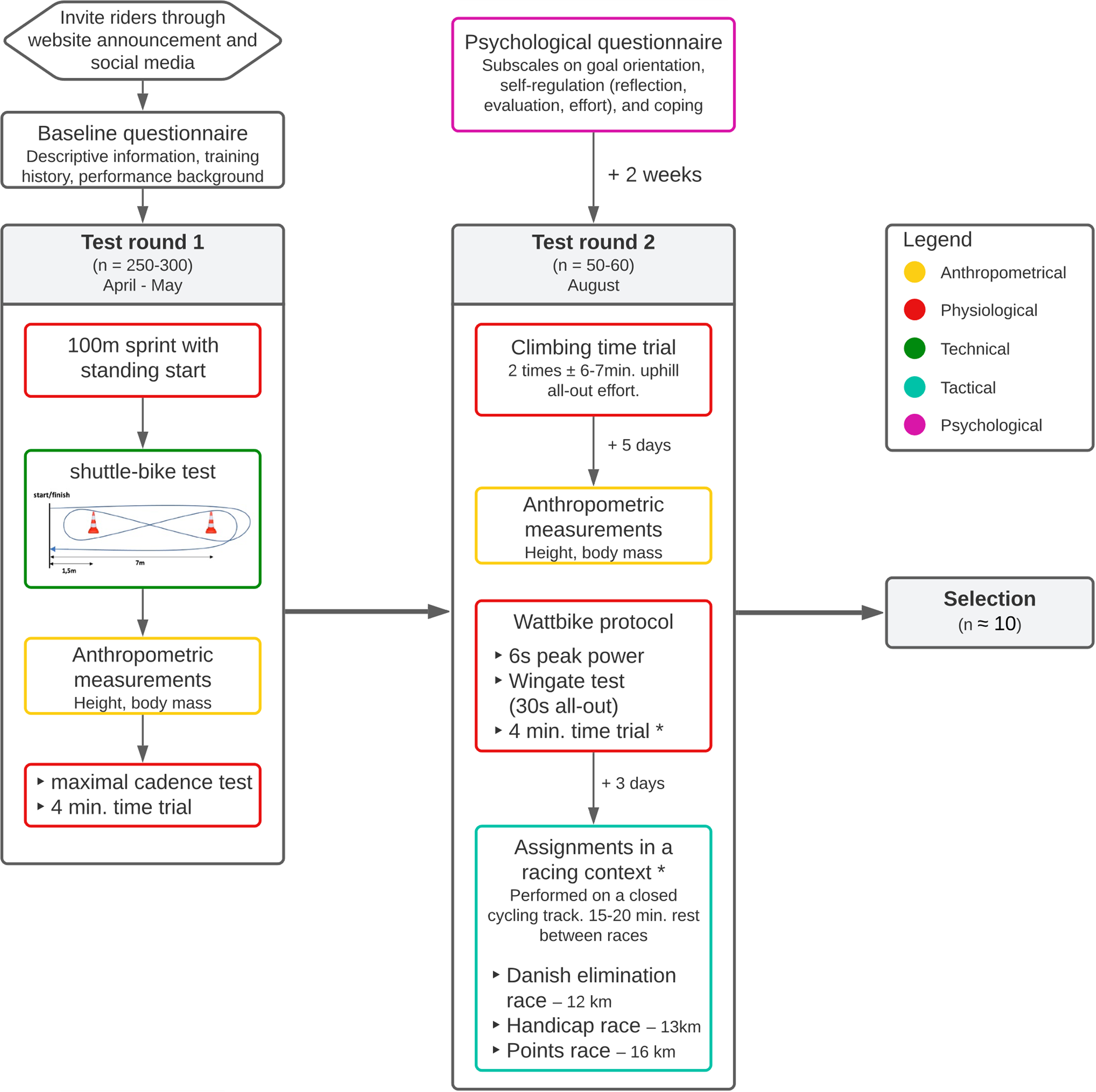
Overview of CCNL's selection procedure. * CCNL used the assignments in a racing context in test round 2 to make a selection, but they were not used for the current study.
Participants
The current study used a subset of the data that CCNL collected across three seasons to analyse the relationship between MPCs and cycling performance in the same year. Before participating in the CCNL testing procedure, participants signed an agreement that their data could be shared with other trusted parties, including our research department. We only analysed data from cyclists that participated in the U17-category in the year of testing, meaning that they had to become 15 or 16 years old during that year. Cyclists also had to participate in at least three races during that season to be included. In the end, a total of 264 cyclists (209 male, 55 female) were included.
Procedures
In TR1, cyclists filled in an online baseline questionnaire at home in which they reported on their sports background, including years of cycling experience, weekly training hours and distance, and annual training volume up to two years before the test. Besides, they were asked to submit the body height of their parents to calculate the percentage of predicted adult height using Khamis & Roche's method, as a measure of maturity. 27 The test round itself consisted of a 100 m sprint test, a cycling-specific agility (“shuttle-bike”) test, anthropometric measurements (height, body mass), and a short time trial (4–5 min., depending on the test year) on an ergometer with a maximal cadence test as warming-up.
The cyclists selected for the second test round (TR2) first filled in an online psychological questionnaire consisting of three parts: goal orientation, SRL-related items (reflection, evaluation and effort) and coping skills. Approximately two weeks later, the cyclists performed a climbing time trial. Again five days later, they performed a testing protocol on an ergometer consisting of all-out tests of successively 6 s, 30 s and 4 min., separated by 6 and 20 min. of active recovery, respectively. The results of all tests and questionnaires are combined with race results to make a final selection of cyclists that enter the programme. Cyclists who participated in TR2 but do not make it to the final selection keep being followed, albeit less closely.
Measurements
An overview of the measurement instruments used to determine the MPCs in CCNL's testing battery is provided in Table 1, together with their accuracy, reliability, and test details if applicable.
Overview of the measurement instruments to determine MPCs, together with their accuracy, reliability, and test details.
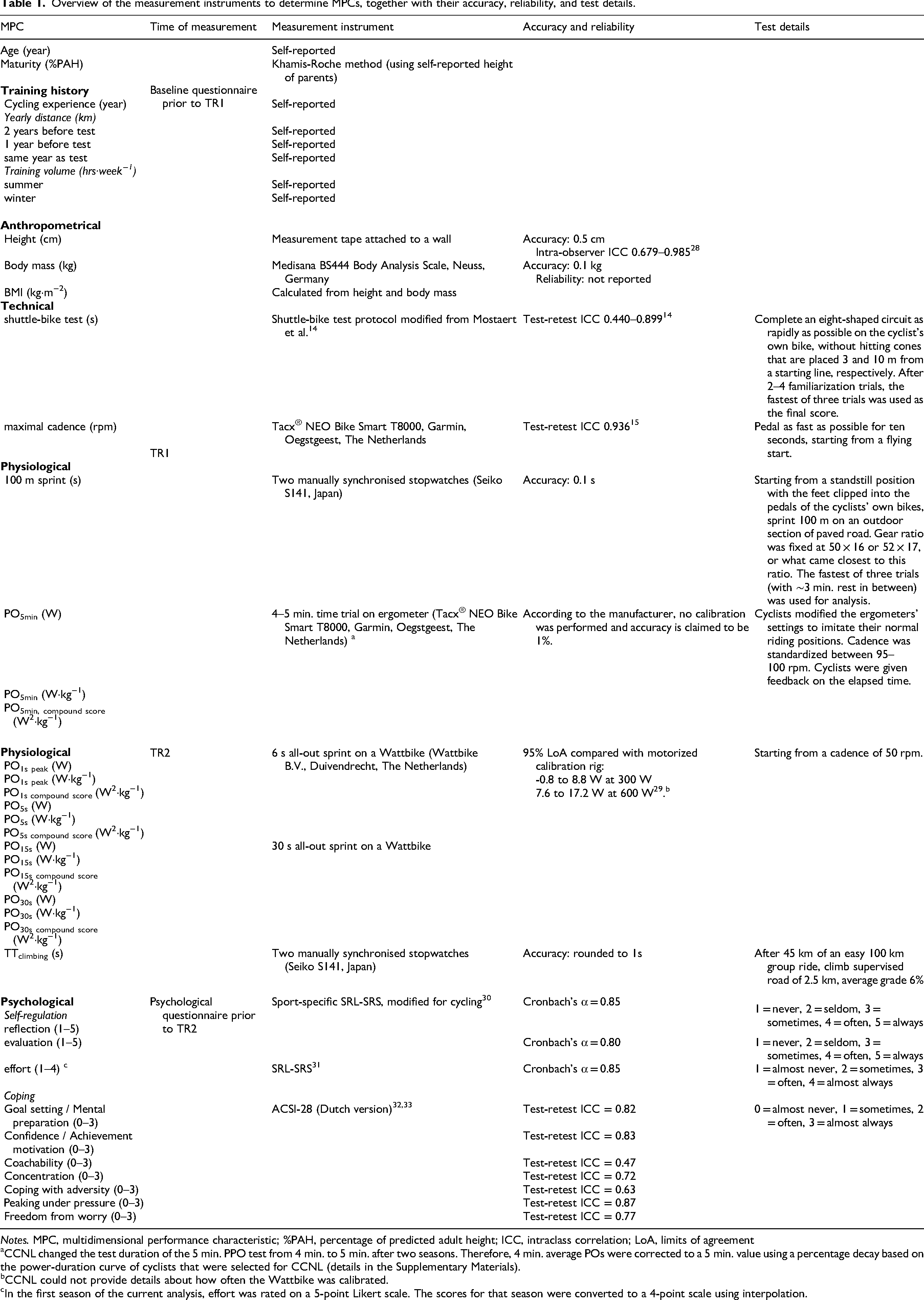
Notes. MPC, multidimensional performance characteristic; %PAH, percentage of predicted adult height; ICC, intraclass correlation; LoA, limits of agreement
CCNL changed the test duration of the 5 min. PPO test from 4 min. to 5 min. after two seasons. Therefore, 4 min. average POs were corrected to a 5 min. value using a percentage decay based on the power-duration curve of cyclists that were selected for CCNL (details in the Supplementary Materials).
CCNL could not provide details about how often the Wattbike was calibrated.
In the first season of the current analysis, effort was rated on a 5-point Likert scale. The scores for that season were converted to a 4-point scale using interpolation.
Cycling performance was quantified with a youth seasonal cycling performance score (YSCPS) according to the method proposed by Hasselaar et al. 34 In short, this method uses the race results of all participations within one season and assigns them a score according to a weighing schedule that is in line with the race level. Races are then divided into five race types (international, stage race, national, time trial, criterium or other cycling disciplines such as cyclocross). For each race type, the weighted points average of the best two performances was calculated and this was averaged over the race types to come to a final YSCPS for each cyclist.
Methods of analysis
The relation between a cyclist's MPCs (test results) and cycling performance (YSCPS) was investigated using two approaches. First, we determined Spearman correlations between each MPC and YSCPS for both males and females. Secondly, we used the machine learning (ML) algorithm XGBoost 35 to construct regression models relating MPCs to YSCPSs for both genders, separately. The advantage of this ML approach is the possibility to take into account non-trivial dependencies (e.g., non-linear patterns) between the predictors and cycling performance, whereas more traditional methods of analysis typically consider linear dependencies. Hence, ML models might better capture the complexity of what determines cycling performance. Another advantage is that XGBoost can handle missing values without having to apply data imputation. Therefore, all predictors and cyclists can be taken into account without the necessity of making estimations for predictor values of certain cyclists.
To construct our ML models, we first checked for collinearity between our predictors (MPCs) to account for potential issues regarding multicollinearity. For highly-correlated MPCs (|r| ≥ .70), only the variable with highest Pearson's correlation coefficient with the cycling performance was maintained. We then used three-fold nested cross-validation to prevent overfitting and estimate the generalizability of our ML models. 36 In short, this entails the entire dataset was split into three distinct parts. One of these parts served as test set and the two remaining parts were combined into a single training dataset. The following procedure was then executed three times, where each time a different part of the dataset was selected as test set. Repeated three-fold inner cross-validation with five different randomizations was applied to the training set for tuning the max_depth, n_estimators and learning_rate hyperparameters of the XGBoost algorithm. Subsequently, these hyperparameter values were used to construct a model on the entire training set and make predictions for the cycling performance using the test set. The generalizability of the model was then determined by comparing these predictions with the actual values of the cycling performance in the test set through calculating R2.
After assessing the generalizability of the model with these aforementioned procedures, we applied three-fold cross-validation with five different randomizations on the entire dataset to find an optimal combination of hyperparameters for constructing our final model. To guarantee robustness, this procedure was executed for ten different randomizations. The most frequently occurring combination of optimal values for these hyperparameters (max_depth, n_estimators and learning_rate) in these ten runs was selected to construct our final model on the entire dataset. For this final model, the feature importance of each predictor was determined by permuting the values of this predictor ten times and calculating the mean decrease in the model accuracy (R2) expressed as a percentage of the model's total accuracy. 37 The six predictors with the largest feature importance scores are presented.
Statistical analysis
As YSCPSs were not normally distributed according to the Shapiro-Wilk test, Spearman correlations are presented. Their 95% confidence intervals (CI) were determined through bootstrapping with 1000 samples. Values were interpreted as small, moderate and large for |ρ| ≥ 0.1, 0.3 and 0.5, respectively. 38 The p-values followed from a permutation test. The significance level (α) was set to 0.05 and the Holm-Bonferroni method was applied to correct for multiple testing. 39
The accuracies of the ML models were reported as median (interquartile range), and feature importance scores as mean ± standard deviation (SD). Data analysis was performed in Python (v3.12.7), with scipy, sklearn and xgboost the main packages being used.
Results
Multidimensional performance characteristics
The mean ± SD of the cyclists’ anthropometrical, physiological, technical and psychological characteristics, as well as their age, maturity status and training history are presented in Table 2, together with their relation with the YSCPS (see the Supplementary Materials for plots of the Spearman correlations). Cyclists differed considerably in their MPCs, as shown by the SDs. High absolute correlations (|ρ| ≥ 0.5) with YSCPS were observed for 5 min. average PO and climbing time trial performance in both males and females. In females, the 5 min. average POs were also the only variables with significant correlations (p < .05). Variables with moderate correlations in males included: age, body mass, maturity status, variables related to training history (with a large correlation for distance cycled one year before the test), cycling-specific agility, and sprint performance (100 m sprint and 5 s absolute PO, the latter being non-significant). All other variables showed low and non-significant correlations with YSCPS.
Multidimensional performance characteristics (MPCs) and their Spearman correlations with the youth seasonal cycling performance score (YSCPS).
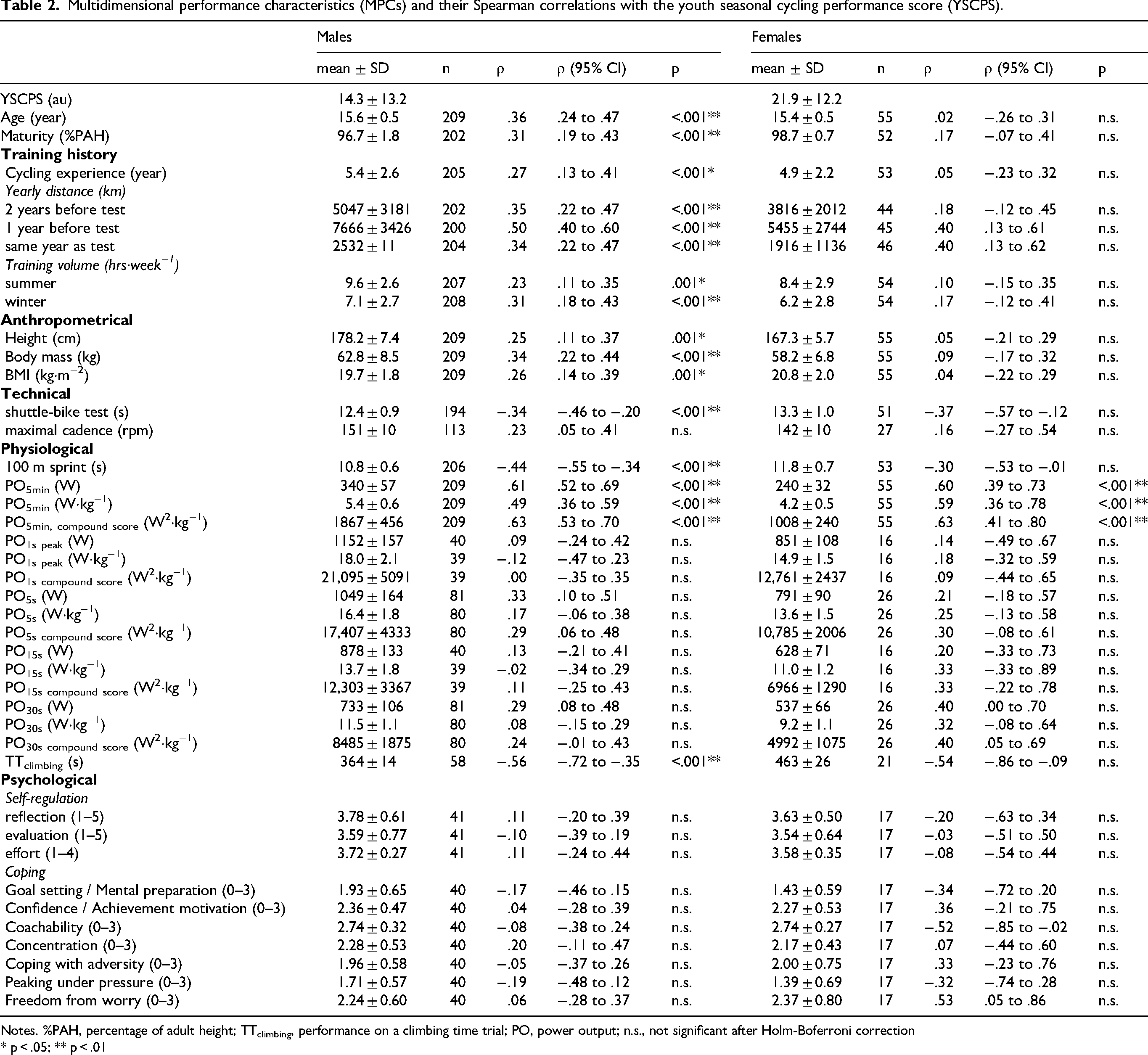
Notes. %PAH, percentage of adult height; TTclimbing, performance on a climbing time trial; PO, power output; n.s., not significant after Holm-Boferroni correction
* p < .05; ** p < .01
Cycling performance model
Predictors used for our machine-learning model are provided in Supplementary Table 1. The performance (R2) of our model on unseen data, i.e., the generalizability of our modelling approach, was 0.44 (0.39–0.49) and 0.30 (0.23–0.37) for males and females, respectively.
For our final model, values of tuned hyperparameters were max_depth = 1, n_estimators = 100 and learning_rate = 0.1 for males and max_depth = 1, n_estimators = 50 and learning_rate = 0.05 for females. The most important predictors of the models are presented in Table 3. For both genders, performance on a climbing time trial, the compound score for 5 min. PO and 100 m sprint performance were among the three best predictors for YSCPSs. Additional predictors included accumulated cycling distance in the year before the test, absolute 5 s PO (both males and females), as well as a cycling-specific agility test (males) and 30 s compound PO (females).
Most important predictors of youth cycling performance based on the machine learning models for males and females.
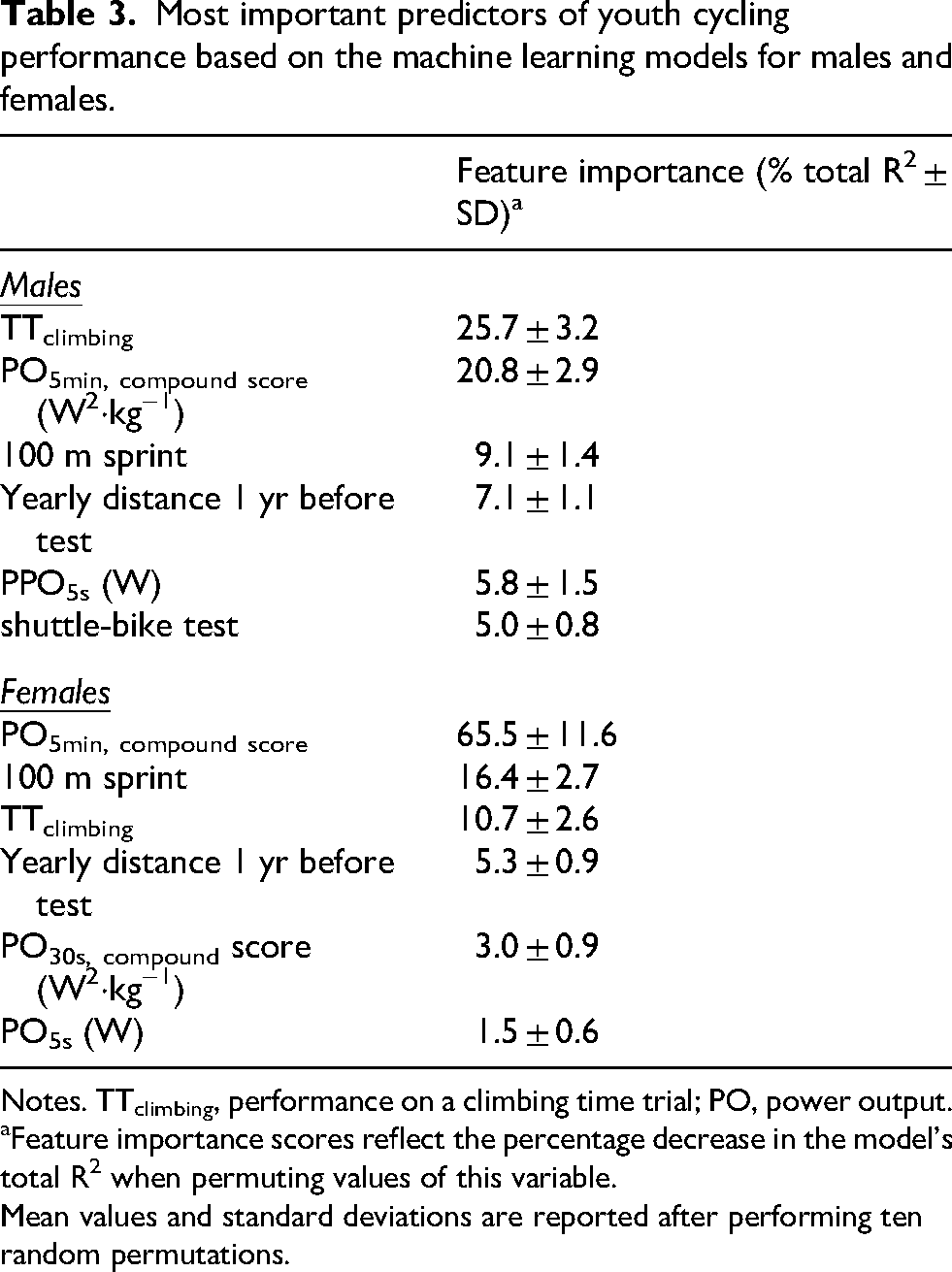
Notes. TTclimbing, performance on a climbing time trial; PO, power output.
Feature importance scores reflect the percentage decrease in the model's total R2 when permuting values of this variable.
Mean values and standard deviations are reported after performing ten random permutations.
Discussion
The aim of this study was to investigate youth cycling performance in the Dutch U17-category. First, the relations between youth cycling performance in the Dutch U17-category and its underlying MPCs were studied. Second, machine learning (ML) models were constructed to predict current cycling performance based on the MPCs. Although multiple MPCs were related to YSCPS, youth cycling performance is predominantly explained by physiological variables in both males and females. In particular, climbing time trial performance, 5 min. PO and sprinting performance showed high correlations with YSCPS and were the most important predictors in our ML models. In males, YSCPSs can additionally be explained by age, maturity, training history, body mass and a cycling-specific agility test.
These results are largely in line with previous research relating anthropometrical and physiological variables to the performance levels of U17 and U19 youth cyclists.12,13 Both Gallo et al. 12 and Menaspà et al. 13 showed that a greater aerobic fitness (PO and oxygen uptake at the aerobic and anaerobic threshold) could distinguish between performance levels. However, anthropometrical variables,12,13 maximal cadence 13 or 5 s PO 13 could not. Although the aerobic fitness tests employed in the current study (5 min. PO test and climbing time trial) had shorter times to exhaustion compared to the intensity corresponding to the exercise thresholds in Gallo et al. and Menaspà et al., they still largely reflect the quality of the aerobic energy system. This confirms that in youth cycling, at least in the Dutch U17-category, aerobic fitness is the most important determinant of cycling performance.
In contrast to the results of former studies,12,13 anaerobic performance (100 m sprint and 5 s PO), as well as body height and body mass were significantly related to YSCPSs in the current study. This may be explained by the different requirements of Dutch cycling races compared to the Italian races investigated in the studies of Gallo et al. and Menaspà et al. The oftentimes flat and windy races in The Netherlands could favour cyclists who are heavier, taller and can produce more power during sprinting. Indeed, the anthropometrical characteristics of professional road cyclists have been shown to relate to the terrain in their country of origin, with cyclist coming from relatively flat countries being heavier and taller. 40 Consequently, TIDS are recommended to see the results of cyclists in a certain race type into perspective with their anthropometrical and anaerobic characteristics when identifying and selecting cycling talent. TIDS also should not forget that MPCs in cycling could be different for international compared to national races. By establishing the MPCs necessary for international success, TIDS can identify cyclists who are likely to perform well internationally. This can prevent that talents are missed who have moderate national race results, but with potential for international races.
Furthermore, the current study showed that age, body mass, maturity status, variables related to training history, cycling-specific agility in the shuttle-bike test, and sprint performance showed moderate correlations with YSCPSs in males. This could be a consequence of the fact that being more mature can result in greater muscle mass, a better developed anaerobic energy system, 41 and subsequently improved cycling performance.12,25,26 Moreover, a large correlation between distance cycled in the past year and YSCPS indicates that it may take at least one year of training experience to perform well in the U17-category. This is an important insight for both youth cyclists who want to improve their performance as well as for a TIDS that aims to identify or select cyclists who are relatively new to the sport. Finally, although a feature importance score of 5% in our ML model for performance on the shuttle-bike test seems small, this MPC could still be relevant for youth cycling performance given that cycling races are often decided on less than seconds.
The strengths of this study include the use of a holistic measure of cycling performance and a talent identification procedure that allowed identification of cyclists from very diverse levels (also children who were not member of a cycling association could participate). Moreover, our ML approach allowed detection of non-trivial dependencies between MPCs and cycling performance, which cannot be captured with linear models. For example, it is possible that sprint performance becomes more important when the physiological capacities of a cyclist are low. Our cycling performance model for females showed an example of how ML can account for such an interaction. That is, where performance on the 100 m sprint test in females only showed a moderate linear correlation with YSCPS and was not even in the top ten highest |ρ| values, this variable had the second highest feature importance score in our ML model.
This study is also not without limitations. Most importantly, 56% (males) to 70% (females) of the variance in cycling performance remained unexplained in our ML models. This relatively low performance of our models has several possible explanations. First, some predictor variables were only measured in TR2. This limited the sample size used and could have resulted in negligible influence for these variables on the models’ accuracies. For example, psychological constructs were not related to YSCPSs nor contributed to the models, but previous studies in swimming and judo showed that these variables did relate to sports performance.22,42 Second, the current study did not take into account some predictor variables that are likely to play an important role in determining youth cycling performance. For example, tactical capabilities, such as the ability to distribute efforts throughout a race, or decide whether or not to get into a breakaway, were ignored. Finally, when comparing YSCPSs of participants in the current study with those observed in the entire population of Dutch U17 youth cyclists, it appeared that relatively low performing cyclists were underrepresented in the current study. Therefore, the MPCs’ correlations with YSCPSs and their influence on our models’ accuracies are potentially lower than would be expected if the study sample was less homogeneous (i.e., more similar to the population of youth cycling races).
There are several interesting avenues for future research. First, as this was an exploratory study, all potential effects need to be confirmed in research with adequate error control. Second, future studies could consider the effect of potentially relevant predictor variables that were not considered here. Although extremely challenging, it would be very interesting to investigate the relation between tactical variables and youth cycling performance. Third, instead of focusing on the current cycling performance, future studies could investigate the effect of MPCs on the development of cycling performance. This would allow to study the relationships between the development of MPCs and the development of performance of cyclists throughout their career. For example, where the current study showed that physiological variables best predicted cycling performance in the U17-category, it could be that other MPCs, such as psychological variables, are essential for developing towards the professional level. Considering that CCNL's talent development strategy is mainly focused at increasing aerobic fitness to this required level, it would be interesting to investigate which MPCs are needed to successfully develop. In addition, while for professional races, an exceptionally high level of aerobic fitness is required, aerobic fitness might become a less important predictor of cycling performance within a homogeneous group of professionals. As such, it is interesting to investigate which other MPCs that receive less attention relate to cycling performance once the professional level is reached.
Practical implications
The current study showed that high aerobic and anaerobic fitness levels are considerably more important for cycling performance in the Dutch U17-category compared to a cyclist's anthropometry, bike-handling skills or psychological characteristics. Cycling coaches may therefore want to prioritize the development of physiological characteristics within their cyclists. They should for example take into account that it may take at least one year of training to perform well in the U17-category. Still, non-physiological performance characteristics such as bike-handling skills should not be neglected. Race results should be interpreted while considering the terrain in relation to a cyclist's anthropometric characteristics, and cyclists whose anthropometric characteristics do not fit the terrain of most youth races in a country should not be overlooked. Finally, the selection procedure of cycling talent employed in the current study offers a new perspective on how TIDS can recruit talented athletes by going into the country and inviting every youth cyclist who is interested. A talent selection procedure in multiple rounds offers the possibility to keep following cyclists who are currently considered not talented enough, but who might unfold their potential later in their development, which could reduce the loss of cycling talent.
Conclusions
This study contributes to the current knowledge on how MPCs relate to youth cycling performance. It showed that aerobic and anaerobic variables are the most important predictors in the Dutch U17-category (i.e., at 14–16 years old). However, age, maturity, training history, body mass and cycling-specific agility also play a role, at least in males. Establishing the MPCs in international races and at later developmental stages can help to identify and reduce the loss of youth cycling talent.
Supplemental Material
sj-docx-1-spo-10.1177_17479541261441428 - Supplemental material for Cycling performance in competitive Dutch youth cyclists: More than just power?
Supplemental material, sj-docx-1-spo-10.1177_17479541261441428 for Cycling performance in competitive Dutch youth cyclists: More than just power? by Jeroen Hasselaar, Arie-Willem de Leeuw, Daphne Harmsen, Martin Truijens, Barbara Huijgen and Marije Elferink-Gemser in International Journal of Sports Science & Coaching
Footnotes
Acknowledgements
The authors would like to thank the coaches of CyclingClassNL and the cyclists who participated in their selection procedure for their collaboration in this study.
ORCID iDs

Ethics approval statement
The ethical committee of the Department of Human Movement Sciences, University of Groningen approved this study (METc 2023/112, Project ID 15826).
Participant consent statement
By applying to the test days of CyclingClassNL, participants consented to sharing their data with research partners, including our department.
Funding
The authors received no financial support for the research, authorship, and/or publication of this article.
Conflict of interest statement
The authors declared no potential conflicts of interest with respect to the research, authorship, and/or publication of this article.
Data availability statement
The data cannot be shared for reasons of privacy.
Supplemental material
Supplemental material for this article is available online.
References
Supplementary Material
Please find the following supplemental material available below.
For Open Access articles published under a Creative Commons License, all supplemental material carries the same license as the article it is associated with.
For non-Open Access articles published, all supplemental material carries a non-exclusive license, and permission requests for re-use of supplemental material or any part of supplemental material shall be sent directly to the copyright owner as specified in the copyright notice associated with the article.
