



Abstract
Talent development research has largely overlooked gender-specific insights, resulting in a significant gender data gap. This study aimed to address this disparity by exploring the perceptions of athletes, parents, and coaches in female rugby talent development environments (TDEs). By identifying strengths and areas for improvement, the study seeks to provide actionable insights to enhance the development of female athletes and inform more effective TDEs. A total of 102 female athletes (mean age=15.8 ± 0.8 years), 80 parents (mean age=48.1 ± 4.9 years, 31 male, 49 female), and 22 coaches (mean age=38.8 ± 11.7 years, 14 male, 7 female, 1 other gender) from three rugby TDEs in Ireland completed the Talent Development Environment Questionnaire (TDEQ-5) or adapted versions. Subscale analysis revealed that both athletes (4.83 ± 0.73) and parents (4.70 ± 0.91) rated Support Network highest and Holistic Quality Preparation lowest (athletes: 3.96 ± 0.95; parents: 4.23 ± 1.46), whereas coaches rated Long-Term Development highest (5.04 ± 0.50) and Alignment of Expectations lowest (4.11 ± 0.58). Item-level analysis ranked individual items into top and bottom quartiles, identifying perceived strengths and areas for improvement across all subscales. The findings reveal notable differences in how athletes, parents, and coaches perceive the TDEs. Addressing these perceptual disparities and the identified areas for improvement may enhance the effectiveness of female rugby TDEs, and better support athletes’ development.
Introduction
Women's rugby has undergone significant global expansion in recent years, marking a period of accelerated participation, investment, and structural reform. 1 In 2019, World Rugby reported over 2.7 million registered female players worldwide, with participation continuing to grow rapidly in subsequent years. 2 Between 2022 and 2023, the number of active registered female players increased by 37%, outpacing the 26% growth observed among males, with females now comprising approximately 25% of the global rugby-playing population. 3 This growth has been driven, in part, by increased visibility through major events such as the inclusion of women's rugby sevens in the 2016 Olympic Games and the Women's Rugby World Cup 2021, which achieved record-breaking attendance and viewership. 4 These developments are underpinned by strategic investments, including the Rugby Football Union's (RFU) professionalisation of the England senior women's rugby union team in 2019, 5 the RFU's 10-year plan to fully professionalise the women's domestic competition, 6 and the launch of new international competitions such as the WXV in 2023. 7
In Ireland, these global trends are mirrored in strategic efforts by the Irish Rugby Football Union (IRFU) to develop and professionalise the women's game. The IRFU's 2024–2028 strategic plan outlines objectives aimed at the establishment of four contracted provincial teams, increasing female participation, and enhancing visibility at all levels of the sport. 8 Provincial structures in Connacht, Leinster, Ulster and Munster are central to this effort, delivering dedicated female talent development (TD) systems, underpinned by national initiatives such as the Women's National Talent Squad, 9 and Ireland's participation in the cross-border Celtic Challenge competition. 10 These programmes are supported by the appointment of dedicated pathway staff, including a Women's Strategy Implementation Lead. 8 Collectively, these efforts illustrate a clear shift toward creating more structured, professionalised, and developmentally aligned environments for female rugby players in Ireland.
Talent development environments
TD research and practice have undergone significant growth in the past two decades, 11 accompanied by a notable shift in focus away from the characteristics and developmental journey of elite athletes, toward understanding the environments in which athletes develop. 12 Martindale and colleagues 13 first conceptualised these talent development environments (TDEs) as “all aspects of the coaching situation” that influence an athlete's development. Building on this, the authors outlined a number of key features that characterise effective TDEs, including: (i) the need for long-term aims and methods, (ii) wide-ranging coherent support and messages, (iii) emphasis on appropriate development, (iv) individualised and ongoing development, and (v) integrated, holistic and systematic development.13,14
Expanding on this work, Henriksen et al.,15–17 developed the holistic ecological approach (HEA) through a series of case studies of successful TDEs across Scandinavia. This body of research emphasised the socially situated nature of TD and the importance of the broader context in which an athlete develops. 12 The HEA model has been tested and empirically validated across a diverse range of sports and contexts, including Danish national sailing, 15 Swedish track and field, 16 Norwegian kayaking, 17 European professional soccer academies,18–21 and Scandinavian handball clubs. 22 These studies have demonstrated that, while environments are inherently unique, successful TDEs tend to share common features such as (i) training groups with supportive relationships, (ii) proximal role models, (iii) support of sporting goals by the wider environment, (iv) support for the development of psychosocial skills, (v) training that allows for diversification, (vi) focus on long-term development, (vii) strong and coherent organisational culture, and (viii) the integration of efforts across sport, school, and family settings. 23 Additionally, more recent work has sought to translate ecological principles into practical guidance for practitioners. Sargent Megicks and colleagues 24 proposed guidelines for the creation of TDEs that prioritise a holistic philosophy of athlete development, stakeholder alignment, a climate of care, a long-term learning and development process, appropriate challenge, and integrated life skill development. 24
Talent development environment questionnaire
Recognising the need for evidence-informed tools to evaluate the quality and effectiveness of TDEs, Martindale and colleagues 25 developed the Talent Development Environment Questionnaire (TDEQ). Drawing on their own foundational work,13,14 the TDEQ was developed from a holistic and non-sport-specific perspective, enabling its application across a wide range of sports and stages of development.25,26 The original version of the TDEQ has since undergone further refinement, resulting in the shortened and more user-friendly TDEQ-5, 26 which consists of 25 items across five subscales, including: long-term development (LTD), holistic quality preparation (HQP), support network (SN), communication (Com), and alignment of expectations (AoE).
The TDEQ-5 has been widely adopted to investigate athletes’ perceptions of their TDEs across a variety of sporting and cultural contexts, offering valuable insights into both perceived strengths and areas for improvement. 27 Across these studies, athletes consistently rated LTD as a strength of their TDEs, reflecting environments that prioritise athlete progression over time, support learning through mistakes, and promote skill development over immediate performance outcomes.28–30 In contrast, the HQP subscale, which includes items relating to the extent to which coaches attend to the athlete's well-being, life outside of sport, and the balance between training, competition, and recovery, has emerged as a recurring area for improvement in many TDEs.28,31,32 Interestingly, the TDEQ has also demonstrated practical value in applied settings. For example, Hall et al., 33 applied the tool over a 12-month period in a professional rugby union setting, identifying areas for improvement and implementing a multi-faceted intervention, which led to measurable enhancements across nearly all targeted items.
Beyond identifying strengths and weaknesses, the TDEQ-5 has also been used to explore the relationship between TDE quality and athlete outcomes. For example, Ivarsson et al., 34 found that Swedish youth football players who perceived their TDE as supporting and focusing on long-term development, reported significantly higher levels of wellbeing. Similarly, Li et al., 30 reported that athletes’ perceptions of strong long-term development, holistic preparation, and effective communication were significant predictors of basic psychological needs satisfaction, which in turn negatively predicted athlete burnout. Moreover, Thomas et al., 32 demonstrated that Caribbean youth track and field athletes who rated their TDE more positively experienced greater psychological wellbeing and lower levels of athlete burnout, with specific subscales such as SN and HQP showing significant associations with these outcomes. Collectively, these findings highlight the psychological benefits of high-quality TDE, suggesting they serve a protective role in promoting athlete wellbeing and reducing burnout.
While the TDEQ-5 was originally developed to capture athlete's perceptions of their TDEs, recent adaptations have extended its use to parents (TDEQ-5P) and coaches (TDEQ-5C). 27 These adapted versions retain the structure and content of the TDEQ-5, while adjusting the phrasing to reflect the different roles and experiences of parents and coaches. In a large multi-sport sample across five European countries, Sargent Megicks and colleagues 27 found that LTD and Com emerged as the highest-rated features across all groups, while SN was perceived less favourably. Notably, the greatest variability in perceptions was observed in the HQP subscale, reflecting discrepancies in how rounded developmental support was perceived by the different stakeholders. 27
The role of parents and coaches
Recognising the complex and socially situated nature of TD, increasing attention has been paid to the diverse range of stakeholders who shape athletes’ experiences across multiple settings, including coaches, parents, teachers, and support staff.35,36 Within this context, the perspectives of parents and coaches play a critical role in shaping the totality of the athlete experience, 36 which has been likened to a curriculum composed of intended, enacted, and experienced elements.37,38 Research has highlighted the need for coherence across this curriculum, referring to the extent to which different elements of an athlete's experience are logically connected and mutually reinforcing both horizontally across a level of performance, and vertically across stages of a pathway.39–41 Yet, studies frequently report incoherence between the different messages, expectations, and forms of support provided by stakeholders, which can undermine the athlete's experience and long-term development.28,42 For example, Taylor et al., 39 highlighted that male athletes within a rugby league TDE were confronted with feedback from parents that was either incoherent or, in some cases, directly contradictory to that provided by coaches. Therefore, integrating parent and coach perspectives into evaluations of TDEs is essential, as it helps identify where gaps or misalignments may exist and promotes a shared understanding of developmental goals.36,40
Recent literature has also emphasised the practical value of involving multiple stakeholders in the evaluation and ongoing refinement of TDEs. Martindale et al., 43 argue that incorporating coaches and parents into formative, research-informed feedback processes can stimulate open dialogue, shared understanding, and more coherent decision-making. Tools like the TDEQ-5 offer an accessible structure for triangulating perceptions across athletes, parents, and coaches, 43 and has been used successfully in longitudinal interventions to identify and address misalignments. 33 Moreover, fostering shared mental models among stakeholders is now considered essential to TD, helping to ensure that all contributors to the athlete's environment are working toward common goals with coherent messaging. 40 Without such alignment, even well-meaning stakeholders may inadvertently pull the athlete in conflicting directions, particularly when parental advice contradicts coaching strategies.44,45
The current study
While the importance of stakeholder perspectives in TDEs is increasingly recognised, research remains limited in its examination of how athletes, coaches, and parents perceive the same environment, particularly within female team sports. This gap is especially concerning given the well-established gender data imbalance in TD research, where female athletes remain significantly underrepresented in empirical studies. 46 Given the rapid expansion and evolving infrastructure of women's rugby in Ireland, there is a pressing need to better understand how TDEs are perceived by those embedded within them. Therefore, the primary aim of this study was to examine and compare the perceptions of athletes, parents, and coaches regarding the quality of female rugby TDEs in Ireland, using the TDEQ-5 and its adapted versions. In doing so, this research sought to identify key strengths and areas for improvement within these TDEs.
Methods
Design
This study was guided by a pragmatic research philosophy, aimed at producing practical and impactful knowledge that can lead to real-world outcomes and positively impact people and practices. 47 Rather than adhering to a specific epistemological approach, a pragmatic research philosophy prioritises application and usefulness for practitioners, providing feasible and actionable strategies in real-world settings. 48 Pragmatic approaches focus on addressing questions and methods that are practically meaningful, rather than pursuing generalisable truths or subjective constructions. 41 Reflecting this pragmatic approach and the study's research objectives, a descriptive design was employed using online questionnaires. Quantitative data were collected via these questionnaires to assess perceptions of TDE quality across multiple stakeholder groups.
Research context
Aligned with the need for greater clarity in understanding the context of TD research, 38 this study was conducted within the female rugby TD system in Ireland. Specifically, the research focused on players, parents, and coaches involved in regional TD teams operating within the national pathway. These teams represent the first stage of structured talent identification and development, providing selected players with enhanced training and competition opportunities. Each team consists of approximately 25–30 players per age group, with selection, deselection, and re-selection processes occurring annually. Players within these TDEs typically train one to two times per week and participate in several competitive fixtures or development camps per season. Following their participation in these regional TDEs, players may progress to Women's National Talent Squad (WNTS), where they receive further exposure to high-performance training and potential national selection.
Participants
A total of 102 female rugby players (mean age = 15.8 ± 0.8 years), 80 parents (mean age = 48.1 ± 4.9 years, 31 male, 49 female), and 22 coaches (mean age = 38.8 ± 11.7 years, 14 male, 7 female, 1 other gender) participated in this study. Athletes were recruited from three regional TD programs and represented multiple age categories, including Under 16 (n = 7), Under 17 (n = 25), and Under 18 (n = 75). Parent participants corresponded to athletes in Under 16 (n = 9), Under 17 (n = 34), and Under 18 (n = 37) age groups. Coach participants included those coaching at Under 16 (n = 2), Under 17 (n = 6), and Under 18 (n = 14) age groups, and had an average of 11.0 ± 8.7 years of coaching experience (range = 1–36 years), with 3.1 ± 2.6 years (range = 1–10 years) spent within their current regional TD team.
Instrumentation
To assess the quality of TDEs, the TDEQ-5 and its adapted versions for parents (TDEQ-5P) and coaches (TDEQ-5C) were utilised in this study. The TDEQ-5 was originally developed to provide a psychometric assessment of athlete perceptions of TDE quality, 26 and has since been adapted to allow for comparable insights from parents and coaches. 27
TDEQ-5
The original TDEQ was developed and validated by Martindale et al., 25 as a comprehensive tool to assess key factors influencing TDEs. The initial version of the TDEQ contained 59 items across seven subscales, providing a detailed evaluation of various aspects of TDE quality. However, subsequent refinements by Li et al., 26 addressed psychometric and practical concerns. Through exploratory and confirmatory factor analysis, these refinements led to the development of the TDEQ-5, a shortened and more athlete-friendly version of the original instrument. The TDEQ-5 consists of 25 items measuring five key subscales; long-term development (LTD; 5 items); holistic quality preparation (HQP; 7 items); support network (SN; 4 items); communication (Com; 4 items); and alignment of expectations (AoE; 5 items). The TDEQ-5 uses a 6-point Likert scale, ranging from 1 (Strongly Disagree) to 6 (Strongly Agree), with higher scores indicating more positive perceptions of the TDE. The tool has been validated across multiple sporting and cultural contexts and has demonstrated strong reliability (α = .79-.86), 26 making it a widely used measure in TDE research. 49
TDEQ-5P and TDEQ-5C
The adaptation process of the TDEQ-5P (parent version) and TDEQ-5C (coach version) is described in detail elsewhere. 27 Briefly, given the absence of a standardised tool to assess parent and coach perceptions of TDEs in a way that allows for direct comparison with athletes, Sargent Megicks et al., 27 adapted the TDEQ-5 by modifying the wording of each item to reflect the perspectives of parents and coaches while maintaining conceptual consistency with the original athlete version. The revised scales underwent an item-by-item review by the research team to ensure clarity and relevance, with no reported disagreements regarding the adaptations. Both adapted versions maintain the 6-point Likert scale format and have demonstrated good internal consistency and reliability. 27
Procedure
Ethical approval for this research study was granted by the university's Research Ethics Committee. Prior to participation, informed consent was obtained from all participants. For athletes under the age of 18, parental consent was required in addition to athlete assent. Data were collected using online questionnaires administered via Microsoft Forms. The lead researcher established contact with key stakeholders and gatekeepers within each of the three TDEs, who facilitated the electronic distribution of the study information and questionnaire links to athletes, parents, and coaches via email and internal communication channels. Data collection took place over a four-week period, during which a reminder was distributed to maximise participation. All participants were asked to provide basic demographic information before completing their respective questionnaire. They were informed that there were no right or wrong answers, assured of the confidentiality and anonymity of their responses, and encouraged to be honest and ask questions if necessary. The questionnaire took an average of 6 min and 39 s to complete for athletes, 8 min and 25 s for parents, and 9 min and 4 s for coaches.
Data analysis
The TDEQ-5 and adapted versions’ responses were coded on a 6-point Likert scale ranging from 1 (strongly disagree) to 6 (strongly agree), with scores from negatively worded items reversed so that higher scores reflected more positive perceptions of the TDE. 28 In line with previous research, 27 items 20 and 25 were removed due to previously identified issues with model fit and reliability, which affected the structural validity of the TDEQ-5 and adapted versions. Following their removal, the modified 5-factor, 23-item model was used for all subsequent analyses. As recommended by Martindale et al., 25 descriptive statistics, including means and standard deviations (SD), were calculated and reported for each item and subscale across athletes, parents, and coaches. As the data were not normally distributed, Kruskal-Wallis tests were conducted to examine differences in subscale and item-level means across participant groups. Where significant differences were found, Dunn's post hoc test with Bonferroni correction was applied to adjust for multiple comparisons. Effect sizes for Kruskal-Wallis tests were reported as eta squared (η2) to provide an estimate of the magnitude of observed differences, with values interpreted as small (η2 = 0.01), medium (η2 = 0.06), and large (η2 = 0.14). 50 Additionally, effect sizes for Dunn's post hoc pairwise comparisons were reported as R-values, with their magnitude classified as small (r = 0.10–0.29), moderate (r = 0.30–0.49), and large (r ≥ 0.50). 50 All items were subsequently quartile ranked by proportion of agreement to determine the key perceived strengths and areas for improvement within the TDE. Items ranked more often by each participant group in the top quartile (i.e., top 25th percentile) were classified as perceived strengths of the TDE. Conversely, items ranked more often by each participant group in the bottom quartile (i.e., bottom 25th percentile) were therefore classified as perceived areas for improvement within the TDE. All statistical analyses were conducted using SPSS (Version 29; IBM), with significance set at p < 0.05.
Results
Subscale analysis
The TDEQ-5 and its adapted versions demonstrated strong internal consistency, with excellent reliability for the TDEQ-5 (α = 0.920) and TDEQ-5P (α = 0.941), and good reliability for the TDEQ-5C (α = 0.843). 51 At the subscale level, LTD (α = 0.796), Com (α = 0.789), HQP (α = 0.777), and AoE (α = 0.759) demonstrated acceptable reliability. 51 While SN (α = 0.626) had the lowest reliability and fell within the questionable range, it remains in line with previous TDEQ research. 27
Table 1 presents the mean and standard deviation scores for each subscale across the three participant groups (athletes, parents, and coaches). Additionally, significant differences identified through Kruskal-Wallis tests and post hoc Dunn's pairwise comparisons are highlighted in the table. To complement these findings, Figure 1 provides a visual comparison of responses using raincloud plots, which display the distribution of scores for each group across the five subscales. Subscale analysis revealed notable differences in how each group rated the subscales, as both athletes (4.83 ± 0.73) and parents (4.70 ± 0.91) rated SN the highest, while HQP received the lowest ratings from both groups (3.96 ± 0.95 and 4.23 ± 1.46, respectively). In contrast, coaches rated LTD the highest (5.04 ± 0.50) and AoE the lowest (4.11 ± 0.58).
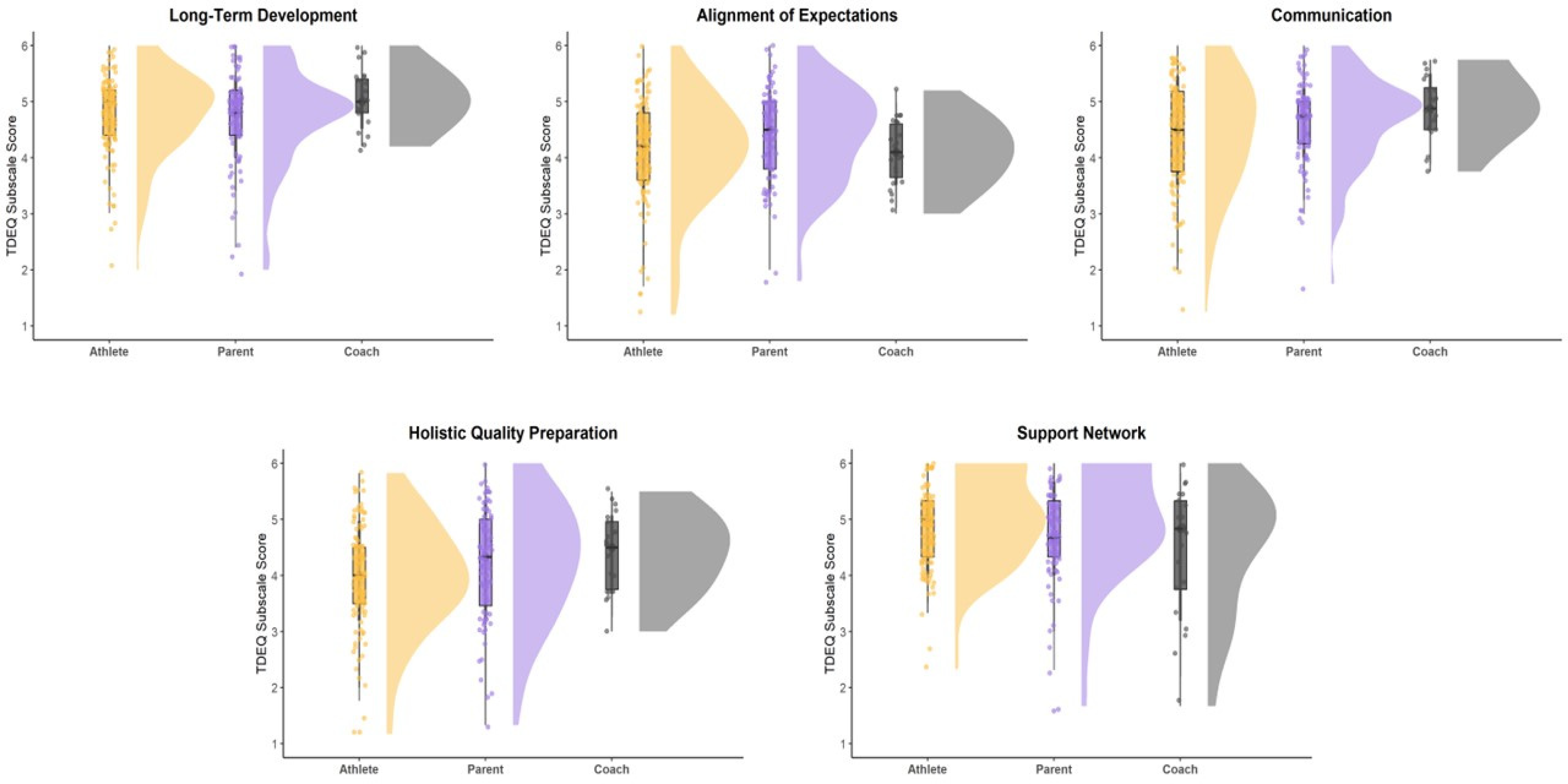
Raincloud plot: Subscale scores by participant groups.
Subscale-level analysis and analysis of variance results; data presented as mean ± standard deviation.
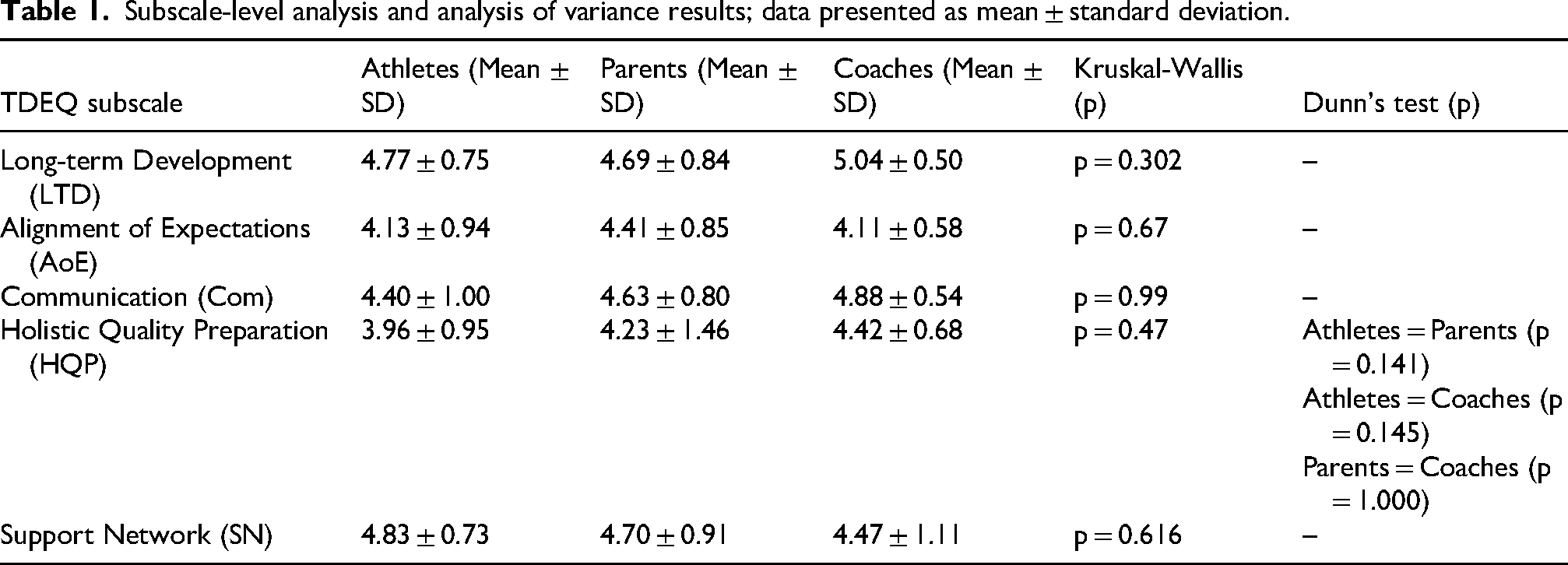
Kruskal-Wallis tests found no significant differences between groups for LTD (H(2) = 2.392, p = 0.302, η2 < 0.01), AoE (H(2) = 5.414, p = 0.670, η2 = 0.02), Com (H(2) = 4.618, p = 0.990, η2 = 0.01), or SN (H(2) = 0.967, p = 0.616, η2 = 0.01). While a significant difference was observed for HQP (H(2) = 6.135, p = 0.047, η2 = 0.02), post hoc Dunn's tests revealed no significant pairwise differences between athletes and parents (p = 0.141, r = 0.015), athletes and coaches (p = 0.145, r = 0.018), or parents and coaches (p = 1.000, r = 0.007).
Item level analysis
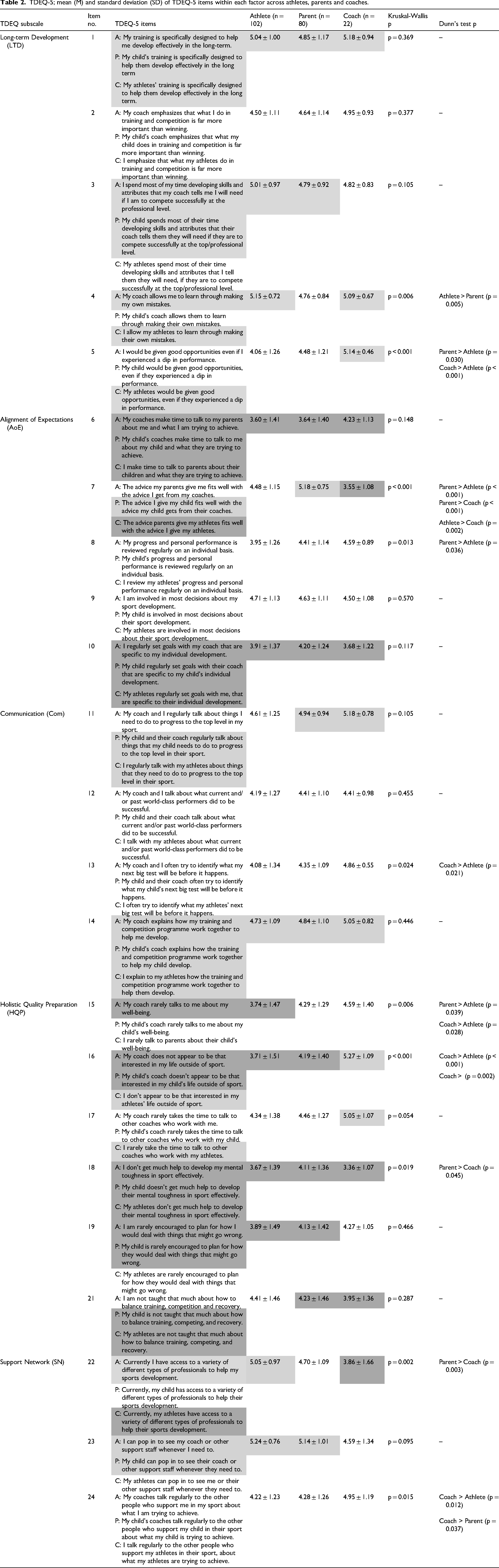
To gain deeper insights into how each participant group perceived the TDE, Table 2 presents the mean and standard deviation scores for each item alongside key strengths (items ranked in the top 25th percentile; light grey) and primary areas for improvement (bottom 25th percentile; dark grey) across participant groups. The following sections explore these findings in greater detail, examining each of the five subscales individually and highlighting significant differences between groups at the item level.
TDEQ-5; mean (M) and standard deviation (SD) of TDEQ-5 items within each factor across athletes, parents and coaches.
Long-Term development
Kruskal-Wallis tests indicated significant differences between participant groups for Item 4 (H(2) = 10.086, p = 0.006 η2 = 0.04), which examined whether coaches allow athletes to learn through making their own mistakes, and Item 5 (H(2) = 18.745, p < 0.001 η2 = 0.08), which assessed whether athletes would be given good opportunities even if they experienced a dip in performance. Post hoc Dunn's tests revealed that athletes rated Item 4 significantly higher than parents (p = 0.005, r = 0.23), while both parents (p = 0.030, r = 0.19) and coaches (p < 0.001, r = 0.036) rated Item 5 significantly higher than athletes.
Item quartile analysis identified LTD as the highest performing subscale, containing the greatest number of perceived strengths, with no items identified as areas for improvement. Item 1, which assessed whether training is specifically designed to help athletes develop effectively in the long term, was rated as a key strength across athletes (5.04 ± 1.00), parents (4.85 ± 1.17), and coaches (5.18 ± 0.94). Item 3, which evaluated the extent to which athletes spend most of their time developing skills and attributes needed to compete at the top/professional level, was considered a key strength by both athletes (5.01 ± 0.97) and parents (4.79 ± 0.92). Similarly, Item 4 was also rated as a key strength by both athletes (5.15 ± 0.72) and coaches (5.09 ± 0.67). Lastly, Item 5 was identified as key strength by coaches (5.14 ± 0.46).
Alignment of expectations
Kruskal-Wallis tests indicated significant differences between participant groups for Item 7 (H(2) = 41.068, p < 0.001 η2 = 0.19), which examines if there is alignment between the advice given by parents and coaches, and Item 8 (H(2) = 8.699, p = 0.013 η2 = 0.03), which assesses the extent to which athlete progress and personal performance are regularly reviewed on an individual basis. Post hoc Dunn's tests revealed that parents rated Item 7 significantly higher than both athletes (p < 0.001, r = 0.32) and coaches (p < 0.001, r = 0.59), while athletes also rated this item greater than coaches (p = 0.002). Additionally, parents rated Item 8 significantly higher than athletes (p = 0.036, r = 0.30).
Item quartile analysis identified Item 6, which assesses the extent to which coaches and parents communicate about an athlete's development, as an area for improvement across athletes (3.60 ± 1.41), parents (3.64 ± 1.40) and coaches (4.23 ± 1.13). Similarly, Item 10, which assesses the extent to which goal setting is a regular and individualised process between athletes and coaches, was also identified as an area for improvement across athletes (3.91 ± 1.37), parents (4.20 ± 1.24) and coaches (3.68 ± 1.22). In contrast, Item 7 revealed contrasting perspectives, with parents identifying it as a key strength (5.18 ± 0.75), while coaches considered it an area for improvement (3.55 ± 1.08).
Communication
Kruskal-Wallis tests indicated significant differences between participant groups for Item 13 (H(2) = 7.480, p = 0.024 η2 = 0.03), which examines the extent to which coaches and athletes identify upcoming tests, with Dunn's post hoc test indicating that coaches rated this item significantly higher than athletes (p = 0.021, r = 0.24).
Item quartile analysis identified Item 11, which assesses the extent to which coaches and athletes regularly discuss what is required to progress to the top level, as a key strength among parents (4.94 ± 0.94) and coaches (5.18 ± 0.78). Additionally, Item 14, which examines whether coaches explain how training and competition programmes work together to support athletes develop, was identified as a key strength across athletes (4.73 ± 1.09), parents (4.84 ± 1.10) and coaches (5.05 ± 0.82).
Holistic quality preparation
Kruskal-Wallis tests indicated significant differences between participant groups for Item 15 (H(2) = 10.131, p = 0.006 η2 = 0.04), which assesses whether coaches talk to athletes about their well-being, Item 16 (H(2) = 23.193, p < 0.001 η2 = 0.10), which examines whether coaches are interested in athletes’ lives outside of sport, and Item 18 (H(2) = 7.915, p = 0.019 η2 = 0.03), which assesses the extent to which athletes are helped to develop mental toughness effectively is supported. Post hoc Dunn's tests revealed that both parents (p = 0.039, r = 0.18) and coaches (p = 0.028, r = 0.23) rated Item 15 significantly higher than athletes. Similarly, coaches rated Item 16 significantly higher than both athletes (p < 0.001, r = 0.43) and parents (p = 0.002, r = 0.33). Lastly, parents rated Item 18 significantly higher than coaches (p = 0.045, r = 0.24).
Item quartile analysis identified HQP as the lowest performing subscale, containing the greatest number of areas for improvement. Item 18 was identified as an area for improvement across athletes (3.67 ± 1.39), parents (4.11 ± 1.36), and coaches (3.36 ± 1.07). Similarly, Item 19, which examines whether athletes are encouraged to plan for how they would deal with setbacks, was identified as an area for improvement by athletes (3.89 ± 1.49) and parents (4.13 ± 1.42). Item 21, which evaluates how well athletes are taught to balance training, competition, and recovery, was also considered an area for improvement by parents (4.23 ± 1.46) and coaches (3.95 ± 1.36). Additionally, Item 15 was regarded as an area for improvement by athletes (3.74 ± 1.47). In contrast, Item 16 revealed contrasting perspectives, with athletes (3.71 ± 1.51) and parents (4.19 ± 1.40) identifying this as an area for improvement, while coaches rated it as a key strength (5.27 ± 1.09). Finally, Item 17, which assesses whether coaches take the time to talk to other coaches working with the athletes, was identified as a key strength by coaches (5.05 ± 1.07).
Support network
Kruskal-Wallis tests indicated significant differences between participant groups for Item 22 (H(2) = 12.687, p = 0.002, η2 = 0.05), which assesses athletes’ access to a variety of professionals to support their development, and Item 24 (H(2) = 8.414, p = 0.015, η2 = 0.03), which assesses the extent to which coaches regularly communicate with other support personnel about an athlete's development. Post hoc Dunn's tests revealed parents rated Item 22 significantly higher than coaches (p = 0.003, r = 0.18), while coaches rated Item 24 significantly higher than both athletes (p = 0.012, r = 0.26) and parents (p = 0.037, r = 0.25).
Item quartile analysis identified Item 23, which assesses athletes’ accessibility to coaches and support staff, was identified as a key strength by both athletes (5.24 ± 0.76) and parents (5.14 ± 1.01). In contrast, Item 22 revealed contrasting perspectives, with athletes identifying it as a key strength (5.05 ± 0.97), while coaches considered it an area for improvement (3.86 ± 1.66).
Discussion
Given the complex and socially situated nature of TD, and the increasingly recognised importance of stakeholder perspectives in TDEs, this current study aimed to assess athletes’, parents’, and coaches’ perceptions of female rugby TDEs across Ireland. The findings presented provide a nuanced understanding of the perceived strengths, and importantly, the perceived areas for improvement within these existing TDEs. While convergence in stakeholder perceptions was evident, which reflects a broadly positive view of the TDEs, there were notable divergences across several subscales. These results highlight the complexity of TD and the importance of considering multiple viewpoints to better understand and enhance the effectiveness of TDEs.
Strengths within the TDEs
Across all stakeholder groups, the long-term development (LTD) subscale emerged as a clear strength within female rugby TDEs, with coaches in particular rating it the highest of all five subscales. These findings align with previous studies which have highlighted LTD as a strength within TDEs across a range of sports and sporting contexts.27,30 Notably, four of the five items within this subscale were regarded as key strengths. Participants reported that training was purposefully designed to support long-term athlete development (Item 1), there was a clear emphasis on developing the skills needed to reach the professional level (Item 3), athletes were encouraged to learn through mistakes (Item 4), and opportunities were maintained even during decrements in performance (Item 5). Collectively, these perceptions reflect the foundational principles of effective TDEs as proposed by Martindale et al.,13,14 which emphasises progressive, individualised development over short-term success. Furthermore, a strong emphasis on LTD may provide positive psychological benefits for athletes, with previous research linking it to greater wellbeing, enhanced basic needs satisfaction, and a reduced risk of burnout.30,32,34
In addition to LTD, the communication (Com) subscale received relatively high ratings across stakeholders. Items related to the clarity of progression pathways (Item 11) and the explanation of how training and competition supports athlete development (Item 14) being noted as key strengths. The importance of communication has been emphasised in previous TDE research, particularly when considering multiple stakeholders. For instance, Curran et al., 28 highlight the need for a shared understanding and aligned messaging across coaches, athletes, and parents, particularly for female athletes who place a high value on communication. 52 The relatively positive ratings from parents in this study are notable given that Clarke et al., 53 highlighted how coaches may intentionally limit communication with parents to avoid potential interference.
The support network (SN) subscale was rated as the highest by athletes and parents, with items related to accessibility to both a variety of professionals (Item 22), coaches and their support staff (Item 23) identified as key strengths by both groups. These findings are largely consistent with previous research indicating the importance of a supportive network for positive athlete outcomes. For instance, Gangsø et al., 54 and Gledhill and Harwood 29 reported SN as one of the highest-rated subscales among male and female athletes in football TDEs, while Thomas et al., 32 found that a strong SN was associated with enhanced athlete wellbeing. However, these findings stand in contrast to Sargent Megicks et al., 27 who reported SN as the lowest-rated subscale across a large European sample, suggesting significant deficiencies in perceived support. This discrepancy may reflect contextual differences in how support structures are resourced and coordinated across different TD systems and in various countries.
Areas for improvement within the TDEs
While several strengths were identified within the female rugby TDEs, the findings highlighted key areas in need of improvement, most notably within the holistic quality preparation (HQP), and alignment of expectations (AoE) subscales. HQP emerged as the most consistently underperforming subscale, with the majority of its items falling within the bottom quartile of scores. Items related to coaches interest in athlete's wellbeing (Item 15) and their life outside sport (Item 16), developing mental toughness (Item 18), planning for setbacks (Item 19), balancing training, competition, and recovery (Item 21) were rated lowest. This suggests that athletes may not be receiving adequate support in these critical areas. In addition, this finding is particularly concerning given the increasing recognition of the need for coaches to support athlete's biopsychosocial development. 55
Indeed, the importance of holistic and systematic support is well-established in the TD literature, with effective TDEs investing in the structures and resources required to assist athletes develop coping strategies, build resilience, and manage the demands of high-performance sport.15,18,20 These current findings are in alignment with earlier research which has consistently identified HQP as a challenging area within TDEs. For example, Sargent Megicks et al., 27 reported that HQP showed the highest variation across stakeholder groups, and was perceived less positively than other subscales, especially by athletes and parents. Similarly, Lyons et al., 56 reported that females in Australian soccer rated HQP significantly lower than males, emphasising that perceptions of holistic preparation may be shaped by demographic and contextual factors.
AoE received relatively low ratings overall, with several items related to communication between coaches and parents (Item 6) and individualised goal setting (Item 10). These findings are consistent with previous research which has highlighted incoherence and alignment as persistent challenges in TDEs. For example, Martindale et al., 43 found that parents frequently highlighted the lack of goal-setting, as well as limited communication around their child's development and progression. Similarly, Curran et al., 28 emphasised the lack of shared understanding across stakeholders as a key barrier to coherence within Irish hockey TDEs. This contrasts with Sargent Megicks et al., 27 where AoE did not emerge as a prominent issue, suggesting that such misalignments may be context-specific or more common in under-resourced or less integrated environments. Likewise, Gangsø et al., 54 found stronger AoE scores in higher-performing academies, indicating that effective alignment may be a distinguishing feature of more successful environments.
Stakeholder differences
A central strength of the current study lies in its triangulated design, incorporating the perspectives of athletes, parents, and coaches. This multi-perspective approach offers a more nuanced understanding of the TDEs when compared to studies which rely on a single group and aligns with growing calls for stakeholder-informed evaluations of TDEs.27,43 While the subscale analysis revealed relatively few statistically significant group differences, item-level analysis uncovered several areas where perceptual misalignments were evident. These subtle yet meaningful differences underscore the value of disaggregating TDEQ data by stakeholder group and reinforce the notion that converging and diverging views can coexist within a broadly shared environment.
For example, in the SN subscale, coaches rated access to a variety of professionals (Item 22) significantly lower than parents, potentially reflecting resource constraints or differing interpretations of what constitutes adequate access. A similar divergence was observed in the HQP subscale for Item 16, which assesses whether coaches discuss the athlete's well-being and life outside of sport. Coaches rated this item significantly higher than both athletes and parents, viewing it as a strength, while the latter groups identified it as an area for improvement. This suggests a disconnect between coach self-perception and how their support is experienced by others. These differences align with findings from Sargent Megicks et al., 27 and Martindale et al., 43 who both highlighted the importance of capturing multiple perspectives when evaluating TDEs. Stakeholders often interact with the environment in distinct ways, and failing to account for these differences can result in an incomplete or overly optimistic view of the environment's effectiveness.
An illustrative example of stakeholder divergence emerged within the AoE subscale, particularly in relation to Item 7, which assessed the consistency of advice athletes receive from parents and coaches. Parents rated this item as a key strength, indicating confidence in the alignment of their messaging with that of the coaches, while, in contrast, coaches rated this same item as an area for improvement. This discrepancy highlights a potential disconnect between how coherence is perceived and how it is enacted, echoing previous research that has emphasised the importance of aligned messaging across stakeholders.28,39 As Webb et al., 40 argue, coherence is a defining feature of high-quality TDEs, and such misalignments can undermine the clarity of developmental goals and the athlete's overall experience. Identifying and addressing these perception gaps is therefore crucial to ensuring a unified and supportive TDE.
Practical implications
The findings of this study offer applied insights for practitioners operating within female rugby TDEs or comparable TD settings. First, the observed stakeholder differences and comparatively lower ratings of the AoE subscale indicate incoherence within the TDEs examined. Improving this coherence requires attention to integration (i.e., the extent to which various stakeholders work in tandem to support the athlete) both horizontally across a level or stage of performance, and vertically across stages of the pathway. 36 An effective way of operationalising this integration is through the deliberate development of shared mental models, whereby stakeholders hold overlapping understandings of athlete developmental needs, long-term objectives, and role responsibilities. Practically, this may involve transparent information sharing, collaborative goal-setting, constructive dialogue and debate, and regular reflective review of practice. 57
Second, the comparatively lower ratings of HQP suggest that athletes may require more deliberate preparation for the psychological demands of the TD pathway. Research on the Psychological Characteristics of Developing Excellence (PCDEs) emphasises the importance of systematically developing skills such as goal setting, self-regulation, commitment, reflective practice, and coping with challenge. 58 These psycho-behavioural skills underpin not only performance progression, but also athletes’ capacity to effectively engage with and utilise their surrounding support structures. Rather than assuming these skills develop implicitly, TDEs should consider embedding structured PCDE development through a “teach-test-tweak-repeat” approach, whereby skills are explicitly taught, tested through realistic and appropriate challenge, and refined through reflection. 59 Monitoring tools such as the PCDEQ2 may further support practitioners in identifying group and individual psycho-behavioural needs.
Limitations
The limitations of this study must be acknowledged. First, data were based on self-reported perceptions, which are inherently subjective and may be influenced by personal experiences, social desirability, or recent interactions. While the inclusion of athletes, parents, and coaches provided a triangulated perspective, such bias cannot be fully eliminated. Second, the sample was specific to regional female rugby TDEs in Ireland. As a result, findings may not be generalisable to other sports or contexts. Third, although the TDEQ-5 and its adapted forms demonstrated strong internal consistency overall, the SN subscale returned a lower reliability coefficient. This aligns with previous studies, 27 suggesting that the construct may be interpreted differently across roles, and findings from this subscale should be interpreted cautiously. Lastly, the study employed a cross-sectional design, capturing perceptions at one point in time. Given that TDEs are dynamic and may evolve across the season, longitudinal or mixed-methods designs would offer richer insights into how stakeholder experiences change and influence development outcomes over time.
Conclusion
This study provides a nuanced understanding of stakeholder perceptions of female rugby TDEs in Ireland, using the TDEQ-5 and its adapted versions. While several strengths were identified, particularly in relation to LTD, areas for improvement were also evident, most notably within HQP and AoE across stakeholders. These findings highlight the importance of including multiple stakeholder perspectives in TDE assessments, as apparent consensus at the subscale level can mask underlying divergences in communication, expectations, and support. Building on previous work, such as Hall et al., 33 who demonstrated how TDEQ findings could be used to inform and implement effective organisational change, the current results offer a similar foundation for targeted intervention. Future research could adopt a longitudinal, intervention-focused approach to examine how addressing the misalignments affects both stakeholder perceptions and athlete development over time. By moving beyond assessment toward application, these findings can play a central role in shaping more coherent and developmentally aligned TDEs in female rugby and beyond.
Footnotes

Ethical considerations
The study was conducted in accordance with the ethical principles of the Declaration of Helsinki and approved by the Atlantic Technological University – Galway City Ethics Committee.
Consent to participate and publish
The participants’ were informed about the study, including its procedures and purpose, through a detailed participant information letter. Written (electronic) informed consent was obtained from all individuals involved in the study. Participation was voluntary.
Funding
The authors received no financial support for the research, authorship, and/or publication of this article.
Declaration of conflicting interest
The authors declared no potential conflicts of interest with respect to the research, authorship, and/or publication of this article.
Data availability
The data that support the findings of this study are available from the corresponding author upon reasonable request.