



Abstract
Introduction
Talent identification and development systems aim to identify young athletes with potential in a sport and support their development. 1 Over the last two decades, recommendations have emphasised development over identification practices, encompassing a holistic approach (e.g., athletic, academic, psychological, psychosocial.1–4 One example of a talent identification and development system focussed on a holistic approach to development is a sports school. Sports schools have been part of the infrastructure of schools internationally for many years5–7 and recently, Morris and colleagues 8 classified sports schools as either 1) a sport led system, 2) an education led system or 3) a combined education and sport system. In line with classifications two and three, a sports school is a unique environment that allocates its resources into developing sporting talent within the educational curriculum. 9 In a recent mixed methods systematic review, Thompson et al. 7 outlined many positive features of sports schools, including a flexible curriculum, athletic services (e.g., coaching, facilities and competition) and improved student-athlete health and wellbeing. However, sports schools are highly variable with negative impacts (e.g., missing school, lower education attainment, higher injury rates) associated with such programmes with further research needed to better understand such programmes.
One common feature that sports schools use to raise their profile and provision to student-athletes is a sport scholarship programme. 10 A review, albeit over 15 years ago, 5 found sports schools across ten countries varied their incentives from a reduction in (or no) school fees to a flexible (or no) cost to training for sport scholar student-athletes. As such, sport scholarship programmes present an attractive opportunity to stakeholders combining academic and sport development.
Talent development environments (TDE) encompass all aspects of the coaching setting and have been described as a dynamic system of athletic and social interactions with successful environments continually producing elite athletes from their juniors. 3 In a review, Martindale et al. 11 identified five key factors of effective TDEs 1) long-term aims and methods, 2) wide ranging coherent support and messages, 3) emphasise appropriate development not early selection, 4) individualised and ongoing development and 5) integrated holistic and systematic development. The quality of the development environment has been identified as one of the most important factors for long-term success. 12 To facilitate the understanding of these environments, Martindale et al. 13 developed the talent development environment questionnaire (TDEQ). This has been further development and to date the most commonly applied version is the “TDEQ-5”. 14 Athletes perceptions of the development environment matter and the TDEQ-5 has been able to distinguish between stronger and weaker TDEs in academy football. 15 In addition, athletes that have considered their TDEs positively have subsequently experienced less stress and higher wellbeing than their counterparts in less supporting and long-term focused development environments. 16 Recent research 17 has found the TDE is related to psychological factors with long-term focus showing a positive correlation to relatedness, intrinsic goals and mastery approach goals. In addition, the findings found a lack of quality holistic preparation was strongly correlated to performance avoidance goals. With TDEs showing to positively benefit athlete wellbeing they are an important construct within a sports school and can be facilitative to athletes in a dual career (DC). As talent development is dynamic and complex, 1 sports school scholarship programmes have a duty of care to ensure student-athlete development is central to the design of the system rather than just offer financial incentives. Whilst features of successful athletic development environments have been identified within sport and education scholarship programmes,18–20 challenges may also exist due to their potential for a lack of compatibility 21 resulting in some environments potentially being unsuccessful.22,23 Therefore, further research is needed to understand the development processes of sports scholarship programmes.
A DC is the combined commitment of education or work with sport. 24 The purpose of a DC development environment is to facilitate an athletes investment in combining both their education or work with their sporting careers 25 and as such should look to provide appropriate resources for athletes to overcome key transitions and challenges. 26 These challenges have been described as internal (e.g., lack of knowledge in preparation to transition, interpersonal conflicts) or external (e.g., absence of good training conditions, financial support, difficulty managing multiple commitments). 26 Understanding the challenges is especially important as the concomitant demands place highly demanding encounters on student-athletes, notably during the junior to senior sporting transition where key academic transitions often run in parallel to the adolescent years.27,28 For example, throughout attendance at a sports school, student-athletes have to overcome two key proposed transitions, one around 11–13 years, the second at 16 years, aligning with a transition to post-secondary education in the United Kingdom. As such sports scholarship programmes should raise an individual's internal resources (e.g., physical fitness, personality traits, motivation) and support external factors (financial support, training opportunities)28–30 so student-athletes can succeed in both education and sport. With sporting success not guaranteed, sports schools must be judged on their ability to provide an appropriate environment (both talent development and DC) for their pupils. 5 Whilst these aims of a sports scholarship programme are known, limited research is available that evaluates sport school scholarship programmes, especially from a talent development and DC perspective.
In summary, the aim of a sport school scholarship programme should be to provide student-athletes the opportunity to effectively combine sport and education 10 and holistically support the development of student-athletes to successfully transition through a DC.4,26 Whilst studies have evaluated sports schools,5,7,9,21,22 to date no study has evaluated the perspectives of student-athletes in a sports school scholarship programme from a TDE viewpoint or their DC development nor explored the relationship between these two concepts. Therefore, the purpose of this study was to explore 1) student-athlete perceptions of their TDE, 2) the DC competency development of student-athletes and 3) the relationship between the TDE and DC competency development.
Method
Study design
To investigate the perspectives of student-athletes on a sports scholarship programme, a single case study design was used with a sports school representing the case of interest. 31 To explore both the TDE and the DC competency development of a sports school sports scholarship programme, the study implemented two previously validated questionnaires. Student-athletes completed the TDEQ-5 14 and the DCCQ-A questionnaire. 32
The case
The case was a fee-paying co-educational sport school in the United Kingdom where there is a long-standing tradition (over 12 years) of academic and sport scholarships to pupils aged 11–18 years. Sport scholarship applicants are given the opportunity to develop their sporting skills through an individualised sports programme including specialised coaching, strength & conditioning and medical support embedded within academic timetables allowing student-athletes to combine sport and academic development simultaneously all-year round. In addition, student-athletes receive online distance learning education when travelling for sporting commitments. Within the school, over 25 coaches (full time and part-time) deliver these sport scholarship programmes, thereby having regular contact with the student-athletes, alongside undertaking other roles and responsibilities (e.g., form tutors, boarding house staff). As such the school can be identified as a TDE, DC development environment and classified as a centralised sports school. 8
Participants
Participants were all student-athletes on an established sports scholarship programme at a UK sports school. A total of 75, British male (m) and female (f) student-athletes aged 16 ± 1.6 years who had been on a sports scholarship programme for 2.6 ± 1.3 years, across eight different sports were invited to participate in the study and complete both questionnaires.
Procedure
Participants were invited to complete the questionnaires via school email and completed them anonymously online using Google Forms. 33 Participants were encouraged to take their time and respond to questions honestly. The TDEQ-5 14 and the subsequent DCCQ-A 32 was administered 4-weeks apart. Despite inviting the same cohort of student-athletes and replicating the methods of invitation, questionnaires had a different response rate, TDEQ-5 (n = 64; 85%) and DCCQ-A (n = 45; 60%) respectively. The questionnaires took approximately 8–20 min for participants to complete. Ethical approval was granted by Leeds Beckett University research ethics committee (Ref: 135612). Gatekeeper consent was provided by the assistant head of co-curricular and sport at the school.
Data collection
Talent Development Environment: The TDEQ 13 has been extensively used in the literature to evaluate a TDE from an athlete's perspective15,34–36 and was therefore chosen to evaluate the TDE of the sports school scholarship programme. Recently, Li et al. 14 redesigned the TDEQ to include only five factors (TDEQ-5), 1) long-term development, 2) holistic quality preparation, 3) support network, 4) communication and 5) alignment of expectations. The TDEQ-5 is the most recent version of the questionnaire and was selected due to its internal reliability and established validity. 14 The TDEQ-5 is scored on a 6-point Likert scale, anchored by, 1 = strongly disagree and 6 = strongly agree. As per previous applications negatively worded items in the TDEQ-5 were reversed, meaning higher rated scores displayed favourable development experiences. 35 A total of 64 (85%) student-athletes (m = 43; f = 21; 15.8 ± 1.6 yrs.) completed the TDEQ-5 (Tennis = 22; Golf = 10; Hockey = 11; Rugby = 8; Cricket = 3; Swimming = 8; Netball = 1; Football = 1). Participants competed in their respective sports at county (37%), regional (27%), national (30%) and international standard (6%).
Dual Career Competency: The dual career competency questionnaire (DCCQ-A), 32 was used to examine the need for DC competency development in student-athletes. It's rationale was based on its implementation across multiple student-athlete European DC environments.37,38 The DCCQ-A explores four competency factors, 1) dual career management, 2) career planning, 3) emotional awareness, and 4) social intelligence & adaptability. It uses a 5-point Likert scale where student-athletes assess their importance of DC competencies (1 = unimportant; 5 = very important) and to what extent they possess these competencies on a second Likert scale (1 = very poor; 5 = very strong). A total of 45 (60%) student-athletes (m = 31; f = 14; 15.6 ± 1.8 yrs.) completed the DCCQ-A (Tennis = 16; Golf = 8; Hockey = 4; Rugby = 7; Cricket = 2; Swimming = 6; Netball = 1; Football = 1). Participants competed in their respective sports at county (30%), regional (20%), national (40%) and international standard (10%).
Data analysis
To examine student-athlete perspectives from the TDEQ-5 means and standard deviations were calculated for each item and the five subscales. An item-by-item analysis was taken of the top five and bottom five questions to further identify areas of perceived strength or weakness. To examine student-athlete DC competencies from the DCCQ-A means and standard deviations were calculated for each item and the four factors. To compare between perceived importance and possession of each competency, a paired sample t test (SPSS v28.) was used. Hedges gav was used to calculate the effect size and is reported as small >=0.2; moderate >=0.5; large >=0.8. 39 In line with previous research37,40 it was assumed a larger effect size reflected the student-athletes need to develop that DC competency. For participants that completed both questionnaires (n = 38; m = 25; f = 13) a Pearson's correlation was performed to see if there was a relationship between factors of the TDE and possession of DC competencies. Cronbach alpha (α) was used to test internal consistency for each factor in both questionnaires, where the lowest level was set at α = 0.5, moderately reliable and above 0.7, high reliability. 41 Descriptive analysis showed the data was normally distributed and statistical significance was set at P < 0.05.
Results
Talent development environment
Three factors showed high internal reliability (communication, α = 0.784; holistic quality preparation, α = 0.784; support network α = 0.705) and two factors showed moderate internal reliability (long term development, α = 0.540; alignment of expectations, α = 0.662). Table 1 presents the individual items for the TDEQ-5 in order of strength for the student-athletes perceptions of their TDE. Item scores ranged from 4.0–5.3 with my training specifically designed to help me develop effectively in the long term (long term development: item 1) and I am involved in most decisions about my sport development (alignment of expectations: item 9) the highest scored items. The remaining top five scores were item 3 (long term development), 4 (long term development), and 16 (holistic quality preparation). In contrast, my coaches talk regularly to the other people who support me in my sport about what I am trying to achieve (support network: item 24) and currently, I have access to a variety of different types of professionals to help my sports development (support network: item 22) were the weakest scored items. Followed by item 19 (alignment of expectations), 13 (communication) and 15 (holistic quality preparation). When analysed across the five factors, long term development (5.0 ± 0.3) was the highest ranked factor followed by alignment of expectations (4.6 ± 0.5), communication (4.4 ± 0.3), holistic quality preparation (4.4 ± 0.3) and support network (4.3 ± 0.4), respectively.
TDEQ-5 responses. Mean ± SD
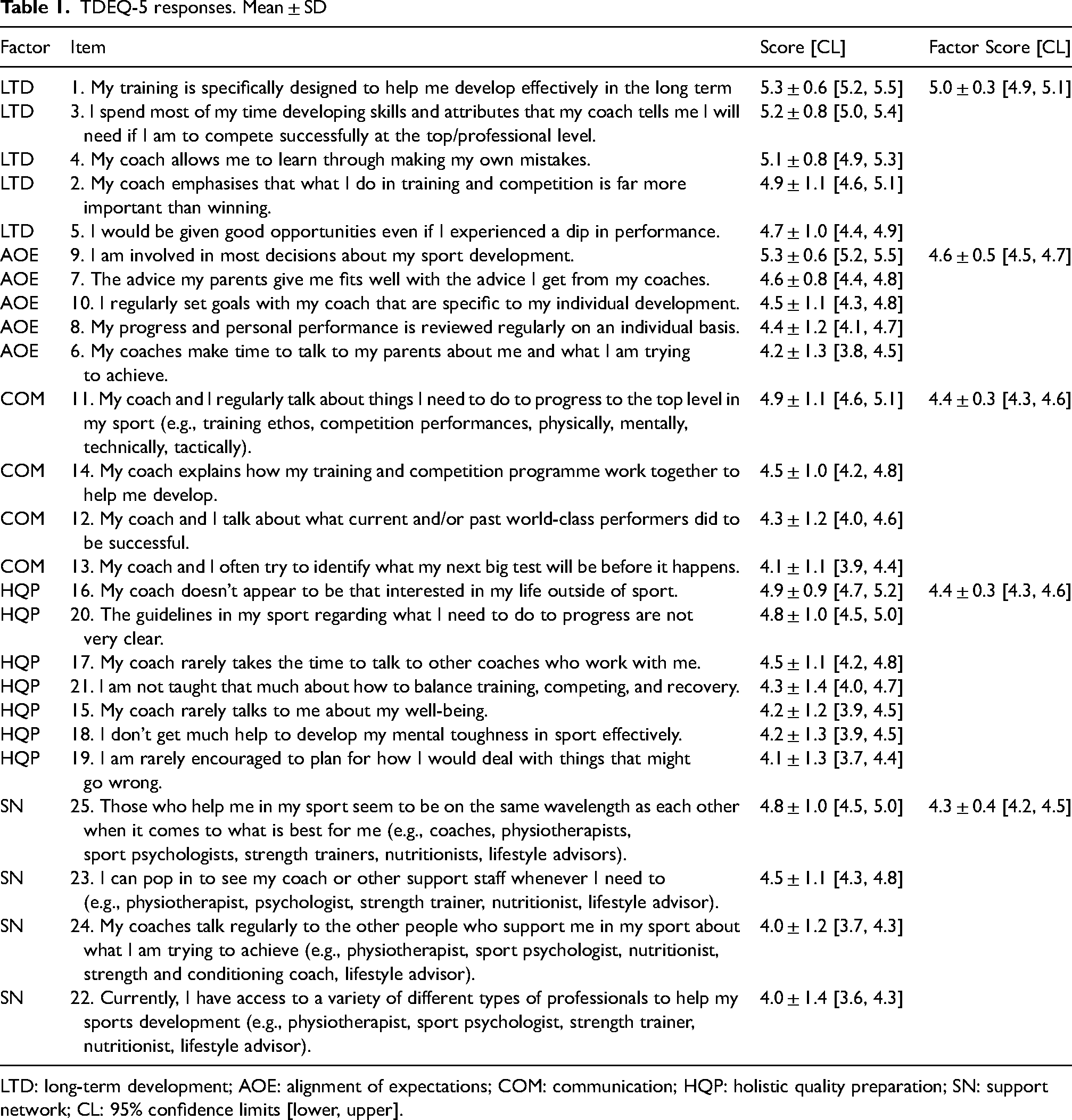
LTD: long-term development; AOE: alignment of expectations; COM: communication; HQP: holistic quality preparation; SN: support network; CL: 95% confidence limits [lower, upper].
Student-Athlete need to develop dual career competencies
DCCQ-A factors had high reliability for importance and possession, (dual career management importance α = 0.831), possession α = 0.888); career planning possession α = 0.669); emotional awareness importance (α = 0.713), possession (α = 0.821); social intelligence and adaptability importance (α = 0.747), possession (α = 0.792). Only career planning importance showed lower than moderate reliability (α = 0.480). Further exploration into removal of an item did not considerably change reliability (α = 0.513).
Table 2 presents the importance and possession of each item from the DCCQ-A in order of the magnitude of the effect (Hedges gav) between importance and possession. This is seen as an indicator of the student-athletes need to develop this competency (i.e., the larger the effect size the greater need to develop). The results show student-athletes perceived all the DC competencies to be important (range 4.1–4.6). In total, 26 out of the 29 items were significantly lower for possession of the DC competency compared to the importance (P < 0.05). The lowest scored possessed DC competencies were the ability to focus on here and now, without being distracted (emotional awareness: item 11) and the ability to use setbacks in sport and/or study as a positive stimulus (emotional awareness: item 36). In contrast, only three items (DC management: item 14, DC management: item 3 and career planning: item 10) demonstrated no difference (P > 0.05) between student-athletes perceived importance and possession of the DC competency. When analysed across the four competency factors for possession, DC management (4.0 ± 0.2) was the highest ranked factor followed by social intelligence and adaptability (3.9 ± 0.2), career planning (3.8 ± 0.2) and emotional awareness (3.6 ± 0.1). Moreover, when considering the development needs of competency factors, emotional awareness (0.85 ± 0.2) had the largest mean effect size followed by social intelligence & adaptability (0.64 ± 0.2), career planning (0.57 ± 0.2) and DC management (0.57 ± 0.2), respectively. Hedges gav analysis showed large differences for seven items with the ability to use setbacks in sport and/ or study as a positive stimulus the competency student-athletes considered needing the most development.
The DC competency needs of sport scholarship student-athletes based on hedges gav.
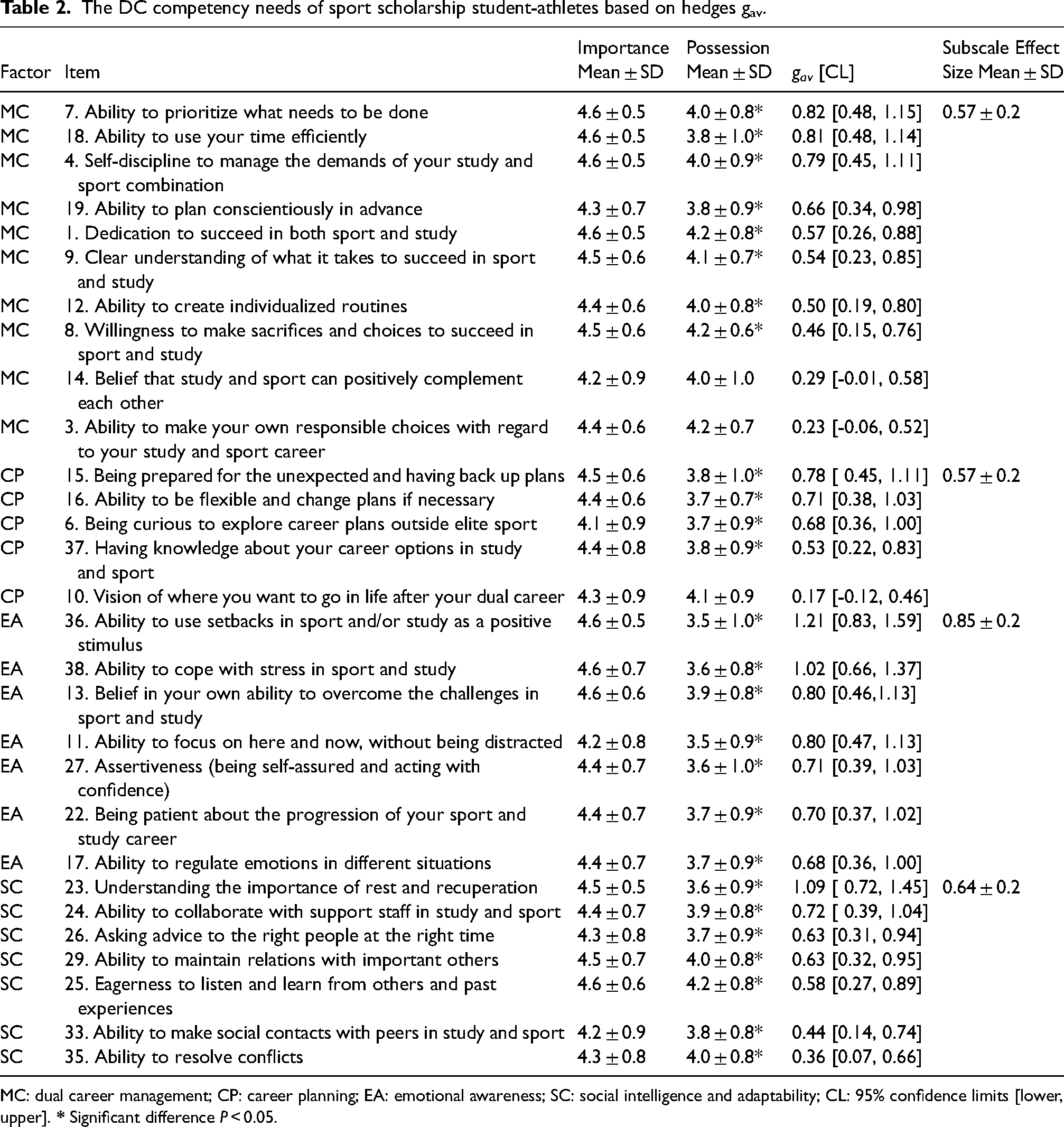
MC: dual career management; CP: career planning; EA: emotional awareness; SC: social intelligence and adaptability; CL: 95% confidence limits [lower, upper].
Talent development environment and dual career competency relationships
Table 3 shows the relationship between overall factors in the TDEQ-5 and the possession of DC competency factors. For the TDE long term development factor, there was a significant moderate relationship between DC management (r = 0.41, P < 0.05) as well as emotional awareness (r = 0.32, P < 0.05). No relationship was found between long term development and career planning or social intelligence and adaptability. Alignment of expectations had a significant moderate relationship with DC management (r = 0.39, P < 0.05). Communication had a significant moderate relationship to emotional awareness (r = 0.36, P < 0.05). Holistic quality preparation had a significant moderate relationship to DC management (r = 0.48, P < 0.01). The factor support network, had a significant moderate relationship to DC management (r = 0.38, P < 0.05).
Relationship between the talent development environment and student-athletes DC competency possession.
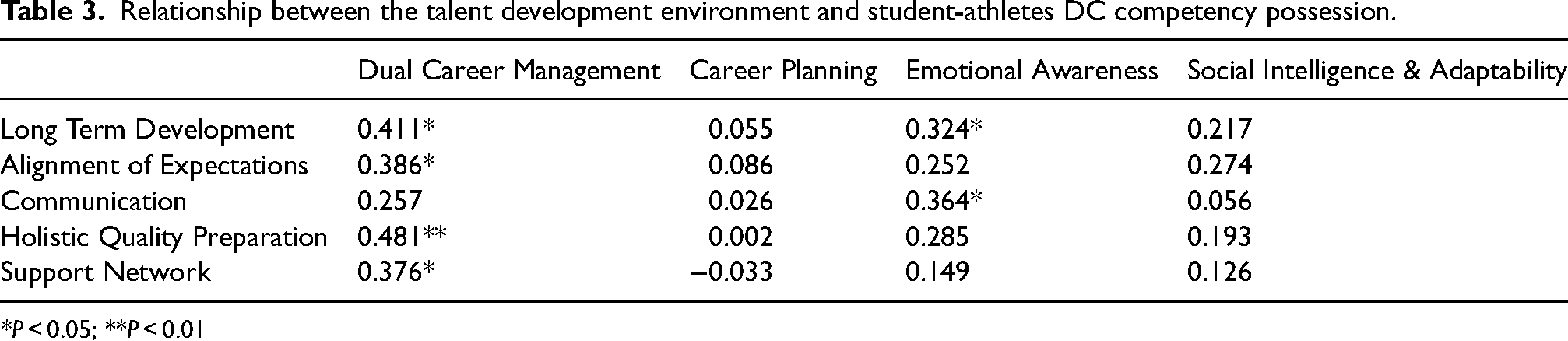
*P < 0.05; **P < 0.01
Discussion
To our knowledge, this is the first study to evaluate student-athlete's perspectives of their TDE, their need for developing DC competencies and the relationship between the two constructs within a sports schools scholarship programme. The findings demonstrated that student-athletes perceived the sports school's TDE positively, with long-term development the strongest subscale and support network the lowest perceived subscale. Student-athletes perceived the possession of their DC competencies to be lower than the importance of most items (26 out of 29) across all four subscales with emotional awareness showing the largest effect size between importance and possession. Furthermore, there was a large effect size for the need to focus development on seven DC competencies. In addition, relationships were found between the TDE and student-athletes possession of DC competencies. These findings of a sports school sports scholarship programme can help advance the design and support of similar programmes to advance TDEs and DC competency development for student-athletes.
The TDE has been highlighted as a key factor for athlete development19,42,43 and should be considered in the design of sports school scholarship programmes. Current findings showed the TDE in the case sports school was positive and each subscale was highly rated, consistent with other sport environments (e.g., soccer academy).15,44 Long-term development was the highest ranked TDE subscale consistent with previous research in a school rugby league programme 34 and international age-group hockey players. 35 On a large scale examination of TDEs across Europe in multiple contexts long-term development was also a consistent strength of TDEs. 45 Student-athletes positive perception of this subscale shows the sports schools sports scholarship programme favourably and is indicative of a less stressful and supportive environment 16 which is more likely to meet the satisfaction needs of its student-athletes. 46 Support network was ranked the lowest subscale, with a lack of communication between school and sport 47 and a limited access to a range of practitioners also found across European TDEs. 45 This understandably presents a challenge to sports schools who deliver a variety of educational opportunities across a broad range of subjects for differing ages of pupils. Subsequently, a central point of contact such as a programme manager could act as a mediator for student-athletes.
The item-by-item analysis, considering the top five and bottom five questions revealed the most positive scored items specifically related to long-term development, including the student-athlete in their sporting development and considering the student-athletes life outside of sport. This is perhaps reflective of the TDE being within a centralised sports school where coaches are fully embedded and more aware of student-athletes academic and co-curricular interests. The five questions which were least positive were from support network, communication and holistic quality preparation. The least positive response currently, I have access to a variety of different types of professionals to help my sports development is very much reflective of the resources the environment provides. When environments have larger resources and extended contact time, youth athletes have perceived their support network more positively. 44 This finding could present a real challenge to sports schools and may explain that despite providing considerably more support services 7 the dynamic, chaotic and multi-agendas of sport schools mean that the service quality remains a complex issue. There was incongruence between some items as student-athletes felt they were rarely encouraged to plan (holistic quality preparation: item 19 and communication: item 13) despite considering to have a strong involvement in most decisions regarding their sports development (alignment of expectations: item 9). Other lower ranked items related to communication within a team (support network: item 24 and alignment of expectations: item 6) highlighting the importance of an integration of efforts between stakeholders. 19 Despite the strength of considering the student-athletes interests outside of sport, a weakness was perceived around personal well-being and mental toughness highlighting the importance of a holistic development approach and the role of integrating pastoral support within schools. In summary, the TDE was rated positive overall with support network an area for the sports scholarship programme to develop.
One of the challenges faced by student-athletes is to successfully combine the demands of education and sport.24,48 Hence, it is important that sport scholarship programmes and TDEs provide resources to develop coping strategies in student-athletes to meet these demands.27,32,49 Effective environments can help individuals cope with adversity, protect against poor health and maintain perspectives for student-athletes.8,20,24 Current findings showed significant differences across 26 items between the importance and possession of DC competencies of student-athletes, with the perceived importance scored higher than their current possession in each of the competencies. Similar reports have been found in elite student-athletes, 40 University students 37 and female student-athletes. 38 In parallel, Linnér et al. 37 found Swedish university student-athletes rated the need to develop 70% of DC competencies. Hedges gav was used to identify which DC competencies student-athletes felt needed attention, with seven items showing a large effect size and four of these items related to emotional awareness. This includes being able to cope with adversity and multiple stressors. In agreement with our findings, De Brandt et al. 40 and Perez-Rivases et al. 38 found emotional awareness as the subscale requiring the most development in Flemish and Spanish student-athletes respectively. Emotional awareness may be a DC factor requiring the most attention due to the increasing demands, the unpredictability of transitions in sport and the increased stress that education and sport can place on youth athletes during key periods of self-discovery and personal development in their lives. 50 One key item that student-athletes reported as requiring development was the “ability to cope with stress in sport and study”. This finding is clearly a concern for DC athletes and the challenge of balancing and managing training, education and other life demands has been identified in school based rugby league 34 and multiple sports in Finland. 47 Further challenges have been found by Ryba et al. 48 in elite junior athletes where conflicting events of sport and school mean most free time away from sport is spent catching up with school work. Therefore, sports schools can support student-athletes during stressful times by offering flexible deadlines, hybrid learning and additional tutor or pastoral support.
The subscales that needed the least development related to DC management and career planning. This may be due to the nature of a sports school where student-athlete schedules are rigidly timetabled and the age of the participants, whereby education is still a primary focus rather than planning for a career outside of sport. In summary, student-athletes perceived all DC competencies as important and rated the possession of each quality as could be improved. Student-athletes suggested 27% of DC competencies needed priority development.
Through the novel implementation of the TDEQ-5 and DCCQ-A, this study has identified some congruence between the two domains. Relationships between the TDE and DC subscales found a correlation between long-term development and the possession of DC management and emotional awareness subscales. Subsequently, positive TDEs that focus on opportunities to facilitate long-term success can facilitate the development of DC management skills such as self-discipline, planning and time-management. In relation, long-term focus may support the development of emotional awareness by helping student-athletes manage stresses and understanding academic commitments. A moderate relationship between communication and emotional awareness emphasises the need for organisations and stakeholders (student-athletes, teachers, coaches and parents) to openly and frequently discuss and monitor student-athletes development across both domains. Especially, during difficult periods in development (i.e., exams and heavy competition blocks) and transitions. If athletes cannot handle this DC challenge they may be confronted with an unsuccessful transition in their sport or education. 51 Holistic quality preparation had a moderate relationship to DC management meaning the holistic preparation messages from TDEs (i.e., considering life outside of training), can significantly support a DC. Overall, the following findings show student-athletes that considered their TDE strongly generally had better DC competencies especially DC management and emotional awareness. It is recommended that sports schools and sports scholarship programmes recognise monitoring and developing a positive TDE is a key aspect of support to help navigate a DC. However, further research is required to understand these factors and the influence between the two constructs to support student-athletes as removing barriers to a DC is not an option. 52 Consequently, it is vital sport school sports scholarship programmes create and afford student-athletes opportunities to develop skills that may overlap and benefit both the sport and study domains.
Limitations
The current study provides novel insights into TDE and DC development in a sports school with a sports scholarship programme. However, this study is not without limitations. Participant's responses may not be representative across sports scholarship programmes internationally or at different stages of development. Furthermore, whilst the internal reliability was moderate for the TDEQ-5 long-term development factor, it is similar to previous TDEQ-5 studies (0.54–0.62).53,54 The career planning importance factor of the DCCQ-A reported below moderate internal reliability. As such caution should be taken when interpreting the findings attached to this factor, but it is plausible that the lower internal consistency of importance is linked to the DC competency development needs of this population of student-athletes with a younger cohort investigated than in previous environments.37,40 As career planning possession had good internal reliability (α = 0.669) and is discussed in more detail throughout. Finally, participant response rate between the TDEQ-5 and DCCQ-A questionnaires was different meaning the findings may not be valid across the whole cohort of student-athletes on the sports scholarship programme at the school.
Conclusions
Sport school scholarships programmes have provided solutions to some of the problems in elite youth athlete development. This study is the first to examine student-athlete perspectives of a sports school scholarship programme from a TDE and DC development need. Findings showed the sports scholarship programme afforded its student-athletes a positive TDE, although student-athletes did not perceive their DC competency development as favourably when comparing the importance and possession of resources needed to manage a DC. Student-athletes that considered the TDE more positively did generally possess better DC management competencies. Subsequently monitoring a sports scholarship programme can ensure a sports school utilises its resources effectively to target development across both sport and education domains and considers how well they are designed, implemented and managed. 7
Footnotes
Acknowledgements
We would like to thank the student-athletes and sports school for participating in this study.
Declaration of conflicting interests
The authors declared no potential conflicts of interest with respect to the research, authorship, and/or publication of this article.
Funding
The authors received no financial support for the research, authorship, and/or publication of this article.
